<?xml version='1.0'?>
<!DOCTYPE art SYSTEM 'http://www.biomedcentral.com/xml/article.dtd'>
<art>
<ui>1556-276X-8-9</ui>
<ji>1556-276X</ji>
<fm>
<dochead>Nano Express</dochead>
<bibl>
<title>
<p>The influence of anatase-rutile mixed phase and ZnO blocking layer on dye-sensitized solar cells based on TiO<sub>2</sub>nanofiberphotoanodes</p></title>
<aug>
<au id="A1" ca="yes"><snm>Ding</snm><fnm>Jianning</fnm><insr iid="I1"/><insr iid="I2"/><email>dingjn@cczu.edu.cn</email></au>
<au id="A2"><snm>Li</snm><fnm>Yan</fnm><insr iid="I1"/><email>liyanlydialee@163.com</email></au>
<au id="A3"><snm>Hu</snm><fnm>Hongwei</fnm><insr iid="I1"/><email>hwhu1989@163.com</email></au>
<au id="A4"><snm>Bai</snm><fnm>Li</fnm><insr iid="I1"/><email>m13616129348@163.com</email></au>
<au id="A5"><snm>Zhang</snm><fnm>Shuai</fnm><insr iid="I1"/><insr iid="I2"/><email>shuaizhang@cczu.edu.cn</email></au>
<au id="A6" ca="yes"><snm>Yuan</snm><fnm>Ningyi</fnm><insr iid="I1"/><insr iid="I2"/><email>nyyuan@cczu.edu.cn</email></au></aug>
<insg>
<ins id="I1"><p>Center for Low-dimensional Materials, Micro-nano Devices and System, Changzhou University, Changzhou 213164, China</p></ins>
<ins id="I2"><p>Jiangsu Key Laboratory for Solar Cell Materials and Technology, Changzhou 213164, China</p></ins></insg>
<source>Nanoscale Research Letters</source>
<section><title><p>Regular submissions</p></title></section><issn>1556-276X</issn>
<pubdate>2013</pubdate>
<volume>8</volume>
<issue>1</issue>
<fpage>9</fpage>
<url>http://www.nanoscalereslett.com/content/8/1/9</url><xrefbib><pubidlist><pubid idtype="doi">10.1186/1556-276X-8-9</pubid><pubid idtype="pmpid">23286741</pubid></pubidlist></xrefbib></bibl>
<history><rec><date><day>29</day><month>11</month><year>2012</year></date></rec><acc><date><day>27</day><month>12</month><year>2012</year></date></acc><pub><date><day>3</day><month>1</month><year>2013</year></date></pub></history>
<cpyrt><year>2013</year><collab>Ding et al.; licensee Springer.</collab><note>This is an Open Access article distributed under the terms of the Creative Commons Attribution License (<url>http://creativecommons.org/licenses/by/2.0</url>), which permits unrestricted use, distribution, and reproduction in any medium, provided the original work is properly cited.</note></cpyrt>
<kwdg>
<kwd>Dye-sensitized solar cell</kwd>
<kwd>Titanium dioxide nanofiber photoanode</kwd>
<kwd>Anatase-rutile mixed phase</kwd>
<kwd>Zinc oxide blocking layer</kwd>
<kwd>Atomic layer deposition method</kwd></kwdg>
<abs>
<sec>
<st>
<p>Abstract</p></st>
<p>High performance is expected in dye-sensitized solar cells (DSSCs) that utilize one-dimensional (1-D) TiO<sub>2</sub> nanostructures owing to the effective electron transport. However, due to the low dye adsorption, mainly because of their smooth surfaces, 1-D TiO<sub>2</sub> DSSCs show relatively lower efficiencies than nanoparticle-based ones. Herein, we demonstrate a very simple approach using thick TiO<sub>2</sub> electrospun nanofiber films as photoanodes to obtain high conversion efficiency. To improve the performance of the DSCCs, anatase-rutile mixed-phase TiO<sub>2</sub> nanofibers are achieved by increasing sintering temperature above 500&#176;C, and very thin ZnO films are deposited by atomic layer deposition (ALD) method as blocking layers. With approximately 40-&#956;m-thick mixed-phase (approximately 15.6&#8201;wt.% rutile) TiO<sub>2</sub> nanofiber as photoanode and 15-nm-thick compact ZnO film as a blocking layer in DSSC, the photoelectric conversion efficiency and short-circuit current are measured as 8.01% and 17.3&#8201;mA&#8201;cm<sup>&#8722;2</sup>, respectively. Intensity-modulated photocurrent spectroscopy and intensity-modulated photovoltage spectroscopy measurements reveal that extremely large electron diffusion length is the key point to support the usage of thick TiO<sub>2</sub> nanofibers as photoanodes with very thin ZnO blocking layers to obtain high photocurrents and high conversion efficiencies.</p></sec></abs></fm>
<bdy>
<sec>
<st>
<p>Background</p></st>
<p>Due to their cost-effectiveness, ease of manufacturing, and suitability for large-area production, dye-sensitized solar cells (DSSCs) have attracted much attention. Typically, the photoanode of a DSSC is made of a TiO<sub>2</sub> nanoparticle film (10-&#956;m thickness) adsorbed with a monolayer Ru-based complex dye. Although the certified energy conversion efficiency of DSSCs has exceeded 12% 
<abbrgrp>
<abbr bid="B1">1</abbr></abbrgrp>, electrons generated from photoexcited dyes injected into the conduction band of TiO<sub>2</sub> will pass through the grain boundaries and interparticle connections, which are strongly influenced by the surface trapping/detrapping effect, leading to slow electron transport 
<abbrgrp>
<abbr bid="B2">2</abbr></abbrgrp>. One-dimensional (1-D) nanostructures have superior electron transport characteristics compared to nanoparticle-based systems 
<abbrgrp>
<abbr bid="B3">3</abbr>
<abbr bid="B4">4</abbr></abbrgrp>. Several methods have been established for the preparation of 1-D structured TiO<sub>2</sub>, including nanowires 
<abbrgrp>
<abbr bid="B5">5</abbr>
<abbr bid="B6">6</abbr></abbrgrp>, nanotubes 
<abbrgrp>
<abbr bid="B7">7</abbr>
<abbr bid="B8">8</abbr>
<abbr bid="B9">9</abbr>
<abbr bid="B10">10</abbr></abbrgrp> and nanofibers. Among the methods for preparing 1-D TiO<sub>2</sub> nanostructures, electrospinning provides a versatile, simple, and continuous process 
<abbrgrp>
<abbr bid="B11">11</abbr>
<abbr bid="B12">12</abbr>
<abbr bid="B13">13</abbr></abbrgrp>. However, even though extremely fast electron transport is available in the 1-D nanostructures, these 1-D TiO<sub>2</sub>-based DSSCs usually show relatively lower efficiencies than nanoparticle-based ones, mainly because of low dye adsorption. To solve this problem of TiO<sub>2</sub> electrospun nanofiber DSSCs, some attempts have been done, such as applying mechanical pressure to break the outer sheaths of nanofibers to increase surface area 
<abbrgrp>
<abbr bid="B14">14</abbr>
<abbr bid="B15">15</abbr></abbrgrp>, calcination of nanofibers with a hot pressing pre-treatment to obtain multi-core cable-like nanofibers 
<abbrgrp>
<abbr bid="B16">16</abbr></abbrgrp>. However, these methods destroy continuous 1-D nanostructures. In view of the excellent electron transport characteristic, which will result in a large diffusion length, it is feasible to increase the thickness of 1-D nanostructure photoanodes to improve dye adsorption and, consequently, to enhance the conversion efficiency of cells. Unfortunately, the lengths of TiO<sub>2</sub> nanowires or nanorods are usually several micrometers 
<abbrgrp>
<abbr bid="B5">5</abbr>
<abbr bid="B6">6</abbr></abbrgrp>, and it is a very difficult or time-consuming mission to enlarge their length, so the conversion efficiency is limited. Long TiO<sub>2</sub> nanotube can be formed by anodization of titanium foils 
<abbrgrp>
<abbr bid="B17">17</abbr></abbrgrp>. However, backside-illumination mode of anodized TiO<sub>2</sub> nanotube-based solar cells is an obstacle for realizing a high efficiency since the redox electrolyte containing the iodine species has an absorption in near UV spectrum and platinum-coated fluorine-doped SnO<sub>2</sub> (FTO) partially and inevitably reflects light 
<abbrgrp>
<abbr bid="B17">17</abbr>
<abbr bid="B18">18</abbr></abbrgrp>. On the contrary, it is very easy within a short period of process to enlarge the thickness of TiO<sub>2</sub> electrospun nanofiber photoanode on FTO substrates for front illumination.</p>
<p>On the other hand, superior performance of anatase-rutile mixed-phase TiO<sub>2</sub> nanoparticle DSSCs with a small amount of rutile to pure phase ones was claimed 
<abbrgrp>
<abbr bid="B19">19</abbr>
<abbr bid="B20">20</abbr></abbrgrp>. Different from nanoparticles, it is relatively difficult for nanowires or nanotubes to control their crystalline phase, so there are little researches on anatase-rutile mixed-phase 1-D TiO<sub>2</sub> DSSCs. Besides, it has been proven effective to block electron recombination by introduction of a compact layer, such as TiO<sub>2</sub>
<abbrgrp>
<abbr bid="B21">21</abbr>
<abbr bid="B22">22</abbr>
<abbr bid="B23">23</abbr>
<abbr bid="B24">24</abbr>
<abbr bid="B25">25</abbr></abbrgrp>, Nb<sub>2</sub>O<sub>5</sub>
<abbrgrp>
<abbr bid="B26">26</abbr></abbrgrp>, and ZnO 
<abbrgrp>
<abbr bid="B27">27</abbr>
<abbr bid="B28">28</abbr></abbrgrp> between the FTO and porous TiO<sub>2</sub>. Nb<sub>2</sub>O<sub>5</sub> is an expensive material for compact film. For ZnO, not only electron transmission is faster than that in TiO<sub>2</sub> but also its conduction band edge is a little more negative than that of TiO<sub>2</sub>, which will introduce an energy barrier at the interface of FTO/TiO<sub>2</sub>. The energy barrier will be favorable to suppress the back electron transfer from FTO to electrolytes. However, the thickness of the reported ZnO blocking layers deposited by sputtering methods 
<abbrgrp>
<abbr bid="B27">27</abbr>
<abbr bid="B28">28</abbr></abbrgrp> was around 150&#8201;nm to get the highest conversion efficiency. Thick blocking layers will reduce transmittance of FTO substrates and consequently decrease the absorption of visible light. Meanwhile, it probably retards the transport of injected electrons from TiO<sub>2</sub> conduction band to FTO, resulting in a low photocurrent 
<abbrgrp>
<abbr bid="B28">28</abbr></abbrgrp>. Atomic layer deposition (ALD) technique can produce continuous, angstrom-level-controlled, and defect-free films, which is very suitable to deposit ultrathin compact film.</p>
<p>In this paper, to make the best of excellent electron transport characteristic of 1-D nanostructures, thick TiO<sub>2</sub> nanofiber films were used as photoanodes to fabricate DSSCs. Meanwhile, anatase-rutile mixed-phase TiO<sub>2</sub> nanofibers obtained by increasing sintering temperature and very thin ZnO compact layers deposited by ALD method were first adopted in the TiO<sub>2</sub> nanofiber DSSC fabrication to further improve photocurrent and conversion efficiency. Combining the above two steps, a short-circuit current density of 17.3&#8201;mAcm<sup>&#8722;2</sup> and a conversion efficiency of 8.01% were achieved for the DSSC using approximately 40-&#956;m-thick TiO<sub>2</sub> nanofiber film as photoanode. Intensity-modulated photocurrent spectroscopy (IMPS) and intensity-modulated photovoltage spectroscopy (IMVS) were used to investigate the dynamic response of charge transfer and recombination in TiO<sub>2</sub> nanofiber DSSCs.</p></sec>
<sec>
<st>
<p>Methods</p></st>
<sec>
<st>
<p>TiO<sub>2</sub> nanofiber synthesis</p></st>
<p>The polyvinylpyrrolidone (PVP)-TiO<sub>2</sub> nanofibers were fabricated using electrospinning technique. Typically, the precursor solution for electrospinning was made from 0.45&#8201;g of PVP (with a molecular weight of 1,300,000; Sigma-Aldrich Corporation, St. Louis, MO, USA), 7&#8201;ml of ethanol, 2&#8201;ml of acetic acid, and 1&#8201;g of titanium (IV) isopropoxide (Sigma-Aldrich). In a typical electrospinning procedure, the precursor solution was loaded into a syringe equipped with a 24 gauge silver-coated needle. The needle was connected to a high-voltage power supply. The electric voltage of 16&#8201;kV was applied between the metal orifice and the Al collector at a distance of 10&#8201;cm. The spinning rate was controlled by the syringe pump at 60&#8201;&#956;l&#8201;min<sup>&#8722;1</sup>. After the electrospinning procedure, the PVP-TiO<sub>2</sub> fiber composite films were then heated at a rate of 4&#176;C&#8201;min<sup>&#8722;1</sup> up to 500&#176;C, 550&#176;C, 600&#176;C, and 700&#176;C, respectively, and then sintered at this temperature for 2&#8201;h to obtain pure TiO<sub>2</sub>-based nanofibers.</p></sec>
<sec>
<st>
<p>Preparation of ultrathin ZnO blocking layers by ALD method</p></st>
<p>ZnO layers were deposited on FTO-coated glass substrates (25 &#937;/sq) by ALD method. FTO glass plates were first cleaned in a detergent solution using an ultrasonic bath for 15&#8201;min and were then rinsed with water and ethanol. Diethylzinc (DEZ; Zn(C<sub>2</sub>H<sub>5</sub>)<sub>2</sub>) and deionized water were used as precursors for ZnO deposition on the cleaned FTO plates. Pure N<sub>2</sub> gas (99.999%) was used to carry and purge gas. The reaction was carried out as follows:</p>
<p>
<display-formula id="M1"><m:math name="1556-276X-8-9-i1" xmlns:m="http://www.w3.org/1998/Math/MathML"><m:mrow>
   <m:mi mathvariant="normal">Zn</m:mi>
   <m:msub>
      <m:mfenced open="(" close=")">
         <m:mrow>
            <m:msub>
               <m:mi mathvariant="normal">C</m:mi>
               <m:mn>2</m:mn>
            </m:msub>
            <m:msub>
               <m:mi mathvariant="normal">H</m:mi>
               <m:mn>5</m:mn>
            </m:msub>
         </m:mrow>
      </m:mfenced>
      <m:mn>2</m:mn>
   </m:msub>
   <m:mo>+</m:mo>
   <m:msub>
      <m:mi mathvariant="normal">H</m:mi>
      <m:mn>2</m:mn>
   </m:msub>
   <m:mi mathvariant="normal">O</m:mi>
   <m:mo>&#8594;</m:mo>
   <m:msub>
      <m:mrow>
         <m:mi mathvariant="normal">Zn</m:mi>
         <m:mspace width="0.25em"/>
         <m:mi mathvariant="normal">O</m:mi>
         <m:mo>+</m:mo>
         <m:mn>2</m:mn>
         <m:mi mathvariant="normal">C</m:mi>
      </m:mrow>
      <m:mn>2</m:mn>
   </m:msub>
   <m:msub>
      <m:mi mathvariant="normal">H</m:mi>
      <m:mn>6</m:mn>
   </m:msub>
</m:mrow>
</m:math></display-formula></p>
<p>Before deposition, the reaction chamber was pumped down from 1 to 2&#8201;Torr. The operating environment of ZnO deposition was maintained at 3&#8201;Torr and 200&#176;C. Each deposition cycle consisted of four steps, which included DEZ reactant, N<sub>2</sub> purge, H<sub>2</sub>O reactant, and N<sub>2</sub> purge. The typical pulse time for introducing DEZ and H<sub>2</sub>O precursors was 0.5&#8201;s, and the purge time of N<sub>2</sub> was 10&#8201;s. The deposition rate of ZnO film at the above conditions approached 0.182&#8201;nm/cycle. Thus, the deposition cycles of 22, 55, 83, and 110 were chosen to produce ZnO layers with thicknesses of 4, 10, 15, and 20&#8201;nm.</p></sec>
<sec>
<st>
<p>Solar cell fabrication and characterization</p></st>
<p>First, the substrates were coated with TiO<sub>2</sub> nanofiber films using a mixed solution (20&#8201;ml ethanol and 2&#8201;ml titanium (IV) isopropoxide) for enhancing the adhesion between TiO<sub>2</sub> films and substrates, and were subsequently sintered at 500&#176;C for 30&#8201;min to ensure good electrical contact between the TiO<sub>2</sub> nanofiber films and the FTO substrates. Then, the TiO<sub>2</sub> electrodes were immersed into the N-719 dye solution (0.5&#8201;mM in ethanol) and were held at room temperature for 24&#8201;h. The dye-treated TiO<sub>2</sub> electrodes were rinsed with ethanol and dried under nitrogen flow. For the counter electrodes, the FTO plates were drilled and coated with a drop of 10&#8201;mM H<sub>2</sub>PtC<sub>l6</sub> (99.99%, Sigma-Aldrich) solution and were then heated at 400&#176;C for 20&#8201;min. The liquid electrolyte was prepared by dissolving 0.6&#8201;M of 1-butyl-3-methylimidazolium iodide, 0.03&#8201;M of iodine, 0.1&#8201;M of guanidinium thiocyanate, and 0.5&#8201;M of 4-<it>tert</it>-butylpyridine in acetonitrile/valeronitrile (85:15&#8201;<it>v</it>/<it>v</it>). Finally, dye-coated TiO<sub>2</sub> films and Pt counter electrodes were assembled into sealed sandwich-type cells by heating with hot-melt films used as spacers. The typical active area of the cell was 0.25&#8201;cm<sup>2</sup>.</p>
<p>The crystallographic structure of the nanofiber was analyzed by X-ray diffraction (XRD) (D/MAX Ultima III, Rigaku Corporation, Tokyo, Japan) using Cu K&#945; radiation. The morphology was determined by scanning electron microscopy (SEM). Specific surface areas of the nanofibers in powder form were measured with a Quantachrome Autosorb-3b static volumetric instrument (Quantachrome Instruments, Boynton Beach, FL, USA). UV-visible (UV&#8211;vis) spectra were carried out on a Hitachi U-3010 spectrophotometer (Hitachi, Ltd., Chiyoda, Tokyo, Japan). The thicknesses of the films were obtained using an &#945;-Step 500 surface-profile measurement system (KLA-Tencor Corporation, Milpitas, CA, USA). Photovoltaic characteristics were measured using a Keithley 2400 source meter (Keithley Instruments Inc., Cleveland, OH, USA). A solar simulator (500-W Xe lamp) was employed as the light source, and the light intensity was adjusted with a Si reference solar cell for approximating AM 1.5 global radiation. IMPS and IMVS spectra were measured on a controlled intensity-modulated photospectroscopy (Zahner Co., Kansas City, MO, USA) in ambient conditions under illumination through the FTO glass side, using a blue light-emitting diode as the light source (BLL01, <it>&#955;</it><sub>max</sub> = 470&#8201;nm, spectral half-width = 25&#8201;nm; Zahner Co.) driven by a frequency response analyzer, and the light intensity (incident photon flux) of the DC component was controlled at 2.5 &#215; 10<sup>16</sup>&#8201;cm<sup>&#8722;2</sup>&#8201;s<sup>&#8722;1</sup>. During the IMVS and IMPS measurements, the cell was illuminated with sinusoidally modulated light having a small AC component (10% or less of the DC component).</p></sec></sec>
<sec>
<st>
<p>Results and discussion</p></st>
<sec>
<st>
<p>Characterization of TiO<sub>2</sub> nanofibers</p></st>
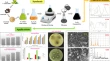
<p>The surface morphologies of as-spun TiO<sub>2</sub>-PVP composite and sintered TiO<sub>2</sub> nanofibers were characterized by SEM as shown in Figure&#8201;
<figr fid="F1">1</figr>. It is found that the network structure of the former is maintained after calcinations in air to remove PVP, forming a porous TiO<sub>2</sub> membrane. The higher sintering temperature, the thinner is TiO<sub>2</sub> fiber. The average fiber diameter of the composite nanofibers is 290 &#177; 90&#8201;nm which decreases to 210 &#177; 60&#8201;nm, 180 &#177; 70&#8201;nm, and 140 &#177; 80&#8201;nm after sintering at 500&#176;C, 550&#176;C, and 600&#176;C, respectively. It is known that crystalline grains of anatase TiO<sub>2</sub> are spherical, while rutile ones are of rod structure. With the increase of the sintering temperature, some anatase TiO<sub>2</sub> grains will transform to rutile ones, which may result in the thinning of the fibers. Moreover, transformation of anatase TiO<sub>2</sub> grains to rutile ones will introduce stress in the fibers, which will cause the fibers to become brittle and even fracture. The insets in Figure&#8201;
<figr fid="F1">1b</figr>, c, d are high-magnification photos of nanofibers, which indicate that the surfaces of TiO<sub>2</sub> nanofibers sintered at 500&#176;C and 550&#176;C are rather smooth, while become a little rough when sintering temperature increases to 600&#176;C. Figure&#8201;
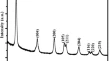
<figr fid="F2">2</figr> shows the XRD patterns of TiO<sub>2</sub> nanofibers. All the peaks of the TiO<sub>2</sub> nanofibers sintered at 500&#176;C are indexed for anatase TiO<sub>2</sub> with dominant (101) peaks. The mean grain size determined from the XRD pattern using the Scherrer formula is around 16&#8201;nm. The nanofibers sintered at 550&#176;C, 600&#176;C, and 700&#176;C are observed to contain both anatase and rutile phases. The phase composition can be determined from XRD results according to the following equation 
<abbrgrp>
<abbr bid="B29">29</abbr></abbrgrp>:</p>
<p>
<display-formula id="M2"><m:math name="1556-276X-8-9-i2" xmlns:m="http://www.w3.org/1998/Math/MathML"><m:mrow>
   <m:msub>
      <m:mi>W</m:mi>
      <m:mi mathvariant="normal">R</m:mi>
   </m:msub>
   <m:mo>=</m:mo>
   <m:msub>
      <m:mi>A</m:mi>
      <m:mi mathvariant="normal">R</m:mi>
   </m:msub>
   <m:mo stretchy="true">/</m:mo>
   <m:mfenced open="(" close=")">
      <m:mrow>
         <m:mn>0.884</m:mn>
         <m:mo>&#215;</m:mo>
         <m:msub>
            <m:mi>A</m:mi>
            <m:mi mathvariant="normal">A</m:mi>
         </m:msub>
         <m:mo>+</m:mo>
         <m:msub>
            <m:mi>A</m:mi>
            <m:mi mathvariant="normal">R</m:mi>
         </m:msub>
      </m:mrow>
   </m:mfenced>
</m:mrow>
</m:math></display-formula></p>
<p>where <it>W</it><sub>R</sub>, <it>A</it><sub>A</sub>, and <it>A</it><sub>R</sub> represent rutile weight percentage, integrated intensity of anatase (101) peak, and rutile (110) peak, respectively 
<abbrgrp>
<abbr bid="B29">29</abbr></abbrgrp>. The calculated rutile contents in the above three mixed-phase nanofiber samples are approximately 15.6, 87.8, and 90.5&#8201;wt.%, and the mean grain sizes are 22, 30, and 42&#8201;nm, respectively. The XRD results indicate that with the increase of sintering temperature, the grain size is gradually increased; however, rutile content is sharply increased in the temperature range of 550&#176;C to 600&#176;C.</p>
<fig id="F1"><title><p>Figure 1</p></title><caption><p>SEM images of electrospun nanofibers</p></caption><text>
   <p><b>SEM images of electrospun nanofibers.</b> As-spun TiO<sub>2</sub>-PVP nanofibers (<b>a</b>), TiO<sub>2</sub> nanofibers after calcination at 500&#176;C (<b>b</b>), 550&#176;C (<b>c</b>), and 600&#176;C (<b>d</b>). The insets in b, c, and d are high-magnification photos of single nanofibers.</p>
</text><graphic file="1556-276X-8-9-1"/></fig>
<fig id="F2"><title><p>Figure 2</p></title><caption><p>XRD patterns of TiO<sub>2</sub> nanofibers sintered at 500&#8201;&#176;C, 550&#8201;&#176;C, 600&#8201;&#176;C, and 700&#8201;&#176;C</p></caption><text>
   <p><b>XRD patterns of TiO</b><sub><b>2</b></sub><b>nanofibers sintered at 500&#176;C, 550&#176;C, 600&#176;C, and 700&#176;C.</b> The diffractions of anatase and rutile phase are labeled in the figure as &#8216;A&#8217; and &#8216;R&#8217;, respectively.</p>
</text><graphic file="1556-276X-8-9-2"/></fig></sec>
<sec>
<st>
<p>Characterization of ultrathin ZnO layers deposited by ALD method</p></st>
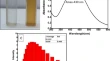
<p>To detect the crystallographic structure and thickness of ZnO layers, except FTO substrates, glass substrates were also used to deposit ZnO layers. XRD patterns for ZnO layers deposited on glass substrate are shown in Figure&#8201;
<figr fid="F3">3a</figr>. A 4-nm-thick ZnO layer does not show any diffraction peak, whereas peaks corresponding to hexagonal phase ZnO are observed for the thickness of 10 or 20&#8201;nm, which indicates that the deposited ZnO layers by ALD method are polycrystalline. Figure&#8201;
<figr fid="F3">3b</figr> shows the UV&#8211;vis transmission spectra for the FTO substrates without ZnO layers and with ZnO layers of different thicknesses. The absorbance edges for the bare FTO and ZnO are around 315 and 380&#8201;nm, respectively, from which the bandgap of ZnO is calculated to be 3.2 to 3.3&#8201;eV. In the visible range, the transmittance of the FTO covered with ZnO decreases slightly with the increase of ZnO film thickness. For instance, it decreases to approximately 95% of the transmittance of the bare FTO for 20-nm-thick ZnO. Therefore, the presence of ZnO layer with the thickness less than 20&#8201;nm will not obviously influence the harvest of light. The inset in Figure&#8201;
<figr fid="F3">3b</figr> is the SEM photo of FTO substrate covered with 15-nm-thick ZnO film, which shows that the ZnO film deposited by ALD method keeps the surface morphology of FTO substrate very well.</p>
<fig id="F3"><title><p>Figure 3</p></title><caption><p>XRD patterns</p></caption><text>
   <p><b>XRD patterns.</b> ZnO layers deposited on glass substrate (<b>a</b>) and UV&#8211;vis transmission spectra for the FTO substrate without and with ZnO layers (<b>b</b>). The inset in b is the SEM photo of FTO substrate covered with 15-nm-thick ZnO film.</p>
</text><graphic file="1556-276X-8-9-3"/></fig></sec>
<sec>
<st>
<p>Performance of DSSCs</p></st>
<sec>
<st>
<p>The influence of sintering temperature of TiO<sub>2</sub> nanofiber photoanodes on the performance of TiO<sub>2</sub> nanofiber cells</p></st>
<p>Cells I to III are TiO<sub>2</sub> nanofiber cells (sintered at 500&#176;C, 550&#176;C, and 600&#176;C) on the bare FTO substrates. Based on the above photocurrent-voltage(<it>J</it><it>V</it>) measurement results, a thickness of approximately 40&#8201;&#956;m was set to fabricate cells I to III. Figure&#8201;
<figr fid="F4">4</figr> illustrates the <it>J</it><it>V</it> characteristics of TiO<sub>2</sub> nanofiber cells under AM 1.5 irradiation of 100&#8201;mW&#8201;cm<sup>&#8722;2</sup>. The photovoltaic properties such as short-circuit current density (<it>J</it><sub>sc</sub>), open-circuit voltage (<it>V</it><sub>oc</sub>), fill factor (FF), and photoelectric conversion efficiency (PCE) of the cells are listed in Table&#8201;
<tblr tid="T1">1</tblr>. Cell I has a <it>J</it><sub>sc</sub> of 15.1&#8201;mA&#8201;cm<sup>&#8722;2</sup>, PCE of 6.39%, <it>V</it><sub>oc</sub> of 0.814&#8201;V, and fill factor (FF) of 0.52. When sintering temperature increased from 500&#176;C to 550&#176;C, cell II gave an improvement of <it>J</it><sub>sc</sub> and <it>V</it><sub>oc</sub> about 1.2&#8201;mA&#8201;cm<sup>&#8722;2</sup> and 11&#8201;mV, respectively, resulting in an efficiency of 7.12%. However, the further increase of sintering temperature decreased <it>J</it><sub>sc</sub>, <it>V</it><sub>oc</sub>, and PCE of cell III to 14.1&#8201;mA&#8201;cm<sup>&#8722;2</sup>, 0.818&#8201;V, and 6.11%, respectively. According to the XRD data, rutile contents of TiO<sub>2</sub> nanofibers are approximately 0, 15.6, and 87.8&#8201;wt.% in cells I, II, and III, respectively. The <it>J</it><it>V</it> measurement results demonstrate that the anatase-rutile mixed-phase TiO<sub>2</sub> nanofiber with a low rutile content is good for enhancing efficiencies of the DSSCs, whereas a high rutile content is detrimental to the efficiencies, which is similar to the reported DSSCs based on mixed-phase TiO<sub>2</sub> nanoparticles 
<abbrgrp>
<abbr bid="B19">19</abbr>
<abbr bid="B20">20</abbr></abbrgrp>.</p>
<fig id="F4"><title><p>Figure 4</p></title><caption><p>Photocurrent-voltage characteristics of cells I to III under AM 1.5 irradiation of 100&#8201;mW&#8201;cm<sup>&#8722;2</sup></p></caption><text>
   <p><b>Photocurrent-voltage characteristics of cells I to III under AM 1.5 irradiation of 100&#8201;mW&#8201;cm</b><sup>&#8722;<b>2</b></sup><b>.</b> Based on TiO<sub>2</sub> nanofibers sintered at 500&#176;C, 550&#176;C, and 600&#176;C.</p>
</text><graphic file="1556-276X-8-9-4"/></fig><table id="T1">
<title>
<p>Table 1</p></title>
<caption>
<p><b>Photocurrent density-voltage characteristics of TiO</b><sub><b>2</b></sub> <b>nanofiber cells sintered at 500&#176;C, 550&#176;C, and 600&#176;C</b></p></caption>
<tgroup align="left" cols="9">
<colspec align="left" colname="c1" colnum="1" colwidth="1*"/>
<colspec align="left" colname="c2" colnum="2" colwidth="1*"/>
<colspec align="left" colname="c3" colnum="3" colwidth="1*"/>
<colspec align="left" colname="c4" colnum="4" colwidth="1*"/>
<colspec align="left" colname="c5" colnum="5" colwidth="1*"/>
<colspec align="left" colname="c6" colnum="6" colwidth="1*"/>
<colspec align="left" colname="c7" colnum="7" colwidth="1*"/>
<colspec align="left" colname="c8" colnum="8" colwidth="1*"/>
<colspec align="left" colname="c9" colnum="9" colwidth="1*"/>
<thead valign="top">
<row rowsep="1">
<entry colname="c1">
<p><b>Cell</b></p></entry>
<entry colname="c2">
<p><b>Temperature (&#176;C)</b></p></entry>
<entry colname="c3">
<p><b><it>J</it></b><sub><b>sc</b></sub> <b>(mA/cm</b><sup><b>2</b></sup><b>)</b></p></entry>
<entry colname="c4">
<p><b><it>V</it></b><sub><b>oc</b></sub> <b>(V)</b></p></entry>
<entry colname="c5">
<p><b>FF</b></p></entry>
<entry colname="c6">
<p><b><it>&#951; </it></b><b>(%)</b></p></entry>
<entry colname="c7">
<p><b><it>&#964;</it></b><sub><b>d</b></sub> <b>(ms)</b></p></entry>
<entry colname="c8">
<p><b><it>&#964;</it></b><sub><b>n</b></sub> <b>(ms)</b></p></entry>
<entry colname="c9">
<p><b><it>L</it></b><sub><b>n</b></sub> <b>(&#956;m)</b></p></entry></row></thead><tfoot>
<p>TiO<sub>2</sub> nanofiber cells on the bare FTO substrates, the transit time (<it>&#964;</it><sub>d</sub>) and electron lifetime (<it>&#964;</it><sub>n</sub>), and diffusion length (<it>L</it><sub>n</sub>).</p></tfoot><tbody valign="top">
<row>
<entry colname="c1">
<p>I</p></entry>
<entry colname="c2">
<p>500</p></entry>
<entry colname="c3">
<p>15.1</p></entry>
<entry colname="c4">
<p>0.814</p></entry>
<entry colname="c5">
<p>0.52</p></entry>
<entry colname="c6">
<p>6.39</p></entry>
<entry colname="c7">
<p>3.36</p></entry>
<entry colname="c8">
<p>55.3</p></entry>
<entry colname="c9">
<p>74.2</p></entry></row>
<row>
<entry colname="c1">
<p>II</p></entry>
<entry colname="c2">
<p>550</p></entry>
<entry colname="c3">
<p>16.3</p></entry>
<entry colname="c4">
<p>0.825</p></entry>
<entry colname="c5">
<p>0.53</p></entry>
<entry colname="c6">
<p>7.12</p></entry>
<entry colname="c7">
<p>1.88</p></entry>
<entry colname="c8">
<p>107.7</p></entry>
<entry colname="c9">
<p>138.3</p></entry></row>
<row rowsep="1">
<entry colname="c1">
<p>III</p></entry>
<entry colname="c2">
<p>600</p></entry>
<entry colname="c3">
<p>14.1</p></entry>
<entry colname="c4">
<p>0.818</p></entry>
<entry colname="c5">
<p>0.53</p></entry>
<entry colname="c6">
<p>6.11</p></entry>
<entry colname="c7">
<p>6.47</p></entry>
<entry colname="c8">
<p>86.9</p></entry>
<entry colname="c9">
<p>67.1</p></entry></row></tbody></tgroup></table>
<p>In this study, specific surface areas were measured to be 28.5, 31.7, and 34.2&#8201;m<sup>2</sup>&#8201;g<sup>&#8722;1</sup> for TiO<sub>2</sub> nanofibers sintered at 500&#176;C, 550&#176;C, and 600&#176;C, respectively, which indicate that thinner rough nanofibers sintered at a higher temperature is favorable to increase the specific surface areas. UV&#8211;vis absorption spectra (Figure&#8201;
<figr fid="F5">5</figr>) of the sensitized TiO<sub>2</sub> nanofiber film show that the absorption edges are successfully extended to the visible region for all the three samples. In contrast with pure anatase phase (sintered at 500&#176;C), mixed-phase TiO<sub>2</sub> nanofibers (sintered at 550&#176;C and 600&#176;C) after N719 sensitization absorb a greater portion of the visible light, which should be the result of joint contribution of large specific surface area and mixed phase. Because anatase phase TiO<sub>2</sub> has the greatest dye absorption ability, while rutile phase TiO<sub>2</sub> possesses excellent light scattering characteristics due to its high refractive index (<it>n</it> = 2.7) 
<abbrgrp>
<abbr bid="B25">25</abbr>
<abbr bid="B26">26</abbr></abbrgrp>, dye-sensitized anatase-rutile mixed-phase TiO<sub>2</sub> with a proper proportion will have an enhanced light absorption.</p>
<fig id="F5"><title><p>Figure 5</p></title><caption><p>UV&#8211;vis absorption spectra</p></caption><text>
   <p><b>UV&#8211;vis absorption spectra.</b> Sensitized TiO<sub>2</sub> nanofiber films (approximately 60-&#956;m thick) sintered at 500&#176;C, 550&#176;C, and 600&#176;C.</p>
</text><graphic file="1556-276X-8-9-5"/></fig>
<p>The IMPS and IMVS plots of cells I to III display semicircles in the complex plane as shown in Figure&#8201;
<figr fid="F6">6</figr>. The transit time (<it>&#964;</it><sub>d</sub>) and electron lifetime (<it>&#964;</it><sub>n</sub>) can be calculated using the equations <it>&#964;</it><sub>d</sub> = 1/(2&#960;<it>f</it><sub>IMPS</sub><sub>min</sub>) and <it>&#964;</it><sub>n</sub> = 1/(2&#960;<it>f</it><sub>IMVS,min</sub>), respectively, where <it>f</it><sub>IMPS,min</sub> and <it>f</it><sub>IMVS,min</sub> are the frequencies at the minimum imaginary component in the IMPS and IMVS plots 
<abbrgrp>
<abbr bid="B30">30</abbr></abbrgrp>. The estimated electron lifetimes of the three cells follow the trend <it>&#964;</it><sub>n II</sub> &gt; <it>&#964;</it><sub>n III</sub> &gt; <it>&#964;</it><sub>n I</sub>, suggesting a reduction in recombination of electrons at the interface between TiO<sub>2</sub> and electrolyte in the presence of rutile phase, while transit times vary in the order <it>&#964;</it><sub>d II</sub> &gt; <it>&#964;</it><sub>d I</sub> &gt; <it>&#964;</it><sub>d III</sub>, indicating that the variation in electron transport rate is dependent on the amount of rutile phase. The competition between collection and recombination of electrons can be expressed in terms of the electron diffusion length. The electron collection efficiency is determined by the effective electron diffusion length, <it>L</it><sub>n</sub>, 
<abbrgrp>
<abbr bid="B31">31</abbr></abbrgrp>:</p>
<p>
<display-formula id="M3"><m:math name="1556-276X-8-9-i3" xmlns:m="http://www.w3.org/1998/Math/MathML"><m:mrow>
   <m:msub>
      <m:mi>L</m:mi>
      <m:mi>n</m:mi>
   </m:msub>
   <m:mo>=</m:mo>
   <m:mi>d</m:mi>
   <m:msup>
      <m:mfenced open="(" close=")">
         <m:mrow>
            <m:msub>
               <m:mi>&#964;</m:mi>
               <m:mi>n</m:mi>
            </m:msub>
            <m:mo stretchy="true">/</m:mo>
            <m:mn>2.35</m:mn>
            <m:msub>
               <m:mi>&#964;</m:mi>
               <m:mi>d</m:mi>
            </m:msub>
         </m:mrow>
      </m:mfenced>
      <m:mrow>
         <m:mn>1</m:mn>
         <m:mo stretchy="true">/</m:mo>
         <m:mn>2</m:mn>
      </m:mrow>
   </m:msup>
</m:mrow>
</m:math></display-formula></p>
<p>where <it>d</it> is the thickness of the photoanode. The calculated <it>L</it><sub>n</sub>/<it>d</it> (as shown in Table&#8201;
<tblr tid="T1">1</tblr>) of TiO<sub>2</sub> nanofiber cell is large and follows the sequence <it>L</it><sub>n II</sub>/<it>d</it><sub>II</sub> &gt; <it>L</it><sub>n I</sub>/<it>d</it><sub>I</sub> &gt; <it>L</it><sub>n III</sub>/<it>d</it><sub>III</sub>. A remarkable large value of 4.9 is found for cell II. A large electron diffusion length is the key point to support the usage of thick TiO<sub>2</sub>nanofibers as photoanodes to obtain high photocurrents and high conversion efficiencies. The largest <it>L</it><sub>n</sub>/<it>d</it><sub>II</sub> of cell II with 15.6% rutile content is speculated to be caused by the interaction of rutile and anatase phases which prompts electron transfer from anatase to rutile due to their different conduction band edge and decreased charge recombination rate. However, if the amount of rutile phase is too high in TiO<sub>2</sub> nanofibers, such as 87.8% in cell III, the property of rutile phase will play a leading role in the cell. A large transit time shows a slow electron transport in cell III, which leads to a decrease in electron diffusion length for cell III. From the above analysis, it is concluded that the superior <it>J</it><sub>sc</sub> of cell II is a consequence of more efficient electron collection and light harvesting. As far as <it>V</it><sub>oc</sub> is concerned, it is known that <it>V</it><sub>oc</sub> corresponds to the energy difference between the quasi-Fermi level of the electrons in the TiO<sub>2</sub> under illumination and the redox potential. If the electron recombination is retarded, the electron density in the conduction band of TiO<sub>2</sub> will be increased, which will result in a negative shift in quasi-Fermi level, thereby <it>V</it><sub>oc</sub> will be increased 
<abbrgrp>
<abbr bid="B32">32</abbr></abbrgrp>. Thus, the higher <it>V</it><sub>oc</sub> of cell II is ascribed to the reduced electron recombination rate. For cell III, in spite of the largest absorbance of visible light, a relatively low <it>J</it><sub>sc</sub> is produced because of an inefficient electron collection. The comparison of cells I to III highlights the existence of a synergistic effect between the anatase and rutile phases in TiO<sub>2</sub> nanofiber DSSCs, as well as suggests a sintering temperature of approximately 550&#176;C which is optimal for enhancing the performance of nanofiber DSSCs.</p>
<fig id="F6"><title><p>Figure 6</p></title><caption><p>IMPS (a) and IMVS (b) plots of cells I to III</p></caption><text>
   <p><b>IMPS (a) and IMVS (b) plots of cells I to III.</b> Based on TiO<sub>2</sub> nanofibers sintered at 500&#176;C, 550&#176;C, and 600&#176;C.</p>
</text><graphic file="1556-276X-8-9-6"/></fig></sec>
<sec>
<st>
<p>The influence of ZnO blocking layer on the performance of TiO<sub>2</sub> nanofiber cells</p></st>
<p>Based on the above results, cell II was chosen as the reference cell to study the influence of ZnO blocking layer on the performance of TiO<sub>2</sub> nanofiber cells. ZnO layers with thicknesses of 4, 10, 15, and 20&#8201;nm were deposited by ALD method on FTO substrates to fabricate cells IV, V, VI, and VII, respectively. <it>J</it><it>V</it> curves of cells II and IV to VII are shown in Figure&#8201;
<figr fid="F7">7</figr>, and the photovoltaic characteristics of these cells are summarized in Table&#8201;
<tblr tid="T2">2</tblr>. Compared with cell II, the performances of the cells with the ZnO layer are significantly improved. With the ZnO layer thickness increased from 0 to 15&#8201;nm, <it>J</it><sub>sc</sub> of the cells is monotonously boosted, but when decreased obviously at 20&#8201;nm, it is still larger than that without the ZnO layer. It is noticed that enhancement in <it>V</it><sub>oc</sub> and FF is very small. The largest <it>J</it><sub>sc</sub> of 17.3&#8201;mA&#8201;cm<sup>&#8722;2</sup> is obtained from cell VI with 15-nm-thick ZnO layer, resulting in the highest PCE of 8.01%, in contrast with 16.3&#8201;mA&#8201;cm<sup>&#8722;2</sup> and 7.12% of reference cell II. This phenomenon indicates that the charge collection of the cells is improved by the blocking function of ZnO layer on interfacial recombination, which is very different from the reported decrease of <it>J</it><sub>sc</sub> caused by thick ZnO blocking layers 
<abbrgrp>
<abbr bid="B30">30</abbr></abbrgrp>.</p>
<fig id="F7"><title><p>Figure 7</p></title><caption><p>Photocurrent-voltage curves of TiO<sub>2</sub> nanofiber cells (sintered at 550&#8201;&#176;C and approximately 60-&#956;m thick)</p></caption><text>
   <p><b>Photocurrent-voltage curves of TiO</b><sub><b>2</b></sub><b>nanofiber cells (sintered at 550&#176;C and approximately 60-&#956;m thick).</b> With ZnO layer of different thicknesses (4 to 20&#8201;nm).</p>
</text><graphic file="1556-276X-8-9-7"/></fig><table id="T2">
<title>
<p>Table 2</p></title>
<caption>
<p><b>Photocurrent density-voltage characteristics of TiO</b><sub><b>2</b></sub> <b>nanofiber cells</b></p></caption>
<tgroup align="left" cols="9">
<colspec align="left" colname="c1" colnum="1" colwidth="1*"/>
<colspec align="left" colname="c2" colnum="2" colwidth="1*"/>
<colspec align="left" colname="c3" colnum="3" colwidth="1*"/>
<colspec align="left" colname="c4" colnum="4" colwidth="1*"/>
<colspec align="left" colname="c5" colnum="5" colwidth="1*"/>
<colspec align="left" colname="c6" colnum="6" colwidth="1*"/>
<colspec align="left" colname="c7" colnum="7" colwidth="1*"/>
<colspec align="left" colname="c8" colnum="8" colwidth="1*"/>
<colspec align="left" colname="c9" colnum="9" colwidth="1*"/>
<thead valign="top">
<row rowsep="1">
<entry colname="c1">
<p><b>Cell</b></p></entry>
<entry colname="c2">
<p><b>ZnO thickness (nm)</b></p></entry>
<entry colname="c3">
<p><b><it>J</it></b><sub><b>sc</b></sub> <b>(mA/cm</b><sup><b>2</b></sup><b>)</b></p></entry>
<entry colname="c4">
<p><b><it>V</it></b><sub><b>oc</b></sub> <b>(V)</b></p></entry>
<entry colname="c5">
<p><b>FF</b></p></entry>
<entry colname="c6">
<p><b><it>&#951; </it></b><b>(%)</b></p></entry>
<entry colname="c7">
<p><b><it>&#964;</it></b><sub><b>d</b></sub> <b>(ms)</b></p></entry>
<entry colname="c8">
<p><b><it>&#964;</it></b><sub><b>n</b></sub> <b>(ms)</b></p></entry>
<entry colname="c9">
<p><b><it>L</it></b><sub><b>n</b></sub> <b>(&#956;m)</b></p></entry></row></thead><tfoot>
<p>TiO<sub>2</sub> nanofiber cells with ZnO layer of different thicknesses, the transit time (<it>&#964;</it><sub>d</sub>) and electron lifetime (<it>&#964;</it><sub>n</sub>), and diffusion length (<it>L</it><sub>n</sub>).</p></tfoot><tbody>
<row>
<entry colname="c1">
<p>II</p></entry>
<entry colname="c2">
<p>0</p></entry>
<entry colname="c3">
<p>14.5</p></entry>
<entry colname="c4">
<p>0.825</p></entry>
<entry colname="c5">
<p>0.53</p></entry>
<entry colname="c6">
<p>6.34</p></entry>
<entry colname="c7">
<p>1.88</p></entry>
<entry colname="c8">
<p>107.7</p></entry>
<entry colname="c9">
<p>138.3</p></entry></row>
<row>
<entry colname="c1">
<p>IV</p></entry>
<entry colname="c2">
<p>4</p></entry>
<entry colname="c3">
<p>15.0</p></entry>
<entry colname="c4">
<p>0.828</p></entry>
<entry colname="c5">
<p>0.54</p></entry>
<entry colname="c6">
<p>6.71</p></entry>
<entry colname="c7">
<p>1.43</p></entry>
<entry colname="c8">
<p>119.5</p></entry>
<entry colname="c9">
<p>166.9</p></entry></row>
<row>
<entry colname="c1">
<p>V</p></entry>
<entry colname="c2">
<p>10</p></entry>
<entry colname="c3">
<p>16.5</p></entry>
<entry colname="c4">
<p>0.833</p></entry>
<entry colname="c5">
<p>0.54</p></entry>
<entry colname="c6">
<p>7.42</p></entry>
<entry colname="c7">
<p>1.21</p></entry>
<entry colname="c8">
<p>154.3</p></entry>
<entry colname="c9">
<p>206.4</p></entry></row>
<row>
<entry colname="c1">
<p>VI</p></entry>
<entry colname="c2">
<p>15</p></entry>
<entry colname="c3">
<p>17.3</p></entry>
<entry colname="c4">
<p>0.842</p></entry>
<entry colname="c5">
<p>0.55</p></entry>
<entry colname="c6">
<p>8.01</p></entry>
<entry colname="c7">
<p>1.08</p></entry>
<entry colname="c8">
<p>179.7</p></entry>
<entry colname="c9">
<p>235.7</p></entry></row>
<row rowsep="1">
<entry colname="c1">
<p>VII</p></entry>
<entry colname="c2">
<p>20</p></entry>
<entry colname="c3">
<p>14.8</p></entry>
<entry colname="c4">
<p>0.825</p></entry>
<entry colname="c5">
<p>0.53</p></entry>
<entry colname="c6">
<p>6.47</p></entry>
<entry colname="c7">
<p>4.62</p></entry>
<entry colname="c8">
<p>354.5</p></entry>
<entry colname="c9">
<p>159.9</p></entry></row></tbody></tgroup></table>
<p>The schematic view of electron transfer with ZnO layer is shown in Figure&#8201;
<figr fid="F8">8</figr>. The interfacial processes involved in charge transportation in the cell are depicted in Figure&#8201;
<figr fid="F8">8b</figr>. As exciton dissociation occurs, electrons injected into the TiO<sub>2</sub> conduction band will transport to the FTO by diffusion 
<abbrgrp>
<abbr bid="B33">33</abbr></abbrgrp>. Because the conduction band edge of ZnO is a little more negative than that of TiO<sub>2</sub>, an energy barrier is introduced at the interface of FTO/TiO<sub>2</sub>, in which ultrathin ZnO layer can effectively suppress the back electron transfer from FTO to electrolytes or may block injected electron transfer from TiO<sub>2</sub> to FTO. The back reaction was studied using IMVS measurements. The electron lifetime <it>&#964;</it><sub>n</sub> obtained from IMVS (as shown in Table&#8201;
<tblr tid="T2">2</tblr>) is 107.7&#8201;ms for the cell without ZnO layer but is significantly increased from 119.5 to 354.5&#8201;ms with ZnO layer thickness increasing from 4 to 20&#8201;nm. The striking increase in the lifetime shows direct evidence that ultrathin ZnO layers prepared by ALD method successfully suppress the charge recombination between electrons emanating from the FTO substrate and I<sub>3</sub><sup>&#8722;</sup> ions in the electrolyte. The transit times of electrons calculated from IMPS measurements reflect charge transport and back reaction. Although an energy barrier is induced by introduction of ZnO layer between the TiO<sub>2</sub> and FTO, the electron transit time estimated from IMPS measurement is decreased from 1.88 to 1.08&#8201;ms for cells with ZnO layer thickness increasing from 0 to 15&#8201;nm. However, when the thickness of ZnO layer further increases, the change trend is reverse, and electron transit time for the cell with 20-nm-thick ZnO layer is markedly increased to 4.62&#8201;ms. It is put forward that relative to the cell without ZnO blocking layer, the electron transport in the cells with ZnO layers is determined by the two competition roles of the suppression effect of recombination with I<sub>3</sub><sup>&#8722;</sup> and potential barrier blocking effect. The increased electron lifetime has verified that ultrathin ZnO layer effectively slows the back recombination of electrons at the interface of FTO/electrolyte, so the decreased electron transit time reveals that the suppression effect is stronger than the potential barrier effect when the ZnO layer thickness is smaller than 20&#8201;nm. The obtained values of <it>L</it><sub>n</sub>/<it>d</it> of cells IV to VII are shown in Table&#8201;
<tblr tid="T2">2</tblr>, which are all larger than that of the reference cell without ZnO layer, with the largest value of 8.4 for cell VI with a 15-nm-thick ZnO blocking layer. As a consequence, <it>J</it><sub>sc</sub>'s of the four cells are significantly improved and reaches the largest value of 17.3&#8201;mA&#8201;cm<sup>&#8722;2</sup> for cell VI. No matter significant improvement of <it>J</it><sub>sc</sub>'s for the four cells, little variation in <it>V</it><sub>oc</sub> is found for cells with and without ZnO layers, manifesting no electrons accumulate at the interface between ZnO and TiO<sub>2</sub>, which is in good agreement with the rapid transport of injected electrons in TiO<sub>2</sub> conduction band to FTO substrates through ZnO layers.</p>
<fig id="F8"><title><p>Figure 8</p></title><caption><p>Schematic view of electron transfer with ZnO layer</p></caption><text>
   <p><b>Schematic view of electron transfer with ZnO layer.</b> TiO<sub>2</sub> nanofiber DSSC with an ultrathin ZnO layer (<b>a</b>). Illustration of the interfacial charge-transfer processes occurring in the DSSC (<b>b</b>). Also shown is the blocking function of ZnO blocking layer on interfacial recombination as described in this paper.</p>
</text><graphic file="1556-276X-8-9-8"/></fig></sec></sec></sec>
<sec>
<st>
<p>Conclusions</p></st>
<p>In summary, thick electrospun TiO<sub>2</sub> nanofibers sintered at 500&#176;C to 600&#176;C were used as photoanodes to fabricate DSSCs. The remarkable electron diffusion length in TiO<sub>2</sub> nanofiber cells is the key point that makes it feasible to use thick photoanode to obtain high photocurrent and high conversion efficiency. Besides, at sintering temperature of 550&#176;C, a small rutile content in the nanofiber (approximately 15.6%) improved conversion efficiency, short-circuit current, and open-circuit voltage of the cell by 10.9%, 7.4%, and 1.35%, respectively. Moreover, it is demonstrated that ultrathin ZnO layer prepared by ALD method could effectively suppress the electron transfer from FTO to electrolytes by IMVS measurements, and its suppression effect of back reaction was stronger than the potential barrier effect of electron transfer from TiO<sub>2</sub> to FTO by IMPS measurements. A large ratio of electron diffusion length to photoanode thickness (<it>L</it><sub>n</sub>/<it>d</it>) was obtained in the approximately 40-&#956;m-thick TiO<sub>2</sub> nanofiber DSSC with a 15-nm-thick ZnO blocking layer, which is responsible for short-circuit current density of 17.3&#8201;mA&#8201;cm<sup>&#8722;2</sup> and conversion efficiency of 8.01%. The research provides a potential approach to fabricate high-efficient DSSCs.</p></sec>
<sec>
<st>
<p>Abbreviations</p></st>
<p>ALD: atomic layer deposition; DSSCs: dye-sensitized solar cells; FF: fill factor; FTO: fluorine-doped SnO<sub>2</sub>; IMPS: intensity-modulated photocurrent spectroscopy; IMVS: intensity-modulated photovoltage spectroscopy; <it>J</it><sub>sc</sub>: short-circuit current; <it>J-V</it>: photocurrent-voltage; PCE: photoelectric conversion efficiency; PVP: polyvinylpyrrolidone; SEM: scanning electron microscope; <it>V</it><sub>oc</sub>: open-circuit voltage; XRD: X-ray diffraction; 1-D: one-dimensional; <it>&#964;</it><sub>d</sub>: transit time; <it>&#964;</it><sub>n</sub>: electron lifetime.</p></sec>
<sec>
<st>
<p>Competing interests</p></st>
<p>The authors declare that they have no competing interests.</p></sec>
<sec>
<st>
<p>Authors&#8217; contributions</p></st>
<p>JND and NYN conceived and designed the experiments, and wrote the paper. YL carried out the experiments and took part in writing. HH and LB participated in the experiments. SZ participated in the discussion and correction of the paper. All authors read and approved the final manuscript.</p></sec></bdy>
<bm>
<ack>
<sec>
<st>
<p>Acknowledgements</p></st>
<p>This work was supported by the National High Technology Research and Development Program 863 (2011AA050511), Jiangsu &#8216;333&#8217; Project, and the Priority Academic Program Development of Jiangsu Higher Education Institutions.</p></sec></ack>
<refgrp><bibl id="B1"><title><p>Porphyrin-sensitized solar cells with cobalt (II/III)-based redox electrolyte exceed 12% efficiency</p></title><aug><au><snm>Yella</snm><fnm>A</fnm></au><au><snm>Lee</snm><fnm>HW</fnm></au><au><snm>Tsao</snm><fnm>HN</fnm></au><au><snm>Yi</snm><fnm>C</fnm></au><au><snm>Chandiran</snm><fnm>AK</fnm></au><au><snm>Nazeeruddin</snm><fnm>MK</fnm></au><au><snm>Diau</snm><fnm>EWG</fnm></au><au><snm>Yeh</snm><fnm>CY</fnm></au><au><snm>Zakeeruddin</snm><fnm>SM</fnm></au><au><snm>Gr&#228;tzel</snm><fnm>M</fnm></au></aug><source>Science</source><pubdate>2011</pubdate><volume>334</volume><fpage>629</fpage><lpage>634</lpage><xrefbib><pubidlist><pubid idtype="doi">10.1126/science.1209688</pubid><pubid idtype="pmpid" link="fulltext">22053043</pubid></pubidlist></xrefbib></bibl><bibl id="B2"><title><p>Influence of electrical potential distribution, charge transport, and recombination on the photopotential and photocurrent conversion efficiency of dye-sensitized nanocrystallineTiO2 solar cells: a study by electrical impedance and optical modulation techniques</p></title><aug><au><snm>Lagemaat</snm><fnm>JVD</fnm></au><au><snm>Park</snm><fnm>NG</fnm></au><au><snm>Frank</snm><fnm>AJ</fnm></au></aug><source>J Phys Chem B</source><pubdate>2000</pubdate><volume>104</volume><fpage>2044</fpage><lpage>2052</lpage><xrefbib><pubid idtype="doi">10.1021/jp993172v</pubid></xrefbib></bibl><bibl id="B3"><title><p>Enhanced charge-collection efficiencies and light scattering in dye-sensitized solar cells using oriented TiO2 nanotubes arrays</p></title><aug><au><snm>Zhu</snm><fnm>K</fnm></au><au><snm>Neale</snm><fnm>NR</fnm></au><au><snm>Miedaner</snm><fnm>A</fnm></au><au><snm>Frank</snm><fnm>AJ</fnm></au></aug><source>Nano Lett</source><pubdate>2007</pubdate><volume>7</volume><fpage>69</fpage><lpage>74</lpage><xrefbib><pubidlist><pubid idtype="doi">10.1021/nl062000o</pubid><pubid idtype="pmpid" link="fulltext">17212442</pubid></pubidlist></xrefbib></bibl><bibl id="B4"><title><p>Nanorod-based dye-sensitized solar cells with improved charge collection efficiency</p></title><aug><au><snm>Kang</snm><fnm>SH</fnm></au><au><snm>Choi</snm><fnm>SH</fnm></au><au><snm>Kang</snm><fnm>MS</fnm></au><au><snm>Kim</snm><fnm>JY</fnm></au><au><snm>Kim</snm><fnm>HS</fnm></au><au><snm>Hyeon</snm><fnm>T</fnm></au><au><snm>Sung</snm><fnm>YE</fnm></au></aug><source>Adv Mater</source><pubdate>2008</pubdate><volume>20</volume><fpage>54</fpage><lpage>58</lpage><xrefbib><pubid idtype="doi">10.1002/adma.200701819</pubid></xrefbib></bibl><bibl id="B5"><title><p>Sol&#8211;gel electrophoretic deposition for the growth of oxide nanorods</p></title><aug><au><snm>Limmer</snm><fnm>SJ</fnm></au><au><snm>Cao</snm><fnm>GZ</fnm></au></aug><source>Adv Mater</source><pubdate>2003</pubdate><volume>15</volume><fpage>427</fpage><lpage>431</lpage><xrefbib><pubid idtype="doi">10.1002/adma.200390099</pubid></xrefbib></bibl><bibl id="B6"><title><p>Electrochemically induced sol&#8211;gel preparation of single-crystalline TiO2 nanowires</p></title><aug><au><snm>Miao</snm><fnm>Z</fnm></au><au><snm>Xu</snm><fnm>DS</fnm></au><au><snm>Ouyang</snm><fnm>JH</fnm></au><au><snm>Guo</snm><fnm>GL</fnm></au><au><snm>Zhao</snm><fnm>XS</fnm></au><au><snm>Tang</snm><fnm>YQ</fnm></au></aug><source>Nano Lett</source><pubdate>2002</pubdate><volume>2</volume><fpage>717</fpage><lpage>720</lpage><xrefbib><pubid idtype="doi">10.1021/nl025541w</pubid></xrefbib></bibl><bibl id="B7"><title><p>Titania nanotubes prepared by chemical processing</p></title><aug><au><snm>Kasuga</snm><fnm>T</fnm></au><au><snm>Hiramatsu</snm><fnm>M</fnm></au><au><snm>Hoson</snm><fnm>A</fnm></au><au><snm>Sekino</snm><fnm>T</fnm></au><au><snm>Niihara</snm><fnm>K</fnm></au></aug><source>Adv Mater</source><pubdate>1999</pubdate><volume>11</volume><fpage>1307</fpage><lpage>1311</lpage><xrefbib><pubid idtype="doi">10.1002/(SICI)1521-4095(199910)11:15&lt;1307::AID-ADMA1307&gt;3.0.CO;2-H</pubid></xrefbib></bibl><bibl id="B8"><title><p>Trititanate nanotubes made via a single alkali treatment</p></title><aug><au><snm>Chen</snm><fnm>Q</fnm></au><au><snm>Zhou</snm><fnm>WZ</fnm></au><au><snm>Du</snm><fnm>GH</fnm></au><au><snm>Peng</snm><fnm>LM</fnm></au></aug><source>Adv Mater</source><pubdate>2002</pubdate><volume>14</volume><fpage>1208</fpage><lpage>1211</lpage><xrefbib><pubid idtype="doi">10.1002/1521-4095(20020903)14:17&lt;1208::AID-ADMA1208&gt;3.0.CO;2-0</pubid></xrefbib></bibl><bibl id="B9"><title><p>Structure and physicochemistry of anodic oxide films on titanium and TA6V alloy</p></title><aug><au><snm>Zwilling</snm><fnm>V</fnm></au><au><snm>Darque-Ceretti</snm><fnm>E</fnm></au><au><snm>Boutry-Forveille</snm><fnm>A</fnm></au><au><snm>David</snm><fnm>D</fnm></au><au><snm>Perrin</snm><fnm>MY</fnm></au><au><snm>Aucouturier</snm><fnm>M</fnm></au></aug><source>Surf Interface Anal</source><pubdate>1999</pubdate><volume>27</volume><fpage>629</fpage><lpage>637</lpage><xrefbib><pubid idtype="doi">10.1002/(SICI)1096-9918(199907)27:7&lt;629::AID-SIA551&gt;3.0.CO;2-0</pubid></xrefbib></bibl><bibl id="B10"><title><p>In situ templated synthesis of anatase single-crystal nanotube arrays</p></title><aug><au><snm>Zhao</snm><fnm>JL</fnm></au><au><snm>Wang</snm><fnm>XH</fnm></au><au><snm>Sun</snm><fnm>TY</fnm></au><au><snm>Li</snm><fnm>LT</fnm></au></aug><source>Nanotechnology</source><pubdate>2005</pubdate><volume>16</volume><fpage>2450</fpage><lpage>2454</lpage><xrefbib><pubidlist><pubid idtype="doi">10.1088/0957-4484/16/10/077</pubid><pubid idtype="pmpid" link="fulltext">20818034</pubid></pubidlist></xrefbib></bibl><bibl id="B11"><title><p>A first report on the fabrication of vertically aligned anatase TiO2 nanowires by electrospinning: preferred architecture for nanostructured solar cells</p></title><aug><au><snm>Krishnamoorthy</snm><fnm>T</fnm></au><au><snm>Thavasi</snm><fnm>V</fnm></au><au><snm>Subodh</snm><fnm>GM</fnm></au><au><snm>Ramakrishna</snm><fnm>S</fnm></au></aug><source>Energ Environ Sci</source><pubdate>2011</pubdate><volume>4</volume><fpage>2807</fpage><lpage>2812</lpage><xrefbib><pubid idtype="doi">10.1039/c1ee01315g</pubid></xrefbib></bibl><bibl id="B12"><title><p>Charge transport characteristics of high efficiency dye-sensitized solar cells based on electrospun TiO2 nanorod photoelectrodes</p></title><aug><au><snm>Lee</snm><fnm>BH</fnm></au><au><snm>Song</snm><fnm>MY</fnm></au><au><snm>Jang</snm><fnm>SY</fnm></au><au><snm>Jo</snm><fnm>SM</fnm></au><au><snm>Kwak</snm><fnm>SY</fnm></au><au><snm>Kim</snm><fnm>DY</fnm></au></aug><source>J Phys Chem C</source><pubdate>2009</pubdate><volume>113</volume><fpage>21453</fpage><lpage>21457</lpage><xrefbib><pubid idtype="doi">10.1021/jp907855x</pubid></xrefbib></bibl><bibl id="B13"><title><p>Electrospinning materials for energy-related applications and devices</p></title><aug><au><snm>Dong</snm><fnm>ZX</fnm></au><au><snm>Kennedy</snm><fnm>SJ</fnm></au><au><snm>Wu</snm><fnm>YQ</fnm></au></aug><source>J Power Sources</source><pubdate>2011</pubdate><volume>196</volume><fpage>4886</fpage><lpage>4904</lpage><xrefbib><pubid idtype="doi">10.1016/j.jpowsour.2011.01.090</pubid></xrefbib></bibl><bibl id="B14"><title><p>TiO2 single-crystalline nanorod electrode for quasi-solid-state dye-sensitized solar cells</p></title><aug><au><snm>Song</snm><fnm>MY</fnm></au><au><snm>Ahn</snm><fnm>YR</fnm></au><au><snm>Jo</snm><fnm>SM</fnm></au><au><snm>Kim</snm><fnm>DY</fnm></au><au><snm>Ahn</snm><fnm>JP</fnm></au></aug><source>Appl Phys Lett</source><pubdate>2005</pubdate><volume>87</volume><fpage>113113</fpage><xrefbib><pubid idtype="doi">10.1063/1.2048816</pubid></xrefbib></bibl><bibl id="B15"><title><p>Ultrasensitive chemiresistors based on electrospun TiO2 nanofibers</p></title><aug><au><snm>Kim</snm><fnm>ID</fnm></au><au><snm>Rothschild</snm><fnm>A</fnm></au><au><snm>Lee</snm><fnm>BH</fnm></au><au><snm>Kim</snm><fnm>DY</fnm></au><au><snm>Jo</snm><fnm>SM</fnm></au><au><snm>Tuller</snm><fnm>HL</fnm></au></aug><source>Nano Lett</source><pubdate>2006</pubdate><volume>6</volume><fpage>2009</fpage><lpage>2013</lpage><xrefbib><pubidlist><pubid idtype="doi">10.1021/nl061197h</pubid><pubid idtype="pmpid" link="fulltext">16968017</pubid></pubidlist></xrefbib></bibl><bibl id="B16"><title><p>Multi-core cable-like TiO2 nanofibrous membranes for dye-sensitized solar cells</p></title><aug><au><snm>Kokubo</snm><fnm>H</fnm></au><au><snm>Ding</snm><fnm>B</fnm></au><au><snm>Naka</snm><fnm>T</fnm></au><au><snm>Tsuchihira</snm><fnm>H</fnm></au><au><snm>Shiratori</snm><fnm>S</fnm></au></aug><source>Nanotechnology</source><pubdate>2007</pubdate><volume>18</volume><fpage>165604</fpage><lpage>6</lpage><xrefbib><pubid idtype="doi">10.1088/0957-4484/18/16/165604</pubid></xrefbib></bibl><bibl id="B17"><title><p>Modified TiO2 nanotube arrays (TNTAs): progressive strategies towards visible light responsive photoanode, a review</p></title><aug><au><snm>Mohamed</snm><fnm>AE</fnm></au><au><snm>Rohani</snm><fnm>S</fnm></au></aug><source>Energ Environ Sci</source><pubdate>2011</pubdate><volume>4</volume><fpage>1065</fpage><lpage>1086</lpage><xrefbib><pubid idtype="doi">10.1039/c0ee00488j</pubid></xrefbib></bibl><bibl id="B18"><title><p>Highly-ordered TiO2 nanotube arrays up to 220&#8201;&#956;m in length: use in water photoelectrolysis and dye-sensitized solar cells</p></title><aug><au><snm>Shankar</snm><fnm>K</fnm></au><au><snm>Mor</snm><fnm>GK</fnm></au><au><snm>Prakasam</snm><fnm>HE</fnm></au><au><snm>Yoriya</snm><fnm>S</fnm></au><au><snm>Paulose</snm><fnm>M</fnm></au><au><snm>Varghese</snm><fnm>OK</fnm></au><au><snm>Grimes</snm><fnm>CA</fnm></au></aug><source>Nanotechnology</source><pubdate>2007</pubdate><volume>18</volume><fpage>1</fpage><lpage>11</lpage></bibl><bibl id="B19"><title><p>Synergistic effect between anatase and rutile TiO2 nanoparticles in dye-sensitized solar cells</p></title><aug><au><snm>Li</snm><fnm>GH</fnm></au><au><snm>Richter</snm><fnm>CP</fnm></au><au><snm>Milot</snm><fnm>RL</fnm></au><au><snm>Cai</snm><fnm>L</fnm></au><au><snm>Schmuttenmaer</snm><fnm>CA</fnm></au><au><snm>Crabtree</snm><fnm>RH</fnm></au><au><snm>Brudvig</snm><fnm>GW</fnm></au><au><snm>Batista</snm><fnm>VS</fnm></au></aug><source>Dalton Trans</source><pubdate>2009</pubdate><volume>45</volume><fpage>10078</fpage><lpage>10085</lpage><xrefbib><pubid idtype="pmpid" link="fulltext">19904436</pubid></xrefbib></bibl><bibl id="B20"><title><p>Effect of the rutile content on the photovoltaic performance of the dye-sensitized solar cells composed of mixed-phase TiO2 photoelectrodes</p></title><aug><au><snm>Yun</snm><fnm>TK</fnm></au><au><snm>Park</snm><fnm>SS</fnm></au><au><snm>Kim</snm><fnm>D</fnm></au><au><snm>Shim</snm><fnm>JH</fnm></au><au><snm>Bae</snm><fnm>JY</fnm></au><au><snm>Huh</snm><fnm>S</fnm></au><au><snm>Won</snm><fnm>YS</fnm></au></aug><source>Dalton Trans</source><pubdate>2012</pubdate><volume>41</volume><fpage>1284</fpage><lpage>1288</lpage><xrefbib><pubidlist><pubid idtype="doi">10.1039/c1dt11765c</pubid><pubid idtype="pmpid" link="fulltext">22124477</pubid></pubidlist></xrefbib></bibl><bibl id="B21"><title><p>Characterization of titanium dioxide blocking layers in dye-sensitized nanocrystalline solar cells</p></title><aug><au><snm>Cameron</snm><fnm>PJ</fnm></au><au><snm>Peter</snm><fnm>LM</fnm></au></aug><source>J Phys Chem B</source><pubdate>2003</pubdate><volume>107</volume><fpage>14394</fpage><lpage>14400</lpage><xrefbib><pubid idtype="doi">10.1021/jp030790+</pubid></xrefbib></bibl><bibl id="B22"><title><p>An efficient and low-cost TiO2 compact layer for performance improvement of dye-sensitized solar cells</p></title><aug><au><snm>Yu</snm><fnm>H</fnm></au><au><snm>Zhang</snm><fnm>SQ</fnm></au><au><snm>Zhao</snm><fnm>HJ</fnm></au><au><snm>Will</snm><fnm>G</fnm></au><au><snm>Liu</snm><fnm>PR</fnm></au></aug><source>Electrochim Acta</source><pubdate>2009</pubdate><volume>54</volume><fpage>1319</fpage><lpage>1324</lpage><xrefbib><pubid idtype="doi">10.1016/j.electacta.2008.09.025</pubid></xrefbib></bibl><bibl id="B23"><title><p>Carrier leakage blocking effect of high temperature sputtered TiO2 film on dye-sensitized mesoporous photoelectrode</p></title><aug><au><snm>Hattori</snm><fnm>R</fnm></au><au><snm>Goto</snm><fnm>H</fnm></au></aug><source>Thin Solid Films</source><pubdate>2007</pubdate><volume>515</volume><fpage>8045</fpage><lpage>8049</lpage><xrefbib><pubid idtype="doi">10.1016/j.tsf.2007.03.079</pubid></xrefbib></bibl><bibl id="B24"><title><p>Effects of a surfactant-templated nanoporous TiO2 interlayer on dye-sensitized solar cells</p></title><aug><au><snm>Ahn</snm><fnm>KS</fnm></au><au><snm>Kang</snm><fnm>MS</fnm></au><au><snm>Lee</snm><fnm>JW</fnm></au><au><snm>Kang</snm><fnm>YS</fnm></au></aug><source>J ApplPhys</source><pubdate>2007</pubdate><volume>101</volume><fpage>084312</fpage></bibl><bibl id="B25"><title><p>Systematic investigation of the role of compact TiO2 layer in solid state dye-sensitized TiO2 solar cells</p></title><aug><au><snm>Peng</snm><fnm>B</fnm></au><au><snm>Jungmann</snm><fnm>G</fnm></au><au><snm>Jager</snm><fnm>C</fnm></au><au><snm>Haarer</snm><fnm>D</fnm></au><au><snm>Schmidt</snm><fnm>HW</fnm></au><au><snm>Thelakkat</snm><fnm>M</fnm></au></aug><source>Coordin Chem Rev</source><pubdate>2004</pubdate><volume>248</volume><fpage>1479</fpage><lpage>1489</lpage><xrefbib><pubid idtype="doi">10.1016/j.ccr.2004.02.008</pubid></xrefbib></bibl><bibl id="B26"><title><p>Sputtered Nb2O5 as a novel blocking layer at conducting glass/TiO2 interfaces in dye-sensitized ionic liquid solar cells</p></title><aug><au><snm>Xia</snm><fnm>J</fnm></au><au><snm>Masaki</snm><fnm>N</fnm></au><au><snm>Jiang</snm><fnm>K</fnm></au><au><snm>Yanagida</snm><fnm>S</fnm></au></aug><source>J PhysChem C</source><pubdate>2007</pubdate><volume>111</volume><fpage>8092</fpage><lpage>8097</lpage></bibl><bibl id="B27"><title><p>Effect of a compact ZnO interlayer on the performance of ZnO-based dye-sensitized solar cells</p></title><aug><au><snm>Perez-Hernandez</snm><fnm>G</fnm></au><au><snm>Vega-Poot</snm><fnm>A</fnm></au><au><snm>Perez-Juarez</snm><fnm>I</fnm></au><au><snm>Camacho</snm><fnm>JM</fnm></au><au><snm>Ares</snm><fnm>O</fnm></au><au><snm>Rejon</snm><fnm>V</fnm></au><au><snm>Pena</snm><fnm>JL</fnm></au><au><snm>Oskam</snm><fnm>G</fnm></au></aug><source>Sol Energ Mat Sol C</source><pubdate>2012</pubdate><volume>100</volume><fpage>21</fpage><lpage>26</lpage></bibl><bibl id="B28"><title><p>Influences on photovoltage performance by interfacial modification of FTO/mesoporous TiO2 using ZnO and TiO2 as the compact film</p></title><aug><au><snm>Liu</snm><fnm>YM</fnm></au><au><snm>Sun</snm><fnm>XH</fnm></au><au><snm>Tai</snm><fnm>QD</fnm></au><au><snm>Hu</snm><fnm>H</fnm></au><au><snm>Chen</snm><fnm>BL</fnm></au><au><snm>Huang</snm><fnm>N</fnm></au><au><snm>Sebo</snm><fnm>B</fnm></au><au><snm>Zhao</snm><fnm>XZ</fnm></au></aug><source>J Alloy Compd</source><pubdate>2011</pubdate><volume>509</volume><fpage>9264</fpage><lpage>9270</lpage><xrefbib><pubid idtype="doi">10.1016/j.jallcom.2011.07.018</pubid></xrefbib></bibl><bibl id="B29"><title><p>Understanding polymorphic phase transformation behavior during growth of nanocrystalline aggregates: insights from TiO2</p></title><aug><au><snm>Zhang</snm><fnm>HZ</fnm></au><au><snm>Banfield</snm><fnm>JF</fnm></au></aug><source>J Phys Chem B</source><pubdate>2000</pubdate><volume>104</volume><fpage>3481</fpage><lpage>3487</lpage></bibl><bibl id="B30"><title><p>Charge transport and back reaction in solid-state dye-sensitized solar cells: a study using intensity-modulated photovoltage and photocurrent spectroscopy</p></title><aug><au><snm>Kruger</snm><fnm>J</fnm></au><au><snm>Plass</snm><fnm>R</fnm></au><au><snm>Gratzel</snm><fnm>M</fnm></au><au><snm>Cameron</snm><fnm>PJ</fnm></au><au><snm>Peter</snm><fnm>LM</fnm></au></aug><source>J Phys Chem B</source><pubdate>2003</pubdate><volume>107</volume><fpage>7536</fpage><lpage>7539</lpage><xrefbib><pubid idtype="doi">10.1021/jp0348777</pubid></xrefbib></bibl><bibl id="B31"><title><p>Electron diffusion length and lifetime in p-type GaN</p></title><aug><au><snm>Bandic</snm><fnm>ZZ</fnm></au><au><snm>Bridger</snm><fnm>PM</fnm></au><au><snm>Piquette</snm><fnm>EC</fnm></au><au><snm>McGill</snm><fnm>TC</fnm></au></aug><source>Appl Phys Lett</source><pubdate>1998</pubdate><volume>73</volume><fpage>3276</fpage><xrefbib><pubid idtype="doi">10.1063/1.122743</pubid></xrefbib></bibl><bibl id="B32"><title><p>The influence of charge transport and recombination on the performance of dye-sensitized solar cells</p></title><aug><au><snm>Wang</snm><fnm>M</fnm></au><au><snm>Chen</snm><fnm>P</fnm></au><au><snm>Humphry-Baker</snm><fnm>R</fnm></au><au><snm>Zakeeruddin</snm><fnm>SM</fnm></au><au><snm>Gratzel</snm><fnm>M</fnm></au></aug><source>Chemphyschem</source><pubdate>2009</pubdate><volume>10</volume><fpage>290</fpage><lpage>299</lpage><xrefbib><pubidlist><pubid idtype="doi">10.1002/cphc.200800708</pubid><pubid idtype="pmpid" link="fulltext">19115326</pubid></pubidlist></xrefbib></bibl><bibl id="B33"><title><p>Comparing organic to inorganic photovoltaic cells: theory, experiment, and simulation</p></title><aug><au><snm>Gregg</snm><fnm>BA</fnm></au><au><snm>Hanna</snm><fnm>MC</fnm></au></aug><source>J Appl Phys</source><pubdate>2003</pubdate><volume>93</volume><fpage>3605</fpage><lpage>3614</lpage><xrefbib><pubid idtype="doi">10.1063/1.1544413</pubid></xrefbib></bibl></refgrp></bm></art>