<?xml version='1.0'?>
<!DOCTYPE art SYSTEM 'http://www.biomedcentral.com/xml/article.dtd'>
<art>
	<ui>1556-276X-8-89</ui>
	<ji>1556-276X</ji>
	<fm>
		<dochead>Nano Express</dochead>
		<bibl>
			<title>
				<p>Annealing effect on Sb<sub>2</sub>S<sub>3</sub>-TiO<sub>2</sub> nanostructures for solar cell applications</p>
			</title>
			<aug>
				<au id="A1"><snm>Li</snm><fnm>Yitan</fnm><insr iid="I1"/><email>liyitan@126.com</email></au>
				<au id="A2"><snm>Wei</snm><fnm>Lin</fnm><insr iid="I2"/><email>wl2003@sdu.edu.cn</email></au>
				<au id="A3"><snm>Zhang</snm><fnm>Ruizi</fnm><insr iid="I1"/><email>837534786@qq.com</email></au>
				<au id="A4" ca="yes"><snm>Chen</snm><fnm>Yanxue</fnm><insr iid="I1"/><email>cyx@sdu.edu.cn</email></au>
				<au id="A5"><snm>Mei</snm><fnm>Liangmo</fnm><insr iid="I1"/><email>mlm@sdu.edu.cn</email></au>
				<au id="A6"><snm>Jiao</snm><fnm>Jun</fnm><insr iid="I3"/><insr iid="I4"/><email>jiaoj@pdx.edu</email></au>
			</aug>
			<insg>
				<ins id="I1"><p>School of Physics and State Key Laboratory of Crystal Materials, Shandong University, Jinan, 250100, People's Republic of China</p></ins>
				<ins id="I2"><p>School of Information Science and Engineering, Shandong University, Jinan, 250100, People's Republic of China</p></ins>
				<ins id="I3"><p>Department of Mechanical and Materials Engineering, Portland State University, P.O. Box 751, Portland, OR, 97207-0751, USA</p></ins>
				<ins id="I4"><p>Department of Physics, Portland State University, P.O. Box 751, Portland, OR, 97207-0751, USA</p></ins>
			</insg>
			<source>Nanoscale Research Letters</source>
			<section><title><p>Regular submissions</p></title></section><issn>1556-276X</issn>
			<pubdate>2013</pubdate>
			<volume>8</volume>
			<issue>1</issue>
			<fpage>89</fpage>
			<url>http://www.nanoscalereslett.com/content/8/1/89</url>
			<xrefbib><pubidlist><pubid idtype="doi">10.1186/1556-276X-8-89</pubid><pubid idtype="pmpid">23421351</pubid></pubidlist></xrefbib>
		</bibl>
		<history><rec><date><day>31</day><month>10</month><year>2012</year></date></rec><acc><date><day>9</day><month>2</month><year>2013</year></date></acc><pub><date><day>19</day><month>2</month><year>2013</year></date></pub></history>
		<cpyrt><year>2013</year><collab>Li et al; licensee Springer.</collab><note>This is an Open Access article distributed under the terms of the Creative Commons Attribution License (<url>http://creativecommons.org/licenses/by/2.0</url>), which permits unrestricted use, distribution, and reproduction in any medium, provided the original work is properly cited.</note></cpyrt>
		<kwdg>
			<kwd>TiO<sub>2</sub>
			</kwd>
			<kwd>Sb<sub>2</sub>S<sub>3</sub>
			</kwd>
			<kwd>Nanorod</kwd>
			<kwd>Solar cells</kwd>
			<kwd>Annealing effect</kwd>
		</kwdg>
		<abs>
			<sec>
				<st>
					<p>Abstract</p>
				</st><p>Nanostructures composited of vertical rutile TiO<sub>2</sub> nanorod arrays and Sb<sub>2</sub>S<sub>3</sub> nanoparticles were prepared on an F:SnO<sub>2</sub> conductive glass by hydrothermal method and successive ionic layer adsorption and reaction method at low temperature. Sb<sub>2</sub>S<sub>3</sub>-sensitized TiO<sub>2</sub> nanorod solar cells were assembled using the Sb<sub>2</sub>S<sub>3</sub>-TiO<sub>2</sub> nanostructure as the photoanode and a polysulfide solution as an electrolyte. Annealing effects on the optical and photovoltaic properties of Sb<sub>2</sub>S<sub>3</sub>-TiO<sub>2</sub> nanostructure were studied systematically. As the annealing temperatures increased, a regular red shift of the bandgap of Sb<sub>2</sub>S<sub>3</sub> nanoparticles was observed, where the bandgap decreased from 2.25 to 1.73 eV. At the same time, the photovoltaic conversion efficiency for the nanostructured solar cells increased from 0.46% up to 1.47% as a consequence of the annealing effect. This improvement can be explained by considering the changes in the morphology, the crystalline quality, and the optical properties caused by the annealing treatment.</p>
			</sec>
		</abs>
	</fm>
	<bdy>
		<sec>
			<st>
				<p>Background</p>
			</st><p>Dye-sensitized solar cells (DSSCs) pioneered by O'Regan and Gr&#228;tzel have been intensively investigated as a promising photovoltaic cell all over the world <abbrgrp>
					<abbr bid="B1">1</abbr>
					<abbr bid="B2">2</abbr>
					<abbr bid="B3">3</abbr>
					<abbr bid="B4">4</abbr>
					<abbr bid="B5">5</abbr>
				</abbrgrp>. Until now, photovoltaic conversion efficiency of up to 11% has been reported for DSSCs in the laboratory <abbrgrp>
					<abbr bid="B6">6</abbr>
				</abbrgrp>. Although the conversion efficiency is impressive, the expense of the dye required to sensitize the solar cell is still not feasible for practical applications. Therefore, it is critical to tailor the materials to be not only cost effective but also long lasting. Recently, the utilization of narrow-bandgap semiconductors as a light-absorbing material, in place of conventional dye molecules, has drawn much attention. Inorganic semiconductors have several advantages over conventional dyes: (1) The bandgap of semiconductor nanoparticles can be easily tuned by size over a wide range to match the solar spectrum. (2) Their large intrinsic dipole moments can lead to rapid charge separation and large extinction coefficient, which is known to reduce the dark current and increase the overall efficiency. (3) In addition, semiconductor sensitizers provide new chances to utilize hot electrons to generate multiple charge carriers with a single photon. These properties make such inorganic narrow-bandgap semiconductors extremely attractive as materials for photovoltaic applications.</p><p>Recently, a range of nano-sized semiconductors has been investigated in photovoltaic applications including CdS <abbrgrp>
					<abbr bid="B7">7</abbr>
					<abbr bid="B8">8</abbr>
					<abbr bid="B9">9</abbr>
				</abbrgrp>, CdSe <abbrgrp>
					<abbr bid="B10">10</abbr>
					<abbr bid="B11">11</abbr>
					<abbr bid="B12">12</abbr>
					<abbr bid="B13">13</abbr>
				</abbrgrp>, Ag<sub>2</sub>S <abbrgrp>
					<abbr bid="B14">14</abbr>
				</abbrgrp>, In<sub>2</sub>S<sub>3</sub>
				<abbrgrp>
					<abbr bid="B15">15</abbr>
				</abbrgrp>, PbS <abbrgrp>
					<abbr bid="B16">16</abbr>
				</abbrgrp>, Sb<sub>2</sub>S<sub>3</sub>
				<abbrgrp>
					<abbr bid="B17">17</abbr>
				</abbrgrp>, Cu<sub>2</sub>O <abbrgrp>
					<abbr bid="B18">18</abbr>
				</abbrgrp>, as well as III-VI quantum ring <abbrgrp>
					<abbr bid="B19">19</abbr>
				</abbrgrp>. Among these narrow-bandgap semiconductors, Sb<sub>2</sub>S<sub>3</sub> has shown much promise as an impressive sensitizer due to its reasonable bandgap of about 1.7 eV, exhibiting a strong absorption of the solar spectrum. The use of Sb<sub>2</sub>S<sub>3</sub> nanoparticles, which may produce more than one electron&#8211;hole pair per single absorbed photon (also known as multiple exciton generation), is a promising solution to enhance power conversion efficiency. Furthermore, the creation of a type-II heterojunction by growing Sb<sub>2</sub>S<sub>3</sub> nanoparticles on the TiO<sub>2</sub> surface greatly enhances charge separation. All of these effects are known to increase the exciton concentration, lifetime of hot electrons, and therefore, the performance of sensitized solar cells. Limited research has previously been carried out with Sb<sub>2</sub>S<sub>3</sub>-TiO<sub>2</sub> nanostructure for solar cell applications <abbrgrp>
					<abbr bid="B20">20</abbr>
					<abbr bid="B21">21</abbr>
					<abbr bid="B22">22</abbr>
				</abbrgrp>. A remarkable performance was obtained in both liquid cell configuration and solid configuration. These findings were based on the use of porous nanocrystalline TiO<sub>2</sub> particles; however, very little research has been conducted using single-crystalline TiO<sub>2</sub> nanorod arrays. Compared with conventional porous polycrystalline TiO<sub>2</sub> films, single-crystalline TiO<sub>2</sub> nanorods grown directly on transparent conductive oxide electrodes provide an ideal alternative solution by avoiding particle-to-particle hopping that occurs in polycrystalline films, thereby increasing the photocurrent efficiency. Further enhancements in solid Sb<sub>2</sub>S<sub>3</sub>-sensitized solar cells demand a deeper understanding of the main parameters determining photoelectric behavior while also requiring additional research and insight into the electrical transporting process in these nanostructures.</p><p>In our present research study, Sb<sub>2</sub>S<sub>3</sub> semiconductor nanoparticles and single-crystalline rutile TiO<sub>2</sub> nanorod arrays were combined to perform as a photoanode for a practical nanostructured solar cell (as depicted in Figure <figr fid="F1">1</figr>). The annealing effect on the photovoltaic performance and optical property of Sb<sub>2</sub>S<sub>3</sub>-TiO<sub>2</sub> nanostructures was studied systematically, and the optimal temperature of 300&#176;C was confirmed. After annealing, apparent changes of morphological, optical, and photovoltaic properties were observed. The photovoltaic conversion efficiency of solar cell assembled using annealed Sb<sub>2</sub>S<sub>3</sub>-TiO<sub>2</sub> nanostructure demonstrated a significant increase of 219%, compared with that based on as-made Sb<sub>2</sub>S<sub>3</sub>-TiO<sub>2</sub> nanostructure.</p>
			<fig id="F1"><title><p>Figure 1</p></title><caption><p>Schematic of (a) bare TiO2 nanorod arrays on FTO and (b) Sb2S3-TiO2 nanostructure on FTO</p></caption><text>
   <p>
      <b>Schematic of (a) bare TiO<sub>2</sub> nanorod arrays on FTO and (b) Sb<sub>2</sub>S<sub>3</sub>-TiO<sub>2</sub> nanostructure on FTO.</b>
   </p>
</text><graphic file="1556-276X-8-89-1"/></fig>
		</sec>
		<sec>
			<st>
				<p>Methods</p>
			</st>
			<sec>
				<st>
					<p>Growth of single-crystalline rutile TiO<sub>2</sub> nanorod arrays by hydrothermal process</p>
				</st><p>TiO<sub>2</sub> nanorod arrays were grown directly on fluorine-doped tin oxide (FTO)-coated glass using the following hydrothermal methods: 50 mL of deionized water was mixed with 40 mL of concentrated hydrochloric acid. After stirring at ambient temperature for 5 min, 400 &#956;L of titanium tetrachloride was added to the mixture. The feedstock, prepared as previously described, was injected into a stainless steel autoclave with a Teflon lining. The FTO substrates were ultrasonically cleaned for 10 min in a mixed solution of deionized water, acetone, and 2-propanol with volume ratios of 1:1:1 and were placed at an angle against the Teflon liner wall with the conducting side facing down. The hydrothermal synthesis was performed by placing the autoclave in an oven and keeping it at 180&#176;C for 2 h. After synthesis, the autoclave was cooled to room temperature under flowing water, and the FTO substrates were taken out, washed extensively with deionized water, and dried in open air.</p>
			</sec>
			<sec>
				<st>
					<p>Deposition of Sb<sub>2</sub>S<sub>3</sub> nanoparticles with successive ionic layer adsorption and reaction method and annealing treatment</p>
				</st><p>Successive ionic layer adsorption and reaction (SILAR) method was used to prepare Sb<sub>2</sub>S<sub>3</sub> semiconductor nanoparticles. In a typical SILAR cycle, the F:SnO<sub>2</sub> conductive glass, pre-grown with TiO<sub>2</sub> nanorod arrays, was dipped into the 0.1 M antimonic chloride ethanol solution for 5 min at 50&#176;C. Next, the F:SnO<sub>2</sub> conductive glass was rinsed with ethanol and then dipped in 0.2 M sodium thiosulfate solution for 5 min at 80&#176;C and finally rinsed in water. This entire SILAR process was repeated for 10 cycles. After the SILAR process, samples were annealed in N<sub>2</sub> flow at varied temperatures from 100&#176;C to 400&#176;C for 30 min. After annealing, a color change was noted in the Sb<sub>2</sub>S<sub>3</sub>-TiO<sub>2</sub> nanostructured samples, which were orange before annealing and gradually turned blackish as the annealing temperature increased.</p>
			</sec>
			<sec>
				<st>
					<p>Characterization of the Sb<sub>2</sub>S<sub>3</sub>-TiO<sub>2</sub> nanostructures</p>
				</st><p>The crystal structure of the Sb<sub>2</sub>S<sub>3</sub>-TiO<sub>2</sub> samples were examined by X-ray diffraction (XD-3, PG Instruments Ltd., Beijing, China) with CuK&#945; radiation (<it>&#955;</it> = 0.154 nm) at a scan rate of 2&#176;/min. X-ray tube voltage and current were set at 40 kV and 30 mA, respectively. The surface morphology of the Sb<sub>2</sub>S<sub>3</sub>-TiO<sub>2</sub> nanostructures was examined by scanning electron microscopy (SEM; FEI Sirion, FEI Company, Hillsboro, OR, USA). The optical absorption spectra were obtained using a dual beam UV-visible spectrometer (TU-1900, PG Instruments, Ltd.).</p>
			</sec>
			<sec>
				<st>
					<p>Solar cell assembly and performance measurement</p>
				</st><p>Solar cells were assembled using a Sb<sub>2</sub>S<sub>3</sub>-TiO<sub>2</sub> nanostructure as the photoanode. Pt counter electrodes were prepared by depositing an approximately 20-nm Pt film on FTO glass using magnetron sputtering. A 60-&#956;m-thick sealing material (SX-1170-60, Solaronix SA, Aubonne, Switzerland) with a 3 &#215; 3 mm aperture was pasted onto the Pt counter electrodes. The Pt counter electrode and the Sb<sub>2</sub>S<sub>3</sub>-TiO<sub>2</sub> sample were sandwiched and sealed with the conductive sides facing inward. A polysulfide electrolyte was injected into the space between the two electrodes. The polysulfide electrolyte was composed of 0.1 M sulfur, 1 M Na<sub>2</sub>S, and 0.1 M NaOH which were dissolved in distilled water and stirred at 80&#176;C for 2 h.</p><p>A solar simulator (Model 94022A, Newport, OH, USA) with an AM1.5 filter was used to illuminate the working solar cell at light intensity of one sun illumination (100 mW/cm<sup>2</sup>). A source meter (2400, Keithley Instruments Inc., Cleveland, OH, USA) was used for electrical characterization during the measurements. The measurements were carried out using a calibrated OSI standard silicon solar photodiode.</p>
			</sec>
		</sec>
		<sec>
			<st>
				<p>Results and discussion</p>
			</st>
			<sec>
				<st>
					<p>Morphology and crystal structure of Sb<sub>2</sub>S<sub>3</sub>-TiO<sub>2</sub> nanostructure</p>
				</st><p>The morphology of the rutile TiO<sub>2</sub> nanorod arrays is shown in Figure <figr fid="F2">2</figr>a. The SEM images clearly show that the entire surface of the FTO glass substrate was uniformly covered with ordered TiO<sub>2</sub> nanorods, and the nanorods were tetragonal in shape with square top facets. This nanorod array presented an easily accessed open structure for Sb<sub>2</sub>S<sub>3</sub> deposition and a higher hole transferring speed for the whole solar cell. No significant changes in nanorod array morphology were observed after annealing at 400&#176;C. As-synthesized Sb<sub>2</sub>S<sub>3</sub>-TiO<sub>2</sub> nanostructure is shown in Figure<figr fid="F2">2</figr>b, indicating a combination of the Sb<sub>2</sub>S<sub>3</sub> nanoparticles and TiO<sub>2</sub> nanorods. The Sb<sub>2</sub>S<sub>3</sub>-TiO<sub>2</sub> nanostructure after annealing at 300&#176;C for 30 min is shown in Figure <figr fid="F2">2</figr>c. Compared to the CdS-TiO<sub>2</sub> nanostructure, in which 5-to 10-nm CdS nanoparticles distributed uniformly on the TiO<sub>2</sub> nanorod <abbrgrp>
						<abbr bid="B9">9</abbr>
					</abbrgrp>, the as-deposited Sb<sub>2</sub>S<sub>3</sub> particles differed with a larger diameter of approximately 50 nm and often covered several TiO<sub>2</sub> nanorods. This structural phenomenon was observed much more so in the annealed sample, where at least some melting of the low melting point (550&#176;C) Sb<sub>2</sub>S<sub>3</sub> clearly occurred. After the annealing treatment, the size of Sb<sub>2</sub>S<sub>3</sub> particles increased, which enabled the Sb<sub>2</sub>S<sub>3</sub> particles to closely contact the TiO<sub>2</sub> nanorod surface. This solid connection between Sb<sub>2</sub>S<sub>3</sub> nanoparticles and the TiO<sub>2</sub> nanorods was beneficial to the charge separation and improved the overall properties of the sensitized solar cells.</p>
				<fig id="F2"><title><p>Figure 2</p></title><caption><p>Typical top-view SEM images of TiO<sub>2</sub> nanorod arrays and Sb<sub>2</sub>S<sub>3</sub>-TiO<sub>2</sub> nanostructures</p></caption><text>
   <p><b>Typical top-view SEM images of TiO<sub>2</sub> nanorod arrays and Sb<sub>2</sub>S<sub>3</sub>-TiO<sub>2</sub> nanostructures. </b>(<b>a</b>) SEM image of a TiO<sub>2</sub> nanorod array grown on SnO<sub>2</sub>:F substrate by hydrothermal process. Inset: A low-magnification SEM image of the same sample. (<b>b</b>) SEM image of the as-grown Sb<sub>2</sub>S<sub>3</sub>-TiO<sub>2</sub> nanostructures. (<b>c</b>) SEM image of Sb<sub>2</sub>S<sub>3</sub>-TiO<sub>2</sub> nanostructures annealed at 300&#176;C for 30 min.</p>
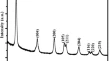
</text><graphic file="1556-276X-8-89-2"/></fig><p>X-ray diffraction (XRD) patterns of the bare TiO<sub>2</sub> nanorod array, the as-synthesized Sb<sub>2</sub>S<sub>3</sub>-TiO<sub>2</sub> nanostructure, and the annealed nanostructure are shown in Figure <figr fid="F3">3</figr>. Note in Figure <figr fid="F3">3</figr>a that the TiO<sub>2</sub> nanorod arrays grown on the FTO-coated glass substrates had a tetragonal rutile structure (JCPDS no. 02&#8211;0494), which may be attributed to the small lattice mismatch between FTO and rutile. The as-synthesized Sb<sub>2</sub>S<sub>3</sub>-TiO<sub>2</sub> nanostructure exhibited a weak diffraction peak (Figure <figr fid="F3">3</figr>b) at 2<it>&#952;</it> = 28.7&#176;, corresponding to the (230) plane of orthorhombic Sb<sub>2</sub>S<sub>3</sub>. As the annealing temperature increased, more diffraction peaks were observed, and the peaks became more distinct at the same time. Figure <figr fid="F3">3</figr>c shows the XRD pattern of the nanostructure annealed at less than 300&#176;C. All of the reflections were indexed to an orthorhombic phase of Sb<sub>2</sub>S<sub>3</sub> (JCPDS no. c-74-1046) <abbrgrp>
						<abbr bid="B23">23</abbr>
					</abbrgrp>. The shape of the diffraction peaks indicates that the product was well crystallized.</p>
				<fig id="F3"><title><p>Figure 3</p></title><caption><p>XRD patterns</p></caption><text>
   <p><b>XRD patterns.</b> The bare TiO<sub>2</sub> nanorod arrays (<b>a</b>), the as-grown Sb<sub>2</sub>S<sub>3</sub>-TiO<sub>2</sub> nanostructure electrode (<b>b</b>), and the annealed Sb<sub>2</sub>S<sub>3</sub>-TiO<sub>2</sub> nanostructure electrode under 300&#176;C (<b>c</b>).</p>
</text><graphic file="1556-276X-8-89-3"/></fig>
			</sec>
			<sec>
				<st>
					<p>Optical property of the Sb<sub>2</sub>S<sub>3</sub>-TiO<sub>2</sub> nanostructures</p>
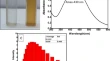
				</st><p>The UV-visible absorption spectra of Sb<sub>2</sub>S<sub>3</sub>-TiO<sub>2</sub> nanostructure samples are shown in Figure <figr fid="F4">4</figr>. An optical bandgap of 2.25 eV is estimated for the as-synthesized Sb<sub>2</sub>S<sub>3</sub> nanoparticles from the absorption spectra, which exhibits obvious blueshift compared with the value of bulk Sb<sub>2</sub>S<sub>3</sub>. After being annealed at 100&#176;C, 200&#176;C, and 300&#176;C for 30 min, the bandgap of Sb<sub>2</sub>S<sub>3</sub> nanoparticles was red shifted to 2.19 eV (565 nm), 2.13 eV (583 nm), and 1.73 eV (716 nm), respectively. When annealed at 400&#176;C, the absorption spectra deteriorated, which may be attributed to the oxidation as well as the evaporation of the Sb<sub>2</sub>S<sub>3</sub> nanoparticles. The Sb<sub>2</sub>S<sub>3</sub>-TiO<sub>2</sub> nanostructure annealed at 300&#176;C shows an enhanced absorption in the visible range, which is of great importance for solar cell applications and will result in higher power conversion efficiency. As shown by the XRD patterns and SEM images, this red shift in the annealed samples may be explained by the annealing-induced increase in particle size at the elevated temperatures. The annealing effect on the optical absorption spectra of bare TiO<sub>2</sub> nanorod arrays was also studied (not included here). No obvious difference was found between the samples with and without annealing treatment. This result suggests that although annealing changes the morphology and crystallinity of Sb<sub>2</sub>S<sub>3</sub> nanoparticles, it does not significantly affect the optical property of TiO<sub>2</sub> nanorod arrays.</p>
				<fig id="F4"><title><p>Figure 4</p></title><caption><p>Optical absorption spectra of Sb<sub>2</sub>S<sub>3</sub>-TiO<sub>2</sub> nanostructure samples</p></caption><text>
   <p><b>Optical absorption spectra of Sb<sub>2</sub>S<sub>3</sub>-TiO<sub>2</sub> nanostructure samples.</b> Before (green spectrum) and after being annealed at 100&#176;C (red spectrum), 200&#176;C (blue-green spectrum), 300&#176;C (black spectrum), and 400&#176;C (brown spectrum).</p>
</text><graphic file="1556-276X-8-89-4"/></fig>
			</sec>
			<sec>
				<st>
					<p>Photovoltaic performance of the solar cell based on Sb<sub>2</sub>S<sub>3</sub>-TiO<sub>2</sub> nanostructure</p>
				</st><p>The photocurrent-voltage (<it>I</it>-<it>V</it>) performances of the solar cells assembled using Sb<sub>2</sub>S<sub>3</sub>-TiO<sub>2</sub> nanostructures annealed under different temperatures are shown in Figure <figr fid="F5">5</figr>. The <it>I</it>-<it>V</it> curves of the samples were measured under one sun illumination (AM1.5, 100 mW/cm<sup>2</sup>). Compared with the solar cell based on as-grown Sb<sub>2</sub>S<sub>3</sub>-TiO<sub>2</sub> nanostructure, the solar cell performances correspondingly improved as the annealing temperatures increased from 100&#176;C to 300&#176;C. The open-circuit voltage (<it>V</it>
					<sub>oc</sub>) improved from 0.3 up to 0.39 V, and the short-circuit current density (<it>J</it>
					<sub>sc</sub>) improved from 6.2 up to 12.1 mA/cm<sup>2</sup>. A power conversion efficiency of 1.47% for the sample with annealing treatment was obtained, indicating an increase of 219% (as compared to the 0.46% for the as-grown sample) as a consequence of the annealing treatment. The photovoltaic performance of annealed Sb<sub>2</sub>S<sub>3</sub>-TiO<sub>2</sub> nanostructured solar cell under 400&#176;C deteriorated, which coincides with the absorption spectrum. Detailed parameters of the solar cells extracted from the <it>I</it>-<it>V</it> characteristics are listed in Table <tblr tid="T1">1</tblr>.</p>
				<fig id="F5"><title><p>Figure 5</p></title><caption><p><it>I</it>-<it>V</it> curves for the solar cells assembled using Sb<sub>2</sub>S<sub>3</sub>-TiO<sub>2</sub> nanostructures annealed under varied temperature.</p></caption><text>
   <p>
      <b>
         <it>I</it>
      </b>
      <b>-</b>
      <b>
         <it>V </it>
      </b>
      <b>curves for the solar cells assembled using Sb<sub>2</sub>S<sub>3</sub>-TiO<sub>2</sub> nanostructures annealed under varied temperature.</b>
   </p>
</text><graphic file="1556-276X-8-89-5"/></fig>
				<table id="T1">
					<title>
						<p>Table 1</p>
					</title>
					<caption>
						<p>
							<b>Parameters of Sb<sub>2</sub>S<sub>3</sub>-TiO<sub>2</sub> nanostructured solar cells annealed at different temperatures</b>
						</p>
					</caption>
					<tgroup align="left" cols="5">
						<colspec align="left" colname="c1" colnum="1" colwidth="1*"/>
						<colspec align="left" colname="c2" colnum="2" colwidth="1*"/>
						<colspec align="left" colname="c3" colnum="3" colwidth="1*"/>
						<colspec align="left" colname="c4" colnum="4" colwidth="1*"/>
						<colspec align="left" colname="c5" colnum="5" colwidth="1*"/>
						<thead valign="top">
							<row rowsep="1">
								<entry colname="c1"/>
								<entry colname="c2">
									<p>
										<b>
											<it>V</it>
										</b>
										<sub>
											<b>oc</b>
										</sub> <b>(V)</b>
									</p>
								</entry>
								<entry colname="c3">
									<p>
										<b>
											<it>J</it>
										</b>
										<sub>
											<b>sc</b>
										</sub> <b>(mA/cm</b>
										<sup>
											<b>2</b>
										</sup><b>)</b>
									</p>
								</entry>
								<entry colname="c4">
									<p>
										<b>FF (%)</b>
									</p>
								</entry>
								<entry colname="c5">
									<p>
										<b>
											<it>&#951; </it>
										</b><b>(%)</b>
									</p>
								</entry>
							</row>
						</thead>
						<tfoot>
							<p>
								<it>V</it>
								<sub>oc</sub>, open-circuit voltage; <it>J</it>
								<sub>sc</sub>, integral photocurrent density; FF, fill factor; <it>&#951;</it>, power conversion efficiency.</p>
						</tfoot>
						<tbody valign="top">
							<row>
								<entry colname="c1">
									<p>As-synthesized Sb<sub>2</sub>S<sub>3</sub>-TiO<sub>2</sub>
									</p>
								</entry>
								<entry colname="c2">
									<p>0.30</p>
								</entry>
								<entry colname="c3">
									<p>6.10</p>
								</entry>
								<entry colname="c4">
									<p>0.25</p>
								</entry>
								<entry colname="c5">
									<p>0.46</p>
								</entry>
							</row>
							<row>
								<entry colname="c1">
									<p>Sb<sub>2</sub>S<sub>3</sub>-TiO<sub>2</sub> under 100&#176;C</p>
								</entry>
								<entry colname="c2">
									<p>0.33</p>
								</entry>
								<entry colname="c3">
									<p>8.65</p>
								</entry>
								<entry colname="c4">
									<p>0.28</p>
								</entry>
								<entry colname="c5">
									<p>0.79</p>
								</entry>
							</row>
							<row>
								<entry colname="c1">
									<p>Sb<sub>2</sub>S<sub>3</sub>-TiO<sub>2</sub> under 200&#176;C</p>
								</entry>
								<entry colname="c2">
									<p>0.34</p>
								</entry>
								<entry colname="c3">
									<p>10.32</p>
								</entry>
								<entry colname="c4">
									<p>0.31</p>
								</entry>
								<entry colname="c5">
									<p>1.10</p>
								</entry>
							</row>
							<row>
								<entry colname="c1">
									<p>Sb<sub>2</sub>S<sub>3</sub>-TiO<sub>2</sub> under 300&#176;C</p>
								</entry>
								<entry colname="c2">
									<p>0.39</p>
								</entry>
								<entry colname="c3">
									<p>12.15</p>
								</entry>
								<entry colname="c4">
									<p>0.31</p>
								</entry>
								<entry colname="c5">
									<p>1.47</p>
								</entry>
							</row>
							<row rowsep="1">
								<entry colname="c1">
									<p>Sb<sub>2</sub>S<sub>3</sub>-TiO<sub>2</sub> under 400&#176;C</p>
								</entry>
								<entry colname="c2">
									<p>0.29</p>
								</entry>
								<entry colname="c3">
									<p>3.82</p>
								</entry>
								<entry colname="c4">
									<p>0.32</p>
								</entry>
								<entry colname="c5">
									<p>0.36</p>
								</entry>
							</row>
						</tbody>
					</tgroup>
				</table><p>This significant improvement of the photovoltaic performance obtained for annealed Sb<sub>2</sub>S<sub>3</sub>-TiO<sub>2</sub> nanostructured solar cells is explained by the following reasons: (1) An enhanced absorption of sunlight caused by the red shift of the bandgap will result in an enhanced current density. (2) Increase of Sb<sub>2</sub>S<sub>3</sub> grain size by annealing will reduce the particle-to-particle hopping of the photo-induced carrier. This hopping may occur in an as-grown nanostructure with Sb<sub>2</sub>S<sub>3</sub> nanoparticles. (3) Improvement of crystal quality of the Sb<sub>2</sub>S<sub>3</sub> nanoparticles by annealing treatment will decrease the internal defects, which can reduce the recombination of photoexcited carriers and result in higher power conversion efficiency. (4) Good contact between the Sb<sub>2</sub>S<sub>3</sub> nanoparticles and the TiO<sub>2</sub> nanorod is formed as a result of high-temperature annealing. Such a superior interface between TiO<sub>2</sub> and nanoparticles can inhibit the interfacial recombination of the injected electrons from TiO<sub>2</sub> to the electrolyte, which is also responsible for its higher efficiency.</p><p>Our findings suggest the possible use of 3D nanostructure material grown by a facile hydrothermal method for sensitized solar cell studies. The drawback of this type of solar cell is a rather poor fill factor, which limits the energy conversion efficiency. This low fill factor may be ascribed to the lower hole recovery rate of the polysulfide electrolyte, which leads to a higher probability for charge recombination <abbrgrp>
						<abbr bid="B24">24</abbr>
					</abbrgrp>. To further improve the efficiency of these nanorod array solar cells, we advise that a new hole transport medium with suitable redox potential and low electron recombination at the semiconductor and electrolyte interface should be developed. Moreover, as reported by Soel et al., other contributions such as the counter electrode material may also influence the fill factor <abbrgrp>
						<abbr bid="B25">25</abbr>
					</abbrgrp>.</p>
			</sec>
		</sec>
		<sec>
			<st>
				<p>Conclusions</p>
			</st><p>With a facile hydrothermal method, the single-crystalline TiO<sub>2</sub> nanorod arrays were successfully grown on fluorine-doped tin oxide glass. Next, Sb<sub>2</sub>S<sub>3</sub> nanoparticles were deposited by successive ionic layer adsorption and reaction method to form a Sb<sub>2</sub>S<sub>3</sub>-TiO<sub>2</sub> nanostructure for solar cell applications. Annealing treatment was conducted under varied temperatures, and the optimal annealing temperature of 300&#176;C was obtained. Obvious enhancement in visible light absorption was observed for the annealed samples. The photovoltaic performance for solar cells based on annealed Sb<sub>2</sub>S<sub>3</sub>-TiO<sub>2</sub> nanostructure shows an increase of up to 219% in power conversion efficiency.</p>
		</sec>
		<sec>
			<st>
				<p>Competing interests</p>
			</st><p>The authors declare that they have no competing interests.</p>
		</sec>
		<sec>
			<st>
				<p>Authors' contributions</p>
			</st><p>YL carried out the preparation of Sb<sub>2</sub>S<sub>3</sub>-TiO<sub>2</sub> nanostructured solar cells and drafted the manuscript. LW conducted the optical absorption spectra and the <it>I</it>-<it>V</it> measurements. RZ carried out the preparation of TiO<sub>2</sub> nanorod arrays and the XRD measurements. YC carried out the SEM characterization and supervised the work. LM and JJ analyzed the results and finalized the manuscript. All authors read and approved the final manuscript.</p>
		</sec>
	</bdy>
	<bm>
		<ack>
			<sec>
				<st>
					<p>Acknowledgments</p>
				</st><p>This work was supported by the National Key Basic Research Program of China (2013CB922303, 2010CB833103), the National Natural Science Foundation of China (60976073, 11274201, 51231007), the 111 Project (B13029), the National Found for Fostering Talents of Basic Science (J1103212), and the Foundation for Outstanding Young Scientist in Shandong Province (BS2010CL036).</p>
			</sec>
		</ack>
		<refgrp><bibl id="B1"><title><p>A low-cost, high-efficiency solar-cell based on dye-sensitized colloidal TiO2 films</p></title><aug><au><snm>O&apos;Regan</snm><fnm>B</fnm></au><au><snm>Gr&#228;tzel</snm><fnm>M</fnm></au></aug><source>Nature</source><pubdate>1991</pubdate><volume>353</volume><fpage>737</fpage><xrefbib><pubid idtype="doi">10.1038/353737a0</pubid></xrefbib></bibl><bibl id="B2"><title><p>Photoelectrochemical cells</p></title><aug><au><snm>Gr&#228;tzel</snm><fnm>M</fnm></au></aug><source>Nature</source><pubdate>2001</pubdate><volume>414</volume><fpage>338</fpage><xrefbib><pubidlist><pubid idtype="doi">10.1038/35104607</pubid><pubid idtype="pmpid" link="fulltext">11713540</pubid></pubidlist></xrefbib></bibl><bibl id="B3"><title><p>Structure and photovoltaic properties of ZnO nanowire for dye-sensitized solar cells</p></title><aug><au><snm>Kao</snm><fnm>MC</fnm></au><au><snm>Chen</snm><fnm>HZ</fnm></au><au><snm>Young</snm><fnm>SL</fnm></au><au><snm>Lin</snm><fnm>CC</fnm></au><au><snm>Kung</snm><fnm>CY</fnm></au></aug><source>Nanoscale Res Lett</source><pubdate>2012</pubdate><volume>7</volume><fpage>260</fpage><xrefbib><pubidlist><pubid idtype="doi">10.1186/1556-276X-7-260</pubid><pubid idtype="pmcid">3413507</pubid><pubid idtype="pmpid" link="fulltext">22607485</pubid></pubidlist></xrefbib></bibl><bibl id="B4"><title><p>Direct synthesis of vertically aligned ZnO nanowires on FTO substrates using a CVD method and the improvement of photovoltaic performance</p></title><aug><au><snm>Lu</snm><fnm>LY</fnm></au><au><snm>Chen</snm><fnm>JJ</fnm></au><au><snm>Li</snm><fnm>LJ</fnm></au><au><snm>Wang</snm><fnm>WY</fnm></au></aug><source>Nanoscale Res Lett</source><pubdate>2012</pubdate><volume>7</volume><fpage>293</fpage><xrefbib><pubidlist><pubid idtype="doi">10.1186/1556-276X-7-293</pubid><pubid idtype="pmcid">3413561</pubid><pubid idtype="pmpid" link="fulltext">22673046</pubid></pubidlist></xrefbib></bibl><bibl id="B5"><title><p>Novel micro-ring structured ZnO photoelectrode for dye-sensitized solar cell</p></title><aug><au><snm>Hossain</snm><fnm>MF</fnm></au><au><snm>Zhang</snm><fnm>ZH</fnm></au><au><snm>Takahashi</snm><fnm>T</fnm></au></aug><source>Nano-Micro Lett</source><pubdate>2010</pubdate><volume>2</volume><fpage>53</fpage></bibl><bibl id="B6"><title><p>Dye-sensitized solar cells with conversion efficiency of 11.1%</p></title><aug><au><snm>Yasuo</snm><fnm>C</fnm></au><au><snm>Ashraful</snm><fnm>I</fnm></au><au><snm>Yuki</snm><fnm>W</fnm></au><au><snm>Ryoichi</snm><fnm>K</fnm></au><au><snm>Naoki</snm><fnm>K</fnm></au><au><snm>HAN</snm><fnm>LY</fnm></au></aug><source>Jpn J Appl Phys</source><pubdate>2006</pubdate><volume>45</volume><fpage>638</fpage><xrefbib><pubid idtype="doi">10.1143/JJAP.45.638</pubid></xrefbib></bibl><bibl id="B7"><title><p>CdS quantum dots sensitized TiO2 nanotube-array photoelectrodes</p></title><aug><au><snm>Sun</snm><fnm>WT</fnm></au><au><snm>Yu</snm><fnm>Y</fnm></au><au><snm>Pan</snm><fnm>HY</fnm></au><au><snm>Gao</snm><fnm>XF</fnm></au><au><snm>Chen</snm><fnm>Q</fnm></au><au><snm>Peng</snm><fnm>LM</fnm></au></aug><source>J Am Chem Soc</source><pubdate>2008</pubdate><volume>130</volume><fpage>1125</fpage></bibl><bibl id="B8"><title><p>Au nanoparticles as interfacial layer for CdS quantum dot-sensitized solar cells</p></title><aug><au><snm>Zhu</snm><fnm>G</fnm></au><au><snm>Su</snm><fnm>FF</fnm></au><au><snm>Lv</snm><fnm>T</fnm></au><au><snm>Pan</snm><fnm>LK</fnm></au><au><snm>Sun</snm><fnm>Z</fnm></au></aug><source>Nanoscale Res Lett</source><pubdate>2010</pubdate><volume>5</volume><fpage>1749</fpage><xrefbib><pubidlist><pubid idtype="doi">10.1007/s11671-010-9705-z</pubid><pubid idtype="pmcid">2964506,2964506</pubid><pubid idtype="pmpid" link="fulltext">21124643</pubid></pubidlist></xrefbib></bibl><bibl id="B9"><title><p>Photosensitization of TiO2 nanorods with CdS quantum dots for photovoltaic applications: a wet-chemical approach</p></title><aug><au><snm>Wang</snm><fnm>CB</fnm></au><au><snm>Jiang</snm><fnm>ZF</fnm></au><au><snm>Wei</snm><fnm>L</fnm></au><au><snm>Chen</snm><fnm>YX</fnm></au><au><snm>Jiao</snm><fnm>J</fnm></au><au><snm>Eastman</snm><fnm>M</fnm></au><au><snm>Liu</snm><fnm>H</fnm></au></aug><source>Nano Energy</source><pubdate>2012</pubdate><volume>1</volume><fpage>440</fpage><xrefbib><pubid idtype="doi">10.1016/j.nanoen.2012.02.005</pubid></xrefbib></bibl><bibl id="B10"><title><p>Highly efficient CdS/CdSe-sensitized solar cells controlled by the structural properties of compact porous TiO2 photoelectrodes</p></title><aug><au><snm>Zhang</snm><fnm>QX</fnm></au><au><snm>Guo</snm><fnm>XZ</fnm></au><au><snm>Huang</snm><fnm>XM</fnm></au><au><snm>Huang</snm><fnm>SQ</fnm></au><au><snm>Li</snm><fnm>DM</fnm></au><au><snm>Luo</snm><fnm>YH</fnm></au><au><snm>Shen</snm><fnm>Q</fnm></au><au><snm>Toyoda</snm><fnm>T</fnm></au><au><snm>Meng</snm><fnm>QB</fnm></au></aug><source>Phys Chem Chem Phys</source><pubdate>2011</pubdate><volume>13</volume><fpage>4659</fpage><xrefbib><pubidlist><pubid idtype="doi">10.1039/c0cp02099k</pubid><pubid idtype="pmpid" link="fulltext">21283841</pubid></pubidlist></xrefbib></bibl><bibl id="B11"><title><p>Facile solution growth of vertically aligned ZnO nanorods sensitized with aqueous CdS and CdSe quantum dots for photovoltaic applications</p></title><aug><au><snm>Luan</snm><fnm>CY</fnm></au><au><snm>Aleksandar</snm><fnm>V</fnm></au><au><snm>Andrei</snm><fnm>SS</fnm></au><au><snm>Xu</snm><fnm>XQ</fnm></au><au><snm>Wang</snm><fnm>HE</fnm></au><au><snm>Chen</snm><fnm>X</fnm></au><au><snm>Xu</snm><fnm>J</fnm></au><au><snm>Zhang</snm><fnm>WJ</fnm></au><au><snm>Lee</snm><fnm>CS</fnm></au><au><snm>Andrey</snm><fnm>LR</fnm></au><au><snm>Juan</snm><fnm>AZ</fnm></au></aug><source>Nanoscale Res Lett</source><pubdate>2011</pubdate><volume>6</volume><fpage>340</fpage><xrefbib><pubidlist><pubid idtype="doi">10.1186/1556-276X-6-340</pubid><pubid idtype="pmcid">3211429</pubid><pubid idtype="pmpid" link="fulltext">21711865</pubid></pubidlist></xrefbib></bibl><bibl id="B12"><title><p>Open structure ZnO/CdSe core/shell nanoneedle arrays for solar cells</p></title><aug><au><snm>Chen</snm><fnm>YX</fnm></au><au><snm>Wei</snm><fnm>L</fnm></au><au><snm>Zhang</snm><fnm>GH</fnm></au><au><snm>Jiao</snm><fnm>J</fnm></au></aug><source>Nanoscale Res Lett</source><pubdate>2012</pubdate><volume>7</volume><fpage>516</fpage><xrefbib><pubidlist><pubid idtype="doi">10.1186/1556-276X-7-516</pubid><pubid idtype="pmcid">3475031</pubid><pubid idtype="pmpid" link="fulltext">22995031</pubid></pubidlist></xrefbib></bibl><bibl id="B13"><title><p>Reduced charge recombination in a co-sensitized quantum dot solar cell with two different sizes of CdSe quantum dot</p></title><aug><au><snm>Chen</snm><fnm>J</fnm></au><au><snm>Lei</snm><fnm>W</fnm></au><au><snm>Deng</snm><fnm>WQ</fnm></au></aug><source>Nanoscale</source><pubdate>2011</pubdate><volume>3</volume><fpage>674</fpage><xrefbib><pubidlist><pubid idtype="doi">10.1039/c0nr00591f</pubid><pubid idtype="pmpid" link="fulltext">21132215</pubid></pubidlist></xrefbib></bibl><bibl id="B14"><title><p>Improved conversion efficiency of Ag2S quantum dot-sensitized solar cells based on TiO2 nanotubes with a ZnO recombination barrier layer</p></title><aug><au><snm>Chen</snm><fnm>C</fnm></au><au><snm>Xie</snm><fnm>Y</fnm></au><au><snm>Ali</snm><fnm>G</fnm></au><au><snm>Yoo</snm><fnm>SH</fnm></au><au><snm>Cho</snm><fnm>SO</fnm></au></aug><source>Nanoscale Res Lett</source><pubdate>2011</pubdate><volume>6</volume><fpage>462</fpage><xrefbib><pubidlist><pubid idtype="doi">10.1186/1556-276X-6-462</pubid><pubid idtype="pmcid">3211883</pubid><pubid idtype="pmpid" link="fulltext">21777458</pubid></pubidlist></xrefbib></bibl><bibl id="B15"><title><p>Effect of internal surface area on the performance of ZnO/In2S3/CuSCN solar cells with extremely thin absorber</p></title><aug><au><snm>Kieven</snm><fnm>D</fnm></au><au><snm>Dittrich</snm><fnm>T</fnm></au><au><snm>Belaidi</snm><fnm>A</fnm></au><au><snm>Tornow</snm><fnm>J</fnm></au><au><snm>Schwarzburg</snm><fnm>K</fnm></au><au><snm>Allsop</snm><fnm>N</fnm></au><au><snm>Lux-Steiner</snm><fnm>M</fnm></au></aug><source>Appl Phys Lett</source><pubdate>2008</pubdate><volume>92</volume><fpage>153107</fpage><xrefbib><pubid idtype="doi">10.1063/1.2909576</pubid></xrefbib></bibl><bibl id="B16"><title><p>Hybrid polymer/ZnO solar cells sensitized by PbS quantum dots</p></title><aug><au><snm>Wang</snm><fnm>LD</fnm></au><au><snm>Zhao</snm><fnm>DX</fnm></au><au><snm>Su</snm><fnm>ZS</fnm></au><au><snm>Shen</snm><fnm>DZ</fnm></au></aug><source>Nanoscale Res Lett</source><pubdate>2012</pubdate><volume>7</volume><fpage>106</fpage><xrefbib><pubidlist><pubid idtype="doi">10.1186/1556-276X-7-106</pubid><pubid idtype="pmcid">3292495</pubid><pubid idtype="pmpid" link="fulltext">22313746</pubid></pubidlist></xrefbib></bibl><bibl id="B17"><title><p>A chemical precursor for depositing Sb2S3 onto mesoporous TiO2 layers in nonaqueous media and its application to solar cells</p></title><aug><au><snm>Maiti</snm><fnm>N</fnm></au><au><snm>Im</snm><fnm>SH</fnm></au><au><snm>Lim</snm><fnm>CS</fnm></au><au><snm>Seok</snm><fnm>SI</fnm></au></aug><source>Dalton Trans</source><pubdate>2012</pubdate><volume>41</volume><fpage>11569</fpage><xrefbib><pubidlist><pubid idtype="doi">10.1039/c2dt31348k</pubid><pubid idtype="pmpid" link="fulltext">22918132</pubid></pubidlist></xrefbib></bibl><bibl id="B18"><title><p>Enhanced photoelectrochemical properties of Cu2O-loaded short TiO2 nanotube array electrode prepared by sonoelectrochemical deposition</p></title><aug><au><snm>Liu</snm><fnm>YB</fnm></au><au><snm>Zhou</snm><fnm>HB</fnm></au><au><snm>Li</snm><fnm>JH</fnm></au><au><snm>Chen</snm><fnm>HC</fnm></au><au><snm>Li</snm><fnm>D</fnm></au><au><snm>Zhou</snm><fnm>BX</fnm></au><au><snm>Cai</snm><fnm>WM</fnm></au></aug><source>Nano-Micro Lett</source><pubdate>2010</pubdate><volume>2</volume><fpage>277</fpage></bibl><bibl id="B19"><title><p>Strain-free ring-shaped nanostructures by droplet epitaxy for photovoltaic application</p></title><aug><au><snm>Wu</snm><fnm>J</fnm></au><au><snm>Wang</snm><fnm>ZM</fnm></au><au><snm>Dorogan</snm><fnm>VG</fnm></au><au><snm>Li</snm><fnm>SB</fnm></au><au><snm>Zhou</snm><fnm>ZH</fnm></au><au><snm>Li</snm><fnm>HD</fnm></au><au><snm>Lee</snm><fnm>JH</fnm></au><au><snm>Kim</snm><fnm>ES</fnm></au><au><snm>Mazur</snm><fnm>YI</fnm></au><au><snm>Salamo</snm><fnm>GJ</fnm></au></aug><source>Appl Phys Lett</source><pubdate>2012</pubdate><volume>101</volume><fpage>043904</fpage><xrefbib><pubid idtype="doi">10.1063/1.4738996</pubid></xrefbib></bibl><bibl id="B20"><title><p>Sb2S3-sensitized nanoporous TiO2 solar cells</p></title><aug><au><snm>Yafit</snm><fnm>I</fnm></au><au><snm>Olivia</snm><fnm>N</fnm></au><au><snm>Miles</snm><fnm>P</fnm></au><au><snm>Gary</snm><fnm>H</fnm></au></aug><source>J Phys Chem C</source><pubdate>2009</pubdate><volume>113</volume><fpage>4254</fpage><xrefbib><pubid idtype="doi">10.1021/jp900302b</pubid></xrefbib></bibl><bibl id="B21"><title><p>Sb2S3-based mesoscopic solar cell using an organic hole conductor</p></title><aug><au><snm>Moon</snm><fnm>SJ</fnm></au><au><snm>Itzhaik</snm><fnm>Y</fnm></au><au><snm>Yum</snm><fnm>JH</fnm></au><au><snm>Zakeeruddin</snm><fnm>SM</fnm></au><au><snm>Hodes</snm><fnm>G</fnm></au><au><snm>Gratzel</snm><fnm>M</fnm></au></aug><source>J Phys Chem Lett</source><pubdate>2010</pubdate><volume>1</volume><fpage>1524</fpage><xrefbib><pubid idtype="doi">10.1021/jz100308q</pubid></xrefbib></bibl><bibl id="B22"><title><p>Performance improvement of Sb2S3-sensitized solar cell by introducing hole buffer layer in cobalt complex electrolyte</p></title><aug><au><snm>Im</snm><fnm>SH</fnm></au><au><snm>Kim</snm><fnm>HJ</fnm></au><au><snm>Rhee</snm><fnm>JH</fnm></au><au><snm>Lim</snm><fnm>CS</fnm></au><au><snm>Seok</snm><fnm>SI</fnm></au></aug><source>Energy Environ Sci</source><pubdate>2011</pubdate><volume>4</volume><fpage>2799</fpage><xrefbib><pubid idtype="doi">10.1039/c0ee00741b</pubid></xrefbib></bibl><bibl id="B23"><title><p>Synthesis of Sb2S3 peanut-shaped superstructures</p></title><aug><au><snm>Han</snm><fnm>QF</fnm></au><au><snm>Chen</snm><fnm>L</fnm></au><au><snm>Zhu</snm><fnm>WC</fnm></au><au><snm>Wang</snm><fnm>MJ</fnm></au><au><snm>Wang</snm><fnm>X</fnm></au><au><snm>Yang</snm><fnm>XJ</fnm></au><au><snm>Lu</snm><fnm>LD</fnm></au></aug><source>Mater Lett</source><pubdate>2009</pubdate><volume>63</volume><fpage>1030</fpage><xrefbib><pubid idtype="doi">10.1016/j.matlet.2009.01.078</pubid></xrefbib></bibl><bibl id="B24"><title><p>Efficient polysulfide electrolyte for CdS quantum dot-sensitized solar cells</p></title><aug><au><snm>Lee</snm><fnm>YL</fnm></au><au><snm>Chang</snm><fnm>CH</fnm></au></aug><source>J Power Sources</source><pubdate>2008</pubdate><volume>185</volume><fpage>584</fpage><xrefbib><pubid idtype="doi">10.1016/j.jpowsour.2008.07.014</pubid></xrefbib></bibl><bibl id="B25"><title><p>Highly efficient and durable quantum dot sensitized ZnO nanowire solar cell using noble-metal-free counter electrode</p></title><aug><au><snm>Seol</snm><fnm>M</fnm></au><au><snm>Ramasamy</snm><fnm>E</fnm></au><au><snm>Lee</snm><fnm>J</fnm></au><au><snm>Yong</snm><fnm>K</fnm></au></aug><source>J Phys Chem C</source><pubdate>2011</pubdate><volume>115</volume><fpage>22018</fpage><xrefbib><pubid idtype="doi">10.1021/jp205844r</pubid></xrefbib></bibl></refgrp>
	</bm>
</art>