<?xml version='1.0'?>
<!DOCTYPE art SYSTEM 'http://www.biomedcentral.com/xml/article.dtd'>
<art>
	<ui>1556-276X-8-84</ui>
	<ji>1556-276X</ji>
	<fm>
		<dochead>Nano Express</dochead>
		<bibl>
			<title>
				<p>On the formation of blisters in annealed hydrogenated a-Si layers</p>
			</title>
			<aug>
				<au id="A1"><snm>Ser&#233;nyi</snm><fnm>Mikl&#243;s</fnm><insr iid="I1"/><email>serenyi@ttk.mta.hu</email></au>
				<au id="A2" ca="yes"><snm>Frigeri</snm><fnm>Cesare</fnm><insr iid="I2"/><email>frigeri@imem.cnr.it</email></au>
				<au id="A3"><snm>Szekr&#233;nyes</snm><fnm>Zsolt</fnm><insr iid="I3"/><email>szekrenyes.zsolt@wigner.mta.hu</email></au>
				<au id="A4"><snm>Kamar&#225;s</snm><fnm>Katalin</fnm><insr iid="I3"/><email>kamaras.katalin@wigner.mta.hu</email></au>
				<au id="A5"><snm>Nasi</snm><fnm>Lucia</fnm><insr iid="I2"/><email>nasi@imem.cnr.it</email></au>
				<au id="A6"><snm>Csik</snm><fnm>Attila</fnm><insr iid="I4"/><email>csik@atomki.hu</email></au>
				<au id="A7"><snm>Kh&#225;nh</snm><fnm>Nguyen Quoc</fnm><insr iid="I1"/><email>n.q.khanh@ttk.mta.hu</email></au>
			</aug>
			<insg>
				<ins id="I1"><p>Institute of Technical Physics and Materials Science, Research Centre for Natural Sciences, Hungarian Academy of Sciences, P.O. Box 49, Budapest H-1525, Hungary</p></ins>
				<ins id="I2"><p>CNR-IMEM Institute, Parco Area delle Scienze 37/A, Parma 43100, Italy</p></ins>
				<ins id="I3"><p>Institute for Solid State Physics and Optics, Wigner Research Centre for Physics, Hungarian Academy of Sciences, P.O. Box 49, Budapest H-1525, Hungary</p></ins>
				<ins id="I4"><p>Institute of Nuclear Research of the Hungarian Academy of Sciences, P.O. Box 51, Debrecen H-4001, Hungary</p></ins>
			</insg>
			<source>Nanoscale Research Letters</source>
			<section><title><p>Nanoengineering</p></title></section><issn>1556-276X</issn>
			<pubdate>2013</pubdate>
			<volume>8</volume>
			<issue>1</issue>
			<fpage>84</fpage>
			<url>http://www.nanoscalereslett.com/content/8/1/84</url>
			<xrefbib><pubidlist><pubid idtype="doi">10.1186/1556-276X-8-84</pubid><pubid idtype="pmpid">23413996</pubid></pubidlist></xrefbib>
		</bibl>
		<history><rec><date><day>12</day><month>9</month><year>2012</year></date></rec><acc><date><day>10</day><month>1</month><year>2013</year></date></acc><pub><date><day>15</day><month>2</month><year>2013</year></date></pub></history>
		<cpyrt><year>2013</year><collab>Ser&#233;nyi et al.; licensee Springer.</collab><note>This is an Open Access article distributed under the terms of the Creative Commons Attribution License (
				<url>http://creativecommons.org/licenses/by/2.0</url>), which permits unrestricted use, distribution, and reproduction in any medium, provided the original work is properly cited.</note></cpyrt>
		<kwdg>
			<kwd>Amorphous Si</kwd>
			<kwd>Hydrogen</kwd>
			<kwd>Annealing</kwd>
			<kwd>IR spectroscopy</kwd>
			<kwd>Blister</kwd>
		</kwdg>
		<abs>
			<sec>
				<st>
					<p>Abstract</p>
				</st>
				<p>Differently hydrogenated radio frequency-sputtered a-Si layers have been studied by infrared (IR) spectroscopy as a function of the annealing time at 350&#176;C with the aim to get a deeper understanding of the origin of blisters previously observed by us in a-Si/a-Ge multilayers prepared under the same conditions as the ones applied to the present a-Si layers. The H content varied between 10.8 and 17.6 at.% as measured by elastic recoil detection analysis. IR spectroscopy showed that the concentration of the clustered (Si-H)<sub>
						<it>n</it>
					</sub> groups and of the (Si-H<sub>2</sub>)<sub>
						<it>n</it>
					</sub> (<it>n</it> &#8805; 1) polymers increased at the expense of the Si-H mono-hydrides with increasing annealing time, suggesting that there is a corresponding increase of the volume of micro-voids whose walls are assumed from literature to be decorated by the clustered mono-hydride groups and polymers. At the same time, an increase in the size of surface blisters was observed. Also, with increasing annealing time, the total concentration of bonded H of any type decreases, indicating that H is partially released from its bonds to Si. It is argued that the H released from the (Si-H)<sub>
						<it>n</it>
					</sub> complexes and polymers at the microvoid surfaces form molecular H<sub>2</sub> inside the voids, whose size increases upon annealing because of the thermal expansion of the H<sub>2</sub> gas, eventually producing plastic surface deformation in the shape of blisters.</p>
			</sec>
		</abs>
	</fm>
	<meta><classifications><classification id="EMRS" subtype="theme_series_title" type="BMC">EMRS-E SiGe 2012</classification><classification id="EMRS" subtype="theme_series_editor" type="BMC">Grzegorz Zatryb and Artur Podhorodecki</classification></classifications></meta><bdy>
		<sec>
			<st>
				<p>Background</p>
			</st>
			<p>The electrical and structural properties of hydrogenated amorphous Si, Ge and SiGe are particularly affected by the hydrogen incorporated and its bonding configuration. On one hand, H has proven to be very efficient in reducing the density of open dangling bonds responsible for deep levels in the bandgap. By hydrogenation, their density can be reduced to 10<sup>15</sup> to 10<sup>16</sup> cm<sup>&#8722;3</sup> in a-Si 
				<abbrgrp>
					<abbr bid="B1">1</abbr>
				</abbrgrp>, which is quite acceptable for device applications, e.g. in photovoltaic solar cells 
				<abbrgrp>
					<abbr bid="B2">2</abbr>
				</abbrgrp>. On the other hand, the H bonding configuration may negatively affect the microstructure of the amorphous lattice. In a-Si, hydrogen is bonded in two modes: as randomly distributed H bonded at isolated network sites (passivating the dangling bonds) and as H bonded in the form of clusters 
				<abbrgrp>
					<abbr bid="B1">1</abbr>
					<abbr bid="B3">3</abbr>
					<abbr bid="B4">4</abbr>
					<abbr bid="B5">5</abbr>
					<abbr bid="B6">6</abbr>
				</abbrgrp>. Smets found that H is silicon-bonded in hydrogenated di-vacancies 
				<abbrgrp>
					<abbr bid="B1">1</abbr>
					<abbr bid="B7">7</abbr>
				</abbrgrp> for low H content. Alternatively, the H clusters are accommodated on the surfaces of voids larger than di-vacancies 
				<abbrgrp>
					<abbr bid="B4">4</abbr>
					<abbr bid="B5">5</abbr>
					<abbr bid="B6">6</abbr>
				</abbrgrp>. Nano- and micro-voids have been detected in a-Si 
				<abbrgrp>
					<abbr bid="B5">5</abbr>
					<abbr bid="B7">7</abbr>
					<abbr bid="B8">8</abbr>
					<abbr bid="B9">9</abbr>
					<abbr bid="B10">10</abbr>
				</abbrgrp> as well as in a-Ge 
				<abbrgrp>
					<abbr bid="B11">11</abbr>
				</abbrgrp>. Such voids are normally present in as-prepared amorphous materials.</p>
			<p>As also recently pointed out by Beyer 
				<abbrgrp>
					<abbr bid="B7">7</abbr>
				</abbrgrp>, voids are still one of the major defects in hydrogenated a-Si. Being empty spaces, they cause density reduction that can change the refractive index, electronic defect states 
				<abbrgrp>
					<abbr bid="B7">7</abbr>
				</abbrgrp> and anomalous stress distribution especially if filled with H 
				<abbrgrp>
					<abbr bid="B12">12</abbr>
				</abbrgrp> or if they form Si-H platelets 
				<abbrgrp>
					<abbr bid="B13">13</abbr>
				</abbrgrp>. Furthermore, the mentioned H clusters that are situated on the inner surfaces of voids can give rise to potential fluctuations in the bulk that deteriorate the electro-optical properties 
				<abbrgrp>
					<abbr bid="B14">14</abbr>
					<abbr bid="B15">15</abbr>
				</abbrgrp>. In a-Si, an increased concentration of Si poly-hydrides, e.g. Si-H<sub>2</sub> di-hydrides, was seen to increase the optical bandgap 
				<abbrgrp>
					<abbr bid="B6">6</abbr>
				</abbrgrp> and decrease the refractive index 
				<abbrgrp>
					<abbr bid="B16">16</abbr>
				</abbrgrp>. Voids, and related H bonding configurations, are also believed to be involved in the Staebler-Wronsky effect 
				<abbrgrp>
					<abbr bid="B17">17</abbr>
					<abbr bid="B18">18</abbr>
				</abbrgrp>, i.e. degradation of the hydrogenated a-Si properties upon illumination 
				<abbrgrp>
					<abbr bid="B1">1</abbr>
					<abbr bid="B9">9</abbr>
				</abbrgrp>.</p>
			<p>According to Beyer, cavities in the material are most crucial if they are large enough to accommodate H molecules 
				<abbrgrp>
					<abbr bid="B7">7</abbr>
				</abbrgrp>. In such a case, in fact, hydrogen may desorb as H<sub>2</sub> with the consequent reconstruction of dangling bonds and Si-Si weak bonds, which causes deterioration of the electronic properties 
				<abbrgrp>
					<abbr bid="B7">7</abbr>
				</abbrgrp>. This work is a contribution in the field of the relationship between H content, H bonding configuration and voids in hydrogenated a-Si single layers deposited by radio frequency (RF) sputtering and subsequently annealed. It was prompted by the need to improve understanding of our previous results about the presence of blisters in hydrogenated a-Si/a-Ge multilayers sputtered in the same way and submitted to annealing with the aim to produce the a-SiGe alloy by Si and Ge diffusion and intermixing 
				<abbrgrp>
					<abbr bid="B19">19</abbr>
					<abbr bid="B20">20</abbr>
				</abbrgrp>. It is reported here that annealing of the single a-Si layers causes the voids to grow to such a size to form surface blisters detectable by AFM (atomic force microscopy). By using infrared (IR) spectroscopy, it is shown that the annealing causes the formation of (Si-H)<sub>
					<it>n</it>
				</sub> clusters and (Si-H<sub>2</sub>)<sub>
					<it>n</it>
				</sub> (<it>n</it> &#8805; 1) polymers covering the surface of voids. It is then argued that the blisters grow from such voids by accumulation of molecular H<sub>2</sub> that had formed by reaction between H atoms released from the (Si-H)<sub>
					<it>n</it>
				</sub> clusters and (Si-H<sub>2</sub>)<sub>
					<it>n</it>
				</sub> (<it>n</it> &#8805; 1) polymers. The results reported here support and confirm our previous hypothesis that ascribed the blisters in a-Si/a-Ge multilayers to the formation of bubbles containing molecular H<sub>2</sub>
				<abbrgrp>
					<abbr bid="B19">19</abbr>
					<abbr bid="B20">20</abbr>
				</abbrgrp>.</p>
		</sec>
		<sec>
			<st>
				<p>Methods</p>
			</st>
			<p>The a-Si layers have been sputtered at a rate of 6.3 nm/min from a high-purity crystalline silicon target in a high-vacuum sputtering apparatus (Leybold Z400, Fergutec, Valkenswaard, The Netherlands) reaching a base pressure better than 5 &#215; 10<sup>&#8722;5</sup> Pa by a turbo molecular pump. The target was coupled to a RF generator (13.56 MHz) via a network for impedance matching between the generator and its load. The substrate was polished (100) silicon wafer and at a distance of 50 mm away from the target. The layer thickness was approximately 400 nm. Sputtering has been done with a mixture of high-purity argon and hydrogen gases. Both gases have been introduced continuously into the chamber by means of electronically adjustable flow controls. A 1,500-V dc wall potential has been applied to sputter the targets under a plasma pressure of 2 Pa. The samples were annealed in high-purity (99.999%) argon at 350&#176;C for 1 and 4 h.</p>
			<p>Controlled layer hydrogenation has been obtained by allowing H to flow continuously into the deposition chamber at different flow rates, namely 0.4, 0.8 and 1.5 ml/min, corresponding to an effective H incorporation in the as-deposited layers of 10.8, 14.7 and 17.6 at.%, respectively, as determined by elastic recoil detection analysis (ERDA). The ERDA measurements were performed with the 1.6 MeV <sup>4</sup>He<sup>+</sup> beam at the 5 MeV Van de Graaff accelerator of Budapest on a-Si layers 40-nm thick. The recoiled H signal was collected by an Si detector placed at 10&#176; detecting angle to the beam direction, with the sample tilted 85&#176; to the normal. Almost background-free ERDA spectra for H were obtained by placing a 6-&#956;m-thick Mylar foil in front of the detector to stop the forward-scattered He ions. Further details can be found in 
				<abbrgrp>
					<abbr bid="B21">21</abbr>
				</abbrgrp>.</p>
			<p>The configuration of the H bonds to Si before and after annealing was evaluated by Fourier transform infrared spectroscopy by employing a Bruker Tensor 37 spectrometer (Bruker, Ettlingen, Germany) with 2 cm<sup>&#8722;1</sup> resolution. All spectra were taken in the 400 to 4,000 cm<sup>&#8722;1</sup> range with a Ge/KBr beam splitter, while the baseline was corrected by an adjusted polynomial function. The index of absorption &#945;(<it>&#969;</it>) is determined from the formula for the <it>T</it> transmission coefficient of the film with thickness <it>d</it>
				<abbrgrp>
					<abbr bid="B22">22</abbr>
				</abbrgrp>
			</p>
			<p>
				<display-formula id="M1">
					<m:math name="1556-276X-8-84-i1" xmlns:m="http://www.w3.org/1998/Math/MathML"><m:mrow>
   <m:mi>T</m:mi>
   <m:mfenced open="(" close=")">
      <m:mi>&#969;</m:mi>
   </m:mfenced>
   <m:mo>=</m:mo>
   <m:mfrac>
      <m:mrow>
         <m:mn>4</m:mn>
         <m:msubsup>
            <m:mi>T</m:mi>
            <m:mn>0</m:mn>
            <m:mn>2</m:mn>
         </m:msubsup>
         <m:msup>
            <m:mi>e</m:mi>
            <m:mrow>
               <m:mo>&#8722;</m:mo>
               <m:mi mathvariant="italic">&#945;d</m:mi>
            </m:mrow>
         </m:msup>
      </m:mrow>
      <m:mrow>
         <m:msup>
            <m:mfenced open="(" close=")">
               <m:mrow>
                  <m:mn>1</m:mn>
                  <m:mo>+</m:mo>
                  <m:msub>
                     <m:mi>T</m:mi>
                     <m:mn>0</m:mn>
                  </m:msub>
               </m:mrow>
            </m:mfenced>
            <m:mn>2</m:mn>
         </m:msup>
         <m:mo>+</m:mo>
         <m:msup>
            <m:mfenced open="(" close=")">
               <m:mrow>
                  <m:mn>1</m:mn>
                  <m:mo>&#8722;</m:mo>
                  <m:msub>
                     <m:mi>T</m:mi>
                     <m:mn>0</m:mn>
                  </m:msub>
               </m:mrow>
            </m:mfenced>
            <m:mn>2</m:mn>
         </m:msup>
         <m:mo>&#215;</m:mo>
         <m:msup>
            <m:mi>e</m:mi>
            <m:mrow>
               <m:mo>&#8722;</m:mo>
               <m:mn>2</m:mn>
               <m:mi mathvariant="italic">&#945;d</m:mi>
            </m:mrow>
         </m:msup>
      </m:mrow>
   </m:mfrac>
</m:mrow>
</m:math>
				</display-formula>
			</p>
			<p>where <it>T</it>
				<sub>0</sub> is the transmission coefficient of the crystalline silicon substrate. Brodsky et al. verified that the equation is correct within &#177;10% only for &#945;<it>d</it> &gt; 0.1 
				<abbrgrp>
					<abbr bid="B22">22</abbr>
				</abbrgrp>. <it>T</it>
				<sub>0</sub> of the single-side-polished substrate was determined experimentally in relation of the transmission through a double specimen to a single one. We found that in the wavenumber region going from 3,000 to 500 cm<sup>&#8722;1</sup>, <it>T</it>
				<sub>0</sub> monotonically decreases from 23% to 16%. This behaviour can be ascribed to the wavelength-dependent light scattering of the rough back side of the wafer.</p>
			<p>The concentration <it>N</it>
				<sub>H</sub> (cm<sup>&#8722;3</sup>) of bonded H is obtained by integrating the peaks in the IR spectrum of the absorption coefficient &#945;(<it>&#969;</it>) through the formula 
				<abbrgrp>
					<abbr bid="B6">6</abbr>
					<abbr bid="B22">22</abbr>
					<abbr bid="B23">23</abbr>
					<abbr bid="B24">24</abbr>
				</abbrgrp>
			</p>
			<p>
				<display-formula id="M2">
					<m:math name="1556-276X-8-84-i2" xmlns:m="http://www.w3.org/1998/Math/MathML"><m:mrow>
   <m:msub>
      <m:mi>N</m:mi>
      <m:mi>H</m:mi>
   </m:msub>
   <m:mo>=</m:mo>
   <m:mi>A</m:mi>
   <m:mstyle displaystyle="true">
      <m:mo>&#8747;</m:mo>
   </m:mstyle>
   <m:mfenced open="[" close="]">
      <m:mrow>
         <m:mi mathvariant="normal">&#945;</m:mi>
         <m:mfenced open="(" close=")">
            <m:mi>&#969;</m:mi>
         </m:mfenced>
         <m:mo stretchy="true">/</m:mo>
         <m:mi>&#969;</m:mi>
      </m:mrow>
   </m:mfenced>
   <m:mi mathvariant="italic">d&#969;</m:mi>
   <m:mo>=</m:mo>
   <m:mi>A</m:mi>
   <m:mo>&#215;</m:mo>
   <m:mtext>I</m:mtext>
</m:mrow>
</m:math>
				</display-formula>
			</p>
			<p>where <it>A</it> (cm<sup>&#8722;2</sup>) is a proportionality constant that depends on the vibration mode, <it>&#969;</it> is the oscillatory frequency, or wavenumber (cm<sup>&#8722;1</sup>), and <it>I</it> is the value of the integral, i.e. the integrated absorption intensity. The integral is extended only to the absorption mode of interest. The total <it>N</it>
				<sub>H</sub> is calculated either from the wagging mode (at approximately 640 cm<sup>&#8722;1</sup> for Si) or from the stretching mode. In the latter case, since the stretching mode often consists of two peaks at approximately 2,000 and 2,100 cm<sup>&#8722;1</sup>, <it>N</it>
				<sub>H</sub> is given by 
				<abbrgrp>
					<abbr bid="B23">23</abbr>
					<abbr bid="B24">24</abbr>
				</abbrgrp>
			</p>
			<p>
				<display-formula id="M3">
					<m:math name="1556-276X-8-84-i3" xmlns:m="http://www.w3.org/1998/Math/MathML"><m:mrow>
   <m:msub>
      <m:mi>N</m:mi>
      <m:mi>H</m:mi>
   </m:msub>
   <m:mo>=</m:mo>
   <m:msub>
      <m:mi>A</m:mi>
      <m:mn>2000</m:mn>
   </m:msub>
   <m:mo>&#215;</m:mo>
   <m:msub>
      <m:mi>I</m:mi>
      <m:mn>2000</m:mn>
   </m:msub>
   <m:mo>+</m:mo>
   <m:msub>
      <m:mi>A</m:mi>
      <m:mn>2100</m:mn>
   </m:msub>
   <m:mo>&#215;</m:mo>
   <m:msub>
      <m:mi>I</m:mi>
      <m:mn>2100</m:mn>
   </m:msub>
</m:mrow>
</m:math>
				</display-formula>
			</p>
			<p>Very often, just the integrated intensity <it>I</it> is used since it is proportional to the concentration of H bonds to Si apart from a constant value. This procedure is mostly used in this paper. The sample structure was analysed by AFM with a Veeco Dimension 3100 instrument (Veeco Instruments Inc., Plainview, NY, USA) in the tapping mode.</p>
		</sec>
		<sec>
			<st>
				<p>Results and discussion</p>
			</st>
			<p>Being well established that ERDA provides very reliable absolute values of concentration, the ERDA results about the H concentration have been used to check whether IR can reliably follow the qualitative evolution of the Si-hydrogen bonding configurations as a function of annealing time. To this aim, the relative H concentration, <it>C</it>
				<sub>H</sub> = <it>N</it>
				<sub>H</sub>/<it>N</it>
				<sub>Si</sub> with <it>N</it>
				<sub>Si</sub> the atomic density of Si (5 &#215; 10<sup>22</sup> cm<sup>&#8722;3</sup>), was calculated from deconvoluted IR spectra in the stretching mode range as described in the &#8216;Methods&#8217; section. Several values for the <it>A</it> of the stretching mode to be included in Equations 2 and 3 have appeared in the literature 
				<abbrgrp>
					<abbr bid="B1">1</abbr>
					<abbr bid="B22">22</abbr>
					<abbr bid="B23">23</abbr>
					<abbr bid="B24">24</abbr>
					<abbr bid="B25">25</abbr>
				</abbrgrp>. It should be mentioned that a local oscillator strength (modified by local field effects and screening by the a-Si matrix) involved in the stretching vibrations leads to different <it>A</it> values which are not directly proportional to the hydrogen concentration. The strength of the 2,000 cm<sup>&#8722;1</sup> stretching band saturates with increasing H concentration up to 6 at.%. The 2,100 cm<sup>&#8722;1</sup> vibration continues to increase up to a level of approximately 30 at.%; therefore, at least two different values should be used. Well-accepted values are those of Amato et al. 
				<abbrgrp>
					<abbr bid="B23">23</abbr>
				</abbrgrp> and Langford et al. 
				<abbrgrp>
					<abbr bid="B24">24</abbr>
				</abbrgrp>. They also suggested that instead of two different values, <it>A</it>
				<sub>2000</sub> and <it>A</it>
				<sub>2100</sub>, an average of them can be used, <it>A</it>
				<sub>av</sub> = 1.4 &#215; 10<sup>20</sup> cm<sup>&#8722;2</sup>
				<abbrgrp>
					<abbr bid="B23">23</abbr>
					<abbr bid="B24">24</abbr>
				</abbrgrp>. Similar results can be obtained by using the proportionality <it>A</it> constant of Brodsky et at. 
				<abbrgrp>
					<abbr bid="B22">22</abbr>
				</abbrgrp> scaled down by a factor of 2 as it was implicitly suggested by them as they wrote that their results are overestimated by a factor of 2 
				<abbrgrp>
					<abbr bid="B22">22</abbr>
					<abbr bid="B25">25</abbr>
				</abbrgrp>. Among the others, Smets et al. suggested instead to use <it>A</it>
				<sub>2000</sub> = <it>A</it>
				<sub>2100</sub> = 9.1 &#215; 10<sup>19</sup> cm<sup>&#8722;2</sup>
				<abbrgrp>
					<abbr bid="B1">1</abbr>
				</abbrgrp>.</p>
			<p>Table&#8201;
				<tblr tid="T1">1</tblr> compares the IR and ERDA results of H concentrations for the case of the a-Si layers hydrogenated with the flow rate of 1.5 ml/min and annealed for different annealing times. The two <it>A</it> values mentioned above have been used. The absolute IR concentrations differ from the ERDA ones irrespective of the <it>A</it> used. However, the qualitative trend exhibited by the IR and ERDA concentrations is the same, which allowed us to use IR spectroscopy to show the trend of the H bond evolution. Concerning the inexact agreement between the two techniques, it can be due to the lack of a calibration sample having a well-known H content in the ERDA experiments. As a calibration sample, a carbon layer containing H was used. Moreover, the H concentration in the reference sample was determined indirectly from the backscattered spectrum, which may have an uncertainty of 25% 
				<abbrgrp>
					<abbr bid="B21">21</abbr>
				</abbrgrp>. On the other hand, the choice of the <it>A</it> plays an important role, as shown by Table&#8201;
				<tblr tid="T1">1</tblr>. In this respect, <it>A</it> may also depend on the material type and properties, as discussed in 
				<abbrgrp>
					<abbr bid="B24">24</abbr>
				</abbrgrp>. It should be noticed that the <it>A</it> value by Smets yields lower IR concentrations which are more compatible with the measured low absorption coefficient of Figures&#8201;
				<figr fid="F1">1</figr> and 
				<figr fid="F2">2</figr>.</p>
			<table id="T1">
				<title>
					<p>Table 1</p>
				</title>
				<caption>
					<p>
						<b>Comparison between ERDA and IR H concentration in a sample hydrogenated at 1.5 ml/min</b>
					</p>
				</caption>
				<tgroup align="left" cols="4">
					<colspec align="left" colname="c1" colnum="1" colwidth="1*"/>
					<colspec align="left" colname="c2" colnum="2" colwidth="1*"/>
					<colspec align="center" colname="c3" colnum="3" colwidth="1*"/>
					<colspec align="center" colname="c4" colnum="4" colwidth="1*"/>
					<thead valign="top">
						<row>
							<entry align="left" colname="c1">
								<p>
									<b>Annealing time (h)</b>
								</p>
							</entry>
							<entry align="center" colname="c2" nameend="c4" namest="c2" rowsep="1">
								<p>
									<b>H (at.%)</b>
								</p>
							</entry>
						</row>
						<row>
							<entry colname="c1"/>
							<entry colname="c2">
								<p>
									<b>ERDA</b>
								</p>
							</entry>
							<entry align="center" colname="c3">
								<p>
									<b>IR</b>
								</p>
							</entry>
							<entry align="center" colname="c4">
								<p>
									<b>IR</b>
								</p>
							</entry>
						</row>
						<row rowsep="1">
							<entry colname="c1"/>
							<entry colname="c2"/>
							<entry align="center" colname="c3">
								<p>
									<b>(A = 1.4 &#215; 10</b>
									<sup>
										<b>20</b>
									</sup><b>)</b> <b>[</b>
									<abbrgrp>
										<abbr bid="B23">23</abbr>
										<abbr bid="B24">24</abbr>
									</abbrgrp><b>]</b>
								</p>
							</entry>
							<entry align="center" colname="c4">
								<p>
									<b>(A = 9.1 &#215; 10</b>
									<sup>
										<b>19</b>
									</sup><b>)</b> <b>[</b>
									<abbrgrp>
										<abbr bid="B1">1</abbr>
									</abbrgrp><b>]</b>
								</p>
							</entry>
						</row>
					</thead>
					<tfoot>
						<p>Comparison between ERDA and IR hydrogen concentration in a-Si single layers hydrogenated at 1.5 ml/min as a function of annealing time at 350&#176;C. IR concentrations are calculated with two different <it>A</it> values (cm<sup>&#8722;2</sup>). See text.</p>
					</tfoot>
					<tbody valign="top">
						<row rowsep="1">
							<entry align="left" colname="c4">
								<p>&#8195;&#8195;&#8195;0</p>
							</entry>
							<entry align="left" colname="c2">
								<p>17.5</p>
							</entry>
							<entry align="center" colname="c3">
								<p>20.4</p>
							</entry>
							<entry align="center" colname="c4">
								<p>13.3</p>
							</entry>
						</row>
						<row rowsep="1">
							<entry align="left" colname="c4">
								<p>&#8195;&#8195;&#8195;1</p>
							</entry>
							<entry align="left" colname="c2">
								<p>10.9</p>
							</entry>
							<entry align="center" colname="c3">
								<p>14.9</p>
							</entry>
							<entry align="center" colname="c4">
								<p>9.55</p>
							</entry>
						</row>
						<row rowsep="1">
							<entry align="left" colname="c4">
								<p>&#8195;&#8195;&#8195;4</p>
							</entry>
							<entry align="left" colname="c2">
								<p>9.9</p>
							</entry>
							<entry align="center" colname="c3">
								<p>12.8</p>
							</entry>
							<entry align="center" colname="c4">
								<p>8.20</p>
							</entry>
						</row>
					</tbody>
				</tgroup>
			</table>
			<fig id="F1"><title><p>Figure 1</p></title><caption><p>Typical IR absorption spectra in the SM range for a sample hydrogenated at 0.8 ml/min</p></caption><text>
   <p><b>Typical IR absorption spectra in the SM range for a sample hydrogenated at 0.8 ml/min.</b> Solid, dash and dot spectra correspond to sample as-deposited, annealed for 1 h and annealed for 4 h, respectively.</p>
</text><graphic file="1556-276X-8-84-1"/></fig>
			<fig id="F2"><title><p>Figure 2</p></title><caption><p>Results of deconvolution of IR spectra</p></caption><text>
   <p><b>Results of deconvolution of IR spectra.</b> Deconvolution of the IR stretching vibration peak into two sub-peaks at 1,996 and 2,092 cm<sup>&#8722;1</sup> in the sample hydrogenated at 1.5 ml/min and annealed at 350&#176;C for 1 h. Similar behaviour is also exhibited by the sample annealed for 4 h. The close square curve is the experimental peak, triangle and dot curves are the two deconvoluted peaks, whereas the open square curve is the fitting to the experimental curve.</p>
</text><graphic file="1556-276X-8-84-2"/></fig>
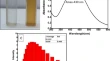
			<p>All samples exhibited IR vibration peaks in the wagging, bending and stretching mode ranges. Detailed information about the different H bonding configurations can be extracted from the stretching and bending modes. Figure&#8201;
				<figr fid="F1">1</figr> shows the IR spectra in the stretching mode (SM) range for the as-deposited, annealed for 1 h and annealed for 4 h samples hydrogenated at 0.8 ml/min. It shows a common feature of all samples observed for every applied hydrogenation, i.e. an increase of the contribution of the vibration at higher wavenumber (approximately 2,100 cm<sup>&#8722;1</sup>) to the stretching mode with increasing annealing time. Instead, the contribution of the vibration at about 2,000 cm<sup>&#8722;1</sup> decreases. Gaussian deconvolution of the stretching peak of the samples with the highest hydrogen content of 17.6 at.% (H = 1.5 ml/min) and annealed for 1 and 4 h showed that for them the contribution of the vibration at about 2,100 cm<sup>&#8722;1</sup> is even higher than that of the vibration at about 2,000 cm<sup>&#8722;1</sup> (Figure&#8201;
				<figr fid="F2">2</figr>). This behaviour is summarised in Figure&#8201;
				<figr fid="F3">3</figr> which gives <it>I</it>
				<sub>2100</sub>/<it>I</it>
				<sub>2000</sub> as a function of annealing time for the three hydrogenation rates. An increase of the intensity of the stretching peak at high wavenumbers and a decrease of the one at low wavenumbers after annealing have been reported in hydrogenated a-Si obtained by H implantation 
				<abbrgrp>
					<abbr bid="B8">8</abbr>
				</abbrgrp> and by plasma deposition 
				<abbrgrp>
					<abbr bid="B26">26</abbr>
				</abbrgrp>. The increase of the peak at about 2,100 cm<sup>&#8722;1</sup> can be due to the IR activation of H atoms that have occupied interstitial sites, i.e. shallow traps, during sputtering. Because of their low binding energy (0.2 to 0.5 eV) 
				<abbrgrp>
					<abbr bid="B8">8</abbr>
				</abbrgrp>, such H atoms may very likely locally rearrange their positions, upon annealing, by breaking weak Si-Si bonds and forming additional Si-H bonds. The latter ones could be of the poly-hydride type, like Si-H<sub>2</sub>, if the rearrangement involves near-neighbouring H atoms. The simultaneous decrease of the peak at about 2,000 cm<sup>&#8722;1</sup>, assigned to isolated Si-H mono-hydrides 
				<abbrgrp>
					<abbr bid="B3">3</abbr>
					<abbr bid="B4">4</abbr>
					<abbr bid="B5">5</abbr>
					<abbr bid="B6">6</abbr>
				</abbrgrp>, would also suggest that previously isolated Si-H bonds may have undergone clustering with formation of (Si-H)<sub>
					<it>n</it>
				</sub> groups. As said shortly, they vibrate at approximately 2,100 cm<sup>&#8722;1</sup>
				<abbrgrp>
					<abbr bid="B4">4</abbr>
					<abbr bid="B5">5</abbr>
					<abbr bid="B6">6</abbr>
					<abbr bid="B22">22</abbr>
					<abbr bid="B23">23</abbr>
					<abbr bid="B24">24</abbr>
				</abbrgrp>.</p>
			<fig id="F3"><title><p>Figure 3</p></title><caption><p>Plot of <it>I</it><sub>2100</sub>/<it>I</it><sub>2000</sub> as a function of annealing time for the three values of hydrogenation</p></caption><text>
   <p><b>Plot of </b><b><it>I</it></b><sub><b>2100</b></sub><b>/</b><b><it>I</it></b><sub><b>2000 </b></sub><b>as a function of annealing time for the three values of hydrogenation.</b> Hydrogenation values: H = 0.4, 0.8 and 1.5 ml/min.</p>
</text><graphic file="1556-276X-8-84-3"/></fig>
			<p>According to literature, the vibration mode at approximately 2,000 cm<sup>&#8722;1</sup> is due to the presence of isolated Si-H mono-hydride bonds 
				<abbrgrp>
					<abbr bid="B3">3</abbr>
					<abbr bid="B4">4</abbr>
					<abbr bid="B5">5</abbr>
					<abbr bid="B6">6</abbr>
					<abbr bid="B13">13</abbr>
					<abbr bid="B16">16</abbr>
					<abbr bid="B22">22</abbr>
					<abbr bid="B23">23</abbr>
					<abbr bid="B24">24</abbr>
				</abbrgrp>. Such mono-hydrides are generally isolated network sites and are associated with H bonded at isolated dangling bonds and vacancies. With increasing H concentration, the hydrogen chemical potential increases, and more complex bonding configurations can form like clustered Si-H groups in the form of Si-H platelets 
				<abbrgrp>
					<abbr bid="B3">3</abbr>
					<abbr bid="B13">13</abbr>
				</abbrgrp>, (Si-H)<sub>
					<it>n</it>
				</sub> groups and poly-hydrides, like Si-H<sub>2</sub> and chains of them, (Si-H<sub>2</sub>)<sub>
					<it>n</it>
				</sub>
				<abbrgrp>
					<abbr bid="B3">3</abbr>
					<abbr bid="B4">4</abbr>
					<abbr bid="B5">5</abbr>
					<abbr bid="B6">6</abbr>
					<abbr bid="B16">16</abbr>
					<abbr bid="B22">22</abbr>
					<abbr bid="B23">23</abbr>
					<abbr bid="B24">24</abbr>
					<abbr bid="B25">25</abbr>
				</abbrgrp>. The Si-H platelets should give an IR signature at the frequency of approximately 2,033 cm<sup>&#8722;1</sup>
				<abbrgrp>
					<abbr bid="B3">3</abbr>
				</abbrgrp>. An IR absorption peak that could be ascribed to Si-H platelets was only observed in the as-deposited sample hydrogenated at the lowest rate of 0.4 ml/min that exhibited a peak at 2,054 cm<sup>&#8722;1</sup>. The poly-hydride bonds instead IR vibrate at approximately 2,100 cm<sup>&#8722;1</sup>
				<abbrgrp>
					<abbr bid="B4">4</abbr>
					<abbr bid="B5">5</abbr>
					<abbr bid="B6">6</abbr>
					<abbr bid="B22">22</abbr>
					<abbr bid="B23">23</abbr>
					<abbr bid="B24">24</abbr>
				</abbrgrp>. The clustered (Si-H)<sub>
					<it>n</it>
				</sub> groups also vibrate at approximately 2,100 cm<sup>&#8722;1</sup>
				<abbrgrp>
					<abbr bid="B4">4</abbr>
					<abbr bid="B5">5</abbr>
					<abbr bid="B6">6</abbr>
					<abbr bid="B13">13</abbr>
					<abbr bid="B16">16</abbr>
					<abbr bid="B22">22</abbr>
					<abbr bid="B23">23</abbr>
					<abbr bid="B24">24</abbr>
				</abbrgrp>. The Si-H mono-hydrides do not yield any bending mode vibration, whereas Si-H<sub>2</sub> and chains of it, (Si-H<sub>2</sub>)<sub>
					<it>n</it>
				</sub>, do 
				<abbrgrp>
					<abbr bid="B4">4</abbr>
					<abbr bid="B5">5</abbr>
					<abbr bid="B6">6</abbr>
					<abbr bid="B13">13</abbr>
					<abbr bid="B16">16</abbr>
					<abbr bid="B22">22</abbr>
					<abbr bid="B23">23</abbr>
					<abbr bid="B24">24</abbr>
				</abbrgrp>. This was used to check the contribution of the latter poly-hydrides to the stretching mode absorption at approximately 2,100 cm<sup>&#8722;1</sup>.</p>
			<p>The bending mode absorption peak was observed in all samples although included in a broad peak. An example of deconvolution of one such broad peak is shown in Figure&#8201;
				<figr fid="F4">4</figr> for the case of the sample hydrogenated at a rate of 0.4 ml/min and annealed for 4 h. The broad peak is fitted by four Gaussians peaked at 853, 887, 936 and 971 cm<sup>&#8722;1</sup>. The former two peaks are the bending mode vibrations of the Si-H<sub>2</sub> di-hydrides, i.e. Si-H<sub>2</sub> and (Si-H<sub>2</sub>)<sub>
					<it>n</it>
				</sub>
				<abbrgrp>
					<abbr bid="B4">4</abbr>
				</abbrgrp>. The other two peaks at the higher wavenumbers of 936 and 971 cm<sup>&#8722;1</sup> have to be ascribed to Si-O vibrations 
				<abbrgrp>
					<abbr bid="B4">4</abbr>
				</abbrgrp>. The bending vibrations at 887 and 853 are usually assigned to Si-H<sub>2</sub> di-hydrides and to chains of it, (Si-H<sub>2</sub>)<sub>
					<it>n</it>
				</sub>, respectively 
				<abbrgrp>
					<abbr bid="B4">4</abbr>
					<abbr bid="B5">5</abbr>
					<abbr bid="B16">16</abbr>
					<abbr bid="B22">22</abbr>
					<abbr bid="B23">23</abbr>
					<abbr bid="B24">24</abbr>
					<abbr bid="B25">25</abbr>
					<abbr bid="B26">26</abbr>
				</abbrgrp>. Their presence in the annealed layers is thus confirmed by Figure&#8201;
				<figr fid="F4">4</figr>. However, the fitting of Figure&#8201;
				<figr fid="F4">4</figr> shows that the concentration of the (Si-H<sub>2</sub>)<sub>
					<it>n</it>
				</sub> chains is some percentage (9.2% in Figure&#8201;
				<figr fid="F4">4</figr>) of that of the single Si-H<sub>2</sub> di-hydrides. It can thus be concluded that besides the mono-hydride clusters (Si-H)<sub>
					<it>n</it>
				</sub>, the Si-H<sub>2</sub> di-hydrides, as well as the (Si-H<sub>2</sub>)<sub>
					<it>n</it>
				</sub> chains (though in a reduced percentage), contribute to the stretching absorption at about 2,100 cm<sup>&#8722;1</sup>. All such Si-hydrogen complexes are reported to reside on the surfaces of voids 
				<abbrgrp>
					<abbr bid="B4">4</abbr>
					<abbr bid="B5">5</abbr>
					<abbr bid="B6">6</abbr>
					<abbr bid="B8">8</abbr>
					<abbr bid="B9">9</abbr>
					<abbr bid="B10">10</abbr>
					<abbr bid="B11">11</abbr>
					<abbr bid="B12">12</abbr>
					<abbr bid="B13">13</abbr>
					<abbr bid="B14">14</abbr>
					<abbr bid="B15">15</abbr>
					<abbr bid="B16">16</abbr>
					<abbr bid="B22">22</abbr>
					<abbr bid="B23">23</abbr>
					<abbr bid="B24">24</abbr>
					<abbr bid="B25">25</abbr>
					<abbr bid="B26">26</abbr>
				</abbrgrp>.</p>
			<fig id="F4"><title><p>Figure 4</p></title><caption><p>IR bending mode range</p></caption><text>
   <p><b>IR bending mode range.</b> Gaussian deconvolution of a broad IR peak between approximately 835 and 1,000 cm<sup>&#8722;1</sup> for the case of the sample hydrogenated at a rate of 0.4 ml/min (H content = 10.8 at.%) and annealed for 4 h. The two peaks at 853 (circles) and 887 (triangles) are due to the bending mode oscillations of Si di-hydrides. See text.</p>
</text><graphic file="1556-276X-8-84-4"/></fig>
			<p>Figure&#8201;
				<figr fid="F3">3</figr> shows that in the as-deposited samples, H is bonded to Si mainly as mono-hydride Si-H, very likely saturating dangling bonds or occupying di-vacancies, as said earlier. Since <it>I</it>
				<sub>2100</sub>/<it>I</it>
				<sub>2000</sub> is not zero (Figure&#8201;
				<figr fid="F3">3</figr>), a certain amount of H also forms the mentioned complexes residing on the surfaces of nano-voids expected to be present in the amorphous host Si material. Nano-voids, with a size of a few nanometers, have been detected in a-Si irrespective of the growth method 
				<abbrgrp>
					<abbr bid="B5">5</abbr>
					<abbr bid="B8">8</abbr>
					<abbr bid="B9">9</abbr>
					<abbr bid="B10">10</abbr>
				</abbrgrp>. The significant increase of the concentration of the clustered (Si-H)<sub>
					<it>n</it>
				</sub> groups and poly-hydrides already after 1-h annealing suggests that the size of the nano-voids has increased, thus offering a larger surface for formation of those complexes. This phenomenon is greater in the samples with the highest H content (1.5 ml/min) for which <it>I</it>
				<sub>2100</sub>/<it>I</it>
				<sub>2000</sub> &gt; 1 for annealing times &#8805;1 h (Figure&#8201;
				<figr fid="F3">3</figr>). The size increase of the nano-voids may have occurred by an Ostwald ripening mechanism 
				<abbrgrp>
					<abbr bid="B8">8</abbr>
					<abbr bid="B27">27</abbr>
				</abbrgrp> whereby small cavities coalesce forming larger ones. Parallel to the increase of the density of the mentioned H complexes in the annealed samples also is the presence of surface blisters, examples of which are shown in the AFM images of Figure&#8201;
				<figr fid="F5">5</figr>. The height, size and density of the blisters increase with increasing annealing time and/or H content, similar to what was already observed in a-Si/a-Ge multilayers 
				<abbrgrp>
					<abbr bid="B19">19</abbr>
					<abbr bid="B20">20</abbr>
				</abbrgrp>, i.e. they show the same behaviour as a function of the annealing temperature as the concentration of the H complexes does. It should be noticed that the height of the blisters remains below 100 nm, and therefore, they do not increase the nonspecular scattering of the micrometre waves in the stretching mode regime in the IR experiments.</p>
			<fig id="F5"><title><p>Figure 5</p></title><caption><p>AFM images of surface blisters</p></caption><text>
   <p><b>AFM images of surface blisters.</b> (<b>a</b>) Sample hydrogenated at 1.5 ml/min and annealed for 1 h (scan size 40 &#956;m) and (<b>b</b>) sample hydrogenated at 0.4 ml/min and annealed for 4 h (scan size 10 &#956;m).</p>
</text><graphic file="1556-276X-8-84-5"/></fig>
			<p>Table&#8201;
				<tblr tid="T2">2</tblr> reports the total integrated intensity of the stretching mode, <it>I</it>
				<sub>SM</sub>&#8201;=&#8201;&#8747;&#8201;<it>&#945;</it>(<it>&#969;</it>)/<it>&#969;</it>
				<it>d&#969;</it> obtained by summing up the integrated intensities of the two deconvoluted peaks at approximately 2,000 and 2,100 cm<sup>&#8722;1</sup>, as a function of annealing time for the three rates of hydrogenation. It shows that the total amount of Si-hydrogen bonds of any type, i.e. the total amount of bonded H, decreases by increasing the annealing time, which suggests that the annealing caused the break of some of the bonds of H to Si. H release from the isolated mono-hydrides is expected to be less likely as they represent the deepest binding sites 
				<abbrgrp>
					<abbr bid="B13">13</abbr>
				</abbrgrp>. If release occurred, H atoms would occupy interstitial positions wherefrom they might diffuse toward the voids and ensure H supply in the environment of blisters. The clustered Si-H groups and polymers decorating the walls of the voids have instead a smaller binding energy 
				<abbrgrp>
					<abbr bid="B13">13</abbr>
				</abbrgrp> and are expected to easily liberate their H into the voids themselves where H atoms may react to form molecular H<sub>2</sub>. According to 
				<abbrgrp>
					<abbr bid="B26">26</abbr>
					<abbr bid="B28">28</abbr>
				</abbrgrp>, H evolution, i.e., break of Si-hydrogen bonds, already starts at temperatures of 250&#176;C 
				<abbrgrp>
					<abbr bid="B26">26</abbr>
				</abbrgrp> or 150&#176;C 
				<abbrgrp>
					<abbr bid="B28">28</abbr>
				</abbrgrp>, which are much lower than the annealing temperature used here. The molecular H<sub>2</sub> in the gas state inside the nanocavities expands upon annealing with consequent increase of the volume of the nanocavities, which would favour their coalescence, leading to bigger and bigger voids. Such bigger voids offer larger inner surfaces for the formation of additional clustered mono-hydrides and (Si-H<sub>2</sub>)<sub>
					<it>n</it>
				</sub>, <it>n</it> &#8805; 1, polymers which will further contribute to the release of additional H to be transformed into H<sub>2</sub>. Eventually, the voids will reach such a big size to cause a lift-off of the layers with the formation of surface blisters, as observed by AFM. The blisters correspond therefore to bubbles containing molecular H<sub>2</sub>. They have developed from microscopic cavities, decorated by clustered mono-hydrides and (Si-H<sub>2</sub>)<sub>
					<it>n</it>
				</sub>, <it>n</it> &#8805; 1, complexes, which have increased their volume because of the increase of the inside pressure due to the thermal expansion of the H<sub>2</sub> gas upon annealing. It was seen in previous works on a-Si, a-Ge layers and a-Si/a-Ge multilayers that for annealing time and/or temperature higher than those considered here, further degradation of the layer surface occurs by explosion of the blisters 
				<abbrgrp>
					<abbr bid="B19">19</abbr>
					<abbr bid="B20">20</abbr>
				</abbrgrp>.</p>
			<table id="T2">
				<title>
					<p>Table 2</p>
				</title>
				<caption>
					<p>
						<b>Total integrated intensity (cm</b>
						<sup>
							<b>&#8722;1</b>
						</sup><b>) of the IR stretching mode</b>
					</p>
				</caption>
				<tgroup align="left" cols="4">
					<colspec align="left" colname="c1" colnum="1" colwidth="1*"/>
					<colspec align="left" colname="c2" colnum="2" colwidth="1*"/>
					<colspec align="left" colname="c3" colnum="3" colwidth="1*"/>
					<colspec align="left" colname="c4" colnum="4" colwidth="1*"/>
					<thead valign="top">
						<row>
							<entry align="left" colname="c1">
								<p>
									<b>Annealing time (h)</b>
								</p>
							</entry>
							<entry align="center" colname="c2" nameend="c4" namest="c2" rowsep="1">
								<p>
									<b>
										<it>I</it>
									</b>
									<sub>
										<b>SM</b>
									</sub> <b>(cm</b>
									<sup>
										<b>&#8722;1</b>
									</sup><b>)</b>
								</p>
							</entry>
						</row>
						<row rowsep="1">
							<entry colname="c1"/>
							<entry align="center" colname="c2">
								<p>
									<b>H = 0.4 ml/min</b>
								</p>
							</entry>
							<entry align="center" colname="c3">
								<p>
									<b>H = 0.8 ml/min</b>
								</p>
							</entry>
							<entry align="center" colname="c4">
								<p>
									<b>H = 1.5 ml/min</b>
								</p>
							</entry>
						</row>
					</thead>
					<tfoot>
						<p>Total integrated intensity (cm<sup>&#8722;1</sup>) of the IR stretching mode, <it>I</it>
							<sub>SM</sub>, as a function of annealing time for the different hydrogenation rates.</p>
					</tfoot>
					<tbody valign="top">
						<row rowsep="1">
							<entry align="left" colname="c1">
								<p>&#8195;&#8195;&#8195;0</p>
							</entry>
							<entry align="center" colname="c2">
								<p>12.8</p>
							</entry>
							<entry align="center" colname="c3">
								<p>30.8</p>
							</entry>
							<entry align="center" colname="c4">
								<p>72.1</p>
							</entry>
						</row>
						<row rowsep="1">
							<entry align="left" colname="c1">
								<p>&#8195;&#8195;&#8195;1</p>
							</entry>
							<entry align="center" colname="c2">
								<p>11.4</p>
							</entry>
							<entry align="center" colname="c3">
								<p>26.8</p>
							</entry>
							<entry align="center" colname="c4">
								<p>52.5</p>
							</entry>
						</row>
						<row rowsep="1">
							<entry align="left" colname="c1">
								<p>&#8195;&#8195;&#8195;4</p>
							</entry>
							<entry align="center" colname="c2">
								<p>10.5</p>
							</entry>
							<entry align="center" colname="c3">
								<p>24.2</p>
							</entry>
							<entry align="center" colname="c4">
								<p>45.1</p>
							</entry>
						</row>
					</tbody>
				</tgroup>
			</table>
		</sec>
		<sec>
			<st>
				<p>Conclusions</p>
			</st>
			<p>The origin of surface blisters that form in hydrogenated RF-sputtered a-Si layers submitted to annealing has been investigated by studying the evolution of the Si-hydrogen bonds by means of IR spectroscopy. By increasing the annealing time and/or H content, the blister size increased. Correspondingly, IR spectroscopy showed that the density of the isolated Si-H mono-hydrides decreased, while the concentration of the clustered (Si-H)<sub>
					<it>n</it>
				</sub> groups and (Si-H<sub>2</sub>)<sub>
					<it>n</it>
				</sub>, <it>n</it> &#8805; 1, polymers increased. As both these complexes reside on the inner surfaces of voids, it is concluded that their accumulation at such surfaces favours the void size increase. It was also seen that the total amount of bonded H decreased upon annealing, suggesting that some H is released from its bonds to Si. The H liberated from the (Si-H)<sub>
					<it>n</it>
				</sub> groups and (Si-H<sub>2</sub>)<sub>
					<it>n</it>
				</sub> polymers decorating the void surfaces is expected to form molecular H<sub>2</sub> within the voids. The expansion of the H<sub>2</sub> gas would cause further growth of the voids up to a size able to produce surface blistering.</p>
		</sec>
		<sec>
			<st>
				<p>Competing interests</p>
			</st>
			<p>The authors declare that they have no competing interests.</p>
		</sec>
		<sec>
			<st>
				<p>Authors&#8217; contributions</p>
			</st>
			<p>MS grew the samples by sputtering, suggested and coordinated the experiment. CF coordinated the interpretation of the results and drafted the manuscript, ZS carried out the IR measurements. KK participated in the IR data elaboration. LN made the AFM work. AC carried out the sample heating experiments. NQK performed the ERDA measurements. All authors read and approved the final manuscript.</p>
		</sec>
		<sec>
			<st>
				<p>Authors&#8217; information</p>
			</st>
			<p>MS is a scientific adviser at the Institute of Technical Physics and Materials Science, Research Centre for Natural Sciences, Hungarian Academy of Sciences, Budapest, Hungary. CF is a senior scientist at the IMEM Institute of the Consiglio Nazionale delle Ricerche, Parma, Italy. ZS is a PhD student and young researcher at the Institute for Solid State Physics and Optics, Wigner Research Centre for Physics, Hungarian Academy of Sciences, Budapest, Hungary. KK is a research professor at the Institute for Solid State Physics and Optics, Wigner Research Centre for Physics, Hungarian Academy of Sciences, Budapest, Hungary. LN is a researcher at the IMEM Institute of the Consiglio Nazionale delle Ricerche, Parma, Italy. AC is a senior research associate at the Institute of Nuclear Research of the Hungarian Academy of Sciences, Hungary. NQK is senior scientist at the Institute of Technical Physics and Materials Science, Research Centre for Natural Sciences, Hungarian Academy of Sciences, Budapest, Hungary.</p>
		</sec>
	</bdy>
	<bm>
		<ack>
			<sec>
				<st>
					<p>Acknowledgements</p>
				</st>
				<p>This work was supported by the Scientific Cooperation Agreement between CNR (Italy) and MTA (Hungary) under the contract MTA 1102, as well as by OTKA under grant nos. K-67969, NF 101329, and CK80126.</p>
			</sec>
		</ack>
		<refgrp><bibl id="B1"><title><p>Vacancies and voids in hydrogenated amorphous silicon</p></title><aug><au><snm>Smets</snm><fnm>AHM</fnm></au><au><snm>Kessels</snm><fnm>WMM</fnm></au><au><snm>van de Sanden</snm><fnm>MCM</fnm></au></aug><source>Appl Phys Lett</source><pubdate>2003</pubdate><volume>82</volume><fpage>1547</fpage><xrefbib><pubid idtype="doi">10.1063/1.1559657</pubid></xrefbib></bibl><bibl id="B2"><title><p>Structural, optical and electrical properties of amorphous silicon thin films prepared by sputtering with different targets</p></title><aug><au><snm>Qin</snm><fnm>Y</fnm></au><au><snm>Feng</snm><fnm>T</fnm></au><au><snm>Li</snm><fnm>Z</fnm></au><au><snm>Sun</snm><fnm>Z</fnm></au></aug><source>Appl Surf Sci</source><pubdate>2011</pubdate><volume>257</volume><fpage>7993</fpage><xrefbib><pubid idtype="doi">10.1016/j.apsusc.2011.04.053</pubid></xrefbib></bibl><bibl id="B3"><title><p>The interaction of atomic hydrogen with very thin amorphous hydrogenated silicon films analyzed using in situ real time infrared spectroscopy: reaction rates and the formation of hydrogen platelets</p></title><aug><au><snm>von Keudell</snm><fnm>A</fnm></au><au><snm>Abelson</snm><fnm>JR</fnm></au></aug><source>J Appl Phys</source><pubdate>1998</pubdate><volume>84</volume><fpage>489</fpage><xrefbib><pubid idtype="doi">10.1063/1.368082</pubid></xrefbib></bibl><bibl id="B4"><title><p>Structural interpretation of the vibrational spectra of a-Si:H alloys</p></title><aug><au><snm>Lucovsky</snm><fnm>G</fnm></au><au><snm>Nemanich</snm><fnm>RJ</fnm></au><au><snm>Knights</snm><fnm>JC</fnm></au></aug><source>Phys Rev B</source><pubdate>1979</pubdate><volume>19</volume><fpage>2064</fpage><xrefbib><pubid idtype="doi">10.1103/PhysRevB.19.2064</pubid></xrefbib></bibl><bibl id="B5"><title><p>Local Si-H bonding environment in hydrogenated amorphous silicon films in relation to structural inhomogeneities</p></title><aug><au><snm>Touir</snm><fnm>H</fnm></au><au><snm>Zellama</snm><fnm>K</fnm></au><au><snm>Morhange</snm><fnm>J-F</fnm></au></aug><source>Phys Rev B</source><pubdate>1999</pubdate><volume>59</volume><fpage>10076</fpage><xrefbib><pubid idtype="doi">10.1103/PhysRevB.59.10076</pubid></xrefbib></bibl><bibl id="B6"><title><p>Influence of hydrogen-bonding configurations on the physical properties of hydrogenated amorphous silicon</p></title><aug><au><snm>Manfredotti</snm><fnm>C</fnm></au><au><snm>Fizzotti</snm><fnm>F</fnm></au><au><snm>Pastorino</snm><fnm>M</fnm></au><au><snm>Polesello</snm><fnm>P</fnm></au><au><snm>Vittone</snm><fnm>E</fnm></au></aug><source>Phys Rev B</source><pubdate>1994</pubdate><volume>50</volume><fpage>18046</fpage><xrefbib><pubid idtype="doi">10.1103/PhysRevB.50.18046</pubid></xrefbib></bibl><bibl id="B7"><title><p>Voids in hydrogenated amorphous silicon materials</p></title><aug><au><snm>Beyer</snm><fnm>W</fnm></au><au><snm>Hilgers</snm><fnm>W</fnm></au><au><snm>Prunici</snm><fnm>P</fnm></au><au><snm>Lennartz</snm><fnm>D</fnm></au></aug><source>J Non-Cryst Solids</source><pubdate>2012</pubdate><volume>358</volume><fpage>2023</fpage><xrefbib><pubid idtype="doi">10.1016/j.jnoncrysol.2011.09.030</pubid></xrefbib></bibl><bibl id="B8"><title><p>Hydrogen solubility and network stability in amorphous silicon</p></title><aug><au><snm>Acco</snm><fnm>S</fnm></au><au><snm>Williamson</snm><fnm>DL</fnm></au><au><snm>Stolk</snm><fnm>PA</fnm></au><au><snm>Saris</snm><fnm>FW</fnm></au><au><snm>van den Boogaard</snm><fnm>MJ</fnm></au><au><snm>Sinke</snm><fnm>WC</fnm></au><au><snm>van der Weg</snm><fnm>WF</fnm></au><au><snm>Roorda</snm><fnm>S</fnm></au><au><snm>Zalm</snm><fnm>PC</fnm></au></aug><source>Phys Rev B</source><pubdate>1996</pubdate><volume>53</volume><fpage>4415</fpage><xrefbib><pubid idtype="doi">10.1103/PhysRevB.53.4415</pubid></xrefbib></bibl><bibl id="B9"><title><p>Structural properties of hot wire a-Si:H films deposited at rates in excess of 100 &#197;/s</p></title><aug><au><snm>Mahan</snm><fnm>AH</fnm></au><au><snm>Xu</snm><fnm>Y</fnm></au><au><snm>Williamson</snm><fnm>DL</fnm></au><au><snm>Beyer</snm><fnm>W</fnm></au><au><snm>Perkins</snm><fnm>JD</fnm></au><au><snm>Vanecek</snm><fnm>M</fnm></au><au><snm>LM</snm><fnm>G</fnm></au><au><snm>BP</snm><fnm>N</fnm></au></aug><source>J Appl Phys</source><pubdate>2001</pubdate><volume>90</volume><fpage>5038</fpage><xrefbib><pubid idtype="doi">10.1063/1.1407317</pubid></xrefbib></bibl><bibl id="B10"><title><p>A study of optical absorption in amorphous hydrogenated silicon thin films of varied thickness</p></title><aug><au><snm>M&#252;llerov&#225;</snm><fnm>J</fnm></au><au><snm>Prus&#225;kov&#225;</snm><fnm>L</fnm></au><au><snm>Netrvalov&#225;</snm><fnm>M</fnm></au><au><snm>Vavrunkov&#225;</snm><fnm>V</fnm></au><au><snm>Sutta</snm><fnm>P</fnm></au></aug><source>Appl Surf Sci</source><pubdate>2010</pubdate><volume>256</volume><fpage>5667</fpage><xrefbib><pubid idtype="doi">10.1016/j.apsusc.2010.03.022</pubid></xrefbib></bibl><bibl id="B11"><title><p>Use of hydrogenation in structural and electronic studies of gap states in amorphous germanium</p></title><aug><au><snm>Connell</snm><fnm>GAN</fnm></au><au><snm>Pawlik</snm><fnm>JR</fnm></au></aug><source>Phys Rev B</source><pubdate>1976</pubdate><volume>13</volume><fpage>787</fpage><xrefbib><pubid idtype="doi">10.1103/PhysRevB.13.787</pubid></xrefbib></bibl><bibl id="B12"><title><p>Hydrogen in amorphous and microcrystalline silicon films prepared by hydrogen dilution</p></title><aug><au><snm>Kroll</snm><fnm>U</fnm></au><au><snm>Meier</snm><fnm>J</fnm></au><au><snm>Shah</snm><fnm>A</fnm></au><au><snm>Mikhailov</snm><fnm>S</fnm></au><au><snm>Weber</snm><fnm>J</fnm></au></aug><source>J Appl Phys</source><pubdate>1996</pubdate><volume>80</volume><fpage>4971</fpage><xrefbib><pubid idtype="doi">10.1063/1.363541</pubid></xrefbib></bibl><bibl id="B13"><title><p>Hydrogen transport in amorphous silicon</p></title><aug><au><snm>Jackson</snm><fnm>WB</fnm></au><au><snm>Tsai</snm><fnm>CC</fnm></au></aug><source>Phys Rev B</source><pubdate>1992</pubdate><volume>45</volume><fpage>6564</fpage><xrefbib><pubid idtype="doi">10.1103/PhysRevB.45.6564</pubid></xrefbib></bibl><bibl id="B14"><title><p>Hydrogen microstructure in hydrogenated amorphous silicon</p></title><aug><au><snm>Daey Ouwens</snm><fnm>J</fnm></au><au><snm>Schropp</snm><fnm>RE</fnm></au></aug><source>Phys Rev B</source><pubdate>1996</pubdate><volume>54</volume><fpage>17759</fpage><xrefbib><pubid idtype="doi">10.1103/PhysRevB.54.17759</pubid></xrefbib></bibl><bibl id="B15"><title><p>Changes in surface topography of amorphous silicon germanium films after light soaking</p></title><aug><au><snm>Agarwal</snm><fnm>P</fnm></au><au><snm>Srivastava</snm><fnm>A</fnm></au><au><snm>Deva</snm><fnm>D</fnm></au></aug><source>J Appl Phys</source><pubdate>2007</pubdate><volume>101</volume><fpage>083504</fpage><xrefbib><pubid idtype="doi">10.1063/1.2721944</pubid></xrefbib></bibl><bibl id="B16"><title><p>Effect of the hydrogen dilution on the local microstructure in hydrogenated amorphous silicon films deposited by radiofrequency magnetron sputtering</p></title><aug><au><snm>Daouahi</snm><fnm>M</fnm></au><au><snm>Zellama</snm><fnm>K</fnm></au><au><snm>Bouchriha</snm><fnm>H</fnm></au><au><snm>Elka&#239;m</snm><fnm>P</fnm></au></aug><source>Eur Phys J Appl Phys</source><pubdate>2000</pubdate><volume>10</volume><fpage>185</fpage><xrefbib><pubid idtype="doi">10.1051/epjap:2000131</pubid></xrefbib></bibl><bibl id="B17"><title><p>Reversible conductivity changes in discharge-produced amorphous Si</p></title><aug><au><snm>Staebler</snm><fnm>DL</fnm></au><au><snm>Wronski</snm><fnm>CR</fnm></au></aug><source>Appl Phys Lett</source><pubdate>1977</pubdate><volume>31</volume><fpage>292</fpage><xrefbib><pubid idtype="doi">10.1063/1.89674</pubid></xrefbib></bibl><bibl id="B18"><title><p>Light-induced annealing of hole trap states: a new aspect of light-induced changes in hydrogenated amorphous silicon</p></title><aug><au><snm>Sakata</snm><fnm>I</fnm></au><au><snm>Kamei</snm><fnm>T</fnm></au><au><snm>Yamanaka</snm><fnm>M</fnm></au></aug><source>J Non-Cryst Solids</source><pubdate>2012</pubdate><volume>358</volume><fpage>2048</fpage><xrefbib><pubid idtype="doi">10.1016/j.jnoncrysol.2011.12.007</pubid></xrefbib></bibl><bibl id="B19"><title><p>Relationship between structural changes, hydrogen content and annealing in stacks of ultrathin Si/Ge amorphous layers</p></title><aug><au><snm>Frigeri</snm><fnm>C</fnm></au><au><snm>Ser&#233;nyi</snm><fnm>M</fnm></au><au><snm>Kh&#225;nh</snm><fnm>NQ</fnm></au><au><snm>Csik</snm><fnm>A</fnm></au><au><snm>Erd&#233;lyi</snm><fnm>Z</fnm></au><au><snm>Nasi</snm><fnm>L</fnm></au><au><snm>Beke</snm><fnm>DL</fnm></au><au><snm>Boyen</snm><fnm>H-G</fnm></au></aug><source>Nanoscale Res Lett</source><pubdate>2011</pubdate><volume>6</volume><fpage>189</fpage><xrefbib><pubidlist><pubid idtype="doi">10.1186/1556-276X-6-189</pubid><pubid idtype="pmcid">3211242</pubid><pubid idtype="pmpid" link="fulltext">21711697</pubid></pubidlist></xrefbib></bibl><bibl id="B20"><title><p>AFM and TEM study of hydrogenated sputtered Si/Ge multilayers</p></title><aug><au><snm>Frigeri</snm><fnm>C</fnm></au><au><snm>Nasi</snm><fnm>L</fnm></au><au><snm>Ser&#233;nyi</snm><fnm>M</fnm></au><au><snm>Csik</snm><fnm>A</fnm></au><au><snm>Erd&#233;lyi</snm><fnm>Z</fnm></au><au><snm>Beke</snm><fnm>DL</fnm></au></aug><source>Superlatt Microstruct</source><pubdate>2009</pubdate><volume>45</volume><fpage>475</fpage><xrefbib><pubid idtype="doi">10.1016/j.spmi.2008.10.023</pubid></xrefbib></bibl><bibl id="B21"><title><p>Determination of hydrogen concentration in a-Si and a-Ge layers by elastic recoil detection analysis</p></title><aug><au><snm>Kh&#225;nh</snm><fnm>NQ</fnm></au><au><snm>Ser&#233;nyi</snm><fnm>M</fnm></au><au><snm>Csik</snm><fnm>A</fnm></au><au><snm>Frigeri</snm><fnm>C</fnm></au></aug><source>Vacuum</source><pubdate>2012</pubdate><volume>86</volume><fpage>711</fpage><xrefbib><pubid idtype="doi">10.1016/j.vacuum.2011.07.050</pubid></xrefbib></bibl><bibl id="B22"><title><p>Infrared and Raman spectra of the silicon-hydrogen-bonds in amorphous silicon prepared by glow discharge and sputtering</p></title><aug><au><snm>Brodsky</snm><fnm>MH</fnm></au><au><snm>Cardona</snm><fnm>M</fnm></au><au><snm>Cuomo</snm><fnm>JJ</fnm></au></aug><source>Phys Rev B</source><pubdate>1977</pubdate><volume>16</volume><fpage>3556</fpage><xrefbib><pubid idtype="doi">10.1103/PhysRevB.16.3556</pubid></xrefbib></bibl><bibl id="B23"><title><p>Hydrogen bonding in amorphous silicon with use of the low-pressure chemical-vapor-deposition technique</p></title><aug><au><snm>Amato</snm><fnm>G</fnm></au><au><snm>Della Mea</snm><fnm>G</fnm></au><au><snm>Fizzotti</snm><fnm>F</fnm></au><au><snm>Manfredotti</snm><fnm>C</fnm></au><au><snm>Marchisio</snm><fnm>R</fnm></au><au><snm>Paccagnella</snm><fnm>A</fnm></au></aug><source>Phys Rev B</source><pubdate>1991</pubdate><volume>43</volume><fpage>6627</fpage><xrefbib><pubid idtype="doi">10.1103/PhysRevB.43.6627</pubid></xrefbib></bibl><bibl id="B24"><title><p>Infrared absorption strength and hydrogen content of hydrogenated amorphous silicon</p></title><aug><au><snm>Langford</snm><fnm>AA</fnm></au><au><snm>Fleet</snm><fnm>ML</fnm></au><au><snm>Nelson</snm><fnm>BP</fnm></au><au><snm>Lanford</snm><fnm>WA</fnm></au><au><snm>Maley</snm><fnm>N</fnm></au></aug><source>Phys Rev B</source><pubdate>1992</pubdate><volume>45</volume><fpage>13367</fpage><xrefbib><pubid idtype="doi">10.1103/PhysRevB.45.13367</pubid></xrefbib></bibl><bibl id="B25"><title><p>Optical properties of amorphous films of an a-Si1&#8211;xGex:H solid solution with different concentrations of hydrogen</p></title><aug><au><snm>Nadzhafov</snm><fnm>BA</fnm></au><au><snm>Isakov</snm><fnm>GI</fnm></au></aug><source>J Appl Spectrosc</source><pubdate>2005</pubdate><volume>72</volume><fpage>396</fpage><xrefbib><pubid idtype="doi">10.1007/s10812-005-0088-3</pubid></xrefbib></bibl><bibl id="B26"><title><p>Effect of annealing on the optical properties of plasma deposited amorphous hydrogenated silicon</p></title><aug><au><snm>Tsai</snm><fnm>CC</fnm></au><au><snm>Fritzsche</snm><fnm>H</fnm></au></aug><source>Solar Energy Mater</source><pubdate>1979</pubdate><volume>1</volume><fpage>29</fpage><xrefbib><pubid idtype="doi">10.1016/0165-1633(79)90054-6</pubid></xrefbib></bibl><bibl id="B27"><aug><au><snm>Verhoeven</snm><fnm>JD</fnm></au></aug><source>Fundamentals of Physical Metallurgy</source><publisher>New York: Wiley</publisher><pubdate>1975</pubdate></bibl><bibl id="B28"><title><p>Hydrogenated microvoids and light-induced degradation of amorphous-silicon solar cells</p></title><aug><au><snm>Carlson</snm><fnm>DE</fnm></au></aug><source>Appl Phys A</source><pubdate>1986</pubdate><volume>41</volume><fpage>305</fpage><xrefbib><pubid idtype="doi">10.1007/BF00616053</pubid></xrefbib></bibl></refgrp>
	</bm>
</art>