<?xml version='1.0'?>
<!DOCTYPE art SYSTEM 'http://www.biomedcentral.com/xml/article.dtd'>
<art>
	<ui>1556-276X-8-36</ui>
	<ji>1556-276X</ji>
	<fm>
		<dochead>Nano Express</dochead>
		<bibl>
			<title>
				<p>Bipolar resistive switching in p-type Co<sub>3</sub>O<sub>4</sub> nanosheets prepared by electrochemical deposition</p>
			</title>
			<aug>
				<au id="A1"><snm>Younis</snm><fnm>Adnan</fnm><insr iid="I1"/><email>a.younis@unsw.edu.au</email></au>
				<au id="A2" ca="yes"><snm>Chu</snm><fnm>Dewei</fnm><insr iid="I1"/><email>d.chu@unsw.edu.au</email></au>
				<au id="A3"><snm>Lin</snm><fnm>Xi</fnm><insr iid="I1"/><email>z3234810@student.unsw.edu.au</email></au>
				<au id="A4"><snm>Lee</snm><fnm>Jiunn</fnm><insr iid="I1"/><email>j.j.lee@unsw.edu.au</email></au>
				<au id="A5"><snm>Li</snm><fnm>Sean</fnm><insr iid="I1"/><email>sean.li@unsw.edu.au</email></au>
			</aug>
			<insg>
				<ins id="I1"><p>School of Materials Science and Engineering, University of New South Wales, Sydney, New South Wales, 2052, Australia</p></ins>
			</insg>
			<source>Nanoscale Research Letters</source>
			<section><title><p>Regular submissions</p></title></section><issn>1556-276X</issn>
			<pubdate>2013</pubdate>
			<volume>8</volume>
			<issue>1</issue>
			<fpage>36</fpage>
			<url>http://www.nanoscalereslett.com/content/8/1/36</url>
			<xrefbib><pubidlist><pubid idtype="doi">10.1186/1556-276X-8-36</pubid><pubid idtype="pmpid">23331856</pubid></pubidlist></xrefbib>
		</bibl>
		<history><rec><date><day>26</day><month>11</month><year>2012</year></date></rec><acc><date><day>14</day><month>1</month><year>2013</year></date></acc><pub><date><day>19</day><month>1</month><year>2013</year></date></pub></history>
		<cpyrt><year>2013</year><collab>Younis et al.; licensee Springer.</collab><note>This is an Open Access article distributed under the terms of the Creative Commons Attribution License (<url>http://creativecommons.org/licenses/by/2.0</url>), which permits unrestricted use, distribution, and reproduction in any medium, provided the original work is properly cited.</note></cpyrt>
		<kwdg>
			<kwd>Electrochemical deposition</kwd>
			<kwd>Resistive switching</kwd>
			<kwd>Nanosheets</kwd>
		</kwdg>
		<abs>
			<sec>
				<st>
					<p>Abstract</p>
				</st><p>Metal oxide nanosheets have potential applications in novel nanoelectronics as nanocrystal building blocks. In this work, the devices with a structure of Au/p-type Co<sub>3</sub>O<sub>4</sub> nanosheets/indium tin oxide/glass having bipolar resistive switching characteristics were successfully fabricated. The experimental results demonstrate that the device have stable high/low resistance ratio that is greater than 25, endurance performance more than 200 cycles, and data retention more than 10,000 s. Such a superior performance of the as-fabricated device could be explained by the bulk film and Co<sub>3</sub>O<sub>4</sub>/indium tin oxide glass substrate interface effect.</p>
			</sec>
		</abs>
	</fm>
	<bdy>
		<sec>
			<st>
				<p>Background</p>
			</st><p>Resistive random access memory (RRAM) is one of the emerging non-volatile memory technologies. It is composed of a thin insulator layer sandwiched between two metals (MIM) that have competitive advantages of greater writing and reading speed, smaller size, and low programming voltage over phase-change RAM <abbrgrp>
					<abbr bid="B1">1</abbr>
				</abbrgrp>, magnetoresistive RAM <abbrgrp>
					<abbr bid="B2">2</abbr>
				</abbrgrp>, flash memory <abbrgrp>
					<abbr bid="B3">3</abbr>
				</abbrgrp>, and ferroelectric RAM <abbrgrp>
					<abbr bid="B4">4</abbr>
				</abbrgrp>. Resistive switching (RS) with different switching behaviors, including bipolar, unipolar, and threshold switching, have been reported in various n-type metal oxides (e.g., perovskite oxides <abbrgrp>
					<abbr bid="B5">5</abbr>
					<abbr bid="B6">6</abbr>
				</abbrgrp> and transition metal oxides <abbrgrp>
					<abbr bid="B7">7</abbr>
					<abbr bid="B8">8</abbr>
					<abbr bid="B9">9</abbr>
					<abbr bid="B10">10</abbr>
					<abbr bid="B11">11</abbr>
				</abbrgrp>). As to the resistive switching mechanism, compared with n-type oxides where oxygen vacancies play a crucial role in the switching process, understanding the resistive switching conduction nature of p-type oxides such as cobalt oxides and nickel oxides, which exhibit excellent memory characteristics <abbrgrp>
					<abbr bid="B12">12</abbr>
				</abbrgrp>, is rather scarce. This is due to the lack of direct experimental evidence to verify the resistive switching conduction characteristics.</p><p>Two-dimensional nanosheets are considered to be excellent candidates for future nanoelectronic applications <abbrgrp>
					<abbr bid="B13">13</abbr>
					<abbr bid="B14">14</abbr>
				</abbrgrp>. Such nanostructures and their electronic states play an important role in realizing the innovative electronic, optical, and magnetic functionalities. For example, the operation of almost all semiconducting devices relies on the application of two-dimensional interfaces. To date, various nanosheets have attracted increasingly fundamental research interest because of their potential to be used for different applications like electrochemical capacitors <abbrgrp>
					<abbr bid="B15">15</abbr>
					<abbr bid="B16">16</abbr>
				</abbrgrp> and super capacitors <abbrgrp>
					<abbr bid="B17">17</abbr>
					<abbr bid="B18">18</abbr>
					<abbr bid="B19">19</abbr>
				</abbrgrp>. However, the resistive switching properties in p-type oxide nanosheets have remained much less explored.</p><p>In this work, we developed a facile approach to fabricate high-quality p-type Co<sub>3</sub>O<sub>4</sub> nanosheets with excellent resistive switching properties. Morphology-controlled Ag nanostructures were also synthesized electrochemically by Liang et al. <abbrgrp>
					<abbr bid="B20">20</abbr>
				</abbrgrp>. The bulk film and cobalt oxide/indium tin oxide (ITO) interface effect was studied in detail. Furthermore, the effect of Au top electrode was investigated to verify the origin of resistive switching properties in these devices.</p>
		</sec>
		<sec>
			<st>
				<p>Methods</p>
			</st><p>Co<sub>3</sub>O<sub>4</sub> nanosheets were prepared by electrochemical deposition, using an Autolab 302N electrochemical workstation (Metrohm, Utrecht, The Netherlands). A standard three-electrode setup in an undivided cell was used. ITO (9.7 &#8486;, 1.1 &#215; 26 &#215; 30 mm; Asahi Glass Corporation, Tokyo, Japan) was used as the working electrode, while platinum foil (0.2 &#215; 10 &#215; 20 mm) was used as the counter electrode. The distance between the two electrodes was 30 mm. The reference electrode was an Ag/AgCl electrode in 4 M KCl solution, against which all the potentials reported herein were measured.</p><p>The ITO substrates were first cleaned by detergent, then rinsed well with ethanol and DI water and then electrodeposited in a solution of 0.1 M Co(NO<sub>3</sub>)<sub>2</sub>.6H<sub>2</sub>O at &#8722;0.8 V for 20 min at 70&#176;C. The as-deposited films were post-annealed in air at 300&#176;C for 1 h with heating and cooling rates of 5&#176;C/min. The phase composition of the samples was determined by X-ray powder diffraction (PANalytical Empyrean (Almelo, The Netherlands with CuK&#945;). The morphologies and microstructure of the samples were characterized by scanning electron microscopy (Nova NanoSEM 230, FEI, Hillsboro, OR, USA)and transmission electron microscopy (TEM; Philips CM200, Amsterdam, Netherlands), respectively. To measure the electrical properties of the films, Au top electrodes were patterned and deposited by sputtering using a metal shadow mask. Voltage&#8211;current curves of the films were measured using an Autolab 302 N electrochemical workstation controlled with Nova software (with a possible error in current and voltage values as &#177;5%). All measurements were repeated at least twice to confirm the results. In the measurement, the working electrode and sensor electrode were connected to the top Au electrode, and the reference and counter electrodes were connected to the ITO substrate.</p><p>X-ray photoelectron spectroscopy (XPS) was performed with an ESCALAB250Xi spectrometer using a monochromatized Al K alpha X-ray source (<it>h</it>V) 1,486.6 eV with 20 eV pass energy. Hall effect measurements were carried out by the Accent HL5500PC (Nanometrics, Milpitas, CA, USA). All measurements were performed at room temperature.</p>
		</sec>
		<sec>
			<st>
				<p>Results and discussion</p>
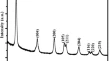
			</st><p>Figure <figr fid="F1">1</figr>a shows the XRD pattern of Co<sub>3</sub>O<sub>4</sub> nanosheets deposited on the ITO substrate. All peaks are assigned to the cubic lattice of Co<sub>3</sub>O<sub>4</sub>. The diffraction data are in a good agreement with JCPDS file no. 9&#8211;418 with no CoO or other impurities detected. The cross-sectional SEM image of the sample was shown in the inset of Figure <figr fid="F1">1</figr>a, where the nanosheet with a thickness of approximately 234 nm can be clearly seen.</p>
			<fig id="F1"><title><p>Figure 1</p></title><caption><p>Co<sub>3</sub>O<sub>4</sub> nanosheets deposited on the ITO substrate</p></caption><text>
   <p><b>Co<sub>3</sub>O<sub>4</sub> nanosheets deposited on the ITO substrate.</b> (<b>a</b>) X-Ray diffraction pattern (inset, cross-sectional image). (<b>b</b>) TEM image of the mesoporous sheets (inset, HRTEM with lattice spacing). (<b>c</b>) Energy-dispersive X-ray spectroscopy (inset, surface morphology).</p>
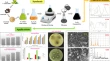
</text><graphic file="1556-276X-8-36-1"/></fig><p>The detailed microstructures of the Co<sub>3</sub>O<sub>4</sub> nanosheets were characterized with TEM. Figure <figr fid="F1">1</figr>b represents typical TEM images of Co<sub>3</sub>O<sub>4</sub> nanosheets. The HRTEM image shown in the inset of Figure <figr fid="F1">1</figr>b clearly demonstrates lattice fringes with a d-spacing of 0.46 nm (111), matching well with the XRD pattern. To further elucidate the composition, energy-dispersive X-ray spectroscopy was used to determine the nominal stoichiometric atomic ratio of Co and O, as shown in Figure <figr fid="F1">1</figr>c.</p><p>The chemical composition of the film was investigated by XPS analysis. The spectra (Co 2<it>p</it> and O 1<it>s</it>, as shown in Figure <figr fid="F2">2</figr>) were acquired and processed using standard XPS peak fitting. Two peaks at binding energies of 780 and 795.1 eV were observed from the Co 2<it>p</it> spectra. The tetrahedral Co<sup>2+</sup> and octahedral Co<sup>3+</sup> contributed to the spin-orbit doublet 2<it>p</it> spectral profile of Co<sub>3</sub>O<sub>4</sub>
				<abbrgrp>
					<abbr bid="B21">21</abbr>
				</abbrgrp>. The relatively sharp peak widths correspond to 2<it>p</it><sub>1/2</sub> to 2<it>p</it><sub>3/2</sub> with separation of 15.1 eV, and the weak satellite structure found in the high binding energy side of 2<it>p</it><sub>3/2</sub> and 2<it>p</it><sub>l/2</sub> transitions indicate the co-existence of Co(II) and Co(III) on the surface of the material. The Co 2<it>p</it> spectrum is well consistent with the XPS spectrum of Co<sub>3</sub>O<sub>4</sub>
				<abbrgrp>
					<abbr bid="B22">22</abbr>
					<abbr bid="B23">23</abbr>
					<abbr bid="B24">24</abbr>
				</abbrgrp>.</p>
			<fig id="F2"><title><p>Figure 2</p></title><caption><p>Co 2<it>p</it> (a) and O 1<it>s</it> (b) XPS spectra of Co<sub>3</sub>O<sub>4</sub> sample</p></caption><text>
   <p>
      <b>Co 2<it>p</it> (a) and O 1<it>s</it> (b) XPS spectra of Co<sub>3</sub>O<sub>4</sub> sample.</b>
   </p>
</text><graphic file="1556-276X-8-36-2"/></fig><p>The O 1<it>s</it> spectra of the sample was also presented in the inset of the same figure The peak at around 530 eV is due to lattice O, while the peak at about 531.6 eV can be attributed to the low coordinated oxygen ions (chemisorbed oxygen) at the surface <abbrgrp>
					<abbr bid="B25">25</abbr>
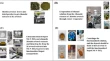
				</abbrgrp>.</p><p>Figure <figr fid="F3">3</figr>a presents the typical current&#8211;voltage (<it>I</it>-<it>V</it>) characteristics of RRAM cell with the Au/Co<sub>3</sub>O<sub>4</sub>/ITO structure, measured by sweeping voltage, at a speed of 1 V/s, in the sequence of 0 &#8594; 2 &#8594; 0 &#8594; &#8722;2 &#8594; 0 V. During the measurements, the bias voltages were applied to the gold top electrode with ITO bottom electrode as ground. By steady increase of the positive voltages imposed on the RRAM cell, a pronounced change of resistance from the high-resistance state (HRS/OFF) to the low-resistance state (LRS/ON) was observed at about 1.05 V, which is called as the SET&#8217; process, and then the device was set in threshold switching mode (no change in current after this voltage).</p>
			<fig id="F3"><title><p>Figure 3</p></title><caption><p>RS properties of the Au/Co<sub>3</sub>O<sub>4</sub>/ITO memory cells</p></caption><text>
   <p><b>RS properties of the Au/Co<sub>3</sub>O<sub>4</sub>/ITO memory cells.</b> (<b>a</b>) Typical bipolar resistance switching <it>I</it>-<it>V</it> curves of the Au/Co<sub>3</sub>O<sub>4</sub>/ITO cells. (<b>b</b>) Electrical pulse-induced resistance switching of the Au/Co<sub>3</sub>O<sub>4</sub>/ITO memory cell at room temperature for 60 s, (inset, data retention of Au/Co<sub>3</sub>O<sub>4</sub>/ITO memory cell for >10<sup>4</sup> s), and (<b>c</b>) <it>I</it>-<it>V</it> curves on log scale.</p>
</text><graphic file="1556-276X-8-36-3"/></fig><p>Subsequently, an opposite &#8216;RESET&#8217; process could also be cited, with the voltage sweep to negative values bringing the device first to an intermediate switching state at &#8722;1.53 V that increased up to &#8722;1.93 V and, after that, completely to OFF state. The sample exhibits a typical bipolar nature of resistive switching. It shows that the positive biasing can be utilized for writing data, while the negative biasing for erasing.</p><p>The electrical stabilities of the Au/Co<sub>3</sub>O<sub>4</sub>/ITO memory device at LRS and HRS have been examined using endurance and retention test. It was observed that the stable HRS and LRS states were maintained with an <it>R</it><sub>OFF</sub>/<it>R</it><sub>ON</sub> ratio of about 25 for 200 pulses, and almost no degradation in the resistance ratio was observed during pulse measurements, as shown in Figure <figr fid="F3">3</figr>b. The device well maintained its switching states (HRS to LRS ratio) for more than 10 s <abbrgrp>
					<abbr bid="B4">4</abbr>
				</abbrgrp>, which indicates that Au/Co<sub>3</sub>O<sub>4</sub>/ITO memory cell can be qualified as a RRAM device due to its decent retention time.</p><p>To further investigate the origin of switching behavior, the <it>I</it>-<it>V</it> curves were replotted on a log-log scale, as shown in Figure <figr fid="F3">3</figr>c. The high conductive state (LRS) slightly follows the ohmic conduction behavior. However, the low conductive state (HRS) was found to follow an ln <it>I</it> vs. <it>V</it><sup>0.5</sup> behavior with a slope of 2.6 in the inset of Figure <figr fid="F3">3</figr>c, which leads to following a Schottky-type conduction emission.</p><p>For resistive switching operations in these devices, the distribution of oxygen ions and its motion can be discussed on the basis of an ionic model <abbrgrp>
					<abbr bid="B26">26</abbr>
					<abbr bid="B27">27</abbr>
					<abbr bid="B28">28</abbr>
				</abbrgrp> that describes the hopping mechanism of O<sup>2&#8722;</sup> ions between different potentials. In our device, ITO used as a bottom electrode can act as a source/reservoir of oxygen ions <abbrgrp>
					<abbr bid="B29">29</abbr>
				</abbrgrp>, and their gradient may produce some diffusion flux (from higher concentration to lower concentration). So, the diffusion coefficient (denoted as <it>D</it>) is expressed as <abbrgrp>
					<abbr bid="B30">30</abbr>
				</abbrgrp>
			</p><p>
				<display-formula id="M1">
					<m:math name="1556-276X-8-36-i1" xmlns:m="http://www.w3.org/1998/Math/MathML"><m:mrow>
   <m:mi>D</m:mi>
   <m:mspace width="0.5em"/>
   <m:mo>=</m:mo>
   <m:mspace width="0.5em"/>
   <m:msub>
      <m:mi>D</m:mi>
      <m:mn>0</m:mn>
   </m:msub>
   <m:mo>exp</m:mo>
   <m:mspace width="0.5em"/>
   <m:mfenced open="(" close=")">
      <m:mrow>
         <m:mo>&#8722;</m:mo>
         <m:mfrac bevelled="true">
            <m:msub>
               <m:mi>E</m:mi>
               <m:mi>a</m:mi>
            </m:msub>
            <m:mtext mathvariant="italic">kt</m:mtext>
         </m:mfrac>
      </m:mrow>
   </m:mfenced>
</m:mrow>
</m:math>
				</display-formula>
			</p><p>where <it>D</it>
				<sub>o</sub> is the diffusion constant, <it>E</it>
				<sub>a</sub> is the activation energy of oxygen vacancy/defect diffusion, <it>k</it> is Boltzmann's constant, and <it>T</it> is the absolute temperature.</p><p>Hence, the dynamics of oxygen concentration (<it>V</it>
				<sub>o</sub>) could be described by taking into account both diffusion (thermal) and drift (electric) effects. Thus, the net continuity equation with its time and displacement dependence is expressed as <abbrgrp>
					<abbr bid="B30">30</abbr>
				</abbrgrp>
			</p><p>
				<display-formula id="M2">
					<m:math name="1556-276X-8-36-i2" xmlns:m="http://www.w3.org/1998/Math/MathML"><m:mrow>
   <m:mfrac>
      <m:mrow>
         <m:mo>&#8706;</m:mo>
         <m:msub>
            <m:mi>V</m:mi>
            <m:mn>0</m:mn>
         </m:msub>
      </m:mrow>
      <m:mrow>
         <m:mo>&#8706;</m:mo>
         <m:mi>t</m:mi>
      </m:mrow>
   </m:mfrac>
   <m:mo>=</m:mo>
   <m:mspace width="0.5em"/>
   <m:mi>D</m:mi>
   <m:mfrac>
      <m:mrow>
         <m:msup>
            <m:mo>&#8706;</m:mo>
            <m:mn>2</m:mn>
         </m:msup>
         <m:msub>
            <m:mi>V</m:mi>
            <m:mn>0</m:mn>
         </m:msub>
      </m:mrow>
      <m:mrow>
         <m:mo>&#8706;</m:mo>
         <m:msup>
            <m:mi>x</m:mi>
            <m:mn>2</m:mn>
         </m:msup>
      </m:mrow>
   </m:mfrac>
   <m:mo>+</m:mo>
   <m:mspace width="0.5em"/>
   <m:mi>&#965;</m:mi>
   <m:mfrac>
      <m:mrow>
         <m:mo>&#8706;</m:mo>
         <m:msub>
            <m:mi>V</m:mi>
            <m:mn>0</m:mn>
         </m:msub>
      </m:mrow>
      <m:mrow>
         <m:mo>&#8706;</m:mo>
         <m:mi>x</m:mi>
      </m:mrow>
   </m:mfrac>
   <m:mo>&#8722;</m:mo>
   <m:mfrac>
      <m:msub>
         <m:mi>V</m:mi>
         <m:mn>0</m:mn>
      </m:msub>
      <m:mi>&#964;</m:mi>
   </m:mfrac>
</m:mrow>
</m:math>
				</display-formula>
			</p><p>where the left side of Equation 2 represents time-dependent evolution of oxygen concentration (<it>V</it>
				<sub>o</sub>), <it>D</it> is the diffusion coefficient, <it>&#965;</it> is the drift velocity, and <it>&#964;</it> represents the recombination time of oxygen ions with metallic cobalt to offset the contribution from oxygen vacancies. In the Au/Co<sub>3</sub>O<sub>4</sub>/ITO device, the applied electrical field generates the drift motion of the oxygen ions, thus inducing the local reduction of Co<sub>3</sub>O<sub>4</sub> with the formation of metallic conducting filaments. With further increase of potential (higher voltage), a substantial Joule heating effect may be generated in the device, which promotes oxygen ion diffusion from ITO into Co<sub>3</sub>O<sub>4</sub>. As a consequence, the migration of oxygen ions may reduce oxygen vacancies and generate Co vacancies simultaneously, which weaken the conducting filaments first and then shatter (due to further joule heating) them by setting the device to threshold switching state <abbrgrp>
					<abbr bid="B31">31</abbr>
					<abbr bid="B32">32</abbr>
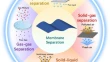
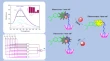
				</abbrgrp>, as illustrated in Figure <figr fid="F4">4</figr>. The migration of oxygen ions which transforms the device from switching memory to threshold state was observed for positive voltages only. For a negative applied bias, the oxygen ion diffusion process starts deceleration that results in filament breaking (intermediate switching state). At a higher negative potential, the diffusion became negligible with majority of ruptured conducting filaments, hence no observable threshold switching state. This polarity dependence implies that the switching transition hinges on the delicately balanced migration of oxygen ions, which must be carefully considered to achieve reliable device operations.</p>
			<fig id="F4"><title><p>Figure 4</p></title><caption><p>Schematic of the Co-rich metallic filament in Co<sub>3</sub>O<sub>4</sub></p></caption><text>
   <p><b>Schematic of the Co-rich metallic filament in Co<sub>3</sub>O<sub>4</sub>.</b> With oxygen gradient-induced drift and the field-induced diffusion motions of the oxygen ions (bulk film effect).</p>
</text><graphic file="1556-276X-8-36-4"/></fig><p>In addition to bulk film effect, the interface between ITO of the bottom electrode (n-type) nanosheet and cobalt oxide (p-type) is also critical to explain switching characteristics Consider the interface as a classical p-n junction with negatively charged electrons or oxygen ions in cobalt oxide and positively charged electrons or oxygen ions in oxygen vacancies in ITO (acting as minority charge carriers in both regions) accumulate at the interface to form a depletion layer. Under forward voltage sweep, these minority charge carriers start moving away from the junction, tending to decrease the width of depletion region with a sudden increase in current (high conduction state or LRS), as shown in Additional file <supplr sid="S1">1</supplr>: Figure S2. The negative applied voltage facilitates the migration of minority charge carriers in both regions towards the junction, which results in the increase of depletion layer causing decrease in current (low conduction state or HRS).</p>
			<suppl id="S1">
				<title>
					<p>Additional file 1</p>
				</title>
				<text>
					<p>
						<b>Supporting information.</b> Contains supporting information (Figures S1, S2, and S3).</p>
				</text>
				<file name="1556-276X-8-36-S1.docx">
   <p>Click here for file</p>
</file>
			</suppl><p>To exclude the possible metal/metal oxide (Au/Co<sub>3</sub>O<sub>4</sub> layers) interface effect (Au used as a top electrode), a test sample without a gold top electrode was also investigated, and the results are shown in Figure S3. It is interesting to note that the RS properties of the device were quite repeatable and similar to the device with Au as the top electrode. This interesting behavior indicates that Au has no significant effects in the resistive switching properties of Co<sub>3</sub>O<sub>4</sub> except for acting as an electrical contact of these devices.</p>
		</sec>
		<sec>
			<st>
				<p>Conclusions</p>
			</st><p>In summary, Co<sub>3</sub>O<sub>4</sub> thin films with nanosheet structure were prepared with a facile electrochemical deposition method. Excellent bipolar resistance switching properties, stable endurance, and retention performance for more than 4 h without observable degradation were achieved. The oxygen ions/vacancies throughout the as-deposited film and interface with minority charge carrier effect are responsible for the switching behavior. Furthermore, the effect of Au top electrode was investigated to verify the origin of resistive switching properties in these devices. The present work demonstrates that these structures have the potential for next-generation non-volatile memory applications.</p>
		</sec>
		<sec>
			<st>
				<p>Competing interests</p>
			</st><p>The authors declare that they have no competing interests.</p>
		</sec>
		<sec>
			<st>
				<p>Authors&#8217; contributions</p>
			</st><p>AY and DC carried out the sample preparation, participated on its analysis, performed all the Analyses, and wrote the paper. XL and JL helped perform the XRD and EDS analyses. SL guided the study and participated in the paper correction. All authors read and approved the final manuscript.</p>
		</sec>
	</bdy>
	<bm>
		<ack>
			<sec>
				<st>
					<p>Acknowledgments</p>
				</st><p>The authors would like to acknowledge the financial support from the Australian Research Council Projects of DP110102391, DP1096769, FT100100956, and DP0988687.</p>
			</sec>
		</ack>
		<refgrp><bibl id="B1"><title><p>Understanding the phase-change mechanism of rewritable optical media</p></title><aug><au><snm>Kolobov</snm><fnm>AVF</fnm></au><au><snm>Paul</snm><fnm>F</fnm></au><au><snm>Anatoly</snm><fnm>I</fnm></au><au><snm>Ankudinov</snm><fnm>I</fnm></au><au><snm>Alexei</snm><fnm>L</fnm></au><au><snm>Tominaga</snm><fnm>J</fnm></au><au><snm>Uruga</snm><fnm>T</fnm></au></aug><source>Nat Mater</source><pubdate>2004</pubdate><volume>3</volume><issue>10</issue><fpage>703</fpage><lpage>708</lpage><xrefbib><pubidlist><pubid idtype="doi">10.1038/nmat1215</pubid><pubid idtype="pmpid" link="fulltext">15359344</pubid></pubidlist></xrefbib></bibl><bibl id="B2"><title><p>Giant magnetoresistance of manganese oxides with a layered perovskite structure</p></title><aug><au><snm>Moritomo</snm><fnm>YA</fnm></au><au><snm>Kuwahara</snm><fnm>H</fnm></au><au><snm>Tokura</snm><fnm>Y</fnm></au></aug><source>Nature</source><pubdate>1996</pubdate><volume>380</volume><issue>6570</issue><fpage>141</fpage><lpage>144</lpage><xrefbib><pubid idtype="doi">10.1038/380141a0</pubid></xrefbib></bibl><bibl id="B3"><title><p>Flash memory cells&#8212;an overview</p></title><aug><au><snm>Pavan</snm><fnm>P</fnm></au><au><snm>Bez</snm><fnm>R</fnm></au><au><snm>Olivo</snm><fnm>P</fnm></au><au><snm>Zanoni</snm><fnm>E</fnm></au></aug><source>Proc IEEE</source><pubdate>1997</pubdate><volume>85</volume><issue>8</issue><fpage>1248</fpage><lpage>1271</lpage><xrefbib><pubid idtype="doi">10.1109/5.622505</pubid></xrefbib></bibl><bibl id="B4"><title><p>Paz de Araujo CA: Ferroelectric memories</p></title><aug><au><snm>Scott</snm><fnm>JF</fnm></au></aug><source>Science</source><pubdate>1989</pubdate><volume>246</volume><issue>4936</issue><fpage>1400</fpage><lpage>1405</lpage><xrefbib><pubidlist><pubid idtype="doi">10.1126/science.246.4936.1400</pubid><pubid idtype="pmpid" link="fulltext">17755995</pubid></pubidlist></xrefbib></bibl><bibl id="B5"><title><p>Current switching of resistive states in magnetoresistive manganites</p></title><aug><au><snm>Asamitsu</snm><fnm>A</fnm></au><au><snm>Tomioka</snm><fnm>Y</fnm></au><au><snm>Kuwahara</snm><fnm>H</fnm></au><au><snm>Tokura</snm><fnm>Y</fnm></au></aug><source>Nature</source><pubdate>1997</pubdate><volume>388</volume><issue>6637</issue><fpage>3</fpage><xrefbib><pubid idtype="pmpid" link="fulltext">9214483</pubid></xrefbib></bibl><bibl id="B6"><title><p>Switching the electrical resistance of individual dislocations in single-crystalline SiTiO<sub>3</sub></p></title><aug><au><snm>Szot</snm><fnm>K</fnm></au><au><snm>Speier</snm><fnm>W</fnm></au><au><snm>Bihlmayer</snm><fnm>G</fnm></au><au><snm>Waser</snm><fnm>R</fnm></au></aug><source>Nat Mater</source><pubdate>2006</pubdate><volume>5</volume><issue>4</issue><fpage>312</fpage><lpage>320</lpage><xrefbib><pubidlist><pubid idtype="doi">10.1038/nmat1614</pubid><pubid idtype="pmpid" link="fulltext">16565712</pubid></pubidlist></xrefbib></bibl><bibl id="B7"><title><p>Electrical manipulation of nanofilaments in transition-metal oxides for resistance-based memory</p></title><aug><au><snm>Lee</snm><fnm>M-J</fnm></au><au><snm>Han</snm><fnm>S</fnm></au><au><snm>Jeon</snm><fnm>SH</fnm></au><au><snm>Park</snm><fnm>BH</fnm></au><au><snm>Kang</snm><fnm>BS</fnm></au><au><snm>Ahn</snm><fnm>S-E</fnm></au><au><snm>Kim</snm><fnm>KH</fnm></au><au><snm>Lee</snm><fnm>CB</fnm></au><au><snm>Kim</snm><fnm>CJ</fnm></au><au><snm>Yoo</snm><fnm>I-K</fnm></au><au><snm>Seo</snm><fnm>DH</fnm></au><au><snm>Li</snm><fnm>X-S</fnm></au><au><snm>Park</snm><fnm>J-B</fnm></au><au><snm>Lee</snm><fnm>J-H</fnm></au><au><snm>Park</snm><fnm>Y</fnm></au></aug><source>Nano Lett</source><pubdate>2009</pubdate><volume>9</volume><issue>4</issue><fpage>1476</fpage><lpage>1481</lpage><xrefbib><pubidlist><pubid idtype="doi">10.1021/nl803387q</pubid><pubid idtype="pmpid" link="fulltext">19296606</pubid></pubidlist></xrefbib></bibl><bibl id="B8"><title><p>Low-temperature-grown transition metal oxide based storage materials and oxide transistors for high-density non-volatile memory</p></title><aug><au><snm>Lee</snm><fnm>M-J</fnm></au><au><snm>Kim</snm><fnm>SI</fnm></au><au><snm>Lee</snm><fnm>CB</fnm></au><au><snm>Yin</snm><fnm>H</fnm></au><au><snm>Ahn</snm><fnm>S-E</fnm></au><au><snm>Kang</snm><fnm>BS</fnm></au><au><snm>Kim</snm><fnm>KH</fnm></au><au><snm>Park</snm><fnm>JC</fnm></au><au><snm>Kim</snm><fnm>CJ</fnm></au><au><snm>Song</snm><fnm>I</fnm></au><au><snm>Kim</snm><fnm>SW</fnm></au><au><snm>Stefanovich</snm><fnm>G</fnm></au><au><snm>Lee</snm><fnm>JH</fnm></au><au><snm>Chung</snm><fnm>SJ</fnm></au><au><snm>Kim</snm><fnm>YH</fnm></au><au><snm>Park</snm><fnm>Y</fnm></au></aug><source>Adv Funct Mater</source><pubdate>2009</pubdate><volume>19</volume><issue>10</issue><fpage>1587</fpage><lpage>1593</lpage><xrefbib><pubid idtype="doi">10.1002/adfm.200801032</pubid></xrefbib></bibl><bibl id="B9"><title><p>The mechanism of electroforming of metal oxide memristive switches</p></title><aug><au><snm>Yang</snm><fnm>JJ</fnm></au><au><snm>Miao</snm><fnm>F</fnm></au><au><snm>Pickett</snm><fnm>MD</fnm></au><au><snm>Ohlberg</snm><fnm>DAA</fnm></au><au><snm>Stewart</snm><fnm>DR</fnm></au><au><snm>Lau</snm><fnm>CN</fnm></au><au><snm>Williams</snm><fnm>RS</fnm></au></aug><source>Nanotechnology</source><pubdate>2009</pubdate><volume>20</volume><issue>21</issue><fpage>215201</fpage><xrefbib><pubidlist><pubid idtype="doi">10.1088/0957-4484/20/21/215201</pubid><pubid idtype="pmpid" link="fulltext">19423925</pubid></pubidlist></xrefbib></bibl><bibl id="B10"><title><p>A family of electronically reconfigurable nanodevices</p></title><aug><au><snm>Yang</snm><fnm>JJ</fnm></au><au><snm>Borghetti</snm><fnm>J</fnm></au><au><snm>Murphy</snm><fnm>D</fnm></au><au><snm>Stewart</snm><fnm>DR</fnm></au><au><snm>Williams</snm><fnm>RS</fnm></au></aug><source>Adv Mater</source><pubdate>2009</pubdate><volume>21</volume><issue>37</issue><fpage>3754</fpage><lpage>3758</lpage><xrefbib><pubid idtype="doi">10.1002/adma.200900822</pubid></xrefbib></bibl><bibl id="B11"><title><p>Fully room-temperature-fabricated nonvolatile resistive memory for ultrafast and high-density memory application</p></title><aug><au><snm>Yang</snm><fnm>YC</fnm></au><au><snm>Pan</snm><fnm>F</fnm></au><au><snm>Liu</snm><fnm>Q</fnm></au><au><snm>Liu</snm><fnm>M</fnm></au><au><snm>Zeng</snm><fnm>F</fnm></au></aug><source>Nano Lett</source><pubdate>2009</pubdate><volume>9</volume><issue>4</issue><fpage>1636</fpage><lpage>1643</lpage><xrefbib><pubidlist><pubid idtype="doi">10.1021/nl900006g</pubid><pubid idtype="pmpid" link="fulltext">19271714</pubid></pubidlist></xrefbib></bibl><bibl id="B12"><title><p>Intrinsic mechanisms of memristive switching</p></title><aug><au><snm>Nagashima</snm><fnm>K</fnm></au><au><snm>Yanagida</snm><fnm>T</fnm></au><au><snm>Oka</snm><fnm>K</fnm></au><au><snm>Kanai</snm><fnm>M</fnm></au><au><snm>Klamchuen</snm><fnm>A</fnm></au><au><snm>Kim</snm><fnm>J-S</fnm></au><au><snm>Park</snm><fnm>BH</fnm></au><au><snm>Kawai</snm><fnm>T</fnm></au></aug><source>Nano Lett</source><pubdate>2011</pubdate><volume>11</volume><issue>5</issue><fpage>2114</fpage><lpage>2118</lpage><xrefbib><pubidlist><pubid idtype="doi">10.1021/nl200707n</pubid><pubid idtype="pmpid" link="fulltext">21476563</pubid></pubidlist></xrefbib></bibl><bibl id="B13"><title><p>Exfoliated oxide nanosheets: new solution to nanoelectronics</p></title><aug><au><snm>Osada</snm><fnm>M</fnm></au><au><snm>Sasaki</snm><fnm>T</fnm></au></aug><source>J Mater Chem</source><pubdate>2009</pubdate><volume>19</volume><issue>17</issue><fpage>2503</fpage><lpage>2511</lpage><xrefbib><pubid idtype="doi">10.1039/b820160a</pubid></xrefbib></bibl><bibl id="B14"><title><p>Two-dimensional dielectric nanosheets: novel nanoelectronics from nanocrystal building blocks</p></title><aug><au><snm>Osada</snm><fnm>M</fnm></au><au><snm>Sasaki</snm><fnm>T</fnm></au></aug><source>Adv Mater</source><pubdate>2012</pubdate><volume>24</volume><issue>2</issue><fpage>210</fpage><lpage>228</lpage><xrefbib><pubidlist><pubid idtype="doi">10.1002/adma.201103241</pubid><pubid idtype="pmpid" link="fulltext">21997712</pubid></pubidlist></xrefbib></bibl><bibl id="B15"><title><p>Preparation of mesoporous Co<sub>3</sub>O<sub>4</sub> nanoparticles via solid&#8211;liquid route and effects of calcination temperature and textural parameters on their electrochemical capacitive behaviors</p></title><aug><au><snm>Zheng</snm><fnm>M-B</fnm></au><au><snm>Cao</snm><fnm>J</fnm></au><au><snm>Liao</snm><fnm>S-T</fnm></au><au><snm>Liu</snm><fnm>J-S</fnm></au><au><snm>Chen</snm><fnm>H-Q</fnm></au><au><snm>Zhao</snm><fnm>Y</fnm></au><au><snm>Dai</snm><fnm>W-J</fnm></au><au><snm>Ji</snm><fnm>G-B</fnm></au><au><snm>Cao</snm><fnm>J-M</fnm></au><au><snm>Tao</snm><fnm>J</fnm></au></aug><source>J Phys Chem C</source><pubdate>2009</pubdate><volume>113</volume><issue>9</issue><fpage>3887</fpage><lpage>3894</lpage><xrefbib><pubid idtype="doi">10.1021/jp810230d</pubid></xrefbib></bibl><bibl id="B16"><title><p>Fabrication of mesoporous cobalt oxide (Co<sub>3</sub>O<sub>4</sub>) film by electrochemical method for electrochemical capacitor</p></title><aug><au><snm>Lee</snm><fnm>J-KK</fnm></au><au><snm>Lee</snm><fnm>J-KK</fnm></au><au><snm>Gil-Pyo</snm><fnm>K</fnm></au><au><snm>Kyung-Hwa</snm><fnm>S</fnm></au><au><snm>In</snm><fnm>K</fnm></au><au><snm>Baeck</snm><fnm>S-H</fnm></au></aug><source>J Nanosci Nanotechnol</source><pubdate>2010</pubdate><volume>10</volume><issue>5</issue><fpage>3676</fpage><lpage>3679</lpage><xrefbib><pubidlist><pubid idtype="doi">10.1166/jnn.2010.2318</pubid><pubid idtype="pmpid">20359026</pubid></pubidlist></xrefbib></bibl><bibl id="B17"><title><p>Substrate dependent self-organization of mesoporous cobalt oxide nanowires with remarkable pseudocapacitance</p></title><aug><au><snm>Rakhi</snm><fnm>RB</fnm></au><au><snm>Chen</snm><fnm>W</fnm></au><au><snm>Cha</snm><fnm>D</fnm></au><au><snm>Alshareef</snm><fnm>HN</fnm></au></aug><source>Nano Lett</source><pubdate>2012</pubdate><volume>12</volume><issue>5</issue><fpage>2559</fpage><lpage>2567</lpage><xrefbib><pubidlist><pubid idtype="doi">10.1021/nl300779a</pubid><pubid idtype="pmpid" link="fulltext">22494065</pubid></pubidlist></xrefbib></bibl><bibl id="B18"><title><p>Highly ordered mesoporous cobalt oxide nanostructures: synthesis, characterisation, magnetic properties, and applications for electrochemical energy devices</p></title><aug><au><snm>Wang</snm><fnm>G</fnm></au><au><snm>Liu</snm><fnm>H</fnm></au><au><snm>Horvat</snm><fnm>J</fnm></au><au><snm>Wang</snm><fnm>B</fnm></au><au><snm>Qiao</snm><fnm>S</fnm></au><au><snm>Park</snm><fnm>J</fnm></au><au><snm>Ahn</snm><fnm>H</fnm></au></aug><source>Chemistry &#8211; AEuropean Journal</source><pubdate>2010</pubdate><volume>16</volume><issue>36</issue><fpage>11020</fpage><lpage>11027</lpage><xrefbib><pubid idtype="pmpid" link="fulltext">23373063</pubid></xrefbib></bibl><bibl id="B19"><title><p>Morphology-controllable synthesis of cobalt oxalates and their conversion to mesoporous Co<sub>3</sub>O<sub>4</sub> nanostructures for application in supercapacitors</p></title><aug><au><snm>Wang</snm><fnm>D</fnm></au><au><snm>Wang</snm><fnm>Q</fnm></au><au><snm>Wang</snm><fnm>T</fnm></au></aug><source>Inorg Chem</source><pubdate>2011</pubdate><volume>50</volume><issue>14</issue><fpage>6482</fpage><lpage>6492</lpage><xrefbib><pubidlist><pubid idtype="doi">10.1021/ic200309t</pubid><pubid idtype="pmpid" link="fulltext">21671652</pubid></pubidlist></xrefbib></bibl><bibl id="B20"><title><p>Synthesis of morphology-controlled silver nanostructures by electrodeposition</p></title><aug><au><snm>Liang</snm><fnm>KZC</fnm></au><au><snm>Liu</snm><fnm>M</fnm></au><au><snm>Jiang</snm><fnm>L</fnm></au><au><snm>Liu</snm><fnm>S</fnm></au><au><snm>Xing</snm><fnm>D</fnm></au><au><snm>Li</snm><fnm>H</fnm></au><au><snm>Na</snm><fnm>Y</fnm></au><au><snm>Zhao</snm><fnm>W</fnm></au><au><snm>Tong</snm><fnm>Y</fnm></au><au><snm>Liu</snm><fnm>P</fnm></au></aug><source>Nano-Micro Lett</source><pubdate>2010</pubdate><volume>2</volume><fpage>6</fpage><lpage>10</lpage></bibl><bibl id="B21"><title><p>The nature of excess oxygen in Co<sub>3</sub>O<sub>4+&#949;</sub></p></title><aug><au><snm>Tyuliev</snm><fnm>G</fnm></au><au><snm>Angelov</snm><fnm>S</fnm></au></aug><source>Appl Surf Sci</source><pubdate>1988</pubdate><volume>32</volume><issue>4</issue><fpage>381</fpage><lpage>391</lpage><xrefbib><pubid idtype="doi">10.1016/0169-4332(88)90089-X</pubid></xrefbib></bibl><bibl id="B22"><title><p>Preparation and magnetic properties of the CoO/Co bilayer</p></title><aug><au><snm>Raquet</snm><fnm>B</fnm></au><au><snm>Mamy</snm><fnm>R</fnm></au><au><snm>Ousset</snm><fnm>JC</fnm></au><au><snm>N&#232;gre</snm><fnm>N</fnm></au><au><snm>Goiran</snm><fnm>M</fnm></au><au><snm>Guerret-Pi&#233;court</snm><fnm>C</fnm></au></aug><source>J Magn Magn Mater</source><pubdate>1998</pubdate><volume>184</volume><issue>1</issue><fpage>41</fpage><lpage>48</lpage><xrefbib><pubid idtype="doi">10.1016/S0304-8853(97)01105-0</pubid></xrefbib></bibl><bibl id="B23"><title><p>An ESCA study of the termination of the passivation of elemental metals</p></title><aug><au><snm>Barr</snm><fnm>TL</fnm></au></aug><source>J Phys Chem</source><pubdate>1978</pubdate><volume>82</volume><issue>16</issue><fpage>1801</fpage><lpage>1810</lpage><xrefbib><pubid idtype="doi">10.1021/j100505a006</pubid></xrefbib></bibl><bibl id="B24"><title><p>X-ray photoelectron studies on some oxides and hydroxides of cobalt, nickel, and copper</p></title><aug><au><snm>McIntyre</snm><fnm>NS</fnm></au><au><snm>Cook</snm><fnm>MG</fnm></au></aug><source>Anal Chem</source><pubdate>1975</pubdate><volume>47</volume><issue>13</issue><fpage>2208</fpage><lpage>2213</lpage><xrefbib><pubid idtype="doi">10.1021/ac60363a034</pubid></xrefbib></bibl><bibl id="B25"><title><p>Controlled synthesis of highly active mesoporous Co<sub>3</sub>O<sub>4</sub> polycrystals for low temperature CO oxidation</p></title><aug><au><snm>Feng</snm><fnm>Y</fnm></au><au><snm>Li</snm><fnm>L</fnm></au><au><snm>Niu</snm><fnm>S</fnm></au><au><snm>Qu</snm><fnm>Y</fnm></au><au><snm>Zhang</snm><fnm>Q</fnm></au><au><snm>Li</snm><fnm>Y</fnm></au><au><snm>Zhao</snm><fnm>W</fnm></au><au><snm>Li</snm><fnm>H</fnm></au><au><snm>Shi</snm><fnm>J</fnm></au></aug><source>Appl Catal Environ</source><pubdate>2012</pubdate><volume>111&#8211;112</volume><fpage>461</fpage><lpage>466</lpage></bibl><bibl id="B26"><title><p>Electronic processes in ionic crystals (Mott, NF.; Gurney, RW.)</p></title><aug><au><snm>Leighton</snm><fnm>PA</fnm></au></aug><source>J Chem Educ</source><pubdate>1941</pubdate><volume>18</volume><issue>5</issue><fpage>249</fpage></bibl><bibl id="B27"><title><p>Exponential ionic drift: fast switching and low volatility of thin-film memristors</p></title><aug><au><snm>Strukov</snm><fnm>D</fnm></au><au><snm>Williams</snm><fnm>R</fnm></au></aug><source>Appl Phys Mater Sci Process</source><pubdate>2009</pubdate><volume>94</volume><issue>3</issue><fpage>515</fpage><lpage>519</lpage><xrefbib><pubid idtype="doi">10.1007/s00339-008-4975-3</pubid></xrefbib></bibl><bibl id="B28"><title><p>A phenomenological model for the reset mechanism of metal oxide RRAM</p></title><aug><au><snm>Shimeng</snm><fnm>Y</fnm></au><au><snm>Wong</snm><fnm>HSP</fnm></au></aug><source>Electron Device Letters, IEEE</source><pubdate>2010</pubdate><volume>31</volume><issue>12</issue><fpage>1455</fpage><lpage>1457</lpage></bibl><bibl id="B29"><title><p>Oxygen level: the dominant of resistive switching characteristics in cerium oxide thin films</p></title><aug><au><snm>Younis</snm><fnm>A</fnm></au><au><snm>Chu</snm><fnm>D</fnm></au><au><snm>Li</snm><fnm>S</fnm></au></aug><source>J Phys D: Appl Phys</source><pubdate>2012</pubdate><volume>45</volume><issue>35</issue><fpage>355101</fpage><xrefbib><pubid idtype="doi">10.1088/0022-3727/45/35/355101</pubid></xrefbib></bibl><bibl id="B30"><title><p>A phenomenological model for the reset mechanism of metal oxide RRAM</p></title><aug><au><snm>Yu</snm><fnm>HWS</fnm></au></aug><source>Electron Device Letters, IEEE</source><pubdate>2010</pubdate><volume>31</volume><issue>12</issue><fpage>1455</fpage><lpage>1457</lpage></bibl><bibl id="B31"><title><p>Effects of heat dissipation on unipolar resistance switching in Pt/NiO/Pt capacitors</p></title><aug><au><snm>Chang</snm><fnm>SH</fnm></au><au><snm>Chae</snm><fnm>SC</fnm></au><au><snm>Lee</snm><fnm>SB</fnm></au><au><snm>Liu</snm><fnm>C</fnm></au><au><snm>Noh</snm><fnm>TW</fnm></au><au><snm>Lee</snm><fnm>JS</fnm></au><au><snm>Kahng</snm><fnm>B</fnm></au><au><snm>Jang</snm><fnm>JH</fnm></au><au><snm>Kim</snm><fnm>MY</fnm></au><au><snm>Kim</snm><fnm>DW</fnm></au><au><snm>Jung</snm><fnm>CU</fnm></au></aug><source>Appl Phys Lett</source><pubdate>2008</pubdate><volume>92</volume><issue>18</issue><fpage>183507</fpage><lpage>183503</lpage><xrefbib><pubid idtype="doi">10.1063/1.2924304</pubid></xrefbib></bibl><bibl id="B32"><aug><au><snm>Chang</snm><fnm>SH</fnm></au><au><snm>Lee</snm><fnm>JS</fnm></au><au><snm>Chae</snm><fnm>SC</fnm></au><au><snm>Lee</snm><fnm>SB</fnm></au><au><snm>Liu</snm><fnm>C</fnm></au><au><snm>Kahng</snm><fnm>B</fnm></au><au><snm>Kim</snm><fnm>D-W</fnm></au><au><snm>Noh</snm><fnm>TW</fnm></au></aug><source>Percolation model explaining both unipolar memory and threshold resistance switchings in NiO film;</source><note>arXiv:0803.4258. 2008. cond-mat.mtrl-sci.</note></bibl></refgrp>
	</bm>
</art>