<?xml version='1.0'?>
<!DOCTYPE art SYSTEM 'http://www.biomedcentral.com/xml/article.dtd'>
<art>
	<ui>1556-276X-8-2</ui>
	<ji>1556-276X</ji>
	<fm>
		<dochead>Nano Express</dochead>
		<bibl>
			<title>
				<p>Hydrothermal evolution, optical and electrochemical properties of hierarchical porous hematite nanoarchitectures</p>
			</title>
			<aug>
				<au id="A1" ca="yes"><snm>Zhu</snm><fnm>Wancheng</fnm><insr iid="I1"/><email>zhuwancheng@tsinghua.org.cn</email></au>
				<au id="A2"><snm>Cui</snm><fnm>Xili</fnm><insr iid="I1"/><email>cuixili198710250@126.com</email></au>
				<au id="A3"><snm>Liu</snm><fnm>Xiaofei</fnm><insr iid="I1"/><email>zisuxiaoxiang@126.com</email></au>
				<au id="A4"><snm>Zhang</snm><fnm>Liyun</fnm><insr iid="I1"/><email>lyzhang10s@imr.ac.cn</email></au>
				<au id="A5"><snm>Huang</snm><fnm>Jia-Qi</fnm><insr iid="I2"/><email>hjq03@mails.tsinghua.edu.cn</email></au>
				<au id="A6"><snm>Piao</snm><fnm>Xianglan</fnm><insr iid="I2"/><email>piaoxl@mail.tsinghua.edu.cn</email></au>
				<au id="A7" ca="yes"><snm>Zhang</snm><fnm>Qiang</fnm><insr iid="I2"/><email>zhang-qiang@mails.tsinghua.edu.cn</email></au>
			</aug>
			<insg>
				<ins id="I1"><p>Department of Chemical Engineering, Qufu Normal University, Shandong, 273165, China</p></ins>
				<ins id="I2"><p>Department of Chemical Engineering, Tsinghua University, Beijing, 100084, China</p></ins>
			</insg>
			<source>Nanoscale Research Letters</source>
			<section><title><p>Regular submissions</p></title></section><issn>1556-276X</issn>
			<pubdate>2013</pubdate>
			<volume>8</volume>
			<issue>1</issue>
			<fpage>2</fpage>
			<url>http://www.nanoscalereslett.com/content/8/1/2</url>
			<xrefbib><pubidlist><pubid idtype="doi">10.1186/1556-276X-8-2</pubid><pubid idtype="pmpid">23279781</pubid></pubidlist></xrefbib>
		</bibl>
		<history><rec><date><day>16</day><month>7</month><year>2012</year></date></rec><acc><date><day>2</day><month>12</month><year>2012</year></date></acc><pub><date><day>2</day><month>1</month><year>2013</year></date></pub></history>
		<cpyrt><year>2013</year><collab>Zhu et al.; licensee Springer.</collab><note>This is an Open Access article distributed under the terms of the Creative Commons Attribution License (<url>http://creativecommons.org/licenses/by/2.0</url>), which permits unrestricted use, distribution, and reproduction in any medium, provided the original work is properly cited.</note></cpyrt>
		<kwdg>
			<kwd>Hematite</kwd>
			<kwd>Hierarchical nanoarchitectures</kwd>
			<kwd>Hydrothermal</kwd>
			<kwd>Mesoporous</kwd>
			<kwd>Lithium-ion batteries</kwd>
		</kwdg>
		<abs>
			<sec>
				<st>
					<p>Abstract</p>
				</st><p>Hollow or porous hematite (&#945;-Fe<sub>2</sub>O<sub>3</sub>) nanoarchitectures have emerged as promising crystals in the advanced materials research. In this contribution, hierarchical mesoporous &#945;-Fe<sub>2</sub>O<sub>3</sub> nanoarchitectures with a pod-like shape were synthesized via a room-temperature coprecipitation of FeCl<sub>3</sub> and NaOH solutions, followed by a mild hydrothermal treatment (120&#176;C to 210&#176;C, 12.0 h). A formation mechanism based on the hydrothermal evolution was proposed. &#946;-FeOOH fibrils were assembled by the reaction-limited aggregation first, subsequent and <it>in situ</it> conversion led to compact pod-like &#945;-Fe<sub>2</sub>O<sub>3</sub> nanoarchitectures, and finally high-temperature, long-time hydrothermal treatment caused loose pod-like &#945;-Fe<sub>2</sub>O<sub>3</sub> nanoarchitectures via the Ostwald ripening. The as-synthesized &#945;-Fe<sub>2</sub>O<sub>3</sub> nanoarchitectures exhibit good absorbance within visible regions and also exhibit an improved performance for Li-ion storage with good rate performance, which can be attributed to the porous nature of Fe<sub>2</sub>O<sub>3</sub> nanoarchitectures. This provides a facile, environmentally benign, and low-cost synthesis strategy for &#945;-Fe<sub>2</sub>O<sub>3</sub> crystal growth, indicating the as-prepared &#945;-Fe<sub>2</sub>O<sub>3</sub> nanoarchitectures as potential advanced functional materials for energy storage, gas sensors, photoelectrochemical water splitting, and water treatment.</p>
			</sec>
		</abs>
	</fm>
	<bdy>
		<sec>
			<st>
				<p>Background</p>
			</st><p>Three-dimensional hierarchical architectures, or nanoarchitectures, assembled by one-dimensional (1D) nanostructures have attracted extraordinary attention and intensive interests owing to their unique structures and fantastic properties different from those of the monomorph structures <abbrgrp>
					<abbr bid="B1">1</abbr>
					<abbr bid="B2">2</abbr>
					<abbr bid="B3">3</abbr>
					<abbr bid="B4">4</abbr>
					<abbr bid="B5">5</abbr>
				</abbrgrp>. Particularly, hierarchical architectures with mesoporous structures have triggered more and more research enthusiasm in recent years for their high surface-to-volume ratio and permeability. Synthesis of mesoporous materials has become a remarkable level in modern materials chemistry <abbrgrp>
					<abbr bid="B6">6</abbr>
				</abbrgrp>. Mesoporous materials are generally synthesized via a soft- or hard-template-aided process, which usually, however, suffers from the removal of templates and resultant structural collapse, although hydrothermal synthesis or treatment has been extensively investigated at various stages with the attempt to improve the hydrothermal stability of the as-synthesized mesoporous products. Consequently, great effort has been made to directly grow mesoporous inorganic materials in the absence of any templates in recent years <abbrgrp>
					<abbr bid="B7">7</abbr>
					<abbr bid="B8">8</abbr>
				</abbrgrp>. Most recently, the hydrothermal method has emerged as a thriving technique for the facile fabrication of the nanoarchitectures <abbrgrp>
					<abbr bid="B9">9</abbr>
					<abbr bid="B10">10</abbr>
					<abbr bid="B11">11</abbr>
					<abbr bid="B12">12</abbr>
				</abbrgrp>, such as AlOOH cantaloupe <abbrgrp>
					<abbr bid="B13">13</abbr>
				</abbrgrp>, Co(OH)<sub>2</sub> and Co<sub>3</sub>O<sub>4</sub> nanocolumns <abbrgrp>
					<abbr bid="B14">14</abbr>
				</abbrgrp>, ZnSe nanoflowers <abbrgrp>
					<abbr bid="B15">15</abbr>
				</abbrgrp>, Ni(OH)<sub>2</sub> and NiO microspheres <abbrgrp>
					<abbr bid="B16">16</abbr>
				</abbrgrp>, and even mesoporous SrCO<sub>3</sub> microspheres <abbrgrp>
					<abbr bid="B8">8</abbr>
				</abbrgrp>.</p><p>As the most stable iron oxide, hematite (&#945;-Fe<sub>2</sub>O<sub>3</sub>) has drawn much concern owing to its widespread applications as catalysts, pigments, gas sensors <abbrgrp>
					<abbr bid="B17">17</abbr>
				</abbrgrp>, photoelectrodes <abbrgrp>
					<abbr bid="B17">17</abbr>
					<abbr bid="B18">18</abbr>
				</abbrgrp>, starting materials for the synthesis of magnetic iron oxide nanoparticles (NPs) <abbrgrp>
					<abbr bid="B19">19</abbr>
				</abbrgrp>, electrode materials for lithium-ion battery (LIB) <abbrgrp>
					<abbr bid="B20">20</abbr>
					<abbr bid="B21">21</abbr>
					<abbr bid="B22">22</abbr>
					<abbr bid="B23">23</abbr>
					<abbr bid="B24">24</abbr>
					<abbr bid="B25">25</abbr>
					<abbr bid="B26">26</abbr>
				</abbrgrp>, etc. &#945;-Fe<sub>2</sub>O<sub>3</sub> is considered a promising active lithium intercalation host due to its high theoretical capacity (1,007 mAh&#183;g<sup>&#8722;1</sup>), low cost, and environmental friendliness. In contrast to graphite electrodes, the lithium storage within iron oxides is mainly achieved through the reversible conversion reaction between lithium ions and metal nanocrystals dispersed in a Li<sub>2</sub>O matrix <abbrgrp>
					<abbr bid="B24">24</abbr>
				</abbrgrp>. Such a process usually causes drastic volume changes (&gt;200%) and severe destruction of the electrode upon electrochemical cycling, especially at a high rate <abbrgrp>
					<abbr bid="B24">24</abbr>
				</abbrgrp>. Particle morphology has been recognized as a key factor influencing the electrochemical performance for lithium storage; thus, hematite nanostructures with different morphologies have been synthesized so as to enhance the electrochemical performance <abbrgrp>
					<abbr bid="B22">22</abbr>
				</abbrgrp>. The mesoporous &#945;-Fe<sub>2</sub>O<sub>3</sub> nanoarchitectures may afford several advantages for LIB application, such as the extended contact area between the active material and the electrolyte as well as the short lithium diffusion length resulting from the thin shell and the hollow space in the central part that buffers the volume expansion during cycling <abbrgrp>
					<abbr bid="B22">22</abbr>
					<abbr bid="B27">27</abbr>
					<abbr bid="B28">28</abbr>
				</abbrgrp>.</p><p>Up to now, a family of hierarchical &#945;-Fe<sub>2</sub>O<sub>3</sub> architectures (microring <abbrgrp>
					<abbr bid="B7">7</abbr>
				</abbrgrp>, melon-like <abbrgrp>
					<abbr bid="B25">25</abbr>
				</abbrgrp>, columnar <abbrgrp>
					<abbr bid="B29">29</abbr>
				</abbrgrp>, and nanotube <abbrgrp>
					<abbr bid="B30">30</abbr>
				</abbrgrp> arrays; nanoplatelets <abbrgrp>
					<abbr bid="B31">31</abbr>
				</abbrgrp>; peanut- <abbrgrp>
					<abbr bid="B32">32</abbr>
				</abbrgrp>, cantaloupe- <abbrgrp>
					<abbr bid="B33">33</abbr>
				</abbrgrp>, or urchin-like <abbrgrp>
					<abbr bid="B34">34</abbr>
				</abbrgrp> nanoarchitectures, etc.) have been available. Most recently, novel hollow architectures (hollow fibers <abbrgrp>
					<abbr bid="B35">35</abbr>
				</abbrgrp>, hollow particles <abbrgrp>
					<abbr bid="B36">36</abbr>
				</abbrgrp>, hollow microspheres and spindles <abbrgrp>
					<abbr bid="B37">37</abbr>
					<abbr bid="B38">38</abbr>
				</abbrgrp>, etc.) and porous nanoarchitectures (nanoporous microscale particles <abbrgrp>
					<abbr bid="B39">39</abbr>
				</abbrgrp>, mesoporous particles <abbrgrp>
					<abbr bid="B40">40</abbr>
					<abbr bid="B41">41</abbr>
				</abbrgrp>, nanocrystal clusters <abbrgrp>
					<abbr bid="B42">42</abbr>
				</abbrgrp>, porous nanoflowers <abbrgrp>
					<abbr bid="B43">43</abbr>
				</abbrgrp>, etc.) have emerged as the new highlights in crystal growth. However, hollow or porous hematite nanoarchitectures were generally fabricated via a forced hydrolysis (100&#176;C, 7 to 14 days) reaction <abbrgrp>
					<abbr bid="B40">40</abbr>
				</abbrgrp>, surfactant-assisted solvothermal process <abbrgrp>
					<abbr bid="B38">38</abbr>
					<abbr bid="B42">42</abbr>
				</abbrgrp>, and hydrothermal- <abbrgrp>
					<abbr bid="B37">37</abbr>
				</abbrgrp> or solvothermal-based <abbrgrp>
					<abbr bid="B43">43</abbr>
				</abbrgrp> or direct <abbrgrp>
					<abbr bid="B42">42</abbr>
				</abbrgrp> calcination (400&#176;C to 800&#176;C) methods. The reported methodologies exhibited drawbacks such as ultralong time or high energy consumption and potentially environmental malignant. It was still a challenge to directly acquire porous/mesoporous hematite nanoarchitectures via a facile, environmentally benign, and low-cost route.</p><p>In our previous work, we developed a hydrothermal synthesis of the porous hematite with a pod-like morphology or short-aspect-ratio ellipsoidal shape (denoted as &#8216;pod-like&#8217; thereafter) in the presence of H<sub>3</sub>BO<sub>3</sub>
				<abbrgrp>
					<abbr bid="B44">44</abbr>
				</abbrgrp>. However, the process still needed to be optimized, the formation mechanism and the effect of H<sub>3</sub>BO<sub>3</sub> were not clear, and properties and potential applications also needed to be further investigated. In this contribution, we report our newly detailed investigation on the optimization of the process and formation mechanism of the mesoporous nanoarchitectures based on the hydrothermal evolution. In addition, the effect of H<sub>3</sub>BO<sub>3</sub> was discussed, the optical and electrochemical properties of the as-synthesized hematite mesoporous nanoarchitectures as well as nanoparticles were investigated in detail, and the application of the as-synthesized mesoporous hematite nanoarchitectures as anode materials for lithium-ion batteries was also evaluated.</p>
		</sec>
		<sec>
			<st>
				<p>Methods</p>
			</st>
			<sec>
				<st>
					<p>Hydrothermal synthesis of the hierarchical hematite nanoarchitectures</p>
				</st><p>All reagents, such as FeCl<sub>3</sub>&#183;6H<sub>2</sub>O, NaOH, and H<sub>3</sub>BO<sub>3</sub>, were of analytical grade and used as received without further purification. Monodisperse &#945;-Fe<sub>2</sub>O<sub>3</sub> particles were synthesized via a coprecipitation of FeCl<sub>3</sub> and NaOH solutions at room temperature, followed by a facile hydrothermal treatment of the slurry in the presence of H<sub>3</sub>BO<sub>3</sub> as the additive. In a typical procedure, 1.281 g of H<sub>3</sub>BO<sub>3</sub> was poured into 10.1 mL of deionized (DI) water, then 9.3 mL of FeCl<sub>3</sub> (1.5 mol&#183;L<sup>&#8722;1</sup>) solution was added, and finally 7.0 mL of NaOH (4 mol&#183;L<sup>&#8722;1</sup>) solution was dropped into the above mixed solution under vigorous magnetic stirring at room temperature, with the molar ratio of FeCl<sub>3</sub>/H<sub>3</sub>BO<sub>3</sub>/NaOH as 2:3:4. After 5 min of stirring, 26.4 mL of the resultant brown slurry was transferred into a Teflon-lined stainless steel autoclave with a capacity of 44 mL. The autoclave was sealed and heated to 90&#176;C to 210&#176;C (heating rate 2&#176;C&#183;min<sup>&#8722;1</sup>) and kept under an isothermal condition for 1.0 to 24.0 h, and then cooled down to room temperature naturally. The product was filtered, washed with DI water for three times, and finally dried at 80&#176;C for 24.0 h for further characterization. To evaluate the effects of the molar ratio of the reactants, the molar ratio of FeCl<sub>3</sub>/H<sub>3</sub>BO<sub>3</sub>/NaOH was altered within the range of 2:(0&#8211;3):(2&#8211;6), with other conditions unchanged.</p>
			</sec>
			<sec>
				<st>
					<p>Evaluation of the hematite nanoarchitectures as the anode materials for lithium batteries</p>
				</st><p>The electrochemical evaluation of the Fe<sub>2</sub>O<sub>3</sub> NPs and nanoarchitectures as anode materials for lithium-ion batteries were carried out using CR2025 coin-type cells with lithium foil as the counter electrode, microporous polyethylene (Celgard 2400, Charlotte, NC, USA) as the separator, and 1.0 mol&#183;L<sup>&#8722;1</sup> LiPF<sub>6</sub> dissolved in a mixture of ethylene carbonate, dimethyl carbonate, ethylene methyl carbonate (1:1:1, by weight) as the electrolyte. All the assembly processes were conducted in an argon-filled glove box. For preparing working electrodes, a mixed slurry of hematite, carbon black, and polyvinylidene fluoride with a mass ratio of 80:10:10 in <it>N</it>-methyl-2-pyrrolidone solvent was pasted on pure Cu foil with a blade and was dried at 100&#176;C for 12 h under vacuum conditions, followed by pressing at 20 kg&#183;cm<sup>&#8722;2</sup>. The galvanostatic discharge/charge measurements were performed at different current densities in the voltage range of 0.01 to 3.0 V on a Neware battery testing system (Shenzhen, China). The specific capacity was calculated based on the mass of hematite. Cyclic voltammogram measurements were performed on a Solartron Analytical 1470E workstation (Farnborough, UK) at a sweep rate of 0.1 mV&#183;s<sup>&#8722;1</sup>.</p>
			</sec>
			<sec>
				<st>
					<p>Characterization</p>
				</st><p>The crystal structures of the samples were identified using an X-ray powder diffractometer (XRD; D8-Advance, Bruker, Karlsruhe, Germany) with a Cu K<sub>&#945;</sub> radiation (<it>&#955;</it> = 1.5406 &#197;) and a fixed power source (40.0 kV, 40.0 mA). The morphology and microstructure of the samples were examined using a field-emission scanning electron microscope (SEM; JSM 7401 F, JEOL, Akishima-shi, Japan) operated at an accelerating voltage of 3.0 kV. The size distribution of the as-synthesized hierarchical architectures was estimated by directly measuring <it>ca</it>. 100 particles from the typical SEM images. The N<sub>2</sub> adsorption-desorption isotherms were measured at 77 K using a chemisorption-physisorption analyzer (Autosorb-1-C, Quantachrome, Boynton Beach, FL, USA) after the samples had been outgassed at 300&#176;C for 60 min. The specific surface area was calculated from the adsorption branches within the relative pressure range of 0.10 to 0.31 using the multipoint Brunauer-Emmett-Teller (BET) method, and the pore size distribution was evaluated from the N<sub>2</sub> desorption isotherm using the Barrett-Joyner-Halenda method. The optical properties were examined using a UV&#8211;vis spectrophotometer (Cary 300, Varian, Palo Alto, CA, USA), with absolute alcohol as the dispersive medium.</p>
			</sec>
		</sec>
		<sec>
			<st>
				<p>Results and discussion</p>
			</st>
			<sec>
				<st>
					<p>Hematite structures obtained at different molar ratios of the reactants</p>
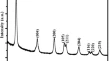
				</st><p>Figure <figr fid="F1">1</figr> shows the influences of the molar ratio of FeCl<sub>3</sub>/H<sub>3</sub>BO<sub>3</sub>/NaOH on the compositions and morphologies of the hydrothermal products obtained at 150&#176;C for 12.0 h. When changing the molar ratio of FeCl<sub>3</sub>/H<sub>3</sub>BO<sub>3</sub>/NaOH within the range of 2:(0&#8211;3):(2&#8211;6), all products were composed of pure-phase hematite (&#945;-Fe<sub>2</sub>O<sub>3</sub>, JCPDS No. 33&#8211;0664), with a detectable slight difference of the crystallinity (Figure <figr fid="F1">1a</figr>). With the molar ratio of FeCl<sub>3</sub>/H<sub>3</sub>BO<sub>3</sub>/NaOH changed from 2:0:6 to 2:0:4 and to 2:0:2, the crystallinity of hematite decreased slightly (Figure <figr fid="F1">1a</figr>
					<sub>1</sub>,a<sub>2</sub>,a<sub>3</sub>). In contrast, the morphologies of the obtained products varied significantly with the change of the molar ratio of reactants. Quasi-spherical hematite NPs with a diameter of 30 to 150 nm were obtained when the molar ratio of FeCl<sub>3</sub>/H<sub>3</sub>BO<sub>3</sub>/NaOH was 2:0:6 (Figure <figr fid="F1">1</figr>b,b<sub>1</sub>), similar to the so-called &#945;-Fe<sub>2</sub>O<sub>3</sub> nanopolyhedra synthesized in the ammonia-water system at 180&#176;C for 8.0 h <abbrgrp>
						<abbr bid="B23">23</abbr>
					</abbrgrp>. With the molar ratio decreased to 2:0:4 and 2:0:2, hierarchical pod-like (with elliptical ends and relatively uniform diameter along the long axial direction, Figure <figr fid="F1">1c</figr>) and peanut-type nanoarchitectures (with relatively sharp elliptical ends and saddle-shaped middle part, Figure <figr fid="F1">1</figr>d,d<sub>1</sub>) were acquired, respectively. The pod-like architectures contained 1D or linear chain-like assemblies of smaller nanoparticles or rod-like subcrystals within the body (as shown in red dotted elliptical and rectangular regions in Figure <figr fid="F1">1c</figr>), with distinct cavities on the surfaces (Figure <figr fid="F1">1c</figr>). The peanut-type nanoarchitectures (Figure <figr fid="F1">1</figr>d,d<sub>1</sub>) also comprised small nanoparticles within the body whereas with not so distinct cavities on the surfaces owing to the relatively compact assembly. Similar 1D assemblies, such as rod-like subcrystals and linear chains of interconnected primary particles, have also been found to exist as the subunits of peanut-type <abbrgrp>
						<abbr bid="B45">45</abbr>
					</abbrgrp> and double-cupola <abbrgrp>
						<abbr bid="B46">46</abbr>
					</abbrgrp> hematite, respectively. Obviously, the molar ratio of 2:0:6 (FeCl<sub>3</sub>/H<sub>3</sub>BO<sub>3</sub>/NaOH) led to nearly monodisperse hematite NPs, whereas the molar ratio of 2:0:4 and 2:0:2 resulted in porous hierarchical architectures with different morphologies. According to Sugimoto&#8217;s research <abbrgrp>
						<abbr bid="B45">45</abbr>
						<abbr bid="B47">47</abbr>
						<abbr bid="B48">48</abbr>
					</abbrgrp>, size control is generally performed by controlling the number of nuclei during the nucleation stage, and nucleation occurs during the addition of NaOH solution into FeCl<sub>3</sub> solution. In the present case, the molar ratio of FeCl<sub>3</sub>/H<sub>3</sub>BO<sub>3</sub>/NaOH as 2:0:6 is the stoichiometric ratio for the formation of colloidal Fe(OH)<sub>3</sub> at room temperature, which led to the greatest degree of supersaturation of Fe(OH)<sub>3</sub> and further resulted in the largest number of nuclei and ultimately brought the quasi-spherical &#945;-Fe<sub>2</sub>O<sub>3</sub> NPs.</p>
				<fig id="F1"><title><p>Figure 1</p></title><caption><p>XRD patterns (a) and SEM (b, c-f) and TEM (b<sub>1</sub>) images of the hydrothermal products</p></caption><text>
   <p><b>XRD patterns (a) and SEM (b, c-f) and TEM (b<sub>1</sub>) images of the hydrothermal products.</b> The products were obtained at 150&#176;C for 12.0 h with different molar ratios of FeCl<sub>3</sub>/H<sub>3</sub>BO<sub>3</sub>/NaOH = 2:0:6 (a<sub>1</sub>, b, b<sub>1</sub>), 2:0:4 (a<sub>2</sub>, c), 2:0:2 (a<sub>3</sub>, d, d<sub>1</sub>), 2:0.3:4 (a<sub>4</sub>, e, e<sub>1</sub>), 2:1.5:4 (a<sub>5</sub>, f, f<sub>1</sub>). Inset: aspect ratio distributions of the corresponding samples (e<sub>1</sub>, f<sub>1</sub>).</p>
</text><graphic file="1556-276X-8-2-1"/></fig><p>However, when H<sub>3</sub>BO<sub>3</sub> was introduced into the reaction system, e.g., the molar ratio of FeCl<sub>3</sub>/H<sub>3</sub>BO<sub>3</sub>/NaOH was designed as 2:0.3:4 (Figure <figr fid="F1">1a</figr>
					<sub>4</sub>,e,e<sub>1</sub>) and 2:1.5:4 (Figure <figr fid="F1">1a</figr>
					<sub>5</sub>,f,f<sub>1</sub>), relatively uniform porous pod-like hematite nanoarchitectures were obtained. For the ratio of 2:0.3:4, 90% of the nanoarchitectures have an aspect ratio (ratio of longitudinal length to latitude diameter) within 1.4 to 1.8 (Figure <figr fid="F1">1e</figr>
					<sub>1</sub>). For the hematite obtained from a molar ratio of FeCl<sub>3</sub>/H<sub>3</sub>BO<sub>3</sub>/NaOH as 2:1.5:4, 95% of the nanoarchitectures have an aspect ratio within 1.4 to 1.8 (Figure <figr fid="F1">1f</figr>
					<sub>1</sub>). Therefore, the introduction of H<sub>3</sub>BO<sub>3</sub> not only preserved the shape of hematite particles, but also improved the morphology uniformity of the nanoarchitectures. This situation was different from that of the formation of peanut-type hematite, which evolved from pseudocubic particles via an ellipsoidal shape with the increasing concentration of the additive such as sulfate or phosphate <abbrgrp>
						<abbr bid="B49">49</abbr>
					</abbrgrp>. On the other hand, compared with those organic surfactant-assisted solvothermal or other solution-based calcination methods, the introduced H<sub>3</sub>BO<sub>3</sub> in the present case could be easily removed via DI water washing and then reused, indicating the environmentally benign characteristic.</p>
			</sec>
			<sec>
				<st>
					<p>Effects of hydrothermal temperature on the hematite product formation</p>
				</st><p>The compositions and morphologies of the hydrothermal products obtained at various temperatures for 12.0 h were tracked so as to further understand the corresponding evolution, as shown in Figure <figr fid="F2">2</figr>. Obviously, the hydrothermal temperature had significant influences on the compositions as well as the morphologies of the products. The sample hydrothermally treated at 90&#176;C was composed of relatively poor-crystallinity and low-aspect-ratio akaganeite (&#946;-FeOOH, JCPDS No. 34&#8211;1266, Figure <figr fid="F2">2a</figr>
					<sub>1</sub>) nanorods or nanofloccules (Figure <figr fid="F2">2b</figr>). When hydrothermally treated at 105&#176;C, the product gradually changed into poor-crystallinity &#945;-Fe<sub>2</sub>O<sub>3</sub> (Figure <figr fid="F2">2a</figr>
					<sub>2</sub>, JCPDS No. 33&#8211;0664) of pod-like and pumpkin-like nanoarchitectures (Figure <figr fid="F2">2c</figr>). Moreover, the local details showed that the nanoarchitecture consisted of short 1D nanostructured subunits and tiny NPs (Figure <figr fid="F2">2c</figr>
					<sub>1</sub>). When treated at 120&#176;C, &#945;-Fe<sub>2</sub>O<sub>3</sub> nanoarchitectures with greatly improved crystallinity (Figure <figr fid="F2">2a</figr>
					<sub>3</sub>) and uniform compact pod-like morphology (Figure <figr fid="F2">2d</figr>) were formed, 87% of which had a longitudinal length of 2.2 to 2.5 &#956;m (Figure <figr fid="F2">2d</figr>
					<sub>1</sub>). Notably, the compact nanoarchitecture contained numerous tiny NPs onto the surfaces. With the temperature increasing up to 150&#176;C and keeping it constant for 12.0 h, the products comprised uniform porous pod-like &#945;-Fe<sub>2</sub>O<sub>3</sub> with higher crystallinity (Figure <figr fid="F2">2a</figr>
					<sub>4</sub>) and multitudinal cavities on the surfaces (Figure <figr fid="F2">2</figr>e,f), 84% of which had a longitudinal length of 2.6 to 3.2 &#956;m <abbrgrp>
						<abbr bid="B44">44</abbr>
					</abbrgrp>. The morphology of the present pod-like &#945;-Fe<sub>2</sub>O<sub>3</sub> nanoarchitectures was somewhat similar to that of the melon-like microparticles by the controlled H<sub>2</sub>C<sub>2</sub>O<sub>4</sub> etching process <abbrgrp>
						<abbr bid="B25">25</abbr>
					</abbrgrp>. With the temperature further going up to 180&#176;C, porous pod-like &#945;-Fe<sub>2</sub>O<sub>3</sub> nanoarchitectures with further improved crystallinity (Figure <figr fid="F2">2a</figr>
					<sub>5</sub>) and more and larger cavities on the surfaces were obtained (Figure <figr fid="F2">2g</figr>), 84% of which had a longitudinal length of 2 to 2.4 &#956;m (Figure <figr fid="F2">2g</figr>
					<sub>1</sub>). When hydrothermally treated at 210&#176;C for 12.0 h, the product evolved into high-crystallinity whereas entirely loose porous &#945;-Fe<sub>2</sub>O<sub>3</sub> nanoarchitectures (Figure <figr fid="F2">2a</figr>
					<sub>6</sub>,h), 84% of which had a longitudinal length of 2.1 to 2.7 &#956;m (Figure <figr fid="F2">2h</figr>
					<sub>1</sub>).</p>
				<fig id="F2"><title><p>Figure 2</p></title><caption><p>XRD patterns (a) and SEM images (b-h) of the hydrothermal products</p></caption><text>
   <p><b>XRD patterns (a) and SEM images (b-h) of the hydrothermal products.</b> The products were synthesized at different temperatures for 12.0 h, with the molar ratio of FeCl<sub>3</sub>/H<sub>3</sub>BO<sub>3</sub>/NaOH = 2:3:4. Temperature (&#176;C) = 90 (a<sub>1</sub>, b), 105 (a<sub>2</sub>, c), 120 (a<sub>3</sub>, d), 150 (a<sub>4</sub>, e, f), 180 (a<sub>5</sub>, g), 210 (a<sub>6</sub>, h). Inset: high-resolution SEM image (c<sub>1</sub>) as well as the longitudinal length distributions (d<sub>1</sub>, g<sub>1</sub>, h<sub>1</sub>) of the corresponding samples. The asterisk represents hematite (&#945;-Fe<sub>2</sub>O<sub>3</sub>, JCPDS No. 33&#8211;0664); nabla represents akaganeite (&#946;-FeOOH, JCPDS No. 34&#8211;1266).</p>
</text><graphic file="1556-276X-8-2-2"/></fig><p>It was worth noting that when treated at a temperature from 90&#176;C to 210&#176;C for 12.0 h, the overall crystallinity of the products became higher (Figure <figr fid="F2">2a</figr>
					<sub>2</sub>,a<sub>3</sub>,a<sub>4</sub>,a<sub>5</sub>,a<sub>6</sub>), and the NPs and cavities within the &#945;-Fe<sub>2</sub>O<sub>3</sub> nanoarchitectures grew larger. The product evolved from compact pod-like nanoarchitectures (Figure <figr fid="F2">2</figr>c,d) to loose (Figure <figr fid="F2">2</figr>e,f) and to looser (Figure <figr fid="F2">2</figr>g,h) pod-like nanoarchitectures. As a matter of fact, with the temperature going up from 120&#176;C to 150&#176;C, to 180&#176;C, and to 210&#176;C, the crystallite size along the [104] direction, i.e., <it>D</it>
					<sub>104</sub>, calculated by the Debye-Scherrer equation also increased from 23.3 to 27.3, to 28.0, and to 31.3 nm, respectively. This was in accordance with the direct observation on the gradual increase in the NP size within the nanoarchitectures (Figure <figr fid="F2">2</figr>d,e,f,g,h), thus accounted for the gradual sharper tendency for the XRD patterns of the corresponding hydrothermal products (Figure <figr fid="F2">2a</figr>
					<sub>3</sub>,a<sub>4</sub>,a<sub>5</sub>,a<sub>6</sub>) obtained from 120&#176;C to 210&#176;C. Analogous to those obtained previously (Figure <figr fid="F1">1</figr>c,e,f), the nanoarchitectures obtained at 150&#176;C to 210&#176;C for 12.0 h were speculated to be constituted of 1D assemblies (Figure <figr fid="F2">2</figr>e,f) or NPs (Figure <figr fid="F2">2</figr>g,h).</p>
			</sec>
			<sec>
				<st>
					<p>Determination of the mesoporous structure of the pod-like &#945;-Fe<sub>2</sub>O<sub>3</sub> nanoarchitectures</p>
				</st><p>Figure <figr fid="F3">3</figr> shows the N<sub>2</sub> adsorption-desorption isotherms and corresponding pore size distributions of the hydrothermally synthesized &#945;-Fe<sub>2</sub>O<sub>3</sub> nanoarchitectures with typical morphologies. Influences of the temperature on the porous &#945;-Fe<sub>2</sub>O<sub>3</sub> nanoarchitectures are summarized in Table <tblr tid="T1">1</tblr>. As listed, the selected nanoarchitectures 1, 2, 3, and 4 corresponded with those obtained at 120&#176;C (Figure <figr fid="F2">2d</figr>), 150&#176;C (Figure <figr fid="F2">2</figr>e,f), 180&#176;C (Figure <figr fid="F2">2g</figr>), and 210&#176;C (Figure <figr fid="F2">2h</figr>) for 12.0 h, respectively. All N<sub>2</sub> adsorption-desorption isotherms of the nanoarchitectures exhibited type IV with an H3-type hysteresis loop. The compact pod-like nanoarchitecture 1 (Figure <figr fid="F2">2d</figr>, <it>D</it>
					<sub>104</sub> = 23.3 nm) had a relatively large adsorbance of N<sub>2</sub> (Figure <figr fid="F3">3a</figr>
					<sub>1</sub>) with a broad hysteresis loop at a relative pressure <it>P</it>/<it>P</it>
					<sub>0</sub> of 0.45 to 0.95 and a very narrow pore diameter distribution concentrating on 3.8 nm (Figure <figr fid="F3">3a</figr>
					<sub>2</sub>). In contrast, the relative loose pod-like nanoarchitecture 2 (Figure <figr fid="F2">2</figr>e,f, <it>D</it>
					<sub>104</sub> = 27.3 nm) showed a relatively small adsorbance of N<sub>2</sub> (Figure <figr fid="F3">3b</figr>
					<sub>1</sub>) with a typical H3-type hysteresis loop at a relative pressure <it>P</it>/<it>P</it>
					<sub>0</sub> of 0.45 to 1.0 and a bimodal pore diameter distribution concentrating on 3.8 and 17.5 nm (Figure <figr fid="F3">3b</figr>
					<sub>2</sub>). The characteristic N<sub>2</sub> adsorption-desorption isotherms (Figure <figr fid="F3">3a</figr>
					<sub>1</sub>,b<sub>1</sub>) and pore size distributions (Figure <figr fid="F3">3a</figr>
					<sub>2</sub>,b<sub>2</sub>) revealed that both nanoarchitectures 1 and 2 are of mesoporous structures.</p>
				<fig id="F3"><title><p>Figure 3</p></title><caption><p>Nitrogen adsorption-desorption isotherms (a<sub>1</sub>-d<sub>1</sub>) and corresponding pore diameter distributions (a<sub>2</sub>-d<sub>2</sub>) of the mesoporous &#945;-Fe<sub>2</sub>O<sub>3</sub></p></caption><text>
   <p><b>Nitrogen adsorption-desorption isotherms (a<sub>1</sub>-d<sub>1</sub>) and corresponding pore diameter distributions (a<sub>2</sub>-d<sub>2</sub>) of the mesoporous &#945;-Fe<sub>2</sub>O<sub>3</sub>.</b> The nanoarchitectures were synthesized at different temperatures for 12.0 h, with the molar ratio of FeCl<sub>3</sub>/H<sub>3</sub>BO<sub>3</sub>/NaOH = 2:3:4. Temperature (&#176;C) = 120 (a<sub>1</sub>, a<sub>2</sub>); 150 (b<sub>1</sub>, b<sub>2</sub>); 180 (c<sub>1</sub>, c<sub>2</sub>); 210 (d<sub>1</sub>, d<sub>2</sub>). The blue line with blue circles represents the desorption curve; the red line with square rectangles represents the adsorption curve.</p>
</text><graphic file="1556-276X-8-2-3"/></fig>
				<table id="T1">
					<title>
						<p>Table 1</p>
					</title>
					<caption>
						<p>
							<b>Mesoporous structures of the &#945;-Fe<sub>2</sub>O<sub>3</sub> synthesized at different temperatures for 12.0 h (FeCl<sub>3</sub>/H<sub>3</sub>BO<sub>3</sub>/NaOH = 2:3:4)</b>
						</p>
					</caption>
					<tgroup align="left" cols="5">
						<colspec align="left" colname="c1" colnum="1" colwidth="1*"/>
						<colspec align="left" colname="c2" colnum="2" colwidth="1*"/>
						<colspec align="left" colname="c3" colnum="3" colwidth="1*"/>
						<colspec align="left" colname="c4" colnum="4" colwidth="1*"/>
						<colspec align="left" colname="c5" colnum="5" colwidth="1*"/>
						<thead valign="top">
							<row>
								<entry colname="c1">
									<p>
										<b>&#945;-Fe<sub>2</sub>O<sub>3</sub> nanoarchitecture</b>
									</p>
								</entry>
								<entry colname="c2">
									<p>
										<b>Temperature</b>
									</p>
								</entry>
								<entry colname="c3">
									<p>
										<b>Multipoint BET</b>
									</p>
								</entry>
								<entry colname="c4">
									<p>
										<b>Total pore volume</b>
									</p>
								</entry>
								<entry colname="c5">
									<p>
										<b>Average pore diameter</b>
									</p>
								</entry>
							</row>
							<row rowsep="1">
								<entry colname="c1"/>
								<entry colname="c2">
									<p>
										<b>(&#176;C)</b>
									</p>
								</entry>
								<entry colname="c3">
									<p>
										<b>(m<sup>2</sup> g<sup>&#8722;1</sup>)</b>
									</p>
								</entry>
								<entry colname="c4">
									<p>
										<b>(cm<sup>3</sup> g<sup>&#8722;1</sup>)</b>
									</p>
								</entry>
								<entry colname="c5">
									<p>
										<b>(nm)</b>
									</p>
								</entry>
							</row>
						</thead>
						<tbody valign="top">
							<row>
								<entry colname="c1">
									<p>1</p>
								</entry>
								<entry colname="c2">
									<p>120</p>
								</entry>
								<entry colname="c3">
									<p>21.3</p>
								</entry>
								<entry colname="c4">
									<p>3.9 &#215; 10<sup>&#8722;2</sup>
									</p>
								</entry>
								<entry colname="c5">
									<p>7.3</p>
								</entry>
							</row>
							<row>
								<entry colname="c1">
									<p>2</p>
								</entry>
								<entry colname="c2">
									<p>150</p>
								</entry>
								<entry colname="c3">
									<p>5.2</p>
								</entry>
								<entry colname="c4">
									<p>2.9 &#215; 10<sup>&#8722;2</sup>
									</p>
								</entry>
								<entry colname="c5">
									<p>22.1</p>
								</entry>
							</row>
							<row>
								<entry colname="c1">
									<p>3</p>
								</entry>
								<entry colname="c2">
									<p>180</p>
								</entry>
								<entry colname="c3">
									<p>2.6</p>
								</entry>
								<entry colname="c4">
									<p>2.9 &#215; 10<sup>&#8722;2</sup>
									</p>
								</entry>
								<entry colname="c5">
									<p>44.7</p>
								</entry>
							</row>
							<row rowsep="1">
								<entry colname="c1">
									<p>4</p>
								</entry>
								<entry colname="c2">
									<p>210</p>
								</entry>
								<entry colname="c3">
									<p>2.0</p>
								</entry>
								<entry colname="c4">
									<p>2.1 &#215; 10<sup>&#8722;2</sup>
									</p>
								</entry>
								<entry colname="c5">
									<p>40.3</p>
								</entry>
							</row>
						</tbody>
					</tgroup>
				</table><p>Comparatively, the looser pod-like nanoarchitecture 3 (Figure <figr fid="F2">2g</figr>, <it>D</it>
					<sub>104</sub> = 28.0 nm) demonstrated a similar adsorbance of N<sub>2</sub> (Figure <figr fid="F3">3c</figr>
					<sub>1</sub>) whereas with a narrow hysteresis loop at a relative pressure <it>P</it>/<it>P</it>
					<sub>0</sub> of 0.40 to 0.95 and a quasi-bimodal pore diameter distribution (Figure <figr fid="F3">3c</figr>
					<sub>2</sub>). Very similarly, the loosest pod-like nanoarchitecture 4 (Figure <figr fid="F2">2h</figr>, <it>D</it>
					<sub>104</sub> = 31.3 nm) exhibited a relatively low adsorbance of N<sub>2</sub> (Figure <figr fid="F3">3d</figr>
					<sub>1</sub>) with also a narrow hysteresis loop at a relative pressure <it>P</it>/<it>P</it>
					<sub>0</sub> of 0.25 to 0.95 as well as a quasi-bimodal pore diameter distribution (Figure <figr fid="F3">3d</figr>
					<sub>2</sub>). It was worth noting that the broad hysteresis loop (Figure <figr fid="F3">3a</figr>
					<sub>1</sub>) and relative narrow one (Figure <figr fid="F3">3b</figr>
					<sub>1</sub>) were due to the strong and weak capillarity phenomena existing within the compact (Figure <figr fid="F2">2d</figr>) and relatively loose nanoarchitectures (Figure <figr fid="F2">2e</figr>), respectively. Moreover, the characteristic H3-type hysteresis loop (Figure <figr fid="F3">3b</figr>
					<sub>1</sub>) indicated the existence of dominant slit pores and channels with a relatively uniform shape and size within the relatively loose pod-like nanoarchitectures (Figure <figr fid="F2">2</figr>e,f). This was in accordance with the SEM observation (Figure <figr fid="F1">1c</figr>) and literature results <abbrgrp>
						<abbr bid="B45">45</abbr>
						<abbr bid="B46">46</abbr>
					</abbrgrp>. The thin hysteresis loops (Figure <figr fid="F3">3c</figr>
					<sub>1</sub>,d<sub>1</sub>) were due to the slight capillarity phenomenon existing within the very loose nanoarchitectures (Figure <figr fid="F2">2</figr>g,h).</p><p>As shown in Table <tblr tid="T1">1</tblr>, with the temperature increasing from 120&#176;C to 150&#176;C, to 180&#176;C, and to 210&#176;C, the corresponding multipoint BET specific surface area of the nanoarchitecture decreased from 21.3 to 5.2, to 2.6, and to 2.0 m<sup>2</sup>&#183;g<sup>&#8722;1</sup>, respectively. Meanwhile, the total pore volume changed from 3.9 &#215; 10<sup>&#8722;2</sup> to 2.9 &#215; 10<sup>&#8722;2</sup>, to 2.9 &#215; 10<sup>&#8722;2</sup>, and to 2.1 &#215; 10<sup>&#8722;2</sup> cm<sup>3</sup>&#183;g<sup>&#8722;1</sup>, with a roughly decreasing tendency; the average pore diameter changed from 7.3 to 22.1, to 44.7, and to 40.3 nm, with a roughly increasing tendency. Thus, according to the general recognition of the porous materials <abbrgrp>
						<abbr bid="B50">50</abbr>
					</abbrgrp>, nanoarchitectures 3 and 4 were determined as the mesoporous structures, whereas the pore diameters were near the macropores category. As a matter of fact, with the temperature increasing from 120&#176;C to 210&#176;C, the evolution of the BET specific surface area, total pore volume, and average pore diameter of the various-morphology pod-like &#945;-Fe<sub>2</sub>O<sub>3</sub> nanoarchitectures agreed with the variation of the <it>D</it>
					<sub>104</sub> calculated by the Debye-Scherrer equation, also in accordance with the SEM observation (Figure <figr fid="F2">2</figr>d,e,f,g,h).</p>
			</sec>
			<sec>
				<st>
					<p>Evolution of the hydrothermal products during hydrothermal process</p>
				</st><p>Since the compact pod-like nanoarchitecture obtained at 105&#176;C for 12.0 h (Figure <figr fid="F2">2c</figr>) bridged 1D &#946;-FeOOH nanostructures and pod-like &#945;-Fe<sub>2</sub>O<sub>3</sub> nanoarchitectures, the composition and morphology of the products hydrothermally treated at 105&#176;C for various times were monitored, as shown in Figure <figr fid="F4">4</figr>. All hydrothermal products obtained at 105&#176;C for 1.0 to 12.0 h exhibited relatively poor crystallinity (Figure <figr fid="F4">4a</figr>
					<sub>1</sub>,a<sub>2</sub>,a<sub>3</sub>). When treated for 1.0 h, the product was composed of &#946;-FeOOH (JCPDS No. 34&#8211;1266) and detectable trace amount of maghemite (&#947;-Fe<sub>2</sub>O<sub>3</sub>, JCPDS No. 25&#8211;1402) in a nearly amorphous state (Figure <figr fid="F4">4a</figr>
					<sub>1</sub>,b). With the time extending to 3.0 h, the product was only &#946;-FeOOH with improved crystallinity, and &#947;-Fe<sub>2</sub>O<sub>3</sub> no longer existed (Figure <figr fid="F4">4a</figr>
					<sub>2</sub>,c). Notably, &#946;-FeOOH at that period exhibited very tiny primary 1D morphology (i.e., fibrils, Figure <figr fid="F4">4c</figr>
					<sub>1</sub>), and a rudimental pod-like aggregate was also observed (denoted as yellow dotted elliptical region in Figure <figr fid="F4">4c</figr>). When treated for 6.0 h, the hydrothermal products containing trace amount of &#946;-FeOOH and majority of newly formed &#945;-Fe<sub>2</sub>O<sub>3</sub> (Figure <figr fid="F4">4a</figr>
					<sub>3</sub> were acquired, exhibiting pod-like or ellipsoidal-shaped aggregates entangled with 1D nanostructures (Figure <figr fid="F4">4d</figr>). The enlarged image (Figure <figr fid="F4">4e</figr>) corresponding to the red dot-dashed rectangular region in Figure <figr fid="F4">4d</figr> clearly showed that the selected developing pod-like aggregate was assembled by 1D &#946;-FeOOH nanowhiskers. In other words, the pod-like aggregate did not simply coexist or was not simply coated with, but constructed by 1D &#946;-FeOOH nanostructures. With the time prolonged to 12.0 h, as mentioned previously, the pure phase of &#945;-Fe<sub>2</sub>O<sub>3</sub> nanoarchitectures consisted of very tiny NPs with compact pod-like and pumpkin-like morphologies acquired (Figure <figr fid="F2">2a</figr>
					<sub>2</sub>,c). The crystallite size <it>D</it>
					<sub>104</sub> calculated by the Debye-Scherrer equation was 20.5 nm, smaller than that of the compact pod-like &#945;-Fe<sub>2</sub>O<sub>3</sub> nanoarchitectures obtained at 120&#176;C for 12.0 h (Figure <figr fid="F2">2d</figr>) due to a relatively lower temperature hydrothermal treatment.</p>
				<fig id="F4"><title><p>Figure 4</p></title><caption><p>Composition (a) and morphology (b-e) evolution of the hydrothermal products</p></caption><text>
   <p><b>Composition (a) and morphology (b-e) evolution of the hydrothermal products.</b> The products were obtained at 105&#176;C for different times, with the molar ratio of FeCl<sub>3</sub>/H<sub>3</sub>BO<sub>3</sub>/NaOH = 2:3:4. Time (h) = 1.0 (a<sub>1</sub>, b); 3.0 (a<sub>2</sub>, c); 6.0 (a<sub>3</sub>, d, e). The asterisk represents &#945;-Fe<sub>2</sub>O<sub>3</sub> (JCPDS No. 33&#8211;0664); nabla represents &#946;-FeOOH (JCPDS No. 34&#8211;1266); the bullet represents maghemite (&#947;-Fe<sub>2</sub>O<sub>3</sub>, JCPDS No. 25&#8211;1402). Inset: high-resolution SEM image of the corresponding sample (c<sub>1</sub>).</p>
</text><graphic file="1556-276X-8-2-4"/></fig>
			</sec>
			<sec>
				<st>
					<p>Formation mechanism of mesoporous pod-like &#945;-Fe<sub>2</sub>O<sub>3</sub> nanoarchitectures</p>
				</st><p>From the phase conversion and morphology evolution of the hydrothermal products, formation of the monodisperse pod-like &#945;-Fe<sub>2</sub>O<sub>3</sub> phase could be further clarified, which experienced a two-step phase transformation from Fe(OH)<sub>3</sub> to &#946;-FeOOH and from &#946;-FeOOH to &#945;-Fe<sub>2</sub>O<sub>3</sub>
					<abbrgrp>
						<abbr bid="B51">51</abbr>
						<abbr bid="B52">52</abbr>
					</abbrgrp>. The room-temperature coprecipitation of FeCl<sub>3</sub> and NaOH solutions and hydrolysis of excessive Fe<sup>3+</sup> ions can be expressed as</p><p>
					<display-formula id="M1">
						<m:math name="1556-276X-8-2-i1" xmlns:m="http://www.w3.org/1998/Math/MathML"><m:mrow>
   <m:mtable columnalign="left">
      <m:mtr>
         <m:mtd>
            <m:msup>
               <m:mi mathvariant="normal">Fe</m:mi>
               <m:mrow>
                  <m:mn>3</m:mn>
                  <m:mo>+</m:mo>
               </m:mrow>
            </m:msup>
            <m:mfenced open="(" close=")">
               <m:mi mathvariant="normal">aq</m:mi>
            </m:mfenced>
         </m:mtd>
      </m:mtr>
      <m:mtr>
         <m:mtd>
            <m:mspace width="1.8em"/>
            <m:mo>+</m:mo>
            <m:msup>
               <m:mrow>
                  <m:mn>3</m:mn>
                  <m:mi mathvariant="normal">OH</m:mi>
               </m:mrow>
               <m:mo>&#8722;</m:mo>
            </m:msup>
            <m:mfenced open="(" close=")">
               <m:mi mathvariant="normal">aq</m:mi>
            </m:mfenced>
            <m:mo>&#8594;</m:mo>
            <m:mi mathvariant="normal">Fe</m:mi>
            <m:msub>
               <m:mfenced open="(" close=")">
                  <m:mi mathvariant="normal">OH</m:mi>
               </m:mfenced>
               <m:mn>3</m:mn>
            </m:msub>
            <m:mfenced open="(" close=")">
               <m:mrow>
                  <m:mi mathvariant="normal">amorphous</m:mi>
                  <m:mspace width="0.25em"/>
                  <m:mi mathvariant="normal">gel</m:mi>
               </m:mrow>
            </m:mfenced>
         </m:mtd>
      </m:mtr>
   </m:mtable>
</m:mrow>
</m:math>
					</display-formula>
				</p><p>
					<display-formula id="M2">
						<m:math name="1556-276X-8-2-i2" xmlns:m="http://www.w3.org/1998/Math/MathML"><m:mrow>
   <m:mtable columnalign="left">
      <m:mtr>
         <m:mtd>
            <m:msup>
               <m:mi mathvariant="normal">Fe</m:mi>
               <m:mrow>
                  <m:mn>3</m:mn>
                  <m:mo>+</m:mo>
               </m:mrow>
            </m:msup>
            <m:mfenced open="(" close=")">
               <m:mi mathvariant="normal">aq</m:mi>
            </m:mfenced>
         </m:mtd>
      </m:mtr>
      <m:mtr>
         <m:mtd>
            <m:mspace width="1.8em"/>
            <m:mo>+</m:mo>
            <m:msub>
               <m:mrow>
                  <m:mn>3</m:mn>
                  <m:mi mathvariant="normal">H</m:mi>
               </m:mrow>
               <m:mn>2</m:mn>
            </m:msub>
            <m:mi mathvariant="normal">O</m:mi>
            <m:mo>&#8594;</m:mo>
            <m:mi mathvariant="normal">Fe</m:mi>
            <m:msub>
               <m:mfenced open="(" close=")">
                  <m:mi mathvariant="normal">OH</m:mi>
               </m:mfenced>
               <m:mn>3</m:mn>
            </m:msub>
            <m:mfenced open="(" close=")">
               <m:mrow>
                  <m:mi mathvariant="normal">amorphous</m:mi>
                  <m:mspace width="0.25em"/>
                  <m:mi mathvariant="normal">gel</m:mi>
               </m:mrow>
            </m:mfenced>
            <m:mo>+</m:mo>
            <m:msup>
               <m:mrow>
                  <m:mn>3</m:mn>
                  <m:mspace width="0.25em"/>
                  <m:mi mathvariant="normal">H</m:mi>
               </m:mrow>
               <m:mo>+</m:mo>
            </m:msup>
            <m:mfenced open="(" close=")">
               <m:mi mathvariant="normal">aq</m:mi>
            </m:mfenced>
         </m:mtd>
      </m:mtr>
   </m:mtable>
</m:mrow>
</m:math>
					</display-formula>
				</p><p>Hydrothermal conversion of amorphous Fe(OH)<sub>3</sub> gel can be expressed as</p><p>
					<display-formula id="M3">
						<m:math name="1556-276X-8-2-i3" xmlns:m="http://www.w3.org/1998/Math/MathML"><m:mrow>
   <m:mi mathvariant="normal">Fe</m:mi>
   <m:msub>
      <m:mfenced open="(" close=")">
         <m:mi mathvariant="normal">OH</m:mi>
      </m:mfenced>
      <m:mn>3</m:mn>
   </m:msub>
   <m:mfenced open="(" close=")">
      <m:mi mathvariant="normal">gel</m:mi>
   </m:mfenced>
   <m:mo>&#8594;</m:mo>
   <m:mi>&#946;</m:mi>
   <m:mo>&#8722;</m:mo>
   <m:mi mathvariant="normal">FeOOH</m:mi>
   <m:mfenced open="(" close=")">
      <m:mi mathvariant="normal">fibrils</m:mi>
   </m:mfenced>
   <m:mo>+</m:mo>
   <m:msub>
      <m:mi mathvariant="normal">H</m:mi>
      <m:mn>2</m:mn>
   </m:msub>
   <m:mi mathvariant="normal">O</m:mi>
</m:mrow>
</m:math>
					</display-formula>
				</p><p>
					<display-formula id="M4">
						<m:math name="1556-276X-8-2-i4" xmlns:m="http://www.w3.org/1998/Math/MathML"><m:mrow>
   <m:mtable columnalign="left">
      <m:mtr>
         <m:mtd>
            <m:mn>2</m:mn>
            <m:mi>&#946;</m:mi>
            <m:mo>&#8722;</m:mo>
            <m:mi mathvariant="normal">FeOOH</m:mi>
            <m:mfenced open="(" close=")">
               <m:mi mathvariant="normal">fibrils</m:mi>
            </m:mfenced>
            <m:mo>&#8594;</m:mo>
            <m:mi>&#945;</m:mi>
            <m:mo>&#8722;</m:mo>
            <m:msub>
               <m:mi mathvariant="normal">Fe</m:mi>
               <m:mn>2</m:mn>
            </m:msub>
            <m:msub>
               <m:mi mathvariant="normal">O</m:mi>
               <m:mn>3</m:mn>
            </m:msub>
            <m:mfenced open="(" close=")">
               <m:mi mathvariant="normal">mesoporous</m:mi>
            </m:mfenced>
         </m:mtd>
      </m:mtr>
      <m:mtr>
         <m:mtd>
            <m:mspace width="1.5em"/>
            <m:mo>+</m:mo>
            <m:msub>
               <m:mi mathvariant="normal">H</m:mi>
               <m:mn>2</m:mn>
            </m:msub>
            <m:mi mathvariant="normal">O</m:mi>
         </m:mtd>
      </m:mtr>
   </m:mtable>
</m:mrow>
</m:math>
					</display-formula>
				</p><p>As known, iron oxyhydroxides (FeOOH) can be crystallized as goethite (&#945;-FeOOH), lepidocrocite (&#947;-FeOOH), and akaganeite (&#946;-FeOOH), and an environment rich of Cl<sup>&#8722;</sup> was favorable for the formation of &#946;-FeOOH phase <abbrgrp>
						<abbr bid="B53">53</abbr>
					</abbrgrp>. In the present case, a molar ratio of the reactants as FeCl<sub>3</sub>/H<sub>3</sub>BO<sub>3</sub>/NaOH = 2:(0&#8211;3):4 led to a surrounding rich of Cl<sup>&#8722;</sup> and thus promoted the formation of &#946;-FeOOH. Tiny &#946;-FeOOH fibrils with poor crystallinity formed at the early stage of the hydrothermal treatment (e.g., 90&#176;C, 12.0 h, Figure <figr fid="F2">2a</figr>
					<sub>1</sub>; 105&#176;C, 1.0 to 3.0 h, Figure <figr fid="F4">4a</figr>
					<sub>1</sub>,a<sub>2</sub>) tended to agglomerate with each other owing to the high surface energy, leading to quasi-amorphous agglomerate bulks of irregular shape (Figures <figr fid="F2">2b</figr> and <figr fid="F4">4</figr>b,c). Undoubtedly, the conversion from &#946;-FeOOH to &#945;-Fe<sub>2</sub>O<sub>3</sub> was crucial to the formation of mesoporous pod-like hematite nanoarchitectures. Sugimoto et al. reported a preparation of monodisperse peanut-type &#945;-Fe<sub>2</sub>O<sub>3</sub> particles from condensed ferric hydroxide gel in the presence of sulfate <abbrgrp>
						<abbr bid="B49">49</abbr>
					</abbrgrp> and found that ellipsoidal hematite turned into a peanut-like shape with the increase in the concentration of sulfate <abbrgrp>
						<abbr bid="B51">51</abbr>
					</abbrgrp>. In the present case, although quasi-spherical &#945;-Fe<sub>2</sub>O<sub>3</sub> NPs were obtained in due case (Figure <figr fid="F1">1b</figr>), the mesoporous hematite nanoarchitectures (Figures <figr fid="F1">1</figr>c,d,e,f and <figr fid="F2">2</figr>d,e,f,g,h) were not directly assembled by those NPs, taking into consideration the remarkable differences of the morphology especially size between the NPs and subunits of nanoarchitectures. It was worth noting that the hydrothermally formed hematite particles exhibited a peanut-like shape at the molar ratio of FeCl<sub>3</sub>/H<sub>3</sub>BO<sub>3</sub>/NaOH as 2:0:2 (Figure <figr fid="F1">1d</figr>) and a pod-like shape at the molar ratio of FeCl<sub>3</sub>/H<sub>3</sub>BO<sub>3</sub>/NaOH as 2:(0&#8211;3):4 (Figures <figr fid="F1">1</figr>c,e,f and <figr fid="F2">2</figr>d,e,f,g,h). Moreover, with the content of H<sub>3</sub>BO<sub>3</sub> increasing, the pod-like &#945;-Fe<sub>2</sub>O<sub>3</sub> nanoarchitectures tended to be uniform in size distribution. Consequently, the morphology evolution of the hydrothermally synthesized &#945;-Fe<sub>2</sub>O<sub>3</sub> nanoarchitectures in the presence of boric acid, from a peanut-type to a pod-like shape, was obviously different from that of the peanut-type &#945;-Fe<sub>2</sub>O<sub>3</sub> particles that originated from condensed ferric hydroxide gel in the presence of sulfate <abbrgrp>
						<abbr bid="B49">49</abbr>
					</abbrgrp>.</p><p>Thus, based on the present experimental results (Figures <figr fid="F1">1</figr>, <figr fid="F2">2</figr>, <figr fid="F3">3</figr>, and <figr fid="F4">4</figr>), the overall formation mechanism of mesoporous pod-like hematite nanoarchitectures in the presence of boric acid was illustrated in Figure <figr fid="F5">5</figr>. Firstly, the amorphous Fe(OH)<sub>3</sub> gel derived from room-temperature coprecipitation was hydrothermally treated under an environment rich of Cl<sup>&#8722;</sup>, leading to poor-crystallinity &#946;-FeOOH fibrils (Figure <figr fid="F5">5a</figr>) <abbrgrp>
						<abbr bid="B53">53</abbr>
					</abbrgrp>. Secondly, with the hydrothermal temperature going up and time going on, &#946;-FeOOH fibrils were organized into a peanut-type assembly, and at the same time, &#946;-FeOOH fibrils began to dissolve, resulting in &#945;-Fe<sub>2</sub>O<sub>3</sub> NPs. As a consequence, peanut-like &#946;-FeOOH/&#945;-Fe<sub>2</sub>O<sub>3</sub> assemblies were obtained (Figure <figr fid="F5">5b</figr>). This process was very analogous to the &#8216;rod-to-dumbbell-to-sphere&#8217; transformation phenomenon, which had been found in the formation of some other hierarchical architectures, such as carbonates (CaCO<sub>3</sub>, BaCO<sub>3</sub>, SrCO<sub>3</sub>, MnCO<sub>3</sub>, CdCO<sub>3</sub>) <abbrgrp>
						<abbr bid="B8">8</abbr>
						<abbr bid="B54">54</abbr>
						<abbr bid="B55">55</abbr>
					</abbrgrp>, fluoroapatite (Ca<sub>5</sub>(PO<sub>4</sub>)<sub>3</sub>OH) <abbrgrp>
						<abbr bid="B56">56</abbr>
					</abbrgrp>, etc. Like the dumbbell transition structure, the present peanut-type assembly was also believed to be formed due to the reaction-limited aggregation. Thirdly, with the hydrothermal treatment further going on, remanent &#946;-FeOOH fibrils were further dissolved and the peanut-like &#946;-FeOOH/&#945;-Fe<sub>2</sub>O<sub>3</sub> assemblies were converted into relatively compact pod-like &#945;-Fe<sub>2</sub>O<sub>3</sub> nanoarchitectures, consisting of 1D or linear chain-like assemblies of rod-like subcrystals or tiny NPs within the body (Figure <figr fid="F5">5c</figr>). No proof convinced that the peanut-type &#946;-FeOOH/&#945;-Fe<sub>2</sub>O<sub>3</sub> assemblies were thoroughly dissolved and reorganized into the pod-like nanoarchitectures with almost unchanged external shape and size. In other words, peanut-like &#946;-FeOOH/&#945;-Fe<sub>2</sub>O<sub>3</sub> assemblies were <it>in situ</it> transformed into &#945;-Fe<sub>2</sub>O<sub>3</sub> NPs within the peanut-like aggregates owing to the hydrothermal treatment. However, the <it>in situ</it> converted tiny &#945;-Fe<sub>2</sub>O<sub>3</sub> NPs bore high surface energy. This promoted the aggregation, instead of the segregation, of those tiny NPs so as to reduce the overall surface energy, leading to relatively compact pod-like &#945;-Fe<sub>2</sub>O<sub>3</sub> nanoarchitectures due to a slight expansion of the entire volume. Finally, with the hydrothermal treatment going on, the compact pod-like &#945;-Fe<sub>2</sub>O<sub>3</sub> nanoarchitectures became looser and looser owing to the coarsening <abbrgrp>
						<abbr bid="B57">57</abbr>
						<abbr bid="B58">58</abbr>
					</abbrgrp> of the constitutional NPs controlled by the traditional Ostwald ripening, i.e., dissolution-reprecipitation mechanism (Figure <figr fid="F5">5d</figr>) <abbrgrp>
						<abbr bid="B58">58</abbr>
					</abbrgrp>. The constitutional &#945;-Fe<sub>2</sub>O<sub>3</sub> subcrystals grew into larger NPs, with 1D assembly behavior disappeared largely.</p>
				<fig id="F5"><title><p>Figure 5</p></title><caption><p>Formation mechanism of the hierarchical mesoporous pod-like hematite nanoarchitectures.</p></caption><text>
   <p>
      <b>Formation mechanism of the hierarchical mesoporous pod-like hematite nanoarchitectures.</b>
   </p>
</text><graphic file="1556-276X-8-2-5"/></fig><p>It is notable, however, that the boric acid played a significant role in the formation of the present mesoporous pod-like &#945;-Fe<sub>2</sub>O<sub>3</sub> nanoarchitectures with uniform morphology and size, confirmed by the above experimental results (Figures <figr fid="F1">1</figr> and <figr fid="F2">2</figr>). Also, as confirmed to improve the uniformity, the amount of boric acid or molar ratio of FeCl<sub>3</sub>/H<sub>3</sub>BO<sub>3</sub>/NaOH should be tuned within a certain composition range. As known, as a weak acid, H<sub>3</sub>BO<sub>3</sub> could form sodium borate (i.e., borax) after the introduction of NaOH, giving rise to the buffer solution. This could tune the release of hydroxyl ions and further control the mild formation of amorphous Fe(OH)<sub>3</sub> gel, leading to subsequent &#946;-FeOOH fibrils with relatively uniform size. This was believed to contribute to the further formation of the peanut-like &#946;-FeOOH/&#945;-Fe<sub>2</sub>O<sub>3</sub> assemblies and ultimate occurrence of the pod-like &#945;-Fe<sub>2</sub>O<sub>3</sub> nanoarchitectures.</p>
			</sec>
			<sec>
				<st>
					<p>Optical absorbance analysis</p>
				</st><p>Hematite NPs have been widely used as ultraviolet absorbents for their broad absorption in the ultraviolet region from the electron transmission of Fe-O. Figure <figr fid="F6">6</figr> shows the optical absorbance spectra of the &#945;-Fe<sub>2</sub>O<sub>3</sub> particles with the photon wavelength in the range of 350 to 650 nm. For sample a<sub>1</sub>, it revealed two absorption edges around 380 to 450 and 540 to 560 nm, which were consistent with the reported hematite NPs <abbrgrp>
						<abbr bid="B59">59</abbr>
						<abbr bid="B60">60</abbr>
						<abbr bid="B61">61</abbr>
					</abbrgrp>. When the &#945;-Fe<sub>2</sub>O<sub>3</sub> clustered into samples b<sub>1</sub> and c<sub>1</sub>, the size of &#945;-Fe<sub>2</sub>O<sub>3</sub> agglomerates was around 500 to 800 nm. The absorbance spectra showed two absorption peaks around 520 to 570 and 600 to 640 nm. The change in the degree of transition depended on the shape and size of the particles. When the hematite particles aggregated to pod-like nanoarchitectures, the size became larger, and then the scattering of visible light was superimposed on the absorption of as-prepared architectures.</p>
				<fig id="F6"><title><p>Figure 6</p></title><caption><p>Optical absorbance spectra (a<sub>1</sub>-c<sub>1</sub>) of the &#945;-Fe<sub>2</sub>O<sub>3</sub> with different morphologies (a<sub>2</sub>-c<sub>2</sub>)</p></caption><text>
   <p><b>Optical absorbance spectra (a<sub>1</sub>-c<sub>1</sub>) of the &#945;-Fe<sub>2</sub>O<sub>3</sub> with different morphologies (a<sub>2</sub>-c<sub>2</sub>).</b> Time (h) = 12.0; Temperature (&#176;C) = 120 (a<sub>1</sub>, a<sub>2</sub>, b<sub>1</sub>, b<sub>2</sub>), 150 (c<sub>1</sub>, c<sub>2</sub>); FeCl<sub>3</sub>/H<sub>3</sub>BO<sub>3</sub>/NaOH = 2:3:6 (a<sub>1</sub>, a<sub>2</sub>), 2:3:4 (b<sub>1</sub>, b<sub>2</sub>, c<sub>1</sub>, c<sub>2</sub>).</p>
</text><graphic file="1556-276X-8-2-6"/></fig><p>It was well illustrated that three types of electronic transitions occurred in the optical absorption spectra of Fe<sup>3+</sup> substances: (a) the Fe<sup>3+</sup> ligand field transition or the <it>d</it>
					<it>d</it> transitions, (b) the ligand to metal charge-transfer transitions, and (c) the pair excitations resulting from the simultaneous excitations of two neighboring Fe<sup>3+</sup> cations that are magnetically coupled. According to <abbrgrp>
						<abbr bid="B62">62</abbr>
						<abbr bid="B63">63</abbr>
					</abbrgrp>, the absorption bands near 390 and 430 nm corresponded to the <sup>6</sup>A<sub>1</sub> &#8594; <sup>4</sup>E(<sup>4</sup>G) and <sup>6</sup>A<sub>1</sub> &#8594; <sup>4</sup>E, <sup>4</sup>A<sub>1</sub>(<sup>4</sup>G) ligand field transitions of Fe<sup>3+</sup>
					<abbrgrp>
						<abbr bid="B59">59</abbr>
						<abbr bid="B60">60</abbr>
					</abbrgrp>. The observed edge at around 520 to 570 and 600 to 640 nm could be assigned to the <sup>6</sup>A<sub>1</sub> &#8594; <sup>4</sup> T<sub>2</sub>(<sup>4</sup>G) ligand field transition of Fe<sup>3+</sup>. As revealed by Figure <figr fid="F6">6</figr>, the electronic transition for the charge transfer in the wavelength region 380 to 450 nm dominated the optical absorption features of the NPs, while the ligand field transitions in the range of 520 to 640 nm dominated the optical absorption features of the architectures. This indicated that the absorption could be modulated by controlling the size and shape of the hematite, which was quite important for the enhancement of the photoelectrocatalytic activity.</p>
			</sec>
			<sec>
				<st>
					<p>Mesoporous pod-like &#945;-Fe<sub>2</sub>O<sub>3</sub> nanoarchitectures as anode materials for lithium-ion batteries</p>
				</st><p>The electrochemical behavior of the hematite electrodes was evaluated by cyclic voltammetry and galvanostatic charge/discharge cycling. As shown in Figure <figr fid="F7">7a</figr>, a spiky peak was observed at 0.65 V with a small peak appearing at 1.0 V during the cathodic polarization of the hematite NPs (presented in Figure <figr fid="F1">1b</figr>) in the first cycle. This indicated the following lithiation steps <abbrgrp>
						<abbr bid="B43">43</abbr>
						<abbr bid="B64">64</abbr>
						<abbr bid="B65">65</abbr>
					</abbrgrp>:</p><p>
					<display-formula id="M5">
						<m:math name="1556-276X-8-2-i5" xmlns:m="http://www.w3.org/1998/Math/MathML"><m:mrow>
   <m:mi>&#945;</m:mi>
   <m:mo>&#8722;</m:mo>
   <m:msub>
      <m:mi mathvariant="normal">Fe</m:mi>
      <m:mn>2</m:mn>
   </m:msub>
   <m:msub>
      <m:mi mathvariant="normal">O</m:mi>
      <m:mn>3</m:mn>
   </m:msub>
   <m:mo>+</m:mo>
   <m:msup>
      <m:mrow>
         <m:mn>2</m:mn>
         <m:mi mathvariant="normal">Li</m:mi>
      </m:mrow>
      <m:mo>+</m:mo>
   </m:msup>
   <m:mo>+</m:mo>
   <m:msup>
      <m:mrow>
         <m:mn>2</m:mn>
         <m:mi mathvariant="normal">e</m:mi>
      </m:mrow>
      <m:mo>&#8722;</m:mo>
   </m:msup>
   <m:mo>&#8594;</m:mo>
   <m:msub>
      <m:mi mathvariant="normal">Li</m:mi>
      <m:mn>2</m:mn>
   </m:msub>
   <m:msub>
      <m:mi mathvariant="normal">Fe</m:mi>
      <m:mn>2</m:mn>
   </m:msub>
   <m:msub>
      <m:mi mathvariant="normal">O</m:mi>
      <m:mn>3</m:mn>
   </m:msub>
   <m:mfenced open="(" close=")">
      <m:mi mathvariant="normal">cubic</m:mi>
   </m:mfenced>
</m:mrow>
</m:math>
					</display-formula>
				</p><p>
					<display-formula id="M6">
						<m:math name="1556-276X-8-2-i6" xmlns:m="http://www.w3.org/1998/Math/MathML"><m:mrow>
   <m:msub>
      <m:mi mathvariant="normal">Li</m:mi>
      <m:mn>2</m:mn>
   </m:msub>
   <m:msub>
      <m:mi mathvariant="normal">Fe</m:mi>
      <m:mn>2</m:mn>
   </m:msub>
   <m:msub>
      <m:mi mathvariant="normal">O</m:mi>
      <m:mn>3</m:mn>
   </m:msub>
   <m:mfenced open="(" close=")">
      <m:mi mathvariant="normal">cubic</m:mi>
   </m:mfenced>
   <m:mo>+</m:mo>
   <m:msup>
      <m:mrow>
         <m:mn>4</m:mn>
         <m:mi mathvariant="normal">Li</m:mi>
      </m:mrow>
      <m:mo>+</m:mo>
   </m:msup>
   <m:mo>+</m:mo>
   <m:msup>
      <m:mrow>
         <m:mn>4</m:mn>
         <m:mi mathvariant="normal">e</m:mi>
      </m:mrow>
      <m:mo>&#8722;</m:mo>
   </m:msup>
   <m:mo>&#8594;</m:mo>
   <m:msup>
      <m:mrow>
         <m:mn>2</m:mn>
         <m:mi mathvariant="normal">Fe</m:mi>
      </m:mrow>
      <m:mn>0</m:mn>
   </m:msup>
   <m:mo>+</m:mo>
   <m:msub>
      <m:mrow>
         <m:mn>3</m:mn>
         <m:mi mathvariant="normal">Li</m:mi>
      </m:mrow>
      <m:mn>2</m:mn>
   </m:msub>
   <m:mi mathvariant="normal">O</m:mi>
</m:mrow>
</m:math>
					</display-formula>
				</p>
				<fig id="F7"><title><p>Figure 7</p></title><caption><p>Representative cyclic voltammograms and charge&#8211;discharge performances of the hematite electrode</p></caption><text>
   <p><b>Representative cyclic voltammograms and charge&#8211;discharge performances of the hematite electrode.</b> (<b>a</b>) Representative cyclic voltammograms of the hematite nanoparticles (presented in Figure <figr fid="F1">1b</figr>) at a scan rate of 0.1 mV s<sup>&#8722;1</sup>; (<b>b</b>) the charge&#8211;discharge performances at various current rates (1 C = 1,006 mA g<sup>&#8722;1</sup>, corresponding to the full discharge in 1 h, a rate of <it>n</it> C corresponds to the full discharge in 1/<it>n</it> h) of the hematite nanoparticles; (<b>c</b>) the rate performance and (<b>d</b>) the cycling performance at a current of 1 C of an electrode fabricated with the hematite nanoparticles presented in Figure <figr fid="F1">1b</figr>; (<b>e</b>) the rate performance and (<b>f</b>) the cycling performance at a current of 1 C of an electrode fabricated with hierarchical mesoporous pod-like hematite nanoarchitectures presented in Figure <figr fid="F2">2e</figr>.</p>
</text><graphic file="1556-276X-8-2-7"/></fig><p>With lithium ions inserted into the crystal structure of the as-prepared &#945;-Fe<sub>2</sub>O<sub>3</sub>, the hexagonal &#945;-Fe<sub>2</sub>O<sub>3</sub> was transformed to cubic Li<sub>2</sub>Fe<sub>2</sub>O<sub>3</sub>. The peak at 0.65 V corresponded to the complete reduction of iron from Fe<sup>2+</sup> to Fe<sup>0</sup> and the decomposition of electrolyte. A broad anodic peak was recorded in the range of 1.4 to 2.2 V, corresponding to the oxidation of Fe<sup>0</sup> to Fe<sup>2+</sup> and further to Fe<sup>3+</sup>
					<abbrgrp>
						<abbr bid="B66">66</abbr>
						<abbr bid="B67">67</abbr>
					</abbrgrp>. The curve of the subsequent cycle was significantly different from that of the first cycle as only one cathodic peak appeared at about 0.8 V with decreased peak intensity, while the anodic process only showed one broad peak with a little decrease in peak intensity. The irreversible phase transformation during the process of lithium insertion and extraction in the initial cycle was the reason for the difference between the first and second cathodic curves <abbrgrp>
						<abbr bid="B24">24</abbr>
					</abbrgrp>. After the first discharge process, &#945;-Fe<sub>2</sub>O<sub>3</sub> was completely reduced to iron NPs and was dispersed in a Li<sub>2</sub>O matrix. The decrease of the redox peak intensity implied that the capacity was decreased during cycling.</p><p>The charge&#8211;discharge curves of the &#945;-Fe<sub>2</sub>O<sub>3</sub> NP (shown in Figure <figr fid="F1">1b</figr>) electrode during the first and second cycles are shown in Figure <figr fid="F7">7b</figr>. In the first discharge curve, there was a weak potential slope located at 1.2 to 1.0 V and an obvious potential plateau at 0.9 to 0.8 V. The capacity obtained above 0.8 V was 780 mAh&#183;g<sup>&#8722;1</sup> (4.6 mol of Li per mole of &#945;-Fe<sub>2</sub>O<sub>3</sub>). After discharging to 0.01 V, the total specific capacity of the as-prepared &#945;-Fe<sub>2</sub>O<sub>3</sub> reached 887 mAh&#183;g<sup>&#8722;1</sup>, corresponding to 5.3 mol of Li per mole of &#945;-Fe<sub>2</sub>O<sub>3</sub>. During the second cycle, the discharge curve only showed a slope at 1.0 to 0.8 V, and the capacity was reduced to 824 mAh&#183;g<sup>&#8722;1</sup>. Usually, the slope behavior during the discharge process of metal oxide anode materials was considered to be related with the irreversible formation of a nanocomposite of crystalline grains of metals and amorphous Li<sub>2</sub>O matrix.</p><p>The comparison of the rate as well as cycling performances between Fe<sub>2</sub>O<sub>3</sub> NPs and nanoarchitectures were also conducted, which were obtained by a 12.0-h hydrothermal treatment at 150&#176;C with a molar ratio of FeCl<sub>3</sub>/H<sub>3</sub>BO<sub>3</sub>/NaOH as 2:0:4 (Figure <figr fid="F1">1b</figr>) and 2:3:4 (Figure <figr fid="F2">2e</figr>), respectively. The discharge and charge capacities in the first cycle at a current of 0.1 C were 1,129 and 887 mAh&#183;g<sup>&#8722;1</sup> for Fe<sub>2</sub>O<sub>3</sub> NPs (Figure <figr fid="F7">7c</figr>) and 1,155 and 827 mAh&#183;g<sup>&#8722;1</sup> for Fe<sub>2</sub>O<sub>3</sub> nanoarchitectures. For the second cycle, the discharge and charge capacities were 871 and 824 mAh&#183;g<sup>&#8722;1</sup> for Fe<sub>2</sub>O<sub>3</sub> NPs and 799 and 795 mAh&#183;g<sup>&#8722;1</sup> for Fe<sub>2</sub>O<sub>3</sub> nanoarchitectures. The Li-ion storage capacitance of the current Fe<sub>2</sub>O<sub>3</sub> NPs/nanoarchitectures reported in this work is higher than that of hematite nanorod (<it>ca</it>. 400 mAh&#183;g<sup>&#8722;1</sup> at 0.1 C) <abbrgrp>
						<abbr bid="B68">68</abbr>
					</abbrgrp>, nanoflakes <abbrgrp>
						<abbr bid="B69">69</abbr>
					</abbrgrp>, hierarchial mesoporous hematite (<it>ca</it>. 700 mAh&#183;g<sup>&#8722;1</sup> at 0.1 C) <abbrgrp>
						<abbr bid="B65">65</abbr>
					</abbrgrp>, hollow nanospindles (457 mAh&#183;g<sup>&#8722;1</sup> at 0.2 mA cm<sup>&#8722;2</sup>) <abbrgrp>
						<abbr bid="B37">37</abbr>
					</abbrgrp>, hollow microspheres (621 mAh&#183;g<sup>&#8722;1</sup> at 0.2 mA cm<sup>&#8722;2</sup>) <abbrgrp>
						<abbr bid="B37">37</abbr>
					</abbrgrp>, and dendrites (670 mAh&#183;g<sup>&#8722;1</sup> at 1 mA cm<sup>&#8722;2</sup>) <abbrgrp>
						<abbr bid="B70">70</abbr>
					</abbrgrp>. When the current increased, both the discharge and charge capacities decreased, especially for Fe<sub>2</sub>O<sub>3</sub> NPs (Figure <figr fid="F7">7</figr>c,e). The discharge and charge capacities of Fe<sub>2</sub>O<sub>3</sub> nanoarchitectures were larger than those of Fe<sub>2</sub>O<sub>3</sub> NPs. For instance, when the current rate increased to 2.0 C, the charge and discharge capacities of Fe<sub>2</sub>O<sub>3</sub> nanoarchitectures were 253 and 247 mAh&#183;g<sup>&#8722;1</sup>, while those of Fe<sub>2</sub>O<sub>3</sub> NPs were only 24 and 21 mAh&#183;g<sup>&#8722;1</sup>. This indicated that the Fe<sub>2</sub>O<sub>3</sub> nanoarchitectures presented much improved rate performance for the reason that the porous nature of Fe<sub>2</sub>O<sub>3</sub> nanoarchitectures allow a fast Li-ion diffusion by offering better electrolyte accessibility and also accommodate the volume change of NPs during Li insertion/extraction.</p><p>However, similar to many Fe<sub>2</sub>O<sub>3</sub> nanostructures reported in literatures, the &#945;-Fe<sub>2</sub>O<sub>3</sub> nanoarchitectures exhibited a rapid capacity fading within the potential range of 0.01 to 3.0 V, suggesting that the crystalline structure of the electrode materials was destroyed by the insertion/extraction of lithium ions and the electrode decomposed the electrolyte. The Fe<sub>2</sub>O<sub>3</sub> nanoarchitectures presented superior charge/discharge stability to the Fe<sub>2</sub>O<sub>3</sub> NPs, e.g., the charging capacities of Fe<sub>2</sub>O<sub>3</sub> nanoarchitectures (Figure <figr fid="F7">7f</figr>) and NPs (Figure <figr fid="F7">7d</figr>) of the tenth cycle were 503 and 356 mAh&#183;g<sup>&#8722;1</sup>, respectively. This indicated that the mesoporous structure of Fe<sub>2</sub>O<sub>3</sub> nanoarchitectures provided more space for Fe<sub>2</sub>O<sub>3</sub> volume change and avoided severe pulverization. Such an improvement could also be confirmed by the cycling performance of mesoporous hematite <abbrgrp>
						<abbr bid="B67">67</abbr>
					</abbrgrp>, which maintained a good stability attributed from the small Fe<sub>2</sub>O<sub>3</sub> size (<it>ca</it>. 10 nm) and abundant pores. The introduction of conductive carbon into the hematite electrode is an effective way to improve the cycle performance <abbrgrp>
						<abbr bid="B68">68</abbr>
					</abbrgrp>. It is highly expected that the hierarchical Fe<sub>2</sub>O<sub>3</sub> nanoarchitectures with ultrafine Fe<sub>2</sub>O<sub>3</sub> building blocks and interconnected pores afford shorter Li-ion diffusion way, fast diffusion rate, and large-volume changes during the charge/discharge process, which can serve as potential anode materials for Li-ion storage.</p>
			</sec>
		</sec>
		<sec>
			<st>
				<p>Conclusions</p>
			</st><p>Uniform monodisperse hierarchical &#945;-Fe<sub>2</sub>O<sub>3</sub> nanoarchitectures with a pod-like shape have been synthesized via a facile, environmentally benign, and low-cost hydrothermal method (120&#176;C to 210&#176;C, 12.0 h), by using FeCl<sub>3</sub>&#183;6H<sub>2</sub>O and NaOH as raw materials in the presence of H<sub>3</sub>BO<sub>3</sub> (molar ratio, FeCl<sub>3</sub>/H<sub>3</sub>BO<sub>3</sub>/NaOH = 2:3:4). The mesoporous &#945;-Fe<sub>2</sub>O<sub>3</sub> nanoarchitectures had a specific surface area of 21.3 to 5.2 m<sup>2</sup>&#183;g<sup>&#8722;1</sup> and an average pore diameter of 7.3 to 22.1 nm. The mesoporous &#945;-Fe<sub>2</sub>O<sub>3</sub> nanoarchitectures were formed as follows: the reaction-limited aggregation of &#946;-FeOOH fibrils led to &#946;-FeOOH/&#945;-Fe<sub>2</sub>O<sub>3</sub> peanut-type assembly, which was subsequently and <it>in situ</it> converted into compact pod-like &#945;-Fe<sub>2</sub>O<sub>3</sub> nanoarchitectures and further into loose pod-like &#945;-Fe<sub>2</sub>O<sub>3</sub> nanoarchitectures through a high-temperature, long-time hydrothermal treatment via the Ostwald ripening. Benefiting from their unique structural characteristics, the as-synthesized hierarchical mesoporous pod-like &#945;-Fe<sub>2</sub>O<sub>3</sub> nanoarchitectures exhibited good absorbance and a high specific discharge capacity. Compared with the traditional solid-state monomorph hematite NPs and other complicated porous hematite nanoarchitectures, the as-synthesized hierarchical mesoporous pod-like &#945;-Fe<sub>2</sub>O<sub>3</sub> nanoarchitectures derived from the facile, environmentally benign, and low-cost hydrothermal route can provide an alternative candidate for novel applications in booming fields, such as gas sensors, lithium-ion batteries, photocatalysis, water treatment, and photoelectrochemical water splitting.</p>
		</sec>
		<sec>
			<st>
				<p>Competing interests</p>
			</st><p>The authors declare that they have no competing interests.</p>
		</sec>
		<sec>
			<st>
				<p>Authors&#8217; contributions</p>
			</st><p>WCZ provided guidance to XLC, XFL, and LYZ as he was the supervisor. WCZ and QZ wrote the paper. JQH conducted the research study on the Li-ion storage performance test. XLP conducted the surface area measurement. All authors read and approved the final manuscript.</p>
		</sec>
	</bdy>
	<bm>
		<ack>
			<sec>
				<st>
					<p>Acknowledgements</p>
				</st><p>This work was supported by the National Natural Science Foundation of China (no. 21276141), the State Key Laboratory of Chemical Engineering, China (no. SKL-ChE-12A05), a project of Shandong Province Higher Educational Science and Technology Program, China (J10LB15), and the Excellent Middle-Aged and Young Scientist Award Foundation of Shandong Province, China (BS2010CL024).</p>
			</sec>
		</ack>
		<refgrp><bibl id="B1"><title><p>Semiconductor nanowires: from self-organization to patterned growth</p></title><aug><au><snm>Fan</snm><fnm>HJ</fnm></au><au><snm>Werner</snm><fnm>P</fnm></au><au><snm>Zacharias</snm><fnm>M</fnm></au></aug><source>Small</source><pubdate>2006</pubdate><volume>2</volume><fpage>700</fpage><lpage>717</lpage><xrefbib><pubidlist><pubid idtype="doi">10.1002/smll.200500495</pubid><pubid idtype="pmpid" link="fulltext">17193109</pubid></pubidlist></xrefbib></bibl><bibl id="B2"><title><p>A novel BiVO<sub>4</sub> hierarchical nanostructure: controllable synthesis, growth mechanism, and application in photocatalysis</p></title><aug><au><snm>Shang</snm><fnm>M</fnm></au><au><snm>Wang</snm><fnm>WZ</fnm></au><au><snm>Ren</snm><fnm>J</fnm></au><au><snm>Sun</snm><fnm>SM</fnm></au><au><snm>Zhang</snm><fnm>L</fnm></au></aug><source>Cryst Eng Comm</source><pubdate>2010</pubdate><volume>12</volume><fpage>1754</fpage><lpage>1758</lpage><xrefbib><pubid idtype="doi">10.1039/b923115c</pubid></xrefbib></bibl><bibl id="B3"><title><p>Hierarchical nanocomposites derived from nanocarbons and layered double hydroxides - properties, synthesis, and applications</p></title><aug><au><snm>Zhao</snm><fnm>MQ</fnm></au><au><snm>Zhang</snm><fnm>Q</fnm></au><au><snm>Huang</snm><fnm>JQ</fnm></au><au><snm>Wei</snm><fnm>F</fnm></au></aug><source>Adv Funct Mater</source><pubdate>2012</pubdate><volume>22</volume><fpage>675</fpage><lpage>694</lpage><xrefbib><pubid idtype="doi">10.1002/adfm.201102222</pubid></xrefbib></bibl><bibl id="B4"><title><p>Mesocrystals: inorganic superstructures made by highly parallel crystallization and controlled alignment</p></title><aug><au><snm>Colfen</snm><fnm>H</fnm></au><au><snm>Antonietti</snm><fnm>M</fnm></au></aug><source>Angew Chem Int Ed</source><pubdate>2005</pubdate><volume>44</volume><fpage>5576</fpage><lpage>5591</lpage><xrefbib><pubid idtype="doi">10.1002/anie.200500496</pubid></xrefbib></bibl><bibl id="B5"><title><p>Mesocrystals - ordered nanoparticle superstructures</p></title><aug><au><snm>Song</snm><fnm>RQ</fnm></au><au><snm>Colfen</snm><fnm>H</fnm></au></aug><source>Adv Mater</source><pubdate>2010</pubdate><volume>22</volume><fpage>1301</fpage><lpage>1330</lpage><xrefbib><pubidlist><pubid idtype="doi">10.1002/adma.200901365</pubid><pubid idtype="pmpid" link="fulltext">20437477</pubid></pubidlist></xrefbib></bibl><bibl id="B6"><title><p>Recent developments in the chemical synthesis of inorganic porous capsules</p></title><aug><au><snm>Liu</snm><fnm>J</fnm></au><au><snm>Liu</snm><fnm>F</fnm></au><au><snm>Gao</snm><fnm>K</fnm></au><au><snm>Wu</snm><fnm>JS</fnm></au><au><snm>Xue</snm><fnm>DF</fnm></au></aug><source>J Mater Chem</source><pubdate>2009</pubdate><volume>19</volume><fpage>6073</fpage><lpage>6084</lpage><xrefbib><pubid idtype="doi">10.1039/b900116f</pubid></xrefbib></bibl><bibl id="B7"><title><p>Template-free hydrothermal synthesis and formation mechanism of hematite microrings</p></title><aug><au><snm>Zhong</snm><fnm>SL</fnm></au><au><snm>Song</snm><fnm>JM</fnm></au><au><snm>Zhang</snm><fnm>S</fnm></au><au><snm>Yao</snm><fnm>HB</fnm></au><au><snm>Xu</snm><fnm>AW</fnm></au><au><snm>Yao</snm><fnm>WT</fnm></au><au><snm>Yu</snm><fnm>SH</fnm></au></aug><source>J Phys Chem C</source><pubdate>2008</pubdate><volume>112</volume><fpage>19916</fpage><lpage>19921</lpage><xrefbib><pubid idtype="doi">10.1021/jp806665b</pubid></xrefbib></bibl><bibl id="B8"><title><p>Hierarchical mesoporous SrCO<sub>3</sub> submicron spheres derived from reaction-limited aggregation induced &#8220;rod-to-dumbbell-to-sphere&#8221; self-assembly</p></title><aug><au><snm>Zhu</snm><fnm>WC</fnm></au><au><snm>Zhang</snm><fnm>GL</fnm></au><au><snm>Li</snm><fnm>J</fnm></au><au><snm>Zhang</snm><fnm>Q</fnm></au><au><snm>Piao</snm><fnm>XL</fnm></au><au><snm>Zhu</snm><fnm>SL</fnm></au></aug><source>Cryst Eng Comm</source><pubdate>2010</pubdate><volume>12</volume><fpage>1795</fpage><lpage>1802</lpage><xrefbib><pubid idtype="doi">10.1039/b923169b</pubid></xrefbib></bibl><bibl id="B9"><title><p>Hydrothermal technology for nanotechnology</p></title><aug><au><snm>Byrappa</snm><fnm>K</fnm></au><au><snm>Adschiri</snm><fnm>T</fnm></au></aug><source>Prog Cryst Growth Ch</source><pubdate>2007</pubdate><volume>53</volume><fpage>117</fpage><lpage>166</lpage><xrefbib><pubid idtype="doi">10.1016/j.pcrysgrow.2007.04.001</pubid></xrefbib></bibl><bibl id="B10"><title><p>Hydrothermal processing of materials: past, present and future</p></title><aug><au><snm>Yoshimura</snm><fnm>M</fnm></au><au><snm>Byrappa</snm><fnm>K</fnm></au></aug><source>J Mater Sci</source><pubdate>2008</pubdate><volume>43</volume><fpage>2085</fpage><lpage>2103</lpage><xrefbib><pubid idtype="doi">10.1007/s10853-007-1853-x</pubid></xrefbib></bibl><bibl id="B11"><title><p>Modification of neodymium-doped ZnO hybrid nanoparticles under mild hydrothermal conditions</p></title><aug><au><snm>Shahmoradi</snm><fnm>B</fnm></au><au><snm>Soga</snm><fnm>K</fnm></au><au><snm>Ananda</snm><fnm>S</fnm></au><au><snm>Somashekar</snm><fnm>R</fnm></au><au><snm>Byrappa</snm><fnm>K</fnm></au></aug><source>Nanoscale</source><pubdate>2010</pubdate><volume>2</volume><fpage>1160</fpage><lpage>1164</lpage><xrefbib><pubidlist><pubid idtype="doi">10.1039/c0nr00069h</pubid><pubid idtype="pmpid" link="fulltext">20648343</pubid></pubidlist></xrefbib></bibl><bibl id="B12"><title><p>An effective morphology control of hydroxyapatite crystals via hydrothermal synthesis</p></title><aug><au><snm>Neira</snm><fnm>IS</fnm></au><au><snm>Kolen&#8217;ko</snm><fnm>YV</fnm></au><au><snm>Lebedev</snm><fnm>OI</fnm></au><au><snm>Van Tendeloo</snm><fnm>G</fnm></au><au><snm>Gupta</snm><fnm>HS</fnm></au><au><snm>Guitian</snm><fnm>F</fnm></au><au><snm>Yoshimura</snm><fnm>M</fnm></au></aug><source>Cryst Growth Des</source><pubdate>2009</pubdate><volume>9</volume><fpage>466</fpage><lpage>474</lpage><xrefbib><pubid idtype="doi">10.1021/cg800738a</pubid></xrefbib></bibl><bibl id="B13"><title><p>One-step synthesis of hierarchical cantaloupe-like AlOOH superstructures via a hydrothermal route</p></title><aug><au><snm>Feng</snm><fnm>YL</fnm></au><au><snm>Lu</snm><fnm>WC</fnm></au><au><snm>Zhang</snm><fnm>LM</fnm></au><au><snm>Bao</snm><fnm>XH</fnm></au><au><snm>Yue</snm><fnm>BH</fnm></au><au><snm>Iv</snm><fnm>Y</fnm></au><au><snm>Shang</snm><fnm>XF</fnm></au></aug><source>Cryst Growth Des</source><pubdate>2008</pubdate><volume>8</volume><fpage>1426</fpage><lpage>1429</lpage><xrefbib><pubid idtype="doi">10.1021/cg7007683</pubid></xrefbib></bibl><bibl id="B14"><title><p>Hydrothermal synthesis of hierarchical nanocolumns of cobalt hydroxide and cobalt oxide</p></title><aug><au><snm>Shao</snm><fnm>YZ</fnm></au><au><snm>Sun</snm><fnm>J</fnm></au><au><snm>Gao</snm><fnm>L</fnm></au></aug><source>J Phys Chem C</source><pubdate>2009</pubdate><volume>113</volume><fpage>6566</fpage><lpage>6572</lpage><xrefbib><pubid idtype="doi">10.1021/jp9005718</pubid></xrefbib></bibl><bibl id="B15"><title><p>Hydrothermal synthesis and high photocatalytic activity of 3D wurtzite ZnSe hierarchical nanostructures</p></title><aug><au><snm>Cao</snm><fnm>F</fnm></au><au><snm>Shi</snm><fnm>WD</fnm></au><au><snm>Zhao</snm><fnm>LJ</fnm></au><au><snm>Song</snm><fnm>SY</fnm></au><au><snm>Yang</snm><fnm>JH</fnm></au><au><snm>Lei</snm><fnm>YQ</fnm></au><au><snm>Zhang</snm><fnm>HJ</fnm></au></aug><source>J Phys Chem C</source><pubdate>2008</pubdate><volume>112</volume><fpage>17095</fpage><lpage>17101</lpage><xrefbib><pubid idtype="doi">10.1021/jp8047345</pubid></xrefbib></bibl><bibl id="B16"><title><p>Fabrication of novel hierarchical &#946;-Ni(OH)<sub>2</sub> and NiO microspheres via an easy hydrothermal process</p></title><aug><au><snm>Kuang</snm><fnm>DB</fnm></au><au><snm>Lei</snm><fnm>BX</fnm></au><au><snm>Pan</snm><fnm>YP</fnm></au><au><snm>Yu</snm><fnm>XY</fnm></au><au><snm>Su</snm><fnm>CY</fnm></au></aug><source>J Phys Chem C</source><pubdate>2009</pubdate><volume>113</volume><fpage>5508</fpage><lpage>5513</lpage><xrefbib><pubid idtype="doi">10.1021/jp809013g</pubid></xrefbib></bibl><bibl id="B17"><title><p>Probing the morphology-device relation of Fe<sub>2</sub>O<sub>3</sub> nanostructures towards photovoltaic and sensing applications</p></title><aug><au><snm>Agarwala</snm><fnm>S</fnm></au><au><snm>Lim</snm><fnm>ZH</fnm></au><au><snm>Nicholson</snm><fnm>E</fnm></au><au><snm>Ho</snm><fnm>GW</fnm></au></aug><source>Nanoscale</source><pubdate>2012</pubdate><volume>4</volume><fpage>194</fpage><lpage>205</lpage><xrefbib><pubidlist><pubid idtype="doi">10.1039/c1nr10856e</pubid><pubid idtype="pmpid" link="fulltext">22075796</pubid></pubidlist></xrefbib></bibl><bibl id="B18"><title><p>Solar water splitting: progress using hematite (&#945;-Fe<sub>2</sub>O<sub>3</sub>) photoelectrodes</p></title><aug><au><snm>Sivula</snm><fnm>K</fnm></au><au><snm>Le Formal</snm><fnm>F</fnm></au><au><snm>Gratzel</snm><fnm>M</fnm></au></aug><source>Chem Sus Chem</source><pubdate>2011</pubdate><volume>4</volume><fpage>432</fpage><lpage>449</lpage></bibl><bibl id="B19"><title><p>Synthesis of monodisperse magnetic iron oxide nanoparticles from submicrometer hematite powders</p></title><aug><au><snm>Cheng</snm><fnm>CJ</fnm></au><au><snm>Lin</snm><fnm>CC</fnm></au><au><snm>Chiang</snm><fnm>RK</fnm></au><au><snm>Lin</snm><fnm>CR</fnm></au><au><snm>Lyubutin</snm><fnm>IS</fnm></au><au><snm>Alkaev</snm><fnm>EA</fnm></au><au><snm>Lai</snm><fnm>HY</fnm></au></aug><source>Cryst Growth Des</source><pubdate>2008</pubdate><volume>8</volume><fpage>877</fpage><lpage>883</lpage><xrefbib><pubid idtype="doi">10.1021/cg0706013</pubid></xrefbib></bibl><bibl id="B20"><title><p>Synthesis of hematite (&#945;-Fe<sub>2</sub>O<sub>3</sub>) nanorods: diameter-size and shape effects on their applications in magnetism, lithium ion battery, and gas sensors</p></title><aug><au><snm>Wu</snm><fnm>CZ</fnm></au><au><snm>Yin</snm><fnm>P</fnm></au><au><snm>Zhu</snm><fnm>X</fnm></au><au><snm>OuYang</snm><fnm>CZ</fnm></au><au><snm>Xie</snm><fnm>Y</fnm></au></aug><source>J Phys Chem B</source><pubdate>2006</pubdate><volume>110</volume><fpage>17806</fpage><lpage>17812</lpage><xrefbib><pubidlist><pubid idtype="doi">10.1021/jp0633906</pubid><pubid idtype="pmpid" link="fulltext">16956266</pubid></pubidlist></xrefbib></bibl><bibl id="B21"><title><p>Hematite hollow spheres with a mesoporous shell: controlled synthesis and applications in gas sensor and lithium ion batteries</p></title><aug><au><snm>Wu</snm><fnm>ZC</fnm></au><au><snm>Yu</snm><fnm>K</fnm></au><au><snm>Zhang</snm><fnm>SD</fnm></au><au><snm>Xie</snm><fnm>Y</fnm></au></aug><source>J Phys Chem C</source><pubdate>2008</pubdate><volume>112</volume><fpage>11307</fpage><lpage>11313</lpage><xrefbib><pubid idtype="doi">10.1021/jp803582d</pubid></xrefbib></bibl><bibl id="B22"><title><p>Uniform hematite nanocapsules based on an anode material for lithium ion batteries</p></title><aug><au><snm>Kim</snm><fnm>HS</fnm></au><au><snm>Piao</snm><fnm>Y</fnm></au><au><snm>Kang</snm><fnm>SH</fnm></au><au><snm>Hyeon</snm><fnm>T</fnm></au><au><snm>Sung</snm><fnm>YE</fnm></au></aug><source>Electrochem Commun</source><pubdate>2010</pubdate><volume>12</volume><fpage>382</fpage><lpage>385</lpage><xrefbib><pubid idtype="doi">10.1016/j.elecom.2009.12.040</pubid></xrefbib></bibl><bibl id="B23"><title><p>&#945;-Fe<sub>2</sub>O<sub>3</sub>: hydrothermal synthesis, magnetic and electrochemical properties</p></title><aug><au><snm>Ma</snm><fnm>JM</fnm></au><au><snm>Lian</snm><fnm>JB</fnm></au><au><snm>Duan</snm><fnm>XC</fnm></au><au><snm>Liu</snm><fnm>XD</fnm></au><au><snm>Zheng</snm><fnm>WJ</fnm></au></aug><source>J Phys Chem C</source><pubdate>2010</pubdate><volume>114</volume><fpage>10671</fpage><lpage>10676</lpage><xrefbib><pubid idtype="doi">10.1021/jp102243g</pubid></xrefbib></bibl><bibl id="B24"><title><p>&#945;-Fe<sub>2</sub>O<sub>3</sub> nanotubes with superior lithium storage capability</p></title><aug><au><snm>Wang</snm><fnm>ZY</fnm></au><au><snm>Luan</snm><fnm>DY</fnm></au><au><snm>Madhavi</snm><fnm>S</fnm></au><au><snm>Li</snm><fnm>CM</fnm></au><au><snm>Lou</snm><fnm>XW</fnm></au></aug><source>Chem Commun</source><pubdate>2011</pubdate><volume>47</volume><fpage>8061</fpage><lpage>8063</lpage><xrefbib><pubid idtype="doi">10.1039/c1cc12111a</pubid></xrefbib></bibl><bibl id="B25"><title><p>Top-down fabrication of &#945;-Fe<sub>2</sub>O<sub>3</sub> single-crystal nanodiscs and microparticles with tunable porosity for largely improved lithium storage properties</p></title><aug><au><snm>Chen</snm><fnm>JS</fnm></au><au><snm>Zhu</snm><fnm>T</fnm></au><au><snm>Yang</snm><fnm>XH</fnm></au><au><snm>Yang</snm><fnm>HG</fnm></au><au><snm>Lou</snm><fnm>XW</fnm></au></aug><source>J Am Chem Soc</source><pubdate>2010</pubdate><volume>132</volume><fpage>13162</fpage><lpage>13164</lpage><xrefbib><pubidlist><pubid idtype="doi">10.1021/ja1060438</pubid><pubid idtype="pmpid" link="fulltext">20822139</pubid></pubidlist></xrefbib></bibl><bibl id="B26"><title><p>Facile fabrication of hierarchical &#945;-Fe<sub>2</sub>O<sub>3</sub>: self-assembly and its magnetic and electrochemical properties</p></title><aug><au><snm>Muruganandham</snm><fnm>M</fnm></au><au><snm>Amutha</snm><fnm>R</fnm></au><au><snm>Sathish</snm><fnm>M</fnm></au><au><snm>Singh</snm><fnm>TS</fnm></au><au><snm>Suri</snm><fnm>RPS</fnm></au><au><snm>Sillanpaa</snm><fnm>M</fnm></au></aug><source>J Phys Chem C</source><pubdate>2011</pubdate><volume>115</volume><fpage>18164</fpage><lpage>18173</lpage><xrefbib><pubid idtype="doi">10.1021/jp205834m</pubid></xrefbib></bibl><bibl id="B27"><title><p>Iron oxide-based nanotube arrays derived from sacrificial template-accelerated hydrolysis: large-area design and reversible lithium storage</p></title><aug><au><snm>Liu</snm><fnm>JP</fnm></au><au><snm>Li</snm><fnm>YY</fnm></au><au><snm>Fan</snm><fnm>HJ</fnm></au><au><snm>Zhu</snm><fnm>ZH</fnm></au><au><snm>Jiang</snm><fnm>J</fnm></au><au><snm>Ding</snm><fnm>RM</fnm></au><au><snm>Hu</snm><fnm>YY</fnm></au><au><snm>Huang</snm><fnm>XT</fnm></au></aug><source>Chem Mater</source><pubdate>2010</pubdate><volume>22</volume><fpage>212</fpage><lpage>217</lpage><xrefbib><pubid idtype="doi">10.1021/cm903099w</pubid></xrefbib></bibl><bibl id="B28"><title><p>Ordered mesoporous &#945;-Fe<sub>2</sub>O<sub>3</sub> (hematite) thin-film electrodes for application in high rate rechargeable lithium batteries</p></title><aug><au><snm>Brezesinski</snm><fnm>K</fnm></au><au><snm>Haetge</snm><fnm>J</fnm></au><au><snm>Wang</snm><fnm>J</fnm></au><au><snm>Mascotto</snm><fnm>S</fnm></au><au><snm>Reitz</snm><fnm>C</fnm></au><au><snm>Rein</snm><fnm>A</fnm></au><au><snm>Tolbert</snm><fnm>SH</fnm></au><au><snm>Perlich</snm><fnm>J</fnm></au><au><snm>Dunn</snm><fnm>B</fnm></au><au><snm>Brezesinski</snm><fnm>T</fnm></au></aug><source>Small</source><pubdate>2011</pubdate><volume>7</volume><fpage>407</fpage><lpage>414</lpage><xrefbib><pubidlist><pubid idtype="doi">10.1002/smll.201001333</pubid><pubid idtype="pmpid" link="fulltext">21294271</pubid></pubidlist></xrefbib></bibl><bibl id="B29"><title><p>Vertically aligned and ordered hematite hierarchical columnar arrays for applications in field-emission, superhydrophilicity, and photocatalysis</p></title><aug><au><snm>Li</snm><fnm>L</fnm></au><au><snm>Koshizaki</snm><fnm>N</fnm></au></aug><source>J Mater Chem</source><pubdate>2010</pubdate><volume>20</volume><fpage>2972</fpage><lpage>2978</lpage><xrefbib><pubid idtype="doi">10.1039/b922322c</pubid></xrefbib></bibl><bibl id="B30"><title><p>Temperature-dependent growth of self-assembled hematite (&#945;-Fe<sub>2</sub>O<sub>3</sub>) nanotube arrays: rapid electrochemical synthesis and photoelectrochemical properties</p></title><aug><au><snm>LaTempa</snm><fnm>TJ</fnm></au><au><snm>Feng</snm><fnm>XJ</fnm></au><au><snm>Paulose</snm><fnm>M</fnm></au><au><snm>Grimes</snm><fnm>CA</fnm></au></aug><source>J Phys Chem C</source><pubdate>2009</pubdate><volume>113</volume><fpage>16293</fpage><lpage>16298</lpage><xrefbib><pubid idtype="doi">10.1021/jp904560n</pubid></xrefbib></bibl><bibl id="B31"><title><p>&#945;-Fe<sub>2</sub>O<sub>3</sub> nano-platelets prepared by mechanochemical/thermal processing</p></title><aug><au><snm>Tsuzuki</snm><fnm>T</fnm></au><au><snm>Schaffel</snm><fnm>F</fnm></au><au><snm>Muroi</snm><fnm>M</fnm></au><au><snm>McCormick</snm><fnm>PG</fnm></au></aug><source>Powder Technol</source><pubdate>2011</pubdate><volume>210</volume><fpage>198</fpage><lpage>202</lpage><xrefbib><pubid idtype="doi">10.1016/j.powtec.2011.03.012</pubid></xrefbib></bibl><bibl id="B32"><title><p>Novel peanut-like &#945;-Fe<sub>2</sub>O<sub>3</sub> superstructures: oriented aggregation and Ostwald ripening in a one-pot solvothermal process</p></title><aug><au><snm>An</snm><fnm>ZG</fnm></au><au><snm>Zhang</snm><fnm>JJ</fnm></au><au><snm>Pan</snm><fnm>SL</fnm></au><au><snm>Song</snm><fnm>GZ</fnm></au></aug><source>Powder Technol</source><pubdate>2012</pubdate><volume>217</volume><fpage>274</fpage><lpage>280</lpage></bibl><bibl id="B33"><title><p>Template-free synthesis of monodispersed and single-crystalline cantaloupe-like Fe<sub>2</sub>O<sub>3</sub> superstructures</p></title><aug><au><snm>Zhu</snm><fnm>LP</fnm></au><au><snm>Xiao</snm><fnm>HM</fnm></au><au><snm>Fu</snm><fnm>SY</fnm></au></aug><source>Cryst Growth Des</source><pubdate>2007</pubdate><volume>7</volume><fpage>177</fpage><lpage>182</lpage><xrefbib><pubid idtype="doi">10.1021/cg060454t</pubid></xrefbib></bibl><bibl id="B34"><title><p>Hematite with the urchinlike structure: its shape-selective synthesis, magnetism, and enhanced photocatalytic performance after TiO<sub>2</sub> encapsulation</p></title><aug><au><snm>Zeng</snm><fnm>SY</fnm></au><au><snm>Tang</snm><fnm>KB</fnm></au><au><snm>Li</snm><fnm>TW</fnm></au><au><snm>Liang</snm><fnm>ZH</fnm></au></aug><source>J Phys Chem C</source><pubdate>2010</pubdate><volume>114</volume><fpage>274</fpage><lpage>283</lpage><xrefbib><pubid idtype="doi">10.1021/jp909111j</pubid></xrefbib></bibl><bibl id="B35"><title><p>Continuous hollow &#945;-Fe2O3 and &#945;-Fe fibers prepared by the sol&#8211;gel method</p></title><aug><au><snm>Gong</snm><fnm>CR</fnm></au><au><snm>Chen</snm><fnm>DR</fnm></au><au><snm>Jiao</snm><fnm>XL</fnm></au><au><snm>Wang</snm><fnm>QL</fnm></au></aug><source>J Mater Chem</source><pubdate>2002</pubdate><volume>12</volume><fpage>1844</fpage><lpage>1847</lpage><xrefbib><pubid idtype="doi">10.1039/b201243j</pubid></xrefbib></bibl><bibl id="B36"><title><p>Sonochemical synthesis of nanosized hollow hematite</p></title><aug><au><snm>Bang</snm><fnm>JH</fnm></au><au><snm>Suslick</snm><fnm>KS</fnm></au></aug><source>J Am Chem Soc</source><pubdate>2007</pubdate><volume>129</volume><fpage>2242</fpage><lpage>2243</lpage><xrefbib><pubidlist><pubid idtype="doi">10.1021/ja0676657</pubid><pubid idtype="pmpid" link="fulltext">17269775</pubid></pubidlist></xrefbib></bibl><bibl id="B37"><title><p>Hematite hollow spindles and microspheres: selective synthesis, growth mechanisms, and application in lithium ion battery and water treatment</p></title><aug><au><snm>Zeng</snm><fnm>SY</fnm></au><au><snm>Tang</snm><fnm>KB</fnm></au><au><snm>Li</snm><fnm>TW</fnm></au><au><snm>Liang</snm><fnm>ZH</fnm></au><au><snm>Wang</snm><fnm>D</fnm></au><au><snm>Wang</snm><fnm>YK</fnm></au><au><snm>Zhou</snm><fnm>WW</fnm></au></aug><source>J Phys Chem C</source><pubdate>2007</pubdate><volume>111</volume><fpage>10217</fpage><lpage>10225</lpage><xrefbib><pubid idtype="doi">10.1021/jp0719661</pubid></xrefbib></bibl><bibl id="B38"><title><p>Controllable fabrication, growth mechanisms, and photocatalytic properties of hematite hollow spindles</p></title><aug><au><snm>Li</snm><fnm>X</fnm></au><au><snm>Yu</snm><fnm>X</fnm></au><au><snm>He</snm><fnm>JH</fnm></au><au><snm>Xu</snm><fnm>Z</fnm></au></aug><source>J Phys Chem C</source><pubdate>2009</pubdate><volume>113</volume><fpage>2837</fpage><lpage>2845</lpage><xrefbib><pubid idtype="doi">10.1021/jp8079217</pubid></xrefbib></bibl><bibl id="B39"><title><p>Preparation of nanoporous micrometer-scale hematite particles by a forced hydrolysis reaction in the presence of polyethylene glycol</p></title><aug><au><snm>Kandori</snm><fnm>K</fnm></au><au><snm>Okamoto</snm><fnm>N</fnm></au><au><snm>Ishikawa</snm><fnm>T</fnm></au></aug><source>Langmuir</source><pubdate>2002</pubdate><volume>18</volume><fpage>2895</fpage><lpage>2900</lpage><xrefbib><pubid idtype="doi">10.1021/la011571n</pubid></xrefbib></bibl><bibl id="B40"><title><p>Preparation of mesoporous hematite particles by a forced hydrolysis reaction accompanying a peptide production reaction</p></title><aug><au><snm>Kandori</snm><fnm>K</fnm></au><au><snm>Hori</snm><fnm>N</fnm></au><au><snm>Ishikawa</snm><fnm>T</fnm></au></aug><source>Colloids Surf A</source><pubdate>2006</pubdate><volume>290</volume><fpage>280</fpage><lpage>287</lpage><xrefbib><pubid idtype="doi">10.1016/j.colsurfa.2006.05.035</pubid></xrefbib></bibl><bibl id="B41"><title><p>Photoelectrochemical water splitting with mesoporous hematite prepared by a solution-based colloidal approach</p></title><aug><au><snm>Sivula</snm><fnm>K</fnm></au><au><snm>Zboril</snm><fnm>R</fnm></au><au><snm>Le Formal</snm><fnm>F</fnm></au><au><snm>Robert</snm><fnm>R</fnm></au><au><snm>Weidenkaff</snm><fnm>A</fnm></au><au><snm>Tucek</snm><fnm>J</fnm></au><au><snm>Frydrych</snm><fnm>J</fnm></au><au><snm>Gratzel</snm><fnm>M</fnm></au></aug><source>J Am Chem Soc</source><pubdate>2010</pubdate><volume>132</volume><fpage>7436</fpage><lpage>7444</lpage><xrefbib><pubidlist><pubid idtype="doi">10.1021/ja101564f</pubid><pubid idtype="pmpid" link="fulltext">20443599</pubid></pubidlist></xrefbib></bibl><bibl id="B42"><title><p>Single-crystal-like hematite colloidal nanocrystal clusters: synthesis and applications in gas sensors, photocatalysis and water treatment</p></title><aug><au><snm>Fang</snm><fnm>XL</fnm></au><au><snm>Chen</snm><fnm>C</fnm></au><au><snm>Jin</snm><fnm>MS</fnm></au><au><snm>Kuang</snm><fnm>Q</fnm></au><au><snm>Xie</snm><fnm>ZX</fnm></au><au><snm>Xie</snm><fnm>SY</fnm></au><au><snm>Huang</snm><fnm>RB</fnm></au><au><snm>Zheng</snm><fnm>LS</fnm></au></aug><source>J Mater Chem</source><pubdate>2009</pubdate><volume>19</volume><fpage>6154</fpage><lpage>6160</lpage><xrefbib><pubid idtype="doi">10.1039/b905034e</pubid></xrefbib></bibl><bibl id="B43"><title><p>Facile route for the fabrication of porous hematite nanoflowers: its synthesis, growth mechanism, application in the lithium ion battery, and magnetic and photocatalytic properties</p></title><aug><au><snm>Zeng</snm><fnm>SY</fnm></au><au><snm>Tang</snm><fnm>KB</fnm></au><au><snm>Li</snm><fnm>TW</fnm></au><au><snm>Liang</snm><fnm>ZH</fnm></au><au><snm>Wang</snm><fnm>D</fnm></au><au><snm>Wang</snm><fnm>YK</fnm></au><au><snm>Qi</snm><fnm>YX</fnm></au><au><snm>Zhou</snm><fnm>WW</fnm></au></aug><source>J Phys Chem C</source><pubdate>2008</pubdate><volume>112</volume><fpage>4836</fpage><lpage>4843</lpage></bibl><bibl id="B44"><title><p>Monodisperse porous pod-like hematite: hydrothermal formation, optical absorbance, and magnetic properties</p></title><aug><au><snm>Zhu</snm><fnm>WC</fnm></au><au><snm>Cui</snm><fnm>XL</fnm></au><au><snm>Wang</snm><fnm>L</fnm></au><au><snm>Liu</snm><fnm>T</fnm></au><au><snm>Zhang</snm><fnm>Q</fnm></au></aug><source>Mater Lett</source><pubdate>2011</pubdate><volume>65</volume><fpage>1003</fpage><lpage>1006</lpage><xrefbib><pubid idtype="doi">10.1016/j.matlet.2010.12.053</pubid></xrefbib></bibl><bibl id="B45"><title><p>Internal structure-analysis of monodispersed peanut-type hematite particles produced by the gel&#8211;sol method</p></title><aug><au><snm>Shindo</snm><fnm>D</fnm></au><au><snm>Park</snm><fnm>GS</fnm></au><au><snm>Waseda</snm><fnm>Y</fnm></au><au><snm>Sugimoto</snm><fnm>T</fnm></au></aug><source>J Colloid Interf Sci</source><pubdate>1994</pubdate><volume>168</volume><fpage>478</fpage><lpage>484</lpage><xrefbib><pubid idtype="doi">10.1006/jcis.1994.1445</pubid></xrefbib></bibl><bibl id="B46"><title><p>Precipitation of &#945;-Fe<sub>2</sub>O<sub>3</sub> from dense &#946;-FeOOH suspensions with added ammonium amidosulfonate</p></title><aug><au><snm>&#381;ic</snm><fnm>M</fnm></au><au><snm>Risti&#263;</snm><fnm>M</fnm></au><au><snm>Musi&#263;</snm><fnm>S</fnm></au></aug><source>J Mol Struct</source><pubdate>2009</pubdate><volume>924&#8211;926</volume><fpage>235</fpage><lpage>242</lpage></bibl><bibl id="B47"><title><p>Shape control of monodisperse hematite particles by organic additives in the gel&#8211;sol system</p></title><aug><au><snm>Sugimoto</snm><fnm>T</fnm></au><au><snm>Itoh</snm><fnm>H</fnm></au><au><snm>Mochida</snm><fnm>T</fnm></au></aug><source>J Colloid Interf Sci</source><pubdate>1998</pubdate><volume>205</volume><fpage>42</fpage><lpage>52</lpage><xrefbib><pubid idtype="doi">10.1006/jcis.1998.5588</pubid></xrefbib></bibl><bibl id="B48"><title><p>Systematic control of size, shape and internal structure of monodisperse &#945;-Fe<sub>2</sub>O<sub>3</sub> particles</p></title><aug><au><snm>Sugimoto</snm><fnm>T</fnm></au><au><snm>Wang</snm><fnm>YS</fnm></au><au><snm>Itoh</snm><fnm>H</fnm></au><au><snm>Muramatsu</snm><fnm>A</fnm></au></aug><source>Colloids Surf A</source><pubdate>1998</pubdate><volume>134</volume><fpage>265</fpage><lpage>279</lpage><xrefbib><pubid idtype="doi">10.1016/S0927-7757(97)00103-9</pubid></xrefbib></bibl><bibl id="B49"><title><p>Preparation of monodisperse peanut-type &#945;-Fe<sub>2</sub>O<sub>3</sub> particles from condensed ferric hydroxide gel</p></title><aug><au><snm>Sugimoto</snm><fnm>T</fnm></au><au><snm>Khan</snm><fnm>MM</fnm></au><au><snm>Muramatsu</snm><fnm>A</fnm></au></aug><source>Colloids Surf A</source><pubdate>1993</pubdate><volume>70</volume><fpage>167</fpage><lpage>169</lpage><xrefbib><pubid idtype="doi">10.1016/0927-7757(93)80285-M</pubid></xrefbib></bibl><bibl id="B50"><title><p>Ordered porous materials for emerging applications</p></title><aug><au><snm>Davis</snm><fnm>ME</fnm></au></aug><source>Nature</source><pubdate>2002</pubdate><volume>417</volume><fpage>813</fpage><lpage>821</lpage><xrefbib><pubidlist><pubid idtype="doi">10.1038/nature00785</pubid><pubid idtype="pmpid" link="fulltext">12075343</pubid></pubidlist></xrefbib></bibl><bibl id="B51"><title><p>Formation mechanism of monodisperse peanut-type &#945;-Fe<sub>2</sub>O<sub>3</sub> particles from condensed ferric hydroxide gel</p></title><aug><au><snm>Sugimoto</snm><fnm>T</fnm></au><au><snm>Khan</snm><fnm>MM</fnm></au><au><snm>Muramatsu</snm><fnm>A</fnm></au><au><snm>Itoh</snm><fnm>H</fnm></au></aug><source>Colloids Surf A</source><pubdate>1993</pubdate><volume>79</volume><fpage>233</fpage><lpage>247</lpage><xrefbib><pubid idtype="doi">10.1016/0927-7757(93)80178-H</pubid></xrefbib></bibl><bibl id="B52"><title><p>Hydrothermal growth mechanism of &#945;-Fe<sub>2</sub>O<sub>3</sub> nanorods derived by near in situ analysis</p></title><aug><au><snm>Almeida</snm><fnm>TP</fnm></au><au><snm>Fay</snm><fnm>MW</fnm></au><au><snm>Zhu</snm><fnm>YQ</fnm></au><au><snm>Brown</snm><fnm>PD</fnm></au></aug><source>Nanoscale</source><pubdate>2010</pubdate><volume>2</volume><fpage>2390</fpage><lpage>2399</lpage><xrefbib><pubidlist><pubid idtype="doi">10.1039/c0nr00280a</pubid><pubid idtype="pmpid">21080566</pubid></pubidlist></xrefbib></bibl><bibl id="B53"><title><p>Akaganeite and goethite-type nanocrystals: synthesis and characterization</p></title><aug><au><snm>Bakoyannakis</snm><fnm>DN</fnm></au><au><snm>Deliyanni</snm><fnm>EA</fnm></au><au><snm>Zouboulis</snm><fnm>AI</fnm></au><au><snm>Matis</snm><fnm>KA</fnm></au><au><snm>Nalbandian</snm><fnm>L</fnm></au><au><snm>Kehagias</snm><fnm>T</fnm></au></aug><source>Micropor Mesopor Mat</source><pubdate>2003</pubdate><volume>59</volume><fpage>35</fpage><lpage>42</lpage><xrefbib><pubid idtype="doi">10.1016/S1387-1811(03)00274-9</pubid></xrefbib></bibl><bibl id="B54"><title><p>Formation of high-magnesian calcites via an amorphous precursor phase: possible biological implications</p></title><aug><au><snm>Raz</snm><fnm>S</fnm></au><au><snm>Weiner</snm><fnm>S</fnm></au><au><snm>Addadi</snm><fnm>L</fnm></au></aug><source>Adv Mater</source><pubdate>2000</pubdate><volume>12</volume><fpage>38</fpage><lpage>42</lpage><xrefbib><pubid idtype="doi">10.1002/(SICI)1521-4095(200001)12:1&lt;38::AID-ADMA38&gt;3.0.CO;2-I</pubid></xrefbib></bibl><bibl id="B55"><title><p>Polymer-controlled morphosynthesis and mineralization of metal carbonate superstructures</p></title><aug><au><snm>Yu</snm><fnm>SH</fnm></au><au><snm>Colfen</snm><fnm>H</fnm></au><au><snm>Antonietti</snm><fnm>M</fnm></au></aug><source>J Phys Chem B</source><pubdate>2003</pubdate><volume>107</volume><fpage>7396</fpage><lpage>7405</lpage></bibl><bibl id="B56"><title><p>Biomimetic growth and self-assembly of fluorapatite aggregates by diffusion into denatured collagen matrices</p></title><aug><au><snm>Kniep</snm><fnm>R</fnm></au><au><snm>Busch</snm><fnm>S</fnm></au></aug><source>Angew Chem Int Ed Engl</source><pubdate>1996</pubdate><volume>35</volume><fpage>2624</fpage><lpage>2626</lpage><xrefbib><pubid idtype="doi">10.1002/anie.199626241</pubid></xrefbib></bibl><bibl id="B57"><title><p>Review progress in Ostwald ripening theories and their applications to nickel-base superalloys - part I: Ostwald ripening theories</p></title><aug><au><snm>Baldan</snm><fnm>A</fnm></au></aug><source>J Mater Sci</source><pubdate>2002</pubdate><volume>37</volume><fpage>2171</fpage><lpage>2202</lpage><xrefbib><pubid idtype="doi">10.1023/A:1015388912729</pubid></xrefbib></bibl><bibl id="B58"><title><p>Coarsening of metal oxide nanoparticles</p></title><aug><au><snm>Oskam</snm><fnm>G</fnm></au><au><snm>Hu</snm><fnm>ZS</fnm></au><au><snm>Penn</snm><fnm>RL</fnm></au><au><snm>Pesika</snm><fnm>N</fnm></au><au><snm>Searson</snm><fnm>PC</fnm></au></aug><source>Phys Rev E</source><pubdate>2002</pubdate><volume>66</volume><fpage>011403</fpage></bibl><bibl id="B59"><title><p>Hematite (&#945;-Fe<sub>2</sub>O<sub>3</sub>) with various morphologies: ionic liquid-assisted synthesis, formation mechanism, and properties</p></title><aug><au><snm>Lian</snm><fnm>JB</fnm></au><au><snm>Duan</snm><fnm>XC</fnm></au><au><snm>Ma</snm><fnm>JM</fnm></au><au><snm>Peng</snm><fnm>P</fnm></au><au><snm>Kim</snm><fnm>TI</fnm></au><au><snm>Zheng</snm><fnm>WJ</fnm></au></aug><source>ACS Nano</source><pubdate>2009</pubdate><volume>3</volume><fpage>3749</fpage><lpage>3761</lpage><xrefbib><pubidlist><pubid idtype="doi">10.1021/nn900941e</pubid><pubid idtype="pmpid" link="fulltext">19877695</pubid></pubidlist></xrefbib></bibl><bibl id="B60"><title><p>Synthesis of a &#945;-Fe<sub>2</sub>O<sub>3</sub> nanocrystal in its different morphological attributes: growth mechanism, optical and magnetic properties</p></title><aug><au><snm>Mitra</snm><fnm>S</fnm></au><au><snm>Das</snm><fnm>S</fnm></au><au><snm>Mandal</snm><fnm>K</fnm></au><au><snm>Chaudhuri</snm><fnm>S</fnm></au></aug><source>Nanotechnology</source><pubdate>2007</pubdate><volume>18</volume><fpage>275608</fpage><xrefbib><pubid idtype="doi">10.1088/0957-4484/18/27/275608</pubid></xrefbib></bibl><bibl id="B61"><title><p>Self-assembled hematite (&#945;-Fe<sub>2</sub>O<sub>3</sub>) nanotube arrays for photoelectrocatalytic degradation of azo dye under simulated solar light irradiation</p></title><aug><au><snm>Zhang</snm><fnm>ZH</fnm></au><au><snm>Hossain</snm><fnm>MF</fnm></au><au><snm>Takahashi</snm><fnm>T</fnm></au></aug><source>Appl Catal B Environ</source><pubdate>2010</pubdate><volume>95</volume><fpage>423</fpage><lpage>429</lpage><xrefbib><pubid idtype="doi">10.1016/j.apcatb.2010.01.022</pubid></xrefbib></bibl><bibl id="B62"><title><p>Size and structure effect on optical transitions of iron oxide nanocrystals</p></title><aug><au><snm>He</snm><fnm>YP</fnm></au><au><snm>Miao</snm><fnm>YM</fnm></au><au><snm>Li</snm><fnm>CR</fnm></au><au><snm>Wang</snm><fnm>SQ</fnm></au><au><snm>Cao</snm><fnm>L</fnm></au><au><snm>Xie</snm><fnm>SS</fnm></au><au><snm>Yang</snm><fnm>GZ</fnm></au><au><snm>Zou</snm><fnm>BS</fnm></au><au><snm>Burda</snm><fnm>C</fnm></au></aug><source>Phys Rev B</source><pubdate>2005</pubdate><volume>71</volume><fpage>125411</fpage></bibl><bibl id="B63"><title><p>Third-order nonlinear optical properties of sol&#8211;gel derived &#945;-Fe<sub>2</sub>O<sub>3</sub>, &#947;-Fe<sub>2</sub>O<sub>3</sub>, and Fe<sub>3</sub>O<sub>4</sub> thin films</p></title><aug><au><snm>Hashimoto</snm><fnm>T</fnm></au><au><snm>Yamada</snm><fnm>T</fnm></au><au><snm>Yoko</snm><fnm>T</fnm></au></aug><source>J Appl Phys</source><pubdate>1996</pubdate><volume>80</volume><fpage>3184</fpage><lpage>3190</lpage><xrefbib><pubid idtype="doi">10.1063/1.363258</pubid></xrefbib></bibl><bibl id="B64"><title><p>Effect of particle size on lithium intercalation into &#945;-Fe<sub>2</sub>O<sub>3</sub></p></title><aug><au><snm>Larcher</snm><fnm>D</fnm></au><au><snm>Masquelier</snm><fnm>C</fnm></au><au><snm>Bonnin</snm><fnm>D</fnm></au><au><snm>Chabre</snm><fnm>Y</fnm></au><au><snm>Masson</snm><fnm>V</fnm></au><au><snm>Leriche</snm><fnm>JB</fnm></au><au><snm>Tarascon</snm><fnm>JM</fnm></au></aug><source>J Electrochem Soc</source><pubdate>2003</pubdate><volume>150</volume><fpage>A133</fpage><lpage>A139</lpage><xrefbib><pubid idtype="doi">10.1149/1.1528941</pubid></xrefbib></bibl><bibl id="B65"><title><p>Hierarchial mesoporous hematite with &#8220;electron-transport channels&#8221; and its improved performances in photocatalysis and lithium ion batteries</p></title><aug><au><snm>Zhou</snm><fnm>W</fnm></au><au><snm>Lin</snm><fnm>LJ</fnm></au><au><snm>Wang</snm><fnm>WJ</fnm></au><au><snm>Zhang</snm><fnm>LL</fnm></au><au><snm>Wu</snm><fnm>QO</fnm></au><au><snm>Li</snm><fnm>JH</fnm></au><au><snm>Guo</snm><fnm>L</fnm></au></aug><source>J Phys Chem C</source><pubdate>2011</pubdate><volume>115</volume><fpage>7126</fpage><lpage>7133</lpage><xrefbib><pubid idtype="doi">10.1021/jp2011606</pubid></xrefbib></bibl><bibl id="B66"><title><p>Surfactant carbonization to synthesize pseudocubic &#945;-Fe<sub>2</sub>O<sub>3</sub>/c nanocomposite and its electrochemical performance in lithium-ion batteries</p></title><aug><au><snm>Cheng</snm><fnm>F</fnm></au><au><snm>Huang</snm><fnm>KL</fnm></au><au><snm>Liu</snm><fnm>SQ</fnm></au><au><snm>Liu</snm><fnm>JL</fnm></au><au><snm>Deng</snm><fnm>RJ</fnm></au></aug><source>Electrochim Acta</source><pubdate>2011</pubdate><volume>56</volume><fpage>5593</fpage><lpage>5598</lpage><xrefbib><pubid idtype="doi">10.1016/j.electacta.2011.04.002</pubid></xrefbib></bibl><bibl id="B67"><title><p>Synthesis of mesoporous &#945;-Fe<sub>2</sub>O<sub>3</sub> nanostructures for highly sensitive gas sensors and high capacity anode materials in lithium ion batteries</p></title><aug><au><snm>Sun</snm><fnm>B</fnm></au><au><snm>Horvat</snm><fnm>J</fnm></au><au><snm>Kim</snm><fnm>HS</fnm></au><au><snm>Kim</snm><fnm>WS</fnm></au><au><snm>Ahn</snm><fnm>J</fnm></au><au><snm>Wang</snm><fnm>GX</fnm></au></aug><source>J Phys Chem C</source><pubdate>2010</pubdate><volume>114</volume><fpage>18753</fpage><lpage>18761</lpage><xrefbib><pubid idtype="doi">10.1021/jp102286e</pubid></xrefbib></bibl><bibl id="B68"><title><p>Electrochemical performance of &#945;-Fe<sub>2</sub>O<sub>3</sub> nanorods as anode material for lithium-ion cells</p></title><aug><au><snm>Liu</snm><fnm>H</fnm></au><au><snm>Wang</snm><fnm>GX</fnm></au><au><snm>Park</snm><fnm>J</fnm></au><au><snm>Wang</snm><fnm>J</fnm></au><au><snm>Zhang</snm><fnm>C</fnm></au></aug><source>Electrochim Acta</source><pubdate>2009</pubdate><volume>54</volume><fpage>1733</fpage><lpage>1736</lpage><xrefbib><pubid idtype="doi">10.1016/j.electacta.2008.09.071</pubid></xrefbib></bibl><bibl id="B69"><title><p>&#945;-Fe<sub>2</sub>O<sub>3</sub> nanoflakes as an anode material for Li-ion batteries</p></title><aug><au><snm>Reddy</snm><fnm>MV</fnm></au><au><snm>Yu</snm><fnm>T</fnm></au><au><snm>Sow</snm><fnm>CH</fnm></au><au><snm>Shen</snm><fnm>ZX</fnm></au><au><snm>Lim</snm><fnm>CT</fnm></au><au><snm>Rao</snm><fnm>GVS</fnm></au><au><snm>Chowdari</snm><fnm>BVR</fnm></au></aug><source>Adv Funct Mater</source><pubdate>2007</pubdate><volume>17</volume><fpage>2792</fpage><lpage>2799</lpage><xrefbib><pubid idtype="doi">10.1002/adfm.200601186</pubid></xrefbib></bibl><bibl id="B70"><title><p>Synthesis of &#945;-Fe<sub>2</sub>O<sub>3</sub> dendrites by a hydrothermal approach and their application in lithium-ion batteries</p></title><aug><au><snm>Pan</snm><fnm>QT</fnm></au><au><snm>Huang</snm><fnm>K</fnm></au><au><snm>Ni</snm><fnm>SB</fnm></au><au><snm>Yang</snm><fnm>F</fnm></au><au><snm>Lin</snm><fnm>SM</fnm></au><au><snm>He</snm><fnm>DY</fnm></au></aug><source>J Phys D Appl Phys</source><pubdate>2009</pubdate><volume>42</volume><fpage>015417</fpage><xrefbib><pubid idtype="doi">10.1088/0022-3727/42/1/015417</pubid></xrefbib></bibl></refgrp>
	</bm>
</art>