<?xml version='1.0'?>
<!DOCTYPE art SYSTEM 'http://www.biomedcentral.com/xml/article.dtd'>
<art>
	<ui>1556-276X-8-11</ui>
	<ji>1556-276X</ji>
	<fm>
		<dochead>Nano Express</dochead>
		<bibl>
			<title>
				<p>Graphitic carbon grown on fluorides by molecular beam epitaxy</p>
			</title>
			<aug>
				<au id="A1"><snm>Jerng</snm><fnm>Sahng-Kyoon</fnm><insr iid="I1"/><email>s.jerng@gmail.com</email></au>
				<au id="A2"><snm>Lee</snm><mnm>Hong</mnm><fnm>Jae</fnm><insr iid="I1"/><email>binggo120@naver.com</email></au>
				<au id="A3"><snm>Kim</snm><mnm>Seung</mnm><fnm>Yong</fnm><insr iid="I1"/><email>yongs.kim77@gmail.com</email></au>
				<au id="A4" ca="yes"><snm>Chun</snm><fnm>Seung-Hyun</fnm><insr iid="I1"/><email>schun@sejong.ac.kr</email></au>
			</aug>
			<insg>
				<ins id="I1"><p>Department of Physics and Graphene, Research Institute Sejong University, Seoul, 143-747, South Korea</p></ins>
			</insg>
			<source>Nanoscale Research Letters</source>
			<section><title><p>Regular submissions</p></title></section><issn>1556-276X</issn>
			<pubdate>2013</pubdate>
			<volume>8</volume>
			<issue>1</issue>
			<fpage>11</fpage>
			<url>http://www.nanoscalereslett.com/content/8/1/11</url>
			<xrefbib><pubidlist><pubid idtype="doi">10.1186/1556-276X-8-11</pubid><pubid idtype="pmpid">23286607</pubid></pubidlist></xrefbib>
		</bibl>
		<history><rec><date><day>6</day><month>12</month><year>2012</year></date></rec><acc><date><day>27</day><month>12</month><year>2012</year></date></acc><pub><date><day>3</day><month>1</month><year>2013</year></date></pub></history>
		<cpyrt><year>2013</year><collab>Jerng et al.; licensee Springer.</collab><note>This is an Open Access article distributed under the terms of the Creative Commons Attribution License (<url>http://creativecommons.org/licenses/by/2.0</url>), which permits unrestricted use, distribution, and reproduction in any medium, provided the original work is properly cited.</note></cpyrt>
		<kwdg>
			<kwd>Graphene</kwd>
			<kwd>Graphitic carbon</kwd>
			<kwd>Molecular beam epitaxy</kwd>
			<kwd>Fluoride</kwd>
			<kwd>81.05.uf</kwd>
			<kwd>81.15.Hi</kwd>
			<kwd>78.30.Ly</kwd>
		</kwdg>
		<abs>
			<sec>
				<st>
					<p>Abstract</p>
				</st><p>We study the growth mechanism of carbon molecules supplied by molecular beam epitaxy on fluoride substrates (MgF<sub>2</sub>, CaF<sub>2</sub>, and BaF<sub>2</sub>). All the carbon layers form graphitic carbon with different crystallinities depending on the cation. Especially, the growth on MgF<sub>2</sub> results in the formation of nanocrystalline graphite (NCG). Such dependence on the cation is a new observation and calls for further systematic studies with other series of substrates. At the same growth temperature, the NCG on MgF<sub>2</sub> has larger clusters than those on oxides. This is contrary to the general expectation because the bond strength of the carbon-fluorine bond is larger than that of the carbon-oxygen bond. Our results show that the growth of graphitic carbon does not simply depend on the chemical bonding between the carbon and the anion in the substrate.</p>
			</sec>
		</abs>
	</fm>
	<bdy>
		<sec>
			<st>
				<p>Background</p>
			</st><p>From the success of graphene growth on Ni or Cu by chemical vapor deposition (CVD) <abbrgrp>
					<abbr bid="B1">1</abbr>
					<abbr bid="B2">2</abbr>
				</abbrgrp>, some variations were introduced to CVD to avoid the use of metallic catalysts <abbrgrp>
					<abbr bid="B3">3</abbr>
					<abbr bid="B4">4</abbr>
					<abbr bid="B5">5</abbr>
					<abbr bid="B6">6</abbr>
					<abbr bid="B7">7</abbr>
					<abbr bid="B8">8</abbr>
				</abbrgrp>. However, the growth of carbon by chemical methods involves a complex mechanism due to the presence of carrier gases. For example, hydrogen acts as an etching reagent as well as a co-catalyst <abbrgrp>
					<abbr bid="B9">9</abbr>
				</abbrgrp>. In contrast, physical deposition methods such as molecular beam epitaxy (MBE) are useful to understand the growth mechanism of carbon because of the relatively simple kinetics <abbrgrp>
					<abbr bid="B10">10</abbr>
					<abbr bid="B11">11</abbr>
					<abbr bid="B12">12</abbr>
					<abbr bid="B13">13</abbr>
				</abbrgrp>. Experimentally, it has been shown that nanocrystalline graphite (NCG) could be formed on crystalline and amorphous oxides by direct sublimation of carbon <abbrgrp>
					<abbr bid="B14">14</abbr>
					<abbr bid="B15">15</abbr>
					<abbr bid="B16">16</abbr>
				</abbrgrp>. Although first-principles calculations partly explained that the strong bonding between carbon and oxygen limited the cluster size <abbrgrp>
					<abbr bid="B14">14</abbr>
					<abbr bid="B16">16</abbr>
				</abbrgrp>, the growth mechanism is yet to be understood.</p><p>So far, carbon MBE has been tried on substrates containing elements from group IV <abbrgrp>
					<abbr bid="B10">10</abbr>
					<abbr bid="B11">11</abbr>
					<abbr bid="B12">12</abbr>
					<abbr bid="B13">13</abbr>
				</abbrgrp>, group V <abbrgrp>
					<abbr bid="B17">17</abbr>
				</abbrgrp>, and group VI <abbrgrp>
					<abbr bid="B12">12</abbr>
					<abbr bid="B14">14</abbr>
					<abbr bid="B15">15</abbr>
					<abbr bid="B16">16</abbr>
				</abbrgrp>. Here, we present the results of carbon MBE on fluorides (where the anion belongs to group VII) and compare them with similar studies on oxides to understand the effect of the anion on the quality of NCG. Since the bonding between carbon and fluorine is much stronger than the bonding between carbon and oxygen, we expected the carbon film to be more amorphous. On the contrary, NCG of good crystallinity was formed on MgF<sub>2</sub>, and the cluster size deduced from Raman spectra was even larger than those of NCGs on MgO and sapphire <abbrgrp>
					<abbr bid="B18">18</abbr>
					<abbr bid="B19">19</abbr>
				</abbrgrp>. These results show that the quality of NCG does not simply depend on the bond strength of carbon and substrate anion, and imply that the carbon growth mechanism could be more complex than previously thought.</p>
		</sec>
		<sec>
			<st>
				<p>Methods</p>
			</st>
			<sec>
				<st>
					<p>Materials and film fabrication</p>
				</st><p>Carbon MBE was done using a home-made ultra-high-vacuum MBE system and a carbon sublimation cell with a pyrolytic graphite filament. The pressure of the chamber was kept below 1.0&#215;10<sup>&#8722;7</sup> Torr during the growth by flowing liquid nitrogen in the shroud. Details about the growth procedure can be found elsewhere <abbrgrp>
						<abbr bid="B14">14</abbr>
					</abbrgrp>. Fluoride substrates (MgF<sub>2</sub>(100), CaF<sub>2</sub>(100), and BaF<sub>2</sub>(111)) were purchased from a commercial vendor (CrysTec GmbH, Berlin, Germany). The growth temperature was fixed at 900&#176;C because of the lower melting points of fluoride substrates compared to oxides.</p>
			</sec>
			<sec>
				<st>
					<p>Characterization</p>
				</st><p>Raman scattering measurements and spatial mapping were performed using a micro-Raman spectroscope (inVia system, Renishaw, Wotton-under-Edge, UK) operated by a 514.5-nm laser. A minimal laser power of 2 mW was used during the measurements to avoid any damage or heating of the carbon films. Atomic force microscopy (AFM) images were taken by a commercial system (NanoFocus Inc., Seoul, South Korea) in a non-contact mode. AFM in a contact mode was also used to determine the film thickness by measuring the step height after lithography. X-ray photoelectron spectroscopy (XPS) measurements to analyze carbon bonding characteristics were done using a Kratos X-ray photoelectron spectrometer (Kratos Analytical Ltd, Manchester, UK) with Mg K&#945; X-ray source. C1<it>s</it> spectra were acquired at 150-W X-ray power with a pass energy of 20 eV and a resolution step of 0.1 eV.</p>
			</sec>
		</sec>
		<sec>
			<st>
				<p>Results and discussion</p>
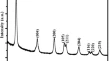
			</st><p>Figure <figr fid="F1">1</figr> shows the Raman spectra from 3- to approximately 5-nm-thick carbon films grown on various fluorides by MBE. The characteristic peaks of graphitic carbon are well identified in all films: the D peak at approximately 1,350 cm<sup>&#8722;1</sup> and the G peak at approximately 1,590 cm<sup>&#8722;1</sup>. These and previous studies show that MBE is an effective method for graphitic carbon growth on a wide range of substrates <abbrgrp>
					<abbr bid="B14">14</abbr>
					<abbr bid="B15">15</abbr>
					<abbr bid="B16">16</abbr>
					<abbr bid="B17">17</abbr>
				</abbrgrp>. The degree of graphitization is, however, quite different depending on the cation. In fact, graphitic carbon refers to a wide range of disordered graphite, from NCG to mainly <it>sp</it>
				<sup>2</sup> amorphous carbon. As clarified by Ferrari <abbrgrp>
					<abbr bid="B20">20</abbr>
				</abbrgrp>, the relative strength of D and G peaks alone cannot determine the degree of disorder, and it is the 2D peak at approximately 2,700 cm<sup>&#8722;1</sup> which distinguishes NCG from amorphous carbon. As shown in Figure <figr fid="F1">1</figr>, the Raman spectra of the carbon film on MgF<sub>2</sub> show a clear 2D peak, indicating that successful NCG growth was accomplished on MgF<sub>2</sub> by carbon MBE. In contrast, the carbon films grown on CaF<sub>2</sub> and BaF<sub>2</sub> can be ascribed to amorphous carbon. As far as we know, carbon MBE on a family of substrates having the same anion has not been reported. Clear understanding of this cation dependence is yet to come, but our results will stimulate systematic studies on other series of substrates and further theoretical investigations.

			</p>
			<fig id="F1"><title><p>Figure 1</p></title><caption><p>Raman spectra of carbon films</p></caption><text>
   <p><b>Raman spectra of carbon films.</b> The films were grown by carbon MBE at 900&#176;C on MgF<sub>2</sub>(100), CaF<sub>2</sub>(100), and BaF<sub>2</sub>(111). The pronounced 2D peak at approximately 2,700 cm<sup>&#8722;1</sup> confirms that nanocrystalline graphite is formed on MgF<sub>2</sub>.</p>
</text><graphic file="1556-276X-8-11-1"/></fig><p>We will focus on the growth on MgF<sub>2</sub> from now on and compare the results with NCGs on oxides. For a quantitative comparison, the Raman spectra of NCG on MgF<sub>2</sub> were fit by several Lorentzian functions as in <abbrgrp>
					<abbr bid="B15">15</abbr>
				</abbrgrp> (Table <tblr tid="T1">1</tblr>). Interestingly, the intensity ratios of the D peak and 2D peak to the G peak (<it>I</it>
				<sub>D</sub>/<it>I</it>
				<sub>G</sub> and <it>I</it>
				<sub>2D</sub>/<it>I</it>
				<sub>G</sub>) are larger than those from NCG on MgO. Furthermore, all the peaks are narrower, implying a better crystallinity on MgF<sub>2</sub> (from the comparisons of the full width at half maximum (FWHM) in Table <tblr tid="T1">1</tblr> and those in <abbrgrp>
					<abbr bid="B15">15</abbr>
				</abbrgrp>). The average cluster size, <it>L</it>
				<sub>a</sub>, can be calculated from the relation <it>I</it>
				<sub>D</sub>/<it>I</it>
				<sub>G</sub> = <it>C L</it>
				<sub>a</sub>
				<sup>2</sup>, where <it>C</it> = 0.0055 and <it>L</it>
				<sub>a</sub> in &#197; <abbrgrp>
					<abbr bid="B20">20</abbr>
				</abbrgrp>. From <it>I</it>
				<sub>D</sub>/<it>I</it>
				<sub>G</sub> = 2.7 (Table <tblr tid="T1">1</tblr>), we get <it>L</it>
				<sub>a</sub> = 22 &#197;, a slight increase from those on oxides <abbrgrp>
					<abbr bid="B15">15</abbr>
					<abbr bid="B16">16</abbr>
				</abbrgrp>. Figure <figr fid="F2">2</figr> shows a Raman map of the intensity ratio of <it>I</it>
				<sub>D</sub>/<it>I</it>
				<sub>G</sub> over 10 &#956;m<sup>2</sup>. Most regions have <it>I</it>
				<sub>D</sub>/<it>I</it>
				<sub>G</sub> = 2.7 &#177; 0.1, thus showing a high degree of uniformity. The uniformity is also better than that of NCG on MgO <abbrgrp>
					<abbr bid="B16">16</abbr>
				</abbrgrp>.


			</p>
			<table id="T1">
				<title>
					<p>Table 1</p>
				</title>
				<caption>
					<p>
						<b>Fitting results of the Raman spectra from the graphitic carbon on MgF</b>
						<sub>
							<b>2</b>
						</sub>
					</p>
				</caption>
				<tgroup align="left" cols="4">
					<colspec align="left" colname="c1" colnum="1" colwidth="1*"/>
					<colspec align="center" colname="c2" colnum="2" colwidth="1*"/>
					<colspec align="center" colname="c3" colnum="3" colwidth="1*"/>
					<colspec align="center" colname="c4" colnum="4" colwidth="1*"/>
					<thead valign="top">
						<row rowsep="1">
							<entry colname="c1"/>
							<entry align="center" colname="c2">
								<p>
									<b>D</b>
								</p>
							</entry>
							<entry align="center" colname="c3">
								<p>
									<b>G</b>
								</p>
							</entry>
							<entry align="center" colname="c4">
								<p>
									<b>2D</b>
								</p>
							</entry>
						</row>
					</thead>
					<tfoot>
						<p>Lorentzian functions are used to fit D, G, and 2D peaks. FWHM, full width at half maximum.</p>
					</tfoot>
					<tbody valign="top">
						<row rowsep="1">
							<entry colname="c1">
								<p>Position (cm<sup>&#8722;1</sup>)</p>
							</entry>
							<entry align="center" colname="c2">
								<p>1,348</p>
							</entry>
							<entry align="center" colname="c3">
								<p>1,601</p>
							</entry>
							<entry align="center" colname="c4">
								<p>2,685</p>
							</entry>
						</row>
						<row rowsep="1">
							<entry colname="c1">
								<p>FWHM (cm<sup>&#8722;1</sup>)</p>
							</entry>
							<entry align="center" colname="c2">
								<p>44</p>
							</entry>
							<entry align="center" colname="c3">
								<p>61</p>
							</entry>
							<entry align="center" colname="c4">
								<p>83</p>
							</entry>
						</row>
						<row rowsep="1">
							<entry colname="c1">
								<p>
									<it>I</it>/<it>I</it>
									<sub>G</sub>
								</p>
							</entry>
							<entry align="center" colname="c2">
								<p>2.8</p>
							</entry>
							<entry align="center" colname="c3">
								<p>1</p>
							</entry>
							<entry align="center" colname="c4">
								<p>0.5</p>
							</entry>
						</row>
					</tbody>
				</tgroup>
			</table>
			<fig id="F2"><title><p>Figure 2</p></title><caption><p>Raman map of graphitic carbon on MgF<sub>2</sub></p></caption><text>
   <p><b>Raman map of graphitic carbon on MgF</b><sub><b>2</b></sub><b>. </b><b>(a)</b> The intensity ratio of the D peak to the G peak is mapped over 10 &#215; 10 &#956;m. The distributions, shown in <b>(b)</b>, imply a high spatial uniformity.</p>
</text><graphic file="1556-276X-8-11-2"/></fig><p>All these results indicate that NCG on MgF<sub>2</sub> is less disordered than those on oxides. This is quite surprising if we consider the bond strength of the C-F bond, which is larger than the C-O bond strength <abbrgrp>
					<abbr bid="B18">18</abbr>
					<abbr bid="B19">19</abbr>
				</abbrgrp>. The high electronegativity of fluorine even makes the C-F bond partially ionic. From first-principles calculations, we have known that the strong C-O bond limits the cluster size of NCG on sapphire and MgO <abbrgrp>
					<abbr bid="B14">14</abbr>
					<abbr bid="B16">16</abbr>
				</abbrgrp>. If that is the whole story, the stronger C-F bond should lead to smaller clusters on MgF<sub>2</sub>. Our results against this imply that an important factor is missing in the theoretical understanding of the NCG growth mechanism. Recently, models such as the catalytic role of step edges or the migration of cyclic carbons are good examples of pertinent suggestions <abbrgrp>
					<abbr bid="B4">4</abbr>
					<abbr bid="B21">21</abbr>
				</abbrgrp>.</p><p>Figure <figr fid="F3">3</figr> presents XPS results to clarify the carbon bonding characteristics. Similar to previous studies <abbrgrp>
					<abbr bid="B14">14</abbr>
					<abbr bid="B16">16</abbr>
				</abbrgrp>, 284.7 &#177; 0.2 and 285.6 &#177; 0.2 eV components in C1<it>s</it> spectra are attributed to <it>sp</it>
				<sup>2</sup> and <it>sp</it>
				<sup>3</sup> bonds <abbrgrp>
					<abbr bid="B22">22</abbr>
				</abbrgrp>, namely, <it>sp</it>
				<sup>2</sup> hybridization of carbon atoms and <it>sp</it>
				<sup>3</sup> hybridization of C-C or C-H bonds, respectively <abbrgrp>
					<abbr bid="B23">23</abbr>
				</abbrgrp>. The fitting results show that the fraction of the <it>sp</it>
				<sup>2</sup> bond is more than 80%, confirming the NCG formation on MgF<sub>2</sub>.

			</p>
			<fig id="F3"><title><p>Figure 3</p></title><caption><p>C1<it>s</it> XPS spectra of graphitic carbon on MgF<sub>2</sub></p></caption><text>
   <p><b>C1</b><b><it>s</it></b><b>XPS spectra of graphitic carbon on MgF</b><sub><b>2</b></sub><b>.</b> The dashed line is a fit with four Lorentzian functions. The two strongest peaks (centered at 284.6 eV (red) and 285.8 eV (green)) are assigned to <it>sp</it><sup>2</sup> and <it>sp</it><sup>3</sup> hybridized carbon atoms, respectively. The fraction of the <it>sp</it><sup>2</sup> bond is estimated to be 80.1%.</p>
</text><graphic file="1556-276X-8-11-3"/></fig><p>Finally, Figure <figr fid="F4">4</figr> shows AFM images before and after the NCG growth on MgF<sub>2</sub>. Unlike crystalline and amorphous oxide substrates, the mean roughness parameter, <it>R</it>
				<sub>a</sub>, of the MgF<sub>2</sub> substrate is large. The <it>R</it>
				<sub>a</sub> of NCG (2.45 nm over 1 &#215; 1 &#956;m scan) is even larger by an order of magnitude than those NCGs on oxide substrates <abbrgrp>
					<abbr bid="B14">14</abbr>
					<abbr bid="B15">15</abbr>
					<abbr bid="B16">16</abbr>
				</abbrgrp>. It is not clear why the surface morphology is worse while the Raman spectra indicate a better crystallinity. We hope that the understanding of NCG growth on MgF<sub>2</sub> can lead to better NCG or possibly graphene growth on other (flat) dielectrics.

			</p>
			<fig id="F4"><title><p>Figure 4</p></title><caption><p>AFM images of graphitic carbon on MgF<sub>2</sub></p></caption><text>
   <p><b>AFM images of graphitic carbon on MgF</b><sub><b>2</b></sub><b>.</b> AFM images of 1 &#215; 1 &#956;m <b>(a)</b> before and <b>(b)</b> after the graphitic carbon growth on MgF<sub>2</sub>. The mean roughness parameters, <it>R</it><sub>a</sub>, from 1 &#215; 1 &#956;m scans are <b>(a)</b> 0.97 and <b>(b)</b> 2.45 nm, respectively.</p>
</text><graphic file="1556-276X-8-11-4"/></fig>
		</sec>
		<sec>
			<st>
				<p>Conclusions</p>
			</st><p>In summary, we have grown graphitic carbon on fluoride substrates, expanding the application of carbon MBE into group VII anions. While amorphous carbons were formed on CaF<sub>2</sub> and BaF<sub>2</sub>, nanocrystalline graphite of good crystallinity was formed on MgF<sub>2</sub> despite the strong bonding between carbon and fluorine. In comparison to similar studies on MgO, the effect of the substrate anion on the quality of NCG contradicts the expectation based on the bond strength between carbon and the anion. Further systematic studies and theoretical investigations are encouraged to understand the carbon growth mechanism by MBE.</p>
		</sec>
		<sec>
			<st>
				<p>Abbreviations</p>
			</st><p>AFM: Atomic force microscopy; CVD: Chemical vapor deposition; FWHM: The full width at half maximum; MBE: Molecular beam epitaxy; NCG: Nanocrystalline graphite; XPS: X-ray photoelectron spectroscopy.</p>
		</sec>
		<sec>
			<st>
				<p>Competing interests</p>
			</st><p>The authors declare that they have no competing interests.</p>
		</sec>
		<sec>
			<st>
				<p>Authors&#8217; contributions</p>
			</st><p>SKJ carried out the carbon molecular beam epitaxy experiments and X-ray photoelectron spectroscopy. JHL carried out the atomic force microscopy measurements. YSK characterized the thin films by Raman spectroscopy. SHC designed the experiments and wrote the manuscript. All authors read and approved the final manuscript.</p>
		</sec>
	</bdy>
	<bm>
		<ack>
			<sec>
				<st>
					<p>Acknowledgments</p>
				</st><p>This research was supported by the Priority Research Centers Program (2012&#8211;0005859), the Basic Science Research Program (2012&#8211;0007298, 2012&#8211;040278), the Center for Topological Matter in POSTECH (2012&#8211;0009194), and the Nanomaterial Technology Development Program (2012M3A7B4049888) through the National Research Foundation of Korea (NRF) funded by the Ministry of Education, Science and Technology (MEST).</p>
			</sec>
		</ack>
		<refgrp><bibl id="B1"><title><p>Large-scale pattern growth of graphene films for stretchable transparent electrodes</p></title><aug><au><snm>Kim</snm><fnm>KS</fnm></au><au><snm>Zhao</snm><fnm>Y</fnm></au><au><snm>Jang</snm><fnm>H</fnm></au><au><snm>Lee</snm><fnm>SY</fnm></au><au><snm>Kim</snm><fnm>JM</fnm></au><au><snm>Kim</snm><fnm>KS</fnm></au><au><snm>Ahn</snm><fnm>J-H</fnm></au><au><snm>Kim</snm><fnm>P</fnm></au><au><snm>Choi</snm><fnm>J-Y</fnm></au><au><snm>Hong</snm><fnm>BH</fnm></au></aug><source>Nature</source><pubdate>2009</pubdate><volume>457</volume><fpage>706</fpage><lpage>710</lpage><xrefbib><pubidlist><pubid idtype="doi">10.1038/nature07719</pubid><pubid idtype="pmpid" link="fulltext">19145232</pubid></pubidlist></xrefbib></bibl><bibl id="B2"><title><p>Large-area synthesis of high-quality and uniform graphene films on copper foils</p></title><aug><au><snm>Li</snm><fnm>X</fnm></au><au><snm>Cai</snm><fnm>W</fnm></au><au><snm>An</snm><fnm>J</fnm></au><au><snm>Kim</snm><fnm>S</fnm></au><au><snm>Nah</snm><fnm>J</fnm></au><au><snm>Yang</snm><fnm>D</fnm></au><au><snm>Piner</snm><fnm>R</fnm></au><au><snm>Velamakanni</snm><fnm>A</fnm></au><au><snm>Jung</snm><fnm>I</fnm></au><au><snm>Tutuc</snm><fnm>E</fnm></au><au><snm>Banerjee</snm><fnm>SK</fnm></au><au><snm>Colombo</snm><fnm>L</fnm></au><au><snm>Ruoff</snm><fnm>RS</fnm></au></aug><source>Science</source><pubdate>2009</pubdate><volume>324</volume><fpage>1312</fpage><lpage>1314</lpage><xrefbib><pubidlist><pubid idtype="doi">10.1126/science.1171245</pubid><pubid idtype="pmpid" link="fulltext">19423775</pubid></pubidlist></xrefbib></bibl><bibl id="B3"><title><p>Direct formation of wafer scale graphene thin layers on insulating substrates by chemical vapor deposition</p></title><aug><au><snm>Su</snm><fnm>CY</fnm></au><au><snm>Lu</snm><fnm>AY</fnm></au><au><snm>Wu</snm><fnm>CY</fnm></au><au><snm>Li</snm><fnm>YT</fnm></au><au><snm>Liu</snm><fnm>KK</fnm></au><au><snm>Zhang</snm><fnm>W</fnm></au><au><snm>Lin</snm><fnm>SY</fnm></au><au><snm>Juang</snm><fnm>ZY</fnm></au><au><snm>Zhong</snm><fnm>YL</fnm></au><au><snm>Chen</snm><fnm>FR</fnm></au><au><snm>Li</snm><fnm>LJ</fnm></au></aug><source>Nano Lett</source><pubdate>2011</pubdate><volume>11</volume><fpage>3612</fpage><lpage>3616</lpage><xrefbib><pubidlist><pubid idtype="doi">10.1021/nl201362n</pubid><pubid idtype="pmpid" link="fulltext">21834558</pubid></pubidlist></xrefbib></bibl><bibl id="B4"><title><p>The catalytic potential of high-kappa dielectrics for graphene formation</p></title><aug><au><snm>Scott</snm><fnm>A</fnm></au><au><snm>Dianat</snm><fnm>A</fnm></au><au><snm>Borrnert</snm><fnm>F</fnm></au><au><snm>Bachmatiuk</snm><fnm>A</fnm></au><au><snm>Zhang</snm><fnm>SS</fnm></au><au><snm>Warner</snm><fnm>JH</fnm></au><au><snm>Borowiak-Palen</snm><fnm>E</fnm></au><au><snm>Knupfer</snm><fnm>M</fnm></au><au><snm>Buchner</snm><fnm>B</fnm></au><au><snm>Cuniberti</snm><fnm>G</fnm></au><au><snm>Rummeli</snm><fnm>MH</fnm></au></aug><source>Appl Phys Lett</source><pubdate>2011</pubdate><volume>98</volume><fpage>073110</fpage><xrefbib><pubid idtype="doi">10.1063/1.3556639</pubid></xrefbib></bibl><bibl id="B5"><title><p>Hafnia nanoparticles &#8211; a model system for graphene growth on a dielectric</p></title><aug><au><snm>Kidambi</snm><fnm>PR</fnm></au><au><snm>Bayer</snm><fnm>BC</fnm></au><au><snm>Weatherup</snm><fnm>RS</fnm></au><au><snm>Ochs</snm><fnm>R</fnm></au><au><snm>Ducati</snm><fnm>C</fnm></au><au><snm>Szab&#243;</snm><fnm>DV</fnm></au><au><snm>Hofmann</snm><fnm>S</fnm></au></aug><source>Phys Status Solidi Rapid Res Lett</source><pubdate>2011</pubdate><volume>5</volume><fpage>341</fpage><lpage>343</lpage><xrefbib><pubid idtype="doi">10.1002/pssr.201100155</pubid></xrefbib></bibl><bibl id="B6"><title><p>Large scale metal-free synthesis of graphene on sapphire and transfer-free device fabrication</p></title><aug><au><snm>Song</snm><fnm>HJ</fnm></au><au><snm>Son</snm><fnm>M</fnm></au><au><snm>Park</snm><fnm>C</fnm></au><au><snm>Lim</snm><fnm>H</fnm></au><au><snm>Levendorf</snm><fnm>MP</fnm></au><au><snm>Tsen</snm><fnm>AW</fnm></au><au><snm>Park</snm><fnm>J</fnm></au><au><snm>Choi</snm><fnm>HC</fnm></au></aug><source>Nanoscale</source><pubdate>2012</pubdate><volume>4</volume><fpage>3050</fpage><lpage>3054</lpage><xrefbib><pubidlist><pubid idtype="doi">10.1039/c2nr30330b</pubid><pubid idtype="pmpid" link="fulltext">22526246</pubid></pubidlist></xrefbib></bibl><bibl id="B7"><title><p>Direct growth of few-layer graphene films on SiO2 substrates and their photovoltaic applications</p></title><aug><au><snm>Bi</snm><fnm>H</fnm></au><au><snm>Sun</snm><fnm>SR</fnm></au><au><snm>Huang</snm><fnm>FQ</fnm></au><au><snm>Xie</snm><fnm>XM</fnm></au><au><snm>Jiang</snm><fnm>MH</fnm></au></aug><source>J Mater Chem</source><pubdate>2012</pubdate><volume>22</volume><fpage>411</fpage><lpage>416</lpage><xrefbib><pubid idtype="doi">10.1039/c1jm14778a</pubid></xrefbib></bibl><bibl id="B8"><title><p>Metal-free growth of nanographene on silicon oxides for transparent conducting applications</p></title><aug><au><snm>Medina</snm><fnm>H</fnm></au><au><snm>Lin</snm><fnm>YC</fnm></au><au><snm>Jin</snm><fnm>CH</fnm></au><au><snm>Lu</snm><fnm>CC</fnm></au><au><snm>Yeh</snm><fnm>CH</fnm></au><au><snm>Huang</snm><fnm>KP</fnm></au><au><snm>Suenaga</snm><fnm>K</fnm></au><au><snm>Robertson</snm><fnm>J</fnm></au><au><snm>Chiu</snm><fnm>PW</fnm></au></aug><source>Adv Funct Mater</source><pubdate>2012</pubdate><volume>22</volume><fpage>2123</fpage><lpage>2128</lpage><xrefbib><pubid idtype="doi">10.1002/adfm.201102423</pubid></xrefbib></bibl><bibl id="B9"><title><p>Role of hydrogen in chemical vapor deposition growth of large single-crystal graphene</p></title><aug><au><snm>Vlassiouk</snm><fnm>I</fnm></au><au><snm>Regmi</snm><fnm>M</fnm></au><au><snm>Fulvio</snm><fnm>PF</fnm></au><au><snm>Dai</snm><fnm>S</fnm></au><au><snm>Datskos</snm><fnm>P</fnm></au><au><snm>Eres</snm><fnm>G</fnm></au><au><snm>Smirnov</snm><fnm>S</fnm></au></aug><source>ACS Nano</source><pubdate>2011</pubdate><volume>5</volume><fpage>6069</fpage><lpage>6076</lpage><xrefbib><pubidlist><pubid idtype="doi">10.1021/nn201978y</pubid><pubid idtype="pmpid" link="fulltext">21707037</pubid></pubidlist></xrefbib></bibl><bibl id="B10"><title><p>Graphitic carbon growth on Si(111) using solid source molecular beam epitaxy</p></title><aug><au><snm>Hackley</snm><fnm>J</fnm></au><au><snm>Ali</snm><fnm>D</fnm></au><au><snm>DiPasquale</snm><fnm>J</fnm></au><au><snm>Demaree</snm><fnm>JD</fnm></au><au><snm>Richardson</snm><fnm>CJK</fnm></au></aug><source>Appl Phys Lett</source><pubdate>2009</pubdate><volume>95</volume><fpage>133114</fpage><xrefbib><pubid idtype="doi">10.1063/1.3242029</pubid></xrefbib></bibl><bibl id="B11"><title><p>Low temperature growth of epitaxial graphene on SiC induced by carbon evaporation</p></title><aug><au><snm>Al-Temimy</snm><fnm>A</fnm></au><au><snm>Riedl</snm><fnm>C</fnm></au><au><snm>Starke</snm><fnm>U</fnm></au></aug><source>Appl Phys Lett</source><pubdate>2009</pubdate><volume>95</volume><fpage>231907&#8211;231907-3</fpage></bibl><bibl id="B12"><title><p>Thin graphitic structure formation on various substrates by gas-source molecular beam epitaxy using cracked ethanol</p></title><aug><au><snm>Maeda</snm><fnm>F</fnm></au><au><snm>Hibino</snm><fnm>H</fnm></au></aug><source>Jpn J Appl Phys</source><pubdate>2010</pubdate><volume>49</volume><fpage>04DH13&#8211;04DH13-6</fpage></bibl><bibl id="B13"><title><p>Graphene growth by molecular beam epitaxy on the carbon-face of SiC</p></title><aug><au><snm>Moreau</snm><fnm>E</fnm></au><au><snm>Godey</snm><fnm>S</fnm></au><au><snm>Ferrer</snm><fnm>FJ</fnm></au><au><snm>Vignaud</snm><fnm>D</fnm></au><au><snm>Wallart</snm><fnm>X</fnm></au><au><snm>Avila</snm><fnm>J</fnm></au><au><snm>Asensio</snm><fnm>MC</fnm></au><au><snm>Bournel</snm><fnm>F</fnm></au><au><snm>Gallet</snm><fnm>JJ</fnm></au></aug><source>Appl Phys Lett</source><pubdate>2010</pubdate><volume>97</volume><fpage>241907</fpage><xrefbib><pubid idtype="doi">10.1063/1.3526720</pubid></xrefbib></bibl><bibl id="B14"><title><p>Nanocrystalline graphite growth on sapphire by carbon molecular beam epitaxy</p></title><aug><au><snm>Jerng</snm><fnm>SK</fnm></au><au><snm>Yu</snm><fnm>DS</fnm></au><au><snm>Kim</snm><fnm>YS</fnm></au><au><snm>Ryou</snm><fnm>J</fnm></au><au><snm>Hong</snm><fnm>S</fnm></au><au><snm>Kim</snm><fnm>C</fnm></au><au><snm>Yoon</snm><fnm>S</fnm></au><au><snm>Efetov</snm><fnm>DK</fnm></au><au><snm>Kim</snm><fnm>P</fnm></au><au><snm>Chun</snm><fnm>SH</fnm></au></aug><source>J Phys Chem C</source><pubdate>2011</pubdate><volume>115</volume><fpage>4491</fpage><lpage>4494</lpage></bibl><bibl id="B15"><title><p>Graphitic carbon growth on crystalline and amorphous oxide substrates using molecular beam epitaxy</p></title><aug><au><snm>Jerng</snm><fnm>SK</fnm></au><au><snm>Yu</snm><fnm>DS</fnm></au><au><snm>Lee</snm><fnm>JH</fnm></au><au><snm>Kim</snm><fnm>C</fnm></au><au><snm>Yoon</snm><fnm>S</fnm></au><au><snm>Chun</snm><fnm>SH</fnm></au></aug><source>Nanoscale Res Lett</source><pubdate>2011</pubdate><volume>6</volume><fpage>565</fpage><xrefbib><pubidlist><pubid idtype="doi">10.1186/1556-276X-6-565</pubid><pubid idtype="pmcid">3213075</pubid><pubid idtype="pmpid" link="fulltext">22029707</pubid></pubidlist></xrefbib></bibl><bibl id="B16"><title><p>Graphitic carbon growth on MgO(100) by molecular beam epitaxy</p></title><aug><au><snm>Jerng</snm><fnm>SK</fnm></au><au><snm>Lee</snm><fnm>JH</fnm></au><au><snm>Yu</snm><fnm>DS</fnm></au><au><snm>Kim</snm><fnm>YS</fnm></au><au><snm>Ryou</snm><fnm>J</fnm></au><au><snm>Hong</snm><fnm>S</fnm></au><au><snm>Kim</snm><fnm>C</fnm></au><au><snm>Yoon</snm><fnm>S</fnm></au><au><snm>Chun</snm><fnm>SH</fnm></au></aug><source>J Phys Chem C</source><pubdate>2012</pubdate><volume>116</volume><fpage>7380</fpage><lpage>7385</lpage><xrefbib><pubid idtype="doi">10.1021/jp210910u</pubid></xrefbib></bibl><bibl id="B17"><title><p>Carbon molecular beam epitaxy on various semiconductor substrates</p></title><aug><au><snm>Jerng</snm><fnm>SK</fnm></au><au><snm>Yu</snm><fnm>DS</fnm></au><au><snm>Lee</snm><fnm>JH</fnm></au><au><snm>Kim</snm><fnm>YS</fnm></au><au><snm>Kim</snm><fnm>C</fnm></au><au><snm>Yoon</snm><fnm>S</fnm></au><au><snm>Chun</snm><fnm>SH</fnm></au></aug><source>Mater Res Bull</source><pubdate>2012</pubdate><volume>47</volume><fpage>2772</fpage><lpage>2775</lpage><xrefbib><pubid idtype="doi">10.1016/j.materresbull.2012.04.123</pubid></xrefbib></bibl><bibl id="B18"><title><p>Understanding organofluorine chemistry. An introduction to the C-F bond</p></title><aug><au><snm>O&apos;Hagan</snm><fnm>D</fnm></au></aug><source>Chem Soc Rev</source><pubdate>2008</pubdate><volume>37</volume><fpage>308</fpage><lpage>319</lpage><xrefbib><pubidlist><pubid idtype="doi">10.1039/b711844a</pubid><pubid idtype="pmpid" link="fulltext">18197347</pubid></pubidlist></xrefbib></bibl><bibl id="B19"><title><p>Perspective on fluorocarbon chemistry</p></title><aug><au><snm>Lemal</snm><fnm>DM</fnm></au></aug><source>J Org Chem</source><pubdate>2004</pubdate><volume>69</volume><fpage>1</fpage><lpage>11</lpage><xrefbib><pubidlist><pubid idtype="doi">10.1021/jo0302556</pubid><pubid idtype="pmpid" link="fulltext">14703372</pubid></pubidlist></xrefbib></bibl><bibl id="B20"><title><p>Raman spectroscopy of graphene and graphite: disorder, electron&#8211;phonon coupling, doping and nonadiabatic effects</p></title><aug><au><snm>Ferrari</snm><fnm>AC</fnm></au></aug><source>Solid State Comm</source><pubdate>2007</pubdate><volume>143</volume><fpage>47</fpage><lpage>57</lpage><xrefbib><pubid idtype="doi">10.1016/j.ssc.2007.03.052</pubid></xrefbib></bibl><bibl id="B21"><title><p>Molecular beam growth of micrometer-size graphene on mica</p></title><aug><au><snm>Lippert</snm><fnm>G</fnm></au><au><snm>Dabrowski</snm><fnm>J</fnm></au><au><snm>Yamamoto</snm><fnm>Y</fnm></au><au><snm>Herziger</snm><fnm>F</fnm></au><au><snm>Maultzsch</snm><fnm>J</fnm></au><au><snm>Lemme</snm><fnm>MC</fnm></au><au><snm>Mehr</snm><fnm>W</fnm></au><au><snm>Lupina</snm><fnm>G</fnm></au></aug><source>Carbon</source><pubdate>2013</pubdate><volume>52</volume><fpage>40</fpage><lpage>48</lpage></bibl><bibl id="B22"><title><p>XPS, Raman spectroscopy, X-ray diffraction, specular X-ray reflectivity, transmission electron microscopy and elastic recoil detection analysis of emissive carbon film characterization</p></title><aug><au><snm>Ermolieff</snm><fnm>A</fnm></au><au><snm>Chabli</snm><fnm>A</fnm></au><au><snm>Pierre</snm><fnm>F</fnm></au><au><snm>Rolland</snm><fnm>G</fnm></au><au><snm>Rouchon</snm><fnm>D</fnm></au><au><snm>Vannuffel</snm><fnm>C</fnm></au><au><snm>Vergnaud</snm><fnm>C</fnm></au><au><snm>Baylet</snm><fnm>J</fnm></au><au><snm>Semeria</snm><fnm>MN</fnm></au></aug><source>Surf Interface Anal</source><pubdate>2001</pubdate><volume>31</volume><fpage>185</fpage><lpage>190</lpage><xrefbib><pubid idtype="doi">10.1002/sia.955</pubid></xrefbib></bibl><bibl id="B23"><title><p>Thickness-dependent reversible hydrogenation of graphene layers</p></title><aug><au><snm>Luo</snm><fnm>Z</fnm></au><au><snm>Yu</snm><fnm>T</fnm></au><au><snm>Kim</snm><fnm>K-j</fnm></au><au><snm>Ni</snm><fnm>Z</fnm></au><au><snm>You</snm><fnm>Y</fnm></au><au><snm>Lim</snm><fnm>S</fnm></au><au><snm>Shen</snm><fnm>Z</fnm></au><au><snm>Wang</snm><fnm>S</fnm></au><au><snm>Lin</snm><fnm>J</fnm></au></aug><source>ACS Nano</source><pubdate>2009</pubdate><volume>3</volume><fpage>1781</fpage><lpage>1788</lpage><xrefbib><pubidlist><pubid idtype="doi">10.1021/nn900371t</pubid><pubid idtype="pmpid" link="fulltext">19492823</pubid></pubidlist></xrefbib></bibl></refgrp>
	</bm>
</art>