<?xml version='1.0'?>
<!DOCTYPE art SYSTEM 'http://www.biomedcentral.com/xml/article.dtd'>
<art>
	<ui>1556-276X-8-10</ui>
	<ji>1556-276X</ji>
	<fm>
		<dochead>Nano Express</dochead>
		<bibl>
			<title>
				<p>Photodeposition of Ag<sub>2</sub>S on TiO<sub>2</sub> nanorod arrays for quantum dot-sensitized solar cells</p>
			</title>
			<aug>
				<au id="A1"><snm>Hu</snm><fnm>Hongwei</fnm><insr iid="I1"/><email>hwhu1989@163.com</email></au>
				<au id="A2" ca="yes"><snm>Ding</snm><fnm>Jianning</fnm><insr iid="I1"/><insr iid="I2"/><email>dingjn@cczu.edu.cn</email></au>
				<au id="A3"><snm>Zhang</snm><fnm>Shuai</fnm><insr iid="I1"/><insr iid="I2"/><email>shuaizhang@cczu.edu.cn</email></au>
				<au id="A4"><snm>Li</snm><fnm>Yan</fnm><insr iid="I1"/><email>liyanlydialee@163.com</email></au>
				<au id="A5"><snm>Bai</snm><fnm>Li</fnm><insr iid="I1"/><email>m13616129348@163.com</email></au>
				<au id="A6" ca="yes"><snm>Yuan</snm><fnm>Ningyi</fnm><insr iid="I1"/><insr iid="I2"/><email>nyyuan@cczu.edu.cn</email></au>
			</aug>
			<insg>
				<ins id="I1"><p>Center for Low-Dimensional Materials, Micro-nano Devices and System, Changzhou University, Changzhou, 213164, China</p></ins>
				<ins id="I2"><p>Jiangsu Key Laboratory for Solar Cell Materials and Technology, Changzhou, 213164, China</p></ins>
			</insg>
			<source>Nanoscale Research Letters</source>
			<section><title><p>Regular submissions</p></title></section><issn>1556-276X</issn>
			<pubdate>2013</pubdate>
			<volume>8</volume>
			<issue>1</issue>
			<fpage>10</fpage>
			<url>http://www.nanoscalereslett.com/content/8/1/10</url>
			<xrefbib><pubidlist><pubid idtype="doi">10.1186/1556-276X-8-10</pubid><pubid idtype="pmpid">23286551</pubid></pubidlist></xrefbib>
		</bibl>
		<history><rec><date><day>5</day><month>11</month><year>2012</year></date></rec><acc><date><day>27</day><month>12</month><year>2012</year></date></acc><pub><date><day>3</day><month>1</month><year>2013</year></date></pub></history>
		<cpyrt><year>2013</year><collab>Hu et al.; licensee Springer.</collab><note>This is an Open Access article distributed under the terms of the Creative Commons Attribution License (<url>http://creativecommons.org/licenses/by/2.0</url>), which permits unrestricted use, distribution, and reproduction in any medium, provided the original work is properly cited.</note></cpyrt>
		<kwdg>
			<kwd>Ag<sub>2</sub>S</kwd>
			<kwd>Quantum dot-sensitized solar cell</kwd>
			<kwd>Photodeposition</kwd>
			<kwd>TiO<sub>2</sub> nanorod</kwd>
		</kwdg>
		<abs>
			<sec>
				<st>
					<p>Abstract</p>
				</st><p>Ag<sub>2</sub>S quantum dots were deposited on the surface of TiO<sub>2</sub> nanorod arrays by a two-step photodeposition. The prepared TiO<sub>2</sub> nanorod arrays as well as the Ag<sub>2</sub>S deposited electrodes were characterized by X-ray diffraction, scanning electron microscope, and transmission electron microscope, suggesting a large coverage of Ag<sub>2</sub>S quantum dots on the ordered TiO<sub>2</sub> nanorod arrays. UV&#8211;vis absorption spectra of Ag<sub>2</sub>S deposited electrodes show a broad absorption range of the visible light. The quantum dot-sensitized solar cells (QDSSCs) based on these electrodes were fabricated, and the photoelectrochemical properties were examined. A high photocurrent density of 10.25 mA/cm<sup>2</sup> with a conversion efficiency of 0.98% at AM 1.5 solar light of 100 mW/cm<sup>2</sup> was obtained with an optimal photodeposition time. The performance of the QDSSC at different incident light intensities was also investigated. The results display a better performance at a lower incident light level with a conversion efficiency of 1.25% at 47 mW/cm<sup>2</sup>.</p>
			</sec>
		</abs>
	</fm>
	<bdy>
		<sec>
			<st>
				<p>Background</p>
			</st><p>Quantum dot-sensitized solar cells (QDSSCs) have attracted increasing attention due to their relatively low cost and potentials to construct high-efficiency energy conversion systems <abbrgrp>
					<abbr bid="B1">1</abbr>
				</abbrgrp>. Compared with organic dyes used in dye-sensitized solar cells (DSSCs), semiconductor sensitizers in the form of quantum dots (QDs) present higher extinction coefficients and adjustable absorption spectra by controlling their size <abbrgrp>
					<abbr bid="B2">2</abbr>
					<abbr bid="B3">3</abbr>
				</abbrgrp>. However, the best efficiency (approximately 5%) reached by QDSSCs is much lower than that of conventional DSSCs <abbrgrp>
					<abbr bid="B4">4</abbr>
					<abbr bid="B5">5</abbr>
				</abbrgrp>. The deposition of QD sensitizers on the electron acceptor (e.g., TiO<sub>2</sub>) related to the loading amount and the connection between QDs and electron acceptor plays a key role in the QDSSC performance. QDs with various sizes should be deposited on the surface of mesoporous TiO<sub>2</sub> separately as a requirement for efficient charge separation <abbrgrp>
					<abbr bid="B6">6</abbr>
				</abbrgrp>. Typically, the coverage of mesoporous TiO<sub>2</sub> by QDs is much less than a full monolayer <abbrgrp>
					<abbr bid="B6">6</abbr>
					<abbr bid="B7">7</abbr>
				</abbrgrp>, which leads to insufficient light harvesting and back electron transfer from exposed TiO<sub>2</sub> to electrolyte. Besides, deposition of typically 3 to 8 nm diameter QDs into mesoporous TiO<sub>2</sub> with relative narrow pores is rather difficult, and large QDs that inserted into mesoporous TiO<sub>2</sub> may also cause pore blocking and subsequently inhibit the penetration of electrolyte deep into the holes <abbrgrp>
					<abbr bid="B8">8</abbr>
				</abbrgrp>. The efficiency enhancement of QDSSCs could be achieved by applying an advanced deposition method as well as suitable TiO<sub>2</sub> nanostructure. For the former, several deposition methods have been developed to anchor QDs on the surface of TiO<sub>2</sub> including <it>ex-situ</it> and <it>in-situ</it> methods <abbrgrp>
					<abbr bid="B6">6</abbr>
				</abbrgrp>, where photodeposition is a promising candidate by taking advantage of the photocatalytic properties of TiO<sub>2</sub> in the deposition process <abbrgrp>
					<abbr bid="B9">9</abbr>
					<abbr bid="B10">10</abbr>
					<abbr bid="B11">11</abbr>
				</abbrgrp>. Photoreduction on the surface of TiO<sub>2</sub> leads to a large and uniform coverage of QDs and intimate contact between the QDs and TiO<sub>2</sub> for efficient interfacial charge transfer <abbrgrp>
					<abbr bid="B11">11</abbr>
				</abbrgrp>. For the latter, one-dimensional oriented arrays (nanotube or nanorod arrays) possess large surface area and efficient electron transfer property that can be employed to improve the performance of QDSSCs <abbrgrp>
					<abbr bid="B12">12</abbr>
					<abbr bid="B13">13</abbr>
				</abbrgrp>. Importantly, the high-oriented arrays provide uniform pore size that is favorable for QD anchoring with rare pore blocking.</p><p>Ag<sub>2</sub>S is an important photoelectric material and has a broad application in terms of photocatalysis and electronic devices <abbrgrp>
					<abbr bid="B14">14</abbr>
					<abbr bid="B15">15</abbr>
					<abbr bid="B16">16</abbr>
					<abbr bid="B17">17</abbr>
				</abbrgrp>. With bulk bandgap of 1.0 eV, close to the optimal bandgap of 1.1 to 1.4 eV for photovoltaic devices <abbrgrp>
					<abbr bid="B18">18</abbr>
				</abbrgrp>, Ag<sub>2</sub>S is a potential sensitizer superior to others used in QDSSCs. Several researches that concentrated on the Ag<sub>2</sub>S-QDSSCs have been reported since the first application of Ag<sub>2</sub>S in QDSSCs <abbrgrp>
					<abbr bid="B19">19</abbr>
					<abbr bid="B20">20</abbr>
					<abbr bid="B21">21</abbr>
					<abbr bid="B22">22</abbr>
					<abbr bid="B23">23</abbr>
				</abbrgrp>. However, the reported conversion efficiency (<it>&#951;</it>) remains lower than that of QDSSCs based on other narrow bandgap semiconductor (e.g., CdS and CdSe) <abbrgrp>
					<abbr bid="B24">24</abbr>
					<abbr bid="B25">25</abbr>
				</abbrgrp>, which is partly attributed to the low coverage of Ag<sub>2</sub>S on the surface of TiO<sub>2</sub>.</p><p>To improve the efficiency of Ag<sub>2</sub>S-QDSSCs, we apply a modified photodeposition as well as an oriented TiO<sub>2</sub> nanorod array (NRA) on the cell. Typically, the oriented TiO<sub>2</sub> NRA was prepared by a simple hydrothermal method. Photodeposition of Ag<sub>2</sub>S was conducted by two steps: photoreduction of Ag<sup>+</sup> to Ag by TiO<sub>2</sub> NRA followed by the sulfurization of Ag to Ag<sub>2</sub>S QDs. To our knowledge, this is the first report of Ag<sub>2</sub>S QD-sensitized TiO<sub>2</sub> NRA solar cells. Results show that a large coverage of Ag<sub>2</sub>S QDs on the TiO<sub>2</sub> NRs has been achieved by this modified photodeposition, and the photoelectrochemical properties of these electrodes suggest that Ag<sub>2</sub>S has a great potential for the improvement of QDSSCs.</p>
		</sec>
		<sec>
			<st>
				<p>Methods</p>
			</st>
			<sec>
				<st>
					<p>Growth of TiO<sub>2</sub> NRA</p>
				</st><p>TiO<sub>2</sub> NRA was grown on the fluorine-doped SnO<sub>2</sub>-coated conducting glass (FTO) substrate (resistance 25 &#8486;/square, transmittance 85%) by a hydrothermal method as described in the literature <abbrgrp>
						<abbr bid="B26">26</abbr>
					</abbrgrp>. Briefly, 30 mL deionized water was mixed with 30 mL concentrated hydrochloric acid (36.5% to 38.0% by weight). The mixture was stirred for 5 min followed by an addition of 1 mL titanium butoxide (98%, Sinopharm Chemical Reagent Co. Ltd., Shanghai, China). After stirring for another 5 min, the mixture was transferred into a Teflon-lined stainless steel autoclave of 100-mL volume. The FTO substrate was placed at an angle against the wall of the Teflonliner with the conducting side facing down. After a hydrothermal treatment at 150&#176;C for 20 h, the substrate was taken out and immersed in 40 mM TiCl<sub>4</sub> aqueous solution for 30 min at 70&#176;C. The TiCl<sub>4</sub>-treated sample was annealed at 450&#176;C for 30 min.</p>
			</sec>
			<sec>
				<st>
					<p>Photodeposition of Ag<sub>2</sub>S on TiO<sub>2</sub> NRA</p>
				</st><p>As illustrated in Figure <figr fid="F1">1</figr>, the photodeposition procedure was conducted in two steps. Firstly, the as-prepared TiO<sub>2</sub> NRA was immersed into the ethanol solution containing Ag<sup>+</sup>. The solution was prepared by dissolving 0.2 g polyvinylpyrrolidone (K90, MW = 1,300,000, Aladdin Chemical Co., Ltd., Shanghai, China) in 20 mL pure ethanol, followed by adding 0.2 mL of AgNO<sub>3</sub> aqueous solution (0.1 M) dropwise. Irradiation was carried out from the direction of TiO<sub>2</sub> film with a high-intensity mercury lamp for a given period. After irradiation, the substrate was taken out, washed with ethanol, and transferred into methanol solution consisting 1 M Na<sub>2</sub>S and 2 M S. The sulfurization reaction was conducted at 50&#176;C for 8 h. Finally, the photoanodes were passivated with ZnS by dipping into 0.1 M Zn(CH<sub>3</sub>COO)<sub>2</sub> and 0.1 M Na<sub>2</sub>S aqueous solution for 1 min alternately.</p>
				<fig id="F1"><title><p>Figure 1</p></title><caption><p>Schematic illustration of the deposition of Ag<sub>2</sub>S on TiO<sub>2</sub> NRA</p></caption><text>
   <p><b>Schematic illustration of the deposition of Ag<sub><b>2</b></sub>S on TiO<sub><b>2</b></sub> NRA.</b> (i) Photoreduction of Ag<sup>+</sup> to Ag; (ii) sulfurization.</p>
</text><graphic file="1556-276X-8-10-1"/></fig>
			</sec>
			<sec>
				<st>
					<p>Solar cell assembly</p>
				</st><p>The counter electrode was prepared by dripping a drop of 10 mM H<sub>2</sub>PtCl<sub>6</sub> (99.99%, Aldrich Company, Inc., Wyoming, USA) ethanol solution onto FTO substrate, followed by heating at 450&#176;C for 15 min. Ag<sub>2</sub>S-sensitized TiO<sub>2</sub> nanorod (NR) photoanode and Pt counter electrode were assembled into sandwichstructure using a sheet of a thermoplastic frame (25-&#956;m thick; Surlyn, DuPont, Wilmington, USA) as spacer between the two electrodes. The polysulfide electrolyte consisted of 0.5 M Na<sub>2</sub>S, 2 M S, 0.2 M KCl, and 0.5 M NaOH in methanol/water (7:3 <it>v</it>/<it>v</it>). An opaque mask with an aperture was coated on the cell to ensure the illuminated area of 0.16 cm<sup>2</sup>.</p>
			</sec>
			<sec>
				<st>
					<p>Characterization</p>
				</st><p>X-ray diffraction (XRD) measurements were carried out using a RAD-3X (Rigaku Corporation, Tokyo, Japan) diffractometer with Cu-K&#945; radiation. The morphology of the films was observed by field emission scanning electron microscopy (FESEM, S4800, Hitachi Ltd., Tokyo, Japan) and transmission electron microscope (TEM, JEM-2100, JEOL Ltd., Beijing, China). To prepare the TEM sample, TiO<sub>2</sub> NRs together with Ag<sub>2</sub>S QDs were scratched from the FTO substrate and dispersed in ethanol by sonication. The UV&#8211;vis absorption spectra of TiO<sub>2</sub> NRA and Ag<sub>2</sub>S-deposited TiO<sub>2</sub> NRA were recorded in the range from 350 to 800 nm using a Hitachi U-3010 spectroscopy. The photocurrent density-voltage (<it>J</it>-<it>V</it>) characteristics of solar cells were examined by a Keithley 2400 sourcemeter (Keithley Instruments, Inc., Cleveland, USA) under illumination by a solar simulator (AM 1.5 G). Incident light intensity was calibrated by standard silicon solar cell and light intensity meter (FZ-Aradiometer) simultaneously. The stability of the solar cell was measured by electrochemical workstation (pp211; Zahner, Elektrik GmbH &amp; Co.KG, Kronach, Germany) with continuous illumination on the solar cell.</p>
			</sec>
		</sec>
		<sec>
			<st>
				<p>Results and discussion</p>
			</st>
			<sec>
				<st>
					<p>Morphology of the TiO<sub>2</sub> NRA</p>
				</st><p>Figure <figr fid="F2">2</figr> shows the FESEM images of TiO<sub>2</sub> NRA grown on the FTO substrate (FTO/TiO<sub>2</sub>) viewed from top (a) and cross-section (b). The TiO<sub>2</sub> film is composed of separate NRs with consistent orientation, forming a uniform array that covered the entire surface of the substrate. The top view of FTO/TiO<sub>2</sub> shows that the top surface of NRs contains many step edges facilitating further growth. The NRs are tetragonal in shape with square top facets, consistent with the growth habit of tetragonal crystal structure. The average side length of the top squares is 200 nm, and the space between them is about the same size. The cross-section view of FTO/TiO<sub>2</sub> shows that the NRs are 2 to 3 &#956;m in length with smooth sides. At the bottom of the TiO<sub>2</sub> NRA, a thin layer composed of short disordered NRs adhering to the FTO substrate is found. The compact layer may reduce the recombination of electron from the FTO to the electrolyte in the working course of QDSSCs by segregating them.</p>
				<fig id="F2"><title><p>Figure 2</p></title><caption><p>FESEM images of TiO<sub>2</sub> NRA</p></caption><text>
   <p><b>FESEM images of TiO<sub><b>2 </b></sub>NRA.</b> Top (<b>a</b>) and cross-sectional views (<b>b</b>).</p>
</text><graphic file="1556-276X-8-10-2"/></fig>
			</sec>
			<sec>
				<st>
					<p>Photodeposition of Ag<sub>2</sub>S QDs</p>
				</st><p>The photodeposition of Ag<sub>2</sub>S QDs was conducted by two separate processes: photoreduction of Ag<sup>+</sup> to Ag and sulfurization of Ag to Ag<sub>2</sub>S. Photocatalytic properties of TiO<sub>2</sub> play an essential role in the reduction of Ag<sup>+</sup>. The mechanism of TiO<sub>2</sub> photocatalytic-reduction metal ions was described in the literature <abbrgrp>
						<abbr bid="B27">27</abbr>
					</abbrgrp>. The main reaction processes of photoreduction Ag<sup>+</sup> are as follows (reactions 1 to 4): (1) Typically, TiO<sub>2</sub> surface exhibits strong adsorptivity for Ag<sup>+</sup>, and the adsorption equilibrium is reached soon after immersing FTO/TiO<sub>2</sub> in Ag<sup>+</sup> ethanol solution in the dark. (2) UV irradiation (<it>&#955;</it> &lt; 400 nm) excites TiO<sub>2</sub> to generate electron&#8211;hole pairs. (3) The electrons reduce the Ag<sup>+</sup> adsorbed preferentially on the surface to Ag, (4) while the holes are irreversibly scavenged by ethanol. Continuous reduction of Ag<sup>+</sup> can produce Ag nucleates on the surface of TiO<sub>2</sub> forming a Schottky junction between them. The charge-separation generated electrons are partially transferred to the Ag clusters from TiO<sub>2</sub>
					<abbrgrp>
						<abbr bid="B28">28</abbr>
					</abbrgrp>. Oxidation and reduction processes are carried on at the surface of TiO<sub>2</sub> and Ag, respectively, as illustrated in Figure <figr fid="F3">3</figr>. Consequently, the reduction on the surface of Ag enables the crystal nucleus to grow up. After the photoreduction, the sulfurization reaction of Ag clusters occurs spontaneously, owing to the low reaction Gibbs energy of &#8722;47.1 kJ/mol <abbrgrp>
						<abbr bid="B29">29</abbr>
					</abbrgrp>.</p><p>
					<display-formula id="M1">
						<m:math name="1556-276X-8-10-i1" xmlns:m="http://www.w3.org/1998/Math/MathML"><m:mrow>
   <m:msub>
      <m:mi mathvariant="normal">TiO</m:mi>
      <m:mn>2</m:mn>
   </m:msub>
   <m:msup>
      <m:mrow>
         <m:mo>+</m:mo>
         <m:mi mathvariant="normal">Ag</m:mi>
      </m:mrow>
      <m:mo>+</m:mo>
   </m:msup>
   <m:mo>&#8594;</m:mo>
   <m:msub>
      <m:mi mathvariant="normal">TiO</m:mi>
      <m:mn>2</m:mn>
   </m:msub>
   <m:msup>
      <m:mi mathvariant="normal">Ag</m:mi>
      <m:mo>+</m:mo>
   </m:msup>
</m:mrow>
</m:math>
					</display-formula>
				</p><p>
					<display-formula id="M2">
						<m:math name="1556-276X-8-10-i2" xmlns:m="http://www.w3.org/1998/Math/MathML"><m:mrow>
   <m:msub>
      <m:mi mathvariant="normal">TiO</m:mi>
      <m:mn>2</m:mn>
   </m:msub>
   <m:mo>+</m:mo>
   <m:mi mathvariant="italic">hv</m:mi>
   <m:mo>&#8594;</m:mo>
   <m:msub>
      <m:mi mathvariant="normal">TiO</m:mi>
      <m:mn>2</m:mn>
   </m:msub>
   <m:mfenced open="(" close=")">
      <m:mrow>
         <m:msup>
            <m:mi>e</m:mi>
            <m:mo>&#8722;</m:mo>
         </m:msup>
         <m:mo>+</m:mo>
         <m:msup>
            <m:mi>h</m:mi>
            <m:mo>+</m:mo>
         </m:msup>
      </m:mrow>
   </m:mfenced>
</m:mrow>
</m:math>
					</display-formula>
				</p><p>
					<display-formula id="M3">
						<m:math name="1556-276X-8-10-i3" xmlns:m="http://www.w3.org/1998/Math/MathML"><m:mrow>
   <m:msup>
      <m:mi>e</m:mi>
      <m:mo>&#8722;</m:mo>
   </m:msup>
   <m:mo>+</m:mo>
   <m:msup>
      <m:mi mathvariant="normal">Ag</m:mi>
      <m:mo>+</m:mo>
   </m:msup>
   <m:mo>&#8594;</m:mo>
   <m:mi mathvariant="normal">Ag</m:mi>
</m:mrow>
</m:math>
					</display-formula>
				</p><p>
					<display-formula id="M4">
						<m:math name="1556-276X-8-10-i4" xmlns:m="http://www.w3.org/1998/Math/MathML"><m:mrow>
   <m:msup>
      <m:mi>h</m:mi>
      <m:mo>+</m:mo>
   </m:msup>
   <m:mo>+</m:mo>
   <m:msub>
      <m:mi mathvariant="normal">C</m:mi>
      <m:mn>2</m:mn>
   </m:msub>
   <m:msub>
      <m:mi mathvariant="normal">H</m:mi>
      <m:mn>5</m:mn>
   </m:msub>
   <m:mi mathvariant="normal">OH</m:mi>
   <m:mo>&#8594;</m:mo>
   <m:msub>
      <m:mi mathvariant="normal">C</m:mi>
      <m:mn>2</m:mn>
   </m:msub>
   <m:msub>
      <m:mi mathvariant="normal">H</m:mi>
      <m:mn>4</m:mn>
   </m:msub>
   <m:mi mathvariant="normal">OH</m:mi>
</m:mrow>
</m:math>
					</display-formula>
				</p>
				<fig id="F3"><title><p>Figure 3</p></title><caption><p>Schematic illustration for charge separation between TiO<sub>2</sub> and Ag, and redox reaction on them</p></caption><text>
   <p>
      <b>Schematic illustration for charge separation between TiO<sub><b>2 </b></sub>and Ag, and redox reaction on them.</b>
   </p>
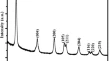
</text><graphic file="1556-276X-8-10-3"/></fig><p>Photoreduction rate of Ag<sup>+</sup> by TiO<sub>2</sub> in ethanol solution is so rapid that the electrode turned to silvery-white within 3 min after immersing FTO/TiO<sub>2</sub> in the solution. To verify the effect of photocatalytic properties of TiO<sub>2</sub> on the reduction process, the ethanol solution containing Ag<sup>+</sup> was irradiated in the same condition but in the absence of TiO<sub>2</sub>, and no silver was observed in 10 h. Similar results were also observed when immersing FTO/TiO<sub>2</sub> in the Ag<sup>+</sup> solution in the dark, consistent with the proposed photoreduction mechanism.</p><p>Figure <figr fid="F4">4</figr> shows XRD patterns of FTO/TiO<sub>2</sub> (a), FTO/TiO<sub>2</sub>/Ag (b), and FTO/TiO<sub>2</sub>/Ag<sub>2</sub>S (c) electrodes. XRD patterns of FTO/TiO<sub>2</sub> electrode reveal that the synthesized TiO<sub>2</sub> NRs are tetragonal rutile structure (JCPDS card no. 21&#8211;1276). The enhanced (101) peak indicates the NRs are well-crystallized and grow in consistent orientation. In the XRD pattern of FTO/TiO<sub>2</sub>/Ag electrode (b), all peaks indexed as TiO<sub>2</sub> crystal have been weakened while the outstanding diffraction peaks of silver (silver-3C, syn JCPDS card no. 04&#8211;0783) emerged. This proves the large coverage of crystallized Ag on the surface of TiO<sub>2</sub> nanostructure as a result of the photoreduction process. As compared with curve b, the XRD pattern of FTO/TiO<sub>2</sub>/Ag<sub>2</sub>S electrode shows five diffraction peaks which agreed well with acanthite Ag<sub>2</sub>S (JCPDS card no. 14&#8211;0072), suggesting a conversion of Ag to Ag<sub>2</sub>S. Additionally, the outstanding peaks of Ag in curve b are not observed in curve c which indicates that the reaction between Ag and S has been completed thoroughly.</p>
				<fig id="F4"><title><p>Figure 4</p></title><caption><p>XRD patterns</p></caption><text>
   <p><b>XRD patterns.</b> FTO/TiO<sub>2</sub> (a), FTO/TiO<sub>2</sub>/Ag (b), and FTO/TiO<sub>2</sub>/Ag<sub>2</sub>S (c) electrodes.</p>
</text><graphic file="1556-276X-8-10-4"/></fig><p>Figure <figr fid="F5">5</figr> displays a SEM image of a top view of FTO/TiO<sub>2</sub>/Ag<sub>2</sub>S electrode with 10-min photoreduction (a) and a TEM image of single NR stripped from the FTO/TiO<sub>2</sub>/Ag<sub>2</sub>S electrode (b). The two images clearly show that TiO<sub>2</sub> NRs are coated by a layer of Ag<sub>2</sub>S crystallites not only on the top surface but also on the four side faces. The top view of FTO/TiO<sub>2</sub>/Ag<sub>2</sub>S electrode shows that the small steps within the top face of TiO<sub>2</sub> NR observed in SEM image of FTO/TiO<sub>2</sub> electrode (Figure <figr fid="F2">2a</figr>) are invisible due to the coverage of Ag<sub>2</sub>S crystallites. The interval between NRs is reserved as well as the ordered TiO<sub>2</sub> NRA structure. The TEM image (b) shows that the entire NR is coated with QDs from the bottom to the top. Most of the QDs that covered the surface of NR disperse well with an average diameter of 10 nm. A closer observation of the Ag<sub>2</sub>S QDs attached with TiO<sub>2</sub> NR can be obtained by the high resolution transmission electron microscope (HRTEM) images (Figure <figr fid="F5">5c,d</figr>). The NR grows along the [001] direction, and lattice fringes with interplanar spacing <it>d</it>
					<sub>110</sub> = 0.321 nm are clearly imaged. The Ag<sub>2</sub>S QDs anchoring on the side surface of TiO<sub>2</sub> NR are composed of small crystallites as observed by the fringes which correspond to the (121) planes of Ag<sub>2</sub>S.</p>
				<fig id="F5"><title><p>Figure 5</p></title><caption><p>SEM, TEM, and HRTEM images</p></caption><text>
   <p><b>SEM, TEM, and HRTEM images.</b> SEM image of FTO/TiO<sub>2</sub>/Ag<sub>2</sub>S (top view) (<b>a</b>), TEM image of a single TiO<sub>2</sub> NR covered with Ag<sub>2</sub>S QDs (<b>b</b>), and HRTEM images of TiO<sub>2</sub>/Ag<sub>2</sub>S (<b>c</b>,<b>d</b>).</p>
</text><graphic file="1556-276X-8-10-5"/></fig>
			</sec>
			<sec>
				<st>
					<p>Optical and photoelectrochemical properties of Ag<sub>2</sub>S QDs-sensitized TiO<sub>2</sub> NRA</p>
				</st><p>Figure <figr fid="F6">6</figr> shows the absorption spectra of FTO/TiO<sub>2</sub> electrode and FTO/TiO<sub>2</sub>/Ag<sub>2</sub>S electrodes with different photoreduction times (<it>t</it>
					<sub>p</sub>). The absorption edge around 400 nm is consistent with bandgap of rutile TiO<sub>2</sub> (3.0 eV). While Ag<sub>2</sub>S QDs are deposited on TiO<sub>2</sub> NRs, absorption spectra are successfully extended to visible wavelength. With <it>t</it>
					<sub>p</sub> increasing from 3 to 15 min, the absorption range changes from 400 to 520 nm until covering the entire visible spectrum; moreover, the absorbance obviously increases. The bandgap of bulk Ag<sub>2</sub>S is 1.0 eV. The redshift of absorption edge for FTO/TiO<sub>2</sub>/Ag<sub>2</sub>S electrodes with prolonged <it>t</it>
					<sub>p</sub> indicates the fact that the size of Ag<sub>2</sub>S QDs gradually increases, and the quantization effect of ultrasmall QDs gradually vanishes. The enhanced absorbance is due to the increased amount of deposited Ag<sub>2</sub>S QDs.</p>
				<fig id="F6"><title><p>Figure 6</p></title><caption><p>UV&#8211;vis absorption spectra of FTO/TiO<sub>2</sub> electrode (a) and FTO/TiO<sub>2</sub>/Ag<sub>2</sub>S electrodes with different photoreduction times (b, c, d, e)</p></caption><text>
   <p>
      <b>UV&#8211;vis absorption spectra of FTO/TiO<sub><b>2 </b></sub>electrode (a) and FTO/TiO<sub><b>2</b></sub><b>/Ag</b><sub><b>2</b></sub>S electrodes with different photoreduction times (b, c, d, e).</b>
   </p>
</text><graphic file="1556-276X-8-10-6"/></fig><p>Figure <figr fid="F7">7</figr> shows <it>J</it>-<it>V</it> characteristics of solar cells fabricated with different photoanodes under AM 1.5 illumination at 100 mW/cm<sup>2</sup>. The photovoltaic properties of these cells are listed in Table <tblr tid="T1">1</tblr>. TiO<sub>2</sub>/Ag<sub>2</sub>S cell with <it>t</it>
					<sub>p</sub> = 3 min possesses a much higher <it>J</it>
					<sub>sc</sub> and a decreased <it>V</it>
					<sub>oc</sub> compared with bare TiO<sub>2</sub> solar cell. The increased <it>J</it>
					<sub>sc</sub> value is attributed to the sensitization of TiO<sub>2</sub> by Ag<sub>2</sub>S QDs, while the slightly decreased <it>V</it>
					<sub>oc</sub> value is mainly due to the band bending between Ag<sub>2</sub>S QDs and TiO<sub>2</sub>. With <it>t</it>
					<sub>p</sub> increasing from 3 to 10 min, the <it>J</it>
					<sub>sc</sub> is promoted from 4.15 to 10.25 mA/cm<sup>2</sup>. The improved <it>J</it>
					<sub>sc</sub> value is caused by an increasing loading amount of Ag<sub>2</sub>S QDs and a broaden absorption spectrum (as shown in Figure <figr fid="F6">6</figr>). Meanwhile, the <it>V</it>
					<sub>oc</sub> values are slightly improved, which is probably due to electron accumulation within TiO<sub>2</sub> shifting the Fermi level to more negative potentials. The optimal solar cell performance is obtained with a <it>&#951;</it> of 0.98% and a superior <it>J</it>
					<sub>sc</sub> of 10.25 mA/cm<sup>2</sup> when <it>t</it>
					<sub>p</sub> = 10 min. The <it>J</it>
					<sub>sc</sub> value is much higher than those of other reported Ag<sub>2</sub>S QD sensitized solar cells even though they were prepared by a TiO<sub>2</sub> nanoparticle matrix with a larger surface area. The enhancement in <it>J</it>
					<sub>sc</sub> is a result of the synergy of larger QD loading amount and fine connection between QDs and TiO<sub>2</sub>. Compared with typical QDSSCs based on other narrow bandgap semiconductors (e.g., CdS and CdSe), the <it>V</it>
					<sub>oc</sub> values of Ag<sub>2</sub>S-QDSSCs are quite low which are almost equivalent to half of the others (CdS-QDSSCs, 0.6 to 0.7 V). Despite of the high <it>J</it>
					<sub>sc</sub> values owing to a broad absorption spectrum, <it>&#951;</it> is limited by the low <it>V</it>
					<sub>oc</sub> values. When <it>t</it>
					<sub>p</sub> was elongated to 15 min, <it>&#951;</it> decreases sharply with a halving <it>J</it>
					<sub>sc</sub> and a lower Fill factor (FF). This phenomenon is speculated to be caused by too long deposition time which results in excess Ag<sub>2</sub>S nanoparticles generated on TiO<sub>2</sub> NRs, consequently decreases effective electron injection and increases recombination rate. The slightly reduced FF as <it>t</it>
					<sub>p</sub> increases also indicates that recombination rate rises with growing amount of loading Ag<sub>2</sub>S nanoparticles.</p>
				<fig id="F7"><title><p>Figure 7</p></title><caption><p><it>J</it>-<it>V</it> characteristics of solar cells fabricated with different photoanodes under AM 1.5 illumination at 100 mW/cm<sup>2</sup></p></caption><text>
   <p>
      <b><it>J</it>-<it>V </it>characteristics of solar cells fabricated with different photoanodes under AM 1.5 illumination at 100 mW/cm<sup><b>2</b></sup>.</b>
   </p>
</text><graphic file="1556-276X-8-10-7"/></fig>
				<table id="T1">
					<title>
						<p>Table 1</p>
					</title>
					<caption>
						<p>
							<b>Photovoltaic parameters of solar cells fabricated with different photoanodes under AM 1.5 illumination at 100 mW/cm<sup><b>2</b></sup></b>
						</p>
					</caption>
					<tgroup align="left" cols="5">
						<colspec align="left" colname="c1" colnum="1" colwidth="1*"/>
						<colspec align="center" colname="c2" colnum="2" colwidth="1*"/>
						<colspec align="center" colname="c3" colnum="3" colwidth="1*"/>
						<colspec align="center" colname="c4" colnum="4" colwidth="1*"/>
						<colspec align="center" colname="c5" colnum="5" colwidth="1*"/>
						<thead valign="top">
							<row rowsep="1">
								<entry colname="c1">
									<p>
										<b>Solar cell</b>
									</p>
								</entry>
								<entry align="center" colname="c2">
									<p>
										<b>
											<it>J</it>
										</b>
										<sub>
											<b>sc</b>
										</sub> <b>(mA/cm</b>
										<sup>
											<b>2</b>
										</sup><b>)</b>
									</p>
								</entry>
								<entry align="center" colname="c3">
									<p>
										<b>
											<it>V</it>
										</b>
										<sub>
											<b>oc</b>
										</sub> <b>(V)</b>
									</p>
								</entry>
								<entry align="center" colname="c4">
									<p>
										<b>FF</b>
									</p>
								</entry>
								<entry align="center" colname="c5">
									<p>
										<b>
											<it>&#951; </it>
										</b><b>(%)</b>
									</p>
								</entry>
							</row>
						</thead>
						<tbody valign="top">
							<row>
								<entry colname="c1">
									<p>Bare TiO<sub>2</sub>
									</p>
								</entry>
								<entry align="center" colname="c2">
									<p>1.34</p>
								</entry>
								<entry align="center" colname="c3">
									<p>0.32</p>
								</entry>
								<entry align="center" colname="c4">
									<p>0.30</p>
								</entry>
								<entry align="center" colname="c5">
									<p>0.13</p>
								</entry>
							</row>
							<row>
								<entry colname="c1">
									<p>3 min</p>
								</entry>
								<entry align="center" colname="c2">
									<p>4.15</p>
								</entry>
								<entry align="center" colname="c3">
									<p>0.24</p>
								</entry>
								<entry align="center" colname="c4">
									<p>0.42</p>
								</entry>
								<entry align="center" colname="c5">
									<p>0.41</p>
								</entry>
							</row>
							<row>
								<entry colname="c1">
									<p>5 min</p>
								</entry>
								<entry align="center" colname="c2">
									<p>9.00</p>
								</entry>
								<entry align="center" colname="c3">
									<p>0.27</p>
								</entry>
								<entry align="center" colname="c4">
									<p>0.38</p>
								</entry>
								<entry align="center" colname="c5">
									<p>0.83</p>
								</entry>
							</row>
							<row>
								<entry colname="c1">
									<p>10 min</p>
								</entry>
								<entry align="center" colname="c2">
									<p>10.25</p>
								</entry>
								<entry align="center" colname="c3">
									<p>0.29</p>
								</entry>
								<entry align="center" colname="c4">
									<p>0.32</p>
								</entry>
								<entry align="center" colname="c5">
									<p>0.98</p>
								</entry>
							</row>
							<row rowsep="1">
								<entry colname="c1">
									<p>15 min</p>
								</entry>
								<entry align="center" colname="c2">
									<p>4.71</p>
								</entry>
								<entry align="center" colname="c3">
									<p>0.28</p>
								</entry>
								<entry align="center" colname="c4">
									<p>0.29</p>
								</entry>
								<entry align="center" colname="c5">
									<p>0.38</p>
								</entry>
							</row>
						</tbody>
					</tgroup>
				</table><p>The <it>J</it>-<it>V</it> curves of a Ag<sub>2</sub>S QD-sensitized solar cell measured at three different light intensities are shown in Figure <figr fid="F8">8</figr>. The photovoltaic performance parameters are listed in Table <tblr tid="T2">2</tblr>. The <it>&#951;</it> reaches a value of 1.25% at 47 mW/cm<sup>2</sup> solar intensity. The <it>J</it>
					<sub>sc</sub> value accumulates to 11.7 mA/cm<sup>2</sup> as incident light intensity increases to 150 mW/cm<sup>2</sup> (150% sun). However, <it>J</it>
					<sub>sc</sub> produced by per unit light power is decreased by a factor of 40.9 compared with lower light level condition of 47% sun. This suggests that the incident light is not effectively converted into electricity at a higher photon density, which may be attributed to a lower rate of photon capture due to the insufficient QDs loading on TiO<sub>2</sub> nanorods. By employing longer TiO<sub>2</sub> NRs, the response of the photocurrent should be promoted to be linear with the incident light intensity, and a higher conversion efficiency should be reached at full sunlight.</p>
				<fig id="F8"><title><p>Figure 8</p></title><caption><p><it>J</it>-<it>V</it> curves of Ag<sub>2</sub>S QD-sensitized solar cell measured at different light intensities</p></caption><text>
   <p>
      <b><it>J</it>-<it>V </it>curves of Ag<sub><b>2</b></sub>S QD-sensitized solar cell measured at different light intensities.</b>
   </p>
</text><graphic file="1556-276X-8-10-8"/></fig>
				<table id="T2">
					<title>
						<p>Table 2</p>
					</title>
					<caption>
						<p>
							<b>Photovoltaic parameters of Ag<sub><b>2</b></sub>S QD-sensitized solar cell measured at different light intensities</b>
						</p>
					</caption>
					<tgroup align="left" cols="5">
						<colspec align="left" colname="c1" colnum="1" colwidth="1*"/>
						<colspec align="center" colname="c2" colnum="2" colwidth="1*"/>
						<colspec align="center" colname="c3" colnum="3" colwidth="1*"/>
						<colspec align="center" colname="c4" colnum="4" colwidth="1*"/>
						<colspec align="center" colname="c5" colnum="5" colwidth="1*"/>
						<thead valign="top">
							<row rowsep="1">
								<entry colname="c1">
									<p>
										<b>
											<it>P</it>
										</b>
										<sub>
											<b>in</b>
										</sub> <b>(mW/cm</b>
										<sup>
											<b>2</b>
										</sup><b>)</b>
									</p>
								</entry>
								<entry align="center" colname="c2">
									<p>
										<b>
											<it>J</it>
										</b>
										<sub>
											<b>sc</b>
										</sub> <b>(mA/cm</b>
										<sup>
											<b>2</b>
										</sup><b>)</b>
									</p>
								</entry>
								<entry align="center" colname="c3">
									<p>
										<b>
											<it>V</it>
										</b>
										<sub>
											<b>oc</b>
										</sub> <b>(V)</b>
									</p>
								</entry>
								<entry align="center" colname="c4">
									<p>
										<b>FF</b>
									</p>
								</entry>
								<entry align="center" colname="c5">
									<p>
										<b>
											<it>&#951; </it>
										</b><b>(%)</b>
									</p>
								</entry>
							</row>
						</thead>
						<tbody valign="top">
							<row>
								<entry colname="c1">
									<p>150</p>
								</entry>
								<entry align="center" colname="c2">
									<p>11.7</p>
								</entry>
								<entry align="center" colname="c3">
									<p>0.3</p>
								</entry>
								<entry align="center" colname="c4">
									<p>0.37</p>
								</entry>
								<entry align="center" colname="c5">
									<p>0.87</p>
								</entry>
							</row>
							<row>
								<entry colname="c1">
									<p>100</p>
								</entry>
								<entry align="center" colname="c2">
									<p>10.3</p>
								</entry>
								<entry align="center" colname="c3">
									<p>0.29</p>
								</entry>
								<entry align="center" colname="c4">
									<p>0.33</p>
								</entry>
								<entry align="center" colname="c5">
									<p>0.98</p>
								</entry>
							</row>
							<row>
								<entry colname="c1">
									<p>47</p>
								</entry>
								<entry align="center" colname="c2">
									<p>6.2</p>
								</entry>
								<entry align="center" colname="c3">
									<p>0.26</p>
								</entry>
								<entry align="center" colname="c4">
									<p>0.36</p>
								</entry>
								<entry align="center" colname="c5">
									<p>1.23</p>
								</entry>
							</row>
							<row rowsep="1">
								<entry colname="c1">
									<p>38</p>
								</entry>
								<entry align="center" colname="c2">
									<p>4.6</p>
								</entry>
								<entry align="center" colname="c3">
									<p>0.25</p>
								</entry>
								<entry align="center" colname="c4">
									<p>0.32</p>
								</entry>
								<entry align="center" colname="c5">
									<p>0.97</p>
								</entry>
							</row>
						</tbody>
					</tgroup>
				</table><p>The photostability of Ag<sub>2</sub>S-QDSSC was measured by illuminating it at 100 mW/cm<sup>2</sup> sunlight for 2 h and characterized by recording the <it>J</it>
					<sub>sc</sub> and <it>V</it>
					<sub>oc</sub> of the device (Figure <figr fid="F9">9</figr>). During illumination, the <it>J</it>
					<sub>sc</sub> remained relatively steady with a drop less than 5%, and the <it>V</it>
					<sub>oc</sub> fluctuated within 2%. This shows that the Ag<sub>2</sub>S QDs are robust in resisting photo corrosion in the presence of polysulfide electrolyte, and the small decline is probably caused by the loss of the solvent.</p>
				<fig id="F9"><title><p>Figure 9</p></title><caption><p>Photostability of Ag<sub>2</sub>S QD-sensitized solar cell under AM 1.5 illumination at 100 mW/cm<sup>2</sup></p></caption><text>
   <p>
      <b>Photostability of Ag<sub><b>2</b></sub>S QD-sensitized solar cell under AM 1.5 illumination at 100 mW/cm<sup><b>2</b></sup>.</b>
   </p>
</text><graphic file="1556-276X-8-10-9"/></fig>
			</sec>
		</sec>
		<sec>
			<st>
				<p>Conclusions</p>
			</st><p>We have deposited Ag<sub>2</sub>S QDs on TiO<sub>2</sub> NRA by a two-step photodeposition. The deposition process was conducted by photoreduction of Ag<sup>+</sup> to Ag on the surface of TiO<sub>2</sub> NRs followed by chemical reaction with sulfur. By controlling the photoreduction period, we have obtained Ag<sub>2</sub>S-sensitized TiO<sub>2</sub> NRs with a large coverage and superior photoelectrochemical properties. QDSSCs based on the Ag<sub>2</sub>S-sensitized TiO<sub>2</sub> NRAs were fabricated. Under optimal condition, the Ag<sub>2</sub>S-QDSSC yields a <it>J</it>
				<sub>sc</sub> of 10.25 mA/cm<sup>2</sup> with a conversion efficiency of 0.98% at AM 1.5 solar light of 100 mW/cm<sup>2</sup>. We also investigated the solar cell performance under varied incident light intensities. Results show that a drawback of these cells in full sun condition compared with the maximum efficiency achieved at lower light level. The key factor that limits the solar cell performance is the low <it>V</it>
				<sub>oc</sub> values we obtained. By employing suitable redox electrolyte, we believe the Ag<sub>2</sub>S-QDSSCs will have a great promotion with increased <it>V</it>
				<sub>oc</sub> values.</p>
		</sec>
		<sec>
			<st>
				<p>Abbreviations</p>
			</st><p>&#951;: conversion efficiency; DSSCs: dye-sensitized solar cells; FESEM: field emission scanning electron microscopy; FF: fill factor; FTO: fluorine-doped SnO<sub>2</sub>-coated conducting glass; HRTEM: high resolution transmission electron microscope; J<sub>sc</sub>: short circuit current density; NR: nanorod; NRA: nanorod array; QDs: quantum dots; QDSSCs: quantum dot-sensitized solar cells; SEM: scanning electron microscope; TEM: transmission electron microscope; t<sub>p</sub>: photoreduction time; V<sub>oc</sub>: open voltage; XRD: X-ray diffraction.</p>
		</sec>
		<sec>
			<st>
				<p>Competing interests</p>
			</st><p>The authors declare that they have no competing interests.</p>
		</sec>
		<sec>
			<st>
				<p>Authors&#8217; contributions</p>
			</st><p>HWH carried out the experiments and wrote the manuscript. JND and NYY conceived the study, participated in its design, and amended the paper. SZ participated in the discussion and interpretation of the data. YL and LB participated in the experiments. All authors read and approved the final manuscript.</p>
		</sec>
	</bdy>
	<bm>
		<ack>
			<sec>
				<st>
					<p>Acknowledgments</p>
				</st><p>This work was supported by the National High Technology Research and Development Program 863 (2011AA050511), Jiangsu &#8220;333&#8221; Project, the Priority Academic Program Development of Jiangsu Higher Education Institutions, and the Postgraduate Research Innovation Projects at Colleges and Universities in Jiangsu Province (CXLX12_0707).</p>
			</sec>
		</ack>
		<refgrp><bibl id="B1"><title><p>Beyond photovoltaics: semiconductor nanoarchitectures for liquid-junction solar cells</p></title><aug><au><snm>Kamat</snm><fnm>PV</fnm></au><au><snm>Tvrdy</snm><fnm>K</fnm></au><au><snm>Baker</snm><fnm>DR</fnm></au><au><snm>Radich</snm><fnm>JG</fnm></au></aug><source>Chem Rev</source><pubdate>2010</pubdate><volume>110</volume><fpage>6664</fpage><lpage>6688</lpage><xrefbib><pubidlist><pubid idtype="doi">10.1021/cr100243p</pubid><pubid idtype="pmpid" link="fulltext">20973544</pubid></pubidlist></xrefbib></bibl><bibl id="B2"><title><p>Experimental determination of the extinction coefficient of CdTe, CdSe, and CdS nanocrystals</p></title><aug><au><snm>Yu</snm><fnm>WW</fnm></au><au><snm>Qu</snm><fnm>LH</fnm></au><au><snm>Guo</snm><fnm>WZ</fnm></au><au><snm>Peng</snm><fnm>XG</fnm></au></aug><source>Chem Mater</source><pubdate>2003</pubdate><volume>15</volume><fpage>2854</fpage><lpage>2860</lpage><xrefbib><pubid idtype="doi">10.1021/cm034081k</pubid></xrefbib></bibl><bibl id="B3"><title><p>Electronic wave functions in semiconductor clusters: experiment and theory</p></title><aug><au><snm>Brus</snm><fnm>L</fnm></au></aug><source>J Phys Chem</source><pubdate>1986</pubdate><volume>90</volume><fpage>2555</fpage><lpage>2560</lpage><xrefbib><pubid idtype="doi">10.1021/j100403a003</pubid></xrefbib></bibl><bibl id="B4"><title><p>Mn-doped quantum dot sensitized solar cells: astrategy to boost efficiency over 5%</p></title><aug><au><snm>Santra</snm><fnm>PK</fnm></au><au><snm>Kamat</snm><fnm>PV</fnm></au></aug><source>J Am Chem Soc</source><pubdate>2012</pubdate><volume>134</volume><fpage>2508</fpage><lpage>2511</lpage><xrefbib><pubidlist><pubid idtype="doi">10.1021/ja211224s</pubid><pubid idtype="pmpid" link="fulltext">22280479</pubid></pubidlist></xrefbib></bibl><bibl id="B5"><title><p>Porphyrin-sensitized solar cells with cobalt (II/III)-based redox electrolyte exceed 12% efficiency</p></title><aug><au><snm>Yella</snm><fnm>A</fnm></au><au><snm>Lee</snm><fnm>HW</fnm></au><au><snm>Tsao</snm><fnm>HN</fnm></au><au><snm>Yi</snm><fnm>C</fnm></au><au><snm>Chandiran</snm><fnm>AK</fnm></au><au><snm>Nazeeruddin</snm><fnm>MK</fnm></au><au><snm>Diau</snm><fnm>EWG</fnm></au><au><snm>Yeh</snm><fnm>CY</fnm></au><au><snm>Zakeeruddin</snm><fnm>SM</fnm></au><au><snm>Gr&#228;tzel</snm><fnm>M</fnm></au></aug><source>Science</source><pubdate>2011</pubdate><volume>334</volume><fpage>629</fpage><lpage>634</lpage><xrefbib><pubidlist><pubid idtype="doi">10.1126/science.1209688</pubid><pubid idtype="pmpid" link="fulltext">22053043</pubid></pubidlist></xrefbib></bibl><bibl id="B6"><title><p>Quantum-dot-sensitized solar cells</p></title><aug><au><snm>Ruhle</snm><fnm>S</fnm></au><au><snm>Shalom</snm><fnm>M</fnm></au><au><snm>Zaban</snm><fnm>A</fnm></au></aug><source>Chem Phys Chem</source><pubdate>2010</pubdate><volume>11</volume><fpage>2290</fpage><lpage>2304</lpage><xrefbib><pubidlist><pubid idtype="doi">10.1002/cphc.201000069</pubid><pubid idtype="pmpid" link="fulltext">20632355</pubid></pubidlist></xrefbib></bibl><bibl id="B7"><title><p>CdSe quantum dot-sensitized TiO2 electrodes: effect of quantum dot coverage and mode of attachment</p></title><aug><au><snm>Guijarro</snm><fnm>N</fnm></au><au><snm>Lana-Villarreal</snm><fnm>T</fnm></au><au><snm>Mora-Ser&#243;</snm><fnm>I</fnm></au><au><snm>Bisquert</snm><fnm>J</fnm></au><au><snm>G&#243;mez</snm><fnm>R</fnm></au></aug><source>J Phys Chem C</source><pubdate>2009</pubdate><volume>113</volume><fpage>4208</fpage><lpage>4214</lpage></bibl><bibl id="B8"><title><p>Highly efficient CdS/CdSe-sensitized solar cells controlled by the structural properties of compact porous TiO2 photoelectrodes</p></title><aug><au><snm>Zhang</snm><fnm>Q</fnm></au><au><snm>Guo</snm><fnm>X</fnm></au><au><snm>Huang</snm><fnm>X</fnm></au><au><snm>Huang</snm><fnm>S</fnm></au><au><snm>Li</snm><fnm>D</fnm></au><au><snm>Luo</snm><fnm>Y</fnm></au><au><snm>Shen</snm><fnm>Q</fnm></au><au><snm>Toyoda</snm><fnm>T</fnm></au><au><snm>Meng</snm><fnm>Q</fnm></au></aug><source>Phys Chem Chem Phys</source><pubdate>2011</pubdate><volume>13</volume><fpage>4659</fpage><lpage>4667</lpage><xrefbib><pubid idtype="pmpid" link="fulltext">21283841</pubid></xrefbib></bibl><bibl id="B9"><title><p>Quantum-dot-sensitized solar cell using a photoanode prepared by in situ photodeposition of CdS on nanocrystallineTiO<sub>2</sub> films</p></title><aug><au><snm>Jin-nouchi</snm><fnm>Y</fnm></au><au><snm>Naya</snm><fnm>S</fnm></au><au><snm>Tada</snm><fnm>H</fnm></au></aug><source>J Phys Chem C</source><pubdate>2010</pubdate><volume>114</volume><fpage>16837</fpage><lpage>16842</lpage><xrefbib><pubid idtype="doi">10.1021/jp1062226</pubid></xrefbib></bibl><bibl id="B10"><title><p>Photodeposition of CdS quantum dots on TiO<sub>2</sub>: preparation, characterization, and reaction mechanism</p></title><aug><au><snm>Fujii</snm><fnm>M</fnm></au><au><snm>Nagasuna</snm><fnm>K</fnm></au><au><snm>Fujishima</snm><fnm>M</fnm></au><au><snm>Akita</snm><fnm>T</fnm></au><au><snm>Tada</snm><fnm>H</fnm></au></aug><source>J Phys Chem C</source><pubdate>2009</pubdate><volume>113</volume><fpage>16711</fpage><lpage>16716</lpage><xrefbib><pubid idtype="doi">10.1021/jp9056626</pubid></xrefbib></bibl><bibl id="B11"><title><p>Photodeposition of metal sulfide quantum dots on titanium (IV) dioxide and the applications to solar energy conversion</p></title><aug><au><snm>Tada</snm><fnm>H</fnm></au><au><snm>Fujishima</snm><fnm>M</fnm></au><au><snm>Kobayashi</snm><fnm>H</fnm></au></aug><source>Chem Soc Rev</source><pubdate>2011</pubdate><volume>40</volume><fpage>4232</fpage><lpage>4243</lpage><xrefbib><pubidlist><pubid idtype="doi">10.1039/c0cs00211a</pubid><pubid idtype="pmpid" link="fulltext">21566829</pubid></pubidlist></xrefbib></bibl><bibl id="B12"><title><p>CdS quantum dots sensitized TiO<sub>2</sub> nanotube-array photoelectrodes</p></title><aug><au><snm>Sun</snm><fnm>WT</fnm></au><au><snm>Yu</snm><fnm>Y</fnm></au><au><snm>Pan</snm><fnm>HY</fnm></au><au><snm>Gao</snm><fnm>XF</fnm></au><au><snm>Chen</snm><fnm>Q</fnm></au><au><snm>Peng</snm><fnm>LM</fnm></au></aug><source>J Am Chem Soc</source><pubdate>2008</pubdate><volume>130</volume><fpage>1124</fpage><lpage>1125</lpage><xrefbib><pubidlist><pubid idtype="doi">10.1021/ja0777741</pubid><pubid idtype="pmpid" link="fulltext">18183979</pubid></pubidlist></xrefbib></bibl><bibl id="B13"><title><p>CdS quantum dot-sensitized TiO<sub>2</sub> nanorod array on transparent conductive glass photoelectrodes</p></title><aug><au><snm>Wang</snm><fnm>H</fnm></au><au><snm>Bai</snm><fnm>Y</fnm></au><au><snm>Zhang</snm><fnm>H</fnm></au><au><snm>Zhang</snm><fnm>Z</fnm></au><au><snm>Li</snm><fnm>J</fnm></au><au><snm>Guo</snm><fnm>L</fnm></au></aug><source>J Phys Chem C</source><pubdate>2010</pubdate><volume>114</volume><fpage>16451</fpage><lpage>16455</lpage><xrefbib><pubid idtype="doi">10.1021/jp104208z</pubid></xrefbib></bibl><bibl id="B14"><title><p>Synthesis and visible-light-induced catalytic activity of Ag<sub>2</sub>S-coupled TiO<sub>2</sub> nanoparticles and nanowires</p></title><aug><au><snm>Xie</snm><fnm>Y</fnm></au><au><snm>Heo</snm><fnm>SH</fnm></au><au><snm>Kim</snm><fnm>YN</fnm></au><au><snm>Yoo</snm><fnm>SH</fnm></au><au><snm>Cho</snm><fnm>SO</fnm></au></aug><source>Nanotechnology</source><pubdate>2010</pubdate><volume>21</volume><fpage>015703</fpage><xrefbib><pubidlist><pubid idtype="doi">10.1088/0957-4484/21/1/015703</pubid><pubid idtype="pmpid" link="fulltext">19946150</pubid></pubidlist></xrefbib></bibl><bibl id="B15"><title><p>Optical and catalytic properties of Ag<sub>2</sub>S nanoparticles</p></title><aug><au><snm>Kryukov</snm><fnm>AI</fnm></au><au><snm>Stroyuk</snm><fnm>AL</fnm></au><au><snm>Zin&#8217;chuk</snm><fnm>NN</fnm></au><au><snm>Korzhak</snm><fnm>AV</fnm></au><au><snm>Kuchmii</snm><fnm>SY</fnm></au></aug><source>J Mol Catal A: Chem</source><pubdate>2004</pubdate><volume>221</volume><fpage>209</fpage><lpage>221</lpage><xrefbib><pubid idtype="doi">10.1016/j.molcata.2004.07.009</pubid></xrefbib></bibl><bibl id="B16"><title><p>Infrared photography based on vapor-deposited silver sulfide thin films</p></title><aug><au><snm>Kitova</snm><fnm>S</fnm></au><au><snm>Eneva</snm><fnm>J</fnm></au><au><snm>Panov</snm><fnm>A</fnm></au><au><snm>Haefke</snm><fnm>H</fnm></au></aug><source>J Imaging Sci Technol</source><pubdate>1994</pubdate><volume>38</volume><fpage>484</fpage><lpage>488</lpage></bibl><bibl id="B17"><title><p>Controlled synthesis of Ag<sub>2</sub>S, Ag<sub>2</sub>Se, and Ag nanofibers by using a general sacrificial template and their application in electronic device fabrication</p></title><aug><au><snm>Wang</snm><fnm>H</fnm></au><au><snm>Qi</snm><fnm>L</fnm></au></aug><source>Adv Funct Mater</source><pubdate>2008</pubdate><volume>18</volume><fpage>1249</fpage><lpage>1256</lpage><xrefbib><pubid idtype="doi">10.1002/adfm.200700953</pubid></xrefbib></bibl><bibl id="B18"><title><p>Infrared colloidal quantum dots for photovoltaics: fundamentals and recent progress</p></title><aug><au><snm>Tang</snm><fnm>J</fnm></au><au><snm>Sargent</snm><fnm>EH</fnm></au></aug><source>Adv Mater</source><pubdate>2011</pubdate><volume>23</volume><fpage>12</fpage><lpage>29</lpage><xrefbib><pubidlist><pubid idtype="doi">10.1002/adma.201001491</pubid><pubid idtype="pmpid" link="fulltext">20842658</pubid></pubidlist></xrefbib></bibl><bibl id="B19"><title><p>Quantum-sized PbS, CdS, Ag<sub>2</sub>S, Sb<sub>2</sub>S<sub>3</sub>, and Bi<sub>2</sub>S<sub>3</sub> particles as sensitizers for various nanoporous wide-bandgap semiconductors</p></title><aug><au><snm>Vogel</snm><fnm>R</fnm></au><au><snm>Hoyer</snm><fnm>P</fnm></au><au><snm>Weller</snm><fnm>H</fnm></au></aug><source>J Phys Chem</source><pubdate>1994</pubdate><volume>98</volume><fpage>3183</fpage><lpage>3188</lpage><xrefbib><pubid idtype="doi">10.1021/j100063a022</pubid></xrefbib></bibl><bibl id="B20"><title><p>Ag<sub>2</sub>S quantum dot-sensitized solar cells</p></title><aug><au><snm>Tubtimtae</snm><fnm>A</fnm></au><au><snm>Wu</snm><fnm>KL</fnm></au><au><snm>Tung</snm><fnm>HY</fnm></au><au><snm>Lee</snm><fnm>MW</fnm></au><au><snm>Wang</snm><fnm>GJ</fnm></au></aug><source>Electrochem Commun</source><pubdate>2010</pubdate><volume>12</volume><fpage>1158</fpage><lpage>1160</lpage><xrefbib><pubid idtype="doi">10.1016/j.elecom.2010.06.006</pubid></xrefbib></bibl><bibl id="B21"><title><p>Improved conversion efficiency of Ag<sub>2</sub>S quantum dot-sensitized solar cells based on TiO<sub>2</sub> nanotubes with a ZnO recombination barrier layer</p></title><aug><au><snm>Chen</snm><fnm>C</fnm></au><au><snm>Xie</snm><fnm>Y</fnm></au><au><snm>Ali</snm><fnm>G</fnm></au><au><snm>Yoo</snm><fnm>SH</fnm></au><au><snm>Cho</snm><fnm>SO</fnm></au></aug><source>Nanoscale Res Lett</source><pubdate>2011</pubdate><volume>6</volume><fpage>462</fpage><xrefbib><pubidlist><pubid idtype="doi">10.1186/1556-276X-6-462</pubid><pubid idtype="pmcid">3211883</pubid><pubid idtype="pmpid" link="fulltext">21777458</pubid></pubidlist></xrefbib></bibl><bibl id="B22"><title><p>Visible to near-infrared light harvesting in Ag<sub>2</sub>S nanoparticles/ZnO nanowire array photoanodes</p></title><aug><au><snm>Wu</snm><fnm>JJ</fnm></au><au><snm>Chang</snm><fnm>RC</fnm></au><au><snm>Chen</snm><fnm>DW</fnm></au><au><snm>Wu</snm><fnm>CT</fnm></au></aug><source>Nanoscale</source><pubdate>2012</pubdate><volume>4</volume><fpage>1368</fpage><lpage>1372</lpage><xrefbib><pubidlist><pubid idtype="doi">10.1039/c2nr11705c</pubid><pubid idtype="pmpid" link="fulltext">22278401</pubid></pubidlist></xrefbib></bibl><bibl id="B23"><title><p>Ag2S quantum dots-sensitized TiO<sub>2</sub> nanotube array photoelectrodes</p></title><aug><au><snm>Xie</snm><fnm>Y</fnm></au><au><snm>Yoo</snm><fnm>SH</fnm></au><au><snm>Chen</snm><fnm>C</fnm></au><au><snm>Cho</snm><fnm>SO</fnm></au></aug><source>Mat Sci Eng B</source><pubdate>2012</pubdate><volume>177</volume><fpage>106</fpage><lpage>111</lpage><xrefbib><pubid idtype="doi">10.1016/j.mseb.2011.09.021</pubid></xrefbib></bibl><bibl id="B24"><title><p>Highly efficient CdSe-sensitized TiO<sub>2</sub> photoelectrode for quantum-dot-sensitized solar cell applications</p></title><aug><au><snm>Lee</snm><fnm>YL</fnm></au><au><snm>Huang</snm><fnm>BM</fnm></au><au><snm>Chien</snm><fnm>HT</fnm></au></aug><source>Chem Mater</source><pubdate>2008</pubdate><volume>20</volume><fpage>6903</fpage><lpage>6905</lpage><xrefbib><pubid idtype="doi">10.1021/cm802254u</pubid></xrefbib></bibl><bibl id="B25"><title><p>Chemical bath deposition of CdS quantum dots onto mesoscopic TiO<sub>2</sub> films for application in quantum-dot-sensitized solar cells</p></title><aug><au><snm>Chang</snm><fnm>CH</fnm></au><au><snm>Lee</snm><fnm>YL</fnm></au></aug><source>Appl Phys Lett</source><pubdate>2007</pubdate><volume>91</volume><fpage>053503</fpage><xrefbib><pubid idtype="doi">10.1063/1.2768311</pubid></xrefbib></bibl><bibl id="B26"><title><p>Growth of oriented single-crystalline rutile TiO<sub>2</sub> nanorods on transparent conducting substrates for dye-sensitized solar cells</p></title><aug><au><snm>Liu</snm><fnm>B</fnm></au><au><snm>Aydil</snm><fnm>ES</fnm></au></aug><source>J Am Chem Soc</source><pubdate>2009</pubdate><volume>131</volume><fpage>3985</fpage><lpage>3990</lpage><xrefbib><pubidlist><pubid idtype="doi">10.1021/ja8078972</pubid><pubid idtype="pmpid" link="fulltext">19245201</pubid></pubidlist></xrefbib></bibl><bibl id="B27"><title><p>Heterogeneous photocatalytic preparation of supported catalysts. Photodeposition of platinum on TiO2 powder and other substrates</p></title><aug><au><snm>Kraeutler</snm><fnm>B</fnm></au><au><snm>Bard</snm><fnm>AJ</fnm></au></aug><source>J Am Chem Soc</source><pubdate>1978</pubdate><volume>100</volume><fpage>4317</fpage><lpage>4318</lpage><xrefbib><pubid idtype="doi">10.1021/ja00481a059</pubid></xrefbib></bibl><bibl id="B28"><title><p>Capture, store, and discharge. Shuttling photogenerated electrons across TiO2&#8211;silver interface</p></title><aug><au><snm>Takai</snm><fnm>A</fnm></au><au><snm>Kamat</snm><fnm>PV</fnm></au></aug><source>ACS Nano</source><pubdate>2011</pubdate><volume>5</volume><fpage>7369</fpage><lpage>7376</lpage><xrefbib><pubidlist><pubid idtype="doi">10.1021/nn202294b</pubid><pubid idtype="pmpid" link="fulltext">21819038</pubid></pubidlist></xrefbib></bibl><bibl id="B29"><aug><au><snm>Lide</snm><fnm>DR</fnm></au></aug><source>Handbook of Chemistry and Physics</source><publisher>Boca Raton: CRC</publisher><edition>83</edition><pubdate>2002</pubdate></bibl></refgrp>
	</bm>
</art>