<?xml version='1.0'?>
<!DOCTYPE art SYSTEM 'http://www.biomedcentral.com/xml/article.dtd'>
<art>
<ui>1556-276X-7-98</ui>
<ji>1556-276X</ji>
<fm>
<dochead>Nano Review</dochead>
<bibl>
<title><p>Increases in solar conversion efficiencies of the ZrO<sub>2 </sub>nanofiber-doped TiO<sub>2 </sub>photoelectrode for dye-sensitized solar cells</p></title>
<aug>
<au id="A1"><snm>Wang</snm><fnm>Jiao</fnm><insr iid="I1"/><email>wangjiao1984@hotmail.com</email></au>
<au id="A2"><snm>Jin</snm><mnm>Mei</mnm><fnm>En</fnm><insr iid="I1"/><email>kujie@naver.com</email></au>
<au id="A3"><snm>Park</snm><fnm>Ju-Young</fnm><insr iid="I2"/><email>g0m8812@hanmail.net</email></au>
<au id="A4"><snm>Wang</snm><mnm>Lin</mnm><fnm>Wan</fnm><insr iid="I1"/><email>kuku-linlin@hotmail.com</email></au>
<au id="A5"><snm>Zhao</snm><mnm>Guan</mnm><fnm>Xing</fnm><insr iid="I1"/><email>xingguan424@naver.com</email></au>
<au id="A6" ca="yes"><snm>Gu</snm><fnm>Hal-Bon</fnm><insr iid="I1"/><email>hbgu@chonnam.ac.kr</email></au>
</aug>
<insg>
<ins id="I1"><p>Department of Electrical Engineering, Chonnam National University, Gwangju, 500-757, South Korea</p></ins>
<ins id="I2"><p>Southwestern Research Institute of Green Energy Technology, Mokpo-si, Jeonllanam-do, 530-400, South Korea</p></ins>
</insg>
<source>Nanoscale Research Letters</source>
<issn>1556-276X</issn>
<pubdate>2012</pubdate>
<volume>7</volume>
<issue>1</issue>
<fpage>98</fpage>
<url>http://www.nanoscalereslett.com/content/7/1/98</url>
<xrefbib><pubidlist><pubid idtype="doi">10.1186/1556-276X-7-98</pubid><pubid idtype="pmpid">22297154</pubid></pubidlist></xrefbib></bibl>
<history><rec><date><day>9</day><month>9</month><year>2011</year></date></rec><acc><date><day>2</day><month>2</month><year>2012</year></date></acc><pub><date><day>2</day><month>2</month><year>2012</year></date></pub></history><cpyrt><year>2012</year><collab>Wang et al; licensee Springer.</collab><note>This is an Open Access article distributed under the terms of the Creative Commons Attribution License (<url>http://creativecommons.org/licenses/by/2.0</url>), which permits unrestricted use, distribution, and reproduction in any medium, provided the original work is properly cited.</note></cpyrt>
<kwdg><kwd>zirconia nanofiber</kwd><kwd>titania</kwd><kwd>DSSC</kwd></kwdg>
<abs>
<sec><st><p>Abstract</p></st>
<p>In this paper, in order to improve the efficiency of dye-sensitized solar cells, we introduced zirconia [ZrO<sub>2</sub>] nanofibers into a mesoporous titania [TiO<sub>2</sub>] photoelectrode. The photoelectrode consists of a few weight percent of ZrO<sub>2 </sub>nanofibers and a mesoporous TiO<sub>2 </sub>powder. The mixed ZrO<sub>2 </sub>nanofibers and the mesoporous TiO<sub>2 </sub>powder possessed a larger surface area than the corresponding mesoporous TiO<sub>2 </sub>powder. The optimum ratio of the ZrO<sub>2 </sub>nanofiber was 5 wt.%. The 5 wt.% ZrO<sub>2</sub>-mixed device could get a short-circuit photocurrent density of 15.9 mA/cm<sup>2</sup>, an open-circuit photovoltage of 0.69 V, a fill factor of 0.60, and a light-to-electricity conversion efficiency of 6.5% under irradiation of AM 1.5 (100 mW/cm<sup>2</sup>).</p>
</sec>
</abs>
</fm>
<bdy>
<sec><st><p>Introduction</p></st>
<p>Dye-sensitized solar cells [DSSCs] have generated a considerable research interest because of their high-energy conversion efficiency (approximately 11%) and low production costs <abbrgrp><abbr bid="B1">1</abbr><abbr bid="B2">2</abbr><abbr bid="B3">3</abbr></abbrgrp>. A typical DSSC device contains a light-harvesting layer on a photoelectrode and a Pt-coated layer on a counter electrode; both electrodes are made of a transparent conducting oxide substrate; an iodine-based electrolyte fills the space between the photoelectrode and the counter electrode to serve as a redox mediator in a sandwich-type structure. Performance of the DSSC depends on many factors such as the TiO<sub>2 </sub>surface morphology, particle size, thickness of the photoelectrode, nature of the dye, etc. <abbrgrp><abbr bid="B4">4</abbr><abbr bid="B5">5</abbr><abbr bid="B6">6</abbr><abbr bid="B7">7</abbr><abbr bid="B8">8</abbr><abbr bid="B9">9</abbr><abbr bid="B10">10</abbr></abbrgrp>.</p>
<p>A high light-to-electricity conversion efficiency results from a large surface area of the mesoporous TiO<sub>2 </sub>photoelectrode, on which the dyes can be sufficiently adsorbed. In this study, we introduced zirconia [ZrO<sub>2</sub>] nanofibers into the mesoporous titania [TiO<sub>2</sub>] photoelectrode. The ZrO<sub>2 </sub>nanofibers are prepared by electrospinning. The TiO<sub>2 </sub>film composite with ZrO<sub>2 </sub>nanofibers creates a larger surface area than the single TiO<sub>2 </sub>film, in which case the amount of dye loading was increased and short-circuit photocurrent density and solar conversion efficiency are also increased.</p>
</sec>
<sec><st><p>Experimental details</p></st>
<p>The ZrO<sub>2 </sub>nanofiber additives were prepared by electrospinning method. At first, mixed together, 6 ml zirconium acetate, 12 ml acetic acid, 12 ml ethanol, and 50 g poly(methyl methacrylate) were stirred for 24 h; then, the compounds were sintered at 700&#176;C for 4 h. A detailed process is displayed in Figure <figr fid="F1">1</figr>.</p>
<fig id="F1"><title><p>Figure 1</p></title><caption><p>Preparation of the ZrO<sub>2 </sub>nanofiber</p></caption><text>
   <p><b>Preparation of the ZrO<sub>2 </sub>nanofiber</b>.</p>
</text><graphic file="1556-276X-7-98-1" hint_layout="single"/></fig>
<p>The TiO<sub>2 </sub>paste was prepared by mixing TiO<sub>2 </sub>with Degussa P-25, polyethylene glycol, acetyl acetone, distilled water, triton X-100, HNO<sub>3</sub>, and ZrO<sub>2 </sub>nanofibers. The concentrations of ZrO<sub>2 </sub>nanofibers were 0, 3, 5, and 7 wt.%. The mixed solutions were ball milled at 100 rpm for 10 h. The photoelectrode was fabricated using a clean fluorine-doped tin dioxide [FTO] (approximately 8 &#8486;/cm<sup>2</sup>, Pilkington conductive glass, Seoul, South Korea) by squeeze printing. The coated photoelectrode was heat treated at 450&#176;C for 30 min with a heating rate of 5&#176;C/min. The obtained photoelectrode was immersed into the ethanol solution containing [<it>cis</it>-diisothiocyanato-bis(2,2'-bipyridyl-4,4'-dicarboxylato)ruthenium(II) bis(tetrabutylammonium)] (N719 dye, Solaronix, Aubonne, Switzerland) for 24 h. The active area of the photoelectrode was 0.5 &#215; 0.5 cm<sup>2</sup>. On the other hand, the counter electrode was prepared similar to the photoelectrode preparation. Pt-Sol (Pt catalyst/SP, Solaronix) was coated onto the FTO glass by the squeeze printing method. The coated paste was heat treated at 450&#176;C for 30 min with a heating rate of 5&#176;C/min.</p>
<p>The electrolyte solution consisted of 0.3 M 1,2-dimethyl-3-propylimidazolium iodide, 0.5 M Li(I), 0.05 M I<sub>2</sub>, and 0.5 M 4-t-butylpyridine in 3-methoxypropionitrile between the two electrodes. The dye-coated photoelectrode and the Pt-coated counter electrode were sandwiched using a 60-&#956;m-thick hot-melt sealing foil (SX 1170-60, Solaronix).</p>
<p>The field-emission scanning electron microscope [FE-SEM] (S-4700, Hitachi, Seoul, South Korea) and BET were used to examine the morphology and the pore distribution volume of the TiO<sub>2 </sub>film. In order to investigate the physical and optical characteristics of the dye-adsorbed TiO<sub>2 </sub>films, the UV-visible [UV-Vis] spectrum measurement was performed. The photovoltaic properties were investigated by measuring the photocurrent-voltage characteristics under illumination with air mass [AM] 1.5 (100 mW/cm<sup>2</sup>) simulated sunlight.</p>
</sec>
<sec><st><p>Results and discussion</p></st>
<p>Figure <figr fid="F2">2</figr> shows the FE-SEM images of the TiO<sub>2 </sub>film's surface and the 5 wt.% ZrO<sub>2 </sub>nanofiber-added TiO<sub>2 </sub>film's surface. In the ZrO<sub>2 </sub>nanofiber-added TiO<sub>2 </sub>film in Figure <figr fid="F2">2b</figr>, the ZrO<sub>2 </sub>nanofiber was shown at the surface of the TiO<sub>2 </sub>film, or the TiO<sub>2 </sub>film was studded with the ZrO<sub>2 </sub>nanofiber. The TiO<sub>2 </sub>film's surface area was increased, and the dye adsorption contents became larger by the addition of the ZrO<sub>2 </sub>nanofiber. So, we can forecast that the TiO<sub>2 </sub>electrode is able to obtain high conversion efficiency.</p>
<fig id="F2"><title><p>Figure 2</p></title><caption><p>FE-SEM images of (a) TiO<sub>2 </sub>film and (b) 5 wt.% ZrO<sub>2 </sub>nanofiber-doped TiO<sub>2 </sub>film</p></caption><text>
   <p><b>FE-SEM images of (a) TiO<sub>2 </sub>film and (b) 5 wt.% ZrO<sub>2 </sub>nanofiber-doped TiO<sub>2 </sub>film</b>.</p>
</text><graphic file="1556-276X-7-98-2" hint_layout="single"/></fig>
<p>Figure <figr fid="F3">3</figr> shows the pore distributions calculated from adsorption data using the Barrett-Joyner-Halenda [BJH] method. As shown in Figure <figr fid="F3">3</figr>, a broad peak was found at around 25 nm, and an added 5 wt.% ZrO<sub>2 </sub>nanofiber at around 30 nm was observed. Compared to the pure TiO<sub>2 </sub>film, the 5 wt.% ZrO<sub>2 </sub>nanofiber-added TiO<sub>2 </sub>films show a significant change in the pore size distribution. A large pore volume in BJH was observed on the TiO<sub>2 </sub>film with 5 wt.% ZrO<sub>2 </sub>nanofibers, which is in agreement with the results of the FE-SEM image.</p>
<fig id="F3"><title><p>Figure 3</p></title><caption><p>BJH curve of TiO<sub>2 </sub>film (triangle) and 5 wt.% ZrO<sub>2 </sub>nanofiber-doped TiO2 film (square)</p></caption><text>
   <p><b>BJH curve of TiO<sub>2 </sub>film (triangle) and 5 wt.% ZrO<sub>2 </sub>nanofiber-doped TiO2 film (square)</b>.</p>
</text><graphic file="1556-276X-7-98-3" hint_layout="single"/></fig>
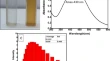
<p>Figure <figr fid="F4">4</figr> shows the UV-Vis absorption spectra of the dye-adsorbed TiO<sub>2 </sub>film and the 3, 5, and 7 wt.% ZrO<sub>2 </sub>nanofiber-doped TiO<sub>2 </sub>films. From the results, the absorption spectra increased at around 538 nm with added ZrO<sub>2 </sub>nanofibers doped in the TiO<sub>2 </sub>film and also enhanced the amount of dye loading. So, the 5 wt.% ZrO<sub>2 </sub>nanofiber-doped TiO<sub>2 </sub>film had the best dye loading, and also, its solar conversion efficiency was the best among the samples.</p>
<fig id="F4"><title><p>Figure 4</p></title><caption><p>UV-Vis spectrum of TiO<sub>2 </sub>film and ZrO<sub>2 </sub>nanofiber-doped TiO<sub>2 </sub>film after 24-h dye absorption</p></caption><text>
   <p><b>UV-Vis spectrum of TiO<sub>2 </sub>film and ZrO<sub>2 </sub>nanofiber-doped TiO<sub>2 </sub>film after 24-h dye absorption</b>.</p>
</text><graphic file="1556-276X-7-98-4" hint_layout="single"/></fig>
<p>In order to determine the factors that influence the stability of the DSSCs, electrochemical impedance spectroscopy [EIS] was performed. Figure <figr fid="F5">5</figr> shows that the Nyquist plot of EIS of the DSSCs exhibits semicircles, which are assigned to the electrochemical reaction at the Pt counter electrode, the charge transfer at the TiO<sub>2</sub>/dye/electrolyte interface, and the Warburg diffusion process of I<sup>-</sup>/I<sub>3</sub><sup>- </sup><abbrgrp><abbr bid="B9">9</abbr><abbr bid="B10">10</abbr></abbrgrp>. As shown in Figure <figr fid="F5">5</figr>, the second semicircle is the resistance (<it>R</it><sub>2</sub>) related to the electron transport in the TiO<sub>2</sub>/dye/electrolyte interface which is reduced. It can be seen that the TiO<sub>2 </sub>film and the 3, 5, and 7 wt.% ZrO<sub>2 </sub>nanofiber-doped TiO<sub>2 </sub>films are 13.2, 10.3, 9.6, and 11.9 &#8486;, respectively.</p>
<fig id="F5"><title><p>Figure 5</p></title><caption><p>Nyquist plots of the DSSCs using TiO<sub>2 </sub>film and ZrO<sub>2 </sub>nanofiber-doped TiO<sub>2 </sub>film</p></caption><text>
   <p><b>Nyquist plots of the DSSCs using TiO<sub>2 </sub>film and ZrO<sub>2 </sub>nanofiber-doped TiO<sub>2 </sub>film</b>. Black circle, 0 wt.%; red diamond, 3 wt.%; cross mark, 5 wt.%; green triangle, 7 wt.%.</p>
</text><graphic file="1556-276X-7-98-5" hint_layout="single"/></fig>
<p>Figure <figr fid="F6">6</figr> shows photocurrent-voltage characteristics of the DSSCs with the ZrO<sub>2 </sub>nanofiber-doped TiO<sub>2 </sub>film. The open-circuit photovoltage was almost the same, and the short-circuit photocurrent density increased with the added amount of ZrO<sub>2 </sub>nanofibers and had reached the maximum at 5 wt.% of ZrO<sub>2 </sub>nanofiber (15.9 mA/cm<sup>2</sup>). The open-circuit photovoltage [<it>V</it><sub>oc</sub>], the short-circuit photocurrent density [<it>J</it><sub>sc</sub>], the fill factor [FF], and the light-to-electricity conversion efficiency [<it>&#951;</it>] at 5 wt.% added ZrO<sub>2 </sub>nanofiber were 0.69 V, 15.9 mA/cm<sup>2</sup>, 0.60, and 6.5%, respectively, as shown in Table <tblr tid="T1">1</tblr>. From the results, we can realize that the insertion of ZrO<sub>2 </sub>nanofibers creates a larger surface area and reduces the resistance of the photoelectrode, especially for the optimal amount of ZrO<sub>2 </sub>contents (7 wt.%) of the photoelectrode in DSSCs.</p>
<fig id="F6"><title><p>Figure 6</p></title><caption><p>Photocurrent-voltage curve of the TiO<sub>2 </sub>film and the TiO<sub>2 </sub>films with ZrO<sub>2 </sub>nanofibers</p></caption><text>
   <p><b>Photocurrent-voltage curve of the TiO<sub>2 </sub>film and the TiO<sub>2 </sub>films with ZrO<sub>2 </sub>nanofibers</b>.</p>
</text><graphic file="1556-276X-7-98-6" hint_layout="single"/></fig>
<tbl id="T1"><title><p>Table 1</p></title><caption><p>Photocurrent-voltage characteristics of DSSCs using TiO<sub>2 </sub>with different amounts of ZrO<sub>2 </sub>nanofibers</p></caption><tblbdy cols="5">
      <r>
         <c ca="left">
            <p>
               <b>Sample</b>
            </p>
         </c>
         <c ca="center">
            <p>
               <b><it>V</it><sub>oc </sub>(V)</b>
            </p>
         </c>
         <c ca="center">
            <p>
               <b><it>J</it><sub>sc </sub>(mA/cm<sup>2</sup>)</b>
            </p>
         </c>
         <c ca="center">
            <p>
               <b>FF</b>
            </p>
         </c>
         <c ca="center">
            <p>
               <b><it>&#951; </it>(%)</b>
            </p>
         </c>
      </r>
      <r>
         <c cspan="5">
            <hr/>
         </c>
      </r>
      <r>
         <c ca="left">
            <p>Pure TiO<sub>2</sub></p>
         </c>
         <c ca="center">
            <p>0.68</p>
         </c>
         <c ca="center">
            <p>11.5</p>
         </c>
         <c ca="center">
            <p>0.62</p>
         </c>
         <c ca="center">
            <p>4.9</p>
         </c>
      </r>
      <r>
         <c ca="left">
            <p>3 wt.% ZrO<sub>2 </sub>nanofiber-doped TiO<sub>2</sub></p>
         </c>
         <c ca="center">
            <p>0.69</p>
         </c>
         <c ca="center">
            <p>14.9</p>
         </c>
         <c ca="center">
            <p>0.60</p>
         </c>
         <c ca="center">
            <p>6.2</p>
         </c>
      </r>
      <r>
         <c ca="left">
            <p>5 wt.% ZrO<sub>2 </sub>nanofiber-doped TiO<sub>2</sub></p>
         </c>
         <c ca="center">
            <p>0.69</p>
         </c>
         <c ca="center">
            <p>15.9</p>
         </c>
         <c ca="center">
            <p>0.60</p>
         </c>
         <c ca="center">
            <p>6.5</p>
         </c>
      </r>
      <r>
         <c ca="left">
            <p>7 wt.% ZrO<sub>2 </sub>nanofiber-doped TiO<sub>2</sub></p>
         </c>
         <c ca="center">
            <p>0.69</p>
         </c>
         <c ca="center">
            <p>14.7</p>
         </c>
         <c ca="center">
            <p>0.59</p>
         </c>
         <c ca="center">
            <p>6.0</p>
         </c>
      </r>
   </tblbdy><tblfn>
      <p><it>V</it><sub>oc</sub>, open-circuit photovoltage; <it>J</it><sub>sc</sub>, short-circuit photocurrent density; FF, fill factor; <it>&#951;</it>, light-to-electricity conversion efficiency; TiO<sub>2</sub>, titania; ZrO<sub>2</sub>, zirconia.</p>
   </tblfn></tbl>
</sec>
<sec><st><p>Conclusions</p></st>
<p>In summary, a ZrO<sub>2 </sub>nanofiber-doped TiO<sub>2 </sub>film was used as a photoelectrode in DSSCs. The ZrO<sub>2 </sub>nanofiber-doped TiO<sub>2 </sub>films had a larger surface area than the pure TiO<sub>2 </sub>film, in which case the amount of dye loading was increased, and <it>J</it><sub>sc </sub>and <it>&#951; </it>were also increased. The optimum ratio of the ZrO<sub>2 </sub>nanofiber was 5 wt.%. The DSSC with the 5 wt.% ZrO<sub>2 </sub>nanofiber photoelectrode provided the highest <it>&#951; </it>of 6.5%, <it>J</it><sub>sc </sub>of 15.9 mA/cm<sup>2</sup>, <it>V</it><sub>oc </sub>of 0.69 V, and FF of 0.60 under AM 1.5 (100 mW/cm<sup>2</sup>) simulated sunlight illumination. Therefore, ZrO<sub>2 </sub>fibers are a promising additive for the realization of high-efficiency DSSCs.</p>
</sec>
<sec><st><p>Competing interests</p></st>
<p>The authors declare that they have no competing interests.</p>
</sec>
<sec><st><p>Authors' contributions</p></st>
<p>JW fabricated the DSSCs and UV-Vis analysis. EMJ was the paper chaser and performed the analysis of photocurrent-voltage characteristics and impedance. WLW performed the BET analysis. J-YP prepared the ZrO<sub>2 </sub>nanofibers. XGZ performed the FE-SEM analysis. H-BG was thesis director. All authors read and approved the final manuscript.</p>
</sec>
</bdy>
<bm>
<refgrp><bibl id="B1"><title><p>A low-cost, high-efficiency solar cell based on dye-sensitized colloidal titanium dioxide films</p></title><aug><au><snm>O&apos;Regan</snm><fnm>B</fnm></au><au><snm>Gr&#228;tzel</snm><fnm>M</fnm></au></aug><source>Nature</source><pubdate>1991</pubdate><volume>335</volume><fpage>737</fpage><lpage>740</lpage></bibl><bibl id="B2"><title><p>Conversion of light to electricity by cis-X2bis(2,2'-bipyridyl-4,4'-dicarboxylate (ruthenium(II) charge transfer sensitizers)X = Cl-, Br1, I-, Cn-, and SCN-) on nanocrystalline titanium dioxide electrodes</p></title><aug><au><snm>Nazeeruddin</snm><fnm>MK</fnm></au><au><snm>Kay</snm><fnm>A</fnm></au><au><snm>Rodicio</snm><fnm>I</fnm></au><au><snm>Humphry</snm><fnm>R</fnm></au><au><snm>Muller</snm><fnm>E</fnm></au><au><snm>Liska</snm><fnm>P</fnm></au><au><snm>Vlachopoulos</snm><fnm>N</fnm></au><au><snm>Gr&#228;tzel</snm><fnm>M</fnm></au></aug><source>J Am Chem Soc</source><pubdate>1993</pubdate><volume>115</volume><fpage>6382</fpage><lpage>6390</lpage><xrefbib><pubid idtype="doi">10.1021/ja00067a063</pubid></xrefbib></bibl><bibl id="B3"><title><p>Influence of scattering layers on efficiency of dye-sensitized solar cells</p></title><aug><au><snm>Hore</snm><fnm>S</fnm></au><au><snm>Vetter</snm><fnm>C</fnm></au><au><snm>Kern</snm><fnm>R</fnm></au><au><snm>Smit</snm><fnm>H</fnm></au><au><snm>Hinsch</snm><fnm>A</fnm></au></aug><source>Sol Energy Mater</source><pubdate>2006</pubdate><volume>90</volume><fpage>1176</fpage><lpage>1188</lpage><xrefbib><pubid idtype="doi">10.1016/j.solmat.2005.07.002</pubid></xrefbib></bibl><bibl id="B4"><title><p>Using hybrid silica-conjugated TiO<sub>2 </sub>nanostructure to enhance the efficiency of dye-sensitized solar cells</p></title><aug><au><snm>Park</snm><fnm>K</fnm></au><au><snm>Gu</snm><fnm>H</fnm></au><au><snm>Jin</snm><fnm>EM</fnm></au><au><snm>Dhayal</snm><fnm>M</fnm></au></aug><source>Electrochimica Acta</source><pubdate>2010</pubdate><volume>55</volume><fpage>5499</fpage><lpage>5505</lpage><xrefbib><pubid idtype="doi">10.1016/j.electacta.2010.04.100</pubid></xrefbib></bibl><bibl id="B5"><title><p>Facile fabrication of mesoporous TiO<sub>2 </sub>electrodes for dye solar cells: chemical modification and repetitive coating</p></title><aug><au><snm>Ito</snm><fnm>Seigo</fnm></au><au><snm>Kitamura</snm><fnm>Takayuki</fnm></au><au><snm>Wada</snm><fnm>Yuji</fnm></au><au><snm>Yanagida</snm><fnm>Shozo</fnm></au></aug><source>Solar Energy Mater Solar Cells</source><pubdate>2003</pubdate><volume>76</volume><fpage>3</fpage><lpage>13</lpage><xrefbib><pubid idtype="doi">10.1016/S0927-0248(02)00209-X</pubid></xrefbib></bibl><bibl id="B6"><title><p>Photovoltaic properties of TiO<sub>2 </sub>photoelectrode prepared by using liquid PEG-EEM binder</p></title><aug><au><snm>Jin</snm><fnm>EM</fnm></au><au><snm>Park</snm><fnm>K</fnm></au><au><snm>Yun</snm><fnm>J</fnm></au><au><snm>Hong</snm><fnm>CK</fnm></au><au><snm>Hwang</snm><fnm>M</fnm></au><au><snm>Park</snm><fnm>B</fnm></au><au><snm>Kim</snm><fnm>K</fnm></au><au><snm>Gu</snm><fnm>H</fnm></au></aug><source>Surface Rev Lett (SRL)</source><pubdate>2010</pubdate><volume>17</volume><fpage>15</fpage><lpage>20</lpage><xrefbib><pubid idtype="doi">10.1142/S0218625X10013576</pubid></xrefbib></bibl><bibl id="B7"><title><p>Effects of HNO<sub>3 </sub>treatment of TiO<sub>2 </sub>nanoparticles on the photovoltaic properties of dye-sensitized solar cells</p></title><aug><au><snm>Park</snm><fnm>KH</fnm></au><au><snm>Jin</snm><fnm>EM</fnm></au><au><snm>Gu</snm><fnm>HB</fnm></au><au><snm>Shim</snm><fnm>SE</fnm></au><au><snm>Hong</snm><fnm>CK</fnm></au></aug><source>Mater Lett</source><pubdate>2009</pubdate><volume>63</volume><fpage>2208</fpage><lpage>2211</lpage><xrefbib><pubid idtype="doi">10.1016/j.matlet.2009.07.034</pubid></xrefbib></bibl><bibl id="B8"><title><p>Preparation of TiO<sub>2</sub>/nano-metal composite particles and their applications in dye-sensitized solar cells</p></title><aug><au><snm>Chou</snm><fnm>Chuen-Shii</fnm></au><au><snm>Yang</snm><fnm>Ru-Yuan</fnm></au><au><snm>Yeh</snm><fnm>Cheng-Kuo</fnm></au><au><snm>Lin</snm><fnm>You-Jen</fnm></au></aug><source>Powder Technol</source><pubdate>2009</pubdate><volume>194</volume><fpage>95</fpage><lpage>105</lpage><xrefbib><pubid idtype="doi">10.1016/j.powtec.2009.03.039</pubid></xrefbib></bibl><bibl id="B9"><title><p>Influence of electrolyte in transport and recombination in dye-sensitized solar cells studied by impedance spectroscopy</p></title><aug><au><snm>Fabregat-Santiago</snm><fnm>F</fnm></au><au><snm>Bisquert</snm><fnm>J</fnm></au><au><snm>Garcia-Belmonte</snm><fnm>G</fnm></au><au><snm>Boschloo</snm><fnm>G</fnm></au><au><snm>Hagfeldt</snm><fnm>A</fnm></au></aug><source>Solar Ener Mat Solar Cells</source><pubdate>2005</pubdate><volume>87</volume><fpage>117</fpage><lpage>131</lpage><xrefbib><pubid idtype="doi">10.1016/j.solmat.2004.07.017</pubid></xrefbib></bibl><bibl id="B10"><title><p><it>J Photochem Photobiol A: </it>Improvement of efficiency of dye-sensitized solar cells based on analysis of equivalent circuit</p></title><aug><au><snm>Koide</snm><fnm>Naoki</fnm></au><au><snm>Islam</snm><fnm>Ashraful</fnm></au><au><snm>Chiba</snm><fnm>Uasou</fnm></au><au><snm>HAn</snm><fnm>Liyuan</fnm></au></aug><source>Chem</source><pubdate>2006</pubdate><volume>182</volume><fpage>296</fpage><lpage>305</lpage></bibl></refgrp>
</bm>
</art>