<?xml version='1.0'?>
<!DOCTYPE art SYSTEM 'http://www.biomedcentral.com/xml/article.dtd'>
<art><ui>1556-276X-7-86</ui><ji>1556-276X</ji><fm>
<dochead>Nano Express</dochead>
<bibl>
<title>
<p>Highly selective fluorescent chemosensor for Zn<sup>2+ </sup>derived from inorganic-organic hybrid magnetic core/shell Fe<sub>3</sub>O<sub>4</sub>@SiO<sub>2 </sub>nanoparticles</p>
</title>
<aug>
<au id="A1"><snm>Wang</snm><fnm>Yujiao</fnm><insr iid="I1"/><email>wyj2009@lzu.cn</email></au>
<au id="A2"><snm>Peng</snm><fnm>Xiaohong</fnm><insr iid="I1"/><email>pengxh08@lzu.cn</email></au>
<au id="A3"><snm>Shi</snm><fnm>Jinmin</fnm><insr iid="I1"/><email>shijm07@lzu.cn</email></au>
<au id="A4"><snm>Tang</snm><fnm>Xiaoliang</fnm><insr iid="I1"/><email>tangxiaol@lzu.edu.cn</email></au>
<au id="A5"><snm>Jiang</snm><fnm>Jie</fnm><insr iid="I1"/><email>jiangj2007@lzu.cn</email></au>
<au id="A6" ca="yes"><snm>Liu</snm><fnm>Weisheng</fnm><insr iid="I1"/><email>liuws@lzu.edu.cn</email></au>
</aug>
<insg>
<ins id="I1"><p>Key Laboratory of Nonferrous Metals Chemistry and Resources Utilization of Gansu Province and State Key Laboratory of Applied Organic Chemistry, College of Chemistry and Chemical Engineering, Lanzhou University, Lanzhou, 730000, People's Republic of China</p></ins>
</insg>
<source>Nanoscale Research Letters</source>
<issn>1556-276X</issn>
<pubdate>2012</pubdate>
<volume>7</volume>
<issue>1</issue>
<fpage>86</fpage>
<url>http://www.nanoscalereslett.com/content/7/1/86</url>
<xrefbib><pubidlist><pubid idtype="doi">10.1186/1556-276X-7-86</pubid><pubid idtype="pmpid">22277075</pubid></pubidlist></xrefbib>
</bibl>
<history><rec><date><day>6</day><month>7</month><year>2011</year></date></rec><acc><date><day>25</day><month>1</month><year>2012</year></date></acc><pub><date><day>25</day><month>1</month><year>2012</year></date></pub></history>
<cpyrt><year>2012</year><collab>Wang et al; licensee Springer.</collab><note>This is an Open Access article distributed under the terms of the Creative Commons Attribution License (<url>http://creativecommons.org/licenses/by/2.0</url>), which permits unrestricted use, distribution, and reproduction in any medium, provided the original work is properly cited.</note></cpyrt>
<abs>
<sec>
<st>
<p>Abstract</p>
</st>
<p>Magnetic nanoparticles with attractive optical properties have been proposed for applications in such areas as separation and magnetic resonance imaging. In this paper, a simple and novel fluorescent sensor of Zn<sup>2+ </sup>was designed with 3,5-di-tert-butyl-2-hydroxybenzaldehyde [DTH] covalently grafted onto the surface of magnetic core/shell Fe<sub>3</sub>O<sub>4</sub>@SiO<sub>2 </sub>nanoparticles [NPs] (DTH-Fe<sub>3</sub>O<sub>4</sub>@SiO<sub>2 </sub>NPs) using the silanol hydrolysis approach. The DTH-Fe<sub>3</sub>O<sub>4</sub>@SiO<sub>2 </sub>inorganic-organic hybrid material was characterized by transmission electron microscopy, dynamic light scattering, X-ray power diffraction, diffuse reflectance infrared Fourier transform, UV-visible absorption and emission spectrometry. The compound DTH exhibited fluorescence response towards Zn<sup>2+ </sup>and Mg<sup>2+ </sup>ions, but the DTH-Fe<sub>3</sub>O<sub>4</sub>@SiO<sub>2 </sub>NPs only effectively recognized Zn<sup>2+ </sup>ion by significant fluorescent enhancement in the presence of various ions, which is due to the restriction of the N-C rotation of DTH-Fe<sub>3</sub>O<sub>4</sub>@SiO<sub>2 </sub>NPs and the formation of the rigid plane with conjugation when the DTH-Fe<sub>3</sub>O<sub>4</sub>@SiO<sub>2 </sub>is coordinated with Zn<sup>2+</sup>. Moreover, this DTH-Fe<sub>3</sub>O<sub>4</sub>@SiO<sub>2 </sub>fluorescent chemosensor also displayed superparamagnetic properties, and thus, it can be recycled by magnetic attraction.</p>
</sec>
</abs>
</fm><bdy>
<sec>
<st>
<p>Background</p>
</st>
<p>Zinc is the second abundant transition metal ion in the human body, which plays a vital role in various biological processes, such as gene expression <abbrgrp>
<abbr bid="B1">1</abbr>
</abbrgrp>, apoptosis <abbrgrp>
<abbr bid="B2">2</abbr>
</abbrgrp>, enzyme regulation <abbrgrp>
<abbr bid="B3">3</abbr>
</abbrgrp>, and neurotransmission <abbrgrp>
<abbr bid="B4">4</abbr>
<abbr bid="B5">5</abbr>
</abbrgrp>. It is also believed that the Zn<sup>2+ </sup>homeostasis may have some bearing on the pathology of Alzheimer's disease and other neurological problems <abbrgrp>
<abbr bid="B6">6</abbr>
<abbr bid="B7">7</abbr>
<abbr bid="B8">8</abbr>
</abbrgrp>. Therefore, there is an urgency to develop approaches to detect Zn<sup>2+ </sup>
<it>in vivo</it>. Besides, techniques for the separation and removal of metal ions and additives in the detection process are very important to prevent poisoning in environmental and biological fields. Conventional analytical methods including atomic absorption spectrophotometry <abbrgrp>
<abbr bid="B9">9</abbr>
</abbrgrp>, inductively coupled plasma atomic emission spectrometry <abbrgrp>
<abbr bid="B10">10</abbr>
</abbrgrp>, and electrochemical method <abbrgrp>
<abbr bid="B11">11</abbr>
</abbrgrp> can hardly be applied for Zn<sup>2+ </sup>ion detection in biological systems due to their complicated pretreatment steps and expensive equipment. Hence, for convenience in future <it>in vivo </it>applications, various fluorescent probes based on small molecules have been designed. They were fairly efficient as reported <abbrgrp>
<abbr bid="B12">12</abbr>
<abbr bid="B13">13</abbr>
<abbr bid="B14">14</abbr>
<abbr bid="B15">15</abbr>
<abbr bid="B16">16</abbr>
<abbr bid="B17">17</abbr>
<abbr bid="B18">18</abbr>
<abbr bid="B19">19</abbr>
<abbr bid="B20">20</abbr>
<abbr bid="B21">21</abbr>
<abbr bid="B22">22</abbr>
</abbrgrp>; however, the small molecules would be toxic <abbrgrp>
<abbr bid="B23">23</abbr>
</abbrgrp>, and it is impossible to recover or remove them from organisms <abbrgrp>
<abbr bid="B24">24</abbr>
</abbrgrp>. The limitation of recoverability blocked the practical applications of small molecular fluorescent probes. To resolve this challenge, the inorganic supports incorporated with small molecular fluorescent probes were applied for the improvement on recoverability.</p>
<p>Various mesoscopic or nanoscopic materials can be acted as the inorganic supports in the design of fluorescent probes, including magnetic nanoparticles, nanotubes, mesoporous silica, metal nanoparticles, and TiO<sub>2 </sub>
<abbrgrp>
<abbr bid="B25">25</abbr>
<abbr bid="B26">26</abbr>
<abbr bid="B27">27</abbr>
<abbr bid="B28">28</abbr>
<abbr bid="B29">29</abbr>
<abbr bid="B30">30</abbr>
<abbr bid="B31">31</abbr>
<abbr bid="B32">32</abbr>
<abbr bid="B33">33</abbr>
<abbr bid="B34">34</abbr>
</abbrgrp>. Among all these inorganic materials, magnetic silica core/shell nanoparticles have advantages over other competitors for biological and environmental applications <abbrgrp>
<abbr bid="B35">35</abbr>
<abbr bid="B36">36</abbr>
<abbr bid="B37">37</abbr>
<abbr bid="B38">38</abbr>
<abbr bid="B39">39</abbr>
<abbr bid="B40">40</abbr>
<abbr bid="B41">41</abbr>
</abbrgrp>. Firstly, they could be simply separated or recovered via external magnetic field. Besides, with magnetic silica core/shell nanoparticles as delivery, their low toxicity and biocompatibility also had advantages for the design of biological fluorescent probes. Furthermore, the silica shell around magnetic core has large surface area, and it can be grafted by fluorescent probes. Therefore, to develop nontoxic, biocompatible, and recoverable fluorimetric Zn<sup>2+ </sup>sensors, introducing the magnetic silica nanoparticles with small molecular fluorescent probes incorporated is very necessary and highly desirable.</p>
<p>In this work, we designed and synthesized a magnetic recoverable fluorescence Zn<sup>2+ </sup>sensor based on 3,5-di-tert-butyl-2-hydroxybenzaldehyde [DTH] covalently grafted onto Fe<sub>3</sub>O<sub>4</sub>@SiO<sub>2 </sub>nanoparticles [NPs] (DTH-Fe<sub>3</sub>O<sub>4</sub>@SiO<sub>2</sub>) to provide highly selective fluorescence changes and efficient magnetic recoverability (Figure <figr fid="F1">1</figr>). This Zn<sup>2+</sup>-selective fluorescent switch of the immobilized chemosensors displayed excellent reversibility, combined with its superparamagnetic property, enabling the recovery of material and repeated uses for Zn<sup>2+ </sup>sensing.</p>
<fig id="F1"><title><p>Figure 1</p></title><caption><p>Syntheses of DTH-APTES and DTH-Fe<sub>3</sub>O<sub>4</sub>@SiO<sub>2</sub></p></caption><text>
   <p><b>Syntheses of DTH-APTES and DTH-Fe<sub>3</sub>O<sub>4</sub>@SiO<sub>2</sub></b>.</p>
</text><graphic file="1556-276X-7-86-1"/></fig>
</sec>
<sec>
<st>
<p>Experimental details</p>
</st>
<sec>
<st>
<p>Materials and methods</p>
</st>
<p>All reagents are purchased commercially. Besides, ethanol was used after purification by standard methods. Other chemicals were used as received without further purification.</p>
<p>Thermal gravimetric analysis [TGA] (P.E. Diamond TG/DTA/SPAECTRUN ONE thermal analyzer, PerkinElmer Inc., Waltham, MA, USA), dynamic light scattering (BI-200SM, Brookhaven Instruments Corporation, Holtsville, NY, USA), transmission electron microscopy [TEM] (Tecnai G<sup>2 </sup>F30, 300 kV, FEI Company, OR, USA), and energy-dispersive X-ray spectrometer [EDX] were used to characterize the materials. X-ray diffraction [XRD] pattern of the synthesized products was recorded with a Rigaku D/MAX 2400 X-ray diffractometer (Tokyo, Japan) using Cu <it>K&#945; </it>radiation (<it>&#955; </it>= 0.154056 &#197;). The scan range (2<it>&#952;</it>) was from 10&#176; to 80&#176;. Solid-state infrared [IR] using diffuse-reflectance infrared Fourier transform [DRIFT] spectroscopy was performed in the 400- to 4,000-cm<sup>-1 </sup>region using a Bruker Vertex 70v (Bremen, Germany) and IR-grade KBr (Sigma-Aldrich Corporation, St. Louis, MO, USA) as the internal standard. <sup>1</sup>H NMR and <sup>13</sup>C NMR spectra were measured on a Bruker DRX 400 spectrometer in a CDCl<sub>3 </sub>solution with TMS as the internal standard. Chemical shift multiplicities are reported as s = singlet, t = triplet, q = quartet, and m = multiplet. Mass spectra were recorded on a Bruker Daltonics esquire6000 mass spectrometer. UV absorption spectra were recorded on a Varian Cary 100 spectrophotometer (Palo Alto, CA, USA) using quartz cells of 1.0-cm path length. Fluorescence measurements were made on a Hitachi F-4500 spectrophotometer (Tokyo, Japan) and a Shimadzu RF-540 spectrofluorophotometer (Chorley, UK) equipped with quartz cuvettes of 1.0-cm path length with a xenon lamp as the excitation source. An excitation and emission slit of 10.0 nm was used for the measurements in the solution state. All spectrophotometric titrations were performed with a suspension of the sample dispersed in ethanol.</p>
<sec>
<st>
<p>Synthesis of Fe<sub>3</sub>O<sub>4</sub>@SiO<sub>2 </sub>NPs</p>
</st>
<p>Fe<sub>3</sub>O<sub>4</sub>@SiO<sub>2 </sub>NPs were synthesized according to the study of Nigam et al. <abbrgrp>
<abbr bid="B42">42</abbr>
</abbrgrp>. The process can be briefly described in the following two steps: (1) FeCl<sub>2 </sub>and FeCl<sub>3 </sub>(molar ratio, 1:2) were added to a concentrated solution of base (25% ammonium hydroxide) under N<sub>2</sub>. The solution was mechanically stirred for 1 h at 20&#176;C and then heated at 70&#176;C for 1 h. The mixture was then stirred for 30 min at 90&#176;C upon addition of citric acid (0.5 g/ml). After cooling the reaction mixture to room temperature, the magnetite NPs were obtained by permanent magnet, and then it was rinsed with deionized water to remove excess citric acid and other nonmagnetic particles thoroughly. (2) Then, the magnetite NPs were further coated with a thin silica layer via a modified St&#246;ber method <abbrgrp>
<abbr bid="B43">43</abbr>
</abbrgrp> to obtain stable Fe<sub>3</sub>O<sub>4</sub>@SiO<sub>2</sub>. Tetraethyl orthosilicate was hydrolyzed with magnetic NPs as seeds in an ethanol/water mixture. The resulting silica-coated magnetite NPs with an average diameter of 60 to 70 nm were used.</p>
</sec>
<sec>
<st>
<p>Synthesis of DTH-Fe<sub>3</sub>O<sub>4</sub>@SiO<sub>2 </sub>NPs</p>
</st>
<p>As shown in Figure <figr fid="F1">1</figr>, the synthetic procedure for 2,4-di-tert-butyl-6-((3-(triethoxysilyl)propylimino)methyl)phenol [DTH-APTES] followed the method previously described in the literatures <abbrgrp>
<abbr bid="B44">44</abbr>
<abbr bid="B45">45</abbr>
</abbrgrp>. DTH (234 mg, 1 mmol) and (3-aminopropyl) triethoxysilane [APTES] (221 mg, 1 mmol) were mixed in dry ethanol (15 mL) at room temperature. Then, the solution was refluxed for 3 h under N<sub>2</sub>. After that, the solvent was evaporated, and the crude product was further purified by flash column chromatography (silica gel, ethyl acetate/petroleum ether 1:2) to produce 371 mg (84.9%) of DTH-APTES as yellow oil. ESI-MS: <it>m/z </it>438.5 (M + H<sup>+</sup>). <sup>1</sup>H NMR: (400 MHz, CDCl<sub>3</sub>): &#948; (ppm) 0.69 (t, 2H, CH<sub>2</sub>Si); 1.22 (t, 9H, CH<sub>3</sub>); 1.30 (s, 9H, C(CH<sub>3</sub>)<sub>3</sub>); 1.43 (s, 9H, C(CH<sub>3</sub>)<sub>3</sub>); 1.82 (m, 2H, CH<sub>2</sub>); 3.58 (t, 2H, NCH<sub>2</sub>); 3.82 (q, 6H, SiOCH<sub>2</sub>); 7.07, 7.36 (d, 2H, Ar); 8.34 (s, 1H, HC = N). <sup>13</sup>C NMR (100 MHz, CDCl<sub>3</sub>): 7.92 (CH<sub>2</sub>Si); 18.30 (CH<sub>3</sub>); 24.38, 29.40, 29.70, 31.50 (CH<sub>3</sub>); 34.11 (C), 35.01 (C); 58.41 (CH<sub>2</sub>); 62.08 (CH<sub>2</sub>); 117.83, 125.69, 126.66, 136.65, 139.75, 158.27 (Ar); 165.80 (C = N). FT-IR (KBr pellet) (cm<sup>-1</sup>): 1,637 (<it>&#957;</it>
<sub>C = N</sub>), 1,275-1,252 (<it>&#957;</it>
<sub>C-O</sub>), 1,596-1,342 (<it>&#957;</it>
<sub>C = C</sub>), 1,106-1,085 (<it>&#957;</it>
<sub>Si-O</sub>).</p>
<p>One hundred milligrams of dried Fe<sub>3</sub>O<sub>4</sub>@SiO<sub>2 </sub>NPs and 356 mg (0.81 mmol) of DTH-APTES were suspended in 10 mL of anhydrous ethanol. The mixture was refluxed for 8 h at 80&#176;C under N<sub>2 </sub>to obtain DTH-Fe<sub>3</sub>O<sub>4</sub>@SiO<sub>2</sub>. The nanoparticles were collected by centrifugation and repeatedly washed with anhydrous ethanol thoroughly. Unreacted organic molecules were removed completely and monitored by the fluorescence of the upper liquid. Then, the DTH-Fe<sub>3</sub>O<sub>4</sub>@SiO<sub>2 </sub>NPs were finally dried under vacuum over night. About 2.81% DTH-APTES in the precursors was finally grafted on the NPs, and the rest could be recycled if no hydrolysis occurred.</p>
</sec>
</sec>
</sec>
<sec>
<st>
<p>Results and discussion</p>
</st>
<sec>
<st>
<p>Characterization of DTH-Fe<sub>3</sub>O<sub>4</sub>@SiO<sub>2</sub>
</p>
</st>
<p>The TEM image (Figure <figr fid="F2">2A</figr>) of DTH-Fe<sub>3</sub>O<sub>4</sub>@SiO<sub>2 </sub>reveals that iron oxide NPs have entrapped in the silica shell successfully, in which the core/shell structures are in a narrow size distribution of 60 to 70 nm <abbrgrp>
<abbr bid="B46">46</abbr>
<abbr bid="B47">47</abbr>
</abbrgrp>, and the diameter of the magnetic core is about 10 nm. The weight ratio of iron vs. silicon was measured to be 2.63:38.94 by EDX. Hence, according to TGA, each magnetic NP has about 6,000 DTH-APTES molecules grafted (see Additional file <supplr sid="S1">1</supplr>). More importantly, the right size of magnetic core/shell NPs smaller than 100 nm is an advantage for their good dispersibility. In addition, an inert silica coating on the surface of magnetite nanoparticles prevents their aggregation in liquid <abbrgrp>
<abbr bid="B48">48</abbr>
</abbrgrp>. Hence, such a good performance on the dispersibility can improve their chemical stability and provide better protection against toxicity.</p>
<fig id="F2"><title><p>Figure 2</p></title><caption><p>TEM image (A) and the particle size histogram from DLS (B) of DTH-Fe<sub>3</sub>O<sub>4</sub>@SiO<sub>2</sub></p></caption><text>
   <p><b>TEM image (A) and the particle size histogram from DLS (B) of DTH-Fe<sub>3</sub>O<sub>4</sub>@SiO<sub>2</sub></b>.</p>
</text><graphic file="1556-276X-7-86-2"/></fig>
<suppl id="S1">
<title>
<p>Additional file 1</p>
</title>
<text>
<p>
<b>Characterization and properties of DTH-Fe<sub>3</sub>O<sub>4</sub>@SiO<sub>2</sub>
</b>. Figure S1, XRD patterns of Fe<sub>3</sub>O<sub>4 </sub>core; Figure S2, TGA curves of Fe<sub>3</sub>O<sub>4</sub>@SiO<sub>2 </sub>(a) and DTH-Fe<sub>3</sub>O<sub>4</sub>@SiO<sub>2 </sub>(b); Figure S3, selectivity of DTH-Fe<sub>3</sub>O<sub>4</sub>@SiO<sub>2 </sub>for Zn<sup>2+ </sup>in the presence of other metal ions in ethanol; and Table S1, the loading of DTH-APTES in the Fe<sub>3</sub>O<sub>4</sub>@SiO<sub>2 </sub>NPs as estimated by different methods.</p>
</text>
<file name="1556-276X-7-86-S1.DOC">
   <p>Click here for file</p>
</file>
</suppl>
<p>In addition, dynamic light scattering [DLS] was performed to further reveal the colloidal stability of NPs. According to DLS results (Figure <figr fid="F2">2B</figr>), DTH-Fe<sub>3</sub>O<sub>4</sub>@SiO<sub>2 </sub>presents good stabilization and a narrow size distribution with peak centered at 147 nm, confirming its good stabilization in ethanol. In a common sense, the diameter achieved by DLS is mostly higher than the one observed in TEM since the size of NPs identified by DLS includes the grafted molecules' steric hindering and the hydrodynamic radius of first few solvent layers <abbrgrp>
<abbr bid="B49">49</abbr>
<abbr bid="B50">50</abbr>
<abbr bid="B51">51</abbr>
</abbrgrp>. Besides, according to the calculated size of DTH-APTES which covalently grafted on the surface of Fe<sub>3</sub>O<sub>4</sub>@SiO<sub>2</sub>, the grafted molecules' steric hindering could increase the diameter by about 2.72 nm.</p>
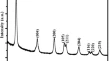
<p>Figure <figr fid="F3">3</figr> shows the XRD powder diffraction patterns of two NPs for the identification of Fe<sub>3</sub>O<sub>4 </sub>in core/shell NPs. XRD patterns of the synthesized Fe<sub>3</sub>O<sub>4</sub>@SiO<sub>2 </sub>(a) and DTH-Fe<sub>3</sub>O<sub>4</sub>@SiO<sub>2 </sub>(b) display relative diffraction peaks in the 2<it>&#952; </it>region of 10&#176; to 80&#176;. We could find that XRD patterns show very low intensities for the peaks attributed to the Fe<sub>3</sub>O<sub>4 </sub>cores, due to the coating of amorphous silica shell, which deduced the efficient content of Fe<sub>3</sub>O<sub>4 </sub>cores and then affected the peak intensities. However, the diffraction peaks of DTH-Fe<sub>3</sub>O<sub>4</sub>@SiO<sub>2 </sub>still maintain the same position as the magnetite core (Figure S1 in Additional file <supplr sid="S1">1</supplr>) <abbrgrp>
<abbr bid="B52">52</abbr>
</abbrgrp>. The six characteristic diffraction peaks in Figure <figr fid="F3">3</figr> can be indexed to (220), (311), (400), (422), (511), and (440), which well agree with the database of magnetite in the Joint Committee on Powder Diffraction Standards [JCPDS] (JCPDS card: 19-629) file <abbrgrp>
<abbr bid="B42">42</abbr>
<abbr bid="B46">46</abbr>
<abbr bid="B53">53</abbr>
<abbr bid="B54">54</abbr>
</abbrgrp>. Also, the broad XRD peak at a low diffraction angle of 20&#176; to 30&#176; corresponds to the amorphous-state SiO<sub>2 </sub>shells surrounding the Fe<sub>3</sub>O<sub>4 </sub>NPs <abbrgrp>
<abbr bid="B53">53</abbr>
</abbrgrp>.</p>
<fig id="F3"><title><p>Figure 3</p></title><caption><p>XRD patterns of Fe<sub>3</sub>O<sub>4</sub>@SiO<sub>2 </sub>(a) and DTH-Fe<sub>3</sub>O<sub>4</sub>@SiO<sub>2 </sub>(b)</p></caption><text>
   <p><b>XRD patterns of Fe<sub>3</sub>O<sub>4</sub>@SiO<sub>2 </sub>(a) and DTH-Fe<sub>3</sub>O<sub>4</sub>@SiO<sub>2 </sub>(b)</b>.</p>
</text><graphic file="1556-276X-7-86-3"/></fig>
<p>The successful conjugation of DTH onto the surface of the Fe<sub>3</sub>O<sub>4</sub>@SiO<sub>2 </sub>NPs can be confirmed by DRIFT (Figure <figr fid="F4">4</figr>). The bands at 3,400 to 3,500 cm<sup>-1 </sup>and 1,000 to 1,250 cm<sup>-1 </sup>are due to -OH stretching on silanol <abbrgrp>
<abbr bid="B55">55</abbr>
</abbrgrp>. It indicates that not all the silanol on Fe<sub>3</sub>O<sub>4</sub>@SiO<sub>2 </sub>NPs have been covalently modified. The band at 1,630 cm<sup>-1 </sup>represents the bending mode of -OH vibrations <abbrgrp>
<abbr bid="B56">56</abbr>
</abbrgrp>. DTH-Fe<sub>3</sub>O<sub>4</sub>@SiO<sub>2 </sub>(see Figure <figr fid="F1">1</figr>) has additional peaks at 2,918 and 2,850 cm<sup>-1 </sup>that correspond to the -CH vibration of aliphatic and aromatic groups <abbrgrp>
<abbr bid="B28">28</abbr>
<abbr bid="B57">57</abbr>
<abbr bid="B58">58</abbr>
</abbrgrp>. The bands at 1,473 and 1,463 cm<sup>-1 </sup>of DTH-Fe<sub>3</sub>O<sub>4</sub>@SiO<sub>2 </sub>are probably due to the bending vibrations of -CH<sub>3</sub>, which come from the DTH part <abbrgrp>
<abbr bid="B59">59</abbr>
</abbrgrp>. According to the spectra of Fe<sub>3</sub>O<sub>4</sub>@SiO<sub>2 </sub>and DTH-Fe<sub>3</sub>O<sub>4</sub>@SiO<sub>2</sub>, the bands which appear as broad and strong and are centered at 1,102 (<it>&#957;</it>
<sub>as</sub>) and 800 cm<sup>-1 </sup>can be attributed to the siloxane (-Si-O-Si-) <abbrgrp>
<abbr bid="B60">60</abbr>
</abbrgrp>. These results support the presence of the organic DTH-APTES in the magnetic material DTH-Fe<sub>3</sub>O<sub>4</sub>@SiO<sub>2</sub>.</p>
<fig id="F4"><title><p>Figure 4</p></title><caption><p>DRIFT spectra of Fe<sub>3</sub>O<sub>4</sub>@SiO<sub>2 </sub>(a) and DTH-Fe<sub>3</sub>O<sub>4</sub>@SiO<sub>2 </sub>(b)</p></caption><text>
   <p><b>DRIFT spectra of Fe<sub>3</sub>O<sub>4</sub>@SiO<sub>2 </sub>(a) and DTH-Fe<sub>3</sub>O<sub>4</sub>@SiO<sub>2 </sub>(b)</b>.</p>
</text><graphic file="1556-276X-7-86-4"/></fig>
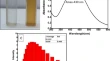
<p>The UV-visible [UV-Vis] spectra of DTH-APTES (1.0 &#215; 10<sup>-5 </sup>M), Fe<sub>3</sub>O<sub>4</sub>@SiO<sub>2 </sub>(0.3 g/L), and DTH-Fe<sub>3</sub>O<sub>4</sub>@SiO<sub>2 </sub>(0.3 g/L) can provide further evidence on the grafting of DTH onto the surface of the Fe<sub>3</sub>O<sub>4</sub>@SiO<sub>2 </sub>NPs (Figure <figr fid="F5">5</figr>). Compared to Fe<sub>3</sub>O<sub>4</sub>@SiO<sub>2 </sub>(b), a new absorption band centered at about 330 nm of DTH-Fe<sub>3</sub>O<sub>4</sub>@SiO<sub>2 </sub>can be attributed to the typical electronic transition of an aromatic ring and -C = N- conjugate system in a Schiff base molecule <abbrgrp>
<abbr bid="B29">29</abbr>
</abbrgrp>. This result can also imply the successful immobilization of DTH-APTES onto the magnetic core/shell NPs.</p>
<fig id="F5"><title><p>Figure 5</p></title><caption><p>UV-Vis spectra of DTH-APTES (a), Fe<sub>3</sub>O<sub>4</sub>@SiO<sub>2 </sub>(b), and DTH-Fe<sub>3</sub>O<sub>4</sub>@SiO<sub>2 </sub>(c)</p></caption><text>
   <p><b>UV-Vis spectra of DTH-APTES (a), Fe<sub>3</sub>O<sub>4</sub>@SiO<sub>2 </sub>(b), and DTH-Fe<sub>3</sub>O<sub>4</sub>@SiO<sub>2 </sub>(c)</b>.</p>
</text><graphic file="1556-276X-7-86-5"/></fig>
<p>The superparamagnetic property of the magnetic NPs plays a vital role for its biological application. Figure <figr fid="F6">6</figr> shows the magnetization curves of the Fe<sub>3</sub>O<sub>4</sub>@SiO<sub>2 </sub>and DTH-Fe<sub>3</sub>O<sub>4</sub>@SiO<sub>2 </sub>which were investigated with a vibrating sample magnetometer tuned from -15,000 to 15,000 Oe at 300 K. The result was consistent with the conclusion that magnetic Fe<sub>3</sub>O<sub>4 </sub>NPs smaller than 30 nm are usually superparamagnetic at room temperature <abbrgrp>
<abbr bid="B47">47</abbr>
</abbrgrp>. The saturation magnetization value for synthesized DTH-Fe<sub>3</sub>O<sub>4</sub>@SiO<sub>2 </sub>is about 3.96 emu/g. The saturation magnetization value for Fe<sub>3</sub>O<sub>4</sub>@SiO<sub>2 </sub>support was measured to be 4.24 emu/g. Considering the grafting rate of 7.64% (according to TGA, Figure S2 and Table S1 in Additional file <supplr sid="S1">1</supplr>), the difference of saturation magnetization values between DTH-Fe<sub>3</sub>O<sub>4</sub>@SiO<sub>2 </sub>and its support could be due to the decreased weight ratio of magnetic support after grafting. More importantly, from the hysteresis loops of Fe<sub>3</sub>O<sub>4</sub>@SiO<sub>2 </sub>NPs and the DTH-Fe<sub>3</sub>O<sub>4</sub>@SiO<sub>2 </sub>NPs, it can be found that both exhibited superparamagnetic properties for no remanence was observed when the applied magnetic field was removed. These phenomena were due to the fact that the magnetite core is smaller than 30 nm in core/shell NPs (Figure <figr fid="F2">2A</figr>). As a result of this superparamagnetic property, DTH-Fe<sub>3</sub>O<sub>4</sub>@SiO<sub>2 </sub>had a reversal magnetic responsivity. It could be easily separated from dispersion after only 5 min using a magnet (Figure <figr fid="F6">6</figr>, inset) and then redispersed by mild agitation when the magnet was removed. The reversal magnetic responsivity of DTH-Fe<sub>3</sub>O<sub>4</sub>@SiO<sub>2 </sub>would be a key factor when evaluating their recoverability <abbrgrp>
<abbr bid="B61">61</abbr>
</abbrgrp>. The magnetic separation capability of DTH-Fe<sub>3</sub>O<sub>4</sub>@SiO<sub>2 </sub>NPs and the reversibility of the combination between DTH-Fe<sub>3</sub>O<sub>4</sub>@SiO<sub>2 </sub>and Zn<sup>2+ </sup>could also provide a simple and efficient route to separate Zn<sup>2+ </sup>rather than through filtration approach (see Figure <figr fid="F6">6</figr> inset).</p>
<fig id="F6"><title><p>Figure 6</p></title><caption><p>Magnetization curves of the Fe<sub>3</sub>O<sub>4</sub>@SiO<sub>2 </sub>(a) and DTH-Fe<sub>3</sub>O<sub>4</sub>@SiO<sub>2 </sub>(b)</p></caption><text>
   <p><b>Magnetization curves of the Fe<sub>3</sub>O<sub>4</sub>@SiO<sub>2 </sub>(a) and DTH-Fe<sub>3</sub>O<sub>4</sub>@SiO<sub>2 </sub>(b)</b>. Inset shows that DTH-Fe<sub>3</sub>O<sub>4</sub>@SiO<sub>2 </sub>was dispersed to an external magnet in ethanol.</p>
</text><graphic file="1556-276X-7-86-6"/></fig>
</sec>
<sec>
<st>
<p>Fluorescence response of DTH-Fe<sub>3</sub>O<sub>4</sub>@SiO<sub>2</sub>
</p>
</st>
<p>To verify its fluorescence response towards various metal ions, we investigated fluorescence properties of DTH-Fe<sub>3</sub>O<sub>4</sub>@SiO<sub>2 </sub>NPs (0.3 g/L, containing 5.2 &#215; 10<sup>-5 </sup>M DTH-APTES according to TGA in Figure S2 and Table S1 in Additional file <supplr sid="S1">1</supplr>) towards various metal ions Ag<sup>+</sup>, Ca<sup>2+</sup>, Cd<sup>2+</sup>, Co<sup>2+</sup>, Cr<sup>3+</sup>, Cu<sup>2+</sup>, Fe<sup>3+</sup>, Hg<sup>2+</sup>, K<sup>+</sup>, Mg<sup>2+</sup>, Mn<sup>2+</sup>, Na<sup>+</sup>, Ni<sup>2+</sup>, and Zn<sup>2+ </sup>in ethanol solution (all as perchlorates, 1.0 &#215; 10<sup>-4 </sup>M). As shown in Figure <figr fid="F7">7A</figr>, DTH-Fe<sub>3</sub>O<sub>4</sub>@SiO<sub>2 </sub>NPs exhibited significant 'off-on' changes in fluorescence emission only for Zn<sup>2+</sup>, but not for the others. It is noted that Cd<sup>2+ </sup>with a <it>d</it>
<sup>10 </sup>electron configuration, which often exhibited coordination properties similar to Zn<sup>2+ </sup>
<abbrgrp>
<abbr bid="B19">19</abbr>
</abbrgrp>, do not influence the fluorescence intensity of DTH-Fe<sub>3</sub>O<sub>4</sub>@SiO<sub>2 </sub>NPs significantly. As a comparison, DTH (1.0 &#215; 10<sup>-5 </sup>M) exhibited fluorescence response towards both Zn<sup>2+ </sup>and Mg<sup>2+ </sup>ions (1.0 &#215; 10<sup>-4 </sup>M) in the same solution, which is not as selective as DTH-Fe<sub>3</sub>O<sub>4</sub>@SiO<sub>2 </sub>for Zn<sup>2+ </sup>detection (Figure <figr fid="F7">7B</figr>). Compared to the single aldehyde DTH, the origin of selectivity for DTH-Fe<sub>3</sub>O<sub>4</sub>@SiO<sub>2 </sub>may come from its Schiff base structure, which prefers to coordinate with Zn<sup>2+ </sup>under the interference of Mg<sup>2+</sup>.</p>
<fig id="F7"><title><p>Figure 7</p></title><caption><p>Fluorescence response of DTH-Fe<sub>3</sub>O<sub>4</sub>@SiO<sub>2 </sub>(A) and DTH (B) to various cations</p></caption><text>
   <p><b>Fluorescence response of DTH-Fe<sub>3</sub>O<sub>4</sub>@SiO<sub>2 </sub>(A) and DTH (B) to various cations</b>. Excitation wavelength was 397 nm. Spectra were recorded every 25 min after adding Zn<sup>2+</sup>.</p>
</text><graphic file="1556-276X-7-86-7"/></fig>
<p>The remarkable increase of fluorescence intensity can be explained as follows: DTH-Fe<sub>3</sub>O<sub>4</sub>@SiO<sub>2 </sub>is poorly fluorescent due to the rotation of the N-C bond of DTH-APTES part. When stably chelated with Zn<sup>2+</sup>, the N-C rotation of DTH-APTES part is restricted and the rigid plane with conjugation is formed and the fluorescence enhanced, which consists of our previous work <abbrgrp>
<abbr bid="B62">62</abbr>
</abbrgrp>. The emission spectra of DTH-Fe<sub>3</sub>O<sub>4</sub>@SiO<sub>2</sub>, which is excited at 397 nm, exhibit the emission maximum at 452 nm with a low quantum yield (<it>&#934; </it>= 0.0042) at room temperature in ethanol. Upon the addition of excess Zn<sup>2+</sup>, the fluorescence intensity of DTH-Fe<sub>3</sub>O<sub>4</sub>@SiO<sub>2 </sub>increased by more than 25-fold, the emission maximum shifts from 452 to 470 nm, and the quantum yield (<it>&#934; </it>= 0.11) results in a 26-fold increase.</p>
<p>As illustrated in Figure <figr fid="F8">8A</figr>, the fluorescence emission of DTH-Fe<sub>3</sub>O<sub>4</sub>@SiO<sub>2 </sub>(0.3 g/L) increases gradually when adding various concentrations (0 to 30 &#956;M) of Zn<sup>2+ </sup>in ethanol, indicating that Zn<sup>2+ </sup>is quantitatively bound to the Schiff base moiety attached to the NPs. Fluorescence titration experiment suggests that the association constant (<it>K<sub>d</sub>
</it>) for Zn<sup>2+ </sup>binding to DTH-Fe<sub>3</sub>O<sub>4</sub>@SiO<sub>2 </sub>is calculated to be 51.08 M<sup>-2 </sup>(log <it>K </it>= 1.71; Figure <figr fid="F8">8A</figr>). Job's plot suggested a 1:2 binding ratio for Zn<sup>2+ </sup>with DTH-APTES (Figure <figr fid="F8">8B</figr>).</p>
<fig id="F8"><title><p>Figure 8</p></title><caption><p>Fluorescence titrations and Job's plot</p></caption><text>
   <p><b>Fluorescence titrations and Job's plot</b>. (<b>A</b>) Fluorescence titrations of DTH-Fe<sub>3</sub>O<sub>4</sub>@SiO<sub>2 </sub>with Zn<sup>2+</sup>. (<b>B</b>) Job's plot of DTH-APTES with Zn<sup>2+</sup>. Spectra were recorded every 25 min after adding Zn<sup>2+</sup>.</p>
</text><graphic file="1556-276X-7-86-8"/></fig>
<p>The competition experiments indicated that the presence of most metal ions, especially Na<sup>+</sup>, K<sup>+</sup>, Ca<sup>2+</sup>, and Mg<sup>2+</sup>, which are abundant in the biological environment, had a negligible effect on Zn<sup>2+ </sup>sensing (Figure <figr fid="F9">9A</figr>). Since Cr<sup>3+</sup>, Cu<sup>2+</sup>, Fe<sup>3+</sup>, and Hg<sup>2+ </sup>also appeared to bind DTH-Fe<sub>3</sub>O<sub>4</sub>@SiO<sub>2 </sub>sensors (Figure S3 in Additional file <supplr sid="S1">1</supplr>), they quenched the fluorescence of the Zn<sup>2+</sup>-DTH-Fe<sub>3</sub>O<sub>4</sub>@SiO<sub>2</sub>, owing to an electron or energy transfer between the metal cation and fluorophore known as the fluorescence quenching mechanism <abbrgrp>
<abbr bid="B63">63</abbr>
<abbr bid="B64">64</abbr>
<abbr bid="B65">65</abbr>
<abbr bid="B66">66</abbr>
</abbrgrp>. The fluorescence enhancement that occurred upon exposure to Zn<sup>2+ </sup>was fully reversible as the addition of EDTA (2.5 &#215; 10<sup>-4 </sup>M; Figure <figr fid="F9">9B</figr> and inset) restored the emission band. Combined with its magnetic property, the results above implied that DTH-Fe<sub>3</sub>O<sub>4</sub>@SiO<sub>2 </sub>was considerably applicable to some field as a new inorganic-organic hybrid sensor for the Zn<sup>2+ </sup>ion.</p>
<fig id="F9"><title><p>Figure 9</p></title><caption><p>Competition of DTH-Fe<sub>3</sub>O<sub>4</sub>@SiO<sub>2 </sub>towards cations and reversibility of DTH-Fe<sub>3</sub>O<sub>4</sub>@SiO<sub>2 </sub>towards Zn<sup>2+</sup></p></caption><text>
   <p><b>Competition of DTH-Fe<sub>3</sub>O<sub>4</sub>@SiO<sub>2 </sub>towards cations and reversibility of DTH-Fe<sub>3</sub>O<sub>4</sub>@SiO<sub>2 </sub>towards Zn<sup>2+</sup></b>. (<b>A</b>) Fluorescent emission changes of DTH-Fe<sub>3</sub>O<sub>4</sub>@SiO<sub>2 </sub>(0.3 g/L) upon addition of 1, blank; 2, Zn<sup>2+</sup>; 3, Na<sup>+</sup>; 4, Na<sup>+ </sup>+ Zn<sup>2+</sup>; 5, K<sup>+</sup>; 6, K<sup>+ </sup>+ Zn<sup>2+</sup>; 7, Ca<sup>2+</sup>; 8, Ca<sup>2+ </sup>+ Zn<sup>2+</sup>; 9, Mg<sup>2+</sup>; and 10, Mg<sup>2+ </sup>+ Zn<sup>2+ </sup>(each metal ion is 100 &#956;M) in ethanol at room temperature. (<b>B</b>) Fluorescence spectra of DTH-Fe<sub>3</sub>O<sub>4</sub>@SiO<sub>2 </sub>(0.3 g/L) in (a) without, (b) with Zn<sup>2+ </sup>(1.0 &#215; 10<sup>-4 </sup>M), and (c) after treatment with EDTA (2.5 &#215; 10<sup>-4 </sup>M) in (b) solution. The inset picture shows the photograph of DTH-Fe<sub>3</sub>O<sub>4</sub>@SiO<sub>2 </sub>with Zn<sup>2+ </sup>by treatment of EDTA (2.5 &#215; 10<sup>-4 </sup>M) under a 365-nm UV light.</p>
</text><graphic file="1556-276X-7-86-9"/></fig>
<p>Figure <figr fid="F10">10A</figr> depicts the UV-Vis spectra of DTH-APTES (10 &#956;M), DTH-APTES (10 &#956;M) + Zn<sup>2+ </sup>(100 &#956;M), DTH-Fe<sub>3</sub>O<sub>4</sub>@SiO<sub>2 </sub>(0.3 g/L), and DTH-Fe<sub>3</sub>O<sub>4</sub>@SiO<sub>2 </sub>(0.3 g/L) + Zn<sup>2+ </sup>(100 &#956;M). It can be seen that the absorbance peaks at around 390 nm are formed when Zn<sup>2+ </sup>is added in both DTH-APTES and DTH-Fe<sub>3</sub>O<sub>4</sub>@SiO<sub>2 </sub>systems. The absorption spectra of DTH-Fe<sub>3</sub>O<sub>4</sub>@SiO<sub>2 </sub>(0.3 g/L) in the presence of various concentrations of Zn<sup>2+ </sup>(0 to 240 &#956;M) were investigated in ethanol at room temperature, as shown in Figure <figr fid="F10">10B</figr>. When Zn<sup>2+ </sup>was added gradually, the absorbance of DTH-Fe<sub>3</sub>O<sub>4</sub>@SiO<sub>2 </sub>at 390 nm gradually increases, which indicated that DTH-Fe<sub>3</sub>O<sub>4</sub>@SiO<sub>2 </sub>NPs coordinated with Zn<sup>2+ </sup>gradually.</p>
<fig id="F10"><title><p>Figure 10</p></title><caption><p>UV-Vis spectra</p></caption><text>
   <p><b>UV-Vis spectra</b>. (<b>A</b>) Absorption spectra of (a) DTH-APTES (1.0 &#215; 10<sup>-5 </sup>M), (b) DTH-APTES + Zn<sup>2+ </sup>(1.0 &#215; 10<sup>-4 </sup>M), (c) DTH-Fe<sub>3</sub>O<sub>4</sub>@SiO<sub>2 </sub>(0.3 g/L), and (d) DTH-Fe<sub>3</sub>O<sub>4</sub>@SiO<sub>2 </sub>(0.3 g/L) + Zn<sup>2+ </sup>(1.0 &#215; 10<sup>-4 </sup>M) in ethanol. (<b>B</b>) UV-Vis spectra of DTH-Fe<sub>3</sub>O<sub>4</sub>@SiO<sub>2 </sub>(0.3 g/L) in ethanol in the presence of different amounts of Zn<sup>2+ </sup>(0 to 240 &#956;M).</p>
</text><graphic file="1556-276X-7-86-10"/></fig>
</sec>
</sec>
<sec>
<st>
<p>Conclusions</p>
</st>
<p>In summary, we have successfully designed and synthesized functionalized magnetic core/shell Fe<sub>3</sub>O<sub>4</sub>@SiO<sub>2 </sub>NPs (DTH-Fe<sub>3</sub>O<sub>4</sub>@SiO<sub>2 </sub>NPs) which could act as a new type of fluorescent chemosensor for efficient sensing and separation of Zn<sup>2+ </sup>in ethanol. The inorganic-organic hybrid fluorescent chemosensor DTH-Fe<sub>3</sub>O<sub>4</sub>@SiO<sub>2 </sub>was able to recognize and adsorb Zn<sup>2+ </sup>with a selective and sensitive fluorescence response in ethanol. The magnetic separation capability of Fe<sub>3</sub>O<sub>4</sub>@SiO<sub>2 </sub>NPs and the reversibility of the combination between DTH-Fe<sub>3</sub>O<sub>4</sub>@SiO<sub>2 </sub>and Zn<sup>2+ </sup>would also provide a simple route to separate Zn<sup>2+ </sup>from the environment (Figure <figr fid="F6">6</figr>, inset).</p>
</sec>
<sec>
<st>
<p>Abbreviations</p>
</st>
<p>APTES: (3-aminopropyl)triethoxysilane; DLS: dynamic light scattering; DRIFT: diffuse-reflectance infrared Fourier transform; DTH: 3,5-di-tert-butyl-2-hydroxybenzaldehyde; DTH-APTES: 2,4-di-tert-butyl-6-((3-(triethoxysilyl)propylimino)methyl)phenol; EDX: energy-dispersive X-ray spectrometer; NPs: nanoparticles; TEM: transmission electron microscopy; TEOS: tetraethyl orthosilicate; TGA: thermal gravimetric analysis; XRD: X-ray power diffraction.</p>
</sec>
<sec>
<st>
<p>Competing interests</p>
</st>
<p>The authors declare that they have no competing interests.</p>
</sec>
<sec>
<st>
<p>Authors' contributions</p>
</st>
<p>YW supervised and participated in all the studies and wrote this paper. XP conceived the study and participated in its design. JS participated in the synthesis of the nanoparticles and the testing of fluorescence property. XT, JJ, and WL participated in the revision of the manuscript. All authors read and approved the final manuscript.</p>
</sec>
</bdy><bm>
<ack>
<sec>
<st>
<p>Acknowledgements</p>
</st>
<p>The authors acknowledge the financial support from the NSFC (grant nos. 20931003 and 91122007) and the Specialized Research Fund for the Doctoral Program of Higher Education (grant no. 20110211130002).</p>
</sec>
</ack>
<refgrp><bibl id="B1"><title><p>The molecular basis for the role of zinc in developmental biology</p></title><aug><au><snm>Falchuk</snm><fnm>KH</fnm></au></aug><source>Mol Cell Biochem</source><pubdate>1998</pubdate><volume>188</volume><fpage>41</fpage><xrefbib><pubidlist><pubid idtype="doi">10.1023/A:1006808119862</pubid><pubid idtype="pmpid" link="fulltext">9823009</pubid></pubidlist></xrefbib></bibl><bibl id="B2"><title><p>Correlation of apoptosis with change in intracellular labile Zn(II) using zinquin [(2-methyl-8-<it>p</it>-toluenesulphonamido-6-quinolyloxy)acetic acid], a new specific fluorescent probe for Zn(II)</p></title><aug><au><snm>Zalewski</snm><fnm>PD</fnm></au><au><snm>Forbes</snm><fnm>IJ</fnm></au><au><snm>Betts</snm><fnm>WH</fnm></au></aug><source>Biochem J</source><pubdate>1993</pubdate><volume>296</volume><fpage>403</fpage><xrefbib><pubidlist><pubid idtype="pmcid">1137710</pubid><pubid idtype="pmpid">8257431</pubid></pubidlist></xrefbib></bibl><bibl id="B3"><title><p>Inhibitory sites in enzymes: zinc removal and reactivation by thionein</p></title><aug><au><snm>Maret</snm><fnm>W</fnm></au><au><snm>Jacob</snm><fnm>C</fnm></au><au><snm>Vallee</snm><fnm>BL</fnm></au><au><snm>Fischer</snm><fnm>EH</fnm></au></aug><source>Proc Natl Acad Sci</source><pubdate>1999</pubdate><volume>96</volume><fpage>1936</fpage><xrefbib><pubidlist><pubid idtype="doi">10.1073/pnas.96.5.1936</pubid><pubid idtype="pmcid">26715</pubid><pubid idtype="pmpid" link="fulltext">10051573</pubid></pubidlist></xrefbib></bibl><bibl id="B4"><title><p>Zinc metabolism in the brain: relevance to human neurodegenerative disorders</p></title><aug><au><snm>Cuajungco</snm><fnm>MP</fnm></au><au><snm>Lees</snm><fnm>GJ</fnm></au></aug><source>Neurobiol Dis</source><pubdate>1997</pubdate><volume>4</volume><fpage>137</fpage><xrefbib><pubidlist><pubid idtype="doi">10.1006/nbdi.1997.0163</pubid><pubid idtype="pmpid" link="fulltext">9361293</pubid></pubidlist></xrefbib></bibl><bibl id="B5"><title><p>Zinc and brain injury</p></title><aug><au><snm>Choi</snm><fnm>DW</fnm></au><au><snm>Koh</snm><fnm>JY</fnm></au></aug><source>Annu Rev Neurosci</source><pubdate>1998</pubdate><volume>21</volume><fpage>347</fpage><xrefbib><pubidlist><pubid idtype="doi">10.1146/annurev.neuro.21.1.347</pubid><pubid idtype="pmpid" link="fulltext">9530500</pubid></pubidlist></xrefbib></bibl><bibl id="B6"><title><p>Metals and neuroscience</p></title><aug><au><snm>Bush</snm><fnm>AI</fnm></au></aug><source>Curr Opin Chem Biol</source><pubdate>2000</pubdate><volume>4</volume><fpage>184</fpage><xrefbib><pubidlist><pubid idtype="doi">10.1016/S1367-5931(99)00073-3</pubid><pubid idtype="pmpid" link="fulltext">10742195</pubid></pubidlist></xrefbib></bibl><bibl id="B7"><title><p>Zinc ions promote alzheimer A&#946; aggregation via population shift of polymorphic states</p></title><aug><au><snm>Miller</snm><fnm>Y</fnm></au><au><snm>Ma</snm><fnm>B</fnm></au><au><snm>Nussinov</snm><fnm>R</fnm></au></aug><source>Proc Natl Acad Sci</source><pubdate>2010</pubdate><volume>107</volume><fpage>9490</fpage><xrefbib><pubidlist><pubid idtype="doi">10.1073/pnas.0913114107</pubid><pubid idtype="pmcid">2906839</pubid><pubid idtype="pmpid" link="fulltext">20448202</pubid></pubidlist></xrefbib></bibl><bibl id="B8"><title><p>Iron-export ferroxidase activity of &#946;-amyloid precursor protein is inhibited by zinc in alzheimer's disease</p></title><aug><au><snm>Duce</snm><fnm>JA</fnm></au><au><snm>Tsatsanis</snm><fnm>A</fnm></au><au><snm>Cater</snm><fnm>MA</fnm></au><au><snm>James</snm><fnm>SA</fnm></au><au><snm>Robb</snm><fnm>E</fnm></au><au><snm>Wikhe</snm><fnm>K</fnm></au><au><snm>Leong</snm><fnm>SL</fnm></au><au><snm>Perez</snm><fnm>K</fnm></au><au><snm>Johanssen</snm><fnm>T</fnm></au><au><snm>Greenough</snm><fnm>MA</fnm></au><au><snm>Cho</snm><fnm>H-H</fnm></au><au><snm>Galatis</snm><fnm>D</fnm></au><au><snm>Moir</snm><fnm>RD</fnm></au><au><snm>Masters</snm><fnm>CL</fnm></au><au><snm>McLean</snm><fnm>C</fnm></au><au><snm>Tanzi</snm><fnm>RE</fnm></au><au><snm>Cappai</snm><fnm>R</fnm></au><au><snm>Barnham</snm><fnm>KJ</fnm></au><au><snm>Ciccotosto</snm><fnm>GD</fnm></au><au><snm>Rogers</snm><fnm>JT</fnm></au><au><snm>Bush</snm><fnm>AI</fnm></au></aug><source>Cell</source><pubdate>2010</pubdate><volume>142</volume><fpage>857</fpage><xrefbib><pubidlist><pubid idtype="doi">10.1016/j.cell.2010.08.014</pubid><pubid idtype="pmcid">2943017</pubid><pubid idtype="pmpid" link="fulltext">20817278</pubid></pubidlist></xrefbib></bibl><bibl id="B9"><title><p>The determination of zinc in water by flame atomic absorption spectrometry after its separation and preconcentration by malachite green loaded microcrystalline triphenylmethane</p></title><aug><au><snm>Li</snm><fnm>Q</fnm></au><au><snm>Zhao</snm><fnm>X</fnm></au><au><snm>Lv</snm><fnm>Q</fnm></au><au><snm>Liu</snm><fnm>G</fnm></au></aug><source>Sep Purif Technol</source><pubdate>2007</pubdate><volume>55</volume><fpage>76</fpage><xrefbib><pubid idtype="doi">10.1016/j.seppur.2006.11.001</pubid></xrefbib></bibl><bibl id="B10"><title><p>High performance ultra trace analysis in molybdenum and tungsten accomplished by on-line coupling of ion chromatography with simultaneous ICP-AES</p></title><aug><au><snm>Wilhartitz</snm><fnm>P</fnm></au><au><snm>Dreer</snm><fnm>S</fnm></au><au><snm>Krismer</snm><fnm>R</fnm></au><au><snm>Bobleter</snm><fnm>O</fnm></au></aug><source>Microchim Acta</source><pubdate>1997</pubdate><volume>125</volume><fpage>45</fpage><xrefbib><pubid idtype="doi">10.1007/BF01246161</pubid></xrefbib></bibl><bibl id="B11"><title><p>Potentiometric studies of N, N'-Bis(2-dimethylaminoethyl)-N, N'-dimethyl-9,10 anthracenedimethanamine as a chemical sensing material for Zn(II) ions</p></title><aug><au><snm>Gupta</snm><fnm>NR</fnm></au><au><snm>Mittal</snm><fnm>S</fnm></au><au><snm>Kumar</snm><fnm>S</fnm></au><au><snm>Kumar</snm><fnm>SKA</fnm></au></aug><source>Mater Sci Eng C</source><pubdate>2008</pubdate><volume>28</volume><fpage>1025</fpage><xrefbib><pubid idtype="doi">10.1016/j.msec.2007.03.003</pubid></xrefbib></bibl><bibl id="B12"><title><p>Zn<sup>2+</sup>-triggered amide tautomerization produces a highly Zn<sup>2+</sup>-selective, cell-permeable, and ratiometric fluorescent sensor</p></title><aug><au><snm>Xu</snm><fnm>Z</fnm></au><au><snm>Baek</snm><fnm>K-H</fnm></au><au><snm>Kim</snm><fnm>HN</fnm></au><au><snm>Cui</snm><fnm>J</fnm></au><au><snm>Qian</snm><fnm>X</fnm></au><au><snm>Spring</snm><fnm>DR</fnm></au><au><snm>Shin</snm><fnm>I</fnm></au><au><snm>Yoon</snm><fnm>J</fnm></au></aug><source>J Am Chem Soc</source><pubdate>2010</pubdate><volume>132</volume><fpage>601</fpage><xrefbib><pubidlist><pubid idtype="doi">10.1021/ja907334j</pubid><pubid idtype="pmpid" link="fulltext">20000765</pubid></pubidlist></xrefbib></bibl><bibl id="B13"><title><p>Signaling recognition events with fluorescent sensors and switches</p></title><aug><au><snm>de Silva</snm><fnm>AP</fnm></au><au><snm>Gunaratne</snm><fnm>HQN</fnm></au><au><snm>Gunnlaugsson</snm><fnm>T</fnm></au><au><snm>Huxley</snm><fnm>AJM</fnm></au><au><snm>McCoy</snm><fnm>CP</fnm></au><au><snm>Rademacher</snm><fnm>JT</fnm></au><au><snm>Rice</snm><fnm>TE</fnm></au></aug><source>Chem Rev</source><pubdate>1997</pubdate><volume>97</volume><fpage>1515</fpage><xrefbib><pubidlist><pubid idtype="doi">10.1021/cr960386p</pubid><pubid idtype="pmpid" link="fulltext">11851458</pubid></pubidlist></xrefbib></bibl><bibl id="B14"><title><p>Solution and fluorescence properties of symmetric dipicolylamine-containing dichlorofluorescein-based Zn<sup>2+ </sup>sensors</p></title><aug><au><snm>Wong</snm><fnm>BA</fnm></au><au><snm>Friedle</snm><fnm>S</fnm></au><au><snm>Lippard</snm><fnm>SJ</fnm></au></aug><source>J Am Chem Soc</source><pubdate>2009</pubdate><volume>131</volume><fpage>7142</fpage><xrefbib><pubidlist><pubid idtype="doi">10.1021/ja900980u</pubid><pubid idtype="pmcid">2704573</pubid><pubid idtype="pmpid" link="fulltext">19405465</pubid></pubidlist></xrefbib></bibl><bibl id="B15"><title><p>Small-molecule fluorescent sensors for investigating zinc metalloneurochemistry</p></title><aug><au><snm>Nolan</snm><fnm>EM</fnm></au><au><snm>Lippard</snm><fnm>SJ</fnm></au></aug><source>Acc Chem Res</source><pubdate>2008</pubdate><volume>42</volume><fpage>193</fpage></bibl><bibl id="B16"><title><p>New strategy for quantifying biological zinc by a modified zinpyr fluorescence sensor</p></title><aug><au><snm>Zhang</snm><fnm>XA</fnm></au><au><snm>Hayes</snm><fnm>D</fnm></au><au><snm>Smith</snm><fnm>SJ</fnm></au><au><snm>Friedle</snm><fnm>S</fnm></au><au><snm>Lippard</snm><fnm>SJ</fnm></au></aug><source>J Am Chem Soc</source><pubdate>2008</pubdate><volume>130</volume><fpage>15788</fpage><xrefbib><pubidlist><pubid idtype="doi">10.1021/ja807156b</pubid><pubid idtype="pmcid">2645955</pubid><pubid idtype="pmpid" link="fulltext">18975868</pubid></pubidlist></xrefbib></bibl><bibl id="B17"><title><p>Ratiometric and water-soluble fluorescent zinc sensor of carboxamidoquinoline with an alkoxyethylamino chain as receptor</p></title><aug><au><snm>Zhang</snm><fnm>Y</fnm></au><au><snm>Guo</snm><fnm>X</fnm></au><au><snm>Si</snm><fnm>W</fnm></au><au><snm>Jia</snm><fnm>L</fnm></au><au><snm>Qian</snm><fnm>X</fnm></au></aug><source>Org Lett</source><pubdate>2008</pubdate><volume>10</volume><fpage>473</fpage><xrefbib><pubidlist><pubid idtype="doi">10.1021/ol702869w</pubid><pubid idtype="pmpid" link="fulltext">18179223</pubid></pubidlist></xrefbib></bibl><bibl id="B18"><title><p>Development of an iminocoumarin-based zinc sensor suitable for ratiometric fluorescence imaging of neuronal zinc</p></title><aug><au><snm>Komatsu</snm><fnm>K</fnm></au><au><snm>Urano</snm><fnm>Y</fnm></au><au><snm>Kojima</snm><fnm>H</fnm></au><au><snm>Nagano</snm><fnm>T</fnm></au></aug><source>J Am Chem Soc</source><pubdate>2007</pubdate><volume>129</volume><fpage>13447</fpage><xrefbib><pubidlist><pubid idtype="doi">10.1021/ja072432g</pubid><pubid idtype="pmpid" link="fulltext">17927174</pubid></pubidlist></xrefbib></bibl><bibl id="B19"><title><p>Development of a zinc ion-selective luminescent lanthanide chemosensor for biological applications</p></title><aug><au><snm>Hanaoka</snm><fnm>K</fnm></au><au><snm>Kikuchi</snm><fnm>K</fnm></au><au><snm>Kojima</snm><fnm>H</fnm></au><au><snm>Urano</snm><fnm>Y</fnm></au><au><snm>Nagano</snm><fnm>T</fnm></au></aug><source>J Am Chem Soc</source><pubdate>2004</pubdate><volume>126</volume><fpage>12470</fpage><xrefbib><pubidlist><pubid idtype="doi">10.1021/ja0469333</pubid><pubid idtype="pmpid" link="fulltext">15453781</pubid></pubidlist></xrefbib></bibl><bibl id="B20"><title><p>A novel, cell-permeable, fluorescent probe for ratiometric imaging of zinc ion</p></title><aug><au><snm>Maruyama</snm><fnm>S</fnm></au><au><snm>Kikuchi</snm><fnm>K</fnm></au><au><snm>Hirano</snm><fnm>T</fnm></au><au><snm>Urano</snm><fnm>Y</fnm></au><au><snm>Nagano</snm><fnm>T</fnm></au></aug><source>J Am Chem Soc</source><pubdate>2002</pubdate><volume>124</volume><fpage>10650</fpage><xrefbib><pubidlist><pubid idtype="doi">10.1021/ja026442n</pubid><pubid idtype="pmpid" link="fulltext">12207508</pubid></pubidlist></xrefbib></bibl><bibl id="B21"><title><p>Both visual and fluorescent sensor for Zn<sup>2+ </sup>based on quinoline platform</p></title><aug><au><snm>Zhou</snm><fnm>X</fnm></au><au><snm>Yu</snm><fnm>B</fnm></au><au><snm>Guo</snm><fnm>Y</fnm></au><au><snm>Tang</snm><fnm>X</fnm></au><au><snm>Zhang</snm><fnm>H</fnm></au><au><snm>Liu</snm><fnm>W</fnm></au></aug><source>Inorg Chem</source><pubdate>2010</pubdate><volume>49</volume><fpage>4002</fpage><xrefbib><pubidlist><pubid idtype="doi">10.1021/ic901354x</pubid><pubid idtype="pmpid" link="fulltext">20353156</pubid></pubidlist></xrefbib></bibl><bibl id="B22"><title><p>Selective zinc sensor molecules with various affinities for Zn<sup>2+</sup>, revealing dynamics and regional distribution of synaptically released Zn<sup>2+ </sup>in hippocampal slices</p></title><aug><au><snm>Komatsu</snm><fnm>K</fnm></au><au><snm>Kikuchi</snm><fnm>K</fnm></au><au><snm>Kojima</snm><fnm>H</fnm></au><au><snm>Urano</snm><fnm>Y</fnm></au><au><snm>Nagano</snm><fnm>T</fnm></au></aug><source>J Am Chem Soc</source><pubdate>2005</pubdate><volume>127</volume><fpage>10197</fpage><xrefbib><pubidlist><pubid idtype="doi">10.1021/ja050301e</pubid><pubid idtype="pmpid" link="fulltext">16028930</pubid></pubidlist></xrefbib></bibl><bibl id="B23"><title><p>Single-dose intravenous toxicity study of IRDye 800CW in sprague-dawley rats</p></title><aug><au><snm>Marshall</snm><fnm>M</fnm></au><au><snm>Draney</snm><fnm>D</fnm></au><au><snm>Sevick-Muraca</snm><fnm>E</fnm></au><au><snm>Olive</snm><fnm>D</fnm></au></aug><source>Mol Imaging Biol</source><pubdate>2010</pubdate><volume>12</volume><fpage>583</fpage><xrefbib><pubidlist><pubid idtype="doi">10.1007/s11307-010-0317-x</pubid><pubid idtype="pmcid">2978892</pubid><pubid idtype="pmpid" link="fulltext">20376568</pubid></pubidlist></xrefbib></bibl><bibl id="B24"><title><p>Blood purification using functionalized core/shell nanomagnets</p></title><aug><au><snm>Herrmann</snm><fnm>IK</fnm></au><au><snm>Urner</snm><fnm>M</fnm></au><au><snm>Koehler</snm><fnm>FM</fnm></au><au><snm>Hasler</snm><fnm>M</fnm></au><au><snm>Roth-Z&apos;Graggen</snm><fnm>B</fnm></au><au><snm>Robert</snm><fnm>N</fnm></au><au><snm>Grass</snm><fnm>UZ</fnm></au><au><snm>Beck-Schimmer</snm><fnm>B</fnm></au><au><snm>Stark</snm><fnm>WJ</fnm></au></aug><source>Small</source><pubdate>2010</pubdate><volume>6</volume><fpage>1388</fpage><xrefbib><pubidlist><pubid idtype="doi">10.1002/smll.201000438</pubid><pubid idtype="pmpid" link="fulltext">20564487</pubid></pubidlist></xrefbib></bibl><bibl id="B25"><title><p>Silica-based chromogenic and fluorogenic hybrid chemosensor materials</p></title><aug><au><snm>Han</snm><fnm>WS</fnm></au><au><snm>Lee</snm><fnm>HY</fnm></au><au><snm>Jung</snm><fnm>SH</fnm></au><au><snm>Lee</snm><fnm>SJ</fnm></au><au><snm>Jung</snm><fnm>JH</fnm></au></aug><source>Chem Soc Rev</source><pubdate>2009</pubdate><volume>38</volume><fpage>1904</fpage><xrefbib><pubidlist><pubid idtype="doi">10.1039/b818893a</pubid><pubid idtype="pmpid" link="fulltext">19551171</pubid></pubidlist></xrefbib></bibl><bibl id="B26"><title><p>A highly sensitive and selective fluorescent Cu<sup>2+ </sup>sensor synthesized with silica nanoparticles</p></title><aug><au><snm>Zheng</snm><fnm>J</fnm></au><au><snm>Xiao</snm><fnm>C</fnm></au><au><snm>Fei</snm><fnm>Q</fnm></au><au><snm>Li</snm><fnm>M</fnm></au><au><snm>Wang</snm><fnm>B</fnm></au><au><snm>Feng</snm><fnm>G</fnm></au><au><snm>Yu</snm><fnm>H</fnm></au><au><snm>Huan</snm><fnm>Y</fnm></au><au><snm>Song</snm><fnm>Z</fnm></au></aug><source>Nanotechnology</source><pubdate>2010</pubdate><volume>21</volume><fpage>045501</fpage><xrefbib><pubidlist><pubid idtype="doi">10.1088/0957-4484/21/4/045501</pubid><pubid idtype="pmpid" link="fulltext">20009178</pubid></pubidlist></xrefbib></bibl><bibl id="B27"><title><p>Optical sensor based on nanomaterial for the selective detection of toxic metal ions</p></title><aug><au><snm>Lee</snm><fnm>SJ</fnm></au><au><snm>Lee</snm><fnm>J-E</fnm></au><au><snm>Seo</snm><fnm>JB</fnm></au><au><snm>Jeong</snm><fnm>Y</fnm></au><au><snm>Lee</snm><fnm>SS</fnm></au><au><snm>Jung</snm><fnm>JH</fnm></au></aug><source>Adv Funct Mater</source><pubdate>2007</pubdate><volume>17</volume><fpage>3441</fpage><xrefbib><pubid idtype="doi">10.1002/adfm.200601202</pubid></xrefbib></bibl><bibl id="B28"><title><p>Multifunctional mesoporous silica material used for detection and adsorption of Cu<sup>2+ </sup>in aqueous solution and biological applications in vitro and in vivo</p></title><aug><au><snm>Meng</snm><fnm>Q</fnm></au><au><snm>Zhang</snm><fnm>X</fnm></au><au><snm>He</snm><fnm>C</fnm></au><au><snm>He</snm><fnm>G</fnm></au><au><snm>Zhou</snm><fnm>P</fnm></au><au><snm>Duan</snm><fnm>C</fnm></au></aug><source>Adv Funct Mater</source><pubdate>2010</pubdate><volume>20</volume><fpage>1903</fpage><xrefbib><pubid idtype="doi">10.1002/adfm.201000080</pubid></xrefbib></bibl><bibl id="B29"><title><p>A novel Zn<sup>II</sup>-sensitive fluorescent chemosensor assembled within aminopropyl-functionalized mesoporous SBA-15</p></title><aug><au><snm>Gao</snm><fnm>L</fnm></au><au><snm>Wang</snm><fnm>Y</fnm></au><au><snm>Wang</snm><fnm>J</fnm></au><au><snm>Huang</snm><fnm>L</fnm></au><au><snm>Shi</snm><fnm>L</fnm></au><au><snm>Fan</snm><fnm>X</fnm></au><au><snm>Zou</snm><fnm>Z</fnm></au><au><snm>Yu</snm><fnm>T</fnm></au><au><snm>Zhu</snm><fnm>M</fnm></au><au><snm>Li</snm><fnm>Z</fnm></au></aug><source>Inorg Chem</source><pubdate>2006</pubdate><volume>45</volume><fpage>6844</fpage><xrefbib><pubidlist><pubid idtype="doi">10.1021/ic0516562</pubid><pubid idtype="pmpid" link="fulltext">16903741</pubid></pubidlist></xrefbib></bibl><bibl id="B30"><title><p>A highly sensitive and selective turn-on fluorogenic and chromogenic sensor based on BODIPY-functionalized magnetic nanoparticles for detecting lead in living cells</p></title><aug><au><snm>Son</snm><fnm>H</fnm></au><au><snm>Lee</snm><fnm>HY</fnm></au><au><snm>Lim</snm><fnm>JM</fnm></au><au><snm>Kang</snm><fnm>D</fnm></au><au><snm>Han</snm><fnm>WS</fnm></au><au><snm>Lee</snm><fnm>SS</fnm></au><au><snm>Jung</snm><fnm>JH</fnm></au></aug><source>Chem Eur J</source><pubdate>2010</pubdate><volume>16</volume><fpage>11549</fpage><xrefbib><pubid idtype="doi">10.1002/chem.201001772</pubid></xrefbib></bibl><bibl id="B31"><title><p>Ultraeffcient separation and sensing of mercury and methylmercury ions in drinking water by using aminonaphthalimide-functionalized Fe<sub>3</sub>O<sub>4</sub>@SiO<sub>2 </sub>core/shell magnetic nanoparticles</p></title><aug><au><snm>Park</snm><fnm>M</fnm></au><au><snm>Seo</snm><fnm>S</fnm></au><au><snm>Lee</snm><fnm>IS</fnm></au><au><snm>Jung</snm><fnm>JH</fnm></au></aug><source>Chem Commun</source><pubdate>2010</pubdate><volume>46</volume><fpage>4478</fpage><xrefbib><pubid idtype="doi">10.1039/c002905j</pubid></xrefbib></bibl><bibl id="B32"><title><p>Highly sensitive fluorescence probe based on functional SBA-15 for selective detection of Hg<sup>2+</sup></p></title><aug><au><snm>Wang</snm><fnm>X</fnm></au><au><snm>Wang</snm><fnm>P</fnm></au><au><snm>Dong</snm><fnm>Z</fnm></au><au><snm>Dong</snm><fnm>Z</fnm></au><au><snm>Ma</snm><fnm>Z</fnm></au><au><snm>Jiang</snm><fnm>J</fnm></au><au><snm>Li</snm><fnm>R</fnm></au><au><snm>Ma</snm><fnm>J</fnm></au></aug><source>Nanoscale Res Lett</source><pubdate>2010</pubdate><volume>5</volume><fpage>1468</fpage><xrefbib><pubidlist><pubid idtype="doi">10.1007/s11671-010-9663-5</pubid><pubid idtype="pmcid">2920407,2920407</pubid><pubid idtype="pmpid" link="fulltext">20730123</pubid></pubidlist></xrefbib></bibl><bibl id="B33"><title><p>Fluorescent gold nanoprobes for the sensitive and selective detection for Hg<sup>2+</sup></p></title><aug><au><snm>Chai</snm><fnm>F</fnm></au><au><snm>Wang</snm><fnm>T</fnm></au><au><snm>Li</snm><fnm>L</fnm></au><au><snm>Liu</snm><fnm>H</fnm></au><au><snm>Zhang</snm><fnm>L</fnm></au><au><snm>Su</snm><fnm>Z</fnm></au><au><snm>Wang</snm><fnm>C</fnm></au></aug><source>Nanoscale Res Lett</source><pubdate>2010</pubdate><volume>5</volume><fpage>1856</fpage><xrefbib><pubidlist><pubid idtype="doi">10.1007/s11671-010-9730-y</pubid><pubid idtype="pmcid">2964487,2964487</pubid><pubid idtype="pmpid" link="fulltext">21124635</pubid></pubidlist></xrefbib></bibl><bibl id="B34"><title><p>Quinoline group modified carbon nanotubes for the detection of zinc ions</p></title><aug><au><snm>Dong</snm><fnm>Z</fnm></au><au><snm>Yang</snm><fnm>B</fnm></au><au><snm>Jin</snm><fnm>J</fnm></au><au><snm>Li</snm><fnm>J</fnm></au><au><snm>Kang</snm><fnm>H</fnm></au><au><snm>Zhong</snm><fnm>X</fnm></au><au><snm>Li</snm><fnm>R</fnm></au><au><snm>Ma</snm><fnm>J</fnm></au></aug><source>Nanoscale Res Lett</source><pubdate>2009</pubdate><volume>4</volume><fpage>335</fpage><xrefbib><pubidlist><pubid idtype="doi">10.1007/s11671-008-9248-8</pubid><pubid idtype="pmcid">2894356,2894356</pubid><pubid idtype="pmpid" link="fulltext">20596287</pubid></pubidlist></xrefbib></bibl><bibl id="B35"><title><p>Multifunctional magnetic-fluorescent nanocomposites for biomedical applications</p></title><aug><au><snm>Corr</snm><fnm>SA</fnm></au><au><snm>Rakovich</snm><fnm>YP</fnm></au><au><snm>Gun&apos;ko</snm><fnm>YK</fnm></au></aug><source>Nanoscale Res Lett</source><pubdate>2008</pubdate><volume>3</volume><fpage>87</fpage><xrefbib><pubid idtype="doi">10.1007/s11671-008-9122-8</pubid></xrefbib></bibl><bibl id="B36"><title><p>Selective detection of iron(III) by rhodamine-modified Fe<sub>3</sub>O<sub>4 </sub>nanoparticles</p></title><aug><au><snm>Wang</snm><fnm>B</fnm></au><au><snm>Hai</snm><fnm>J</fnm></au><au><snm>Liu</snm><fnm>Z</fnm></au><au><snm>Wang</snm><fnm>Q</fnm></au><au><snm>Yang</snm><fnm>Z</fnm></au><au><snm>Sun</snm><fnm>S</fnm></au></aug><source>Angew Chem Int Ed</source><pubdate>2010</pubdate><volume>49</volume><fpage>4576</fpage><xrefbib><pubid idtype="doi">10.1002/anie.201001373</pubid></xrefbib></bibl><bibl id="B37"><title><p>Synthesis of magnetic Fe<sub>2</sub>O<sub>3</sub>/Au core/shell nanoparticles for bioseparation and immunoassay based on surface-enhanced raman spectroscopy</p></title><aug><au><snm>Bao</snm><fnm>F</fnm></au><au><snm>Yao</snm><fnm>J-L</fnm></au><au><snm>Gu</snm><fnm>R-A</fnm></au></aug><source>Langmuir</source><pubdate>2009</pubdate><volume>25</volume><fpage>10782</fpage><xrefbib><pubidlist><pubid idtype="doi">10.1021/la901337r</pubid><pubid idtype="pmpid" link="fulltext">19552373</pubid></pubidlist></xrefbib></bibl><bibl id="B38"><title><p>Poly(L-lysine)-modified iron oxide nanoparticles for stem cell labeling</p></title><aug><au><snm>Babic</snm><fnm>M</fnm></au><au><snm>Hor&#225;k</snm><fnm>D</fnm></au><au><snm>Trchov&#225;</snm><fnm>M</fnm></au><au><snm>Jendelov&#225;</snm><fnm>P</fnm></au><au><snm>Glogarov&#225;</snm><fnm>Ki</fnm></au><au><snm>Lesn&#253;</snm><fnm>P</fnm></au><au><snm>Herynek</snm><fnm>V</fnm></au><au><snm>H&#225;jek</snm><fnm>M</fnm></au><au><snm>Sykov&#225;</snm><fnm>E</fnm></au></aug><source>Bioconjugate Chem</source><pubdate>2008</pubdate><volume>19</volume><fpage>740</fpage><xrefbib><pubid idtype="doi">10.1021/bc700410z</pubid></xrefbib></bibl><bibl id="B39"><title><p>Targeted nanoagents for the detection of cancers</p></title><aug><au><snm>McCarthy</snm><fnm>JR</fnm></au><au><snm>Bhaumik</snm><fnm>J</fnm></au><au><snm>Karver</snm><fnm>MR</fnm></au><au><snm>Sibel Erdem</snm><fnm>S</fnm></au><au><snm>Weissleder</snm><fnm>R</fnm></au></aug><source>Molecular Oncology</source><pubdate>2010</pubdate><volume>4</volume><fpage>511</fpage><xrefbib><pubidlist><pubid idtype="doi">10.1016/j.molonc.2010.08.003</pubid><pubid idtype="pmcid">2981649</pubid><pubid idtype="pmpid" link="fulltext">20851695</pubid></pubidlist></xrefbib></bibl><bibl id="B40"><title><p>Supercritical-fluid-assisted one-pot synthesis of biocompatible core (<it>&#947;</it>-Fe<sub>2</sub>O<sub>3</sub>)/shell(SiO<sub>2</sub>) nanoparticles as high relaxivity T<sub>2</sub>-contrast agents for magnetic resonance imaging</p></title><aug><au><snm>Taboada</snm><fnm>E</fnm></au><au><snm>Solanas</snm><fnm>R</fnm></au><au><snm>Rodriguez</snm><fnm>E</fnm></au><au><snm>Weissleder</snm><fnm>R</fnm></au><au><snm>Roig</snm><fnm>A</fnm></au></aug><source>Adv Funct Mater</source><pubdate>2009</pubdate><volume>19</volume><fpage>2319</fpage><xrefbib><pubid idtype="doi">10.1002/adfm.200801681</pubid></xrefbib></bibl><bibl id="B41"><title><p>Magnetic polymer microspheres with azidocarbonyl groups: synthesis, characterization and application in protein immobilization</p></title><aug><au><snm>Guo</snm><fnm>N</fnm></au><au><snm>Wu</snm><fnm>DC</fnm></au><au><snm>Pan</snm><fnm>XH</fnm></au><au><snm>Lu</snm><fnm>ML</fnm></au></aug><source>J Appl Polym Sci</source><pubdate>2009</pubdate><volume>112</volume><fpage>2383</fpage><xrefbib><pubid idtype="doi">10.1002/app.29755</pubid></xrefbib></bibl><bibl id="B42"><title><p>Development of citrate-stabilized Fe<sub>3</sub>O<sub>4 </sub>nanoparticles: conjugation and release of doxorubicin for therapeutic applications</p></title><aug><au><snm>Nigam</snm><fnm>S</fnm></au><au><snm>Barick</snm><fnm>KC</fnm></au><au><snm>Bahadur</snm><fnm>D</fnm></au></aug><source>J Magn Magn Mater</source><pubdate>2011</pubdate><volume>323</volume><fpage>237</fpage><xrefbib><pubid idtype="doi">10.1016/j.jmmm.2010.09.009</pubid></xrefbib></bibl><bibl id="B43"><title><p>Controlled growth of monodisperse silica spheres in the micron size range</p></title><aug><au><snm>St&#246;ber</snm><fnm>W</fnm></au><au><snm>Fink</snm><fnm>A</fnm></au><au><snm>Bohn</snm><fnm>E</fnm></au></aug><source>J Colloid Interface Sci</source><pubdate>1968</pubdate><volume>26</volume><fpage>62</fpage><xrefbib><pubid idtype="doi">10.1016/0021-9797(68)90272-5</pubid></xrefbib></bibl><bibl id="B44"><title><p>Silica immobilized salicylaldimine Cu(II) and Co(II) complexes as catalysts in cyclohexene oxidation: a comparative study of support effects</p></title><aug><au><snm>Malumbazo</snm><fnm>N</fnm></au><au><snm>Mapolie</snm><fnm>SF</fnm></au></aug><source>J Mol Catal A: Chem</source><pubdate>2009</pubdate><volume>312</volume><fpage>70</fpage><xrefbib><pubid idtype="doi">10.1016/j.molcata.2009.07.006</pubid></xrefbib></bibl><bibl id="B45"><title><p>Catalytic hydroxylation of phenol using immobilized late transition metal salicylaldimine complexes</p></title><aug><au><snm>Ray</snm><fnm>S</fnm></au><au><snm>Mapolie</snm><fnm>SF</fnm></au><au><snm>Darkwa</snm><fnm>J</fnm></au></aug><source>J Mol Catal A: Chem</source><pubdate>2007</pubdate><volume>267</volume><fpage>143</fpage><xrefbib><pubid idtype="doi">10.1016/j.molcata.2006.11.031</pubid></xrefbib></bibl><bibl id="B46"><title><p>Multifunctional nano-architecture for biomedical applications</p></title><aug><au><snm>Ma</snm><fnm>D</fnm></au><au><snm>Guan</snm><fnm>J</fnm></au><au><snm>Normandin</snm><fnm>F</fnm></au><au><snm>De&#194;nomme&#194;e</snm><fnm>S</fnm></au><au><snm>Enright</snm><fnm>G</fnm></au><au><snm>Veres</snm><fnm>T</fnm></au><au><snm>Simard</snm><fnm>B</fnm></au></aug><source>Chem Mater</source><pubdate>2006</pubdate><volume>18</volume><fpage>1920</fpage><xrefbib><pubid idtype="doi">10.1021/cm052067x</pubid></xrefbib></bibl><bibl id="B47"><title><p>Synthesis and characterization of biocompatible and size-tunable multifunctional porous silica nanoparticles</p></title><aug><au><snm>Lin</snm><fnm>Y-S</fnm></au><au><snm>Haynes</snm><fnm>CL</fnm></au></aug><source>Chem Mater</source><pubdate>2009</pubdate><volume>21</volume><fpage>3979</fpage><xrefbib><pubid idtype="doi">10.1021/cm901259n</pubid></xrefbib></bibl><bibl id="B48"><title><p>Magnetic iron oxide nanoparticles: synthesis, stabilization, vectorization, physicochemical characterizations, and biological applications</p></title><aug><au><snm>Laurent</snm><fnm>S</fnm></au><au><snm>Forge</snm><fnm>D</fnm></au><au><snm>Port</snm><fnm>M</fnm></au><au><snm>Roch</snm><fnm>A</fnm></au><au><snm>Robic</snm><fnm>C</fnm></au><au><snm>Elst</snm><fnm>LV</fnm></au><au><snm>Muller</snm><fnm>RN</fnm></au></aug><source>Chem Rev</source><pubdate>2008</pubdate><volume>108</volume><fpage>2064</fpage><xrefbib><pubidlist><pubid idtype="doi">10.1021/cr068445e</pubid><pubid idtype="pmpid" link="fulltext">18543879</pubid></pubidlist></xrefbib></bibl><bibl id="B49"><title><p>Lag periods during the self-assembly of {Mo<sub>72</sub>Fe<sub>30</sub>} macroions: connection to the virus capsid formation process</p></title><aug><au><snm>Zhang</snm><fnm>J</fnm></au><au><snm>Li</snm><fnm>D</fnm></au><au><snm>Liu</snm><fnm>G</fnm></au><au><snm>Glover</snm><fnm>KJ</fnm></au><au><snm>Liu</snm><fnm>T</fnm></au></aug><source>J Am Chem Soc</source><pubdate>2009</pubdate><volume>131</volume><fpage>15152</fpage><xrefbib><pubidlist><pubid idtype="doi">10.1021/ja903548m</pubid><pubid idtype="pmpid" link="fulltext">19795865</pubid></pubidlist></xrefbib></bibl><bibl id="B50"><title><p>Stability and electrostatic assembly of Au nanorods for use in biological assays</p></title><aug><au><snm>Sethi</snm><fnm>M</fnm></au><au><snm>Joung</snm><fnm>G</fnm></au><au><snm>Knecht</snm><fnm>MR</fnm></au></aug><source>Langmuir</source><pubdate>2008</pubdate><volume>25</volume><fpage>317</fpage></bibl><bibl id="B51"><title><p>Dispersion of fatty acid surface modified ceria nanocrystals in various organic solvents</p></title><aug><au><snm>Arita</snm><fnm>T</fnm></au><au><snm>Ueda</snm><fnm>Y</fnm></au><au><snm>Minami</snm><fnm>K</fnm></au><au><snm>Naka</snm><fnm>T</fnm></au><au><snm>Adschiri</snm><fnm>T</fnm></au></aug><source>Ind Eng Chem Fundam</source><pubdate>2009</pubdate><volume>49</volume><fpage>1947</fpage></bibl><bibl id="B52"><title><p>Iridium-complex-functionalized Fe<sub>3</sub>O<sub>4</sub>/SiO<sub>2 </sub>core/shell nanoparticles: a facile three-in-one system in magnetic resonance imaging, luminescence imaging, and photodynamic therapy</p></title><aug><au><snm>Lai</snm><fnm>C-W</fnm></au><au><snm>Wang</snm><fnm>Y-H</fnm></au><au><snm>Lai</snm><fnm>C-H</fnm></au><au><snm>Yang</snm><fnm>M-J</fnm></au><au><snm>Chen</snm><fnm>C-Y</fnm></au><au><snm>Chou</snm><fnm>P-T</fnm></au><au><snm>Chan</snm><fnm>C-S</fnm></au><au><snm>Chi</snm><fnm>Y</fnm></au><au><snm>Chen</snm><fnm>Y-C</fnm></au><au><snm>Hsiao</snm><fnm>J-K</fnm></au></aug><source>Small</source><pubdate>2008</pubdate><volume>4</volume><fpage>218</fpage><xrefbib><pubidlist><pubid idtype="doi">10.1002/smll.200700283</pubid><pubid idtype="pmpid" link="fulltext">18196505</pubid></pubidlist></xrefbib></bibl><bibl id="B53"><title><p>Preparation and properties of a new multifunctional material composed of superparamagnetic core and rhodamine B doped silica shell</p></title><aug><au><snm>Ren</snm><fnm>C</fnm></au><au><snm>Li</snm><fnm>J</fnm></au><au><snm>Chen</snm><fnm>X</fnm></au><au><snm>Hu</snm><fnm>Z</fnm></au><au><snm>Xue</snm><fnm>D</fnm></au></aug><source>Nanotechnology</source><pubdate>2007</pubdate><volume>18</volume><fpage>345604</fpage><xrefbib><pubid idtype="doi">10.1088/0957-4484/18/34/345604</pubid></xrefbib></bibl><bibl id="B54"><title><p>Facile synthesis and magnetic properties of monodisperse Fe<sub>3</sub>O<sub>4</sub>/silica nanocomposite microspheres with embedded structures via a direct solution-based route</p></title><aug><au><snm>Chen</snm><fnm>L</fnm></au><au><snm>Xu</snm><fnm>Z</fnm></au><au><snm>Dai</snm><fnm>H</fnm></au><au><snm>Zhang</snm><fnm>S</fnm></au></aug><source>J Alloys Compd</source><pubdate>2010</pubdate><volume>497</volume><fpage>221</fpage><xrefbib><pubid idtype="doi">10.1016/j.jallcom.2010.03.016</pubid></xrefbib></bibl><bibl id="B55"><title><p>Silicon nanowires-based fluorescence sensor for Cu(II)</p></title><aug><au><snm>Mu</snm><fnm>L</fnm></au><au><snm>Shi</snm><fnm>W</fnm></au><au><snm>Chang</snm><fnm>JC</fnm></au><au><snm>Lee</snm><fnm>S-T</fnm></au></aug><source>Nano Lett</source><pubdate>2008</pubdate><volume>8</volume><fpage>104</fpage><xrefbib><pubidlist><pubid idtype="doi">10.1021/nl072164k</pubid><pubid idtype="pmpid" link="fulltext">18095729</pubid></pubidlist></xrefbib></bibl><bibl id="B56"><title><p>Quantitative determination of (3-aminopropyl)triethoxysilane on silica gel surface using diffuse reflectance infrared Fourier transform spectrometry</p></title><aug><au><snm>Murthy</snm><fnm>RSS</fnm></au><au><snm>Leyden</snm><fnm>DE</fnm></au></aug><source>Anal Chem</source><pubdate>1986</pubdate><volume>58</volume><fpage>1228</fpage><xrefbib><pubid idtype="doi">10.1021/ac00297a057</pubid></xrefbib></bibl><bibl id="B57"><title><p>Fluorescence sensing of zinc(II) using ordered mesoporous silica material (MCM-41) functionalized with N-(quinolin-8-yl)-2-[3-(triethoxysilyl)propylamino]acetamide</p></title><aug><au><snm>Pal</snm><fnm>P</fnm></au><au><snm>Rastogi</snm><fnm>SK</fnm></au><au><snm>Gibson</snm><fnm>CM</fnm></au><au><snm>Aston</snm><fnm>DE</fnm></au><au><snm>Branen</snm><fnm>AL</fnm></au><au><snm>Bitterwolf</snm><fnm>TE</fnm></au></aug><source>ACS Appl Mat Interfaces</source><pubdate>2011</pubdate><volume>3</volume><fpage>279</fpage><xrefbib><pubid idtype="doi">10.1021/am100923x</pubid></xrefbib></bibl><bibl id="B58"><title><p>Highly sensitive and selective fluorescence sensor based on functional SBA-15 for detection of Hg<sup>2+ </sup>in aqueous media</p></title><aug><au><snm>Song</snm><fnm>C</fnm></au><au><snm>Zhang</snm><fnm>X</fnm></au><au><snm>Jia</snm><fnm>C</fnm></au><au><snm>Zhou</snm><fnm>P</fnm></au><au><snm>Quan</snm><fnm>X</fnm></au><au><snm>Duan</snm><fnm>C</fnm></au></aug><source>Talanta</source><pubdate>2010</pubdate><volume>81</volume><fpage>643</fpage><xrefbib><pubidlist><pubid idtype="doi">10.1016/j.talanta.2009.12.047</pubid><pubid idtype="pmpid" link="fulltext">20188976</pubid></pubidlist></xrefbib></bibl><bibl id="B59"><title><p>Utilization of fly ash from power plant for adsorption of hydrocarbon contamination in water</p></title><aug><au><snm>Sasithorn</snm><fnm>J</fnm></au><au><snm>Wiwattanadate</snm><fnm>D</fnm></au><au><snm>Sangsuk</snm><fnm>S</fnm></au></aug><source>J Met Mater Miner</source><pubdate>2010</pubdate><volume>20</volume><fpage>5</fpage></bibl><bibl id="B60"><title><p>Selective fluoride sensing using organic-inorganic hybrid nanomaterials containing anthraquinonew</p></title><aug><au><snm>Kim</snm><fnm>E</fnm></au><au><snm>Kim</snm><fnm>HJ</fnm></au><au><snm>Bae</snm><fnm>DR</fnm></au><au><snm>Lee</snm><fnm>SJ</fnm></au><au><snm>Cho</snm><fnm>EJ</fnm></au><au><snm>Seo</snm><fnm>MR</fnm></au><au><snm>Kim</snm><fnm>JS</fnm></au><au><snm>Jung</snm><fnm>JH</fnm></au></aug><source>New J Chem</source><pubdate>2008</pubdate><volume>32</volume><fpage>1003</fpage><xrefbib><pubid idtype="doi">10.1039/b714406g</pubid></xrefbib></bibl><bibl id="B61"><title><p>Magnetically recoverable SiO<sub>2</sub>-coated Fe<sub>3</sub>O<sub>4 </sub>nanoparticles: a new platform for asymmetric transfer hydrogenation of aromatic ketones in aqueous medium</p></title><aug><au><snm>Sun</snm><fnm>Y</fnm></au><au><snm>Liu</snm><fnm>G</fnm></au><au><snm>Gu</snm><fnm>H</fnm></au><au><snm>Huang</snm><fnm>T</fnm></au><au><snm>Zhang</snm><fnm>Y</fnm></au><au><snm>Li</snm><fnm>H</fnm></au></aug><source>Chem Commun</source><pubdate>2011</pubdate><volume>47</volume><fpage>2583</fpage><xrefbib><pubid idtype="doi">10.1039/c0cc03730c</pubid></xrefbib></bibl><bibl id="B62"><title><p>Aroylhydrazone derivative as fluorescent sensor for highly selective recognition of Zn<sup>2+ </sup>ions: syntheses, characterization, crystal structures and spectroscopic properties</p></title><aug><au><snm>Peng</snm><fnm>X</fnm></au><au><snm>Tang</snm><fnm>X</fnm></au><au><snm>Qin</snm><fnm>W</fnm></au><au><snm>Dou</snm><fnm>W</fnm></au><au><snm>Guo</snm><fnm>Y</fnm></au><au><snm>Zheng</snm><fnm>J</fnm></au><au><snm>Liu</snm><fnm>W</fnm></au><au><snm>Wang</snm><fnm>D</fnm></au></aug><source>Dalton Trans</source><pubdate>2011</pubdate><volume>40</volume><fpage>5271</fpage><xrefbib><pubidlist><pubid idtype="doi">10.1039/c0dt01590c</pubid><pubid idtype="pmpid" link="fulltext">21468436</pubid></pubidlist></xrefbib></bibl><bibl id="B63"><title><p>Ratiometric Zn<sup>2+ </sup>sensor and strategy for Hg<sup>2+ </sup>selective recognition by central metal ion replacement</p></title><aug><au><snm>Wu</snm><fnm>Z</fnm></au><au><snm>Zhang</snm><fnm>Y</fnm></au><au><snm>Ma</snm><fnm>JS</fnm></au><au><snm>Yang</snm><fnm>G</fnm></au></aug><source>Inorg Chem</source><pubdate>2006</pubdate><volume>45</volume><fpage>3140</fpage><xrefbib><pubidlist><pubid idtype="doi">10.1021/ic051589b</pubid><pubid idtype="pmpid" link="fulltext">16602764</pubid></pubidlist></xrefbib></bibl><bibl id="B64"><title><p>Synthesis and characterization of zinc sensors based on a monosubstituted fluorescein platform</p></title><aug><au><snm>Nolan</snm><fnm>EM</fnm></au><au><snm>Burdette</snm><fnm>SC</fnm></au><au><snm>Harvey</snm><fnm>JH</fnm></au><au><snm>Hilderbrand</snm><fnm>SA</fnm></au><au><snm>Lippard</snm><fnm>SJ</fnm></au></aug><source>Inorg Chem</source><pubdate>2004</pubdate><volume>43</volume><fpage>2624</fpage><xrefbib><pubidlist><pubid idtype="doi">10.1021/ic035158+</pubid><pubid idtype="pmpid" link="fulltext">15074981</pubid></pubidlist></xrefbib></bibl><bibl id="B65"><title><p>Modulating affinities of di-2-picolylamine (DPA)-substituted quinoline sensors for zinc ions by varying pendant ligands</p></title><aug><au><snm>Xue</snm><fnm>L</fnm></au><au><snm>Wang</snm><fnm>H-H</fnm></au><au><snm>Wang</snm><fnm>X-J</fnm></au><au><snm>Jiang</snm><fnm>H</fnm></au></aug><source>Inorg Chem</source><pubdate>2008</pubdate><volume>47</volume><fpage>4310</fpage><xrefbib><pubidlist><pubid idtype="doi">10.1021/ic702393z</pubid><pubid idtype="pmpid" link="fulltext">18410092</pubid></pubidlist></xrefbib></bibl><bibl id="B66"><title><p>A highly selective 'off-on' fluorescence chemosensor for Cr(III)</p></title><aug><au><snm>Sarkar</snm><fnm>M</fnm></au><au><snm>Banthia</snm><fnm>S</fnm></au><au><snm>Samanta</snm><fnm>A</fnm></au></aug><source>Tetrahedron Lett</source><pubdate>2006</pubdate><volume>47</volume><fpage>7575</fpage><xrefbib><pubid idtype="doi">10.1016/j.tetlet.2006.08.091</pubid></xrefbib></bibl></refgrp>
</bm></art>