<?xml version='1.0'?>
<!DOCTYPE art SYSTEM 'http://www.biomedcentral.com/xml/article.dtd'>
<art>
	<ui>1556-276X-7-684</ui>
	<ji>1556-276X</ji>
	<fm>
		<dochead>Nano Express</dochead>
		<bibl>
			<title>
				<p>Sn-doped In<sub>2</sub>O<sub>3</sub> nanowires: enhancement of electrical field emission by a selective area growth</p>
			</title>
			<aug>
				<au id="A1"><snm>Chang</snm><fnm>Wen-Chih</fnm><insr iid="I1"/><email>d9731801@oz.nthu.edu.tw</email></au>
				<au id="A2"><snm>Kuo</snm><fnm>Cheng-Hsiang</fnm><insr iid="I1"/><email>s9831817@m98.nthu.edu.tw</email></au>
				<au id="A3"><snm>Juan</snm><fnm>Chien-Chang</fnm><insr iid="I1"/><email>d943554@oz.nthu.edu.tw</email></au>
				<au id="A4"><snm>Lee</snm><fnm>Pei-Jung</fnm><insr iid="I1"/><email>sdemitao@yahoo.com.tw</email></au>
				<au id="A5"><snm>Chueh</snm><fnm>Yu-Lun</fnm><insr iid="I1"/><email>ylchueh@mx.nthu.edu.tw</email></au>
				<au id="A6" ca="yes"><snm>Lin</snm><fnm>Su-Jien</fnm><insr iid="I1"/><email>sjlin@mx.nthu.edu.tw</email></au>
			</aug>
			<insg>
				<ins id="I1"><p>Department of Materials Science and Engineering, National Tsing Hua University, No. 101, Sec. 2, Kuang-Fu Rd., Hsinchu, 30013, Taiwan</p></ins>
			</insg>
			<source>Nanoscale Research Letters</source>
			<section><title><p>SI:  Nano Component 2011</p></title></section><issn>1556-276X</issn>
			<pubdate>2012</pubdate>
			<volume>7</volume>
			<issue>1</issue>
			<fpage>684</fpage>
			<url>http://www.nanoscalereslett.com/content/7/1/684</url>
			<xrefbib><pubidlist><pubid idtype="doi">10.1186/1556-276X-7-684</pubid><pubid idtype="pmpid">23259411</pubid></pubidlist></xrefbib>
		</bibl>
		<history><rec><date><day>24</day><month>9</month><year>2012</year></date></rec><acc><date><day>8</day><month>11</month><year>2012</year></date></acc><pub><date><day>21</day><month>12</month><year>2012</year></date></pub></history>
		<cpyrt><year>2012</year><collab>Chang et al.; licensee Springer.</collab><note>This is an Open Access article distributed under the terms of the Creative Commons Attribution License (<url>http://creativecommons.org/licenses/by/2.0</url>), which permits unrestricted use, distribution, and reproduction in any medium, provided the original work is properly cited.</note></cpyrt>
		<kwdg>
			<kwd>ITO</kwd>
			<kwd>Nanowire</kwd>
			<kwd>Field emission</kwd>
			<kwd>Screen effect.</kwd>
		</kwdg>
		<abs>
			<sec>
				<st>
					<p>Abstract</p>
				</st><p>Selective area growth of single crystalline Sn-doped In<sub>2</sub>O<sub>3</sub> (ITO) nanowires synthesized via vapor&#8211;liquid&#8211;solid (VLS) method at 600&#176;C was applied to improve the field emission behavior owing to the reduction of screen effect. The enhanced field emission performance reveals the reduction of turn-on fields from 9.3 to 6.6 V &#956;m<sup>&#8722;1</sup> with increase of field enhancement factors (<it>&#946;</it>) from 1,621 to 1,857 after the selective area growth at 3 h. Moreover, we find that the screen effect also highly depends on the length of nanowires on the field emission performance. Consequently, the turn-on fields increase from 6.6 to 13.6 V &#956;m<sup>&#8722;1</sup> with decreasing <it>&#946;</it> values from 1,857 to 699 after the 10-h growth. The detailed screen effect in terms of electrical potential and NW density are investigated in details. The findings provide an effective way of improving the field emission properties for nanodevice application.</p>
			</sec>
		</abs>
	</fm>
	<meta><classifications><classification id="NC2011" subtype="theme_series_title" type="BMC">Nano Component 2011</classification><classification id="NC2011" subtype="theme_series_editor" type="BMC"/></classifications></meta><bdy>
		<sec>
			<st>
				<p>Background</p>
			</st><p>Recently, the Sn-doped In<sub>2</sub>O<sub>3</sub> (indium tin oxide (ITO)) material as a transparent conducting oxides is widely used on many technological applications, such as solar cell <abbrgrp>
					<abbr bid="B1">1</abbr>
				</abbrgrp> and flat panel display <abbrgrp>
					<abbr bid="B2">2</abbr>
					<abbr bid="B3">3</abbr>
				</abbrgrp>. Especially in nanoscale region, the Sn-doped In<sub>2</sub>O<sub>3</sub> (ITO) nanowires have exhibited some superior properties such as good thermal stability, higher metallic conductivity, and excellent oxidation resistance, which make ITO nanowires (NWs) being suitable as a promising candidate not only as a transparent electrode but also as an emitter <abbrgrp>
					<abbr bid="B4">4</abbr>
					<abbr bid="B5">5</abbr>
					<abbr bid="B6">6</abbr>
					<abbr bid="B7">7</abbr>
				</abbrgrp>. Up to now, several research groups have reported the growth of ITO nanowires, nanorods, and nanowhisker with different synthetic methods, such as thermal evaporation <abbrgrp>
					<abbr bid="B8">8</abbr>
					<abbr bid="B9">9</abbr>
					<abbr bid="B10">10</abbr>
					<abbr bid="B11">11</abbr>
				</abbrgrp>, electron beam evaporation <abbrgrp>
					<abbr bid="B12">12</abbr>
				</abbrgrp>, sputtering <abbrgrp>
					<abbr bid="B13">13</abbr>
				</abbrgrp>, and pulse laser deposition <abbrgrp>
					<abbr bid="B14">14</abbr>
				</abbrgrp>. These nanostructures were found to exhibit a good performance at field emission as an electron emitter due to their high aspect ratio at the nanoscale region and unique extrinsic properties. In the previous report, Wan et al. has reported the epitaxial growth of vertically aligned ITO NWs on the (100) yttrium-stabilized zirconia substrate and showed a superior field emission property <abbrgrp>
					<abbr bid="B6">6</abbr>
				</abbrgrp>.</p><p>For a good field emission performance from nanowires, it highly depends on the shape of the nanowire <abbrgrp>
					<abbr bid="B15">15</abbr>
				</abbrgrp>, circus radius of the nanowire at the tip region <abbrgrp>
					<abbr bid="B16">16</abbr>
				</abbrgrp>, work function <abbrgrp>
					<abbr bid="B17">17</abbr>
				</abbrgrp>, and packing density of the nanowire <abbrgrp>
					<abbr bid="B15">15</abbr>
				</abbrgrp>. Thus, to obtain the high-density emission sites, one of the most important factors, the screen effect, due to the disturbance of electric field resulting from the interference of emission at different spacings between nanowires must be minimized <abbrgrp>
					<abbr bid="B18">18</abbr>
				</abbrgrp>. Therefore, the selective area growth of nanowires was required. However, how electrical field emission properties of ITO NWs influenced by the screen effect in the differently grown situations is still interesting <abbrgrp>
					<abbr bid="B19">19</abbr>
				</abbrgrp>. Several selective growth methods had been used, such as nanosphere lithography <abbrgrp>
					<abbr bid="B20">20</abbr>
				</abbrgrp>, electron-beam lithography <abbrgrp>
					<abbr bid="B21">21</abbr>
					<abbr bid="B22">22</abbr>
				</abbrgrp>, and conventional photolithography <abbrgrp>
					<abbr bid="B19">19</abbr>
				</abbrgrp>.</p><p>In this regard, we present a selective area growth of single crystalline Sn-doped ITO NWs to improve the field emission properties owing to the reduction of the screen effect. In our previous study, the conductive properties of ITO NWs have been investigated, which is compatible with that of the high quality ITO thin films <abbrgrp>
					<abbr bid="B23">23</abbr>
					<abbr bid="B24">24</abbr>
				</abbrgrp>. A periodically arrayed Au film prepared via a copper grid mask is used to control the growth area of ITO NWs in order to investigate the screen effect. Importantly, the length of ITO NWs was found to significantly influence the field emission properties. As a result, the reduced turn-on fields from 9.3 to 6.6 V &#956;m<sup>&#8722;1</sup> and improved <it>&#946;</it> values from 1,621 to 1,857 could be found after the selective area growth of Sn-doped ITO NWs at 3 h.</p>
		</sec>
		<sec>
			<st>
				<p>Methods</p>
			</st>
			<sec>
				<st>
					<p>Growth of Sn-doped ITO nanowires</p>
				</st><p>The ITO nanowires were grown by the hydrogen thermal reduction vapor transport method. Indium (99.9%) and tin (99.9%) were mixed as source powders with the weight ratio of 9:1 and placed in an alumina boat (Al<sub>2</sub>O<sub>3</sub>). The 5-nm-thick Au film as the catalyst was deposited on the silicon substrate by a sputter process and patterned by a copper grid mask. The alumina boat was placed in the center of the alumina tube and then the substrates were put into the low region (several center meters) next to the source powder. The system was heated up to 600&#176;C with a heating rate of 5&#176;C/min. Consequently, the ITO NWs were grown at 600&#176;C for 10 and 3 h with a constant flow of mixed Ar/H<sub>2</sub> gas (10% H<sub>2</sub>) at 90 sccm. Another oxygen gas was flowed into the furnace with 0.5 sccm as a source of oxygen to form ITO NWs. After the furnace had been cooled down to room temperature, gray products were found on the surface of the silicon substrate.</p>
			</sec>
			<sec>
				<st>
					<p>Characterization</p>
				</st><p>Structures of products were analyzed by X-ray diffractometer (XRD, Shimadzu XRD 6000, Nakagyo-ku, Kyoto, Japan) and transmission electron microscope (TEM, JEOL-2010, JEOL Ltd., Akishima, Tokyo, Japan). The morphology was analyzed by field emission scanning electron microscope (SEM, JEOL-6500). The X-ray photoelectron spectroscopy (XPS, ULVAC-PHI, PHI Quantera SXM, Chanhassen, MN, USA) was used to examine the chemical composition of nanowires. Field emission measurement of ITO NW arrays was performed with a parallel plate as the cathode and a circular steeliness tip as the anode (1-mm diameter). A high voltage&#8211;current instrument, Keithley 237 (Cleveland, OH, USA), was operated to perform the field emission characteristics. All emission measurements were carried out in a vacuum chamber with a pressure kept under 10<sup>&#8722;6</sup> Torr The applied voltage between the electrodes was increased to a maximum of 1,000 V by 20-V step.</p>
			</sec>
		</sec>
		<sec>
			<st>
				<p>Results and discussion</p>
			</st><p>Figure <figr fid="F1">1</figr> shows the growth of ITO NWs catalyzed by a selected-area gold film. According to the vapor&#8211;liquid&#8211;solid (VLS) growth mechanism <abbrgrp>
					<abbr bid="B25">25</abbr>
					<abbr bid="B26">26</abbr>
					<abbr bid="B27">27</abbr>
				</abbrgrp>, the possible reaction routes can be assumed as follows:</p><p>
				<display-formula id="M1">
					<m:math name="1556-276X-7-684-i1" xmlns:m="http://www.w3.org/1998/Math/MathML"><m:mrow>
   <m:mn>2</m:mn>
   <m:mi>I</m:mi>
   <m:msub>
      <m:mi>n</m:mi>
      <m:mfenced open="(" close=")">
         <m:mi>g</m:mi>
      </m:mfenced>
   </m:msub>
   <m:mo>+</m:mo>
   <m:mfrac>
      <m:mn>1</m:mn>
      <m:mn>2</m:mn>
   </m:mfrac>
   <m:msub>
      <m:mi>O</m:mi>
      <m:mrow>
         <m:mn>2</m:mn>
         <m:mfenced open="(" close=")">
            <m:mi>g</m:mi>
         </m:mfenced>
      </m:mrow>
   </m:msub>
   <m:mo>&#8594;</m:mo>
   <m:mi>I</m:mi>
   <m:msub>
      <m:mi>n</m:mi>
      <m:mn>2</m:mn>
   </m:msub>
   <m:msub>
      <m:mi>O</m:mi>
      <m:mfenced open="(" close=")">
         <m:mi>g</m:mi>
      </m:mfenced>
   </m:msub>
</m:mrow>
</m:math>
				</display-formula>
			</p><p>
				<display-formula id="M2">
					<m:math name="1556-276X-7-684-i2" xmlns:m="http://www.w3.org/1998/Math/MathML"><m:mrow>
   <m:mi>S</m:mi>
   <m:msub>
      <m:mi>n</m:mi>
      <m:mfenced open="(" close=")">
         <m:mi>g</m:mi>
      </m:mfenced>
   </m:msub>
   <m:mo>+</m:mo>
   <m:mfrac>
      <m:mn>1</m:mn>
      <m:mn>2</m:mn>
   </m:mfrac>
   <m:msub>
      <m:mi>O</m:mi>
      <m:mrow>
         <m:mn>2</m:mn>
         <m:mfenced open="(" close=")">
            <m:mi>g</m:mi>
         </m:mfenced>
      </m:mrow>
   </m:msub>
   <m:mo>&#8594;</m:mo>
   <m:mi>I</m:mi>
   <m:msub>
      <m:mi>n</m:mi>
      <m:mn>2</m:mn>
   </m:msub>
   <m:msub>
      <m:mi>O</m:mi>
      <m:mfenced open="(" close=")">
         <m:mi>g</m:mi>
      </m:mfenced>
   </m:msub>
</m:mrow>
</m:math>
				</display-formula>
			</p><p>
				<display-formula id="M3">
					<m:math name="1556-276X-7-684-i3" xmlns:m="http://www.w3.org/1998/Math/MathML"><m:mrow>
   <m:mi>I</m:mi>
   <m:msub>
      <m:mi>n</m:mi>
      <m:mn>2</m:mn>
   </m:msub>
   <m:msub>
      <m:mi>O</m:mi>
      <m:mfenced open="(" close=")">
         <m:mi>g</m:mi>
      </m:mfenced>
   </m:msub>
   <m:mo>+</m:mo>
   <m:msub>
      <m:mi>H</m:mi>
      <m:mrow>
         <m:mn>2</m:mn>
         <m:mfenced open="(" close=")">
            <m:mi>g</m:mi>
         </m:mfenced>
      </m:mrow>
   </m:msub>
   <m:mo>&#8594;</m:mo>
   <m:mn>2</m:mn>
   <m:msub>
      <m:mfenced open="[" close="]">
         <m:mi mathvariant="italic">In</m:mi>
      </m:mfenced>
      <m:mfenced open="(" close=")">
         <m:mi mathvariant="italic">Au</m:mi>
      </m:mfenced>
   </m:msub>
   <m:mo>+</m:mo>
   <m:msub>
      <m:mi>H</m:mi>
      <m:mn>2</m:mn>
   </m:msub>
   <m:msub>
      <m:mi>O</m:mi>
      <m:mfenced open="(" close=")">
         <m:mi>g</m:mi>
      </m:mfenced>
   </m:msub>
</m:mrow>
</m:math>
				</display-formula>
			</p><p>
				<display-formula id="M4">
					<m:math name="1556-276X-7-684-i4" xmlns:m="http://www.w3.org/1998/Math/MathML"><m:mrow>
   <m:mi mathvariant="italic">Sn</m:mi>
   <m:msub>
      <m:mi>O</m:mi>
      <m:mrow>
         <m:mn>2</m:mn>
         <m:mfenced open="(" close=")">
            <m:mi>g</m:mi>
         </m:mfenced>
      </m:mrow>
   </m:msub>
   <m:mo>+</m:mo>
   <m:mn>2</m:mn>
   <m:msub>
      <m:mi>H</m:mi>
      <m:mrow>
         <m:mn>2</m:mn>
         <m:mfenced open="(" close=")">
            <m:mi>g</m:mi>
         </m:mfenced>
      </m:mrow>
   </m:msub>
   <m:mo>&#8594;</m:mo>
   <m:msub>
      <m:mfenced open="[" close="]">
         <m:mi mathvariant="italic">Sn</m:mi>
      </m:mfenced>
      <m:mfenced open="(" close=")">
         <m:mi mathvariant="italic">Au</m:mi>
      </m:mfenced>
   </m:msub>
   <m:mo>+</m:mo>
   <m:mn>2</m:mn>
   <m:msub>
      <m:mi>H</m:mi>
      <m:mn>2</m:mn>
   </m:msub>
   <m:msub>
      <m:mi>O</m:mi>
      <m:mfenced open="(" close=")">
         <m:mi>g</m:mi>
      </m:mfenced>
   </m:msub>
</m:mrow>
</m:math>
				</display-formula>
			</p><p>
				<display-formula id="M5">
					<m:math name="1556-276X-7-684-i5" xmlns:m="http://www.w3.org/1998/Math/MathML"><m:mrow>
   <m:mn>2</m:mn>
   <m:msub>
      <m:mfenced open="[" close="]">
         <m:mi mathvariant="italic">In</m:mi>
      </m:mfenced>
      <m:mfenced open="(" close=")">
         <m:mi mathvariant="italic">Au</m:mi>
      </m:mfenced>
   </m:msub>
   <m:mo>+</m:mo>
   <m:mn>3</m:mn>
   <m:msub>
      <m:mi>H</m:mi>
      <m:mn>2</m:mn>
   </m:msub>
   <m:msub>
      <m:mi>O</m:mi>
      <m:mfenced open="(" close=")">
         <m:mi>g</m:mi>
      </m:mfenced>
   </m:msub>
   <m:mo>&#8594;</m:mo>
   <m:mi>I</m:mi>
   <m:msub>
      <m:mi>n</m:mi>
      <m:mn>2</m:mn>
   </m:msub>
   <m:msub>
      <m:mi>O</m:mi>
      <m:mrow>
         <m:mn>3</m:mn>
         <m:mfenced open="(" close=")">
            <m:mi>s</m:mi>
         </m:mfenced>
      </m:mrow>
   </m:msub>
   <m:mo>+</m:mo>
   <m:mn>3</m:mn>
   <m:msub>
      <m:mi>H</m:mi>
      <m:mrow>
         <m:mn>2</m:mn>
         <m:mfenced open="(" close=")">
            <m:mi>g</m:mi>
         </m:mfenced>
      </m:mrow>
   </m:msub>
</m:mrow>
</m:math>
				</display-formula>
			</p><p>
				<display-formula id="M6">
					<m:math name="1556-276X-7-684-i6" xmlns:m="http://www.w3.org/1998/Math/MathML"><m:mrow>
   <m:msub>
      <m:mfenced open="[" close="]">
         <m:mi mathvariant="italic">Sn</m:mi>
      </m:mfenced>
      <m:mfenced open="(" close=")">
         <m:mi mathvariant="italic">Au</m:mi>
      </m:mfenced>
   </m:msub>
   <m:mo>+</m:mo>
   <m:mn>2</m:mn>
   <m:msub>
      <m:mi>H</m:mi>
      <m:mn>2</m:mn>
   </m:msub>
   <m:msub>
      <m:mi>O</m:mi>
      <m:mfenced open="(" close=")">
         <m:mi>g</m:mi>
      </m:mfenced>
   </m:msub>
   <m:mo>&#8594;</m:mo>
   <m:mi mathvariant="italic">Sn</m:mi>
   <m:msub>
      <m:mi>O</m:mi>
      <m:mrow>
         <m:mn>2</m:mn>
         <m:mfenced open="(" close=")">
            <m:mi>s</m:mi>
         </m:mfenced>
      </m:mrow>
   </m:msub>
   <m:mo>+</m:mo>
   <m:mn>2</m:mn>
   <m:msub>
      <m:mi>H</m:mi>
      <m:mrow>
         <m:mn>2</m:mn>
         <m:mfenced open="(" close=")">
            <m:mi>g</m:mi>
         </m:mfenced>
      </m:mrow>
   </m:msub>
</m:mrow>
</m:math>
				</display-formula>
			</p>
			<fig id="F1"><title><p>Figure 1</p></title><caption><p>Schematics for the selective area growth of ITO nanowire growth</p></caption><text>
   <p>
      <b>Schematics for the selective area growth of ITO nanowire growth.</b>
   </p>
</text><graphic file="1556-276X-7-684-1"/></fig><p>The reaction of the VLS method is at a high-temperature environment. As the temperature increases to 600&#176;C, the Au drops could be formed, and the low melting point of the source powder (In and Sn) is evaporated to combine with oxygen gas to form metal oxide gases (In<sub>2</sub>O<sub>3</sub>, SnO<sub>2</sub>) through the chemical reactions of Equations 1 and 2. Subsequently, the metal oxide gases could be reduced by hydrogen to form the metal atoms and then enter to the liquid gold drops to form eutectic alloy through Equations 3 and 4. Furthermore, hydrogen and oxygen could combine to form H<sub>2</sub>O. Finally, the eutectic alloy drops would be oxidized to form the Sn-doped In<sub>2</sub>O<sub>3</sub> NWs by H<sub>2</sub>O, namely, Equations 5 and 6. When the temperature increased to 600&#176;C, the oxygen would be introduced into the alumina tube, resulting in the oxidization of In and Sn vapors, with which the growth time would be conducted at 600&#176;C for 3 and 10 h.</p><p>To decrease the screening effect on the arbitrarily grown ITO NWs, the Sn-doped ITO NWs were alternatively grown on the Au film with the selective area of patterned 50-&#956;m square with a distance of 10 &#956;m for each square pattern. Figure <figr fid="F2">2a</figr> reveals a SEM image of Sn-doped ITO nanowires after the selective area growth. Clearly, the center of the patterned area shows the arbitrary growth of ITO NWs (Figure <figr fid="F2">2b</figr>), and the inset shows ITO nanowires with catalytic Au nanoparticles, confirming the VLS method of Sn-doped ITO NWs. In addition, the dispersion of ITO nanowire diameter ranges from 40 to approximately 200 nm with an average diameter of 110 nm.</p>
			<fig id="F2"><title><p>Figure 2</p></title><caption><p>SEM images</p></caption><text>
   <p><b>SEM images.</b> (<b>a</b>) A SEM image of the selective area growth of ITO nanowires. (<b>b</b>) Enlarged SEM image taken from the center of the patterned area. The inset shows an ITO nanowire with catalytic gold nanoparticle.</p>
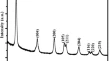
</text><graphic file="1556-276X-7-684-2"/></fig><p>To illuminate the detailed structure and components of the ITO NWs, the as-prepared nanowires were characterized by XRD, TEM, and XPS. Figure <figr fid="F3">3a</figr> shows the X-ray spectra of ITO NWs. All the peaks are indexed being the In<sub>2</sub>O<sub>3</sub> cubic structure, while a small peak shows Au<sub>9</sub>In<sub>4</sub> phase, which comes from the catalytic gold nanoparticles on the top of ITO nanowires. Furthermore, the high-resolution TEM image and the corresponding selected area electron diffraction (SAED) pattern with zone axis of [001] are shown in Figure <figr fid="F3">3b</figr> and the inset, respectively. The symmetric spots in the SAED pattern exhibit a single crystalline phase with the growth direction of [100]. The lattice spacing of 0.506 nm corresponding to (200) plane was indexed, which is consistent with In<sub>2</sub>O<sub>3</sub> cubic phase. The XPS analysis is used to confirm the chemical compositions of ITO NWs. Figure <figr fid="F3">3c</figr> shows the XPS spectra of O 1<it>s</it>, In 3<it>d</it>, and Sn 3<it>d</it> core levels in the ITO NWs. The binding energy of Sn 3<it>d</it>
				<sub>5/2</sub> and Sn 3<it>d</it>
				<sub>3/2</sub> at 495.1 &#177; 0.1 eV and 486.6 &#177; 0.1 eV, correspond to the Sn<sup>4+</sup> ion, respectively, which are relative to the electrical conduction of the nanowires <abbrgrp>
					<abbr bid="B28">28</abbr>
				</abbrgrp>. The O 1<it>s</it> peak is deconvoluted by a Gaussian function into three positions. The lower binding energy component at 530 &#177; 0.1 eV is due to the O<sup>2&#8722;</sup> ions whose neighboring indium atoms are surrounded by the six nearest O<sup>2&#8722;</sup> ions. The medium binding energy at 531.3 &#177; 0.1 eV corresponds to the oxygen deficiency regions, which are called oxygen vacancies <abbrgrp>
					<abbr bid="B28">28</abbr>
					<abbr bid="B29">29</abbr>
				</abbrgrp>. The higher binding energy at 532.6 &#177; 0.1 eV is associated with the oxygen of free hydroxyl group, which is possibly due to the water molecules absorbed on the surface <abbrgrp>
					<abbr bid="B30">30</abbr>
				</abbrgrp>. All XPS results show that Sn atoms are doped into the In<sub>2</sub>O<sub>3</sub> NWs with the existence of oxygen vacancies. Consequently, the oxygen vacancies and Sn ions contribute the electron concentration to the NWs, resulting in an n-type semiconducting behavior.</p>
			<fig id="F3"><title><p>Figure 3</p></title><caption><p>XRD spectra and high-resolution TEM image</p></caption><text>
   <p><b>XRD spectra and high-resolution TEM image.</b> (<b>a</b>) XRD spectra of ITO NWs. (<b>b</b>) A high-resolution TEM image of ITO nanowire. The inset shows a corresponding selective area diffraction pattern, revealing that [100] is a preferred growth direction. (<b>c</b>) Chemical bonding information of In, Sn, and O for the ITO NWs extracted from the XPS spectra.</p>
</text><graphic file="1556-276X-7-684-3"/></fig><p>Figure <figr fid="F4">4a</figr> shows field emission properties of the ITO NWs grown on Au film and patterned Au film with growth time of 3 and 10 h, respectively. The turn-on field (<it>E</it>
				<sub>on</sub>) is defined as the electric field required for generating a current density of 0.01 mA/cm<sup>2</sup>, and 0.1 mA/cm<sup>2</sup> is sufficient for operating display panel devices. It is found that the turn-on field decreases from 9.3 to 6.6 V &#956;m<sup>&#8722;1</sup> after the selective area growth of ITO NWs at the growth time of 3 h. Insets in Figure <figr fid="F4">4b</figr> reveal a linear relationship, so-called ln(<it>J</it>/<it>E</it>
				<sup>2</sup>)-(1/<it>E</it>) plot, indicating that the field-emission behavior follows Fowler-Nordheim relationship, i.e., electrons tunneling through a potential barrier, which can be expressed as follows <abbrgrp>
					<abbr bid="B31">31</abbr>
					<abbr bid="B32">32</abbr>
					<abbr bid="B33">33</abbr>
				</abbrgrp>:</p><p>
				<display-formula id="M7">
					<m:math name="1556-276X-7-684-i7" xmlns:m="http://www.w3.org/1998/Math/MathML"><m:mrow>
   <m:mi>J</m:mi>
   <m:mo>=</m:mo>
   <m:mfenced open="(" close=")">
      <m:mfrac>
         <m:mrow>
            <m:mi>A</m:mi>
            <m:msup>
               <m:mi>&#946;</m:mi>
               <m:mn>2</m:mn>
            </m:msup>
            <m:msup>
               <m:mi>E</m:mi>
               <m:mn>2</m:mn>
            </m:msup>
         </m:mrow>
         <m:mi>&#981;</m:mi>
      </m:mfrac>
   </m:mfenced>
   <m:mo>exp</m:mo>
   <m:mfenced open="(" close=")">
      <m:mfrac>
         <m:mrow>
            <m:mo>&#8722;</m:mo>
            <m:mi>B</m:mi>
            <m:msup>
               <m:mi>&#981;</m:mi>
               <m:mfrac bevelled="true">
                  <m:mn>3</m:mn>
                  <m:mn>2</m:mn>
               </m:mfrac>
            </m:msup>
         </m:mrow>
         <m:mi mathvariant="italic">&#946;E</m:mi>
      </m:mfrac>
   </m:mfenced>
   <m:mo>,</m:mo>
</m:mrow>
</m:math>
				</display-formula>
			</p><p>where <it>J</it> is the emission current density; <it>E</it>, the applied field; <it>&#981;</it>, the work function of emitter material; <it>&#946;</it>, the enhancement factor; <it>A</it>, constant (1.56 &#215; 10<sup>&#8722;10</sup> A V<sup>&#8722;2</sup> eV); and <it>B</it>, constant (6.8 &#215;10<sup>3</sup> eV<sup>&#8722;3/2</sup> V &#956;m<sup>&#8722;1</sup>) The field enhancement factor, <it>&#946;</it>, reflects the degree of the field emission enhancement of the tip shape on a planar surface, which is also dependent on the geometry of the nanowire, the crystal structure, and the density at the emitting points. It can be determined by the slope of the ln(<it>J</it>/<it>E</it>
				<sup>2</sup>)-(1/<it>E</it>) plot with a work function value of 4.3 eV <abbrgrp>
					<abbr bid="B6">6</abbr>
				</abbrgrp>. Consequently, the turn-on fields and the <it>&#946;</it> values of the ITO NWs with and without selective area growth at different growth times are listed in Table <tblr tid="T1">1</tblr>. Obviously, the field enhancement factors (<it>&#946;</it>) from 1,621 to 1,857 can be achieved after the selective area growth at 3 h. Moreover, we find that the screen effect also highly depends on the length of nanowires on the field emission performance. As a result, the turn-on fields increase from 6.6 to 13.6 V &#956;m<sup>&#8722;1</sup>, and <it>&#946;</it> values decrease from 1,857 to 699 after 10-h growth. Compared to the <it>&#946;</it> values of other materials, such as Si nanowires (<it>&#946;</it> = 1,000) <abbrgrp>
					<abbr bid="B34">34</abbr>
				</abbrgrp>, NiSi<sub>2</sub> nanorods (<it>&#946;</it> = 630) <abbrgrp>
					<abbr bid="B35">35</abbr>
				</abbrgrp>, NiSi<sub>2</sub> nanowires (<it>&#946;</it> = 501) <abbrgrp>
					<abbr bid="B36">36</abbr>
				</abbrgrp>, SnO<sub>2</sub> (<it>&#946;</it> = 1402.9) <abbrgrp>
					<abbr bid="B37">37</abbr>
				</abbrgrp>, AlN (<it>&#946;</it> = 950) <abbrgrp>
					<abbr bid="B38">38</abbr>
				</abbrgrp>, and ZnO (<it>&#946;</it> = 1,464) <abbrgrp>
					<abbr bid="B39">39</abbr>
				</abbrgrp>, the Sn-doped ITO NWs are promising emitters. The findings indicate that the less stacking density via the selective area growth and the reduction of the NW length could decrease the screen effect, resulting in the increase of the enhancement factor.</p>
			<fig id="F4"><title><p>Figure 4</p></title><caption><p><it>J</it>-<it>E</it> field emission curves and Fowler-Nordheim plots</p></caption><text>
   <p><b><it>J</it></b><b>-</b><b><it>E </it></b><b>field emission curves and Fowler-Nordheim plots.</b> (<b>a</b>) <it>J</it>-<it>E</it> field emission curves for flat and selectively patterned growth at 3 and 10 h, respectively. (<b>b</b>) The corresponding Fowler-Nordheim plots from (a) for four samples.</p>
</text><graphic file="1556-276X-7-684-4"/></fig>
			<table id="T1">
				<title>
					<p>Table 1</p>
				</title>
				<caption>
					<p>
						<b>Turn-on fields and field enhancement factors for the growth of the ITO NWs at different conditions</b>
					</p>
				</caption>
				<tgroup align="left" cols="3">
					<colspec align="left" colname="c1" colnum="1" colwidth="1*"/>
					<colspec align="left" colname="c2" colnum="2" colwidth="1*"/>
					<colspec align="left" colname="c3" colnum="3" colwidth="1*"/>
					<thead valign="top">
						<row rowsep="1">
							<entry colname="c1"/>
							<entry colname="c2">
								<p>
									<b>
										<it>E</it>
									</b>
									<sub>
										<b>on</b>
									</sub> <b>(V &#956;m</b>
									<sup>
										<b>&#8722;1</b>
									</sup><b>) at </b><b>
										<it>J </it>
									</b><b>= 0.01 mA cm</b>
									<sup>
										<b>&#8722;2</b>
									</sup>
								</p>
							</entry>
							<entry colname="c3">
								<p>
									<b>
										<it>&#946;</it>
									</b>
								</p>
							</entry>
						</row>
					</thead>
					<tbody valign="top">
						<row>
							<entry colname="c1">
								<p>Flat 10-h growth</p>
							</entry>
							<entry colname="c2">
								<p>18</p>
							</entry>
							<entry colname="c3">
								<p>429</p>
							</entry>
						</row>
						<row>
							<entry colname="c1">
								<p>Patterned 10-h growth</p>
							</entry>
							<entry colname="c2">
								<p>13.6</p>
							</entry>
							<entry colname="c3">
								<p>699</p>
							</entry>
						</row>
						<row>
							<entry colname="c1">
								<p>Flat 3-h growth</p>
							</entry>
							<entry colname="c2">
								<p>9.3</p>
							</entry>
							<entry colname="c3">
								<p>1,621</p>
							</entry>
						</row>
						<row rowsep="1">
							<entry colname="c1">
								<p>Patterned 3-h growth</p>
							</entry>
							<entry colname="c2">
								<p>6.6</p>
							</entry>
							<entry colname="c3">
								<p>1,857</p>
							</entry>
						</row>
					</tbody>
				</tgroup>
			</table><p>The cross-sectional SEM images for the growth of Sn-doped ITO NWs at 10 and 3 h are shown in Figure <figr fid="F5">5a,b</figr> to confirm the reduction of the screen effect, respectively. Obviously, ITO NWs are tangled together due to the longer length (10-h growth), while the quasi-vertical growth could be achieved at the shorter time (3-h growth). According to the screening effect, the electrical field around ITO NWs with longer length and random growth would interfere together to result in screen effect, thereby a poor field emission <abbrgrp>
					<abbr bid="B40">40</abbr>
					<abbr bid="B41">41</abbr>
				</abbrgrp>. The corresponding potential distribution of the ITO NWs for Sn-doped ITO NWs grown at 10 and 3 h related to the electrical field are shown in Figure <figr fid="F5">5c,d</figr>, respectively. Notably, Figure <figr fid="F5">5c</figr> (10-h growth) reveals that the NWs significantly tangled together, resulting in lower current emission because of the lesser equipotential lines owing to the server screen effect. Therefore, only the higher NWs would emit current. On the contrary, Figure <figr fid="F5">5d</figr> (3-h growth) reveals that the shorter NWs could decrease the screen effect due to the much larger dispersive equipotential lines around the NWs, triggering a higher current emission. This is why the shorter grown time of ITO NWs shows the much better FE property. The findings provide an effective way of improving the field emission properties for nanodevice application.</p>
			<fig id="F5"><title><p>Figure 5</p></title><caption><p>Cross-sectional SEM images for ITO NWs</p></caption><text>
   <p><b>Cross-sectional SEM images for ITO NWs.</b> NWs grown at (<b>a</b>) 10 and (<b>b</b>) 3 h, respectively. (<b>c</b>) and (<b>d</b>) The corresponding distribution of emission current and electric potential for ITO NWs grown at10 and 3 h, respectively.</p>
</text><graphic file="1556-276X-7-684-5"/></fig>
		</sec>
		<sec>
			<st>
				<p>Conclusion</p>
			</st><p>We present a selective area growth of single crystalline Sn-doped In<sub>2</sub>O<sub>3</sub> (ITO) nanowires synthesized via VLS method at 600&#176;C in order to improve the field emission behavior by the reduction of screen effect. The enhanced field emission performance reveals the reduction of turn-on fields from 9.3 to 6.6 V &#956;m<sup>&#8722;1</sup> with increase of field enhancement factors (<it>&#946;</it>) from 1,621 to 1857 after the selective area growth at 3 h. Moreover, we find that the screen effect also highly depends on the length of nanowires on the field emission performance. The turn-on fields increase from 6.6 to 13.6 V &#956;m<sup>&#8722;1</sup>, and <it>&#946;</it> values decrease from 1,857 to 699 after the 10-h growth. The screen effect is predominated after the length of nanowires increases, namely the longer growth time, thereby degrading the field emission performance. Consequently, the turn-on fields and <it>&#946;</it> values change from 13.6 V &#956;m<sup>&#8722;1</sup> and 699 to 6.6 V &#956;m<sup>&#8722;1</sup> and 1,857, respectively, as the growth time of Sn-doped ITO NWs decreases into 3 h. The detailed screen effect in terms of electrical potential and NW density was investigated in details. The findings provide an effective way of improving the field emission properties for nano-emitter application.</p>
		</sec>
		<sec>
			<st>
				<p>Competing interests</p>
			</st><p>The authors declare that they have no competing interests.</p>
		</sec>
		<sec>
			<st>
				<p>Authors&#8217; contributions</p>
			</st><p>WCC operated the SEM instrument and measured the FE property. PJL deposited the gold film of Si sample. CCJ operated the TEM instrument. CHK carried out the XPS characterization. SJL and YLC support the information and organized the final version of the paper. All authors read and approved the final manuscript.</p>
		</sec>
	</bdy>
	<bm>
		<ack>
			<sec>
				<st>
					<p>Acknowledgment</p>
				</st><p>This work was supported by the National Science Council, Taiwan, under grant number NSC-99-2221-E-007-069-MY3.</p>
			</sec>
		</ack>
		<refgrp><bibl id="B1"><title><p>Doubled layered ITO/SnO<sub>2</sub> conducting glass for substrate of dye-sensitized solar cells</p></title><aug><au><snm>Ngamsinlapasathian</snm><fnm>S</fnm></au><au><snm>Sreethawong</snm><fnm>T</fnm></au><au><snm>Suzuki</snm><fnm>Y</fnm></au><au><snm>Yoshikawa</snm><fnm>S</fnm></au></aug><source>Sol Energy Mater Sol Cells</source><pubdate>2006</pubdate><volume>90</volume><fpage>2129</fpage><lpage>2140</lpage><xrefbib><pubid idtype="doi">10.1016/j.solmat.2005.12.005</pubid></xrefbib></bibl><bibl id="B2"><title><p>Heteroepitaxial growth of tin-doped indium oxide films on single crystalline yttria stabilized zirconia substrates</p></title><aug><au><snm>Kamei</snm><fnm>M</fnm></au><au><snm>Yagami</snm><fnm>T</fnm></au><au><snm>Takaki</snm><fnm>S</fnm></au><au><snm>Shigesato</snm><fnm>Y</fnm></au></aug><source>Appl Phys Lett</source><pubdate>1994</pubdate><volume>64</volume><fpage>2712</fpage><lpage>2714</lpage><xrefbib><pubid idtype="doi">10.1063/1.111474</pubid></xrefbib></bibl><bibl id="B3"><title><p>Highly electrically conductive indium&#8211;tin&#8211;oxide thin films epitaxially grown on yttria-stabilized zirconia (100) by pulsed-laser deposition</p></title><aug><au><snm>Ohta</snm><fnm>H</fnm></au><au><snm>Orita</snm><fnm>M</fnm></au><au><snm>Hirano</snm><fnm>M</fnm></au><au><snm>Tanji</snm><fnm>H</fnm></au><au><snm>Kawazoe</snm><fnm>H</fnm></au><au><snm>Hosono</snm><fnm>H</fnm></au></aug><source>Appl Phys Lett</source><pubdate>2000</pubdate><volume>76</volume><fpage>2740</fpage><xrefbib><pubid idtype="doi">10.1063/1.126461</pubid></xrefbib></bibl><bibl id="B4"><title><p>Bottom-up growth of fully transparent contact layers of indium tin oxide nanowires for light-emitting devices</p></title><aug><au><snm>O&#8217;Dwyer</snm><fnm>C</fnm></au><au><snm>Szachowicz</snm><fnm>M</fnm></au><au><snm>Visimberga</snm><fnm>G</fnm></au><au><snm>Lavayen</snm><fnm>V</fnm></au><au><snm>Newcomb</snm><fnm>S</fnm></au><au><snm>Torres</snm><fnm>C</fnm></au></aug><source>Nat Nanotechnol</source><pubdate>2009</pubdate><volume>4</volume><fpage>239</fpage><lpage>244</lpage><xrefbib><pubidlist><pubid idtype="doi">10.1038/nnano.2008.418</pubid><pubid idtype="pmpid">19350034</pubid></pubidlist></xrefbib></bibl><bibl id="B5"><title><p>UV light emitting transparent conducting tin-doped indium oxide (ITO) nanowires</p></title><aug><au><snm>Gao</snm><fnm>J</fnm></au><au><snm>Chen</snm><fnm>R</fnm></au><au><snm>Li</snm><fnm>DH</fnm></au><au><snm>Jiang</snm><fnm>L</fnm></au><au><snm>Ye</snm><fnm>JC</fnm></au><au><snm>Ma</snm><fnm>XC</fnm></au><au><snm>Chen</snm><fnm>XD</fnm></au><au><snm>Xiong</snm><fnm>QH</fnm></au><au><snm>Sun</snm><fnm>HD</fnm></au><au><snm>Wu</snm><fnm>T</fnm></au></aug><source>Nanotechnol</source><pubdate>2011</pubdate><volume>22</volume><fpage>195706</fpage><xrefbib><pubid idtype="doi">10.1088/0957-4484/22/19/195706</pubid></xrefbib></bibl><bibl id="B6"><title><p>Vertically aligned tin-doped indium oxide nanowire arrays: epitaxial growth and electron field emission properties</p></title><aug><au><snm>Wan</snm><fnm>Q</fnm></au><au><snm>Feng</snm><fnm>P</fnm></au><au><snm>Wang</snm><fnm>TH</fnm></au></aug><source>Appl Phys Lett</source><pubdate>2006</pubdate><volume>89</volume><fpage>123102</fpage><xrefbib><pubid idtype="doi">10.1063/1.2345278</pubid></xrefbib></bibl><bibl id="B7"><title><p>High-performance transparent conducting oxide nanowires</p></title><aug><au><snm>Wan</snm><fnm>Q</fnm></au><au><snm>Dattoli</snm><fnm>E</fnm></au><au><snm>Fung</snm><fnm>W</fnm></au><au><snm>Guo</snm><fnm>W</fnm></au><au><snm>Chen</snm><fnm>Y</fnm></au><au><snm>Pan</snm><fnm>X</fnm></au><au><snm>Lu</snm><fnm>W</fnm></au></aug><source>Nano Lett</source><pubdate>2006</pubdate><volume>6</volume><fpage>2909</fpage><lpage>2915</lpage><xrefbib><pubidlist><pubid idtype="doi">10.1021/nl062213d</pubid><pubid idtype="pmpid" link="fulltext">17163729</pubid></pubidlist></xrefbib></bibl><bibl id="B8"><title><p>Synthesis of oxygen-deficient indium-tin-oxide (ITO) nanofibers</p></title><aug><au><snm>Peng</snm><fnm>XS</fnm></au><au><snm>Meng</snm><fnm>GW</fnm></au><au><snm>Wang</snm><fnm>XF</fnm></au><au><snm>Wang</snm><fnm>YW</fnm></au><au><snm>Zhang</snm><fnm>J</fnm></au><au><snm>Liu</snm><fnm>X</fnm></au><au><snm>Zhang</snm><fnm>LD</fnm></au></aug><source>Chem Mater</source><pubdate>2002</pubdate><volume>14</volume><fpage>4490</fpage><lpage>4493</lpage><xrefbib><pubid idtype="doi">10.1021/cm025567o</pubid></xrefbib></bibl><bibl id="B9"><title><p>Low temperature synthesized Sn doped indium oxide nanowires</p></title><aug><au><snm>Lee</snm><fnm>SY</fnm></au><au><snm>Lee</snm><fnm>CY</fnm></au><au><snm>Lin</snm><fnm>P</fnm></au><au><snm>Tseng</snm><fnm>TY</fnm></au></aug><source>Nanotechnol</source><pubdate>2005</pubdate><volume>16</volume><fpage>451</fpage><lpage>457</lpage><xrefbib><pubid idtype="doi">10.1088/0957-4484/16/4/021</pubid></xrefbib></bibl><bibl id="B10"><title><p>Tin-doped indium oxide nanobelts grown by carbothermal reduction method</p></title><aug><au><snm>Orlandi</snm><fnm>MO</fnm></au><au><snm>Aguiar</snm><fnm>R</fnm></au><au><snm>Lanfredi</snm><fnm>AJC</fnm></au><au><snm>Longo</snm><fnm>E</fnm></au><au><snm>Varela</snm><fnm>JA</fnm></au><au><snm>Leite</snm><fnm>ER</fnm></au></aug><source>Appl Phys A: Mater Sci Process</source><pubdate>2005</pubdate><volume>80</volume><fpage>23</fpage><lpage>25</lpage><xrefbib><pubid idtype="doi">10.1007/s00339-004-3027-x</pubid></xrefbib></bibl><bibl id="B11"><title><p>Epitaxial growth of vertically aligned and branched single&#8208;crystalline tin&#8208;doped indium oxide nanowire arrays</p></title><aug><au><snm>Wan</snm><fnm>Q</fnm></au><au><snm>Wei</snm><fnm>M</fnm></au><au><snm>Zhi</snm><fnm>D</fnm></au><au><snm>MacManus-Driscoll</snm><fnm>JL</fnm></au><au><snm>Blamire</snm><fnm>MG</fnm></au></aug><source>Adv Mater</source><pubdate>2006</pubdate><volume>18</volume><fpage>234</fpage><lpage>238</lpage><xrefbib><pubid idtype="doi">10.1002/adma.200501673</pubid></xrefbib></bibl><bibl id="B12"><title><p>Nanostructure and properties of indium tin oxide (ITO) films produced by electron beam evaporation</p></title><aug><au><snm>Pokaipisit</snm><fnm>A</fnm></au><au><snm>Udomkan</snm><fnm>N</fnm></au><au><snm>Limsuwan</snm><fnm>P</fnm></au></aug><source>Mod Phys Lett B</source><pubdate>2006</pubdate><volume>20</volume><fpage>1049</fpage><lpage>1058</lpage><xrefbib><pubid idtype="doi">10.1142/S0217984906011402</pubid></xrefbib></bibl><bibl id="B13"><title><p>Indium tin oxide nanowires growth by dc sputtering</p></title><aug><au><snm>Fung</snm><fnm>MK</fnm></au><au><snm>Sun</snm><fnm>YC</fnm></au><au><snm>Ng</snm><fnm>AMC</fnm></au><au><snm>Chen</snm><fnm>XY</fnm></au><au><snm>Wong</snm><fnm>KK</fnm></au><au><snm>Djuri&#353;i&#8217; c</snm><fnm>AB</fnm></au><au><snm>Chan</snm><fnm>WK</fnm></au></aug><source>Appl Phys A</source><pubdate>2011</pubdate><volume>104</volume><fpage>1075</fpage><lpage>1080</lpage><xrefbib><pubid idtype="doi">10.1007/s00339-011-6372-6</pubid></xrefbib></bibl><bibl id="B14"><title><p>Pulsed laser deposition of indium tin oxide nanowires in argon and helium</p></title><aug><au><snm>Yong</snm><fnm>TK</fnm></au><au><snm>Tan</snm><fnm>SS</fnm></au><au><snm>Nee</snm><fnm>CH</fnm></au><au><snm>Yap</snm><fnm>SS</fnm></au><au><snm>Kee</snm><fnm>YY</fnm></au><au><snm>Gy&#246;rgy</snm><fnm>S</fnm></au><au><snm>Zsolt Endre</snm><fnm>H</fnm></au><au><snm>Jason</snm><fnm>M</fnm></au><au><snm>Yoke-Khin</snm><fnm>Y</fnm></au><au><snm>Teck-Yong</snm><fnm>T</fnm></au></aug><source>Mater Lett</source><pubdate>2012</pubdate><volume>66</volume><fpage>280</fpage><lpage>281</lpage><xrefbib><pubid idtype="doi">10.1016/j.matlet.2011.08.085</pubid></xrefbib></bibl><bibl id="B15"><title><p>Characterizing and comparing the cathodoluminesence and field emission properties of Sb doped SnO<sub>2</sub> and SnO<sub>2</sub> nanowires</p></title><aug><au><snm>Wu</snm><fnm>JM</fnm></au></aug><source>Thin Solid Films</source><pubdate>2009</pubdate><volume>517</volume><fpage>1289</fpage><lpage>1293</lpage></bibl><bibl id="B16"><title><p>Role of extrinsic atoms on the morphology and field emission properties of carbon nanotubes</p></title><aug><au><snm>Chen</snm><fnm>LH</fnm></au><au><snm>Hong</snm><fnm>KH</fnm></au><au><snm>Xiao</snm><fnm>DQ</fnm></au><au><snm>Hsieh</snm><fnm>WJ</fnm></au><au><snm>Lai</snm><fnm>SH</fnm></au><au><snm>Lin</snm><fnm>TC</fnm></au><au><snm>Shieu</snm><fnm>FS</fnm></au><au><snm>Chen</snm><fnm>KJ</fnm></au><au><snm>Cheng</snm><fnm>HC</fnm></au></aug><source>Appl Phys Lett</source><pubdate>2003</pubdate><volume>82</volume><fpage>4334</fpage><xrefbib><pubid idtype="doi">10.1063/1.1579136</pubid></xrefbib></bibl><bibl id="B17"><title><p>ZnO:Al nanostructures synthesized on pre-deposited aluminum (Al)/Si template: formation, photoluminescence and electron field emission</p></title><aug><au><snm>Fang</snm><fnm>CW</fnm></au><au><snm>Wu</snm><fnm>JM</fnm></au><au><snm>Lee</snm><fnm>LT</fnm></au><au><snm>Hsien</snm><fnm>YH</fnm></au><au><snm>Lo</snm><fnm>SC</fnm></au><au><snm>Chen</snm><fnm>CH</fnm></au></aug><source>Thin Solid Films</source><pubdate>2008</pubdate><volume>517</volume><fpage>1268</fpage><lpage>1273</lpage><xrefbib><pubid idtype="doi">10.1016/j.tsf.2008.06.037</pubid></xrefbib></bibl><bibl id="B18"><title><p>Tuning the field emission properties of patterned carbon nanotube films</p></title><aug><au><snm>Bonard</snm><fnm>JM</fnm></au><au><snm>Weiss</snm><fnm>N</fnm></au><au><snm>Kind</snm><fnm>H</fnm></au><au><snm>Stockli</snm><fnm>T</fnm></au><au><snm>Forro</snm><fnm>L</fnm></au><au><snm>Kern</snm><fnm>K</fnm></au><au><snm>Chatelain</snm><fnm>A</fnm></au></aug><source>Adv Mater</source><pubdate>2001</pubdate><volume>13</volume><fpage>184</fpage><xrefbib><pubid idtype="doi">10.1002/1521-4095(200102)13:3&lt;184::AID-ADMA184&gt;3.0.CO;2-I</pubid></xrefbib></bibl><bibl id="B19"><title><p>Diminish the screen effect in field emission via patterned and selective edge growth of ZnO nanorod arrays</p></title><aug><au><snm>Liu</snm><fnm>N</fnm></au><au><snm>Fang</snm><fnm>G</fnm></au><au><snm>Zeng</snm><fnm>W</fnm></au><au><snm>Long</snm><fnm>H</fnm></au><au><snm>Yuan</snm><fnm>L</fnm></au><au><snm>Zhao</snm><fnm>X</fnm></au></aug><source>Appl Phys Lett</source><pubdate>2009</pubdate><volume>95</volume><fpage>153505</fpage><xrefbib><pubid idtype="doi">10.1063/1.3247887</pubid></xrefbib></bibl><bibl id="B20"><title><p>Well-ordered ZnO nanowire arrays on GaN substrate fabricated via nanosphere lithography</p></title><aug><au><snm>Fan</snm><fnm>HJ</fnm></au><au><snm>Fuhrmann</snm><fnm>B</fnm></au><au><snm>Scholz</snm><fnm>R</fnm></au><au><snm>Syrowatka</snm><fnm>F</fnm></au><au><snm>Dadgar</snm><fnm>A</fnm></au><au><snm>Krost</snm><fnm>A</fnm></au><au><snm>Zacharias</snm><fnm>M</fnm></au></aug><source>J Cryst Growth</source><pubdate>2006</pubdate><volume>287</volume><fpage>34</fpage><lpage>38</lpage><xrefbib><pubid idtype="doi">10.1016/j.jcrysgro.2005.10.038</pubid></xrefbib></bibl><bibl id="B21"><title><p>Position-controlled ZnO nanoflower arrays grown on glass substrates for electron emitter application</p></title><aug><au><snm>Kim</snm><fnm>YJ</fnm></au><au><snm>Yoo</snm><fnm>J</fnm></au><au><snm>Kwon</snm><fnm>BH</fnm></au><au><snm>Hong</snm><fnm>YJ</fnm></au><au><snm>Lee</snm><fnm>CH</fnm></au><au><snm>Yi</snm><fnm>GC</fnm></au></aug><source>Nanotechnol</source><pubdate>2008</pubdate><volume>19</volume><fpage>315202</fpage><xrefbib><pubid idtype="doi">10.1088/0957-4484/19/31/315202</pubid></xrefbib></bibl><bibl id="B22"><title><p>Controlled selective growth of ZnO nanorod arrays and their field emission properties</p></title><aug><au><snm>Ahsanulhaq</snm><fnm>Q</fnm></au><au><snm>Kim</snm><fnm>JH</fnm></au><au><snm>Hahn</snm><fnm>YB</fnm></au></aug><source>Nanotechnol</source><pubdate>2007</pubdate><volume>18</volume><fpage>485307</fpage><xrefbib><pubid idtype="doi">10.1088/0957-4484/18/48/485307</pubid></xrefbib></bibl><bibl id="B23"><title><p>Dip-coating of ITO films</p></title><aug><au><snm>Nishio</snm><fnm>K</fnm></au><au><snm>Sei</snm><fnm>T</fnm></au><au><snm>Tsuchiya</snm><fnm>T</fnm></au></aug><source>J Mater Sci</source><pubdate>1996</pubdate><volume>31</volume><fpage>1761</fpage><lpage>1766</lpage><xrefbib><pubid idtype="doi">10.1007/BF00372189</pubid></xrefbib></bibl><bibl id="B24"><title><p>Synthesis of single crystal Sn-doped In2O3 nanowires: size-dependent conductive characteristic</p></title><aug><au><snm>Chang</snm><fnm>WC</fnm></au><au><snm>Kuo</snm><fnm>CH</fnm></au><au><snm>Lee</snm><fnm>PJ</fnm></au><au><snm>Chueh</snm><fnm>YL</fnm></au><au><snm>Lin</snm><fnm>SJ</fnm></au></aug><source>Phys Chem Chem Phys</source><pubdate>2012</pubdate><volume>14</volume><fpage>13041</fpage><lpage>13045</lpage><xrefbib><pubid idtype="pmpid" link="fulltext">22886004</pubid></xrefbib></bibl><bibl id="B25"><title><p>Vapor&#8208;liquid&#8208;solid mechanism of single crystal growth</p></title><aug><au><snm>Wagner</snm><fnm>RS</fnm></au><au><snm>Ellis</snm><fnm>WC</fnm></au></aug><source>Appl Phys Lett</source><pubdate>1964</pubdate><volume>4</volume><fpage>89</fpage><lpage>90</lpage><xrefbib><pubid idtype="doi">10.1063/1.1753975</pubid></xrefbib></bibl><bibl id="B26"><title><p>Vapor pressure and dissociation energy of (In<sub>2</sub>O)</p></title><aug><au><snm>Valderrama</snm><fnm>J</fnm></au><au><snm>Jacob</snm><fnm>KT</fnm></au></aug><source>Thermochim Acta</source><pubdate>1977</pubdate><volume>21</volume><fpage>215</fpage><lpage>224</lpage><xrefbib><pubid idtype="doi">10.1016/0040-6031(77)85019-3</pubid></xrefbib></bibl><bibl id="B27"><title><p>Catalytic growth of semiconducting In<sub>2</sub>O<sub>3</sub> nanofibers</p></title><aug><au><snm>Liang</snm><fnm>C</fnm></au><au><snm>Meng</snm><fnm>G</fnm></au><au><snm>Lei</snm><fnm>Y</fnm></au><au><snm>Phillipp</snm><fnm>F</fnm></au><au><snm>Zhang</snm><fnm>L</fnm></au></aug><source>Adv Mater</source><pubdate>2001</pubdate><volume>13</volume><fpage>1330</fpage><xrefbib><pubid idtype="doi">10.1002/1521-4095(200109)13:17&lt;1330::AID-ADMA1330&gt;3.0.CO;2-6</pubid></xrefbib></bibl><bibl id="B28"><title><p>X-ray photoemission spectroscopy studies of Sn-doped indium-oxide films</p></title><aug><au><snm>Fan</snm><fnm>JCC</fnm></au><au><snm>Goodenough</snm><fnm>JB</fnm></au></aug><source>J Appl Phys</source><pubdate>1977</pubdate><volume>48</volume><fpage>3524</fpage><lpage>3531</lpage><xrefbib><pubid idtype="doi">10.1063/1.324149</pubid></xrefbib></bibl><bibl id="B29"><title><p>Effect of oxygen concentration in the sputtering ambient on the microstructure, electrical and optical properties of radio-frequency magnetron-sputtered indium tin oxide films</p></title><aug><au><snm>Wu</snm><fnm>WF</fnm></au><au><snm>Chiou</snm><fnm>BS</fnm></au></aug><source>Semicond Part Sci Technol</source><pubdate>1996</pubdate><volume>11</volume><fpage>196</fpage><lpage>202</lpage><xrefbib><pubid idtype="doi">10.1088/0268-1242/11/2/009</pubid></xrefbib></bibl><bibl id="B30"><title><p>Effect of substrate temperature on the surface structure, composition and morphology of indium-tin oxide films</p></title><aug><au><snm>Carvalho</snm><fnm>CN</fnm></au><au><snm>Rego</snm><fnm>AMB</fnm></au><au><snm>Amaral</snm><fnm>A</fnm></au><au><snm>Brogueira</snm><fnm>P</fnm></au><au><snm>Lavareda</snm><fnm>G</fnm></au></aug><source>Surf CoatTechnol</source><pubdate>2000</pubdate><volume>124</volume><fpage>70</fpage><lpage>75</lpage><xrefbib><pubid idtype="doi">10.1016/S0257-8972(99)00619-2</pubid></xrefbib></bibl><bibl id="B31"><title><p>Electron emission in intense electric fields</p></title><aug><au><snm>Fowler</snm><fnm>RH</fnm></au><au><snm>Nordheim</snm><fnm>L</fnm></au></aug><source>Proc R Soc London, Ser A</source><pubdate>1928</pubdate><volume>119</volume><fpage>173</fpage><lpage>181</lpage><xrefbib><pubid idtype="doi">10.1098/rspa.1928.0091</pubid></xrefbib></bibl><bibl id="B32"><title><p>Experimental and computational study of field emission characteristics from amorphous carbon single nanotips grown by carbon contamination - I</p></title><aug><au><snm>Edgcombe</snm><fnm>CJ</fnm></au><au><snm>Valdre</snm><fnm>U</fnm></au></aug><source>Experiments and computation. Philos Mag B</source><pubdate>2002</pubdate><volume>82</volume><fpage>987</fpage></bibl><bibl id="B33"><title><p>Modeling the electron field emission from carbon nanotube films</p></title><aug><au><snm>Filip</snm><fnm>V</fnm></au><au><snm>Nicolaescu</snm><fnm>D</fnm></au><au><snm>Tanemura</snm><fnm>M</fnm></au><au><snm>Okuyama</snm><fnm>F</fnm></au></aug><source>Ultramicroscopy</source><pubdate>2001</pubdate><volume>89</volume><fpage>39</fpage><lpage>49</lpage><xrefbib><pubidlist><pubid idtype="doi">10.1016/S0304-3991(01)00107-3</pubid><pubid idtype="pmpid" link="fulltext">11770750</pubid></pubidlist></xrefbib></bibl><bibl id="B34"><title><p>Synthesis of taperlike Si nanowires with strong field emission</p></title><aug><au><snm>Chueh</snm><fnm>YL</fnm></au><au><snm>Chou</snm><fnm>LJ</fnm></au><au><snm>Cheng</snm><fnm>SL</fnm></au><au><snm>He</snm><fnm>JH</fnm></au><au><snm>We</snm><fnm>WW</fnm></au><au><snm>Chen</snm><fnm>LJ</fnm></au></aug><source>Appl Phys Lett</source><pubdate>2005</pubdate><volume>86</volume><fpage>133112</fpage><xrefbib><pubid idtype="doi">10.1063/1.1883316</pubid></xrefbib></bibl><bibl id="B35"><title><p>Field emission from Ni-disilicide nanorods formed by using implantation of Ni in Si coupled with laser annealing</p></title><aug><au><snm>Ok</snm><fnm>YW</fnm></au><au><snm>Seong</snm><fnm>TY</fnm></au><au><snm>Choi</snm><fnm>CJ</fnm></au><au><snm>Tu</snm><fnm>KN</fnm></au></aug><source>Appl Phys Lett</source><pubdate>2006</pubdate><volume>88</volume><fpage>043106</fpage><xrefbib><pubid idtype="doi">10.1063/1.2167797</pubid></xrefbib></bibl><bibl id="B36"><title><p>Anomalous growth and characterization of carbon-coated nickel silicide nanowires</p></title><aug><au><snm>Lee</snm><fnm>KS</fnm></au><au><snm>Mo</snm><fnm>YH</fnm></au><au><snm>Nahm</snm><fnm>KS</fnm></au><au><snm>Shim</snm><fnm>HW</fnm></au><au><snm>Suh</snm><fnm>EK</fnm></au><au><snm>Kim</snm><fnm>JR</fnm></au><au><snm>Kim</snm><fnm>JJ</fnm></au></aug><source>Chem Phys Lett</source><pubdate>2004</pubdate><volume>384</volume><fpage>215</fpage><xrefbib><pubid idtype="doi">10.1016/j.cplett.2003.11.107</pubid></xrefbib></bibl><bibl id="B37"><title><p>Beaklike SnO2 nanorods with strong photoluminescent and field-emission properties</p></title><aug><au><snm>He</snm><fnm>JH</fnm></au><au><snm>Wu</snm><fnm>TH</fnm></au><au><snm>Hsin</snm><fnm>CL</fnm></au><au><snm>Li</snm><fnm>KM</fnm></au><au><snm>Chen</snm><fnm>LJ</fnm></au><au><snm>Chueh</snm><fnm>YL</fnm></au><au><snm>Chou</snm><fnm>LJ</fnm></au><au><snm>Wang</snm><fnm>ZL</fnm></au></aug><source>Small</source><pubdate>2006</pubdate><volume>2</volume><fpage>116</fpage><xrefbib><pubidlist><pubid idtype="doi">10.1002/smll.200500210</pubid><pubid idtype="pmpid" link="fulltext">17193566</pubid></pubidlist></xrefbib></bibl><bibl id="B38"><title><p>Electron field emission from ion implanted diamond</p></title><aug><au><snm>Zhu</snm><fnm>W</fnm></au><au><snm>Kochanski</snm><fnm>GP</fnm></au><au><snm>Jin</snm><fnm>S</fnm></au><au><snm>Seibles</snm><fnm>L</fnm></au><au><snm>Jacobson</snm><fnm>D</fnm></au><au><snm>McCormack</snm><fnm>CM</fnm></au><au><snm>White</snm><fnm>AE</fnm></au></aug><source>Appl Phys Lett</source><pubdate>1995</pubdate><volume>67</volume><fpage>1157</fpage><xrefbib><pubid idtype="doi">10.1063/1.114993</pubid></xrefbib></bibl><bibl id="B39"><title><p>Characterization and field-emission properties of needle-like zinc oxide nanowires grown vertically on conductive zinc oxide films</p></title><aug><au><snm>Tseng</snm><fnm>YK</fnm></au><au><snm>Huang</snm><fnm>CJ</fnm></au><au><snm>Cheng</snm><fnm>HM</fnm></au><au><snm>Kin</snm><fnm>IN</fnm></au><au><snm>Liu</snm><fnm>KS</fnm></au><au><snm>Chen</snm><fnm>IC</fnm></au></aug><source>Adv Funct Mater</source><pubdate>2003</pubdate><volume>87</volume><fpage>73109</fpage></bibl><bibl id="B40"><title><p>Field emission and photo fluorescence characteristics of zinc oxide nanowires synthesized by a metal catalyzed vapor&#8211;liquid&#8211;solid process</p></title><aug><au><snm>Li</snm><fnm>SY</fnm></au><au><snm>Lin</snm><fnm>P</fnm></au><au><snm>Lee</snm><fnm>CY</fnm></au><au><snm>Tseng</snm><fnm>TY</fnm></au></aug><source>J Appl Phys</source><pubdate>2004</pubdate><volume>95</volume><fpage>3711</fpage><lpage>3716</lpage><xrefbib><pubid idtype="doi">10.1063/1.1655685</pubid></xrefbib></bibl><bibl id="B41"><title><p>ZnO nanowire arrays grown on Al:ZnO buffer layers and their enhanced electron field emission</p></title><aug><au><snm>Chen</snm><fnm>ZH</fnm></au><au><snm>Tang</snm><fnm>YB</fnm></au><au><snm>Liu</snm><fnm>Y</fnm></au><au><snm>Yuan</snm><fnm>GD</fnm></au><au><snm>Zhang</snm><fnm>WF</fnm></au><au><snm>Zapien</snm><fnm>JA</fnm></au><au><snm>Belloa</snm><fnm>I</fnm></au><au><snm>Zhang</snm><fnm>WJ</fnm></au><au><snm>Lee</snm><fnm>CS</fnm></au><au><snm>Lee</snm><fnm>ST</fnm></au></aug><source>J Appl Phys</source><pubdate>2009</pubdate><volume>106</volume><fpage>064303</fpage><xrefbib><pubid idtype="doi">10.1063/1.3213091</pubid></xrefbib></bibl></refgrp>
	</bm>
</art>