<?xml version='1.0'?>
<!DOCTYPE art SYSTEM 'http://www.biomedcentral.com/xml/article.dtd'>
<art>
<ui>1556-276X-7-56</ui>
<ji>1556-276X</ji>
<fm>
<dochead>Nano Idea</dochead>
<bibl>
<title><p>Performance characteristics of polymer photovoltaic solar cells with an additive-incorporated active layer</p></title>
<aug>
<au id="A1" ce="yes"><snm>Kim</snm><fnm>Hyomin</fnm><insr iid="I1"/><email>khmguy@naver.com</email></au>
<au id="A2" ce="yes"><snm>Ok</snm><fnm>Sunseong</fnm><insr iid="I1"/><email>sasang07@nate.com</email></au>
<au id="A3" ce="yes"><snm>Chae</snm><fnm>Hyunhee</fnm><insr iid="I1"/><email>chh0811@nate.com</email></au>
<au id="A4" ca="yes"><snm>Choe</snm><fnm>Youngson</fnm><insr iid="I1"/><email>choe@pusan.ac.kr</email></au>
</aug>
<insg>
<ins id="I1"><p>Department of Chemical Engineering, Pusan National University, Busan, 609-735, South Korea</p></ins>
</insg>
<source>Nanoscale Research Letters</source>
<issn>1556-276X</issn>
<pubdate>2012</pubdate>
<volume>7</volume>
<issue>1</issue>
<fpage>56</fpage>
<url>http://www.nanoscalereslett.com/content/7/1/56</url>
<xrefbib><pubidlist><pubid idtype="doi">10.1186/1556-276X-7-56</pubid><pubid idtype="pmpid">22221558</pubid></pubidlist></xrefbib></bibl>
<history><rec><date><day>5</day><month>9</month><year>2011</year></date></rec><acc><date><day>5</day><month>1</month><year>2012</year></date></acc><pub><date><day>5</day><month>1</month><year>2012</year></date></pub></history><cpyrt><year>2012</year><collab>Kim et al; licensee Springer.</collab><note>This is an Open Access article distributed under the terms of the Creative Commons Attribution License (<url>http://creativecommons.org/licenses/by/2.0</url>), which permits unrestricted use, distribution, and reproduction in any medium, provided the original work is properly cited.</note></cpyrt>
<kwdg><kwd>bulk heterojunction</kwd><kwd>power conversion efficiency</kwd><kwd>polymer solar cell</kwd><kwd>excitons</kwd></kwdg>
<abs>
<sec><st><p>Abstract</p></st>
<p>We have investigated the performance characteristics of bulk-heterojunction polymer solar cells based on poly(3-hexylthiophene-2,5-diyl) and [6,6]-phenyl C<sub>61 </sub>butyric acid methyl ester by adding 1,8-octanedithiol as a processing agent in an active layer. The effects of the additive, 1,8-octanedithiol, on the device performance parameter characteristics have been discussed. The current density-voltage measurements, UV-Vis absorption spectra, X-ray diffraction spectra, and scanning probe microscope images have been used to discuss the performance characteristics of polymer solar cells.</p>
</sec>
</abs>
</fm>
<meta><classifications><classification id="IFFMandAFM2011" subtype="theme_series_title" type="BMC">IFFM&amp;AFM2011 </classification><classification id="IFFMandAFM2011" subtype="theme_series_editor" type="BMC">Jin-Hyo Boo</classification></classifications></meta><bdy>
<sec><st><p>Background</p></st>
<p>Clean and renewable energies have been considerable issues in the last decade. For this reason, organic photovoltaic cells have been attractive devices as next-generation substitute energy sources <abbrgrp><abbr bid="B1">1</abbr><abbr bid="B2">2</abbr><abbr bid="B3">3</abbr><abbr bid="B4">4</abbr></abbrgrp>. Currently, the power conversion efficiencies of organic photovoltaic cells have been steadily improved around 6% through polymer solar cells <abbrgrp><abbr bid="B5">5</abbr></abbrgrp>. There have been reports that polymer solar cells have many advantages of cost-effectiveness in the fabrication process, and the mechanical flexibility and polymeric materials provide a wide field of applications <abbrgrp><abbr bid="B6">6</abbr><abbr bid="B7">7</abbr></abbrgrp>.</p>
<p>Bulk-heterojunction [BHJ] solar cells, based on phase-separated blends of polymer semiconductors and fullerene derivatives, typically consist of a conjugated polymer, poly(3-hexylthiophene-2,5-diyl) [P3HT] as an electron donor, and fullerene derivatives, [6,6]-phenyl C<sub>61 </sub>butyric acid methyl ester [PCBM] as an electron acceptor <abbrgrp><abbr bid="B8">8</abbr><abbr bid="B9">9</abbr><abbr bid="B10">10</abbr><abbr bid="B11">11</abbr><abbr bid="B12">12</abbr></abbrgrp>. Especially, P3HT has attracted lots of interest due to its high crystallinity and self-assembling property. In supporting P3HT crystallite formation, PCBM should be dispersed between P3HT chains <abbrgrp><abbr bid="B13">13</abbr></abbrgrp>. For this, thermal and solvent annealing can be used to improve their roles between P3HT and PCBM <abbrgrp><abbr bid="B14">14</abbr><abbr bid="B15">15</abbr></abbrgrp>. Recently, a small volume ratio of additives such as 1,8-octanedithiol has been incorporated into the P3HT:PCBM system to improve the interactions between P3HT and PCBM <abbrgrp><abbr bid="B16">16</abbr></abbrgrp>.</p>
<p>In this work, we have fabricated BHJ solar cells based on P3HT and PCBM, which were dispersed using a single solvent, chlorobenzene and 1,2-dichlorobenzene. The effects of the additive, 1,8-octanedithiol, on the performance characteristics of polymer solar cells have been investigated. The results of current density-voltage [<it>J</it>-<it>V</it>] measurements, UV-Visible [UV-Vis] absorption spectra, X-ray diffraction [XRD] spectra, and scanning probe microscope [SPM] images will be intensively used to discuss the performance characteristics of polymer solar cells fabricated in this study.</p>
</sec>
<sec><st><p>Methods</p></st>
<p>BHJ films were prepared via a solution process. P3HT (Rieke Metals, Inc., Lincoln, NE, USA) and PCBM (Nano-C, Westwood, MA, USA) with a 1:1 wt/wt ratio was dissolved in chlorobenzene and 1,2-dichlorobenzene to make a 2.4 wt.% solution. The blend solution was stirred for 24 h at 40&#176;C in a shaking incubator. 1,8-Octanedithiol (formula C<sub>8</sub>H<sub>18</sub>S<sub>2</sub>, molecular weight 178.36 g/mol, boiling point 269&#176;C to 270&#176;C, density, 0.97 g/mL at 25&#176;C, Sigma-Aldrich Corporation, St. Louis, MO, USA) and 1,8-diiodooctane (formula C<sub>8</sub>H<sub>16</sub>I<sub>2</sub>, molecular weight 366.02 g/mol, boiling point 167&#176;C to 169&#176;C, density 1.84 g/mL at 25&#176;C, Sigma-Aldrich Corporation) were selected as additives, and 2.5 vol.% additives were then added into the base solution. The solution containing a mixture of P3HT:PCBM with processing additives was stirred for 10 min. Polymer solar cells were fabricated on the pre-patterned indium tin oxide [ITO] glass substrate. Poly(3,4-ethylenedioxyhiophene):poly(styrenesulfonate) [PEDOT:PSS] was spin-coated onto the ITO substrate at 3,000 rpm for 30 s, and the prepared thin film was then baked at 120&#176;C for 10 min on a hot plate in air. The prepared solution was spin-coated onto the PEDOT:PSS layer at 1,000 rpm for 30 s, and then, the spin-coated thin film was dried in a Petri dish. As a final step, an Al electrode was deposited onto the spin-coated layer by thermal evaporation. The fabricated devices were annealed at 120&#176;C for 30 min. An active area of the device, 2 mm &#215; 2 mm in dimension, was made using a shadow mask. The <it>J</it>-<it>V </it>and power conversion efficiency (<it>&#951;</it><sub>e</sub>) characteristics were measured using a 2400 multi-source meter unit (Keithley Instruments, Inc., Seoul, South Korea). A xenon lamp (100 mW/cm<sup>2</sup>) was used as a light source, and the light intensity has been measured by a silicon photodiode calibrated for an AM 1.5 spectrum. The absorption spectrum were taken using an Optizen 2120UV spectrophotometer (Mecasys Co., Ltd., Daejeon, South Korea); XRD images were obtained using a high-resolution X-ray diffractometer (Philips, Amsterdam, The Netherlands); and SPM images were obtained using a SPM (Multimode, Digital Instruments, Inc., Tonawanda, NY, USA).</p>
</sec>
<sec><st><p>Results and discussion</p></st>
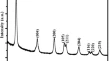
<p>The XRD spectrum of active layers, P3HT:PCBM films, are shown in Figure <figr fid="F1">1</figr>. When the processing additive, 1,8-octanedithiol, was used, peak intensities were much higher than those of the films without 1,8-octanedithiol, and this implies that the P3HT:PCBM films possess a crystalline nature and that highly ordered structures are formed in the films using a processing additive. The crystallinity of P3HT in the films significantly increases with the presence of 1,8-octanedithiol. It implies that the interaction between P3HT is stronger, and the size distribution of P3HT crystals is broader with an increasing amount of 1,8-octanedithiol. The processing additive, 1,8-octanedithiol, could provide a stronger driving force for polymer aggregation. A highly ordered structure in P3HT:PCBM films can provide short pathways to benefit the carrier mobility.</p>
<fig id="F1"><title><p>Figure 1</p></title><caption><p>XRD spectra of the devices solution-processed with chlorobenzene and different amounts of 1,8-octanedithiol</p></caption><text>
   <p><b>XRD spectra of the devices solution-processed with chlorobenzene and different amounts of 1,8-octanedithiol</b>.</p>
</text><graphic file="1556-276X-7-56-1"/></fig>
<p>Absorption spectra of active layers are shown in Figure <figr fid="F2">2</figr>. As the amount of 1,8-octanedithiol was increased in the BHJ film formation process, the absorption intensities were increased. P3HT:PCBM composite films processed with 1,8-octanedithiol have shown three dominant features in absorption: two peaks at 510 and 550 nm and one shoulder at 610 nm appeared due to strong interchain interactions. When adding 1,8-octanedithiol, the absorption band of P3HT:PCBM composite film peaks are red-shifted, and the intensity of the absorption band only increased with the increasing amount of 1,8-octanedithiol. Such a shift on the absorption peak is associated with <it>&#960;</it>-<it>&#960;</it>* transition, indicating that the P3HT chains interact more strongly. At the presence of PCBM, a uniform dispersion of polymer aggregates can be obtained. Therefore, it is considered that the addition of 1,8-octanedithiol helps the crystallization of P3HT as observed by the absorption spectrum.</p>
<fig id="F2"><title><p>Figure 2</p></title><caption><p>UV-Vis absorption spectra of the devices solution-processed with chlorobenzene and different amounts of 1,8-octanedithiol</p></caption><text>
   <p><b>UV-Vis absorption spectra of the devices solution-processed with chlorobenzene and different amounts of 1,8-octanedithiol</b>.</p>
</text><graphic file="1556-276X-7-56-2"/></fig>
<p>From the SPM images, as shown in Figure <figr fid="F3">3</figr>, the growth of polymer aggregates or clusters is clearly seen. The aggregate size gets bigger with the increasing amount of 1,8-octanedithiol, consistent with the higher crystallinity observed in the XRD spectrum when increasing the amount of 1,8-octanedithiol. The roughness value and aggregate size are very important because of the fact that the exciton diffusion length in a polymer system is about 5 to 10 nm. Therefore, it is necessary to maintain a proper size of the polymer aggregate because of an efficient dissociation of excitons generated in the films to achieve higher efficiency. A finely dispersed structure is observed when there is no 1,8-octanedithiol. Thin fibrillar structures appear when the amount of 1,8-octanedithiol reaches 1.5 vol.%, as shown in Figure <figr fid="F3">3</figr>, and Figure the P3HT domain grows bigger when more than 1.5 vol.% 1,8-octanedithiol is added.</p>
<fig id="F3"><title><p>Figure 3</p></title><caption><p>SPM images of P3HT:PCBM films formed using chlorobenzene with different amounts of 1.8-octanedithiol. Chlorobenzene alone</p></caption><text>
   <p><b>SPM images of P3HT:PCBM films formed using chlorobenzene with different amounts of 1.8-octanedithiol. Chlorobenzene alone</b>. (<b>a</b>), chlorobenzene with 1.5 vol.% of 1.8-octanedithiol (<b>b</b>), chlorobenzene with 3.5 vol.% of 1.8-octanedithiol (<b>c</b>), and 1,2-dichlorobenzene with 5.5 vol.% of 1.8-octanedithiol (<b>d</b>).</p>
</text><graphic file="1556-276X-7-56-3"/></fig>
<p>The photoluminescence [PL] spectra of active layers are shown in Figure <figr fid="F4">4</figr>. The PL intensity increased in the wavelength range of 550 to 650 nm with the increasing amount of 1,8-octanedithiol. A high PL intensity indicates that not all excitons generated on one polymer within the film reached the interface of the other polymers <abbrgrp><abbr bid="B17">17</abbr></abbrgrp>. When the conjugation length increases or when the domain size of P3HT increases, the PL intensity of P3HT increases <abbrgrp><abbr bid="B18">18</abbr></abbrgrp>. An increase in the PL intensity suggests that PCBM is not close enough to contact with P3HT to undergo a charge transfer, and the interface area between P3HT and PCBM is decreasing <abbrgrp><abbr bid="B19">19</abbr></abbrgrp>. It is observed that more severe phase separation occurred when more 1,8-octanedithiol is added. It appears that after the exciton dissociates at the P3HT:PCBM interface, an efficient carrier collection is required for a high performance of the device. When adding an additive, carrier transport pathways, associated with the crystallinity of P3HT, can be formed well. Through the analysis results of the UV-Vis absorption and PL spectrum, it can be considered that there is a proper point to dissociate the exciton to achieve higher device performance. In addition, the growth of P3HT domains is consistent with the PL spectra results showing that the interface area of P3HT and PCBM is decreasing and also consistent with the XRD spectra (Figure <figr fid="F1">1</figr>), showing wider polymer domain distributions.</p>
<fig id="F4"><title><p>Figure 4</p></title><caption><p>PL spectra of the devices solution-processed with chlorobenzene and different amounts of 1,8-octanedithiol</p></caption><text>
   <p><b>PL spectra of the devices solution-processed with chlorobenzene and different amounts of 1,8-octanedithiol</b>.</p>
</text><graphic file="1556-276X-7-56-4"/></fig>
<p>The <it>J</it>-<it>V </it>curves of devices, which are solution-processed using different amounts of 1,8-octanedithiol, are shown in Figure <figr fid="F5">5</figr>. By introducing a small amount of the additive to a solution-processed active layer, the <it>J</it>-<it>V </it>characteristics of the active layer were improved, and consequently, higher power conversion efficiency [PCE] of the device was obtained as shown in Figure <figr fid="F6">6</figr>. The values of a short-circuit current density [<it>J</it><sub>sc</sub>], a fill factor [FF], an open-circuit voltage [<it>V</it><sub>oc</sub>], and PCE were all improved as 1,8-octanedithoil was added until 3.5 vol.%. However, when adding over 4.5 vol.% of 1,8-octanedithiol, the values of all characteristic parameters were decreased. As a result, when chlorobenzene as a solvent and 3.5 vol.% 1,8-octanedithiol as an additive were employed in a solution process, the performance characteristics of the device were significantly improved, showing that <it>J</it><sub>sc </sub>= 10.81 mA/cm<sup>2</sup>, FF = 0.54, <it>V</it><sub>oc </sub>= 0.59 V, and PCE = 3.46%. Even though the absorption intensity and crystallinity are increased, the PL intensity also increased. Because of this reason, the film with 3.5 vol.% of 1,8-octanedithiol exhibited the best device performances in this work.</p>
<fig id="F5"><title><p>Figure 5</p></title><caption><p><it>J</it>-<it>V </it>curves of the devices solution-processed with chlorobenzene and different amounts of 1,8-octanedithiol</p></caption><text>
   <p><b><it>J</it>-<it>V </it>curves of the devices solution-processed with chlorobenzene and different amounts of 1,8-octanedithiol</b>.</p>
</text><graphic file="1556-276X-7-56-5"/></fig>
<fig id="F6"><title><p>Figure 6</p></title><caption><p>Photovoltaic response</p></caption><text>
   <p><b>Photovoltaic response</b>. Photovoltaic response of solar cell devices with chlorobenzene and different amounts of 1,8-octanedithiol, <it>J</it><sub>sc</sub>, PCE, <it>V</it><sub>oc</sub>, and FF.</p>
</text><graphic file="1556-276X-7-56-6"/></fig>
</sec>
<sec><st><p>Conclusions</p></st>
<p>The performance characteristics of BHJ polymer solar cells based on P3HT and PCBM can be improved by introducing a processing additive, 1,8-octanedithiol, to a solution-based film formation process, and an optimized amount of 1,8-octanedithiol can be determined. As the amount of 1,8-octanedithiol was increased, the intensity of the UV-Vis absorption and the crystallinity of P3HT significantly increased, and the PL intensity also increased simultaneously, consequently exhibiting the improved performances of the BHJ polymer solar cells. By employing the processing additive, 1,8-octanedithiol, the PCE was increased from 2.16% to 3.46% in this study.</p>
</sec>
<sec><st><p>Abbreviations</p></st>
<p>BHJ: bulk heterojunction; ITO: indium tin oxide; PCBM: [6,6]-phenyl C<sub>61 </sub>butyric acid methyl ester; PCE: power conversion efficiency; PEDOT:PSS: poly(3,4-ethylenedioxythiophene:poly(4-styrenesulfonate); PL: photoluminescence; P3HT: poly(3-hexylthiophene-2,5-diyl); SPM: scanning probe microscope; XRD: X-ray diffraction.</p>
</sec>
<sec><st><p>Competing interests</p></st>
<p>The authors declare that they have no competing interests.</p>
</sec>
<sec><st><p>Authors' contributions</p></st>
<p>HK and HC planned the experiment, taking part in drawing the outlines of the manuscript. SO performed the experimental analyses. YC conceived the study and joined the experimental design and coordination. All authors read and approved the final manuscript.</p>
</sec>
<sec><st><p>Authors' information</p></st>
<p>HK, SO, and HC are students of a Master's course and YC is a professor in the Chemical Engineering Department of Pusan National University, South Korea.</p>
</sec>
</bdy>
<bm>
<ack>
<sec><st><p>Acknowledgements</p></st>
<p>This research was supported by the Basic Science Research Program through the National Research Foundation of Korea (NRF) funded by the Ministry of Education, Science and Technology (2010-0003825) and the Brain Korea 21 project.</p>
</sec>
</ack>
<refgrp><bibl id="B1"><title><p>Organic photovoltaics: technology and market</p></title><aug><au><snm>Brabec</snm><fnm>CJ</fnm></au></aug><source>Sol Energ Mater Sol Cell</source><pubdate>2004</pubdate><volume>83</volume><fpage>273</fpage><lpage>292</lpage><xrefbib><pubid idtype="doi">10.1016/j.solmat.2004.02.030</pubid></xrefbib></bibl><bibl id="B2"><title><p>Origin of the open circuit voltage of plastic solar cells</p></title><aug><au><snm>Brabec</snm><fnm>CJ</fnm></au><au><snm>Cravino</snm><fnm>A</fnm></au><au><snm>Meissner</snm><fnm>D</fnm></au><au><snm>Sariciftci</snm><fnm>NS</fnm></au></aug><source>Adv Funct Mater</source><pubdate>2001</pubdate><volume>11</volume><fpage>374</fpage><lpage>380</lpage><xrefbib><pubid idtype="doi">10.1002/1616-3028(200110)11:5&lt;374::AID-ADFM374&gt;3.0.CO;2-W</pubid></xrefbib></bibl><bibl id="B3"><title><p>Manipulating interfaces in a hybrid solar cell by <it>in situ </it>photosensitizer polymerization and sequential hydrophilicity/hydrophobicity control for enhanced conversion efficiency</p></title><aug><au><snm>Lee</snm><fnm>W</fnm></au><au><snm>Shin</snm><fnm>S</fnm></au><au><snm>Han</snm><fnm>SH</fnm></au><au><snm>Cho</snm><fnm>BW</fnm></au></aug><source>Appl Phys Lett</source><pubdate>2008</pubdate><volume>92</volume><fpage>193307</fpage><lpage>193309</lpage><xrefbib><pubid idtype="doi">10.1063/1.2929368</pubid></xrefbib></bibl><bibl id="B4"><title><p>Polyelectrolytes-organometallic multilayers for efficient photocurrent generation: [polypropylviologen/RuL2(NCS)2/(PEDOT;PSS)]n on ITO</p></title><aug><au><snm>Lee</snm><fnm>W</fnm></au><au><snm>Hyung</snm><fnm>KH</fnm></au><au><snm>Kim</snm><fnm>YH</fnm></au><au><snm>Cai</snm><fnm>G</fnm></au><au><snm>Han</snm><fnm>SH</fnm></au></aug><source>Electrochem Commun</source><pubdate>2007</pubdate><volume>9</volume><fpage>729</fpage><lpage>734</lpage><xrefbib><pubid idtype="doi">10.1016/j.elecom.2006.10.020</pubid></xrefbib></bibl><bibl id="B5"><title><p>Efficient tandem polymer solar cells fabricated by all-solution processing</p></title><aug><au><snm>Kim</snm><fnm>JY</fnm></au><au><snm>Lee</snm><fnm>K</fnm></au><au><snm>Coates</snm><fnm>NE</fnm></au><au><snm>Moses</snm><fnm>D</fnm></au><au><snm>Nguyen</snm><fnm>TQ</fnm></au><au><snm>Dante</snm><fnm>M</fnm></au><au><snm>Heeger</snm><fnm>AJ</fnm></au></aug><source>Science</source><pubdate>2007</pubdate><volume>317</volume><fpage>222</fpage><lpage>225</lpage><xrefbib><pubidlist><pubid idtype="doi">10.1126/science.1141711</pubid><pubid idtype="pmpid" link="fulltext">17626879</pubid></pubidlist></xrefbib></bibl><bibl id="B6"><title><p>High-efficiency solution processable polymer photovoltaic cells by self-organization of polymer blends</p></title><aug><au><snm>Li</snm><fnm>G</fnm></au><au><snm>Shrotriya</snm><fnm>V</fnm></au><au><snm>Huang</snm><fnm>J</fnm></au><au><snm>Yao</snm><fnm>Y</fnm></au><au><snm>Moriarity</snm><fnm>T</fnm></au><au><snm>Emery</snm><fnm>K</fnm></au><au><snm>Yang</snm><fnm>Y</fnm></au></aug><source>Nat Mater</source><pubdate>2005</pubdate><volume>4</volume><fpage>864</fpage><lpage>868</lpage><xrefbib><pubid idtype="doi">10.1038/nmat1500</pubid></xrefbib></bibl><bibl id="B7"><title><p>Realization of large area flexible fullerene-conjugated polymer photocells: a route to plastic solar cells</p></title><aug><au><snm>Brabec</snm><fnm>CJ</fnm></au><au><snm>Padinger</snm><fnm>F</fnm></au><au><snm>Hummelen</snm><fnm>JC</fnm></au><au><snm>Janssen</snm><fnm>RAJ</fnm></au><au><snm>Sariciftc</snm><fnm>NS</fnm></au></aug><source>Synth Met</source><pubdate>1999</pubdate><volume>102</volume><fpage>861</fpage><lpage>864</lpage><xrefbib><pubid idtype="doi">10.1016/S0379-6779(98)00366-X</pubid></xrefbib></bibl><bibl id="B8"><title><p>Charge separation and photovoltaic conversion in polymer composites with internal donor-acceptor heterojunctions</p></title><aug><au><snm>Yu</snm><fnm>G</fnm></au><au><snm>Heeger</snm><fnm>AJ</fnm></au></aug><source>J Appl Phys</source><pubdate>1995</pubdate><volume>78</volume><fpage>4510</fpage><lpage>4515</lpage><xrefbib><pubid idtype="doi">10.1063/1.359792</pubid></xrefbib></bibl><bibl id="B9"><title><p>Polymer photovoltaic cells: enhanced efficiencies via a network of internal donor-acceptor heterojunctions</p></title><aug><au><snm>Yu</snm><fnm>G</fnm></au><au><snm>Gao</snm><fnm>J</fnm></au><au><snm>Hummelen</snm><fnm>JC</fnm></au><au><snm>Wudl</snm><fnm>F</fnm></au><au><snm>Heeger</snm><fnm>AJ</fnm></au></aug><source>Science</source><pubdate>1995</pubdate><volume>270</volume><fpage>1789</fpage><lpage>91</lpage><xrefbib><pubid idtype="doi">10.1126/science.270.5243.1789</pubid></xrefbib></bibl><bibl id="B10"><title><p>Exciton diffusion and dissociation in a poly(p-phenylenevinylene)/C60 heterojunction photovoltaic cell</p></title><aug><au><snm>Halls</snm><fnm>JJM</fnm></au><au><snm>Pichler</snm><fnm>K</fnm></au><au><snm>Friend</snm><fnm>RH</fnm></au><au><snm>Moratti</snm><fnm>SC</fnm></au><au><snm>Moratti</snm><fnm>AB</fnm></au></aug><source>Appl Phys Lett</source><pubdate>1996</pubdate><volume>68</volume><fpage>3120</fpage><lpage>3122</lpage><xrefbib><pubid idtype="doi">10.1063/1.115797</pubid></xrefbib></bibl><bibl id="B11"><title><p>Variations in semiconducting polymer microstructure and hole mobility with spin-coating speed</p></title><aug><au><snm>DeLongchamp</snm><fnm>DM</fnm></au><au><snm>Vogel</snm><fnm>BM</fnm></au><au><snm>Jung</snm><fnm>Y</fnm></au><au><snm>Gurau</snm><fnm>MC</fnm></au><au><snm>Richter</snm><fnm>CA</fnm></au><au><snm>Kirillov</snm><fnm>OA</fnm></au><au><snm>Obrzut</snm><fnm>J</fnm></au><au><snm>Fischer</snm><fnm>DA</fnm></au><au><snm>Sambasivan</snm><fnm>S</fnm></au><au><snm>Richter</snm><fnm>LJ</fnm></au><au><snm>Lin</snm><fnm>EK</fnm></au></aug><source>Chem Mater</source><pubdate>2005</pubdate><volume>17</volume><fpage>5610</fpage><lpage>5612</lpage><xrefbib><pubid idtype="doi">10.1021/cm0513637</pubid></xrefbib></bibl><bibl id="B12"><title><p>Performance of low-operating voltage P3HT-based thin-film transistors with anodized Ta2O5 insulator</p></title><aug><au><snm>Seong</snm><fnm>JY</fnm></au><au><snm>Chung</snm><fnm>KS</fnm></au><au><snm>Kwak</snm><fnm>SK</fnm></au><au><snm>Kim</snm><fnm>YH</fnm></au><au><snm>Moon</snm><fnm>DG</fnm></au><au><snm>Han</snm><fnm>JI</fnm></au><au><snm>Kim</snm><fnm>WK</fnm></au></aug><source>J Korea Phys Soc</source><pubdate>2004</pubdate><volume>45</volume><fpage>S914</fpage><lpage>S916</lpage></bibl><bibl id="B13"><title><p>Correlation between structural and optical properties of composite polymer/fullerene films for organic solar cells</p></title><aug><au><snm>Erb</snm><fnm>T</fnm></au><au><snm>Zhokhavets</snm><fnm>U</fnm></au><au><snm>Gobsch</snm><fnm>G</fnm></au><au><snm>Raleva</snm><fnm>S</fnm></au><au><snm>Stuhn</snm><fnm>B</fnm></au><au><snm>Schilinsky</snm><fnm>P</fnm></au><au><snm>Waldauf</snm><fnm>C</fnm></au><au><snm>Brabec</snm><fnm>CJ</fnm></au></aug><source>Adv Funct Mater</source><pubdate>2005</pubdate><volume>15</volume><fpage>1193</fpage><lpage>1196</lpage><xrefbib><pubid idtype="doi">10.1002/adfm.200400521</pubid></xrefbib></bibl><bibl id="B14"><title><p>Effects of postproduction treatment on plastic solar cells</p></title><aug><au><snm>Padinger</snm><fnm>F</fnm></au><au><snm>Rittberger</snm><fnm>RS</fnm></au><au><snm>Sariciftci</snm><fnm>NS</fnm></au></aug><source>Adv Funct Mater</source><pubdate>2003</pubdate><volume>13</volume><fpage>85</fpage><lpage>88</lpage><xrefbib><pubid idtype="doi">10.1002/adfm.200390011</pubid></xrefbib></bibl><bibl id="B15"><title><p>High-efficiency solution processable polymer photovoltaic cells by self-organization of polymer blends</p></title><aug><au><snm>Li</snm><fnm>G</fnm></au><au><snm>Shrotriya</snm><fnm>V</fnm></au><au><snm>Huang</snm><fnm>J</fnm></au><au><snm>Yao</snm><fnm>Y</fnm></au><au><snm>Moriarty</snm><fnm>T</fnm></au><au><snm>Emery</snm><fnm>K</fnm></au><au><snm>Yang</snm><fnm>Y</fnm></au></aug><source>Nat Mater</source><pubdate>2005</pubdate><volume>4</volume><fpage>864</fpage><lpage>868</lpage><xrefbib><pubid idtype="doi">10.1038/nmat1500</pubid></xrefbib></bibl><bibl id="B16"><title><p>Effects of solvent mixtures on the nanoscale phase separation in polymer solar cells</p></title><aug><au><snm>Yao</snm><fnm>Y</fnm></au><au><snm>Hou</snm><fnm>J</fnm></au><au><snm>Xu</snm><fnm>Z</fnm></au><au><snm>Li</snm><fnm>G</fnm></au><au><snm>Yang</snm><fnm>Y</fnm></au></aug><source>Adv Funct Mater</source><pubdate>2008</pubdate><volume>18</volume><fpage>1783</fpage><lpage>1789</lpage><xrefbib><pubid idtype="doi">10.1002/adfm.200701459</pubid></xrefbib></bibl><bibl id="B17"><title><p>Comparative study: the effects of solvent on the morphology, optical and structural features of regioregular poly(3-hexylthiophene):fullerene thin films</p></title><aug><au><snm>Motaung</snm><fnm>DE</fnm></au><au><snm>Malgas</snm><fnm>GF</fnm></au><au><snm>Arendse</snm><fnm>CJ</fnm></au></aug><source>Synth Met</source><pubdate>2010</pubdate><volume>160</volume><fpage>876</fpage><lpage>882</lpage><xrefbib><pubid idtype="doi">10.1016/j.synthmet.2010.01.038</pubid></xrefbib></bibl><bibl id="B18"><title><p>Effect of annealing of poly(3-hexylthiophene)/fullerene bulk heterojunction composites on structural and optical properties</p></title><aug><au><snm>Zhokhavets</snm><fnm>U</fnm></au><au><snm>Erb</snm><fnm>T</fnm></au><au><snm>Hoppe</snm><fnm>H</fnm></au><au><snm>Gobsch</snm><fnm>G</fnm></au><au><snm>Sariciftci</snm><fnm>NS</fnm></au></aug><source>Thin Solid Films</source><pubdate>2007</pubdate><volume>496</volume><fpage>679</fpage><lpage>682</lpage></bibl><bibl id="B19"><title><p>Fast-grown interpenetrating network in poly(3-hexylthiophene): methanofullerenes solar cells processed with additive</p></title><aug><au><snm>Chen</snm><fnm>HY</fnm></au><au><snm>Yang</snm><fnm>H</fnm></au><au><snm>Yang</snm><fnm>G</fnm></au><au><snm>Sista</snm><fnm>S</fnm></au><au><snm>Zadoyan</snm><fnm>R</fnm></au><au><snm>Li</snm><fnm>G</fnm></au><au><snm>Yang</snm><fnm>Y</fnm></au></aug><source>J Phys Chem C</source><pubdate>2009</pubdate><volume>113</volume><fpage>7946</fpage><lpage>7953</lpage><xrefbib><pubid idtype="doi">10.1021/jp810798z</pubid></xrefbib></bibl></refgrp>
</bm>
</art>