<?xml version='1.0'?>
<!DOCTYPE art SYSTEM 'http://www.biomedcentral.com/xml/article.dtd'>
<art>
	<ui>1556-276X-7-542</ui>
	<ji>1556-276X</ji>
	<fm>
		<dochead>Nano Express</dochead>
		<bibl>
			<title>
				<p>Aluminum-doped ceria-zirconia solid solutions with enhanced thermal stability and high oxygen storage capacity</p>
			</title>
			<aug>
				<au id="A1"><snm>Dong</snm><fnm>Qiang</fnm><insr iid="I1"/><email>dong@tagen.tohoku.ac.jp</email></au>
				<au id="A2" ca="yes"><snm>Yin</snm><fnm>Shu</fnm><insr iid="I1"/><email>shuyin@tagen.tohoku.ac.jp</email></au>
				<au id="A3"><snm>Guo</snm><fnm>Chongshen</fnm><insr iid="I1"/><email>bigguop@mail.tagen.tohoku.ac.jp</email></au>
				<au id="A4"><snm>Sato</snm><fnm>Tsugio</fnm><insr iid="I1"/><email>tsusato@tagen.tohoku.ac.jp</email></au>
			</aug>
			<insg>
				<ins id="I1"><p>Center for Exploration of New Inorganic Materials (CENIM), Institute of Multidisciplinary Research for Advanced Materials, Tohoku University, 2-1-1 Katahira, Aoba-ku, Sendai, 980-8577, Japan</p></ins>
			</insg>
			<source>Nanoscale Research Letters</source>
			<section><title><p>Regular submissions</p></title></section><issn>1556-276X</issn>
			<pubdate>2012</pubdate>
			<volume>7</volume>
			<issue>1</issue>
			<fpage>542</fpage>
			<url>http://www.nanoscalereslett.com/content/7/1/542</url>
			<xrefbib><pubidlist><pubid idtype="doi">10.1186/1556-276X-7-542</pubid><pubid idtype="pmpid">23025588</pubid></pubidlist></xrefbib>
		</bibl>
		<history><rec><date><day>23</day><month>7</month><year>2012</year></date></rec><acc><date><day>17</day><month>9</month><year>2012</year></date></acc><pub><date><day>1</day><month>10</month><year>2012</year></date></pub></history>
		<cpyrt><year>2012</year><collab>Dong et al.; licensee Springer.</collab><note>This is an Open Access article distributed under the terms of the Creative Commons Attribution License (<url>http://creativecommons.org/licenses/by/2.0</url>), which permits unrestricted use, distribution, and reproduction in any medium, provided the original work is properly cited.</note></cpyrt>
		<kwdg>
			<kwd>Solvothermal</kwd>
			<kwd>Aluminum</kwd>
			<kwd>Solid solutions</kwd>
			<kwd>Catalysis</kwd>
			<kwd>Oxygen storage capacity</kwd>
			<kwd>Thermal stability</kwd>
		</kwdg>
		<abs>
			<sec>
				<st>
					<p>Abstract</p>
				</st><p>A facile solvothermal method to synthesize aluminum-doped ceria-zirconia (Ce<sub>0.5</sub>Zr<sub>0.5-<it>x</it>
					</sub>Al<sub>
						<it>x</it>
					</sub>O<sub>2-<it>x</it>/2</sub>, <it>x</it>&#8201;=&#8201;0.1 to 0.4) solid solutions was carried out using Ce(NH<sub>4</sub>)<sub>2</sub>(NO<sub>3</sub>)<sub>6</sub>, Zr(NO<sub>3</sub>)<sub>3</sub>&#183;2H<sub>2</sub>O Al(NO<sub>3</sub>)<sub>3</sub>&#183;9H<sub>2</sub>O, and NH<sub>4</sub>OH as the starting materials at 200&#176;C for 24 h. The obtained solid solutions from the solvothermal reaction were calcined at 1,000&#176;C for 20 h in air atmosphere to evaluate the thermal stability. The synthesized Ce<sub>0.5</sub>Zr<sub>0.3</sub>Al<sub>0.2</sub>O<sub>1.9</sub> particle was characterized for the oxygen storage capacity (OSC) in automotive catalysis. For the characterization, X-ray diffraction, transmission electron microscopy, and the Brunauer-Emmet-Teller (BET) technique were employed. The OSC values of all samples were measured at 600&#176;C using thermogravimetric-differential thermal analysis. Ce<sub>0.5</sub>Zr<sub>0.3</sub>Al<sub>0.2</sub>O<sub>1.9</sub> solid solutions calcined at 1,000&#176;C for 20 h with a BET surface area of 18 m<sup>2</sup> g<sup>&#8722;1</sup> exhibited a considerably high OSC of 427 &#956;mol-O g<sup>&#8722;1</sup> and good OSC performance stability. The same synthesis route was employed for the preparation of the CeO<sub>2</sub> and Ce<sub>0.5</sub>Zr<sub>0.5</sub>O<sub>2</sub>. The incorporation of aluminum ion in the lattice of ceria-based catalyst greatly enhanced the thermal stability and OSC.</p>
			</sec>
		</abs>
	</fm>
	<meta><classifications><classification id="NC2011" subtype="theme_series_title" type="BMC">Nano Component 2011</classification><classification id="NC2011" subtype="theme_series_editor" type="BMC"/></classifications></meta><bdy>
		<sec>
			<st>
				<p>Background</p>
			</st><p>Ceria (CeO<sub>2</sub>)-based materials have attracted considerable interest for more than half a century due to their far-ranging applications in catalysts, fuel cells, cosmetics, gas sensors, and solid-state electrolytes and especially their crucial application as promoters of three-way catalysts (TWCs), which are commonly used to reduce the emissions of CO, NO<sub>
					<it>x</it>
				</sub>, and hydrocarbons from automobile exhausts, because of their excellent oxygen storage capacity (OSC) <abbrgrp>
					<abbr bid="B1">1</abbr>
					<abbr bid="B2">2</abbr>
					<abbr bid="B3">3</abbr>
					<abbr bid="B4">4</abbr>
					<abbr bid="B5">5</abbr>
					<abbr bid="B6">6</abbr>
					<abbr bid="B7">7</abbr>
					<abbr bid="B8">8</abbr>
				</abbrgrp>. Since 1990s, CeO<sub>2</sub>-ZrO<sub>2</sub> solid solutions have gradually replaced pure CeO<sub>2</sub> as OSC materials in the TWCs to reduce the emission of toxic pollutants (CO, NO<sub>
					<it>x</it>
				</sub>, hydrocarbons, etc.) from automobile exhaust and because of their enhanced OSC performance and improved thermal stability at elevated temperatures <abbrgrp>
					<abbr bid="B9">9</abbr>
					<abbr bid="B10">10</abbr>
					<abbr bid="B11">11</abbr>
					<abbr bid="B12">12</abbr>
					<abbr bid="B13">13</abbr>
				</abbrgrp>.</p><p>The redox property of CeO<sub>2</sub> can be greatly enhanced by the incorporation of zirconium ions (Zr<sup>4+</sup>) into the lattice to form a solid solution <abbrgrp>
					<abbr bid="B14">14</abbr>
					<abbr bid="B15">15</abbr>
					<abbr bid="B16">16</abbr>
				</abbrgrp>. Nagai et al. have suggested that enhancing the homogeneity of Ce and Zr atoms in the CeO<sub>2</sub>-ZrO<sub>2</sub> solid solution can improve the OSC performance <abbrgrp>
					<abbr bid="B17">17</abbr>
				</abbrgrp>. The detailed structure and property of CeO<sub>2</sub>-ZrO<sub>2</sub> solid solutions were reported in a review article by Monte and Kaspar <abbrgrp>
					<abbr bid="B12">12</abbr>
				</abbrgrp>. This review included the results of reducing performance for a series of samples with gradually elevated Ce contents, and a possible mechanism of structural changes in the reducing process was proposed. Fornasiero et al. have reported that an optimum composition like Ce<sub>0.5</sub>Zr<sub>0.5</sub>O<sub>2</sub> (molar ratio of Ce:Zr = 1:1) can exist as a cubic phase, which can have a considerably high redox property <abbrgrp>
					<abbr bid="B18">18</abbr>
				</abbrgrp>. Using density functional theory, Wang et al. found that in a series of Ce<sub>1-<it>x</it>
				</sub>Zr<sub>
					<it>x</it>
				</sub>O<sub>2</sub> solutions with a content of 50%, ZrO<sub>2</sub> possesses the lowest formation energy of the O vacancy; therefore, Ce<sub>0.5</sub>Zr<sub>0.5</sub>O<sub>2</sub> exhibits the best OSC performance <abbrgrp>
					<abbr bid="B19">19</abbr>
				</abbrgrp>. Recently, many researchers have paid much attention to prepare the Ce<sub>0.5</sub>Zr<sub>0.5</sub>O<sub>2</sub> solutions with the homogeneity of the composition, good dispersion of particles, narrow particle size distribution, better crystallinity, and high surface area in order to improve OSC and redox property due to their catalytic applications <abbrgrp>
					<abbr bid="B20">20</abbr>
					<abbr bid="B21">21</abbr>
					<abbr bid="B22">22</abbr>
					<abbr bid="B23">23</abbr>
					<abbr bid="B24">24</abbr>
					<abbr bid="B25">25</abbr>
				</abbrgrp>.</p><p>Although Ce<sub>0.5</sub>Zr<sub>0.5</sub>O<sub>2</sub> solid solutions have been studied extensively, there are few reports on the preparation of Ce<sub>0.5</sub>Zr<sub>0.5-<it>x</it>
				</sub>M<sub>
					<it>x</it>
				</sub>O<sub>2-<it>x</it>/2</sub> in the literature <abbrgrp>
					<abbr bid="B26">26</abbr>
					<abbr bid="B27">27</abbr>
				</abbrgrp>. Considering the smaller cation radius of Al<sup>3+</sup> (0.059 nm) compared to those of Zr<sup>4+</sup> (0.084 nm) and Ce<sup>4+</sup> (0.097 nm), the incorporation of Al<sup>3+</sup> into Ce-Zr solid solutions may enhance the oxygen release reaction to form larger Ce<sup>3+</sup>. In the present work, for the first time, we describe the preparation and characterization of Ce<sub>0.5</sub>Zr<sub>0.3</sub>Al<sub>0.2</sub>O<sub>1.9</sub> solid solutions with high surface area via a facile solvothermal route. The further experiment results show that the introduction of aluminum ion enhances the thermal stability and OSC even after calcination at a very strict condition of 1,000&#176;C for 20 h. The OSC of CeO<sub>2</sub>, Ce<sub>0.5</sub>Zr<sub>0.5</sub>O<sub>2</sub>, and the composites which consisted of different aluminum amounts were also prepared via the same method and compared.</p>
		</sec>
		<sec>
			<st>
				<p>Methods</p>
			</st><p>All chemicals used were of analytical grade and were purchased from Kanto Chemical Co. Inc., Tokyo, Japan (purity 99.999%). The chemicals were used without further purification.</p>
			<sec>
				<st>
					<p>Catalysts preparation</p>
				</st><p>The stoichiometric amounts of (NH<sub>4</sub>)<sub>2</sub>Ce(NO<sub>3</sub>)<sub>6</sub> (6 mmol), ZrO(NO<sub>3</sub>)<sub>2</sub> (3.6 mmol), and Al(NO<sub>3</sub>)<sub>3</sub>&#183;9H<sub>2</sub>O (2.4 mmol) were dissolved in 60 ml of distilled water. NH<sub>4</sub>OH solution was slowly dropped into the above mixed solution, and the pH value was maintained at 9. The yellow mixed solution was introduced in a 100-ml Teflon&#174;-lined autoclave (SAN-AI Science, Co. Ltd, Nagoya, Japan), which was maintained at 200&#176;C for 24 h, then cooled to room temperature naturally. The obtained products were washed with distilled water three times and dried in air at 100&#176;C for 12 h to form the as-prepared fresh samples. Finally, the fresh samples were calcined at 1,000&#176;C for 20 h in air atmosphere to evaluate the thermal stability. The same synthesis route was employed for the preparation of the CeO<sub>2</sub> and Ce<sub>0.5</sub>Zr<sub>0.5</sub>O<sub>2</sub>.</p>
			</sec>
			<sec>
				<st>
					<p>OSC analysis</p>
				</st><p>The OSC of the samples calcined at 1,000&#176;C for 20 h was determined by thermogravimetric-differential thermal analysis (TG-DTA; Rigaku TAS-200, Rigaku Corporation, Tokyo, Japan) at 600&#176;C. Before the measurements, the samples were held in flowing air at 600&#176;C for 30 min to remove residual water and other volatile gases. The mixed gas of CO-N<sub>2</sub> (100 cm<sup>3</sup> min<sup>&#8722;1</sup>) and air (100 cm<sup>3</sup> min<sup>&#8722;1</sup>) was flowed alternately at 600&#176;C. Finally, OSC was analyzed after getting the TGA profile.</p>
			</sec>
			<sec>
				<st>
					<p>Characterization</p>
				</st><p>The phase composition of the sample was determined by X-ray diffraction analysis (XRD; Bruker D2 Phaser, Bruker Optik GmbH, Ettlingen, Germany) using graphite-monochromized CuK&#945; radiation. The morphology and size of the samples were determined by transmission electron microscopy (TEM; JEOL JEM-2010, JEOL Ltd., Akishima, Tokyo, Japan). The specific surface area was measured using a BET (NOVA 4200e, Quantachrome GmbH and Co. KG, Odelzhausen, Germany) surface area and pore size analyzer.</p>
			</sec>
		</sec>
		<sec>
			<st>
				<p>Results and discussion</p>
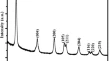
			</st><p>All products of (a) CeO<sub>2</sub>, (b) Ce<sub>0.5</sub>Zr<sub>0.5</sub>O<sub>2</sub>, and (c) Ce<sub>0.5</sub>Zr<sub>0.3</sub>Al<sub>0.2</sub>O<sub>1.9</sub> consisted of a single phase of fluorite structure (Figure <figr fid="F1">1</figr> (a) to (c)). All the diffraction patterns exhibited broad peaks, suggesting that the fresh samples were nanocrystalline materials. The calcined samples had a slight shift in diffraction peaks when compared to the pure CeO<sub>2</sub> XRD pattern, indicating the formation of corresponding solid solutions. The calculated lattice parameters of the calcined samples of Ce<sub>0.5</sub>Zr<sub>0.5</sub>O<sub>2</sub> (<it>a</it>&#8201;=&#8201;0.5384 nm) and Ce<sub>0.5</sub>Zr<sub>0.3</sub>Al<sub>0.2</sub>O<sub>1.9</sub> (<it>a</it>&#8201;=&#8201;0.5299 nm) are smaller than that of CeO<sub>2</sub> (<it>a</it>&#8201;=&#8201;0.5413 nm). The shrinkage of lattice cells may be due to the substitution of the smaller cation radius of Zr<sup>4+</sup> (0.084 nm) and Al<sup>3+</sup> (0.0059 nm) with Ce<sup>4+</sup> (0.097 nm). No phase separation was noticed even at such high calcination temperatures at 1,000&#176;C for 20 h, except the increase of particle size (Figure <figr fid="F1">1</figr> (a') to (c')). The crystal sizes of the fresh CeO<sub>2</sub>, Ce<sub>0.5</sub>Zr<sub>0.5</sub>O<sub>2</sub>, and Ce<sub>0.5</sub>Zr<sub>0.3</sub>Al<sub>0.2</sub>O<sub>1.9</sub> calculated by Scherer's formula were 9, 5, and 3 nm, while those of the calcined CeO<sub>2</sub>, Ce<sub>0.5</sub>Zr<sub>0.5</sub>O<sub>2</sub>, and Ce<sub>0.5</sub>Zr<sub>0.3</sub>Al<sub>0.2</sub>O<sub>1.9</sub> were 35, 10, and 8 nm, respectively.</p>
			<fig id="F1"><title><p>Figure 1</p></title><caption><p>XRD patterns of fresh and calcined samples.</p></caption><text>
   <p><b>XRD patterns of fresh and calcined samples. </b>Fresh samples: (a) CeO<sub>2</sub>, (b) Ce<sub>0.5</sub>Zr<sub>0.5</sub>O<sub>2</sub>, and (c) Ce<sub>0.5</sub>Zr<sub>0.3</sub>Al<sub>0.2</sub>O<sub>1.9</sub>. Calcined samples: (a') CeO<sub>2</sub>, (b') Ce<sub>0.5</sub>Zr<sub>0.5</sub>O<sub>2</sub>, and (c') Ce<sub>0.5</sub>Zr<sub>0.3</sub>Al<sub>0.2</sub>O<sub>1.9</sub>.</p>
</text><graphic file="1556-276X-7-542-1"/></fig><p>The morphology and size of the fresh and calcined samples (1,000&#176;C for 20 h) were observed by TEM as shown in Figure <figr fid="F2">2</figr>. For the fresh samples, the particles seem to be partly dispersed and formed small agglomerates (Figure <figr fid="F2">2</figr> (a) to (c)), and the single particle exhibited a spherical-like morphology with the diameters of 9 to 12 nm, 5 to 8 nm, and 3 to 5 nm for CeO<sub>2</sub>, Ce<sub>0.5</sub>Zr<sub>0.5</sub>O<sub>2</sub>, and Ce<sub>0.5</sub>Zr<sub>0.3</sub>Al<sub>0.2</sub>O<sub>1.9</sub>, respectively, which are in agreement with the crystallite size calculated from Scherer's formula. The particle size increased after calcination at 1,000&#176;C for 20 h because of aggregation, and the particle sizes were found to increase to 90 to 100 nm, 50 to 55 nm, and 30 to 35 nm for the CeO<sub>2</sub>, Ce<sub>0.5</sub>Zr<sub>0.5</sub>O<sub>2</sub>, and Ce<sub>0.5</sub>Zr<sub>0.3</sub>Al<sub>0.2</sub>O<sub>1.9</sub> samples as shown in Figure <figr fid="F2">2</figr> (a') to (c'), respectively.</p>
			<fig id="F2"><title><p>Figure 2</p></title><caption><p>TEM images of fresh and calcined samples.</p></caption><text>
   <p><b>TEM images of fresh and calcined samples. </b>Fresh samples: (a) CeO<sub>2</sub>, (b) Ce<sub>0.5</sub>Zr<sub>0.5</sub>O<sub>2</sub>, and (c) Ce<sub>0.5</sub>Zr<sub>0.3</sub>Al<sub>0.2</sub>O<sub>1.9</sub>. Calcined samples: (a') CeO<sub>2</sub>, (b') Ce<sub>0.5</sub>Zr<sub>0.5</sub>O<sub>2</sub>, and (c') Ce<sub>0.5</sub>Zr<sub>0.3</sub>Al<sub>0.2</sub>O<sub>1.9</sub>.</p>
</text><graphic file="1556-276X-7-542-2"/></fig><p>BET nitrogen adsorption-desorption analysis was undertaken to measure the specific surface area of all samples. As a result, the fresh sample of Ce<sub>0.5</sub>Zr<sub>0.3</sub>Al<sub>0.2</sub>O<sub>1.9</sub> showed a much higher surface area (232 m<sup>2</sup> g<sup>&#8722;1</sup>) than those of CeO<sub>2</sub> (119 m<sup>2</sup> g<sup>&#8722;1</sup>) and Ce<sub>0.5</sub>Zr<sub>0.5</sub>O<sub>2</sub> (168 m<sup>2</sup> g<sup>&#8722;1</sup>, Figure <figr fid="F3">3</figr> (a) to (c)). After calcinations at 1,000&#176;C for 20 h in air, the specific surface areas of CeO<sub>2</sub> (3 m<sup>2</sup> g<sup>&#8722;1</sup>) and Ce<sub>0.5</sub>Zr<sub>0.5</sub>O<sub>2</sub> (8 m<sup>2</sup> g<sup>&#8722;1</sup>) decreased to less than 10 m<sup>2</sup> g<sup>&#8722;1</sup>, but the sample of Ce<sub>0.5</sub>Zr<sub>0.3</sub>Al<sub>0.2</sub>O<sub>1.9</sub> exhibited a relatively higher BET specific surface area of 18 m<sup>2</sup> g<sup>&#8722;1</sup> (Figure <figr fid="F3">3</figr> (a') to (c')).</p>
			<fig id="F3"><title><p>Figure 3</p></title><caption><p>BET specific surface areas of fresh and calcined samples.</p></caption><text>
   <p><b>BET specific surface areas of fresh and calcined samples. </b> Fresh samples: (a) CeO<sub>2</sub>, (b) Ce<sub>0.5</sub>Zr<sub>0.5</sub>O<sub>2</sub>, and (c) Ce<sub>0.5</sub>Zr<sub>0.3</sub>Al<sub>0.2</sub>O<sub>1.9</sub>. Calcined samples: (a') CeO<sub>2</sub>, (b') Ce<sub>0.5</sub>Zr<sub>0.5</sub>O<sub>2</sub>, and (c') Ce<sub>0.5</sub>Zr<sub>0.3</sub>Al<sub>0.2</sub>O<sub>1.9</sub>.</p>
</text><graphic file="1556-276X-7-542-3"/></fig><p>The OSC values of the calcined samples were determined at 600&#176;C with a continuous flow of CO-N<sub>2</sub> gas and air alternately. Figure <figr fid="F4">4</figr> shows the typical TG profiles of the CeO<sub>2</sub>, Ce<sub>0.5</sub>Zr<sub>0.5</sub>O<sub>2</sub>, and Ce<sub>0.5</sub>Zr<sub>0.3</sub>Al<sub>0.2</sub>O<sub>1.9</sub> samples. The TG profile shows the oxygen release/storage performance of the CeO<sub>2</sub>, Ce<sub>0.5</sub>Zr<sub>0.5</sub>O<sub>2</sub>, and Ce<sub>0.5</sub>Zr<sub>0.3</sub>Al<sub>0.2</sub>O<sub>1.9</sub> samples at 600&#176;C with time. As a result, Ce<sub>0.5</sub>Zr<sub>0.3</sub>Al<sub>0.2</sub>O<sub>1.9</sub> exhibited a higher OSC of 427 &#956;mol-O g<sup>&#8722;1</sup>, when compared to those of the CeO<sub>2</sub> (25 &#956;mol-O g<sup>&#8722;1</sup>) and Ce<sub>0.5</sub>Zr<sub>0.5</sub>O<sub>2</sub> (350 &#956;mol-O g<sup>&#8722;1</sup>) samples (Table <tblr tid="T1">1</tblr>). It is accepted that the OSC is dependent on the specific surface area; it is obvious that Ce<sub>0.5</sub>Zr<sub>0.3</sub>Al<sub>0.2</sub>O<sub>1.9</sub> exhibited the highest specific surface area and highest OSC values even after calcination at such high temperature as 1,000&#176;C for 20 h. In order to examine OSC performance stability, oxygen release/storage cycle measurement was tested, and Ce<sub>0.5</sub>Zr<sub>0.3</sub>Al<sub>0.2</sub>O<sub>1.9</sub> retained the same OSC even after 22 cycles (Figure <figr fid="F5">5</figr>). The result indicates that Ce<sub>0.5</sub>Zr<sub>0.3</sub>Al<sub>0.2</sub>O<sub>1.9</sub> has good OSC performance stability.</p>
			<fig id="F4"><title><p>Figure 4</p></title><caption><p>TG profiles of calcined samples (1,000&#176;C, 20 h) at 600&#176;C, which show oxygen release/storage properties.</p></caption><text>
   <p><b>TG profiles of calcined	samples </b>( <b>1 </b>, <b>000 </b>&#176; <b>C </b>, <b>20 h </b>) <b>at 600 </b>&#176;<b>C</b>, <b>which show oxygen release </b>/ <b>storage properties. </b>(a) CeO<sub>2</sub>, (b) Ce<sub>0.5</sub>Zr<sub>0.5</sub>O<sub>2</sub>, and (c) Ce<sub>0.5</sub>Zr<sub>0.3</sub>Al<sub>0.2</sub>O<sub>1.9</sub>.</p>
</text><graphic file="1556-276X-7-542-4"/></fig>
			<table id="T1">
				<title>
					<p>Table 1</p>
				</title>
				<caption>
					<p>
						<b>OSC at 600 </b>&#176; <b>C of the CeO </b>
						<sub>
							<b>2 </b>
						</sub>, <b>Ce </b>
						<sub>
							<b>0 </b>.<b>5 </b>
						</sub><b>Zr </b>
						<sub>
							<b>0 </b>.<b>5 </b>
						</sub><b>O</b>
						<sub>
							<b>2 </b>
						</sub>, <b>and Ce </b>
						<sub>
							<b>0 </b>.<b>5 </b>
						</sub><b>Zr </b>
						<sub>
							<b>0 </b>.<b>3 </b>
						</sub><b>Al </b>
						<sub>
							<b>0 </b>.<b>2 </b>
						</sub><b>O </b>
						<sub>
							<b>1 </b>.<b>9 </b>
						</sub><b>calcined at 1 </b>,<b>000 </b>&#176; <b>C for 20 h</b>
					</p>
				</caption>
				<tgroup align="left" cols="2">
					<colspec align="left" colname="c1" colnum="1" colwidth="1*"/>
					<colspec align="center" colname="c2" colnum="2" colwidth="1*"/>
					<thead valign="top">
						<row rowsep="1">
							<entry colname="c1">
								<p>
									<b>Chemical composition</b>
								</p>
							</entry>
							<entry align="center" colname="c2">
								<p>
									<b>OSC (&#956;mol-O g </b>
									<sup>&#8722; <b>1 </b>
									</sup><b>)</b>
								</p>
							</entry>
						</row>
					</thead>
					<tfoot>
						<p>
							<sup>a</sup>It is accepted that the Ce<sub>0.5</sub>Zr<sub>0.5</sub>O<sub>2</sub> composition possessed excellent OSC property <abbrgrp>
								<abbr bid="B10">10</abbr>
								<abbr bid="B11">11</abbr>
								<abbr bid="B12">12</abbr>
								<abbr bid="B13">13</abbr>
								<abbr bid="B14">14</abbr>
							</abbrgrp>.</p>
					</tfoot>
					<tbody>
						<row>
							<entry colname="c1">
								<p>CeO<sub>2</sub>
								</p>
							</entry>
							<entry align="center" colname="c2">
								<p>25.0</p>
							</entry>
						</row>
						<row>
							<entry colname="c1">
								<p>Ce<sub>0.5</sub>Zr<sub>0.5</sub>O<sub>2</sub>
									<sup>a</sup>
								</p>
							</entry>
							<entry align="center" colname="c2">
								<p>350.0</p>
							</entry>
						</row>
						<row rowsep="1">
							<entry colname="c1">
								<p>Ce<sub>0.5</sub>Zr<sub>0.3</sub>Al<sub>0.2</sub>O<sub>1.9</sub>
								</p>
							</entry>
							<entry align="center" colname="c2">
								<p>427.0</p>
							</entry>
						</row>
					</tbody>
				</tgroup>
			</table>
			<fig id="F5"><title><p>Figure 5</p></title><caption><p>TG profiles after measuring OSC at 600&#176;C for Ce<sub>0.5</sub>Zr<sub>0.3</sub>Al<sub>0.2</sub>O<sub>1.9</sub> (1,000&#176;C, 20 h) after 22 cycles</p></caption><text>
   <p><b>TG profiles during measurement of</b><b>OSC at 600</b>&#176;<b>C for Ce</b><sub><b>0</b>.<b>5</b></sub><b>Zr</b><sub><b>0</b>.<b>3</b></sub><b>Al</b><sub><b>0</b>.<b>2</b></sub><b>O</b><sub><b>1</b>.<b>9</b></sub> (<b>1</b>,<b>000</b>&#176;<b>C</b>, <b>20 h</b>) <b>after 22 cycles.</b> The profiles show oxygen release/storage properties.</p>
</text><graphic file="1556-276X-7-542-5"/></fig><p>The amount of incorporated aluminum was also controlled to test its effect on the OSC of the calcined sample as shown in Figure <figr fid="F6">6</figr> and Table <tblr tid="T2">2</tblr>. As a result, Ce<sub>0.5</sub>Zr<sub>0.3</sub>Al<sub>0.2</sub>O<sub>1.9</sub> exhibited the highest OSC of 427 &#956;mol-O g<sup>&#8722;1</sup> (Table <tblr tid="T1">1</tblr>), when compared to those of the Ce<sub>0.5</sub>Zr<sub>0.4</sub>Al<sub>0.1</sub>O<sub>1.95</sub> (378 &#956;mol-O g<sup>&#8722;1</sup>), Ce<sub>0.5</sub>Zr<sub>0.2</sub>Al<sub>0.3</sub>O<sub>1.85</sub> (389 &#956;mol-O g<sup>&#8722;1</sup>), and Ce<sub>0.5</sub>Zr<sub>0.1</sub>Al<sub>0.4</sub>O<sub>1.8</sub> (261 &#956;mol-O g<sup>&#8722;1</sup>) samples (Table <tblr tid="T2">2</tblr>), Therefore, in Ce<sub>0.5</sub>Zr<sub>0.5-<it>x</it>
				</sub>Al<sub>
					<it>x</it>
				</sub>O<sub>
					<it>y</it>
				</sub> (0.1&#8201;&lt;<it>x</it>&#8201;&lt;&#8201;0.5, <it>x</it> is the amount of incorporated aluminum), the most appropriate amount of incorporated aluminum might be around <it>x</it>&#8201;=&#8201;0.2.</p>
			<fig id="F6"><title><p>Figure 6</p></title><caption><p>TG profiles after measuring OSC at 600&#176;C for calcined samples (1,000&#176;C, 20 h)</p></caption><text>
   <p><b>TG profiles during measurement of</b><b>OSC at 600</b>&#176;<b>C for calcined samples</b><b>(1</b>,<b>000</b>&#176;<b>C</b>, <b>20 h).</b> The profiles show oxygen release/storage properties. (a) Ce<sub>0.5</sub>Zr<sub>0.4</sub>Al<sub>0.1</sub>O<sub>1.95</sub>, (b) Ce<sub>0.5</sub>Zr<sub>0.2</sub>Al<sub>0.3</sub>O<sub>1.85</sub>, and (c) Ce<sub>0.5</sub>Zr<sub>0.1</sub>Al<sub>0.4</sub>O<sub>1.8</sub>.</p>
</text><graphic file="1556-276X-7-542-6"/></fig>
			<table id="T2">
				<title>
					<p>Table 2</p>
				</title>
				<caption>
					<p>
						<b>OSC at 600 </b>&#176; <b>C of the Ce </b>
						<sub>
							<b>0 </b>.<b>5 </b>
						</sub><b>Zr </b>
						<sub>
							<b>0 </b>.<b>4 </b>
						</sub><b>Al </b>
						<sub>
							<b>0 </b>.<b>1 </b>
						</sub><b>O </b>
						<sub>
							<b>1 </b>.<b>95 </b>
						</sub>, <b>Ce </b>
						<sub>
							<b>0 </b>.<b>5 </b>
						</sub><b>Zr </b>
						<sub>
							<b>0 </b>.<b>2 </b>
						</sub><b>Al </b>
						<sub>
							<b>0 </b>.<b>3 </b>
						</sub><b>O</b>
						<sub>
							<b>1 </b>.<b>85 </b>
						</sub>, <b>and Ce </b>
						<sub>
							<b>0 </b>.<b>5 </b>
						</sub><b>Zr </b>
						<sub>
							<b>0 </b>.<b>1 </b>
						</sub><b>Al </b>
						<sub>
							<b>0 </b>.<b>4 </b>
						</sub><b>O </b>
						<sub>
							<b>1 </b>.<b>8 </b>
						</sub><b>calcined at 1 </b>, <b>000 </b>&#176; <b>C for 20 h</b>
					</p>
				</caption>
				<tgroup align="left" cols="2">
					<colspec align="left" colname="c1" colnum="1" colwidth="1*"/>
					<colspec align="center" colname="c2" colnum="2" colwidth="1*"/>
					<thead valign="top">
						<row rowsep="1">
							<entry colname="c1">
								<p>
									<b>Chemical composition</b>
								</p>
							</entry>
							<entry align="center" colname="c2">
								<p>
									<b>OSC (&#956;mol-O g </b>
									<sup>&#8722; <b>1 </b>
									</sup><b>)</b>
								</p>
							</entry>
						</row>
					</thead>
					<tbody valign="top">
						<row>
							<entry colname="c1">
								<p>Ce<sub>0.5</sub>Zr<sub>0.4</sub>Al<sub>0.1</sub>O<sub>1.95</sub>
								</p>
							</entry>
							<entry align="center" colname="c2">
								<p>378.0</p>
							</entry>
						</row>
						<row>
							<entry colname="c1">
								<p>Ce<sub>0.5</sub>Zr<sub>0.2</sub>Al<sub>0.3</sub>O<sub>1.85</sub>
								</p>
							</entry>
							<entry align="center" colname="c2">
								<p>389.0</p>
							</entry>
						</row>
						<row rowsep="1">
							<entry colname="c1">
								<p>Ce<sub>0.5</sub>Zr<sub>0.1</sub>Al<sub>0.4</sub>O<sub>1.8</sub>
								</p>
							</entry>
							<entry align="center" colname="c2">
								<p>261.0</p>
							</entry>
						</row>
					</tbody>
				</tgroup>
			</table>
		</sec>
		<sec>
			<st>
				<p>Conclusions</p>
			</st><p>Ce<sub>0.5</sub>Zr<sub>0.3</sub>Al<sub>0.2</sub>O<sub>1.9</sub> solid solutions with high surface area were successfully synthesized via a facile solvothermal method. The structures of the fresh samples and calcined samples were characterized by X-ray diffraction. The lattice parameters of the Ce<sub>0.5</sub>Zr<sub>0.3</sub>Al<sub>0.2</sub>O<sub>1.9</sub> solid solution are smaller than those of CeO<sub>2</sub> and Ce<sub>0.5</sub>Zr<sub>0.5</sub>O<sub>2</sub>, suggesting the incorporation of the Al<sup>3+</sup> into Ce-Zr solid solutions. The fresh particles showed spherical-like morphology with a diameter of 3 to 5 nm determined by TEM. The Ce<sub>0.5</sub>Zr<sub>0.3</sub>Al<sub>0.2</sub>O<sub>1.9</sub> solid solutions exhibited a remarkably higher oxygen storage capacity than those of the CeO<sub>2</sub> and Ce<sub>0.5</sub>Zr<sub>0.5</sub>O<sub>2</sub> samples prepared via the same method, even after calcination at 1,000&#176;C for 20 h, indicating the improvement of the OSC and thermal stability due to the incorporation of aluminum. An appropriate amount of incorporated aluminum is also suggested.</p>
		</sec>
		<sec>
			<st>
				<p>Competing interests</p>
			</st><p>The authors declare that they have no competing interests.</p>
		</sec>
		<sec>
			<st>
				<p>Authors&#8217; contributions</p>
			</st><p>QD participated in the design of the study, carried out the total experiments, and performed the result analysis as well as drafted the manuscript. SY participated in the design of the study, gave the theoretical and experimental guidance, and made the corrections of manuscript. CG mainly helped in the experiments and measurements. TS gave the theoretical and experimental guidance and helped to amend the manuscript. All authors read and approved the final manuscript.</p>
		</sec>
		<sec>
			<st>
				<p>Authors&#8217; information</p>
			</st><p>QD, SY, CG, and TS are an assistant professor, an associate professor, a Ph.D. candidate, and a full professor, respectively, at the Institute of Multidisciplinary Research for Advanced Materials, Tohoku University.</p>
		</sec>
	</bdy>
	<bm>
		<ack>
			<sec>
				<st>
					<p>Acknowledgments</p>
				</st><p>This work was supported by the Rare Metal Substitute Materials Development Project of New Energy and Industrial Technology Development Organization (NEDO), Japan and the Management Expenses Grants for National Universities Corporations from the Ministry of Education, Culture, Sports and Science for Technology of Japan (MEXT).</p>
			</sec>
		</ack>
		<refgrp><bibl id="B1"><title><p>Ceria in automotive exhaustcatalysts: I. Oxygen storage</p></title><aug><au><snm>Yao</snm><fnm>HC</fnm></au><au><snm>Yu</snm><fnm>YF</fnm></au></aug><source>J Catal</source><pubdate>1984</pubdate><volume>86</volume><fpage>254</fpage><xrefbib><pubid idtype="doi">10.1016/0021-9517(84)90371-3</pubid></xrefbib></bibl><bibl id="B2"><title><p>A rationale for the development of thermally stable nanostructured CeO<sub>2 </sub>-ZrO<sub>2 </sub>-containing mixed oxides</p></title><aug><au><snm>Di Monte</snm><fnm>R</fnm></au><au><snm>Kasper</snm><fnm>J</fnm></au><au><snm>Bradshaw</snm><fnm>H</fnm></au><au><snm>Norman</snm><fnm>C</fnm></au></aug><source>J Rare Earth</source><pubdate>2008</pubdate><volume>26</volume><fpage>136</fpage><xrefbib><pubid idtype="doi">10.1016/S1002-0721(08)60053-8</pubid></xrefbib></bibl><bibl id="B3"><title><p>Fuel-cell technology: running on natural gas</p></title><aug><au><snm>Steele</snm><fnm>BCH</fnm></au></aug><source>Nature</source><pubdate>1999</pubdate><volume>400</volume><fpage>619</fpage><xrefbib><pubid idtype="doi">10.1038/23144</pubid></xrefbib></bibl><bibl id="B4"><title><p>Materials for fuel-cell technologies</p></title><aug><au><snm>Steele</snm><fnm>BCH</fnm></au><au><snm>Heinzel</snm><fnm>A</fnm></au></aug><source>Nature</source><pubdate>2001</pubdate><volume>414</volume><fpage>345</fpage><xrefbib><pubidlist><pubid idtype="doi">10.1038/35104620</pubid><pubid idtype="pmpid" link="fulltext">11713541</pubid></pubidlist></xrefbib></bibl><bibl id="B5"><title><p>Synthesis and morphological control of monodispersed microsized ceria particles</p></title><aug><au><snm>Yin</snm><fnm>S</fnm></au><au><snm>Minamidate</snm><fnm>Y</fnm></au><au><snm>Sato</snm><fnm>T</fnm></au></aug><source>Surf Rev Lett</source><pubdate>2010</pubdate><volume>17</volume><issue>2</issue><fpage>147</fpage><xrefbib><pubid idtype="doi">10.1142/S0218625X10013552</pubid></xrefbib></bibl><bibl id="B6"><title><p>Synthesis of monodispersed plate-like CeO<sub>2 </sub> particles by precipitation process in sodium hydrogen carbonate solution</p></title><aug><au><snm>Yin</snm><fnm>S</fnm></au><au><snm>Minamidate</snm><fnm>Y</fnm></au><au><snm>Sato</snm><fnm>T</fnm></au></aug><source>Adv Sci Technol</source><pubdate>2010</pubdate><volume>63</volume><fpage>30</fpage></bibl><bibl id="B7"><title><p>Solution synthesis of homogeneous plate-like multifunctional CeO<sub>2 </sub> particles</p></title><aug><au><snm>Yin</snm><fnm>S</fnm></au><au><snm>Minamidate</snm><fnm>Y</fnm></au><au><snm>Tonouchi</snm><fnm>S</fnm></au><au><snm>Goto</snm><fnm>T</fnm></au><au><snm>Dong</snm><fnm>Q</fnm></au><au><snm>Yamane</snm><fnm>H</fnm></au><au><snm>Sato</snm><fnm>T</fnm></au></aug><source>RSC Adv</source><pubdate>2012</pubdate><volume>2</volume><fpage>5976</fpage><xrefbib><pubid idtype="doi">10.1039/c2ra20280h</pubid></xrefbib></bibl><bibl id="B8"><title><p>Morphology control of cerium oxide particles synthesized via a supercritical solvothermal method</p></title><aug><au><snm>Devaraju</snm><fnm>MK</fnm></au><au><snm>Yin</snm><fnm>S</fnm></au><au><snm>Sato</snm><fnm>T</fnm></au></aug><source>Appl Mater Interfaces</source><pubdate>2009</pubdate><volume>1</volume><issue>11</issue><fpage>2694</fpage><xrefbib><pubid idtype="doi">10.1021/am900574m</pubid></xrefbib></bibl><bibl id="B9"><title><p>Use of CeO<sub>2 </sub>-based oxides in the three-way catalysis</p></title><aug><au><snm>Ka&#353;par</snm><fnm>J</fnm></au><au><snm>Fornasiero</snm><fnm>P</fnm></au><au><snm>Graziani</snm><fnm>M</fnm></au></aug><source>Catal Today</source><pubdate>1999</pubdate><volume>50</volume><fpage>285</fpage><xrefbib><pubid idtype="doi">10.1016/S0920-5861(98)00510-0</pubid></xrefbib></bibl><bibl id="B10"><title><p>Nanostructured materials for advanced automotive de-pollution catalysts</p></title><aug><au><snm>Ka&#353;par</snm><fnm>J</fnm></au><au><snm>Fornasiero</snm><fnm>P</fnm></au></aug><source>J Solid State Chem</source><pubdate>2003</pubdate><volume>171</volume><fpage>19</fpage><xrefbib><pubid idtype="doi">10.1016/S0022-4596(02)00141-X</pubid></xrefbib></bibl><bibl id="B11"><title><p>Heterogeneous environmental catalysis-a gentle art: CeO<sub>2 </sub>-ZrO<sub>2 </sub> mixed oxides as a case history</p></title><aug><au><snm>Di Monte</snm><fnm>R</fnm></au><au><snm>Ka&#353;par</snm><fnm>J</fnm></au></aug><source>Catal Today</source><pubdate>2005</pubdate><volume>100</volume><fpage>27</fpage><xrefbib><pubid idtype="doi">10.1016/j.cattod.2004.11.005</pubid></xrefbib></bibl><bibl id="B12"><title><p>Nanostructured CeO<sub>2 </sub>-ZrO<sub>2 </sub>mixed oxides</p></title><aug><au><snm>Di Monte</snm><fnm>R</fnm></au><au><snm>Ka&#353;par</snm><fnm>J</fnm></au></aug><source>J Mater Chem</source><pubdate>2005</pubdate><volume>15</volume><fpage>633</fpage><xrefbib><pubid idtype="doi">10.1039/b414244f</pubid></xrefbib></bibl><bibl id="B13"><title><p>Modification of the redox behaviour of CeO<sub>2 </sub>induced by structural doping with ZrO<sub>2</sub></p></title><aug><au><snm>Fornasiero</snm><fnm>P</fnm></au><au><snm>Balducci</snm><fnm>G</fnm></au><au><snm>Di Monte</snm><fnm>R</fnm></au><au><snm>Ka&#353;par</snm><fnm>J</fnm></au><au><snm>Sergo</snm><fnm>V</fnm></au><au><snm>Gubitosa</snm><fnm>G</fnm></au><au><snm>Ferrero</snm><fnm>A</fnm></au><au><snm>Graziani</snm><fnm>M</fnm></au></aug><source>J Catal</source><pubdate>1996</pubdate><volume>164</volume><fpage>173</fpage><xrefbib><pubid idtype="doi">10.1006/jcat.1996.0373</pubid></xrefbib></bibl><bibl id="B14"><title><p>An XRD and TEM investigation of the structure of alumina-supported ceria-zirconia</p></title><aug><au><snm>Yao</snm><fnm>MH</fnm></au><au><snm>Baird</snm><fnm>RJ</fnm></au><au><snm>Kunz</snm><fnm>FW</fnm></au><au><snm>Hoost</snm><fnm>TE</fnm></au></aug><source>J Catal</source><pubdate>1997</pubdate><volume>166</volume><fpage>67</fpage><xrefbib><pubid idtype="doi">10.1006/jcat.1997.1504</pubid></xrefbib></bibl><bibl id="B15"><title><p>Thermal stability of Pd or Pt loaded Ce<sub>0.68 </sub>Zr<sub>0.32 </sub>O<sub>2 </sub>and Ce<sub>0.50 </sub>Zr<sub>0.50 </sub> O<sub>2 </sub>catalyst materials under oxidizing conditions</p></title><aug><au><snm>Kenevey</snm><fnm>K</fnm></au><au><snm>Valdivieso</snm><fnm>F</fnm></au><au><snm>Soustelle</snm><fnm>M</fnm></au><au><snm>Pijolat</snm><fnm>M</fnm></au></aug><source>Appl Catal B: Environ</source><pubdate>2001</pubdate><volume>29</volume><fpage>93</fpage><xrefbib><pubid idtype="doi">10.1016/S0926-3373(00)00196-X</pubid></xrefbib></bibl><bibl id="B16"><title><p>Phases in ceria-zirconia binary oxide (1-x)CeO<sub>2 </sub>-xZrO<sub>2 </sub> nanoparticles: the effect of particle size</p></title><aug><au><snm>Zhang</snm><fnm>F</fnm></au><au><snm>Chen</snm><fnm>CH</fnm></au><au><snm>Hanson</snm><fnm>JC</fnm></au><au><snm>Robinson</snm><fnm>RD</fnm></au><au><snm>Herman</snm><fnm>IP</fnm></au><au><snm>Chan</snm><fnm>SW</fnm></au></aug><source>J Am Ceram Soc</source><pubdate>2006</pubdate><volume>89</volume><fpage>1028</fpage><xrefbib><pubid idtype="doi">10.1111/j.1551-2916.2005.00788.x</pubid></xrefbib></bibl><bibl id="B17"><title><p>Structure analysis of CeO<sub>2 </sub>-ZrO<sub>2 </sub>mixed oxides as oxygen storage promoters in automotive catalysts</p></title><aug><au><snm>Nagai</snm><fnm>T</fnm></au><au><snm>Nonaka</snm><fnm>T</fnm></au><au><snm>Suda</snm><fnm>A</fnm></au><au><snm>Sugiura</snm><fnm>M</fnm></au></aug><source>R&amp;D Rev Toyota CRDL</source><pubdate>2002</pubdate><volume>37</volume><fpage>20</fpage><xrefbib><pubidlist><pubid idtype="pmcid">3531530</pubid><pubid idtype="pmpid" link="fulltext">23277812</pubid></pubidlist></xrefbib></bibl><bibl id="B18"><title><p>Rh-loaded CeO<sub>2 </sub>-ZrO<sub>2 </sub>solid solutions as highly efficient oxygen exchangers: dependence of the reduction behavior and the oxygen storage capacity on the structural properties</p></title><aug><au><snm>Fornasiero</snm><fnm>P</fnm></au><au><snm>Di Monte</snm><fnm>R</fnm></au><au><snm>Rao</snm><fnm>GR</fnm></au><au><snm>Ka&#353;par</snm><fnm>J</fnm></au><au><snm>Meriani</snm><fnm>S</fnm></au><au><snm>Trovarelli</snm><fnm>A</fnm></au><au><snm>Graziani</snm><fnm>M</fnm></au></aug><source>J Catal</source><pubdate>1995</pubdate><volume>151</volume><fpage>168</fpage><xrefbib><pubid idtype="doi">10.1006/jcat.1995.1019</pubid></xrefbib></bibl><bibl id="B19"><title><p>A model to understand the oxygen vacancy formation in Zr-doped CeO<sub>2 </sub>: electrostatic interaction and structural relaxation</p></title><aug><au><snm>Wang</snm><fnm>HF</fnm></au><au><snm>Gong</snm><fnm>XQ</fnm></au><au><snm>Guo</snm><fnm>YL</fnm></au><au><snm>Guo</snm><fnm>Y</fnm></au><au><snm>Lu</snm><fnm>GZ</fnm></au><au><snm>Hu</snm><fnm>P</fnm></au></aug><source>J Phys Chem C</source><pubdate>2009</pubdate><volume>113</volume><fpage>10229</fpage><xrefbib><pubid idtype="doi">10.1021/jp900942a</pubid></xrefbib></bibl><bibl id="B20"><title><p>Hydrothermal synthesis of monodisperse Ce<sub>0.5 </sub>Zr<sub>0.5 </sub>O<sub>2 </sub>metastable solid solution nanocrystals</p></title><aug><au><snm>Taniguchi</snm><fnm>T</fnm></au><au><snm>Watanabe</snm><fnm>T</fnm></au><au><snm>Matsushita</snm><fnm>N</fnm></au><au><snm>Yoshimura</snm><fnm>M</fnm></au></aug><source>Eur J Inorg Chem</source><pubdate>2009</pubdate><volume>14</volume><fpage>2054</fpage></bibl><bibl id="B21"><title><p>A rapid hydrothermal synthesis of rare earth oxide activated Y(OH)<sub>3 </sub>and Y<sub>2 </sub>O<sub>3 </sub>nanotubes</p></title><aug><au><snm>Devaraju</snm><fnm>MK</fnm></au><au><snm>Liu</snm><fnm>XW</fnm></au><au><snm>Yusuke</snm><fnm>K</fnm></au><au><snm>Yin</snm><fnm>S</fnm></au><au><snm>Sato</snm><fnm>T</fnm></au></aug><source>Nanotechnology</source><pubdate>2009</pubdate><volume>20</volume><fpage>405606</fpage><xrefbib><pubidlist><pubid idtype="doi">10.1088/0957-4484/20/40/405606</pubid><pubid idtype="pmpid" link="fulltext">19738312</pubid></pubidlist></xrefbib></bibl><bibl id="B22"><title><p>Synthesis of CeO<sub>2 </sub>, ZrO<sub>2 </sub>, Ce0.5Zr<sub>0.5 </sub>O<sub>2 </sub>, and TiO<sub>2 </sub>nanoparticles by a novel oil-in-water microemulsion reaction method and their use as catalyst support for CO oxidation</p></title><aug><au><snm>Sanchez-Domingueza</snm><fnm>M</fnm></au><au><snm>Liotta</snm><fnm>LF</fnm></au><au><snm>Carlod</snm><fnm>GD</fnm></au><au><snm>Pantaleob</snm><fnm>G</fnm></au><au><snm>Veneziab</snm><fnm>AM</fnm></au><au><snm>Solansa</snm><fnm>C</fnm></au><au><snm>Boutonnet</snm><fnm>M</fnm></au></aug><source>Catal Today</source><pubdate>2010</pubdate><volume>158</volume><fpage>35</fpage><xrefbib><pubid idtype="doi">10.1016/j.cattod.2010.05.026</pubid></xrefbib></bibl><bibl id="B23"><title><p>Synthesis of nanocrystalline CeO<sub>2 </sub>-ZrO<sub>2 </sub>solid solutions by a citrate complexation route: a thermochemical and structural study</p></title><aug><au><snm>Fuentes</snm><fnm>RO</fnm></au><au><snm>Baker</snm><fnm>RT</fnm></au></aug><source>J Phys Chem C</source><pubdate>2009</pubdate><volume>113</volume><fpage>914</fpage><xrefbib><pubid idtype="doi">10.1021/jp808825c</pubid></xrefbib></bibl><bibl id="B24"><title><p>Investigation of the oxygen exchange property and oxygen storage capacity of Ce<sub>x </sub>Zr1<sub>-x </sub>O<sub>2 </sub>nanocrystals</p></title><aug><au><snm>Yang</snm><fnm>JO</fnm></au><au><snm>Yang</snm><fnm>HM</fnm></au></aug><source>J Phys Chem C</source><pubdate>2009</pubdate><volume>113</volume><fpage>6921</fpage><xrefbib><pubid idtype="doi">10.1021/jp808075t</pubid></xrefbib></bibl><bibl id="B25"><title><p>Synthesis of mesoporous Ce1<sub>-x </sub>Zr<sub>x </sub>O<sub>2 </sub>(x = 0.2-0.5) and catalytic properties of CuO based catalysts</p></title><aug><au><snm>Teng</snm><fnm>ML</fnm></au><au><snm>Luo</snm><fnm>LT</fnm></au><au><snm>Yang</snm><fnm>XM</fnm></au></aug><source>Micropor Mesopor Mat</source><pubdate>2009</pubdate><volume>119</volume><fpage>158</fpage><xrefbib><pubid idtype="doi">10.1016/j.micromeso.2008.10.019</pubid></xrefbib></bibl><bibl id="B26"><title><p>A new oxygen storage capacity material of tin doped ceria-zirconia supported paradium-alumina catalyst with high CO oxidation activity</p></title><aug><au><snm>Dong</snm><fnm>Q</fnm></au><au><snm>Yin</snm><fnm>S</fnm></au><au><snm>Guo</snm><fnm>CS</fnm></au><au><snm>Sato</snm><fnm>T</fnm></au></aug><source>Chem Lett</source><note>in press</note></bibl><bibl id="B27"><title><p>Ce<sub>0.5 </sub>Zr<sub>0.4 </sub>Sn<sub>0.1 </sub>O<sub>2 </sub>/Al<sub>2 </sub>O<sub>3 </sub>catalysts with enhanced oxygen storage capacity and high CO oxidation activity</p></title><aug><au><snm>Dong</snm><fnm>Q</fnm></au><au><snm>Yin</snm><fnm>S</fnm></au><au><snm>Guo</snm><fnm>CS</fnm></au><au><snm>Sato</snm><fnm>T</fnm></au></aug><source>Catal Sci Technol</source><pubdate>2012</pubdate><xrefbib><pubid idtype="doi">10.1039/C2CY20425H</pubid></xrefbib></bibl></refgrp>
	</bm>
</art>