<?xml version='1.0'?>
<!DOCTYPE art SYSTEM 'http://www.biomedcentral.com/xml/article.dtd'>
<art>
  <ui>1556-276X-7-528</ui>
  <ji>1556-276X</ji>
  <fm>
    <dochead>Nano Express</dochead>
    <bibl>
      <title>
        <p>Magnetic Mn<sub>5</sub>Ge<sub>3</sub> nanocrystals embedded in crystalline Ge: a magnet/semiconductor hybrid synthesized by ion implantation</p>
      </title>
      <aug>
        <au id="A1" ca="yes"><snm>Zhou</snm><fnm>Shengqiang</fnm><insr iid="I1"/><email>s.zhou@hzdr.de</email></au>
        <au id="A2" ca="yes"><snm>Zhang</snm><fnm>Wenxu</fnm><insr iid="I2"/><email>xwzhang@uestc.edu.cn</email></au>
        <au id="A3"><snm>Shalimov</snm><fnm>Artem</fnm><insr iid="I1"/><email>a.shalimov@hzdr.de</email></au>
        <au id="A4"><snm>Wang</snm><fnm>Yutian</fnm><insr iid="I1"/><insr iid="I3"/><email>y.wang@hzdt.de</email></au>
        <au id="A5"><snm>Huang</snm><fnm>Zhisuo</fnm><insr iid="I2"/><email>zshuang@uestc.edu.cn</email></au>
        <au id="A6"><snm>Buerger</snm><fnm>Danilo</fnm><insr iid="I1"/><email>d.buerger@hzdr.de</email></au>
        <au id="A7"><snm>M&#252;cklich</snm><fnm>Arndt</fnm><insr iid="I1"/><email>a.muecklich@hzdr.de</email></au>
        <au id="A8"><snm>Zhang</snm><fnm>Wanli</fnm><insr iid="I2"/><email>wlzhang@uestc.edu.cn</email></au>
        <au id="A9"><snm>Schmidt</snm><fnm>Heidemarie</fnm><insr iid="I4"/><email>heidemarie.schmidt@hzdr.de</email></au>
        <au id="A10"><snm>Helm</snm><fnm>Manfred</fnm><insr iid="I1"/><insr iid="I3"/><email>m.helm@hzdr.de</email></au>
      </aug>
      <insg>
        <ins id="I1"><p>Institute of Ion Beam Physics and Materials Research, Helmholtz-Zentrum Dresden-Rossendorf, PO Box 510119, Dresden, 01314, Germany</p></ins>
        <ins id="I2"><p>State Key Laboratory of Electronic Thin Films and Integrated Devices, University of Electronic Science and Technology of China, Chengdu, 610054, China</p></ins>
        <ins id="I3"><p>Technische Universit&#228;t Dresden, Dresden, 01062, Germany</p></ins>
        <ins id="I4"><p>Fakult&#228;t Elektrotechnik und Informationstechnik, Materialsysteme der Nanoelektronik, Technische Universit&#228;t Chemnitz, Chemnitz, 09107, Germany</p></ins>
      </insg>
      <source>Nanoscale Research Letters</source>
      <section><title><p>SI: International Conference on Superlattices, Nanostructures, and Nanodevices (ICSNN 2012)</p></title></section><issn>1556-276X</issn>
      <pubdate>2012</pubdate>
      <volume>7</volume>
      <issue>1</issue>
      <fpage>528</fpage>
      <url>http://www.nanoscalereslett.com/content/7/1/528</url>
      <xrefbib><pubidlist><pubid idtype="doi">10.1186/1556-276X-7-528</pubid><pubid idtype="pmpid">23009168</pubid></pubidlist></xrefbib>
    </bibl>
    <history><rec><date><day>14</day><month>7</month><year>2012</year></date></rec><acc><date><day>2</day><month>9</month><year>2012</year></date></acc><pub><date><day>25</day><month>9</month><year>2012</year></date></pub></history>
    <cpyrt><year>2012</year><collab>Zhou et al.; licensee Springer.</collab><note>This is an Open Access article distributed under the terms of the Creative Commons Attribution License (
<url>http://creativecommons.org/licenses/by/2.0</url>), which permits unrestricted use, distribution, and reproduction in any medium, provided the original work is properly cited.</note></cpyrt>
    <kwdg>
      <kwd>Mn<sub>5</sub>Ge<sub>3</sub></kwd>
      <kwd>Ion implantation</kwd>
      <kwd>Magnetic nanocrystals</kwd>
      <kwd>Magnetoresistance</kwd>
    </kwdg>
    <abs>
      <sec>
        <st>
          <p>Abstract</p>
        </st>
        <p>The integration of ferromagnetic Mn<sub>5</sub>Ge<sub>3</sub> with the Ge matrix is promising for spin injection in a silicon-compatible geometry. In this paper, we report the preparation of magnetic Mn<sub>5</sub>Ge<sub>3</sub> nanocrystals embedded inside the Ge matrix by Mn ion implantation at elevated temperature. By X-ray diffraction and transmission electron microscopy, we observe crystalline Mn<sub>5</sub>Ge<sub>3</sub> with variable size depending on the Mn ion fluence. The electronic structure of Mn in Mn<sub>5</sub>Ge<sub>3</sub> nanocrystals is a 3<it>d</it><sup>6</sup> configuration, which is the same as that in bulk Mn<sub>5</sub>Ge<sub>3</sub>. A large positive magnetoresistance has been observed at low temperatures. It can be explained by the conductivity inhomogeneity in the magnetic/semiconductor hybrid system.</p>
      </sec>
    </abs>
  </fm>
  <meta><classifications><classification id="ICSNN_2012" subtype="theme_series_title" type="BMC">International Conference on Superlattices, Nanostructures, and Nanodevices (ICSNN 2012)</classification><classification id="ICSNN_2012" subtype="theme_series_editor" type="BMC">Oliver G. Schmidt, Manfred Helm and Rinaldo Trotta</classification></classifications></meta><bdy>
    <sec>
      <st>
        <p>Background</p>
      </st>
      <p>Due to its compatibility to Si technology, Ge has attracted special attention as a host semiconductor for diluted magnetic impurity atoms. However, due to the low solid solubility of transition metals in Ge, intermetallic compounds (mainly Mn<sub>5</sub>Ge<sub>3</sub>) tend to form in the Ge host 
<abbrgrp><abbr bid="B1">1</abbr><abbr bid="B2">2</abbr><abbr bid="B3">3</abbr><abbr bid="B4">4</abbr><abbr bid="B5">5</abbr><abbr bid="B6">6</abbr></abbrgrp>. Mn<sub>5</sub>Ge<sub>3</sub> is a half metallic ferromagnet with a large spin polarization 
<abbrgrp><abbr bid="B7">7</abbr></abbrgrp>. By first principle calculation, large spin injection efficiency is expected by the integration of Mn<sub>5</sub>Ge<sub>3</sub> within the Ge matrix 
<abbrgrp><abbr bid="B7">7</abbr></abbrgrp>. Electrical spin injection and detection in Ge have been experimentally demonstrated 
<abbrgrp><abbr bid="B8">8</abbr><abbr bid="B9">9</abbr></abbrgrp>. Therefore, considerable work has been done to fabricate epitaxial Mn<sub>5</sub>Ge<sub>3</sub> films as well as nanostructures 
<abbrgrp><abbr bid="B10">10</abbr><abbr bid="B11">11</abbr><abbr bid="B12">12</abbr></abbrgrp>. The Curie temperature (<it>T</it><sub>C</sub>) of Mn<sub>5</sub>Ge<sub>3</sub> is 296 K, which can be effectively increased by carbon doping. Spiesser et al. reported the epitaxial growth of Mn<sub>5</sub>Ge<sub>3</sub>C<sub><it>x</it></sub> films on Ge(111) 
<abbrgrp><abbr bid="B13">13</abbr></abbrgrp>. When <it>x</it> is around 0.6, <it>T</it><sub>C</sub> can be as high as 430 K. On the other hand, some unknown nanoscale Mn-rich phases also form under particular conditions during molecular beam epitaxy (MBE) growth 
<abbrgrp><abbr bid="B14">14</abbr><abbr bid="B15">15</abbr><abbr bid="B16">16</abbr><abbr bid="B17">17</abbr><abbr bid="B18">18</abbr><abbr bid="B19">19</abbr></abbrgrp>. Those nanostructures can have a <it>T</it><sub>C</sub> much higher than 300 K. Besides MBE, ion implantation has been used to prepare ferromagnetic semiconductors as well as hybrids of ferromagnets embedded in semiconductors 
<abbrgrp><abbr bid="B20">20</abbr><abbr bid="B21">21</abbr><abbr bid="B22">22</abbr><abbr bid="B23">23</abbr><abbr bid="B24">24</abbr></abbrgrp>. The advantages of ion implantation include compatibility with conventional Si-chip technology and lateral patterning. Patterning by ion implantation allows the synthesis of magnetic structures comprising different magnetic phases. By carbon implantation into Mn<sub>5</sub>Ge<sub>3</sub> and Mn<sub>5</sub>Si<sub>3</sub>, S&#252;rgers et al. obtained lateral magnetic hybrid structures in the micrometer and submicrometer range 
<abbrgrp><abbr bid="B25">25</abbr></abbrgrp>. In this contribution, we report the preparation of magnetic Mn<sub>5</sub>Ge<sub>3</sub> nanocrystals embedded inside the Ge matrix by Mn ion implantation at an elevated temperature. We identify the formation of nanocrystalline Mn<sub>5</sub>Ge<sub>3</sub> by X-ray diffraction (XRD) and transmission electron microscopy (TEM). The magnetic, electronic, and magnetotransport properties will be reported for this magnetic/semiconductor hybrid system.</p>
    </sec>
    <sec>
      <st>
        <p>Methods</p>
      </st>
      <p>Nearly intrinsic Ge(001) wafers (n-type with the electron concentration of 10<sup>13</sup> to 10<sup>14</sup> cm<sup>&#8722;3</sup>) were implanted with 100-keV Mn ions at 673 K to avoid amorphization. It is worthy to note that we also used p-type Ge(001) as the substrates and got similar structural and magnetic properties. We varied the ion fluence to get samples with a large range of Mn concentrations, resulting in different structural and magnetic properties. The corresponding preparation and characterization parameters are listed in Table 
<tblr tid="T1">1</tblr>. Structural analysis was performed by synchrotron radiation XRD (SR-XRD) at the Rossendorf beamline (BM20) at the ESRF with an X-ray wavelength of 0.154 nm. Magnetic properties were analyzed using a superconducting quantum interference device magnetometer (Quantum Design Inc., San Diego, CA, USA) with the field along the sample surface. X-ray absorption spectroscopy (XAS) measurements were performed at the beamline UE46/PGM-1 at BESSY II (Helmholtz-Zentrum, Berlin, Germany). Magnetotransport properties were measured using the van der Pauw geometry with a magnetic field applied perpendicular to the film plane. Fields up to 9 T were applied over a wide temperature range from 5 to 300 K.</p>
      <table id="T1">
        <title>
          <p>Table 1</p>
        </title>
        <caption>
          <p>
            <b>Sample identification, structural, and magnetic parameters</b>
          </p>
        </caption>
        <tgroup align="left" cols="6">
          <colspec align="left" colname="c1" colnum="1" colwidth="1*"/>
          <colspec align="center" colname="c2" colnum="2" colwidth="1*"/>
          <colspec align="center" colname="c3" colnum="3" colwidth="1*"/>
          <colspec align="center" colname="c4" colnum="4" colwidth="1*"/>
          <colspec align="center" colname="c5" colnum="5" colwidth="1*"/>
          <colspec align="center" colname="c6" colnum="6" colwidth="1*"/>
          <thead valign="top">
            <row rowsep="1">
              <entry align="left" colname="c1">
                <p>
                  <b>Sample identifier</b>
                </p>
              </entry>
              <entry align="center" colname="c2">
                <p>
                  <b>Mn fluence</b>
                </p>
              </entry>
              <entry align="center" colname="c3">
                <p>
                  <b>Concentration</b>
                </p>
              </entry>
              <entry align="center" colname="c4">
                <p>
                  <b>Mn</b>
                  <sub>
                    <b>5</b>
                  </sub>
                  <b>Ge</b>
                  <sub>
                    <b>3</b>
                  </sub>
                  <b>(XRD)</b>
                </p>
              </entry>
              <entry align="center" colname="c5">
                <p>
                  <b>
                    <it>T</it>
                  </b>
                  <sub>
                    <b>max</b>
                  </sub>
                  <b>(ZFC/FC)</b>
                </p>
              </entry>
              <entry align="center" colname="c6">
                <p>
                  <b>Average diameter</b>
                </p>
              </entry>
            </row>
          </thead>
          <tbody valign="top">
            <row>
              <entry colname="c1">
                <p>1E15</p>
              </entry>
              <entry align="char" char="&#215;" colname="c2">
                <p>1&#8201;&#215;&#8201;10<sup>15</sup> cm<sup>&#8722;2</sup></p>
              </entry>
              <entry align="center" colname="c3">
                <p>0.2%</p>
              </entry>
              <entry align="center" colname="c4">
                <p>-</p>
              </entry>
              <entry align="center" colname="c5">
                <p>-</p>
              </entry>
              <entry align="center" colname="c6">
                <p>-</p>
              </entry>
            </row>
            <row>
              <entry colname="c1">
                <p>1E16</p>
              </entry>
              <entry align="char" char="&#215;" colname="c2">
                <p>1&#8201;&#215;&#8201;10<sup>16</sup> cm<sup>&#8722;2</sup></p>
              </entry>
              <entry align="center" colname="c3">
                <p>2%</p>
              </entry>
              <entry align="center" colname="c4">
                <p>Yes</p>
              </entry>
              <entry align="center" colname="c5">
                <p>185 K</p>
              </entry>
              <entry align="center" colname="c6">
                <p>5 nm</p>
              </entry>
            </row>
            <row rowsep="1">
              <entry colname="c1">
                <p>5E16</p>
              </entry>
              <entry align="char" char="&#215;" colname="c2">
                <p>5&#8201;&#215;&#8201;10<sup>16</sup> cm<sup>&#8722;2</sup></p>
              </entry>
              <entry align="center" colname="c3">
                <p>10%</p>
              </entry>
              <entry align="center" colname="c4">
                <p>Yes</p>
              </entry>
              <entry align="center" colname="c5">
                <p>270 K</p>
              </entry>
              <entry align="center" colname="c6">
                <p>11 nm</p>
              </entry>
            </row>
          </tbody>
        </tgroup>
      </table>
    </sec>
    <sec>
      <st>
        <p>Results and discussion</p>
      </st>
      <sec>
        <st>
          <p>Mn<sub>5</sub>Ge<sub>3</sub> nanocrystal formation</p>
        </st>
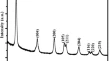
        <p>The SR-XRD 2&#952;-&#952; scans confirm the formation of Mn<sub>5</sub>Ge<sub>3</sub> nanomagnets. As shown in Figure 
<figr fid="F1">1</figr>, beside the main peaks from Ge(004), the diffraction peaks of Mn<sub>5</sub>Ge<sub>3</sub>(111), (002), (310), (222), and (004) are clearly visible. Note that, compared to the work by Ottaviano et al. 
<abbrgrp><abbr bid="B20">20</abbr></abbrgrp>, the SR-XRD reveals more Mn<sub>5</sub>Ge<sub>3</sub> peaks even for a much smaller Mn ion fluence due to the large flux of X-rays from the synchrotron source, which allows for the detection of small Mn<sub>5</sub>Ge<sub>3</sub> nanocrystals. Therefore, we have to revisit the work by Ottaviano et al<it>.</it> They concluded that Mn<sub>5</sub>Ge<sub>3</sub> nanocrystals formed by ion implantation are preferentially (002)-oriented in the Ge(001) matrix 
<abbrgrp><abbr bid="B20">20</abbr></abbrgrp>. However, Zeng et al. 
<abbrgrp><abbr bid="B10">10</abbr></abbrgrp> prepared Mn<sub>5</sub>Ge<sub>3</sub> layers by molecular beam epitaxy, and they found the crystalline orientation as Mn<sub>5</sub>Ge<sub>3</sub>(001)&#8201;&#8741;&#8201;Ge(111). The SR-XRD observations therefore led us to conclude that Mn<sub>5</sub>Ge<sub>3</sub> nanocrystals formed by Mn implantation are indeed randomly oriented inside the Ge(001) matrix, which is also supported by the magnetic properties shown later. We found nearly isotropic hysteresis loops with magnetic field along different directions. Note that in the work of Jain et al. 
<abbrgrp><abbr bid="B26">26</abbr></abbrgrp>, the Mn<sub>5</sub>Ge<sub>3</sub> nanocrystals were grown by annealing GeMn films on Ge(001) substrates prepared by MBE. Most of the Mn<sub>5</sub>Ge<sub>3</sub> clusters (97%) have their <it>c</it>-axis perpendicular to the film plane. The accumulated literature data suggest that the growth of Mn<sub>5</sub>Ge<sub>3</sub> nanocrystals from the Ge matrix is different from the Mn<sub>5</sub>Ge<sub>3</sub> thin films.</p>
        <fig id="F1"><title><p>Figure 1</p></title><caption><p>XRD 2&#952;-&#952; scans revealing the formation of Mn<sub>5</sub>Ge<sub>3</sub> nanomagnets</p></caption><text>
   <p><b>XRD 2&#952;-&#952; scans revealing the formation of Mn</b><sub><b>5</b></sub><b>Ge</b><sub><b>3</b></sub><b>nanomagnets.</b> Beside the main peaks from Ge(004), the diffraction peaks of Mn<sub>5</sub>Ge<sub>3</sub>(111), (002), (310), (222), and (004) are clearly visible.</p>
</text><graphic file="1556-276X-7-528-1"/></fig>
        <p>Figure 
<figr fid="F2">2</figr> shows cross-section TEM images of samples 1E16 and 5E16. The white contrast spots are from precipitates that are located in the depth between 20 and 120 nm, which is in agreement with the depth profile of Mn ion implantation. The average crystallite size is increased from 5 to 11 nm with increasing Mn fluences from 1&#8201;&#215;&#8201;10<sup>16</sup> to 5&#8201;&#215;&#8201;10<sup>16</sup> cm<sup>&#8722;2</sup>. For detailed analysis, we focus on the sample 5E16. As shown in Figure 
<figr fid="F2">2</figr>b, the well-defined Moir&#233; patterns are a strong indication for monocrystalline precipitates embedded in a crystalline matrix. Using high-resolution TEM, the precipitates can be identified to be Mn<sub>5</sub>Ge<sub>3</sub>, as shown in Figure 
<figr fid="F2">2</figr>c,d. Figure 
<figr fid="F2">2</figr>d is the fast Fourier transform (FFT) of the image shown in Figure 
<figr fid="F2">2</figr>c. The FFT reveals lattice spacings amounting to 0.298 nm (indicated by the open circles) and 0.623 nm (indicated by the open squares), which correspond to Mn<sub>5</sub>Ge<sub>3</sub>(111) and (001), respectively.</p>
        <fig id="F2"><title><p>Figure 2</p></title><caption><p>TEM and high-resolution TEM images of samples</p></caption><text>
   <p><b>TEM and high-resolution TEM images of samples.</b> TEM image of the cross section showing the formation of precipitates (<b>a</b>) 1E16 and (<b>b</b>) 5E16, and high-resolution TEM for an individual Mn<sub>5</sub>Ge<sub>3</sub> particle (<b>c</b>) in sample 5E16. (<b>d</b>) FFT of the precipitate indicated in (c).</p>
</text><graphic file="1556-276X-7-528-2"/></fig>
      </sec>
      <sec>
        <st>
          <p>Magnetic properties</p>
        </st>
        <p>Figure 
<figr fid="F3">3</figr>a shows the zero field-cooled and field-cooled (ZFC/FC) magnetization curves in a 50-Oe field for different Mn fluences. The FC curve for sample 1E15 completely overlaps with the corresponding ZFC curve at around zero. Magnetic Mn<sub>5</sub>Ge<sub>3</sub> nanocrystals can be excluded in this sample, which is consistent with the SR-XRD observation, except that they are very small and dilute beyond the detection limit of SR-XRD. For samples 1E16 and 5E16, a distinct difference in the ZFC/FC curves was observed. The ZFC curves show a gradual increase at low temperatures, peaking at different temperatures, while the FC curves monotonically increase with decreasing temperature. The width of the peaks in the ZFC curves is due to the size distribution of Mn<sub>5</sub>Ge<sub>3</sub> nanocrystals, as shown in the TEM images (Figure 
<figr fid="F2">2</figr>). In this paper, we take the temperature (<it>T</it><sub>max</sub>) at the maximum of the ZFC curve as the average blocking temperature listed in Table 
<tblr tid="T1">1</tblr>.</p>
        <fig id="F3"><title><p>Figure 3</p></title><caption><p>ZFC/FC magnetization and hysteresis loops</p></caption><text>
   <p><b>ZFC/FC magnetization and hysteresis loops.</b> (<b>a</b>) Magnetization curves with an applied field of 50 Oe after ZFC/FC for the Mn-implanted Ge. The lower branches are ZFC curves, while the upper branches are FC curves. With increasing fluence, the Mn<sub>5</sub>Ge<sub>3</sub> nanocrystals are growing in size, resulting in a higher blocking temperature. The curves are vertically shifted to increase the visibility. (<b>b</b>) Hysteresis loops measured at 5 K for Mn-implanted Ge with different fluence, and the inset shows the magnetization at 300 K for sample 5E16.</p>
</text><graphic file="1556-276X-7-528-3"/></fig>
        <p>Figure 
<figr fid="F3">3</figr>b shows the magnetization versus field reversal (M-H) of all samples measured at 5 K. Hysteretic behaviors were observed for samples 1E16 and 5E16. With increasing Mn concentration, the saturation magnetization is increased from 10.1 to 69.2 emu/cm<sup>3</sup> (by assuming the implanted depth of 100 nm), and the coercivity is increased from 0.22 to 0.26 T. At 300 K, sample 5E16 only shows field-induced magnetization (see the inset of Figure 
<figr fid="F3">3</figr>b). The saturation magnetization of the sample 5E16 (1E16) is 69.2 (10.1) emu/cm<sup>3</sup>, corresponding to around 1.5 (1.1) &#956;<sub>B</sub>/Mn, which is smaller than 2.6&#8201;&#177;&#8201;0.5 &#956;<sub>B</sub>/Mn as reported in the study of Bihler et al. 
<abbrgrp><abbr bid="B1">1</abbr></abbrgrp>, which means that not all of the implanted Mn ions form the ferromagnetic Mn<sub>5</sub>Ge<sub>3</sub> phase.</p>
        <p>We also compared the magnetization between the in-plane and out-of-plane directions at 5 K for sample 5E16 (not shown). In contrast to the studies of Bihler et al. 
<abbrgrp><abbr bid="B1">1</abbr></abbrgrp> and Jain et al. 
<abbrgrp><abbr bid="B8">8</abbr></abbrgrp>, there is no detectable magnetic anisotropy. For the bulk Mn<sub>5</sub>Ge<sub>3</sub>, the magnetic easy axis is [001]. The absence of magnetic anisotropy in our samples is due to the random crystallographic orientation of the Mn<sub>5</sub>Ge<sub>3</sub> nanocrystals.</p>
        <p>As shown in Figure 
<figr fid="F3">3</figr>b, the hysteresis loop is not square-like. The distribution of coercivity field is due to the size distribution of the nanomagnets, as evidenced by the TEM images, and is also possibly due to the random distribution of the nanomagnet easy axis. According to the Stoner and Wohlfarth model for single-domain magnetic nanoparticles, the maximum coercive field gives the anisotropy field <it>&#956;</it><sub>0</sub><it>H</it><sub><it>a</it>2</sub>&#8201;=&#8201;0.26 T for sample 5E16. Using the bulk saturation magnetization (<it>M</it><sub><it>S</it></sub>) for Mn<sub>5</sub>Ge<sub>3</sub> (1,100 kA/m) 
<abbrgrp><abbr bid="B26">26</abbr></abbrgrp>, one can deduce the anisotropy constant: K<sub>2</sub>&#8201;=&#8201;<it>&#956;</it><sub>0</sub><it>H</it><sub><it>a</it>2</sub><it>M</it><sub><it>S</it></sub>/2&#8201;&#8776;&#8201;1.4&#8201;&#215;&#8201;10<sup>5</sup> J/m<sup>3</sup>, which is smaller than the value reported by Jain et al<it>.</it>
<abbrgrp><abbr bid="B26">26</abbr></abbrgrp>. Based on the N&#233;el-Brown model, the volume for a nanomagnet V&#8201;=&#8201;25<it>k</it><sub>B</sub><it>T</it><sub>max</sub>/K<sub>2</sub> (<it>k</it><sub>B</sub> as the Boltzmann constant), we calculate the average diameter of Ge<sub>3</sub>Mn<sub>5</sub> clusters in sample 5E16 to be approximately 10.8 nm (<it>T</it><sub>max</sub>&#8201;<it>=</it>&#8201;270 K). The average diameter is in good agreement with the results obtained by TEM. However, the average diameter for sample 1E16 deduced from the ZFC magnetization is as large as 9.5 nm, which is much larger than the value from the TEM observation.</p>
        <p>The magnetic properties of the Mn-implanted Ge were also investigated by X-ray magnetic circular dichroism (XMCD) at Mn <it>L</it><sub>2,3</sub> edge. Right before the XAS measurements, the sample was etched in deionized water for 2 min to remove the surface oxide layer 
<abbrgrp><abbr bid="B27">27</abbr></abbrgrp>. Figure 
<figr fid="F4">4</figr>a presents the Mn <it>L</it><sub>2,3</sub> XAS measured in total electron yield mode at around 4.5 K; <it>&#956;</it>&#8201;+&#8201;and <it>&#956;</it>&#8201;&#8722;&#8201;represent the absorption intensity with the direction of magnetization parallel and antiparallel to the photon helicity, respectively. As shown in Figure 
<figr fid="F4">4</figr>a, after etching, we obtained very similar spectra as was reported for ferromagnetic Mn<sub>5</sub>Ge<sub>3</sub>
<abbrgrp><abbr bid="B28">28</abbr></abbrgrp>. The XAS spectra can be classified into the 2<it>p</it><sub>3/2</sub> (approximately 641 eV) and 2<it>p</it><sub>1/2</sub> (approximately 651 eV) absorption regions. The shape of the main feature indicates the itinerant nature of ferromagnetic Mn<sub>5</sub>Ge<sub>3</sub>. On the other hand, the weak shoulders appear at 642 and 644 eV, and the doublet structure is observed in the 2<it>p</it><sub>1/2</sub> excitation region, which could be related with some diluted Mn impurities in the Ge matrix 
<abbrgrp><abbr bid="B21">21</abbr></abbrgrp> or oxidized Mn 
<abbrgrp><abbr bid="B29">29</abbr></abbrgrp>. Figure 
<figr fid="F4">4</figr>b shows the XMCD spectrum, revealing a large negative signal (approximately 641 eV) and a small positive signal (approximately 644 eV) in the 2<it>p</it><sub>3/2</sub> region and a larger positive signal (approximately 651.5 eV) in the 2<it>p</it><sub>1/2</sub> region. Note that the shoulders and the doublet in XAS spectra are hardly resolvable in the XMCD spectrum, which indicates that the oxidized Mn ions have no contribution to the ferromagnetism. According to the sum rule, the integrated intensity of the XMCD signal in the whole region is proportional to the orbital magnetic moment relative to the spin magnetic moment. In the present XMCD spectrum, the integration is nearly zero, indicating that the orbital magnetic moment is negligible for Mn<sub>5</sub>Ge<sub>3</sub>. Comparing our experimental results with the published calculations, the electronic structure of Mn ions can be assumed to be in the 3<it>d</it><sup>6</sup> configuration without spin-orbit interaction 
<abbrgrp><abbr bid="B28">28</abbr><abbr bid="B30">30</abbr></abbrgrp>.</p>
        <fig id="F4"><title><p>Figure 4</p></title><caption><p>Mn <it>L</it><sub>2,3</sub> X-ray absorption</p></caption><text>
   <p><b>Mn </b><b><it>L</it></b><sub><b>2,3</b></sub><b>X-ray absorption.</b> (<b>a</b>) XAS for magnetization and helicity parallel (&#956;+) and antiparallel (&#956;&#8722;) and (<b>b</b>) XMCD (&#956;&#8201;+&#8201;&#8722;&#8201;&#956;&#8722;) measured at around 10 K under an external field of 6,000 Oe applied perpendicular to the surface.</p>
</text><graphic file="1556-276X-7-528-4"/></fig>
      </sec>
      <sec>
        <st>
          <p>Magnetotransport properties</p>
        </st>
        <p>All three samples show p-type conductivity and large magnetoresistance (MR) effect. Figure 
<figr fid="F5">5</figr>a shows the measurement results for sample 5E16. The MR is defined as <it>R</it>(<it>H</it>)&#8201;&#8722;&#8201;<it>R</it>(0)]&#8201;/&#8201;<it>R</it>(0), where <it>R</it>(<it>H</it>) is the sheet resistance at a field of <it>H</it>, <it>R</it>(0) is the sheet resistance at zero field. One can see that MR is positive and may saturate at a large field. Different from ferromagnetic semiconductors or metals, there is no hysteresis in MR curves for the Mn<sub>5</sub>Ge<sub>3</sub>/Ge hybrids. In this case, the spin scattering should have a very small contribution to transport. Similar positive MR effect has also been reported for GeMn-nanocolumns/Ge hybrids 
<abbrgrp><abbr bid="B15">15</abbr></abbrgrp>. Note that the Ga-doped Ge shows only the neglectable MR effect as shown in Figure 
<figr fid="F5">5</figr>a. The MR effect can be interpreted by the inhomogeneity of the sample: the different conductivity and Hall resistivity of GeMn and Ge (or Mn-rich and -poor regions). We modeled the hybrid system where Mn-rich nanoparticles were embedded in the Ge matrix by a 2D slice as in the work of Yu et al<it>.</it>
<abbrgrp><abbr bid="B31">31</abbr></abbrgrp>. Under steady-state conditions, the continuality of the current requires that 
<inline-formula><m:math name="1556-276X-7-528-i1" xmlns:m="http://www.w3.org/1998/Math/MathML"><m:mrow>
   <m:mo>&#8711;</m:mo>
   <m:mo>&#183;</m:mo>
   <m:mfenced open="[" close="]">
      <m:mrow>
         <m:mi>&#963;</m:mi>
         <m:mo>&#183;</m:mo>
         <m:mo>&#8711;</m:mo>
         <m:mi>U</m:mi>
         <m:mfenced open="(" close=")">
            <m:mrow>
               <m:mi>x</m:mi>
               <m:mo>,</m:mo>
               <m:mi>y</m:mi>
            </m:mrow>
         </m:mfenced>
      </m:mrow>
   </m:mfenced>
   <m:mo>=</m:mo>
   <m:mn>0</m:mn>
</m:mrow>
</m:math></inline-formula>, where 
<inline-formula><m:math name="1556-276X-7-528-i2" xmlns:m="http://www.w3.org/1998/Math/MathML"><m:mrow>
   <m:mi>U</m:mi>
   <m:mfenced open="(" close=")">
      <m:mrow>
         <m:mi>x</m:mi>
         <m:mo>,</m:mo>
         <m:mi>y</m:mi>
      </m:mrow>
   </m:mfenced>
</m:mrow>
</m:math></inline-formula> is the electrostatic potential at position <it>(x, y)</it> on the 2D slice. The materials were fully characterized by their conduction matrices, which vary with the position of different materials. Thus, the finite element method (FEM) proposed by Moussa et al. 
<abbrgrp><abbr bid="B32">32</abbr></abbrgrp> was used. We applied a constant potential between two electrodes and calculated the induced averaged potential difference at the other two electrodes in the geometry of the van der Pauw method. The current normal to the boundary of the slice was set to zero (the natural boundary condition). The transport properties of the matrix and nanocrystal are simple, characterized by the conductivity matrix with the components:</p>
        <p>
          <display-formula>
            <m:math name="1556-276X-7-528-i3" xmlns:m="http://www.w3.org/1998/Math/MathML"><m:mspace width="1em"/>
<m:mrow>
   <m:msub>
      <m:mi>&#963;</m:mi>
      <m:mi mathvariant="italic">xx</m:mi>
   </m:msub>
   <m:mfenced open="(" close=")">
      <m:mi>&#946;</m:mi>
   </m:mfenced>
   <m:mo>=</m:mo>
   <m:msub>
      <m:mi>&#963;</m:mi>
      <m:mi mathvariant="italic">yy</m:mi>
   </m:msub>
   <m:mfenced open="(" close=")">
      <m:mi>&#946;</m:mi>
   </m:mfenced>
   <m:mo>=</m:mo>
   <m:mfrac>
      <m:mrow>
         <m:mi>&#963;</m:mi>
         <m:mfenced open="(" close=")">
            <m:mn>0</m:mn>
         </m:mfenced>
      </m:mrow>
      <m:mfenced open="[" close="]">
         <m:mrow>
            <m:mn>1</m:mn>
            <m:mo>+</m:mo>
            <m:msup>
               <m:mi>&#946;</m:mi>
               <m:mn>2</m:mn>
            </m:msup>
         </m:mrow>
      </m:mfenced>
   </m:mfrac>
   <m:mtext>,</m:mtext>
</m:mrow>
</m:math>
          </display-formula>
        </p>
        <p>
          <display-formula>
            <m:math name="1556-276X-7-528-i4" xmlns:m="http://www.w3.org/1998/Math/MathML"><m:mspace width="1em"/>
<m:mrow>
   <m:msub>
      <m:mi>&#963;</m:mi>
      <m:mi mathvariant="italic">xy</m:mi>
   </m:msub>
   <m:mfenced open="(" close=")">
      <m:mi>&#946;</m:mi>
   </m:mfenced>
   <m:mo>=</m:mo>
   <m:mo>&#8722;</m:mo>
   <m:msub>
      <m:mi>&#963;</m:mi>
      <m:mi mathvariant="italic">yx</m:mi>
   </m:msub>
   <m:mfenced open="(" close=")">
      <m:mi>&#946;</m:mi>
   </m:mfenced>
   <m:mo>=</m:mo>
   <m:mo>&#8722;</m:mo>
   <m:mfrac>
      <m:mrow>
         <m:mi>&#963;</m:mi>
         <m:mfenced open="(" close=")">
            <m:mn>0</m:mn>
         </m:mfenced>
         <m:mi>&#946;</m:mi>
      </m:mrow>
      <m:mfenced open="[" close="]">
         <m:mrow>
            <m:mn>1</m:mn>
            <m:mo>+</m:mo>
            <m:msup>
               <m:mi>&#946;</m:mi>
               <m:mn>2</m:mn>
            </m:msup>
         </m:mrow>
      </m:mfenced>
   </m:mfrac>
   <m:mtext>,</m:mtext>
</m:mrow>
</m:math>
          </display-formula>
        </p>
        <p>where <it>&#963;</it>(0) is the zero-field conductivity and <it>&#946;</it>&#8201;=&#8201;<it>R</it><sub><it>H</it></sub><it>&#963;</it>(0)<it>&#956;</it><sub>0</sub><it>H</it>, in which <it>R</it><sub><it>H</it></sub> is the Hall coefficient of the materials and <it>&#956;</it><sub>0</sub> is the susceptibility in vacuum.</p>
        <fig id="F5"><title><p>Figure 5</p></title><caption><p>Measured MR, calculated MR, and parameters</p></caption><text>
   <p><b>Measured MR, calculated MR, and parameters.</b> (<b>a</b>) MR for sample 5E16 measured at different temperatures and the result for Ga-implanted Ge (*) is shown for comparison, (<b>b</b>) the calculated MR by considering two conductivity components, and (<b>c</b>) parameters <it>a</it> and <it>b</it> used in the FEM calculations as well as the MR data at 6 T at different temperatures.</p>
</text><graphic file="1556-276X-7-528-5"/></fig>
        <p>The material parameters of the matrix are chosen to be 
<inline-formula><m:math name="1556-276X-7-528-i5" xmlns:m="http://www.w3.org/1998/Math/MathML"><m:mrow>
   <m:mspace width="0.1em"/>
   <m:mspace width="0.1em"/>
   <m:msubsup>
      <m:mi>&#963;</m:mi>
      <m:mi>H</m:mi>
      <m:mi mathvariant="italic">Ge</m:mi>
   </m:msubsup>
   <m:mfenced open="(" close=")">
      <m:mn>0</m:mn>
   </m:mfenced>
   <m:mo>=</m:mo>
   <m:msup>
      <m:mn>10</m:mn>
      <m:mn>4</m:mn>
   </m:msup>
   <m:mi>&#937;</m:mi>
   <m:msup>
      <m:mi>m</m:mi>
      <m:mrow>
         <m:mo>&#8722;</m:mo>
         <m:mn>1</m:mn>
      </m:mrow>
   </m:msup>
</m:mrow>
</m:math></inline-formula>, 
<inline-formula><m:math name="1556-276X-7-528-i6" xmlns:m="http://www.w3.org/1998/Math/MathML"><m:mrow>
   <m:msubsup>
      <m:mi>R</m:mi>
      <m:mi>H</m:mi>
      <m:mi mathvariant="italic">Ge</m:mi>
   </m:msubsup>
   <m:mo>=</m:mo>
   <m:msup>
      <m:mn>10</m:mn>
      <m:mrow>
         <m:mo>&#8722;</m:mo>
         <m:mn>6</m:mn>
      </m:mrow>
   </m:msup>
   <m:mspace width="0.1em"/>
   <m:msup>
      <m:mi>C</m:mi>
      <m:mrow>
         <m:mo>&#8722;</m:mo>
         <m:mn>1</m:mn>
      </m:mrow>
   </m:msup>
   <m:mspace width="0.1em"/>
   <m:msup>
      <m:mi>m</m:mi>
      <m:mn>3</m:mn>
   </m:msup>
</m:mrow>
</m:math></inline-formula>. The material parameters of the nanocrystal are as follows: 
<inline-formula><m:math name="1556-276X-7-528-i7" xmlns:m="http://www.w3.org/1998/Math/MathML"><m:mrow>
   <m:msubsup>
      <m:mi>&#963;</m:mi>
      <m:mi>H</m:mi>
      <m:mi mathvariant="italic">GeMn</m:mi>
   </m:msubsup>
   <m:mfenced open="(" close=")">
      <m:mn>0</m:mn>
   </m:mfenced>
   <m:mo>=</m:mo>
   <m:mi>a</m:mi>
   <m:msubsup>
      <m:mi>&#963;</m:mi>
      <m:mi>H</m:mi>
      <m:mi mathvariant="italic">Ge</m:mi>
   </m:msubsup>
   <m:mfenced open="(" close=")">
      <m:mn>0</m:mn>
   </m:mfenced>
</m:mrow>
</m:math></inline-formula> and 
<inline-formula><m:math name="1556-276X-7-528-i8" xmlns:m="http://www.w3.org/1998/Math/MathML"><m:mrow>
   <m:msubsup>
      <m:mi>R</m:mi>
      <m:mi>H</m:mi>
      <m:mi mathvariant="italic">GeMn</m:mi>
   </m:msubsup>
   <m:mo>=</m:mo>
   <m:mi>b</m:mi>
   <m:msubsup>
      <m:mi>R</m:mi>
      <m:mi>H</m:mi>
      <m:mi mathvariant="italic">Ge</m:mi>
   </m:msubsup>
</m:mrow>
</m:math></inline-formula>. There are two free parameters <it>a</it> and <it>b</it> which are the ratios of conductivity and Hall coefficient of the two phases, respectively. Both the conductivity and the Hall coefficient are functions of temperature. The resistance of the system is calculated by FEM where a constant current is applied and the corresponding voltages are measured in the geometry of the van der Pauw method. The calculated curves are presented in Figure 
<figr fid="F5">5</figr>b. The experimental MR curves can be well reproduced by FEM calculations. The <it>a</it> and <it>b</it> values used in the FEM calculations are shown in Figure 
<figr fid="F5">5</figr>c. The MR magnitude is sensitive to the ratio of conductivity of the two constitutes. Beside the magnetoresistance, the samples also show anomalous Hall resistance (i.e., the Hall resistance deviates from a linear behavior), which can be explained by two kinds of carriers with different mobilities 
<abbrgrp><abbr bid="B33">33</abbr></abbrgrp>. On the other hand, we have to note the rather large discrepancy in the MR magnitude between the experimental and modeled values. In the model, for simplifying, we neglect the anomalous Hall effect in the GeMn constitute, which may induce this discrepancy. Also, in order to account non-monotonic dependence of MR on temperature (see Figure 
<figr fid="F5">5</figr>c), we have to vary parameters <it>a</it> and <it>b</it> accordingly. The decrease of <it>a</it> and <it>b</it> at temperature below 50 K cannot be understood and is the aim for the future work.</p>
      </sec>
    </sec>
    <sec>
      <st>
        <p>Conclusions</p>
      </st>
      <p>We have prepared magnetic Mn<sub>5</sub>Ge<sub>3</sub> nanocrystals embedded inside the Ge matrix by Mn ion implantation into Ge substrates. The crystalline size of Mn<sub>5</sub>Ge<sub>3</sub> can be tuned by varying the Mn fluence. The Mn ions in Mn<sub>5</sub>Ge<sub>3</sub> nanocrystals are in the 3<it>d</it><sup>6</sup> configuration. Large positive magnetoresistance has been observed in the Mn<sub>5</sub>Ge<sub>3</sub>/Ge hybrid system. It could be due to the inhomogeneity in samples with constitutes having different transport properties.</p>
    </sec>
    <sec>
      <st>
        <p>Competing interests</p>
      </st>
      <p>The authors declare that they have no competing interests.</p>
    </sec>
    <sec>
      <st>
        <p>Authors&#8217; contributions</p>
      </st>
      <p>SZ designed the experiments and wrote the manuscript. WXZ and ZH made fittings for the magnetoresistance data. AS performed the XRD measurement. YW carried out the XMCD and XAS measurements. DB and HS helped during magneto-transport measurement. AM performed the TEM characterization. WLZ supervised the fitting of the magnetoresistance data. MH supervised the whole work. All authors read and approved the final manuscript.</p>
    </sec>
  </bdy>
  <bm>
    <ack>
      <sec>
        <st>
          <p>Acknowledgments</p>
        </st>
        <p>The work was supported by the Helmholtz-Gemeinschaft Deutscher Forschungszentren (HGF-VH-NG-713) and by the International Science and Technology Cooperation Program of China (2012DFA51430). Heidemarie Schmidt thanks the financial support from DFG SCHM1663/4-1.</p>
      </sec>
    </ack>
    <refgrp><bibl id="B1"><title><p>Structural and magnetic properties of Mn5Ge3 clusters in a dilute magnetic germanium matrix</p></title><aug><au><snm>Bihler</snm><fnm>C</fnm></au><au><snm>Jaeger</snm><fnm>C</fnm></au><au><snm>Vallaitis</snm><fnm>T</fnm></au><au><snm>Gjukic</snm><fnm>M</fnm></au><au><snm>Brandt</snm><fnm>MS</fnm></au><au><snm>Pippel</snm><fnm>E</fnm></au><au><snm>Woltersdorf</snm><fnm>J</fnm></au><au><snm>Gosele</snm><fnm>U</fnm></au></aug><source>Appl Phys Lett</source><pubdate>2006</pubdate><volume>88</volume><fpage>112506</fpage><xrefbib><pubid idtype="doi">10.1063/1.2185448</pubid></xrefbib></bibl><bibl id="B2"><title><p>Magnetic and structural properties of GexMn1&#8722;x films: precipitation of intermetallic nanomagnets</p></title><aug><au><snm>Ahlers</snm><fnm>S</fnm></au><au><snm>Bougeard</snm><fnm>D</fnm></au><au><snm>Sircar</snm><fnm>N</fnm></au><au><snm>Abstreiter</snm><fnm>G</fnm></au><au><snm>Trampert</snm><fnm>A</fnm></au><au><snm>Opel</snm><fnm>M</fnm></au><au><snm>Gross</snm><fnm>R</fnm></au></aug><source>Physical Review B</source><pubdate>2006</pubdate><volume>74</volume><fpage>214411</fpage></bibl><bibl id="B3"><title><p>Growth of ferromagnetic nanoparticles in a diluted magnetic semiconductor obtained by Mn+ implantation on Ge single crystals</p></title><aug><au><snm>Passacantando</snm><fnm>M</fnm></au><au><snm>Ottaviano</snm><fnm>L</fnm></au><au><snm>D&#8217;Orazio</snm><fnm>F</fnm></au><au><snm>Lucari</snm><fnm>F</fnm></au><au><snm>De Biase</snm><fnm>M</fnm></au><au><snm>Impellizzeri</snm><fnm>G</fnm></au><au><snm>Priolo</snm><fnm>F</fnm></au></aug><source>Physical Review B</source><pubdate>2006</pubdate><volume>73</volume><fpage>195207</fpage></bibl><bibl id="B4"><title><p>Direct structural evidences of Mn11Ge8 and Mn5Ge2 clusters in Ge0.96Mn0.04 thin films</p></title><aug><au><snm>Wang</snm><fnm>Y</fnm></au><au><snm>Zou</snm><fnm>J</fnm></au><au><snm>Zhao</snm><fnm>Z</fnm></au><au><snm>Han</snm><fnm>X</fnm></au><au><snm>Zhou</snm><fnm>X</fnm></au><au><snm>Wang</snm><fnm>KL</fnm></au></aug><source>Appl Phys Lett</source><pubdate>2008</pubdate><volume>92</volume><fpage>101913</fpage><xrefbib><pubid idtype="doi">10.1063/1.2884527</pubid></xrefbib></bibl><bibl id="B5"><title><p>Structure and magnetism of self-organized Ge1&#8722;xMnx nanocolumns on Ge(001)</p></title><aug><au><snm>Devillers</snm><fnm>T</fnm></au><au><snm>Jamet</snm><fnm>M</fnm></au><au><snm>Barski</snm><fnm>A</fnm></au><au><snm>Poydenot</snm><fnm>V</fnm></au><au><snm>Bayle-Guillemaud</snm><fnm>P</fnm></au><au><snm>Bellet-Amalric</snm><fnm>E</fnm></au><au><snm>Cherifi</snm><fnm>S</fnm></au><au><snm>Cibert</snm><fnm>J</fnm></au></aug><source>Physical Review B</source><pubdate>2007</pubdate><volume>76</volume><fpage>205306</fpage></bibl><bibl id="B6"><title><p>Mn0.06Ge0.94 diluted magnetic semiconductor epitaxially grown on Ge(001): influence of Mn5Ge3 nanoscopic clusters on the electronic and magnetic properties</p></title><aug><au><snm>De Padova</snm><fnm>P</fnm></au><au><snm>Ayoub</snm><fnm>JP</fnm></au><au><snm>Berbezier</snm><fnm>I</fnm></au><au><snm>Perfetti</snm><fnm>P</fnm></au><au><snm>Quaresima</snm><fnm>C</fnm></au><au><snm>Testa</snm><fnm>AM</fnm></au><au><snm>Fiorani</snm><fnm>D</fnm></au><au><snm>Olivieri</snm><fnm>B</fnm></au><au><snm>Mariot</snm><fnm>JM</fnm></au><au><snm>Taleb-Ibrahimi</snm><fnm>A</fnm></au><au><snm>Richter</snm><fnm>MC</fnm></au><au><snm>Heckmann</snm><fnm>O</fnm></au><au><snm>Hricovini</snm><fnm>K</fnm></au></aug><source>Physical Review B</source><pubdate>2008</pubdate><volume>77</volume><fpage>045203</fpage></bibl><bibl id="B7"><title><p>First-principles characterization of ferromagnetic Mn5Ge3 for spintronic applications</p></title><aug><au><snm>Picozzi</snm><fnm>S</fnm></au><au><snm>Continenza</snm><fnm>A</fnm></au><au><snm>Freeman</snm><fnm>AJ</fnm></au></aug><source>Physical Review B</source><pubdate>2004</pubdate><volume>70</volume><fpage>235205</fpage></bibl><bibl id="B8"><title><p>Electrical spin injection and detection at Al2O3/n-type germanium interface using three terminal geometry</p></title><aug><au><snm>Jain</snm><fnm>A</fnm></au><au><snm>Louahadj</snm><fnm>L</fnm></au><au><snm>Peiro</snm><fnm>J</fnm></au><au><snm>Le Breton</snm><fnm>JC</fnm></au><au><snm>Vergnaud</snm><fnm>C</fnm></au><au><snm>Barski</snm><fnm>A</fnm></au><au><snm>Beigne</snm><fnm>C</fnm></au><au><snm>Notin</snm><fnm>L</fnm></au><au><snm>Marty</snm><fnm>A</fnm></au><au><snm>Baltz</snm><fnm>V</fnm></au><au><snm>Auffret</snm><fnm>S</fnm></au><au><snm>Augendre</snm><fnm>E</fnm></au><au><snm>Jaffr&#232;s</snm><fnm>H</fnm></au><au><snm>George</snm><fnm>JM</fnm></au><au><snm>Jamet</snm><fnm>M</fnm></au></aug><source>Appl Phys Lett</source><pubdate>2011</pubdate><volume>99</volume><fpage>162102</fpage><lpage>162103</lpage><xrefbib><pubid idtype="doi">10.1063/1.3652757</pubid></xrefbib></bibl><bibl id="B9"><title><p>Electrical and thermal spin accumulation in germanium</p></title><aug><au><snm>Jain</snm><fnm>A</fnm></au><au><snm>Vergnaud</snm><fnm>C</fnm></au><au><snm>Peiro</snm><fnm>J</fnm></au><au><snm>Le Breton</snm><fnm>JC</fnm></au><au><snm>Prestat</snm><fnm>E</fnm></au><au><snm>Louahadj</snm><fnm>L</fnm></au><au><snm>Portemont</snm><fnm>C</fnm></au><au><snm>Ducruet</snm><fnm>C</fnm></au><au><snm>Baltz</snm><fnm>V</fnm></au><au><snm>Marty</snm><fnm>A</fnm></au><au><snm>Barski</snm><fnm>A</fnm></au><au><snm>Bayle-Guillemaud</snm><fnm>P</fnm></au><au><snm>Vila</snm><fnm>L</fnm></au><au><snm>Attan&#233;</snm><fnm>JP</fnm></au><au><snm>Augendre</snm><fnm>E</fnm></au><au><snm>Jaffr&#232;s</snm><fnm>H</fnm></au><au><snm>George</snm><fnm>JM</fnm></au><au><snm>Jamet</snm><fnm>M</fnm></au></aug><source>Appl Phys Lett</source><pubdate>2012</pubdate><volume>101</volume><fpage>022402</fpage><lpage>022404</lpage><xrefbib><pubid idtype="doi">10.1063/1.4733620</pubid></xrefbib></bibl><bibl id="B10"><title><p>Epitaxial ferromagnetic Mn5Ge3 on Ge(111)</p></title><aug><au><snm>Zeng</snm><fnm>C</fnm></au><au><snm>Erwin</snm><fnm>SC</fnm></au><au><snm>Feldman</snm><fnm>LC</fnm></au><au><snm>Li</snm><fnm>AP</fnm></au><au><snm>Jin</snm><fnm>R</fnm></au><au><snm>Song</snm><fnm>Y</fnm></au><au><snm>Thompson</snm><fnm>JR</fnm></au><au><snm>Weitering</snm><fnm>HH</fnm></au></aug><source>Appl Phys Lett</source><pubdate>2003</pubdate><volume>83</volume><fpage>5002</fpage><lpage>5004</lpage><xrefbib><pubid idtype="doi">10.1063/1.1633684</pubid></xrefbib></bibl><bibl id="B11"><title><p>Linear magnetization dependence of the intrinsic anomalous Hall effect</p></title><aug><au><snm>Zeng</snm><fnm>C</fnm></au><au><snm>Yao</snm><fnm>Y</fnm></au><au><snm>Niu</snm><fnm>Q</fnm></au><au><snm>Weitering</snm><fnm>HH</fnm></au></aug><source>Phys Rev Lett</source><pubdate>2006</pubdate><volume>96</volume><fpage>037204</fpage><xrefbib><pubid idtype="pmpid" link="fulltext">16486762</pubid></xrefbib></bibl><bibl id="B12"><title><p>Epitaxial Mn5Ge3 nano-islands on a Ge(001) surface</p></title><aug><au><snm>Kim</snm><fnm>H</fnm></au><au><snm>Jung</snm><fnm>G-E</fnm></au><au><snm>Lim</snm><fnm>J-H</fnm></au><au><snm>Chung</snm><fnm>KH</fnm></au><au><snm>Kahng</snm><fnm>S-J</fnm></au><au><snm>Son</snm><fnm>W-j</fnm></au><au><snm>Han</snm><fnm>S</fnm></au></aug><source>Nanotechnology</source><pubdate>2008</pubdate><volume>19</volume><fpage>025707</fpage><xrefbib><pubidlist><pubid idtype="doi">10.1088/0957-4484/19/02/025707</pubid><pubid idtype="pmpid" link="fulltext">21817556</pubid></pubidlist></xrefbib></bibl><bibl id="B13"><title><p>Control of magnetic properties of epitaxial Mn5Ge3Cx films induced by carbon doping</p></title><aug><au><snm>Spiesser</snm><fnm>A</fnm></au><au><snm>Slipukhina</snm><fnm>I</fnm></au><au><snm>Dau</snm><fnm>MT</fnm></au><au><snm>Arras</snm><fnm>E</fnm></au><au><snm>Le Thanh</snm><fnm>V</fnm></au><au><snm>Michez</snm><fnm>L</fnm></au><au><snm>Pochet</snm><fnm>P</fnm></au><au><snm>Saito</snm><fnm>H</fnm></au><au><snm>Yuasa</snm><fnm>S</fnm></au><au><snm>Jamet</snm><fnm>M</fnm></au><au><snm>Derrien</snm><fnm>J</fnm></au></aug><source>Physical Review B</source><pubdate>2011</pubdate><volume>84</volume><fpage>165203</fpage></bibl><bibl id="B14"><title><p>Investigation of magnetic anisotropy of (Ge, Mn) nanocolumns</p></title><aug><au><snm>Jain</snm><fnm>A</fnm></au><au><snm>Jamet</snm><fnm>M</fnm></au><au><snm>Barski</snm><fnm>A</fnm></au><au><snm>Devillers</snm><fnm>T</fnm></au><au><snm>Porret</snm><fnm>C</fnm></au><au><snm>Bayle-Guillemaud</snm><fnm>P</fnm></au><au><snm>Gambarelli</snm><fnm>S</fnm></au><au><snm>Maurel</snm><fnm>V</fnm></au><au><snm>Desfonds</snm><fnm>G</fnm></au></aug><source>Appl Phys Lett</source><pubdate>2010</pubdate><volume>97</volume><fpage>202502</fpage><lpage>202503</lpage><xrefbib><pubid idtype="doi">10.1063/1.3505501</pubid></xrefbib></bibl><bibl id="B15"><title><p>High-Curie-temperature ferromagnetism in self-organized Ge1&#8722;xMnx nanocolumns</p></title><aug><au><snm>Jamet</snm><fnm>M</fnm></au><au><snm>Barski</snm><fnm>A</fnm></au><au><snm>Devillers</snm><fnm>T</fnm></au><au><snm>Poydenot</snm><fnm>V</fnm></au><au><snm>Dujardin</snm><fnm>R</fnm></au><au><snm>Bayle-Guillemaud</snm><fnm>P</fnm></au><au><snm>Rothman</snm><fnm>J</fnm></au><au><snm>Bellet-Amalric</snm><fnm>E</fnm></au><au><snm>Marty</snm><fnm>A</fnm></au><au><snm>Cibert</snm><fnm>J</fnm></au><au><snm>Mattana</snm><fnm>R</fnm></au><au><snm>Tatarenko</snm><fnm>S</fnm></au></aug><source>Nat Mater</source><pubdate>2006</pubdate><volume>5</volume><fpage>653</fpage><lpage>659</lpage><xrefbib><pubidlist><pubid idtype="doi">10.1038/nmat1686</pubid><pubid idtype="pmpid" link="fulltext">16845420</pubid></pubidlist></xrefbib></bibl><bibl id="B16"><title><p>Clustering in a precipitate-free GeMn magnetic semiconductor</p></title><aug><au><snm>Bougeard</snm><fnm>D</fnm></au><au><snm>Ahlers</snm><fnm>S</fnm></au><au><snm>Trampert</snm><fnm>A</fnm></au><au><snm>Sircar</snm><fnm>N</fnm></au><au><snm>Abstreiter</snm><fnm>G</fnm></au></aug><source>Phys Rev Lett</source><pubdate>2006</pubdate><volume>97</volume><fpage>237202</fpage><xrefbib><pubid idtype="pmpid" link="fulltext">17280238</pubid></xrefbib></bibl><bibl id="B17"><title><p>Dopant segregation and giant magnetoresistance in manganese-doped germanium</p></title><aug><au><snm>Li</snm><fnm>AP</fnm></au><au><snm>Zeng</snm><fnm>C</fnm></au><au><snm>van Benthem</snm><fnm>K</fnm></au><au><snm>Chisholm</snm><fnm>MF</fnm></au><au><snm>Shen</snm><fnm>J</fnm></au><au><snm>Nageswara Rao</snm><fnm>SVS</fnm></au><au><snm>Dixit</snm><fnm>SK</fnm></au><au><snm>Feldman</snm><fnm>LC</fnm></au><au><snm>Petukhov</snm><fnm>AG</fnm></au><au><snm>Foygel</snm><fnm>M</fnm></au><au><snm>Weitering</snm><fnm>HH</fnm></au></aug><source>Physical Review B</source><pubdate>2007</pubdate><volume>75</volume><fpage>201201</fpage></bibl><bibl id="B18"><title><p>Electric-field-controlled ferromagnetism in high-Curie-temperature Mn0.05Ge0.95 quantum dots</p></title><aug><au><snm>Xiu</snm><fnm>F</fnm></au><au><snm>Wang</snm><fnm>Y</fnm></au><au><snm>Kim</snm><fnm>J</fnm></au><au><snm>Hong</snm><fnm>A</fnm></au><au><snm>Tang</snm><fnm>J</fnm></au><au><snm>Jacob</snm><fnm>AP</fnm></au><au><snm>Zou</snm><fnm>J</fnm></au><au><snm>Wang</snm><fnm>KL</fnm></au></aug><source>Nat Mater</source><pubdate>2010</pubdate><volume>9</volume><fpage>337</fpage><lpage>344</lpage><xrefbib><pubidlist><pubid idtype="doi">10.1038/nmat2716</pubid><pubid idtype="pmpid" link="fulltext">20208524</pubid></pubidlist></xrefbib></bibl><bibl id="B19"><title><p>Coherent magnetic semiconductor nanodot arrays</p></title><aug><au><snm>Wang</snm><fnm>Y</fnm></au><au><snm>Xiu</snm><fnm>FX</fnm></au><au><snm>Zou</snm><fnm>J</fnm></au><au><snm>Beyermann</snm><fnm>WP</fnm></au><au><snm>Zhou</snm><fnm>Y</fnm></au><au><snm>Wang</snm><fnm>KL</fnm></au></aug><source>Nanoscale Res Lett</source><pubdate>2011</pubdate><volume>6</volume><fpage>134</fpage><xrefbib><pubidlist><pubid idtype="pmcid">3211181</pubid><pubid idtype="pmpid" link="fulltext">21711627</pubid></pubidlist></xrefbib></bibl><bibl id="B20"><title><p>Phase separation and dilution in implanted MnxGe1&#8722;x alloys</p></title><aug><au><snm>Ottaviano</snm><fnm>L</fnm></au><au><snm>Passacantando</snm><fnm>M</fnm></au><au><snm>Picozzi</snm><fnm>S</fnm></au><au><snm>Continenza</snm><fnm>A</fnm></au><au><snm>Gunnella</snm><fnm>R</fnm></au><au><snm>Verna</snm><fnm>A</fnm></au><au><snm>Bihlmayer</snm><fnm>G</fnm></au><au><snm>Impellizzeri</snm><fnm>G</fnm></au><au><snm>Priolo</snm><fnm>F</fnm></au></aug><source>Appl Phys Lett</source><pubdate>2006</pubdate><volume>88</volume><fpage>061907</fpage><xrefbib><pubid idtype="doi">10.1063/1.2171485</pubid></xrefbib></bibl><bibl id="B21"><title><p>Mn L2,3 x-ray absorption spectra of a diluted Mn&#8211;Ge alloy</p></title><aug><au><snm>Ottaviano</snm><fnm>L</fnm></au><au><snm>Passacantando</snm><fnm>M</fnm></au><au><snm>Verna</snm><fnm>A</fnm></au><au><snm>D&#8217;Amico</snm><fnm>F</fnm></au><au><snm>Gunnella</snm><fnm>R</fnm></au></aug><source>Appl Phys Lett</source><pubdate>2007</pubdate><volume>90</volume><fpage>242105</fpage><xrefbib><pubid idtype="doi">10.1063/1.2746063</pubid></xrefbib></bibl><bibl id="B22"><title><p>Memory effect of Mn5Ge3 nanomagnets embedded inside a Mn-diluted Ge matrix</p></title><aug><au><snm>Zhou</snm><fnm>S</fnm></au><au><snm>Shalimov</snm><fnm>A</fnm></au><au><snm>Potzger</snm><fnm>K</fnm></au><au><snm>Jeutter</snm><fnm>NM</fnm></au><au><snm>Baehtz</snm><fnm>C</fnm></au><au><snm>Helm</snm><fnm>M</fnm></au><au><snm>Fassbender</snm><fnm>J</fnm></au><au><snm>Schmidt</snm><fnm>H</fnm></au></aug><source>Appl Phys Lett</source><pubdate>2009</pubdate><volume>95</volume><fpage>192505</fpage><xrefbib><pubid idtype="doi">10.1063/1.3264076</pubid></xrefbib></bibl><bibl id="B23"><title><p>The importance of hole concentration in establishing carrier-mediated ferromagnetism in Mn doped Ge</p></title><aug><au><snm>Zhou</snm><fnm>S</fnm></au><au><snm>Burger</snm><fnm>D</fnm></au><au><snm>Skorupa</snm><fnm>W</fnm></au><au><snm>Oesterlin</snm><fnm>P</fnm></au><au><snm>Helm</snm><fnm>M</fnm></au><au><snm>Schmidt</snm><fnm>H</fnm></au></aug><source>Appl Phys Lett</source><pubdate>2010</pubdate><volume>96</volume><fpage>202105</fpage><xrefbib><pubid idtype="doi">10.1063/1.3428770</pubid></xrefbib></bibl><bibl id="B24"><title><p>Hysteretic anomalous Hall effect in a ferromagnetic</p></title><aug><au><snm>Burger</snm><fnm>D</fnm></au><au><snm>Zhou</snm><fnm>S</fnm></au><au><snm>Howler</snm><fnm>M</fnm></au><au><snm>Ou</snm><fnm>X</fnm></au><au><snm>Kovacs</snm><fnm>GJ</fnm></au><au><snm>Reuther</snm><fnm>H</fnm></au><au><snm>Mucklich</snm><fnm>A</fnm></au><au><snm>Skorupa</snm><fnm>W</fnm></au><au><snm>Helm</snm><fnm>M</fnm></au><au><snm>Schmidt</snm><fnm>H</fnm></au></aug><source>Mn-rich Ge:Mn nanonet. Appl Phys Lett</source><pubdate>2012</pubdate><volume>100</volume><fpage>012406</fpage></bibl><bibl id="B25"><title><p>Magnetic order by C-ion implantation into Mn5Si3 and Mn5Ge3 and its lateral modification</p></title><aug><au><snm>Surgers</snm><fnm>C</fnm></au><au><snm>Potzger</snm><fnm>K</fnm></au><au><snm>Strache</snm><fnm>T</fnm></au><au><snm>Moller</snm><fnm>W</fnm></au><au><snm>Fischer</snm><fnm>G</fnm></au><au><snm>Joshi</snm><fnm>N</fnm></au><au><snm>Lohneysen</snm><fnm>H</fnm></au></aug><source>Appl Phys Lett</source><pubdate>2008</pubdate><volume>93</volume><fpage>062503</fpage><xrefbib><pubid idtype="doi">10.1063/1.2969403</pubid></xrefbib></bibl><bibl id="B26"><title><p>Structure and magnetism of Ge3Mn5 clusters</p></title><aug><au><snm>Jain</snm><fnm>A</fnm></au><au><snm>Jamet</snm><fnm>M</fnm></au><au><snm>Barski</snm><fnm>A</fnm></au><au><snm>Devillers</snm><fnm>T</fnm></au><au><snm>Yu</snm><fnm>IS</fnm></au><au><snm>Porret</snm><fnm>C</fnm></au><au><snm>Bayle-Guillemaud</snm><fnm>P</fnm></au><au><snm>Favre-Nicolin</snm><fnm>V</fnm></au><au><snm>Gambarelli</snm><fnm>S</fnm></au><au><snm>Maurel</snm><fnm>V</fnm></au><au><snm>Desfonds</snm><fnm>G</fnm></au><au><snm>Jacquot</snm><fnm>JF</fnm></au><au><snm>Tardif</snm><fnm>S</fnm></au></aug><source>J Appl Phys</source><pubdate>2011</pubdate><volume>109</volume><fpage>013911</fpage><lpage>013914</lpage><xrefbib><pubid idtype="doi">10.1063/1.3531222</pubid></xrefbib></bibl><bibl id="B27"><title><p>Comparison of the magnetic properties of GeMn thin films through Mn L-edge x-ray absorption</p></title><aug><au><snm>Ahlers</snm><fnm>S</fnm></au><au><snm>Stone</snm><fnm>PR</fnm></au><au><snm>Sircar</snm><fnm>N</fnm></au><au><snm>Arenholz</snm><fnm>E</fnm></au><au><snm>Dubon</snm><fnm>OD</fnm></au><au><snm>Bougeard</snm><fnm>D</fnm></au></aug><source>Appl Phys Lett</source><pubdate>2009</pubdate><volume>95</volume><fpage>151911</fpage><xrefbib><pubid idtype="doi">10.1063/1.3232245</pubid></xrefbib></bibl><bibl id="B28"><title><p>Mn 2p&#8211;3d soft X-ray magnetic circular dichroism study of Mn5Ge3</p></title><aug><au><snm>Hirai</snm><fnm>C</fnm></au><au><snm>Sato</snm><fnm>H</fnm></au><au><snm>Kimura</snm><fnm>A</fnm></au><au><snm>Yaji</snm><fnm>K</fnm></au><au><snm>Iori</snm><fnm>K</fnm></au><au><snm>Taniguchi</snm><fnm>M</fnm></au><au><snm>Hiraoka</snm><fnm>K</fnm></au><au><snm>Muro</snm><fnm>T</fnm></au><au><snm>Tanaka</snm><fnm>A</fnm></au></aug><source>Physica B</source><pubdate>2004</pubdate><volume>351</volume><fpage>341</fpage><lpage>343</lpage><xrefbib><pubid idtype="doi">10.1016/j.physb.2004.06.048</pubid></xrefbib></bibl><bibl id="B29"><title><p>Exchange bias in GeMn nanocolumns: the role of surface oxidation</p></title><aug><au><snm>Tardif</snm><fnm>S</fnm></au><au><snm>Cherifi</snm><fnm>S</fnm></au><au><snm>Jamet</snm><fnm>M</fnm></au><au><snm>Devillers</snm><fnm>T</fnm></au><au><snm>Barski</snm><fnm>A</fnm></au><au><snm>Schmitz</snm><fnm>D</fnm></au><au><snm>Darowski</snm><fnm>N</fnm></au><au><snm>Thakur</snm><fnm>P</fnm></au><au><snm>Cezar</snm><fnm>JC</fnm></au><au><snm>Brookes</snm><fnm>NB</fnm></au><au><snm>Mattana</snm><fnm>R</fnm></au><au><snm>Cibert</snm><fnm>J</fnm></au></aug><source>Appl Phys Lett</source><pubdate>2010</pubdate><volume>97</volume><fpage>062501</fpage><lpage>062503</lpage><xrefbib><pubid idtype="doi">10.1063/1.3476343</pubid></xrefbib></bibl><bibl id="B30"><title><p>Atomic approach to core-level spectroscopy of delocalized systems: case of ferromagnetic metallic Mn5Ge3</p></title><aug><au><snm>Sangaletti</snm><fnm>L</fnm></au><au><snm>Drera</snm><fnm>G</fnm></au><au><snm>Magnano</snm><fnm>E</fnm></au><au><snm>Bondino</snm><fnm>F</fnm></au><au><snm>Cepek</snm><fnm>C</fnm></au><au><snm>Sepe</snm><fnm>A</fnm></au><au><snm>Goldoni</snm><fnm>A</fnm></au></aug><source>Physical Review B</source><pubdate>2010</pubdate><volume>81</volume><fpage>085204</fpage></bibl><bibl id="B31"><title><p>Modeling magnetotransport in inhomogeneous (Ge, Mn) films</p></title><aug><au><snm>Yu</snm><fnm>I-S</fnm></au><au><snm>Jamet</snm><fnm>M</fnm></au><au><snm>Marty</snm><fnm>A</fnm></au><au><snm>Devillers</snm><fnm>T</fnm></au><au><snm>Barski</snm><fnm>A</fnm></au><au><snm>Beigne</snm><fnm>C</fnm></au><au><snm>Bayle-Guillemaud</snm><fnm>P</fnm></au><au><snm>Cibert</snm><fnm>J</fnm></au></aug><source>J Appl Phys</source><pubdate>2011</pubdate><volume>109</volume><fpage>123906</fpage><xrefbib><pubid idtype="doi">10.1063/1.3596575</pubid></xrefbib></bibl><bibl id="B32"><title><p>Finite-element modeling of extraordinary magnetoresistance in thin film semiconductors with metallic inclusions</p></title><aug><au><snm>Moussa</snm><fnm>J</fnm></au><au><snm>Ram-Mohan</snm><fnm>LR</fnm></au><au><snm>Sullivan</snm><fnm>J</fnm></au><au><snm>Zhou</snm><fnm>T</fnm></au><au><snm>Hines</snm><fnm>DR</fnm></au><au><snm>Solin</snm><fnm>SA</fnm></au></aug><source>Physical Review B</source><pubdate>2001</pubdate><volume>64</volume><fpage>184410</fpage></bibl><bibl id="B33"><title><p>Anomalous Hall resistance in Ge:Mn systems with low Mn concentrations</p></title><aug><au><snm>Zhou</snm><fnm>S</fnm></au><au><snm>Burger</snm><fnm>D</fnm></au><au><snm>Helm</snm><fnm>M</fnm></au><au><snm>Schmidt</snm><fnm>H</fnm></au></aug><source>Appl Phys Lett</source><pubdate>2009</pubdate><volume>95</volume><fpage>172103</fpage><xrefbib><pubid idtype="doi">10.1063/1.3257363</pubid></xrefbib></bibl></refgrp>
  </bm>
</art>