<?xml version='1.0'?>
<!DOCTYPE art SYSTEM 'http://www.biomedcentral.com/xml/article.dtd'>
<art>
	<ui>1556-276X-7-505</ui>
	<ji>1556-276X</ji>
	<fm>
		<dochead>Nano Express</dochead>
		<bibl>
			<title>
				<p>Preparation of bismuth nanowire encased in quartz template for Hall measurements using focused ion beam processing</p>
			</title>
			<aug>
				<au id="A1" ca="yes"><snm>Murata</snm><fnm>Masayuki</fnm><insr iid="I1"/><insr iid="I4"/><email>murata@env.saitama-u.ac.jp</email></au>
				<au id="A2"><snm>Hasegawa</snm><fnm>Yasuhiro</fnm><insr iid="I1"/><email>hasegawa@mail.saitama-u.ac.jp</email></au>
				<au id="A3"><snm>Komine</snm><fnm>Takashi</fnm><insr iid="I2"/><email>komine@mx.ibaraki.ac.jp</email></au>
				<au id="A4"><snm>Kobayashi</snm><fnm>Tomohiro</fnm><insr iid="I3"/><email>t-koba@riken.jp</email></au>
			</aug>
			<insg>
				<ins id="I1"><p>Saitama University, 255 Shimo-Okubo, Sakura-ku, Saitama, 338-8570, Japan</p></ins>
				<ins id="I2"><p>Ibaraki University, 4-12-1 Nakanarusawa, Hitachi, Ibaraki, 316-8511, Japan</p></ins>
				<ins id="I3"><p>RIKEN, 2-1 Hirosawa, Wako, Saitama, 351-0198, Japan</p></ins>
				<ins id="I4"><p>Japan Society for the Promotion of Science (JSPS), Sumitomo-Ichibancho FS Bldg., 8 Ichibancho, Chiyoda-ku, Tokyo, 102-8472, Japan</p></ins>
			</insg>
			<source>Nanoscale Research Letters</source>
			<section><title><p>Regular submissions</p></title></section><issn>1556-276X</issn>
			<pubdate>2012</pubdate>
			<volume>7</volume>
			<issue>1</issue>
			<fpage>505</fpage>
			<url>http://www.nanoscalereslett.com/content/7/1/505</url>
			<xrefbib><pubidlist><pubid idtype="doi">10.1186/1556-276X-7-505</pubid><pubid idtype="pmpid">22958335</pubid></pubidlist></xrefbib>
		</bibl>
		<history><rec><date><day>13</day><month>8</month><year>2012</year></date></rec><acc><date><day>2</day><month>9</month><year>2012</year></date></acc><pub><date><day>7</day><month>9</month><year>2012</year></date></pub></history>
		<cpyrt><year>2012</year><collab>Murata et al.; licensee Springer.</collab><note>This is an Open Access article distributed under the terms of the Creative Commons Attribution License (<url>http://creativecommons.org/licenses/by/2.0</url>), which permits unrestricted use, distribution, and reproduction in any medium, provided the original work is properly cited.</note></cpyrt>
		<kwdg>
			<kwd>Bismuth nanowire</kwd>
			<kwd>Hall measurement</kwd>
			<kwd>focused ion beam</kwd>
			<kwd>thermoelectrics</kwd>
			<kwd>81.07.Gf</kwd>
		</kwdg>
		<abs>
			<sec>
				<st>
					<p>Abstract</p>
				</st><p>Forming electrodes on opposite sides of an individual bismuth nanowire was attempted to prepare for Hall measurements. Although a 1-mm-long bismuth nanowire which is completely covered with a quartz template has been successfully fabricated to prevent oxidation, it is very difficult to attach Hall electrodes on the opposite sides of the nanowire due to the quartz covering. One side of the cylindrical quartz template was removed by polishing without exposure of the nanowire to the atmosphere; the thickness between the polished template surface and the nanowire was estimated to be several micrometers. Focused ion beam processing was successfully employed to expose both surfaces of the nanowire under high vacuum by removing part of the quartz template. A carbon thin film was then deposited <it>in situ</it> on the wire surface to fabricate an electrical contact on the bismuth nanowire sample. Furthermore, the energy dispersive X-ray analysis was performed to the area processed by focused ion beam, and the bismuth component of the nanowire was successfully detected. It was confirmed that the focused ion beam processing was applicable to attach electrodes to bismuth nanowire for Hall measurement.</p>
			</sec>
		</abs>
	</fm>
	<bdy>
		<sec>
			<st>
				<p>Background</p>
			</st><p>Nanoscale structures such as superlattices and nanowires attract research interest due to their electrical transport properties. It has been expected that nanostructured thermoelectric materials would exhibit enhanced performance <abbrgrp>
					<abbr bid="B1">1</abbr>
					<abbr bid="B2">2</abbr>
					<abbr bid="B3">3</abbr>
					<abbr bid="B4">4</abbr>
					<abbr bid="B5">5</abbr>
				</abbrgrp>. In particular, one-dimensional bismuth nanowires have been expected to show an enhanced figure of merit as thermoelectric materials <abbrgrp>
					<abbr bid="B2">2</abbr>
					<abbr bid="B3">3</abbr>
				</abbrgrp>. Bismuth, as a semimetal, has interesting electrical properties such as small effective mass, low carrier density, and a long mean free path; and the properties of bismuth, such as its Fermi surface and effective mass, have been well studied <abbrgrp>
					<abbr bid="B6">6</abbr>
					<abbr bid="B7">7</abbr>
				</abbrgrp>. Bismuth nanowires have been fabricated using several methods for the study of the thermoelectric properties of one-dimensional systems <abbrgrp>
					<abbr bid="B8">8</abbr>
					<abbr bid="B9">9</abbr>
					<abbr bid="B10">10</abbr>
					<abbr bid="B11">11</abbr>
					<abbr bid="B12">12</abbr>
					<abbr bid="B13">13</abbr>
				</abbrgrp>. Our group has fabricated a bismuth microwire array using a glass template and individual nanowires using a quartz template by application of a liquid-phase high pressure injection method <abbrgrp>
					<abbr bid="B14">14</abbr>
					<abbr bid="B15">15</abbr>
					<abbr bid="B16">16</abbr>
					<abbr bid="B17">17</abbr>
					<abbr bid="B18">18</abbr>
					<abbr bid="B19">19</abbr>
					<abbr bid="B20">20</abbr>
					<abbr bid="B21">21</abbr>
					<abbr bid="B22">22</abbr>
					<abbr bid="B23">23</abbr>
					<abbr bid="B24">24</abbr>
				</abbrgrp>. The quartz template possesses an individual hole of several-hundred-nanometer diameter and over 1 mm long and is fabricated by identical procedure of an optical fiber for us to make the nanowire <abbrgrp>
					<abbr bid="B21">21</abbr>
				</abbrgrp>. The simultaneous measurement of the Seebeck coefficient and resistivity was successfully achieved using the bismuth nanowire. The results implied that the carrier mobility of a nanowire less than 1 &#956;m in diameter was significantly reduced compared with that for a bulk bismuth sample due to the collision at the quartz template surface, which functioned as a boundary condition, as a result of the classical size effect <abbrgrp>
					<abbr bid="B25">25</abbr>
					<abbr bid="B26">26</abbr>
				</abbrgrp>. Although we have considered variations in the mobility of each carrier in the nanowire sample using a mean free path limitation model, direct measurement results have not yet been reported. Discussions have been based only on the model and temperature dependence measurement results of Seebeck coefficient and resistivity. Therefore, the carrier density and mobility should be evaluated by Hall measurement.</p><p>Bismuth nanowires are usually fabricated by using alumina templates <abbrgrp>
					<abbr bid="B8">8</abbr>
					<abbr bid="B9">9</abbr>
					<abbr bid="B10">10</abbr>
					<abbr bid="B11">11</abbr>
				</abbrgrp>. Since bismuth nanowires are covered with the alumina template, the template must be removed so that the electrodes can be attached at the opposite sides of the nanowire for Hall measurements. Even if the alumina template component was completely removed using acid, it has been reported that the bare surface of the bismuth nanowire is likely to be oxidized in the atmosphere. Therefore, removal of the oxide layer covering the nanowire surface is a very important process to achieve ohmic contact with the electrodes <abbrgrp>
					<abbr bid="B27">27</abbr>
					<abbr bid="B28">28</abbr>
					<abbr bid="B29">29</abbr>
				</abbrgrp>. Recently, a new fabrication process for bismuth nanowires called on-film formation of nanowires was reported <abbrgrp>
					<abbr bid="B30">30</abbr>
				</abbrgrp>, where the oxidized surface was removed by ion beam sputtering, and electrodes were deposited <it>in situ</it> on the bismuth nanowire without breaking the vacuum. However, a majority of the bismuth nanowire area was oxidized.</p><p>In the current research, however, the bismuth nanowires were covered with a quartz template; therefore, oxidation of the wire surface is prevented. Although such nanowire has apparent advantages, it was not considered to be suitable for the four-wire and Hall measurements because it is very difficult to remove the quartz component locally. However, in the previous study, we had successfully fabricated electrodes on the surface of the bismuth nanowire with ohmic contact using polishing and focused ion beam (FIB) processing and performed four-wire resistance measurement <abbrgrp>
					<abbr bid="B31">31</abbr>
				</abbrgrp>. A local area of the bismuth wire was successfully exposed, and a carbon electrode was deposited on the bismuth wire <it>in situ</it>. In this paper, this method was applied for the preparation of a Hall measurement sample and discussed for a nanowire covered with a quartz template. The quartz template was cut using FIB processing to successfully expose the opposite side surfaces of a bismuth nanowire under high vacuum, and a carbon electrode was then immediately deposited on the surface of the bismuth nanowire.</p>
		</sec>
		<sec>
			<st>
				<p>Methods</p>
			</st><p>An individual bismuth nanowire sample covered with a quartz template was prepared for the experiment. The diameter and length of the nanowire were <it>ca</it>. 700 nm and &gt;1 mm, respectively. The individual nanowire was located in the center of the quartz template, of which the diameter was <it>ca</it>. 0.5 mm. The nanowire could be observed through the template using an optical microscope, due to the transparency of the template. However, removal of the quartz component was a significant challenge, even though the nanowire could be identified within the template. Several methods was attempted to achieve the removal of the template, with the conclusion that the quartz component would be best removed using polishing and FIB processing. The process used to fabricate the electrical contact on the bismuth nanowire is summarized in Figure <figr fid="F1">1</figr>. Firstly, a side of the quartz template was removed by polishing, as shown in Figure <figr fid="F1">1</figr> (a). The typical diameter of the template was over 0.5 mm, which made the polishing process relatively easy using an optical microscope. Polishing was continued to achieve a distance of <it>ca.</it> 1 &#956;m between the template surface and the bismuth nanowire. The roughness of the polished side surface was less than&#8201;&#177;&#8201;50 nm. A thin film Pt-Pd layer (<it>ca.</it> 10 nm) was deposited on the polished surface to prevent charge up during the FIB process. The layer was completely removed by FIB processing after the fabrication of the electrodes was completed. The bismuth nanowire sample was installed into a dual-beam FIB apparatus capable of scanning ion microscopy (SIM) and scanning electron microscopy (SEM). The typical vacuum used for FIB processing was approximately 4.0&#8201;&#215;&#8201;10<sup>&#8722;5</sup> Pa. During FIB processing, the position of the nanowire was not detected by SIM or SEM; however, the approximate position along the wire length was visualized using a position coordinate of the microscope. Gallium (Ga) ion beam sputtering was employed for FIB processing, with detection of the bismuth nanowire position, as shown in Figure <figr fid="F1">1</figr> (b). The typical area of removed template was 3&#8201;&#215;&#8201;10 &#956;m, corresponding to the wire length direction and its perpendicular, respectively (Figure <figr fid="F2">2a</figr>). A very slow sputtering rate was used for careful identification of the wire from SIM imaging. The SIM imaging could not directly detect the bismuth nanowire signal unless the wire was exposed using FIB processing. However, the use of an accelerated Ga ion beam (30 kV) made it possible to detect where the nanowire was lying, even if the wire was not completely exposed, and this was recognized under low vacuum SEM with application of a high voltage. Unfortunately, the acceleration voltage and angle of the SEM detector in the dual-beam FIB apparatus were not suitable to identify the wire position when covered with quartz. The high voltage energy Ga ion beam could penetrate the low density quartz template and could be detected at the bismuth nanowire surface. Therefore, the density difference was detected by SIM imaging, as shown in Figure <figr fid="F2">2a</figr>. The FIB processing was stopped right after the bismuth nanowire could be detected. The thickness between the surface of the template and the nanowire was estimated to be less than 500 nm. After successfully determining the position of the bismuth nanowire, rectangular portions of the template adjacent to the nanowire were removed by FIB to a depth of 5 &#956;m from the quartz surface and a distance of 650 nm from the edge of bismuth nanowire (Figures <figr fid="F1">1</figr> (c) and 2b). The template with bismuth nanowire was then tilted (<it>ca.</it> 60&#186;) to expose each wire side for FIB processing, as shown in Figure <figr fid="F1">1</figr> (d). A small area of the quartz wall (typically 1&#8201;&#215;&#8201;1 &#956;m) was exposed to the Ga ion beam (Figure <figr fid="F2">2c</figr>) and was gradually eliminated under low current. The structure was not observed even if the nanowire was located in there because the nanowire was packed into the quartz template. The FIB was stopped when any structure was identified, as shown in Figures <figr fid="F1">1</figr> (e) and 2c. Figure <figr fid="F3">3</figr> shows an SEM image of the exposed side of the wire in the quartz template after completion of the FIB processing. The inset of Figure <figr fid="F3">3</figr> shows a magnified image after FIB processing, which shows the diameter of the FIB hole was less than 100 nm. Therefore, there is a possibility to apply this technique to nanowires with diameters less than 100 nm. The detected position of the bismuth nanowire was consistent with that expected in Figure <figr fid="F2">2a</figr> and with the estimated distance between the template surface and nanowire. Therefore, we could conclude that this is a bismuth nanowire in the quartz template. Further processing was required at the opposite side (Figure <figr fid="F2">2d</figr>) to achieve a gap between both sides of the wire of typically &lt;1 &#956;m size, to enable taking Hall measurements with very small error. Inset of Figure <figr fid="F2">2d</figr> shows optical microscope image of the processed area. The nanowire could be observed through the quartz template. Thereby removal of the quartz component was successfully achieved using the FIB process without oxidation of the nanowire surface.</p>
			<fig id="F1"><title><p>Figure 1</p></title><caption><p>Schematic diagram showing the processing for preparation of a bismuth nanowire for Hall measurements</p></caption><text>
   <p><b>Schematic diagram showing the processing for preparation of a bismuth nanowire for Hall measurements.</b> (<b>a</b>) Polishing, (<b>b</b>) detection of the nanowire location, (<b>c</b>) removal of the side parts of the template, (<b>d</b>) exposure of the wire surface, (<b>e</b>) 3-D view of the exposed wire surface, (<b>f</b>) carbon deposition to form electrical contacts, and (<b>g</b>) contact between carbon film and copper electrodes located on the top of the quartz.</p>
</text><graphic file="1556-276X-7-505-1"/></fig>
			<fig id="F2"><title><p>Figure 2</p></title><caption><p>SIM images during the FIB process</p></caption><text>
   <p><b>SIM images during the FIB process.</b> (<b>a</b>) Detection of the nanowire location, (<b>b</b>) removal of the side parts of the template, (<b>c</b>) side view tilted at 60&#186; to expose the nanowire surface, and (<b>d</b>) top view of the processed area after FIB processing. Inset of (<b>d</b>) shows optical microscope image of the processed area.</p>
</text><graphic file="1556-276X-7-505-2"/></fig>
			<fig id="F3"><title><p>Figure 3</p></title><caption><p>SEM image of the FIB processed area</p></caption><text>
   <p><b>SEM image of the FIB processed area.</b> The thick red line represents the location of the bismuth nanowire in the quartz template. The inset shows a magnified figure of the exposed side area of the nanowire. Points 1 and 2 indicate the locations used for EDX analysis.</p>
</text><graphic file="1556-276X-7-505-3"/></fig>
		</sec>
		<sec>
			<st>
				<p>Results and discussion</p>
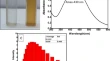
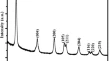
			</st><p>It should be noted that there is a possibility that the bismuth component is vaporized when exposed to the Ga ion beam. Therefore, energy dispersive X-ray (EDX) analysis was performed at points 1 and 2 shown in Figure <figr fid="F3">3</figr>. Point 1 is the FIB-processed quartz template and is composed of Si and O as the main components of quartz, as shown in Figure <figr fid="F4">4</figr>. Although a Ga component was also observed due to the Ga ion beam processing, no bismuth component was detected at point 1. In contrast, at point 2 which was located in the center of the exposure area for the nanowire, the bismuth component was successfully detected (Figure <figr fid="F4">4</figr>). The electron beam for EDX has a typical spread of 1&#8201;&#215;&#8201;1 &#956;m; therefore, Si and O components were also detected at point 2. Al was also detected as a component of the microscope stage. The difference between points 1 and 2 indicates that the bismuth component remained after FIB processing.</p>
			<fig id="F4"><title><p>Figure 4</p></title><caption><p>EDX spectra at points 1 and 2, as indicated in Figure <figr fid="F3">3</figr></p></caption><text>
   <p><b>EDX spectra at points 1 and 2, as indicated in Figure</b><figr fid="F3">3</figr>.</p>
</text><graphic file="1556-276X-7-505-4"/></fig><p>Carbon electrodes were then deposited <it>in situ</it> on the exposed wire side surfaces to avoid oxidation and provide electrical contact points. Figure <figr fid="F5">5</figr> shows a typical SEM image of carbon deposition on the exposed nanowire surface. The typical thickness of the carbon deposition was <it>ca.</it> 0.5 &#956;m. After achieving the electrical contact, the carbon film layer was then extended to a copper electrode on the surface of the quartz template, as shown in Figure <figr fid="F1">1</figr> (f) and (g). The expected length of carbon between the surface of the bismuth nanowire and copper electrode is approximately 20 &#956;m; therefore, the resistance of the carbon component was estimated to be <it>ca.</it> 200 &#937; at an assumed resistivity of 50 &#956;&#937; m. The resistance would be reduced for a thicker carbon film.</p>
			<fig id="F5"><title><p>Figure 5</p></title><caption><p>SEM image after carbon deposition onto the exposed side surface of the bismuth nanowire</p></caption><text>
   <p>
      <b>SEM image after carbon deposition onto the exposed side surface of the bismuth nanowire.</b>
   </p>
</text><graphic file="1556-276X-7-505-5"/></fig><p>Figure <figr fid="F6">6</figr> shows a schematic diagram of the configuration used for Hall measurements after polishing, FIB processing, and carbon deposition of the nanowire. The bismuth nanowire is fixed on an alumina plate as a back base prepared with copper electrodes. A thermometer is attached on the plate to measure the temperature. The thermocouple and heater are also attached in order to measure thermoelectromotive force for measurement of a Seebeck coefficient. The lead wires from the pad on the alumina plate are connected to the copper electrode located on the surface of the quartz template. The Hall effect signal in a magnetic field is measured using this configuration, which also makes it possible to perform resistance measurements by the four-probe method. The magnitude of the resistance using the two-probe method was relatively large due to the small diameter and long length of the nanowire. For example, the resistance of a bismuth nanowire with a diameter of 100 nm and a length of 1 mm was estimated to be <it>ca.</it> 166 k&#937; for an assumed resistivity of 1.3 &#956;&#937;m. The value is relatively large for the resistance measurements; therefore, the time constant of the circuit should be considered. If the four-probe method is used, then the resistance value can be easily controlled using a suitable gap for measurement of the voltage. Therefore, the configuration shown in Figure <figr fid="F6">6</figr> enables the successful measurement of the electrical properties of nanowires, including not only the resistivity and Hall coefficient, but also the Seebeck and Nernst coefficients.</p>
			<fig id="F6"><title><p>Figure 6</p></title><caption><p>Schematic diagram showing the configuration used for Hall measurement of the bismuth nanowire</p></caption><text>
   <p>
      <b>Schematic diagram showing the configuration used for Hall measurement of the bismuth nanowire.</b>
   </p>
</text><graphic file="1556-276X-7-505-6"/></fig><p>The magnitudes of the Hall voltage measured for the nanowire are now discussed. The Hall coefficient (<it>R</it>
				<sub>H</sub>) for a two-carrier model is expressed by <inline-formula>
					<m:math name="1556-276X-7-505-i1" xmlns:m="http://www.w3.org/1998/Math/MathML"><m:mrow>
   <m:msub>
      <m:mi>R</m:mi>
      <m:mi>H</m:mi>
   </m:msub>
   <m:mo>=</m:mo>
   <m:mfrac>
      <m:msub>
         <m:mi>r</m:mi>
         <m:mi>H</m:mi>
      </m:msub>
      <m:mi>e</m:mi>
   </m:mfrac>
   <m:mfrac>
      <m:mrow>
         <m:mi>p</m:mi>
         <m:mo>&#8722;</m:mo>
         <m:mi>n</m:mi>
         <m:msup>
            <m:mi>b</m:mi>
            <m:mn>2</m:mn>
         </m:msup>
      </m:mrow>
      <m:msup>
         <m:mfenced open="(" close=")">
            <m:mrow>
               <m:mi>p</m:mi>
               <m:mo>+</m:mo>
               <m:mi>n</m:mi>
               <m:mi>b</m:mi>
            </m:mrow>
         </m:mfenced>
         <m:mn>2</m:mn>
      </m:msup>
   </m:mfrac>
</m:mrow>
</m:math>
				</inline-formula>
				<inline-formula>
					<m:math name="1556-276X-7-505-i2" xmlns:m="http://www.w3.org/1998/Math/MathML"><m:mrow>
   <m:mi>b</m:mi>
   <m:mo>=</m:mo>
   <m:mfrac>
      <m:msub>
         <m:mi>&#956;</m:mi>
         <m:mi>n</m:mi>
      </m:msub>
      <m:msub>
         <m:mi>&#956;</m:mi>
         <m:mi>p</m:mi>
      </m:msub>
   </m:mfrac>
</m:mrow>
</m:math>
				</inline-formula> , where <it>r</it>
				<sub>H</sub> is the Hall factor, <it>n</it> and <it>p</it> are the electron and hole carrier densities, respectively, and <it>b</it> is the mobility ratio between electrons &#956;<sub>
					<it>n</it>
				</sub> and holes &#956;<sub>
					<it>p</it>
				</sub>
				<abbrgrp>
					<abbr bid="B32">32</abbr>
				</abbrgrp>. The value of <it>r</it>
				<sub>H</sub> is almost 1, even if carrier scattering processes are assumed. The values of <it>n</it> and <it>p</it> are taken from <abbrgrp>
					<abbr bid="B7">7</abbr>
				</abbrgrp> for that of bulk Bi. The <it>b</it> value was estimated to be from 3 to 10, depending on the crystal orientation <abbrgrp>
					<abbr bid="B33">33</abbr>
				</abbrgrp>, and a value of <it>b</it>&#8201;=&#8201;3 was selected as a severe assumption. The Hall resistance <it>R</it>
				<sub>Hall</sub> is approximately expressed as <inline-formula>
					<m:math name="1556-276X-7-505-i3" xmlns:m="http://www.w3.org/1998/Math/MathML"><m:mrow>
   <m:msub>
      <m:mi>R</m:mi>
      <m:mtext mathvariant="italic">Hall</m:mtext>
   </m:msub>
   <m:mo>=</m:mo>
   <m:msub>
      <m:mi>R</m:mi>
      <m:mi>H</m:mi>
   </m:msub>
   <m:mfrac>
      <m:mrow>
         <m:mi>B</m:mi>
         <m:mi mathvariant="italic">l</m:mi>
      </m:mrow>
      <m:mi>S</m:mi>
   </m:mfrac>
   <m:mo>=</m:mo>
   <m:mfrac>
      <m:mrow>
         <m:mn>4</m:mn>
         <m:msub>
            <m:mi>R</m:mi>
            <m:mi>H</m:mi>
         </m:msub>
         <m:mi>B</m:mi>
      </m:mrow>
      <m:mrow>
         <m:mi>&#960;</m:mi>
         <m:mi>d</m:mi>
      </m:mrow>
   </m:mfrac>
</m:mrow>
</m:math>
				</inline-formula>, where <it>d</it> and <it>B</it> are the wire diameter and the magnitude of the magnetic field, respectively. Here the cross section of the nanowire (<it>S</it>) and the gap between metal electrodes for the Hall measurement (<it>l</it>) are approximated by <inline-formula>
					<m:math name="1556-276X-7-505-i4" xmlns:m="http://www.w3.org/1998/Math/MathML"><m:mrow>
   <m:mi>S</m:mi>
   <m:mo>=</m:mo>
   <m:mi>&#960;</m:mi>
   <m:msup>
      <m:mfenced open="(" close=")">
         <m:mfrac>
            <m:mi>d</m:mi>
            <m:mn>2</m:mn>
         </m:mfrac>
      </m:mfenced>
      <m:mn>2</m:mn>
   </m:msup>
</m:mrow>
</m:math>
				</inline-formula> and <inline-formula>
					<m:math name="1556-276X-7-505-i5" xmlns:m="http://www.w3.org/1998/Math/MathML"><m:mrow>
   <m:mi mathvariant="italic">l</m:mi>
   <m:mo>=</m:mo>
   <m:mi>d</m:mi>
</m:mrow>
</m:math>
				</inline-formula>, respectively. Conditions of <it>d</it>&#8201;=&#8201;100 to 1,000 nm were considered in <it>B</it>&#8201;=&#8201;0.12 T, which satisfy the low magnetic field approximation at 300 K <abbrgrp>
					<abbr bid="B34">34</abbr>
				</abbrgrp>. Therefore, the calculated |<it>R</it>
				<sub>Hall</sub>| is estimated to be from 0.19 &#937; at 1,000 nm to 1.9 &#937; at 100 nm. The electric current introduced into the bismuth nanowire for the measurement should ideally be less than 1 &#956;A due to the small heat capacity of the narrow wire and the high resistance, so that an increase in temperature and burn out can be avoided. The absolute value of the measured Hall voltage was estimated to be 190 nV to 1.9 &#956;V under the same conditions. Nanovolt-order voltage can be measured using a lock-in amplifier with modulation of the introduced current and magnetic field, which confirms that the configuration (Figure <figr fid="F6">6</figr>) enables the experimental measurement of the Hall coefficient. The Hall coefficient of the bismuth nanowire enables us to evaluate carrier density and mobility experimentally. Therefore, the temperature dependence of resistivity of bismuth nanowires less than 1 &#956;m can be described by the measurement of carrier density and mobility more directly than the calculation model of our previous study. In  ition, it will be possible to measure not only Hall coefficient but also Nernst coefficient using the configuration; then, various electrical properties of bismuth nanowires can be evaluated.</p>
		</sec>
		<sec>
			<st>
				<p>Conclusions</p>
			</st><p>A method to attach Hall electrodes on opposite sides of an individual bismuth nanowire encased in a quartz template was demonstrated using polishing, FIB processing, and carbon deposition. An accelerated Ga ion beam was used to detect the position of the nanowire in the quartz template without exposure. The quartz component covering the nanowire was then successfully removed with the Ga ion beam to locally expose the opposite side surfaces of the nanowire. Carbon thin films were then deposited <it>in situ</it> on the exposed wire surfaces to form electrical contacts, while avoiding oxidation of the nanowire. EDX analysis of the processed area indicated that the bismuth component remained after FIB processing.</p><p>The mobility reduction of bismuth nanowires less than 1 &#956;m in diameter due to mean free path limitation at wire boundary will be evaluated experimentally by Hall measurement. Moreover, further investigations are planned using the configuration to examine the temperature and wire diameter dependence of the thermoelectric properties of bismuth nanowires, and the influence of the quantum effect using much smaller diameter of bismuth nanowires will be also estimated.</p>
		</sec>
		<sec>
			<st>
				<p>Competing interests</p>
			</st><p>The authors declare that they have no competing interests.</p>
		</sec>
		<sec>
			<st>
				<p>Authors' contributions</p>
			</st><p>MM carried out experiments, the polishing, FIB processing, EDX analysis, and drafted the manuscript. YH and TK guided the idea and the experiments and revised the manuscript. TK participated in the design of the FIB processing. All authors read and approved final manuscript.</p>
		</sec>
		<sec>
			<st>
				<p>Authors' information</p>
			</st><p>MM is a PhD candidate under associate professor YH in the department of engineering, Saitama University, Japan.</p>
		</sec>
	</bdy>
	<bm>
		<ack>
			<sec>
				<st>
					<p>Acknowledgments</p>
				</st><p>This research was supported in part by Grant-in-Aid for JSPS Fellows, Grant-in-Aid for Scientific Research (B) and (C), leading industrial technology development project grant funds of NEDO, Asahi Glass Foundation, Japan Aluminum Association, and TEPCO Memorial Foundation. This work was performed under the auspices of the National Institute for Fusion Science (NIFS) collaborative research (NIFS11KECA012) and NINS's Creating innovative research fields project (number NIFS08KEIN0091). This research was supported by the Nanotechnology network program (Center for Nanotechnology Network, National Institute for Material Science) of the Ministry of Education, Culture, Sports, Science and Technology.</p>
			</sec>
		</ack>
		<refgrp><bibl id="B1"><title><p>Effect of quantum-well structures on the thermoelectric figure of merit</p></title><aug><au><snm>Hicks</snm><fnm>LD</fnm></au><au><snm>Dresselhaus</snm><fnm>MS</fnm></au></aug><source>Phys Rev B</source><pubdate>1993</pubdate><volume>47</volume><fpage>12727</fpage><lpage>12731</lpage><xrefbib><pubid idtype="doi">10.1103/PhysRevB.47.12727</pubid></xrefbib></bibl><bibl id="B2"><title><p>Thermoelectric figure of merit of a one-dimensional conductor</p></title><aug><au><snm>Hicks</snm><fnm>LD</fnm></au><au><snm>Dresselhaus</snm><fnm>MS</fnm></au></aug><source>Phys Rev B</source><pubdate>1993</pubdate><volume>47</volume><fpage>16631</fpage><lpage>16634</lpage><xrefbib><pubid idtype="doi">10.1103/PhysRevB.47.16631</pubid></xrefbib></bibl><bibl id="B3"><title><p>Nanowires and nanotubes</p></title><aug><au><snm>Dresselhaus</snm><fnm>MS</fnm></au><au><snm>Lin</snm><fnm>YM</fnm></au><au><snm>Rabin</snm><fnm>O</fnm></au><au><snm>Jorio</snm><fnm>A</fnm></au><au><snm>Souza Filho</snm><fnm>AG</fnm></au><au><snm>Pimenta</snm><fnm>MA</fnm></au><au><snm>Saito</snm><fnm>R</fnm></au><au><snm>Samsonidze Ge</snm><fnm>G</fnm></au><au><snm>Dresselhaus</snm><fnm>G</fnm></au></aug><source>Mater Sci Eng C</source><pubdate>2003</pubdate><volume>23</volume><fpage>129</fpage><lpage>140</lpage><xrefbib><pubid idtype="doi">10.1016/S0928-4931(02)00240-0</pubid></xrefbib></bibl><bibl id="B4"><title><p>Quantum dot superlattice thermoelectric materials and devices</p></title><aug><au><snm>Harman</snm><fnm>TC</fnm></au><au><snm>Taylor</snm><fnm>PJ</fnm></au><au><snm>Walsh</snm><fnm>MP</fnm></au><au><snm>LaForge</snm><fnm>BE</fnm></au></aug><source>Science</source><pubdate>2002</pubdate><volume>297</volume><fpage>2229</fpage><lpage>2232</lpage><xrefbib><pubidlist><pubid idtype="doi">10.1126/science.1072886</pubid><pubid idtype="pmpid" link="fulltext">12351781</pubid></pubidlist></xrefbib></bibl><bibl id="B5"><title><p>Thin-film thermoelectric devices with high room-temperature figures of merit</p></title><aug><au><snm>Venkatasubramanian</snm><fnm>R</fnm></au><au><snm>Siivola</snm><fnm>E</fnm></au><au><snm>Colpitts</snm><fnm>T</fnm></au><au><snm>O&apos;Quinn</snm><fnm>B</fnm></au></aug><source>Nature</source><pubdate>2001</pubdate><volume>413</volume><fpage>597</fpage><lpage>602</lpage><xrefbib><pubidlist><pubid idtype="doi">10.1038/35098012</pubid><pubid idtype="pmpid" link="fulltext">11595940</pubid></pubidlist></xrefbib></bibl><bibl id="B6"><title><p>Electronic properties of the group V semimetals</p></title><aug><au><snm>Dresselhaus</snm><fnm>MS</fnm></au></aug><source>Conference on the Physics of Semimetals and Narrow Gap Semiconductors: 1970 March 20-21; Dallas</source><publisher>New York: Pergamon Press</publisher><editor>Carter DL, Bate RT</editor><pubdate>1970</pubdate><fpage>3</fpage><lpage>33</lpage></bibl><bibl id="B7"><title><p>Electron and hole transport in bismuth</p></title><aug><au><snm>Michenaud</snm><fnm>J-P</fnm></au><au><snm>Issi</snm><fnm>J-P</fnm></au></aug><source>J Phys C: Solid State Phys</source><pubdate>1972</pubdate><volume>5</volume><fpage>3061</fpage><lpage>3072</lpage><xrefbib><pubid idtype="doi">10.1088/0022-3719/5/21/011</pubid></xrefbib></bibl><bibl id="B8"><title><p>Thermoelectric power of bismuth nanowires</p></title><aug><au><snm>Heremans</snm><fnm>J</fnm></au><au><snm>Thrush</snm><fnm>CM</fnm></au></aug><source>Phys Rev B</source><pubdate>1999</pubdate><volume>59</volume><fpage>12579</fpage><lpage>12583</lpage><xrefbib><pubid idtype="doi">10.1103/PhysRevB.59.12579</pubid></xrefbib></bibl><bibl id="B9"><title><p>Electronic transport in a three-dimensional network of one-dimensional bismuth quantum wires</p></title><aug><au><snm>Huber</snm><fnm>TE</fnm></au><au><snm>Graf</snm><fnm>MJ</fnm></au></aug><source>Phys Rev B</source><pubdate>1999</pubdate><volume>60</volume><fpage>16880</fpage><lpage>16884</lpage><xrefbib><pubid idtype="doi">10.1103/PhysRevB.60.16880</pubid></xrefbib></bibl><bibl id="B10"><title><p>Finite-size effects in bismuth nanowires</p></title><aug><au><snm>Liu</snm><fnm>K</fnm></au><au><snm>Chien</snm><fnm>CL</fnm></au><au><snm>Searson</snm><fnm>PC</fnm></au></aug><source>Phys Rev B</source><pubdate>1998</pubdate><volume>58</volume><fpage>14681</fpage><lpage>14684</lpage><xrefbib><pubid idtype="doi">10.1103/PhysRevB.58.R14681</pubid></xrefbib></bibl><bibl id="B11"><title><p>Transport properties of Bi nanowire arrays</p></title><aug><au><snm>Lin</snm><fnm>Y-M</fnm></au><au><snm>Cronin</snm><fnm>SB</fnm></au><au><snm>Ying</snm><fnm>JY</fnm></au><au><snm>Dresselhaus</snm><fnm>MS</fnm></au><au><snm>Heremans</snm><fnm>JP</fnm></au></aug><source>Appl Phys Lett</source><pubdate>2000</pubdate><volume>76</volume><fpage>3944</fpage><lpage>3946</lpage><xrefbib><pubid idtype="doi">10.1063/1.126829</pubid></xrefbib></bibl><bibl id="B12"><title><p>Diameter-dependent thermopower of bismuth nanowires</p></title><aug><au><snm>Nikolaeva</snm><fnm>A</fnm></au><au><snm>Huber</snm><fnm>TE</fnm></au><au><snm>Gitsu</snm><fnm>D</fnm></au><au><snm>Konopko</snm><fnm>L</fnm></au></aug><source>Phys Rev B</source><pubdate>2008</pubdate><volume>77</volume><fpage>035422</fpage></bibl><bibl id="B13"><title><p>Finite-size effects in the electrical transport properties of single bismuth nanowires</p></title><aug><au><snm>Cornelius</snm><fnm>TW</fnm></au><au><snm>Toimil-Molares</snm><fnm>ME</fnm></au><au><snm>Neumann</snm><fnm>R</fnm></au><au><snm>Karim</snm><fnm>S</fnm></au></aug><source>J Appl Phys</source><pubdate>2006</pubdate><volume>100</volume><fpage>114307</fpage><xrefbib><pubid idtype="doi">10.1063/1.2388857</pubid></xrefbib></bibl><bibl id="B14"><title><p>Magneto-Seebeck coefficient of a bismuth microwire array in a magnetic field</p></title><aug><au><snm>Hasegawa</snm><fnm>Y</fnm></au><au><snm>Ishikawa</snm><fnm>Y</fnm></au><au><snm>Komine</snm><fnm>T</fnm></au><au><snm>Huber</snm><fnm>TE</fnm></au><au><snm>Suzuki</snm><fnm>A</fnm></au><au><snm>Morita</snm><fnm>H</fnm></au><au><snm>Shirai</snm><fnm>H</fnm></au></aug><source>Appl Phys Lett</source><pubdate>2004</pubdate><volume>85</volume><fpage>917</fpage><lpage>919</lpage><xrefbib><pubid idtype="doi">10.1063/1.1781390</pubid></xrefbib></bibl><bibl id="B15"><title><p>Electronic transport properties of a bismuth microwire array in a magnetic field</p></title><aug><au><snm>Hasegawa</snm><fnm>Y</fnm></au><au><snm>Ishikawa</snm><fnm>Y</fnm></au><au><snm>Morita</snm><fnm>H</fnm></au><au><snm>Komine</snm><fnm>T</fnm></au><au><snm>Shirai</snm><fnm>H</fnm></au><au><snm>Nakamura</snm><fnm>H</fnm></au></aug><source>J Appl Phys</source><pubdate>2005</pubdate><volume>97</volume><fpage>083907</fpage><xrefbib><pubid idtype="doi">10.1063/1.1865342</pubid></xrefbib></bibl><bibl id="B16"><title><p>Aspect ratio dependence of magnetoresistivity in polycrystalline bismuth microwire arrays</p></title><aug><au><snm>Hasegawa</snm><fnm>Y</fnm></au><au><snm>Nakano</snm><fnm>H</fnm></au><au><snm>Morita</snm><fnm>H</fnm></au><au><snm>Kurokouchi</snm><fnm>A</fnm></au><au><snm>Wada</snm><fnm>K</fnm></au><au><snm>Komine</snm><fnm>T</fnm></au><au><snm>Nakamura</snm><fnm>H</fnm></au></aug><source>J Appl Phys</source><pubdate>2007</pubdate><volume>101</volume><fpage>033704</fpage><xrefbib><pubid idtype="doi">10.1063/1.2432876</pubid></xrefbib></bibl><bibl id="B17"><title><p>Power factor enhancement in a magnetic field using polycrystalline bismuth microwire arrays</p></title><aug><au><snm>Hasegawa</snm><fnm>Y</fnm></au><au><snm>Nakano</snm><fnm>H</fnm></au><au><snm>Morita</snm><fnm>H</fnm></au><au><snm>Komine</snm><fnm>T</fnm></au><au><snm>Okumura</snm><fnm>H</fnm></au><au><snm>Nakamura</snm><fnm>H</fnm></au></aug><source>J Appl Phys</source><pubdate>2007</pubdate><volume>102</volume><fpage>073701</fpage><xrefbib><pubid idtype="doi">10.1063/1.2785003</pubid></xrefbib></bibl><bibl id="B18"><title><p>Evaluation of thermoelectric properties in Bi-microwires by the Harman method</p></title><aug><au><snm>Iwasaki</snm><fnm>H</fnm></au><au><snm>Morita</snm><fnm>H</fnm></au><au><snm>Hasegawa</snm><fnm>Y</fnm></au></aug><source>Jpn J Appl Phys</source><pubdate>2008</pubdate><volume>47</volume><fpage>3576</fpage><lpage>3580</lpage><xrefbib><pubid idtype="doi">10.1143/JJAP.47.3576</pubid></xrefbib></bibl><bibl id="B19"><title><p>Reduction of contact resistance at terminations of bismuth wire arrays</p></title><aug><au><snm>Hasegawa</snm><fnm>Y</fnm></au><au><snm>Ishikawa</snm><fnm>Y</fnm></au><au><snm>Shirai</snm><fnm>H</fnm></au><au><snm>Morita</snm><fnm>H</fnm></au><au><snm>Kurokouchi</snm><fnm>A</fnm></au><au><snm>Wada</snm><fnm>K</fnm></au><au><snm>Komine</snm><fnm>T</fnm></au><au><snm>Nakamura</snm><fnm>H</fnm></au></aug><source>Rev Sci Instrum</source><pubdate>2005</pubdate><volume>76</volume><fpage>113902</fpage><xrefbib><pubid idtype="doi">10.1063/1.2126952</pubid></xrefbib></bibl><bibl id="B20"><title><p>Mobility estimation in microsized bismuth wire arrays</p></title><aug><au><snm>Hasegawa</snm><fnm>Y</fnm></au><au><snm>Murata</snm><fnm>M</fnm></au><au><snm>Nakamura</snm><fnm>D</fnm></au><au><snm>Komine</snm><fnm>T</fnm></au><au><snm>Taguchi</snm><fnm>T</fnm></au><au><snm>Nakamura</snm><fnm>S</fnm></au></aug><source>J Appl Phys</source><pubdate>2009</pubdate><volume>105</volume><fpage>103715</fpage><xrefbib><pubid idtype="doi">10.1063/1.3133136</pubid></xrefbib></bibl><bibl id="B21"><title><p>Thermoelectric properties of bismuth micro/nanowire array elements pressured into a quartz template mold</p></title><aug><au><snm>Hasegawa</snm><fnm>Y</fnm></au><au><snm>Murata</snm><fnm>M</fnm></au><au><snm>Nakamura</snm><fnm>D</fnm></au><au><snm>Komine</snm><fnm>T</fnm></au><au><snm>Taguchi</snm><fnm>T</fnm></au><au><snm>Nakamura</snm><fnm>S</fnm></au></aug><source>J Electron Mater</source><pubdate>2009</pubdate><volume>38</volume><fpage>944</fpage><lpage>949</lpage><xrefbib><pubid idtype="doi">10.1007/s11664-009-0781-8</pubid></xrefbib></bibl><bibl id="B22"><title><p>Reducing thermal conductivity of thermoelectric materials by using a narrow wire geometry</p></title><aug><au><snm>Hasegawa</snm><fnm>Y</fnm></au><au><snm>Murata</snm><fnm>M</fnm></au><au><snm>Nakamura</snm><fnm>D</fnm></au><au><snm>Komine</snm><fnm>T</fnm></au></aug><source>J Appl Phys</source><pubdate>2009</pubdate><volume>106</volume><fpage>063703</fpage><xrefbib><pubid idtype="doi">10.1063/1.3212982</pubid></xrefbib></bibl><bibl id="B23"><title><p>Electrical nanocontact between bismuth nanowire edges and electrodes</p></title><aug><au><snm>Murata</snm><fnm>M</fnm></au><au><snm>Nakamura</snm><fnm>D</fnm></au><au><snm>Hasegawa</snm><fnm>Y</fnm></au><au><snm>Komine</snm><fnm>T</fnm></au><au><snm>Uematsu</snm><fnm>D</fnm></au><au><snm>Nakamura</snm><fnm>S</fnm></au><au><snm>Taguchi</snm><fnm>T</fnm></au></aug><source>J Electron Mater</source><pubdate>2010</pubdate><volume>39</volume><fpage>1536</fpage><lpage>1542</lpage><xrefbib><pubid idtype="doi">10.1007/s11664-010-1282-5</pubid></xrefbib></bibl><bibl id="B24"><title><p>Thermoelectric properties of a 593-nm individual bismuth nanowire prepared using a quartz template</p></title><aug><au><snm>Nakamura</snm><fnm>D</fnm></au><au><snm>Murata</snm><fnm>M</fnm></au><au><snm>Hasegawa</snm><fnm>Y</fnm></au><au><snm>Komine</snm><fnm>T</fnm></au><au><snm>Uematsu</snm><fnm>D</fnm></au><au><snm>Nakamura</snm><fnm>S</fnm></au><au><snm>Taguchi</snm><fnm>T</fnm></au></aug><source>J Electron Mater</source><pubdate>2010</pubdate><volume>39</volume><fpage>1960</fpage><lpage>1965</lpage><xrefbib><pubid idtype="doi">10.1007/s11664-009-1045-3</pubid></xrefbib></bibl><bibl id="B25"><title><p>Thermoelectric properties of bismuth nanowires in a quartz template</p></title><aug><au><snm>Murata</snm><fnm>M</fnm></au><au><snm>Nakamura</snm><fnm>D</fnm></au><au><snm>Hasegawa</snm><fnm>Y</fnm></au><au><snm>Komine</snm><fnm>T</fnm></au><au><snm>Taguchi</snm><fnm>T</fnm></au><au><snm>Nakamura</snm><fnm>S</fnm></au><au><snm>Jovovic</snm><fnm>V</fnm></au><au><snm>Heremans</snm><fnm>JP</fnm></au></aug><source>Appl Phys Lett</source><pubdate>2009</pubdate><volume>94</volume><fpage>192104</fpage><xrefbib><pubid idtype="doi">10.1063/1.3133355</pubid></xrefbib></bibl><bibl id="B26"><title><p>Mean free path limitation of thermoelectric properties of bismuth nanowire</p></title><aug><au><snm>Murata</snm><fnm>M</fnm></au><au><snm>Nakamura</snm><fnm>D</fnm></au><au><snm>Hasegawa</snm><fnm>Y</fnm></au><au><snm>Komine</snm><fnm>T</fnm></au><au><snm>Taguchi</snm><fnm>T</fnm></au><au><snm>Nakamura</snm><fnm>S</fnm></au><au><snm>Jaworski</snm><fnm>CM</fnm></au><au><snm>Jovovic</snm><fnm>V</fnm></au><au><snm>Heremans</snm><fnm>JP</fnm></au></aug><source>J Appl Phys</source><pubdate>2009</pubdate><volume>105</volume><fpage>113706</fpage><xrefbib><pubid idtype="doi">10.1063/1.3131842</pubid></xrefbib></bibl><bibl id="B27"><title><p>Making electrical contacts to nanowires with a thick oxide coating</p></title><aug><au><snm>Cronin</snm><fnm>SB</fnm></au><au><snm>Lin</snm><fnm>Y-M</fnm></au><au><snm>Rabin</snm><fnm>O</fnm></au><au><snm>Black</snm><fnm>MR</fnm></au><au><snm>Ying</snm><fnm>JY</fnm></au><au><snm>Dresselhaus</snm><fnm>MS</fnm></au><au><snm>Gai</snm><fnm>PL</fnm></au><au><snm>Minet</snm><fnm>J-P</fnm></au><au><snm>Issi</snm><fnm>J-P</fnm></au></aug><source>Nanotechnology</source><pubdate>2002</pubdate><volume>13</volume><fpage>653</fpage><lpage>658</lpage><xrefbib><pubid idtype="doi">10.1088/0957-4484/13/5/322</pubid></xrefbib></bibl><bibl id="B28"><title><p>Multiprobe magnetoresistance measurements on isolated magnetic nanowires</p></title><aug><au><snm>Vila</snm><fnm>L</fnm></au><au><snm>Piraux</snm><fnm>L</fnm></au><au><snm>George</snm><fnm>JM</fnm></au><au><snm>Faini</snm><fnm>G</fnm></au></aug><source>Appl Phys Lett</source><pubdate>2002</pubdate><volume>80</volume><fpage>3805</fpage><lpage>3807</lpage><xrefbib><pubid idtype="doi">10.1063/1.1478783</pubid></xrefbib></bibl><bibl id="B29"><title><p>Fabrication of bismuth nanowires with a silver nanocrystal shadowmask</p></title><aug><au><snm>Choi</snm><fnm>SH</fnm></au><au><snm>Wang</snm><fnm>KL</fnm></au><au><snm>Leung</snm><fnm>MS</fnm></au><au><snm>Stupian</snm><fnm>GW</fnm></au><au><snm>Presser</snm><fnm>N</fnm></au><au><snm>Morgan</snm><fnm>BA</fnm></au><au><snm>Robertson</snm><fnm>RE</fnm></au><au><snm>Abraham</snm><fnm>M</fnm></au><au><snm>King</snm><fnm>EE</fnm></au><au><snm>Tueling</snm><fnm>MB</fnm></au><au><snm>Chung</snm><fnm>SW</fnm></au><au><snm>Heath</snm><fnm>JR</fnm></au><au><snm>Cho</snm><fnm>SL</fnm></au><au><snm>Ketterson</snm><fnm>JB</fnm></au></aug><source>J Vac Sci Technol A</source><pubdate>2000</pubdate><volume>18</volume><fpage>1326</fpage><lpage>1328</lpage><xrefbib><pubid idtype="doi">10.1116/1.582348</pubid></xrefbib></bibl><bibl id="B30"><title><p>On-film formation of Bi nanowires with extraordinary electron mobility</p></title><aug><au><snm>Shim</snm><fnm>W</fnm></au><au><snm>Ham</snm><fnm>J</fnm></au><au><snm>Lee</snm><fnm>K</fnm></au><au><snm>Jeung</snm><fnm>W</fnm></au><au><snm>Johnson</snm><fnm>M</fnm></au><au><snm>Lee</snm><fnm>W</fnm></au></aug><source>Nano Lett</source><pubdate>2009</pubdate><volume>9</volume><fpage>18</fpage><lpage>22</lpage><xrefbib><pubidlist><pubid idtype="doi">10.1021/nl8016829</pubid><pubid idtype="pmpid" link="fulltext">19032034</pubid></pubidlist></xrefbib></bibl><bibl id="B31"><title><p>Four-wire resistance measurements of a bismuth nanowire encased in a quartz template utilizing focused ion beam processing</p></title><aug><au><snm>Murata</snm><fnm>M</fnm></au><au><snm>Yamamoto</snm><fnm>H</fnm></au><au><snm>Tsunemi</snm><fnm>F</fnm></au><au><snm>Hasegawa</snm><fnm>Y</fnm></au><au><snm>Komine</snm><fnm>T</fnm></au></aug><source>J Electron Mater</source><pubdate>2012</pubdate><volume>41</volume><fpage>1442</fpage><lpage>1449</lpage><xrefbib><pubid idtype="doi">10.1007/s11664-012-1986-9</pubid></xrefbib></bibl><bibl id="B32"><aug><au><snm>Seeger</snm><fnm>K</fnm></au></aug><source>Semiconductor Physics</source><publisher>Berlin: Springer</publisher><edition>9</edition><pubdate>2004</pubdate></bibl><bibl id="B33"><title><p>Transport properties of bismuth single crystals</p></title><aug><au><snm>Gallo</snm><fnm>CF</fnm></au><au><snm>Chandrasekher</snm><fnm>BS</fnm></au><au><snm>Shutter</snm><fnm>PH</fnm></au></aug><source>J Apple Phys</source><pubdate>1963</pubdate><volume>34</volume><fpage>144</fpage><lpage>152</lpage><xrefbib><pubid idtype="doi">10.1063/1.1729056</pubid></xrefbib></bibl><bibl id="B34"><title><p>A method for analysis of carrier density and mobility in polycrystalline bismuth</p></title><aug><au><snm>Hasegawa</snm><fnm>Y</fnm></au><au><snm>Ishikawa</snm><fnm>Y</fnm></au><au><snm>Saso</snm><fnm>T</fnm></au><au><snm>Shirai</snm><fnm>H</fnm></au><au><snm>Morita</snm><fnm>H</fnm></au><au><snm>Komine</snm><fnm>T</fnm></au><au><snm>Nakamura</snm><fnm>H</fnm></au></aug><source>Physica B</source><pubdate>2006</pubdate><volume>382</volume><fpage>140</fpage><lpage>146</lpage><xrefbib><pubid idtype="doi">10.1016/j.physb.2006.02.011</pubid></xrefbib></bibl></refgrp>
	</bm>
</art>