<?xml version='1.0'?>
<!DOCTYPE art SYSTEM 'http://www.biomedcentral.com/xml/article.dtd'>
<art><ui>1556-276X-7-48</ui><ji>1556-276X</ji><fm>
<dochead>Nano Express</dochead>
<bibl>
<title>
<p>Preparation of TiO<sub>2 </sub>nanotube/nanoparticle composite particles and their applications in dye-sensitized solar cells</p>
</title>
<aug>
<au id="A1"><snm>Lee</snm><fnm>Chang Hyo</fnm><insr iid="I1"/><email>uchmaki@naver.com</email></au>
<au id="A2"><snm>Rhee</snm><fnm>Seung Woo</fnm><insr iid="I1"/><email>lee_s_w1007@naver.com</email></au>
<au id="A3" ca="yes"><snm>Choi</snm><fnm>Hyung Wook</fnm><insr iid="I1"/><email>chw@kyungwon.ac.kr</email></au>
</aug>
<insg>
<ins id="I1"><p>Department of Electrical Engineering, Kyungwon University, San 65 Bokjeong-dong, Sujeong-gu, Seongnam, Gyeonggi-do, 461-701, Seoul, Korea</p></ins>
</insg>
<source>Nanoscale Research Letters</source>
<issn>1556-276X</issn>
<pubdate>2012</pubdate>
<volume>7</volume>
<issue>1</issue>
<fpage>48</fpage>
<url>http://www.nanoscalereslett.com/content/7/1/48</url>
<xrefbib><pubidlist><pubid idtype="doi">10.1186/1556-276X-7-48</pubid><pubid idtype="pmpid">22222095</pubid></pubidlist></xrefbib>
</bibl>
<history><rec><date><day>9</day><month>9</month><year>2011</year></date></rec><acc><date><day>5</day><month>1</month><year>2012</year></date></acc><pub><date><day>5</day><month>1</month><year>2012</year></date></pub></history>
<cpyrt><year>2012</year><collab>Lee et al; licensee Springer.</collab><note>This is an Open Access article distributed under the terms of the Creative Commons Attribution License (<url>http://creativecommons.org/licenses/by/2.0</url>), which permits unrestricted use, distribution, and reproduction in any medium, provided the original work is properly cited.</note></cpyrt>
<kwdg>
<kwd>composites</kwd>
<kwd>chemical synthesis</kwd>
<kwd>X-ray diffraction</kwd>
<kwd>electron microscopy</kwd>
<kwd>optical properties.</kwd>
</kwdg>
<abs>
<sec>
<st>
<p>Abstract</p>
</st>
<p>Efficiency of dye-sensitized solar cells [DSSCs] was enhanced by combining the use of TiO<sub>2 </sub>nanotubes [TNTs] and nanoparticles. TNTs were fabricated by a sol-gel method, and TiO<sub>2 </sub>powders were produced through an alkali hydrothermal transformation. DSSCs were constructed using TNTs and TiO<sub>2 </sub>nanoparticles at various weight percentages. TNTs and TiO<sub>2 </sub>nanoparticles were coated onto FTO glass by the screen printing method. The DSSCs were fabricated using ruthenium(II) (N-719) and electrolyte (I<sub>3</sub>/I<sub>3</sub>
<sup>-</sup>) dyes. The crystalline structure and morphology were characterized by X-ray diffraction and using a scanning electron microscope. The absorption spectra were measured using an UV-Vis spectrometer. The incident photocurrent conversion efficiency was measured using a solar simulator (100 mW/cm<sup>2</sup>). The DSSCs based on TNT/TiO<sub>2 </sub>nanoparticle hybrids showed better photovoltaic performance than cells made purely of TiO<sub>2 </sub>nanoparticles.</p>
</sec>
</abs>
</fm><meta>
<classifications>
<classification id="IFFMandAFM2011" subtype="theme_series_title" type="BMC">IFFM&amp;AFM2011 </classification>
<classification id="IFFMandAFM2011" subtype="theme_series_editor" type="BMC">Jin-Hyo Boo</classification>
</classifications>
</meta><bdy>
<sec>
<st>
<p>Introduction</p>
</st>
<p>Dye-sensitized solar cells [DSSCs] have been intensively studied following their discovery in 1991. DSSCs have been extensively researched over the past decades due to their high energy-conversion efficiency and especially their low production cost as cheaper alternatives to silicon solar cells <abbrgrp>
<abbr bid="B1">1</abbr>
<abbr bid="B2">2</abbr>
<abbr bid="B3">3</abbr>
</abbrgrp>. A DSSC is composed of a dye-adsorbed nanoporous TiO<sub>2 </sub>layer on a fluorine-doped tin oxide [FTO] glass substrate, redox electrolytes, and a counter electrode. A unidirectional charge flow with no electron leakage at the interfaces is essential for high energy-conversion efficiency <abbrgrp>
<abbr bid="B4">4</abbr>
</abbrgrp>. The energy-conversion efficiency is likely to be dependent on the morphology and structure of the dye-adsorbed TiO<sub>2 </sub>film. Ito et al. introduced mesoporous TiO<sub>2 </sub>particular films as photoanodes to enhance the effective surface area, to absorb more dye molecules, and thus, to achieve more light absorption and greater efficiency <abbrgrp>
<abbr bid="B5">5</abbr>
<abbr bid="B6">6</abbr>
</abbrgrp>. The high conversion efficiency achieved by the DSSC may be attributed to its uniquely porous titania film, which is usually prepared with titania nanoparticles. Sol-gel processing of titanium dioxide has been extensively investigated, and modern processes have been developed to refine and control the stability as well as the phase formation of the colloidal precursors <abbrgrp>
<abbr bid="B7">7</abbr>
</abbrgrp>. However, because the mesoporous TiO<sub>2 </sub>particles are randomly connected, this will unavoidably lead to the recombination of electron-hole pairs, decreasing efficiency. Subsequently, researchers started to explore the use of ordinal TiO<sub>2 </sub>in DSSCs; this includes TiO<sub>2 </sub>nanowires, nanorods, and TiO<sub>2 </sub>nanotubes [TNTs]. The preparation of TNTs by a hydrothermal treatment of TiO<sub>2 </sub>powder in a 10-M NaOH aqueous solution has been reported <abbrgrp>
<abbr bid="B8">8</abbr>
<abbr bid="B9">9</abbr>
</abbrgrp>. The use of oxide semiconductors in the form of nanorods, nanowires, and nanotubes may be an interesting approach to improve electron transport through the film. Because of the one-dimensional nature of these nanostructures, their morphology facilitates electron transfer up to the collecting electrode, decreasing the ohmic loss through the TNTs <abbrgrp>
<abbr bid="B10">10</abbr>
<abbr bid="B11">11</abbr>
<abbr bid="B12">12</abbr>
<abbr bid="B13">13</abbr>
</abbrgrp>. To improve electron transport, provide a large surface area to adsorb the sensitized dye, and enhance incident light harvest, the use of TNTs in DSSCs has been explored <abbrgrp>
<abbr bid="B14">14</abbr>
<abbr bid="B15">15</abbr>
</abbrgrp>. In the present work, the effect of combining TiO<sub>2 </sub>nanoparticles with TNTs and the resulting effect on solar cell performance have been investigated. DSSCs were constructed by the application of TNTs and TiO<sub>2 </sub>nanoparticles at various weight ratios. TNTs were fabricated by a hydrothermal-temperature process using the sol-gel method. TiO<sub>2 </sub>powder was produced through alkali hydrothermal transformation. The introduction of TNTs, with a much more open structure, enables the electrolyte to penetrate easily inside the film, increasing the interfacial contact between the nanotubes, the dye, and the electrolyte. In addition, a high level of dye adsorption on TiO<sub>2 </sub>in the form of nanorods and nanotubes is expected because of the high surface area of these nanostructures. It is expected that the photoelectrical performance of the DSSC can be further improved.</p>
</sec>
<sec>
<st>
<p>Experimental details</p>
</st>
<sec>
<st>
<p>Preparation of TiO<sub>2 </sub>nanoparticles and nanotubes</p>
</st>
<p>The TiO<sub>2 </sub>main layer was prepared using the sol-gel method. Nano-TiO<sub>2 </sub>was synthesized using titanium(IV) isopropoxide [TTIP] (Aldrich Chemical, Sigma-Aldrich Corporation, St. Louis, MO, USA), nitric acid, ethyl alcohol, and distilled water. The TTIP was mixed with ethanol, and distilled water was added drop by drop under vigorous stirring for 1 h. This solution was then peptized using nitric acid and heated under reflux at 80&#176;C for 8 h. After this period, a TiO<sub>2 </sub>sol was prepared. The prepared sol was dried to yield a TiO<sub>2 </sub>powder. The TiO<sub>2 </sub>particles were calcined in air at 450&#176;C for 1 h using a programmable furnace to obtain the desired TiO<sub>2 </sub>stoichiometry and crystallinity. TNTs were prepared using a hydrothermal process described in the authors' previous work. Then, 5 g of TiO<sub>2 </sub>particles prepared by the sol-gel method were mixed with 500 ml of a 10-M NaOH aqueous solution, followed by hydrothermal treatment at 150&#176;C (TNTs) in a Teflon-lined autoclave for 12 h. After the hydrothermal reaction, the treated powders were washed thoroughly with distilled water and 0.1 M HCl and subsequently filtered and dried at 80&#176;C for 1 day. To achieve the desired TNT size and crystallinity, the powders were calcined in air at 500&#176;C for 1 h <abbrgrp>
<abbr bid="B16">16</abbr>
</abbrgrp>.</p>
</sec>
<sec>
<st>
<p>Preparation of TiO<sub>2 </sub>electrode films</p>
</st>
<p>TiO<sub>2 </sub>nanoparticles and TNTs prepared by the sol-gel and hydrothermal methods were mixed at various weight ratios (without TNT, 9:1 (10 wt.%), 8:2 (20 wt.%), 7:3 (30 wt.%), 5:5 (50 wt.%), and 100 wt.% TNTs; total weight 6 g) and ground in a mortar. Acetic acid (1 ml), distilled water (5 ml), and ethanol (30 ml) were added gradually drop by drop to disperse the TiO<sub>2 </sub>nanoparticles and nanotubes under continuous grinding. The TiO<sub>2 </sub>dispersions in the mortar were transferred with an excess of ethanol (100 ml) to a tall beaker and stirred with a 4-cm-long magnet tip at 300 rpm. Anhydrous terpineol (20 g) and ethyl celluloses (3 g) in ethanol were added, followed by further stirring. The dispersed contents were concentrated by evaporating the ethanol in a rotary evaporator. The pastes were finished by grinding in a three-roller mill <abbrgrp>
<abbr bid="B17">17</abbr>
</abbrgrp>. An optically transparent conducting glass (FTO, sheet resistance 8 &#937;/sq) was washed in ethanol and deionized water in an ultrasonic bath for 10 min. The FTO glass was immersed in a 40-mm-deep TiCl<sub>4 </sub>aqueous solution at 70&#176;C for 30 min to make good mechanical contact. A TiO<sub>2 </sub>film with a thickness of 12 to 15 &#956;m was deposited onto the pretreated conducting glass using the screen printing technique and sintered again at 450&#176;C for 15 min and at 500&#176;C for 15 min in air.</p>
</sec>
<sec>
<st>
<p>Assembly of the DSSCs</p>
</st>
<p>The nanoporous TiO<sub>2 </sub>electrode films were immersed in the dye (N-719) complex for 24 h at room temperature. A counter electrode was prepared by spin-coating an H<sub>2</sub>PTCl<sub>6 </sub>solution onto the FTO glass and heating at 450&#176;C for 30 min. The dye-adsorbed TiO<sub>2 </sub>electrode and the PT counter electrode were assembled into a sandwich-type cell and sealed with a hot-melt sealant of 50-&#956;m thick. An electrolyte solution was introduced through a drilled hole in the counter electrode. The hole was then sealed using a cover glass.</p>
</sec>
<sec>
<st>
<p>Measurements</p>
</st>
<p>The phase of the particles obtained at various hydrothermal temperatures was examined by X-ray diffraction [XRD] using a D/MAX-2200 diffractometer with CuK&#945; radiation (Rigaku Corporation, Shibuya-ku, Tokyo, Japan). The morphology and thickness of the prepared TNT layers were investigated by field-emission scanning electron microscopy [FE-SEM] (model S-4700, Hitachi, Chiyoda-ku, Tokyo, Japan). The absorption spectra of the TiO<sub>2 </sub>electrode films were measured using a UV-Vis spectrometer (UV-Vis 8453, Agilent Technologies Inc., Santa Clara, CA, USA). The conversion efficiency of the fabricated DSSC was measured using an I-V solar simulator (McScience, Suwon-si, South Korea). The incident photocurrent conversion efficiency was measured using an IPCE Model Qex7 (PV Measurements, Inc., Boulder, CO, USA). The active area of the resulting cell exposed to light was approximately 0.25 cm<sup>2 </sup>(0.5 cm &#215; 0.5 cm).</p>
</sec>
<sec>
<st>
<p>Results and discussions</p>
</st>
</sec>
<sec>
<st>
<p>Morphological characterization of TiO<sub>2 </sub>film</p>
</st>
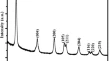
<p>Figure <figr fid="F1">1a</figr> shows the XRD pattern of the sol-gel TiO<sub>2 </sub>nanoparticles at 450&#176;C, which indicates a mixture of the anatase and rutile phases. The XRD pattern of TiO<sub>2 </sub>nanoparticles shows prominent anatase peaks at (101), (004), (200) and prominent rutile peaks at (110) and (101). Figure <figr fid="F1">1b</figr> shows the XRD patterns of the TNT films prepared at hydrothermal temperatures at 150&#176;C for 12 h. The TiO<sub>2 </sub>nanoparticles were observed to be transformed into the anatase phase by the hydrothermal method. As can be observed from the corresponding XRD patterns (Figure <figr fid="F1">1b</figr>), the TNTs possess a highly crystallized anatase structure without any impurity phase. In the TNTs, the rutile peaks indicate that the transformation to anatase is complete. FE-SEM images of the TiO<sub>2 </sub>sol-gel nanoparticles and the TNTs prepared at hydrothermal temperatures are shown in Figure <figr fid="F2">2a</figr>. The diameter of the TiO<sub>2 </sub>nanoparticles prepared by the sol-gel method is consistently about 25 nm. Figure <figr fid="F2">2b</figr> shows an FE-SEM image of the sample anatase TNTs which were grown at 150&#176;C for 12 h and exhibit a pure tube-like structure. The length of the TNTs is several macrometers, their diameter is approximately 50 to 100 nm, and they are very uniform, quite clean, and smooth-surfaced. Figure <figr fid="F3">3</figr> shows the surface morphology of the electrode film on the FTO glass. Figure <figr fid="F3">3a</figr> shows a film made from TiO<sub>2 </sub>nanoparticles and TNT hybrids, which has a porous structure. A cross-sectional SEM image of the TiO<sub>2 </sub>electrode film (Figure <figr fid="F3">3b</figr>) was also captured. The top part is the TiO<sub>2 </sub>electrode film. The middle one is the FTO layer, and the lowest one is the glass substrate. The electrode is 12- to 15-&#956;m thick in Figure <figr fid="F3">3b</figr>.</p>
<fig id="F1"><title><p>Figure 1</p></title><caption><p>XRD patterns of TiO<sub>2 </sub>nanoparticles and TNTs</p></caption><text>
   <p><b>XRD patterns of TiO<sub>2 </sub>nanoparticles and TNTs</b>.</p>
</text><graphic file="1556-276X-7-48-1" hint_layout="single"/></fig>
<fig id="F2"><title><p>Figure 2</p></title><caption><p>FE-SEM images of TiO<sub>2 </sub>nanoparticles and TNT films</p></caption><text>
   <p><b>FE-SEM images of TiO<sub>2 </sub>nanoparticles and TNT films</b>. (<b>a</b>) TiO<sub>2 </sub>nanoparticles made by the sol-gel method and (<b>b</b>) TNT films made by the hydrothermal method at 150&#176;C for 12 h.</p>
</text><graphic file="1556-276X-7-48-2" hint_layout="single"/></fig>
<fig id="F3"><title><p>Figure 3</p></title><caption><p>Cross-sectional (a) and top-view (b) FE-SEM images of the TiO<sub>2 </sub>nanoparticle/TNT composite layer</p></caption><text>
   <p><b>Cross-sectional (a) and top-view (b) FE-SEM images of the TiO<sub>2 </sub>nanoparticle/TNT composite layer</b>.</p>
</text><graphic file="1556-276X-7-48-3" hint_layout="single"/></fig>
</sec>
<sec>
<st>
<p>Influence of TNTs on dye adsorption</p>
</st>
<p>Figure <figr fid="F4">4</figr> shows how the UV-Vis absorbance of the TNTs affects the dye-adsorbed TiO<sub>2 </sub>films. It is known that the N-719 dye shows absorption peaks. Figure <figr fid="F4">4</figr> shows the absorption spectrum of the N-719 dye in the 400- to 800-nm wavelength range in the flexible TiO<sub>2 </sub>electrode film contained with various percentages of TNTs. The TNT content in the TiO<sub>2 </sub>nanoparticles was 0, 10, 20, 30, 50, and 100 wt.%. It can be seen in Figure <figr fid="F4">4</figr> that in the 400- to 500-nm wavelength range, the absorbance for the sample containing 10 wt.% TiO<sub>2</sub>/TNT was the highest, and the absorbance of the sample containing 100 wt.% TNT was the lowest. The absorption of the nanoparticle film made purely of TiO<sub>2 </sub>was slightly reduced in this region compared to the 10 wt.% and 20 wt.% TNT films. According to Lambert-Beer's law, higher absorbance means a higher dye concentration; a suitable amount of TNT in the film could provide a large surface area for dye adsorption. Therefore, the TiO<sub>2 </sub>layer with the dye serves as the photoactive layer. It is well known that the photocurrent of a flexible DSSC is correlated directly with the number of dye molecules; the more dye molecules are adsorbed, the more incident light is harvested, and the larger is the photocurrent.</p>
<fig id="F4"><title><p>Figure 4</p></title><caption><p>Absorption spectra of dye from TiO<sub>2 </sub>films containing different ratios of TNTs</p></caption><text>
   <p><b>Absorption spectra of dye from TiO<sub>2 </sub>films containing different ratios of TNTs</b>.</p>
</text><graphic file="1556-276X-7-48-4" hint_layout="single"/></fig>
</sec>
<sec>
<st>
<p>IPCE measurements</p>
</st>
<p>The incident photocurrent conversion efficiency [IPCE] is defined as the number of electrons in the external circuit produced by an incident photon at a given wavelength divided by the number of incident photons <abbrgrp>
<abbr bid="B18">18</abbr>
</abbrgrp>. The IPCE spectra as a function of wavelength for the TiO<sub>2 </sub>electrode films (10 wt.% TNT, 100 wt.% TNT, and without TNT) are shown in Figure <figr fid="F5">5</figr>. The maximum efficiency at the 510-nm wavelength coincides with the maximum absorption wavelength of the N-719 dye. The IPCE peak height at 510 nm for the 10 wt.% TiO<sub>2</sub>/TNT cell is 53.3%, which is much higher than the values of 15.1% obtained for the 100 wt.% TNT cell and 37.2% for the cell without TNT. Furthermore, over the whole spectral region, the 10 wt.% TNT cell exhibits considerable higher IPCE values than the other two samples. Based on the experimental results and data analysis described above, the constructed TiO<sub>2</sub>/TNT (10 wt.%) cell exhibits a combination of a relatively large amount of dye adsorption, low transfer resistance, long electron lifetime, and IPCE, all possibly leading to enhanced <it>J</it>
<sub>sc </sub>and <it>&#951; </it>in DSSCs.</p>
<fig id="F5"><title><p>Figure 5</p></title><caption><p>IPCE action spectra of solar cells</p></caption><text>
   <p><b>IPCE action spectra of solar cells</b>. IPCE action spectra of solar cells made from TiO<sub>2 </sub>films (10 wt.% TNT, 100 wt.% TNT, and without TNT).</p>
</text><graphic file="1556-276X-7-48-5" hint_layout="single"/></fig>
</sec>
<sec>
<st>
<p>Photovoltaic performance of composite TiO<sub>2</sub>/TNT DSSCs</p>
</st>
<p>Figure <figr fid="F6">6</figr> shows the current-voltage photovoltaic performance curves of DSSCs based on the pure TiO<sub>2 </sub>cell, 10, 20, 30, 50, and 100 wt.% TNT cells, and cells without any TNT under AM 1.5 illumination (100 mW/cm<sup>2</sup>). One of the most important parameters of a solar cell is its photoelectric conversion efficiency, i.e., the ratio of the output power to the incident power. The energy conversion <it>&#951; </it>can be estimated as:</p>
<fig id="F6"><title><p>Figure 6</p></title><caption><p><it>I</it>-<it>V </it>characteristic of DSSC using hybrid TiO<sub>2</sub>/TNT films</p></caption><text>
   <p><b><it>I</it>-<it>V </it>characteristic of DSSC using hybrid TiO<sub>2</sub>/TNT films</b>.</p>
</text><graphic file="1556-276X-7-48-6" hint_layout="single"/></fig>
<p>
<display-formula>
<m:math name="1556-276X-7-48-i1" xmlns:m="http://www.w3.org/1998/Math/MathML"><m:mrow>
   <m:mi>&#951;</m:mi>
   <m:mo class="MathClass-rel">=</m:mo>
   <m:mfrac>
      <m:mrow>
         <m:msub>
            <m:mrow>
               <m:mi>V</m:mi>
            </m:mrow>
            <m:mrow>
               <m:mstyle class="text">
                  <m:mtext class="textsf" mathvariant="sans-serif">oc</m:mtext>
               </m:mstyle>
            </m:mrow>
         </m:msub>
         <m:mo class="MathClass-bin">&#215;</m:mo>
         <m:msub>
            <m:mrow>
               <m:mi>J</m:mi>
            </m:mrow>
            <m:mrow>
               <m:mstyle class="text">
                  <m:mtext class="textsf" mathvariant="sans-serif">sc</m:mtext>
               </m:mstyle>
            </m:mrow>
         </m:msub>
         <m:mo class="MathClass-bin">&#215;</m:mo>
         <m:mstyle class="text">
            <m:mtext class="textsf" mathvariant="sans-serif">FF</m:mtext>
         </m:mstyle>
      </m:mrow>
      <m:mrow>
         <m:msub>
            <m:mrow>
               <m:mi>P</m:mi>
            </m:mrow>
            <m:mrow>
               <m:mstyle class="text">
                  <m:mtext class="textsf" mathvariant="sans-serif">s</m:mtext>
               </m:mstyle>
            </m:mrow>
         </m:msub>
      </m:mrow>
   </m:mfrac>
   <m:mo class="MathClass-punc">,</m:mo>
</m:mrow>
</m:math>
</display-formula>
</p>
<p>where <it>V</it>
<sub>oc </sub>is the open-circuit voltage, <it>J</it>
<sub>sc </sub>is the integral photocurrent density, FF is the fill factor:</p>
<p>
<display-formula>
<m:math name="1556-276X-7-48-i2" xmlns:m="http://www.w3.org/1998/Math/MathML"><m:mrow>
   <m:mfrac>
      <m:mrow>
         <m:msub>
            <m:mrow>
               <m:mi>V</m:mi>
            </m:mrow>
            <m:mrow>
               <m:mo class="qopname">max</m:mo>
            </m:mrow>
         </m:msub>
         <m:mo class="MathClass-bin">&#215;</m:mo>
         <m:msub>
            <m:mrow>
               <m:mi>J</m:mi>
            </m:mrow>
            <m:mrow>
               <m:mo class="qopname">max</m:mo>
            </m:mrow>
         </m:msub>
      </m:mrow>
      <m:mrow>
         <m:msub>
            <m:mrow>
               <m:mi>V</m:mi>
            </m:mrow>
            <m:mrow>
               <m:mstyle class="text">
                  <m:mtext class="textsf" mathvariant="sans-serif">oc</m:mtext>
               </m:mstyle>
            </m:mrow>
         </m:msub>
         <m:mo class="MathClass-bin">&#215;</m:mo>
         <m:msub>
            <m:mrow>
               <m:mi>J</m:mi>
            </m:mrow>
            <m:mrow>
               <m:mstyle class="text">
                  <m:mtext class="textsf" mathvariant="sans-serif">sc</m:mtext>
               </m:mstyle>
            </m:mrow>
         </m:msub>
      </m:mrow>
   </m:mfrac>
   <m:mo class="MathClass-punc">,</m:mo>
</m:mrow>
</m:math>
</display-formula>
</p>
<p>and <it>P</it>
<sub>s </sub>is the intensity of the incident light.</p>
<p>Table <tblr tid="T1">1</tblr> summarizes the efficiency, fill factor, open-circuit voltage, and integral photocurrent for the corresponding solar cells. It can be seen that these DSSCs have a similar <it>V</it>
<sub>oc </sub>of 0.65 V; because these flexible DSSCs have the same compositions, it makes sense that their <it>V</it>
<sub>oc </sub>values are close. However, the <it>J</it>
<sub>sc </sub>difference increases or decreases at various weight percentages of TNTs and TiO<sub>2 </sub>nanoparticles. A DSSC with a light-to-electric energy conversion efficiency of 4.57%, a short-circuit current density of 10.41 mA/cm<sup>2</sup>, an open-circuit voltage of 0.662 V, and a fill factor of 66.17% was achieved. For the hybrid 10 wt.% TiO<sub>2</sub>/TNT cell, the best results for conversion efficiency were obtained; the 100 wt.% TNT cell showed the worst results for conversion efficiency because the TNTs were in a random arrangement. The DSSCs based on TiO<sub>2 </sub>nanoparticle/TNT hybrids ranging from 0 to 100 wt.% showed higher values of FF, <it>V</it>
<sub>oc</sub>, and <it>J</it>
<sub>sc</sub>, and therefore higher efficiencies <it>&#951; </it>than the cell based on pure TiO<sub>2 </sub>nanoparticles. It is obvious that the voltage of the DSSC with 10 wt.% TNTs is higher than that without TNTs.</p>
<tbl id="T1"><title><p>Table 1</p></title><caption><p><it>J</it><sub>sc</sub>, <it>V</it><sub>oc</sub>, FF, and efficiency</p></caption><tblbdy cols="5">
      <r>
         <c>
            <p/>
         </c>
         <c ca="center">
            <p>
               <b><it>V</it><sub>oc </sub>(V)</b>
            </p>
         </c>
         <c ca="center">
            <p>
               <b><it>J</it><sub>sc </sub>(mA/cm<sup>2</sup>)</b>
            </p>
         </c>
         <c ca="center">
            <p>
               <b>FF (%)</b>
            </p>
         </c>
         <c ca="center">
            <p>
               <b><it>&#951; </it>(%)</b>
            </p>
         </c>
      </r>
      <r>
         <c cspan="5">
            <hr/>
         </c>
      </r>
      <r>
         <c ca="left">
            <p>TiO<sub>2 </sub>nanoparticles</p>
         </c>
         <c ca="center">
            <p>0.65</p>
         </c>
         <c ca="center">
            <p>8.67</p>
         </c>
         <c ca="center">
            <p>67.51</p>
         </c>
         <c ca="center">
            <p>3.84</p>
         </c>
      </r>
      <r>
         <c ca="left">
            <p>10 wt.% TNT</p>
         </c>
         <c ca="center">
            <p>0.66</p>
         </c>
         <c ca="center">
            <p>10.41</p>
         </c>
         <c ca="center">
            <p>66.17</p>
         </c>
         <c ca="center">
            <p>4.57</p>
         </c>
      </r>
      <r>
         <c ca="left">
            <p>20 wt.% TNT</p>
         </c>
         <c ca="center">
            <p>0.64</p>
         </c>
         <c ca="center">
            <p>9.56</p>
         </c>
         <c ca="center">
            <p>66.33</p>
         </c>
         <c ca="center">
            <p>4.07</p>
         </c>
      </r>
      <r>
         <c ca="left">
            <p>30 wt.% TNT</p>
         </c>
         <c ca="center">
            <p>0.66</p>
         </c>
         <c ca="center">
            <p>8.30</p>
         </c>
         <c ca="center">
            <p>66.36</p>
         </c>
         <c ca="center">
            <p>3.65</p>
         </c>
      </r>
      <r>
         <c ca="left">
            <p>50 wt.% TNT</p>
         </c>
         <c ca="center">
            <p>0.65</p>
         </c>
         <c ca="center">
            <p>7.09</p>
         </c>
         <c ca="center">
            <p>67.65</p>
         </c>
         <c ca="center">
            <p>3.15</p>
         </c>
      </r>
      <r>
         <c ca="left">
            <p>100 wt.% TNT</p>
         </c>
         <c ca="center">
            <p>0.66</p>
         </c>
         <c ca="center">
            <p>5.65</p>
         </c>
         <c ca="center">
            <p>66.59</p>
         </c>
         <c ca="center">
            <p>2.49</p>
         </c>
      </r>
   </tblbdy><tblfn>
      <p><it>V</it><sub>oc</sub>, open-circuit voltage; <it>J</it><sub>sc</sub>, integral photocurrent density; FF is the fill factor; <it>&#951;</it>, energy conversion; TNT, TiO<sub>2 </sub>nanotube.</p>
   </tblfn></tbl>
</sec>
</sec>
<sec>
<st>
<p>Conclusions</p>
</st>
<p>DSSCs were constructed with TiO<sub>2 </sub>films made of different weight percentages of TNTs and TiO<sub>2 </sub>nanoparticles. The anatase-phase crystal property was found to be at its best at a hydrothermal temperature of 150&#176;C for 12 h. The size and structure of the TNTs were adjusted by varying the hydrothermal temperature. It was found that the conversion efficiency of the DSSCs was highly affected by the properties of the TNTs. A DSSC with a light-to-electric energy conversion efficiency of 4.56% was achieved under a simulated solar light irradiation of 100 mW/cm<sup>2 </sup>(AM 1.5). The DSSC based on a TiO<sub>2</sub>/TNT combination at the optimal weight percentage (10 wt.% TNT) showed better photovoltaic performance than the cell made purely of TiO<sub>2 </sub>nanoparticles.</p>
</sec>
<sec>
<st>
<p>Competing interests</p>
</st>
<p>The authors declare that they have no competing interests.</p>
</sec>
<sec>
<st>
<p>Authors' contributions</p>
</st>
<p>HWC and CHL presided over and fully participated in all of the work. HWC and CHL conceived and designed the experiments. CHL and SWR wrote the paper. All authors read and approved the final manuscript.</p>
</sec>
</bdy><bm>
<ack>
<sec>
<st>
<p>Acknowledgements</p>
</st>
<p>This work was supported by a Human Resources Development grant from the Korea Institute of Energy Technology Evaluation and Planning (KETEP) funded by the Korean government's Ministry of Knowledge Economy (No. 20104010100510).</p>
</sec>
</ack>
<refgrp><bibl id="B1"><title><p>Solar energy conversion by dye-sensitized photovoltaic cells</p></title><aug><au><snm>Gr&#228;tzel</snm><fnm>M</fnm></au></aug><source>Inorg Chem</source><pubdate>2005</pubdate><volume>44</volume><fpage>6841</fpage></bibl><bibl id="B2"><title><p>Advancing beyond current generation dye-sensitized solar cells</p></title><aug><au><snm>Hamann</snm><fnm>TW</fnm></au><au><snm>Jensen</snm><fnm>RA</fnm></au><au><snm>Martinson</snm><fnm>ABF</fnm></au><au><snm>Ryswyk</snm><fnm>HV</fnm></au><au><snm>Hupp</snm><fnm>JT</fnm></au></aug><source>Energ Environ Sci</source><pubdate>2008</pubdate><volume>1</volume><fpage>66</fpage></bibl><bibl id="B3"><title><p>Review of recent progress in dye-sensitized solar cells</p></title><aug><au><snm>Kong</snm><fnm>FT</fnm></au><au><snm>Dai</snm><fnm>S-Y</fnm></au><au><snm>Wang</snm><fnm>KJ</fnm></au></aug><source>Adv Opto Elect</source><pubdate>2007</pubdate><volume>2007</volume><fpage>75384</fpage></bibl><bibl id="B4"><title><p>Importance of blocking layers at conducting glass/TiO<sub>2 </sub>interfaces in dye-sensitized ionic-liquid solar cells</p></title><aug><au><snm>Xia</snm><fnm>J</fnm></au><au><snm>Masaki</snm><fnm>N</fnm></au><au><snm>Jiang</snm><fnm>K</fnm></au><au><snm>Wada</snm><fnm>Y</fnm></au><au><snm>Yanagida</snm><fnm>S</fnm></au></aug><source>Chem Lett</source><pubdate>2006</pubdate><volume>35</volume><fpage>252</fpage></bibl><bibl id="B5"><title><p>Control of dark current in photoelectrochemical (TiO<sub>2</sub>/I<sup>-</sup>/I<sub>3</sub><sup>-</sup>) and dye-sensitized solar cells</p></title><aug><au><snm>Ito</snm><fnm>S</fnm></au><au><snm>Liska</snm><fnm>P</fnm></au><au><snm>Comte</snm><fnm>P</fnm></au><au><snm>Charvet</snm><fnm>R</fnm></au><au><snm>P&#233;chy</snm><fnm>P</fnm></au><au><snm>Bach</snm><fnm>U</fnm></au><au><snm>Schmidt-Mende</snm><fnm>L</fnm></au><au><snm>Zakeeruddin</snm><fnm>SM</fnm></au><au><snm>Kay</snm><fnm>A</fnm></au><au><snm>Nazeeruddin</snm><fnm>MK</fnm></au><au><snm>Gr&#228;tzel</snm><fnm>M</fnm></au></aug><source>Chem Commun</source><pubdate>2005</pubdate><volume>34</volume><fpage>4351</fpage></bibl><bibl id="B6"><title><p>Systematic investigation of the role of compact TiO<sub>2 </sub>layer in solid state dye-sensitized solar cells</p></title><aug><au><snm>Peng</snm><fnm>B</fnm></au><au><snm>Jungmann</snm><fnm>G</fnm></au><au><snm>J&#228;ger</snm><fnm>C</fnm></au><au><snm>Haarer</snm><fnm>D</fnm></au><au><snm>Schmidt</snm><fnm>H-W</fnm></au><au><snm>Thelakkat</snm><fnm>M</fnm></au></aug><source>Coord Chem Rev</source><pubdate>2001</pubdate><volume>248</volume><fpage>1479</fpage></bibl><bibl id="B7"><title><p>Surface modification of stretched TiO<sub>2 </sub>nanotubes for solid-state dye-sensitized solar cells</p></title><aug><au><snm>Kang</snm><fnm>SH</fnm></au><au><snm>Kim</snm><fnm>JY</fnm></au><au><snm>Kim</snm><fnm>Y</fnm></au><au><snm>Kim</snm><fnm>HS</fnm></au><au><snm>Sung</snm><fnm>YE</fnm></au></aug><source>J Phys Chem C</source><pubdate>2007</pubdate><volume>111</volume><fpage>9614</fpage></bibl><bibl id="B8"><title><p>Backside illuminated dye-sensitized solar cells based on titania nanotube array electrodes</p></title><aug><au><snm>Paulose</snm><fnm>M</fnm></au><au><snm>Shankar</snm><fnm>K</fnm></au><au><snm>Varghese</snm><fnm>OK</fnm></au><au><snm>Mor</snm><fnm>GK</fnm></au><au><snm>Hardin</snm><fnm>B</fnm></au><au><snm>Grimes</snm><fnm>CA</fnm></au></aug><source>Nanotechnology</source><pubdate>2006</pubdate><volume>17</volume><fpage>1446</fpage></bibl><bibl id="B9"><title><p>A review on highly ordered, vertically oriented TiO<sub>2 </sub>nanotube arrays: fabrication, material properties, and solar energy applications</p></title><aug><au><snm>Mor</snm><fnm>GK</fnm></au><au><snm>Varghese</snm><fnm>OK</fnm></au><au><snm>Paulose</snm><fnm>M</fnm></au><au><snm>Shankar</snm><fnm>K</fnm></au><au><snm>Grimes</snm><fnm>CA</fnm></au></aug><source>Sol Energy Mater Sol Cells</source><pubdate>2006</pubdate><volume>90</volume><fpage>2011</fpage></bibl><bibl id="B10"><title><p>Intensity dependence of the back reaction and transport of electrons in dye-sensitized nanocrystalline TiO<sub>2 </sub>solar cells</p></title><aug><au><snm>Fisher</snm><fnm>AC</fnm></au><au><snm>Peter</snm><fnm>LM</fnm></au><au><snm>Ponomarev</snm><fnm>EA</fnm></au><au><snm>Walker</snm><fnm>AB</fnm></au><au><snm>Wijayantha</snm><fnm>KGU</fnm></au></aug><source>J Phys Chem</source><pubdate>2000</pubdate><volume>B104</volume><fpage>949</fpage></bibl><bibl id="B11"><title><p>Highly efficient dye-sensitized solar cells with a titania thin-film electrode composed of a network structure of single-crystal-like TiO<sub>2 </sub>nanowires made by the "oriented attachment" mechanism</p></title><aug><au><snm>Adachi</snm><fnm>M</fnm></au><au><snm>Murata</snm><fnm>Y</fnm></au><au><snm>Kao</snm><fnm>JT</fnm></au><au><snm>Jiu</snm><fnm>J</fnm></au><au><snm>Sakamoto</snm><fnm>M</fnm></au><au><snm>Wang</snm><fnm>F-M</fnm></au></aug><source>J Am Chem Soc</source><pubdate>2004</pubdate><volume>126</volume><fpage>14943</fpage></bibl><bibl id="B12"><title><p>Use of highly-ordered TiO<sub>2 </sub>nanotube arrays in dye-sensitized solar cells</p></title><aug><au><snm>Mor</snm><fnm>GK</fnm></au><au><snm>Shangkar</snm><fnm>K</fnm></au><au><snm>Paulose</snm><fnm>M</fnm></au><au><snm>Varghese</snm><fnm>OK</fnm></au><au><snm>Grimes</snm><fnm>CA</fnm></au></aug><source>Nano Lett</source><pubdate>2006</pubdate><volume>6</volume><fpage>215</fpage></bibl><bibl id="B13"><title><p>Growth of oriented single-crystalline rutile TiO<sub>2 </sub>nanorods on transparent conducting substrates for dye-sensitized solar cells</p></title><aug><au><snm>Liu</snm><fnm>B</fnm></au><au><snm>Aydil</snm><fnm>ES</fnm></au></aug><source>J Am Chem Soc</source><pubdate>2009</pubdate><volume>131</volume><fpage>3985</fpage></bibl><bibl id="B14"><title><p>Formation of titanium oxide nanotube</p></title><aug><au><snm>Kasuga</snm><fnm>T</fnm></au><au><snm>Hiramatsu</snm><fnm>M</fnm></au><au><snm>Hoson</snm><fnm>A</fnm></au><au><snm>Sekino</snm><fnm>T</fnm></au><au><snm>Niihara</snm><fnm>K</fnm></au></aug><source>Langmuir</source><pubdate>1998</pubdate><volume>14</volume><fpage>3160</fpage></bibl><bibl id="B15"><title><p>Titania nanotubes prepared by chemical processing</p></title><aug><au><snm>Kasuga</snm><fnm>T</fnm></au><au><snm>Hiramatsu</snm><fnm>M</fnm></au><au><snm>Hoson</snm><fnm>A</fnm></au><au><snm>Sekino</snm><fnm>T</fnm></au><au><snm>Niihara</snm><fnm>K</fnm></au></aug><source>Adv Mater</source><pubdate>1999</pubdate><volume>11</volume><fpage>1307</fpage></bibl><bibl id="B16"><title><p>Synthesis of TiO<sub>2 </sub>nanotube by hydrothermal method and application for dye-sensitized solar cell</p></title><aug><au><snm>Lee</snm><fnm>CH</fnm></au><au><snm>Kim</snm><fnm>KH</fnm></au><au><snm>Jang</snm><fnm>KU</fnm></au><au><snm>Park</snm><fnm>SJ</fnm></au><au><snm>Choi</snm><fnm>HW</fnm></au></aug><source>Mol Cryst Liq Cryst</source><pubdate>2011</pubdate><volume>539</volume><fpage>125</fpage></bibl><bibl id="B17"><title><p>Fabrication of screen-printing pastes from TiO<sub>2 </sub>powders for dye-sensitised solar cells</p></title><aug><au><snm>Ito</snm><fnm>S</fnm></au><au><snm>Chen</snm><fnm>P</fnm></au><au><snm>Comte</snm><fnm>P</fnm></au><au><snm>Nazeeruddin</snm><fnm>MK</fnm></au><au><snm>Liska</snm><fnm>P</fnm></au><au><snm>Pechy</snm><fnm>P</fnm></au><au><snm>Gr&#228;tzel</snm><fnm>M</fnm></au></aug><source>Prog Photovolt Res Appl</source><pubdate>2007</pubdate><volume>15</volume><fpage>603</fpage></bibl><bibl id="B18"><title><p>Optimizing the photocurrent efficiency of dye-sensitized solar cells through the controlled aggregation of chalcogenoxanthylium dyes on nanocrystalline titania films</p></title><aug><au><snm>Mann</snm><fnm>JR</fnm></au><au><snm>Gannon</snm><fnm>MK</fnm></au><au><snm>Fitzgibbons</snm><fnm>TC</fnm></au><au><snm>Detty</snm><fnm>MR</fnm></au><au><snm>Watson</snm><fnm>DF</fnm></au></aug><source>J Phys Chem C</source><pubdate>2008</pubdate><volume>112</volume><fpage>13057</fpage></bibl></refgrp>
</bm></art>