<?xml version='1.0'?>
<!DOCTYPE art SYSTEM 'http://www.biomedcentral.com/xml/article.dtd'>
<art>
	<ui>1556-276X-7-458</ui>
	<ji>1556-276X</ji>
	<fm>
		<dochead>Nano Express</dochead>
		<bibl>
			<title>
				<p>Improved light extraction of InGaN/GaN blue LEDs by GaOOH NRAs using a thin ATO seed layer</p>
			</title>
			<aug>
				<au id="A1"><snm>Lee</snm><mnm>Kwan</mnm><fnm>Hee</fnm><insr iid="I1"/><email>nymphlhk@khu.ac.kr</email></au>
				<au id="A2"><snm>Joo</snm><mnm>Hyuk</mnm><fnm>Dong</fnm><insr iid="I1"/><email>Joodonghyuk@khu.ac.kr</email></au>
				<au id="A3"><snm>Kim</snm><mnm>Sub</mnm><fnm>Myung</fnm><insr iid="I1"/><email>wow1322@khu.ac.kr</email></au>
				<au id="A4" ca="yes"><snm>Yu</snm><mnm>Su</mnm><fnm>Jae</fnm><insr iid="I1"/><email>jsyu@khu.ac.kr</email></au>
			</aug>
			<insg>
				<ins id="I1"><p>Department of Electronics and Radio Engineering, Kyung Hee University, 1 Seocheon-dong, Giheung-gu, Yongin-si, Gyeonggi-do 446-701, Republic of Korea</p></ins>
			</insg>
			<source>Nanoscale Research Letters</source>
			<section><title><p>Regular submissions</p></title></section><issn>1556-276X</issn>
			<pubdate>2012</pubdate>
			<volume>7</volume>
			<issue>1</issue>
			<fpage>458</fpage>
			<url>http://www.nanoscalereslett.com/content/7/1/458</url>
			<xrefbib><pubidlist><pubid idtype="doi">10.1186/1556-276X-7-458</pubid><pubid idtype="pmpid">22898006</pubid></pubidlist></xrefbib>
		</bibl>
		<history><rec><date><day>18</day><month>1</month><year>2012</year></date></rec><acc><date><day>11</day><month>7</month><year>2012</year></date></acc><pub><date><day>16</day><month>8</month><year>2012</year></date></pub></history>
		<cpyrt><year>2012</year><collab>Lee et al.; licensee Springer.</collab><note>This is an Open Access article distributed under the terms of the Creative Commons Attribution License (
				<url>http://creativecommons.org/licenses/by/2.0</url>), which permits unrestricted use, distribution, and reproduction in any medium, provided the original work is properly cited.</note></cpyrt>
		<kwdg>
			<kwd>Light extraction</kwd>
			<kwd>Light-emitting diodes</kwd>
			<kwd>Gallium oxide hydroxide</kwd>
			<kwd>Nanorod arrays</kwd>
			<kwd>Electrochemical deposition</kwd>
		</kwdg>
		<abs>
			<sec>
				<st>
					<p>Abstract</p>
				</st>
				<p>We investigated the effect of gallium oxide hydroxide (GaOOH) nanorod arrays (NRAs) on the light extraction of InGaN/GaN multiple quantum well blue light-emitting diodes (LEDs). GaOOH NRAs were prepared on an indium tin oxide electrode (ITO) layer of LEDs by electrochemical deposition method. The GaOOH NRAs with preferred orientations were grown on the ITO surface by sputtering a thin antimony-doped tin oxide seed layer, which enhances heterogeneous reactions. Surface density and coverage were also efficiently controlled by the different growth voltages. For LEDs with GaOOH NRAs grown at &#8722;2&#8201;V, the light output power was increased by 22% without suffering from any serious electrical degradation and wavelength shift as compared with conventional LEDs.</p>
			</sec>
		</abs>
	</fm>
	<bdy>
		<sec>
			<st>
				<p>Background</p>
			</st>
			<p>There has been growing interest in gallium nitride (GaN)-based light-emitting diodes (LEDs) as the most promising light source for automotive lightings, indoor/outdoor lighting products, backlight units for liquid crystal displays, and solid-state lightings 
				<abbrgrp>
					<abbr bid="B1">1</abbr>
				</abbrgrp>. However, the light generated in the active region of LEDs undergoes Fresnel reflection loss and a narrow escape cone due to high refractive index contrast at the GaN/air or indium tin oxide (ITO)/air interface when it is emitted out from the device. To solve these problems, various techniques including surface texturing/roughening and incorporation of photonic crystal structures, subwavelength structures, ZnO nanorods have been developed for GaN-based LEDs 
				<abbrgrp>
					<abbr bid="B2">2</abbr>
					<abbr bid="B3">3</abbr>
					<abbr bid="B4">4</abbr>
					<abbr bid="B5">5</abbr>
					<abbr bid="B6">6</abbr>
					<abbr bid="B7">7</abbr>
				</abbrgrp>. However, some methods require complex process steps and cause plasma-induced damage 
				<abbrgrp>
					<abbr bid="B2">2</abbr>
					<abbr bid="B7">7</abbr>
				</abbrgrp>.</p>
			<p>Gallium oxide hydroxide (GaOOH) is an important starting material for the synthesis of gallium oxide (Ga<sub>2</sub>O<sub>3</sub>) and gallium nitride (GaN) by simple heat treatments 
				<abbrgrp>
					<abbr bid="B8">8</abbr>
					<abbr bid="B9">9</abbr>
				</abbrgrp>. In recent years, extensive attention has been paid to the shape- and size-controlled synthesis of GaOOH nanostructures for device applications in optoelectronics and photonics 
				<abbrgrp>
					<abbr bid="B10">10</abbr>
					<abbr bid="B11">11</abbr>
					<abbr bid="B12">12</abbr>
					<abbr bid="B13">13</abbr>
				</abbrgrp>. GaOOH exhibits a high transparency in the ultraviolet and visible wavelength ranges, and its refractive index is lower than that of Ga<sub>2</sub>O<sub>3</sub> of 1.8 to 1.9 because the hydroxide materials are less dense 
				<abbrgrp>
					<abbr bid="B11">11</abbr>
					<abbr bid="B12">12</abbr>
				</abbrgrp>. Thus, controllable growth in GaOOH nanorod arrays (NRAs) can efficiently provide a graded refractive index profile for GaN-based LEDs. GaOOH or Ga<sub>2</sub>O<sub>3</sub> would also act as an efficient surface passivation layer 
				<abbrgrp>
					<abbr bid="B13">13</abbr>
				</abbrgrp>. Several growth methods, such as sol&#8211;gel process, sonochemical reaction, and hydrothermal synthesis, have been employed to synthesize the rodlike GaOOH structures 
				<abbrgrp>
					<abbr bid="B8">8</abbr>
					<abbr bid="B14">14</abbr>
					<abbr bid="B15">15</abbr>
				</abbrgrp>. However, the rod-shaped GaOOH in powder form, made by homogeneous nucleation from chemical solutions, was usually prepared. For more efficient device applications, it is essential to grow vertically aligned NRAs on substrates. It was found that the vertically aligned GaOOH NRAs can be grown on rigid substrates by chemical solution deposition (CSD) using thin metal oxide (SnO<sub>2</sub> and MgO) seed layer 
				<abbrgrp>
					<abbr bid="B16">16</abbr>
				</abbrgrp>. These materials indicate the low lattice mismatch with GaOOH for <it>a</it>-axis (<it>a</it>
				<sub>GaOOH</sub>&#8201;=&#8201;4.58 &#8491;, <it>a</it>
				<sub>SnO2</sub>&#8201;=&#8201;4.738 &#8491;, <it>a</it>
				<sub>MgO</sub>&#8201;=&#8201;4.212 &#8491;). However, the CSD process takes a long growth time, and it is not easy to control the growth process. Meanwhile, electrochemical deposition (ED) process is a simple, cost-effective, low-temperature, and fast growth method. In this work, we fabricated GaN-based blue LEDs with electrochemically grown GaOOH NRAs to enhance the light extraction efficiency. The GaOOH NRAs were successfully synthesized on the ITO surface of LEDs by the use of a thin antimony (Sb)-doped SnO<sub>2</sub> (ATO) seed layer, which is one of the transparent conducting oxide materials and indicates a refractive index of 1.8 to 2 in the visible wavelength range 
				<abbrgrp>
					<abbr bid="B17">17</abbr>
				</abbrgrp>. Compared with conventional LEDs, the optical and electrical characteristics of LEDs with GaOOH NRAs were investigated.</p>
		</sec>
		<sec>
			<st>
				<p>Methods</p>
			</st>
			<p>GaN-based blue LED structures were grown on sapphire (Al<sub>2</sub>O<sub>3</sub>) substrate by metal organic chemical vapor deposition. The epilayer structure consisted of a 3.5-&#956;m-thick undoped GaN layer, a 4-&#956;m-thick Si-doped n-type GaN layer, five pairs of InGaN/GaN multiple quantum wells (MQWs), and a 210-nm-thick Mg-doped p-type GaN layer. The LEDs were fabricated with a mesa size of 400&#8201;&#215;&#8201;450&#8201;&#956;m<sup>2</sup> in a lateral device using conventional fabrication processes. After mesa etching process, a 200-nm-thick ITO layer was deposited on the p-type GaN layer using an e-beam evaporator, and it was annealed at 600&#176;C for 60&#8201;s in air ambient. The Cr/Au (10/500&#8201;nm) layers were used as the <it>p</it>- and <it>n</it>-metal electrodes. In the fabricated LEDs, GaOOH NRAs were synthesized on the ITO surface by ED method.</p>
			<p>Figure&#8201;
				<figr fid="F1">1</figr> shows the schematic diagram of the fabrication procedure for InGaN/GaN MQW blue LEDs with GaOOH NRAs by ED method. To grow the GaOOH NRAs, a thin ATO seed layer was deposited on the ITO surface of LEDs using RF magnetron sputtering system at room temperature without masking the electrodes for a simple fabrication process. The LED samples were mounted on the sample holder. The sample holder and platinum (Pt) electrode were then immediately immersed into the chemical solution, consisting of gallium nitrate (5&#8201;mM, Ga(NO<sub>3</sub>)<sub>3</sub>&#183;<it>x</it>H<sub>2</sub>O), ammonium nitrate (5&#8201;mM, NH<sub>4</sub>NO<sub>3</sub>), and deionized (DI) water. The LED sample and the Pt electrode were used as cathodic and anodic electrodes, respectively. The distance between the electrodes was about 1&#8201;cm. For 100&#8201;min of growth time, a constant cathodic voltage was applied to the top surface (i.e., <it>p</it>-electrode and ITO surface) of LED samples versus the Pt electrode, and the growth temperature was fixed at 80&#8201;&#176;C. Also, the working solution was stirred at 80&#8201;rpm for reaction time. When the growth process finished, the samples were immediately taken out from the solution and rinsed in flowing DI water several times to remove any unwanted residues and then dried with a flow of pure N<sub>2</sub> gas. The morphologies of electrodeposited GaOOH NRAs were characterized by field emission scanning electron microscopy (FE-SEM). The crystal structure was analyzed by X-ray diffraction (XRD) with monochromated CuK<it>&#945;</it> irradiation (<it>&#955;</it>&#8201;=&#8201;1.54056&#8201;&#197;). The optical and electrical properties of the fabricated LEDs were analyzed, and the electroluminescence (EL) was also measured at room temperature.</p>
			<fig id="F1"><title><p>Figure 1</p></title><caption><p>Fabrication procedure&#8217;s schematic diagram for InGaN/GaN MQW blue LEDs with GaOOH NRAs by ED method</p></caption><text>
   <p>
      <b>Fabrication procedure&#8217;s schematic diagram for InGaN/GaN MQW blue LEDs with GaOOH NRAs by ED method.</b>
   </p>
</text><graphic file="1556-276X-7-458-1"/></fig>
		</sec>
		<sec>
			<st>
				<p>Results and discussion</p>
			</st>
			<p>Figure&#8201;
				<figr fid="F2">2</figr>a,b shows the top-view SEM images of GaOOH rods synthesized on Si substrates without and with a thin sputtered ATO seed layer under a cathodic voltage of &#8722;2&#8201;V at 80&#176;C. In general, GaOOH precipitates are easily formed in aqueous solutions by the following reaction 
				<abbrgrp>
					<abbr bid="B8">8</abbr>
				</abbrgrp>:</p>
			<p>
				<display-formula>
					<m:math name="1556-276X-7-458-i1" xmlns:m="http://www.w3.org/1998/Math/MathML"><m:mrow>
   <m:msup>
      <m:mtext>Ga</m:mtext>
      <m:mrow>
         <m:mn>3</m:mn>
         <m:mo>+</m:mo>
      </m:mrow>
   </m:msup>
   <m:mo>+</m:mo>
   <m:mn>2</m:mn>
   <m:msub>
      <m:mtext>H</m:mtext>
      <m:mn>2</m:mn>
   </m:msub>
   <m:mtext>O</m:mtext>
   <m:mo>&#8594;</m:mo>
   <m:mtext>GaOOH</m:mtext>
   <m:mo>+</m:mo>
   <m:mn>3</m:mn>
   <m:msup>
      <m:mtext>H</m:mtext>
      <m:mo>+</m:mo>
   </m:msup>
</m:mrow>
</m:math>
				</display-formula>
			</p>
			<fig id="F2"><title><p>Figure 2</p></title><caption><p>SEM images of GaOOH rods synthesized on Si substrates. (a) Without and (b) with an ATO seed layer under a cathodic voltage of &#8722;2&#8201;V at 80&#8201;&#176;C.</p></caption><text>
   <p><b>SEM images of GaOOH rods synthesized on Si substrates.</b> (<b>a</b>) Without and (<b>b</b>) with an ATO seed layer under a cathodic voltage of &#8722;2&#8201;V at 80&#176;C.</p>
</text><graphic file="1556-276X-7-458-2"/></fig>
			<p>At high temperature, the OH<sup>&#8722;</sup> ion is sufficiently generated in water, and GaOOH can be easily synthesized by homogeneous nucleation 
				<abbrgrp>
					<abbr bid="B15">15</abbr>
				</abbrgrp>. In the ED method, similarly, the growth processes were carried out in aqueous gallium nitrate solution at 80&#176;C. Thus, the white-colored GaOOH precipitates were naturally formed in the chemical solution during the reaction time. For ED process, the growth of GaOOH rods is mainly based on the generation of OH<sup>&#8722;</sup> ions at the cathode electrode. When the certain voltage is applied, the OH<sup>&#8722;</sup> ions are produced near the cathode electrode by electrochemical reduction of precursors such as NO<sub>3</sub>
				<sup>&#8722;</sup> and O<sub>2</sub> in aqueous gallium nitrate solution 
				<abbrgrp>
					<abbr bid="B18">18</abbr>
				</abbrgrp>. The Ga<sup>3+</sup> ions then react with the OH<sup>&#8722;</sup> ions, and GaOOH rods are formed. First, the influence of the seed layer on the growth property of GaOOH rods was investigated. In the case of the growth process without the seed layer, only a few GaOOH rods were observed on the substrate, and the rods were located parallel to the surface, as can be seen in Figure&#8201;
				<figr fid="F2">2</figr>a. This means that the GaOOH rods were synthesized through homogeneous nucleation without the influence of a substrate. The synthesized GaOOH rods indicated the rhombus-shaped structures with an average rod length of&#8201;approximately 1.9&#8201;&#956;m and lateral dimensions of 200 to 600&#8201;nm. Under a cathodic voltage, the heterogeneous nucleation was enhanced by depositing a thin ATO seed layer on Si substrate. As shown in Figure&#8201;
				<figr fid="F2">2</figr>b, the GaOOH NRAs were vertically and uniformly synthesized on the ATO/Si surface. The morphology of GaOOH NRAs indicated a rhombus-shaped structure. The GaOOH NRAs had an average nanorod length of&#8201;approximately 520&#8201;nm, and the lateral dimension was roughly varied from 50 to 220&#8201;nm.</p>
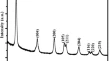
			<p>Figure&#8201;
				<figr fid="F3">3</figr> shows the 2<it>&#952;</it> scan XRD patterns of the GaOOH nanorods grown on Si substrates without and with a thin sputtered ATO seed layer under a cathodic voltage of &#8722;2&#8201;V at 80&#176;C. All diffraction peaks were indexed to the orthorhombic &#945;-GaOOH phase without any impurity phase. For bare Si substrate, the strong diffraction peak of (110) was only observed because the GaOOH rods lie parallel to the substrate, as shown in Figure&#8201;
				<figr fid="F2">2</figr>a. In the case of GaOOH NRAs with the ATO seed layer, the diffraction peaks were assigned to (110), (021), and (111) plane orientations. The diffraction intensity of (111) peak was dominant. These results show that GaOOH NRAs can be efficiently formed on the substrate with a thin ATO seed layer by the ED method. Also, the ATO seed layer plays an important role in controlling the oriented growth of GaOOH NRAs by enhancing the heterogeneous nucleation on the substrate.</p>
			<fig id="F3"><title><p>Figure 3</p></title><caption><p>XRD patterns of the GaOOH NRAs grown on Si substrates. (a) Without and (b) with an ATO seed layer under a cathodic voltage of &#8722;2&#8201;V at 80&#8201;&#176;C.</p></caption><text>
   <p><b>XRD patterns of the GaOOH NRAs grown on Si substrates.</b> (<b>a</b>) Without and (<b>b</b>) with an ATO seed layer under a cathodic voltage of &#8722;2&#8201;V at 80&#176;C.</p>
</text><graphic file="1556-276X-7-458-3"/></fig>
			<p>In order to investigate the effect of cathodic voltage on the growth properties, the GaOOH NRAs were synthesized on the ITO electrode of LEDs with/without the ATO seed layer under various cathodic voltages for 100&#8201;min. The cathodic voltage was changed from &#8722;1.8 to &#8722;2.2&#8201;V. Figure&#8201;
				<figr fid="F4">4</figr>a shows the top-view SEM image of GaOOH rods grown on bare ITO electrode under a cathodic voltage of &#8722;2&#8201;V. The precipitation behavior on bare ITO electrode was similar to that formed on bare Si substrate. Only a few submicrometer-sized GaOOH rods lying parallel to the ITO electrode were observed, which indicates the homogeneous nucleation of GaOOH. In the case of the growth process with the ATO seed layer, the GaOOH NRAs were synthesized by the heterogeneous nucleation on the ATO/ITO surface. For all samples, the GaOOH NRAs were grown with preferred orientations on the ITO electrode as shown in Figure&#8201;
				<figr fid="F4">4</figr>b,c,d. At &#8722;1.8&#8201;V, the GaOOH NRAs were sparsely synthesized. Additionally, the homogeneous nucleation of GaOOH rods was partially observed. As the cathodic voltage increased, the growth rate became higher, and the surface coverage was increased. At &#8722;2&#8201;V, the GaOOH NRAs were more densely and uniformly synthesized on the ATO/ITO surface. The average nanorod length was approximately 520&#8201;nm, and the lateral dimension became larger than that of GaOOH nanorods grown at &#8722;1.8&#8201;V. But most of the GaOOH nanorods were smaller than 260&#8201;nm. For an excessive cathodic voltage of &#8722;2.2&#8201;V, the ATO/ITO surface was almost wholly covered by large GaOOH NRAs with lateral dimensions above 300&#8201;nm. Also, the average nanorod length was increased by approximately 800&#8201;nm. The different cathodic voltage provides different amount of electrons for the growth reaction, and the increased voltage promotes the generation of OH<sup>&#8722;</sup> ions by electrochemical reduction of NO<sub>3</sub>
				<sup>&#8722;</sup> and dissolved O<sub>2</sub> near the cathodic electrode. Thus, the more GaOOH nuclei are formed on the ATO/ITO surface, and the surface density is increased. Also, the growth reactions are accelerated.</p>
			<fig id="F4"><title><p>Figure 4</p></title><caption><p>SEM images of GaOOH rods.</p></caption><text>
   <p><b>SEM images of GaOOH rods.</b> These rods are grown on ITO electrode of LEDs with and without ATO seed layer under different cathodic voltages for 100&#8201;min at 80&#176;C. (<b>a</b>) Bare ITO, &#8722;2&#8201;V; (<b>b</b>) ATO/ITO, &#8722;1.8&#8201;V; (<b>c</b>) ATO/ITO, &#8722;2&#8201;V; and (<b>d</b>) ATO/ITO, &#8722;2.2&#8201;V.</p>
</text><graphic file="1556-276X-7-458-4"/></fig>
			<p>Figure&#8201;
				<figr fid="F5">5</figr> shows the room-temperature EL spectra of InGaN/GaN MQW blue LEDs with and without electrochemically grown oriented GaOOH NRAs on ITO surface using a thin sputtered ATO seed layer. The GaOOH NRAs were synthesized under a cathodic voltage of &#8722;2&#8201;V for 100&#8201;min. The EL peak wavelength was not shifted after the growth process of GaOOH NRAs. For all LEDs with/without GaOOH NRAs, the emission peak wavelength was observed at <it>&#955;</it>&#8201;=&#8201;448.81 and 446.85&#8201;nm for 20 and 60&#8201;mA, respectively. This shows that the formation of GaOOH NRAs on GaN-based LEDs does not induce any radiative defects or surface damages. Furthermore, the EL intensity of LED with GaOOH NRAs was improved compared with the conventional LED. The inset shows the illumination image of the fabricated InGaN/GaN MQW LEDs with/without oriented GaOOH NRAs at an injection current of 5&#8201;mA. The LED with oriented GaOOH NRAs was brighter than the conventional LED. From these results, the light output power of GaN-based LEDs can be efficiently improved by the electrodeposited GaOOH NRAs.</p>
			<fig id="F5"><title><p>Figure 5</p></title><caption><p>Room-temperature EL spectra of LEDs with and without GaOOH NRAs at various injection currents.</p></caption><text>
   <p><b>Room-temperature EL spectra of LEDs with and without GaOOH NRAs at various injection currents.</b> The inset shows the illumination images of the fabricated LEDs with/without GaOOH NRAs at an injection current of 5&#8201;mA.</p>
</text><graphic file="1556-276X-7-458-5"/></fig>
			<p>Figure&#8201;
				<figr fid="F6">6</figr> shows the measured light-current&#8211;voltage (<it>L</it>-<it>I</it>-<it>V</it>) curves of the fabricated InGaN/GaN MQW blue LEDs with and without oriented GaOOH NRAs grown under a cathodic voltage of &#8722;2&#8201;V. The inset shows the measured <it>L</it>-<it>I</it> curves of the fabricated InGaN/GaN MQW blue LEDs with and without oriented GaOOH NRAs grown at different cathodic voltages. The FE-SEM image of LED with GaOOH NRAs on ATO/ITO films is also shown in the inset of Figure&#8201;
				<figr fid="F6">6</figr>. The <it>L</it>-<it>I</it>-<it>V</it> measurements were carried out using a probe station system. The samples were loaded on the copper mount with a thermistor to control a constant temperature of 298&#8201;K. The device characteristics were not affected by a thin ATO seed layer. After the formation of GaOOH NRAs, the forward voltages were 2.98 and 3.03&#8201;V at 20&#8201;mA for the convention LED and the LED with GaOOH NRAs, respectively. The very slight increment may be caused by the GaOOH NRAs grown on the <it>p</it>-electrode because it is not masked for a simple fabrication process. However, there was no distinct electrical degradation. This indicates that the ATO layer only acts as a seed layer to grow the oriented GaOOH NRAs without sacrificing the electrical and optical properties. Compared with conventional LED, the light output power was increased by 22% for LEDs with GaOOH NRAs at an injection current of 20&#8201;mA. The integrated GaOOH NRAs may offer the graded refractive index between the ITO electrode and air, as well as the textured surface. Thus, the internal reflection is efficiently reduced, and more photons can escape from the GaOOH NRAs/ITO surface. Meanwhile, the saturation behavior of the maximum output power was observed at similar current injection levels for both samples. For conventional LED, the output power was saturated at 468&#8201;mA, and it was slightly increased to 470&#8201;mA for the LED with GaOOH NRAs. As shown in the inset of Figure&#8201;
				<figr fid="F6">6</figr>, the maximum limitation in light output power was also investigated for different surface coverage and rod lengths. For LEDs with GaOOH NRAs grown at &#8722;1.8 and &#8722;2.2&#8201;V, the improvement in light output power was 8 and 12%, respectively. As the cathodic voltage increases, the ITO surface is wholly covered by the GaOOH NRAs with higher surface coverage and longer rod lengths, and it eventually indicates the close-packed morphology. The close-packed morphology of GaOOH NRAs may hinder effective light scattering, and the longer rod lengths lead to high light absorption loss. Consequently, the improvement in light extraction efficiency of GaN-based LEDs can be efficiently obtained by integrating controllably grown GaOOH NRAs under optimization condition.</p>
			<fig id="F6"><title><p>Figure 6</p></title><caption><p>Measured <it>L</it>-<it>I</it>-<it>V</it> curves of LEDs with and without GaOOH NRAs.</p></caption><text>
   <p><b>Measured </b><b><it>L</it></b><b>-</b><b><it>I</it></b><b>-</b><b><it>V </it></b><b>curves of LEDs with and without GaOOH NRAs.</b> They are grown at &#8722;2&#8201;V in CW operation at 298&#8201;K. The inset shows the <it>L</it>-<it>I</it> curves (top) of the LEDs with and without GaOOH NRAs grown at different cathodic voltages of &#8722;1.8 and &#8722;2.2&#8201;V and the cross-sectional SEM image (bottom) of GaOOH NRAs grown on the ATO/ITO surface of the LED at &#8722;2&#8201;V.</p>
</text><graphic file="1556-276X-7-458-6"/></fig>
		</sec>
		<sec>
			<st>
				<p>Conclusions</p>
			</st>
			<p>GaN-based LEDs with GaOOH NRAs on ITO electrode were fabricated by the ED method. The oriented growth of GaOOH NRAs on the ITO electrode was successfully obtained by the use of a thin sputtered ATO seed layer. The surface coverage and density of GaOOH NRAs were controlled by the cathodic voltage. In comparison with the conventional LEDs, the enhancement of 22% in light output power was achieved by the incorporation of GaOOH NRAs without any radiative defects. The electrical properties also were not distinctly affected by the growth process in GaOOH NRAs.</p>
		</sec>
		<sec>
			<st>
				<p>Competing interests</p>
			</st>
			<p>The authors declare that they do not have competing interests.</p>
		</sec>
		<sec>
			<st>
				<p>Authors&#8217; contributions</p>
			</st>
			<p>HKL proposed the original idea, carried out most of the experimental works associated with fabrication and characterization of samples, analyzed the results, and prepared the manuscript. DHJ and MSK helped the experimental works and characterization of samples. JSY developed the conceptual framework, supervised the whole work, and finalized the manuscript. All authors read and approved the final manuscript.</p>
		</sec>
	</bdy>
	<bm>
		<ack>
			<sec>
				<st>
					<p>Acknowledgments</p>
				</st>
				<p>This research was supported partially by a grant from the Ministry of Knowledge Economy of the Republic of Korea, under the project no. 10039151 and by Basic Science Research Program through the NRF funded by the MEST (no. 2011&#8211;0026393).</p>
			</sec>
		</ack>
		<refgrp><bibl id="B1"><title><p>Candela-class high-brightness InGaN/AlGaN double-heterostructure blue-light-emitting diodes</p></title><aug><au><snm>Nakamura</snm><fnm>S</fnm></au><au><snm>Mukai</snm><fnm>T</fnm></au><au><snm>Senoh</snm><fnm>M</fnm></au></aug><source>Appl Phys Lett</source><pubdate>1994</pubdate><volume>64</volume><fpage>1687</fpage><lpage>1689</lpage><xrefbib><pubid idtype="doi">10.1063/1.111832</pubid></xrefbib></bibl><bibl id="B2"><title><p>Strong light extraction enhancement in GaInN light-emitting diodes by using self-organized nanoscale patterning of p-type GaN</p></title><aug><au><snm>Chhajed</snm><fnm>S</fnm></au><au><snm>Lee</snm><fnm>W</fnm></au><au><snm>Cho</snm><fnm>J</fnm></au><au><snm>Schubert</snm><fnm>EF</fnm></au><au><snm>Kim</snm><fnm>JK</fnm></au></aug><source>Appl Phys Lett</source><pubdate>2011</pubdate><volume>98</volume><fpage>071102</fpage><xrefbib><pubid idtype="doi">10.1063/1.3554426</pubid></xrefbib></bibl><bibl id="B3"><title><p>Enhanced light extraction of InGaN-based green LEDs by nano-imprinted 2D photonic crystal pattern</p></title><aug><au><snm>Cheng</snm><fnm>BS</fnm></au><au><snm>Chiu</snm><fnm>CH</fnm></au><au><snm>Huang</snm><fnm>KJ</fnm></au><au><snm>Lai</snm><fnm>CF</fnm></au><au><snm>Kuo</snm><fnm>HC</fnm></au><au><snm>Lin</snm><fnm>CH</fnm></au><au><snm>Lu</snm><fnm>TC</fnm></au><au><snm>Wang</snm><fnm>SC</fnm></au><au><snm>Yu</snm><fnm>CC</fnm></au></aug><source>Semicond Sci Technol</source><pubdate>2008</pubdate><volume>23</volume><fpage>055002</fpage><xrefbib><pubid idtype="doi">10.1088/0268-1242/23/5/055002</pubid></xrefbib></bibl><bibl id="B4"><title><p>Disordered antireflective nanostructures on GaN-based light-emitting diodes using Ag nanoparticles for improved light extraction efficiency</p></title><aug><au><snm>Song</snm><fnm>YM</fnm></au><au><snm>Choi</snm><fnm>ES</fnm></au><au><snm>Park</snm><fnm>GC</fnm></au><au><snm>Park</snm><fnm>CY</fnm></au><au><snm>Jang</snm><fnm>SJ</fnm></au><au><snm>Lee</snm><fnm>YT</fnm></au></aug><source>App Phys Lett</source><pubdate>2011</pubdate><volume>97</volume><fpage>093110</fpage></bibl><bibl id="B5"><title><p>Optimization of hydrothermal growth ZnO nanorods for enhancement of light extraction from GaN blue LEDs</p></title><aug><au><snm>Soh</snm><fnm>CB</fnm></au><au><snm>Tay</snm><fnm>CB</fnm></au><au><snm>Chua</snm><fnm>SJ</fnm></au><au><snm>Le</snm><fnm>HQ</fnm></au><au><snm>Ang</snm><fnm>NSS</fnm></au><au><snm>Teng</snm><fnm>JH</fnm></au></aug><source>J Cryst Growth</source><pubdate>2010</pubdate><volume>312</volume><fpage>1848</fpage><lpage>1854</lpage><xrefbib><pubid idtype="doi">10.1016/j.jcrysgro.2010.02.041</pubid></xrefbib></bibl><bibl id="B6"><title><p>Light-extraction enhancement of large-area GaN-based LEDs with electrochemically grown ZnO nanorod arrays</p></title><aug><au><snm>Lee</snm><fnm>HK</fnm></au><au><snm>Kim</snm><fnm>MS</fnm></au><au><snm>Yu</snm><fnm>JS</fnm></au></aug><source>IEEE Photon Technol Lett</source><pubdate>2011</pubdate><volume>23</volume><fpage>1204</fpage><lpage>1206</lpage></bibl><bibl id="B7"><title><p>Enhanced light output of GaN-based light-emitting diodes with ZnO nanorod arrays</p></title><aug><au><snm>An</snm><fnm>SJ</fnm></au><au><snm>Chae</snm><fnm>JH</fnm></au><au><snm>Yi</snm><fnm>GC</fnm></au><au><snm>Park</snm><fnm>GH</fnm></au></aug><source>Appl Phys Lett</source><pubdate>2008</pubdate><volume>92</volume><fpage>121108</fpage><xrefbib><pubid idtype="doi">10.1063/1.2903153</pubid></xrefbib></bibl><bibl id="B8"><title><p>Synthesis of gallium hydroxide crystals in aqueous solutions with or without urea and their calcination behavior</p></title><aug><au><snm>Tas</snm><fnm>AC</fnm></au><au><snm>Majewski</snm><fnm>PJ</fnm></au><au><snm>Aldinger</snm><fnm>F</fnm></au></aug><source>J Am Ceram Soc</source><pubdate>2002</pubdate><volume>85</volume><fpage>1421</fpage><lpage>1429</lpage><xrefbib><pubid idtype="doi">10.1111/j.1151-2916.2002.tb00291.x</pubid></xrefbib></bibl><bibl id="B9"><title><p>A one-step method for the growth of Ga2O3-nanorod-based white-light-emitting phosphors</p></title><aug><au><snm>Vanithakumari</snm><fnm>SC</fnm></au><au><snm>Nanda</snm><fnm>KK</fnm></au></aug><source>Adv Mater</source><pubdate>2009</pubdate><volume>21</volume><fpage>3581</fpage><lpage>3584</lpage><xrefbib><pubid idtype="doi">10.1002/adma.200900072</pubid></xrefbib></bibl><bibl id="B10"><title><p>Rapid microwave hydrothermal synthesis of GaOOH nanorods with photocatalytic activity toward aromatic compounds</p></title><aug><au><snm>Sun</snm><fnm>M</fnm></au><au><snm>Li</snm><fnm>D</fnm></au><au><snm>Zhang</snm><fnm>W</fnm></au><au><snm>Fu</snm><fnm>X</fnm></au><au><snm>Shao</snm><fnm>Y</fnm></au><au><snm>Li</snm><fnm>W</fnm></au><au><snm>Xiao</snm><fnm>G</fnm></au><au><snm>He</snm><fnm>Y</fnm></au></aug><source>Nanotechnology</source><pubdate>2010</pubdate><volume>21</volume><fpage>355601</fpage><xrefbib><pubidlist><pubid idtype="doi">10.1088/0957-4484/21/35/355601</pubid><pubid idtype="pmpid" link="fulltext">20683143</pubid></pubidlist></xrefbib></bibl><bibl id="B11"><title><p>Fabrication of Ga2O3 thin films by aqueous solution deposition</p></title><aug><au><snm>Ohya</snm><fnm>Y</fnm></au><au><snm>Okano</snm><fnm>J</fnm></au><au><snm>Kasuya</snm><fnm>Y</fnm></au><au><snm>Ban</snm><fnm>T</fnm></au></aug><source>J Ceram Soc Jpn</source><pubdate>2009</pubdate><volume>117</volume><fpage>973</fpage><lpage>977</lpage><xrefbib><pubid idtype="doi">10.2109/jcersj2.117.973</pubid></xrefbib></bibl><bibl id="B12"><title><p>Refractive index and hygroscopic stability of AlxGa1-xAs native oxides</p></title><aug><au><snm>Hall</snm><fnm>DC</fnm></au><au><snm>Wu</snm><fnm>H</fnm></au><au><snm>Kou</snm><fnm>L</fnm></au><au><snm>Luo</snm><fnm>Y</fnm></au><au><snm>Epstein</snm><fnm>RJ</fnm></au><au><snm>Blum</snm><fnm>O</fnm></au><au><snm>Hou</snm><fnm>H</fnm></au></aug><source>Appl Phys Lett</source><pubdate>1999</pubdate><volume>75</volume><fpage>1110</fpage><lpage>1112</lpage><xrefbib><pubid idtype="doi">10.1063/1.124612</pubid></xrefbib></bibl><bibl id="B13"><title><p>Photoenhanced wet oxidation of gallium nitride</p></title><aug><au><snm>Peng</snm><fnm>LH</fnm></au><au><snm>Liao</snm><fnm>CH</fnm></au><au><snm>Hsu</snm><fnm>YC</fnm></au><au><snm>Jong</snm><fnm>CS</fnm></au><au><snm>Huang</snm><fnm>CN</fnm></au><au><snm>Ho</snm><fnm>JK</fnm></au><au><snm>Chiu</snm><fnm>CC</fnm></au><au><snm>Chen</snm><fnm>CY</fnm></au></aug><source>Appl Phys Lett</source><pubdate>2000</pubdate><volume>76</volume><fpage>511</fpage><lpage>513</lpage><xrefbib><pubid idtype="doi">10.1063/1.125804</pubid></xrefbib></bibl><bibl id="B14"><title><p>Sonochemical hydrolysis of Ga3+ ions: synthesis of scroll-like cylindrical nanoparticles of gallium oxide hydroxide</p></title><aug><au><snm>Avivi</snm><fnm>S</fnm></au><au><snm>Mastai</snm><fnm>Y</fnm></au><au><snm>Hodes</snm><fnm>G</fnm></au><au><snm>Gedanken</snm><fnm>A</fnm></au></aug><source>J Am Chem Soc</source><pubdate>1999</pubdate><volume>121</volume><fpage>4196</fpage><lpage>4199</lpage><xrefbib><pubid idtype="doi">10.1021/ja9835584</pubid></xrefbib></bibl><bibl id="B15"><title><p>Application of sol&#8211;gel method in the synthesis of gallium(III)-oxide</p></title><aug><au><snm>Ristic</snm><fnm>M</fnm></au><au><snm>Popovic</snm><fnm>S</fnm></au><au><snm>Music</snm><fnm>S</fnm></au></aug><source>Mater Lett</source><pubdate>2005</pubdate><volume>59</volume><fpage>1227</fpage><lpage>1233</lpage><xrefbib><pubid idtype="doi">10.1016/j.matlet.2004.11.055</pubid></xrefbib></bibl><bibl id="B16"><title><p>Chemical deposition of rodlike GaOOH and beta-Ga2O3 films using simple aqueous solutions</p></title><aug><au><snm>Fujihara</snm><fnm>S</fnm></au><au><snm>Shibata</snm><fnm>Y</fnm></au><au><snm>Hosono</snm><fnm>E</fnm></au></aug><source>J Electrochem Soc</source><pubdate>2005</pubdate><volume>152</volume><fpage>C764</fpage><lpage>C768</lpage><xrefbib><pubid idtype="doi">10.1149/1.2060627</pubid></xrefbib></bibl><bibl id="B17"><title><p>Influence of oblique-angle sputtered transparent conducting oxides on performance of Si-based thin film solar cells</p></title><aug><au><snm>Leem</snm><fnm>JW</fnm></au><au><snm>Yu</snm><fnm>JS</fnm></au></aug><source>Phys Status Solidi A</source><pubdate>2011</pubdate><volume>208</volume><fpage>2220</fpage><lpage>2225</lpage><xrefbib><pubid idtype="doi">10.1002/pssa.201026644</pubid></xrefbib></bibl><bibl id="B18"><title><p>Electrodeposition of hierarchical ZnO nanorod-nanosheet structures and their applications in dye-sensitized solar cells</p></title><aug><au><snm>Qiu</snm><fnm>J</fnm></au><au><snm>Guo</snm><fnm>M</fnm></au><au><snm>Wang</snm><fnm>X</fnm></au></aug><source>ACS Appl Mater Interfaces</source><pubdate>2011</pubdate><volume>3</volume><fpage>2358</fpage><lpage>2367</lpage><xrefbib><pubidlist><pubid idtype="doi">10.1021/am2002789</pubid><pubid idtype="pmpid" link="fulltext">21675757</pubid></pubidlist></xrefbib></bibl></refgrp>
	</bm>
</art>