<?xml version='1.0'?>
<!DOCTYPE art SYSTEM 'http://www.biomedcentral.com/xml/article.dtd'>
<art>
	<ui>1556-276X-7-437</ui>
	<ji>1556-276X</ji>
	<fm>
		<dochead>Nano Express</dochead>
		<bibl>
			<title>
				<p>Controlled synthesis of bilayer graphene on nickel</p>
			</title>
			<aug>
				<au id="A1"><snm>Umair</snm><fnm>Ahmad</fnm><insr iid="I1"/><email>ahmad-umair@uiowa.edu</email></au>
				<au id="A2" ca="yes"><snm>Raza</snm><fnm>Hassan</fnm><insr iid="I1"/><email>nstnrg@gmail.com</email></au>
			</aug>
			<insg>
				<ins id="I1"><p>Department of Electrical and Computer Engineering, University of Iowa, Iowa City, IA, 52242, USA</p></ins>
			</insg>
			<source>Nanoscale Research Letters</source>
			<section><title><p>Regular submissions</p></title></section><issn>1556-276X</issn>
			<pubdate>2012</pubdate>
			<volume>7</volume>
			<issue>1</issue>
			<fpage>437</fpage>
			<url>http://www.nanoscalereslett.com/content/7/1/437</url>
			<xrefbib><pubidlist><pubid idtype="doi">10.1186/1556-276X-7-437</pubid><pubid idtype="pmpid">22863171</pubid></pubidlist></xrefbib>
		</bibl>
		<history><rec><date><day>11</day><month>6</month><year>2012</year></date></rec><acc><date><day>25</day><month>7</month><year>2012</year></date></acc><pub><date><day>6</day><month>8</month><year>2012</year></date></pub></history>
		<cpyrt><year>2012</year><collab>Umair and Raza; licensee Springer.</collab><note>This is an Open Access article distributed under the terms of the Creative Commons Attribution License (<url>http://creativecommons.org/licenses/by/2.0</url>), which permits unrestricted use, distribution, and reproduction in any medium, provided the original work is properly cited.</note></cpyrt>
		<kwdg>
			<kwd>Bilayer graphene</kwd>
			<kwd>Chemical vapor deposition</kwd>
			<kwd>Raman spectroscopy</kwd>
		</kwdg>
		<abs>
			<sec>
				<st>
					<p>Abstract</p>
				</st><p>We report a uniform and low-defect synthesis of bilayer graphene on evaporated polycrystalline nickel films. We used atmospheric pressure chemical vapor deposition with ultra-fast substrate cooling after exposure to methane at 1,000&#176;C. The optimized process parameters, i.e., growth time, annealing profile and flow rates of various gases, are reported. By using Raman spectroscopy mapping, the ratio of 2D to G peak intensities (<it>I</it>
					<sub>2D</sub>/<it>I</it>
					<sub>G</sub>) is in the range of 0.9 to 1.6 over 96% of the 200 &#956;m&#8201;&#215;&#8201;200 &#956;m area. Moreover, the average ratio of D to G peak intensities (<it>I</it>
					<sub>D</sub>/<it>I</it>
					<sub>G</sub>) is about 0.1.</p>
			</sec>
		</abs>
	</fm>
	<bdy>
		<sec>
			<st>
				<p>Background</p>
			</st><p>Graphene, a monolayer of sp<sup>2</sup>-hybridized C atoms arranged in a honeycomb structure, has attracted a lot of attention due to its excellent electrical, mechanical and optical properties <abbrgrp>
					<abbr bid="B1">1</abbr>
					<abbr bid="B2">2</abbr>
					<abbr bid="B3">3</abbr>
				</abbrgrp>. Monolayer and bilayer graphene (BLG) are semi-metals with zero band gap. The intrinsic band gap has been the key in semiconducting devices. Band gap can be induced by patterning graphene into nano-ribbons <abbrgrp>
					<abbr bid="B4">4</abbr>
					<abbr bid="B5">5</abbr>
					<abbr bid="B6">6</abbr>
					<abbr bid="B7">7</abbr>
					<abbr bid="B8">8</abbr>
					<abbr bid="B9">9</abbr>
					<abbr bid="B10">10</abbr>
				</abbrgrp>. Another method to introduce band gap is to apply electric field in the stacking direction of BLG <abbrgrp>
					<abbr bid="B11">11</abbr>
					<abbr bid="B12">12</abbr>
					<abbr bid="B13">13</abbr>
					<abbr bid="B14">14</abbr>
				</abbrgrp>.</p><p>Graphene synthesis on transition metals by chemical vapor deposition (CVD) or via segregation of solid carbon sources is generally a scalable process <abbrgrp>
					<abbr bid="B15">15</abbr>
					<abbr bid="B16">16</abbr>
					<abbr bid="B17">17</abbr>
					<abbr bid="B18">18</abbr>
					<abbr bid="B19">19</abbr>
					<abbr bid="B20">20</abbr>
					<abbr bid="B21">21</abbr>
					<abbr bid="B22">22</abbr>
					<abbr bid="B23">23</abbr>
					<abbr bid="B24">24</abbr>
				</abbrgrp>. Transition metals such as Ni, Cu, Pt, Ir and Pd have been used as substrates for graphene growth <abbrgrp>
					<abbr bid="B25">25</abbr>
					<abbr bid="B26">26</abbr>
					<abbr bid="B27">27</abbr>
					<abbr bid="B28">28</abbr>
					<abbr bid="B29">29</abbr>
				</abbrgrp>. Several hydrocarbons, like methane (CH<sub>4</sub>), acetylene, ethylene, propane, etc., have been used in atmospheric and low-pressure CVD as a carbon source <abbrgrp>
					<abbr bid="B25">25</abbr>
				</abbrgrp>. Besides the CVD of the above mentioned gases, C<sub>60</sub> and solid polymers such as poly(methyl metha-crylate), polystyrene and acrylonitrile butadiene styrene have also been decomposed to grow graphene <abbrgrp>
					<abbr bid="B30">30</abbr>
					<abbr bid="B31">31</abbr>
					<abbr bid="B32">32</abbr>
				</abbrgrp>.</p><p>Graphene synthesizes on Ni due to segregation of carbon at high temperatures. Due to the high solubility of carbon in Ni, precipitation of extra carbon occurs at the metal surfaces during cooling. Since the precipitation is a non-equilibrium process, this makes thickness control of graphene a challenge <abbrgrp>
					<abbr bid="B33">33</abbr>
					<abbr bid="B34">34</abbr>
				</abbrgrp>. The segregation of extra carbon during the cooling process can be decreased by reducing Ni film thickness. Moreover, extra carbon segregation can also be controlled by controlling the cooling rate <abbrgrp>
					<abbr bid="B15">15</abbr>
					<abbr bid="B22">22</abbr>
					<abbr bid="B35">35</abbr>
					<abbr bid="B36">36</abbr>
					<abbr bid="B37">37</abbr>
				</abbrgrp>. Very high cooling rate has been reported to deposit amorphous carbon deposition, whereas low cooling rate leads to no growth <abbrgrp>
					<abbr bid="B15">15</abbr>
				</abbrgrp>. It has been reported that the carbon segregation on Ni is non-uniform at low temperatures. However, CH<sub>4</sub> has high decomposition temperature, which helps in constant carbon coverage over the Ni surfaces <abbrgrp>
					<abbr bid="B38">38</abbr>
				</abbrgrp>. Furthermore, high melting point of Ni enables high-temperature annealing, which results in larger domains, thus making it favorable for large-area low-defect growth <abbrgrp>
					<abbr bid="B25">25</abbr>
				</abbrgrp>.</p><p>In this paper, we report a method to control the precipitation of extra carbon on Ni surface during the cooling-down process. We reduce the sample temperature from the growth temperature of 1,000&#176;C to room temperature in a few seconds, which leads to a uniform BLG growth.</p>
		</sec>
		<sec>
			<st>
				<p>Methods</p>
			</st><p>BLG was grown on a 300 nm Ni film, evaporated on SiO<sub>2</sub> (300 nm)/Si substrate. SiO<sub>2</sub>/Si substrate was treated with acetone (10 min), methanol (10 min), deionized (DI) water rinse (10 min) and nanostrip (20 min; commercial Piranha substitute), followed by another DI water rinse (10 min). After cleaning, Ni was evaporated by using an e-beam evaporator at 1&#197;/s. Ni/SiO<sub>2</sub>/Si samples were gently cleaned in UV ozone for 2 min before loading in the CVD furnace. UV ozone eliminates organic contaminants from the Ni film, which is important for uniform growth. Process gases were supplied by Airgas (Denver, CO, USA) with research grade 5.0 (minimum purity 99.999%). The samples were loaded into the CVD furnace (1-inch tube diameter; Lindbergh/Blue, Thermo Scientific, Logan, UT, USA) at room temperature and heated to 700&#176;C in 200 sccm Ar ambient. At 700&#176;C, 65 sccm H<sub>2</sub> was introduced in addition to Ar, and the samples were annealed for another 10 min. The temperature was ramped to 1,000&#176;C in Ar/H<sub>2</sub> ambient. To stabilize the growth temperature, the samples were further annealed for 10 min after reaching 1,000&#176;C. Ar/H<sub>2</sub> annealing sequence leads to increased grain size and decreased surface roughness <abbrgrp>
					<abbr bid="B18">18</abbr>
					<abbr bid="B22">22</abbr>
				</abbrgrp>. Finally, H<sub>2</sub> was turned off, and BLG was synthesized by introducing CH<sub>4</sub> into the furnace in addition to the already flowing Ar gas. A wide process parameter space was explored, which includes (a) varying the growth time (50, 60 and 120 s) under a constant CH<sub>4</sub> flow rate (23 sccm) and (b) varying the flow rates (6, 12 and 23 sccm) under a constant growth time (120 s). After the growth, the sample temperature was reduced to room temperature within a few seconds by pulling the quartz tube out of the hot region of the furnace.</p><p>For material characterization, micro-Raman spectroscopy (Raman Nicolet Almega XR Spectrometer, Thermo Scientific) was used in the point scan and the area scan mode <abbrgrp>
					<abbr bid="B3">3</abbr>
					<abbr bid="B39">39</abbr>
					<abbr bid="B40">40</abbr>
				</abbrgrp>. A 532 nm laser (10 mW power) was used with a 0.6 &#956;m spot size, 15 s scan time and four scans per point. To examine the uniformity of the synthesized graphene, the ratio of 2D to G peak intensities (<it>I</it>
				<sub>2D</sub>/<it>I</it>
				<sub>G</sub> ratio) was taken over an area of 200 &#956;m&#8201;&#215;&#8201;200 &#956;m. In the area scan, a 2.1 &#956;m spot size was used with 15 s scan time, four scans per point and 10 &#956;m step size.</p>
		</sec>
		<sec>
			<st>
				<p>Results and discussions</p>
			</st><p>Figure <figr fid="F1">1</figr>a,d shows the ratio of 2D to G peak intensities (<it>I</it>
				<sub>2D</sub>/<it>I</it>
				<sub>G</sub>) at two different locations for a sample that was grown under 23 sccm CH<sub>4</sub> for 120 s. In each case, the <it>I</it>
				<sub>2D</sub>/<it>I</it>
				<sub>G</sub> ratio is in the range of 0.9 to 1.6 over 96% of the total 200 &#956;m&#8201;&#215;&#8201;200 &#956;m area. This suggests that the BLG is grown over a larger percentage of area on polycrystalline Ni film <abbrgrp>
					<abbr bid="B21">21</abbr>
					<abbr bid="B22">22</abbr>
					<abbr bid="B39">39</abbr>
					<abbr bid="B40">40</abbr>
				</abbrgrp>. The <it>I</it>
				<sub>2D</sub> and <it>I</it>
				<sub>G</sub> plots over these locations are shown in Figure <figr fid="F1">1</figr>b,e and Figure <figr fid="F1">1</figr>c,f, respectively. These plots show a uniform intensity distribution for the G and D peaks, which further implies the graphene sample uniformity. </p>
			<fig id="F1"><title><p>Figure 1</p></title><caption><p>Two-dimensional Raman intensity map for bilayer graphene. (a) <it>I</it><sub>2D</sub>/<it>I</it><sub>G</sub> ratio (ratio of 2D to G peak intensities). <b>(b)</b><it>I</it><sub>2D</sub> (intensity of 2D peak). <b>(c)</b><it>I</it><sub>G</sub> (intensity of G peak). <b>(d)</b>, <b>(e)</b> and <b>(f)</b> show <it>I</it><sub>2D</sub>/<it>I</it><sub>G</sub>, <it>I</it><sub>2D</sub> and <it>I</it><sub>G</sub>, respectively, for a different area. BLG was grown by using CVD on 300-nm of evaporated Ni film under CH<sub>4</sub>/Ar (23:200 sccm) at 1,000 &#176;C for 120 s. The total area of each view map is 200 &#956;m&#8201;&#215;&#8201;200 &#956;m</p></caption><text>
   <p><b> Two-dimensional Raman intensity map for bilayer graphene.</b> (<b>a</b>) <it>I</it><sub>2D</sub>/<it>I</it><sub>G</sub> ratio (ratio of 2D to G peak intensities). (<b>b</b>) <it>I</it><sub>2D</sub> (intensity of 2D peak). (<b>c</b>) <it>I</it><sub>G</sub> (intensity of G peak). (<b>d</b>), (<b>e</b>) and (<b>f</b>) show <it>I</it><sub>2D</sub>/<it>I</it><sub>G</sub>, <it>I</it><sub>2D</sub> and <it>I</it><sub>G</sub>, respectively, for a different area. BLG was grown by using CVD on 300-nm of evaporated Ni film under CH<sub>4</sub>/Ar (23:200 sccm) at 1,000&#176;C for 120 s. The total area of each view map is 200 &#956;m&#8201;&#215;&#8201;200 &#956;m.</p>
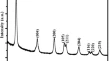
</text><graphic file="1556-276X-7-437-1"/></fig><p>Next, the growth time was varied to study the effect on the number of layers, uniformity and defect density of the synthesized graphene. Figure <figr fid="F2">2</figr>a shows the Raman spectra of the samples that were treated under 23 sccm of CH<sub>4</sub> for 50, 60 and 120 s. The <it>I</it>
				<sub>2D</sub>/<it>I</it>
				<sub>G</sub> ratio is close to unity with these varying growth times. This quenching method inhibits the precipitation of extra C on the Ni surface and thus controls the number of layers and the uniformity of the graphene for various growth times. Furthermore, after turning the CH<sub>4</sub> off, if there is some residual C inside the furnace, the ultra-fast cooling suppresses its further segregation. Moreover, the effect of the CH<sub>4</sub> flow rate was also studied for constant growth time. Figure <figr fid="F2">2</figr>b shows the Raman spectra of samples for which the growth time was 120 s with CH<sub>4</sub> flow rates of 6, 12 and 23 sccm. It shows that the BLG growth is consistent for a wide range of flow rates.</p>
			<fig id="F2"><title><p>Figure 2</p></title><caption><p>Raman spectra for various growth conditions. (a) Increasing the growth time decreases the D peak intensity for 23 sccm of CH<sub>4</sub>. <b>(b)</b> BLG quality is uniform over wide CH<sub>4</sub> flow rates for 120-s growth time</p></caption><text>
   <p><b> Raman spectra for various growth conditions.</b> (<b>a</b>) Increasing the growth time decreases the D peak intensity for 23 sccm of CH<sub>4</sub>. (<b>b</b>) BLG quality is uniform over wide CH<sub>4</sub> flow rates for 120-s growth time.</p>
</text><graphic file="1556-276X-7-437-2"/></fig><p>Another important observation is that the intensity of the D peak decreases as the growth time increases from 50 to 120 s, as shown in Figure <figr fid="F2">2</figr>a. The ratio of D to G peak intensities (<it>I</it>
				<sub>D</sub>/<it>I</it>
				<sub>G</sub> ratio) was taken over 20 locations for the samples grown under 23 sccm of CH<sub>4</sub> for 50, 60 and 120 s. The mean and standard deviation of <it>I</it>
				<sub>D</sub>/<it>I</it>
				<sub>G</sub> ratio are plotted in the error bar graph shown in Figure <figr fid="F3">3</figr>. The average <it>I</it>
				<sub>D</sub>/<it>I</it>
				<sub>G</sub> ratio for the sample grown under 23 sccm of CH<sub>4</sub> for 120 s is 0.1 with a standard deviation of 0.05, which suggests a low defect density of BLG for these parameters. Moreover, Figure <figr fid="F3">3</figr> also shows that the average defect density decreases with the increasing growth time. Figure <figr fid="F2">2</figr>b also shows that the defect density of BLG is small for the samples grown under wide CH<sub>4</sub> flow rates for 120 s.</p>
			<fig id="F3"><title><p>Figure 3</p></title><caption><p><it>I</it><sub>D</sub>/<it>I</it><sub>G</sub> ratio (ratio of D to G peak intensities). The average defect density decreases with increasing growth time</p></caption><text>
   <p><b><it> I</it></b><sub><b>D</b></sub><b>/</b><b><it>I</it></b><sub><b>G</b></sub><b>ratio (ratio of D to G peak intensities).</b> The average defect density decreases with increasing growth time.</p>
</text><graphic file="1556-276X-7-437-3"/></fig><p>We find that quenching the samples from the hot region of the furnace helps in reducing the non-equilibrium precipitation of extra carbon on the Ni surfaces during the cooling process, and that the main growth mechanism is diffusion of carbon on Ni surface due to the decomposed CH<sub>4</sub>. With fast cooling, the reduced sample temperature stops further segregation of carbon due to any residual carbon inside the furnace, even after CH<sub>4</sub> flow was turned off. The thickness of the graphene is almost constant even with a wide range of CH<sub>4</sub> flow rates (6 to 23 sccm), which shows that the segregation process is rather self-limiting. Furthermore, the growth temperature is high due to high decomposition temperature of CH<sub>4</sub> that supports the uniform carbon diffusion over the Ni surface. This helps in growing uniform BLG with less defect density. Moreover, as the growth time is decreased, the average intensity of the D peak increases, which indicates incomplete growth. This further verifies the self-limiting equilibrium segregation of carbon on Ni surface, with reduced out-diffused carbon atoms from the C-Ni solution due to fast cooling. To verify the proposed growth mechanism, graphene was grown on 300 nm Ni film, with 23 sccm CH<sub>4</sub> flow rated for 120 s, cooling the samples within the furnace. Due to slow cooling, the precipitation of carbon on Ni surface from the C-Ni solution is a dominant process.</p><p>Yet, another way to reduce the precipitation of extra carbon is to reduce the thickness of Ni film as less thick films would absorb less carbon and thus contribute to further decrease in out-diffused carbon. To characterize this effect, the growth was performed on 200 and 100 nm thick Ni films, with 23 sccm CH<sub>4</sub> flow rate for 120 s. For the 200 nm Ni film, the <it>I</it>
				<sub>2D</sub>/<it>I</it>
				<sub>G</sub> ratio is close to unity, and the area uniformity is similar to the 300 nm thick films. However, growth on 100 nm Ni film results in increased surface roughness. Although the <it>I</it>
				<sub>2D</sub>/<it>I</it>
				<sub>G</sub> ratio is still around unity in this process, surface coverage is only 50%.</p>
		</sec>
		<sec>
			<st>
				<p>Conclusions</p>
			</st><p>In conclusion, we have reported a method to synthesize bilayer graphene through CVD of CH<sub>4</sub> on polycrystalline Ni films with an ultra-fast cooling technique. The number of graphene layers is uniform over a wide area with low defect density. The growth is consistent over a certain variation of CH<sub>4</sub> flow rate and growth time.</p>
		</sec>
		<sec>
			<st>
				<p>Competing interests</p>
			</st><p>Both authors declare that they have no competing interests.</p>
		</sec>
		<sec>
			<st>
				<p>Authors&#8217; contribution</p>
			</st><p>HR and AU have equal contribution to this work and the manuscript. Both authors read and approved the final manuscript.</p>
		</sec>
	</bdy>
	<bm>
		<ack>
			<sec>
				<st>
					<p>Acknowledgements</p>
				</st><p>We are grateful to A. Mohsin for the useful discussions, J. Baltrusaitis for helping with the Raman spectroscopy and T. Z. Raza for critically reviewing an early draft of this manuscript. We are also thankful to C. Coretsopoulos, D. Norton and J. Olesberg for their help in the Micro Fabrication Facility. Evaporation was carried out in the Micro Fabrication Facility, and the Raman spectroscopy was performed in the Central Microscopy Research Facility at the University of Iowa. This work is supported by the MPSFP program of the VPR office at the University of Iowa.</p>
			</sec>
		</ack>
		<refgrp><bibl id="B1"><title><p>The rise of graphene</p></title><aug><au><snm>Geim</snm><fnm>AK</fnm></au><au><snm>Novoselov</snm><fnm>KS</fnm></au></aug><source>Nat Mater</source><pubdate>2007</pubdate><volume>6</volume><fpage>183</fpage><lpage>191</lpage><xrefbib><pubidlist><pubid idtype="doi">10.1038/nmat1849</pubid><pubid idtype="pmpid" link="fulltext">17330084</pubid></pubidlist></xrefbib></bibl><bibl id="B2"><title><p>The electronic properties of graphene</p></title><aug><au><snm>Castro Neto</snm><fnm>AH</fnm></au><au><snm>Peres</snm><fnm>NMR</fnm></au><au><snm>Novoselov</snm><fnm>KS</fnm></au><au><snm>Geim</snm><fnm>AK</fnm></au></aug><source>Rev Mod Phys</source><pubdate>2009</pubdate><volume>81</volume><fpage>109</fpage><lpage>162</lpage><xrefbib><pubid idtype="doi">10.1103/RevModPhys.81.109</pubid></xrefbib></bibl><bibl id="B3"><aug><au><snm>Raza</snm><fnm>H</fnm></au></aug><source>Graphene Nanoelectronics: Metrology, Synthesis, Properties and Applications</source><publisher>Springer, Berlin</publisher><pubdate>2012</pubdate></bibl><bibl id="B4"><title><p>Edge state in graphene ribbons: nanometer size effect and edge shape dependence</p></title><aug><au><snm>Nakada</snm><fnm>K</fnm></au><au><snm>Fujita</snm><fnm>M</fnm></au><au><snm>Dresselhaus</snm><fnm>G</fnm></au><au><snm>Dresselhaus</snm><fnm>MS</fnm></au></aug><source>Phys Rev B</source><pubdate>1996</pubdate><volume>54</volume><fpage>17954</fpage><lpage>17961</lpage><xrefbib><pubid idtype="doi">10.1103/PhysRevB.54.17954</pubid></xrefbib></bibl><bibl id="B5"><title><p>Peculiar localized states at zig-zag edges</p></title><aug><au><snm>Fujita</snm><fnm>M</fnm></au><au><snm>Wakabayashi</snm><fnm>K</fnm></au><au><snm>Nakada</snm><fnm>K</fnm></au><au><snm>Kusakabe</snm><fnm>K</fnm></au></aug><source>J Phys Soc Jpn</source><pubdate>1996</pubdate><volume>65</volume><fpage>1920</fpage><lpage>1923</lpage><xrefbib><pubid idtype="doi">10.1143/JPSJ.65.1920</pubid></xrefbib></bibl><bibl id="B6"><title><p>Electronic and magnetic properties of nanographite ribbons</p></title><aug><au><snm>Wakabayashi</snm><fnm>K</fnm></au><au><snm>Fujita</snm><fnm>M</fnm></au><au><snm>Ajiki</snm><fnm>H</fnm></au><au><snm>Sigrist</snm><fnm>M</fnm></au></aug><source>Phys Rev B</source><pubdate>1999</pubdate><volume>59</volume><fpage>8271</fpage><lpage>8282</lpage><xrefbib><pubid idtype="doi">10.1103/PhysRevB.59.8271</pubid></xrefbib></bibl><bibl id="B7"><title><p>Graphitic ribbons without hydrogen-termination: electronic structures and stabilities</p></title><aug><au><snm>Kawai</snm><fnm>T</fnm></au><au><snm>Miyamoto</snm><fnm>Y</fnm></au><au><snm>Sugino</snm><fnm>O</fnm></au><au><snm>Koga</snm><fnm>Y</fnm></au></aug><source>Phys Rev B</source><pubdate>2000</pubdate><volume>62</volume><fpage>R16349</fpage><lpage>R16352</lpage><xrefbib><pubid idtype="doi">10.1103/PhysRevB.62.R16349</pubid></xrefbib></bibl><bibl id="B8"><title><p>Armchair graphene nanoribbons: electronic structure and electric-field modulation</p></title><aug><au><snm>Raza</snm><fnm>H</fnm></au><au><snm>Kan</snm><fnm>EC</fnm></au></aug><source>Phys Rev B</source><pubdate>2008</pubdate><volume>77</volume><fpage>245434</fpage></bibl><bibl id="B9"><title><p>Zigzag graphene nanoribbons: bandgap and midgap state modulation</p></title><aug><au><snm>Raza</snm><fnm>H</fnm></au></aug><source>J Phys Condens Matter</source><pubdate>2011</pubdate><volume>23</volume><fpage>382203</fpage><xrefbib><pubidlist><pubid idtype="doi">10.1088/0953-8984/23/38/382203</pubid><pubid idtype="pmpid" link="fulltext">21891831</pubid></pubidlist></xrefbib></bibl><bibl id="B10"><title><p>Edge and passivation effects in armchair graphene nanoribbons</p></title><aug><au><snm>Raza</snm><fnm>H</fnm></au></aug><source>Phys Rev B</source><pubdate>2011</pubdate><volume>84</volume><fpage>165425</fpage></bibl><bibl id="B11"><title><p>Electrons in bilayer graphene</p></title><aug><au><snm>McCann</snm><fnm>E</fnm></au><au><snm>Abergel</snm><fnm>DSL</fnm></au><au><snm>Fal&#8217;ko</snm><fnm>VI</fnm></au></aug><source>Solid State Commun</source><pubdate>2007</pubdate><volume>143</volume><fpage>110</fpage><lpage>115</lpage><xrefbib><pubid idtype="doi">10.1016/j.ssc.2007.03.054</pubid></xrefbib></bibl><bibl id="B12"><title><p>Biased bilayer graphene: semiconductor with a gap tunable by the electric field effect</p></title><aug><au><snm>Castro</snm><fnm>E</fnm></au><au><snm>Novoselov</snm><fnm>K</fnm></au><au><snm>Morozov</snm><fnm>S</fnm></au><au><snm>Peres</snm><fnm>N</fnm></au><au><snm>Dos Santos</snm><fnm>J</fnm></au><au><snm>Nilsson</snm><fnm>J</fnm></au><au><snm>Guinea</snm><fnm>F</fnm></au><au><snm>Geim</snm><fnm>A</fnm></au><au><snm>Neto</snm><fnm>A</fnm></au></aug><source>Phys Rev Lett</source><pubdate>2007</pubdate><volume>99</volume><fpage>216802</fpage><xrefbib><pubid idtype="pmpid" link="fulltext">18233240</pubid></xrefbib></bibl><bibl id="B13"><title><p>Graphene field-effect transistors with high on/off current ratio and large transport band gap at room temperature</p></title><aug><au><snm>Xia</snm><fnm>F</fnm></au><au><snm>Farmer</snm><fnm>DB</fnm></au><au><snm>Lin</snm><fnm>Y-M</fnm></au><au><snm>Avouris</snm><fnm>P</fnm></au></aug><source>Nano Lett</source><pubdate>2010</pubdate><volume>10</volume><fpage>715</fpage><lpage>718</lpage><xrefbib><pubidlist><pubid idtype="doi">10.1021/nl9039636</pubid><pubid idtype="pmpid" link="fulltext">20092332</pubid></pubidlist></xrefbib></bibl><bibl id="B14"><title><p>Field modulation in bilayer graphene band structure</p></title><aug><au><snm>Raza</snm><fnm>H</fnm></au><au><snm>Kan</snm><fnm>EC</fnm></au></aug><source>J Phys Condens Matter</source><pubdate>2009</pubdate><volume>21</volume><fpage>102202</fpage><xrefbib><pubidlist><pubid idtype="doi">10.1088/0953-8984/21/10/102202</pubid><pubid idtype="pmpid" link="fulltext">21817415</pubid></pubidlist></xrefbib></bibl><bibl id="B15"><title><p>Graphene segregated on Ni surfaces and transferred to insulators</p></title><aug><au><snm>Yu</snm><fnm>Q</fnm></au><au><snm>Lian</snm><fnm>J</fnm></au><au><snm>Siriponglert</snm><fnm>S</fnm></au><au><snm>Li</snm><fnm>H</fnm></au><au><snm>Chen</snm><fnm>YP</fnm></au><au><snm>Pei</snm><fnm>S-S</fnm></au></aug><source>Appl Phys Lett</source><pubdate>2008</pubdate><volume>93</volume><fpage>113103</fpage><xrefbib><pubid idtype="doi">10.1063/1.2982585</pubid></xrefbib></bibl><bibl id="B16"><title><p>Large area, few-layer graphene films on arbitrary substrates by chemical vapor deposition</p></title><aug><au><snm>Reina</snm><fnm>A</fnm></au><au><snm>Jia</snm><fnm>X</fnm></au><au><snm>Ho</snm><fnm>J</fnm></au><au><snm>Nezich</snm><fnm>D</fnm></au><au><snm>Son</snm><fnm>H</fnm></au><au><snm>Bulovic</snm><fnm>V</fnm></au><au><snm>Dresselhaus</snm><fnm>MS</fnm></au><au><snm>Kong</snm><fnm>J</fnm></au></aug><source>Nano Lett</source><pubdate>2009</pubdate><volume>9</volume><fpage>30</fpage><lpage>35</lpage><xrefbib><pubidlist><pubid idtype="doi">10.1021/nl801827v</pubid><pubid idtype="pmpid" link="fulltext">19046078</pubid></pubidlist></xrefbib></bibl><bibl id="B17"><title><p>Large-scale pattern growth of graphene films for stretchable transparent electrodes</p></title><aug><au><snm>Kim</snm><fnm>KS</fnm></au><au><snm>Zhao</snm><fnm>Y</fnm></au><au><snm>Jang</snm><fnm>H</fnm></au><au><snm>Lee</snm><fnm>SY</fnm></au><au><snm>Kim</snm><fnm>JM</fnm></au><au><snm>Kim</snm><fnm>KS</fnm></au><au><snm>Ahn</snm><fnm>J-H</fnm></au><au><snm>Kim</snm><fnm>P</fnm></au><au><snm>Choi</snm><fnm>J-Y</fnm></au><au><snm>Hong</snm><fnm>BH</fnm></au></aug><source>Nature</source><pubdate>2009</pubdate><volume>457</volume><fpage>706</fpage><lpage>710</lpage><xrefbib><pubidlist><pubid idtype="doi">10.1038/nature07719</pubid><pubid idtype="pmpid" link="fulltext">19145232</pubid></pubidlist></xrefbib></bibl><bibl id="B18"><title><p>Large-area synthesis of high-quality and uniform graphene films on copper foils</p></title><aug><au><snm>Li</snm><fnm>X</fnm></au><au><snm>Cai</snm><fnm>W</fnm></au><au><snm>An</snm><fnm>J</fnm></au><au><snm>Kim</snm><fnm>S</fnm></au><au><snm>Nah</snm><fnm>J</fnm></au><au><snm>Yang</snm><fnm>D</fnm></au><au><snm>Piner</snm><fnm>R</fnm></au><au><snm>Velamakanni</snm><fnm>A</fnm></au><au><snm>Jung</snm><fnm>I</fnm></au><au><snm>Tutuc</snm><fnm>E</fnm></au><au><snm>Banerjee</snm><fnm>SK</fnm></au><au><snm>Colombo</snm><fnm>L</fnm></au><au><snm>Ruoff</snm><fnm>RS</fnm></au></aug><source>Science</source><pubdate>2009</pubdate><volume>324</volume><fpage>1312</fpage><lpage>1314</lpage><xrefbib><pubidlist><pubid idtype="doi">10.1126/science.1171245</pubid><pubid idtype="pmpid" link="fulltext">19423775</pubid></pubidlist></xrefbib></bibl><bibl id="B19"><title><p>Wafer-scale synthesis and transfer of graphene films</p></title><aug><au><snm>Lee</snm><fnm>Y</fnm></au><au><snm>Bae</snm><fnm>S</fnm></au><au><snm>Jang</snm><fnm>H</fnm></au><au><snm>Jang</snm><fnm>S</fnm></au><au><snm>Zhu</snm><fnm>S-E</fnm></au><au><snm>Sim</snm><fnm>SH</fnm></au><au><snm>Song</snm><fnm>YI</fnm></au><au><snm>Hong</snm><fnm>BH</fnm></au><au><snm>Ahn</snm><fnm>J-H</fnm></au></aug><source>Nano Lett</source><pubdate>2010</pubdate><volume>10</volume><fpage>490</fpage><lpage>493</lpage><xrefbib><pubidlist><pubid idtype="doi">10.1021/nl903272n</pubid><pubid idtype="pmpid" link="fulltext">20044841</pubid></pubidlist></xrefbib></bibl><bibl id="B20"><title><p>Synthesis of high-quality monolayer and bilayer graphene on copper using chemical vapor deposition</p></title><aug><au><snm>Liu</snm><fnm>W</fnm></au><au><snm>Li</snm><fnm>H</fnm></au><au><snm>Xu</snm><fnm>C</fnm></au><au><snm>Khatami</snm><fnm>Y</fnm></au><au><snm>Banerjee</snm><fnm>K</fnm></au></aug><source>Carbon</source><pubdate>2011</pubdate><volume>49</volume><fpage>4122</fpage><lpage>4130</lpage><xrefbib><pubid idtype="doi">10.1016/j.carbon.2011.05.047</pubid></xrefbib></bibl><bibl id="B21"><title><p>Direct growth of bilayer graphene on SiO2 substrates by carbon diffusion through nickel</p></title><aug><au><snm>Peng</snm><fnm>Z</fnm></au><au><snm>Yan</snm><fnm>Z</fnm></au><au><snm>Sun</snm><fnm>Z</fnm></au><au><snm>Tour</snm><fnm>JM</fnm></au></aug><source>ACS Nano</source><pubdate>2011</pubdate><volume>5</volume><fpage>8241</fpage><lpage>8247</lpage><xrefbib><pubidlist><pubid idtype="doi">10.1021/nn202923y</pubid><pubid idtype="pmpid" link="fulltext">21888426</pubid></pubidlist></xrefbib></bibl><bibl id="B22"><title><p>Autonomously controlled homogenous growth of wafer-sized high-quality graphene via a smart Janus substrate</p></title><aug><au><snm>Wan</snm><fnm>D</fnm></au><au><snm>Lin</snm><fnm>T</fnm></au><au><snm>Bi</snm><fnm>H</fnm></au><au><snm>Huang</snm><fnm>F</fnm></au><au><snm>Xie</snm><fnm>X</fnm></au><au><snm>Chen</snm><fnm>I-W</fnm></au><au><snm>Jiang</snm><fnm>M</fnm></au></aug><source>Adv Funct Mater</source><pubdate>2012</pubdate><volume>22</volume><fpage>1033</fpage><lpage>1039</lpage><xrefbib><pubid idtype="doi">10.1002/adfm.201102560</pubid></xrefbib></bibl><bibl id="B23"><title><p>Synthesis, transfer, and devices of single- and few-layer graphene by chemical vapor deposition</p></title><aug><au><snm>Arco</snm><fnm>LGD</fnm></au><au><snm>Zhang</snm><fnm>Y</fnm></au><au><snm>Kumar</snm><fnm>A</fnm></au><au><snm>Zhou</snm><fnm>C</fnm></au></aug><source>IEEE Trans Nanotechnol</source><pubdate>2009</pubdate><volume>8</volume><fpage>135</fpage><lpage>138</lpage></bibl><bibl id="B24"><title><p>Synthesis of large-area graphene layers on poly-nickel substrate by chemical vapor deposition: wrinkle formation</p></title><aug><au><snm>Chae</snm><fnm>SJ</fnm></au><au><snm>Gunes</snm><fnm>F</fnm></au><au><snm>Kim</snm><fnm>KK</fnm></au><au><snm>Kim</snm><fnm>ES</fnm></au><au><snm>Gang</snm><fnm>HH</fnm></au><au><snm>Kim</snm><fnm>SM</fnm></au><au><snm>Shin</snm><fnm>H-J</fnm></au><au><snm>Yoon</snm><fnm>S-M</fnm></au><au><snm>Choi</snm><fnm>J-Y</fnm></au><au><snm>Park</snm><fnm>MH</fnm></au><au><snm>Yang</snm><fnm>CW</fnm></au><au><snm>Pribat</snm><fnm>D</fnm></au><au><snm>Le</snm><fnm>YH</fnm></au></aug><source>Adv Mater</source><pubdate>2009</pubdate><volume>21</volume><fpage>2328</fpage><lpage>2333</lpage><xrefbib><pubid idtype="doi">10.1002/adma.200803016</pubid></xrefbib></bibl><bibl id="B25"><title><p>Graphene: piecing it together</p></title><aug><au><snm>R&#252;mmeli</snm><fnm>MH</fnm></au><au><snm>Rocha</snm><fnm>CG</fnm></au><au><snm>Ortmann</snm><fnm>F</fnm></au><au><snm>Ibrahim</snm><fnm>I</fnm></au><au><snm>Sevincli</snm><fnm>H</fnm></au><au><snm>B&#246;rrnert</snm><fnm>F</fnm></au><au><snm>Kunstmann</snm><fnm>J</fnm></au><au><snm>Bachmatiuk</snm><fnm>A</fnm></au><au><snm>P&#246;tschke</snm><fnm>M</fnm></au><au><snm>Shiraishi</snm><fnm>M</fnm></au><au><snm>Meyyappan</snm><fnm>M</fnm></au><au><snm>B&#252;chner</snm><fnm>V</fnm></au><au><snm>Roche</snm><fnm>S</fnm></au><au><snm>Cuniberti</snm><fnm>G</fnm></au></aug><source>Adv Mater</source><pubdate>2011</pubdate><volume>23</volume><fpage>4471</fpage><lpage>4490</lpage><xrefbib><pubidlist><pubid idtype="doi">10.1002/adma.201101855</pubid><pubid idtype="pmpid">22103000</pubid></pubidlist></xrefbib></bibl><bibl id="B26"><title><p>Growth and properties of few-layer graphene prepared by chemical vapor deposition</p></title><aug><au><snm>Park</snm><fnm>HJ</fnm></au><au><snm>Meyer</snm><fnm>J</fnm></au><au><snm>Roth</snm><fnm>S</fnm></au><au><snm>Sk&#225;kalov&#225;</snm><fnm>V</fnm></au></aug><source>Carbon</source><pubdate>2010</pubdate><volume>48</volume><fpage>1088</fpage><lpage>1094</lpage><xrefbib><pubid idtype="doi">10.1016/j.carbon.2009.11.030</pubid></xrefbib></bibl><bibl id="B27"><title><p>Formation of monolayer graphene by annealing sacrificial nickel thin films</p></title><aug><au><snm>Pollard</snm><fnm>AJ</fnm></au><au><snm>Nair</snm><fnm>RR</fnm></au><au><snm>Sabki</snm><fnm>SN</fnm></au><au><snm>Staddon</snm><fnm>CR</fnm></au><au><snm>Perdigao</snm><fnm>LMA</fnm></au><au><snm>Hsu</snm><fnm>CH</fnm></au><au><snm>Garfitt</snm><fnm>JM</fnm></au><au><snm>Gangopadhyay</snm><fnm>S</fnm></au><au><snm>Gleeson</snm><fnm>HF</fnm></au><au><snm>Geim</snm><fnm>AK</fnm></au><au><snm>Beton</snm><fnm>PH</fnm></au></aug><source>J PhysChemLett</source><pubdate>2009</pubdate><volume>113</volume><fpage>16565</fpage><lpage>16567</lpage></bibl><bibl id="B28"><title><p>Chemical vapor deposition of graphene films</p></title><aug><au><snm>Nandamuri</snm><fnm>G</fnm></au><au><snm>Roumimov</snm><fnm>S</fnm></au><au><snm>Solanki</snm><fnm>R</fnm></au></aug><source>Nanotechnology</source><pubdate>2010</pubdate><volume>21</volume><fpage>145604</fpage><xrefbib><pubidlist><pubid idtype="doi">10.1088/0957-4484/21/14/145604</pubid><pubid idtype="pmpid" link="fulltext">20215663</pubid></pubidlist></xrefbib></bibl><bibl id="B29"><title><p>Bulk growth of mono- to few-layer graphene on nickel particles by chemical vapor deposition from methane</p></title><aug><au><snm>Chen</snm><fnm>Z</fnm></au><au><snm>Ren</snm><fnm>W</fnm></au><au><snm>Liu</snm><fnm>B</fnm></au><au><snm>Gao</snm><fnm>L</fnm></au><au><snm>Pei</snm><fnm>S</fnm></au><au><snm>Wu</snm><fnm>Z-S</fnm></au><au><snm>Zhao</snm><fnm>J</fnm></au><au><snm>Cheng</snm><fnm>H-M</fnm></au></aug><source>Carbon</source><pubdate>2010</pubdate><volume>48</volume><fpage>3543</fpage><lpage>3550</lpage><xrefbib><pubid idtype="doi">10.1016/j.carbon.2010.05.052</pubid></xrefbib></bibl><bibl id="B30"><title><p>Growth of graphene from solid carbon sources</p></title><aug><au><snm>Sun</snm><fnm>Z</fnm></au><au><snm>Yan</snm><fnm>Z</fnm></au><au><snm>Yao</snm><fnm>J</fnm></au><au><snm>Beitler</snm><fnm>E</fnm></au><au><snm>Zhu</snm><fnm>Y</fnm></au><au><snm>Tour</snm><fnm>JM</fnm></au></aug><source>Nature</source><pubdate>2010</pubdate><volume>468</volume><fpage>549</fpage><lpage>552</lpage><xrefbib><pubidlist><pubid idtype="doi">10.1038/nature09579</pubid><pubid idtype="pmpid" link="fulltext">21068724</pubid></pubidlist></xrefbib></bibl><bibl id="B31"><title><p>Transfer-free growth of few-layer graphene by self-assembled monolayers</p></title><aug><au><snm>Shin</snm><fnm>H-J</fnm></au><au><snm>Choi</snm><fnm>WM</fnm></au><au><snm>Yoon</snm><fnm>S-M</fnm></au><au><snm>Han</snm><fnm>GH</fnm></au><au><snm>Woo</snm><fnm>YS</fnm></au><au><snm>Kim</snm><fnm>ES</fnm></au><au><snm>Chae</snm><fnm>SJ</fnm></au><au><snm>Li</snm><fnm>X-S</fnm></au><au><snm>Benayad</snm><fnm>A</fnm></au><au><snm>Loc</snm><fnm>DD</fnm></au><au><snm>Gunes</snm><fnm>F</fnm></au><au><snm>Lee</snm><fnm>YH</fnm></au><au><snm>Choi</snm><fnm>J-Y</fnm></au></aug><source>Adv Mater</source><pubdate>2011</pubdate><volume>23</volume><fpage>4392</fpage><lpage>4397</lpage><xrefbib><pubidlist><pubid idtype="doi">10.1002/adma.201102526</pubid><pubid idtype="pmpid" link="fulltext">21882264</pubid></pubidlist></xrefbib></bibl><bibl id="B32"><title><p>Graphene formation by decomposition of C60</p></title><aug><au><snm>Sabki</snm><fnm>SN</fnm></au><au><snm>Garfitt</snm><fnm>JM</fnm></au><au><snm>Capiod</snm><fnm>P</fnm></au><au><snm>Beton</snm><fnm>PH</fnm></au></aug><source>J Phys Chem</source><pubdate>2011</pubdate><volume>115</volume><fpage>7472</fpage><lpage>7476</lpage><xrefbib><pubid idtype="doi">10.1021/jp200628b</pubid></xrefbib></bibl><bibl id="B33"><title><p>Graphene as transparent electrode material for organic electronics</p></title><aug><au><snm>Pang</snm><fnm>S</fnm></au><au><snm>Hernandez</snm><fnm>Y</fnm></au><au><snm>Feng</snm><fnm>X</fnm></au><au><snm>M&#252;llen</snm><fnm>K</fnm></au></aug><source>Adv Mater</source><pubdate>2011</pubdate><volume>23</volume><fpage>2779</fpage><lpage>2795</lpage><xrefbib><pubidlist><pubid idtype="doi">10.1002/adma.201100304</pubid><pubid idtype="pmpid" link="fulltext">21520463</pubid></pubidlist></xrefbib></bibl><bibl id="B34"><title><p>Evolution of graphene growth on Ni and Cu by carbon isotope labeling</p></title><aug><au><snm>Li</snm><fnm>X</fnm></au><au><snm>Cai</snm><fnm>W</fnm></au><au><snm>Colombo</snm><fnm>L</fnm></au><au><snm>Ruoff</snm><fnm>RS</fnm></au></aug><source>Nano Lett</source><pubdate>2009</pubdate><volume>9</volume><fpage>4268</fpage><lpage>4272</lpage><xrefbib><pubidlist><pubid idtype="doi">10.1021/nl902515k</pubid><pubid idtype="pmpid" link="fulltext">19711970</pubid></pubidlist></xrefbib></bibl><bibl id="B35"><title><p>A simple alcohol-chemical vapor deposition synthesis of single-layer graphenes using flash cooling</p></title><aug><au><snm>Miyata</snm><fnm>Y</fnm></au><au><snm>Kamon</snm><fnm>K</fnm></au><au><snm>Ohashi</snm><fnm>K</fnm></au><au><snm>Kitaura</snm><fnm>R</fnm></au><au><snm>Yoshimura</snm><fnm>M</fnm></au><au><snm>Shinohara</snm><fnm>H</fnm></au></aug><source>Appl Phys Lett</source><pubdate>2010</pubdate><volume>96</volume><fpage>263105</fpage><xrefbib><pubid idtype="doi">10.1063/1.3458797</pubid></xrefbib></bibl><bibl id="B36"><title><p>Chemical vapor deposition of large area few layer graphene on Si catalyzed with nickel films</p></title><aug><au><snm>Liu</snm><fnm>W</fnm></au><au><snm>Chung</snm><fnm>C-H</fnm></au><au><snm>Miao</snm><fnm>C-Q</fnm></au><au><snm>Wang</snm><fnm>Y-J</fnm></au><au><snm>Li</snm><fnm>B-Y</fnm></au><au><snm>Ruan</snm><fnm>L-Y</fnm></au><au><snm>Patel</snm><fnm>K</fnm></au><au><snm>Park</snm><fnm>Y-J</fnm></au><au><snm>Woo</snm><fnm>J</fnm></au><au><snm>Xie</snm><fnm>Y-H</fnm></au></aug><source>Thin Solid Films</source><pubdate>2010</pubdate><volume>518</volume><fpage>S128</fpage><lpage>S132</lpage><xrefbib><pubid idtype="doi">10.1016/j.tsf.2009.10.070</pubid></xrefbib></bibl><bibl id="B37"><aug><au><snm>Zhou</snm><fnm>Q</fnm></au><au><snm>Lin</snm><fnm>L</fnm></au></aug><source>Synthesis of graphene using micro chemical vapor deposition</source><publisher>IEEE, Wanchai. Hong Kong</publisher><series>
   <title>
      <p>In IEEE 23rd International Conference on Micro Electro Mechanical Systems</p>
   </title>
</series><pubdate>2010</pubdate><fpage>43</fpage><lpage>46</lpage></bibl><bibl id="B38"><title><p>Equilibrium segregation of carbon to a nickel (111) surface: a surface phase transition</p></title><aug><au><snm>Shelton</snm><fnm>JC</fnm></au><au><snm>Patil</snm><fnm>HR</fnm></au><au><snm>Blakely</snm><fnm>JM</fnm></au></aug><source>Surf Sci</source><pubdate>1974</pubdate><volume>43</volume><fpage>493</fpage><lpage>520</lpage><xrefbib><pubid idtype="doi">10.1016/0039-6028(74)90272-6</pubid></xrefbib></bibl><bibl id="B39"><title><p>Raman spectrum of graphene and graphene layers</p></title><aug><au><snm>Ferrari</snm><fnm>AC</fnm></au><au><snm>Meyer</snm><fnm>JC</fnm></au><au><snm>Scardaci</snm><fnm>V</fnm></au><au><snm>Casiraghi</snm><fnm>C</fnm></au><au><snm>Lazzeri</snm><fnm>M</fnm></au><au><snm>Mauri</snm><fnm>F</fnm></au><au><snm>Piscanec</snm><fnm>S</fnm></au><au><snm>Jiang</snm><fnm>D</fnm></au><au><snm>Novoselov</snm><fnm>KS</fnm></au><au><snm>Roth</snm><fnm>S</fnm></au><au><snm>Geim</snm><fnm>AK</fnm></au></aug><source>Phys Rev Lett</source><pubdate>2006</pubdate><volume>97</volume><fpage>187401</fpage><xrefbib><pubid idtype="pmpid" link="fulltext">17155573</pubid></xrefbib></bibl><bibl id="B40"><title><p>Raman spectroscopy in graphene</p></title><aug><au><snm>Malard</snm><fnm>LM</fnm></au><au><snm>Pimenta</snm><fnm>MA</fnm></au><au><snm>Dresselhaus</snm><fnm>G</fnm></au><au><snm>Dresselhaus</snm><fnm>MS</fnm></au></aug><source>Phys Rep</source><pubdate>2009</pubdate><volume>473</volume><fpage>51</fpage><lpage>87</lpage><xrefbib><pubid idtype="doi">10.1016/j.physrep.2009.02.003</pubid></xrefbib></bibl></refgrp>
	</bm>
</art>