<?xml version='1.0'?>
<!DOCTYPE art SYSTEM 'http://www.biomedcentral.com/xml/article.dtd'>
<art><ui>1556-276X-7-417</ui><ji>1556-276X</ji><fm><dochead>Nano Express</dochead><bibl><title><p>Mechanically activated catalyst mixing for high-yield boron nitride nanotube growth</p></title><aug><au id="A1"><snm>Li</snm><fnm>Ling</fnm><insr iid="I1"/><insr iid="I2"/><email>08B921005@hit.edu.cn</email></au><au id="A2" ca="yes"><snm>Li</snm><mnm>Hua</mnm><fnm>Lu</fnm><insr iid="I2"/><email>luhua.li@deakin.edu.au</email></au><au id="A3"><snm>Chen</snm><fnm>Ying</fnm><insr iid="I2"/><email>ian.chen@deakin.edu.au</email></au><au id="A4"><snm>Dai</snm><mi>J</mi><fnm>Xiujuan</fnm><insr iid="I2"/><email>jane.dai@deakin.edu.au</email></au><au id="A5"><snm>Xing</snm><fnm>Tan</fnm><insr iid="I2"/><email>txing@deakin.edu.au</email></au><au id="A6"><snm>Petravic</snm><fnm>Mladen</fnm><insr iid="I3"/><email>mpetravic@phy.uniri.hr</email></au><au id="A7" ca="yes"><snm>Liu</snm><fnm>Xiaowei</fnm><insr iid="I1"/><email>lxw@hit.edu.cn</email></au></aug><insg><ins id="I1"><p>MEMS Center, Harbin Institute of Technology, Harbin 150001, China</p></ins><ins id="I2"><p>Institute for Frontier Materials, Deakin University, Geelong Waurn Ponds Campus, Waurn Ponds, Victoria 3216, Australia</p></ins><ins id="I3"><p>Department of Physics and Center for Micro and Nano Sciences and Technologies, University of Rijeka, Rijeka 51000, Croatia</p></ins></insg><source>Nanoscale Research Letters</source><section><title><p>Regular submissions</p></title></section><issn>1556-276X</issn><pubdate>2012</pubdate><volume>7</volume><issue>1</issue><fpage>417</fpage><url>http://www.nanoscalereslett.com/content/7/1/417</url><xrefbib><pubidlist><pubid idtype="doi">10.1186/1556-276X-7-417</pubid><pubid idtype="pmpid">22827911</pubid></pubidlist></xrefbib></bibl><history><rec><date><day>19</day><month>6</month><year>2012</year></date></rec><acc><date><day>14</day><month>7</month><year>2012</year></date></acc><pub><date><day>24</day><month>7</month><year>2012</year></date></pub></history><cpyrt><year>2012</year><collab>Li et al.; licensee Springer.</collab><note>This is an Open Access article distributed under the terms of the Creative Commons Attribution License (<url>http://creativecommons.org/licenses/by/2.0</url>), which permits unrestricted use, distribution, and reproduction in any medium, provided the original work is properly cited.</note></cpyrt><kwdg><kwd>Boron nitride nanotube</kwd><kwd>Mechanical milling</kwd><kwd>Nanostructured materials</kwd><kwd>Synthesis</kwd><kwd>X-ray absorption fine structure</kwd><kwd>PACS</kwd><kwd>81.07.De</kwd><kwd>81.16.Be</kwd><kwd>68.55.A-.</kwd></kwdg><abs><sec><st><p>Abstract</p></st><p>Boron nitride nanotubes (BNNTs) have many fascinating properties and a wide range of applications. An improved ball milling method has been developed for high-yield BNNT synthesis, in which metal nitrate, such as Fe(NO<sub>3</sub>)<sub>3</sub>, and amorphous boron powder are milled together to prepare a more effective precursor. The heating of the precursor in nitrogen-containing gas produces a high density of BNNTs with controlled structures. The chemical bonding and structure of the synthesized BNNTs are precisely probed by near-edge X-ray absorption fine structure spectroscopy. The higher efficiency of the precursor containing milling-activated catalyst is revealed by thermogravimetric analyses. Detailed X-ray diffraction and X-ray photoelectron spectroscopy investigations disclose that during ball milling the Fe(NO<sub>3</sub>)<sub>3</sub> decomposes to Fe which greatly accelerates the nitriding reaction and therefore increases the yield of BNNTs. This improved synthesis method brings the large-scale production and application of BNNTs one step closer.</p></sec></abs></fm><bdy><sec><st><p>Background</p></st><p>Boron nitride nanotubes (BNNTs) are a promising nanomaterial with many fascinating properties and a wide range of applications. BNNTs have high thermal and chemical stabilities <abbrgrp><abbr bid="B1">1</abbr><abbr bid="B2">2</abbr></abbrgrp> and can be reinforced into composites working in harsh environments. BNNTs have a wide bandgap close to 6 eV and strong deep ultraviolet light emission <abbrgrp><abbr bid="B3">3</abbr><abbr bid="B4">4</abbr></abbrgrp>, useful in fabricating optoelectronic devices at nanoscale. Transistor behaviour has been predicted from BNNTs due to their giant stark effect <abbrgrp><abbr bid="B5">5</abbr></abbrgrp>. In addition, BNNTs have many potential bioapplications, including drug delivery, nanofluidics and nanoscaled biosensors <abbrgrp><abbr bid="B6">6</abbr><abbr bid="B7">7</abbr><abbr bid="B8">8</abbr></abbrgrp>.</p><p>BNNTs were first produced using arc discharge and laser ablation methods <abbrgrp><abbr bid="B9">9</abbr><abbr bid="B10">10</abbr></abbrgrp>. Later on, other synthesis routes, including ball milling and annealing <abbrgrp><abbr bid="B11">11</abbr><abbr bid="B12">12</abbr><abbr bid="B13">13</abbr><abbr bid="B14">14</abbr></abbrgrp>, chemical vapour deposition <abbrgrp><abbr bid="B15">15</abbr><abbr bid="B16">16</abbr><abbr bid="B17">17</abbr></abbrgrp> and other thermal chemical methods <abbrgrp><abbr bid="B6">6</abbr><abbr bid="B18">18</abbr></abbrgrp>, were demonstrated. The ball milling and annealing method has been shown to be able to produce larger quantities of BNNTs and more easily to scale up <abbrgrp><abbr bid="B11">11</abbr><abbr bid="B12">12</abbr><abbr bid="B13">13</abbr></abbrgrp>. In this process, metal nanoparticles from repeated collisions between milling jar and balls during ball milling act as catalysts for BNNT growth <abbrgrp><abbr bid="B11">11</abbr><abbr bid="B12">12</abbr><abbr bid="B13">13</abbr></abbrgrp>. The recent B ink process added metal nitrate (e.g. Fe(NO<sub>3</sub>)<sub>3</sub> or Co(NO<sub>3</sub>)<sub>2</sub>) to the milled B powder in the form of ethanol solution, and the additional nitrate catalyst showed a more efficient catalytic effect and greatly boosted the growth of BNNTs <abbrgrp><abbr bid="B19">19</abbr><abbr bid="B20">20</abbr></abbrgrp>, especially in the case of the growth of BNNT thin films on different surfaces <abbrgrp><abbr bid="B21">21</abbr></abbrgrp>.</p><p>Here, we report an improved ball milling and annealing method for BNNT synthesis, which shows a better BNNT yield compared to the original ball milling method as well as the B ink method. The method involves ball milling of metal nitrate with B powder, and the subsequent thermal annealing of the milled powder in nitrogen-containing gases grows a high density of BNNTs.</p></sec><sec><st><p>Methods</p></st><p>Amorphous B powder (95% to 97%, Fluka, Sigma-Aldrich Corporation, St. Louis, MO, USA) and 10 wt.% Fe(NO<sub>3</sub>)<sub>3</sub>&#8226;9H<sub>2</sub>O (98%, Pronalys, Thermo Fisher Scientific, Waltham, MA, USA) were sealed in a stainless milling jar with several hardened steel balls. The weight ratio of ball to powder was 80:1. Dehydrated NH<sub>3</sub> gas was filled into the jar at a pressure of 250 kPa. The ball milling was conducted on a custom-built vertical milling machine and lasted for 150 h at a speed of 110 rpm at room temperature. The milled powder was then heated up to 1,100&#176;C in N<sub>2</sub>&#8201;+&#8201;15% H<sub>2</sub> or 1,300&#176;C in NH<sub>3</sub> for 3 to 6 h to produce BNNTs.</p><p>The morphology and chemical composition of the products were investigated using a Supra 55VP scanning electron microscope (SEM; Carl Zeiss AG, Oberkochen, Germany) equipped with an energy dispersive X-ray spectroscopy (EDX) system. A JEOL-2100 transmission electron microscope (TEM; JEOL Ltd., Akishima, Tokyo, Japan) was used to check the structure of the nanotubes. The material phases were analysed by X-ray diffraction (XRD; PANalytical B.V., Almelo, The Netherlands). The nitriding reaction rates of different samples were compared by thermogravimetric analyses (TGA; Netzsch, Hanau, Germany) which monitored the sample weight changes up to 1,300&#176;C (with a temperature increasing rate of 10&#176;C/min) in a pure N<sub>2</sub> atmosphere. A Thermo Fischer Scientific K-alpha X-ray photoelectron spectroscopy (XPS) system was used to measure the chemical compositions of the milled B powders. Pass energies of 100 and 20 eV were used in survey and high-resolution scans. All XPS data were corrected using the binding energy of C-C at 284.6 eV. The near-edge X-ray absorption fine structure (NEXAFS) measurements were performed in the ultrahigh vacuum chamber (approximately 10<sup>&#8722;10</sup> mbar) at the undulator soft X-ray spectroscopy beamline of the Australian Synchrotron, Victoria, Australia. The raw NEXAFS data were normalized to the photoelectron current of the photon beam, measured on an Au grid.</p></sec><sec><st><p>Results and discussion</p></st><p>Figure&#8201;<figr fid="F1">1</figr>a,b shows SEM images of a typical product after the heating of the milled powder in N<sub>2</sub>&#8201;+&#8201;15% H<sub>2</sub> atmosphere at 1,100&#176;C. The nanotubes mainly have diameters of 60 to 100 nm and lengths of 50 to 200 &#956;m. Majority of the tubes have a bamboo-like structure (Figure&#8201;<figr fid="F1">1</figr>c), but cylindrical nanotubes can also be easily found under TEM (Figure&#8201;<figr fid="F1">1</figr>d). The BNNTs normally have metal catalysts at the tips, suggesting that the BNNTs produced in the current method are following the same vapour-liquid-solid (VLS) growth mechanism as in the original ball milling method and the B ink method <abbrgrp><abbr bid="B11">11</abbr><abbr bid="B19">19</abbr><abbr bid="B22">22</abbr></abbrgrp>. The EDX result (Figure&#8201;<figr fid="F1">1</figr>e) confirms that the sample mainly consists of B and N elements, along with O impurities and metal catalysts from the added Fe(NO<sub>3</sub>)<sub>3</sub> as well as the repeated collisions between the steel milling jar and balls during ball milling <abbrgrp><abbr bid="B11">11</abbr><abbr bid="B13">13</abbr></abbrgrp>. Cylindrical BNNTs with smaller diameters of approximately 10 nm can be harvested if the milled powder is heated in NH<sub>3</sub> gas at 1,300&#176;C (Figure&#8201;<figr fid="F2">2</figr>a). These BN tubes have shorter lengths of 5 to 8 &#956;m. The TEM image in Figure&#8201;<figr fid="F2">2</figr>b shows the straight walls of a BNNT produced under this condition.</p><fig id="F1"><title><p>Figure 1</p></title><caption><p>SEM images (a,b), TEM images (c,d) and EDX spectrum (e) of BNNTs</p></caption><text>
   <p><b>SEM images (a,b), TEM images (c,d) and EDX spectrum (e) of BNNTs.</b> The BNNTs were produced by heating the Fe(NO<sub>3</sub>)<sub>3</sub>&#8201;+&#8201;B milled powder in N<sub>2</sub>&#8201;+&#8201;15% H<sub>2</sub> gas at 1,100&#176;C.</p>
</text><graphic file="1556-276X-7-417-1"/></fig><fig id="F2"><title><p>Figure 2</p></title><caption><p>SEM (a) and TEM (b) images of the BNNTs produced in NH<sub>3</sub> gas at 1,300&#176;C</p></caption><text>
   <p>
      <b>SEM (a) and TEM (b) images of the BNNTs produced in NH</b>
      <sub>
         <b>3</b>
      </sub>
      <b>gas at 1,300&#176;C.</b>
   </p>
</text><graphic file="1556-276X-7-417-2"/></fig><p>The precise chemical structure and bonding of the produced BNNTs were determined by NEXAFS spectroscopy. In the B K-edge region, the BNNTs produced in N<sub>2</sub>&#8201;+&#8201;15% H<sub>2</sub> and NH<sub>3</sub> gases mainly show similar NEXAFS spectra (Figure&#8201;<figr fid="F3">3</figr>a,b): a sharp &#960;* resonance at 192.0 eV and broad &#963;* resonances at higher energies, corresponding to core-level electron transitions to the unoccupied antibonding <it>s&#8201;+&#8201;p</it><sub><it>z</it></sub> and <it>p</it><sub><it>x</it></sub>&#8201;<it>+&#8201;p</it><sub><it>y</it></sub> orbitals due to the dipole selection rule &#916;<it>l</it>&#8201;=&#8201;&#177;1, where &#916;<it>l</it> is the angular momentum quantum number difference between the initial and final states <abbrgrp><abbr bid="B23">23</abbr><abbr bid="B24">24</abbr></abbrgrp>. The strong &#960;* resonances from both types of BNNTs suggest that B and N atoms have a covalent <it>sp</it><sup><it>2</it></sup> bonding. Close to the strong &#960;* resonance, there also exist two satellite peaks at 192.6 and 193.3 eV, commonly observed from various hBN materials <abbrgrp><abbr bid="B25">25</abbr><abbr bid="B26">26</abbr><abbr bid="B27">27</abbr><abbr bid="B28">28</abbr></abbrgrp>. These weak peaks represent point defects in the form of one or two nitrogen vacancies decorated by oxygen atoms in a hexagonal ring <abbrgrp><abbr bid="B24">24</abbr><abbr bid="B29">29</abbr></abbrgrp>. The relatively stronger satellite peaks shown in the NEXAFS spectrum of the N<sub>2</sub>&#8201;+&#8201;15% H<sub>2</sub>-produced BNNTs (Figure&#8201;<figr fid="F3">3</figr>a) indicate more point defects and chemical impurities in the product, consistent with their bamboo structure. In contrast, the small cylindrical BNNTs synthesized in NH<sub>3</sub> gas have much better structure and purity. In addition, the full width at half maximum of the &#960;* resonance of the NH<sub>3</sub>-synthesized BNNTs (0.348 eV) is slightly smaller than that of the N<sub>2</sub>&#8201;+&#8201;15% H<sub>2</sub>-synthesized BNNTs (0.368 eV), suggesting slightly more disorders in the latter product.</p><fig id="F3"><title><p>Figure 3</p></title><caption><p>NEXAFS spectra around the B K-edge region of BNNTs produced from heating the milled powder</p></caption><text>
   <p><b>NEXAFS spectra around the B K-edge region of BNNTs produced from heating the milled powder.</b> In (<b>a</b>) N<sub>2</sub>&#8201;+&#8201;15% H<sub>2</sub> at 1,100&#176;C and (<b>b</b>) NH<sub>3</sub> at 1,300&#176;C.</p>
</text><graphic file="1556-276X-7-417-3"/></fig><p>The improved BNNT yield by mechanically milling B powder and Fe(NO<sub>3</sub>)<sub>3</sub> was verified by TGA. Figure&#8201;<figr fid="F4">4</figr> compares the mass increases, implying the level of nitriding and BNNT formation, among three samples during the heating in a N<sub>2</sub> atmosphere: (i) B powder milled alone, as in the original ball milling and annealing method <abbrgrp><abbr bid="B11">11</abbr><abbr bid="B13">13</abbr></abbrgrp>; (ii) B ink, a mixture of ball milled B powder and Fe(NO<sub>3</sub>)<sub>3</sub> ethanol solution, as in the case of the B ink method <abbrgrp><abbr bid="B19">19</abbr></abbrgrp>; and (iii) milled powder of B and Fe(NO<sub>3</sub>)<sub>3</sub> mixture. In samples (ii) and (iii), the same amount (0.04 M) of Fe(NO<sub>3</sub>)<sub>3</sub> was added. Among the three samples, the B powder milled alone (i) had the lowest mass gains of only 10.6% at 1,100&#176;C and 22.4% at 1,300&#176;C and therefore the slowest nitriding rate. The B ink sample (ii) showed a dramatic increase in the BN formation rate during heating, evidenced by 32.3% and 48.1% weight gains at 1,100&#176;C and 1,300&#176;C, respectively. This increase was mainly due to the catalytic enhancement from the Fe(NO<sub>3</sub>)<sub>3</sub> added in the form of nitrate ethanol solution, which has been carefully studied previously <abbrgrp><abbr bid="B19">19</abbr></abbrgrp>. The highest mass gain was from the Fe(NO<sub>3</sub>)<sub>3</sub> and B milled powder (iii), which showed 62.1% and 76.5% weight increases at 1,100&#176;C and 1,300&#176;C, respectively. In addition, the sample (iii) had the lowest starting nitriding temperature among the three samples. Note that the TGA results shown here should not be directly compared with those in <abbrgrp><abbr bid="B19">19</abbr></abbrgrp> because N<sub>2</sub> instead of N<sub>2</sub>&#8201;+&#8201;5% H<sub>2</sub> was used in the current study (hydrogen can further enhance BN formation) <abbrgrp><abbr bid="B30">30</abbr></abbrgrp>. These results clearly illustrate that the improved milling method has even higher BNNT yield than the B ink method.</p><fig id="F4"><title><p>Figure 4</p></title><caption><p>TGA curves</p></caption><text>
   <p><b>TGA curves.</b> TGA curves of (i) B powder ball milled alone, (ii) B ink with 0.04 M Fe(NO<sub>3</sub>)<sub>3</sub> ethanol solution and (iii) B powder ball milled with 0.04 M Fe(NO<sub>3</sub>)<sub>3</sub>, heated up to 1,300&#176;C in N<sub>2</sub> gas with a temperature increasing rate of 10&#176;C/min.</p>
</text><graphic file="1556-276X-7-417-4"/></fig><p>XRD analyses were used to investigate why the milled catalyst had a higher efficiency in BNNT production. Figure&#8201;<figr fid="F5">5</figr> (i) shows the XRD pattern of the B powder milled alone: a broad diffraction peak centred at approximately 22&#176;, possibly representing an amorphous B phase caused by extensive milling. When Fe(NO<sub>3</sub>)<sub>3</sub> was added to the milling, this peak further broadened, and an additional peak at 44.8&#176; appeared (Figure&#8201;<figr fid="F5">5</figr> (ii)). Because the only difference between the two milled powder is the addition of Fe(NO<sub>3</sub>)<sub>3</sub>, the additional peak at 44.8&#176; should be Fe(NO<sub>3</sub>)<sub>3</sub> related. However, this peak does not match Fe(NO<sub>3</sub>)<sub>3</sub> whose XRD pattern is shown in Figure&#8201;<figr fid="F5">5</figr> (iii) for comparison. This suggests that the Fe(NO<sub>3</sub>)<sub>3</sub> may have decomposed during the milling, which actually is not surprising because Fe(NO<sub>3</sub>)<sub>3</sub> is not stable and can easily decompose to iron oxide under the high-energy ball milling collisions <abbrgrp><abbr bid="B31">31</abbr><abbr bid="B32">32</abbr></abbrgrp>. However, the 44.8&#176; peak position is more close to the Fe peak at 45.1&#176; or Fe<sub>2</sub>B peaks at 42.6&#176; and 45.0&#176;. Both Fe and Fe<sub>2</sub>B possibilities are reasonable because the iron oxide decomposed from Fe(NO<sub>3</sub>)<sub>3</sub> could be further reduced to Fe by ammonia gas or B powder, and it is also possible that the iron oxide has a disproportionation reaction with the excessive B to form metastable amorphous boron iron nanoparticles during milling (that is, iron is reduced from iron oxide by B and simultaneously reacts with B to form boron iron) <abbrgrp><abbr bid="B33">33</abbr></abbrgrp>. Although no research on the ball milling of B and Fe(NO<sub>3</sub>)<sub>3</sub> has been conducted, there are reports on the milling of B and Fe, in which FeB and Fe<sub>2</sub>B were formed <abbrgrp><abbr bid="B34">34</abbr><abbr bid="B35">35</abbr></abbrgrp>. Unfortunately, it is hard to judge from the XRD results alone on which possibility is the case in our experiment because of the amorphization and crystal size reduction induced broadening of the XRD peaks after milling.</p><fig id="F5"><title><p>Figure 5</p></title><caption><p>XRD patterns</p></caption><text>
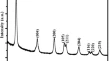
   <p><b>XRD patterns.</b> XRD patterns of (i) B powder milled alone, (ii) B powder milled with Fe(NO<sub>3</sub>)<sub>3</sub>, (iii) as-purchased Fe(NO<sub>3</sub>)<sub>3</sub>&#8226;9H<sub>2</sub>O and (iv) BNNTs produced by the improved ball milling method.</p>
</text><graphic file="1556-276X-7-417-5"/></fig><p>Therefore, XPS was used to get more information on the B powder milled with and without Fe(NO<sub>3</sub>)<sub>3</sub>. Figure&#8201;<figr fid="F6">6</figr>a compares the XPS survey scans on the two powders. The high level of O is due to the surface oxidation of the chemically reactive B particles produced by milling when exposed to air. It is interesting that high contents of N have been detected from both the milled powders. In contrast, the un-milled B powder had almost no N signal. The high resolution scans in N 1s region (Figure&#8201;<figr fid="F6">6</figr>b) reveal that the milling-introduced N was mainly in the form of B-N bonds, as evidenced by the dominating peaks centred at 397.9 eV. The N mainly came from the NH<sub>3</sub> milling atmosphere rather than the added Fe(NO<sub>3</sub>)<sub>3</sub> because (1) B powder milled alone also resulted in high N contents (Figure&#8201;<figr fid="F6">6</figr>b) and (2) 10 wt.% of Fe(NO<sub>3</sub>)<sub>3</sub>&#8226;9H<sub>2</sub>O was added to B powder, which only gave a maximum B:N ratio of 1:0.0083, enormously less than the detected B:N ratios: 1:0.36 for the B&#8201;+&#8201;Fe(NO<sub>3</sub>)<sub>3</sub> milled powder and 1:0.21 for B milled alone powder. It reveals that the milling of Fe(NO<sub>3</sub>)<sub>3</sub> injected 71% more N to the B powder. This enhancement may come from the Fe decomposed from Fe(NO<sub>3</sub>)<sub>3</sub>, as Fe is a well-known catalyst in nitriding as well as decomposition of NH<sub>3</sub><abbrgrp><abbr bid="B36">36</abbr></abbrgrp>. Turning back to the XRD results in Figure&#8201;<figr fid="F5">5</figr> (i) and (ii), we realize that the approximately 22&#176; diffraction peaks are partly contributed by the BN (002) peak at 26.8&#176;, and the further broadening of the 22&#176; peak after the addition of Fe(NO<sub>3</sub>)<sub>3</sub> is due to the formation of more nitrides, leading to a stronger XRD signal of BN. According to XPS, no NO<sub>3</sub><sup>&#8722;</sup> peak (at 406.8 eV) is shown in the N 1s region from the Fe(NO<sub>3</sub>)<sub>3</sub> milled powder, indicating that all Fe(NO<sub>3</sub>)<sub>3</sub> were possibly decomposed during ball milling. This is consistent with the XRD results in Figure&#8201;<figr fid="F5">5</figr>. The B 1s spectra (Figure&#8201;<figr fid="F6">6</figr>c) consist of a series of peaks: 192.8 eV (B<sub>2</sub>O<sub>3</sub>), 191.9 eV (B<sub>x</sub>O<sub>y</sub>), 191.3 eV (BN<sub>x</sub>O<sub>y</sub>), 190.3 eV (BN) and 188 eV (B-B). This suggests that the 22&#176; XRD peak may also contain the signals from boron oxides. Nevertheless, it should also be noted that XRD and XPS analyses have totally different measuring depths (microns for XRD and a few nanometers for XPS) and therefore may provide different information from the surface and bulk of a sample. Again, the BN peak is stronger for the Fe(NO<sub>3</sub>)<sub>3</sub> milled powder, confirming that much more nitriding happened when Fe(NO<sub>3</sub>)<sub>3</sub> was added. However, due to the overlapping between the Fe<sub>2</sub>B peak at 188.2 eV and the B-B peak at 188 eV, it is hard to judge the possible existence of Fe<sub>2</sub>B from the B 1s spectra. In the Fe 2p region (Figure&#8201;<figr fid="F6">6</figr>d), both the milled powders show Fe peaks at 706.8 and 720.0 eV and Fe<sub>2</sub>O<sub>3</sub> peaks at 710.7 and 724.3 eV. The binding energy of Fe<sub>2</sub>B is 706.7 eV, overlapping with the Fe 2p<sub>3/2</sub> peak at 706.8 eV, which is not helpful to directly determine the presence of Fe<sub>2</sub>B. However, the 706.8 eV peak from the Fe(NO<sub>3</sub>)<sub>3</sub> milled B powder is not more intense than that of the B milled alone powder, which is contradictory to the existence of Fe<sub>2</sub>B. So, it is more likely that the final state of Fe(NO<sub>3</sub>)<sub>3</sub> after ball milling is Fe. This conclusion is consistent with (1) 71% more B-N bonds formed when Fe(NO<sub>3</sub>)<sub>3</sub> is added, because Fe has a strong catalytic effect in nitriding and ammonia decomposition; and (2) the more level of Fe<sub>2</sub>O<sub>3</sub> (710.7 and 724.3 eV) when Fe(NO<sub>3</sub>)<sub>3</sub> is added to ball milling, because the Fe decomposed from Fe(NO<sub>3</sub>)<sub>3</sub> can be easily oxidized to Fe<sub>2</sub>O<sub>3</sub> on the surface after exposed to air.</p><fig id="F6"><title><p>Figure 6</p></title><caption><p>XPS spectra and corresponding fittings of B powder milled with (red) and without (blue) Fe(NO<sub>3</sub>)<sub>3</sub></p></caption><text>
   <p><b>XPS spectra and corresponding fittings of B powder milled with (red) and without (blue) Fe(NO</b><sub><b>3</b></sub><b>)</b><sub><b>3</b></sub><b>.</b> (<b>a</b>) Survey scans, (<b>b</b>) N 1s region, (<b>c</b>) B 1s region and (<b>d</b>) Fe 2p region.</p>
</text><graphic file="1556-276X-7-417-6"/></fig><p>The above analysis results reveal the following enhancing mechanism of ball milling Fe(NO<sub>3</sub>)<sub>3</sub> with B powder. During the milling, Fe(NO<sub>3</sub>)<sub>3</sub> was first decomposed to iron oxide under milling collisions, and the iron oxide was then reduced to Fe by either NH<sub>3</sub> or B. These reduced Fe was much more reactive than the steel particles from the collisions between the steel milling jar and balls, due to both the more stable nature of steel and the smaller particle sizes of the chemically reduced Fe. During the heating up to 1,300&#176;C in nitrogen-containing gases, the Fe became quasi-liquid at lower temperature than the steel particles and provides a better catalytic effect. BNNTs started to form from the BN layers precipitating on the surface of the metal particles diffused with excessive B and N atoms, following the VLS growth mechanism <abbrgrp><abbr bid="B22">22</abbr></abbrgrp>. As a result, a strong BN phase XRD peak was observed after the heating (Figure&#8201;<figr fid="F5">5</figr> (iv)). The Fe(NO<sub>3</sub>)<sub>3</sub>&#8201;+&#8201;B milled powder showed even better BNNT yield than the B ink, possibly thanks to the 71% more N content of the Fe(NO<sub>3</sub>)<sub>3</sub> milled powder. The amorphous B-N phase produced by milling is unstable and can directly provide N source for BNNT growth with little aid from the nitrogen-containing gas. This can reduce the temperature of BNNT formation and result in a better yield of BNNTs.</p></sec><sec><st><p>Conclusions</p></st><p>The ball milling of amorphous B powder and metal nitrate, such as Fe(NO<sub>3</sub>)<sub>3</sub>, produces a more effective precursor for BNNT production. The detailed XRD and XPS investigations reveal that during the milling of B powder and Fe(NO<sub>3</sub>)<sub>3</sub>, Fe(NO<sub>3</sub>)<sub>3</sub> is first decomposed to iron oxide which is further reduced to Fe. The reduced Fe greatly increases the nitriding reaction of the B powder during ball milling in ammonia (NH<sub>3</sub>) atmosphere, evidenced by 71% more N content. The pre-formed amorphous BN is much more reactive than crystallined hBN and can directly provide N source for the formation of BNNTs; therefore it lowers the BNNT formation temperature and improves the nitriding rate. The homogeneously mixed additional Fe reduced from Fe(NO<sub>3</sub>)<sub>3</sub> also acts as effective catalysts and assists the growth of BNNTs. As a result, a higher yield of BNNTs can be synthesized. Other metal nitrates, such as Mg(NO<sub>3</sub>)<sub>2</sub> and Co(NO<sub>3</sub>)<sub>2</sub>, can also be used in this method.</p></sec><sec><st><p>Competing interests</p></st><p>The authors declare that they have no competing interests.</p></sec><sec><st><p>Authors' contributions</p></st><p>LL produced the materials; conducted the SEM, XRD, EDX and TGA measurements; and drafted the manuscript. LHL provided the idea, designed this study, carried out the TEM and NEXAFS investigations and drafted the manuscript. YC provided the idea and drafted the manuscript. XJD did the XPS analyses. TX assisted in the ball milling process. MP participated in the NEXAFS measurements. XL participated in the manuscript preparation. All authors read and approved the final manuscript.</p></sec></bdy><bm><ack><sec><st><p>Acknowledgements</p></st><p>We thank Dr. Bruce Cowie from Australian Synchrotron for the experimental support, and scientific and technical assistance from the XPS facility in RMIT University Part of this research was undertaken on the soft X-ray beamline at the Australian Synchrotron, Victoria, Australia. Financial support from the Australian Research Council under the centre of excellence and discovery programmes as well as Deakin University under CRGS are gratefully acknowledged.</p></sec></ack><refgrp><bibl id="B1"><title><p>Synthesis and characterization of ropes made of BN multiwalled nanotubes</p></title><aug><au><snm>Golberg</snm><fnm>D</fnm></au><au><snm>Bando</snm><fnm>Y</fnm></au><au><snm>Kurashima</snm><fnm>K</fnm></au><au><snm>Sato</snm><fnm>T</fnm></au></aug><source>Scr Mater</source><pubdate>2001</pubdate><volume>44</volume><fpage>1561</fpage><lpage>1565</lpage><xrefbib><pubid idtype="doi">10.1016/S1359-6462(01)00724-2</pubid></xrefbib></bibl><bibl id="B2"><title><p>Boron nitride nanotubes: pronounced resistance to oxidation</p></title><aug><au><snm>Chen</snm><fnm>Y</fnm></au><au><snm>Zou</snm><fnm>J</fnm></au><au><snm>Campbell</snm><fnm>SJ</fnm></au><au><snm>Le Caer</snm><fnm>G</fnm></au></aug><source>Appl Phys Lett</source><pubdate>2004</pubdate><volume>84</volume><fpage>2430</fpage><lpage>2432</lpage><xrefbib><pubid idtype="doi">10.1063/1.1667278</pubid></xrefbib></bibl><bibl id="B3"><title><p>Stability and band gap constancy of boron nitride nanotubes</p></title><aug><au><snm>Blase</snm><fnm>X</fnm></au><au><snm>Rubio</snm><fnm>A</fnm></au><au><snm>Louie</snm><fnm>SG</fnm></au><au><snm>Cohen</snm><fnm>ML</fnm></au></aug><source>Europhys Lett</source><pubdate>1994</pubdate><volume>28</volume><fpage>335</fpage><lpage>340</lpage><xrefbib><pubid idtype="doi">10.1209/0295-5075/28/5/007</pubid></xrefbib></bibl><bibl id="B4"><title><p>Single deep ultraviolet light emission from boron nitride nanotube film</p></title><aug><au><snm>Li</snm><fnm>LH</fnm></au><au><snm>Chen</snm><fnm>Y</fnm></au><au><snm>Lin</snm><fnm>MY</fnm></au><au><snm>Glushenkov</snm><fnm>AM</fnm></au><au><snm>Cheng</snm><fnm>BM</fnm></au><au><snm>Yu</snm><fnm>J</fnm></au></aug><source>Appl Phys Lett</source><pubdate>2010</pubdate><volume>97</volume><fpage>141104</fpage><xrefbib><pubid idtype="doi">10.1063/1.3497261</pubid></xrefbib></bibl><bibl id="B5"><title><p>Observation of the giant stark effect in boron-nitride nanotubes</p></title><aug><au><snm>Ishigami</snm><fnm>M</fnm></au><au><snm>Sau</snm><fnm>JD</fnm></au><au><snm>Aloni</snm><fnm>S</fnm></au><au><snm>Cohen</snm><fnm>ML</fnm></au><au><snm>Zettl</snm><fnm>A</fnm></au></aug><source>Phys Rev Lett</source><pubdate>2005</pubdate><volume>94</volume><fpage>056804</fpage><xrefbib><pubid idtype="pmpid" link="fulltext">15783676</pubid></xrefbib></bibl><bibl id="B6"><title><p>Effective precursor for high yield synthesis of pure BN nanotubes</p></title><aug><au><snm>Zhi</snm><fnm>C</fnm></au><au><snm>Bando</snm><fnm>Y</fnm></au><au><snm>Tan</snm><fnm>C</fnm></au><au><snm>Golberg</snm><fnm>D</fnm></au></aug><source>Solid State Commun</source><pubdate>2005</pubdate><volume>135</volume><fpage>67</fpage><lpage>70</lpage><xrefbib><pubid idtype="doi">10.1016/j.ssc.2005.03.062</pubid></xrefbib></bibl><bibl id="B7"><title><p>Boron nitride nanotubes selectively permeable to cations or anions</p></title><aug><au><snm>Hilder</snm><fnm>TA</fnm></au><au><snm>Gordon</snm><fnm>D</fnm></au><au><snm>Chung</snm><fnm>S-H</fnm></au></aug><source>Small</source><pubdate>2009</pubdate><volume>5</volume><fpage>2870</fpage><lpage>2875</lpage><xrefbib><pubidlist><pubid idtype="doi">10.1002/smll.200901229</pubid><pubid idtype="pmpid" link="fulltext">19795403</pubid></pubidlist></xrefbib></bibl><bibl id="B8"><title><p>Platinum nanoparticle modified polyaniline-functionalized boron nitride nanotubes for amperometric glucose enzyme biosensor</p></title><aug><au><snm>Wu</snm><fnm>J</fnm></au><au><snm>Yin</snm><fnm>L</fnm></au></aug><source>ACS Appl Mater Interfaces</source><pubdate>2011</pubdate><volume>3</volume><fpage>4354</fpage><lpage>4362</lpage><xrefbib><pubidlist><pubid idtype="doi">10.1021/am201008n</pubid><pubid idtype="pmpid" link="fulltext">22013877</pubid></pubidlist></xrefbib></bibl><bibl id="B9"><title><p>Boron nitride nanotubes</p></title><aug><au><snm>Chopra</snm><fnm>NG</fnm></au><au><snm>Luyken</snm><fnm>RJ</fnm></au><au><snm>Cherrey</snm><fnm>K</fnm></au><au><snm>Crespi</snm><fnm>VH</fnm></au><au><snm>Cohen</snm><fnm>ML</fnm></au><au><snm>Louie</snm><fnm>SG</fnm></au><au><snm>Zettl</snm><fnm>A</fnm></au></aug><source>Science</source><pubdate>1995</pubdate><volume>269</volume><fpage>966</fpage><lpage>967</lpage><xrefbib><pubidlist><pubid idtype="doi">10.1126/science.269.5226.966</pubid><pubid idtype="pmpid" link="fulltext">17807732</pubid></pubidlist></xrefbib></bibl><bibl id="B10"><title><p>Nanotubes in boron nitride laser heated at high pressure</p></title><aug><au><snm>Golberg</snm><fnm>D</fnm></au><au><snm>Bando</snm><fnm>Y</fnm></au><au><snm>Eremets</snm><fnm>M</fnm></au><au><snm>Takemura</snm><fnm>K</fnm></au><au><snm>Kurashima</snm><fnm>K</fnm></au><au><snm>Yusa</snm><fnm>H</fnm></au></aug><source>Appl Phys Lett</source><pubdate>1996</pubdate><volume>69</volume><fpage>2045</fpage><lpage>2047</lpage><xrefbib><pubid idtype="doi">10.1063/1.116874</pubid></xrefbib></bibl><bibl id="B11"><title><p>Synthesis of boron nitride nanotubes at low temperatures using reactive ball milling</p></title><aug><au><snm>Chen</snm><fnm>Y</fnm></au><au><snm>Fitz Gerald</snm><fnm>J</fnm></au><au><snm>Williams</snm><fnm>JS</fnm></au><au><snm>Bulcock</snm><fnm>S</fnm></au></aug><source>Chem Phys Lett</source><pubdate>1999</pubdate><volume>299</volume><fpage>260</fpage><lpage>264</lpage><xrefbib><pubid idtype="doi">10.1016/S0009-2614(98)01252-4</pubid></xrefbib></bibl><bibl id="B12"><title><p>Synthesis of boron nitride nanotubes from boron oxide by ball milling and annealing process</p></title><aug><au><snm>Li</snm><fnm>YJ</fnm></au><au><snm>Zhou</snm><fnm>JE</fnm></au><au><snm>Zhao</snm><fnm>K</fnm></au><au><snm>Tung</snm><fnm>SM</fnm></au><au><snm>Schneider</snm><fnm>E</fnm></au></aug><source>Mater Lett</source><pubdate>2009</pubdate><volume>63</volume><fpage>1733</fpage><lpage>1736</lpage><xrefbib><pubid idtype="doi">10.1016/j.matlet.2009.05.005</pubid></xrefbib></bibl><bibl id="B13"><title><p>Synthesis and growth of boron nitride nanotubes by a ball milling&#8211;annealing process</p></title><aug><au><snm>Kim</snm><fnm>J</fnm></au><au><snm>Lee</snm><fnm>S</fnm></au><au><snm>Uhm</snm><fnm>YR</fnm></au><au><snm>Jun</snm><fnm>J</fnm></au><au><snm>Rhee</snm><fnm>CK</fnm></au><au><snm>Kim</snm><fnm>GM</fnm></au></aug><source>Acta Mater</source><pubdate>2011</pubdate><volume>59</volume><fpage>2807</fpage><lpage>2813</lpage><xrefbib><pubid idtype="doi">10.1016/j.actamat.2011.01.019</pubid></xrefbib></bibl><bibl id="B14"><title><p>Synthesis of bulk quantity BN nanotubes with uniform morphology</p></title><aug><au><snm>Wen</snm><fnm>G</fnm></au><au><snm>Zhang</snm><fnm>T</fnm></au><au><snm>Huang</snm><fnm>XX</fnm></au><au><snm>Zhong</snm><fnm>B</fnm></au><au><snm>Zhang</snm><fnm>XD</fnm></au><au><snm>Yu</snm><fnm>HM</fnm></au></aug><source>Scr Mater</source><pubdate>2010</pubdate><volume>62</volume><fpage>25</fpage><lpage>28</lpage><xrefbib><pubid idtype="doi">10.1016/j.scriptamat.2009.09.018</pubid></xrefbib></bibl><bibl id="B15"><title><p>CVD growth of boron nitride nanotubes</p></title><aug><au><snm>Lourie</snm><fnm>OR</fnm></au><au><snm>Jones</snm><fnm>CR</fnm></au><au><snm>Bartlett</snm><fnm>BM</fnm></au><au><snm>Gibbons</snm><fnm>PC</fnm></au><au><snm>Ruoff</snm><fnm>RS</fnm></au><au><snm>Buhro</snm><fnm>WE</fnm></au></aug><source>Chem Mater</source><pubdate>2000</pubdate><volume>12</volume><fpage>1808</fpage><lpage>1810</lpage><xrefbib><pubid idtype="doi">10.1021/cm000157q</pubid></xrefbib></bibl><bibl id="B16"><title><p>Bulk synthesis, growth mechanism and properties of highly pure ultrafine boron nitride nanotubes with diameters of sub-10 nm</p></title><aug><au><snm>Huang</snm><fnm>Y</fnm></au><au><snm>Lin</snm><fnm>J</fnm></au><au><snm>Tang</snm><fnm>CC</fnm></au><au><snm>Bando</snm><fnm>Y</fnm></au><au><snm>Zhi</snm><fnm>CY</fnm></au><au><snm>Zhai</snm><fnm>TY</fnm></au><au><snm>Dierre</snm><fnm>B</fnm></au><au><snm>Sekiguchi</snm><fnm>T</fnm></au><au><snm>Golberg</snm><fnm>D</fnm></au></aug><source>Nanotechnology</source><pubdate>2011</pubdate><volume>22</volume><fpage>145602</fpage><xrefbib><pubidlist><pubid idtype="doi">10.1088/0957-4484/22/14/145602</pubid><pubid idtype="pmpid" link="fulltext">21346299</pubid></pubidlist></xrefbib></bibl><bibl id="B17"><title><p>Catalyst-free synthesis of nanotubes and whiskers in an optical furnace and a gaseous model for their formation and growth</p></title><aug><au><snm>Sartinska</snm><fnm>LL</fnm></au></aug><source>Acta Mater</source><pubdate>2011</pubdate><volume>59</volume><fpage>4395</fpage><lpage>4403</lpage><xrefbib><pubid idtype="doi">10.1016/j.actamat.2011.03.063</pubid></xrefbib></bibl><bibl id="B18"><title><p>Effective growth of boron nitride nanotubes</p></title><aug><au><snm>Tang</snm><fnm>CC</fnm></au><au><snm>Ding</snm><fnm>XX</fnm></au><au><snm>Huang</snm><fnm>XT</fnm></au><au><snm>Gan</snm><fnm>ZW</fnm></au><au><snm>Qi</snm><fnm>SR</fnm></au><au><snm>Liu</snm><fnm>W</fnm></au><au><snm>Fan</snm><fnm>SS</fnm></au></aug><source>Chem Phys Lett</source><pubdate>2002</pubdate><volume>356</volume><fpage>254</fpage><lpage>258</lpage><xrefbib><pubid idtype="doi">10.1016/S0009-2614(02)00325-1</pubid></xrefbib></bibl><bibl id="B19"><title><p>Synthesis of boron nitride nanotubes by boron ink annealing</p></title><aug><au><snm>Li</snm><fnm>LH</fnm></au><au><snm>Chen</snm><fnm>Y</fnm></au><au><snm>Glushenkov</snm><fnm>AM</fnm></au></aug><source>Nanotechnology</source><pubdate>2010</pubdate><volume>21</volume><fpage>105601</fpage><xrefbib><pubidlist><pubid idtype="doi">10.1088/0957-4484/21/10/105601</pubid><pubid idtype="pmpid" link="fulltext">20154372</pubid></pubidlist></xrefbib></bibl><bibl id="B20"><title><p>Synthesis of boron nitride nanotubes, bamboos and nanowires</p></title><aug><au><snm>Li</snm><fnm>LH</fnm></au><au><snm>Li</snm><fnm>CP</fnm></au><au><snm>Chen</snm><fnm>Y</fnm></au></aug><source>Physica E</source><pubdate>2008</pubdate><volume>40</volume><fpage>2513</fpage><lpage>2516</lpage><xrefbib><pubid idtype="doi">10.1016/j.physe.2007.06.065</pubid></xrefbib></bibl><bibl id="B21"><title><p>Boron nitride nanotube films grown from boron ink painting</p></title><aug><au><snm>Li</snm><fnm>LH</fnm></au><au><snm>Chen</snm><fnm>Y</fnm></au><au><snm>Glushenkov</snm><fnm>AM</fnm></au></aug><source>J Mater Chem</source><pubdate>2010</pubdate><volume>20</volume><fpage>9679</fpage><lpage>9683</lpage><xrefbib><pubid idtype="doi">10.1039/c0jm01414a</pubid></xrefbib></bibl><bibl id="B22"><title><p>Microstructure and growth model of periodic spindle-unit BN nanotubes by nitriding Fe-B nanoparticles with nitrogen/ammonia mixture</p></title><aug><au><snm>Huo</snm><fnm>KF</fnm></au><au><snm>Hu</snm><fnm>Z</fnm></au><au><snm>Fu</snm><fnm>JJ</fnm></au><au><snm>Xu</snm><fnm>H</fnm></au><au><snm>Wang</snm><fnm>XZ</fnm></au><au><snm>Chen</snm><fnm>Y</fnm></au><au><snm>L&#252;</snm><fnm>YN</fnm></au></aug><source>J Phys Chem B</source><pubdate>2003</pubdate><volume>107</volume><fpage>11316</fpage><lpage>11320</lpage><xrefbib><pubid idtype="doi">10.1021/jp035375w</pubid></xrefbib></bibl><bibl id="B23"><title><p>Photoemission investigation of hexagonal BN: band structure and atomic effects</p></title><aug><au><snm>Barth</snm><fnm>J</fnm></au><au><snm>Kunz</snm><fnm>C</fnm></au><au><snm>Zimkina</snm><fnm>TM</fnm></au></aug><source>Solid State Commun</source><pubdate>1980</pubdate><volume>36</volume><fpage>453</fpage><lpage>456</lpage><xrefbib><pubid idtype="doi">10.1016/0038-1098(80)90932-1</pubid></xrefbib></bibl><bibl id="B24"><title><p>Decoration of nitrogen vacancies by oxygen atoms in boron nitride nanotubes</p></title><aug><au><snm>Petravic</snm><fnm>M</fnm></au><au><snm>Peter</snm><fnm>R</fnm></au><au><snm>Kavre</snm><fnm>I</fnm></au><au><snm>Li</snm><fnm>LH</fnm></au><au><snm>Chen</snm><fnm>Y</fnm></au><au><snm>Fan</snm><fnm>LJ</fnm></au><au><snm>Yang</snm><fnm>YW</fnm></au></aug><source>Phys Chem Chem Phys</source><pubdate>2010</pubdate><volume>12</volume><fpage>15349</fpage><lpage>15353</lpage><xrefbib><pubid idtype="pmpid" link="fulltext">20967376</pubid></xrefbib></bibl><bibl id="B25"><title><p>A quasi-atomic treatment of chemical and structural effects on K-shell excitations in hexagonal and cubic BN crystals</p></title><aug><au><snm>Franke</snm><fnm>R</fnm></au><au><snm>Bender</snm><fnm>S</fnm></au><au><snm>Hormes</snm><fnm>J</fnm></au><au><snm>Pavlychev</snm><fnm>AA</fnm></au><au><snm>Fominych</snm><fnm>NG</fnm></au></aug><source>Chem Phys</source><pubdate>1997</pubdate><volume>216</volume><fpage>243</fpage><lpage>257</lpage><xrefbib><pubid idtype="doi">10.1016/S0301-0104(96)00374-6</pubid></xrefbib></bibl><bibl id="B26"><title><p>Identification of ternary boron-carbon-nitrogen hexagonal phases by x-ray absorption spectroscopy</p></title><aug><au><snm>Jimenez</snm><fnm>I</fnm></au><au><snm>Gago</snm><fnm>R</fnm></au><au><snm>Albella</snm><fnm>JM</fnm></au><au><snm>Terminello</snm><fnm>LJ</fnm></au></aug><source>Appl Phys Lett</source><pubdate>2001</pubdate><volume>78</volume><fpage>3430</fpage><lpage>3432</lpage><xrefbib><pubid idtype="doi">10.1063/1.1376428</pubid></xrefbib></bibl><bibl id="B27"><title><p>Investigating the structure of boron nitride nanotubes by near-edge X-ray absorption fine structure (NEXAFS) spectroscopy</p></title><aug><au><snm>Wong</snm><fnm>SS</fnm></au><au><snm>Hemraj-Benny</snm><fnm>T</fnm></au><au><snm>Banerjee</snm><fnm>S</fnm></au><au><snm>Sambasivan</snm><fnm>S</fnm></au><au><snm>Fischer</snm><fnm>DA</fnm></au><au><snm>Han</snm><fnm>WQ</fnm></au><au><snm>Misewich</snm><fnm>JA</fnm></au></aug><source>Phys Chem Chem Phys</source><pubdate>2005</pubdate><volume>7</volume><fpage>1103</fpage><lpage>1106</lpage><xrefbib><pubid idtype="pmpid">19791320</pubid></xrefbib></bibl><bibl id="B28"><title><p>Identification of B-K near edge x-ray absorption fine structure peaks of boron nitride thin films prepared by sputtering deposition</p></title><aug><au><snm>Niibe</snm><fnm>M</fnm></au><au><snm>Miyamoto</snm><fnm>K</fnm></au><au><snm>Mitamura</snm><fnm>T</fnm></au><au><snm>Mochiji</snm><fnm>K</fnm></au></aug><source>J Vac Sci Technol A</source><pubdate>2010</pubdate><volume>28</volume><fpage>1157</fpage><lpage>1160</lpage><xrefbib><pubid idtype="doi">10.1116/1.3474913</pubid></xrefbib></bibl><bibl id="B29"><title><p>Point defects in hexagonal BN, BC(3) and BC(x)N compounds studied by x-ray absorption near-edge structure</p></title><aug><au><snm>Caretti</snm><fnm>I</fnm></au><au><snm>Jimenez</snm><fnm>I</fnm></au></aug><source>J Appl Phys</source><pubdate>2011</pubdate><volume>110</volume><fpage>023511</fpage><xrefbib><pubid idtype="doi">10.1063/1.3602996</pubid></xrefbib></bibl><bibl id="B30"><title><p>Influence of nitriding gases on the growth of boron nitride nanotubes</p></title><aug><au><snm>Yu</snm><fnm>J</fnm></au><au><snm>Li</snm><fnm>BCP</fnm></au><au><snm>Zou</snm><fnm>J</fnm></au><au><snm>Chen</snm><fnm>Y</fnm></au></aug><source>J Mater Sci</source><pubdate>2007</pubdate><volume>42</volume><fpage>4025</fpage><lpage>4030</lpage><xrefbib><pubid idtype="doi">10.1007/s10853-006-0381-4</pubid></xrefbib></bibl><bibl id="B31"><title><p>Silica gel supported ferric nitrate: a convenient oxidizing reagent</p></title><aug><au><snm>Khadilkar</snm><fnm>B</fnm></au><au><snm>Borkar</snm><fnm>S</fnm></au></aug><source>Synth Commun</source><pubdate>1998</pubdate><volume>28</volume><fpage>207</fpage><lpage>212</lpage></bibl><bibl id="B32"><title><p>The thermal decomposition of Fe(NO3)3&#8226;9H2O</p></title><aug><au><snm>Wieczorek-Ciurowa</snm><fnm>K</fnm></au><au><snm>Kozak</snm><fnm>A</fnm></au></aug><source>J Therm Anal Calorim</source><pubdate>1999</pubdate><volume>58</volume><fpage>647</fpage><lpage>651</lpage><xrefbib><pubid idtype="doi">10.1023/A:1010112814013</pubid></xrefbib></bibl><bibl id="B33"><title><p>Mechanical behavior of borides formed on borided cold work tool steel</p></title><aug><au><snm>Sen</snm><fnm>S</fnm></au><au><snm>Ozbek</snm><fnm>I</fnm></au><au><snm>Sen</snm><fnm>U</fnm></au><au><snm>Bindal</snm><fnm>C</fnm></au></aug><source>Surf CoatTechnol</source><pubdate>2001</pubdate><volume>135</volume><fpage>173</fpage><lpage>177</lpage><xrefbib><pubid idtype="doi">10.1016/S0257-8972(00)01064-1</pubid></xrefbib></bibl><bibl id="B34"><title><p>Mechanically alloyed Fe-B, Fe-Si and Fe-B-Si powders</p></title><aug><au><snm>Ruuskanen</snm><fnm>P</fnm></au><au><snm>Heczko</snm><fnm>O</fnm></au></aug><source>Key Eng Mater</source><pubdate>1993</pubdate><volume>81&#8211;3</volume><fpage>159</fpage><lpage>168</lpage></bibl><bibl id="B35"><title><p>Reactive milling with metals for environmentally benign sustainable production</p></title><aug><au><snm>Kaupp</snm><fnm>G</fnm></au></aug><source>CrystEngComm</source><pubdate>2011</pubdate><volume>13</volume><fpage>3108</fpage><lpage>3121</lpage><xrefbib><pubid idtype="doi">10.1039/c1ce05085k</pubid></xrefbib></bibl><bibl id="B36"><title><p>Study of the ammonia decomposition over iron catalysts</p></title><aug><au><snm>Arabczyk</snm><fnm>W</fnm></au><au><snm>Zamlynny</snm><fnm>J</fnm></au></aug><source>Catal Lett</source><pubdate>1999</pubdate><volume>60</volume><fpage>167</fpage><lpage>171</lpage><xrefbib><pubid idtype="doi">10.1023/A:1019007024041</pubid></xrefbib></bibl></refgrp></bm></art>