<?xml version='1.0'?>
<!DOCTYPE art SYSTEM 'http://www.biomedcentral.com/xml/article.dtd'>
<art>
	<ui>1556-276X-7-368</ui>
	<ji>1556-276X</ji>
	<fm>
		<dochead>Nano Idea</dochead>
		<bibl>
			<title>
				<p>Investigations into the impact of various substrates and ZnO ultra thin seed layers prepared by atomic layer deposition on growth of ZnO nanowire array</p>
			</title>
			<aug>
				<au id="A1"><snm>Ding</snm><fnm>JN</fnm><insr iid="I1"/><insr iid="I2"/><email>dingjn@cczu.edu.cn</email></au>
				<au id="A2"><snm>Liu</snm><fnm>YB</fnm><insr iid="I1"/><insr iid="I2"/><email>solarliu@126.com</email></au>
				<au id="A3"><snm>Tan</snm><fnm>CB</fnm><insr iid="I1"/><insr iid="I2"/><email>tanchengbang@163.com</email></au>
				<au id="A4" ca="yes"><snm>Yuan</snm><fnm>NY</fnm><insr iid="I1"/><insr iid="I2"/><email>nyyuan@cczu.edu.cn</email></au>
			</aug>
			<insg>
				<ins id="I1"><p>Center for Low-Dimensional Materials, Micro-Nano Devices and System, Changzhou University, Changzhou, 213164, China</p></ins>
				<ins id="I2"><p>Jiangsu Key Laboratory for Solar Cell Materials and Technolgy, Changzhou, 213164, China</p></ins>
			</insg>
			<source>Nanoscale Research Letters</source>
			<issn>1556-276X</issn>
			<pubdate>2012</pubdate>
			<volume>7</volume>
			<issue>1</issue>
			<fpage>368</fpage>
			<url>http://www.nanoscalereslett.com/content/7/1/368</url>
			<xrefbib><pubidlist><pubid idtype="doi">10.1186/1556-276X-7-368</pubid><pubid idtype="pmpid">22759838</pubid></pubidlist></xrefbib>
		</bibl>
		<history><rec><date><day>13</day><month>10</month><year>2011</year></date></rec><acc><date><day>19</day><month>6</month><year>2012</year></date></acc><pub><date><day>3</day><month>7</month><year>2012</year></date></pub></history>
		<cpyrt><year>2012</year><collab>Ding et al.; licensee Springer.</collab><note>This is an Open Access article distributed under the terms of the Creative Commons Attribution License (
				<url>http://creativecommons.org/licenses/by/2.0</url>), which permits unrestricted use, distribution, and reproduction in any medium, provided the original work is properly cited.</note></cpyrt>
		<kwdg>
			<kwd>ZnO</kwd>
			<kwd>Seed layers</kwd>
			<kwd>The fluctuate amplitude</kwd>
			<kwd>Frequency of roughness</kwd>
		</kwdg>
		<abs>
			<sec>
				<st>
					<p>Abstract</p>
				</st>
				<p>The impact of various substrates and zinc oxide (ZnO) ultra thin seed layers prepared by atomic layer deposition on the geometric morphology of subsequent ZnO nanowire arrays (NWs) fabricated by the hydrothermal method was investigated. The investigated substrates included B-doped ZnO films, indium tin oxide films, single crystal silicon (111), and glass sheets. Scanning electron microscopy and X-ray diffraction measurements revealed that the geometry and aligment of the NWs were controlled by surface topography of the substrates and thickness of the ZnO seed layers, respectively. According to atomic force microscopy data, we suggest that the substrate, fluctuate amplitude and fluctuate frequency of roughness on ZnO seed layers have a great impact on the alignment of the resulting NWs, whereas the influence of the seed layers' texture was negligible.</p>
			</sec>
		</abs>
	</fm>
	<bdy>
		<sec>
			<st>
				<p>Background</p>
			</st>
			<p>Zinc oxide (ZnO) is a semiconductor with wide band-gap (3.37&#8201;eV) and possesses high excited binding energy of 60&#8201;meV. 
				<abbrgrp>
					<abbr bid="B1">1</abbr>
					<abbr bid="B2">2</abbr>
				</abbrgrp> It has been widely studied and applied to field effect transistors 
				<abbrgrp>
					<abbr bid="B3">3</abbr>
				</abbrgrp>, field emitters 
				<abbrgrp>
					<abbr bid="B4">4</abbr>
				</abbrgrp>, photodetectors 
				<abbrgrp>
					<abbr bid="B5">5</abbr>
				</abbrgrp>, gas sensors 
				<abbrgrp>
					<abbr bid="B6">6</abbr>
				</abbrgrp>, dye-sensitized solar cells 
				<abbrgrp>
					<abbr bid="B7">7</abbr>
				</abbrgrp>, and other optoelectronic devices 
				<abbrgrp>
					<abbr bid="B8">8</abbr>
					<abbr bid="B9">9</abbr>
				</abbrgrp> because of its special properties, such as long-term stability, relatively low material costs, simple processing due to its compatibility with wet chemical etching, biocompatibility, environmental friendliness, excellent radiation resistance, and so on. In these applications, one-dimensional (1D) and nanoscale ZnO materials (e.g., nanorods, nanowires, and nanotubes) have attracted considerable attention due to their significantly different electronic and photoelectron-chemical properties and have potential applications in electronic and photonic devices 
				<abbrgrp>
					<abbr bid="B10">10</abbr>
					<abbr bid="B11">11</abbr>
					<abbr bid="B12">12</abbr>
					<abbr bid="B13">13</abbr>
					<abbr bid="B14">14</abbr>
				</abbrgrp>.</p>
			<p>To obtain 1D ZnO materials, there are several methods including physical vapor phase growth that required high temperature and chemical approaches working at low temperature, in which hydrothermal synthesis is a good chemical approach for the synthesis of ZnO nanowire arrays (NWs) by fabricating ZnO seeds with the morphology of thin films or nanoparticles on substrates firstly 
				<abbrgrp>
					<abbr bid="B15">15</abbr>
					<abbr bid="B16">16</abbr>
				</abbrgrp>. Atomic layer deposition (ALD) is a good method for growing high-quality ZnO seed layers 
				<abbrgrp>
					<abbr bid="B17">17</abbr>
					<abbr bid="B18">18</abbr>
					<abbr bid="B19">19</abbr>
					<abbr bid="B20">20</abbr>
				</abbrgrp> because it requires low growth temperature and can offer excellent conformality, easy and accurate thickness control, good reproducibility, and high uniformity over a large area. However, the reported thickness of the seed layers prepared by ALD was greater than 10&#8201;nm 
				<abbrgrp>
					<abbr bid="B19">19</abbr>
					<abbr bid="B20">20</abbr>
				</abbrgrp>. Moreover, although the effect of roughness and texture of seed layers on the alignment of NWs has been reported 
				<abbrgrp>
					<abbr bid="B19">19</abbr>
					<abbr bid="B21">21</abbr>
					<abbr bid="B22">22</abbr>
				</abbrgrp>, few research focused on the mechanism on how the roughness of seed layers affected the orientation of NWs.</p>
		</sec>
		<sec>
			<st>
				<p>Presentation of the hypothesis</p>
			</st>
			<p>In this paper, we first deposited ZnO seed layers with different thickness (2 to 50&#8201;nm) on different substrates by ALD method. The effect of the substrates and the seed layers' thickness on morphology and alignment of subsequent ZnO nanorods prepared by hydrothemal method was studied. It was found that roughness rather than the texture of the ZnO seed layers had a great impact on the alignment of the resulting NWs.</p>
		</sec>
		<sec>
			<st>
				<p>Testing the hypothesis</p>
			</st>
			<p>In this article, the ALD technique was employed to deposit ZnO seed layers on various substrates. The substrates included B-doped ZnO (BZO) films, indium tin oxides (ITO) films, single crystal (111) silicon, and glass sheets. Diethylzinc [DEZ, Zn(C<sub>2</sub>H<sub>5</sub>)<sub>2</sub>] and deionized water were used as the precursors for ZnO deposition. Pure N<sub>2</sub> gas (99.999%) was used to carry and purge gas. The reaction is carried out as follows:</p>
			<p>
				<display-formula id="M1">
					<m:math name="1556-276X-7-368-i1" xmlns:m="http://www.w3.org/1998/Math/MathML"><m:mrow>
   <m:mi>Z</m:mi>
   <m:mi>n</m:mi>
   <m:msub>
      <m:mrow>
         <m:mo stretchy="true">(</m:mo>
         <m:msub>
            <m:mi>C</m:mi>
            <m:mn>2</m:mn>
         </m:msub>
         <m:msub>
            <m:mi>H</m:mi>
            <m:mn>5</m:mn>
         </m:msub>
         <m:mo stretchy="true">)</m:mo>
      </m:mrow>
      <m:mn>2</m:mn>
   </m:msub>
   <m:mo>+</m:mo>
   <m:msub>
      <m:mi>H</m:mi>
      <m:mn>2</m:mn>
   </m:msub>
   <m:mi>O</m:mi>
   <m:mo>&#8594;</m:mo>
   <m:mi>Z</m:mi>
   <m:mi>n</m:mi>
   <m:mi>O</m:mi>
   <m:mo>+</m:mo>
   <m:mn>2</m:mn>
   <m:msub>
      <m:mi>C</m:mi>
      <m:mn>2</m:mn>
   </m:msub>
   <m:msub>
      <m:mi>H</m:mi>
      <m:mn>6</m:mn>
   </m:msub>
</m:mrow>
</m:math>
				</display-formula>
			</p>
			<p>The reaction chamber was pumped down to 1 to 2&#8201;Torr before deposition. The operating environment of ZnO deposition was maintained at 3&#8201;Torr and 200&#176;C. Each deposition cycle consisted of four steps, which included DEZ reactant, N<sub>2</sub> purge, H<sub>2</sub>O reactant, and N<sub>2</sub> purge. The typical pulse time for introducing DEZ and H<sub>2</sub>O precursors was 0.5&#8201;s, and the N<sub>2</sub> purge time was 10&#8201;s. The deposition cycles of 11, 22, 33, 44, 55, 110, and 275 were chosen to produce ZnO seed layers with the various thickness of 2, 4, 6, 8, 10, 20, and 50&#8201;nm. The deposition rate at the above conditions approaches 0.182&#8201;nm/cycle.</p>
			<p>The subsequent hydrothermal growth was carried out at 90&#176;C in a sealed kettle by immersing the deposited substrates in aqueous solution (80&#8201;mL) containing zinc nitrate (Zn(NO<sub>3</sub>)<sub>2</sub>&#183;6H<sub>2</sub>O, 0.01&#8201;mol/L) and hexamethylenetetramine (HMTA; C<sub>6</sub>H<sub>12</sub>N<sub>4</sub> 0.01&#8201;mol/L). ZnO NWs were fabricated according to the following reactions.</p>
			<p>
				<display-formula id="M2">
					<m:math name="1556-276X-7-368-i2" xmlns:m="http://www.w3.org/1998/Math/MathML"><m:mrow>
   <m:msub>
      <m:mrow>
         <m:mo stretchy="true">(</m:mo>
         <m:mi>C</m:mi>
         <m:msub>
            <m:mi>H</m:mi>
            <m:mn>2</m:mn>
         </m:msub>
         <m:mo stretchy="true">)</m:mo>
      </m:mrow>
      <m:mn>6</m:mn>
   </m:msub>
   <m:msub>
      <m:mi>N</m:mi>
      <m:mn>4</m:mn>
   </m:msub>
   <m:mo>+</m:mo>
   <m:mn>6</m:mn>
   <m:msub>
      <m:mi>H</m:mi>
      <m:mn>2</m:mn>
   </m:msub>
   <m:mi>O</m:mi>
   <m:mo>&#8594;</m:mo>
   <m:mn>6</m:mn>
   <m:mi>H</m:mi>
   <m:mi>C</m:mi>
   <m:mi>H</m:mi>
   <m:mi>O</m:mi>
   <m:mo>+</m:mo>
   <m:mn>4</m:mn>
   <m:mi>N</m:mi>
   <m:msub>
      <m:mi>H</m:mi>
      <m:mn>3</m:mn>
   </m:msub>
</m:mrow>
</m:math>
				</display-formula>
			</p>
			<p>
				<display-formula id="M3">
					<m:math name="1556-276X-7-368-i3" xmlns:m="http://www.w3.org/1998/Math/MathML"><m:mrow>
   <m:mi>N</m:mi>
   <m:msub>
      <m:mi>H</m:mi>
      <m:mn>3</m:mn>
   </m:msub>
   <m:mo>+</m:mo>
   <m:msub>
      <m:mi>H</m:mi>
      <m:mn>2</m:mn>
   </m:msub>
   <m:mi>O</m:mi>
   <m:mo>&#8594;</m:mo>
   <m:mi>N</m:mi>
   <m:msub>
      <m:mi>H</m:mi>
      <m:mn>4</m:mn>
   </m:msub>
   <m:msup>
      <m:mrow/>
      <m:mo>+</m:mo>
   </m:msup>
   <m:mo>+</m:mo>
   <m:mi>O</m:mi>
   <m:msup>
      <m:mi>H</m:mi>
      <m:mo>&#8722;</m:mo>
   </m:msup>
</m:mrow>
</m:math>
				</display-formula>
			</p>
			<p>
				<display-formula id="M4">
					<m:math name="1556-276X-7-368-i4" xmlns:m="http://www.w3.org/1998/Math/MathML"><m:mrow>
   <m:mn>2</m:mn>
   <m:mi>O</m:mi>
   <m:msup>
      <m:mi>H</m:mi>
      <m:mo>&#8722;</m:mo>
   </m:msup>
   <m:mo>+</m:mo>
   <m:mi>Z</m:mi>
   <m:msup>
      <m:mi>n</m:mi>
      <m:mrow>
         <m:mn>2</m:mn>
         <m:mo>+</m:mo>
      </m:mrow>
   </m:msup>
   <m:mi>n</m:mi>
   <m:mi>O</m:mi>
   <m:mo stretchy="true">(</m:mo>
   <m:mi>s</m:mi>
   <m:mo stretchy="true">)</m:mo>
   <m:mo>+</m:mo>
   <m:msub>
      <m:mi>H</m:mi>
      <m:mn>2</m:mn>
   </m:msub>
   <m:mi>O</m:mi>
</m:mrow>
</m:math>
				</display-formula>
			</p>
			<p>Finally, the samples were washed with deionized water and dried in air before characterization. The morphology of the NWs was characterized by scanning electron microscopy (SEM, Philips FEIXL30 SFEG, Amsterdam, Netherlands) and transmission electron microscopy (TEM, Hitachi HF-2000, Chiyoda, Tokyo, Japan). TEM samples were prepared by gently dragging the holey (400 mesh Cu, SPI supplies, West Chester, PA, USA) carbon grids along the surface of the samples. X-ray diffraction (XRD) analysis was performed with a Rigaku Dmax-2000 diffractometer using CuKa radiation (Rigaku Corporation, Tokyo, Japan). The morphology of the seed layers and roughness was characterized by an atomic force microscope (AFM, Park Systems XE-100, Santa Clara, California, USA). The photoluminescence (PL) spectroscopy is performed on an Olympus BX51 microscope with Hg illumination and UV filter cube (U-MWU2, excitation, Olympus Shinjuku, Tokyo, Japan).</p>
			<p>Figure 
				<figr fid="F1">1</figr>b shows the typical hexagonal cylinder shaped ZnO NWs grown on Si and glass substrates with the 10-nm-thick ZnO seed layers. The morphology is different from that of the NWs grown on the BZO (Figure 
				<figr fid="F1">1</figr>d) and ITO substrates (Figure 
				<figr fid="F1">1</figr>f) although the thickness of the seed layers is the same of 10&#8201;nm. Figure 
				<figr fid="F1">1</figr>d shows the inclined NWs grown on the BZO substrate that have short and thick geometry morphologies. The diameters of the NWs range from several tens of nanometers to hundreds of nanometers. It is noteworthy that the diameters of the NWs are consisted with the size of the grains on the surface of BZO film (shown in Figure 
				<figr fid="F1">1</figr>c). Analogously, the nonuniform rough ITO surface with the several tens of nanometers grain size (shown in Figure 
				<figr fid="F1">1</figr>e) produced anomalous NWs with the average diameter of about 200&#8201;nm. Different from the Si and glass substrates, the BZO and ITO films have obvious grain boundaries on the film surfaces. Grains can be the site of nucleate for the growth of NWs and ZnO seed layer with a 10&#8201;nm thickness is too thin to shield the morphologies of BZO and ITO films. So the morphologies of BZO and ITO films have a great influence on NWs, which results in the NWs having similar geometric morphology with the substrate surface. So we get the conclusion that the NWs prepared by hydrothermal reaction were influenced greatly by surface topography of substrates when substrates are covered with ultra-thin seed layers.</p>
			<fig id="F1"><title><p>Figure 1</p></title><caption><p>AFM three-dimenional images</p></caption><text>
   <p><b>AFM three-dimenional images.</b> AFM three-dimensional images of (<b>a</b>) Si substrates, (<b>c</b>) BZO substrates, and (<b>e</b>) ITO substrates SEM images of NWs grown on Si substrates (<b>b</b>), on BZO substrates and (<b>d</b>), on ITO substrates (<b>f</b>).</p>
</text><graphic file="1556-276X-7-368-1"/></fig>
			<p>To learn more about these ZnO NWs, TEM was used to characterize the ZnO NW structures. Figure 
				<figr fid="F2">2</figr> shows high-resolution TEM images taken from ZnO NWs grown on various substrates. The insert figures show the corresponding low-resolution TEM images and selected-area electron diffraction patterns, which indicates that the ZnO nanorods are single-crystalline in structure. The HRTEM images of ZnO nanorods grown on various substrates reveal clear lattice spacing of 0.52 or 0.25&#8201;nm correspond to the inter-planar spacing of the wurtzite ZnO (001) or (002) face, which indicate that the ZnO nanorod growth occurs preferentially along the [001] direction. So the crystal structures of NWs prepared by hydrothermal reaction were not influenced by surface topography of substrates.</p>
			<fig id="F2"><title><p>Figure 2</p></title><caption><p>The high- and low-resolution images and the selected area diffraction patters</p></caption><text>
   <p><b>The high- and low-resolution images and the selected area diffraction patters.</b> High-resolution TEM images, low-resolution TEM images, and the selected area electron diffraction patterns (see inset) of NWs grown on Si substrate (<b>a</b>), on BZO substrate and (<b>b</b>), on ITO substrate (<b>c</b>).</p>
</text><graphic file="1556-276X-7-368-2"/></fig>
			<p>In order to understand the relationship between the thin seed layer and the NWs, a more systematic structural investigation was carried out. Figure 
				<figr fid="F3">3</figr> shows SEM photographs of NWs grown on glass substrates pre-coated with ZnO seed layers. The ZnO seed layers with thickness from 2 to 50&#8201;nm were deposited by ALD method. It can be clearly found that ZnO nanoparticles grow out of the 2-nm-thick seed layer, whereas NWs grow out of the seed layers whose thickness is above 4&#8201;nm (Figure 
				<figr fid="F3">3</figr>a). Moreover, the NWs on 6- and 8-nm-thick seed layers have the best alignment, with an average rod diameter of 100&#8201;nm (Figure 
				<figr fid="F3">3</figr>c,d). However, the relatively sparse and poorly aligned NWs are obtained on the seed layers with the thickness greater than 10&#8201;nm, and their orientation gets worse and worse with the increase of the seed layers' thickness (Figure 
				<figr fid="F3">3</figr>e,f,g). For example, the NWs on the 20-nm-thick seed layer are more disordered than those on the seed layers with the thickness of 6 and 8&#8201;nm. When the seed layer's thickness reaches 50&#8201;nm, almost all the NWs are slanting as shown in Figure 
				<figr fid="F3">3</figr>g. Therefore, the threshold thickness of the seed layers for the conversion between the well-aligned and poorly-aligned NWs is 8&#8201;nm.</p>
			<fig id="F3"><title><p>Figure 3</p></title><caption><p>SEM images of the NWs grown on ZnO seed layers with different thickness</p></caption><text>
   <p><b>SEM images of the NWs grown on ZnO seed layers with different thickness.</b> (<b>a</b>) 2&#8201;nm, (<b>b</b>) 4&#8201;nm, (<b>c</b>) 6&#8201;nm, (<b>d</b>) 8&#8201;nm, (<b>e</b>) 10&#8201;nm, (<b>f</b>) 20&#8201;nm, (<b>g</b>) 50&#8201;nm and AFM images of ZnO seed layers with different thickness (<b>h</b>) 2&#8201;nm, (<b>i</b>) 4&#8201;nm, (<b>j</b>) 6&#8201;nm, (<b>k</b>) 8&#8201;nm, (<b>l</b>) 10&#8201;nm, (<b>m</b>) 20&#8201;nm, and (<b>n</b>) 50&#8201;nm. The lateral scan dimensions are 2&#8201;&#956;m&#8201;&#215;&#8201;2 &#956;mm, and the Z value denotes the full vertical length scale.</p>
</text><graphic file="1556-276X-7-368-3"/></fig>
			<p>In Figure 
				<figr fid="F4">4</figr>a, the crystal structure of the NWs was examined. All the diffraction peaks can be indexed to the wurtzite structure of ZnO (36&#8211;1451). The peak intensity ratio of (101) to (002) according to the different thickness of the seed layers is shown in Figure 
				<figr fid="F4">4</figr>b. As discussed above, the NWs grown on the seed layer with the thickness of 6 or 8&#8201;nm exhibit a strong peak intensity ratio, indicating good orientation of the NWs. Consequently, the XRD results are consistent with SEM results in Figure 
				<figr fid="F3">3</figr>. It should be noted that the peak intensity ratio of the nanoparticles grown on the 2-nm-thick seed layer exhibits the third largest value, which indicates that the nanoparticles prefer the growth along the c-axis direction even if it is a failure to generate NWs due to very thin seed layer.</p>
			<fig id="F4"><title><p>Figure 4</p></title><caption><p>The XRD spectra and ZNO peak ratios</p></caption><text>
   <p><b>The XRD spectra and ZNO peak ratios.</b> (<b>a</b>) XRD spectra of NWs grown on pre-coated substrates with different thickness (from top to bottom, 2, 4, 6, 8, 10, 20, and 50&#8201;nm). (<b>b</b>) ZnO peak ratios for (1 0 1) to (0 0 2) as a function of substrate thickness.</p>
</text><graphic file="1556-276X-7-368-4"/></fig>
			<p>We suggest that one of the important reasons for the alignment variation according to different thickness of the seed layers is the ZnO seed roughness, which is also reported by previous research 
				<abbrgrp>
					<abbr bid="B19">19</abbr>
					<abbr bid="B21">21</abbr>
				</abbrgrp>. The images of the ZnO seed films with different thickness deposited on glass substrates were characterized by AFM. As shown in Figure 
				<figr fid="F5">5</figr>, their roughness increases from 0.479 to 1.37&#8201;nm with their thickness (from 2 to 50&#8201;nm).</p>
			<fig id="F5"><title><p>Figure 5</p></title><caption><p>The dependence of roughness on seed thickness</p></caption><text>
   <p>
      <b>The dependence of roughness on seed thickness.</b>
   </p>
</text><graphic file="1556-276X-7-368-5"/></fig>
			<p>The reason why roughness affects orientation of NWs has been hypothesized and proved. It is well known that roughness represents fluctuation amplitude and frequency of substrate or film surface, which plays an important role in nucleation and growth of NWs 
				<abbrgrp>
					<abbr bid="B21">21</abbr>
				</abbrgrp>. However, the fluctuation amplitude and frequency of roughness also determine the orientation. Figure 
				<figr fid="F6">6</figr> shows three-dimensional images of the seed layers with the thickness of 6 and 50&#8201;nm. As shown in the edges indicated by the circle in Figure 
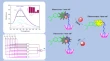
				<figr fid="F6">6</figr>, it could be found that compared with that on 6-nm-thick seed layer, the fluctuation amplitude and frequency of the roughness for the 50-nm-thick seed layer are larger and smaller than those for the 6-nm-thick seed layer, respectively, which may be caused by stack of the ZnO nanoparticles. The augment of spacing of local peaks weakens interaction among ZnO nanorods, which leads to free growth and slant of some nanorods. This relationship is shown schematically in Figure 
				<figr fid="F7">7</figr>.</p>
			<fig id="F6"><title><p>Figure 6</p></title><caption><p>AFM three-dimensional images of (a) 6&#8201;nm seed layers and (b) 50&#8201;nm seed layers</p></caption><text>
   <p>
      <b>AFM three-dimensional images of (a) 6&#8201;nm seed layers and (b) 50&#8201;nm seed layers.</b>
   </p>
</text><graphic file="1556-276X-7-368-6"/></fig>
			<fig id="F7"><title><p>Figure 7</p></title><caption><p>The schematic model</p></caption><text>
   <p><b>The schematic model.</b> Schematic model for the effect of fluctuate amplitude and frequency of seed layer roughness on the alignment of NWs.</p>
</text><graphic file="1556-276X-7-368-7"/></fig>
			<p>Another convincing evidence that the fluctuation amplitude and frequency of roughness affect orientation of NWs is shown in Figure 
				<figr fid="F8">8</figr>. Figure 
				<figr fid="F8">8</figr>a, c gives AFM photos of 6-nm-thick seed layers before and after annealing. Comparing Figure 
				<figr fid="F8">8</figr>b,d, it can be found that the alignment of NWs obtained on the annealed seed layer becomes poor. Although annealing usually can improve the crystallinity of the seeds, the peak spacing of the seed layers increases after annealing, resulting in poor alignment of the NWs. This result shows that the fluctuation amplitude and frequency of roughness determine the orientation.</p>
			<fig id="F8"><title><p>Figure 8</p></title><caption><p>AFM and SEM images</p></caption><text>
   <p><b>AFM and SEM images.</b> (<b>a</b>)AFM image of 6-nm-thick seed layer. (<b>b</b>)SEM image of NWs grown on 6-nm-thick seed layer. (<b>c</b>) AFM image of 6-nm-thick seed layer after annealing. (<b>d</b>)SEM image of NWs grown on annealed 6-nm-thick seed layer.</p>
</text><graphic file="1556-276X-7-368-8"/></fig>
			<p>The texture of ZnO seed layers was also reported to be another factor which affects the ZnO NWs' orientation 
				<abbrgrp>
					<abbr bid="B22">22</abbr>
				</abbrgrp>. However, in the present paper, it is found that the texture of ZnO seed layers does not affect the alignment. The XRD data for the seed layers with different thickness are shown in Figure 
				<figr fid="F9">9</figr>. The ZnO seed layers with thickness under 10&#8201;nm do not show any reflection peak due to ultra-thin thickness. On the other hand, 10-, 20-, and 50-nm-thick seed layers appear the same diffraction peaks, indicating that the seed layers deposited at the same condition have the same texture. So, we suggest that the seed layers with different small thickness exhibit almost the same texture and do not have the major change with increase of thickness. Given the analysis above, we suggest that the texture of the ZnO seeds does not directly determine the ZnO NWs orientation in our experiments.</p>
			<fig id="F9"><title><p>Figure 9</p></title><caption><p>XRD spectra of ZnO seed layers</p></caption><text>
   <p><b>XRD spectra of ZnO seed layers.</b> The XRD spectra of ZnO seed layers with different thickness (from top to bottom, 2, 4, 6, 8,10, 20, and 50&#8201;nm).</p>
</text><graphic file="1556-276X-7-368-9"/></fig>
			<p>PL spectroscopy is an effective technique for evaluating the optical properties and defects of semiconductor materials. Figure 
				<figr fid="F10">10</figr> shows typical room-temperature PL spectra of the ZnO NWs grown on glass substrates with different seed thickness. The PL spectra from all samples exhibit the same profile with a dominant emission peak centered at 383&#8201;nm, which corresponds to the ultraviolet emission of ZnO with a band gap of 3.24&#8201;eV 
				<abbrgrp>
					<abbr bid="B23">23</abbr>
				</abbrgrp>. In addition to the UV emission, two weak emissions at 450 and 468&#8201;nm also can be observed for the as-grown samples. The weak peaks in the blue-green band result from an electronic transition from the level of the ionized oxygen vacancies to the valence band 
				<abbrgrp>
					<abbr bid="B24">24</abbr>
				</abbrgrp>. We can see clearly that no obvious change of PL spectroscopy is occurred as the increase of seed thickness, which means that there is no relation between crystal defects and seed thickness.</p>
			<fig id="F10"><title><p>Figure 10</p></title><caption><p>The PL micrographs of ZnO NWs</p></caption><text>
   <p><b>The PL micrographs of ZnO NWs.</b> PL micrographs of ZnO NWs grown on pre-coated glass substrate with different thickness (from top to bottom, 2, 4, 6, 8,10, 20, and 50&#8201;nm).</p>
</text><graphic file="1556-276X-7-368-10"/></fig>
		</sec>
		<sec>
			<st>
				<p>Implications of the hypothesis</p>
			</st>
			<p>We demonstrate that the growth of the ZnO NWs on ultra-thin seed layers is strongly influenced by the substrates and thickness of the seed films. NWs could be obtained on the smooth substrates covered with seed layers whose thickness is larger than 4&#8201;nm and have good alignment when roughness of the seed layers is also suitable. Besides, it is found that the thickness of the seed layers affects fluctuation amplitude and frequency of the roughness, which affects the alignment of the resulting NWs in succession. However, the crystal defects were influenced greatly by substrates instead of seed layers. The research provides prospect for preparation of the ZnO NWs on thin seed layers.</p>
		</sec>
		<sec>
			<st>
				<p>Competing interests</p>
			</st>
			<p>The authors declare that they have no competing interests.</p>
		</sec>
		<sec>
			<st>
				<p>Authors&#8217; contributions</p>
			</st>
			<p>JND guided the work of this paper and revised the manuscript. YBL carried out the experiments and drafted the manuscript. CBT participated in the design of the experiments. NYY participated in the design of the studies and revised the manuscript. All authors read and approved the final manuscript.</p>
		</sec>
		<sec>
			<st>
				<p>Authors&#8217; information</p>
			</st>
			<p>JND is a professor at the Center for Low-Dimensional Materials, Micro-Nano Devices and System, Changzhou University, Changzhou 213164, China and at Jiangsu Key Laboratory for Solar Cell Materials and Technology, Changzhou, 213164, China. YBL and CBT are both post-graduates at the Center for Low-Dimensional Materials, Micro-Nano Devices and System, Changzhou University, Changzhou 213164, China. NYY is a professor at the Center for Low-Dimensional Materials, Micro-Nano Devices and System, Changzhou University, Changzhou 213164, China.</p>
		</sec>
	</bdy>
	<bm>
		<ack>
			<sec>
				<st>
					<p>Acknowledgments</p>
				</st>
				<p>This work was supported by the National High Technology Research and Development Program 863 (2011AA050511), Qing Lan Project (2008&#8211;04), Jiangsu &#8216;333&#8217; Project (201041), and the Priority Academic Program Development of Jiangsu Higher Education Institutions.</p>
			</sec>
		</ack>
		<refgrp><bibl id="B1"><title><p>Room-temperature ultraviolet nanowire nanolasers</p></title><aug><au><snm>Huang</snm><fnm>MH</fnm></au><au><snm>Mao</snm><fnm>S</fnm></au><au><snm>Feick</snm><fnm>H</fnm></au><au><snm>Yan</snm><fnm>H</fnm></au><au><snm>Wu</snm><fnm>Y</fnm></au><au><snm>Kind</snm><fnm>H</fnm></au><au><snm>Weber</snm><fnm>E</fnm></au><au><snm>Russo</snm><fnm>R</fnm></au><au><snm>Yang</snm><fnm>P</fnm></au></aug><source>Science</source><pubdate>1897</pubdate><volume>2001</volume><fpage>292</fpage></bibl><bibl id="B2"><title><p>Photoluminescence Of A ZnO/GaN heterostructure interface</p></title><aug><au><snm>Liu</snm><fnm>SJ</fnm></au><au><snm>Yu</snm><fnm>QX</fnm></au><au><snm>Wang</snm><fnm>J</fnm></au><au><snm>Liao</snm><fnm>Y</fnm></au><au><snm>Li</snm><fnm>XG</fnm></au></aug><source>Chin Phys Lett</source><pubdate>2009</pubdate><volume>26</volume><fpage>077805</fpage><xrefbib><pubid idtype="doi">10.1088/0256-307X/26/7/077805</pubid></xrefbib></bibl><bibl id="B3"><title><p>Field-effect transistors based on single semiconducting oxide nanobelts</p></title><aug><au><snm>Arnold</snm><fnm>MS</fnm></au><au><snm>Avouris</snm><fnm>P</fnm></au><au><snm>Pan</snm><fnm>ZW</fnm></au><au><snm>Wang</snm><fnm>ZL</fnm></au></aug><source>J Phys Chem B</source><pubdate>2003</pubdate><volume>107</volume><fpage>659</fpage><xrefbib><pubid idtype="doi">10.1021/jp0271054</pubid></xrefbib></bibl><bibl id="B4"><title><p>Characterization and Field-emission properties of needle-like zinc oxide nanowires grown vertically on conductive zinc oxide films</p></title><aug><au><snm>Tseng</snm><fnm>YK</fnm></au><au><snm>Huang</snm><fnm>CJ</fnm></au><au><snm>Cheng</snm><fnm>HM</fnm></au><au><snm>Lin</snm><fnm>IN</fnm></au><au><snm>Liu</snm><fnm>KS</fnm></au><au><snm>Chen</snm><fnm>IC</fnm></au></aug><source>Adv Funct Mater</source><pubdate>2003</pubdate><volume>13</volume><fpage>811</fpage><xrefbib><pubid idtype="doi">10.1002/adfm.200304434</pubid></xrefbib></bibl><bibl id="B5"><title><p>ZnO Schottky ultraviolet photodetectors</p></title><aug><au><snm>Liang</snm><fnm>S</fnm></au><au><snm>Sheng</snm><fnm>H</fnm></au><au><snm>Liu</snm><fnm>Y</fnm></au><au><snm>Huo</snm><fnm>Z</fnm></au><au><snm>Lu</snm><fnm>Y</fnm></au><au><snm>Shen</snm><fnm>H</fnm></au></aug><source>J Cryst Growth</source><pubdate>2001</pubdate><volume>225</volume><fpage>110</fpage><xrefbib><pubid idtype="doi">10.1016/S0022-0248(01)00830-2</pubid></xrefbib></bibl><bibl id="B6"><title><p>Fabrication and ethanol sensing characteristics of ZnO nanowire gas sensors</p></title><aug><au><snm>Wan</snm><fnm>Q</fnm></au><au><snm>Li</snm><fnm>QH</fnm></au><au><snm>Chen</snm><fnm>YJ</fnm></au><au><snm>Wang</snm><fnm>TH</fnm></au><au><snm>He</snm><fnm>XL</fnm></au><au><snm>Li</snm><fnm>JP</fnm></au><au><snm>Lin</snm><fnm>CL</fnm></au></aug><source>Appl Phys Lett</source><pubdate>2004</pubdate><volume>84</volume><fpage>3654</fpage><xrefbib><pubid idtype="doi">10.1063/1.1738932</pubid></xrefbib></bibl><bibl id="B7"><title><p>Nanowire dye-sensitized solar cells</p></title><aug><au><snm>Law</snm><fnm>M</fnm></au><au><snm>Greene</snm><fnm>LE</fnm></au><au><snm>Johnson</snm><fnm>JC</fnm></au><au><snm>Saykally</snm><fnm>R</fnm></au><au><snm>Yang</snm><fnm>PD</fnm></au></aug><source>Nature Mater</source><pubdate>2005</pubdate><volume>4</volume><fpage>455</fpage><xrefbib><pubid idtype="doi">10.1038/nmat1387</pubid></xrefbib></bibl><bibl id="B8"><title><p>Piezoelectric characterization of individual zinc oxide nanobelt probed by piezoresponse force microscope</p></title><aug><au><snm>Zhao</snm><fnm>MH</fnm></au><au><snm>Wang</snm><fnm>ZL</fnm></au><au><snm>Mao</snm><fnm>SX</fnm></au></aug><source>Nano Lett</source><pubdate>2004</pubdate><volume>4</volume><fpage>587</fpage><xrefbib><pubid idtype="doi">10.1021/nl035198a</pubid></xrefbib></bibl><bibl id="B9"><title><p>Defect photoluminescence of undoping ZnO films and its dependence on annealing conditions</p></title><aug><au><snm>Lin</snm><fnm>B</fnm></au><au><snm>Fu</snm><fnm>Z</fnm></au><au><snm>Jia</snm><fnm>Y</fnm></au><au><snm>Liao</snm><fnm>G</fnm></au></aug><source>J Electrochem Soc</source><pubdate>2001</pubdate><volume>148</volume><fpage>G110</fpage><xrefbib><pubid idtype="doi">10.1149/1.1346616</pubid></xrefbib></bibl><bibl id="B10"><title><p>Threading dislocations in domain-matching epitaxial films of ZnO</p></title><aug><au><snm>Liu</snm><fnm>WR</fnm></au><au><snm>Hsieh</snm><fnm>WF</fnm></au><au><snm>Hsu</snm><fnm>CH</fnm></au><au><snm>Liang</snm><fnm>KS</fnm></au><au><snm>Chien</snm><fnm>FSS</fnm></au></aug><source>J Appl Crystallogr</source><pubdate>2007</pubdate><volume>40</volume><fpage>924</fpage><xrefbib><pubid idtype="doi">10.1107/S0021889807033997</pubid></xrefbib></bibl><bibl id="B11"><title><p>Third-harmonic generation from ZnO films deposited by MOCVD</p></title><aug><au><snm>Liu</snm><fnm>CY</fnm></au><au><snm>Zhang</snm><fnm>BP</fnm></au><au><snm>Binh</snm><fnm>NT</fnm></au><au><snm>Segawa</snm><fnm>Y</fnm></au></aug><source>Appl Phys B</source><pubdate>2004</pubdate><volume>79</volume><fpage>83</fpage><xrefbib><pubid idtype="doi">10.1007/s00340-004-1507-5</pubid></xrefbib></bibl><bibl id="B12"><title><p>Comparison of nanostructure characteristics of ZnO grown on GaN and sapphire</p></title><aug><au><snm>Shiao</snm><fnm>WY</fnm></au><au><snm>Chi</snm><fnm>CY</fnm></au><au><snm>Chin</snm><fnm>SC</fnm></au><au><snm>Huang</snm><fnm>CF</fnm></au><au><snm>Tang</snm><fnm>TY</fnm></au><au><snm>Lu</snm><fnm>YC</fnm></au><au><snm>Lin</snm><fnm>YL</fnm></au><au><snm>Hong</snm><fnm>L</fnm></au><au><snm>Jen</snm><fnm>FY</fnm></au><au><snm>Yang</snm><fnm>CC</fnm></au><au><snm>Zhang</snm><fnm>BP</fnm></au><au><snm>Segawa</snm><fnm>Y</fnm></au></aug><source>J Appl Phys</source><pubdate>2006</pubdate><volume>99</volume><fpage>054301</fpage><xrefbib><pubid idtype="doi">10.1063/1.2174121</pubid></xrefbib></bibl><bibl id="B13"><title><p>Transparent ZnO thin-film transistor fabricated by rf magnetron sputtering</p></title><aug><au><snm>Carcia</snm><fnm>PF</fnm></au><au><snm>McLean</snm><fnm>RS</fnm></au><au><snm>Reilly</snm><fnm>MH</fnm></au><au><snm>Nunes</snm><fnm>G</fnm></au></aug><source>Appl Phys Lett</source><pubdate>2003</pubdate><volume>82</volume><fpage>1117</fpage><xrefbib><pubid idtype="doi">10.1063/1.1553997</pubid></xrefbib></bibl><bibl id="B14"><title><p>Hydrogen-doped high conductivity ZnO films deposited by radio-frequency magnetron sputtering</p></title><aug><au><snm>Chen</snm><fnm>LY</fnm></au><au><snm>Chen</snm><fnm>WH</fnm></au><au><snm>Wang</snm><fnm>JJ</fnm></au><au><snm>Hong</snm><fnm>FCN</fnm></au><au><snm>Su</snm><fnm>YK</fnm></au></aug><source>Appl Phys Lett</source><pubdate>2004</pubdate><volume>85</volume><fpage>5628</fpage><xrefbib><pubid idtype="doi">10.1063/1.1835991</pubid></xrefbib></bibl><bibl id="B15"><title><p>Selective growth of ZnO nanorods on pre-coated ZnO buffer layer</p></title><aug><au><snm>Hsu</snm><fnm>HC</fnm></au><au><snm>Tseng</snm><fnm>YK</fnm></au><au><snm>Cheng</snm><fnm>HM</fnm></au><au><snm>Kuo</snm><fnm>JH</fnm></au><au><snm>Hsieh</snm><fnm>WF</fnm></au></aug><source>J Cryst Growth</source><pubdate>2004</pubdate><volume>261</volume><fpage>520</fpage><xrefbib><pubid idtype="doi">10.1016/j.jcrysgro.2003.09.040</pubid></xrefbib></bibl><bibl id="B16"><title><p>Density-controlled hydrothermal growth of well-aligned ZnO nanorod arrays</p></title><aug><au><snm>Ma</snm><fnm>T</fnm></au><au><snm>Guo</snm><fnm>M</fnm></au><au><snm>Zhang</snm><fnm>M</fnm></au><au><snm>Zhang</snm><fnm>YJ</fnm></au><au><snm>Wang</snm><fnm>XD</fnm></au></aug><source>Nanotechnology</source><pubdate>2007</pubdate><volume>18</volume><fpage>035605</fpage><xrefbib><pubidlist><pubid idtype="doi">10.1088/0957-4484/18/3/035605</pubid><pubid idtype="pmpid" link="fulltext">19636128</pubid></pubidlist></xrefbib></bibl><bibl id="B17"><title><p>Controlling of preferential growth mode of ZnO thin films grown by atomic layer deposition</p></title><aug><au><snm>Wojcik</snm><fnm>A</fnm></au><au><snm>Godlewski</snm><fnm>M</fnm></au><au><snm>Guziewicz</snm><fnm>E</fnm></au><au><snm>Minikayev</snm><fnm>R</fnm></au><au><snm>Paszkowicz</snm><fnm>W</fnm></au></aug><source>J Cryst Growth</source><pubdate>2008</pubdate><volume>310</volume><fpage>284</fpage><xrefbib><pubid idtype="doi">10.1016/j.jcrysgro.2007.10.010</pubid></xrefbib></bibl><bibl id="B18"><title><p>UV electroluminescence and structure of n-ZnO/p-GaN heterojunction light-emitting diodes grown by atomic layer deposition</p></title><aug><au><snm>Chen</snm><fnm>HC</fnm></au><au><snm>Chen</snm><fnm>MJ</fnm></au><au><snm>Wu</snm><fnm>MK</fnm></au><au><snm>Cheng</snm><fnm>YC</fnm></au><au><snm>Tsai</snm><fnm>FY</fnm></au></aug><source>IEEE J Sel Topics Quantum Electron</source><pubdate>2008</pubdate><volume>14</volume><fpage>1053</fpage></bibl><bibl id="B19"><title><p>Fabrication of ZnO nanorods and nanotubes in aqueous solutions</p></title><aug><au><snm>Li</snm><fnm>QC</fnm></au><au><snm>Kumar</snm><fnm>V</fnm></au><au><snm>Li</snm><fnm>Y</fnm></au><au><snm>Zhang</snm><fnm>H</fnm></au><au><snm>Marks</snm><fnm>TJ</fnm></au><au><snm>Chang</snm><fnm>RPH</fnm></au></aug><source>Chem Mater</source><pubdate>2005</pubdate><volume>17</volume><fpage>1001</fpage><xrefbib><pubid idtype="doi">10.1021/cm048144q</pubid></xrefbib></bibl><bibl id="B20"><title><p>Surface polarity shielding and hierarchical ZnO nano-architectures produced using sequential hydrothermal crystal synthesis and thin film atomic layer deposition</p></title><aug><au><snm>Na</snm><fnm>JS</fnm></au><au><snm>Gong</snm><fnm>B</fnm></au><au><snm>Scarel</snm><fnm>G</fnm></au><au><snm>Parsons</snm><fnm>GN</fnm></au></aug><source>ACS Nano</source><pubdate>2009</pubdate><volume>3</volume><fpage>3191</fpage><xrefbib><pubidlist><pubid idtype="doi">10.1021/nn900702e</pubid><pubid idtype="pmpid" link="fulltext">19785432</pubid></pubidlist></xrefbib></bibl><bibl id="B21"><title><p>Tunable arrays of ZnO nanorods and nanoneedles via seed layer and solution chemistry</p></title><aug><au><snm>Lee</snm><fnm>YJ</fnm></au><au><snm>Sounart</snm><fnm>TL</fnm></au><au><snm>Scrymgeour</snm><fnm>DA</fnm></au><au><snm>Voigt</snm><fnm>JA</fnm></au><au><snm>Hsu</snm><fnm>JWP</fnm></au></aug><source>J Cryst Growth</source><pubdate>2007</pubdate><volume>304</volume><fpage>80</fpage><xrefbib><pubid idtype="doi">10.1016/j.jcrysgro.2007.02.011</pubid></xrefbib></bibl><bibl id="B22"><title><p>General route to vertical ZnO nanowire arrays using textured ZnO seeds</p></title><aug><au><snm>Greene</snm><fnm>LE</fnm></au><au><snm>Law</snm><fnm>M</fnm></au><au><snm>Tan</snm><fnm>DH</fnm></au><au><snm>Montano</snm><fnm>M</fnm></au><au><snm>Goldberger</snm><fnm>J</fnm></au><au><snm>Somorjai</snm><fnm>G</fnm></au><au><snm>Yang</snm><fnm>PD</fnm></au></aug><source>Nano Lett</source><pubdate>2005</pubdate><volume>5</volume><fpage>1231</fpage><xrefbib><pubidlist><pubid idtype="doi">10.1021/nl050788p</pubid><pubid idtype="pmpid">16178216</pubid></pubidlist></xrefbib></bibl><bibl id="B23"><title><p>Low-temperature growth of well-aligned ZnO nanorods by chemical vapor deposition</p></title><aug><au><snm>Wu</snm><fnm>JJ</fnm></au><au><snm>Liu</snm><fnm>SC</fnm></au></aug><source>Adv Mater</source><pubdate>2002</pubdate><volume>14</volume><fpage>215</fpage><xrefbib><pubid idtype="doi">10.1002/1521-4095(20020205)14:3&lt;215::AID-ADMA215&gt;3.0.CO;2-J</pubid></xrefbib></bibl><bibl id="B24"><title><p>Photoluminescence of ZnO films excited with light of different wavelength</p></title><aug><au><snm>Zhang</snm><fnm>DH</fnm></au><au><snm>Wang</snm><fnm>QP</fnm></au><au><snm>Xue</snm><fnm>ZY</fnm></au></aug><source>Appl Surf Sci</source><pubdate>2003</pubdate><volume>207</volume><fpage>20</fpage><xrefbib><pubid idtype="doi">10.1016/S0169-4332(02)01225-4</pubid></xrefbib></bibl></refgrp>
	</bm>
</art>