<?xml version='1.0'?>
<!DOCTYPE art SYSTEM 'http://www.biomedcentral.com/xml/article.dtd'>
<art>
	<ui>1556-276X-7-302</ui>
	<ji>1556-276X</ji>
	<fm>
		<dochead>Nano Express</dochead>
		<bibl>
			<title>
				<p>Junction investigation of graphene/silicon Schottky diodes</p>
			</title>
			<aug>
				<au id="A1"><snm>Mohammed</snm><fnm>Muatez</fnm><insr iid="I1"/><email>mzmohammed@ualr.edu</email></au>
				<au id="A2" ca="yes"><snm>Li</snm><fnm>Zhongrui</fnm><insr iid="I1"/><email>zxli3@ualr.edu</email></au>
				<au id="A3"><snm>Cui</snm><fnm>Jingbiao</fnm><insr iid="I1"/><email>jxcui@ualr.edu</email></au>
				<au id="A4" ca="yes"><snm>Chen</snm><fnm>Tar-pin</fnm><insr iid="I1"/><email>txchen@ualr.edu</email></au>
			</aug>
			<insg>
				<ins id="I1"><p>Department of Physics and Astronomy, University of Arkansas at Little Rock, Little Rock, AR, 870-71656, USA</p></ins>
			</insg>
			<source>Nanoscale Research Letters</source>
			<issn>1556-276X</issn>
			<pubdate>2012</pubdate>
			<volume>7</volume>
			<issue>1</issue>
			<fpage>302</fpage>
			<url>http://www.nanoscalereslett.com/content/7/1/302</url>
			<xrefbib><pubidlist><pubid idtype="doi">10.1186/1556-276X-7-302</pubid><pubid idtype="pmpid">22687246</pubid></pubidlist></xrefbib>
		</bibl>
		<history><rec><date><day>16</day><month>12</month><year>2011</year></date></rec><acc><date><day>20</day><month>4</month><year>2012</year></date></acc><pub><date><day>11</day><month>6</month><year>2012</year></date></pub></history>
		<cpyrt><year>2012</year><collab>Mohammed et al.; licensee Springer.</collab><note>This is an Open Access article distributed under the terms of the Creative Commons Attribution License (
				<url>http://creativecommons.org/licenses/by/2.0</url>), which permits unrestricted use, distribution, and reproduction in any medium, provided the original work is properly cited.</note></cpyrt>
		<kwdg>
			<kwd>Graphene</kwd>
			<kwd>heterojunction</kwd>
			<kwd>Schottky diode</kwd>
		</kwdg>
		<abs>
			<sec>
				<st>
					<p>
						<b>Abstract</b>
					</p>
				</st>
				<p>Here we present a facile technique for the large-scale production of few-layer graphene flakes. The as-sonicated, supernatant, and sediment of the graphene product were respectively sprayed onto different types of silicon wafers. It was found that all devices exhibited current rectification properties, and the supernatant graphene devices have the best performance. Schottky junctions formed between graphene flakes and silicon n-type substrates exhibit good photovoltaic conversion efficiency while graphene/p-Si devices have poor light harvesting capability.</p>
			</sec>
		</abs>
	</fm>
	<bdy>
		<sec>
			<st>
				<p>Background</p>
			</st>
			<p>Since the first demonstration of graphene nanosheets in 2004, it has been considered as a chemically stable and mechanically strong new material 
				<abbrgrp>
					<abbr bid="B1">1</abbr>
				</abbrgrp>. Tremendous work has been devoted to this material because it has exhibited outstanding properties particularly in the optoelectronic field 
				<abbrgrp>
					<abbr bid="B2">2</abbr>
				</abbrgrp>. The two dimensional honeycomb lattice of the graphene leads to a hybridization of sp<sup>2</sup> which, in turn, leads to extraordinary electrical properties with ultrahigh carrier mobility (approximately 100,000&#8201;cm<sup>2</sup>/Vs) 
				<abbrgrp>
					<abbr bid="B3">3</abbr>
				</abbrgrp>. A monolayer of graphene has a thickness of 0.34&#8201;nm and absorbs 2.3&#8201;% of white light 
				<abbrgrp>
					<abbr bid="B4">4</abbr>
				</abbrgrp>; even graphene layers of 1,000&#8201;nm thick still have a transparency of approximately 70&#8201;% 
				<abbrgrp>
					<abbr bid="B5">5</abbr>
				</abbrgrp>, which makes it possible to use graphene as transparent electrodes 
				<abbrgrp>
					<abbr bid="B6">6</abbr>
				</abbrgrp>. Graphene has the advantages over carbon nanotubes of being naturally compatible with thin film processing, enabling large device areas and hence, high operating powers. Also, graphene is more readily scalable and has a lower contact resistance. The combination of these enticing electrical and optical properties of the graphene motivated the researchers to experience it in the field of optoelectronic devices 
				<abbrgrp>
					<abbr bid="B7">7</abbr>
				</abbrgrp>.</p>
			<p>Previous use of graphene in organic solar cell applications was mainly confined as flexible transparent electrodes to replace transparent indium tin oxide or fluorine-doped tin oxide for collecting charge carriers 
				<abbrgrp>
					<abbr bid="B8">8</abbr>
				</abbrgrp>. Recently, graphene-on-silicon configurations were made into solar cells by using membrane transfer technique 
				<abbrgrp>
					<abbr bid="B9">9</abbr>
				</abbrgrp>. However, the fabrication process based on membrane transfer is expensive and difficult to scale up. The previous studies have explored electron transport in graphene; the Schottky barriers between graphene and silicon have not been studied thoroughly. The Schottky barriers have been observed at bulk, highly ordered pyrolytic graphite/silicon interfaces 
				<abbrgrp>
					<abbr bid="B10">10</abbr>
				</abbrgrp>, but no photocurrents could be measured; a comparison of n- and p-type substrates was not given in this prior work. Moreover, the local effect of light absorption on the <it>J-V</it> characteristics of graphene/silicon interfaces has not been studied.</p>
			<p>In this work we present a facile technique for the large-scale production of few-layer graphene flakes. Next, as-sonicated (So), supernatant (Su) and sediment (Se) of the graphene product were respectively sprayed onto n-/p-type silicon wafers. The current rectification properties of the formed Schottky junctions between different graphene sources and silicon substrates were compared.</p>
		</sec>
		<sec>
			<st>
				<p>Methods</p>
			</st>
			<p>The graphene flakes were synthesized through chemical vapor deposition of acetylene on a MgO-supported Fe-Co bimetallic catalyst (Fe-Co/MgO with a stoichiometric composition of 2.5:2.5:95&#8201;wt%) 
				<abbrgrp>
					<abbr bid="B11">11</abbr>
				</abbrgrp>. The catalyst was prepared by using the impregnation technique. Initially, the weighted amounts of Fe(NO<sub>3</sub>)<sub>3</sub>&#183;9H<sub>2</sub>O and Co(NO<sub>3</sub>)<sub>2</sub>&#183;6H<sub>2</sub>O were dissolved in ethanol under agitation. Subsequently, the MgO powder with a surface area of 130&#8201;m<sup>2</sup>/g was mixed the solution and followed by drying at 60&#176;C overnight. The catalyst was obtained by calcinating the resulting mixture in air at 500&#176;C for 2&#8201;h. Graphene sheets can grow on the catalyst system from pyrolysis of acetylene at 1,000&#176;C with the argon flow as carrier gas. The mixture product can be collected after 30&#8201;min of reaction and cooled under argon flow for about 10&#8201;min. Impurities like catalystsupport MgO and Fe-Co metal particles can be removed by washing the mixture product with hydrochloric acid under sonication. The purified graphene sheets can be obtained after filtration and washing.</p>
			<p>Purified graphene flakes were first dispersed in pure <it>N</it>-methyl-2-pyrrolidone (NMP, 0.1&#8201;mg/mL) under sonication(So, G-NMP). The G-NMP solution can be directly utilized to make G/n-Si devices. Part of the G-NMP solution was centrifuged; the supernatant (Su) and the sediment (Se) were taken out respectively and used for the fabrication of G/n-Si devices. The three different solutions were sprayed respectively on n-type silicon wafer (resistivity,&#8201;0.295 Ohm&#183;cm and mobility, 1,026&#8201;cm<sup>2</sup>/Vs), p-type silicon substrate (resistivity, 21 Ohm&#183;cm and mobility, 1,502&#8201;cm<sup>2</sup>/Vs) and glass substrates (for reference) by airbrushing. A silicon wafer with a window of pre-deposited insulating layer and a glass substrate were placed on a heating platform side by side (so that the resulting graphene flake films on Si and glass substrates should have the same thickness) and heated up to 150&#176;C in order to evaporate the NMP solvent from the coatings. The schematic diagram of graphene-on-silicon Schottky device was displayed in Figure 
				<figr fid="F1">1</figr>.</p>
			<fig id="F1"><title><p>Figure 1</p></title><caption><p>Schematic diagram of a graphene-on-silicon device Characterization techniques</p></caption><text>
   <p><b>Schematic diagram of a graphene-on-silicon device.</b> Characterization techniques.</p>
</text><graphic file="1556-276X-7-302-1"/></fig>
			<p>To characterize the morphological properties of graphene nanosheets, several techniques such as microscopy and X-ray diffraction (XRD) were utilized. Atomic force microscopy (AFM) images were obtained on Veeco Dimension 3100 AFM system (Veeco Instruments, Inc., NY, USA). Scanning electron microscopy (SEM) images were obtained using a JEOL 7000&#8201;F high-resolution scanning electron microscope (JEOL Ltd., Tokyo, Japan). This microscope has a resolution of 1.2&#8201;nm at an accelerating voltage of 15&#8201;kV and a working distance of 10&#8201;mm. The final products were mounted on aluminum pins with double-sided carbon tape and their corresponding SEM images were obtained. Elemental analysis was performed with Genesis energy dispersive spectrometer system (EDAX Inc., Mahwah, NJ, USA). The X-ray powder diffraction profiles of graphene sheets were recorded in &#952;-2&#952; mode on Bruker D8 Discovery diffraction system (Bruker AXS Corporation, Madison, WI, USA). The monochromatic Cu <it>K&#945;</it> radiation line and general area detector diffraction system were used as an excitation source and detector, respectively. The experiments were carried out in Bragg-Brentano geometry.</p>
			<p>To understand how a different graphene source affect the G/n-Si Schottky junction properties, current density-voltage (<it>J-V</it>) characteristics were investigated in the dark and under illumination using a solar simulator at air mass coefficient 1.5 (approximately 100&#8201;mW/cm<sup>2</sup>) inside a glove box in a nitrogen environment. The illumination was on the graphene flake side. The devices were irradiated in an area of 1&#8201;&#215;&#8201;1&#8201;cm<sup>2</sup> and data were recorded using a Keithley 2400 source meter (Keithley Instruments Inc., Cleveland, OH, USA).</p>
		</sec>
		<sec>
			<st>
				<p>Results and discussions</p>
			</st>
			<p>As shown Figure 
				<figr fid="F2">2</figr>a, the thermal gravimetric analysis (TGA) results show the purity of graphene flake as-purified sample is better than 99&#8201;wt%. The combustion temperature is around 620&#176;C. Raman spectroscopy is a nondestructive optical technique, has been successfully used to characterize graphene and other carbon-based materials 
				<abbrgrp>
					<abbr bid="B12">12</abbr>
					<abbr bid="B13">13</abbr>
				</abbrgrp>. Furthermore, it was shown that the Raman spectrum of graphene provides useful information about its crystallinity and the number of layers present within the sample 
				<abbrgrp>
					<abbr bid="B4">4</abbr>
				</abbrgrp>. The typical Raman spectra (Figure 
				<figr fid="F2">2</figr>b) of the few-layer graphene has three main peaks which are commonly referred to as the <it>D</it> band (approximately 1,350&#8201;cm<sup>&#8722;1</sup>), <it>G</it> band (approximately 1,580&#8201;cm<sup>&#8722;1</sup>) and the 2<it>D</it> band (approximately 2,650&#8201;cm<sup>&#8722;1</sup>). The <it>D</it> band arises due to the breathing modes of sp<sup>2</sup> atoms in rings and its intensity is usually associated with defects in the carbon-based material 
				<abbrgrp>
					<abbr bid="B14">14</abbr>
				</abbrgrp>, in the case of graphene, a substantial contribution which typically comes from the edge effects 
				<abbrgrp>
					<abbr bid="B15">15</abbr>
				</abbrgrp>. The <it>G</it> band is often referred to the E<sub>2g</sub> mode at the Brillouin zone center due to the bond stretching of sp<sup>2</sup> atoms in both ring and chains 
				<abbrgrp>
					<abbr bid="B16">16</abbr>
				</abbrgrp>. The 2<it>D</it> band is the second order mode and its shape as well as its position is used to identify a single layer from bilayer and few (less than five) layer graphene 
				<abbrgrp>
					<abbr bid="B4">4</abbr>
				</abbrgrp>. Figure 
				<figr fid="F2">2</figr>b shows the Raman spectrum of our graphene flakes measured at 633&#8201;nm excitation.</p>
			<fig id="F2"><title><p>Figure 2</p></title><caption><p>TGA result, Raman spectra, and XRD pattern of the graphene flakes</p></caption><text>
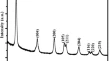
   <p><b>TGA result, Raman spectra, and XRD pattern of the graphene flakes.</b> The TGA result (<b>a</b>), Raman spectra (<b>b</b>) and XRD pattern (<b>c</b>) of the graphene flakes obtained from the supernatant, sonication, and sediment.</p>
</text><graphic file="1556-276X-7-302-2"/></fig>
			<p>The crystallinity and number of layers in the graphene nanosheets can be analyzed by XRD technique. The XRD profile of the graphene sheets grown by radio frequency catalytic chemical vapor deposition method was shown in Figure 
				<figr fid="F2">2</figr>c. The typical features for graphite at 25.3&#176; (002) and 49.1&#176; (004) are identified in this graphene XRD pattern 
				<abbrgrp>
					<abbr bid="B17">17</abbr>
				</abbrgrp>. The 44.7&#176; (100) and 74.7&#176; (110) diffraction peaks originate from the two-dimensional in-plane symmetry along the graphene sheets 
				<abbrgrp>
					<abbr bid="B18">18</abbr>
				</abbrgrp>. The layer-to-layer distance (<it>d</it>-spacing) between two subsequent graphene sheets can be calculated from the (002) diffraction peak position 
				<abbrgrp>
					<abbr bid="B17">17</abbr>
				</abbrgrp>. The width of the diffraction peak can be used to evaluate the crystallite size by using the Scherrer equation (thickness =&#8201;0.9 &#955;/(<it>B</it> cos &#952;), where &#955; is the x-ray wavelength, <it>B</it> is the full width at half maximum of the diffraction peak, and &#952; is the Bragg angle) 
				<abbrgrp>
					<abbr bid="B19">19</abbr>
				</abbrgrp>. Based on the values of the <it>d</it>-spacing and the size of crystallite, the graphene sheets in this work were estimated to have in average of about four layers.</p>
			<p>The top view morphologies of a typical G/Si device made of supernatant were displayed in SEM and AFM images (Figure 
				<figr fid="F3">3</figr>). Both SEM and AFM characterization on the graphene coating reveals that graphene flakes are overlapped and interconnected, which ensures a conducting pathway even if there are cracks formed in one of the layers.</p>
			<fig id="F3"><title><p>Figure 3</p></title><caption><p>SEM and AFM images of typical graphene-on-silicon devices</p></caption><text>
   <p><b>SEM and AFM images of typical graphene-on-silicon devices.</b> SEM top view (<b>a</b>) and cross section view (<b>b</b>) images of the typical graphene-on-silicon devices. The inset in (a) displays the AFM image of the graphene flakes obtained from the supernatant.</p>
</text><graphic file="1556-276X-7-302-3"/></fig>
			<p>The typical dark current&#8211;voltage characteristic of G/n-Si heterojunction device is displayed in the top inset of Figure 
				<figr fid="F4">4</figr>. The G/n-Si heterojunctions are highly rectifying with an &#8216;on/off&#8217; current ratio of 10 to approximately 10<sup>3</sup> at &#177;1&#8201;V. As seen from Figure 
				<figr fid="F5">5</figr>b, the G/n-Si with a graphene source from supernatant have highest on/off ratio, and those made of sediment have the lowest on/off ratio, which might be caused by impurities in the sediment. Similarly, the supernatant devices also have the highest rectification factors, while the junctions between sediment graphene and silicon exhibit lowest rectification factors, as seen in Figure 
				<figr fid="F4">4</figr>. The ideality factor is derived from the slope of the dark <it>J-V</it> curve. The Shockley ideal diode equation gives the <it>J-V</it> characteristic of an ideal diode in either forward or reverse bias (or no bias). The equation is as follows:</p>
			<p>
				<display-formula id="M1">
					<m:math name="1556-276X-7-302-i1" xmlns:m="http://www.w3.org/1998/Math/MathML"><m:mrow>
   <m:mi>J</m:mi>
   <m:mo>=</m:mo>
   <m:msub>
      <m:mi>J</m:mi>
      <m:mi>S</m:mi>
   </m:msub>
   <m:mo stretchy="true">(</m:mo>
   <m:msup>
      <m:mi>e</m:mi>
      <m:mrow>
         <m:msub>
            <m:mi>V</m:mi>
            <m:mi>D</m:mi>
         </m:msub>
         <m:mo>/</m:mo>
         <m:mi>n</m:mi>
         <m:msub>
            <m:mi>V</m:mi>
            <m:mi>T</m:mi>
         </m:msub>
      </m:mrow>
   </m:msup>
   <m:mo>&#8722;</m:mo>
   <m:mn>1</m:mn>
   <m:mo stretchy="true">)</m:mo>
</m:mrow>
</m:math>
				</display-formula>
			</p>
			<p>where <it>J</it> is the diode current, <it>J</it>
				<sub>
					<it>S</it>
				</sub> is the reverse bias saturation current (or scale current), <it>V</it>
				<sub>D</sub> is the voltage across the diode, <it>V</it>
				<sub>T</sub> is the thermal voltage (<it>k</it>
				<sub>
					<it>B</it>
				</sub>T, <it>k</it>
				<sub>
					<it>B</it>
				</sub> is the Boltzmann constant, <it>T</it> the temperature in Kelvin), and <it>n</it> is the ideality factor, also known as the quality factor, or sometimes emission coefficient. The ideality factor <it>n</it> varies from 1 to 2 depending on the fabrication process and the semiconductor material and, in many cases, is assumed to be approximately equal to 1. As shown in Figure 
				<figr fid="F3">3</figr>, the ideality factor of the G/n-Si devices change in the order <it>n</it>(Su)&#8201;&gt;&#8201;<it>n</it>(So)&#8201;&gt;&#8201;<it>n</it>(Se) . The saturation current density <it>Js</it> can be expressed with thermionic emission model 
				<abbrgrp>
					<abbr bid="B20">20</abbr>
				</abbrgrp> in the form of current density (mA/cm<sup>2</sup>)</p>
			<p>
				<display-formula id="M2">
					<m:math name="1556-276X-7-302-i2" xmlns:m="http://www.w3.org/1998/Math/MathML"><m:mrow>
   <m:msub>
      <m:mi>J</m:mi>
      <m:mi>S</m:mi>
   </m:msub>
   <m:mo>=</m:mo>
   <m:mi>A</m:mi>
   <m:msup>
      <m:mi>T</m:mi>
      <m:mn>2</m:mn>
   </m:msup>
   <m:msup>
      <m:mi>e</m:mi>
      <m:mrow>
         <m:mo>&#8722;</m:mo>
         <m:mi>e</m:mi>
         <m:msub>
            <m:mi>&#966;</m:mi>
            <m:mi mathvariant="italic">SB</m:mi>
         </m:msub>
         <m:mo>/</m:mo>
         <m:msub>
            <m:mi>k</m:mi>
            <m:mi>B</m:mi>
         </m:msub>
         <m:mi>T</m:mi>
      </m:mrow>
   </m:msup>
</m:mrow>
</m:math>
				</display-formula>
			</p>
			<p>where <it>A</it> is the Richardson constant, which is 112 A/(cm<sup>2</sup>K<sup>2</sup>)for n-Si and 32 A/(cm<sup>2</sup>K<sup>2</sup>) for p-Si substrates 
				<abbrgrp>
					<abbr bid="B21">21</abbr>
				</abbrgrp>, and <it>e&#981;</it>
				<sub>SB</sub> is the zero-bias Schottky barrier height. By combining equations 1 and 2 and fitting the <it>J-V</it> curves of the devices in dark, the Schottky barriers are estimated to be 0.52 to 0.67&#8201;eV on average for the graphene/n-Si devices and 0.61 to 0.73&#8201;eV for the graphene/p-Si devices at 300&#8201;K, which is consistent with the higher current densities observed in n-Si devices versus p-Si devices. These values are comparable to the values of the bilayer graphene-on-silicon devices 
				<abbrgrp>
					<abbr bid="B22">22</abbr>
				</abbrgrp>, but considerably smaller than the Schottky barrier heights (approximately 0.7&#8201;eV) measured previously in graphene/graphene oxide interfaces 
				<abbrgrp>
					<abbr bid="B23">23</abbr>
				</abbrgrp>, and the value obtained from the temperature-dependent data (approximately 0.85&#8201;eV) 
				<abbrgrp>
					<abbr bid="B24">24</abbr>
				</abbrgrp>.</p>
			<fig id="F4"><title><p>Figure 4</p></title><caption><p><it>J-V</it> characteristic curves of G/n-Si devices, rectification and ideality factors</p></caption><text>
   <p><b><it>J-V</it></b><b>characteristic curves of G/n-Si devices, rectification and ideality factors.</b> (<b>a</b>) The <it>J-V</it> characteristic curves of G/n-Si devices were collected in dark. (<b>b</b>) The rectification factors (left y-axis) and the ideality factors (right y-axis) of G/n-Si devices with different graphene source and different thickness.</p>
</text><graphic file="1556-276X-7-302-4"/></fig>
			<fig id="F5"><title><p>Figure 5</p></title><caption><p><it>J-V</it> characteristic curves of G/n-Si and G/p-Si devices with different graphene sources in the dark</p></caption><text>
   <p>
      <b>
         <it>J-V</it>
      </b>
      <b>characteristic curves of G/n-Si and G/p-Si devices with different graphene sources in the dark.</b>
   </p>
</text><graphic file="1556-276X-7-302-5"/></fig>
			<p>Usually graphene flakes, generally known to exhibit weak p-type conductivity 
				<abbrgrp>
					<abbr bid="B25">25</abbr>
				</abbrgrp>, and different Schottky junction solar cells composed of the graphene and n-/p-type Si substrates were evaluated (Figures 
				<figr fid="F5">5</figr>a,b). By virtue of the formation of Schottky barrier, excellent rectification characteristics are observed (Figure 
				<figr fid="F5">5</figr>a). Moreover, these devices exhibit pronounced photovoltaic effects upon white light illumination. As shown in Figure 
				<figr fid="F5">5</figr>b, the device made of p-Si wafer shows the worst performance, with a power conversion efficiency of less than 0.005&#8201;%. In contrast, substantial increase of to 0.02&#8201;% is observed when graphene flakes are deposited onto n-type silicon wafers. Further increase in the conversion efficiency was observed for devices made of Se and Su graphene flakes. It might be due to the fact that Su graphene has much less impurities which could cause exciton quenching.</p>
			<p>To investigate the underlying physics of the G/Si Schottky junction solar cells, photoresponse characteristics of both G/n-Si and G/p-Si devices were shown in Figure 
				<figr fid="F6">6</figr>a,b. The observed high sensitivity to the light illumination, with a large i<sub>on</sub>/i<sub>off</sub> ratio of &gt;10<sup>2</sup>, suggests that the electron&#8211;hole pairs could be efficiently generated and separated in the G/Si solar cells, which helps facilitate the Schottky junctions to harvest solar light more effectively. The schematic energy band diagrams of G/n-Si and G/p-Si were displayed in Figure 
				<figr fid="F7">7</figr>a,b. As a result of the formation of Schottky barrier at the G/Si interface, partial carriers in Si substrates tend to move to the graphene side and consequently, the energy levels near the Si surface will bend upward (for n-Si) or downward (for p-Si), causing the formation of space-charge region and built-in electric field near the G/Si interface. Upon light illumination, the photogenerated electron&#8211;hole pairs will be separated within the built-in field region, and the resulted free electrons and holes will move towards opposite directions, which results in the generation of photocurrent. This model suggests that the graphene films serve not only as transparent electrodes but also as important active layers in the devices.</p>
			<fig id="F6"><title><p>Figure 6</p></title><caption><p><it>J-V</it> characteristic curves of the G/n-Si (left) and G/p-Si (right) devices with different grapheme sources under AM1.5 illumination</p></caption><text>
   <p>
      <b>
         <it>J-V</it>
      </b>
      <b>characteristic curves of the G/n-Si (left) and G/p-Si (right) devices with different grapheme sources under AM1.5 illumination.</b>
   </p>
</text><graphic file="1556-276X-7-302-6"/></fig>
			<fig id="F7"><title><p>Figure 7</p></title><caption><p>Energy diagrams of G/n-Si and G/p-Si Schottky junctions upon light illumination</p></caption><text>
   <p><b>Energy diagrams of G/n-Si and G/p-Si Schottky junctions upon light illumination.</b> The energy diagrams of G/n-Si (a) and G/p-Si (b) Schottky junctions upon light illumination, respectively. &#934;<sub>G</sub>/&#934;<sub>Si</sub> and E<sub><it>F</it>G</sub>/E<sub><it>F</it>Si</sub> denote the work functions and Fermi energy levels of graphene/Si. <it>&#967;</it><sub>Si</sub> is the electron affinity of silicon. E<sub><it>C</it></sub> and E<sub><it>V</it></sub> are the conduction band and valence band of silicon, respectively.</p>
</text><graphic file="1556-276X-7-302-7"/></fig>
			<p>Although the photovoltaic conversion efficiency of the G/Si solar cells is relatively low, the photovoltaic performance could be improved by doping graphene with nitrogen in G/p-Si configuration, which could be attributed to the enhanced n-type conductivity of the graphene film at higher N doping concentration, or treating graphene with a strong acid such as SOCl<sub>2</sub> or nitric acid in G/n-Si devices 
				<abbrgrp>
					<abbr bid="B26">26</abbr>
				</abbrgrp>. Additionally, increasing the graphene flake size would be helpful for the improvement of photovoltaic conversion of both devices.</p>
		</sec>
		<sec>
			<st>
				<p>Conclusion</p>
			</st>
			<p>We developed chemical vapor deposition approach to the synthesis of graphene at large scale and low cost, which makes the wide applications of graphene possible. The graphene coating on n-Si wafer forms Schottky junction with rectification behavior. The fabrication of Schottky junctions has the merits of low cost and simplicity. By comparing different graphene sources, it was found that the supernatant graphene is the most desirable material for the fabrication of G/n-Si junction with excellent rectifying capability and good photovoltaic conversion efficiency. Although G/p-Si also exhibit rectification behavior, they demonstrate poor photovoltaics conversion efficiency due to the weak p-type conductivity of our graphene flakes.</p>
		</sec>
		<sec>
			<st>
				<p>Competing interests</p>
			</st>
			<p>The authors declare that they have no competing interests.</p>
		</sec>
		<sec>
			<st>
				<p>Authors' contributions</p>
			</st>
			<p>MM and ZL contribute equally in this work. MM carried out the experiments and measurements; ZL offered idea, performed data analysis and drafted the manuscript. JC and CT participated in the discussion. All authors read and approved the final manuscript.</p>
		</sec>
		<sec>
			<st>
				<p>Authors' information</p>
			</st>
			<p>MM is Ph.D. candidate connected with the Department of Physics and Astronomy, University of Arkansas at Little Rock. ZL is a visiting professor at the Department of Physics and Astronomy, University of Arkansas at Little Rock, JC and TC are the professors at Department of Physics and Astronomy, University of Arkansas at Little Rock.</p>
		</sec>
	</bdy>
	<bm>
		<ack>
			<sec>
				<st>
					<p>Acknowledgments</p>
				</st>
				<p>This work was supported by NSF EPSCOR ASSET II project (EPS-1003970). Thanks are also given to Nanotechnology Center at University of Arkansas at Little Rock for using their facilities. MM gratefully acknowledges the scholarship support from Iraqi government.</p>
			</sec>
		</ack>
		<refgrp><bibl id="B1"><title><p>Electric field effect in atomically thin carbon films</p></title><aug><au><snm>Novoselov</snm><fnm>KS</fnm></au><au><snm>Geim</snm><fnm>AK</fnm></au><au><snm>Morozov</snm><fnm>SV</fnm></au><au><snm>Jiang</snm><fnm>D</fnm></au><au><snm>Zhang</snm><fnm>Y</fnm></au><au><snm>Dubonos</snm><fnm>SV</fnm></au><au><snm>Grigorieva</snm><fnm>IV</fnm></au><au><snm>Firsov</snm><fnm>AA</fnm></au></aug><source>Science</source><pubdate>2004</pubdate><volume>306</volume><fpage>666</fpage><lpage>669</lpage><xrefbib><pubidlist><pubid idtype="doi">10.1126/science.1102896</pubid><pubid idtype="pmpid" link="fulltext">15499015</pubid></pubidlist></xrefbib></bibl><bibl id="B2"><title><p>Graphene: status and prospect</p></title><aug><au><snm>Geim</snm><fnm>AK</fnm></au></aug><source>Science</source><pubdate>2009</pubdate><volume>324</volume><fpage>1530</fpage><lpage>1534</lpage><xrefbib><pubidlist><pubid idtype="doi">10.1126/science.1158877</pubid><pubid idtype="pmpid" link="fulltext">19541989</pubid></pubidlist></xrefbib></bibl><bibl id="B3"><title><p>Photocurrent imaging and efficient photon detection in a graphene transistor</p></title><aug><au><snm>Xia</snm><fnm>F</fnm></au><au><snm>Mueller</snm><fnm>T</fnm></au><au><snm>Golizadeh-Mojarad</snm><fnm>R</fnm></au><au><snm>Freitag</snm><fnm>M</fnm></au><au><snm>Tsang</snm><fnm>J</fnm></au><au><snm>Perebeinos</snm><fnm>V</fnm></au><au><snm>Avouris</snm><fnm>P</fnm></au></aug><source>Nano Lett.</source><pubdate>2009</pubdate><volume>9</volume><fpage>1039</fpage><lpage>1044</lpage><xrefbib><pubidlist><pubid idtype="doi">10.1021/nl8033812</pubid><pubid idtype="pmpid" link="fulltext">19203207</pubid></pubidlist></xrefbib></bibl><bibl id="B4"><title><p>Fine structure constant defines visual transparency of graphene</p></title><aug><au><snm>Nair</snm><fnm>RR</fnm></au><au><snm>Blake</snm><fnm>P</fnm></au><au><snm>Grigorenko</snm><fnm>AN</fnm></au><au><snm>Novoselov</snm><fnm>KS</fnm></au><au><snm>Booth</snm><fnm>TJ</fnm></au><au><snm>Stauber</snm><fnm>T</fnm></au><au><snm>Peres</snm><fnm>NMR</fnm></au><au><snm>Geim</snm><fnm>AK</fnm></au></aug><source>Science</source><pubdate>2008</pubdate><volume>320</volume><fpage>1308</fpage><xrefbib><pubidlist><pubid idtype="doi">10.1126/science.1156965</pubid><pubid idtype="pmpid" link="fulltext">18388259</pubid></pubidlist></xrefbib></bibl><bibl id="B5"><title><p>Transparent, conductive graphene electrodes for dye-sensitized solar cells</p></title><aug><au><snm>Wang</snm><fnm>X</fnm></au><au><snm>Zhi</snm><fnm>L</fnm></au><au><snm>Muellen</snm><fnm>K</fnm></au></aug><source>Nano Lett</source><pubdate>2008</pubdate><volume>8</volume><issue>1</issue><fpage>323</fpage><lpage>327</lpage><xrefbib><pubidlist><pubid idtype="doi">10.1021/nl072838r</pubid><pubid idtype="pmpid" link="fulltext">18069877</pubid></pubidlist></xrefbib></bibl><bibl id="B6"><title><p>Graphene as transparent electrode material for organic electronics</p></title><aug><au><snm>Pang</snm><fnm>S</fnm></au><au><snm>Hernandez</snm><fnm>Y</fnm></au><au><snm>Feng</snm><fnm>X</fnm></au><au><snm>M&#252;llen</snm><fnm>K</fnm></au></aug><source>Adv Mater</source><pubdate>2010</pubdate><volume>23</volume><issue>25</issue><fpage>2779</fpage><lpage>2795</lpage></bibl><bibl id="B7"><title><p>Inorganic nanocrystal bulk heterojunctions</p></title><aug><au><snm>Nam</snm><fnm>C</fnm></au><au><snm>Black</snm><fnm>C</fnm></au></aug><source>US Patent Application Publication 2010</source><pubdate>2010</pubdate><note>Publication no. US 2010/0276731 A1</note></bibl><bibl id="B8"><title><p>Tuning of a graphene-electrode work function to enhance the efficiency of organic bulk heterojunction photovoltaic cells with an inverted structure</p></title><aug><au><snm>Gomez De Arco</snm><fnm>L</fnm></au><au><snm>Zhang</snm><fnm>Y</fnm></au><au><snm>Schlenker</snm><fnm>CW</fnm></au><au><snm>Ryu</snm><fnm>K</fnm></au><au><snm>Thompson</snm><fnm>ME</fnm></au><au><snm>Zhou</snm><fnm>C</fnm></au></aug><source>ACS Nano</source><pubdate>2010</pubdate><volume>4</volume><fpage>2865</fpage><lpage>2873</lpage><xrefbib><pubidlist><pubid idtype="doi">10.1021/nn901587x</pubid><pubid idtype="pmpid" link="fulltext">20394355</pubid></pubidlist></xrefbib></bibl><bibl id="B9"><title><p>Graphene-on-silicon Schottky junction solar cells</p></title><aug><au><snm>Li</snm><fnm>X</fnm></au><au><snm>Zhu</snm><fnm>H</fnm></au><au><snm>Wang</snm><fnm>K</fnm></au><au><snm>Cao</snm><fnm>A</fnm></au><au><snm>Wie</snm><fnm>J</fnm></au><au><snm>Li</snm><fnm>C</fnm></au><au><snm>Jia</snm><fnm>Y</fnm></au><au><snm>Li</snm><fnm>Z</fnm></au><au><snm>Li</snm><fnm>X</fnm></au><au><snm>Wu</snm><fnm>D</fnm></au></aug><source>Adv Mater</source><pubdate>2010</pubdate><volume>22</volume><issue>25</issue><fpage>2743</fpage><lpage>2748</lpage><xrefbib><pubidlist><pubid idtype="doi">10.1002/adma.200904383</pubid><pubid idtype="pmpid" link="fulltext">20379996</pubid></pubidlist></xrefbib></bibl><bibl id="B10"><title><p>Graphite based Schottky diodes formed on Si, GaAs, and 4&#8201;H-SiC substrates</p></title><aug><au><snm>Tongay</snm><fnm>S</fnm></au><au><snm>Schumann</snm><fnm>T</fnm></au><au><snm>Hebard</snm><fnm>AF</fnm></au></aug><source>Appl Phys Lett</source><pubdate>2009</pubdate><volume>95</volume><issue>22</issue><fpage>222103</fpage><lpage>222105</lpage><xrefbib><pubid idtype="doi">10.1063/1.3268788</pubid></xrefbib></bibl><bibl id="B11"><title><p>Versatile catalytic system for the large-scale and controlled synthesis of single-wall, double-wall, multi-wall, and graphene carbon nanostructures</p></title><aug><au><snm>Dervishi</snm><fnm>E</fnm></au><au><snm>Li</snm><fnm>Z</fnm></au><au><snm>Watanabe</snm><fnm>F</fnm></au><au><snm>Courte</snm><fnm>A</fnm></au><au><snm>Biswas</snm><fnm>A</fnm></au><au><snm>Biris</snm><fnm>AR</fnm></au><au><snm>Saini</snm><fnm>V</fnm></au><au><snm>Xu</snm><fnm>Y</fnm></au><au><snm>Biris</snm><fnm>AS</fnm></au></aug><source>Chem Mater</source><pubdate>2009</pubdate><volume>21</volume><fpage>5491</fpage><lpage>5498</lpage><xrefbib><pubid idtype="doi">10.1021/cm902502c</pubid></xrefbib></bibl><bibl id="B12"><title><p>Raman spectrum of graphene and graphene layers</p></title><aug><au><snm>Ferrari</snm><fnm>AC</fnm></au><au><snm>Meyer</snm><fnm>JC</fnm></au><au><snm>Scardaci</snm><fnm>V</fnm></au><au><snm>Casiraghi</snm><fnm>C</fnm></au><au><snm>Lazzeri</snm><fnm>M</fnm></au><au><snm>Mauri</snm><fnm>F</fnm></au><au><snm>Piscanec</snm><fnm>S</fnm></au><au><snm>Jiang</snm><fnm>D</fnm></au><au><snm>Novoselov</snm><fnm>KS</fnm></au><au><snm>Roth</snm><fnm>S</fnm></au><au><snm>Geim</snm><fnm>AK</fnm></au></aug><source>Phys Rev Lett</source><pubdate>2006</pubdate><volume>97</volume><fpage>189701</fpage><xrefbib><pubid idtype="pmpid" link="fulltext">17155590</pubid></xrefbib></bibl><bibl id="B13"><title><p>Raman imaging of doping domains in graphene on SiO2</p></title><aug><au><snm>Graf</snm><fnm>D</fnm></au><au><snm>Molitor</snm><fnm>F</fnm></au><au><snm>Ensslin</snm><fnm>K</fnm></au><au><snm>Jungen</snm><fnm>CA</fnm></au><au><snm>Hierold</snm><fnm>C</fnm></au><au><snm>Wirtz</snm><fnm>L</fnm></au></aug><source>Nano Lett</source><pubdate>2007</pubdate><volume>7</volume><fpage>238</fpage><lpage>242</lpage><xrefbib><pubidlist><pubid idtype="doi">10.1021/nl061702a</pubid><pubid idtype="pmpid" link="fulltext">17297984</pubid></pubidlist></xrefbib></bibl><bibl id="B14"><title><p>Raman spectroscopy of graphene and graphite: disorder, electron&#8211;phonon coupling, doping and nonadiabatic effects</p></title><aug><au><snm>Ferrari</snm><fnm>AC</fnm></au></aug><source>Solid State Communications</source><pubdate>2007</pubdate><volume>143</volume><fpage>47</fpage><lpage>57</lpage><xrefbib><pubid idtype="doi">10.1016/j.ssc.2007.03.052</pubid></xrefbib></bibl><bibl id="B15"><title><p>Large area, few-layer graphene films on arbitrary substrates by chemical vapor deposition</p></title><aug><au><snm>Reina</snm><fnm>A</fnm></au><au><snm>Jia</snm><fnm>X</fnm></au><au><snm>Ho</snm><fnm>J</fnm></au><au><snm>Nezich</snm><fnm>D</fnm></au><au><snm>Son</snm><fnm>H</fnm></au><au><snm>Bulovic</snm><fnm>V</fnm></au><au><snm>Dresselhaus</snm><fnm>MS</fnm></au><au><snm>Kong</snm><fnm>J</fnm></au></aug><source>Nano Lett</source><pubdate>2009</pubdate><volume>9</volume><issue>1</issue><fpage>30</fpage><lpage>35</lpage><xrefbib><pubidlist><pubid idtype="doi">10.1021/nl801827v</pubid><pubid idtype="pmpid" link="fulltext">19046078</pubid></pubidlist></xrefbib></bibl><bibl id="B16"><title><p>Sood AK: Raman spectroscopy of graphene on different substrates and influence of defects</p></title><aug><au><snm>Das</snm><fnm>A</fnm></au><au><snm>Chakraborty</snm><fnm>B</fnm></au></aug><source>Bul. Mater Sci</source><pubdate>2008</pubdate><volume>31</volume><issue>3</issue><fpage>579</fpage><lpage>584</lpage><xrefbib><pubid idtype="doi">10.1007/s12034-008-0090-5</pubid></xrefbib></bibl><bibl id="B17"><title><p>Large reversible capacity of high quality graphene sheets as an anode material for lithium-ion batteries</p></title><aug><au><snm>Lian</snm><fnm>P</fnm></au><au><snm>Zhu</snm><fnm>X</fnm></au><au><snm>Liang</snm><fnm>S</fnm></au><au><snm>Li</snm><fnm>Z</fnm></au><au><snm>Yang</snm><fnm>W</fnm></au><au><snm>Wang</snm><fnm>H</fnm></au></aug><source>Electrochim Acta</source><pubdate>2010</pubdate><volume>55</volume><fpage>3909</fpage><lpage>3914</lpage><xrefbib><pubid idtype="doi">10.1016/j.electacta.2010.02.025</pubid></xrefbib></bibl><bibl id="B18"><title><p>Synthesis of graphite by chlorination of iron carbide at moderate temperatures</p></title><aug><au><snm>Dimovski</snm><fnm>S</fnm></au><au><snm>Nikitin</snm><fnm>A</fnm></au><au><snm>Ye</snm><fnm>H</fnm></au><au><snm>Gogotsi</snm><fnm>Y</fnm></au></aug><source>J. Mat. Chem.</source><pubdate>2004</pubdate><volume>14</volume><fpage>238</fpage><lpage>243</lpage><xrefbib><pubid idtype="doi">10.1039/b311938f</pubid></xrefbib></bibl><bibl id="B19"><title><p>An X&#8210;ray study of carbon black</p></title><aug><au><snm>Biscoe</snm><fnm>J</fnm></au><au><snm>Warren</snm><fnm>B</fnm></au></aug><source>J Appl Phys</source><pubdate>1942</pubdate><volume>12</volume><fpage>346</fpage></bibl><bibl id="B20"><aug><au><snm>Sze</snm><fnm>SM</fnm></au><au><snm>Ng</snm><fnm>KK</fnm></au></aug><source>The physics of semiconductor devices</source><publisher>New York: Wiley Interscience</publisher><edition>3</edition><pubdate>2007</pubdate></bibl><bibl id="B21"><title><p>Schottky-barrier heights of single-crystal NiSi2 on Si(111): the effect of a surface p-n junction</p></title><aug><au><snm>Tung</snm><fnm>RT</fnm></au><au><snm>Ng</snm><fnm>KK</fnm></au><au><snm>Gibson</snm><fnm>JM</fnm></au><au><snm>Levi</snm><fnm>AFJ</fnm></au></aug><source>Phys. Rev. B</source><pubdate>1986</pubdate><volume>33</volume><issue>10</issue><fpage>7077</fpage><lpage>7090</lpage><xrefbib><pubid idtype="doi">10.1103/PhysRevB.33.7077</pubid></xrefbib></bibl><bibl id="B22"><title><p>Graphene-silicon Schottky diodes</p></title><aug><au><snm>Chen</snm><fnm>CC</fnm></au><au><snm>Aykol</snm><fnm>M</fnm></au><au><snm>Chang</snm><fnm>CC</fnm></au><au><snm>Levi</snm><fnm>AFJ</fnm></au><au><snm>Cronin</snm><fnm>SB</fnm></au></aug><source>Nano Lett</source><pubdate>2011</pubdate><volume>11</volume><issue>5</issue><fpage>1863</fpage><lpage>1867</lpage><xrefbib><pubidlist><pubid idtype="doi">10.1021/nl104364c</pubid><pubid idtype="pmpid" link="fulltext">21517055</pubid></pubidlist></xrefbib></bibl><bibl id="B23"><title><p>Epitaxial-graphene/graphene-oxide junction: an essential step towards epitaxial graphene electronics</p></title><aug><au><snm>Wu</snm><fnm>XS</fnm></au><au><snm>Sprinkle</snm><fnm>M</fnm></au><au><snm>Li</snm><fnm>XB</fnm></au><au><snm>Ming</snm><fnm>F</fnm></au><au><snm>Berger</snm><fnm>C</fnm></au><au><snm>de Heer</snm><fnm>WA</fnm></au></aug><source>Phys Rev Lett</source><pubdate>2008</pubdate><volume>101</volume><issue>2</issue><fpage>026801</fpage><xrefbib><pubid idtype="pmpid" link="fulltext">18764210</pubid></xrefbib></bibl><bibl id="B24"><title><p>Rectification at graphene-semiconductor interfaces: zero-gap semiconductor-based diodes</p></title><aug><au><snm>Tongay</snm><fnm>S</fnm></au><au><snm>Lemaitre</snm><fnm>M</fnm></au><au><snm>Miao</snm><fnm>X</fnm></au><au><snm>Gila</snm><fnm>B</fnm></au><au><snm>Appleton</snm><fnm>BR</fnm></au><au><snm>Hebard</snm><fnm>AF</fnm></au></aug><source>Phys Rev X</source><pubdate>2012</pubdate><volume>2</volume><fpage>011002</fpage></bibl><bibl id="B25"><title><p>Large area, few-layer graphene films on arbitrary substrates by chemical vapor deposition</p></title><aug><au><snm>Reina</snm><fnm>A</fnm></au><au><snm>Jia</snm><fnm>XT</fnm></au><au><snm>Ho</snm><fnm>J</fnm></au><au><snm>Nezich</snm><fnm>D</fnm></au><au><snm>Son</snm><fnm>H</fnm></au><au><snm>Bulovic</snm><fnm>V</fnm></au><au><snm>Dresselhaus</snm><fnm>MS</fnm></au><au><snm>Kong</snm><fnm>J</fnm></au></aug><source>Nano Lett</source><pubdate>2009</pubdate><volume>9</volume><fpage>30</fpage><xrefbib><pubidlist><pubid idtype="doi">10.1021/nl801827v</pubid><pubid idtype="pmpid" link="fulltext">19046078</pubid></pubidlist></xrefbib></bibl><bibl id="B26"><title><p>Rollto-roll production of 30-inch graphene films for transparent electrodes</p></title><aug><au><snm>Bae</snm><fnm>SK</fnm></au><au><snm>Kim</snm><fnm>HK</fnm></au><au><snm>Lee</snm><fnm>YB</fnm></au><au><snm>Xu</snm><fnm>XF</fnm></au><au><snm>Park</snm><fnm>JS</fnm></au><au><snm>Zheng</snm><fnm>Y</fnm></au><au><snm>Balakrishnan</snm><fnm>J</fnm></au><au><snm>Lei</snm><fnm>T</fnm></au><au><snm>Kim</snm><fnm>HR</fnm></au><au><snm>Song</snm><fnm>YI</fnm></au><au><snm>Kim</snm><fnm>YJ</fnm></au><au><snm>Kim</snm><fnm>KS</fnm></au><au><snm>Ozyilmaz</snm><fnm>B</fnm></au><au><snm>Ahn</snm><fnm>JH</fnm></au><au><snm>Hong</snm><fnm>BH</fnm></au><au><snm>Iijima</snm><fnm>S</fnm></au></aug><source>Nat Nanotech</source><pubdate>2010</pubdate><volume>5</volume><fpage>574</fpage><lpage>578</lpage></bibl></refgrp>
	</bm>
</art>