<?xml version='1.0'?>
<!DOCTYPE art SYSTEM 'http://www.biomedcentral.com/xml/article.dtd'>
<art>
	<ui>1556-276X-7-248</ui>
	<ji>1556-276X</ji>
	<fm>
		<dochead>Nano Express</dochead>
		<bibl>
			<title>
				<p>Different interface orientations of pentacene and PTCDA induce different degrees of disorder</p>
			</title>
			<aug>
				<au id="A1"><snm>Poschlad</snm><fnm>Angela</fnm><insr iid="I1"/><insr iid="I2"/><email>angela.poschlad@kit.edu</email></au>
				<au id="A2"><snm>Meded</snm><fnm>Velimir</fnm><insr iid="I1"/><insr iid="I2"/><email>velimir.meded@kit.edu</email></au>
				<au id="A3"><snm>Maul</snm><fnm>Robert</fnm><insr iid="I1"/><email>robert.maul@gmx.de</email></au>
				<au id="A4" ca="yes"><snm>Wenzel</snm><fnm>Wolfgang</fnm><insr iid="I2"/><email>wolfgang.wenzel@kit.edu</email></au>
			</aug>
			<insg>
				<ins id="I1"><p>Steinbuch Centre for Computing, Karlsruhe Institute of Technology (KIT), Karlsruhe, 76131, Germany</p></ins>
				<ins id="I2"><p>Institute for Nanotechnology, Karlsruhe Institute of Technology (KIT), Karlsruhe, 76131, Germany</p></ins>
			</insg>
			<source>Nanoscale Research Letters</source>
			<section><title><p>SI: Trends in NanoTechnology 2011 (TNT2011)</p></title></section><issn>1556-276X</issn>
			<pubdate>2012</pubdate>
			<volume>7</volume>
			<issue>1</issue>
			<fpage>248</fpage>
			<url>http://www.nanoscalereslett.com/content/7/1/248</url>
			<xrefbib><pubidlist><pubid idtype="doi">10.1186/1556-276X-7-248</pubid><pubid idtype="pmpid">22583772</pubid></pubidlist></xrefbib>
		</bibl>
		<history><rec><date><day>11</day><month>1</month><year>2012</year></date></rec><acc><date><day>17</day><month>4</month><year>2012</year></date></acc><pub><date><day>14</day><month>5</month><year>2012</year></date></pub></history>
		<cpyrt><year>2012</year><collab>Poschlad et al.; licensee Springer.</collab><note>This is an Open Access article distributed under the terms of the Creative Commons Attribution License(
				<url>http://creativecommons.org/licenses/by/2.0</url>), which permits unrestricted use, distribution, and reproduction in any medium, provided the original work is properly cited.</note></cpyrt>
		<kwdg>
			<kwd>Organic interfaces</kwd>
			<kwd>Organic electronic devices</kwd>
			<kwd>Interface disorder</kwd>
			<kwd>Molecular dynamics</kwd>
			<kwd>PTCDA</kwd>
			<kwd>Pentacene</kwd>
		</kwdg>
		<abs>
			<sec>
				<st>
					<p>Abstract</p>
				</st>
				<sec>
					<st>
						<p/>
					</st>
					<p>Organic polymers or crystals are commonly used in manufacturing of today&#8216;s electronically functional devices (OLEDs, organic solar cells, etc). Understanding their morphology in general and at the interface in particular is of paramount importance. Proper knowledge of molecular orientation at interfaces is essential for predicting optoelectronic properties such as exciton diffusion length, charge carrier mobility, and molecular quadrupole moments. Two promising candidates are pentacene and 3,4:9,10-perylenetetracarboxylic dianhydride (PTCDA). Different orientations of pentacene on PTCDA have been investigated using an atomistic molecular dynamics approach. Here, we show that the degree of disorder at the interface depends largely on the crystal orientation and that more ordered interfaces generally suffer from large vacancy formation.</p>
				</sec>
			</sec>
		</abs>
	</fm>
	<meta><classifications><classification id="TNT_2011" subtype="theme_series_title" type="BMC">12th Trends in NanoTechnology International Conference (TNT2011)</classification><classification id="TNT_2011" subtype="theme_series_editor" type="BMC"/></classifications></meta><bdy>
		<sec>
			<st>
				<p>Background</p>
			</st>
			<p>Organic light emitting diodes (OLEDs), organic solar cells, organic thin films transistors, etc. are made of organic polymers or crystals 
				<abbrgrp>
					<abbr bid="B1">1</abbr>
					<abbr bid="B2">2</abbr>
					<abbr bid="B3">3</abbr>
				</abbrgrp>. The effect of the disorder in organic devices on optoelectronic properties was analyzed by Rim et al. 
				<abbrgrp>
					<abbr bid="B4">4</abbr>
				</abbrgrp>. They showed an increased photocurrent generation with improved molecular order. It occurs due to the influence of the stacking on the exciton diffusion length. Hu et al. measured a strong dependence of the conductance across highly oriented pentacene nanocrystals on the packing orientation 
				<abbrgrp>
					<abbr bid="B5">5</abbr>
				</abbrgrp>. The influence of packing on charge transport in organic solids was also analyzed using Monte Carlo methods 
				<abbrgrp>
					<abbr bid="B6">6</abbr>
				</abbrgrp>. Kwiatkowski et al. 
				<abbrgrp>
					<abbr bid="B6">6</abbr>
				</abbrgrp> were able to predict the mobilities of electron and holes for ordered and disordered Alq3. Different functional organic materials were reviewed by Ishii et al. 
				<abbrgrp>
					<abbr bid="B7">7</abbr>
				</abbrgrp>. They highlighted the energy level alignment and electronic structures at organic/inorganic and organic/organic interfaces of, for example, Alq3, 3,4:9,10-perylenetetracarboxylic dianhydride (PTCDA) and 1,4,5,8-tetrathiafulvalene (TTF).</p>
			<p>In our work, the morphology of interfaces between pentacene 
				<abbrgrp>
					<abbr bid="B8">8</abbr>
				</abbrgrp> and PTCDA 
				<abbrgrp>
					<abbr bid="B9">9</abbr>
				</abbrgrp> was analyzed (Figure 
				<figr fid="F1">1</figr>a). Both molecules form different crystal modifications. Pentacene is known to have a high temperature (HT) and a low temperature (LT) polymorph. Yoneya et al.
				<abbrgrp>
					<abbr bid="B8">8</abbr>
				</abbrgrp> showed that the LT polymorph is destabilized by substrates and transforms into HT polymorph. Therefore, the HT polymorph was used as the base for simulations. For PTCDA, the <it>&#945;</it>polymorph 
				<abbrgrp>
					<abbr bid="B9">9</abbr>
				</abbrgrp> was used.</p>
			<fig id="F1"><title><p>Figure 1</p></title><caption><p>Pentacene and PTCDA: Chemical formulas and interface formation</p></caption><text>
   <p><b>Pentacene and PTCDA: Chemical formulas and interface formation.</b> (<b>a</b>) Chemical formulas of PTCDA (top) and pentacene (bottom) are presented. (<b>b</b>) Example of the realistic interface formed by PTCDA (212) on pentacene (100). After full MD relaxation cycle, pentacene molecules have closed the holes coming from the zigzag nature of the PTCDA surface in a disordered fashion. (<b>c</b>) Example of the realistic interface formed by PTCDA (212) on pentacene (001). After full MD relaxation cycle, pentacene molecules remain in crystalline structure forming vacancies coming from the zigzag nature of the PTCDA surface.</p>
</text><graphic file="1556-276X-7-248-1"/></fig>
			<p>Molecular orientation at interfaces is decisive for predicting optoelectronic properties such as exciton diffusion length 
				<abbrgrp>
					<abbr bid="B10">10</abbr>
				</abbrgrp>, charge carrier mobility 
				<abbrgrp>
					<abbr bid="B11">11</abbr>
				</abbrgrp>, and molecular quadrupole moments 
				<abbrgrp>
					<abbr bid="B12">12</abbr>
				</abbrgrp>. Verlaak et al. analyzed the impact of the molecular quadrupole moments, influenced by e. g., material and crystal orientation on the interface energetics. An insight on models of electronic processes across organic interfaces is given by Beljonne et al. 
				<abbrgrp>
					<abbr bid="B13">13</abbr>
				</abbrgrp>, while a review of the corresponding theoretical approaches is presented by Br&#233;das 
				<abbrgrp>
					<abbr bid="B14">14</abbr>
				</abbrgrp>.</p>
			<p>Our study of organic-organic pentacene/PDCDA interfaces is organized as follows: after a brief introduction presented above, we proceed with the presentation of the methods followed by the results and some conclusive remarks.</p>
		</sec>
		<sec>
			<st>
				<p>Methods</p>
			</st>
			<p>The molecular dynamic (MD) simulations of the interfaces between PTCDA and pentacene have been performed with the atomistic molecular dynamics package GROMACS (Stockholm Center for Biomembrane Research, Stockholm, Sweden and Biomedical Centre, Uppsala, Sweden) 
				<abbrgrp>
					<abbr bid="B15">15</abbr>
				</abbrgrp> using the generalized amber force field (GAFF) parameterization 
				<abbrgrp>
					<abbr bid="B16">16</abbr>
				</abbrgrp> for organic molecules, having Yoneya et al.&#8217;s work 
				<abbrgrp>
					<abbr bid="B8">8</abbr>
				</abbrgrp> in mind, and ESP charges 
				<abbrgrp>
					<abbr bid="B17">17</abbr>
				</abbrgrp> calculated with the semi-empirical quantum chemistry package MOPAC (Stewart Computational Chemistry, Colorado Springs, CO, USA) 
				<abbrgrp>
					<abbr bid="B18">18</abbr>
				</abbrgrp>. The parameter conversion from amber to GROMACS was done with the help of Antechamber python parser interface (ACPYPE) 
				<abbrgrp>
					<abbr bid="B19">19</abbr>
				</abbrgrp>, the recommended tool for using GAFF with GROMACS, cf 
				<abbrgrp>
					<abbr bid="B8">8</abbr>
					<abbr bid="B20">20</abbr>
					<abbr bid="B21">21</abbr>
					<abbr bid="B22">22</abbr>
				</abbrgrp>. After simulation, a check of basic molecule parameters was done and the results for the example of pentacene are presented in Table 
				<tblr tid="T1">1</tblr>. A more detailed report on relative errors in energy, dehidrals, etc can be found in the ACPYPE wiki 
				<abbrgrp>
					<abbr bid="B23">23</abbr>
				</abbrgrp>.</p>
			<table id="T1">
				<title>
					<p>Table 1</p>
				</title>
				<caption>
					<p>
						<b>Comparison of calculated and experimental relevant parameters</b>
					</p>
				</caption>
				<tgroup cols="11">
					<colspec align="left" colname="c1" colnum="1" colwidth="9*"/>
					<colspec align="center" colname="c2" colnum="2" colwidth="9*"/>
					<colspec align="center" colname="c3" colnum="3" colwidth="9*"/>
					<colspec align="center" colname="c4" colnum="4" colwidth="9*"/>
					<colspec align="center" colname="c5" colnum="5" colwidth="9*"/>
					<colspec align="center" colname="c6" colnum="6" colwidth="9*"/>
					<colspec align="center" colname="c7" colnum="7" colwidth="9*"/>
					<colspec align="center" colname="c8" colnum="8" colwidth="9*"/>
					<colspec align="center" colname="c9" colnum="9" colwidth="9*"/>
					<colspec align="center" colname="c10" colnum="10" colwidth="9*"/>
					<colspec align="center" colname="c11" colnum="11" colwidth="10*"/>
					<thead valign="top">
						<row rowsep="1">
							<entry align="center" colname="c1" nameend="c11" namest="c1">
								<p>
									<b>Bonds in pentacene</b>
								</p>
							</entry>
						</row>
						<row rowsep="1">
							<entry align="left" colname="c1"/>
							<entry align="center" colname="c2">
								<p>
									<b>C1-C2</b>
								</p>
							</entry>
							<entry align="center" colname="c3">
								<p>
									<b>C2-C3</b>
								</p>
							</entry>
							<entry align="center" colname="c4">
								<p>
									<b>C3-C4</b>
								</p>
							</entry>
							<entry align="center" colname="c5">
								<p>
									<b>C4-C5</b>
								</p>
							</entry>
							<entry align="center" colname="c6">
								<p>
									<b>C5-C6</b>
								</p>
							</entry>
							<entry align="center" colname="c7">
								<p>
									<b>C6-C7</b>
								</p>
							</entry>
							<entry align="center" colname="c8">
								<p>
									<b>C4-C21</b>
								</p>
							</entry>
							<entry align="center" colname="c9">
								<p>
									<b>C6-C19</b>
								</p>
							</entry>
							<entry align="center" colname="c10">
								<p>
									<b>C-H</b>
								</p>
							</entry>
							<entry align="center" colname="c11"/>
						</row>
					</thead>
					<tfoot>
						<p>A representative selection of bonds and angles of pentacene is presented. A comparison of measured 
							<abbrgrp>
								<abbr bid="B24">24</abbr>
							</abbrgrp> and <it>ab initio</it>
							<abbrgrp>
								<abbr bid="B25">25</abbr>
							</abbrgrp> parameters with results from the MD calculations is displayed showing a generally good agreement between the methods.</p>
					</tfoot>
					<tbody valign="top">
						<row rowsep="1">
							<entry align="left" colname="c1">
								<p>
									<it>Ab initio</it>
								</p>
							</entry>
							<entry align="center" colname="c2">
								<p>1.43</p>
							</entry>
							<entry align="center" colname="c3">
								<p>1.38</p>
							</entry>
							<entry align="center" colname="c4">
								<p>1.44</p>
							</entry>
							<entry align="center" colname="c5">
								<p>1.4</p>
							</entry>
							<entry align="center" colname="c6">
								<p>1.42</p>
							</entry>
							<entry align="center" colname="c7">
								<p>1.43</p>
							</entry>
							<entry align="center" colname="c8">
								<p>1.46</p>
							</entry>
							<entry align="center" colname="c9">
								<p>1.46</p>
							</entry>
							<entry align="center" colname="c10">
								<p>1.1</p>
							</entry>
							<entry align="center" colname="c11"/>
						</row>
						<row rowsep="1">
							<entry align="left" colname="c1">
								<p>Exp</p>
							</entry>
							<entry align="center" colname="c2">
								<p>1.441</p>
							</entry>
							<entry align="center" colname="c3">
								<p>1.358</p>
							</entry>
							<entry align="center" colname="c4">
								<p>1.428</p>
							</entry>
							<entry align="center" colname="c5">
								<p>1.381</p>
							</entry>
							<entry align="center" colname="c6">
								<p>1.409</p>
							</entry>
							<entry align="center" colname="c7">
								<p>1.396</p>
							</entry>
							<entry align="center" colname="c8">
								<p>1.453</p>
							</entry>
							<entry align="center" colname="c9">
								<p>1.464</p>
							</entry>
							<entry align="center" colname="c10">
								<p>na</p>
							</entry>
							<entry align="center" colname="c11"/>
						</row>
						<row rowsep="1">
							<entry align="left" colname="c1">
								<p>MD</p>
							</entry>
							<entry align="center" colname="c2">
								<p>1.397</p>
							</entry>
							<entry align="center" colname="c3">
								<p>1.394</p>
							</entry>
							<entry align="center" colname="c4">
								<p>1.395</p>
							</entry>
							<entry align="center" colname="c5">
								<p>1.399</p>
							</entry>
							<entry align="center" colname="c6">
								<p>1.395</p>
							</entry>
							<entry align="center" colname="c7">
								<p>1.395</p>
							</entry>
							<entry align="center" colname="c8">
								<p>1.403</p>
							</entry>
							<entry align="center" colname="c9">
								<p>1.403</p>
							</entry>
							<entry align="center" colname="c10">
								<p>1.088</p>
							</entry>
							<entry align="center" colname="c11"/>
						</row>
						<row rowsep="1">
							<entry align="center" colname="c1" nameend="c11" namest="c1">
								<p>
									<b>Angles in pentacene</b>
								</p>
							</entry>
						</row>
						<row rowsep="1">
							<entry align="left" colname="c1"/>
							<entry align="center" colname="c2">
								<p>
									<b>C-C-C</b>
								</p>
							</entry>
							<entry align="center" colname="c3">
								<p>
									<b>C-C-C</b>
								</p>
							</entry>
							<entry align="center" colname="c4">
								<p>
									<b>C-C-C</b>
								</p>
							</entry>
							<entry align="center" colname="c5">
								<p>
									<b>C-C-C</b>
								</p>
							</entry>
							<entry align="center" colname="c6">
								<p>
									<b>C-C-C</b>
								</p>
							</entry>
							<entry align="center" colname="c7">
								<p>
									<b>C-C-C</b>
								</p>
							</entry>
							<entry align="center" colname="c8">
								<p>
									<b>C-C-C</b>
								</p>
							</entry>
							<entry align="center" colname="c9">
								<p>
									<b>C-C-C</b>
								</p>
							</entry>
							<entry align="center" colname="c10">
								<p>
									<b>C-C-C</b>
								</p>
							</entry>
							<entry align="center" colname="c11">
								<p>
									<b>C-C-C</b>
								</p>
							</entry>
						</row>
						<row rowsep="1">
							<entry align="left" colname="c1">
								<p>Exp</p>
							</entry>
							<entry align="center" colname="c2">
								<p>121</p>
							</entry>
							<entry align="center" colname="c3">
								<p>123</p>
							</entry>
							<entry align="center" colname="c4">
								<p>124</p>
							</entry>
							<entry align="center" colname="c5">
								<p>124</p>
							</entry>
							<entry align="center" colname="c6">
								<p>123</p>
							</entry>
							<entry align="center" colname="c7">
								<p>119</p>
							</entry>
							<entry align="center" colname="c8">
								<p>119</p>
							</entry>
							<entry align="center" colname="c9">
								<p>118</p>
							</entry>
							<entry align="center" colname="c10">
								<p>118</p>
							</entry>
							<entry align="center" colname="c11">
								<p>118</p>
							</entry>
						</row>
						<row rowsep="1">
							<entry align="left" colname="c1">
								<p>MD</p>
							</entry>
							<entry align="center" colname="c2">
								<p>120.2</p>
							</entry>
							<entry align="center" colname="c3">
								<p>120.1</p>
							</entry>
							<entry align="center" colname="c4">
								<p>120.1</p>
							</entry>
							<entry align="center" colname="c5">
								<p>120.3</p>
							</entry>
							<entry align="center" colname="c6">
								<p>120.2</p>
							</entry>
							<entry align="center" colname="c7">
								<p>119.8</p>
							</entry>
							<entry align="center" colname="c8">
								<p>119.8</p>
							</entry>
							<entry align="center" colname="c9">
								<p>119.9</p>
							</entry>
							<entry align="center" colname="c10">
								<p>119.8</p>
							</entry>
							<entry align="center" colname="c11">
								<p>119.8</p>
							</entry>
						</row>
					</tbody>
				</tgroup>
			</table>
			<p>The systems were simulated with a step size of 0.5 fs for more than 3 ns at a temperature of 300 K using a Berendsen thermostat 
				<abbrgrp>
					<abbr bid="B26">26</abbr>
				</abbrgrp> for temperature control. The van der Waals cut-off was set to 1.2 nm, the Coulomb cut-off to 5 nm and the relative permittivity was set to four which was taken from Wang et al. 
				<abbrgrp>
					<abbr bid="B27">27</abbr>
				</abbrgrp>. No periodic boundary conditions were used owing to the different crystal lattices.</p>
			<p>Three surfaces were chosen and combined. For pentacene the surfaces (100), (010), and (001) were used and for PTCDA the surfaces used are (102), (-221), and (212) as defined by Miller indices. The combination of these surfaces led to nine different interface facets, e. g., (212) on (010) and (-221) on (001), as depicted in Figure 
				<figr fid="F1">1</figr>b,c showing their relaxed structures, leaving rotation and translation as degrees of freedom. An optimal relative orientation within each of these nine facets was found by performing four simulations each with relative orientations from being twisted against each other. After a total energy comparison, the structure with the lowest mean energy per molecule of the fully relaxed systems was chosen. As an example, the energy-evolution for the interface facet (-221)//(100) is shown in Figure 
				<figr fid="F2">2</figr>. The set of simulations were done on systems arranged to fill a 10&#8201;&#215;&#8201;10&#8201;&#215;&#8201;10 nm<sup>3</sup> cube with each crystal type, filling half the space.</p>
			<fig id="F2"><title><p>Figure 2</p></title><caption><p>Time-evolution of mean energy per molecule for the four interfaces of (-221) PTCDA and (100) pentacene</p></caption><text>
   <p><b>Time-evolution of mean energy per molecule for the four interfaces of (-221) PTCDA and (100) pentacene.</b> The triangles mark the mean energy at subsequent time steps where each relative orientation is represented by a different color. After few hundred picoseconds, equilibrium is reached and the energy, driven by the given temperature, fluctuates around an average value. The dashed lines represent the average energy between 1.5 ns and 3 ns of simulation time.</p>
</text><graphic file="1556-276X-7-248-2"/></fig>
		</sec>
		<sec>
			<st>
				<p>Results and discussion</p>
			</st>
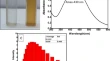
			<p>In order to quantify the disorder at the pentacene/PTCDA interface, we used distribution of <it>&#981;</it>, defined as the angle between the molecular and the interface plane (or rather their respective normals) as shown in Figure 
				<figr fid="F3">3</figr>. Owing to the fact that the molecules will start to relax, they will start to deviate from the bulk values. The more molecules have different <it>&#981;</it>, the more disordered is the structure.</p>
			<fig id="F3"><title><p>Figure 3</p></title><caption><p>Definition of the angle defining the molecular orientation along with a distribution at one interface</p></caption><text>
   <p><b>Definition of the angle defining the molecular orientation along with a distribution at one interface.</b> (<b>a</b>) <it>&#981;</it>is the angle between the normal of the molecule plane and the normal of the interface plane (z-axis), i. e. the angle between the molecule plane and the interface plane. (<b>b</b>) Distribution of the angle <it>&#981;</it>(blue area) for the relaxed pentacene molecules at the interface of (-221)//(100) (pictogram in the left upper corner). Contributing pentacene molecules have a PTCDA neighbor with maximal atom-atom distance of 0.4 nm. The red dashed lines at 145.5 degree and 157 degree mark the values for the ideal morphology.</p>
</text><graphic file="1556-276X-7-248-3"/></fig>
			<p>In the histograms of Figure 
				<figr fid="F4">4</figr>, the <it>y</it>-axis was defined as distance in &#197; from the (ideal) interface in <it>z</it>-direction, while the <it>x</it>-axis shows the angle distribution. Light blue regions mark the disordered regions. Two clear patterns can be observed: 1) size of the disordered region can vary from 2 to 16 &#197;, and 2) the disorder seems to spread asymmetrically from the ideal interface, clearly preferring pentacene-rich regions. The first pattern can be explained as having two competing effects at the interface, one being the optimization of the intermolecular distance/interaction and the other being the conservation of bulk properties. The second pattern can be understood in the light of much stronger <it>&#928;</it>&#8722;<it>&#928;</it> stacking of the PTCDA molecules, leading to a stronger intermolecular interactions, and greater energies are required to disrupt these molecules from their bulk positions when compared to pentacene bulk.</p>
			<fig id="F4"><title><p>Figure 4</p></title><caption><p>Angular distribution of angle <it>&#981;</it>as function of distance from the interface</p></caption><text>
   <p><b>Angular distribution of angle</b><it>&#981;</it><b>as function of distance from the interface.</b> The 2d-histograms (<b>a&#8211;i</b>) show the angle <it>&#981;</it>depending on the distance to the interface at <it>z</it>=0, where <it>&#981;</it>is the angle between the molecule plane and the interface plane (see Figure 
						<figr fid="F3">3</figr>a). The distance to the interface is given as the <it>z</it> coordinate of the molecule center in &#197;. Each histogram represents the results for one of the interface facets configurations given in Miller indices (001), (010), and (100) for pentacene (as marked on the right side of the histograms) and as (102), (212) and (-221) for PTCDA (as marked above the histograms). The box size is proportional to the number of occurrence. The interface location is emphasized by a dashed line with PTCDA located above and pentacene below it. The region of disorder is marked in light blue. Outside the light blue area the crystals are in their bulk phase. The corresponding relaxed crystal morphology is represented by the inset molecular structure.</p>
</text><graphic file="1556-276X-7-248-4"/></fig>
		</sec>
		<sec>
			<st>
				<p>Conclusions</p>
			</st>
			<p>Analysis of PTCDA/pentacene interfaces was performed with two emerging messages: there seems to be two competing effects, one coming from intermolecular interaction, which leads to disordered interfaces, while the other coming from the preservation of bulk properties results in large interfacial vacancies. Both of the effects would lead to dramatically diminished transport properties. Namely, increased disorder would cause greater energy disorder of the interfacial hopping sites, while interfacial vacancies would lead to diminished intermolecular overlaps, or hopping matrix elements. Whether which of the competing effects is influencing more the hopping transport properties is the focus of our ongoing research. Our second observation is that pentacene seems to be, in general, a more flexible material, which can be observed from the fact that the disordered regions are predominantly pentacene-rich.</p>
		</sec>
		<sec>
			<st>
				<p>Competing interests</p>
			</st>
			<p>The authors declare that they have no competing interests.</p>
		</sec>
		<sec>
			<st>
				<p>Author&#8217;s contributions</p>
			</st>
			<p>AP carried out the molecular dynamics calculations, the setup of the initial system and helped in drafting of the manuscript, and revisions. VM helped in analysis and interpretation of data, and drafted the manuscript and revisions. RM provided the calculation of the partial charges. WW participated in the design of the study, formulated the original scientific question and helped in analysis and interpretation of data. All authors read and approved the final manuscript.</p>
		</sec>
		<sec>
			<st>
				<p>Authors&#8217; information</p>
			</st>
			<p>AP is Ph.D. student, VM and RM have Ph.D. degree in physics, and WW is an associate professor at Karlsruhe Institute of Technology.</p>
		</sec>
	</bdy>
	<bm>
		<ack>
			<sec>
				<st>
					<p>Acknowledgements</p>
				</st>
				<p>This work was supported by bwGRiD resources and the FP7 project MINOTOR. bwGRiD is the central collection of computing power within the state of Baden-Wuerttemberg operated by eight universities, providing access for local researchers. Further thanks go to Ivan Kondov from SCC/KIT.</p>
			</sec>
		</ack>
		<refgrp><bibl id="B1"><title><p>Electron injection via pentacene thin films for efficient inverted organic light-emitting diodes</p></title><aug><au><snm>Yun</snm><fnm>C</fnm></au><au><snm>Cho</snm><fnm>H</fnm></au><au><snm>Kang</snm><fnm>H</fnm></au><au><snm>Lee</snm><fnm>Y</fnm></au></aug><source>Appl Phys Lett</source><pubdate>2009</pubdate><volume>95</volume><fpage>053301</fpage><xrefbib><pubid idtype="doi">10.1063/1.3192361</pubid></xrefbib></bibl><bibl id="B2"><title><p>Molecular bulk heterojunctions: an emerging approach to organic solar cells</p></title><aug><au><snm>Roncaliu</snm><fnm>J</fnm></au></aug><source>Acc Chem Res</source><pubdate>2009</pubdate><volume>42</volume><fpage>1719</fpage><lpage>1730</lpage><xrefbib><pubidlist><pubid idtype="doi">10.1021/ar900041b</pubid><pubid idtype="pmpid" link="fulltext">19580313</pubid></pubidlist></xrefbib></bibl><bibl id="B3"><title><p>Organic single-crystal field-effect transistors</p></title><aug><au><snm>Reese</snm><fnm>Bao</fnm></au></aug><source>Mat Today</source><pubdate>2007</pubdate><volume>10</volume><fpage>20</fpage><lpage>27</lpage></bibl><bibl id="B4"><title><p>Effect of molecular packing on the exciton diffusion length in organic solar cells</p></title><aug><au><snm>Rim</snm><fnm>S</fnm></au><au><snm>Fink</snm><fnm>R</fnm></au><au><snm>Sch&#246;neboom</snm><fnm>J</fnm></au><au><snm>Erk</snm><fnm>P</fnm></au><au><snm>Peumans</snm><fnm>P</fnm></au></aug><source>Appl Phys Lett</source><pubdate>2007</pubdate><volume>91</volume><fpage>173504</fpage><xrefbib><pubid idtype="doi">10.1063/1.2783202</pubid></xrefbib></bibl><bibl id="B5"><title><p>Orientation-dependent conductance study of pentacene nanocrystals by conductive atomic force microscopy</p></title><aug><au><snm>Hu</snm><fnm>W-S</fnm></au><au><snm>Tao</snm><fnm>Y-T</fnm></au><au><snm>Chen</snm><fnm>Y-F</fnm></au><au><snm>Chang</snm><fnm>C-S</fnm></au></aug><source>Appl Phys Lett</source><pubdate>2008</pubdate><volume>93</volume><fpage>053304</fpage><xrefbib><pubid idtype="doi">10.1063/1.2960343</pubid></xrefbib></bibl><bibl id="B6"><title><p>Simulating charge transport in tris (8-hydroxyquinoline) aluminium (Alq3)</p></title><aug><au><snm>Kwiatkowski</snm><fnm>J</fnm></au><au><snm>Nelson</snm><fnm>J</fnm></au><au><snm>Li</snm><fnm>J</fnm></au><au><snm>Br&#233;das</snm><fnm>J</fnm></au><au><snm>Wenzel</snm><fnm>W</fnm></au><au><snm>Lennartz</snm><fnm>C</fnm></au></aug><source>Phys Chem Chem Phys</source><pubdate>2008</pubdate><volume>10</volume><fpage>1852</fpage><lpage>1858</lpage><xrefbib><pubid idtype="pmpid" link="fulltext">18368176</pubid></xrefbib></bibl><bibl id="B7"><title><p>Energy level alignment and interfacial electronic structures at organic/metal and organic/organic Interfaces</p></title><aug><au><snm>Ishii</snm><fnm>H</fnm></au><au><snm>Sugiyama</snm><fnm>K</fnm></au><au><snm>Ito</snm><fnm>E</fnm></au><au><snm>Seki</snm><fnm>K</fnm></au></aug><source>Adv Mater</source><pubdate>1999</pubdate><volume>11</volume><fpage>8</fpage></bibl><bibl id="B8"><title><p>Molecular dynamics simulations of pentacene thin films: The effect of surface on polymorph selection</p></title><aug><au><snm>Yoneya</snm><fnm>M</fnm></au><au><snm>Kawasaki</snm><fnm>M</fnm></au><au><snm>Ando</snm><fnm>M</fnm></au></aug><source>J Mater Chem</source><pubdate>2010</pubdate><volume>20</volume><fpage>10397</fpage><lpage>10402</lpage><xrefbib><pubid idtype="doi">10.1039/c0jm01577f</pubid></xrefbib></bibl><bibl id="B9"><title><p>3,4:9,10-Perylenetetracarboxylic dianhydride (PTCDA) by electron crystallography</p></title><aug><au><snm>Ogawa</snm><fnm>T</fnm></au><au><snm>Kuwamoto</snm><fnm>K</fnm></au><au><snm>Isoda</snm><fnm>S</fnm></au><au><snm>Kobayashi</snm><fnm>T</fnm></au><au><snm>Karl</snm><fnm>N</fnm></au></aug><source>Acta Cryst B</source><pubdate>1999</pubdate><volume>55</volume><fpage>123</fpage><lpage>130</lpage><xrefbib><pubid idtype="doi">10.1107/S0108768198009872</pubid></xrefbib></bibl><bibl id="B10"><title><p>Observation of long-range exciton diffusion in highly ordered organic semiconductors</p></title><aug><au><snm>Najafov</snm><fnm>H</fnm></au><au><snm>Lee</snm><fnm>B</fnm></au><au><snm>Zhou</snm><fnm>Q</fnm></au><au><snm>Feldman</snm><fnm>L</fnm></au><au><snm>Podzorov</snm><fnm>V</fnm></au></aug><source>Nat Mater</source><pubdate>2010</pubdate><volume>9</volume><fpage>938</fpage><lpage>943</lpage><xrefbib><pubidlist><pubid idtype="doi">10.1038/nmat2872</pubid><pubid idtype="pmpid" link="fulltext">20935655</pubid></pubidlist></xrefbib></bibl><bibl id="B11"><title><p>Charge transport in organic crystals: role of disorder and topological connectivity</p></title><aug><au><snm>Vehoff</snm><fnm>T</fnm></au><au><snm>Baumeier</snm><fnm>B</fnm></au><au><snm>Troisi</snm><fnm>A</fnm></au><au><snm>Andrienko</snm><fnm>D</fnm></au></aug><source>J Am Chem Soc</source><pubdate>2010</pubdate><volume>13</volume><fpage>11702</fpage><lpage>11708</lpage></bibl><bibl id="B12"><title><p>Electronic structure and geminate pair energetics at organic&#8211;organic interfaces: the case of pentacene/C60 heterojunctions</p></title><aug><au><snm>Verlaak</snm><fnm>S</fnm></au><au><snm>Beljonne</snm><fnm>D</fnm></au><au><snm>Cheyns</snm><fnm>D</fnm></au><au><snm>Rolin</snm><fnm>C</fnm></au><au><snm>Linares</snm><fnm>M</fnm></au><au><snm>Castet</snm><fnm>F</fnm></au><au><snm>Cornil</snm><fnm>J</fnm></au><au><snm>Heremans</snm><fnm>P</fnm></au></aug><source>Adv Func Mat</source><pubdate>2009</pubdate><volume>19</volume><fpage>3809</fpage><lpage>3814</lpage><xrefbib><pubid idtype="doi">10.1002/adfm.200901233</pubid></xrefbib></bibl><bibl id="B13"><title><p>Electronic processes at organic-organic interfaces: insight from modeling and implications for opto-electronic devices</p></title><aug><au><snm>Beljonne</snm><fnm>D</fnm></au><au><snm>Cornil</snm><fnm>J</fnm></au><au><snm>Muccioli</snm><fnm>L</fnm></au><au><snm>Zannoni</snm><fnm>CJ</fnm></au><au><snm>Castet</snm><fnm>F</fnm></au></aug><source>Chem Mater</source><pubdate>2011</pubdate><volume>23</volume><fpage>591</fpage><lpage>609</lpage><xrefbib><pubid idtype="doi">10.1021/cm1023426</pubid></xrefbib></bibl><bibl id="B14"><title><p>Molecular understanding of organic solar cells: the challenges</p></title><aug><au><snm>Br&#233;das</snm><fnm>J</fnm></au><au><snm>Norton</snm><fnm>J</fnm></au><au><snm>Cornil</snm><fnm>J</fnm></au><au><snm>Coropceanu</snm><fnm>V</fnm></au></aug><source>Acc Chem Res</source><pubdate>2009</pubdate><volume>42</volume><fpage>1691</fpage><lpage>1699</lpage><xrefbib><pubidlist><pubid idtype="doi">10.1021/ar900099h</pubid><pubid idtype="pmpid" link="fulltext">19653630</pubid></pubidlist></xrefbib></bibl><bibl id="B15"><title><p>GROMACS 3.0: a package for molecular simulation and trajectory analysis</p></title><aug><au><snm>Lindahl</snm><fnm>E</fnm></au><au><snm>Hess</snm><fnm>B</fnm></au><au><snm>van der Spoel</snm><fnm>D</fnm></au></aug><source>J of Mol Model</source><pubdate>2001</pubdate><volume>7</volume><fpage>306</fpage><lpage>317</lpage></bibl><bibl id="B16"><title><p>Development and testing of a general amber force field</p></title><aug><au><snm>Wang</snm><fnm>J</fnm></au><au><snm>Wolf</snm><fnm>R</fnm></au><au><snm>Caldwell</snm><fnm>J</fnm></au><au><snm>Kollman</snm><fnm>P</fnm></au><au><snm>Case</snm><fnm>D</fnm></au></aug><source>J Comput Chem</source><pubdate>2004</pubdate><volume>25</volume><fpage>1157</fpage><xrefbib><pubidlist><pubid idtype="doi">10.1002/jcc.20035</pubid><pubid idtype="pmpid" link="fulltext">15116359</pubid></pubidlist></xrefbib></bibl><bibl id="B17"><title><p>An approach to computing electrostatic charges for molecules</p></title><aug><au><snm>Singh</snm><fnm>UC</fnm></au><au><snm>Kollman</snm><fnm>PA</fnm></au></aug><source>J Comp Chem</source><pubdate>1983</pubdate><volume>5</volume><fpage>129</fpage><lpage>145</lpage></bibl><bibl id="B18"><title><p>Optimization of parameters for semiempirical methods V: modification of NDDO approximations and application to 70 elements</p></title><aug><au><snm>Stewart</snm><fnm>JJP</fnm></au></aug><source>J Mol Modeling</source><pubdate>2007</pubdate><volume>13</volume><fpage>1173</fpage><lpage>1213</lpage><xrefbib><pubid idtype="doi">10.1007/s00894-007-0233-4</pubid></xrefbib></bibl><bibl id="B19"><title><p>ACPYPE - Antechamber python parser interface</p></title><aug><au><snm>Sousa da Silva</snm><fnm>A</fnm></au><au><snm>Vranken</snm><fnm>W</fnm></au><au><snm>Laue</snm><fnm>E</fnm></au></aug><note>[
					<url>http://code.google.com/p/acpype/</url>]</note></bibl><bibl id="B20"><title><p>Topology and dynamics of the interaction between 5-nitroimidazole radiosensitizers and duplex DNA studied by a combination of docking, molecular dynamic simulations and NMR spectroscopy</p></title><aug><au><snm>Ramalho</snm><fnm>TC</fnm></au><au><snm>Fran&#231;a</snm><fnm>TC</fnm></au><au><snm>Cortopassi</snm><fnm>WA</fnm></au><au><snm>Gon&#231;alves</snm><fnm>AS</fnm></au><au><snm>da Silva</snm><fnm>AW</fnm></au><au><snm>da Cunha</snm><fnm>EF</fnm></au></aug><source>J Mol Struc</source><pubdate>2011</pubdate><volume>992</volume><fpage>65</fpage><lpage>71</lpage><xrefbib><pubid idtype="doi">10.1016/j.molstruc.2011.02.042</pubid></xrefbib></bibl><bibl id="B21"><title><p>Investigating the structural basis of arylamides to improve potency against M. tuberculosis strain through molecular dynamics simulations</p></title><aug><au><snm>Punkvang</snm><fnm>A</fnm></au><au><snm>Saparpakorn</snm><fnm>P</fnm></au><au><snm>Hannongbuam</snm><fnm>S</fnm></au><au><snm>Wolschann</snm><fnm>P</fnm></au><au><snm>Beyer</snm><fnm>A</fnm></au><au><snm>Pungpo</snm><fnm>P</fnm></au></aug><source>Europ J Med Chem</source><pubdate>2010</pubdate><volume>45</volume><fpage>5585</fpage><lpage>5593</lpage><xrefbib><pubid idtype="doi">10.1016/j.ejmech.2010.09.008</pubid></xrefbib></bibl><bibl id="B22"><title><p>Molecular docking and simulation studies of farnesyl trasnferase with the potential inhibitor theflavin</p></title><aug><au><snm>Balajee</snm><fnm>R</fnm></au><au><snm>Rajan</snm><fnm>MSD</fnm></au></aug><source>J Appl Pharm Sci</source><pubdate>2011</pubdate><volume>8</volume><fpage>141</fpage><lpage>148</lpage></bibl><bibl id="B23"><title><p>ACPYPE Wiki: Testing ACPYPE amb2gmx function</p></title><note>[
					<url>http://code.google.com/p/acpype/wiki/TestingAcpypeAmb2gmx</url>]</note></bibl><bibl id="B24"><title><p>The crystal and molecular structure of pentacene</p></title><aug><au><snm>Campbell</snm><fnm>RB</fnm></au><au><snm>Robertson</snm><fnm>MJ</fnm></au><au><snm>Trotter</snm><fnm>J</fnm></au></aug><source>Acta Cryst</source><pubdate>1961</pubdate><volume>14</volume><fpage>705</fpage><xrefbib><pubid idtype="doi">10.1107/S0365110X61002163</pubid></xrefbib></bibl><bibl id="B25"><title><p>Structural and electronic properties of pentacene molecule and molecular pentacene solid</p></title><aug><au><snm>Endres</snm><fnm>RG</fnm></au><au><snm>Fong</snm><fnm>CY</fnm></au><au><snm>Yang</snm><fnm>LH</fnm></au><au><snm>Witte</snm><fnm>G</fnm></au><au><snm>W&#246;ll</snm><fnm>C</fnm></au></aug><source>Comp Mat Sci</source><pubdate>2004</pubdate><volume>29</volume><fpage>362</fpage><lpage>370</lpage><xrefbib><pubid idtype="doi">10.1016/j.commatsci.2003.09.006</pubid></xrefbib></bibl><bibl id="B26"><title><p>Molecular dynamics with coupling to an external bath</p></title><aug><au><snm>Berendsen</snm><fnm>HJC</fnm></au><au><snm>Postma</snm><fnm>JPM</fnm></au><au><snm>van</snm><fnm>Gunsteren</fnm><suf>W F</suf></au><au><snm>DiNola</snm><fnm>A</fnm></au><au><snm>Haak</snm><fnm>JR</fnm></au></aug><source>J Chem Phys</source><pubdate>1984</pubdate><volume>81</volume><fpage>3684</fpage><xrefbib><pubid idtype="doi">10.1063/1.448118</pubid></xrefbib></bibl><bibl id="B27"><title><p>Influence of measuring environment on the electrical characteristics of pentacene-based thin film transistors</p></title><aug><au><snm>Wang</snm><fnm>Y</fnm></au><au><snm>Chengb</snm><fnm>H</fnm></au><au><snm>Wanga</snm><fnm>Y</fnm></au><au><snm>Hub</snm><fnm>T</fnm></au><au><snm>Hob</snm><fnm>J</fnm></au><au><snm>Leeb</snm><fnm>C</fnm></au><au><snm>Leia</snm><fnm>T</fnm></au><au><snm>Yeha</snm><fnm>C</fnm></au></aug><source>Thin Solid Films</source><pubdate>2004</pubdate><volume>467</volume><fpage>215</fpage><lpage>219</lpage><xrefbib><pubid idtype="doi">10.1016/j.tsf.2004.04.001</pubid></xrefbib></bibl></refgrp>
	</bm>
</art>