<?xml version='1.0'?>
<!DOCTYPE art SYSTEM 'http://www.biomedcentral.com/xml/article.dtd'>
<art>
<ui>1556-276X-7-24</ui>
<ji>1556-276X</ji>
<fm>
<dochead>Nano Express</dochead>
<bibl>
<title><p>Investigation of a new lead-free Bi<sub>0.5</sub>(Na<sub>0.40</sub>K<sub>0.10</sub>)TiO<sub>3</sub>-(Ba<sub>0.7</sub>Sr<sub>0.3</sub>)TiO<sub>3 </sub>piezoelectric ceramic</p></title>
<aug>
<au id="A1"><snm>Jaita</snm><fnm>Pharatree</fnm><insr iid="I1"/><email>pharatree@gmail.com</email></au>
<au id="A2"><snm>Watcharapasorn</snm><fnm>Anucha</fnm><insr iid="I1"/><insr iid="I2"/><email>anucha@stanfordalumni.org</email></au>
<au id="A3" ca="yes"><snm>Jiansirisomboon</snm><fnm>Sukanda</fnm><insr iid="I1"/><insr iid="I2"/><email>sukanda@chiangmai.ac.th</email></au>
</aug>
<insg>
<ins id="I1"><p>Department of Physics and Materials Science, Faculty of Science, Chiang Mai University, Chiang Mai, 50200, Thailand</p></ins>
<ins id="I2"><p>Materials Science Research Center, Faculty of Science, Chiang Mai University, Chiang Mai, 50200, Thailand</p></ins>
</insg>
<source>Nanoscale Research Letters</source>
<issn>1556-276X</issn>
<pubdate>2012</pubdate>
<volume>7</volume>
<issue>1</issue>
<fpage>24</fpage>
<url>http://www.nanoscalereslett.com/content/7/1/24</url>
<xrefbib><pubidlist><pubid idtype="doi">10.1186/1556-276X-7-24</pubid><pubid idtype="pmpid">22221833</pubid></pubidlist></xrefbib></bibl>
<history><rec><date><day>6</day><month>9</month><year>2011</year></date></rec><acc><date><day>5</day><month>1</month><year>2012</year></date></acc><pub><date><day>5</day><month>1</month><year>2012</year></date></pub></history><cpyrt><year>2012</year><collab>Jaita et al; licensee Springer.</collab><note>This is an Open Access article distributed under the terms of the Creative Commons Attribution License (<url>http://creativecommons.org/licenses/by/2.0</url>), which permits unrestricted use, distribution, and reproduction in any medium, provided the original work is properly cited.</note></cpyrt>
<kwdg><kwd>ceramics</kwd><kwd>X-ray diffraction</kwd><kwd>dielectric properties</kwd><kwd>microstructure</kwd><kwd>piezoelectricity</kwd></kwdg>
<abs>
<sec><st><p>Abstract</p></st>
<p>Lead-free piezoelectric compositions of the (1-<it>x</it>)Bi<sub>0.5</sub>(Na<sub>0.40</sub>K<sub>0.10</sub>)TiO<sub>3</sub>-<it>x</it>(Ba<sub>0.7</sub>Sr<sub>0.3</sub>)TiO<sub>3 </sub>system (when <it>x </it>= 0, 0.05, 0.10, 0.15, and 0.20) were fabricated using a solid-state mixed oxide method and sintered between 1,050&#176;C and 1,175&#176;C for 2 h. The effect of (Ba<sub>0.7</sub>Sr<sub>0.3</sub>)TiO<sub>3 </sub>[BST] content on phase, microstructure, and electrical properties was investigated. The optimum sintering temperature was 1,125&#176;C at which all compositions had densities of at least 98% of their theoretical values. X-ray diffraction patterns that showed tetragonality were increased with the increasing BST. Scanning electron micrographs showed a slight reduction of grain size when BST was added. The addition of BST was also found to improve the dielectric and piezoelectric properties of the BNKT ceramic. A large room-temperature dielectric constant, <it>&#949;</it><sub><it>r </it></sub>(1,609), and piezoelectric coefficient, <it>d</it><sub>33 </sub>(214 pC/N), were obtained at an optimal composition of <it>x </it>= 0.10.</p>
</sec>
</abs>
</fm>
<meta><classifications><classification id="IFFMandAFM2011" subtype="theme_series_title" type="BMC">IFFM&amp;AFM2011 </classification><classification id="IFFMandAFM2011" subtype="theme_series_editor" type="BMC">Jin-Hyo Boo</classification></classifications></meta><bdy>
<sec><st><p>Background</p></st>
<p>Although Pb(Zr, Ti)O<sub>3 </sub>has played a dominant role in piezoelectric materials, waste of products containing Pb causes a crucial environmental problem. Thus, it is urgent to search for lead-free piezoelectric ceramics with excellent properties comparable to those found in lead-based ceramics.</p>
<p>Because it has a large remanent polarization [<it>P</it><sub><it>r</it></sub>] of approximately 38 &#956;C/cm<sup>2 </sup>and a high Curie temperature [<it>T</it><sub><it>c</it></sub>] of approximately 320&#176;C, (Bi<sub>0.5</sub>Na<sub>0.5</sub>)TiO<sub>3 </sub>[BNT] is a candidate material for a lead-free piezoelectric ceramic. However, poling difficulties due to its high coercive field [<it>E</it><sub><it>c</it></sub>] of approximately 73 kV/cm and high conductivity often require some modifications. It has been reported that BNT-based compositions modified with BaTiO<sub>3 </sub><abbrgrp><abbr bid="B1">1</abbr></abbrgrp>, (Ba, Sr)TiO<sub>3 </sub><abbrgrp><abbr bid="B2">2</abbr></abbrgrp>, and Ba(Zr, Ti)O<sub>3 </sub><abbrgrp><abbr bid="B3">3</abbr></abbrgrp> showed improved piezoelectric properties. Another modification based on the work of Sasaki et al. <abbrgrp><abbr bid="B4">4</abbr></abbrgrp> showed that Bi<sub>0.5</sub>(Na<sub>1-<it>x</it></sub>K<sub><it>x</it></sub>)<sub>0.5</sub>TiO<sub>3 </sub>ceramic had a morphotropic phase boundary [MPB] between rhombohedral and tetragonal phases near <it>x </it>= 0.16 to 0.20, at which a relatively high <it>d</it><sub>33 </sub>of 151 pC/N was obtained.</p>
<p>Aside from BNT, lead-free barium strontium titanate, (Ba<sub>1-<it>x</it></sub>Sr<sub><it>x</it></sub>)TiO<sub>3</sub>, as well as doped BaTiO<sub>3 </sub>are currently important dielectric materials for capacitor applications <abbrgrp><abbr bid="B5">5</abbr></abbrgrp>. The main purpose of adding Sr<sup>2+ </sup>into BaTiO<sub>3 </sub>is to shift the <it>T</it><sub><it>c </it></sub>(approximately 130&#176;C) towards room temperature, offering a high dielectric constant and a low dielectric loss, tan<it>&#948; </it><abbrgrp><abbr bid="B6">6</abbr></abbrgrp>. At <it>x </it>= 0.3 composition, a relatively high permittivity was achieved. Recently, Lee et al. <abbrgrp><abbr bid="B2">2</abbr></abbrgrp> have studied the (1-<it>x</it>)(Bi<sub>0.5</sub>Na<sub>0.5</sub>)TiO<sub>3</sub>-<it>x</it>(Ba<sub>0.7</sub>Sr<sub>0.3</sub>)TiO<sub>3 </sub>system. The addition of (Ba<sub>0.7</sub>Sr<sub>0.3</sub>)TiO<sub>3 </sub>into (Bi<sub>0.5</sub>Na<sub>0.5</sub>)TiO<sub>3 </sub>generated a phase transition from rhombohedral to tetragonal. The improvement of both dielectric and piezoelectric performances was found at an MPB of <it>x </it>= 0.08.</p>
<p>In order to develop a new material system with both high piezoelectric and dielectric performances, (1-<it>x</it>)Bi<sub>0.5</sub>(Na<sub>0.40</sub>K<sub>0.10</sub>)TiO<sub>3</sub>-<it>x</it>(Ba<sub>0.7</sub>Sr<sub>0.3</sub>)TiO<sub>3 </sub>[(1-<it>x</it>)BNKT-<it>x</it>BST] (<it>x </it>= 0 to 0.20) ceramics were prepared. The effect of the BST concentration on phase, microstructure, and electrical properties of the ceramics was investigated and discussed.</p>
</sec>
<sec><st><p>Methods</p></st>
<p>Conventional mixed-oxide technique was used to prepare Bi<sub>0.5</sub>(Na<sub>0.40</sub>K<sub>0.10</sub>)TiO<sub>3 </sub>and (Ba<sub>0.7</sub>Sr<sub>0.3</sub>)TiO<sub>3 </sub>powders. The starting materials were Bi<sub>2</sub>O<sub>3</sub>, Na<sub>2</sub>CO<sub>3</sub>, TiO<sub>2</sub>, K<sub>2</sub>CO<sub>3</sub>, BaCO<sub>3</sub>, and SrCO<sub>3</sub>. A stoichiometric amount of BNKT and BST powders was weighed, ball-milled for 24 h, and dried using the oven-drying method. BNKT and BST powders were separately calcined for 2 h at 900&#176;C for BNKT and 1,100&#176;C for BST. The calcined powders were then weighed, mixed, and oven-dried to produce the mixed powders of (1-<it>x</it>)BNKT-<it>x</it>BST (when <it>x </it>= 0, 0.05, 0.10, 0.15, and 0.20). After drying and sieving, a few drops of 3 wt.% PVA binders were added before being uniaxially pressed into pellets of 10 mm in diameter. These pellets were covered with their own powders and subsequently sintered at 1,050&#176;C to 1,175&#176;C for 2 h with a heating/cooling rate of 5&#176;C/min.</p>
<p>Phase evolution was examined using an X-ray diffraction [XRD] diffractometer (X'Pert, PANalytical B.V., Almelo, The Netherlands). Bulk densities were determined using Archimedes' method. The theoretical densities of all samples were calculated based on the theoretical densities of BNKT (5.84 g/cm<sup>3</sup>) <abbrgrp><abbr bid="B7">7</abbr></abbrgrp> and BST (5.75 g/cm<sup>3</sup>) <abbrgrp><abbr bid="B8">8</abbr></abbrgrp>. Surfaces of the ceramics were observed using a scanning electron microscope [SEM] (JSM-6335F, JEOL Ltd., Akishima, Tokyo, Japan). Grain size was determined by mean linear intercept method.</p>
<p>For electrical measurements, two parallel surfaces were polished and painted with silver paste for electrical contacts. Dielectric properties were determined at 25&#176;C to 500&#176;C with a frequency of 10 kHz using a 4284A-LCR meter (Agilent Technologies, Santa Clara, CA, USA) connected to a high-temperature furnace. A standard Sawyer-Tower circuit was used to measure the hysteresis loop. The samples were poled at 60&#176;C in a stirred silicone oil bath by applying a DC electric field of 5 kV/mm for 15 min, and piezoelectric measurements were then carried out using a <it>d</it><sub>33</sub>-meter (S5865, KCF Technologies, Inc., State College, PA, USA).</p>
</sec>
<sec><st><p>Results and discussion</p></st>
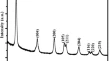
<p>XRD patterns of BNKT-BST mixed powders are shown in Figure <figr fid="F1">1a</figr>. There were no detectable impurities for all compositions. A separation of (110) main peak (2<it>&#952; </it>at approximately 32&#176;) was not observed for pure BNKT powder. When 5 mol% BST was added, the (110) main peak was slightly asymmetrical and featured a slight splitting of the BST peak. With increasing BST, peaks that belonged to BST were dominantly shown and led to more splitting.</p>
<fig id="F1"><title><p>Figure 1</p></title><caption><p>XRD patterns and plots</p></caption><text>
   <p><b>XRD patterns and plots</b>. (<b>a</b>) XRD patterns of BNKT-BST powders. (<b>b</b>) Plots of relative density and sintering temperature.</p>
</text><graphic file="1556-276X-7-24-1" hint_layout="double"/></fig>
<p>Plots of relative density as a function of sintering temperature with different BST contents are shown in Figure <figr fid="F1">1b</figr>. The optimum sintering temperature of BNKT-BST ceramics was 1,125&#176;C at which all samples had densities ranging from 5.72 to 5.81 g/cm<sup>3</sup>, corresponding to at least 98% of their theoretical values (see Table <tblr tid="T1">1</tblr>). Thus, the samples sintered at this temperature were selected for further characterizations.</p>
<tbl id="T1"><title><p>Table 1</p></title><caption><p>Physical and electrical properties of (1-<it>x</it>)BNKT-<it>x</it>BST ceramics sintered at 1,125&#176;C</p></caption><tblbdy cols="11">
      <r>
         <c ca="center">
            <p>
               <b>
                  <it>x</it>
               </b>
            </p>
         </c>
         <c ca="center">
            <p>
               <b>Density (g/cm<sup>3</sup>)</b>
            </p>
         </c>
         <c ca="center">
            <p>
               <b>
                  <it>c/a</it>
               </b>
            </p>
         </c>
         <c ca="center">
            <p>
               <b>Grain size (&#956;m)</b>
            </p>
         </c>
         <c ca="center">
            <p>
               <b><it>T</it><sub><it>c </it></sub>(&#176;C)</b>
            </p>
         </c>
         <c ca="center">
            <p>
               <b>
                  <it>&#949;</it>
                  <sub>
                     <it>r</it>
                  </sub>
                  <sup>a</sup>
               </b>
            </p>
         </c>
         <c ca="center">
            <p>
               <b>tan<it>&#948;</it><sup>a</sup></b>
            </p>
         </c>
         <c ca="center">
            <p>
               <b><it>P</it><sub><it>r </it></sub>(&#956;C/cm<sup>2</sup>)</b>
            </p>
         </c>
         <c ca="center">
            <p>
               <b><it>E</it><sub><it>c </it></sub>(kV/cm)</b>
            </p>
         </c>
         <c ca="center">
            <p>
               <b>
                  <it>R</it>
                  <sub>
                     <it>sq</it>
                  </sub>
               </b>
            </p>
         </c>
         <c ca="center">
            <p>
               <b>
                  <it>d</it>
                  <sub>33</sub>
               </b>
            </p>
            <p>
               <b>(pC/N)</b>
            </p>
         </c>
      </r>
      <r>
         <c cspan="11">
            <hr/>
         </c>
      </r>
      <r>
         <c ca="center">
            <p>0</p>
         </c>
         <c ca="center">
            <p>5.81 &#177; 0.01</p>
         </c>
         <c ca="center">
            <p>1.0083</p>
         </c>
         <c ca="center">
            <p>0.60 &#177; 0.09</p>
         </c>
         <c ca="center">
            <p>320</p>
         </c>
         <c ca="center">
            <p>1,419</p>
         </c>
         <c ca="center">
            <p>0.0479</p>
         </c>
         <c ca="center">
            <p>31.62</p>
         </c>
         <c ca="center">
            <p>32.01</p>
         </c>
         <c ca="center">
            <p>1.12</p>
         </c>
         <c ca="center">
            <p>178</p>
         </c>
      </r>
      <r>
         <c ca="center">
            <p>0.05</p>
         </c>
         <c ca="center">
            <p>5.80 &#177; 0.02</p>
         </c>
         <c ca="center">
            <p>1.0118</p>
         </c>
         <c ca="center">
            <p>0.40 &#177; 0.04</p>
         </c>
         <c ca="center">
            <p>310</p>
         </c>
         <c ca="center">
            <p>1,581</p>
         </c>
         <c ca="center">
            <p>0.0559</p>
         </c>
         <c ca="center">
            <p>14.03</p>
         </c>
         <c ca="center">
            <p>10.28</p>
         </c>
         <c ca="center">
            <p>0.48</p>
         </c>
         <c ca="center">
            <p>98</p>
         </c>
      </r>
      <r>
         <c ca="center">
            <p>0.10</p>
         </c>
         <c ca="center">
            <p>5.77 &#177; 0.01</p>
         </c>
         <c ca="center">
            <p>1.0120</p>
         </c>
         <c ca="center">
            <p>0.39 &#177; 0.04</p>
         </c>
         <c ca="center">
            <p>308</p>
         </c>
         <c ca="center">
            <p>1,609</p>
         </c>
         <c ca="center">
            <p>0.0618</p>
         </c>
         <c ca="center">
            <p>28.14</p>
         </c>
         <c ca="center">
            <p>22.96</p>
         </c>
         <c ca="center">
            <p>1.04</p>
         </c>
         <c ca="center">
            <p>214</p>
         </c>
      </r>
      <r>
         <c ca="center">
            <p>0.15</p>
         </c>
         <c ca="center">
            <p>5.76 &#177; 0.01</p>
         </c>
         <c ca="center">
            <p>1.0156</p>
         </c>
         <c ca="center">
            <p>0.46 &#177; 0.07</p>
         </c>
         <c ca="center">
            <p>305</p>
         </c>
         <c ca="center">
            <p>1,430</p>
         </c>
         <c ca="center">
            <p>0.0576</p>
         </c>
         <c ca="center">
            <p>25.11</p>
         </c>
         <c ca="center">
            <p>25.67</p>
         </c>
         <c ca="center">
            <p>0.98</p>
         </c>
         <c ca="center">
            <p>205</p>
         </c>
      </r>
      <r>
         <c ca="center">
            <p>0.20</p>
         </c>
         <c ca="center">
            <p>5.72 &#177; 0.01</p>
         </c>
         <c ca="center">
            <p>1.0163</p>
         </c>
         <c ca="center">
            <p>0.47 &#177; 0.06</p>
         </c>
         <c ca="center">
            <p>289</p>
         </c>
         <c ca="center">
            <p>1,082</p>
         </c>
         <c ca="center">
            <p>0.0477</p>
         </c>
         <c ca="center">
            <p>21.96</p>
         </c>
         <c ca="center">
            <p>29.08</p>
         </c>
         <c ca="center">
            <p>0.98</p>
         </c>
         <c ca="center">
            <p>191</p>
         </c>
      </r>
   </tblbdy><tblfn>
      <p><sup>a</sup>Dielectric data obtained at room temperature (1 kHz).</p>
   </tblfn></tbl>
<p>Figure <figr fid="F2">2a</figr> showed XRD patterns of BNKT-BST ceramics. All compositions showed a pure perovskite phase. BST had diffused into the BNKT lattice and formed solid solutions. All peaks were found to shift slightly to a lower angle. The shift scale was increased with the increasing of BST to a maximum value at <it>x </it>= 0.20. The slight distortion of the XRD patterns was attributed to larger sized Ba<sup>2+ </sup>(1.42 &#197;) and Sr<sup>2+ </sup>(1.26 &#197;) ions diffused into the BNKT lattice to replace Bi<sup>3+ </sup>(1.17 &#197;), Na<sup>+ </sup>(1.18 &#197;), and K<sup>+ </sup>(1.33 &#197;) <abbrgrp><abbr bid="B9">9</abbr></abbrgrp>, resulting in the enlargement of lattice constant and lattice energy which induced a phase transformation in order to stabilize the structure <abbrgrp><abbr bid="B10">10</abbr></abbrgrp>. In Figure <figr fid="F2">2b</figr>, Bi<sub>0.5</sub>(Na<sub>0.40</sub>K<sub>0.10</sub>)TiO<sub>3 </sub>was a mixed phase between BNT rhombohedral and BKT tetragonal, whereas (Ba<sub>0.7</sub>Sr<sub>0.3</sub>)TiO<sub>3 </sub>was mainly tetragonal in phase. At <it>x </it>= 0.05, the peak around 46.5&#176; was slightly asymmetrical, and (202) peak started to split into two peaks of (002) and (200). At <it>x </it>= 0.10, the intensity of (200) peak was found to decrease, while it was gradually increased for (002) peak. Moreover, (200) peak underwent an asymmetric broadening, and (002) peak obviously split into two peaks. This indicated that the addition of a higher tetragonal BST into BNKT at <it>x </it>= 0.10 became close to the optimum of rhombohedral and tetragonal phases of the BNKT-BST system. As its crystal structure was considered to contain nearly the same amount of coexisting rhombohedral and tetragonal structures in BNKT-0.10BST ceramic, the optimal dielectric and piezoelectric properties should be obtained in this composition. The addition of a BST content greater than 10 mol% led to a wider separation of the (002) and (200) peaks and showed mainly a tetragonal structure, corresponding to an increase in tetragonality as shown in Table <tblr tid="T1">1</tblr>.</p>
<fig id="F2"><title><p>Figure 2</p></title><caption><p>XRD patterns of BNKT-BST ceramics</p></caption><text>
   <p><b>XRD patterns of BNKT-BST ceramics</b>. The samples were sintered at 1,125&#176;C. (<b>a</b>) 2<it>&#952; </it>= 10&#176; to 80&#176; and (<b>b</b>) 2<it>&#952; </it>= 44&#176; to 48&#176;.</p>
</text><graphic file="1556-276X-7-24-2" hint_layout="double"/></fig>
<p>SEM images in Figure <figr fid="F3">3</figr> confirmed that all ceramics were of high quality and densely sintered at 1,125&#176;C. An addition of BST allowed shortening of the sintering duration to attain a dense sintered bulk with similar grain size. The microstructure of a pure BNKT ceramic revealed a larger grain size (0.60 &#956;m) with a relatively wide grain size distribution compared to BST-added samples. The addition of BST, however, slightly inhibited grain growth, as can be seen from a slight drop of grain size from 0.60 &#956;m for pure BNKT to around 0.39 to 0.47 &#956;m for BST-added samples (see Table <tblr tid="T1">1</tblr>).</p>
<fig id="F3"><title><p>Figure 3</p></title><caption><p>SEM micrographs of (1-<it>x</it>)BNKT-<it>x</it>BST ceramics</p></caption><text>
   <p><b>SEM micrographs of (1-<it>x</it>)BNKT-<it>x</it>BST ceramics</b>. The samples were sintered at 1125&#176;C. (<b>a</b>) <it>x </it>= 0, (<b>b</b>) <it>x </it>= 0.05, (<b>c</b>) <it>x </it>= 0.10, (<b>d</b>) <it>x </it>= 0.15, and (<b>e</b>) <it>x </it>= 0.20.</p>
</text><graphic file="1556-276X-7-24-3" hint_layout="double"/></fig>
<p>Dielectric constant and dielectric loss of (1-<it>x</it>)BNKT-<it>x</it>BST ceramics were plotted as a function of temperature shown in Figure <figr fid="F4">4</figr>. At <it>T</it><sub><it>c</it></sub>, the highest <it>&#949;</it><sub><it>r </it></sub>of 5,006 was observed in pure BNKT. For BST-added samples, the maximum <it>&#949;</it><sub><it>r </it></sub>of 4,921 was observed in BNKT-0.10BST ceramic. Since the crystalline structure of BNKT-0.10BST was considered to be near optimum composition having a comparable coexistence of rhombohedral and tetragonal phases, the increase in <it>&#949;</it><sub><it>r </it></sub>would be expected. The <it>T</it><sub><it>c </it></sub>of pure BNKT was found to be 320&#176;C. It has been shown that an A-site isovalent additive had the effect of lowering the <it>T</it><sub><it>c </it></sub><abbrgrp><abbr bid="B11">11</abbr></abbrgrp>. BST is virtually an A-site isovalent additive in which Ba<sub>0.7</sub>Sr<sub>0.3 </sub>has an effective charge of +2, which is the same as +2 of Bi<sub>0.5</sub>(Na<sub>0.40</sub>K<sub>0.10</sub>). Moreover, BST has a much lower <it>T</it><sub><it>c </it></sub>(approximately 42&#176;C) <abbrgrp><abbr bid="B12">12</abbr></abbrgrp> compared with BNKT; a reduction of <it>T</it><sub><it>c </it></sub>was observed in our system. At room temperature, <it>&#949;</it><sub><it>r </it></sub>of pure BNKT was found to be 1,419. The addition of 10 mol% BST showed an optimum <it>&#949;</it><sub><it>r </it></sub>of 1,609. As free energy of the rhombohedral phase was close to that of the tetragonal phase, these two phases existing at the BNKT-0.10BST composition easily changed to each other when an electric field was applied. This helped promote the movement and polarization of ferroelectric active ions, leading to the increase of <it>&#949;</it><sub><it>r </it></sub><abbrgrp><abbr bid="B13">13</abbr></abbrgrp>. With a further increasing BST, a slight decrease in <it>&#949;</it><sub><it>r </it></sub>was observed. Phase analysis using XRD patterns indicated that the compositions slightly deviated from the optimal composition, and hence, the lowering of <it>&#949;</it><sub><it>r </it></sub>values in our samples seemed reasonable.</p>
<fig id="F4"><title><p>Figure 4</p></title><caption><p>Plots of temperature dependence on dielectric constant and dielectric loss</p></caption><text>
   <p><b>Plots of temperature dependence on dielectric constant and dielectric loss</b>. The measurement was done at a frequency of 10 kHz for BNKT-BST ceramics and sintered at 1,125&#176;C.</p>
</text><graphic file="1556-276X-7-24-4" hint_layout="single"/></fig>
<p>From Figure <figr fid="F5">5</figr>, the hysteresis loop of pure BNKT showed the maximum <it>E</it><sub><it>c </it></sub>at approximately 31.49 kV/cm, <it>P</it><sub><it>r </it></sub>at approximately 30.48 &#956;C/cm<sup>2</sup>, and <it>R</it><sub><it>sq </it></sub>at approximately 1.10. Ferroelectric property was slightly degraded when BST was added, as can be seen from a decreasing trend in <it>R</it><sub><it>sq</it></sub>, <it>E</it><sub><it>c</it></sub>, and <it>P</it><sub><it>r</it></sub>. Since BST by itself was known to have a low <it>E</it><sub><it>c </it></sub>(approximately 2 kV/cm) and <it>P</it><sub><it>r </it></sub>(approximately 5 &#956;C/cm<sup>2</sup>) <abbrgrp><abbr bid="B12">12</abbr></abbrgrp> compared with pure BNKT, this seemed to be the reason for a reduction of both <it>P</it><sub><it>r </it></sub>and <it>E</it><sub><it>c </it></sub>observed in BST-added samples. Among BST-added samples, the highest <it>P</it><sub><it>r </it></sub>of 28.14 &#956;C/cm<sup>2 </sup>was observed for BNKT-0.10BST. Besides, an increase of spontaneous polarization directions due to the coexistence of rhombohedral and tetragonal phases (eight directions for rhombohedral phase and six directions for tetragonal phase) was also a reason that gave a high <it>P</it><sub><it>r </it></sub>in BNKT-0.10BST. Moreover, a decrease of <it>E</it><sub><it>c </it></sub>(approximately 22.96 kV/cm) in BNKT-0.10BST in comparison with that in pure BNKT was also observed at this composition. This decrease in <it>E</it><sub><it>c </it></sub>indicated easier ionic motion, and therefore, the improvement of piezoelectricity would be expected for this composition <abbrgrp><abbr bid="B14">14</abbr></abbrgrp>. The addition of BST content over 10 mol% caused the material to completely transform to a tetragonal phase, resulting in a slight decrease of <it>P</it><sub><it>r</it></sub>. The reduction of <it>P</it><sub><it>r </it></sub>when the crystal structure changed to be more tetragonal in structure was similar to the previous work on BNT-BST system <abbrgrp><abbr bid="B2">2</abbr></abbrgrp>.</p>
<fig id="F5"><title><p>Figure 5</p></title><caption><p>Plots of polarization as an electric field function of (1-<it>x</it>)BNKT-<it>x</it>BST ceramics</p></caption><text>
   <p><b>Plots of polarization as an electric field function of (1-<it>x</it>)BNKT-<it>x</it>BST ceramics</b>. The samples were sintered at 1,125&#176;C. (<b>a</b>) <it>x </it>= 0, (<b>b</b>) <it>x </it>= 0.05, (<b>c</b>) <it>x </it>= 0.10, (<b>d</b>) <it>x </it>= 0.15, and (<b>e</b>) <it>x </it>= 0.20.</p>
</text><graphic file="1556-276X-7-24-5" hint_layout="double"/></fig>
<p>Piezoelectric coefficients of (1-<it>x</it>)BNKT-<it>x</it>BST ceramics are listed in Table <tblr tid="T1">1</tblr>. The <it>d</it><sub>33 </sub>of pure BNKT ceramic was 178 pC/N, which was close to the value of 165 pC/N observed earlier by Hiruma et al. <abbrgrp><abbr bid="B15">15</abbr></abbrgrp>. The highest <it>d</it><sub>33 </sub>of 214 pC/N was observed for the BNKT-0.10BST ceramic. As the crystal structure of BNKT-0.10BST was nearly a coexistence of rhombohedral and tetragonal phases, a flexibility increase in the domain wall could effectively occur. Moreover, <it>E</it><sub><it>c </it></sub>of this composition was lower than that of pure BNKT, whereas <it>P</it><sub><it>r </it></sub>was maintained. Thus, it is obvious that the optimal piezoelectric properties would occur in this composition. The <it>d</it><sub>33 </sub>decreased with the further increasing BST content of over 10 mol%. This was supported by phase analysis using XRD which indicated a deviation of the composition from the mixed rhombohedral and tetragonal phases of BNKT-BST system to mainly the tetragonal BST phase. In addition, the change in crystal structure to being more tetragonal may also contribute to the reduction in the piezoelectric performance of BNKT-BST ceramics similar to the reduction in <it>d</it><sub>33 </sub>observed in the previous work on BNKT-BZT system <abbrgrp><abbr bid="B13">13</abbr></abbrgrp>.</p>
</sec>
<sec><st><p>Conclusions</p></st>
<p>New (1-<it>x</it>)BNKT-<it>x</it>BST ceramics were successfully fabricated. The optimum sintering temperature of all ceramics was 1,125&#176;C. XRD indicated that the addition of BST into BNKT caused a change in crystal structure and increase in lattice parameters. The addition of BST also inhibited grain growth. The incorporation of 10 mol% BST was found to be an optimum condition that could enhance <it>&#949;</it><sub><it>r </it></sub>and <it>d</it><sub>33 </sub>to the maximum values of 1,609 and 214 pC/N, respectively. In addition, it also possessed a relatively low <it>E</it><sub><it>c</it></sub>, while <it>T</it><sub><it>c </it></sub>and <it>P</it><sub><it>r </it></sub>were quite comparable to that of pure BNKT. Therefore, BNKT-0.10BST ceramic is a promising candidate as a new lead-free piezoelectric ceramic which can be further used in actuator applications.</p>
</sec>
<sec><st><p>Competing interests</p></st>
<p>The authors declare that they have no competing interests.</p>
</sec>
<sec><st><p>Authors' contributions</p></st>
<p>PJ carried out experiments and wrote the manuscript. AW and SJ participated in the conception of the study and revised the manuscript for important intellectual contents. All authors read and approved the final version of the manuscript.</p>
</sec>
</bdy>
<bm>
<ack>
<sec><st><p>Acknowledgements</p></st>
<p>This work is financially supported by the Thailand Research Fund (TRF) and the National Research University Project under Thailand's Office of the Higher Education Commission (OHEC). The Faculty of Science and the Graduate School, Chiang Mai University is also acknowledged. PJ would like to acknowledge financial support from the TRF through the Royal Golden Jubilee Ph.D. Program.</p>
</sec>
</ack>
<refgrp><bibl id="B1"><title><p>(Bi<sub>1/2</sub>Na<sub>1/2</sub>)TiO<sub>3</sub>-BaTiO<sub>3 </sub>system for lead-free piezoelectric ceramic</p></title><aug><au><snm>Takenaka</snm><fnm>T</fnm></au><au><snm>Maruyama</snm><fnm>K</fnm></au><au><snm>Sakata</snm><fnm>K</fnm></au></aug><source>Jpn J Appl Phys</source><pubdate>1991</pubdate><volume>30</volume><fpage>2236</fpage><lpage>2246</lpage><xrefbib><pubid idtype="doi">10.1143/JJAP.30.2236</pubid></xrefbib></bibl><bibl id="B2"><title><p>Crystal structure, dielectric and ferroelectric properties of (Bi<sub>0.5</sub>Na<sub>0.5</sub>)TiO<sub>3</sub>-(Ba, Sr)TiO<sub>3 </sub>lead-free piezoelectric ceramics</p></title><aug><au><snm>Lee</snm><fnm>WC</fnm></au><au><snm>Huang</snm><fnm>CY</fnm></au><au><snm>Tsao</snm><fnm>LK</fnm></au><au><snm>Wu</snm><fnm>YC</fnm></au></aug><source>J Alloy Compd</source><pubdate>2010</pubdate><volume>492</volume><fpage>307</fpage><lpage>312</lpage><xrefbib><pubid idtype="doi">10.1016/j.jallcom.2009.11.083</pubid></xrefbib></bibl><bibl id="B3"><title><p>Preparation and properties of (Bi<sub>1/2</sub>Na<sub>1/2</sub>)TiO<sub>3</sub>-Ba(Ti, Zr)O<sub>3 </sub>lead-free piezoelectric ceramics</p></title><aug><au><snm>Peng</snm><fnm>C</fnm></au><au><snm>Li</snm><fnm>JF</fnm></au><au><snm>Gong</snm><fnm>W</fnm></au></aug><source>Mater Lett</source><pubdate>2005</pubdate><volume>59</volume><fpage>1576</fpage><lpage>1580</lpage><xrefbib><pubid idtype="doi">10.1016/j.matlet.2005.01.026</pubid></xrefbib></bibl><bibl id="B4"><title><p>Dielectric and pizoelectric properties of (Bi<sub>0.5</sub>Na<sub>0.5</sub>)TiO<sub>3</sub>-(Bi<sub>0.5</sub>K<sub>0.5</sub>)TiO<sub>3 </sub>systems</p></title><aug><au><snm>Sasaki</snm><fnm>A</fnm></au><au><snm>Chiba</snm><fnm>T</fnm></au><au><snm>Mamiya</snm><fnm>Y</fnm></au><au><snm>Otsuki</snm><fnm>E</fnm></au></aug><source>Jpn J Appl Phys</source><pubdate>1999</pubdate><volume>38</volume><fpage>5564</fpage><lpage>5567</lpage><xrefbib><pubid idtype="doi">10.1143/JJAP.38.5564</pubid></xrefbib></bibl><bibl id="B5"><title><p>Phase equilibria in the system BaO-TiO<sub>2</sub></p></title><aug><au><snm>Rase</snm><fnm>DE</fnm></au><au><snm>Roy</snm><fnm>R</fnm></au></aug><source>J Am Ceram Soc</source><pubdate>1955</pubdate><volume>38</volume><fpage>102</fpage><lpage>113</lpage></bibl><bibl id="B6"><title><p>Dielectric properties of Y-doped Ba<sub>1-x</sub>Sr<sub>x</sub>TiO<sub>3 </sub>ceramics</p></title><aug><au><snm>Xu</snm><fnm>J</fnm></au><au><snm>Liu</snm><fnm>H</fnm></au><au><snm>He</snm><fnm>B</fnm></au><au><snm>Hao</snm><fnm>H</fnm></au><au><snm>Li</snm><fnm>Y</fnm></au><au><snm>Cao</snm><fnm>M</fnm></au><au><snm>Yu</snm><fnm>Z</fnm></au></aug><source>Optica Applicata</source><pubdate>2010</pubdate><volume>1</volume><fpage>255</fpage><lpage>264</lpage></bibl><bibl id="B7"><title><p>Enhancing electrical properties in NBT-KBT lead-free piezoelectric ceramics by optimizing sintering temperature</p></title><aug><au><snm>Zhang</snm><fnm>YR</fnm></au><au><snm>Li</snm><fnm>JF</fnm></au><au><snm>Zhang</snm><fnm>BP</fnm></au></aug><source>J Am Ceram Soc</source><pubdate>2008</pubdate><volume>91</volume><fpage>2716</fpage><lpage>2719</lpage><xrefbib><pubid idtype="doi">10.1111/j.1551-2916.2008.02469.x</pubid></xrefbib></bibl><bibl id="B8"><title><p>Crystal and electronic structures of (Ba, Sr)TiO<sub>3</sub></p></title><aug><au><snm>Liu</snm><fnm>RS</fnm></au><au><snm>Cheng</snm><fnm>YC</fnm></au><au><snm>Chen</snm><fnm>JM</fnm></au><au><snm>Liu</snm><fnm>RG</fnm></au><au><snm>Wang</snm><fnm>JL</fnm></au><au><snm>Tsai</snm><fnm>JC</fnm></au><au><snm>Hsu</snm><fnm>MY</fnm></au></aug><source>Mater Lett</source><pubdate>1998</pubdate><volume>37</volume><fpage>285</fpage><lpage>289</lpage><xrefbib><pubid idtype="doi">10.1016/S0167-577X(98)00107-4</pubid></xrefbib></bibl><bibl id="B9"><title><p>Revised effective ionic radii and systematic studies of interatomic distances in halides and chalcogenides</p></title><aug><au><snm>Shannon</snm><fnm>RD</fnm></au></aug><source>Acta Cryst</source><pubdate>1976</pubdate><volume>A32</volume><fpage>751</fpage><lpage>767</lpage></bibl><bibl id="B10"><title><p>Chemical composition and tolerance factor at the morphotropic phase boundary in (Bi<sub>0.5</sub>Na<sub>0.5</sub>)TiO<sub>3</sub>-based piezoelectric ceramics</p></title><aug><au><snm>Lee</snm><fnm>WC</fnm></au><au><snm>Huang</snm><fnm>CY</fnm></au><au><snm>Tsao</snm><fnm>LK</fnm></au><au><snm>Wu</snm><fnm>YC</fnm></au></aug><source>J Euro Ceram Soc</source><pubdate>2009</pubdate><volume>29</volume><fpage>1443</fpage><lpage>1448</lpage><xrefbib><pubid idtype="doi">10.1016/j.jeurceramsoc.2008.08.028</pubid></xrefbib></bibl><bibl id="B11"><aug><au><snm>Kasap</snm><fnm>S</fnm></au><au><snm>Capper</snm><fnm>P</fnm></au></aug><source>Springer Handbook of Electronic and Photonic Materials</source><publisher>New York: Springer Science + Business Media, Inc</publisher><pubdate>2006</pubdate></bibl><bibl id="B12"><title><p>Enhanced spontaneous polarization in Sr and Ca co-doped BaTiO<sub>3 </sub>ceramics</p></title><aug><au><snm>Cheng</snm><fnm>X</fnm></au><au><snm>Shen</snm><fnm>M</fnm></au></aug><source>Solid State Commun</source><pubdate>2007</pubdate><volume>141</volume><fpage>587</fpage><lpage>590</lpage><xrefbib><pubid idtype="doi">10.1016/j.ssc.2007.01.009</pubid></xrefbib></bibl><bibl id="B13"><title><p>Piezoelectric and dielectric properties of Bi<sub>0.5</sub>(Na<sub>0.84</sub>K<sub>0.16</sub>)<sub>0.5</sub>TiO<sub>3</sub>-Ba(Zr<sub>0.04</sub>Ti<sub>0.96</sub>)O<sub>3 </sub>lead free piezoelectric ceramics</p></title><aug><au><snm>Chen</snm><fnm>ZW</fnm></au><au><snm>Hu</snm><fnm>JQ</fnm></au></aug><source>Adv Appl Ceram</source><pubdate>2008</pubdate><volume>107</volume><fpage>222</fpage><lpage>226</lpage><xrefbib><pubid idtype="doi">10.1179/174367608X263403</pubid></xrefbib></bibl><bibl id="B14"><aug><au><snm>Xu</snm><fnm>Y</fnm></au></aug><source>Ferroelectric Materials and Their Application</source><publisher>New York: Elsevier Science Publishing Company, Inc</publisher><pubdate>1991</pubdate></bibl><bibl id="B15"><title><p>Phase transition temperature and electrical properties of (Bi<sub>1/2</sub>Na<sub>1/2</sub>)TiO<sub>3</sub>-(Bi<sub>1/2</sub>A<sub>1/2</sub>)TiO<sub>3 </sub>(A = Li and K) lead-free ferroelectric ceramics</p></title><aug><au><snm>Hiruma</snm><fnm>Y</fnm></au><au><snm>Yoshii</snm><fnm>K</fnm></au><au><snm>Nagata</snm><fnm>H</fnm></au><au><snm>Takenaka</snm><fnm>T</fnm></au></aug><source>J Appl Phy</source><pubdate>2008</pubdate><volume>103</volume><fpage>084121</fpage><lpage>084127</lpage><xrefbib><pubid idtype="doi">10.1063/1.2903498</pubid></xrefbib></bibl></refgrp>
</bm>
</art>