<?xml version='1.0'?>
<!DOCTYPE art SYSTEM 'http://www.biomedcentral.com/xml/article.dtd'>
<art>
<ui>1556-276X-7-194</ui>
<ji>1556-276X</ji>
<fm>
<dochead>Nano Express</dochead>
<bibl>
<title><p>Formation polarity dependent improved resistive switching memory characteristics using nanoscale (1.3 nm) core-shell IrO<sub>x </sub>nano-dots</p></title>
<aug>
<au id="A1"><snm>Banerjee</snm><fnm>Writam</fnm><insr iid="I1"/><email>writam.banerjee@gmail.com</email></au>
<au id="A2" ca="yes"><snm>Maikap</snm><fnm>Siddheswar</fnm><insr iid="I1"/><email>sidhu@mail.cgu.edu.tw</email></au>
<au id="A3"><snm>Lai</snm><fnm>Chao-Sung</fnm><insr iid="I1"/><email>cslai@mail.cgu.edu.tw</email></au>
<au id="A4"><snm>Chen</snm><fnm>Yi-Yan</fnm><insr iid="I2"/><email>d98527006@ntu.edu.tw</email></au>
<au id="A5"><snm>Tien</snm><fnm>Ta-Chang</fnm><insr iid="I3"/><email>tien@itri.org.tw</email></au>
<au id="A6"><snm>Lee</snm><fnm>Heng-Yuan</fnm><insr iid="I4"/><email>hengyuan@itri.org.tw</email></au>
<au id="A7"><snm>Chen</snm><fnm>Wei-Su</fnm><insr iid="I4"/><email>george@itri.org.tw</email></au>
<au id="A8"><snm>Chen</snm><mi>T</mi><fnm>Frederick</fnm><insr iid="I4"/><email>fred_chen@itri.org.tw</email></au>
<au id="A9"><snm>Kao</snm><fnm>Ming-Jer</fnm><insr iid="I4"/><email>mjkao@itri.org.tw</email></au>
<au id="A10"><snm>Tsai</snm><fnm>Ming-Jinn</fnm><insr iid="I4"/><email>mjtsai@itri.org.tw</email></au>
<au id="A11"><snm>Yang</snm><fnm>Jer-Ren</fnm><insr iid="I2"/><email>jryang@ntu.edu.tw</email></au>
</aug>
<insg>
<ins id="I1"><p>Department of Electronic Engineering, Chang Gung University, 259 Wen-Hwa 1st Rd., Kwei-Shan, Tao-Yuan 333, Taiwan</p></ins>
<ins id="I2"><p>Department of Materials Science and Engineering, National Taiwan University, Taipei 106, Taiwan</p></ins>
<ins id="I3"><p>Material and Chemical Research Laboratories, Industrial Technology Research Institute, Hsinchu, Taiwan 310, Taiwan</p></ins>
<ins id="I4"><p>Electronic and Opto-Electronic Research Laboratories, Industrial Technology Research Institute, Hsinchu 310, Taiwan</p></ins>
</insg>
<source>Nanoscale Research Letters</source>
<issn>1556-276X</issn>
<pubdate>2012</pubdate>
<volume>7</volume>
<issue>1</issue>
<fpage>194</fpage>
<url>http://www.nanoscalereslett.com/content/7/1/194</url>
<xrefbib><pubidlist><pubid idtype="doi">10.1186/1556-276X-7-194</pubid><pubid idtype="pmpid">22439604</pubid></pubidlist></xrefbib></bibl>
<history><rec><date><day>30</day><month>11</month><year>2011</year></date></rec><acc><date><day>22</day><month>3</month><year>2012</year></date></acc><pub><date><day>22</day><month>3</month><year>2012</year></date></pub></history><cpyrt><year>2012</year><collab>Banerjee et al; licensee Springer.</collab><note>This is an Open Access article distributed under the terms of the Creative Commons Attribution License (<url>http://creativecommons.org/licenses/by/2.0</url>), which permits unrestricted use, distribution, and reproduction in any medium, provided the original work is properly cited.</note></cpyrt>
<kwdg><kwd>Resistive switching</kwd><kwd>Nanoscale</kwd><kwd>Memory</kwd><kwd>IrO<sub>x </sub>nano-dot</kwd><kwd>Formation polarity</kwd></kwdg>
<abs>
<sec><st><p>Abstract</p></st>
<p>Improved resistive switching memory characteristics by controlling the formation polarity in an IrO<sub>x</sub>/Al<sub>2</sub>O<sub>3</sub>/IrO<sub>x</sub>-ND/Al<sub>2</sub>O<sub>3</sub>/WO<sub>x</sub>/W structure have been investigated. High density of 1 &#215; 10<sup>13</sup>/cm<sup>2 </sup>and small size of 1.3 nm in diameter of the IrO<sub>x </sub>nano-dots (NDs) have been observed by high-resolution transmission electron microscopy. The IrO<sub>x</sub>-NDs, Al<sub>2</sub>O<sub>3</sub>, and WO<sub>x </sub>layers are confirmed by X-ray photo-electron spectroscopy. Capacitance-voltage hysteresis characteristics show higher charge-trapping density in the IrO<sub>x</sub>-ND memory as compared to the pure Al<sub>2</sub>O<sub>3 </sub>devices. This suggests that the IrO<sub>x</sub>-ND device has more defect sites than that of the pure Al<sub>2</sub>O<sub>3 </sub>devices. Stable resistive switching characteristics under positive formation polarity on the IrO<sub>x </sub>electrode are observed, and the conducting filament is controlled by oxygen ion migration toward the Al<sub>2</sub>O<sub>3</sub>/IrO<sub>x </sub>top electrode interface. The switching mechanism is explained schematically based on our resistive switching parameters. The resistive switching random access memory (ReRAM) devices under positive formation polarity have an applicable resistance ratio of &gt; 10 after extrapolation of 10 years data retention at 85&#176;C and a long read endurance of 10<sup>5 </sup>cycles. A large memory size of &gt; 60 Tbit/sq in. can be realized in future for ReRAM device application. This study is not only important for improving the resistive switching memory performance but also help design other nanoscale high-density nonvolatile memory in future.</p>
</sec>
</abs>
</fm>
<meta><classifications><classification id="IEEE INEC2011" subtype="theme_series_title" type="BMC">INEC 2011</classification><classification id="IEEE INEC2011" subtype="theme_series_editor" type="BMC"/></classifications></meta><bdy>
<sec><st><p>Introduction</p></st>
<p>Many oxide materials such as NiO<sub>x </sub><abbrgrp><abbr bid="B1">1</abbr><abbr bid="B2">2</abbr><abbr bid="B3">3</abbr><abbr bid="B4">4</abbr></abbrgrp>, HfO<sub>x </sub><abbrgrp><abbr bid="B5">5</abbr><abbr bid="B6">6</abbr></abbrgrp>, Cu<sub>2</sub>O <abbrgrp><abbr bid="B7">7</abbr></abbrgrp>, Gd<sub>2</sub>O<sub>3 </sub><abbrgrp><abbr bid="B8">8</abbr></abbrgrp>, TaO<sub>x </sub><abbrgrp><abbr bid="B9">9</abbr><abbr bid="B10">10</abbr></abbrgrp>, TiO<sub>2 </sub><abbrgrp><abbr bid="B11">11</abbr></abbrgrp>, ZrO<sub>2 </sub><abbrgrp><abbr bid="B12">12</abbr><abbr bid="B13">13</abbr></abbrgrp>, AlO<sub>x </sub><abbrgrp><abbr bid="B14">14</abbr><abbr bid="B15">15</abbr><abbr bid="B16">16</abbr></abbrgrp>, Na<sub>0.5</sub>Bi<sub>0.5</sub>TiO<sub>3 </sub><abbrgrp><abbr bid="B17">17</abbr></abbrgrp>, SrTiO<sub>3 </sub><abbrgrp><abbr bid="B18">18</abbr></abbrgrp>, and so on have been reported for nanoscale nonvolatile resistive switching random access memory (ReRAM) applications. Basically, a single layer of resistive switching material has been investigated by many groups. Due to stochastic nature of the conducting filament in a single binary-oxide resistive switching material <abbrgrp><abbr bid="B19">19</abbr></abbrgrp>, it results poor switching cycles. To improve the ReRAM device performance, many nano-dots (NDs) such as ruthenium (Ru) <abbrgrp><abbr bid="B19">19</abbr></abbrgrp>, gold (Au) <abbrgrp><abbr bid="B20">20</abbr></abbrgrp>, copper (Cu) <abbrgrp><abbr bid="B21">21</abbr></abbrgrp>, nickel <abbrgrp><abbr bid="B22">22</abbr></abbrgrp>, and so on have been reported. External electric field will control conducting filament formation/rupture through the NDs in the same pathway <abbrgrp><abbr bid="B22">22</abbr></abbrgrp>, which can improve the switching parameters. However, it is still an issue to improve the resistive switching parameter using NDs in the insulating materials. Even though many types of NDs have been reported to improve the resistive switching memory characteristics, the core-shell iridium-oxide (IrO<sub>x</sub>) NDs embedded in high-&#954; Al<sub>2</sub>O<sub>3 </sub>film for IrO<sub>x</sub>/Al<sub>2</sub>O<sub>3</sub>/IrO<sub>x</sub>-NDs/Al<sub>2</sub>O<sub>3</sub>/WO<sub>x</sub>/W ReRAM device have not been reported yet. The electrically conducting iridium (Ir) or iridum-oxide (IrO<sub>x</sub>) metal is an attractive one due to its high work function (&gt; 5 eV) and noble metal. Furthermore, formation polarity is also one of the important keys to improve the resistive switching performance because it can also control the conducting pathways through the NDs. It is known that the Gibbs free energies of the Al<sub>2</sub>O<sub>3</sub>, IrO<sub>2</sub>, WO<sub>3</sub>, and WO<sub>2 </sub>films are -1,582.3 <abbrgrp><abbr bid="B23">23</abbr></abbrgrp>, -183.75, -506.63, and -526.0 kJ/mole, respectively, at 300 K <abbrgrp><abbr bid="B24">24</abbr></abbrgrp>. It is suggested that the high-&#954; Al<sub>2</sub>O<sub>3 </sub>film will be easily oxidized than those of the WO<sub>3</sub>, WO<sub>2</sub>, and IrO<sub>2 </sub>films. Under external bias, the oxygen ions (O<sup>2-</sup>) will be generated from the Al<sub>2</sub>O<sub>3 </sub>layer, while oxygen vacancies (V<sub>o</sub>) will be supplied from the WO<sub>x </sub>layer. It is known that the Al<sub>2</sub>O<sub>3 </sub>film has negative-type defects. The defects density in the Al<sub>2</sub>O<sub>3 </sub>film will be increased by including core-shell IrO<sub>x</sub>-NDs. It is expected that the core-shell IrO<sub>x</sub>-NDs embedded in the Al<sub>2</sub>O<sub>3 </sub>films will not only increase the defect density but also will guide the conducting filament through a single nano-dot, which can be controlled also by external formation polarity. Due to noble metal of Ir, it will not be oxidized under external bias; however, the surface of the IrO<sub>x</sub>-ND will control the oxygen-vacancy filament. Even the IrO<sub>x </sub>metal, it will also not be oxidized under external bias. Due to IrAlO mixture on the IrO<sub>x</sub>-ND surface, this will control the filament formation/rupture. In order to understand the defective IrO<sub>x</sub>-NDs embedded in the Al<sub>2</sub>O<sub>3 </sub>films, the memory capacitors in an IrO<sub>x</sub>/Al<sub>2</sub>O<sub>3</sub>/IrO<sub>x</sub>-ND/Al<sub>2</sub>O<sub>3</sub>/SiO<sub>2</sub>/n-Si structure have also been reported. Improved resistive switching parameters such as <it>set</it>/<it>reset </it>voltages, low resistance state (LRS)/high resistance state (HRS), switching cycles, read endurance of &gt; 10<sup>5 </sup>times, and extrapolated 10 years data retention at 85&#176;C of the IrO<sub>x</sub>-ND ReRAM device under positive formation polarity (PF) have been reported. Formation polarity dependent resistive switching phenomena have been also explained by oxygen ions migration under external bias. The ReRAM device with layer-by-layer has been observed by high-resolution transmission electron microscopy (HRTEM), energy dispersive X-ray spectroscopy (EDX), and X-ray photoelectron spectroscopy (XPS) analyses.</p>
</sec>
<sec><st><p>Experimental</p></st>
<p>Resistive switching memory characteristics using IrO<sub>x</sub>-NDs in an IrO<sub>x</sub>/Al<sub>2</sub>O<sub>3</sub>/IrO<sub>x</sub>-NDs/Al<sub>2</sub>O<sub>3</sub>/WO<sub>x</sub>/W metal-insulator-metal structure were investigated. First, tungsten (W) bottom electrode (BE) with a thickness of approximately 100 nm was deposited by sputtering on SiO<sub>2 </sub>(200 nm)/Si substrate. To design the ReRAM device, the SiO<sub>2 </sub>layer with a thickness of approximately 150 nm was deposited. Different via sizes from 0.6 &#215; 0.6-8 &#215; 8 &#956;m<sup>2 </sup>were patterned using standard lithography. Then, photoresist was coated and opened the active and top electrode (TE) regions. Then, high-&#954; Al<sub>2</sub>O<sub>3 </sub>film with a thickness of approximately 3 nm was deposited by radio frequency (rf) sputtering system using Al<sub>2</sub>O<sub>3 </sub>target. Then, the IrO<sub>x </sub>nano-layer with a nominal thickness of approximately 1.5 nm was also deposited by rf sputtering system. The Ir target was used during deposition of the IrO<sub>x </sub>layer. The ratio of argon (Ar) to oxygen (O<sub>2</sub>) gasses was 1:1 (i.e., 25 sccm:25 sccm) during deposition. Then, high-&#954; Al<sub>2</sub>O<sub>3 </sub>film with a thickness of approximately 3 nm was deposited using the same conditions above. Finally, the IrO<sub>x </sub>metal as a TE with a thickness of approximately 350 nm was deposited. The resistivity of the IrO<sub>x </sub>metal layer was approximately 600 &#956;&#937; cm, which is similar to reported result (approximately 500 &#956;&#937; cm) of IrO<sub>2 </sub><abbrgrp><abbr bid="B25">25</abbr></abbrgrp>. This suggests that the IrO<sub>x </sub>is a metallic film. During deposition of the Al<sub>2</sub>O<sub>3 </sub>and IrO<sub>x </sub>nanolayers, the bottom W electrode was partially oxidized, which results in a WO<sub>x </sub>film on the W surface. To fabricate the ReRAM device, a lift-off process was used. Schematic view of our ReRAM device is shown in Figure <figr fid="F1">1</figr>. Microstructure of all layers in the ReRAM device was investigated by HRTEM. Material compositions were studied by XPS with Al K<sub>&#945; </sub>monochrom X-ray and energy of 1,486.6 eV. X-ray with a small-diameter of 500 &#956;m was focused on IrO<sub>x</sub>/Al<sub>2</sub>O<sub>3</sub>/WO<sub>x</sub>/W structure. The surface spectra were taken by etching the layers one-by-one. All spectra were calibrated by C1s spectrum at an energy of 284.6 eV. Resistive switching memory characteristics were measured by HP 4156C semiconductor parameter analyzer {Agilent Technologies, 5301 Stevens Creek Blvd, Santa Clara, CA, 95051, USA} for a device size of 0.6 &#215; 0.6 &#956;m<sup>2</sup>.</p>
<fig id="F1"><title><p>Figure 1</p></title><caption><p>The schematic view of the fabricated IrO<sub>x</sub>-ND based ReRAM devices</p></caption><text>
   <p><b>The schematic view of the fabricated IrO<sub>x</sub>-ND based ReRAM devices</b>.</p>
</text><graphic file="1556-276X-7-194-1" hint_layout="single"/></fig>
<p>Furthermore, charge-trapping behaviors of the IrO<sub>x</sub>-NDs in an IrO<sub>x</sub>/Al<sub>2</sub>O<sub>3</sub>/IrO<sub>x</sub>-NDs/Al<sub>2</sub>O<sub>3</sub>/SiO<sub>2</sub>/n-Si metal-insulator-semiconductor (MIS) structure were also investigated. After cleaning the n-type Si (100) wafers, a SiO<sub>2 </sub>tunneling oxide with a thickness of approximately 3.6 nm was grown. Then, high-&#954; Al<sub>2</sub>O<sub>3 </sub>tunneling oxide with a thickness of approximately 1.2 nm was deposited. So the thickness of stack tunneling oxide (SiO<sub>2 </sub>+ Al<sub>2</sub>O<sub>3</sub>) was approximately 4.8 nm. The IrO<sub>x </sub>metal gate electrode with a gate area (&#934;) of 3.14 &#215; 10<sup>-4 </sup>cm<sup>2 </sup>was deposited by a shadow mask. Capacitance-voltage (C-V) hysteresis characteristics of the MIS structure were measured by HP 4284A LCR meter {Agilent Technologies, 5301 Stevens Creek Blvd, Santa Clara, CA, 95051, USA}.</p>
</sec>
<sec><st><p>Results and discussion</p></st>
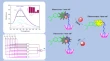
<p>Figure <figr fid="F2">2a</figr> shows the size and density of the IrO<sub>x</sub>-NDs in MIS structure. The thickness of Al<sub>2</sub>O<sub>3 </sub>blocking oxide is 8 nm. As-deposited IrO<sub>x </sub>nanolayer shows self-assembly NDs because as-deposited layer is very thin (1.5 nm). Isolated IrO<sub>x</sub>-NDs are observed clearly (Figure <figr fid="F2">2b</figr>). The IrO<sub>x</sub>-NDs have high density of approximately 1 &#215; 10<sup>13</sup>/cm<sup>2 </sup>(Figure <figr fid="F2">2c</figr>), which results a large memory size of &gt; 60 Tbit/sq in. The nano-dots are core-shell structure (Figure <figr fid="F2">2d</figr>). Core region of the NDs is Ir-rich, and shell region is oxygen-rich or IrAlO mixture. It is indicated that V<sub>o </sub>can be observed in the core region, and oxygen accumulations (O<sup>2-</sup>) can be observed in the shell region. The IrO<sub>x</sub>-NDs have a nanoscale average diameter of approximately 1.3 nm (Figure <figr fid="F2">2e</figr>). The hole or electron trapping can be measured from the C-V hysteresis characteristics of the MIS capacitors. Figure <figr fid="F3">3a</figr> shows high-frequency (1 MHz) clockwise C-V hysteresis characteristics of the MIS capacitors. A small equivalent oxide thickness of approximately 8 nm is obtained. A large memory window of approximately 1.2 V is observed under a sweeping gate voltage of &#177; 7 V for the IrO<sub>x</sub>-ND device, while a small memory of 0.3 V is observed for the pure Al<sub>2</sub>O<sub>3 </sub>chrage-trapping layers (Figure <figr fid="F3">3b</figr>). The neutral flat-band voltage (V<sub>FB</sub>) is found to be +0.15 V for the IrO<sub>x</sub>-ND devices (not shown here). The hole and electron trapping densities can be calculated using equation in reference <abbrgrp><abbr bid="B26">26</abbr></abbrgrp>. High hole-trapping densities for the pure Al<sub>2</sub>O<sub>3 </sub>and IrO<sub>x</sub>-NDs capacitors are found to be approximately 5.6 &#215; 10<sup>11</sup>/cm<sup>2 </sup>and approximately 3.1 &#215; 10<sup>12</sup>/cm<sup>2</sup>, respectively (Figure <figr fid="F3">3b</figr>). Almost no electrons are trapped in the core-region IrO<sub>x</sub>-ND under positive voltage, but holes are trapped on the shell region under negative bias on the IrO<sub>x </sub>electrode. This suggests that the holes can be trapped on the nano-dot surface easily because the surface has negative-type defects. These trapping holes as well as oxygen vacancy on the surface of the NDs will lead the conducting filament as well as resistive switching memory parameters under formation polarity, which have been explained below.</p>
<fig id="F2"><title><p>Figure 2</p></title><caption><p>Different images of IrO<sub>x</sub>-NDs in an IrO<sub>x</sub>/Al<sub>2</sub>O<sub>3</sub>/IrO<sub>x</sub>-NDs/Al<sub>2</sub>O<sub>3</sub>/SiO<sub>2</sub>/n-Si MIS structure</p></caption><text>
   <p><b>Different images of IrO<sub>x</sub>-NDs in an IrO<sub>x</sub>/Al<sub>2</sub>O<sub>3</sub>/IrO<sub>x</sub>-NDs/Al<sub>2</sub>O<sub>3</sub>/SiO<sub>2</sub>/n-Si MIS structure</b>. (<b>a</b>) Cross-sectional HRTEM image on IrO<sub>x</sub>-NDs in an IrO<sub>x</sub>/Al<sub>2</sub>O<sub>3</sub>/IrO<sub>x</sub>-NDs/Al<sub>2</sub>O<sub>3</sub>/SiO<sub>2</sub>/n-Si MIS structure. (<b>b</b>) Plane view TEM image. (<b>c</b>) Scanning tunneling electron microscope image and (<b>d</b>) a single core-shell IrO<sub>x</sub>-ND. (<b>e</b>) Histogram of the IrO<sub>x</sub>-NDs with an average size of 1.3 nm with a high density of IrO<sub>x</sub>-NDs of 1 &#215; 10<sup>13</sup>/cm<sup>2</sup>.</p>
</text><graphic file="1556-276X-7-194-2" hint_layout="double"/></fig>
<fig id="F3"><title><p>Figure 3</p></title><caption><p>Typical hysteresis characteristics of the IrO<sub>x</sub>-ND MIS capacitors and V<sub>FB </sub>shift with sweeping gate voltages</p></caption><text>
   <p><b>Typical hysteresis characteristics of the IrO<sub>x</sub>-ND MIS capacitors and V<sub>FB </sub>shift with sweeping gate voltages</b>. (<b>a</b>) Typical C-V hysteresis characteristics of the IrO<sub>x</sub>-ND MIS capacitors and (<b>b</b>) V<sub>FB </sub>shift with sweeping gate voltages for the IrO<sub>x</sub>-ND and pure Al<sub>2</sub>O<sub>3 </sub>charge-trapping devices.</p>
</text><graphic file="1556-276X-7-194-3" hint_layout="single"/></fig>
<p>Figure <figr fid="F4">4a</figr> shows typical HRTEM image of a ReRAM device with a size of 8 &#215; 8 &#956;m<sup>2</sup>. The stack switching layers with self-assembly IrO<sub>x</sub>-NDs are observed clearly in Figure <figr fid="F4">4b</figr>. The IrO<sub>x</sub>-NDs with a thickness of approximately 1.5 nm are sandwiched in between high-&#954; Al<sub>2</sub>O<sub>3 </sub>layers with a thickness of approximately 3 nm. A small size of approximately 1.3 nm in a diameter is observed. The IrO<sub>x</sub>-NDs shows crystalline, while the high-&#954; Al<sub>2</sub>O<sub>3 </sub>film shows amorphous. The WO<sub>x </sub>layer with a thickness of approximately 14 nm is also observed, which is expected from our deposition. The WO<sub>x </sub>film shows polycrystalline. All layers are also confirmed by XPS analysis below.</p>
<fig id="F4"><title><p>Figure 4</p></title><caption><p>The cross-sectional TEM and HRTEM images</p></caption><text>
   <p><b>The cross-sectional TEM and HRTEM images</b>. (<b>a) </b>Cross-sectional TEM image of an IrO<sub>x</sub>/Al<sub>2</sub>O<sub>3 </sub>/IrO<sub>x</sub>-NDs/Al<sub>2</sub>O<sub>3</sub>/WO<sub>x</sub>/W ReRAM device with a device size of 8 &#215; 8 &#956;m<sup>2</sup>. (<b>b) </b>HRTEM image of the stack layers.</p>
</text><graphic file="1556-276X-7-194-4" hint_layout="single"/></fig>
<p>Figure <figr fid="F5">5a</figr> shows the XPS spectra of the Ir<it>4f </it>core levels with the Ir<sub>2</sub>O<sub>3 </sub>and IrO<sub>2 </sub>compositions. The peak fitting was performed using Shirley background subtraction and Gaussian-Lorentzian functions. Two peaks positions of the X-ray photo-electron spectra are strong indication of the presence of Ir<sub>2</sub>O<sub>3 </sub><it>4f</it><sub>7/2 </sub>and Ir<sub>2</sub>O<sub>3 </sub><it>4f</it><sub>5/2 </sub>spin orbital components with peak energies centered at approximately 62.04 and approximately 65.12 eV, respectively. The peak binding energies of the IrO<sub>2 </sub><it>4f</it><sub>7/2 </sub>and IrO<sub>2 </sub><it>4f</it><sub>5/2 </sub>doublets are centered at approximately 63.70 and approximately 66.42 eV, respectively. The IrO<sub>2 </sub>peak intensity is smaller than that of the Ir<sub>2</sub>O<sub>3</sub>, which is evidently prove the presence of IrO<sub>x </sub>NDs. This IrO<sub>x</sub>-ND is embedded in the high-&#954; Al<sub>2</sub>O<sub>3 </sub>films, which is also confirmed by Al<it>2p </it>and O<it>1s </it>signals (not shown here). Choi et al. <abbrgrp><abbr bid="B27">27</abbr></abbrgrp> reported the peak energy positions for IrO<sub>2</sub><it>4f<sub>7/2 </sub></it>and IrO<sub>2</sub><it>4f<sub>5/2 </sub></it>which are located at 61.9 and 64.9 eV, respectively. The presence of metallic W and oxygen-rich WO<sub>3 </sub>can be confirmed by XPS analysis of W<it>4f </it>spectra (Figure <figr fid="F5">5b</figr>) in 14 nm-thick WO<sub>x </sub>layer. The peak binding energies of the W<it>4f</it><sub>7/2 </sub>and W<it>4f</it><sub>5/2 </sub>electrons are centered at 30.85 and 33.06 eV, respectively. The energy peak separation is 2.2 eV. The positions of binding energies for WO<sub>3</sub><it>4f<sub>7/2 </sub></it>and WO<sub>3</sub><it>4f<sub>5/2 </sub></it>electrons are located at 35.43 and 37.56 eV, respectively, and these values are similar to the reported results at 35.0 and 37.6 eV for the WO<sub>3</sub><it>4f</it><sub>7/2 </sub>and WO<sub>3</sub><it>4f</it><sub>5/2 </sub>electrons, respectively <abbrgrp><abbr bid="B28">28</abbr></abbrgrp>. The W sub-oxide (WO<sub>x</sub>) located at 35.0 eV could be formed during the deposition process, and the oxygen-vacancy could be found in the WO<sub>x </sub>films. Due to both the IrO<sub>x</sub>-NDs in the high-&#954; Al<sub>2</sub>O<sub>3</sub>/WO<sub>x </sub>bilayer structure and high charge-trapping density, improved resistive switching memory performance has been explained below.</p>
<fig id="F5"><title><p>Figure 5</p></title><caption><p>XPS of Ir<it>4f </it>electrons from the IrO<sub>x</sub>-NDs and W<it>4f </it>core-level electrons in the WO<sub>x </sub>layer</p></caption><text>
   <p><b>XPS of Ir<it>4f </it>electrons from the IrO<sub>x</sub>-NDs and W<it>4f </it>core-level electrons in the WO<sub>x </sub>layer</b>. (<b>a</b>) XPS of the Ir<it>4f </it>electrons from the IrO<sub>x</sub>-NDs and (<b>b</b>) W<it>4f </it>core-level electrons in the WO<sub>x </sub>layer.</p>
</text><graphic file="1556-276X-7-194-5" hint_layout="single"/></fig>
<p>Figure <figr fid="F6">6a</figr> shows electrochemical formation process of our IrO<sub>x</sub>/Al<sub>2</sub>O<sub>3</sub>/IrO<sub>x</sub>-NDs/Al<sub>2</sub>O<sub>3</sub>/WO<sub>x</sub>/W ReRAM device. The pristine devices show low leakage current. The currents increase with increasing voltage, and it is limited by current compliance (I<sub>CC</sub>) of 500 &#956;A. The average leakage current under negative formation (NF) is 229.7 pA at a read voltage (V<sub>read</sub>) of -2.0 V, while it is 673.3 pA under PF at a V<sub>read </sub>of +2.0 V. Asymmetry values of the leakage currents under NF and PF polarities are quite reasonable due to the different work function (&#934;<sub>m</sub>) values of IrO<sub>x </sub>[(&#934;<sub>m</sub>)<sub>IrOx </sub>&#8776; 5.2 eV <abbrgrp><abbr bid="B14">14</abbr></abbrgrp>, and of W [(&#934;<sub>m</sub>)<sub>W </sub>&#8776; 4.3-4.91 eV <abbrgrp><abbr bid="B29">29</abbr></abbrgrp>] electrodes. Considering the electron affinities (<it>&#967;</it>) of 3.33 eV <abbrgrp><abbr bid="B30">30</abbr></abbrgrp> for WO<sub>3 </sub>and 1.25 eV for Al<sub>2</sub>O<sub>3 </sub>layers, the values of the effective barrier heights (&#934;<sub>b</sub>) are found to be [&#934;<sub>b </sub>= (&#934;<sub>m</sub>)<sub>W</sub>-(<it>&#967;</it>)<sub>WO3</sub>] 1.3 eV and [(&#934;<sub>b</sub>) = (&#934;<sub>m</sub>)<sub>IrOx</sub>-(<it>&#967;</it>)<sub>Al2O3</sub>] 3.95 eV, respectively. So the electron injection at the IrO<sub>x</sub>/Al<sub>2</sub>O<sub>3 </sub>interface will be lower than that of the W/WO<sub>x </sub>interface. In consequence, the currents under PF increase rapidly which results a lower and tight distribution of formation voltages as compared to NF (6-7 V vs. -7 to -9 V). This suggests that lower formation voltage can protect device degradation <abbrgrp><abbr bid="B22">22</abbr></abbrgrp>. During the formation process, the high electric field breaks the Al<sub>2</sub>O<sub>3 </sub>film and forms the Al-O bonds with oxygen vacancy as well as oxygen vacancy filament. In consequence, oxygen ions (O<sup>2-</sup>) will be released from the conduction channels. These oxygen ions will move from the Al<sub>2</sub>O<sub>3</sub>/IrO<sub>x</sub>-NDs/Al<sub>2</sub>O<sub>3 </sub>stacks toward WO<sub>x </sub>layer under NF because the TE has negative polarity, and the BE is grounded during measurement. Under PF, the oxygen ions will move toward the TE because the TE has positive polarity. In this case, the oxygen ions will be accumulated at the Al<sub>2</sub>O<sub>3</sub>/TE interface, i.e., oxygen-rich AlO<sub>x </sub>film. So the oxygen vacancy filament can be formed in the Al<sub>2</sub>O<sub>3</sub>/IrO<sub>x</sub>-NDs/Al<sub>2</sub>O<sub>3 </sub>stack. The WO<sub>x </sub>layer will behave as a conductiong layer under PF. After the first reset operation, the ReRAM devices under both NF and PF show bipolar resistive switching characteristics. Figure <figr fid="F6">6b</figr> shows typical I-V characteristics with 50 DC cycles at room temperature (RT), as shown by arrows: 1&#8594;4 after NF. The LRS currents are fitted with ohmic, and the HRS currents are fitted with Schottky emission (not shown here). Large variations of the set and reset voltages at a V<sub>read </sub>of -0.2 V are -1.7 to -3.6 V and +2.0 to +3.2 V, respectively (Figure <figr fid="F6">6d</figr>) and large variations in LRS and HRS are also observed (Figure <figr fid="F6">6e</figr>). Typical resistance ratio under NF is approximately 10<sup>3</sup>. Under PF, excellent DC I-V switching cycles are observed (Figure <figr fid="F6">6c</figr>). A tight distribution of the set voltages from +2.0 to +2.9 V as well as reset voltages is observed (Figure <figr fid="F6">6d</figr>). Average HRS and LRS values are approximately 2 M&#937; and 20 k&#937;, respectively (Figure <figr fid="F6">6e</figr>). So an acceptable resistance ratio of approximately 10<sup>2 </sup>is obtained under PF. Even at high temperature of 85&#176;C, excellent consecutive 100 DC switching cycles is observed under PF (Figure <figr fid="F6">6f</figr>). To investigate the current conduction mechanism under PF, I-V curves of LRS and HRS are fitted linearly in log-log plot, which are in agreement with the trap-charge controlled space charge limited current model for both LRS and HRS (not shown here).</p>
<fig id="F6"><title><p>Figure 6</p></title><caption><p>Formation characteristics of the devices under NF and PF, and I-V characteristics for NF and PF devices</p></caption><text>
   <p><b>Formation characteristics of the devices under NF and PF, and I-V characteristics for NF and PF devices</b>. (<b>a) </b>Formation characteristics of the pristine resistive memory devices under NF and PF. (<b>b</b>) Typical I-V hysteresis characteristics for the NF devices at RT. (<b>c</b>) Typical I-V characteristics with stable switching for the PF devices at RT. Statistical distribution of the NF and PF devices for (<b>d</b>) set/reset voltages and (<b>e) </b>LRS/HRS. (<b>f</b>) Consecutive 100 DC cycles at 85&#176;C for the PF devices.</p>
</text><graphic file="1556-276X-7-194-6" hint_layout="double"/></fig>
<p>Figure <figr fid="F7">7</figr> shows typical AC endurance characteristics for both NF and PF devices up to 10<sup>3 </sup>cycles. Both the devices are programmed at a voltage of &#177; 4 V, a low I<sub>CC </sub>of 500 &#956;A, and a V<sub>read </sub>of &#177; 0.1 V. Inferior AC cycles are observed for the NF devices, where as the PF devices show excellent switching stability. Improved resistive switching parameters of the IrO<sub>x</sub>/Al<sub>2</sub>O<sub>3</sub>/IrO<sub>x</sub>-NDs/Al<sub>2</sub>O<sub>3</sub>/WO<sub>x</sub>/W structure under PF can be explianed as follows. For the NF devices, the oxygen ions will move from the Al<sub>2</sub>O<sub>3</sub>/IrO<sub>x</sub>-NDs/Al<sub>2</sub>O<sub>3 </sub>stack toward the WO<sub>x </sub>layer under a negative voltage (-V &lt; V<sub>set</sub>) on the TE or the oxygen vacancies will move from the WO<sub>x </sub>layer toward the Al<sub>2</sub>O<sub>3</sub>/IrO<sub>x</sub>-NDs/Al<sub>2</sub>O<sub>3 </sub>stack (Figure <figr fid="F8">8a</figr>). It seems that the oxygen ions will be hidden in to the WO<sub>x </sub>layer. It results the oxygen vacancy filament through the IrO<sub>x</sub>-NDs as well as LRS. Under reset operation (+V &gt; V<sub>reset</sub>), the oxygen ions will move from WO<sub>x </sub>layer toward Al<sub>2</sub>O<sub>3</sub>/IrO<sub>x</sub>-NDs/Al<sub>2</sub>O<sub>3 </sub>stack and oxidize the conducting filament as well as HRS (Figure <figr fid="F8">8c</figr>). Due to the lower barrier height at the W/WO<sub>3 </sub>interface, the injected electrons will be higher. This result indicates a higher O<sup>2-</sup>ions migration and randomized rupture of the conducting filaments. According to our previous report, improved resistive switching characteristics of the IrO<sub>x</sub>-ND ReRAM devices are observed as compared to the pure Al<sub>2</sub>O<sub>3 </sub>ReRAM device under NF due to oxygen-vacancy filament confinement by the IrO<sub>x</sub>-NDs <abbrgrp><abbr bid="B31">31</abbr></abbrgrp>. Even though IrO<sub>x</sub>-NDs are embedded in the Al<sub>2</sub>O<sub>3 </sub>switching material, but higher O<sup>2-</sup>ions migration will reset HRS dispersion resulting a variation of switching cycles. This suggests that the controllable reset operation is also a crucial issue to improve the repeatable switching cycles. So oxygen ions migration leads to the filament formation/rupture in the Al<sub>2</sub>O<sub>3</sub>/IrO<sub>x</sub>-NDs/Al<sub>2</sub>O<sub>3 </sub>stack under NF, which results an inferior switching cycles. In previous literature, similar phenomena using oxygen vacancies generation and recombination to form/rupture a conducting filament to switch the LRS and HRS are also reported in some other ReRAM devices <abbrgrp><abbr bid="B32">32</abbr><abbr bid="B33">33</abbr></abbrgrp>. For the PF devices, the oxygen ions will move from the Al<sub>2</sub>O<sub>3</sub>/IrO<sub>x</sub>-NDs/Al<sub>2</sub>O<sub>3 </sub>stack toward the Al<sub>2</sub>O<sub>3</sub>/TE interface under a positive voltage (+V &gt; V<sub>set</sub>) on the TE or the oxygen vacancies will move from the Al<sub>2</sub>O<sub>3</sub>/TE interface (oxygen-rich AlO<sub>x</sub>) toward Al<sub>2</sub>O<sub>3</sub>/IrO<sub>x</sub>-NDs/Al<sub>2</sub>O<sub>3 </sub>stack and sets LRS (Figure <figr fid="F8">8b</figr>). This suggests that an insulating layer as a series resistor with LRS will be created at the Al<sub>2</sub>O<sub>3</sub>/TE interface under set operation, which will limit electron injection at the W/WO<sub>x </sub>interface. This result indicates a thinner and stable conducting filament formation, as shown in Figure <figr fid="F8">8b</figr>. So the LRS of the PF devices is higher than that of the NF devices (Figure <figr fid="F6">6e</figr>) due to series insulator (oxygen-rich AlO<sub>x </sub>layer). Under reset operation (-V &lt; V<sub>reset</sub>), the filament can be ruptured by oxygen ions migration from the Al<sub>2</sub>O<sub>3</sub>/TE (i.e., oxygen-rich AlO<sub>x </sub>layer) and oxidize the partial filament, which results also a stable HRS because the electron injection (O<sup>2- </sup>ions migration from oxygen-rich AlO<sub>x </sub>layer) from the TE is very low, and this will be limited by the IrO<sub>x</sub>-ND/Al<sub>2</sub>O<sub>3</sub>/TE region, as shown in Figure <figr fid="F8">8d</figr>. The conduction filaments in the WO<sub>x</sub>/Al<sub>2</sub>O<sub>3</sub>/IrO<sub>x</sub>-NDs region will remain after reset operation. Due to this remaining filament, the next set operation will be also easier. Due to this stable reset, repeatable switching cycles are expected for the PF devices. So the HRS of the PF devices is lower as compared to the NF devices (Figure <figr fid="F6">6e</figr>), due to shorter length filament oxidized. Basically, the limitation of electron injections (O<sup>2- </sup>ions migration) can control the charge trapping (filament oxidation)/de-trapping (filament formation) through the IrO<sub>x</sub>-ND boundary. A similar study has been reported by other group <abbrgrp><abbr bid="B34">34</abbr></abbrgrp>. For the PF devices, the filament can be formed or ruptured repeatedly than that of the NF devices. This reveals that the filament formation/rupture is more controllable (i.e., localized filament) when it is formed at the IrO<sub>x</sub>-NDs/oxygen-rich AlO<sub>x </sub>interface region because it has short length, and an oxygen-rich AlO<sub>x </sub>layer is in series which can protect the higher electron injection. So the improved resistive switching characteristics are expected for the PF devices. It is noted that a small size (1.3 nm) NDs are observed, and the filament diameter can be adjusted through a single ND in future. It indicates that the device size can be down scale to 1.3 nm in future for advanced high-density nonvolatile memory applications.</p>
<fig id="F7"><title><p>Figure 7</p></title><caption><p>Improved AC endurance characteristics are observed for the PF devices</p></caption><text>
   <p><b>Improved AC endurance characteristics are observed for the PF devices</b>.</p>
</text><graphic file="1556-276X-7-194-7" hint_layout="single"/></fig>
<fig id="F8"><title><p>Figure 8</p></title><caption><p>The schematic illustration of the switching mechanisms of NF and PF devices</p></caption><text>
   <p><b>The schematic illustration of the switching mechanisms of NF and PF devices</b>. Schematic illustration of the switching mechanisms of (<b>a</b>) the NF devices and (<b>b</b>) the PF devices under set operation, (<b>c</b>) the NF devices and (<b>d</b>) the PF devices under reset operation.</p>
</text><graphic file="1556-276X-7-194-8" hint_layout="double"/></fig>
<p>Figure <figr fid="F9">9a</figr> shows stable resistance ratio with an excellent non-destructive read up to 10<sup>5 </sup>times for the PF devices. No fluctuation can be detected in LRS (25 k&#937;) and HRS (2.2 M&#937;) values at a V<sub>read </sub>of +0.2 V. Figure <figr fid="F9">9b</figr> shows the retention characteristics of the PF devices at 500 &#956;A with a program/erase voltage of &#177; 4 V. The data retention ability is quite remarkable for both at RT and 85&#176;C. Extrapolated 10 years of data retention with a resistance ratio of &gt; 10<sup>2 </sup>at RT and &gt; 10 at 85&#176;C are obtained. It is expected that a single IrO<sub>x</sub>-ND in the Al<sub>2</sub>O<sub>3</sub>/IrO<sub>x</sub>-NDs/Al<sub>2</sub>O<sub>3</sub>/WO<sub>x </sub>stack can control the resistive switching characteristics in future.</p>
<fig id="F9"><title><p>Figure 9</p></title><caption><p>The non-destructive read endurance of 10<sup>5 </sup>cycles and retention characteristics of the PF devices</p></caption><text>
   <p><b>The non-destructive read endurance of 10<sup>5 </sup>cycles and retention characteristics of the PF devices</b>. (<b>a</b>) Non-destructive read endurance of 10<sup>5 </sup>cycles of the PF devices. (<b>b</b>) Retention characteristics of the PF devices at RT and 85&#176;C.</p>
</text><graphic file="1556-276X-7-194-9" hint_layout="single"/></fig>
</sec>
<sec><st><p>Conclusions</p></st>
<p>Formation polarity dependent ReRAM devices using IrO<sub>x</sub>/Al<sub>2</sub>O<sub>3</sub>/IrO<sub>x</sub>-NDs/Al<sub>2</sub>O<sub>3</sub>/WO<sub>x</sub>/W structure have been investigated. The devices are confirmed by HRTEM, EDX, and XPS analyses. The improved resistive switching parameters such as stable set and reset voltages, HRS/LRS with a acceptable ratio of &gt; 10, long read endurance of 10<sup>5 </sup>times, and extrapolated 10 years data retention at 85&#176;C under PF are obtained owing to the filament controlled at the IrO<sub>x</sub>-NDs/oxygen-rich AlO<sub>x </sub>interface. Due to the high-charge trapping density, controllable O<sup>2- </sup>ions migration and nano filament formation through the core-shell IrO<sub>x</sub>-ND under PF, the improvement of the resistive switching memory characteristics is evident and the switching mechanism is explained successfully. A large memory size of &gt; 60 Tbit/sq in. can be obtained. It is expected that the scalability potential of this resistive switching memory device could be the diameter (approximately 1.3 nm) of a single IrO<sub>x</sub>-ND in future.</p>
</sec>
<sec><st><p>Competing interests</p></st>
<p>The authors declare that they have no competing interests.</p>
</sec>
<sec><st><p>Authors' contributions</p></st>
<p>WB carried out the device fabrication, measurement, and data analysis under the instruction of SM. CSL helped to WB for experiments. YYC performed the TEM measurements of MIS capacitors under the instruction of JRY and SM. TCT performed the XPS measurements. HYL, WSC, FTC, MJK, and MJT performed via structure design and fabrication. All the authors contributed to the preparation and revision of the manuscript, and approved its final version.</p>
</sec>
</bdy>
<bm>
<ack>
<sec><st><p>Acknowledgements</p></st>
<p>This work was financially supported by the National Science Council (NSC), Taiwan under contract numbers: NSC-97-2221-E-182-051-MY3 and NSC-98-2221-E-182-052-MY3. The authors are also grateful to MSSCORPS CO., LTD., Hsinchu for their HRTEM support and discussion of our ReRAM device.</p>
</sec>
</ack>
<refgrp><bibl id="B1"><title><p>Nanoionics-based resistive switching memories</p></title><aug><au><snm>Waser</snm><fnm>R</fnm></au><au><snm>Aono</snm><fnm>M</fnm></au></aug><source>Nature Mater</source><pubdate>2007</pubdate><volume>6</volume><fpage>833</fpage><xrefbib><pubid idtype="doi">10.1038/nmat2023</pubid></xrefbib></bibl><bibl id="B2"><title><p>Resistive switching in transition metal oxides</p></title><aug><au><snm>Sawa</snm><fnm>A</fnm></au></aug><source>Mater Today</source><pubdate>2008</pubdate><volume>11</volume><fpage>28</fpage></bibl><bibl id="B3"><title><p>Nonvolatile and unipolar resistive switching characteristics of pulsed laser ablated NiO films</p></title><aug><au><snm>Panda</snm><fnm>D</fnm></au><au><snm>Dhar</snm><fnm>A</fnm></au><au><snm>Ray</snm><fnm>SK</fnm></au></aug><source>J Appl Phys</source><pubdate>2010</pubdate><volume>108</volume><fpage>104513</fpage><xrefbib><pubid idtype="doi">10.1063/1.3514036</pubid></xrefbib></bibl><bibl id="B4"><title><p>Size-dependent retention time in NiO-based resistive-switching memories</p></title><aug><au><snm>Ielmini</snm><fnm>D</fnm></au><au><snm>Nardi</snm><fnm>F</fnm></au><au><snm>Cagli</snm><fnm>C</fnm></au><au><snm>Lacaita</snm><fnm>AL</fnm></au></aug><source>IEEE Electron Dev Lett</source><pubdate>2010</pubdate><volume>31</volume><fpage>353</fpage><lpage>355</lpage></bibl><bibl id="B5"><title><p>Low-power and nanosecond switching in robust hafnium oxide reactive memory with a thin Ti cap</p></title><aug><au><snm>Lee</snm><fnm>HY</fnm></au><au><snm>Chen</snm><fnm>YS</fnm></au><au><snm>Chen</snm><fnm>PS</fnm></au><au><snm>Wu</snm><fnm>TY</fnm></au><au><snm>Chen</snm><fnm>F</fnm></au><au><snm>Wang</snm><fnm>CC</fnm></au><au><snm>Tzeng</snm><fnm>PJ</fnm></au><au><snm>Tsai</snm><fnm>MJ</fnm></au><au><snm>Lien</snm><fnm>C</fnm></au></aug><source>IEEE Electron Device Lett</source><pubdate>2010</pubdate><volume>31</volume><fpage>44</fpage><lpage>46</lpage></bibl><bibl id="B6"><title><p>Highly scalable non-volatile resistive memory using simple binary oxide driven by asymmetric unipolar voltage pulses</p></title><aug><au><snm>Baek</snm><fnm>IG</fnm></au><au><snm>Lee</snm><fnm>MS</fnm></au><au><snm>Seo</snm><fnm>S</fnm></au><au><snm>Lee</snm><fnm>MJ</fnm></au><au><snm>Seo</snm><fnm>DH</fnm></au><au><snm>Suh</snm><fnm>DS</fnm></au><au><snm>Park</snm><fnm>JC</fnm></au><au><snm>Park</snm><fnm>SO</fnm></au><au><snm>Kim</snm><fnm>HS</fnm></au><au><snm>Yoo</snm><fnm>IK</fnm></au><au><snm>Chung</snm><fnm>UI</fnm></au><au><snm>Moon</snm><fnm>JT</fnm></au></aug><source>Tech Dig - Int Electron Devices Meet</source><pubdate>2004</pubdate><fpage>587</fpage><lpage>590</lpage></bibl><bibl id="B7"><title><p>Erasing characteristics of Cu<sub>2</sub>O metal-insulator-metal resistive switching memory</p></title><aug><au><snm>Chen</snm><fnm>A</fnm></au><au><snm>Haddad</snm><fnm>S</fnm></au><au><snm>Wu</snm><fnm>YC</fnm></au><au><snm>Fang</snm><fnm>TN</fnm></au><au><snm>Kaza</snm><fnm>S</fnm></au><au><snm>Lan</snm><fnm>Z</fnm></au></aug><source>Appl Phys Lett</source><pubdate>2008</pubdate><volume>92</volume><fpage>013503</fpage><xrefbib><pubid idtype="doi">10.1063/1.2828864</pubid></xrefbib></bibl><bibl id="B8"><title><p>Forming-free colossal resistive switching effect in rare-earth-oxide Gd<sub>2</sub>O<sub>3 </sub>films for memristor applications</p></title><aug><au><snm>Cao</snm><fnm>X</fnm></au><au><snm>Li</snm><fnm>X</fnm></au><au><snm>Gao</snm><fnm>X</fnm></au><au><snm>Yu</snm><fnm>W</fnm></au><au><snm>Liu</snm><fnm>X</fnm></au></aug><source>J Appl Phys</source><pubdate>2009</pubdate><volume>106</volume><fpage>073723</fpage><xrefbib><pubid idtype="doi">10.1063/1.3236573</pubid></xrefbib></bibl><bibl id="B9"><title><p>High switching endurance in TaO<sub>x </sub>memristive devices</p></title><aug><au><snm>Yang</snm><fnm>JJ</fnm></au><au><snm>Zhang</snm><fnm>MX</fnm></au><au><snm>Strachan</snm><fnm>JP</fnm></au><au><snm>Miao</snm><fnm>F</fnm></au><au><snm>Pickett</snm><fnm>MD</fnm></au><au><snm>Kelley</snm><fnm>RD</fnm></au><au><snm>Ribeiro</snm><fnm>GM</fnm></au><au><snm>Williams</snm><fnm>RS</fnm></au></aug><source>Appl Phys Lett</source><pubdate>2010</pubdate><volume>92</volume><fpage>232102</fpage></bibl><bibl id="B10"><title><p>Improved bipolar resistive switching memory using W/TaO<sub>x</sub>/W structure</p></title><aug><au><snm>Prakash</snm><fnm>A</fnm></au><au><snm>Maikap</snm><fnm>S</fnm></au><au><snm>Lee</snm><fnm>HY</fnm></au><au><snm>Chen</snm><fnm>G</fnm></au><au><snm>Chen</snm><fnm>F</fnm></au><au><snm>Tsai</snm><fnm>MJ</fnm></au><au><snm>Kao</snm><fnm>MJ</fnm></au></aug><source>Adv Mater Res</source><pubdate>2011</pubdate><volume>159</volume><fpage>333</fpage></bibl><bibl id="B11"><title><p>TiO<sub>2</sub>-based metal-insulator-metal selection device for bipolar resistive random access memory cross-point application</p></title><aug><au><snm>Shin</snm><fnm>J</fnm></au><au><snm>Kim</snm><fnm>I</fnm></au><au><snm>Biju</snm><fnm>KP</fnm></au><au><snm>Jo</snm><fnm>M</fnm></au><au><snm>Park</snm><fnm>J</fnm></au><au><snm>Lee</snm><fnm>J</fnm></au><au><snm>Jung</snm><fnm>S</fnm></au><au><snm>Hwang</snm><fnm>H</fnm></au></aug><source>J Appl Phys</source><pubdate>2011</pubdate><volume>109</volume><fpage>033712</fpage><xrefbib><pubid idtype="doi">10.1063/1.3544205</pubid></xrefbib></bibl><bibl id="B12"><title><p>Effect of top electrode material on resistive switching properties of ZrO<sub>2 </sub>film memory devices</p></title><aug><au><snm>Lin</snm><fnm>CY</fnm></au><au><snm>Wu</snm><fnm>CY</fnm></au><au><snm>Wu</snm><fnm>CY</fnm></au><au><snm>Lee</snm><fnm>TC</fnm></au><au><snm>Yang</snm><fnm>FL</fnm></au><au><snm>Hu</snm><fnm>C</fnm></au><au><snm>Tseng</snm><fnm>TY</fnm></au></aug><source>IEEE Electron Dev Let</source><pubdate>2007</pubdate><volume>28</volume><fpage>366</fpage><lpage>368</lpage></bibl><bibl id="B13"><title><p>Resistive switching properties of Au/ZrO<sub>2</sub>/Ag structure for low-voltage nonvolatile memory applications</p></title><aug><au><snm>Li</snm><fnm>Y</fnm></au><au><snm>Long</snm><fnm>S</fnm></au><au><snm>Zhang</snm><fnm>M</fnm></au><au><snm>Liu</snm><fnm>Q</fnm></au><au><snm>Shao</snm><fnm>L</fnm></au><au><snm>Zhang</snm><fnm>S</fnm></au><au><snm>Wang</snm><fnm>Y</fnm></au><au><snm>Zuo</snm><fnm>Q</fnm></au><au><snm>Liu</snm><fnm>S</fnm></au><au><snm>Liu</snm><fnm>M</fnm></au></aug><source>IEEE Electron Dev Lett</source><pubdate>2010</pubdate><volume>31</volume><fpage>117</fpage><lpage>119</lpage></bibl><bibl id="B14"><title><p>High-&#954; Al<sub>2</sub>O<sub>3</sub>/WO<sub>x </sub>bilayer dielectrics for low-power resistive switching memory applications</p></title><aug><au><snm>Banerjee</snm><fnm>W</fnm></au><au><snm>Rahaman</snm><fnm>SZ</fnm></au><au><snm>Prakash</snm><fnm>A</fnm></au><au><snm>Maikap</snm><fnm>S</fnm></au></aug><source>Jpn J Appl Phys</source><pubdate>2011</pubdate><volume>50</volume><fpage>10PH01</fpage><xrefbib><pubid idtype="doi">10.1143/JJAP.50.10PH01</pubid></xrefbib></bibl><bibl id="B15"><title><p>Ultrathin Al<sub>2</sub>O<sub>3 </sub>film with a reactive Ti layer based resistive memory</p></title><aug><au><snm>Chen</snm><fnm>PS</fnm></au><au><snm>Chen</snm><fnm>YS</fnm></au><au><snm>Lee</snm><fnm>HY</fnm></au><au><snm>Liu</snm><fnm>W</fnm></au><au><snm>Gu</snm><fnm>PY</fnm></au><au><snm>Chen</snm><fnm>F</fnm></au><au><snm>Tsai</snm><fnm>MJ</fnm></au></aug><source>IEEE International NanoElectronics Conference</source><pubdate>2011</pubdate><fpage>27</fpage></bibl><bibl id="B16"><title><p>Al<sub>2</sub>O<sub>3</sub>-based RRAM using atomic layer deposition (ALD) with 1-&#956;A reset current</p></title><aug><au><snm>Wu</snm><fnm>Y</fnm></au><au><snm>Lee</snm><fnm>B</fnm></au><au><snm>Wong</snm><fnm>HSP</fnm></au></aug><source>IEEE Electron Dev Lett</source><pubdate>2010</pubdate><volume>31</volume><fpage>1449</fpage><lpage>1451</lpage></bibl><bibl id="B17"><title><p>Study on resistance switching properties of Na0.5Bi0.5TiO3 thin films using impedance spectroscopy</p></title><aug><au><snm>Zhang</snm><fnm>T</fnm></au><au><snm>Zhang</snm><fnm>X</fnm></au><au><snm>Ding</snm><fnm>L</fnm></au><au><snm>Zhang</snm><fnm>W</fnm></au></aug><source>Nanoscale Res Lett</source><pubdate>2009</pubdate><volume>4</volume><fpage>1309</fpage><lpage>1314</lpage><xrefbib><pubidlist><pubid idtype="doi">10.1007/s11671-009-9397-4</pubid><pubid idtype="pmcid">2893894,2893894</pubid><pubid idtype="pmpid" link="fulltext">20628453</pubid></pubidlist></xrefbib></bibl><bibl id="B18"><title><p>Bipolar resistance switching characteristics with opposite polarity of Au/SrTiO<sub>3</sub>/Ti memory cells</p></title><aug><au><snm>Sun</snm><fnm>X</fnm></au><au><snm>Li</snm><fnm>G</fnm></au><au><snm>Chen</snm><fnm>Li</fnm></au><au><snm>Shi</snm><fnm>Z</fnm></au><au><snm>Zhang</snm><fnm>W</fnm></au></aug><source>Nanoscale Res Lett</source><pubdate>2011</pubdate><volume>6</volume><fpage>599</fpage><xrefbib><pubidlist><pubid idtype="doi">10.1186/1556-276X-6-599</pubid><pubid idtype="pmcid">3260421</pubid><pubid idtype="pmpid" link="fulltext">22107926</pubid></pubidlist></xrefbib></bibl><bibl id="B19"><title><p>Role of Ru nano-dots embedded in TiO<sub>2 </sub>thin films for improving the resistive switching behavior</p></title><aug><au><snm>Yoon</snm><fnm>JH</fnm></au><au><snm>Kim</snm><fnm>KM</fnm></au><au><snm>Lee</snm><fnm>MH</fnm></au><au><snm>Kim</snm><fnm>SK</fnm></au><au><snm>Kim</snm><fnm>GH</fnm></au><au><snm>Song</snm><fnm>SJ</fnm></au><au><snm>Seok</snm><fnm>JY</fnm></au><au><snm>Hwang</snm><fnm>CS</fnm></au></aug><source>Appl Phys Lett</source><pubdate>2010</pubdate><volume>97</volume><fpage>232904</fpage><xrefbib><pubid idtype="doi">10.1063/1.3525801</pubid></xrefbib></bibl><bibl id="B20"><title><p>Resistance switching of Au-implanted-ZrO<sub>2 </sub>film for nonvolatile memory application</p></title><aug><au><snm>Liu</snm><fnm>Q</fnm></au><au><snm>Guan</snm><fnm>W</fnm></au><au><snm>Long</snm><fnm>S</fnm></au><au><snm>Liu</snm><fnm>M</fnm></au><au><snm>Zhang</snm><fnm>S</fnm></au><au><snm>Wang</snm><fnm>Q</fnm></au><au><snm>Chen</snm><fnm>J</fnm></au></aug><source>J Appl Phys</source><pubdate>2008</pubdate><volume>104</volume><fpage>114514</fpage><xrefbib><pubid idtype="doi">10.1063/1.3033561</pubid></xrefbib></bibl><bibl id="B21"><title><p>Controllable growth of nanoscale conductive filaments in solid-electrolyte-based ReRAM by using a metal nanocrystal covered bottom electrode</p></title><aug><au><snm>Liu</snm><fnm>Q</fnm></au><au><snm>Long</snm><fnm>S</fnm></au><au><snm>Lv</snm><fnm>H</fnm></au><au><snm>Wang</snm><fnm>W</fnm></au><au><snm>Niu</snm><fnm>J</fnm></au><au><snm>Huo</snm><fnm>Z</fnm></au><au><snm>Chen</snm><fnm>J</fnm></au><au><snm>Liu</snm><fnm>M</fnm></au></aug><source>ACS Nano</source><pubdate>2010</pubdate><volume>4</volume><fpage>6162</fpage><lpage>6168</lpage><xrefbib><pubidlist><pubid idtype="doi">10.1021/nn1017582</pubid><pubid idtype="pmpid" link="fulltext">20853865</pubid></pubidlist></xrefbib></bibl><bibl id="B22"><title><p>Influence of nanocrystals on resistive switching characteristic in binary metal oxides memory devices</p></title><aug><au><snm>Tsai</snm><fnm>YT</fnm></au><au><snm>Chang</snm><fnm>TC</fnm></au><au><snm>Lin</snm><fnm>CC</fnm></au><au><snm>Chen</snm><fnm>SC</fnm></au><au><snm>Chen</snm><fnm>CW</fnm></au><au><snm>Sze</snm><fnm>SM</fnm></au><au><snm>Yeh (Hung)</snm><fnm>FS</fnm></au><au><snm>Tseng</snm><fnm>TY</fnm></au></aug><source>Electrochemical and Solid-State Letters</source><pubdate>2011</pubdate><volume>14</volume><fpage>H135</fpage><lpage>H138</lpage><xrefbib><pubid idtype="doi">10.1149/1.3531843</pubid></xrefbib></bibl><bibl id="B23"><title><p>Electrical and interfacial characteristics of nanolaminate (Al<sub>2</sub>O<sub>3</sub>/ZrO<sub>2</sub>/Al<sub>2</sub>O<sub>3</sub>) gate stack on fully depleted SiGe-on-insulator</p></title><aug><au><snm>Di</snm><fnm>Z</fnm></au><au><snm>Zhang</snm><fnm>M</fnm></au><au><snm>Liu</snm><fnm>W</fnm></au><au><snm>Shen</snm><fnm>Q</fnm></au><au><snm>Song</snm><fnm>Z</fnm></au><au><snm>Lin</snm><fnm>C</fnm></au><au><snm>Huang</snm><fnm>A</fnm></au><au><snm>Chu</snm><fnm>PK</fnm></au></aug><source>Mater Sci Semicond Process</source><pubdate>2006</pubdate><volume>9</volume><fpage>959</fpage><lpage>963</lpage><xrefbib><pubid idtype="doi">10.1016/j.mssp.2006.10.011</pubid></xrefbib></bibl><bibl id="B24"><url>http://www.doitpoms.ac.uk/tlplib/ellingham_diagrams/interactive.php.</url></bibl><bibl id="B25"><title><p>Formation process and material properties of reactive sputtered IrO thin films</p></title><aug><au><snm>Horng</snm><fnm>RH</fnm></au><au><snm>Wu</snm><fnm>DS</fnm></au><au><snm>Wu</snm><fnm>LH</fnm></au><au><snm>Lee</snm><fnm>MK</fnm></au></aug><source>Thin Solid Films</source><pubdate>2000</pubdate><volume>373</volume><fpage>231</fpage><lpage>234</lpage><xrefbib><pubid idtype="doi">10.1016/S0040-6090(00)01141-X</pubid></xrefbib></bibl><bibl id="B26"><title><p>Impact of metal nano layer thickness on tunneling oxide and memory performance of core-shell iridium-oxide nanocrystals</p></title><aug><au><snm>Banerjee</snm><fnm>W</fnm></au><au><snm>Maikap</snm><fnm>S</fnm></au><au><snm>Tien</snm><fnm>TC</fnm></au><au><snm>Li</snm><fnm>WC</fnm></au><au><snm>Yang</snm><fnm>JR</fnm></au></aug><source>J Appl Phys</source><pubdate>2011</pubdate><volume>110</volume><fpage>074309</fpage><xrefbib><pubid idtype="doi">10.1063/1.3642961</pubid></xrefbib></bibl><bibl id="B27"><title><p>Atomic layer deposited IrO<sub>2 </sub>nanodots for charge-trap flash-memory devices</p></title><aug><au><snm>Choi</snm><fnm>S</fnm></au><au><snm>Cha</snm><fnm>YK</fnm></au><au><snm>Seo</snm><fnm>BS</fnm></au><au><snm>Park</snm><fnm>S</fnm></au><au><snm>Park</snm><fnm>JH</fnm></au><au><snm>Shin</snm><fnm>S</fnm></au><au><snm>Seol</snm><fnm>KS</fnm></au><au><snm>Park</snm><fnm>JB</fnm></au><au><snm>Jung</snm><fnm>YS</fnm></au><au><snm>Park</snm><fnm>Y</fnm></au><au><snm>Park</snm><fnm>Y</fnm></au><au><snm>Yoo</snm><fnm>IK</fnm></au><au><snm>Choi</snm><fnm>SH</fnm></au></aug><source>J Phys D Appl Phys</source><pubdate>2007</pubdate><volume>40</volume><fpage>1426</fpage><xrefbib><pubid idtype="doi">10.1088/0022-3727/40/5/017</pubid></xrefbib></bibl><bibl id="B28"><title><p>XPS analysis of tungsten electrodeposit from formamide bath</p></title><aug><au><snm>Takei</snm><fnm>T</fnm></au></aug><source>Mater Lett</source><pubdate>1992</pubdate><volume>13</volume><fpage>56</fpage><lpage>63</lpage><xrefbib><pubid idtype="doi">10.1016/0167-577X(92)90178-M</pubid></xrefbib></bibl><bibl id="B29"><title><p>The effect of oxygen on the work function of tungsten gate electrodes in MOS devices</p></title><aug><au><snm>Grubbs</snm><fnm>ME</fnm></au><au><snm>Deal</snm><fnm>M</fnm></au><au><snm>Nishi</snm><fnm>Y</fnm></au><au><snm>Clemens</snm><fnm>BM</fnm></au></aug><source>IEEE Electron Dev Lett</source><pubdate>2009</pubdate><volume>30</volume><fpage>925</fpage><lpage>927</lpage></bibl><bibl id="B30"><title><p>Photodetachment of WO<sub>3</sub>: The electron affinity of WO<sub>3</sub></p></title><aug><au><snm>Walter</snm><fnm>CW</fnm></au><au><snm>Hertzler</snm><fnm>CF</fnm></au><au><snm>Devynck</snm><fnm>P</fnm></au><au><snm>Smith</snm><fnm>GP</fnm></au><au><snm>Peterson</snm><fnm>JR</fnm></au></aug><source>J Chem Phys</source><pubdate>1991</pubdate><volume>95</volume><fpage>824</fpage><lpage>827</lpage><xrefbib><pubid idtype="doi">10.1063/1.461089</pubid></xrefbib></bibl><bibl id="B31"><title><p>Improved resistive switching memory characteristics using core-shell IrO<sub>x </sub>nano-dots in Al<sub>2</sub>O<sub>3</sub>/WO<sub>x </sub>bilayer structure</p></title><aug><au><snm>Banerjee</snm><fnm>W</fnm></au><au><snm>Maikap</snm><fnm>S</fnm></au><au><snm>Rahaman</snm><fnm>SZ</fnm></au><au><snm>Prakash</snm><fnm>A</fnm></au><au><snm>Tien</snm><fnm>TC</fnm></au><au><snm>Li</snm><fnm>WC</fnm></au><au><snm>Yang</snm><fnm>JR</fnm></au></aug><source>J Electrochemical Soc</source><pubdate>2012</pubdate><volume>159</volume><issue>2</issue><fpage>H177</fpage><lpage>H182</lpage><xrefbib><pubid idtype="doi">10.1149/2.067202jes</pubid></xrefbib></bibl><bibl id="B32"><title><p>Switching the electrical resistance of individual dislocations in single-crystalline SrTiO<sub>3</sub></p></title><aug><au><snm>Szot</snm><fnm>K</fnm></au><au><snm>Speier</snm><fnm>W</fnm></au><au><snm>Bihlmayer</snm><fnm>G</fnm></au><au><snm>Waser</snm><fnm>R</fnm></au></aug><source>Nature Mater</source><pubdate>2006</pubdate><volume>5</volume><fpage>312</fpage><lpage>320</lpage><xrefbib><pubid idtype="doi">10.1038/nmat1614</pubid></xrefbib></bibl><bibl id="B33"><title><p>Resistive switching characteristics of Sm<sub>2</sub>O<sub>3 </sub>thin films for nonvolatile memory applications</p></title><aug><au><snm>Huang</snm><fnm>SY</fnm></au><au><snm>Chang</snm><fnm>TC</fnm></au><au><snm>Chen</snm><fnm>MC</fnm></au><au><snm>Chen</snm><fnm>SC</fnm></au><au><snm>Lo</snm><fnm>HP</fnm></au><au><snm>Huang</snm><fnm>HC</fnm></au><au><snm>Gan</snm><fnm>DS</fnm></au><au><snm>Sze</snm><fnm>SM</fnm></au><au><snm>Tsai</snm><fnm>MJ</fnm></au></aug><source>Solid-State Electronics</source><pubdate>2011</pubdate><volume>63</volume><fpage>189</fpage><lpage>191</lpage><xrefbib><pubid idtype="doi">10.1016/j.sse.2011.04.012</pubid></xrefbib></bibl><bibl id="B34"><title><p>A new class of charge-trap flash memory with resistive switching mechanisms</p></title><aug><au><snm>An</snm><fnm>HM</fnm></au><au><snm>Lee</snm><fnm>EB</fnm></au><au><snm>Kim</snm><fnm>HD</fnm></au><au><snm>Seo</snm><fnm>YJ</fnm></au><au><snm>Kim</snm><fnm>TG</fnm></au></aug><source>IEEE Transactions on Electron Devices</source><pubdate>2010</pubdate><volume>57</volume><fpage>2398</fpage><lpage>2404</lpage></bibl></refgrp>
</bm>
</art>