<?xml version='1.0'?>
<!DOCTYPE art SYSTEM 'http://www.biomedcentral.com/xml/article.dtd'>
<art>
<ui>1556-276X-7-117</ui>
<ji>1556-276X</ji>
<fm>
<dochead>Original paper</dochead>
<bibl>
<title><p>Field emission from <it>in situ</it>-grown vertically aligned SnO<sub>2 </sub>nanowire arrays</p></title>
<aug>
<au id="A1"><snm>Zhou</snm><fnm>Zhihua</fnm><insr iid="I1"/><email>zhihuazhou@uestc.edu.cn</email></au>
<au id="A2"><snm>Wu</snm><fnm>Jiang</fnm><insr iid="I1"/><email>jiang731@gmail.com</email></au>
<au id="A3"><snm>Li</snm><fnm>Handong</fnm><insr iid="I1"/><email>hdli.phys@gmail.com</email></au>
<au ca="yes" id="A4"><snm>Wang</snm><fnm>Zhiming</fnm><insr iid="I1"/><email>zhmwang@gmail.com</email></au>
</aug>
<insg>
<ins id="I1"><p>State Key Laboratory of Electronic Thin Film and Integrated Devices, School of Microelectronics and Solid-State Electronics, University of Electronic Science and Technology of China, Chengdu 610054, China</p></ins>
</insg>
<source>Nanoscale Research Letters</source>
<issn>1556-276X</issn>
<pubdate>2012</pubdate>
<volume>7</volume>
<issue>1</issue>
<fpage>117</fpage>
<url>http://www.nanoscalereslett.com/content/7/1/117</url>
<xrefbib><pubidlist><pubid idtype="pmpid">22330800</pubid><pubid idtype="doi">10.1186/1556-276X-7-117</pubid></pubidlist></xrefbib></bibl>
<history><rec><date><day>11</day><month>12</month><year>2011</year></date></rec><acc><date><day>13</day><month>2</month><year>2012</year></date></acc><pub><date><day>13</day><month>2</month><year>2012</year></date></pub></history><cpyrt><year>2012</year><collab>Zhou et al; licensee Springer.</collab><note>This is an Open Access article distributed under the terms of the Creative Commons Attribution License (<url>http://creativecommons.org/licenses/by/2.0</url>), which permits unrestricted use, distribution, and reproduction in any medium, provided the original work is properly cited.</note></cpyrt>
<abs>
<sec><st><p>Abstract</p></st>
<p>Vertically aligned SnO<sub>2 </sub>nanowire arrays have been <it>in situ </it>fabricated on a silicon substrate via thermal evaporation method in the presence of a Pt catalyst. The field emission properties of the SnO<sub>2 </sub>nanowire arrays have been investigated. Low turn-on fields of 1.6 to 2.8 V/&#956;m were obtained at anode-cathode separations of 100 to 200 &#956;m. The current density fluctuation was lower than 5% during a 120-min stability test measured at a fixed applied electric field of 5 V/&#956;m. The favorable field-emission performance indicates that the fabricated SnO<sub>2 </sub>nanowire arrays are promising candidates as field emitters.</p>
</sec>
</abs>
</fm>
<bdy>
<sec><st><p>Introduction</p></st>
<p>SnO<sub>2 </sub>is a wide bandgap semiconductor (<it>E</it><sub>g </sub>= 3.6 eV, 300 K) which has been widely applied in gas sensors, solar cells, lithium-ion batteries, and nanoelectronic devices <abbrgrp><abbr bid="B1">1</abbr><abbr bid="B2">2</abbr><abbr bid="B3">3</abbr><abbr bid="B4">4</abbr></abbrgrp> due to its outstanding optical and electrical properties <abbrgrp><abbr bid="B5">5</abbr></abbrgrp>. Nanoscaled SnO<sub>2 </sub>presenting peculiar properties superior to its bulk counterpart because of the quantum effects has attracted much interest in recent years. Various methods have been developed to fabricate a SnO<sub>2 </sub>nanostructure, including thermal evaporation of the metal tin (Sn) <abbrgrp><abbr bid="B6">6</abbr></abbrgrp>, sonochemical method <abbrgrp><abbr bid="B7">7</abbr></abbrgrp>, carbothermal reduction <abbrgrp><abbr bid="B8">8</abbr></abbrgrp>, hydrothermal method <abbrgrp><abbr bid="B9">9</abbr></abbrgrp>, electrodeposition method <abbrgrp><abbr bid="B10">10</abbr></abbrgrp>, and so on. The field-emission [FE] properties of SnO<sub>2 </sub>nanobelts, nanoflowers, <abbrgrp><abbr bid="B11">11</abbr></abbrgrp> and nanowires <abbrgrp><abbr bid="B12">12</abbr></abbrgrp> were also studied considering the potential applications of FE flat displays, X-ray sources, and microwave devices. It was found that the nanowires and long nanobelts of SnO<sub>2 </sub>exhibited outstanding FE properties <abbrgrp><abbr bid="B13">13</abbr><abbr bid="B14">14</abbr><abbr bid="B15">15</abbr></abbrgrp>. In general, vertically aligned nanowire arrays are the best candidates for FE sources because the efficiency of the field emitters is based on the extremely small radii of the tips, and the diameter of the nanowire, the precise position, and the alignment can be well controlled <abbrgrp><abbr bid="B16">16</abbr><abbr bid="B17">17</abbr><abbr bid="B18">18</abbr></abbrgrp>. Therefore, it is necessary to develop a method to fabricate well-aligned SnO<sub>2 </sub>nanowire arrays to further improve the FE performance.</p>
<p>In this work, an <it>in situ </it>catalytic thermal evaporation method was developed to fabricate vertically aligned SnO<sub>2 </sub>nanowire arrays on a silicon substrate. The FE characteristics of the SnO<sub>2 </sub>nanowire arrays were studied. The <it>in situ</it>-grown SnO<sub>2 </sub>nanowire arrays, benefiting from the well-aligned structure and the <it>in situ</it>-grown fabrication method, demonstrated favorable low turn-on electric fields and a relatively stable emission behavior.</p>
</sec>
<sec><st><p>Experimental details</p></st>
<p>For preparing the SnO<sub>2 </sub>nanowire arrays, 2 g of tin powder (Sinopharm Chemical Reagent Co., Ltd., Shanghai, China) was put in a ceramic boat. A silicon (100) substrate sputtered with a 5-nm-thick Pt film was placed on the top of the ceramic boat. The distance between the tin powder and the substrate was about 0.5 cm. The ceramic boat was placed in the middle of an electric resistance tube furnace. The electric resistance tube furnace was purged with a continuous 100-sccm high-purity nitrogen gas for 15 min beforehand. Then, it was heated up to 850&#176;C at a rate of approximately 30&#176;C/min and kept at 850&#176;C for 10 min. Lastly, it was cooled down to room temperature naturally, and a white layer of product was found on the silicon substrate.</p>
<p>The surface morphology and crystal structure of the <it>in situ</it>-grown SnO<sub>2 </sub>nanowire arrays were investigated by scanning electron microscopy [SEM] (JEOL JEM-6320F, JEOL Ltd., Akishima, Tokyo, Japan), high-resolution transmission electron microscopy [HRTEM] (JEOL JEM-2100, JEOL Ltd., Akishima, Tokyo, Japan), and X-ray diffraction [XRD] (Bruker-AXS D8, Bruker Optik Gmbh, Ettlingen, Germany). The optical properties of the <it>in situ</it>-grown nanowire arrays were studied by Raman spectroscopy (French Labrum-HR cofocal laser micro-Raman spectrometer (Dilor S.A, Villeneuve d'Ascq, France) using an argon-ion laser at 514.5 nm).</p>
<p>The FE measurements were performed in a vacuum chamber at a pressure of 3 &#215; 10<sup>-5 </sup>Pa at room temperature. The silicon substrate with the <it>in situ</it>-grown SnO<sub>2 </sub>nanowire arrays served as the cathode, and a fluorine-tin-oxide coated glass served as the anode. The cathode and anode were separated with mica spacers. The applied electric field (<it>E</it>) was determined by dividing the applied voltage (<it>V</it>) by the anode-cathode separation (<it>d</it>). The emission density (<it>J</it>) was evaluated from the quotient of the obtained emission current divided by the cathode surface area (0.25 cm<sup>2</sup>).</p>
</sec>
<sec><st><p>Results and discussion</p></st>
<p>Figure <figr fid="F1">1a</figr> shows a top view SEM image of the <it>in situ</it>-grown SnO<sub>2 </sub>nanowire arrays. It can be seen that the nanowire was vertically aligned on the silicon substrate with diameters between 40 to 60 nm. Noticeably, on the top of each nanowire, there was a globule, which strongly indicates that the nanowire grew via a vapor-liquid-solid mechanism <abbrgrp><abbr bid="B19">19</abbr></abbrgrp>. The density of the SnO<sub>2 </sub>nanowire arrays, determined by counting nanowires in a representative area of a SEM image, was estimated to be 3 &#215; 10<sup>7</sup>/mm<sup>2</sup>. Figure <figr fid="F1">1b</figr> presents a high-resolution TEM image of a single SnO<sub>2 </sub>nanowire. It shows that the SnO<sub>2 </sub>nanowire is a single crystalline nanowire with an interplanar spacing of 0.34 nm corresponding to the (110) plane of a rutile crystalline SnO<sub>2</sub>.</p>
<fig id="F1"><title><p>Figure 1</p></title><caption><p>Morphology characterization of the prepared SnO<sub>2 </sub>nanowire arrays</p></caption><text>
   <p><b>Morphology characterization of the prepared SnO<sub>2 </sub>nanowire arrays</b>. A (<b>a</b>) typical SEM image and (<b>b</b>) HRTEM image.</p>
</text><graphic file="1556-276X-7-117-1"/></fig>
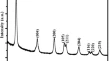
<p>XRD characterization was employed to investigate the crystal structure of the <it>in situ</it>-grown SnO<sub>2 </sub>nanowire arrays. Figure <figr fid="F2">2a</figr> shows a typical XRD pattern. The diffraction peaks can be well indexed to the standard values of bulk SnO<sub>2 </sub>(JCPDS card: 41-1445), Si (JCPDS card: 27-1402), and Pt (JCPDS card: 88-2343). The peaks attributed to SnO<sub>2 </sub>demonstrate that the <it>in situ</it>-grown sample crystallized with the tetragonal rutile structure with lattice constants of <it>a </it>= 4.738 &#197; and <it>c </it>= 3.187 &#197;.</p>
<fig id="F2"><title><p>Figure 2</p></title><caption><p>X-ray diffraction pattern (a) and Raman spectrum (b) of the prepared SnO<sub>2 </sub>nanowire arrays</p></caption><text>
   <p><b>X-ray diffraction pattern (a) and Raman spectrum (b) of the prepared SnO<sub>2 </sub>nanowire arrays</b>.</p>
</text><graphic file="1556-276X-7-117-2"/></fig>
<p>A typical room temperature Raman spectrum of the <it>in situ</it>-grown SnO<sub>2 </sub>nanowire arrays is shown in Figure <figr fid="F2">2b</figr>. It can be seen that there were three fundamental Raman peaks located at 475, 633, and 774 cm<sup>-1</sup>, which correspond to <it>E<sub>g</sub>, A</it><sub>1<it>g</it></sub>, and <it>B</it><sub>2<it>g </it></sub>vibration modes, respectively. The results are in good agreement with those of the rutile single crystal SnO<sub>2 </sub>nanowire reported previously <abbrgrp><abbr bid="B20">20</abbr></abbrgrp>. Besides the fundamental Raman peaks, the other two Raman peaks located at about 320 and 695 cm<sup><it>-</it>1 </sup>were also observed, which correspond to IR-active <it>E</it><sub><it>u</it>3</sub>TO and <it>A</it><sub>2<it>u</it></sub>LO (TO is the mode of transverse optical phonons; LO is the mode of longitudinal optical phonons) modes, respectively <abbrgrp><abbr bid="B21">21</abbr></abbrgrp>. The strong and sharp peak located at about 522 cm<sup>-1 </sup>corresponds to the characteristic peak of the silicon substrate <abbrgrp><abbr bid="B22">22</abbr><abbr bid="B23">23</abbr></abbrgrp>. It is believed that the broadening of the peaks in the Raman scattering results is attributed to the quantum confinement effect of the sample <abbrgrp><abbr bid="B24">24</abbr></abbrgrp>.</p>
<p>To investigate FE properties of the <it>in situ</it>-grown SnO<sub>2 </sub>nanowire arrays, FE measurements were performed at various anode-cathode separations. Figure <figr fid="F3">3</figr> presents the FE current density (<it>J</it>) of the <it>in situ</it>-grown SnO<sub>2 </sub>nanowire arrays as a function of the applied electric field (<it>E</it>) measured at anode-cathode separations of 100, 150, and 200 &#956;m. The turn-on field is defined as the applied electric field which produces a current density distinguished from the background noise (here, defined as 0.01 mA cm<sup>-2</sup>) <abbrgrp><abbr bid="B25">25</abbr></abbrgrp>. It can be seen from the figure that the turn-on fields were dependent on the anode-cathode distance: their value decreased as the anode-cathode distance increased, and the turn-on fields were measured to be 2.8, 2.0, and 1.6 V &#956;m<sup>-1</sup>, respectively. These values are lower than those reported by He et al. <abbrgrp><abbr bid="B26">26</abbr></abbrgrp> (5.8 V &#956;m<sup>-1</sup>) and Wang et al. <abbrgrp><abbr bid="B27">27</abbr></abbrgrp> (3.77 V &#956;m<sup>-1</sup>) for the SnO<sub>2 </sub>nanowire. The lower turn-on fields may be attributed to the good alignment of the SnO<sub>2 </sub>nanowire. Additionally, we believe that the <it>in situ </it>fabrication method, which made good electrical contacts between the SnO<sub>2 </sub>nanowire and the silicon substrate, contributed greatly to the lower turn-on fields. Moreover, the emitter radius of the SnO<sub>2 </sub>nanowire among the arrays was approximately 50 nm, which is small enough to make the FE performance excellent <abbrgrp><abbr bid="B28">28</abbr></abbrgrp>.</p>
<fig id="F3"><title><p>Figure 3</p></title><caption><p>Field-emission current density as a function of the applied electric field</p></caption><text>
   <p><b>Field-emission current density as a function of the applied electric field</b>. The measurements were performed at various anode-cathode separations of 100, 150, and 200 &#956;m.</p>
</text><graphic file="1556-276X-7-117-3"/></fig>
<p>In order to understand the emission characteristics, FE properties were also analyzed by applying the classic Fowler-Nordheim [FN] law using the following equation <abbrgrp><abbr bid="B29">29</abbr></abbrgrp>:</p>
<p><display-formula id="M1"><m:math xmlns:m="http://www.w3.org/1998/Math/MathML" name="1556-276X-7-117-i1"><m:mrow>
   <m:mi>J</m:mi>
   <m:mo class="MathClass-rel">=</m:mo>
   <m:mfrac>
      <m:mrow>
         <m:mi>a</m:mi>
         <m:msubsup>
            <m:mrow>
               <m:mi>E</m:mi>
            </m:mrow>
            <m:mrow>
               <m:mi>l</m:mi>
               <m:mi>o</m:mi>
               <m:mi>c</m:mi>
            </m:mrow>
            <m:mrow>
               <m:mn>2</m:mn>
            </m:mrow>
         </m:msubsup>
      </m:mrow>
      <m:mrow>
         <m:mi>&#966;</m:mi>
      </m:mrow>
   </m:mfrac>
   <m:mo class="qobname">exp</m:mo>
   <m:mrow>
      <m:mo class="MathClass-open">(</m:mo>
      <m:mrow>
         <m:mfrac>
            <m:mrow>
               <m:mo class="MathClass-bin">-</m:mo>
               <m:mi>b</m:mi>
               <m:msup>
                  <m:mrow>
                     <m:mi>&#966;</m:mi>
                  </m:mrow>
                  <m:mrow>
                     <m:mn>3</m:mn>
                     <m:mo class="MathClass-bin">/</m:mo>
                     <m:mn>2</m:mn>
                  </m:mrow>
               </m:msup>
            </m:mrow>
            <m:mrow>
               <m:msub>
                  <m:mrow>
                     <m:mi>E</m:mi>
                  </m:mrow>
                  <m:mrow>
                     <m:mstyle class="text">
                        <m:mtext class="textsf" mathvariant="sans-serif">loc</m:mtext>
                     </m:mstyle>
                  </m:mrow>
               </m:msub>
            </m:mrow>
         </m:mfrac>
      </m:mrow>
      <m:mo class="MathClass-close">)</m:mo>
   </m:mrow>
   <m:mo class="MathClass-punc">,</m:mo>
</m:mrow>
</m:math>
</display-formula></p>
<p>where <it>J </it>is the FE current density, <it>&#934; </it>is the barrier height of the emission tip surface, and <it>E</it><sub>loc </sub>is the local microscopic electric field at the emission sites. The <it>a </it>and <it>b </it>in the equation are constants with value of 1.54 &#215; 10<sup>-10 </sup>(A V<sup>-2 </sup>eV) and 6.83 &#215; 10<sup>9 </sup>(V eV<sup>-3/2 </sup>&#956;m<sup>-1</sup>), respectively. <it>E</it><sub>loc</sub>, which could be up to a hundred or thousand times of the macroscopic electric field between the cathode and anode, can be calculated using the following equation:</p>
<p><display-formula id="M2"><m:math xmlns:m="http://www.w3.org/1998/Math/MathML" name="1556-276X-7-117-i2"><m:mrow>
   <m:msub>
      <m:mrow>
         <m:mi>E</m:mi>
      </m:mrow>
      <m:mrow>
         <m:mi>l</m:mi>
         <m:mi>o</m:mi>
         <m:mi>c</m:mi>
      </m:mrow>
   </m:msub>
   <m:mo class="MathClass-rel">=</m:mo>
   <m:mi>&#946;</m:mi>
   <m:mfrac>
      <m:mrow>
         <m:mi>V</m:mi>
      </m:mrow>
      <m:mrow>
         <m:mi>d</m:mi>
      </m:mrow>
   </m:mfrac>
   <m:mo class="MathClass-punc">,</m:mo>
</m:mrow>
</m:math>
</display-formula></p>
<p>where <it>&#946; </it>is the field enhancement factor, <it>V </it>is the applied voltage, and <it>d </it>is the anode-cathode separation. The value of <it>&#946;</it>, which is related to the spatial distribution of emitting centers, the crystal structure, and the geometry morphology of emitters, reflects the ability of the emitters to enhance the applied local electric field around the probe compared to the macroscopic electric field. The FN emission behavior can be evaluated from the linearity of the curves plotting ln(<it>J/E<sup>2</sup></it>) versus 1/<it>E</it>. Figure <figr fid="F4">4</figr> shows the corresponding FN plots. It can be seen that, besides the noise districts, the three plots go near to a straight line. It indicates that the field emission from the <it>in situ</it>-grown SnO<sub>2 </sub>nanowire arrays follows the FN relationship well, and the field emission process is a barrier tunneling quantum mechanical process <abbrgrp><abbr bid="B30">30</abbr><abbr bid="B31">31</abbr></abbrgrp>.</p>
<fig id="F4"><title><p>Figure 4</p></title><caption><p>Fowler-Nordheim plots of the field emission current densities of the <it>in situ</it>-grown SnO<sub>2 </sub>nanowire arrays</p></caption><text>
   <p><b>Fowler-Nordheim plots of the field emission current densities of the <it>in situ</it>-grown SnO<sub>2 </sub>nanowire arrays</b>.</p>
</text><graphic file="1556-276X-7-117-4"/></fig>
<p>In general, FE characteristics depend on the work function and field enhancement factor (<it>&#946;</it>) of emitters <abbrgrp><abbr bid="B32">32</abbr></abbrgrp>. Both density and tip morphology influence the <it>&#946; </it>value of emitters. Ordinarily, emitters with high aspect ratios exhibit a favorable FE performance due to their much higher <it>&#946; </it>value. The value of <it>&#946; </it>can be calculated from the slope of a FN plot (<it>k</it><sub>FN</sub>) according to the following equation:</p>
<p><display-formula id="M3"><m:math xmlns:m="http://www.w3.org/1998/Math/MathML" name="1556-276X-7-117-i3"><m:mrow>
   <m:mi>k</m:mi>
   <m:mo class="MathClass-rel">=</m:mo>
   <m:mi>b</m:mi>
   <m:msup>
      <m:mrow>
         <m:mi>&#966;</m:mi>
      </m:mrow>
      <m:mrow>
         <m:mn>3</m:mn>
         <m:mo class="MathClass-bin">/</m:mo>
         <m:mn>2</m:mn>
      </m:mrow>
   </m:msup>
   <m:mfrac>
      <m:mrow>
         <m:mi>d</m:mi>
      </m:mrow>
      <m:mrow>
         <m:mi>&#946;</m:mi>
      </m:mrow>
   </m:mfrac>
   <m:mo class="MathClass-punc">,</m:mo>
</m:mrow>
</m:math>
</display-formula></p>
<p>where <it>&#966; </it>is the work function of SnO<sub>2 </sub>(4.3 eV) <abbrgrp><abbr bid="B33">33</abbr></abbrgrp>. By analyzing the data in Figure <figr fid="F4">4</figr>, the values of <it>&#946; </it>are estimated to be 1,082, 1,378, and 1,638 as <it>d </it>is 100, 150, and 200 &#956;m, respectively. It can be seen that the values of <it>&#946; </it>are high enough for practical application as field emitters.</p>
<p>The temporal FE current stability was measured over 120 min at an anode-cathode separation of 100 &#956;m at a fixed voltage of 500 V. The current density fluctuation is lower than 5%, as shown in Figure <figr fid="F5">5</figr>. The stability test results confirm that the <it>in situ</it>-grown SnO<sub>2 </sub>nanowire arrays are competent for being high-performance field emitters <abbrgrp><abbr bid="B34">34</abbr></abbrgrp>.</p>
<fig id="F5"><title><p>Figure 5</p></title><caption><p>Time dependence of the emission current of the <it>in situ</it>-grown SnO<sub>2 </sub>nanowire arrays</p></caption><text>
   <p><b>Time dependence of the emission current of the <it>in situ</it>-grown SnO<sub>2 </sub>nanowire arrays</b>. The characterization was measured at a fixed applied voltage (500 V) with an anode-cathode separation of 100 &#956;m.</p>
</text><graphic file="1556-276X-7-117-5"/></fig>
<p>To fabricate the vertically aligned SnO<sub>2 </sub>nanowire arrays, the thickness of a Pt catalyst is of vital importance. From many experiment results, it was found that the suitable thickness of the Pt catalyst was about 2 to 10 nm. The average length of a single SnO<sub>2 </sub>nanowire in the arrays can be controlled by adjusting the reaction time. It should be noted that the SnO<sub>2 </sub>nanowire will bend if their lengths exceeded <it>ca</it>. 100 &#956;m due to the force of their own gravity. Additionally, it was found that no nanowire grew on a blank silicon substrate (without Pt catalyst). This feature makes the <it>in situ</it>-grown method meaningful because the emitter patterns can be well controlled and designed by selective sputtering of the Pt catalyst using traditional lithography mask technology.</p>
</sec>
<sec><st><p>Conclusions</p></st>
<p>In summary, vertically aligned SnO<sub>2 </sub>nanowire arrays were deposited on a silicon substrate by an <it>in situ</it>-grown method. The FE properties of the SnO<sub>2 </sub>nanowire arrays were systematically studied. The FE measurement results showed that the SnO<sub>2 </sub>nanowire arrays had a low turn-on field of 1.6 to 2.8 V &#956;m<sup>-1 </sup>at anode-cathode separations of 100 to 200 &#956;m. The low turn-on fields can be attributed to the vertically aligned structure and the high aspect ratio of the SnO<sub>2 </sub>nanowire. Moreover, the <it>in situ</it>-grown method, which makes good electrical contacts between the SnO<sub>2 </sub>nanowire and the silicon substrate, improved the FE performance greatly.</p>
</sec>
<sec><st><p>Competing interests</p></st>
<p>The authors declare that they have no competing interests.</p>
</sec>
<sec><st><p>Authors' contributions</p></st>
<p>ZHZ conducted all the experiments and drafted the manuscript. JW provided helpful guidance and suggestions. HDL helped in drafting the manuscript. ZMW supervised all of the study. All authors read and approved the final manuscript.</p>
</sec>
</bdy>
<bm>
<ack>
<sec><st><p>Acknowledgements</p></st>
<p>This work was primarily supported by the Scientific Research Starting Foundation for Outstanding talent, University of Electronic Science and Technology of China.</p>
</sec>
</ack>
<refgrp><bibl id="B1"><title><p>Band-edge engineered hybrid structures for dye-sensitized solar cells based on SnO<sub>2 </sub>nanowires</p></title><aug><au><snm>Gubbala</snm><fnm>S</fnm></au><au><snm>Chakrapani</snm><fnm>V</fnm></au><au><snm>Kumar</snm><fnm>V</fnm></au><au><snm>Sunkara</snm><fnm>MK</fnm></au></aug><source>Adv Funct Mater</source><pubdate>2008</pubdate><volume>18</volume><fpage>2411</fpage><lpage>2418</lpage><xrefbib><pubid idtype="doi">10.1002/adfm.200800099</pubid></xrefbib></bibl><bibl id="B2"><title><p>Branched SnO<sub>2 </sub>nanowires on metallic nanowire backbones for ethanol sensors application</p></title><aug><au><snm>Wan</snm><fnm>Q</fnm></au><au><snm>Huang</snm><fnm>J</fnm></au><au><snm>Xie</snm><fnm>Z</fnm></au><au><snm>Wang</snm><fnm>TH</fnm></au><au><snm>Dattoli</snm><fnm>EN</fnm></au><au><snm>Lu</snm><fnm>W</fnm></au></aug><source>Appl Phys Lett</source><pubdate>2008</pubdate><volume>92</volume><fpage>102101</fpage><xrefbib><pubid idtype="doi">10.1063/1.2890735</pubid></xrefbib></bibl><bibl id="B3"><title><p>A gradient microarray electronic nose based on percolating SnO<sub>2 </sub>nanowire sensing elements</p></title><aug><au><snm>Sysoev</snm><fnm>VV</fnm></au><au><snm>Goschnick</snm><fnm>J</fnm></au><au><snm>Schneider</snm><fnm>T</fnm></au><au><snm>Strelcov</snm><fnm>E</fnm></au><au><snm>Kolmakov</snm><fnm>A</fnm></au></aug><source>Nano Lett</source><pubdate>2007</pubdate><volume>7</volume><fpage>3182</fpage><lpage>3188</lpage><xrefbib><pubidlist><pubid idtype="doi">10.1021/nl071815+</pubid><pubid idtype="pmpid" link="fulltext">17924710</pubid></pubidlist></xrefbib></bibl><bibl id="B4"><title><p>Hard templating synthesis of mesoporous and nanowire SnO<sub>2 </sub>lithium battery anode materials</p></title><aug><au><snm>Kim</snm><fnm>H</fnm></au><au><snm>Cho</snm><fnm>J</fnm></au></aug><source>J Mater Chem</source><pubdate>2008</pubdate><volume>18</volume><fpage>771</fpage><lpage>775</lpage><xrefbib><pubid idtype="doi">10.1039/b714904b</pubid></xrefbib></bibl><bibl id="B5"><title><p>The current image of single SnO<sub>2 </sub>nanobelt nanodevice studied by conductive atomic force microscopy</p></title><aug><au><snm>Wang</snm><fnm>S</fnm></au><au><snm>Cheng</snm><fnm>G</fnm></au><au><snm>Cheng</snm><fnm>K</fnm></au><au><snm>Jiang</snm><fnm>X</fnm></au><au><snm>Du</snm><fnm>Z</fnm></au></aug><source>Nanoscale Res Lett</source><pubdate>2011</pubdate><volume>6</volume><fpage>541</fpage><xrefbib><pubidlist><pubid idtype="doi">10.1186/1556-276X-6-541</pubid><pubid idtype="pmcid">3212080</pubid><pubid idtype="pmpid" link="fulltext">21970459</pubid></pubidlist></xrefbib></bibl><bibl id="B6"><title><p>SnO<sub>2 </sub>nanowhiskers and their ethanol sensing characteristics</p></title><aug><au><snm>Ying</snm><fnm>Z</fnm></au><au><snm>Wan</snm><fnm>Q</fnm></au><au><snm>Song</snm><fnm>ZT</fnm></au><au><snm>Feng</snm><fnm>SL</fnm></au></aug><source>Nanotechnology</source><pubdate>2004</pubdate><volume>15</volume><fpage>1682</fpage><lpage>1684</lpage><xrefbib><pubid idtype="doi">10.1088/0957-4484/15/11/053</pubid></xrefbib></bibl><bibl id="B7"><title><p>Biotemplate fabrication of SnO<sub>2 </sub>nanotubular materials by a sonochemical method for gas sensors</p></title><aug><au><snm>Zhu</snm><fnm>SM</fnm></au><au><snm>Zhang</snm><fnm>D</fnm></au><au><snm>Gu</snm><fnm>JJ</fnm></au><au><snm>Xu</snm><fnm>JQ</fnm></au><au><snm>Dong</snm><fnm>JP</fnm></au><au><snm>Li</snm><fnm>JL</fnm></au></aug><source>J Nanopart Res</source><pubdate>2010</pubdate><volume>12</volume><fpage>1389</fpage><lpage>1400</lpage><xrefbib><pubid idtype="doi">10.1007/s11051-009-9684-0</pubid></xrefbib></bibl><bibl id="B8"><title><p>Growth, characterization and technological applications of semiconductor SnO<sub>2 </sub>nanotubes and In<sub>2</sub>O<sub>3 </sub>nanowires</p></title><aug><au><snm>Wang</snm><fnm>GX</fnm></au><au><snm>Park</snm><fnm>JS</fnm></au><au><snm>Park</snm><fnm>MS</fnm></au></aug><source>J Nanosci Nanotechnol</source><pubdate>2009</pubdate><volume>9</volume><fpage>1144</fpage><lpage>1147</lpage><xrefbib><pubidlist><pubid idtype="doi">10.1166/jnn.2009.C106</pubid><pubid idtype="pmpid">19441474</pubid></pubidlist></xrefbib></bibl><bibl id="B9"><title><p>Hydrothermal synthesis of SnO<sub>2 </sub>nanoflower arrays and their optical properties</p></title><aug><au><snm>Wang</snm><fnm>YL</fnm></au><au><snm>Guo</snm><fnm>M</fnm></au><au><snm>Zhang</snm><fnm>M</fnm></au><au><snm>Wang</snm><fnm>XD</fnm></au></aug><source>Scripta Mater</source><pubdate>2009</pubdate><volume>61</volume><fpage>234</fpage><lpage>236</lpage><xrefbib><pubid idtype="doi">10.1016/j.scriptamat.2009.03.040</pubid></xrefbib></bibl><bibl id="B10"><title><p>Characterization of nanocrystalline SnO<sub>2 </sub>thin film fabricated by electrodeposition method for dye-sensitized solar cell application</p></title><aug><au><snm>El-Etre</snm><fnm>AY</fnm></au><au><snm>Reda</snm><fnm>SM</fnm></au></aug><source>Appl Surf Sci</source><pubdate>2010</pubdate><volume>256</volume><fpage>6601</fpage><lpage>6606</lpage><xrefbib><pubid idtype="doi">10.1016/j.apsusc.2010.04.055</pubid></xrefbib></bibl><bibl id="B11"><title><p>Synthesis and field emission of patterned SnO<sub>2 </sub>nanoflowers</p></title><aug><au><snm>Zhang</snm><fnm>YS</fnm></au><au><snm>Yu</snm><fnm>K</fnm></au><au><snm>Li</snm><fnm>GD</fnm></au><au><snm>Peng</snm><fnm>DY</fnm></au><au><snm>Zhang</snm><fnm>QX</fnm></au><au><snm>Xu</snm><fnm>F</fnm></au><au><snm>Bai</snm><fnm>W</fnm></au><au><snm>Ouyang</snm><fnm>SX</fnm></au><au><snm>Zhu</snm><fnm>ZQ</fnm></au></aug><source>Mater Lett</source><pubdate>2006</pubdate><volume>60</volume><fpage>3109</fpage><lpage>3112</lpage><xrefbib><pubid idtype="doi">10.1016/j.matlet.2006.02.053</pubid></xrefbib></bibl><bibl id="B12"><title><p>Structure and field emission properties of SnO<sub>2 </sub>nanowires</p></title><aug><au><snm>Li</snm><fnm>LJ</fnm></au><au><snm>Zong</snm><fnm>FJ</fnm></au><au><snm>Cui</snm><fnm>XD</fnm></au><au><snm>Ma</snm><fnm>HL</fnm></au><au><snm>Wu</snm><fnm>XH</fnm></au><au><snm>Zhang</snm><fnm>QD</fnm></au><au><snm>Wang</snm><fnm>YL</fnm></au><au><snm>Yang</snm><fnm>F</fnm></au><au><snm>Zhao</snm><fnm>JZ</fnm></au></aug><source>Mater Lett</source><pubdate>2007</pubdate><volume>61</volume><fpage>4152</fpage><lpage>4155</lpage><xrefbib><pubid idtype="doi">10.1016/j.matlet.2007.01.044</pubid></xrefbib></bibl><bibl id="B13"><title><p>Enhancement of field emission of SnO<sub>2 </sub>nanowires film by exposure of hydrogen gas</p></title><aug><au><snm>Jang</snm><fnm>HS</fnm></au><au><snm>Kang</snm><fnm>SO</fnm></au><au><snm>Kim</snm><fnm>YI</fnm></au></aug><source>Solid State Commun</source><pubdate>2006</pubdate><volume>140</volume><fpage>495</fpage><lpage>499</lpage><xrefbib><pubid idtype="doi">10.1016/j.ssc.2006.09.024</pubid></xrefbib></bibl><bibl id="B14"><title><p>Controllable synthesis and field emission properties of SnO<sub>2 </sub>zigzag nanobelts</p></title><aug><au><snm>Wu</snm><fnm>J</fnm></au><au><snm>Yu</snm><fnm>K</fnm></au><au><snm>Li</snm><fnm>LJ</fnm></au><au><snm>Xu</snm><fnm>JW</fnm></au><au><snm>Shang</snm><fnm>DJ</fnm></au><au><snm>Xu</snm><fnm>YE</fnm></au><au><snm>Zhu</snm><fnm>ZQ</fnm></au></aug><source>J Phys D Appl Phys</source><pubdate>2008</pubdate><volume>41</volume><fpage>185302</fpage><xrefbib><pubid idtype="doi">10.1088/0022-3727/41/18/185302</pubid></xrefbib></bibl><bibl id="B15"><title><p>Field emission investigations of RuO<sub>2</sub>-doped SnO<sub>2 </sub>wires</p></title><aug><au><snm>Bhise</snm><fnm>AB</fnm></au><au><snm>Late</snm><fnm>DJ</fnm></au><au><snm>Ramgir</snm><fnm>NS</fnm></au><au><snm>More</snm><fnm>MA</fnm></au><au><snm>Mulla</snm><fnm>IS</fnm></au><au><snm>Pillai</snm><fnm>VK</fnm></au><au><snm>Joag</snm><fnm>DS</fnm></au></aug><source>Appl Surf Sci</source><pubdate>2007</pubdate><volume>253</volume><fpage>9159</fpage><lpage>9163</lpage><xrefbib><pubid idtype="doi">10.1016/j.apsusc.2007.05.058</pubid></xrefbib></bibl><bibl id="B16"><title><p>Inorganic semiconductor nanostructures and their field-emission applications</p></title><aug><au><snm>Fang</snm><fnm>XS</fnm></au><au><snm>Bando</snm><fnm>Y</fnm></au><au><snm>Gautam</snm><fnm>UK</fnm></au><au><snm>Ye</snm><fnm>C</fnm></au><au><snm>Golberg</snm><fnm>D</fnm></au></aug><source>J Mater Chem</source><pubdate>2008</pubdate><volume>18</volume><fpage>509</fpage><lpage>522</lpage><xrefbib><pubid idtype="doi">10.1039/b712874f</pubid></xrefbib></bibl><bibl id="B17"><title><p>Preparation and characterization of polyacrylonitrile/antimony doped tin oxide composite nanofibers by electrospinning method</p></title><aug><au><snm>Pan</snm><fnm>W</fnm></au><au><snm>He</snm><fnm>XW</fnm></au><au><snm>Chen</snm><fnm>Y</fnm></au></aug><source>Optoelectron Adv Mat</source><pubdate>2010</pubdate><volume>4</volume><fpage>390</fpage><lpage>394</lpage></bibl><bibl id="B18"><title><p>Tin oxide nanorod array-based electrochemical hydrogen peroxide biosensor</p></title><aug><au><snm>Liu</snm><fnm>J</fnm></au><au><snm>Li</snm><fnm>Y</fnm></au><au><snm>Huang</snm><fnm>X</fnm></au><au><snm>Zhu</snm><fnm>Z</fnm></au></aug><source>Nanoscale Res Lett</source><pubdate>2010</pubdate><volume>5</volume><fpage>1177</fpage><lpage>1181</lpage><xrefbib><pubidlist><pubid idtype="doi">10.1007/s11671-010-9622-1</pubid><pubid idtype="pmcid">2894215,2894215</pubid><pubid idtype="pmpid" link="fulltext">20596358</pubid></pubidlist></xrefbib></bibl><bibl id="B19"><title><p>Synthesis and applications of one-dimensional semiconductors</p></title><aug><au><snm>Barth</snm><fnm>S</fnm></au><au><snm>Hernandez-Ramirez</snm><fnm>F</fnm></au><au><snm>Holmes</snm><fnm>JD</fnm></au><au><snm>Romano-Rodriguez</snm><fnm>A</fnm></au></aug><source>Prog Mater Sci</source><pubdate>2010</pubdate><volume>55</volume><fpage>563</fpage><lpage>627</lpage><xrefbib><pubid idtype="doi">10.1016/j.pmatsci.2010.02.001</pubid></xrefbib></bibl><bibl id="B20"><title><p>Synthesis and optical properties of SnO<sub>2 </sub>nanorods</p></title><aug><au><snm>Gu</snm><fnm>F</fnm></au><au><snm>Wang</snm><fnm>SF</fnm></au><au><snm>Cao</snm><fnm>HM</fnm></au><au><snm>Li</snm><fnm>CZ</fnm></au></aug><source>Nanotechnology</source><pubdate>2008</pubdate><volume>19</volume><fpage>095708</fpage><xrefbib><pubidlist><pubid idtype="doi">10.1088/0957-4484/19/9/095708</pubid><pubid idtype="pmpid" link="fulltext">21817690</pubid></pubidlist></xrefbib></bibl><bibl id="B21"><title><p>Preparation and structural characterization of nanocrystalline SnO<sub>2 </sub>powders</p></title><aug><au><snm>Zheng</snm><fnm>MJ</fnm></au><au><snm>Ma</snm><fnm>L</fnm></au><au><snm>Xu</snm><fnm>WL</fnm></au><au><snm>Ding</snm><fnm>GQ</fnm></au><au><snm>Shen</snm><fnm>WZ</fnm></au></aug><source>Appl Phys A-mater</source><pubdate>2005</pubdate><volume>81</volume><fpage>721</fpage><lpage>723</lpage><xrefbib><pubid idtype="doi">10.1007/s00339-005-3223-3</pubid></xrefbib></bibl><bibl id="B22"><title><p>Raman scattering study of ion implanted and C.W.-Laser annealed polycrystalline silicon</p></title><aug><au><snm>Nakashima</snm><fnm>S</fnm></au><au><snm>Oima</snm><fnm>S</fnm></au><au><snm>Mitsuishi</snm><fnm>A</fnm></au><au><snm>Nishimura</snm><fnm>T</fnm></au><au><snm>Fukumoto</snm><fnm>T</fnm></au><au><snm>Akasaka</snm><fnm>Y</fnm></au></aug><source>Solid State Commun</source><pubdate>1981</pubdate><volume>40</volume><fpage>765</fpage><lpage>768</lpage><xrefbib><pubid idtype="doi">10.1016/0038-1098(81)90825-5</pubid></xrefbib></bibl><bibl id="B23"><title><p>Photoluminescence and field-emission properties of Cu-doped SnO<sub>2 </sub>nanobelts</p></title><aug><au><snm>Li</snm><fnm>LJ</fnm></au><au><snm>Yu</snm><fnm>K</fnm></au><au><snm>Mao</snm><fnm>HB</fnm></au><au><snm>Zhu</snm><fnm>ZQ</fnm></au></aug><source>Appl Phys A-mater</source><pubdate>2010</pubdate><volume>99</volume><fpage>865</fpage><lpage>869</lpage><xrefbib><pubid idtype="doi">10.1007/s00339-010-5620-5</pubid></xrefbib></bibl><bibl id="B24"><title><p>Raman scattering study of rutile SnO<sub>2 </sub>nanobelts synthesized by thermal evaporation of Sn powders</p></title><aug><au><snm>Sun</snm><fnm>S</fnm></au></aug><source>Chem Phys Lett</source><pubdate>2003</pubdate><volume>376</volume><fpage>103</fpage><lpage>107</lpage><xrefbib><pubid idtype="doi">10.1016/S0009-2614(03)00965-5</pubid></xrefbib></bibl><bibl id="B25"><title><p>Morphology and field emission from ZnO nanowire arrays synthesized at different temperature</p></title><aug><au><snm>Li</snm><fnm>M-K</fnm></au><au><snm>Wang</snm><fnm>D-Z</fnm></au><au><snm>Ding</snm><fnm>Y-W</fnm></au><au><snm>Guo</snm><fnm>X-Y</fnm></au><au><snm>Ding</snm><fnm>S</fnm></au><au><snm>Jin</snm><fnm>H</fnm></au></aug><source>Mat Sci Eng A-struct</source><pubdate>2007</pubdate><volume>452-453</volume><fpage>417</fpage><lpage>421</lpage></bibl><bibl id="B26"><title><p>Beaklike SnO<sub>2 </sub>nanorods with strong photoluminescent and field-emission properties</p></title><aug><au><snm>He</snm><fnm>JH</fnm></au><au><snm>Wu</snm><fnm>TH</fnm></au><au><snm>Hsin</snm><fnm>CL</fnm></au><au><snm>Li</snm><fnm>KM</fnm></au><au><snm>Chen</snm><fnm>LJ</fnm></au><au><snm>Chueh</snm><fnm>YL</fnm></au><au><snm>Chou</snm><fnm>LJ</fnm></au><au><snm>Wang</snm><fnm>ZL</fnm></au></aug><source>Small</source><pubdate>2006</pubdate><volume>2</volume><fpage>116</fpage><lpage>120</lpage><xrefbib><pubidlist><pubid idtype="doi">10.1002/smll.200500210</pubid><pubid idtype="pmpid" link="fulltext">17193566</pubid></pubidlist></xrefbib></bibl><bibl id="B27"><title><p>Considerable enhancement of field emission of SnO<sub>2 </sub>nanowires by post-annealing process in oxygen at high temperature</p></title><aug><au><snm>Wang</snm><fnm>JB</fnm></au><au><snm>Li</snm><fnm>K</fnm></au><au><snm>Zhong</snm><fnm>XL</fnm></au><au><snm>Zhou</snm><fnm>YC</fnm></au><au><snm>Fang</snm><fnm>XS</fnm></au><au><snm>Tang</snm><fnm>CC</fnm></au><au><snm>Bando</snm><fnm>Y</fnm></au></aug><source>Nanoscale Res Lett</source><pubdate>2009</pubdate><volume>4</volume><fpage>1135</fpage><lpage>1140</lpage><xrefbib><pubidlist><pubid idtype="doi">10.1007/s11671-009-9367-x</pubid><pubid idtype="pmcid">2894354,2894354</pubid><pubid idtype="pmpid" link="fulltext">20596286</pubid></pubidlist></xrefbib></bibl><bibl id="B28"><title><p>Quantum-mechanical investigation of field-emission mechanism of a micrometer-long single-walled carbon nanotube</p></title><aug><au><snm>Zheng</snm><fnm>X</fnm></au><au><snm>Chen</snm><fnm>G</fnm></au><au><snm>Li</snm><fnm>Z</fnm></au><au><snm>Deng</snm><fnm>S</fnm></au><au><snm>Xu</snm><fnm>N</fnm></au></aug><source>Phys Rev Lett</source><pubdate>2004</pubdate><volume>92</volume><fpage>106803</fpage><xrefbib><pubid idtype="pmpid" link="fulltext">15089226</pubid></xrefbib></bibl><bibl id="B29"><title><p>Fabrication and properties of film-under-gate field emission arrays with SnO<sub>2 </sub>emitters for flat lamp</p></title><aug><au><snm>Zhang</snm><fnm>YA</fnm></au><au><snm>Lin</snm><fnm>JY</fnm></au><au><snm>Guo</snm><fnm>TL</fnm></au></aug><source>Appl Surf Sci</source><pubdate>2010</pubdate><volume>257</volume><fpage>306</fpage><lpage>311</lpage><xrefbib><pubid idtype="doi">10.1016/j.apsusc.2010.06.093</pubid></xrefbib></bibl><bibl id="B30"><title><p>A carbon nanotube field-emission electron source</p></title><aug><au><snm>de Heer</snm><fnm>WA</fnm></au><au><snm>Ch&#226;telain</snm><fnm>A</fnm></au><au><snm>Ugarte</snm><fnm>D</fnm></au></aug><source>Science</source><pubdate>1995</pubdate><volume>270</volume><fpage>1179</fpage><lpage>1180</lpage><xrefbib><pubid idtype="doi">10.1126/science.270.5239.1179</pubid></xrefbib></bibl><bibl id="B31"><title><p>Effect of nitrogen on deposition and field emission properties of boron-doped micro- and nano-crystalline diamond films</p></title><aug><au><snm>Li</snm><fnm>LA</fnm></au><au><snm>Cheng</snm><fnm>SH</fnm></au><au><snm>Li</snm><fnm>HD</fnm></au><au><snm>Yu</snm><fnm>Q</fnm></au><au><snm>Liu</snm><fnm>JW</fnm></au><au><snm>Lv</snm><fnm>XY</fnm></au></aug><source>Nano-Micro Lett</source><pubdate>2010</pubdate><volume>2</volume><fpage>154</fpage><lpage>159</lpage></bibl><bibl id="B32"><title><p>Electrochemical synthesis of Cu/ZnO nanocomposite films and their efficient field emission behaviour</p></title><aug><au><snm>Sheini</snm><fnm>FJ</fnm></au><au><snm>Singh</snm><fnm>J</fnm></au><au><snm>Srivasatva</snm><fnm>ON</fnm></au><au><snm>Joag</snm><fnm>DS</fnm></au><au><snm>More</snm><fnm>MA</fnm></au></aug><source>Appl Surf Sci</source><pubdate>2010</pubdate><volume>256</volume><fpage>2110</fpage><lpage>2114</lpage><xrefbib><pubid idtype="doi">10.1016/j.apsusc.2009.09.056</pubid></xrefbib></bibl><bibl id="B33"><title><p>Vacuum electron field emission from SnO<sub>2 </sub>nanowhiskers annealed in N<sub>2 </sub>and O<sub>2 </sub>atmospheres</p></title><aug><au><snm>Luo</snm><fnm>S</fnm></au><au><snm>Chu</snm><fnm>PK</fnm></au><au><snm>Di</snm><fnm>Z</fnm></au><au><snm>Zhang</snm><fnm>M</fnm></au><au><snm>Liu</snm><fnm>W</fnm></au><au><snm>Lin</snm><fnm>C</fnm></au><au><snm>Fan</snm><fnm>J</fnm></au><au><snm>Wu</snm><fnm>X</fnm></au></aug><source>Appl Phys Lett</source><pubdate>2006</pubdate><volume>88</volume><fpage>013109</fpage><xrefbib><pubid idtype="doi">10.1063/1.2161573</pubid></xrefbib></bibl><bibl id="B34"><title><p>Extremely stable field emission from AlZnO nanowire arrays</p></title><aug><au><snm>Xue</snm><fnm>XY</fnm></au><au><snm>Li</snm><fnm>LM</fnm></au><au><snm>Yu</snm><fnm>HC</fnm></au><au><snm>Chen</snm><fnm>YJ</fnm></au><au><snm>Wang</snm><fnm>YG</fnm></au><au><snm>Wang</snm><fnm>TH</fnm></au></aug><source>Appl Phys Lett</source><pubdate>2006</pubdate><volume>89</volume><fpage>043118</fpage><xrefbib><pubid idtype="doi">10.1063/1.2236288</pubid></xrefbib></bibl></refgrp>
</bm>
</art>