<?xml version='1.0'?>
<!DOCTYPE art SYSTEM 'http://www.biomedcentral.com/xml/article.dtd'>
<art><ui>1556-276X-6-84</ui><ji>1556-276X</ji><fm>
<dochead>Nano Express</dochead>
<bibl>
<title>
<p>Temperature and electron density dependence of spin relaxation in GaAs/AlGaAs quantum well</p>
</title>
<aug>
<au id="A1"><snm>Han</snm><fnm>Lifen</fnm><insr iid="I1"/><email>hanlifen0413@163.com</email></au>
<au id="A2"><snm>Zhu</snm><fnm>Yonggang</fnm><insr iid="I1"/><email>ygzhu@semi.ac.cn</email></au>
<au ca="yes" id="A3"><snm>Zhang</snm><fnm>Xinhui</fnm><insr iid="I1"/><email>xinhuiz@semi.ac.cn</email></au>
<au id="A4"><snm>Tan</snm><fnm>Pingheng</fnm><insr iid="I1"/><email>phtan@red.semi.ac.cn</email></au>
<au id="A5"><snm>Ni</snm><fnm>Haiqiao</fnm><insr iid="I1"/><email>nihq@red.semi.ac.cn</email></au>
<au id="A6"><snm>Niu</snm><fnm>Zhichuan</fnm><insr iid="I1"/><email>zcniu@red.semi.ac.cn</email></au>
</aug>
<insg>
<ins id="I1"><p>State Key Laboratory for Superlattices and Microstructures, Institute of Semiconductors, Chinese Academy of Sciences, P. O. Box 912, Beijing 100083, People's Republic of China</p></ins>
</insg>
<source>Nanoscale Research Letters</source>
<issn>1556-276X</issn>
<pubdate>2011</pubdate>
<volume>6</volume>
<issue>1</issue>
<fpage>84</fpage>
<url>http://www.nanoscalereslett.com/content/6/1/84</url>
<xrefbib><pubidlist><pubid idtype="pmpid">21711611</pubid><pubid idtype="doi">10.1186/1556-276X-6-84</pubid></pubidlist></xrefbib>
</bibl>
<history><rec><date><day>12</day><month>9</month><year>2010</year></date></rec><acc><date><day>12</day><month>1</month><year>2011</year></date></acc><pub><date><day>12</day><month>1</month><year>2011</year></date></pub></history>
<cpyrt><year>2011</year><collab>Han et al; licensee Springer.</collab><note>This is an Open Access article distributed under the terms of the Creative Commons Attribution License (<url>http://creativecommons.org/licenses/by/2.0</url>), which permits unrestricted use, distribution, and reproduction in any medium, provided the original work is properly cited.</note></cpyrt>
<abs>
<sec>
<st>
<p>Abstract</p>
</st>
<p>Temperature and carrier density-dependent spin dynamics for GaAs/AlGaAs quantum wells (QWs) with different structural symmetries have been studied by using time-resolved Kerr rotation technique. The spin relaxation time is measured to be much longer for the symmetrically designed GaAs QW comparing with the asymmetrical one, indicating the strong influence of Rashba spin-orbit coupling on spin relaxation. D'yakonov-Perel' mechanism has been revealed to be the dominant contribution for spin relaxation in GaAs/AlGaAs QWs. The spin relaxation time exhibits non-monotonic-dependent behavior on both temperature and photo-excited carrier density, revealing the important role of non-monotonic temperature and density dependence of electron-electron Coulomb scattering. Our experimental observations demonstrate good agreement with recently developed spin relaxation theory based on microscopic kinetic spin Bloch equation approach.</p>
</sec>
</abs>
</fm><meta>
<classifications>
<classification id="ICSNN_2010" subtype="theme_series_title" type="BMC">International Conference on Superlattices, Nanostructures and Nanodevices (ICSNN 2010)</classification>
<classification id="ICSNN_2010" subtype="theme_series_editor" type="BMC"/>
</classifications>
</meta><bdy>
<sec>
<st>
<p>Introduction</p>
</st>
<p>Spin dynamics and the related physics in semiconductors have drawn much attention in the past years because of its importance to realize novel spin-electronic devices <abbrgrp>
<abbr bid="B1">1</abbr>
</abbrgrp>. In recent years, electron spin relaxation in many types of materials, especially in low dimensional III-V group semiconductor heterostructures, has been studied extensively both theoretically and experimentally <abbrgrp>
<abbr bid="B1">1</abbr>
</abbrgrp>. The relevant spin relaxation mechanisms, such as the Elliott-Yafet, Bir-Aranov-Pikus (BAP), and D'yakonov-Perel' (DP) mechanisms as well as hyperfine interactions, have been well established to describe spin relaxation and dephasing dynamics. However, the relative importance of these mechanisms strongly depends on material design and temperature as well as carrier concentration and so on. Previous investigations in literature show that the BAP mechanism dominates the spin relaxation at low temperatures for bulk GaAs <abbrgrp>
<abbr bid="B2">2</abbr>
<abbr bid="B3">3</abbr>
</abbrgrp> and GaAs/AlGaAs quantum wells (QWs) <abbrgrp>
<abbr bid="B4">4</abbr>
<abbr bid="B5">5</abbr>
</abbrgrp>, whereas DP mechanism dominates spin relaxation in other regimes. However, recent reexaminations using the microscopic kinetic spin Bloch equation approach <abbrgrp>
<abbr bid="B6">6</abbr>
<abbr bid="B7">7</abbr>
<abbr bid="B8">8</abbr>
<abbr bid="B9">9</abbr>
</abbrgrp> have revealed that the BAP mechanism is much less important than DP mechanism for intrinsic III-V group semiconductors, even at low temperatures. The DP mechanism resulting from spin-orbit coupling in systems lacking inversion symmetry, such as zinc-blende structure or asymmetric confining potentials in QWs, has a spin relaxation rate inversely related to the momentum scattering rate <abbrgrp>
<abbr bid="B9">9</abbr>
</abbrgrp>. Electron spin relaxation in GaAs QWs has been experimentally studied through temperature <abbrgrp>
<abbr bid="B10">10</abbr>
<abbr bid="B11">11</abbr>
</abbrgrp> and QW width dependence <abbrgrp>
<abbr bid="B10">10</abbr>
<abbr bid="B11">11</abbr>
<abbr bid="B12">12</abbr>
</abbrgrp>, and DP mechanism has been revealed to dominate spin relaxation in intrinsic QWs at high temperatures <abbrgrp>
<abbr bid="B10">10</abbr>
</abbrgrp>. The oscillatory spin dynamics study for two-dimensional electron gas (2DEG) at low temperatures also demonstrated the dominance of DP mechanism in the weak momentum scattering regime <abbrgrp>
<abbr bid="B13">13</abbr>
</abbrgrp>. The observed enhancement of spin relaxation time resulting from electron-electron scattering in <it>n</it>-doped GaAs/AlGaAs QW agrees with DP mechanism governed by electron-electron scattering as well <abbrgrp>
<abbr bid="B14">14</abbr>
<abbr bid="B15">15</abbr>
<abbr bid="B16">16</abbr>
<abbr bid="B17">17</abbr>
</abbrgrp>. The experimental observation of electron spin relaxation time maximum for temperature-dependent study in a high-mobility GaAs/AlGaAs 2DEG has also revealed the importance of electron-electron Coulomb scattering <abbrgrp>
<abbr bid="B18">18</abbr>
</abbrgrp>.</p>
<p>The spin-orbit (SO) coupling leads to a strong momentum-dependent mixing of spin and orbital-momentum eigenstates, so that scattering processes change spin and orbital angular momentum, and therefore contribute to spin relaxation accordingly <abbrgrp>
<abbr bid="B19">19</abbr>
<abbr bid="B20">20</abbr>
<abbr bid="B21">21</abbr>
</abbrgrp>. For electrons in two-dimensional semiconductor heterostructures or QWs, the Rashba SO coupling due to structure inversion asymmetry and the Dresselhaus SO coupling due to bulk inversion asymmetry in the compounds cause electron spin relaxation and decoherence through spin precession of carriers with finite crystal momentum <it>k </it>in the effective <it>k</it>-dependent crystal magnetic field of an inversion-asymmetric material. Therefore, spin relaxation and decoherence studies in semiconductors have revealed important physics of SO coupling. Since carrier spin relaxation is related to several competing mechanisms and particularly different materials and structural designs, different SO coupling is involved to spin relaxation processes. Thus, the experimental investigation of spin relaxation and its dependence on temperature and carrier density have been found to vary widely between different samples. In this study, we have designed two GaAs/AlGaAs QWs with different structural symmetries. The spin relaxation time is measured to be much shorter for the asymmetrically designed GaAs/AlGaAs QW comparing with the symmetrical one, indicating the strong effect of Rashba SO coupling on spin relaxation. The comprehensive studies of temperature and carrier density dependence of spin relaxation time for both samples have revealed that electron spin relaxation in GaAs/AlGaAs QWs is governed mainly by DP mechanism in the entire temperature regime. The spin relaxation time exhibits non-monotonic behavior for both temperature and photo-excited carrier density dependence, revealing the important role of non-monotonic temperature and density dependence of electron-electron Coulomb scattering. Our experimental observations demonstrate good agreement with recently developed spin relaxation theory based on microscopic kinetic spin Bloch equation approach <abbrgrp>
<abbr bid="B6">6</abbr>
<abbr bid="B7">7</abbr>
<abbr bid="B8">8</abbr>
<abbr bid="B9">9</abbr>
</abbrgrp>.</p>
</sec>
<sec>
<st>
<p>Experimental details</p>
</st>
<p>The samples used in our experiments were <it>n</it>-modulation-doped single GaAs/AlGaAs QW with well width of 10 nm grown by molecular beam epitaxy on (100)-oriented semi-insulating GaAs substrates. As shown in Figure <figr fid="F1">1</figr>, one of the samples is designed to be symmetric with two-side symmetric Al<sub>0.3</sub>Ga<sub>0.7</sub>As barriers and &#948;-doping concentration of 2 &#215; 10<sup>10 </sup>cm<sup>-2</sup>. The other sample is designed to be asymmetric with different aluminum components at two sides (Al<sub>0.3</sub>Ga<sub>0.7</sub>As for the upside barrier and Al<sub>0.25</sub>Ga<sub>0.75</sub>As for the downside barrier) and asymmetric doping concentration as well (the nominal upside <it>n</it>-modulation doping is 2 &#215; 10<sup>11 </sup>cm<sup>-2 </sup>and the downside doping is 2 &#215; 10<sup>10 </sup>cm<sup>-2</sup>). The rest layer structures and growth conditions are identical for two samples.</p>
<fig id="F1"><title><p>Figure 1</p></title><caption><p>Schematic diagram of the symmetric (left) and asymmetric (right) GaAs/AlGaAs quantum well structures grown by MBE</p></caption><text>
   <p><b>Schematic diagram of the symmetric (left) and asymmetric (right) GaAs/AlGaAs quantum well structures grown by MBE</b>.</p>
</text><graphic file="1556-276X-6-84-1"/></fig>
<p>In our time-resolved magneto-Kerr rotation measurement, a Ti:Sapphire laser system (Chameleon Ultra II, Coherent Inc., USA) provided 150 fs pulses with repetition rate of 80 MHz. The pump beam with central wavelength ranging from 770 to 860 nm was incident normal to the sample, while probe beam was at an angle of about 30&#176; to the surface normal. The polarization of the pump beam was adjusted to be circularly polarized and the probe beam was linearly polarized. The sample was mounted within a Janis closed-cycle optical cryostat, which is located in-between two poles of an electromagnet. After reflection from sample, the Kerr rotation signal was detected by a sensitive optical bridge and lock-in amplifier. The photoluminescence (PL) measurements have been first performed at wide temperature range to check the sample's quality and identify the band-edge energies for the specially designed samples.</p>
</sec>
<sec>
<st>
<p>Results and discussion</p>
</st>
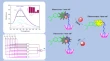
<p>Both samples have shown very good PL response up to room temperature as shown in Figure <figr fid="F2">2</figr>, indicating a good sample quality. The PL peak at 848 nm is related to the band edge of QW and the peak at 870 nm is related to the band edge of GaAs substrate. The band edge-related PL peak for QW has blue-shifted to 798 nm at 10 K as expected. The time-resolved Kerr rotation measurements are then performed at different temperatures and photo-excitation powers with excitation wavelength centered either at the resonant position of the band edge PL peak of QWs or well above it. The typical time-resolved Kerr rotation signals measured at 20, 200, and 250 K with an excitation wavelength of 798 nm and pumping electron densities of 1.15 &#215; 10<sup>11 </sup>cm<sup>-2 </sup>for the asymmetric GaAs QW have been presented in Figure <figr fid="F3">3a</figr>. The temperature dependence of electron spin relaxation times extracted from the exponential decay function fitting of time-resolved Kerr response for both symmetric and asymmetric GaAs/AlGaAs QWs is shown in Figure <figr fid="F3">3b</figr>. The measured spin relaxation time for the symmetric GaAs/AlGaAs QW is in general longer than the asymmetric one at low temperature regime (&lt; 100 K). This result is consistent with the well-established DP spin relaxation mechanism, in which the SO coupling plays an important role for electron spin relaxation. It is naturally expected that the Rashba SO coupling in the asymmetric sample should be stronger than the symmetric one, whereas the Dresselhaus SO coupling could be similar for two samples. The shorter spin relaxation time for the asymmetric QW is caused by much stronger inhomogeneous magnetic fluctuations resulting from stronger Rashba SO coupling than the symmetric QW. Meanwhile, electron spin relaxation times for both symmetric and asymmetric GaAs/AlGaAs QWs have shown non-monotonical dependence on temperature. Spin relaxation time increases first with increasing temperature, showing a peak value of 399 ps around 180 K, and then decreases with further increase in temperature for the asymmetric QW. The symmetric GaAs/Al<sub>0.3</sub>Ga<sub>0.7</sub>As QW shows the similar temperature-dependent spin relaxation time behavior, but with a maximum spin relaxation time of 592 ps observed around 60 K. The BAP mechanism, in which the spin relaxation is caused by spin-flip via the electron-hole exchange interaction, predicts that the spin-relaxation time decreases rapidly with increasing temperature in low-temperature regime. However, the observed low temperature dependence of spin relaxation is in contrast to the BAP mechanism. Rather, the appearance of a peak in the temperature-dependent spin relaxation time for both symmetric and asymmetric GaAs QW structures agrees well with the theoretical reexamination of spin dynamics in both QW and bulk intrinsic III-V group semiconductors <abbrgrp>
<abbr bid="B6">6</abbr>
<abbr bid="B7">7</abbr>
<abbr bid="B8">8</abbr>
<abbr bid="B9">9</abbr>
</abbrgrp>, in which BAP mechanism has been shown to be much less important than DP mechanism, even at low temperatures. The strengthening momentum scatterings at higher temperatures suppress the inhomogeneous broadening (the random spin precession), and tend to prolong the spin relaxation time with DP mechanism, in which spin relaxation time is inversely proportional to the momentum scattering time <it>&#964;</it>
<sub>p </sub>The appearance of the peaks in Figure <figr fid="F3">3b</figr> originates from the DP mechanism controlled by electron-electron Coulomb scattering. In addition, as discussed in references <abbrgrp>
<abbr bid="B6">6</abbr>
<abbr bid="B7">7</abbr>
<abbr bid="B8">8</abbr>
<abbr bid="B9">9</abbr>
</abbrgrp>, electron-electron Coulomb scattering rate <inline-formula>
<m:math xmlns:m="http://www.w3.org/1998/Math/MathML" name="1556-276X-6-84-i1"><m:mrow>
   <m:msubsup>
      <m:mi>&#964;</m:mi>
      <m:mtext>p</m:mtext>
      <m:mrow>
         <m:mtext>ee</m:mtext>
      </m:mrow>
   </m:msubsup>
</m:mrow>
</m:math>
</inline-formula> is a non-monotonic function of temperature and electron density with a minimum of <inline-formula>
<m:math xmlns:m="http://www.w3.org/1998/Math/MathML" name="1556-276X-6-84-i1">
<m:mrow>
<m:msubsup>
<m:mi>&#964;</m:mi>
<m:mtext>p</m:mtext>
<m:mrow>
<m:mtext>ee</m:mtext>
</m:mrow>
</m:msubsup>
</m:mrow>
</m:math>
</inline-formula> corresponding to the crossover from the degenerate limit to the non-degenerate one at Fermi temperature <it>T</it>
<sub>F </sub>= <it>E</it>
<sub>F</sub>
<it>/K</it>
<sub>B </sub>
<abbrgrp>
<abbr bid="B6">6</abbr>
<abbr bid="B7">7</abbr>
<abbr bid="B8">8</abbr>
<abbr bid="B9">9</abbr>
</abbrgrp>.</p>
<fig id="F2"><title><p>Figure 2</p></title><caption><p>The PL response measured at room temperature for both symmetric and asymmetric GaAs/AlGaAs QWs</p></caption><text>
   <p><b>The PL response measured at room temperature for both symmetric and asymmetric GaAs/AlGaAs QWs</b>.</p>
</text><graphic file="1556-276X-6-84-2"/></fig>
<fig id="F3"><title><p>Figure 3</p></title><caption><p>Temperature dependence of electron spin relaxation times measured at excitation wavelength of 798 nm and optically pumped electron densities of 1.15 &#215; 10<sup>11 </sup>cm<sup>-2</sup></p></caption><text>
   <p><b>Temperature dependence of electron spin relaxation times measured at excitation wavelength of 798 nm and optically pumped electron densities of 1.15 &#215; 10<sup>11 </sup>cm<sup>-2</sup></b>. <b>(a) </b>The time-resolved Kerr rotation signals measured at 20, 200, and 250 K for the asymmetric GaAs QW. <b>(b) </b>Temperature dependence of electron spin relaxation times measured for both symmetric and asymmetric GaAs QW samples. The solid lines are drawn to guide eyes.</p>
</text><graphic file="1556-276X-6-84-3"/></fig>
<p>When temperature further increases, electron-phonon scattering will then strengthen and become comparable to electron-electron scattering, eventually dominate the spin relaxation process; thus, spin relaxation time decreases with further rising temperatures. As a result, spin relaxation time shows a maximum. Considering the total electron density, <it>n</it>
<sub>e </sub>is the sum of optically excited carrier density and doping density (assuming fully ionized Si doping), the peak of temperature-dependent spin relaxation time is calculated to appear at about 59 and 140 K for the symmetric and asymmetric GaAs/AlGaAs QW samples under optically pumped electron density of 1.15 &#215; 10<sup>11 </sup>cm<sup>-2</sup>, respectively. This, however, only agrees with the observed peak position for the symmetric sample. The inconsistence for the asymmetric sample may result from the uncertainty of the actual electron density.</p>
<p>The typical time-resolved Kerr rotation signals measured at 10 K with the excitation wavelength of 798 nm at three different pumping electron densities for the asymmetric GaAs QW have been presented in Figure <figr fid="F4">4a</figr>. The optically pumped electron density dependence of electron spin relaxation times measured at 10 K with the excitation wavelength of 798 nm for both symmetric and asymmetric GaAs/AlGaAs QWs is shown in Figure <figr fid="F4">4b</figr>. Again, the electron spin relaxation times for both symmetric and asymmetric GaAs/AlGaAs QWs have shown non-monotonic dependence on excitation density with a peak appearing at electron density of <it>n</it>
<sub>c </sub>= 1.5-1.7 &#215; 10<sup>11</sup>cm<sup>-2 </sup>The non-monotonic density dependence of spin relaxation time mainly results from electron-electron Coulomb scatterings contribution at low temperature. It is known that, in the strong scattering regime, the spin relaxation time can be expressed as <inline-formula>
<m:math xmlns:m="http://www.w3.org/1998/Math/MathML" name="1556-276X-6-84-i2"><m:mrow>
   <m:msubsup>
      <m:mi>&#964;</m:mi>
      <m:mrow>
         <m:mi>s</m:mi>
         <m:mo>.</m:mo>
         <m:mi>i</m:mi>
      </m:mrow>
      <m:mrow>
         <m:mo>&#8722;</m:mo>
         <m:mn>1</m:mn>
      </m:mrow>
   </m:msubsup>
   <m:mo>=</m:mo>
   <m:mo>&#9001;</m:mo>
   <m:msub>
      <m:mo>&#937;</m:mo>
      <m:mo>&#8869;</m:mo>
   </m:msub>
   <m:msup>
      <m:mrow/>
      <m:mn>2</m:mn>
   </m:msup>
   <m:mo>&#9002;</m:mo>
   <m:msubsup>
      <m:mi>&#964;</m:mi>
      <m:mtext>p</m:mtext>
      <m:mo>*</m:mo>
   </m:msubsup>
</m:mrow>
</m:math>
</inline-formula>
<abbrgrp>
<abbr bid="B6">6</abbr>
<abbr bid="B7">7</abbr>
<abbr bid="B8">8</abbr>
<abbr bid="B9">9</abbr>
</abbrgrp>, where &#9001;&#937;<sub>&#8869;</sub>
<sup>2</sup>&#9002; is the average square of the component for precession vector in the plane perpendicular to <it>i</it>, and <inline-formula>
<m:math xmlns:m="http://www.w3.org/1998/Math/MathML" name="1556-276X-6-84-i3"><m:mrow>
   <m:msubsup>
      <m:mi>&#964;</m:mi>
      <m:mtext>p</m:mtext>
      <m:mo>&#8727;</m:mo>
   </m:msubsup>
</m:mrow>
</m:math>
</inline-formula> is the momentum scattering time. In the non-degenerate (low density) regime, the electron-electron scattering increases with electron density, whereas the inhomogeneous broadening barely changes since the distribution function is close to the Boltzmann distribution. The spin relaxation is thus governed by strengthening electron-electron scattering with increasing carrier density. Therefore, spin relaxation time increases with increasing excitation density. In degenerate (high density) regime, both <inline-formula>
<m:math xmlns:m="http://www.w3.org/1998/Math/MathML" name="1556-276X-6-84-i3">
<m:mrow>
<m:msubsup>
<m:mi>&#964;</m:mi>
<m:mtext>p</m:mtext>
<m:mo>&#8727;</m:mo>
</m:msubsup>
</m:mrow>
</m:math>
</inline-formula> and the inhomogeneous broadening &#9001;&#937;<sub>&#8869;</sub>
<sup>2</sup>&#9002; increase with electron density, leading to the decreased spin relaxation time with carrier density. The similar non-monotonic-dependent behavior on excitation density for spin relaxation time has also been experimentally observed for intrinsic GaAs QW <abbrgrp>
<abbr bid="B22">22</abbr>
</abbrgrp> and bulk CdTe crystal <abbrgrp>
<abbr bid="B23">23</abbr>
<abbr bid="B24">24</abbr>
</abbrgrp> at room temperature. DP mechanism has been revealed to dominate the electron spin relaxation at room temperature. The doping density-dependent electron spin relaxation investigation at low temperature for <it>n</it>-type bulk GaAs has also observed a peak in spin-dephasing times <abbrgrp>
<abbr bid="B25">25</abbr>
</abbrgrp>, and this peak has been attributed to the influence of electron screening and scattering on the spin dynamics of the excited electrons <abbrgrp>
<abbr bid="B25">25</abbr>
<abbr bid="B26">26</abbr>
</abbrgrp>. The high temperature regime (280-400 K) investigation of spin relaxation time as a function of carrier density for bulk GaAs also confirmed the dominance of DP and electron optical-phonon scattering mechanism <abbrgrp>
<abbr bid="B27">27</abbr>
</abbrgrp>. Our experimental investigations for temperature and carrier density-dependent electron spin dynamics give further demonstration of DP mechanism-governed spin relaxation process in <it>n</it>-modulation-doped GaAs QWs.</p>
<fig id="F4"><title><p>Figure 4</p></title><caption><p>Photo-excited carrier density dependence of electron spin relaxation times measured at 10 K with excitation wavelength of 798 nm</p></caption><text>
   <p><b>Photo-excited carrier density dependence of electron spin relaxation times measured at 10 K with excitation wavelength of 798 nm</b>. <b>(a) </b>The typical time-resolved Kerr rotation signals measured at three different pumping electron densities for the asymmetric GaAs QW. <b>(b) </b>Photo-excited carrier density dependence of electron spin relaxation times measured for both symmetric and asymmetric GaAs QW samples. The solid lines are drawn to guide eyes.</p>
</text><graphic file="1556-276X-6-84-4"/></fig>
</sec>
<sec>
<st>
<p>Conclusions</p>
</st>
<p>In conclusion, the temperature and carrier density-dependent studies of spin relaxation time for modulation-doped GaAs/AlGaAs QWs have demonstrated a good agreement with recently developed spin relaxation theory based on microscopic kinetic spin Bloch equation approach. The spin relaxation time is measured to be much longer for the symmetrically designed GaAs QW comparing with the asymmetrical one, indicating the strong influence of Rashba SO coupling on spin relaxation. DP mechanism has been revealed to dominate spin relaxation for <it>n</it>-modulation-doped GaAs QWs in the entire temperature regime. Our experimental results provide further fundamental understanding of spin dynamics in modulation-doped heterostructures toward potential semiconductor spintronics application based on GaAs/AlGaAs material systems.</p>
</sec>
<sec>
<st>
<p>Abbreviations</p>
</st>
<p>BAP: Bir-Aranov-Pikus; DP: D'yakonov-Perel; PL: photoluminescence; QW: quantum wells; SO: spin-orbit; 2DEG: two-dimensional electron gas.</p>
</sec>
<sec>
<st>
<p>Competing interests</p>
</st>
<p>The authors declare that they have no competing interests.</p>
</sec>
<sec>
<st>
<p>Authors' contributions</p>
</st>
<p>LFH carried out the time resolved Kerr rotation measurements for all samples and performed the calculation and analysis. YGZ helped out the experimental setup and instructions. XHZ conceived of the study and participated in its design and coordination as well as manuscript drafting. P H Tan performed the PL measurement. HQN and ZCN grew GaAs QW samples with high quality by molecular beam epitaxy method. All authors read and approved the final manuscript.</p>
</sec>
</bdy><bm>
<ack>
<sec>
<st>
<p>Acknowledgements</p>
</st>
<p>This study was supported by the National Basic Research Program of China under Grant Nos. 2011CB922200 and 2007CB924904; the National Natural Science Foundation of China under Grant Nos. 10974195 and 10734060.</p>
</sec>
</ack>
<refgrp><bibl id="B1"><title><p>Spin Physics in Semiconductors</p></title><aug><au><snm>Dyakonov</snm><fnm>MI</fnm></au></aug><publisher>Berlin: Springer-Verlag</publisher><pubdate>2008</pubdate></bibl><bibl id="B2"><title><p>Temperature dependence of electron-spin coherence in intrinsic bulk GaAs</p></title><aug><au><snm>Lai</snm><fnm>TS</fnm></au><au><snm>Liu</snm><fnm>XD</fnm></au><au><snm>Xu</snm><fnm>HH</fnm></au><au><snm>Jiao</snm><fnm>ZX</fnm></au><au><snm>Wen</snm><fnm>JH</fnm></au><au><snm>Lin</snm><fnm>WZ</fnm></au></aug><source>Appl Phys Lett</source><pubdate>2006</pubdate><volume>88</volume><fpage>192106</fpage><xrefbib><pubid idtype="doi">10.1063/1.2202754</pubid></xrefbib></bibl><bibl id="B3"><title><p>Pauli blockade of the electron spin flip in bulk GaAs</p></title><aug><au><snm>Amo</snm><fnm>A</fnm></au><au><snm>Vi&#241;a</snm><fnm>L</fnm></au><au><snm>Lugli</snm><fnm>P</fnm></au><au><snm>Tejedor</snm><fnm>C</fnm></au><au><snm>Toropov</snm><fnm>AI</fnm></au><au><snm>Zhuravlev</snm><fnm>KS</fnm></au></aug><source>Phys Rev B</source><pubdate>2007</pubdate><volume>75</volume><fpage>085202</fpage><xrefbib><pubid idtype="doi">10.1103/PhysRevB.75.085202</pubid></xrefbib></bibl><bibl id="B4"><title><p>Observation of extremely long electron-spin-relaxation times in p-type delta-doped GaAs/Al<sub>x</sub>Ga<sub>1-x</sub>As double heterostructures</p></title><aug><au><snm>Wagner</snm><fnm>J</fnm></au><au><snm>Schneider</snm><fnm>H</fnm></au><au><snm>Richards</snm><fnm>D</fnm></au><au><snm>Fischer</snm><fnm>A</fnm></au><au><snm>Ploog</snm><fnm>K</fnm></au></aug><source>Phys Rev B</source><pubdate>1993</pubdate><volume>47</volume><fpage>4786</fpage><xrefbib><pubid idtype="doi">10.1103/PhysRevB.47.4786</pubid></xrefbib></bibl><bibl id="B5"><title><p>Effect of electron-hole interaction on electron spin relaxation in GaAs/AlGaAs quantum wells at room temperature</p></title><aug><au><snm>Gotoh</snm><fnm>H</fnm></au><au><snm>Ando</snm><fnm>H</fnm></au><au><snm>Sogawa</snm><fnm>T</fnm></au><au><snm>Kamada</snm><fnm>H</fnm></au><au><snm>Kagawa</snm><fnm>T</fnm></au><au><snm>Iwamura</snm><fnm>H</fnm></au></aug><source>J Appl Phys</source><pubdate>2000</pubdate><volume>87</volume><fpage>3394</fpage><xrefbib><pubid idtype="doi">10.1063/1.372356</pubid></xrefbib></bibl><bibl id="B6"><title><p>Spin relaxation due to the Bir-Aronov-Pikus mechanism in intrinsic and p-type GaAs quantum wells from a fully microscopic approach</p></title><aug><au><snm>Zhou</snm><fnm>J</fnm></au><au><snm>Wu</snm><fnm>MW</fnm></au></aug><source>Phys Rev B</source><pubdate>2008</pubdate><volume>77</volume><fpage>075318</fpage><xrefbib><pubid idtype="doi">10.1103/PhysRevB.77.075318</pubid></xrefbib></bibl><bibl id="B7"><title><p>Electron-spin relaxation in bulk III-V semiconductors from a fully microscopic kinetic spin Bloch equation approach</p></title><aug><au><snm>Jiang</snm><fnm>JH</fnm></au><au><snm>Wu</snm><fnm>MW</fnm></au></aug><source>Phys Rev B</source><pubdate>2009</pubdate><volume>79</volume><fpage>125206</fpage><xrefbib><pubid idtype="doi">10.1103/PhysRevB.79.125206</pubid></xrefbib></bibl><bibl id="B8"><title><p>Spin relaxation in <it>n</it>-type GaAs quantum wells from a fully microscopic approach</p></title><aug><au><snm>Jiang</snm><fnm>JH</fnm></au><au><snm>Cheng</snm><fnm>JL</fnm></au><au><snm>Wu</snm><fnm>MW</fnm></au></aug><source>Phys Rev B</source><pubdate>2007</pubdate><volume>75</volume><fpage>045305</fpage><xrefbib><pubid idtype="doi">10.1103/PhysRevB.75.045305</pubid></xrefbib></bibl><bibl id="B9"><title><p>Spin dynamics in semiconductors</p></title><aug><au><snm>Wu</snm><fnm>MW</fnm></au><au><snm>Jiang</snm><fnm>JH</fnm></au><au><snm>Weng</snm><fnm>MQ</fnm></au></aug><source>Phys Rep</source><pubdate>2010</pubdate><volume>493</volume><fpage>61</fpage><xrefbib><pubid idtype="doi">10.1016/j.physrep.2010.04.002</pubid></xrefbib></bibl><bibl id="B10"><title><p>Spin relaxation in GaAs/Al<sub>x</sub>Ga<sub>1-x</sub>As quantum wells</p></title><aug><au><snm>Malinowski</snm><fnm>A</fnm></au><au><snm>Britton</snm><fnm>RS</fnm></au><au><snm>Grevatt</snm><fnm>T</fnm></au><au><snm>Harley</snm><fnm>RT</fnm></au><au><snm>Ritchie</snm><fnm>DA</fnm></au><au><snm>Simmons</snm><fnm>MY</fnm></au></aug><source>Phys Rev B</source><pubdate>2000</pubdate><volume>62</volume><fpage>13034</fpage><xrefbib><pubid idtype="doi">10.1103/PhysRevB.62.13034</pubid></xrefbib></bibl><bibl id="B11"><title><p>Spin relaxation in GaAs (110) quantum wells</p></title><aug><au><snm>Ohno</snm><fnm>Y</fnm></au><au><snm>Terauchi</snm><fnm>R</fnm></au><au><snm>Adachi</snm><fnm>T</fnm></au><au><snm>Matsukura</snm><fnm>F</fnm></au><au><snm>Ohno</snm><fnm>H</fnm></au></aug><source>Phys Rev Lett</source><pubdate>1999</pubdate><volume>83</volume><fpage>4196</fpage><xrefbib><pubid idtype="doi">10.1103/PhysRevLett.83.4196</pubid></xrefbib></bibl><bibl id="B12"><title><p>Room temperature spin relaxation in GaAs/AlGaAs multiple quantum wells</p></title><aug><au><snm>Britton</snm><fnm>RS</fnm></au><au><snm>Grevatt</snm><fnm>T</fnm></au><au><snm>Malinowski</snm><fnm>A</fnm></au><au><snm>Harley</snm><fnm>RT</fnm></au><au><snm>Perozzo</snm><fnm>P</fnm></au><au><snm>Cameron</snm><fnm>AR</fnm></au><au><snm>Miller</snm><fnm>A</fnm></au></aug><source>Appl Phys Lett</source><pubdate>1998</pubdate><volume>73</volume><fpage>2140</fpage><xrefbib><pubid idtype="doi">10.1063/1.122403</pubid></xrefbib></bibl><bibl id="B13"><title><p>Oscillatory Dyakonov-Perel spin dynamics in two-dimensional electron gases</p></title><aug><au><snm>Leyland</snm><fnm>WJH</fnm></au><au><snm>Harley</snm><fnm>RT</fnm></au><au><snm>Henini</snm><fnm>M</fnm></au><au><snm>Shields</snm><fnm>AJ</fnm></au><au><snm>Farrer</snm><fnm>I</fnm></au><au><snm>Ritchie</snm><fnm>DA</fnm></au></aug><source>Phys Rev B</source><pubdate>2007</pubdate><volume>76</volume><fpage>195305</fpage><xrefbib><pubid idtype="doi">10.1103/PhysRevB.76.195305</pubid></xrefbib></bibl><bibl id="B14"><title><p>Enhanced spin-relaxation time due to electron-electron scattering in semiconductor quantum wells</p></title><aug><au><snm>Leyland</snm><fnm>WJH</fnm></au><au><snm>John</snm><fnm>GH</fnm></au><au><snm>Harley</snm><fnm>RT</fnm></au><au><snm>Glazov</snm><fnm>MM</fnm></au><au><snm>Ivchenko</snm><fnm>EL</fnm></au><au><snm>Ritchie</snm><fnm>DA</fnm></au><au><snm>Farrer</snm><fnm>I</fnm></au><au><snm>Shields</snm><fnm>AJ</fnm></au><au><snm>Henini</snm><fnm>M</fnm></au></aug><source>Phys Rev B</source><pubdate>2007</pubdate><volume>75</volume><fpage>165309</fpage><xrefbib><pubid idtype="doi">10.1103/PhysRevB.75.165309</pubid></xrefbib></bibl><bibl id="B15"><title><p>A novel mechanism for spin dephasing due to spin-conserving scatterings</p></title><aug><au><snm>Wu</snm><fnm>MW</fnm></au><au><snm>Ning</snm><fnm>CZ</fnm></au></aug><source>Eur Phys J B</source><pubdate>2000</pubdate><volume>18</volume><fpage>373</fpage><xrefbib><pubid idtype="doi">10.1007/s100510070021</pubid></xrefbib></bibl><bibl id="B16"><title><p>Kinetics of spin coherence of electrons in an undoped semiconductor quantum well</p></title><aug><au><snm>Wu</snm><fnm>MW</fnm></au><au><snm>Metiu</snm><fnm>H</fnm></au></aug><source>Phys Rev B</source><pubdate>2000</pubdate><volume>61</volume><fpage>2945</fpage><xrefbib><pubid idtype="doi">10.1103/PhysRevB.61.2945</pubid></xrefbib></bibl><bibl id="B17"><title><p>Spin dephasing induced by inhomogeneous broadening in D'yakonov-Perel' effect in a <it>n</it>-doped GaAs quantum well</p></title><aug><au><snm>Wu</snm><fnm>MW</fnm></au></aug><source>J Phys Soc Jpn</source><pubdate>2001</pubdate><volume>70</volume><fpage>2195</fpage><xrefbib><pubid idtype="doi">10.1143/JPSJ.70.2195</pubid></xrefbib></bibl><bibl id="B18"><title><p>Effect of electron-electron scattering on spin dephasing in a high-mobility low-density two-dimensional electron gas</p></title><aug><au><snm>Ruan</snm><fnm>XZ</fnm></au><au><snm>Luo</snm><fnm>HH</fnm></au><au><snm>Yang</snm><fnm>J</fnm></au><au><snm>Xu</snm><fnm>ZY</fnm></au><au><snm>Umansky</snm><fnm>V</fnm></au></aug><source>Phys Rev B</source><pubdate>2008</pubdate><volume>77</volume><fpage>193307</fpage><xrefbib><pubid idtype="doi">10.1103/PhysRevB.77.193307</pubid></xrefbib></bibl><bibl id="B19"><title><p>Spin relaxation in semiconductor quantum wells</p></title><aug><au><snm>Sham</snm><fnm>LJ</fnm></au></aug><source>J Phys Condens Matter</source><pubdate>1993</pubdate><volume>5</volume><fpage>A51</fpage><xrefbib><pubid idtype="doi">10.1088/0953-8984/5/33A/005</pubid></xrefbib></bibl><bibl id="B20"><title><p>Spin relaxation anisotropy in two-dimensional semiconductor systems</p></title><aug><au><snm>Averkiev</snm><fnm>NS</fnm></au><au><snm>Golub</snm><fnm>LE</fnm></au><au><snm>Willander</snm><fnm>M</fnm></au></aug><source>J Phys Condens Matter</source><pubdate>2002</pubdate><volume>14</volume><fpage>R271</fpage><xrefbib><pubid idtype="doi">10.1088/0953-8984/14/12/202</pubid></xrefbib></bibl><bibl id="B21"><title><p>Optical Orientation</p></title><aug><au><snm>Pikus</snm><fnm>GE</fnm></au><au><snm>Titkov</snm><fnm>AN</fnm></au></aug><publisher>Amsterdam: North-Holland</publisher><editor>Meier F, Zakharchenya BP</editor><pubdate>1984</pubdate><fpage>73</fpage><lpage>131</lpage></bibl><bibl id="B22"><title><p>Density dependence of spin relaxation in GaAs quantum well at room temperature</p></title><aug><au><snm>Teng</snm><fnm>LH</fnm></au><au><snm>Zhang</snm><fnm>P</fnm></au><au><snm>Lai</snm><fnm>TS</fnm></au><au><snm>Wu</snm><fnm>MW</fnm></au></aug><source>EuroPhys Lett</source><pubdate>2008</pubdate><volume>84</volume><fpage>27006</fpage><xrefbib><pubid idtype="doi">10.1209/0295-5075/84/27006</pubid></xrefbib></bibl><bibl id="B23"><title><p>Photon energy and carrier density dependence of spin dynamics in bulk CdTe crystal at room temperature</p></title><aug><au><snm>Ma</snm><fnm>H</fnm></au><au><snm>Jin</snm><fnm>ZM</fnm></au><au><snm>Ma</snm><fnm>GH</fnm></au><au><snm>Liu</snm><fnm>WM</fnm></au><au><snm>Tang</snm><fnm>SH</fnm></au></aug><source>Appl Phys Lett</source><pubdate>2009</pubdate><volume>94</volume><fpage>241112</fpage><xrefbib><pubid idtype="doi">10.1063/1.3155428</pubid></xrefbib></bibl><bibl id="B24"><title><p>Comment on "Photon energy and carrier density dependence of spin dynamics in bulk CdTe crystal at room temperature"</p></title><aug><au><snm>Jiang</snm><fnm>JH</fnm></au><au><snm>Wu</snm><fnm>MW</fnm></au></aug><source>Appl Phys Lett</source><pubdate>2010</pubdate><volume>96</volume><fpage>136101</fpage><xrefbib><pubid idtype="doi">10.1063/1.3371817</pubid></xrefbib></bibl><bibl id="B25"><title><p>Ultrafast spin dynamics in optically excited bulk GaAs at low temperatures</p></title><aug><au><snm>Krau&#223;</snm><fnm>M</fnm></au><au><snm>Schneider</snm><fnm>HC</fnm></au><au><snm>Bratschitsch</snm><fnm>R</fnm></au><au><snm>Chen</snm><fnm>Z</fnm></au><au><snm>Cundiff</snm><fnm>ST</fnm></au></aug><source>Phys Rev B</source><pubdate>2010</pubdate><volume>81</volume><fpage>035213</fpage></bibl><bibl id="B26"><title><p>A Peak in Density Dependence of Electron Spin Relaxation Time in <it>n</it>-Type Bulk GaAs in the Metallic Regime</p></title><aug><au><snm>Shen</snm><fnm>K</fnm></au></aug><source>Chin Phys Lett</source><pubdate>2009</pubdate><volume>26</volume><fpage>067201</fpage><xrefbib><pubid idtype="doi">10.1088/0256-307X/26/6/067201</pubid></xrefbib></bibl><bibl id="B27"><title><p>High temperature electron spin relaxation in bulk GaAs</p></title><aug><au><snm>Oertel</snm><fnm>S</fnm></au><au><snm>H&#252;bner</snm><fnm>J</fnm></au><au><snm>Oestreich</snm><fnm>M</fnm></au></aug><source>Appl Phys Lett</source><pubdate>2008</pubdate><volume>93</volume><fpage>132112</fpage><xrefbib><pubid idtype="doi">10.1063/1.2993344</pubid></xrefbib></bibl></refgrp>
</bm></art>