<?xml version='1.0'?>
<!DOCTYPE art SYSTEM 'http://www.biomedcentral.com/xml/article.dtd'>
<art>
<ui>1556-276X-6-81</ui>
<ji>1556-276X</ji>
<fm>
<dochead>Nano Express</dochead>
<bibl>
<title><p>GaN nanorods grown on Si (111) substrates and exciton localization</p></title>
<aug>
<au id="A1"><snm>Park</snm><mi>S</mi><fnm>Young</fnm><insr iid="I1"/><insr iid="I2"/><email>yspark@dongguk.edu</email></au>
<au id="A2"><snm>Holmes</snm><mi>J</mi><fnm>Mark</fnm><insr iid="I2"/><email>m.holmes1@physics.ox.ac.uk</email></au>
<au id="A3"><snm>Shon</snm><fnm>Y</fnm><insr iid="I3"/><email>sonyun@dongguk.edu</email></au>
<au id="A4"><snm>Yoon</snm><mnm>Taek</mnm><fnm>Im</fnm><insr iid="I3"/><email>ityoon@dongguk.edu</email></au>
<au ca="yes" id="A5"><snm>Im</snm><fnm>Hyunsik</fnm><insr iid="I1"/><email>hyunsik7@dongguk.edu</email></au>
<au id="A6"><snm>Taylor</snm><mi>A</mi><fnm>Robert</fnm><insr iid="I2"/><email>R.Taylor1@physics.ox.ac.uk</email></au>
</aug>
<insg>
<ins id="I1"><p>Department of Semiconductor Science, Dongguk University, Seoul, 100-715, South Korea</p></ins>
<ins id="I2"><p>Clarendon Laboratory, Department of Physics, University of Oxford, Parks Road, Oxford, OX1 3PU, UK</p></ins>
<ins id="I3"><p>Quantum Functional Semiconductor Research Center, Dongguk University, Seoul, 100-715, South Korea</p></ins>
</insg>
<source>Nanoscale Research Letters</source>
<issn>1556-276X</issn>
<pubdate>2011</pubdate>
<volume>6</volume>
<issue>1</issue>
<fpage>81</fpage>
<url>http://www.nanoscalereslett.com/content/6/1/81</url>
<xrefbib><pubidlist><pubid idtype="pmpid">21711583</pubid><pubid idtype="doi">10.1186/1556-276X-6-81</pubid></pubidlist></xrefbib></bibl>
<history><rec><date><day>23</day><month>8</month><year>2010</year></date></rec><acc><date><day>12</day><month>1</month><year>2011</year></date></acc><pub><date><day>12</day><month>1</month><year>2011</year></date></pub></history><cpyrt><year>2011</year><collab>Park et al; licensee Springer.</collab><note>This is an Open Access article distributed under the terms of the Creative Commons Attribution License (<url>http://creativecommons.org/licenses/by/2.0</url>), which permits unrestricted use, distribution, and reproduction in any medium, provided the original work is properly cited.</note></cpyrt>
<abs>
<sec><st><p>Abstract</p></st>
<p>We have investigated exciton localization in binary GaN nanorods using micro- and time-resolved photoluminescence measurements. The temperature dependence of the photoluminescence has been measured, and several phonon replicas have been observed at the lower energy side of the exciton bound to basal stacking faults (<it>I</it><sub>1</sub>). By analyzing the Huang-Rhys parameters as a function of temperature, deduced from the phonon replica intensities, we have found that the excitons are strongly localized in the lower energy tails. The lifetimes of the <it>I</it><sub>1 </sub>and <it>I</it><sub>2 </sub>transitions were measured to be &lt; 100 ps due to enhanced surface recombination.</p>
<p>PACS: 78.47.+p, 78.55.-m, 78.55.Cr, 78.66.-w, 78.66.Fd</p>
</sec>
</abs>
</fm>
<bdy>
<sec><st><p>Introduction</p></st>
<p>The wide band gap semiconductor, GaN, and its heterojunction systems with AlGaN, has been intensively investigated during the past decade and has shown to be a very useful material for developing light emitting diodes, laser diodes, and high-power and high-temperature electronic devices <abbrgrp><abbr bid="B1">1</abbr><abbr bid="B2">2</abbr></abbrgrp>. It features a parabolic lowest conduction band with a band gap energy of approximately 3.4 eV. The separation between the conduction band and the nearest satellite valley is approximately 1.4 eV. Due to the properties of its constituents, it is also characterized by high-energy optical phonons (<it>&#295;</it>&#969;<sub>LO </sub>&#8776; 92 meV).</p>
<p>Carrier localization in III-nitride materials caused by compositional fluctuations in ternary alloys leads to tailing of the energy bands that is observed in both absorption and photoluminescence (PL) spectra. Furthermore, it has been claimed that this localization gives rise to the high quantum efficiency commonly found in III-nitrides by preventing the carriers from reaching the dislocation level (which acts as many non-radiative recombination centers) <abbrgrp><abbr bid="B3">3</abbr><abbr bid="B4">4</abbr></abbrgrp>. These localizations are caused by alloy fluctuations in ternary semiconductors such as AlGaN <abbrgrp><abbr bid="B5">5</abbr><abbr bid="B6">6</abbr></abbrgrp> and InGaN <abbrgrp><abbr bid="B7">7</abbr><abbr bid="B8">8</abbr></abbrgrp> and in multi-quantum well structures such as AlGaN/GaN <abbrgrp><abbr bid="B9">9</abbr></abbrgrp> and InGaN/GaN <abbrgrp><abbr bid="B10">10</abbr></abbrgrp>. In binary systems such as GaN nanorods, clear identification of exciton localization with an appropriate analysis has rarely been reported. Exciton localization features have, however, been identified on basal stacking faults (BSFs) in <it>a</it>-plane epitaxial laterally overgrown GaN both experimentally <abbrgrp><abbr bid="B11">11</abbr></abbrgrp> and in numerical calculations <abbrgrp><abbr bid="B12">12</abbr></abbrgrp>.</p>
<p>In this paper, we report on exciton localization within binary semiconductor GaN nanorods that are grown directly on Si(111) substrates. Time-integrated micro-photoluminescence and time-resolved photoluminescence (TRPL) experiments were carried out in order to study the optical properties of the GaN nanorods. The Huang-Rhys (H-R) parameters were calculated from the phonon replica intensities in order to understand exciton localization due to potential fluctuations.</p>
</sec>
<sec><st><p>Experimental</p></st>
<sec><st><p>Sample preparation and characterization</p></st>
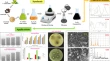
<p>The samples used in this study were grown on Si (111) substrates, without a buffer layer, by RF-plasma-assisted molecular beam epitaxy. The Ga source is a 7N5 pure metal in a conventional effusion cell. Nitrogen of 6N purity is further purified through a nitrogen purifier and then introduced into a plasma generator. A Si(111) substrate was degreased and then etched with diluted HF. The substrate was treated by thermal annealing at 1,000&#176;C for 30 min. After deoxidation, the substrate temperature was lowered to 750&#176;C for growth. The nanorod dimensions and density were determined by controlling the III/V ratio as well as growth time. The optical properties of GaN nanorods are determined mainly by the nanorods' dimensions, which in turn are strongly affected by the III/V ratio. More detailed growth conditions and techniques for GaN nanorods have been reported elsewhere <abbrgrp><abbr bid="B13">13</abbr><abbr bid="B14">14</abbr><abbr bid="B15">15</abbr><abbr bid="B16">16</abbr></abbrgrp>. Figure <figr fid="F1">1a, b</figr> shows high-resolution field emission scanning electron microscopy images at the cross-sectional and the plan view, respectively, for the bulk-like GaN nanorods. Two growth regimes are present in the sample, that is, a compact columnar growth from the Si substrate, and nanorods which protrude from the compact region. The compact region forms from the coalescence of nanorods. The average nanorod diameter is approximately 100 nm, and the average length is approximately 4 &#956;m. More detailed information on the nanorods can be found in references <abbrgrp><abbr bid="B13">13</abbr><abbr bid="B14">14</abbr></abbrgrp>.</p>
<fig id="F1"><title><p>Figure 1</p></title><caption><p>SEM photographs of nanorods for top view (a) and side view (b)</p></caption><text>
   <p><b>SEM photographs of nanorods for top view (a) and side view (b)</b>. The light blue square-dotted circle shows the area principally excited by the laser in the micro-PL experiment.</p>
</text><graphic file="1556-276X-6-81-1"/></fig>
</sec>
<sec><st><p>Photoluminescence measurements</p></st>
<p>A commercial micro-PL spectroscopy system (Renishaw Wotton-under-Edge, UK) was used for photoluminescence measurements. The excitation source was a He-Cd laser operating at 325 nm. This was focused to a spot size of approximately 0.8 &#956;m<sup>2 </sup>(marked with the dotted circle in Figure <figr fid="F1">1b</figr>) on the sample by a 36&#215; reflecting objective positioned above a continuous-flow helium cryostat which housed the sample. The same objective was used to both focus the incident beam and to collect the resulting luminescence, which was subsequently directed to a spectrometer with a spectral resolution of approximately 700 &#956;eV and a spatial resolution of 0.8 &#956;m. The signal was detected using a charge-coupled device detector. For TRPL measurements, a frequency-tripled pulsed Ti:Al<sub>2</sub>O<sub>3 </sub>laser (100 fs at 76 MHz) was used to excite the samples at a wavelength of 266 nm. A commercial time-correlated single-photon counting system was used for detection.</p>
</sec>
</sec>
<sec><st><p>Results and discussion</p></st>
<p>The temperature dependence of the PL emission from the nanorods, measured at temperatures from 4.2 to 75 K, is presented in Figure <figr fid="F2">2a</figr>. Figure <figr fid="F2">2b</figr> shows a zoomed-in section of the spectra in which a strong excitonic emission, originating from both donor-bound excitons (<it>I</it><sub>2 </sub>transition or D<sup>0</sup>X) and free excitons (FX) at energies of 3.468 and 3.476 eV, respectively, is observed. These peaks dominate the spectra at higher temperatures (note the log scale). The FX emission appears as a high-energy shoulder on the <it>I</it><sub>2 </sub>peak, and we observe that it becomes red-shifted as the temperature increases, in line with the band gap energy dependence on temperature. At temperatures above 75 K, the <it>I</it><sub>2 </sub>emission was deionized contributing to the FX emission. In contrast, the <it>I</it><sub>2 </sub>emission energy appears to be temperature independent, which supports the assertion that it originates from a localized source. To the best of our knowledge, this localization effect has not previously been observed in GaN epilayers, and indeed, we only observe the effect in samples such as the one investigated here, which exhibits the coalescence of many nanorods.</p>
<fig id="F2"><title><p>Figure 2</p></title><caption><p>Spectra of temperature-dependent PL</p></caption><text>
   <p><b>Spectra of temperature-dependent PL</b>. <b>(a) </b>Temperature-dependent PL spectra at temperatures ranging from 4.2 K (higher intensity) to 75 K (lower intensity) and <b>(b) </b>in the extended scale.</p>
</text><graphic file="1556-276X-6-81-2"/></fig>
<p>In addition to these two peaks, there is a broad emission (full width at half maximum (FWHM), approximately 30 meV) at 3.417 eV, which has been labeled <it>I</it><sub>1</sub><sup>0</sup>. This has been attributed to both extended structural defects located at the bottom of the nanorods <abbrgrp><abbr bid="B17">17</abbr></abbrgrp> and the recombination of excitons bound to the BSFs. The BSFs are produced during the initial phase of the growth and propagate perpendicularly to the <it>c</it>-axis from the substrate toward the surface of the sample <abbrgrp><abbr bid="B18">18</abbr><abbr bid="B19">19</abbr></abbrgrp>. Indeed, densely merged GaN nanorods on the surface (as shown in Figure <figr fid="F1">1</figr>) may result in the formation of the localized defects.</p>
<p>A series of satellite peaks at the low energy side of the aforementioned transitions, which is assigned to phonon replicas of the <it>I</it><sub>1</sub><sup>0 </sup>emission, are also observed. The energy separation of each adjacent peak is approximately 92 meV, in good agreement with the longitudinal optical (LO) phonon energy in GaN. We denote the intensity of the nth phonon replica for <it>I</it><sub>1</sub><sup>0 </sup>as <it>I</it><sub>1</sub><it><sup>n </sup></it>(<it>n </it>= 0, 1, 2, <it>etc</it>), where <it>n </it>= 0 corresponds to the main emission line (non-replica). The intensity ratio of adjacent phonon replicas can be expressed as</p>
<p><display-formula id="M1"><m:math xmlns:m="http://www.w3.org/1998/Math/MathML" name="1556-276X-6-81-i1"><m:mrow>
   <m:mtable>
      <m:mtr>
         <m:mtd>
            <m:mrow>
               <m:mfrac>
                  <m:mrow>
                     <m:msup>
                        <m:mi>I</m:mi>
                        <m:mrow>
                           <m:mi>n</m:mi>
                           <m:mo>+</m:mo>
                           <m:mn>1</m:mn>
                        </m:mrow>
                     </m:msup>
                  </m:mrow>
                  <m:mrow>
                     <m:msup>
                        <m:mi>I</m:mi>
                        <m:mi>n</m:mi>
                     </m:msup>
                  </m:mrow>
               </m:mfrac>
               <m:mtext>&#8201;</m:mtext>
               <m:mtext>&#8201;</m:mtext>
               <m:mo>=</m:mo>
               <m:mtext>&#8201;</m:mtext>
               <m:mtext>&#8201;</m:mtext>
               <m:mfrac>
                  <m:mrow>
                     <m:msub>
                        <m:mi>S</m:mi>
                        <m:mi>n</m:mi>
                     </m:msub>
                  </m:mrow>
                  <m:mrow>
                     <m:mi>n</m:mi>
                     <m:mo>+</m:mo>
                     <m:mn>1</m:mn>
                  </m:mrow>
               </m:mfrac>
               <m:mtext>&#8201;</m:mtext>
               <m:mo>,</m:mo>
            </m:mrow>
         </m:mtd>
         <m:mtd>
            <m:mrow>
               <m:mi>n</m:mi>
               <m:mo>=</m:mo>
               <m:mn>0</m:mn>
               <m:mo>,</m:mo>
               <m:mtext>&#8201;</m:mtext>
               <m:mtext>&#8201;</m:mtext>
               <m:mn>1</m:mn>
               <m:mo>,</m:mo>
               <m:mtext>&#8201;</m:mtext>
               <m:mtext>&#8201;</m:mtext>
               <m:mn>2</m:mn>
               <m:mo>,</m:mo>
               <m:mtext>&#8201;</m:mtext>
               <m:mn>3...</m:mn>
            </m:mrow>
         </m:mtd>
      </m:mtr>
   </m:mtable>
</m:mrow>
</m:math></display-formula></p>
<p>where <it>S</it>, the H-R parameter, is defined as</p>
<p><display-formula id="M2"><m:math xmlns:m="http://www.w3.org/1998/Math/MathML" name="1556-276X-6-81-i2"><m:mrow>
   <m:mi>S</m:mi>
   <m:mtext>&#8201;</m:mtext>
   <m:mtext>&#8201;</m:mtext>
   <m:mo>=</m:mo>
   <m:mtext>&#8201;</m:mtext>
   <m:mtext>&#8201;</m:mtext>
   <m:mstyle displaystyle="true">
      <m:munder>
         <m:mo>&#8721;</m:mo>
         <m:mi>q</m:mi>
      </m:munder>
      <m:mrow>
         <m:mfrac>
            <m:mrow>
               <m:msup>
                  <m:mrow>
                     <m:mrow>
                        <m:mo>|</m:mo>
                        <m:mrow>
                           <m:mi>V</m:mi>
                           <m:mo stretchy="false">(</m:mo>
                           <m:mi>q</m:mi>
                           <m:mo stretchy="false">)</m:mo>
                        </m:mrow>
                        <m:mo>|</m:mo>
                     </m:mrow>
                  </m:mrow>
                  <m:mn>2</m:mn>
               </m:msup>
            </m:mrow>
            <m:mrow>
               <m:msub>
                  <m:mi>E</m:mi>
                  <m:mrow>
                     <m:mi>L</m:mi>
                     <m:mi>O</m:mi>
                  </m:mrow>
               </m:msub>
            </m:mrow>
         </m:mfrac>
      </m:mrow>
   </m:mstyle>
</m:mrow>
</m:math></display-formula></p>
<p>Here, <it>E</it><sub>LO </sub>is the LO phonon energy and <it>V</it>(<it>q</it>) is the matrix element for the interaction between the exciton and the phonon, with wave vector <it>q</it>. The H-R parameter is therefore a quantitative measure of the exciton-phonon coupling strength <abbrgrp><abbr bid="B20">20</abbr><abbr bid="B21">21</abbr></abbrgrp> and, by extension, a measure of the degree of localization (localized excitons have a stronger interaction with phonons as their wavefunctions contain large <it>q </it>components <abbrgrp><abbr bid="B22">22</abbr></abbrgrp>).</p>
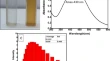
<p>The inset of the Figure <figr fid="F3">3</figr> shows the extracted H-R parameters for the <it>I</it><sub>1 </sub>transition as a function of temperature (<it>T</it>). The value of <it>S</it><sub>1 </sub>at <it>T </it>= 4.2 K for the <it>I</it><sub>1 </sub>is measured to be 0.29. It is a well-documented phenomenon that the value of <it>S</it><sub>0 </sub>is always smaller than the H-R parameter measured between higher order satellite peaks <abbrgrp><abbr bid="B21">21</abbr></abbrgrp> due to the fact that whilst all recombining excitons contribute to the zero order peak, only those that are deeply confined contribute meaningfully to the higher order satellites. The ratio of <it>S</it><sub>1</sub>/<it>S</it><sub>0</sub>, or the extent to which <it>S</it><sub>0 </sub>is reduced by this effect, can therefore be used as a measure of the proportion of carriers that are localized <abbrgrp><abbr bid="B5">5</abbr><abbr bid="B21">21</abbr></abbrgrp>. Value of <it>S</it><sub>1</sub>/<it>S</it><sub>0 </sub>much in excess of unity represents a situation with few localized carriers. Figure <figr fid="F3">3</figr> shows the temperature dependence of the ratio <it>S</it><sub>1</sub>/<it>S</it><sub>0 </sub>for the <it>I</it><sub>1 </sub>transition. The value of <it>S</it><sub>1</sub>/<it>S</it><sub>0 </sub>initially decreases with increasing temperature (4.2 to 30 K) before rapidly increasing for temperatures above 30 K. Similar behavior has been observed previously in InGaN QWs <abbrgrp><abbr bid="B23">23</abbr></abbrgrp> and Al<it><sub>x</sub></it>Ga<sub>1 - <it>x</it></sub>N alloys <abbrgrp><abbr bid="B5">5</abbr></abbrgrp> and is explained by exciton localization: Carriers that are strongly localized to deeper states at low temperature interact with the phonons but become delocalized by thermal energy with increasing temperature. The rise of <it>S</it><sub>1</sub>/<it>S</it><sub>0 </sub>for temperatures over 40 K roughly corresponds to, and is indeed caused by, the onset of a fall in <it>S</it><sub>0 </sub>while <it>S</it><sub>1 </sub>continues to rise. The continuing increase of <it>S</it><sub>1 </sub>(and <it>S</it><sub>0 </sub>for <it>T </it>&lt; 50 K) with temperature is due to an increased population of phonons. The fall in <it>S</it><sub>0 </sub>(<it>T </it>&gt; 50 K) is most likely due to the delocalization of excitons at <it>I</it><sub>1</sub><sup>0</sup>, causing a reduction in the intensity at <it>I</it><sub>1</sub><sup>1 </sup>(and indeed <it>I</it><sub>1</sub><sup>2</sup>). The emission intensity of <it>I</it><sub>1</sub><sup>0</sup>, however, is due to emission from all recombining excitons, so the thermal delocalization will have a less immediate effect on <it>I</it><sub>1</sub><sup>0</sup>resulting in a decrease of <it>S</it><sub>0 </sub>and hence the increase of the ratio <it>S</it><sub>1</sub>/<it>S</it><sub>0</sub>.</p>
<fig id="F3"><title><p>Figure 3</p></title><caption><p><it>S</it><sub>1</sub>/<it>S</it><sub>0 </sub>for the <it>I</it>1 transition as a function of temperature</p></caption><text>
   <p><b><it>S</it><sub>1</sub>/<it>S</it><sub>0 </sub>for the <it>I</it>1 transition as a function of temperature</b>. The inset shows the extracted value of the H-R factor for the <it>I</it>1 transition as a function of temperature.</p>
</text><graphic file="1556-276X-6-81-3"/></fig>
<p>In order to further understand the carrier recombination dynamics of the excitons in GaN nanorods, we performed TRPL measurements on the sample at a range of photon energies. Two representative TRPL decay traces, taken at 10 K, along with the instrument response function (IRF), are presented in Figure <figr fid="F4">4</figr>. The shoulders in the IRF traces are due to electron reflections. This is a common problem in time-correlated photon counting system when relatively short time decays are involved. Software has been used to take into account this response function in the fitting procedure. The FWHM of the IRF is approximately 40 ps and was de-convoluted from the measured decays with commercial decay analysis software (PicoQuant Fluofit, PicoQuant GmbH, Berlin Germany). The mono-exponential lifetimes of the emission at 3.417 and 3.468 eV are calculated to be approximately 68.1 ps and approximately 92.2 ps, respectively. The decay rate is fast due to surface recombination on the nanorods, which is enhanced by the large surface to volume ratio exhibited by the columns. This is consistent with the results by Schlager <it>et al </it><abbrgrp><abbr bid="B24">24</abbr></abbrgrp>. The surface recombination lifetime, <it>&#964;</it><sub>s</sub>, which is strongly dependent on the surface recombination velocity, <it>v</it><sub>s</sub>, can be approximated to <it>d</it>/4<it>v</it><sub>s </sub>for the case of a hexagonal column of diameter <it>d </it><abbrgrp><abbr bid="B24">24</abbr><abbr bid="B25">25</abbr></abbrgrp>. We estimated the surface recombination velocity to be 27 &#215; 10<sup>3 </sup>cm.s<sup>-1</sup>, which is a little larger, but comparable, than that calculated by Schlager <it>et al</it>, owing to the faster decays observed in our case. It should be noted, however, that in the literature, there is little consistency in the lifetimes quoted for the donor-bound and acceptor-bound excitons. In fact, in GaN, the lifetimes range widely from a few tens to a few hundreds of picoseconds <abbrgrp><abbr bid="B26">26</abbr><abbr bid="B27">27</abbr><abbr bid="B28">28</abbr><abbr bid="B29">29</abbr><abbr bid="B30">30</abbr><abbr bid="B31">31</abbr></abbrgrp>.</p>
<fig id="F4"><title><p>Figure 4</p></title><caption><p>Decay traces of time-resolved PL</p></caption><text>
   <p><b>Decay traces of time-resolved PL</b>. Time-resolved PL decay traces for the emissions at 3.417 eV (red squares) and at 3.468 eV (green circles). For reference purpose, the IRF is also shown (black dashed line). The decay time is deduced using a conventional fitting procedure (solid lines).</p>
</text><graphic file="1556-276X-6-81-4"/></fig>
</sec>
<sec><st><p>Conclusions</p></st>
<p>In summary, we have investigated the exciton localization in bulk-like GaN nanorods by micro- and time-resolved photoluminescence measurements. In the temperature-dependent photoluminescence measurements, several phonon replicas at the lower energy side of the exciton bound to the BSFs (<it>I</it><sub>1</sub><sup>0</sup>) are observed. By analyzing the H-R parameter as a function of temperature deduced from the phonon replica intensities, we found that the excitons are strongly localized in the lower energy tails. For the <it>I</it><sub>1 </sub>transition, the value of <it>S</it><sub>1</sub>/<it>S</it><sub>0 </sub>slightly decreases when the temperature increases from 4.2 to 30 K and then rapidly increases with further temperature increase, up to a value of 75 K. The PL decay times for the emissions at 3.468 and 3.417 eV were measured to be 92.2 and 68.1 ps, respectively. These fast decays are due to surface recombination, which is enhanced due to the large surface to volume ratio of the columns. It is finally concluded that exciton localizations in III-nitride materials can be observed not only in ternary alloys but also in binary semiconductors.</p>
</sec>
<sec><st><p>Competing interests</p></st>
<p>The authors declare that they have no competing interests.</p>
</sec>
<sec><st><p>Authors' contributions</p></st>
<p>YP carried out sample growth, performed PL measurements and drafted the manuscript. MH participated in PL measurements. YS participated in the structural analysis of the sample. IY participated in the growth of the sample. HI performed the data analysis and drafted the manuscript. RT participated in PL measurements and in the design of the study. All authors read and approved the final manuscript.</p>
</sec>
</bdy>
<bm>
<ack><sec><st><p>Acknowledgements</p></st>
<p>This research was supported by Basic Science Research Program through the National Research Foundation of Korea (NRF) (grant numbers K20901000002-09E0100-00210, 2010-0023856, and 2009-0076332). M. Holmes acknowledges funding from the Engineering and Physical Sciences Research Council (EPSRC) U.K. (GR/S82176/01).</p>
</sec>
</ack>
<refgrp><bibl id="B1"><title><p>High-power, long-lifetime InGaN multi-quantum-well-structure laser diodes</p></title><aug><au><snm>Nakamura</snm><fnm>S</fnm></au><au><snm>Senoh</snm><fnm>M</fnm></au><au><snm>Nagahama</snm><fnm>S</fnm></au><au><snm>Iwasa</snm><fnm>N</fnm></au><au><snm>Yamada</snm><fnm>T</fnm></au><au><snm>Matsushita</snm><fnm>T</fnm></au><au><snm>Sugimoto</snm><fnm>Y</fnm></au><au><snm>Kiyoku</snm><fnm>H</fnm></au></aug><source>Jpn J Appl Phys</source><pubdate>1997</pubdate><volume>36</volume><issue>Part 2</issue><fpage>L1059</fpage></bibl><bibl id="B2"><title><p>The impact of surface states on the DC and RF characteristics of AlGaN/GaN HFETs</p></title><aug><au><snm>Ventury</snm><fnm>R</fnm></au><au><snm>Zhang</snm><fnm>NQ</fnm></au><au><snm>Keller</snm><fnm>S</fnm></au><au><snm>Mishra</snm><fnm>UK</fnm></au></aug><source>IEEE Trans Electron Devices</source><pubdate>2001</pubdate><volume>48</volume><fpage>560</fpage></bibl><bibl id="B3"><title><p>Optical investigations of AlGaN on GaN epitaxial films</p></title><aug><au><snm>Steude</snm><fnm>G</fnm></au><au><snm>Meyer</snm><fnm>BK</fnm></au><au><snm>Goldner</snm><fnm>A</fnm></au><au><snm>Hoffman</snm><fnm>A</fnm></au><au><snm>Bertram</snm><fnm>F</fnm></au><au><snm>Christen</snm><fnm>J</fnm></au><au><snm>Amano</snm><fnm>H</fnm></au><au><snm>Akasaki</snm><fnm>I</fnm></au></aug><source>Appl Phys Lett</source><pubdate>1999</pubdate><volume>74</volume><fpage>2456</fpage></bibl><bibl id="B4"><title><p>Dynamics of anomalous optical transitions in Al<it><sub>x</sub></it>Ga<sub>1<it>-x</it></sub>N alloys</p></title><aug><au><snm>Cho</snm><fnm>YH</fnm></au><au><snm>Gainer</snm><fnm>GH</fnm></au><au><snm>Lam</snm><fnm>JB</fnm></au><au><snm>Song</snm><fnm>JJ</fnm></au><au><snm>Yang</snm><fnm>W</fnm></au><au><snm>Jhe</snm><fnm>W</fnm></au></aug><source>Phys Rev B</source><pubdate>2000</pubdate><volume>61</volume><fpage>7203</fpage></bibl><bibl id="B5"><title><p>Optical investigation of exciton localization in Al<it><sub>x</sub></it>Ga<sub>1-<it>x</it></sub>N</p></title><aug><au><snm>Lee</snm><fnm>KB</fnm></au><au><snm>Parbrook</snm><fnm>PJ</fnm></au><au><snm>Wang</snm><fnm>T</fnm></au><au><snm>Ranalli</snm><fnm>F</fnm></au><au><snm>Martin</snm><fnm>T</fnm></au><au><snm>Balmer</snm><fnm>RS</fnm></au><au><snm>Wallis</snm><fnm>DJ</fnm></au></aug><source>J Appl Phys</source><pubdate>2007</pubdate><volume>101</volume><fpage>053513</fpage></bibl><bibl id="B6"><title><p>Optical and electrical properties of Al-rich AlGaN alloys</p></title><aug><au><snm>Li</snm><fnm>J</fnm></au><au><snm>Nam</snm><fnm>KB</fnm></au><au><snm>Lin</snm><fnm>JY</fnm></au><au><snm>Jiang</snm><fnm>HX</fnm></au></aug><source>Appl Phys Lett</source><pubdate>2001</pubdate><volume>79</volume><fpage>3245</fpage></bibl><bibl id="B7"><title><p>Localized exciton and its stimulated emission in surface mode from single-layer In<it><sub>x</sub></it>Ga<sub>1<it>-x</it></sub>N</p></title><aug><au><snm>Satake</snm><fnm>A</fnm></au><au><snm>Masumoto</snm><fnm>Y</fnm></au><au><snm>Takao</snm><fnm>M</fnm></au><au><snm>Tsunenori</snm><fnm>A</fnm></au><au><snm>Fumihiko</snm><fnm>N</fnm></au><au><snm>Masao</snm><fnm>I</fnm></au></aug><source>Phys Rev B</source><pubdate>1998</pubdate><volume>57</volume><fpage>R2041</fpage></bibl><bibl id="B8"><title><p>Investigations of phonon sidebands in InGaN/GaN multi-quantum well luminescence</p></title><aug><au><snm>Pecharroman-Gallego</snm><fnm>R</fnm></au><au><snm>Edwards</snm><fnm>PR</fnm></au><au><snm>Martin</snm><fnm>RW</fnm></au><au><snm>Watson</snm><fnm>IM</fnm></au></aug><source>Mater Sci Eng B</source><pubdate>2002</pubdate><volume>93</volume><fpage>94</fpage></bibl><bibl id="B9"><title><p>Exciton localization behaviour in different well width undoped GaN/Al<sub>0.07</sub>Ga<sub>0.93</sub>N nanostructures</p></title><aug><au><snm>Sabooni</snm><fnm>M</fnm></au><au><snm>Esmaeili</snm><fnm>M</fnm></au><au><snm>Haratizadeh</snm><fnm>H</fnm></au><au><snm>Monemar</snm><fnm>B</fnm></au><au><snm>Paskov</snm><fnm>P</fnm></au><au><snm>Kamiyama</snm><fnm>S</fnm></au><au><snm>Iwaya</snm><fnm>M</fnm></au><au><snm>Amano</snm><fnm>H</fnm></au><au><snm>Akasaki</snm><fnm>I</fnm></au></aug><source>Opto-electro Rev</source><pubdate>2007</pubdate><volume>15</volume><fpage>163</fpage></bibl><bibl id="B10"><title><p>Temperature and well number dependence of exciton localization in InGaN/GaN quantum wells</p></title><aug><au><snm>Pecharroman-Gallego</snm><fnm>R</fnm></au></aug><source>Semicond Sci Technol</source><pubdate>2007</pubdate><volume>22</volume><fpage>1276</fpage></bibl><bibl id="B11"><title><p>Exciton localization on basal stacking faults in <it>a</it>-plane epitaxial lateral overgrown GaN grown by hydride vapor phase epitaxy</p></title><aug><au><snm>Cordir</snm><fnm>P</fnm></au><au><snm>Lefebvre</snm><fnm>P</fnm></au><au><snm>Levrat</snm><fnm>J</fnm></au><au><snm>Dussaigne</snm><fnm>A</fnm></au><au><snm>Ganiere</snm><fnm>JD</fnm></au><au><snm>Martin</snm><fnm>D</fnm></au><au><snm>Ristic</snm><fnm>J</fnm></au><au><snm>Zhu</snm><fnm>T</fnm></au><au><snm>Grandjean</snm><fnm>N</fnm></au><au><snm>Deveaud-Pledran</snm><fnm>B</fnm></au></aug><source>J Appl Phys</source><pubdate>2009</pubdate><volume>105</volume><fpage>43102</fpage></bibl><bibl id="B12"><title><p>Electron localization by a donor in the vicinity of a basal stacking fault in GaN</p></title><aug><au><snm>Cordir</snm><fnm>P</fnm></au><au><snm>Lefebvre</snm><fnm>P</fnm></au><au><snm>Ristic</snm><fnm>J</fnm></au><au><snm>Ganiere</snm><fnm>J-D</fnm></au><au><snm>Deveaud-Pledran</snm><fnm>B</fnm></au></aug><source>Phys Rev B</source><pubdate>2009</pubdate><volume>80</volume><fpage>153309</fpage></bibl><bibl id="B13"><title><p>Self-assembled GaN nanorods grown directly on (111) Si substrates: Dependence on growth conditions</p></title><aug><au><snm>Park</snm><fnm>YS</fnm></au><au><snm>Lee</snm><fnm>SH</fnm></au><au><snm>Oh</snm><fnm>JE</fnm></au><au><snm>Park</snm><fnm>CM</fnm></au><au><snm>Kang</snm><fnm>TW</fnm></au></aug><source>J Crystal Growth</source><pubdate>2005</pubdate><volume>282</volume><fpage>313</fpage></bibl><bibl id="B14"><title><p>Optical properties of GaN nanorods grown by molecular-beam epitaxy; dependence on growth time</p></title><aug><au><snm>Park</snm><fnm>CM</fnm></au><au><snm>Park</snm><fnm>YS</fnm></au><au><snm>Im</snm><fnm>H</fnm></au><au><snm>Kang</snm><fnm>TW</fnm></au></aug><source>Nanotechnology</source><pubdate>2006</pubdate><volume>17</volume><fpage>952</fpage></bibl><bibl id="B15"><title><p>Photoluminescence studies of GaN nanorods on Si (111) substrates grown by molecular-beam epitaxy</p></title><aug><au><snm>Park</snm><fnm>YS</fnm></au><au><snm>Park</snm><fnm>CM</fnm></au><au><snm>Fu</snm><fnm>DJ</fnm></au><au><snm>Kang</snm><fnm>TW</fnm></au><au><snm>Oh</snm><fnm>JE</fnm></au></aug><source>Appl Phys Lett</source><pubdate>2005</pubdate><volume>85</volume><fpage>5718</fpage></bibl><bibl id="B16"><title><p>Abnormal photoluminescence properties of GaN nanorods grown on Si (111) by molecular-beam epitaxy</p></title><aug><au><snm>Park</snm><fnm>YS</fnm></au><au><snm>Kang</snm><fnm>TW</fnm></au><au><snm>Taylor</snm><fnm>RA</fnm></au></aug><source>Nanotechnology</source><pubdate>2008</pubdate><volume>19</volume><fpage>475402</fpage></bibl><bibl id="B17"><title><p>Characterization of GaN quantum discs embedded in Al<it><sub>x</sub></it>Ga<sub>1<it>-x</it></sub>N nanocolumns grown by molecular beam epitaxy</p></title><aug><au><snm>Ristic</snm><fnm>J</fnm></au><au><snm>Calleja</snm><fnm>E</fnm></au><au><snm>Sanchez-Garcia</snm><fnm>MA</fnm></au><au><snm>Ulloa</snm><fnm>JM</fnm></au><au><snm>Sanchez-Paramo</snm><fnm>J</fnm></au><au><snm>Calleja</snm><fnm>JM</fnm></au><au><snm>Jahn</snm><fnm>U</fnm></au><au><snm>Trampert</snm><fnm>A</fnm></au><au><snm>Ploog</snm><fnm>KH</fnm></au></aug><source>Phys Rev B</source><pubdate>2003</pubdate><volume>68</volume><fpage>125303</fpage></bibl><bibl id="B18"><title><p>Cathodoluminescence and transmission electron microscopy study of the influence of crystal defects on optical transitions in GaN</p></title><aug><au><snm>Shreter</snm><fnm>G</fnm></au><au><snm>Guzzi</snm><fnm>M</fnm></au><au><snm>Melnik</snm><fnm>YV</fnm></au><au><snm>Vassilevski</snm><fnm>K</fnm></au><au><snm>Dmitiev</snm><fnm>VA</fnm></au><au><snm>Strunk</snm><fnm>HP</fnm></au></aug><source>Phys Status Solidi A</source><pubdate>1999</pubdate><volume>171</volume><fpage>325</fpage></bibl><bibl id="B19"><title><p>Luminescence from stacking faults in gallium nitride</p></title><aug><au><snm>Liu</snm><fnm>R</fnm></au><au><snm>Bell</snm><fnm>A</fnm></au><au><snm>Ponce</snm><fnm>FA</fnm></au><au><snm>Chen</snm><fnm>CQ</fnm></au><au><snm>Yang</snm><fnm>JW</fnm></au><au><snm>Khan</snm><fnm>MA</fnm></au></aug><source>Appl Phys Lett</source><pubdate>2005</pubdate><volume>86</volume><fpage>021908</fpage></bibl><bibl id="B20"><title><p>Theory of light absorption and non-radiative transitions in F-centres</p></title><aug><au><snm>Huang</snm><fnm>K</fnm></au><au><snm>Rhys</snm><fnm>A</fnm></au></aug><source>Proc R Soc A</source><pubdate>1950</pubdate><volume>204</volume><fpage>404</fpage></bibl><bibl id="B21"><title><p>Optical spectroscopy of AlGaInP based wide band gap quantum wells</p></title><aug><au><snm>Mowbray</snm><fnm>DJ</fnm></au><au><snm>Kowalski</snm><fnm>OP</fnm></au><au><snm>Skolnick</snm><fnm>MS</fnm></au><au><snm>Hopkinson</snm><fnm>M</fnm></au><au><snm>David</snm><fnm>JPR</fnm></au></aug><source>Superlatt Microstruct</source><pubdate>1994</pubdate><volume>15</volume><fpage>313</fpage></bibl><bibl id="B22"><title><p>Particle localization and phonon sidebands in GaAs/Al<it><sub>x</sub></it>Ga<sub>1-<it>x</it></sub>As multiple quantum wells</p></title><aug><au><snm>Brener</snm><fnm>I</fnm></au><au><snm>Olszakier</snm><fnm>M</fnm></au><au><snm>Cohen</snm><fnm>E</fnm></au><au><snm>Ehrenfreund</snm><fnm>E</fnm></au><au><snm>Azra</snm><fnm>R</fnm></au><au><snm>Pfeiffer</snm><fnm>L</fnm></au></aug><source>Phys Rev B</source><pubdate>1992</pubdate><volume>46</volume><fpage>7927</fpage></bibl><bibl id="B23"><title><p>Phonon-assisted photoluminescence in InGaN/GaN multiple quantum wells</p></title><aug><au><snm>Paskov</snm><fnm>PP</fnm></au><au><snm>Holtz</snm><fnm>PO</fnm></au><au><snm>Monemar</snm><fnm>B</fnm></au><au><snm>Kamiyama</snm><fnm>S</fnm></au><au><snm>Iwaya</snm><fnm>M</fnm></au><au><snm>Amano</snm><fnm>H</fnm></au><au><snm>Akasaki</snm><fnm>I</fnm></au></aug><source>Phys Status Solidi B</source><pubdate>2002</pubdate><volume>234</volume><fpage>755</fpage></bibl><bibl id="B24"><title><p>Steady-state and time-resolved photoluminescence from relaxed and strained GaN nanowires grown by catalyst-free molecular-beam epitaxy</p></title><aug><au><snm>Schlager</snm><fnm>JB</fnm></au><au><snm>Bertness</snm><fnm>KA</fnm></au><au><snm>Blanchard</snm><fnm>PT</fnm></au><au><snm>Robins</snm><fnm>LH</fnm></au><au><snm>Roshko</snm><fnm>A</fnm></au><au><snm>Sanford</snm><fnm>NA</fnm></au></aug><source>J Appl Phys</source><pubdate>2008</pubdate><volume>103</volume><fpage>124309</fpage></bibl><bibl id="B25"><title><p>Surface recombination in ZnO nanorods grown by chemical bath deposition</p></title><aug><au><snm>Zhao</snm><fnm>QX</fnm></au><au><snm>Yang</snm><fnm>LL</fnm></au><au><snm>Millander</snm><fnm>M</fnm></au><au><snm>Sernelius</snm><fnm>BE</fnm></au><au><snm>Holtz</snm><fnm>PO</fnm></au></aug><source>J Appl Phys</source><pubdate>2008</pubdate><volume>104</volume><fpage>073526</fpage></bibl><bibl id="B26"><title><p>Dynamics of bound-exciton luminescences from epitaxial GaN</p></title><aug><au><snm>Eckey</snm><fnm>L</fnm></au><au><snm>Holst</snm><fnm>CJ</fnm></au><au><snm>Maxim</snm><fnm>P</fnm></au><au><snm>Hoffmann</snm><fnm>A</fnm></au><au><snm>Broser</snm><fnm>I</fnm></au><au><snm>Meyer</snm><fnm>BK</fnm></au><au><snm>Wetzel</snm><fnm>C</fnm></au><au><snm>Mohov</snm><fnm>EN</fnm></au><au><snm>Baranov</snm><fnm>PG</fnm></au></aug><source>Appl Phys Lett</source><pubdate>1996</pubdate><volume>68</volume><fpage>415</fpage></bibl><bibl id="B27"><title><p>Time-resolved exciton luminescence in GaN grown by metalorganic chemical vapor deposition</p></title><aug><au><snm>Shan</snm><fnm>W</fnm></au><au><snm>Xie</snm><fnm>XC</fnm></au><au><snm>Song</snm><fnm>JJ</fnm></au><au><snm>Goldenberg</snm><fnm>B</fnm></au></aug><source>Appl Phys Lett</source><pubdate>1995</pubdate><volume>67</volume><fpage>2512</fpage></bibl><bibl id="B28"><title><p>Time-resolved photoluminescence studies of GaN epilayers grown by gas source molecular beam epitaxy on an AlN buffer layer on (111) Si</p></title><aug><au><snm>Godlewski</snm><fnm>M</fnm></au><au><snm>Bergman</snm><fnm>JP</fnm></au><au><snm>Monemar</snm><fnm>B</fnm></au><au><snm>Rossner</snm><fnm>U</fnm></au><au><snm>Barski</snm><fnm>A</fnm></au></aug><source>Appl Phys Lett</source><pubdate>1999</pubdate><volume>69</volume><fpage>2089</fpage></bibl><bibl id="B29"><title><p>Radiative carrier lifetime, momentum matrix element, and hole effective mass in GaN</p></title><aug><au><snm>Im</snm><fnm>JS</fnm></au><au><snm>Moritz</snm><fnm>A</fnm></au><au><snm>Stevber</snm><fnm>F</fnm></au><au><snm>Harle</snm><fnm>V</fnm></au><au><snm>Scholz</snm><fnm>F</fnm></au><au><snm>Hangleiter</snm><fnm>A</fnm></au></aug><source>Appl Phys Lett</source><pubdate>1997</pubdate><volume>70</volume><fpage>631</fpage></bibl><bibl id="B30"><title><p>Exciton lifetimes in GaN and GaInN</p></title><aug><au><snm>Harris</snm><fnm>JS</fnm></au><au><snm>Monemar</snm><fnm>B</fnm></au><au><snm>Amano</snm><fnm>H</fnm></au><au><snm>Akasaki</snm><fnm>I</fnm></au></aug><source>Appl Phys Lett</source><pubdate>1995</pubdate><volume>67</volume><fpage>840</fpage></bibl><bibl id="B31"><title><p>Excitonic recombination in GaN grown by molecular beam epitaxy</p></title><aug><au><snm>Smith</snm><fnm>M</fnm></au><au><snm>Chen</snm><fnm>GD</fnm></au><au><snm>Li</snm><fnm>JZ</fnm></au><au><snm>Lin</snm><fnm>JY</fnm></au><au><snm>Jiang</snm><fnm>HX</fnm></au><au><snm>Salvador</snm><fnm>A</fnm></au><au><snm>Kim</snm><fnm>WK</fnm></au><au><snm>Aktas</snm><fnm>O</fnm></au><au><snm>Botchkarev</snm><fnm>A</fnm></au><au><snm>Morkoc</snm><fnm>H</fnm></au></aug><source>Appl Phys Lett</source><pubdate>1995</pubdate><volume>67</volume><fpage>3387</fpage></bibl></refgrp>
</bm>
</art>