<?xml version='1.0'?>
<!DOCTYPE art SYSTEM 'http://www.biomedcentral.com/xml/article.dtd'>
<art>
   <ui>1556-276X-6-66</ui>
   <ji>1556-276X</ji>
   <fm>
      <dochead>Nano Idea</dochead>
      <bibl>
         <title>
            <p>Solvothermal synthesis of uniform bismuth nanospheres using poly(<it>N</it>-vinyl-2-pyrrolidone) as a reducing agent</p>
         </title>
         <aug>
            <au id="A1"><snm>Wu</snm><fnm>Jiliang</fnm><insr iid="I1"/><email>wujil@163.com</email></au>
            <au id="A2"><snm>Qin</snm><fnm>Fan</fnm><insr iid="I1"/><email>zwj_2010@yahoo.com</email></au>
            <au id="A3"><snm>Lu</snm><fnm>Zhong</fnm><insr iid="I1"/><email>zz0726@163.com</email></au>
            <au id="A4"><snm>Yang</snm><fnm>Hai-Jian</fnm><insr iid="I2"/><email>yanghaijian@vip.sina.com</email></au>
            <au ca="yes" id="A5"><snm>Chen</snm><fnm>Rong</fnm><insr iid="I1"/><email>rchenhku@hotmail.com</email></au>
         </aug>
         <insg>
            <ins id="I1"><p>Key Laboratory for Green Chemical Process of Ministry of Education and School of Chemical Engineering &amp; Pharmacy, Wuhan Institute of Technology, Wuhan, 430073, P. R. China</p></ins>
            <ins id="I2"><p>Key Laboratory of Catalysis and Materials Science of the State Ethnic Affairs Commission &amp; Ministry of Education, College of Chemistry and Materials Science, South-Central University for Nationalities, Wuhan, 430074, P. R. China</p></ins>
         </insg>
         <source>Nanoscale Research Letters</source>
         <issn>1556-276X</issn>
         <pubdate>2011</pubdate>
         <volume>6</volume>
         <issue>1</issue>
         <fpage>66</fpage>
         <url>http://www.nanoscalereslett.com/content/6/1/66</url>
         <xrefbib><pubidlist><pubid idtype="pmpid">21711606</pubid><pubid idtype="doi">10.1186/1556-276X-6-66</pubid></pubidlist></xrefbib>
      </bibl>
      <history><rec><date><day>26</day><month>7</month><year>2010</year></date></rec><acc><date><day>12</day><month>1</month><year>2011</year></date></acc><pub><date><day>12</day><month>1</month><year>2011</year></date></pub></history>
      <cpyrt><year>2011</year><collab>Wu et al; licensee Springer.</collab><note>This is an Open Access article distributed under the terms of the Creative Commons Attribution License (<url>http://creativecommons.org/licenses/by/2.0</url>), which permits unrestricted use, distribution, and reproduction in any medium, provided the original work is properly cited.</note></cpyrt>
      <abs>
         <sec>
            <st>
               <p>Abstract</p>
            </st>
            <p>Uniform bismuth nanospheres were successfully prepared from bismuth nitrate in the presence of poly(<it>N</it>-vinyl-2-pyrrolidone) (PVP) by solvothermal process. The product was characterized by powder X-ray diffraction, scanning electron microscopy, transmission electron microscopy, selected area electron diffraction, and energy-dispersive X-ray. PVP plays a critical role both as a reducing agent and a capping agent in the formation of bismuth nanospheres. Shape and size of bismuth nanospheres could be tuned by changing the employed PVP/bismuth salt ratio. It was also found the solvent had an effect on the morphologies of bismuth nanomaterials. The possible formation and growth mechanism of bismuth nanospheres were also discussed and proposed to explain the reduction step.</p>
         </sec>
      </abs>
   </fm>
   <bdy>
      <sec>
         <st>
            <p>Introduction</p>
         </st>
         <p>Recently, metal nanostructures with functional properties have been extensively studied due to their wide applications. Among the various metal nanostructures, monodisperse metallic nanospheres have attracted considerable attention because of their unique optical, catalytic, as well as novel chemical and biological properties <abbrgrp><abbr bid="B1">1</abbr><abbr bid="B2">2</abbr><abbr bid="B3">3</abbr><abbr bid="B4">4</abbr><abbr bid="B5">5</abbr><abbr bid="B6">6</abbr><abbr bid="B7">7</abbr><abbr bid="B8">8</abbr></abbrgrp>. For example, the controlled silver nanospheres were applied for optical studies and antibacterial applications <abbrgrp><abbr bid="B9">9</abbr><abbr bid="B10">10</abbr></abbrgrp>. Thus, much effort has been devoted to the preparation of new metal nanospheres and their functional transformation <abbrgrp><abbr bid="B11">11</abbr><abbr bid="B12">12</abbr><abbr bid="B13">13</abbr><abbr bid="B14">14</abbr></abbrgrp>. As a semimetal, bismuth has unusual properties due to its highly anisotropic Fermi surface, low carrier densities, small carrier effective masses, and long carrier mean free path <abbrgrp><abbr bid="B15">15</abbr></abbrgrp>. Bismuth nanostructures have received steadily growing interests, since they play important roles in many diverse applications <abbrgrp><abbr bid="B16">16</abbr><abbr bid="B17">17</abbr></abbrgrp>. Different bismuth nanomaterials, such as single-crystal bismuth thin film and nanowire, have been investigated for their large magnetoresistance, finite-size effects, and enhanced thermal conductivity <abbrgrp><abbr bid="B18">18</abbr><abbr bid="B19">19</abbr><abbr bid="B20">20</abbr></abbrgrp>. It was also reported that spherical bismuth nanomaterials were a good catalyst for the growth of SnS<sub>2 </sub>nanotubes and germanium nanowires <abbrgrp><abbr bid="B21">21</abbr><abbr bid="B22">22</abbr></abbrgrp>. Up to now, a wide variety of bismuth nanostructures such as nanoparticles <abbrgrp><abbr bid="B23">23</abbr></abbrgrp>, nanowires <abbrgrp><abbr bid="B24">24</abbr></abbrgrp>, nanorods <abbrgrp><abbr bid="B25">25</abbr></abbrgrp>, nanotubes <abbrgrp><abbr bid="B26">26</abbr><abbr bid="B27">27</abbr><abbr bid="B28">28</abbr></abbrgrp>, triangular nanoplates <abbrgrp><abbr bid="B29">29</abbr></abbrgrp>, bunch-like nanostructures <abbrgrp><abbr bid="B17">17</abbr></abbrgrp>, nanocubes <abbrgrp><abbr bid="B30">30</abbr></abbrgrp>, as well as nanospheres (&gt;100 nm) <abbrgrp><abbr bid="B31">31</abbr><abbr bid="B32">32</abbr><abbr bid="B33">33</abbr><abbr bid="B34">34</abbr></abbrgrp> have been prepared by using different methods. Among these methods, solvothermal synthesis has become an important and promising approach to prepare controlled inorganic nanocrystals <abbrgrp><abbr bid="B35">35</abbr><abbr bid="B36">36</abbr><abbr bid="B37">37</abbr></abbrgrp>.</p>
         <p>In the reported literatures, the alcohol [normally ethylene glycol (EG)] was used as both solvent and reducing agent to generate bismuth nanospheres with a wide size distribution <abbrgrp><abbr bid="B31">31</abbr><abbr bid="B32">32</abbr><abbr bid="B33">33</abbr><abbr bid="B34">34</abbr></abbrgrp>. Wang and Xia <abbrgrp><abbr bid="B38">38</abbr></abbrgrp> have developed the synthesis of uniform bismuth nanospheres by thermal decomposition bismuth acetate in EG under the protection of nitrogen. The use of protection of inactive gas and organic metal precursor, however, made it complicated and costly. Hence, a simple, low-cost approach for the preparation of uniform bismuth nanospheres is highly desired.</p>
         <p>In this communication, we describe a solvothermal process for the synthesis of uniform bismuth nanospheres in the presence of poly(<it>N</it>-vinyl-2-pyrrolidone) (PVP). In most cases, PVP was used as a protecting agent to cap and stabilize the particles to avoid aggregation in the solution <abbrgrp><abbr bid="B39">39</abbr></abbrgrp>. It was also reported that PVP was used as reducing agent in the preparation of noble metallic nanostructures <abbrgrp><abbr bid="B40">40</abbr><abbr bid="B41">41</abbr></abbrgrp>. In this synthesis, PVP acts as both reducing and capping agent. To the best of our knowledge, there are few publications relevant to the synthesis of bismuth nanomaterials using PVP as a reducing agent.</p>
      </sec>
      <sec>
         <st>
            <p>Experimental</p>
         </st>
         <sec>
            <st>
               <p>Chemicals</p>
            </st>
            <p>Bismuth nitrate pentahydrate (Bi(NO<sub>3</sub>)<sub>3</sub>&#183;5H<sub>2</sub>O) was purchased from Fuchen Chemicals Reagent (China). <it>N</it>,<it>N</it>-dimethylformamide (DMF), ammonia, mannitol, and EG were purchased from Sinopharm Chemical Reagent (China); PVP (with average <it>M</it><sub>w </sub>of 10,000) was purchased from Sigma-Aldrich Inc. All the reagents were analytical grade and used directly without further purification.</p>
         </sec>
         <sec>
            <st>
               <p>Synthesis of uniform bismuth nanospheres</p>
            </st>
            <p>In a typical procedure, 0.5 mmol Bi(NO<sub>3</sub>)<sub>3</sub>&#183;5H<sub>2</sub>O was dissolved in 12.5 mL of 0.1 mol/L mannitol solution, then 7.5 mL NH<sub>3</sub>&#183;H<sub>2</sub>O (5 mol/L) was added to the solution slowly with vigorously stirring. After stirring for about 15 min, the white precipitation was collected and washed with deionized water by centrifugation for five times. Then the obtained white precipitation and 0.155 g of PVP were introduced into 35 mL EG. The mixture was stirred and sonicated until all the chemicals were well dispersed. Then it was transferred into a stainless steel autoclave with Teflon liner. The autoclave was sealed and maintained at 180&#176;C for 12 h. After cooling to room temperature, the obtained black solution was centrifuged and the solid product was collected. The black solid product was then washed with absolute alcohol for five to seven times followed by centrifugation. Finally, the solid product was dried in a desiccator for a few days for further characterization (sample 1). Other samples of bismuth nanomaterials were also prepared with different amounts of PVP and different solvents using the same methods under identical conditions (Table <tblr tid="T1">1</tblr>).</p>
            <tbl id="T1"><title><p>Table 1</p></title><caption><p>Experimental conditions for the synthesis of bimuth nanomaterials</p></caption><tblbdy cols="3">
      <r>
         <c ca="left">
            <p>
               <b>Sample number</b>
            </p>
         </c>
         <c ca="center">
            <p>
               <b>The amount of PVP (g)</b>
            </p>
         </c>
         <c ca="center">
            <p>
               <b>Solvent</b>
            </p>
         </c>
      </r>
      <r>
         <c cspan="3">
            <hr/>
         </c>
      </r>
      <r>
         <c ca="left">
            <p>
               <b>1</b>
            </p>
         </c>
         <c ca="center">
            <p>0.155</p>
         </c>
         <c ca="center">
            <p>EG</p>
         </c>
      </r>
      <r>
         <c ca="left">
            <p>
               <b>2</b>
            </p>
         </c>
         <c ca="center">
            <p>0</p>
         </c>
         <c ca="center">
            <p>EG</p>
         </c>
      </r>
      <r>
         <c ca="left">
            <p>
               <b>3</b>
            </p>
         </c>
         <c ca="center">
            <p>0.310</p>
         </c>
         <c ca="center">
            <p>EG</p>
         </c>
      </r>
      <r>
         <c ca="left">
            <p>
               <b>4</b>
            </p>
         </c>
         <c ca="center">
            <p>0.465</p>
         </c>
         <c ca="center">
            <p>EG</p>
         </c>
      </r>
      <r>
         <c ca="left">
            <p>
               <b>5</b>
            </p>
         </c>
         <c ca="center">
            <p>0.155</p>
         </c>
         <c ca="center">
            <p>DMF</p>
         </c>
      </r>
   </tblbdy></tbl>
         </sec>
         <sec>
            <st>
               <p>Characterizations</p>
            </st>
            <p>The bismuth nanostructures were characterized by powder X-ray diffraction (XRD), scanning electron microscopy (SEM), transmission electron microscopy (TEM), selected area electron diffraction (SAED), and energy-dispersive X-ray (EDX). The powder XRD pattern was recorded on Bruker AXS D8 Discover (Cu K&#945; radiation, &#955; = 1.5406 &#197;). The scanning rate is 1&#176;/min in the 2&#952; range from 20 to 70&#176;. The SEM images were taken on a Hitachi S4800 field emission scanning electron microscope operating at 3 or 5 kV (FESEM, Japan). TEM images and SAED pictures were recorded on a Philips Technai G2 20 electron microscope (Manufacturer: FEI Company), using an accelerating voltage of 200 kV. The EDX analysis was performed on an Oxford Instruments Inca with a scanning range from 0 to 20 keV. The samples for TEM observations were prepared by dispersing some of the solid products into absolute alcohol and then sonicated for several minutes. A few drops of the suspension were deposited on the copper grid, which was then put into the desiccator. The thermogravimetric and differential analysis was done by DIAMOND TG/DTA instrument (PerkinElmer Instruments, Waltham, CT, USA) with a heating rate of 10&#176;C/min.</p>
         </sec>
      </sec>
      <sec>
         <st>
            <p>Results and discussion</p>
         </st>
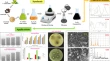
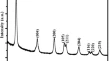
         <p>Figure <figr fid="F1">1a</figr> shows the typical powder XRD pattern of the as-synthesized product (sample 1). All the diffraction peaks could be readily indexed to be rhombohedral phase of bismuth, which were consistent with the literature values (JCPDS No. 05-0519). No impurity was detected in this pattern, indicating the formation of pure bismuth products under current synthetic condition. The sharp and strong diffraction peaks also confirm the well crystallization of the products.</p>
         <fig id="F1"><title><p>Figure 1</p></title><caption><p>XRD pattern (a) and SEM images of the as-synthesized product in EG at lower (b, c) and higher (d) magnifications (sample 1)</p></caption><text>
   <p><b>XRD pattern (a) and SEM images of the as-synthesized product in EG at lower (b, c) and higher (d) magnifications (sample 1)</b>.</p>
</text><graphic file="1556-276X-6-66-1"/></fig>
         <p>The morphologies and structures of the as-prepared bismuth nanospheres were investigated by SEM and TEM images. Figure <figr fid="F1">1b, c, d</figr> shows the representative SEM images of the as-prepared bismuth nanospheres with different magnifications. The low-magnification images (Figure <figr fid="F1">1b, c</figr>) indicate the large production of uniform bismuth nanospheres. No other bismuth morphologies could be found in the whole sample. The diameters of these nanospheres varied from 160 to 210 nm and most of them were about 180 nm. The high-magnification image shown in Figure <figr fid="F1">1d</figr> clearly reveals the detailed morphologies of the products, indicating the formation of uniform, regular nanospheres with smooth surfaces.</p>
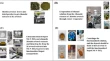
         <p>The low- (Figure <figr fid="F2">2a</figr>) and high-magnification (Figure <figr fid="F2">2b</figr>) TEM images further demonstrated the morphologies of these bismuth nanospheres clearly. It also reveals a well-defined spheric structure and smooth surface. The statistical analysis showed that bismuth nanospheres had a narrow size distribution and the average diameter was about 180 nm with a standard deviation of 10 nm (Figure <figr fid="F2">2c</figr>). SAED pattern taken from an individual bismuth particle showed clear diffraction spots, indicating a good single-crystal structure (Figure <figr fid="F2">2d</figr>). The elemental composition of the nanospheres was also analyzed by EDX, and characteristic bismuth absorption peaks were observed (Figure S1 in Additional File <supplr sid="S1">1</supplr>). The copper and carbon peaks are due to the carbon-coated copper grid.</p>
         <fig id="F2"><title><p>Figure 2</p></title><caption><p>Typical (a) low- and (b) high-magnification TEM images of as-prepared bismuth nanospheres (sample 1)</p></caption><text>
   <p><b>Typical (a) low- and (b) high-magnification TEM images of as-prepared bismuth nanospheres (sample 1)</b>. <b>(c) </b>The histogram of size distribution of the bismuth nanospheres prepared from "a". <b>(d) </b>The SAED pattern of a single bismuth nanosphere.</p>
</text><graphic file="1556-276X-6-66-2"/></fig>
         <suppl id="S1">
            <title>
               <p>Additional file 1</p>
            </title>
            <text>
               <p><b>Figure S1</b>. EDX spectrum of bismuth nanospheres prepared in EG.</p>
            </text>
            <file name="1556-276X-6-66-S1.DOCX">
   <p>Click here for file</p>
</file>
         </suppl>
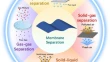
         <p>To investigate the composition of the white precipitate obtained in the synthetic procedure, thermogravimetric and differential thermal analysis (TG/DTA) and EDX measurements were carried out. Figure <figr fid="F3">3a</figr> shows the results of the thermal analysis of the white precipitate at a heating rate of 10&#176;C/min in the nitrogen atmosphere. It indicates a two-step weight loss in the temperature range from 25 to 200 and 200 to 300&#176;C. The first weight loss in the TG trace could be attributed to the desorption of physically adsorbed water, and the second one could be recognized in according with the exothermal reaction in DTA trace (Figure <figr fid="F3">3a</figr>). The exothermal reaction thermal was found to arise from the decomposition of the white precipitate. The white precipitate was further investigated by EDX spectrum. As shown in Figure <figr fid="F3">3b</figr>, the white precipitate was composed of Bi, O, and C and no other additional elements were detected. The Si signal is attributed to the silicon wafers. When the white precipitate was calcined at 350&#176;C for 90 min, the XRD pattern of the calcined product was very close to the standard data (Bi<sub>2</sub>O<sub>3</sub>, JCPDS No. 71-2274) (Figure S2 in Additional File <supplr sid="S2">2</supplr>). Hence, it was proposed that the possible component of the white precipitate was bismuth complexes (Bi<sup>III</sup>-mannitol), which were formed in ammonia solution.</p>
         <fig id="F3"><title><p>Figure 3</p></title><caption><p>Thermogravimetric and differential thermal analysis (TG/DTA) and EDX Analysis (a) TG/DTA curves of thermal decomposition of the white precipitation at a heating rate of 10&#176;C/min in the N<sub>2 </sub>atmosphere; (b) EDX pattern of the white precipitation</p></caption><text>
   <p><b>Thermogravimetric and differential thermal analysis (TG/DTA) and EDX Analysis (a) TG/DTA curves of thermal decomposition of the white precipitation at a heating rate of 10&#176;C/min in the N<sub>2 </sub>atmosphere; (b) EDX pattern of the white precipitation</b>.</p>
</text><graphic file="1556-276X-6-66-3"/></fig>
         <suppl id="S2">
            <title>
               <p>Additional file 2</p>
            </title>
            <text>
               <p><b>Figure S2</b>. XRD pattern of the white precipitation was calcined at 350&#176;C for 90 min.</p>
            </text>
            <file name="1556-276X-6-66-S2.DOCX">
   <p>Click here for file</p>
</file>
         </suppl>
         <p>In this study, it was found that there was no black product precipitated from the solution in the absence of PVP under identical experiment condition. The XRD pattern of the obtained white product could not be assigned in the XRD standard data base (Figure S3 in Additional File <supplr sid="S3">3</supplr>). It is obvious that PVP plays a key role in the formation of bismuth nanospheres. It was proposed that PVP reduced Bi<sup>3+ </sup>ions to give metallic bismuth. The reduction process could be probably understood considering two main reactions: (1) direct abstraction of hydrogen atoms from the polymer by the Bi<sup>3+ </sup>ions; (2) reduction of the Bi<sup>3+ </sup>ions by the organic radicals formed in (1) or during the bismuth-accelerated degradation of PVP, which is similar to the reported literatures <abbrgrp><abbr bid="B40">40</abbr><abbr bid="B42">42</abbr></abbrgrp>. It was reported that the capping organic molecules in the reaction system could determine the subsequent morphology of the product because of their special chemical properties and self-assembling functions <abbrgrp><abbr bid="B43">43</abbr><abbr bid="B44">44</abbr><abbr bid="B45">45</abbr></abbrgrp>. Recently, it was also found that EG molecules could adsorb onto the surface of bismuth crystals through O-Bi bonding which could significantly decrease their growth rates and lead to highly anisotropic growth <abbrgrp><abbr bid="B33">33</abbr><abbr bid="B46">46</abbr></abbrgrp>. Thus, when the molar ratio of repeating units of PVP to Bi<sup>3+ </sup>is about 3, that is, there is no excess PVP in the solution, these uniform bismuth nanospheres can be obtained under the only effect of EG.</p>
         <suppl id="S3">
            <title>
               <p>Additional file 3</p>
            </title>
            <text>
               <p><b>Figure S3</b>. XRD pattern of the white product obtained in EG in the absence of PVP.</p>
            </text>
            <file name="1556-276X-6-66-S3.DOCX">
   <p>Click here for file</p>
</file>
         </suppl>
         <p>
            <display-formula id="M1">
               <graphic file="1556-276X-6-66-i1.gif"/>
            </display-formula>
         </p>
         <p>
            <display-formula id="M2">
               <graphic file="1556-276X-6-66-i2.gif"/>
            </display-formula>
         </p>
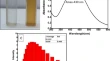
         <p>When the amount of PVP was increased to 0.310 g (the molar ratio of repeating units of PVP to Bi<sup>3+ </sup>is about 6), bismuth nanospheres and nanowires were formed, as shown in Figure <figr fid="F4">4a</figr>. The diameters of obtained bismuth nanospheres were in the range from 250 to 500 nm, and the length of the nanowires varies from 0.5 to more than 6 &#956;m. When the molar ratio of repeating units of PVP to Bi<sup>3+ </sup>was further increased to about 9 (the amount of PVP is 0.465 g), a mass of bismuth nanowires were obtained and few bismuth nanospheres remained, as shown in Figure <figr fid="F4">4b</figr>. The length of bismuth nanowires is up to 10 &#956;m and the diameters of nanospheres are in range from 200 to 500 nm. The elemental composition of these nanowires and few nanospheres was also analyzed by EDX, and characteristic bismuth absorption peaks were observed (Figure <figr fid="F4">4e</figr>). Thus, PVP is considered to act both as reducing agent and capping agent in this synthesis. It was believed that the formation of bismuth nanowires was based on the Ostwald ripening process <abbrgrp><abbr bid="B47">47</abbr><abbr bid="B48">48</abbr></abbrgrp>. At first, bismuth nanoparticles were formed in the solution according to eqs 1 or 2 with PVP as reducing or nucleating agent. Then, the excess PVP molecules could cap onto the surface of bismuth particles <abbrgrp><abbr bid="B33">33</abbr></abbrgrp>, and bismuth nanowires were produced through this polyol process. In this process, bismuth particles can continuously grow into nanospheres, nanorods, or nanowires. The co-effect of PVP and EG resulted in a wide size distribution of the diameter of bismuth nanospheres in this experiment and literatures <abbrgrp><abbr bid="B31">31</abbr><abbr bid="B32">32</abbr><abbr bid="B33">33</abbr></abbrgrp>.</p>
         <fig id="F4"><title><p>Figure 4</p></title><caption><p>SEM (a) image of bismuth nanomaterials were obtained when the amount of PVP was 0.310 g (sample 3)</p></caption><text>
   <p><b>SEM (a) image of bismuth nanomaterials were obtained when the amount of PVP was 0.310 g (sample 3)</b>. SEM image <b>(b) </b>and EDX pattern <b>(e) </b>of bismuth nanomaterials were obtained when the amount of PVP was 0.465 g (sample 4). Typical low- <b>(c)</b>, high-magnification <b>(d) </b>TEM images, and EDX spectrum (<b>f</b>) of the bismuth nanostructures using DMF instead of EG as solvent (sample 5).</p>
</text><graphic file="1556-276X-6-66-4"/></fig>
         <p>Interestingly, when DMF was instead of EG, bismuth nanoparticles and nanotubes arrays were formed under identical experimental conditions (Figure <figr fid="F4">4c, d</figr>). The average diameter of bismuth nanoparticles is about 50 nm, and the diameters of the bismuth nanotubes are in a narrow range from about 3.2 to 5.2 nm, with an average diameter of 4.3 nm. EDX was used to further analyze the elemental compositions of these nanotubes lying on the hole of the copper grid. It reveals the elemental Bi signals and confirmed the purity of this bismuth nanotube (Figure <figr fid="F4">4f</figr>). The copper and carbon peaks are due to the carbon-coated copper grid. Here, DMF plays an important role in the fabrication of bismuth nanotubes. In this synthesis, the starting materials can dissolve in DMF and DMF can partially decompose into dimethylamine, which is a good coordination ligand with N-chelation. The diffusion of Bi<sup>3+ </sup>ions in DMF-dimethylamine will be faster due to its lower viscosity, which is beneficial for the formation of nanotube products <abbrgrp><abbr bid="B49">49</abbr></abbrgrp>. The formation mechanism is still limited and further study in progress.</p>
      </sec>
      <sec>
         <st>
            <p>Conclusions</p>
         </st>
         <p>In summary, uniform bismuth nanospheres were successfully synthesized via a facile solvothermal process by reduction of EG solution of bismuth salt, using PVP both as a reducing agent and a capping agent. The shapes and sizes of the bismuth nanostructures varied with the changing of the PVP/bismuth salt molar ratio. Uniform bismuth nanospheres with an average diameter of 180 nm could be routinely synthesized through this solvothermal approach by controlling the PVP/bismuth salt ratio. The solvent EG also played an important role in the formation of uniform bismuth nanospheres. Bismuth nanoparticles and nanotubes were formed when DMF was used as a solvent instead of EG. The possible formation mechanism of the bismuth nanotubes was also discussed and further study was in progress.</p>
      </sec>
      <sec>
         <st>
            <p>Abbreviations</p>
         </st>
         <p>DMF: <it>N</it>,<it>N</it>-dimethylformamide; EDX: energy-dispersive X-ray; EG: ethylene glycol; PVP: poly(<it>N</it>-vinyl-2-pyrrolidone); SAED: selected area electron diffraction; SEM: scanning electron microscopy; TEM: transmission electron microscopy; XRD: X-ray diffraction.</p>
      </sec>
      <sec>
         <st>
            <p>Competing interests</p>
         </st>
         <p>The authors declare that they have no competing interests.</p>
      </sec>
      <sec>
         <st>
            <p>Authors' contributions</p>
         </st>
         <p>JW participated in the acquisition of data and drafted the manuscript. FQ carried out the SEM characterization and participated the analysis and interpretation of data. ZL and HJY helped to draft and revise the manuscript. RC made contributions to conception and design of the study, revised the manuscript critically for important intellectual content, and has given final approval of the version to be published.</p>
      </sec>
   </bdy>
   <bm>
      <ack>
         <sec>
            <st>
               <p>Acknowledgements</p>
            </st>
            <p>This study was supported by National Natural Science Foundation of China (Grant 20801043), the Program for New Century Excellent Talents in University (NCET-09-0136), and the Outstanding Youth Scientific Foundation of Hubei Province (2009CDA075).</p>
         </sec>
      </ack>
      <refgrp><bibl id="B1"><title><p>Monodisperse platinum nanospheres with adjustable diameters from 10 to 100 nm: Synthesis and distinct optical properties</p></title><aug><au><snm>Bigall</snm><fnm>NC</fnm></au><au><snm>H&#228;rtling</snm><fnm>T</fnm></au><au><snm>Klose</snm><fnm>M</fnm></au><au><snm>Simon</snm><fnm>P</fnm></au><au><snm>Eng</snm><fnm>LM</fnm></au><au><snm>Eychm&#252;ller</snm><fnm>A</fnm></au></aug><source>Nano Lett</source><pubdate>2008</pubdate><volume>8</volume><fpage>4588</fpage><xrefbib><pubidlist><pubid idtype="doi">10.1021/nl802901t</pubid><pubid idtype="pmpid">19367978</pubid></pubidlist></xrefbib></bibl><bibl id="B2"><title><p>Synthesis, characterization, and tunable optical properties of hollow gold nanospheres</p></title><aug><au><snm>Schwartzberg</snm><fnm>AM</fnm></au><au><snm>Olson</snm><fnm>TY</fnm></au><au><snm>Talley</snm><fnm>CE</fnm></au><au><snm>Zhang</snm><fnm>JZ</fnm></au></aug><source>J Phys Chem B</source><pubdate>2006</pubdate><volume>110</volume><fpage>19935</fpage><xrefbib><pubidlist><pubid idtype="doi">10.1021/jp062136a</pubid><pubid idtype="pmpid">17020380</pubid></pubidlist></xrefbib></bibl><bibl id="B3"><title><p>Palladium nanohexagons and nanospheres in selective alkyne hydrogenation</p></title><aug><au><snm>Semagina</snm><fnm>N</fnm></au><au><snm>Kiwi-Minsker</snm><fnm>L</fnm></au></aug><source>Catal Lett</source><pubdate>2009</pubdate><volume>127</volume><fpage>334</fpage><xrefbib><pubid idtype="doi">10.1007/s10562-008-9684-1</pubid></xrefbib></bibl><bibl id="B4"><title><p>Surface-enhanced raman scattering imaging of HER2 cancer markers overexpressed in single MCF7 cells using antibody conjugated hollow gold nanospheres</p></title><aug><au><snm>Lee</snm><fnm>S</fnm></au><au><snm>Chon</snm><fnm>H</fnm></au><au><snm>Lee</snm><fnm>M</fnm></au><au><snm>Choo</snm><fnm>J</fnm></au><au><snm>Shin</snm><fnm>SY</fnm></au><au><snm>Lee</snm><fnm>YH</fnm></au><au><snm>Rhyu</snm><fnm>IJ</fnm></au><au><snm>Son</snm><fnm>SW</fnm></au><au><snm>Oh</snm><fnm>CH</fnm></au></aug><source>Biosens Bioelectron</source><pubdate>2009</pubdate><volume>24</volume><fpage>2260</fpage><xrefbib><pubidlist><pubid idtype="doi">10.1016/j.bios.2008.10.018</pubid><pubid idtype="pmpid" link="fulltext">19056254</pubid></pubidlist></xrefbib></bibl><bibl id="B5"><title><p>Widefield and high-resolution reflectance imaging of gold and silver nanospheres</p></title><aug><au><snm>Nitin</snm><fnm>N</fnm></au><au><snm>Javier</snm><fnm>DJ</fnm></au><au><snm>Roblyer</snm><fnm>DM</fnm></au><au><snm>Richards-Kortum</snm><fnm>R</fnm></au></aug><source>J Biomed Opt</source><pubdate>2007</pubdate><volume>12</volume><fpage>051505</fpage><xrefbib><pubidlist><pubid idtype="doi">10.1117/1.2800314</pubid><pubid idtype="pmpid" link="fulltext">17994869</pubid></pubidlist></xrefbib></bibl><bibl id="B6"><title><p>Photothermal optical coherence tomography of epidermal growth factor receptor in live cells using immunotargeted gold nanospheres</p></title><aug><au><snm>Skala</snm><fnm>MC</fnm></au><au><snm>Crow</snm><fnm>MJ</fnm></au><au><snm>Wax</snm><fnm>A</fnm></au><au><snm>Izatt</snm><fnm>JA</fnm></au></aug><source>Nano Lett</source><pubdate>2008</pubdate><volume>8</volume><fpage>3461</fpage><xrefbib><pubidlist><pubid idtype="doi">10.1021/nl802351p</pubid><pubid idtype="pmcid">2574829</pubid><pubid idtype="pmpid">18767886</pubid></pubidlist></xrefbib></bibl><bibl id="B7"><title><p>Dimers of silver nanospheres: Facile synthesis and their use as hot spots for surface-enhanced raman scattering</p></title><aug><au><snm>Li</snm><fnm>W</fnm></au><au><snm>Camargo</snm><fnm>PHC</fnm></au><au><snm>Lu</snm><fnm>X</fnm></au><au><snm>Xia</snm><fnm>Y</fnm></au></aug><source>Nano Lett</source><pubdate>2008</pubdate><volume>9</volume><fpage>485</fpage><xrefbib><pubid idtype="doi">10.1021/nl803621x</pubid></xrefbib></bibl><bibl id="B8"><title><p>Highly sensitive immunoassay of lung cancer marker carcinoembryonic antigen using surface-enhanced raman scattering of hollow gold nanospheres</p></title><aug><au><snm>Chon</snm><fnm>H</fnm></au><au><snm>Lee</snm><fnm>S</fnm></au><au><snm>Son</snm><fnm>SW</fnm></au><au><snm>Oh</snm><fnm>CH</fnm></au><au><snm>Choo</snm><fnm>J</fnm></au></aug><source>Anal Chem</source><pubdate>2009</pubdate><volume>81</volume><fpage>3029</fpage><xrefbib><pubidlist><pubid idtype="doi">10.1021/ac802722c</pubid><pubid idtype="pmpid" link="fulltext">19301845</pubid></pubidlist></xrefbib></bibl><bibl id="B9"><title><p>Controlled etching as a route to high quality silver nanospheres for optical studies</p></title><aug><au><snm>Cobley</snm><fnm>CM</fnm></au><au><snm>Rycenga</snm><fnm>M</fnm></au><au><snm>Zhou</snm><fnm>F</fnm></au><au><snm>Li</snm><fnm>ZY</fnm></au><au><snm>Xia</snm><fnm>Y</fnm></au></aug><source>J Phys Chem C</source><pubdate>2009</pubdate><volume>113</volume><fpage>16975</fpage><xrefbib><pubid idtype="doi">10.1021/jp906457f</pubid></xrefbib></bibl><bibl id="B10"><title><p>Proteomic analysis of the mode of antibacterial action of silver nanoparticles</p></title><aug><au><snm>Lok</snm><fnm>C-N</fnm></au><au><snm>Ho</snm><fnm>C-M</fnm></au><au><snm>Chen</snm><fnm>R</fnm></au><au><snm>He</snm><fnm>Q-Y</fnm></au><au><snm>Yu</snm><fnm>W-Y</fnm></au><au><snm>Sun</snm><fnm>H</fnm></au><au><snm>Tam</snm><fnm>PK-H</fnm></au><au><snm>Chiu</snm><fnm>J-F</fnm></au><au><snm>Che</snm><fnm>C-M</fnm></au></aug><source>J Proteome Res</source><pubdate>2006</pubdate><volume>5</volume><fpage>916</fpage><xrefbib><pubidlist><pubid idtype="doi">10.1021/pr0504079</pubid><pubid idtype="pmpid" link="fulltext">16602699</pubid></pubidlist></xrefbib></bibl><bibl id="B11"><title><p>Non-aqueous sol-gel approach towards the controllable synthesis of nickel nanospheres, nanowires, and nanoflowers</p></title><aug><au><snm>Jia</snm><fnm>FL</fnm></au><au><snm>Zhang</snm><fnm>LZ</fnm></au><au><snm>Shang</snm><fnm>XY</fnm></au><au><snm>Yang</snm><fnm>Y</fnm></au></aug><source>Adv Mater</source><pubdate>2008</pubdate><volume>20</volume><fpage>1050</fpage><xrefbib><pubid idtype="doi">10.1002/adma.200702159</pubid></xrefbib></bibl><bibl id="B12"><title><p>Block copolymer-mediated synthesis of size-tunable gold nanospheres and nanoplates</p></title><aug><au><snm>Goy-L&#243;pez</snm><fnm>S</fnm></au><au><snm>Castro</snm><fnm>E</fnm></au><au><snm>Taboada</snm><fnm>P</fnm></au><au><snm>Mosquera</snm><fnm>Vc</fnm></au></aug><source>Langmuir</source><pubdate>2008</pubdate><volume>24</volume><fpage>13186</fpage><xrefbib><pubid idtype="pmpid" link="fulltext">18925755</pubid></xrefbib></bibl><bibl id="B13"><title><p>Anomalous aggregation growth of palladium nanosphere with spr band in visible range</p></title><aug><au><snm>Xiao</snm><fnm>C-W</fnm></au><au><snm>Shen</snm><fnm>C-M</fnm></au><au><snm>Xu</snm><fnm>Z-C</fnm></au><au><snm>Yang</snm><fnm>T-Z</fnm></au><au><snm>Gao</snm><fnm>H-J</fnm></au></aug><source>Chin Phys B</source><pubdate>2008</pubdate><volume>17</volume><fpage>2066</fpage><xrefbib><pubid idtype="doi">10.1088/1674-1056/17/6/021</pubid></xrefbib></bibl><bibl id="B14"><title><p>Mesoporous, self-assembled palladium nanospheres: High efficiency activator for electroless nickel deposition</p></title><aug><au><snm>Lee</snm><fnm>C-L</fnm></au><au><snm>Kuo</snm><fnm>L-C</fnm></au><au><snm>Huang</snm><fnm>Y-C</fnm></au><au><snm>Yen</snm><fnm>Y-W</fnm></au></aug><source>Electrochem Commun</source><pubdate>2006</pubdate><volume>8</volume><fpage>697</fpage><xrefbib><pubid idtype="doi">10.1016/j.elecom.2006.02.023</pubid></xrefbib></bibl><bibl id="B15"><title><p>Large magnetoresistance and finite-size effects in electrodeposited single-crystal Bi thin films</p></title><aug><au><snm>Yang</snm><fnm>FY</fnm></au><au><snm>Liu</snm><fnm>K</fnm></au><au><snm>Chien</snm><fnm>CL</fnm></au><au><snm>Searson</snm><fnm>PC</fnm></au></aug><source>Phys Rev Lett</source><pubdate>1999</pubdate><volume>82</volume><fpage>3328</fpage><xrefbib><pubid idtype="doi">10.1103/PhysRevLett.82.3328</pubid></xrefbib></bibl><bibl id="B16"><title><p>Synthesis and thermoelectric characterisation of bismuth nanoparticles</p></title><aug><au><snm>Carotenuto</snm><fnm>G</fnm></au><au><snm>Hison</snm><fnm>C</fnm></au><au><snm>Capezzuto</snm><fnm>F</fnm></au><au><snm>Palomba</snm><fnm>M</fnm></au><au><snm>Perlo</snm><fnm>P</fnm></au><au><snm>Conte</snm><fnm>P</fnm></au></aug><source>J Nanoparticle Res</source><pubdate>2009</pubdate><volume>11</volume><fpage>1729</fpage><xrefbib><pubid idtype="doi">10.1007/s11051-008-9541-6</pubid></xrefbib></bibl><bibl id="B17"><title><p>Synthesis and electrochemical sensing toward heavy metals of bunch-like bismuth nanostructures</p></title><aug><au><snm>Zhang</snm><fnm>Z</fnm></au><au><snm>Yu</snm><fnm>K</fnm></au><au><snm>Bai</snm><fnm>D</fnm></au><au><snm>Zhu</snm><fnm>Z</fnm></au></aug><source>Nanoscale Res Lett</source><pubdate>2010</pubdate><volume>5</volume><fpage>398</fpage><xrefbib><pubid idtype="doi">10.1007/s11671-009-9495-3</pubid></xrefbib></bibl><bibl id="B18"><title><p>Size-dependent transport and thermoelectric properties of individual polycrystalline bismuth nanowires</p></title><aug><au><snm>Boukai</snm><fnm>A</fnm></au><au><snm>Xu</snm><fnm>K</fnm></au><au><snm>Heath</snm><fnm>JR</fnm></au></aug><source>Adv Mater</source><pubdate>2006</pubdate><volume>18</volume><fpage>864</fpage><xrefbib><pubid idtype="doi">10.1002/adma.200502194</pubid></xrefbib></bibl><bibl id="B19"><title><p>Role of boundary roughness in the electronic transport of Bi nanowires</p></title><aug><au><snm>Huber</snm><fnm>TE</fnm></au><au><snm>Nikolaeva</snm><fnm>A</fnm></au><au><snm>Gitsu</snm><fnm>D</fnm></au><au><snm>Konopko</snm><fnm>L</fnm></au><au><snm>Graf</snm><fnm>MJ</fnm></au></aug><source>J Appl Phys</source><pubdate>2008</pubdate><volume>104</volume><fpage>123704</fpage><xrefbib><pubid idtype="doi">10.1063/1.3041491</pubid></xrefbib></bibl><bibl id="B20"><title><p>Thermal conductivity suppression in bismuth nanowires</p></title><aug><au><snm>Moore</snm><fnm>AL</fnm></au><au><snm>Pettes</snm><fnm>MT</fnm></au><au><snm>Zhou</snm><fnm>F</fnm></au><au><snm>Shi</snm><fnm>L</fnm></au></aug><source>J Appl Phys</source><pubdate>2009</pubdate><volume>106</volume><fpage>034310</fpage><xrefbib><pubid idtype="doi">10.1063/1.3191657</pubid></xrefbib></bibl><bibl id="B21"><title><p>Bismuth-catalyzed growth of SnS<sub>2 </sub>nanotubes and their stability</p></title><aug><au><snm>Yella</snm><fnm>A</fnm></au><au><snm>Mugnaioli</snm><fnm>E</fnm></au><au><snm>Panth&#246;fer</snm><fnm>M</fnm></au><au><snm>Therese</snm><fnm>HA</fnm></au><au><snm>Kolb</snm><fnm>U</fnm></au><au><snm>Tremel</snm><fnm>W</fnm></au></aug><source>Angew Chem Int Ed</source><pubdate>2009</pubdate><volume>48</volume><fpage>6426</fpage><xrefbib><pubid idtype="doi">10.1002/anie.200900546</pubid></xrefbib></bibl><bibl id="B22"><title><p>Synthesis parameter space of bismuth catalyzed germanium nanowires</p></title><aug><au><snm>Xiang</snm><fnm>Y</fnm></au><au><snm>Cao</snm><fnm>L</fnm></au><au><snm>Arbiol</snm><fnm>J</fnm></au><au><snm>Brongersma</snm><fnm>ML</fnm></au><au><snm>Fontcuberta i Morral</snm><fnm>A</fnm></au></aug><source>Appl Phys Lett</source><pubdate>2009</pubdate><volume>94</volume><fpage>163101</fpage><xrefbib><pubid idtype="doi">10.1063/1.3116625</pubid></xrefbib></bibl><bibl id="B23"><title><p>Size- and shape-controlled synthesis of bismuth nanoparticles</p></title><aug><au><snm>Wang</snm><fnm>F</fnm></au><au><snm>Tang</snm><fnm>R</fnm></au><au><snm>Yu</snm><fnm>H</fnm></au><au><snm>Gibbons</snm><fnm>PC</fnm></au><au><snm>Buhro</snm><fnm>WE</fnm></au></aug><source>Chem Mater</source><pubdate>2008</pubdate><volume>20</volume><fpage>3656</fpage><xrefbib><pubid idtype="doi">10.1021/cm8004425</pubid></xrefbib></bibl><bibl id="B24"><title><p>Magnetic-field-assisted solvothermal growth of single-crystalline bismuth nanowires</p></title><aug><au><snm>Xu</snm><fnm>Y</fnm></au><au><snm>Ren</snm><fnm>Z</fnm></au><au><snm>Ren</snm><fnm>W</fnm></au><au><snm>Cao</snm><fnm>G</fnm></au><au><snm>Deng</snm><fnm>K</fnm></au><au><snm>Zhong</snm><fnm>Y</fnm></au></aug><source>Nanotechnology</source><pubdate>2008</pubdate><volume>19</volume><fpage>115602</fpage><xrefbib><pubid idtype="doi">10.1088/0957-4484/19/11/115602</pubid></xrefbib></bibl><bibl id="B25"><title><p>Template-catalyst-free growth of single crystalline bismuth nanorods by RF magnetron sputtering method</p></title><aug><au><snm>Cao</snm><fnm>S</fnm></au><au><snm>Guo</snm><fnm>C</fnm></au><au><snm>Wang</snm><fnm>Y</fnm></au><au><snm>Miao</snm><fnm>J</fnm></au><au><snm>Zhang</snm><fnm>Z</fnm></au><au><snm>Liu</snm><fnm>Q</fnm></au></aug><source>Solid State Commun</source><pubdate>2009</pubdate><volume>149</volume><fpage>87</fpage><xrefbib><pubid idtype="doi">10.1016/j.ssc.2008.10.003</pubid></xrefbib></bibl><bibl id="B26"><title><p>Electronic transport behavior of bismuth nanotubes with a predesigned wall thickness</p></title><aug><au><snm>Yang</snm><fnm>D</fnm></au><au><snm>Meng</snm><fnm>G</fnm></au><au><snm>Xu</snm><fnm>Q</fnm></au><au><snm>Han</snm><fnm>F</fnm></au><au><snm>Kong</snm><fnm>M</fnm></au><au><snm>Zhang</snm><fnm>L</fnm></au></aug><source>J Phys Chem C</source><pubdate>2008</pubdate><volume>112</volume><fpage>8614</fpage><xrefbib><pubid idtype="doi">10.1021/jp8008892</pubid></xrefbib></bibl><bibl id="B27"><title><p>Energy-induced morphology changes in bismuth nanotubes</p></title><aug><au><snm>Derrouiche</snm><fnm>S</fnm></au><au><snm>Zoican Loebick</snm><fnm>C</fnm></au><au><snm>Wang</snm><fnm>C</fnm></au><au><snm>Pfefferle</snm><fnm>L</fnm></au></aug><source>J Phys Chem C</source><pubdate>2010</pubdate><volume>114</volume><fpage>4336</fpage><xrefbib><pubid idtype="doi">10.1021/jp911039j</pubid></xrefbib></bibl><bibl id="B28"><title><p>High-yield synthesis and structure of double-walled bismuth-nanotubes</p></title><aug><au><snm>Boldt</snm><fnm>R</fnm></au><au><snm>Kaiser</snm><fnm>M</fnm></au><au><snm>K&#246;hler</snm><fnm>D</fnm></au><au><snm>Krumeich</snm><fnm>F</fnm></au><au><snm>Ruck</snm><fnm>M</fnm></au></aug><source>Nano Lett</source><pubdate>2010</pubdate><volume>10</volume><fpage>208</fpage><xrefbib><pubidlist><pubid idtype="doi">10.1021/nl903291j</pubid><pubid idtype="pmpid" link="fulltext">20017566</pubid></pubidlist></xrefbib></bibl><bibl id="B29"><title><p>Synthesis and characterization of triangular bismuth nanoplates</p></title><aug><au><snm>Fu</snm><fnm>R</fnm></au><au><snm>Xu</snm><fnm>S</fnm></au><au><snm>Lu</snm><fnm>Y-N</fnm></au><au><snm>Zhu</snm><fnm>JJ</fnm></au></aug><source>Cryst Growth Des</source><pubdate>2005</pubdate><volume>5</volume><fpage>1379</fpage><xrefbib><pubid idtype="doi">10.1021/cg049686n</pubid></xrefbib></bibl><bibl id="B30"><title><p>Shape control of single crystalline bismuth nanostructures</p></title><aug><au><snm>Wang</snm><fnm>WZ</fnm></au><au><snm>Poudel</snm><fnm>B</fnm></au><au><snm>Ma</snm><fnm>Y</fnm></au><au><snm>Ren</snm><fnm>ZF</fnm></au></aug><source>J Phys Chem B</source><pubdate>2006</pubdate><volume>110</volume><fpage>25702</fpage><xrefbib><pubidlist><pubid idtype="doi">10.1021/jp063474e</pubid><pubid idtype="pmpid">17181209</pubid></pubidlist></xrefbib></bibl><bibl id="B31"><title><p>Synthesis of bismuth micro- and nanospheres by a simple refluxing method</p></title><aug><au><snm>Cheng</snm><fnm>G</fnm></au><au><snm>Wu</snm><fnm>J</fnm></au><au><snm>Xiao</snm><fnm>F</fnm></au><au><snm>Yu</snm><fnm>H</fnm></au><au><snm>Lu</snm><fnm>Z</fnm></au><au><snm>Yu</snm><fnm>X</fnm></au><au><snm>Chen</snm><fnm>R</fnm></au></aug><source>Mater Lett</source><pubdate>2009</pubdate><volume>63</volume><fpage>2239</fpage><xrefbib><pubid idtype="doi">10.1016/j.matlet.2009.07.045</pubid></xrefbib></bibl><bibl id="B32"><title><p>Synthesis and characterization of poly(vinyl pyrrolidone)-capped bismuth nanospheres</p></title><aug><au><snm>Li</snm><fnm>J</fnm></au><au><snm>Fan</snm><fnm>H</fnm></au><au><snm>Chen</snm><fnm>J</fnm></au><au><snm>Liu</snm><fnm>L</fnm></au></aug><source>Colloids Surf A</source><pubdate>2009</pubdate><volume>340</volume><fpage>66</fpage><xrefbib><pubid idtype="doi">10.1016/j.colsurfa.2009.03.007</pubid></xrefbib></bibl><bibl id="B33"><title><p>Synthesis and characterization of bismuth single-crystalline nanowires and nanospheres</p></title><aug><au><snm>Wang</snm><fnm>J</fnm></au><au><snm>Wang</snm><fnm>X</fnm></au><au><snm>Peng</snm><fnm>Q</fnm></au><au><snm>Li</snm><fnm>Y</fnm></au></aug><source>Inorg Chem</source><pubdate>2004</pubdate><volume>43</volume><fpage>7552</fpage><xrefbib><pubidlist><pubid idtype="doi">10.1021/ic049129q</pubid><pubid idtype="pmpid" link="fulltext">15530107</pubid></pubidlist></xrefbib></bibl><bibl id="B34"><title><p>Microwave synthesis of bismuth nanospheres using bismuth citrate as a precursor</p></title><aug><au><snm>Wu</snm><fnm>J</fnm></au><au><snm>Yang</snm><fnm>H</fnm></au><au><snm>Li</snm><fnm>H</fnm></au><au><snm>Lu</snm><fnm>Z</fnm></au><au><snm>Yu</snm><fnm>X</fnm></au><au><snm>Chen</snm><fnm>R</fnm></au></aug><source>J Alloys Compd</source><pubdate>2010</pubdate><volume>498</volume><fpage>L8</fpage><xrefbib><pubid idtype="doi">10.1016/j.jallcom.2010.03.165</pubid></xrefbib></bibl><bibl id="B35"><title><p>A general strategy for nanocrystal synthesis</p></title><aug><au><snm>Wang</snm><fnm>X</fnm></au><au><snm>Zhuang</snm><fnm>J</fnm></au><au><snm>Peng</snm><fnm>Q</fnm></au><au><snm>Li</snm><fnm>Y</fnm></au></aug><source>Nature</source><pubdate>2005</pubdate><volume>437</volume><fpage>121</fpage><xrefbib><pubidlist><pubid idtype="doi">10.1038/nature03968</pubid><pubid idtype="pmpid" link="fulltext">16136139</pubid></pubidlist></xrefbib></bibl><bibl id="B36"><title><p>Solvothermal preparation of TiO<sub>2</sub>/saponite nanocomposites and photocatalytic activity</p></title><aug><au><snm>Nikolopoulou</snm><fnm>A</fnm></au><au><snm>Papoulis</snm><fnm>D</fnm></au><au><snm>Komarneni</snm><fnm>S</fnm></au><au><snm>Tsolis-Katagas</snm><fnm>P</fnm></au><au><snm>Panagiotaras</snm><fnm>D</fnm></au><au><snm>Kacandes</snm><fnm>GH</fnm></au><au><snm>Zhang</snm><fnm>P</fnm></au><au><snm>Yin</snm><fnm>S</fnm></au><au><snm>Sato</snm><fnm>T</fnm></au></aug><source>Appl Clay Sci</source><pubdate>2009</pubdate><volume>46</volume><fpage>363</fpage><xrefbib><pubid idtype="doi">10.1016/j.clay.2009.09.007</pubid></xrefbib></bibl><bibl id="B37"><title><p>Interface reaction for the self-assembly of silver nanocrystals under microwave-assisted solvothermal conditions</p></title><aug><au><snm>Gao</snm><fnm>F</fnm></au><au><snm>Lu</snm><fnm>Q</fnm></au><au><snm>Komarneni</snm><fnm>S</fnm></au></aug><source>Chem Mater</source><pubdate>2005</pubdate><volume>17</volume><fpage>856</fpage><xrefbib><pubid idtype="doi">10.1021/cm048663t</pubid></xrefbib></bibl><bibl id="B38"><title><p>Bottom-up and top-down approaches to the synthesis of monodispersed spherical colloids of low melting-point metals</p></title><aug><au><snm>Wang</snm><fnm>Y</fnm></au><au><snm>Xia</snm><fnm>Y</fnm></au></aug><source>Nano Lett</source><pubdate>2004</pubdate><volume>4</volume><fpage>2047</fpage><xrefbib><pubid idtype="doi">10.1021/nl048689j</pubid></xrefbib></bibl><bibl id="B39"><title><p>Microwave-polyol process for Pt and Ag nanoparticles</p></title><aug><au><snm>Komarneni</snm><fnm>S</fnm></au><au><snm>Li</snm><fnm>D</fnm></au><au><snm>Newalkar</snm><fnm>B</fnm></au><au><snm>Katsuki</snm><fnm>H</fnm></au><au><snm>Bhalla</snm><fnm>AS</fnm></au></aug><source>Langmuir</source><pubdate>2002</pubdate><volume>18</volume><fpage>5959</fpage><xrefbib><pubid idtype="doi">10.1021/la025741n</pubid></xrefbib></bibl><bibl id="B40"><title><p>One-step synthesis of gold and silver hydrosols using poly(N-vinyl-2-pyrrolidone) as a reducing agent</p></title><aug><au><snm>Hoppe</snm><fnm>CE</fnm></au><au><snm>Lazzari</snm><fnm>M</fnm></au><au><snm>Pardinas-Blanco</snm><fnm>I</fnm></au><au><snm>Lopez-Quintela</snm><fnm>MA</fnm></au></aug><source>Langmuir</source><pubdate>2006</pubdate><volume>22</volume><fpage>7027</fpage><xrefbib><pubidlist><pubid idtype="doi">10.1021/la060885d</pubid><pubid idtype="pmpid" link="fulltext">16863256</pubid></pubidlist></xrefbib></bibl><bibl id="B41"><title><p>Shape-controlled synthesis of platinum nanocrystals for catalytic and electrocatalytic applications</p></title><aug><au><snm>Chen</snm><fnm>J</fnm></au><au><snm>Lim</snm><fnm>B</fnm></au><au><snm>Lee</snm><fnm>EP</fnm></au><au><snm>Xia</snm><fnm>Y</fnm></au></aug><source>Nano Today</source><pubdate>2009</pubdate><volume>4</volume><fpage>81</fpage><xrefbib><pubid idtype="doi">10.1016/j.nantod.2008.09.002</pubid></xrefbib></bibl><bibl id="B42"><title><p>Photo-oxidative degradation of some water-soluble polymers in the presence of accelerating agents</p></title><aug><au><snm>Kaczmarek</snm><fnm>H</fnm></au><au><snm>Kami&#324;ska</snm><fnm>A</fnm></au><au><snm>&#346;wiatek</snm><fnm>M</fnm></au><au><snm>Rabek</snm><fnm>JF</fnm></au></aug><source>Die Angew Makromol Chem</source><pubdate>1998</pubdate><volume>261-262</volume><fpage>109</fpage><xrefbib><pubid idtype="doi">10.1002/(SICI)1522-9505(19981201)261-262:1&lt;109::AID-APMC109&gt;3.0.CO;2-S</pubid></xrefbib></bibl><bibl id="B43"><title><p>Synthesis, vibrational spectra and X-ray structures of copper(I) thiourea complexes</p></title><aug><au><snm>Bombicz</snm><fnm>P</fnm></au><au><snm>Mutikainen</snm><fnm>I</fnm></au><au><snm>Krunks</snm><fnm>M</fnm></au><au><snm>Leskel&#228;</snm><fnm>T</fnm></au><au><snm>Madar&#225;sz</snm><fnm>J</fnm></au><au><snm>Niinist&#246;</snm><fnm>L</fnm></au></aug><source>Inorg Chim Acta</source><pubdate>2004</pubdate><volume>357</volume><fpage>513</fpage><xrefbib><pubid idtype="doi">10.1016/j.ica.2003.08.019</pubid></xrefbib></bibl><bibl id="B44"><title><p>Shape control of CdSe nanocrystals</p></title><aug><au><snm>Peng</snm><fnm>X</fnm></au><au><snm>Manna</snm><fnm>L</fnm></au><au><snm>Yang</snm><fnm>W</fnm></au><au><snm>Wickham</snm><fnm>J</fnm></au><au><snm>Scher</snm><fnm>E</fnm></au><au><snm>Kadavanich</snm><fnm>A</fnm></au><au><snm>Alivisatos</snm><fnm>AP</fnm></au></aug><source>Nature</source><pubdate>2000</pubdate><volume>404</volume><fpage>59</fpage><xrefbib><pubidlist><pubid idtype="doi">10.1038/35003535</pubid><pubid idtype="pmpid" link="fulltext">10716439</pubid></pubidlist></xrefbib></bibl><bibl id="B45"><title><p>Anisotropic shape control of colloidal inorganic nanocrystals</p></title><aug><au><snm>Lee</snm><fnm>S-M</fnm></au><au><snm>Cho</snm><fnm>S-N</fnm></au><au><snm>Cheon</snm><fnm>J</fnm></au></aug><source>Adv Mater</source><pubdate>2003</pubdate><volume>15</volume><fpage>441</fpage><xrefbib><pubid idtype="doi">10.1002/adma.200390102</pubid></xrefbib></bibl><bibl id="B46"><title><p>Size control of semimetal bismuth nanoparticles and the UV-visible and IR absorption spectra</p></title><aug><au><snm>Wang</snm><fnm>YW</fnm></au><au><snm>Hong</snm><fnm>BH</fnm></au><au><snm>Kim</snm><fnm>KS</fnm></au></aug><source>J Phys Chem B</source><pubdate>2005</pubdate><volume>109</volume><fpage>7067</fpage><xrefbib><pubidlist><pubid idtype="doi">10.1021/jp046423v</pubid><pubid idtype="pmpid">16851804</pubid></pubidlist></xrefbib></bibl><bibl id="B47"><title><p>Colloidal nanocrystal synthesis and the organic-inorganic interface</p></title><aug><au><snm>Yin</snm><fnm>Y</fnm></au><au><snm>Alivisatos</snm><fnm>AP</fnm></au></aug><source>Nature</source><pubdate>2005</pubdate><volume>437</volume><fpage>664</fpage><xrefbib><pubidlist><pubid idtype="doi">10.1038/nature04165</pubid><pubid idtype="pmpid" link="fulltext">16193041</pubid></pubidlist></xrefbib></bibl><bibl id="B48"><title><p>Semiconductor clusters, nanocrystals, and quantum dots</p></title><aug><au><snm>Alivisatos</snm><fnm>AP</fnm></au></aug><source>Science</source><pubdate>1996</pubdate><volume>271</volume><fpage>933</fpage><xrefbib><pubid idtype="doi">10.1126/science.271.5251.933</pubid></xrefbib></bibl><bibl id="B49"><title><p>Solvothermal synthesis of porous tellurium nanotubes</p></title><aug><au><snm>Wei</snm><fnm>G</fnm></au><au><snm>Deng</snm><fnm>Y</fnm></au><au><snm>Lin</snm><fnm>Y-H</fnm></au><au><snm>Nan</snm><fnm>C-W</fnm></au></aug><source>Chem Phys Lett</source><pubdate>2003</pubdate><volume>372</volume><fpage>590</fpage><xrefbib><pubid idtype="doi">10.1016/S0009-2614(03)00463-9</pubid></xrefbib></bibl></refgrp>
   </bm>
</art>