<?xml version='1.0'?>
<!DOCTYPE art SYSTEM 'http://www.biomedcentral.com/xml/article.dtd'>
<art>
<ui>1556-276X-6-618</ui>
<ji>1556-276X</ji>
<fm>
<dochead>Nano Idea</dochead>
<bibl>
<title><p>Fano-Rashba effect in thermoelectricity of a double quantum dot molecular junction</p></title>
<aug>
<au id="A1"><snm>Liu</snm><fnm>YS</fnm><insr iid="I1"/><email>ysliu@cslg.edu.cn</email></au>
<au id="A2"><snm>Hong</snm><fnm>XK</fnm><insr iid="I1"/><email>hxk@cslg.cn</email></au>
<au id="A3"><snm>Feng</snm><fnm>JF</fnm><insr iid="I1"/><email>fengjinfu@cslg.edu.cn</email></au>
<au id="A4" ca="yes"><snm>Yang</snm><fnm>XF</fnm><insr iid="I1"/><insr iid="I2"/><email>xfyang@theochem.kth.se</email></au>
</aug>
<insg>
<ins id="I1"><p>Jiangsu Laboratory of Advanced Functional materials and College of Physics and Engineering, Changshu Institute of Technology, Changshu 215500, China</p></ins>
<ins id="I2"><p>Department of Theoretical Chemistry, School of Biotechnology, Royal Institute of Technology, S-106 91 Stockholm, Sweden</p></ins>
</insg>
<source>Nanoscale Research Letters</source>
<issn>1556-276X</issn>
<pubdate>2011</pubdate>
<volume>6</volume>
<issue>1</issue>
<fpage>618</fpage>
<url>http://www.nanoscalereslett.com/content/6/1/618</url>
<xrefbib><pubidlist><pubid idtype="doi">10.1186/1556-276X-6-618</pubid><pubid idtype="pmpid">22151740</pubid></pubidlist></xrefbib></bibl>
<history><rec><date><day>25</day><month>1</month><year>2011</year></date></rec><acc><date><day>7</day><month>12</month><year>2011</year></date></acc><pub><date><day>7</day><month>12</month><year>2011</year></date></pub></history><cpyrt><year>2011</year><collab>Liu et al; licensee Springer.</collab><note>This is an Open Access article distributed under the terms of the Creative Commons Attribution License (<url>http://creativecommons.org/licenses/by/2.0</url>), which permits unrestricted use, distribution, and reproduction in any medium, provided the original work is properly cited.</note></cpyrt>
<kwdg><kwd>Rashba spin-orbit interaction</kwd><kwd>Aharonov-Bohm interferometer</kwd><kwd>Quantum dots</kwd><kwd>Fano effects</kwd></kwdg>
<abs>
<sec><st><p>Abstract</p></st>
<p>We examine the relation between the phase-coherent processes and spin-dependent thermoelectric effects in an Aharonov-Bohm (AB) interferometer with a Rashba quantum dot (QD) in each of its arm by using the Green's function formalism and equation of motion (EOM) technique. Due to the interplay between quantum destructive interference and Rashba spin-orbit interaction (RSOI) in each QD, an asymmetrical transmission node splits into two spin-dependent asymmetrical transmission nodes in the transmission spectrum and, as a consequence, results in the enhancement of the spin-dependent thermoelectric effects near the spin-dependent asymmetrical transmission nodes. We also examine the evolution of spin-dependent thermoelectric effects from a symmetrical parallel geometry to a configuration in series. It is found that the spin-dependent thermoelectric effects can be enhanced by controlling the dot-electrode coupling strength. The simple analytical expressions are also derived to support our numerical results.</p>
<p>PACS numbers: 73.63.Kv; 71.70.Ej; 72.20.Pa</p>
</sec>
</abs>
</fm>
<bdy>
<sec><st><p>Introduction</p></st>
<p>With the fast development and improvement of experimental techniques <abbrgrp><abbr bid="B1">1</abbr><abbr bid="B2">2</abbr><abbr bid="B3">3</abbr><abbr bid="B4">4</abbr><abbr bid="B5">5</abbr><abbr bid="B6">6</abbr><abbr bid="B7">7</abbr><abbr bid="B8">8</abbr><abbr bid="B9">9</abbr></abbrgrp>, much important physical properties in QD molecules such as electronic structures, electronic transport, and thermoelectric effects et al have widely attracted academic attention <abbrgrp><abbr bid="B10">10</abbr><abbr bid="B11">11</abbr><abbr bid="B12">12</abbr><abbr bid="B13">13</abbr><abbr bid="B14">14</abbr><abbr bid="B15">15</abbr><abbr bid="B16">16</abbr><abbr bid="B17">17</abbr><abbr bid="B18">18</abbr><abbr bid="B19">19</abbr><abbr bid="B20">20</abbr><abbr bid="B21">21</abbr><abbr bid="B22">22</abbr><abbr bid="B23">23</abbr><abbr bid="B24">24</abbr><abbr bid="B25">25</abbr><abbr bid="B26">26</abbr><abbr bid="B27">27</abbr><abbr bid="B28">28</abbr><abbr bid="B29">29</abbr></abbrgrp>. QDs can be realized by etching a two-dimensional electron gas (2DEG) below the surface of AlGaAs/GaAs heterostructures or by an electrostatic potential. Confinement of particles in all three spatial directions results in the discrete energy levels such like an atom or a molecule. We can therefore think of QDs as artificial atoms or molecules. The small sizes of QDs make the phase-coherent of waves become more important, and quantum interference phenomena emerge when the particles moves along different transport paths. Fano resonances, known in the atomic physics, arise from quantum interference effects between resonant and nonresonant processes <abbrgrp><abbr bid="B30">30</abbr></abbrgrp>. The main embodying of the Fano resonances is the asymmetric line profile in the transmission spectrum, which originates from the coexistence the resonant transmission peak and the resonant transmission dip. The first experiment observation of the asymmetrical Fano line shape in the QD system has been reported in a single-electron transistor <abbrgrp><abbr bid="B31">31</abbr></abbrgrp>.</p>
<p>The RSOI in the QD can be introduced by an asymmetrical-interface electric field applied to the semiconductor heterostructures <abbrgrp><abbr bid="B32">32</abbr><abbr bid="B33">33</abbr></abbrgrp>. Electron spin, the intrinsic properties of electrons, become more important when electrons transport through the AB interferometer. The RSOI can couple the spin degree of freedom to its orbital motion, which provides a possible method to control the spin of transport electrons. A spin transistor by using the RSOI in a semiconductor sandwiched between two ferromagnetic electrodes has been proposed <abbrgrp><abbr bid="B34">34</abbr></abbrgrp>. In spin Hall devices, spin-up and spin-down electrons flow in an opposite direction using the Rashba SOI and a longitudinal electric field such that the spin polarization becomes infinity <abbrgrp><abbr bid="B35">35</abbr><abbr bid="B36">36</abbr><abbr bid="B37">37</abbr></abbrgrp>. Some theoretical and experimental works have also shown that the spin-polarization of current based on the RSOI can reach as high as 100%<abbrgrp><abbr bid="B38">38</abbr><abbr bid="B39">39</abbr></abbrgrp> or infinite <abbrgrp><abbr bid="B40">40</abbr></abbrgrp>.</p>
<p>Recently, an experimental measurement of the spin Seebeck effect (the conversion of heat to spin polarization) by detecting the redistribution of spins along the length of a sample of permalloy (NiFe) induced by a temperature gradient was firstly demonstrated <abbrgrp><abbr bid="B41">41</abbr></abbrgrp>. The new heat-to-electron spin discovery can be named as "thermo-spintronics". More recently, the spin Seebeck effect was also observed in a ferromagnetic semiconductor GaMnAs <abbrgrp><abbr bid="B42">42</abbr></abbrgrp>. Much academic work on spin-dependent thermoelectric effects in single QD attached to ferromagnetic leads with collinear magnetic moments or noncollinear magnetic moments has been reported <abbrgrp><abbr bid="B43">43</abbr><abbr bid="B44">44</abbr><abbr bid="B45">45</abbr><abbr bid="B46">46</abbr></abbrgrp>. Up to now, we note that most of the spin Seebeck effects are obtained by using ferromagnetic materials such as ferromagnetic thin films, ferromagnetic semiconductors, or ferromagnetic electrodes et al. In our previous work, a pure spin generator consisting of a Rashba quantum dot molecule sandwiched between two non-ferromagnetic electrodes via RSOI instead of ferromagnetic materials has been proposed by the coaction of the magnetic flux <abbrgrp><abbr bid="B24">24</abbr></abbrgrp>. It should be noted that charge thermopower of QD molecular junctions in the Kondo regime and the Coulomb blockade regime have been widely investigated <abbrgrp><abbr bid="B25">25</abbr><abbr bid="B26">26</abbr><abbr bid="B27">27</abbr><abbr bid="B28">28</abbr><abbr bid="B29">29</abbr></abbrgrp>.</p>
<p>In the present work, we investigate the spin-dependent thermoelectric effects of parallel-coupled double quantum dots embedded in an AB interferometer, in which the RSOI in each QD is considered by introducing a spin-dependent phase factor in the linewidth matrix elements. Due to the quantum destructive interference, an asymmetrical transmission node can be observed in the transmission spectrum in the absence of the RSOI. Using an inversion asymmetrical interface electric field, the RSOI can be introduced in the QDs. The asymmetrical transmission node splits into two spin-dependent asymmetrical transmission nodes in the transmission spectrum and, as a consequence, results in the enhancement of the spin-dependent Seebeck effects near the spin-dependent asymmetrical transmission nodes. We also examine the evolution of spin-dependent Seebeck effects from a symmetrical parallel geometry to a configuration in series. The asymmetrical couplings between QDs and non-ferromagnetic electrodes induce the enhancement of spin-dependent Seebeck effects in the vicinity of spin-dependent asymmetrical transmission nodes. Although the spin-dependent Seebeck effects in the AB interferometer have not been realized experimentally so far, our theoretical study provides a better way to enhance spin-dependent Seebeck effects in the AB interferometer in the absence of the ferromagnetic materials.</p>
</sec>
<sec><st><p>Model and method</p></st>
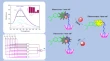
<p>The schematic diagram for the quantum device based on parallel-coupled double quantum dots embedded in an AB interferometer in the present work is illustrated in Figure <figr fid="F1">1</figr>, and two noninteracting QDs embedded in the AB interferometer. QDs can be realized in the two-dimensional electron gas of an AlGaAs/GaAs heterostructure, in which a tunable tunneling barrier between the two dots is formed by using two gate voltages. So we can set <it>t<sub>c </sub></it>as the coupling between the two QDs, which can be modulated by using the gate voltages <abbrgrp><abbr bid="B1">1</abbr></abbrgrp>. The RSOI is assumed to exist inside QDs, which can produce two main effects including a spin-dependent extra phase factor in the tunnel matrix elements and interlevel spin-flip term <abbrgrp><abbr bid="B47">47</abbr><abbr bid="B48">48</abbr></abbrgrp>. In the present paper, we only consider the first term because of only one energy level in each QD. When a temperature gradient &#916;<it>T </it>between the two metallic electrodes is presented, a spin-dependent thermoelectric voltage &#916;<it>V</it><sub>&#8593;(<it>&#8595;</it>) </sub>emerges. The proposed spin-dependent thermoelectric AB interferometer can be described by using the following Hamiltonian in a second-quantized form as,</p>
<fig id="F1"><title><p>Figure 1</p></title><caption><p>(Color online) Schematic diagram for a thermoelectric device based on a double QD AB interferometer in the presence of magnetic flux &#934;</p></caption><text>
   <p><b>(Color online) Schematic diagram for a thermoelectric device based on a double QD AB interferometer in the presence of magnetic flux &#934;</b>. A spin-dependent thermoelectric voltage &#916;<it>V<sub>&#963; </sub></it>is generated when a temperature gradient &#916;<it>T </it>is presented, where <it>&#956; </it>is the chemical potential of the metallic electrodes, and <it>T </it>is the temperature of the metallic electrode.</p>
</text><graphic file="1556-276X-6-618-1" hint_layout="single"/></fig>
<p><display-formula id="M1"><m:math name="1556-276X-6-618-i1" xmlns:m="http://www.w3.org/1998/Math/MathML"><m:mrow>
   <m:msub>
      <m:mrow>
         <m:mi>H</m:mi>
      </m:mrow>
      <m:mrow>
         <m:mi>t</m:mi>
         <m:mi>o</m:mi>
         <m:mi>t</m:mi>
         <m:mi>a</m:mi>
         <m:mi>l</m:mi>
      </m:mrow>
   </m:msub>
   <m:mo class="MathClass-rel">=</m:mo>
   <m:munder class="msub">
      <m:mrow>
         <m:mo mathsize="big"> &#8721;</m:mo>
      </m:mrow>
      <m:mrow>
         <m:mi>&#945;</m:mi>
         <m:mo class="MathClass-rel">=</m:mo>
         <m:mi>L</m:mi>
         <m:mo class="MathClass-punc">,</m:mo>
         <m:mi>R</m:mi>
         <m:mo class="MathClass-punc">;</m:mo>
         <m:mspace width="2.77695pt" class="tmspace"/>
         <m:mi>k</m:mi>
         <m:mi>&#963;</m:mi>
      </m:mrow>
   </m:munder>
   <m:msub>
      <m:mrow>
         <m:mi>&#1013;</m:mi>
      </m:mrow>
      <m:mrow>
         <m:mi>&#945;</m:mi>
         <m:mi>k</m:mi>
         <m:mi>&#963;</m:mi>
      </m:mrow>
   </m:msub>
   <m:msubsup>
      <m:mrow>
         <m:mi>a</m:mi>
      </m:mrow>
      <m:mrow>
         <m:mi>&#945;</m:mi>
         <m:mi>k</m:mi>
         <m:mi>&#963;</m:mi>
      </m:mrow>
      <m:mrow>
         <m:mo class="MathClass-bin">&#8224;</m:mo>
      </m:mrow>
   </m:msubsup>
   <m:msub>
      <m:mrow>
         <m:mi>a</m:mi>
      </m:mrow>
      <m:mrow>
         <m:mi>&#945;</m:mi>
         <m:mi>k</m:mi>
         <m:mi>&#963;</m:mi>
      </m:mrow>
   </m:msub>
   <m:mo class="MathClass-bin">+</m:mo>
   <m:munder class="msub">
      <m:mrow>
         <m:mo mathsize="big">&#8721;</m:mo>
      </m:mrow>
      <m:mrow>
         <m:mi>n</m:mi>
         <m:mo class="MathClass-rel">=</m:mo>
         <m:mn>1</m:mn>
         <m:mo class="MathClass-punc">,</m:mo>
         <m:mn>2</m:mn>
         <m:mo class="MathClass-punc">;</m:mo>
         <m:mi>&#963;</m:mi>
      </m:mrow>
   </m:munder>
   <m:msub>
      <m:mrow>
         <m:mi>&#1013;</m:mi>
      </m:mrow>
      <m:mrow>
         <m:mi>n</m:mi>
      </m:mrow>
   </m:msub>
   <m:msubsup>
      <m:mrow>
         <m:mi>d</m:mi>
      </m:mrow>
      <m:mrow>
         <m:mi>n</m:mi>
         <m:mi>&#963;</m:mi>
      </m:mrow>
      <m:mrow>
         <m:mo class="MathClass-bin">&#8224;</m:mo>
      </m:mrow>
   </m:msubsup>
   <m:msub>
      <m:mrow>
         <m:mi>d</m:mi>
      </m:mrow>
      <m:mrow>
         <m:mi>n</m:mi>
         <m:mi>&#963;</m:mi>
      </m:mrow>
   </m:msub>
   <m:mo class="MathClass-bin">-</m:mo>
   <m:msub>
      <m:mrow>
         <m:mi>t</m:mi>
      </m:mrow>
      <m:mrow>
         <m:mi>c</m:mi>
      </m:mrow>
   </m:msub>
   <m:mrow>
      <m:mo class="MathClass-open">(</m:mo>
      <m:mrow>
         <m:msubsup>
            <m:mrow>
               <m:mi>d</m:mi>
            </m:mrow>
            <m:mrow>
               <m:mn>1</m:mn>
               <m:mi>&#963;</m:mi>
            </m:mrow>
            <m:mrow>
               <m:mo class="MathClass-bin">&#8224;</m:mo>
            </m:mrow>
         </m:msubsup>
         <m:msub>
            <m:mrow>
               <m:mi>d</m:mi>
            </m:mrow>
            <m:mrow>
               <m:mn>2</m:mn>
               <m:mi>&#963;</m:mi>
            </m:mrow>
         </m:msub>
         <m:mo class="MathClass-bin">+</m:mo>
         <m:mi>H</m:mi>
         <m:mo class="MathClass-punc">.</m:mo>
         <m:mi>c</m:mi>
         <m:mo class="MathClass-punc">.</m:mo>
      </m:mrow>
      <m:mo class="MathClass-close">)</m:mo>
   </m:mrow>
   <m:mo class="MathClass-bin">+</m:mo>
   <m:munder class="msub">
      <m:mrow>
         <m:mo mathsize="big">&#8721;</m:mo>
      </m:mrow>
      <m:mrow>
         <m:mi>k</m:mi>
         <m:mo class="MathClass-punc">,</m:mo>
         <m:mi>&#945;</m:mi>
         <m:mo class="MathClass-punc">,</m:mo>
         <m:mi>&#963;</m:mi>
         <m:mo class="MathClass-punc">,</m:mo>
         <m:mi>n</m:mi>
      </m:mrow>
   </m:munder>
   <m:mrow>
      <m:mo class="MathClass-open">[</m:mo>
      <m:mrow>
         <m:msub>
            <m:mrow>
               <m:mi>V</m:mi>
            </m:mrow>
            <m:mrow>
               <m:mi>&#945;</m:mi>
               <m:mi>&#963;</m:mi>
               <m:mi>n</m:mi>
            </m:mrow>
         </m:msub>
         <m:msubsup>
            <m:mrow>
               <m:mi>d</m:mi>
            </m:mrow>
            <m:mrow>
               <m:mi>n</m:mi>
               <m:mi>&#963;</m:mi>
            </m:mrow>
            <m:mrow>
               <m:mo class="MathClass-bin">&#8224;</m:mo>
            </m:mrow>
         </m:msubsup>
         <m:msub>
            <m:mrow>
               <m:mi>a</m:mi>
            </m:mrow>
            <m:mrow>
               <m:mi>&#945;</m:mi>
               <m:mi>k</m:mi>
               <m:mi>&#963;</m:mi>
            </m:mrow>
         </m:msub>
         <m:mo class="MathClass-bin">+</m:mo>
         <m:mi>H</m:mi>
         <m:mo class="MathClass-punc">.</m:mo>
         <m:mi>c</m:mi>
         <m:mo class="MathClass-punc">.</m:mo>
      </m:mrow>
      <m:mo class="MathClass-close">]</m:mo>
   </m:mrow>
   <m:mo class="MathClass-punc">,</m:mo>
</m:mrow>
</m:math>
</display-formula></p>
<p>where <inline-formula><m:math name="1556-276X-6-618-i2" xmlns:m="http://www.w3.org/1998/Math/MathML"><m:msubsup>
   <m:mrow>
      <m:mi>a</m:mi>
   </m:mrow>
   <m:mrow>
      <m:mi>&#945;</m:mi>
      <m:mi>k</m:mi>
      <m:mi>&#963;</m:mi>
   </m:mrow>
   <m:mrow>
      <m:mo class="MathClass-bin">&#8224;</m:mo>
   </m:mrow>
</m:msubsup>
<m:mrow>
   <m:mo class="MathClass-open">(</m:mo>
   <m:mrow>
      <m:msub>
         <m:mrow>
            <m:mi>a</m:mi>
         </m:mrow>
         <m:mrow>
            <m:mi>&#945;</m:mi>
            <m:mi>k</m:mi>
            <m:mi>&#963;</m:mi>
         </m:mrow>
      </m:msub>
   </m:mrow>
   <m:mo class="MathClass-close">)</m:mo>
</m:mrow>
</m:math>
</inline-formula> is the creation(annihilation) operator for an electron with energy <it>&#949;<sub>&#945;k&#963;</sub></it>, momentum <it>k </it>and spin index <it>&#963; </it>in electrode <it>&#945;</it>. The electrode <it>&#945; </it>can be regarded as an independent electron and thermal reservoirs, which can be described by using the Fermi-Dirac distribution such as <it>f<sub>&#945; </sub></it>= 1/{<it>exp</it>[(<it>&#949; </it>- <it>&#956;<sub>&#945;</sub></it>)/(<it>k<sub>B</sub>T<sub>&#945;</sub></it>) + 1}. Here <it>k<sub>B </sub></it>is the Boltzmann constant. <inline-formula><m:math name="1556-276X-6-618-i3" xmlns:m="http://www.w3.org/1998/Math/MathML"><m:mrow>
   <m:msubsup>
      <m:mrow>
         <m:mi>d</m:mi>
      </m:mrow>
      <m:mrow>
         <m:mi>n</m:mi>
         <m:mi>&#963;</m:mi>
      </m:mrow>
      <m:mrow>
         <m:mo class="MathClass-bin">&#8224;</m:mo>
      </m:mrow>
   </m:msubsup>
   <m:mrow>
      <m:mo class="MathClass-open">(</m:mo>
      <m:mrow>
         <m:msub>
            <m:mrow>
               <m:mi>d</m:mi>
            </m:mrow>
            <m:mrow>
               <m:mi>n</m:mi>
               <m:mi>&#963;</m:mi>
            </m:mrow>
         </m:msub>
      </m:mrow>
      <m:mo class="MathClass-close">)</m:mo>
   </m:mrow>
</m:mrow>
</m:math>
</inline-formula> creates (destroys) an electron with energy <it>&#949;<sub>n </sub></it>and spin index <it>&#963; </it>in the nth QD. <it>t<sub>c </sub></it>describes the tunnel coupling between the two QDs, which can be controlled by using the voltages applied to the gate electrodes <abbrgrp><abbr bid="B1">1</abbr></abbrgrp>. The tunnel matrix element <it>V<sub>&#945;&#963;n </sub></it>in a symmetric gauge is assumed to be independent of momentum <it>k</it>, and it can be written as <inline-formula><m:math name="1556-276X-6-618-i4" xmlns:m="http://www.w3.org/1998/Math/MathML"><m:msub>
   <m:mrow>
      <m:mi>V</m:mi>
   </m:mrow>
   <m:mrow>
      <m:mi>L</m:mi>
      <m:mi>&#963;</m:mi>
      <m:mn>1</m:mn>
   </m:mrow>
</m:msub>
<m:mo class="MathClass-rel">=</m:mo>
<m:mspace width="2.77695pt" class="tmspace"/>
<m:mo class="MathClass-rel">&#8739;</m:mo>
<m:msub>
   <m:mrow>
      <m:mi>V</m:mi>
   </m:mrow>
   <m:mrow>
      <m:mi>L</m:mi>
      <m:mi>&#963;</m:mi>
      <m:mn>1</m:mn>
   </m:mrow>
</m:msub>
<m:mo class="MathClass-rel">&#8739;</m:mo>
<m:msup>
   <m:mrow>
      <m:mi>e</m:mi>
   </m:mrow>
   <m:mrow>
      <m:mi>i</m:mi>
      <m:mrow>
         <m:mo class="MathClass-open">(</m:mo>
         <m:mrow>
            <m:mi>&#981;</m:mi>
            <m:mo class="MathClass-bin">-</m:mo>
            <m:mi>&#963;</m:mi>
            <m:msub>
               <m:mrow>
                  <m:mi>&#966;</m:mi>
               </m:mrow>
               <m:mrow>
                  <m:mi>R</m:mi>
               </m:mrow>
            </m:msub>
         </m:mrow>
         <m:mo class="MathClass-close">)</m:mo>
      </m:mrow>
      <m:mo class="MathClass-bin">&#8725;</m:mo>
      <m:mn>4</m:mn>
   </m:mrow>
</m:msup>
</m:math>
</inline-formula>, <inline-formula><m:math name="1556-276X-6-618-i5" xmlns:m="http://www.w3.org/1998/Math/MathML"><m:msub>
   <m:mrow>
      <m:mi>V</m:mi>
   </m:mrow>
   <m:mrow>
      <m:mi>L</m:mi>
      <m:mi>&#963;</m:mi>
      <m:mn>2</m:mn>
   </m:mrow>
</m:msub>
<m:mo class="MathClass-rel">=</m:mo>
<m:mspace width="2.77695pt" class="tmspace"/>
<m:mo class="MathClass-rel">&#8739;</m:mo>
<m:msub>
   <m:mrow>
      <m:mi>V</m:mi>
   </m:mrow>
   <m:mrow>
      <m:mi>L</m:mi>
      <m:mi>&#963;</m:mi>
      <m:mn>2</m:mn>
   </m:mrow>
</m:msub>
<m:mo class="MathClass-rel">&#8739;</m:mo>
<m:msup>
   <m:mrow>
      <m:mi>e</m:mi>
   </m:mrow>
   <m:mrow>
      <m:mo class="MathClass-bin">-</m:mo>
      <m:mi>i</m:mi>
      <m:mrow>
         <m:mo class="MathClass-open">(</m:mo>
         <m:mrow>
            <m:mi>&#981;</m:mi>
            <m:mo class="MathClass-bin">-</m:mo>
            <m:mi>&#963;</m:mi>
            <m:msub>
               <m:mrow>
                  <m:mi>&#966;</m:mi>
               </m:mrow>
               <m:mrow>
                  <m:mi>R</m:mi>
               </m:mrow>
            </m:msub>
         </m:mrow>
         <m:mo class="MathClass-close">)</m:mo>
      </m:mrow>
      <m:mo class="MathClass-bin">&#8725;</m:mo>
      <m:mn>4</m:mn>
   </m:mrow>
</m:msup>
</m:math>
</inline-formula>, <inline-formula><m:math name="1556-276X-6-618-i6" xmlns:m="http://www.w3.org/1998/Math/MathML"><m:msub>
   <m:mrow>
      <m:mi>V</m:mi>
   </m:mrow>
   <m:mrow>
      <m:mi>R</m:mi>
      <m:mi>&#963;</m:mi>
      <m:mn>1</m:mn>
   </m:mrow>
</m:msub>
<m:mo class="MathClass-rel">=</m:mo>
<m:mspace width="2.77695pt" class="tmspace"/>
<m:mo class="MathClass-rel">&#8739;</m:mo>
<m:msub>
   <m:mrow>
      <m:mi>V</m:mi>
   </m:mrow>
   <m:mrow>
      <m:mi>R</m:mi>
      <m:mi>&#963;</m:mi>
      <m:mn>1</m:mn>
   </m:mrow>
</m:msub>
<m:mo class="MathClass-rel">&#8739;</m:mo>
<m:msup>
   <m:mrow>
      <m:mi>e</m:mi>
   </m:mrow>
   <m:mrow>
      <m:mo class="MathClass-bin">-</m:mo>
      <m:mi>i</m:mi>
      <m:mrow>
         <m:mo class="MathClass-open">(</m:mo>
         <m:mrow>
            <m:mi>&#981;</m:mi>
            <m:mo class="MathClass-bin">-</m:mo>
            <m:mi>&#963;</m:mi>
            <m:msub>
               <m:mrow>
                  <m:mi>&#966;</m:mi>
               </m:mrow>
               <m:mrow>
                  <m:mi>R</m:mi>
               </m:mrow>
            </m:msub>
         </m:mrow>
         <m:mo class="MathClass-close">)</m:mo>
      </m:mrow>
      <m:mo class="MathClass-bin">&#8725;</m:mo>
      <m:mn>4</m:mn>
   </m:mrow>
</m:msup>
</m:math>
</inline-formula>, <inline-formula><m:math name="1556-276X-6-618-i7" xmlns:m="http://www.w3.org/1998/Math/MathML"><m:msub>
   <m:mrow>
      <m:mi>V</m:mi>
   </m:mrow>
   <m:mrow>
      <m:mi>R</m:mi>
      <m:mi>&#963;</m:mi>
      <m:mn>2</m:mn>
   </m:mrow>
</m:msub>
<m:mo class="MathClass-rel">=</m:mo>
<m:mspace width="2.77695pt" class="tmspace"/>
<m:mo class="MathClass-rel">&#8739;</m:mo>
<m:msub>
   <m:mrow>
      <m:mi>V</m:mi>
   </m:mrow>
   <m:mrow>
      <m:mi>R</m:mi>
      <m:mi>&#963;</m:mi>
      <m:mn>2</m:mn>
   </m:mrow>
</m:msub>
<m:mo class="MathClass-rel">&#8739;</m:mo>
<m:msup>
   <m:mrow>
      <m:mi>e</m:mi>
   </m:mrow>
   <m:mrow>
      <m:mi>i</m:mi>
      <m:mrow>
         <m:mo class="MathClass-open">(</m:mo>
         <m:mrow>
            <m:mi>&#981;</m:mi>
            <m:mo class="MathClass-bin">-</m:mo>
            <m:mi>&#963;</m:mi>
            <m:msub>
               <m:mrow>
                  <m:mi>&#966;</m:mi>
               </m:mrow>
               <m:mrow>
                  <m:mi>R</m:mi>
               </m:mrow>
            </m:msub>
         </m:mrow>
         <m:mo class="MathClass-close">)</m:mo>
      </m:mrow>
      <m:mo class="MathClass-bin">&#8725;</m:mo>
      <m:mn>4</m:mn>
   </m:mrow>
</m:msup>
</m:math>
</inline-formula>, with the AB phase <it>&#981; </it>= 2<it>&#960;</it>&#934;/&#934;<sub>0 </sub>and the flux quantum &#934;<sub>0 </sub>= <it>h/e</it>. &#934; can be calculated by the equation <inline-formula><m:math name="1556-276X-6-618-i8" xmlns:m="http://www.w3.org/1998/Math/MathML"><m:mi>&#981;</m:mi>
<m:mo class="MathClass-rel">=</m:mo>
<m:mover accent="true">
   <m:mrow>
      <m:mi>B</m:mi>
   </m:mrow>
   <m:mo class="MathClass-op">&#8594;</m:mo>
</m:mover>
<m:mo class="MathClass-bin">&#8901;</m:mo>
<m:mover accent="true">
   <m:mrow>
      <m:mi>S</m:mi>
   </m:mrow>
   <m:mo class="MathClass-op">&#8594;</m:mo>
</m:mover>
</m:math>
</inline-formula>, where <it>B </it>is the magnetic field threading the AB interferometer and <it>S </it>is the corresponding area of the quantum ring consisting of the double quantum dots and metallic electrodes. The value S may be obtained in the previous well-known experimental work <abbrgrp><abbr bid="B1">1</abbr></abbrgrp>. So the magnitude of the magnetic field B is 16.4<it>mT </it>when <it>&#981; </it>= 2<it>&#960;</it>. In the absence of the RSOI, the work will come back to the previous work <abbrgrp><abbr bid="B24">24</abbr></abbrgrp>, in which a 2<it>&#960;</it>-periodic linear conductance is obtained, and it is in good agreement with the experimental work <abbrgrp><abbr bid="B1">1</abbr></abbrgrp>. <it>&#966;<sub>R </sub></it>denotes the difference between <it>&#966;</it><sub><it>R</it>1 </sub>and <it>&#966;</it><sub><it>R</it>2</sub>, where <it>&#966;<sub>Ri </sub></it>is the phase factor induced by the RSOI inside the ith QD.</p>
<p>In the steady state, using the Green's functions and Dyson's equations, the electric current with spin index <it>&#963; </it>through the AB interferometer can be calculated by <abbrgrp><abbr bid="B49">49</abbr></abbrgrp>,</p>
<p><display-formula id="M2"><m:math name="1556-276X-6-618-i9" xmlns:m="http://www.w3.org/1998/Math/MathML"><m:mrow>
   <m:msub>
      <m:mrow>
         <m:mi>I</m:mi>
      </m:mrow>
      <m:mrow>
         <m:mi>&#963;</m:mi>
      </m:mrow>
   </m:msub>
   <m:mrow>
      <m:mo class="MathClass-open">(</m:mo>
      <m:mrow>
         <m:msub>
            <m:mrow>
               <m:mi>&#956;</m:mi>
            </m:mrow>
            <m:mrow>
               <m:mi>L</m:mi>
            </m:mrow>
         </m:msub>
         <m:mo class="MathClass-punc">,</m:mo>
         <m:mspace width="2.77695pt" class="tmspace"/>
         <m:msub>
            <m:mrow>
               <m:mi>T</m:mi>
            </m:mrow>
            <m:mrow>
               <m:mi>L</m:mi>
            </m:mrow>
         </m:msub>
         <m:mo class="MathClass-punc">;</m:mo>
         <m:msub>
            <m:mrow>
               <m:mi>&#956;</m:mi>
            </m:mrow>
            <m:mrow>
               <m:mi>R</m:mi>
            </m:mrow>
         </m:msub>
         <m:mo class="MathClass-punc">,</m:mo>
         <m:mspace width="2.77695pt" class="tmspace"/>
         <m:msub>
            <m:mrow>
               <m:mi>T</m:mi>
            </m:mrow>
            <m:mrow>
               <m:mi>R</m:mi>
            </m:mrow>
         </m:msub>
      </m:mrow>
      <m:mo class="MathClass-close">)</m:mo>
   </m:mrow>
   <m:mo class="MathClass-rel">=</m:mo>
   <m:mfrac>
      <m:mrow>
         <m:mi>e</m:mi>
      </m:mrow>
      <m:mrow>
         <m:mi>h</m:mi>
      </m:mrow>
   </m:mfrac>
   <m:mo class="MathClass-op">&#8747; </m:mo>
   <m:mi>d</m:mi>
   <m:mi>&#949;</m:mi>
   <m:msub>
      <m:mrow>
         <m:mi>&#964;</m:mi>
      </m:mrow>
      <m:mrow>
         <m:mi>&#963;</m:mi>
      </m:mrow>
   </m:msub>
   <m:mrow>
      <m:mo class="MathClass-open">(</m:mo>
      <m:mrow>
         <m:mi>&#949;</m:mi>
      </m:mrow>
      <m:mo class="MathClass-close">)</m:mo>
   </m:mrow>
   <m:mrow>
      <m:mo class="MathClass-open">[</m:mo>
      <m:mrow>
         <m:msub>
            <m:mrow>
               <m:mi>f</m:mi>
            </m:mrow>
            <m:mrow>
               <m:mi>L</m:mi>
            </m:mrow>
         </m:msub>
         <m:mrow>
            <m:mo class="MathClass-open">(</m:mo>
            <m:mrow>
               <m:mi>&#949;</m:mi>
            </m:mrow>
            <m:mo class="MathClass-close">)</m:mo>
         </m:mrow>
         <m:mo class="MathClass-bin">-</m:mo>
         <m:msub>
            <m:mrow>
               <m:mi>f</m:mi>
            </m:mrow>
            <m:mrow>
               <m:mi>R</m:mi>
            </m:mrow>
         </m:msub>
         <m:mrow>
            <m:mo class="MathClass-open">(</m:mo>
            <m:mrow>
               <m:mi>&#949;</m:mi>
            </m:mrow>
            <m:mo class="MathClass-close">)</m:mo>
         </m:mrow>
      </m:mrow>
      <m:mo class="MathClass-close">]</m:mo>
   </m:mrow>
   <m:mo class="MathClass-punc">,</m:mo>
</m:mrow>
</m:math>
</display-formula></p>
<p>and the thermal current with spin index <it>&#963; </it>from the electrode <it>&#945; </it>is calculated by <abbrgrp><abbr bid="B50">50</abbr></abbrgrp>,</p>
<p><display-formula id="M3"><m:math name="1556-276X-6-618-i10" xmlns:m="http://www.w3.org/1998/Math/MathML"><m:mrow>
   <m:msubsup>
      <m:mrow>
         <m:mi>J</m:mi>
      </m:mrow>
      <m:mrow>
         <m:mi>&#963;</m:mi>
      </m:mrow>
      <m:mrow>
         <m:mi>&#945;</m:mi>
      </m:mrow>
   </m:msubsup>
   <m:mo class="MathClass-rel">=</m:mo>
   <m:mfrac>
      <m:mrow>
         <m:mn>1</m:mn>
      </m:mrow>
      <m:mrow>
         <m:mi>h</m:mi>
      </m:mrow>
   </m:mfrac>
   <m:mo class="MathClass-op">&#8747; </m:mo>
   <m:mi>d</m:mi>
   <m:mi>&#949;</m:mi>
   <m:mrow>
      <m:mo class="MathClass-open">(</m:mo>
      <m:mrow>
         <m:mi>&#949;</m:mi>
         <m:mo class="MathClass-bin">-</m:mo>
         <m:msub>
            <m:mrow>
               <m:mi>&#956;</m:mi>
            </m:mrow>
            <m:mrow>
               <m:mi>&#945;</m:mi>
            </m:mrow>
         </m:msub>
      </m:mrow>
      <m:mo class="MathClass-close">)</m:mo>
   </m:mrow>
   <m:msub>
      <m:mrow>
         <m:mi>&#964;</m:mi>
      </m:mrow>
      <m:mrow>
         <m:mi>&#963;</m:mi>
      </m:mrow>
   </m:msub>
   <m:mrow>
      <m:mo class="MathClass-open">(</m:mo>
      <m:mrow>
         <m:mi>&#949;</m:mi>
      </m:mrow>
      <m:mo class="MathClass-close">)</m:mo>
   </m:mrow>
   <m:mrow>
      <m:mo class="MathClass-open">[</m:mo>
      <m:mrow>
         <m:msub>
            <m:mrow>
               <m:mi>f</m:mi>
            </m:mrow>
            <m:mrow>
               <m:mi>L</m:mi>
            </m:mrow>
         </m:msub>
         <m:mrow>
            <m:mo class="MathClass-open">(</m:mo>
            <m:mrow>
               <m:mi>&#949;</m:mi>
            </m:mrow>
            <m:mo class="MathClass-close">)</m:mo>
         </m:mrow>
         <m:mo class="MathClass-bin">-</m:mo>
         <m:msub>
            <m:mrow>
               <m:mi>f</m:mi>
            </m:mrow>
            <m:mrow>
               <m:mi>R</m:mi>
            </m:mrow>
         </m:msub>
         <m:mrow>
            <m:mo class="MathClass-open">(</m:mo>
            <m:mrow>
               <m:mi>&#949;</m:mi>
            </m:mrow>
            <m:mo class="MathClass-close">)</m:mo>
         </m:mrow>
      </m:mrow>
      <m:mo class="MathClass-close">]</m:mo>
   </m:mrow>
   <m:mo class="MathClass-punc">,</m:mo>
</m:mrow>
</m:math>
</display-formula></p>
<p>where <it>&#964;<sub>&#963;</sub></it>(<it>&#949;</it>) is the transmission probability of electron with spin index <it>&#963;</it>, which can be given by <inline-formula><m:math name="1556-276X-6-618-i11" xmlns:m="http://www.w3.org/1998/Math/MathML"><m:msub>
   <m:mrow>
      <m:mi>&#964;</m:mi>
   </m:mrow>
   <m:mrow>
      <m:mi>&#963;</m:mi>
   </m:mrow>
</m:msub>
<m:mrow>
   <m:mo class="MathClass-open">(</m:mo>
   <m:mrow>
      <m:mi>&#949;</m:mi>
   </m:mrow>
   <m:mo class="MathClass-close">)</m:mo>
</m:mrow>
<m:mo class="MathClass-rel">=</m:mo>
<m:mi>T</m:mi>
<m:mi>r</m:mi>
<m:mrow>
   <m:mo class="MathClass-open">[</m:mo>
   <m:mrow>
      <m:msubsup>
         <m:mrow>
            <m:mo>&#915;</m:mo>
         </m:mrow>
         <m:mrow>
            <m:mi>&#963;</m:mi>
         </m:mrow>
         <m:mrow>
            <m:mi>L</m:mi>
         </m:mrow>
      </m:msubsup>
      <m:msubsup>
         <m:mrow>
            <m:mstyle mathvariant="bold">
               <m:mstyle mathvariant="italic">
                  <m:mi>G</m:mi>
               </m:mstyle>
            </m:mstyle>
         </m:mrow>
         <m:mrow>
            <m:mi>&#963;</m:mi>
         </m:mrow>
         <m:mrow>
            <m:mi>r</m:mi>
         </m:mrow>
      </m:msubsup>
      <m:msubsup>
         <m:mrow>
            <m:mo>&#915;</m:mo>
         </m:mrow>
         <m:mrow>
            <m:mi>&#963;</m:mi>
         </m:mrow>
         <m:mrow>
            <m:mi>R</m:mi>
         </m:mrow>
      </m:msubsup>
      <m:msubsup>
         <m:mrow>
            <m:mstyle mathvariant="bold">
               <m:mi>G</m:mi>
            </m:mstyle>
         </m:mrow>
         <m:mrow>
            <m:mi>&#963;</m:mi>
         </m:mrow>
         <m:mrow>
            <m:mi>a</m:mi>
         </m:mrow>
      </m:msubsup>
   </m:mrow>
   <m:mo class="MathClass-close">]</m:mo>
</m:mrow>
</m:math>
</inline-formula>. The spin-dependent linewidth matrix <inline-formula><m:math name="1556-276X-6-618-i12" xmlns:m="http://www.w3.org/1998/Math/MathML"><m:msubsup>
   <m:mrow>
      <m:mo>&#915;</m:mo>
   </m:mrow>
   <m:mrow>
      <m:mi>&#963;</m:mi>
   </m:mrow>
   <m:mrow>
      <m:mi>L</m:mi>
      <m:mrow>
         <m:mo class="MathClass-open">(</m:mo>
         <m:mrow>
            <m:mi>R</m:mi>
         </m:mrow>
         <m:mo class="MathClass-close">)</m:mo>
      </m:mrow>
   </m:mrow>
</m:msubsup>
</m:math>
</inline-formula> describes the tunnel coupling of the two QDs to the left (right) metallic electrode, which can be expressed as,</p>
<p><display-formula id="M4"><m:math name="1556-276X-6-618-i13" xmlns:m="http://www.w3.org/1998/Math/MathML"><m:mrow>
   <m:msubsup>
      <m:mrow>
         <m:mo>&#915;</m:mo>
      </m:mrow>
      <m:mrow>
         <m:mi>&#963;</m:mi>
      </m:mrow>
      <m:mrow>
         <m:mi>L</m:mi>
         <m:mrow>
            <m:mo class="MathClass-open">(</m:mo>
            <m:mrow>
               <m:mi>R</m:mi>
            </m:mrow>
            <m:mo class="MathClass-close">)</m:mo>
         </m:mrow>
      </m:mrow>
   </m:msubsup>
   <m:mrow>
      <m:mo class="MathClass-open">(</m:mo>
      <m:mrow>
         <m:mi>&#949;</m:mi>
      </m:mrow>
      <m:mo class="MathClass-close">)</m:mo>
   </m:mrow>
   <m:mo class="MathClass-rel">=</m:mo>
   <m:mfenced separators="" open="(" close=")">
      <m:mrow>
         <m:mtable equalrows="false" columnlines="none none none none none none none none none none none none none none none none none none none" equalcolumns="false" class="array">
            <m:mtr>
               <m:mtd class="array" columnalign="center">
                  <m:msubsup>
                     <m:mrow>
                        <m:mo>&#915;</m:mo>
                     </m:mrow>
                     <m:mrow>
                        <m:mn>11</m:mn>
                     </m:mrow>
                     <m:mrow>
                        <m:mi>L</m:mi>
                        <m:mrow>
                           <m:mo class="MathClass-open">(</m:mo>
                           <m:mrow>
                              <m:mi>R</m:mi>
                           </m:mrow>
                           <m:mo class="MathClass-close">)</m:mo>
                        </m:mrow>
                     </m:mrow>
                  </m:msubsup>
               </m:mtd>
               <m:mtd class="array" columnalign="center">
                  <m:msqrt>
                     <m:mrow>
                        <m:msubsup>
                           <m:mrow>
                              <m:mo>&#915;</m:mo>
                           </m:mrow>
                           <m:mrow>
                              <m:mn>11</m:mn>
                           </m:mrow>
                           <m:mrow>
                              <m:mi>L</m:mi>
                              <m:mrow>
                                 <m:mo class="MathClass-open">(</m:mo>
                                 <m:mrow>
                                    <m:mi>R</m:mi>
                                 </m:mrow>
                                 <m:mo class="MathClass-close">)</m:mo>
                              </m:mrow>
                           </m:mrow>
                        </m:msubsup>
                        <m:msubsup>
                           <m:mrow>
                              <m:mo>&#915;</m:mo>
                           </m:mrow>
                           <m:mrow>
                              <m:mn>22</m:mn>
                           </m:mrow>
                           <m:mrow>
                              <m:mi>L</m:mi>
                              <m:mrow>
                                 <m:mo class="MathClass-open">(</m:mo>
                                 <m:mrow>
                                    <m:mi>R</m:mi>
                                 </m:mrow>
                                 <m:mo class="MathClass-close">)</m:mo>
                              </m:mrow>
                           </m:mrow>
                        </m:msubsup>
                     </m:mrow>
                  </m:msqrt>
                  <m:msup>
                     <m:mrow>
                        <m:mi>e</m:mi>
                     </m:mrow>
                     <m:mrow>
                        <m:mo class="MathClass-bin">+</m:mo>
                        <m:mrow>
                           <m:mo class="MathClass-open">(</m:mo>
                           <m:mrow>
                              <m:mo class="MathClass-bin">-</m:mo>
                           </m:mrow>
                           <m:mo class="MathClass-close">)</m:mo>
                        </m:mrow>
                        <m:mi>i</m:mi>
                        <m:msub>
                           <m:mrow>
                              <m:mi>&#981;</m:mi>
                           </m:mrow>
                           <m:mrow>
                              <m:mi>&#963;</m:mi>
                           </m:mrow>
                        </m:msub>
                        <m:mo class="MathClass-bin">&#8725;</m:mo>
                        <m:mn>2</m:mn>
                     </m:mrow>
                  </m:msup>
               </m:mtd>
            </m:mtr>
            <m:mtr>
               <m:mtd class="array" columnalign="center">
                  <m:msqrt>
                     <m:mrow>
                        <m:msubsup>
                           <m:mrow>
                              <m:mo>&#915;</m:mo>
                           </m:mrow>
                           <m:mrow>
                              <m:mn>11</m:mn>
                           </m:mrow>
                           <m:mrow>
                              <m:mi>L</m:mi>
                              <m:mrow>
                                 <m:mo class="MathClass-open">(</m:mo>
                                 <m:mrow>
                                    <m:mi>R</m:mi>
                                 </m:mrow>
                                 <m:mo class="MathClass-close">)</m:mo>
                              </m:mrow>
                           </m:mrow>
                        </m:msubsup>
                        <m:msubsup>
                           <m:mrow>
                              <m:mo>&#915;</m:mo>
                           </m:mrow>
                           <m:mrow>
                              <m:mn>22</m:mn>
                           </m:mrow>
                           <m:mrow>
                              <m:mi>L</m:mi>
                              <m:mrow>
                                 <m:mo class="MathClass-open">(</m:mo>
                                 <m:mrow>
                                    <m:mi>R</m:mi>
                                 </m:mrow>
                                 <m:mo class="MathClass-close">)</m:mo>
                              </m:mrow>
                           </m:mrow>
                        </m:msubsup>
                     </m:mrow>
                  </m:msqrt>
                  <m:msup>
                     <m:mrow>
                        <m:mi>e</m:mi>
                     </m:mrow>
                     <m:mrow>
                        <m:mo class="MathClass-bin">-</m:mo>
                        <m:mrow>
                           <m:mo class="MathClass-open">(</m:mo>
                           <m:mrow>
                              <m:mo class="MathClass-bin">+</m:mo>
                           </m:mrow>
                           <m:mo class="MathClass-close">)</m:mo>
                        </m:mrow>
                        <m:mi>i</m:mi>
                        <m:msub>
                           <m:mrow>
                              <m:mi>&#981;</m:mi>
                           </m:mrow>
                           <m:mrow>
                              <m:mi>&#963;</m:mi>
                           </m:mrow>
                        </m:msub>
                        <m:mo class="MathClass-bin">&#8725;</m:mo>
                        <m:mn>2</m:mn>
                     </m:mrow>
                  </m:msup>
               </m:mtd>
               <m:mtd class="array" columnalign="center">
                  <m:msubsup>
                     <m:mrow>
                        <m:mo>&#915;</m:mo>
                     </m:mrow>
                     <m:mrow>
                        <m:mn>22</m:mn>
                     </m:mrow>
                     <m:mrow>
                        <m:mi>L</m:mi>
                        <m:mrow>
                           <m:mo class="MathClass-open">(</m:mo>
                           <m:mrow>
                              <m:mi>R</m:mi>
                           </m:mrow>
                           <m:mo class="MathClass-close">)</m:mo>
                        </m:mrow>
                     </m:mrow>
                  </m:msubsup>
               </m:mtd>
            </m:mtr>
            <m:mtr>
               <m:mtd class="array" columnalign="center"/>
            </m:mtr>
         </m:mtable>
      </m:mrow>
   </m:mfenced>
   <m:mo class="MathClass-punc">,</m:mo>
</m:mrow>
</m:math>
</display-formula></p>
<p>where <inline-formula><m:math name="1556-276X-6-618-i14" xmlns:m="http://www.w3.org/1998/Math/MathML"><m:mrow>
   <m:msubsup>
      <m:mrow>
         <m:mo>&#915;</m:mo>
      </m:mrow>
      <m:mrow>
         <m:mi>n</m:mi>
         <m:mi>m</m:mi>
      </m:mrow>
      <m:mrow>
         <m:mi>&#945;</m:mi>
      </m:mrow>
   </m:msubsup>
   <m:mo class="MathClass-rel">=</m:mo>
   <m:mn>2</m:mn>
   <m:mi>&#960;</m:mi>
   <m:msub>
      <m:mrow>
         <m:mo mathsize="big">&#8721;</m:mo>
      </m:mrow>
      <m:mrow>
         <m:mi>k</m:mi>
      </m:mrow>
   </m:msub>
   <m:mo class="MathClass-rel">&#8739;</m:mo>
   <m:msub>
      <m:mrow>
         <m:mi>V</m:mi>
      </m:mrow>
      <m:mrow>
         <m:mi>&#945;</m:mi>
         <m:mi>&#963;</m:mi>
         <m:mi>n</m:mi>
      </m:mrow>
   </m:msub>
   <m:mo class="MathClass-rel">&#8741;</m:mo>
   <m:msubsup>
      <m:mrow>
         <m:mi>V</m:mi>
      </m:mrow>
      <m:mrow>
         <m:mi>&#945;</m:mi>
         <m:mi>&#963;</m:mi>
         <m:mi>m</m:mi>
      </m:mrow>
      <m:mrow>
         <m:mo class="MathClass-bin">*</m:mo>
      </m:mrow>
   </m:msubsup>
   <m:mo class="MathClass-rel">&#8739;</m:mo>
   <m:mi>&#948;</m:mi>
   <m:mrow>
      <m:mo class="MathClass-open">(</m:mo>
      <m:mrow>
         <m:mi>&#949;</m:mi>
         <m:mo class="MathClass-bin">-</m:mo>
         <m:msub>
            <m:mrow>
               <m:mi>&#949;</m:mi>
            </m:mrow>
            <m:mrow>
               <m:mi>&#945;</m:mi>
               <m:mi>k</m:mi>
               <m:mi>&#963;</m:mi>
            </m:mrow>
         </m:msub>
      </m:mrow>
      <m:mo class="MathClass-close">)</m:mo>
   </m:mrow>
</m:mrow>
</m:math>
</inline-formula>. <inline-formula><m:math name="1556-276X-6-618-i15" xmlns:m="http://www.w3.org/1998/Math/MathML"><m:mspace width="2.77695pt" class="tmspace"/>
<m:msubsup>
   <m:mrow>
      <m:mstyle mathvariant="bold">
         <m:mi>G</m:mi>
      </m:mstyle>
   </m:mrow>
   <m:mrow>
      <m:mi>&#963;</m:mi>
   </m:mrow>
   <m:mrow>
      <m:mi>r</m:mi>
   </m:mrow>
</m:msubsup>
<m:mrow>
   <m:mo class="MathClass-open">(</m:mo>
   <m:mrow>
      <m:mi>&#949;</m:mi>
   </m:mrow>
   <m:mo class="MathClass-close">)</m:mo>
</m:mrow>
</m:math>
</inline-formula> is the 2 <it>&#215; </it>2 matrix of the fourier transform of retarded QD Green's function, and its matrix elements in the time space can be defined as <inline-formula><m:math name="1556-276X-6-618-i16" xmlns:m="http://www.w3.org/1998/Math/MathML"><m:mrow>
   <m:msubsup>
      <m:mrow>
         <m:mi>G</m:mi>
      </m:mrow>
      <m:mrow>
         <m:mi>n</m:mi>
         <m:mi>&#963;</m:mi>
         <m:mo class="MathClass-punc">,</m:mo>
         <m:mi>m</m:mi>
         <m:mi>&#963;</m:mi>
      </m:mrow>
      <m:mrow>
         <m:mi>r</m:mi>
      </m:mrow>
   </m:msubsup>
   <m:mrow>
      <m:mo class="MathClass-open">(</m:mo>
      <m:mrow>
         <m:mi>t</m:mi>
      </m:mrow>
      <m:mo class="MathClass-close">)</m:mo>
   </m:mrow>
   <m:mo class="MathClass-rel">=</m:mo>
   <m:mo class="MathClass-bin">-</m:mo>
   <m:mi>i</m:mi>
   <m:mi>&#920;</m:mi>
   <m:mrow>
      <m:mo class="MathClass-open">(</m:mo>
      <m:mrow>
         <m:mi>t</m:mi>
      </m:mrow>
      <m:mo class="MathClass-close">)</m:mo>
   </m:mrow>
   <m:mo class="MathClass-rel">&lt;</m:mo>
   <m:mrow>
      <m:mo class="MathClass-open">{</m:mo>
      <m:mrow>
         <m:msub>
            <m:mrow>
               <m:mi>d</m:mi>
            </m:mrow>
            <m:mrow>
               <m:mi>n</m:mi>
               <m:mi>&#963;</m:mi>
            </m:mrow>
         </m:msub>
         <m:mrow>
            <m:mo class="MathClass-open">(</m:mo>
            <m:mrow>
               <m:mi>t</m:mi>
            </m:mrow>
            <m:mo class="MathClass-close">)</m:mo>
         </m:mrow>
         <m:mo class="MathClass-punc">,</m:mo>
         <m:mspace width="2.77695pt" class="tmspace"/>
         <m:msubsup>
            <m:mrow>
               <m:mi>d</m:mi>
            </m:mrow>
            <m:mrow>
               <m:mi>m</m:mi>
               <m:mi>&#963;</m:mi>
            </m:mrow>
            <m:mrow>
               <m:mo class="MathClass-bin">&#8224;</m:mo>
            </m:mrow>
         </m:msubsup>
         <m:mrow>
            <m:mo class="MathClass-open">(</m:mo>
            <m:mrow>
               <m:mn>0</m:mn>
            </m:mrow>
            <m:mo class="MathClass-close">)</m:mo>
         </m:mrow>
      </m:mrow>
      <m:mo class="MathClass-close">}</m:mo>
   </m:mrow>
   <m:mo class="MathClass-rel">></m:mo>
</m:mrow>
</m:math>
</inline-formula>, where &#920;(<it>t</it>) is the step function. The advanced dot Green's function can be obtained by the relation <inline-formula><m:math name="1556-276X-6-618-i17" xmlns:m="http://www.w3.org/1998/Math/MathML"><m:msubsup>
   <m:mrow>
      <m:mstyle mathvariant="bold">
         <m:mi>G</m:mi>
      </m:mstyle>
   </m:mrow>
   <m:mrow>
      <m:mi>&#963;</m:mi>
   </m:mrow>
   <m:mrow>
      <m:mi>a</m:mi>
   </m:mrow>
</m:msubsup>
<m:mrow>
   <m:mo class="MathClass-open">(</m:mo>
   <m:mrow>
      <m:mi>&#949;</m:mi>
   </m:mrow>
   <m:mo class="MathClass-close">)</m:mo>
</m:mrow>
<m:mo class="MathClass-rel">=</m:mo>
<m:msup>
   <m:mrow>
      <m:mrow>
         <m:mo class="MathClass-open">[</m:mo>
         <m:mrow>
            <m:msubsup>
               <m:mrow>
                  <m:mstyle mathvariant="bold">
                     <m:mi>G</m:mi>
                  </m:mstyle>
               </m:mrow>
               <m:mrow>
                  <m:mi>&#963;</m:mi>
               </m:mrow>
               <m:mrow>
                  <m:mi>r</m:mi>
               </m:mrow>
            </m:msubsup>
            <m:mrow>
               <m:mo class="MathClass-open">(</m:mo>
               <m:mrow>
                  <m:mi>&#949;</m:mi>
               </m:mrow>
               <m:mo class="MathClass-close">)</m:mo>
            </m:mrow>
         </m:mrow>
         <m:mo class="MathClass-close">]</m:mo>
      </m:mrow>
   </m:mrow>
   <m:mrow>
      <m:mo class="MathClass-bin">+</m:mo>
   </m:mrow>
</m:msup>
</m:math>
</inline-formula>.</p>
<p>We consider the quantum system in the linear response regime such as an infinitesimal temperature gradient &#916;<it>T </it>raised in the right metallic electrode, which will induce an infinitesimal spin-dependent thermoelectric voltage &#916;<it>V<sub>&#963; </sub></it>since the two tunneling channels related to spin are opened. We divide the tunneling current into two parts: one is from the temperature gradient &#916;<it>T</it>, which is calculated by <inline-formula><m:math name="1556-276X-6-618-i18" xmlns:m="http://www.w3.org/1998/Math/MathML"><m:mo>&#916;</m:mo>
<m:msubsup>
   <m:mrow>
      <m:mi>I</m:mi>
   </m:mrow>
   <m:mrow>
      <m:mi>&#963;</m:mi>
   </m:mrow>
   <m:mrow>
      <m:mi>T</m:mi>
   </m:mrow>
</m:msubsup>
<m:mo class="MathClass-rel">=</m:mo>
<m:msub>
   <m:mrow>
      <m:mi>I</m:mi>
   </m:mrow>
   <m:mrow>
      <m:mi>&#963;</m:mi>
   </m:mrow>
</m:msub>
<m:mrow>
   <m:mo class="MathClass-open">(</m:mo>
   <m:mrow>
      <m:mi>&#956;</m:mi>
      <m:mo class="MathClass-punc">,</m:mo>
      <m:mspace width="2.77695pt" class="tmspace"/>
      <m:mi>T</m:mi>
      <m:mo class="MathClass-punc">;</m:mo>
      <m:mi>&#956;</m:mi>
      <m:mo class="MathClass-punc">,</m:mo>
      <m:mspace width="2.77695pt" class="tmspace"/>
      <m:mi>T</m:mi>
      <m:mo class="MathClass-bin">+</m:mo>
      <m:mo>&#916;</m:mo>
      <m:mi>T</m:mi>
   </m:mrow>
   <m:mo class="MathClass-close">)</m:mo>
</m:mrow>
</m:math>
</inline-formula>; the other is from the Seebeck effects, which can be calculated by <inline-formula><m:math name="1556-276X-6-618-i19" xmlns:m="http://www.w3.org/1998/Math/MathML"><m:mo>&#916;</m:mo>
<m:msubsup>
   <m:mrow>
      <m:mi>I</m:mi>
   </m:mrow>
   <m:mrow>
      <m:mi>&#963;</m:mi>
   </m:mrow>
   <m:mrow>
      <m:mi>V</m:mi>
   </m:mrow>
</m:msubsup>
<m:mo class="MathClass-rel">=</m:mo>
<m:msub>
   <m:mrow>
      <m:mi>I</m:mi>
   </m:mrow>
   <m:mrow>
      <m:mi>&#963;</m:mi>
   </m:mrow>
</m:msub>
<m:mrow>
   <m:mo class="MathClass-open">(</m:mo>
   <m:mrow>
      <m:mi>&#956;</m:mi>
      <m:mo class="MathClass-punc">,</m:mo>
      <m:mspace width="2.77695pt" class="tmspace"/>
      <m:mi>T</m:mi>
      <m:mo class="MathClass-punc">;</m:mo>
      <m:mi>&#956;</m:mi>
      <m:mo class="MathClass-bin">+</m:mo>
      <m:mi>e</m:mi>
      <m:mo>&#916;</m:mo>
      <m:msub>
         <m:mrow>
            <m:mi>V</m:mi>
         </m:mrow>
         <m:mrow>
            <m:mi>&#963;</m:mi>
         </m:mrow>
      </m:msub>
      <m:mo class="MathClass-punc">,</m:mo>
      <m:mspace width="2.77695pt" class="tmspace"/>
      <m:mi>T</m:mi>
   </m:mrow>
   <m:mo class="MathClass-close">)</m:mo>
</m:mrow>
</m:math>
</inline-formula>. The spin-dependent Seebeck coefficient <it>S<sub>&#963; </sub></it>can be calculated by <abbrgrp><abbr bid="B50">50</abbr></abbrgrp>,</p>
<p><display-formula id="M5"><m:math name="1556-276X-6-618-i20" xmlns:m="http://www.w3.org/1998/Math/MathML"><m:mo>&#916;</m:mo>
<m:msubsup>
   <m:mrow>
      <m:mi>I</m:mi>
   </m:mrow>
   <m:mrow>
      <m:mi>&#963;</m:mi>
   </m:mrow>
   <m:mrow>
      <m:mi>T</m:mi>
   </m:mrow>
</m:msubsup>
<m:mo class="MathClass-bin">+</m:mo>
<m:mo>&#916;</m:mo>
<m:msubsup>
   <m:mrow>
      <m:mi>I</m:mi>
   </m:mrow>
   <m:mrow>
      <m:mi>&#963;</m:mi>
   </m:mrow>
   <m:mrow>
      <m:mi>V</m:mi>
   </m:mrow>
</m:msubsup>
<m:mo class="MathClass-rel">=</m:mo>
<m:mn>0</m:mn>
<m:mo class="MathClass-punc">.</m:mo>
</m:math>
</display-formula></p>
<p>After expanding the Fermi-Dirac distribution function to the first order in &#916;<it>T </it>and &#916;<it>V<sub>&#963;</sub></it>, we obtain the spin-dependent Seebeck coefficient by <it>S<sub>&#963; </sub></it>= &#916;<it>V<sub>&#963;</sub>/</it>&#916;<it>T </it>as,</p>
<p><display-formula id="M6"><m:math name="1556-276X-6-618-i21" xmlns:m="http://www.w3.org/1998/Math/MathML"><m:mrow>
   <m:msub>
      <m:mrow>
         <m:mi>S</m:mi>
      </m:mrow>
      <m:mrow>
         <m:mi>&#963;</m:mi>
      </m:mrow>
   </m:msub>
   <m:mrow>
      <m:mo class="MathClass-open">(</m:mo>
      <m:mrow>
         <m:mi>&#956;</m:mi>
         <m:mo class="MathClass-punc">,</m:mo>
         <m:mspace width="2.77695pt" class="tmspace"/>
         <m:mi>T</m:mi>
      </m:mrow>
      <m:mo class="MathClass-close">)</m:mo>
   </m:mrow>
   <m:mo class="MathClass-rel">=</m:mo>
   <m:mo class="MathClass-bin">-</m:mo>
   <m:mfrac>
      <m:mrow>
         <m:mn>1</m:mn>
      </m:mrow>
      <m:mrow>
         <m:mi>e</m:mi>
         <m:mi>T</m:mi>
      </m:mrow>
   </m:mfrac>
   <m:mfrac>
      <m:mrow>
         <m:msub>
            <m:mrow>
               <m:mi>K</m:mi>
            </m:mrow>
            <m:mrow>
               <m:mn>1</m:mn>
               <m:mi>&#963;</m:mi>
            </m:mrow>
         </m:msub>
         <m:mrow>
            <m:mo class="MathClass-open">(</m:mo>
            <m:mrow>
               <m:mi>&#956;</m:mi>
               <m:mo class="MathClass-punc">,</m:mo>
               <m:mi>T</m:mi>
            </m:mrow>
            <m:mo class="MathClass-close">)</m:mo>
         </m:mrow>
      </m:mrow>
      <m:mrow>
         <m:msub>
            <m:mrow>
               <m:mi>K</m:mi>
            </m:mrow>
            <m:mrow>
               <m:mn>0</m:mn>
               <m:mi>&#963;</m:mi>
            </m:mrow>
         </m:msub>
         <m:mrow>
            <m:mo class="MathClass-open">(</m:mo>
            <m:mrow>
               <m:mi>&#956;</m:mi>
               <m:mo class="MathClass-punc">,</m:mo>
               <m:mi>T</m:mi>
            </m:mrow>
            <m:mo class="MathClass-close">)</m:mo>
         </m:mrow>
      </m:mrow>
   </m:mfrac>
   <m:mo class="MathClass-punc">.</m:mo>
</m:mrow>
</m:math>
</display-formula></p>
<p>where <inline-formula><m:math name="1556-276X-6-618-i22" xmlns:m="http://www.w3.org/1998/Math/MathML"><m:msub>
   <m:mrow>
      <m:mi>K</m:mi>
   </m:mrow>
   <m:mrow>
      <m:mi>&#957;</m:mi>
      <m:mi>&#963;</m:mi>
   </m:mrow>
</m:msub>
<m:mrow>
   <m:mo class="MathClass-open">(</m:mo>
   <m:mrow>
      <m:mi>&#956;</m:mi>
      <m:mo class="MathClass-punc">,</m:mo>
      <m:mspace width="2.77695pt" class="tmspace"/>
      <m:mi>T</m:mi>
   </m:mrow>
   <m:mo class="MathClass-close">)</m:mo>
</m:mrow>
<m:mo class="MathClass-rel">=</m:mo>
<m:mo class="MathClass-op"> &#8747; </m:mo>
<m:mi>d</m:mi>
<m:mi>&#949;</m:mi>
<m:mrow>
   <m:mo class="MathClass-open">(</m:mo>
   <m:mrow>
      <m:mo class="MathClass-bin">-</m:mo>
      <m:mfrac>
         <m:mrow>
            <m:mi>&#8706;</m:mi>
            <m:mi>f</m:mi>
         </m:mrow>
         <m:mrow>
            <m:mi>&#8706;</m:mi>
            <m:mi>&#949;</m:mi>
         </m:mrow>
      </m:mfrac>
   </m:mrow>
   <m:mo class="MathClass-close">)</m:mo>
</m:mrow>
<m:msup>
   <m:mrow>
      <m:mrow>
         <m:mo class="MathClass-open">(</m:mo>
         <m:mrow>
            <m:mi>&#949;</m:mi>
            <m:mo class="MathClass-bin">-</m:mo>
            <m:mi>&#956;</m:mi>
         </m:mrow>
         <m:mo class="MathClass-close">)</m:mo>
      </m:mrow>
   </m:mrow>
   <m:mrow>
      <m:mi>&#957;</m:mi>
   </m:mrow>
</m:msup>
<m:msub>
   <m:mrow>
      <m:mi>&#964;</m:mi>
   </m:mrow>
   <m:mrow>
      <m:mi>&#963;</m:mi>
   </m:mrow>
</m:msub>
<m:mrow>
   <m:mo class="MathClass-open">(</m:mo>
   <m:mrow>
      <m:mi>&#949;</m:mi>
   </m:mrow>
   <m:mo class="MathClass-close">)</m:mo>
</m:mrow>
<m:mrow>
   <m:mo class="MathClass-open">(</m:mo>
   <m:mrow>
      <m:mi>&#957;</m:mi>
      <m:mo class="MathClass-rel">=</m:mo>
      <m:mn>0</m:mn>
      <m:mo class="MathClass-punc">,</m:mo>
      <m:mn>1</m:mn>
      <m:mo class="MathClass-punc">,</m:mo>
      <m:mn>2</m:mn>
   </m:mrow>
   <m:mo class="MathClass-close">)</m:mo>
</m:mrow>
</m:math>
</inline-formula>. <it>f </it>= {1 + <it>exp</it>[(<it>&#949; </it>- <it>&#956;</it>)/(<it>k<sub>B</sub>T</it>)]}<sup>-1 </sup>denotes the zero bias fermi distribution (<it>&#956; </it>= <it>&#956;<sub>L </sub></it>= <it>&#956;<sub>R</sub></it>) and zero temperature gradient (<it>T </it>= <it>T<sub>L </sub></it>= <it>T<sub>R</sub></it>). The spin-dependent Seebeck effects can be measured in the experiments as the following descriptions. First, the AB interferometer based on DQD molecular junction can be realized by using a two-dimensional electron gas below the surface of an AlGaAs/GaAs heterostructure <abbrgrp><abbr bid="B1">1</abbr></abbrgrp>. The RSOI in the QD can be introduced by using an asymmetrical-interface electric field. The temperature of the left electrode is kept at a constant, and that of the right electrode can be heated to a desired temperature by using an electric heater. So a temperature gradient can be generated in the DQD molecular junction. Second, the spin-dependent thermoelectric voltage can be measured by using the spin-detection technique involving inverse-spin-Hall effect <abbrgrp><abbr bid="B51">51</abbr><abbr bid="B52">52</abbr></abbrgrp>. Accompanying the electric charge flowing, the energy of electrons can also be carried from one metallic electrode to the other metallic electrode. In the linear response regime (<it>&#956;<sub>L </sub></it>= <it>&#956;<sub>R </sub></it>= <it>&#956;</it>), we assume that an infinitesimal temperature gradient &#916;<it>T </it>is raised in the right metallic electrode, and the heat current <inline-formula><m:math name="1556-276X-6-618-i23" xmlns:m="http://www.w3.org/1998/Math/MathML"><m:mo>&#916;</m:mo>
<m:msub>
   <m:mrow>
      <m:mi>J</m:mi>
   </m:mrow>
   <m:mrow>
      <m:mi>&#963;</m:mi>
   </m:mrow>
</m:msub>
<m:mrow>
   <m:mo class="MathClass-open">(</m:mo>
   <m:mrow>
      <m:mo>&#916;</m:mo>
      <m:msub>
         <m:mrow>
            <m:mi>J</m:mi>
         </m:mrow>
         <m:mrow>
            <m:mi>&#963;</m:mi>
         </m:mrow>
      </m:msub>
      <m:mo class="MathClass-rel">=</m:mo>
      <m:mo>&#916;</m:mo>
      <m:msubsup>
         <m:mrow>
            <m:mi>J</m:mi>
         </m:mrow>
         <m:mrow>
            <m:mi>&#963;</m:mi>
         </m:mrow>
         <m:mrow>
            <m:mi>&#945;</m:mi>
         </m:mrow>
      </m:msubsup>
   </m:mrow>
   <m:mo class="MathClass-close">)</m:mo>
</m:mrow>
</m:math>
</inline-formula> is divided into two parts following one from the temperature gradient <inline-formula><m:math name="1556-276X-6-618-i24" xmlns:m="http://www.w3.org/1998/Math/MathML"><m:mo>&#916;</m:mo>
<m:msubsup>
   <m:mrow>
      <m:mi>J</m:mi>
   </m:mrow>
   <m:mrow>
      <m:mi>&#963;</m:mi>
   </m:mrow>
   <m:mrow>
      <m:mi>T</m:mi>
   </m:mrow>
</m:msubsup>
</m:math>
</inline-formula> and the other from the Seebeck effects <inline-formula><m:math name="1556-276X-6-618-i25" xmlns:m="http://www.w3.org/1998/Math/MathML"><m:mo>&#916;</m:mo>
<m:msubsup>
   <m:mrow>
      <m:mi>J</m:mi>
   </m:mrow>
   <m:mrow>
      <m:mi>&#963;</m:mi>
   </m:mrow>
   <m:mrow>
      <m:mi>V</m:mi>
   </m:mrow>
</m:msubsup>
</m:math>
</inline-formula>. They can be obtained by the equations <inline-formula><m:math name="1556-276X-6-618-i26" xmlns:m="http://www.w3.org/1998/Math/MathML"><m:mo>&#916;</m:mo>
<m:msubsup>
   <m:mrow>
      <m:mi>J</m:mi>
   </m:mrow>
   <m:mrow>
      <m:mi>&#963;</m:mi>
   </m:mrow>
   <m:mrow>
      <m:mi>T</m:mi>
   </m:mrow>
</m:msubsup>
<m:mo class="MathClass-rel">=</m:mo>
<m:msub>
   <m:mrow>
      <m:mi>J</m:mi>
   </m:mrow>
   <m:mrow>
      <m:mi>&#963;</m:mi>
   </m:mrow>
</m:msub>
<m:mrow>
   <m:mo class="MathClass-open">(</m:mo>
   <m:mrow>
      <m:mi>&#956;</m:mi>
      <m:mo class="MathClass-punc">,</m:mo>
      <m:mspace width="2.77695pt" class="tmspace"/>
      <m:mi>T</m:mi>
      <m:mo class="MathClass-punc">;</m:mo>
      <m:mi>&#956;</m:mi>
      <m:mo class="MathClass-punc">,</m:mo>
      <m:mspace width="2.77695pt" class="tmspace"/>
      <m:mi>T</m:mi>
      <m:mo class="MathClass-bin">+</m:mo>
      <m:mo>&#916;</m:mo>
      <m:mi>T</m:mi>
   </m:mrow>
   <m:mo class="MathClass-close">)</m:mo>
</m:mrow>
</m:math>
</inline-formula> and <inline-formula><m:math name="1556-276X-6-618-i27" xmlns:m="http://www.w3.org/1998/Math/MathML"><m:mo>&#916;</m:mo>
<m:msubsup>
   <m:mrow>
      <m:mi>J</m:mi>
   </m:mrow>
   <m:mrow>
      <m:mi>&#963;</m:mi>
   </m:mrow>
   <m:mrow>
      <m:mi>V</m:mi>
   </m:mrow>
</m:msubsup>
<m:mo class="MathClass-rel">=</m:mo>
<m:msub>
   <m:mrow>
      <m:mi>J</m:mi>
   </m:mrow>
   <m:mrow>
      <m:mi>&#963;</m:mi>
   </m:mrow>
</m:msub>
<m:mrow>
   <m:mo class="MathClass-open">(</m:mo>
   <m:mrow>
      <m:mi>&#956;</m:mi>
      <m:mo class="MathClass-punc">,</m:mo>
      <m:mspace width="2.77695pt" class="tmspace"/>
      <m:mi>T</m:mi>
      <m:mo class="MathClass-punc">;</m:mo>
      <m:mi>&#956;</m:mi>
      <m:mo class="MathClass-bin">+</m:mo>
      <m:mi>e</m:mi>
      <m:mo>&#916;</m:mo>
      <m:msub>
         <m:mrow>
            <m:mi>V</m:mi>
         </m:mrow>
         <m:mrow>
            <m:mi>&#963;</m:mi>
         </m:mrow>
      </m:msub>
      <m:mo class="MathClass-punc">,</m:mo>
      <m:mspace width="2.77695pt" class="tmspace"/>
      <m:mi>T</m:mi>
   </m:mrow>
   <m:mo class="MathClass-close">)</m:mo>
</m:mrow>
</m:math>
</inline-formula>. The total thermal current can be calculated by the sum of two terms as <abbrgrp><abbr bid="B50">50</abbr></abbrgrp>,</p>
<p><display-formula id="M7"><m:math name="1556-276X-6-618-i28" xmlns:m="http://www.w3.org/1998/Math/MathML"><m:mrow>
   <m:mo>&#916;</m:mo>
   <m:msub>
      <m:mrow>
         <m:mi>J</m:mi>
      </m:mrow>
      <m:mrow>
         <m:mi>&#963;</m:mi>
      </m:mrow>
   </m:msub>
   <m:mo class="MathClass-rel">=</m:mo>
   <m:mo>&#916;</m:mo>
   <m:msubsup>
      <m:mrow>
         <m:mi>J</m:mi>
      </m:mrow>
      <m:mrow>
         <m:mi>&#963;</m:mi>
      </m:mrow>
      <m:mrow>
         <m:mi>T</m:mi>
      </m:mrow>
   </m:msubsup>
   <m:mo class="MathClass-bin">+</m:mo>
   <m:mo>&#916;</m:mo>
   <m:msubsup>
      <m:mrow>
         <m:mi>J</m:mi>
      </m:mrow>
      <m:mrow>
         <m:mi>&#963;</m:mi>
      </m:mrow>
      <m:mrow>
         <m:mi>V</m:mi>
      </m:mrow>
   </m:msubsup>
   <m:mo class="MathClass-punc">.</m:mo>
</m:mrow>
</m:math>
</display-formula></p>
<p>The corresponding electronic thermal conductance <it>&#954;<sub>el </sub></it>can be defined by <inline-formula><m:math name="1556-276X-6-618-i29" xmlns:m="http://www.w3.org/1998/Math/MathML"><m:msub>
   <m:mrow>
      <m:mi>&#954;</m:mi>
   </m:mrow>
   <m:mrow>
      <m:mi>e</m:mi>
      <m:mi>l</m:mi>
   </m:mrow>
</m:msub>
<m:mo class="MathClass-rel">=</m:mo>
<m:mfrac>
   <m:mrow>
      <m:mo>&#916;</m:mo>
      <m:msub>
         <m:mrow>
            <m:mi>J</m:mi>
         </m:mrow>
         <m:mrow>
            <m:mi>&#963;</m:mi>
         </m:mrow>
      </m:msub>
   </m:mrow>
   <m:mrow>
      <m:mo>&#916;</m:mo>
      <m:mi>T</m:mi>
   </m:mrow>
</m:mfrac>
</m:math>
</inline-formula>. After expanding the Fermi-Dirac distribution function to the first order in &#916;<it>T </it>and &#916;<it>V<sub>&#963; </sub></it>to Eq. (7), we obtain the electronic thermal conductance from the temperature gradient,</p>
<p><display-formula id="M8"><m:math name="1556-276X-6-618-i30" xmlns:m="http://www.w3.org/1998/Math/MathML"><m:mrow>
   <m:msubsup>
      <m:mrow>
         <m:mi>&#954;</m:mi>
      </m:mrow>
      <m:mrow>
         <m:mi>e</m:mi>
         <m:mi>l</m:mi>
         <m:mo class="MathClass-punc">,</m:mo>
         <m:mi>&#963;</m:mi>
      </m:mrow>
      <m:mrow>
         <m:mi>T</m:mi>
      </m:mrow>
   </m:msubsup>
   <m:mrow>
      <m:mo class="MathClass-open">(</m:mo>
      <m:mrow>
         <m:mi>&#956;</m:mi>
         <m:mo class="MathClass-punc">,</m:mo>
         <m:mspace width="2.77695pt" class="tmspace"/>
         <m:mi>T</m:mi>
      </m:mrow>
      <m:mo class="MathClass-close">)</m:mo>
   </m:mrow>
   <m:mo class="MathClass-rel">=</m:mo>
   <m:mfrac>
      <m:mrow>
         <m:msub>
            <m:mrow>
               <m:mi>K</m:mi>
            </m:mrow>
            <m:mrow>
               <m:mn>2</m:mn>
               <m:mi>&#963;</m:mi>
            </m:mrow>
         </m:msub>
      </m:mrow>
      <m:mrow>
         <m:mi>h</m:mi>
         <m:mi>T</m:mi>
      </m:mrow>
   </m:mfrac>
   <m:mo class="MathClass-punc">,</m:mo>
</m:mrow>
</m:math>
</display-formula></p>
<p>and the electronic thermal conductance from the Seebeck effects,</p>
<p><display-formula id="M9"><m:math name="1556-276X-6-618-i31" xmlns:m="http://www.w3.org/1998/Math/MathML"><m:mrow>
   <m:msubsup>
      <m:mrow>
         <m:mi>&#954;</m:mi>
      </m:mrow>
      <m:mrow>
         <m:mi>e</m:mi>
         <m:mi>l</m:mi>
         <m:mo class="MathClass-punc">,</m:mo>
         <m:mi>&#963;</m:mi>
      </m:mrow>
      <m:mrow>
         <m:mi>V</m:mi>
      </m:mrow>
   </m:msubsup>
   <m:mrow>
      <m:mo class="MathClass-open">(</m:mo>
      <m:mrow>
         <m:mi>&#956;</m:mi>
         <m:mo class="MathClass-punc">,</m:mo>
         <m:mspace width="2.77695pt" class="tmspace"/>
         <m:mi>T</m:mi>
      </m:mrow>
      <m:mo class="MathClass-close">)</m:mo>
   </m:mrow>
   <m:mo class="MathClass-rel">=</m:mo>
   <m:mfrac>
      <m:mrow>
         <m:msub>
            <m:mrow>
               <m:mi>K</m:mi>
            </m:mrow>
            <m:mrow>
               <m:mn>1</m:mn>
               <m:mi>&#963;</m:mi>
            </m:mrow>
         </m:msub>
         <m:mi>e</m:mi>
         <m:msub>
            <m:mrow>
               <m:mi>S</m:mi>
            </m:mrow>
            <m:mrow>
               <m:mi>&#963;</m:mi>
            </m:mrow>
         </m:msub>
      </m:mrow>
      <m:mrow>
         <m:mi>h</m:mi>
      </m:mrow>
   </m:mfrac>
   <m:mo class="MathClass-punc">.</m:mo>
</m:mrow>
</m:math>
</display-formula></p>
<p>The differential conductance with spin index <it>&#963; </it>may be expressed as <inline-formula><m:math name="1556-276X-6-618-i32" xmlns:m="http://www.w3.org/1998/Math/MathML"><m:mrow>
   <m:msub>
      <m:mrow>
         <m:mi>G</m:mi>
      </m:mrow>
      <m:mrow>
         <m:mi>&#963;</m:mi>
      </m:mrow>
   </m:msub>
   <m:mrow>
      <m:mo class="MathClass-open">(</m:mo>
      <m:mrow>
         <m:mi>&#956;</m:mi>
         <m:mo class="MathClass-punc">,</m:mo>
         <m:mspace width="2.77695pt" class="tmspace"/>
         <m:mi>T</m:mi>
      </m:mrow>
      <m:mo class="MathClass-close">)</m:mo>
   </m:mrow>
   <m:mo class="MathClass-rel">=</m:mo>
   <m:mfrac>
      <m:mrow>
         <m:msup>
            <m:mrow>
               <m:mi>e</m:mi>
            </m:mrow>
            <m:mrow>
               <m:mn>2</m:mn>
            </m:mrow>
         </m:msup>
      </m:mrow>
      <m:mrow>
         <m:mi>h</m:mi>
      </m:mrow>
   </m:mfrac>
   <m:msub>
      <m:mrow>
         <m:mi>K</m:mi>
      </m:mrow>
      <m:mrow>
         <m:mn>0</m:mn>
         <m:mi>&#963;</m:mi>
      </m:mrow>
   </m:msub>
   <m:mrow>
      <m:mo class="MathClass-open">(</m:mo>
      <m:mrow>
         <m:mi>&#956;</m:mi>
         <m:mo class="MathClass-punc">,</m:mo>
         <m:mspace width="2.77695pt" class="tmspace"/>
         <m:mi>T</m:mi>
      </m:mrow>
      <m:mo class="MathClass-close">)</m:mo>
   </m:mrow>
</m:mrow>
</m:math>
</inline-formula>. In the linear response regime, the charge and spin figure-of-merits (FOMs) can be defined as,</p>
<p><display-formula id="M10"><m:math name="1556-276X-6-618-i33" xmlns:m="http://www.w3.org/1998/Math/MathML"><m:mrow>
   <m:msub>
      <m:mrow>
         <m:mi>Z</m:mi>
      </m:mrow>
      <m:mrow>
         <m:mi>C</m:mi>
      </m:mrow>
   </m:msub>
   <m:mi>T</m:mi>
   <m:mo class="MathClass-rel">=</m:mo>
   <m:mfrac>
      <m:mrow>
         <m:msubsup>
            <m:mrow>
               <m:mi>S</m:mi>
            </m:mrow>
            <m:mrow>
               <m:mi>c</m:mi>
            </m:mrow>
            <m:mrow>
               <m:mn>2</m:mn>
            </m:mrow>
         </m:msubsup>
         <m:msub>
            <m:mrow>
               <m:mi>G</m:mi>
            </m:mrow>
            <m:mrow>
               <m:mi>c</m:mi>
            </m:mrow>
         </m:msub>
         <m:mi>T</m:mi>
      </m:mrow>
      <m:mrow>
         <m:msub>
            <m:mrow>
               <m:mo mathsize="big">&#8721;</m:mo>
            </m:mrow>
            <m:mrow>
               <m:mi>&#963;</m:mi>
            </m:mrow>
         </m:msub>
         <m:msubsup>
            <m:mrow>
               <m:mi>&#954;</m:mi>
            </m:mrow>
            <m:mrow>
               <m:mi>e</m:mi>
               <m:mi>l</m:mi>
               <m:mo class="MathClass-punc">,</m:mo>
               <m:mi>&#963;</m:mi>
            </m:mrow>
            <m:mrow>
               <m:mi>T</m:mi>
            </m:mrow>
         </m:msubsup>
         <m:mo class="MathClass-bin">+</m:mo>
         <m:msub>
            <m:mrow>
               <m:mo mathsize="big"> &#8721;</m:mo>
            </m:mrow>
            <m:mrow>
               <m:mi>&#963;</m:mi>
            </m:mrow>
         </m:msub>
         <m:msubsup>
            <m:mrow>
               <m:mi>&#954;</m:mi>
            </m:mrow>
            <m:mrow>
               <m:mi>e</m:mi>
               <m:mi>l</m:mi>
               <m:mo class="MathClass-punc">,</m:mo>
               <m:mi>&#963;</m:mi>
            </m:mrow>
            <m:mrow>
               <m:mi>V</m:mi>
            </m:mrow>
         </m:msubsup>
      </m:mrow>
   </m:mfrac>
   <m:mo class="MathClass-punc">,</m:mo>
</m:mrow>
</m:math>
</display-formula></p>
<p>and</p>
<p><display-formula id="M11"><m:math name="1556-276X-6-618-i34" xmlns:m="http://www.w3.org/1998/Math/MathML"><m:mrow>
   <m:msub>
      <m:mrow>
         <m:mi>Z</m:mi>
      </m:mrow>
      <m:mrow>
         <m:mi>S</m:mi>
      </m:mrow>
   </m:msub>
   <m:mi>T</m:mi>
   <m:mo class="MathClass-rel">=</m:mo>
   <m:mfrac>
      <m:mrow>
         <m:msubsup>
            <m:mrow>
               <m:mi>S</m:mi>
            </m:mrow>
            <m:mrow>
               <m:mi>S</m:mi>
            </m:mrow>
            <m:mrow>
               <m:mn>2</m:mn>
            </m:mrow>
         </m:msubsup>
         <m:msub>
            <m:mrow>
               <m:mi>G</m:mi>
            </m:mrow>
            <m:mrow>
               <m:mi>s</m:mi>
            </m:mrow>
         </m:msub>
         <m:mi>T</m:mi>
      </m:mrow>
      <m:mrow>
         <m:msub>
            <m:mrow>
               <m:mo mathsize="big">&#8721;</m:mo>
            </m:mrow>
            <m:mrow>
               <m:mi>&#963;</m:mi>
            </m:mrow>
         </m:msub>
         <m:msubsup>
            <m:mrow>
               <m:mi>&#954;</m:mi>
            </m:mrow>
            <m:mrow>
               <m:mi>e</m:mi>
               <m:mi>l</m:mi>
               <m:mo class="MathClass-punc">,</m:mo>
               <m:mi>&#963;</m:mi>
            </m:mrow>
            <m:mrow>
               <m:mi>T</m:mi>
            </m:mrow>
         </m:msubsup>
         <m:mo class="MathClass-bin">+</m:mo>
         <m:msub>
            <m:mrow>
               <m:mo mathsize="big"> &#8721;</m:mo>
            </m:mrow>
            <m:mrow>
               <m:mi>&#963;</m:mi>
            </m:mrow>
         </m:msub>
         <m:msubsup>
            <m:mrow>
               <m:mi>&#954;</m:mi>
            </m:mrow>
            <m:mrow>
               <m:mi>e</m:mi>
               <m:mi>l</m:mi>
               <m:mo class="MathClass-punc">,</m:mo>
               <m:mi>&#963;</m:mi>
            </m:mrow>
            <m:mrow>
               <m:mi>V</m:mi>
            </m:mrow>
         </m:msubsup>
      </m:mrow>
   </m:mfrac>
   <m:mo class="MathClass-punc">,</m:mo>
</m:mrow>
</m:math>
</display-formula></p>
<p>respectively, where <inline-formula><m:math name="1556-276X-6-618-i35" xmlns:m="http://www.w3.org/1998/Math/MathML"><m:msub>
   <m:mrow>
      <m:mi>G</m:mi>
   </m:mrow>
   <m:mrow>
      <m:mi>c</m:mi>
   </m:mrow>
</m:msub>
<m:mo class="MathClass-rel">=</m:mo>
<m:mfrac>
   <m:mrow>
      <m:msup>
         <m:mrow>
            <m:mi>e</m:mi>
         </m:mrow>
         <m:mrow>
            <m:mn>2</m:mn>
         </m:mrow>
      </m:msup>
   </m:mrow>
   <m:mrow>
      <m:mi>h</m:mi>
   </m:mrow>
</m:mfrac>
<m:mrow>
   <m:mo class="MathClass-open">[</m:mo>
   <m:mrow>
      <m:msub>
         <m:mrow>
            <m:mi>K</m:mi>
         </m:mrow>
         <m:mrow>
            <m:mn>0</m:mn>
            <m:mi>&#8593;</m:mi>
         </m:mrow>
      </m:msub>
      <m:mrow>
         <m:mo class="MathClass-open">(</m:mo>
         <m:mrow>
            <m:mi>&#956;</m:mi>
            <m:mo class="MathClass-punc">,</m:mo>
            <m:mspace width="2.77695pt" class="tmspace"/>
            <m:mi>T</m:mi>
         </m:mrow>
         <m:mo class="MathClass-close">)</m:mo>
      </m:mrow>
      <m:mo class="MathClass-bin">+</m:mo>
      <m:msub>
         <m:mrow>
            <m:mi>K</m:mi>
         </m:mrow>
         <m:mrow>
            <m:mn>0</m:mn>
            <m:mi>&#8595;</m:mi>
         </m:mrow>
      </m:msub>
      <m:mrow>
         <m:mo class="MathClass-open">(</m:mo>
         <m:mrow>
            <m:mi>&#956;</m:mi>
            <m:mo class="MathClass-punc">,</m:mo>
            <m:mspace width="2.77695pt" class="tmspace"/>
            <m:mi>T</m:mi>
         </m:mrow>
         <m:mo class="MathClass-close">)</m:mo>
      </m:mrow>
   </m:mrow>
   <m:mo class="MathClass-close">]</m:mo>
</m:mrow>
</m:math>
</inline-formula> and <inline-formula><m:math name="1556-276X-6-618-i36" xmlns:m="http://www.w3.org/1998/Math/MathML"><m:msub>
   <m:mrow>
      <m:mi>G</m:mi>
   </m:mrow>
   <m:mrow>
      <m:mi>s</m:mi>
   </m:mrow>
</m:msub>
<m:mo class="MathClass-rel">=</m:mo>
<m:mfrac>
   <m:mrow>
      <m:msup>
         <m:mrow>
            <m:mi>e</m:mi>
         </m:mrow>
         <m:mrow>
            <m:mn>2</m:mn>
         </m:mrow>
      </m:msup>
   </m:mrow>
   <m:mrow>
      <m:mi>h</m:mi>
   </m:mrow>
</m:mfrac>
<m:mrow>
   <m:mo class="MathClass-open">[</m:mo>
   <m:mrow>
      <m:msub>
         <m:mrow>
            <m:mi>K</m:mi>
         </m:mrow>
         <m:mrow>
            <m:mn>0</m:mn>
            <m:mi>&#8593;</m:mi>
         </m:mrow>
      </m:msub>
      <m:mrow>
         <m:mo class="MathClass-open">(</m:mo>
         <m:mrow>
            <m:mi>&#956;</m:mi>
            <m:mo class="MathClass-punc">,</m:mo>
            <m:mspace width="2.77695pt" class="tmspace"/>
            <m:mi>T</m:mi>
         </m:mrow>
         <m:mo class="MathClass-close">)</m:mo>
      </m:mrow>
      <m:mo class="MathClass-bin">-</m:mo>
      <m:msub>
         <m:mrow>
            <m:mi>K</m:mi>
         </m:mrow>
         <m:mrow>
            <m:mn>0</m:mn>
            <m:mi>&#8595;</m:mi>
         </m:mrow>
      </m:msub>
      <m:mrow>
         <m:mo class="MathClass-open">(</m:mo>
         <m:mrow>
            <m:mi>&#956;</m:mi>
            <m:mo class="MathClass-punc">,</m:mo>
            <m:mspace width="2.77695pt" class="tmspace"/>
            <m:mi>T</m:mi>
         </m:mrow>
         <m:mo class="MathClass-close">)</m:mo>
      </m:mrow>
   </m:mrow>
   <m:mo class="MathClass-close">]</m:mo>
</m:mrow>
</m:math>
</inline-formula>. In this study, the phonon thermal conductance of the junction, which is typically limited by the QDs-electrode contact, has been ignored in the case of the poor link for phonon transport.</p>
</sec>
<sec><st><p>Results and discussion</p></st>
<p>In the following numerical calculations, we set &#1043; = 1<it>ev </it>as the energy unit in this paper. For simplicity, the energy levels of QDs are identical (<it>&#949;</it><sub>1 </sub>= <it>&#949;</it><sub>2 </sub>= 0).</p>
<p>In Figure <figr fid="F2">2</figr>, we plot the spin-dependent transmission probability <it>&#964;<sub>&#963;</sub></it>, spin-dependent See-beck coefficient <it>S<sub>&#963;</sub></it>, and spin-dependent Lorenz number <inline-formula><m:math name="1556-276X-6-618-i37" xmlns:m="http://www.w3.org/1998/Math/MathML"><m:msub>
   <m:mrow>
      <m:mi>L</m:mi>
   </m:mrow>
   <m:mrow>
      <m:mi>&#963;</m:mi>
   </m:mrow>
</m:msub>
<m:mo class="MathClass-rel">=</m:mo>
<m:mi>h</m:mi>
<m:mrow>
   <m:mo class="MathClass-open">(</m:mo>
   <m:mrow>
      <m:msubsup>
         <m:mrow>
            <m:mi>&#954;</m:mi>
         </m:mrow>
         <m:mrow>
            <m:mi>e</m:mi>
            <m:mi>l</m:mi>
            <m:mo class="MathClass-punc">,</m:mo>
            <m:mi>&#963;</m:mi>
         </m:mrow>
         <m:mrow>
            <m:mi>T</m:mi>
         </m:mrow>
      </m:msubsup>
      <m:mo class="MathClass-bin">+</m:mo>
      <m:msubsup>
         <m:mrow>
            <m:mi>&#954;</m:mi>
         </m:mrow>
         <m:mrow>
            <m:mi>e</m:mi>
            <m:mi>l</m:mi>
            <m:mo class="MathClass-punc">,</m:mo>
            <m:mi>&#963;</m:mi>
         </m:mrow>
         <m:mrow>
            <m:mi>V</m:mi>
         </m:mrow>
      </m:msubsup>
   </m:mrow>
   <m:mo class="MathClass-close">)</m:mo>
</m:mrow>
<m:mo class="MathClass-bin">&#8725;</m:mo>
<m:mrow>
   <m:mo class="MathClass-open">(</m:mo>
   <m:mrow>
      <m:msup>
         <m:mrow>
            <m:mi>e</m:mi>
         </m:mrow>
         <m:mrow>
            <m:mn>2</m:mn>
         </m:mrow>
      </m:msup>
      <m:msub>
         <m:mrow>
            <m:mi>&#964;</m:mi>
         </m:mrow>
         <m:mrow>
            <m:mi>&#963;</m:mi>
         </m:mrow>
      </m:msub>
      <m:mi>T</m:mi>
   </m:mrow>
   <m:mo class="MathClass-close">)</m:mo>
</m:mrow>
</m:math>
</inline-formula> as functions of the chemical potential <it>&#956; </it>under several different values of <it>&#981; </it>at room temperature (T = 300 K). The phase factor <it>&#981;<sub>R </sub></it>due to the RSOI inside the QD is fixed at <inline-formula><m:math name="1556-276X-6-618-i38" xmlns:m="http://www.w3.org/1998/Math/MathML"><m:mfrac>
   <m:mrow>
      <m:mi>&#960;</m:mi>
   </m:mrow>
   <m:mrow>
      <m:mn>2</m:mn>
   </m:mrow>
</m:mfrac>
</m:math>
</inline-formula>, which is reasonable in semiconductor heterostructures <abbrgrp><abbr bid="B51">51</abbr><abbr bid="B52">52</abbr><abbr bid="B53">53</abbr><abbr bid="B54">54</abbr></abbrgrp>. We first consider the case of the AB interferometer with symmetrical parallel geometry <it>&#955; </it>= 1 and a magnetic flux <it>&#981; </it>threading through the AB interferometer. When the interdot tunnel coupling is considered (<it>t<sub>c </sub></it>= &#1043;<sub>0</sub>), the transmission probability <it>&#964;<sub>&#963; </sub></it>has an exact expression,</p>
<fig id="F2"><title><p>Figure 2</p></title><caption><p>(Color online) Spin-dependent transmission probability <it>&#964;<sub>&#963;</sub></it>(logarithmic scale), spin-dependent Seebeck coefficient <it>S<sub>&#963;</sub></it>, and spin-dependent Lorenz number <it>L<sub>&#963; </sub></it>(in units of <inline-formula><m:math name="1556-276X-6-618-i60" xmlns:m="http://www.w3.org/1998/Math/MathML"><m:msub>
   <m:mrow>
      <m:mi>L</m:mi>
   </m:mrow>
   <m:mrow>
      <m:mi>W</m:mi>
      <m:mi>F</m:mi>
   </m:mrow>
</m:msub>
<m:mo class="MathClass-rel">=</m:mo>
<m:mfrac>
   <m:mrow>
      <m:msup>
         <m:mrow>
            <m:mi>&#960;</m:mi>
         </m:mrow>
         <m:mrow>
            <m:mn>2</m:mn>
         </m:mrow>
      </m:msup>
      <m:msubsup>
         <m:mrow>
            <m:mi>k</m:mi>
         </m:mrow>
         <m:mrow>
            <m:mi>B</m:mi>
         </m:mrow>
         <m:mrow>
            <m:mn>2</m:mn>
         </m:mrow>
      </m:msubsup>
   </m:mrow>
   <m:mrow>
      <m:mn>3</m:mn>
      <m:msup>
         <m:mrow>
            <m:mi>e</m:mi>
         </m:mrow>
         <m:mrow>
            <m:mn>2</m:mn>
         </m:mrow>
      </m:msup>
   </m:mrow>
</m:mfrac>
</m:math></inline-formula> as functions of the chemical potential <it>&#956; </it>under different values of <it>&#981; </it>at room temperature (T = 300 K)</p></caption><text>
   <p><b>(Color online) Spin-dependent transmission probability <it>&#964;<sub>&#963;</sub></it>(logarithmic scale), spin-dependent Seebeck coefficient <it>S<sub>&#963;</sub></it>, and spin-dependent Lorenz number <it>L<sub>&#963; </sub></it>(in units of <inline-formula><m:math name="1556-276X-6-618-i60" xmlns:m="http://www.w3.org/1998/Math/MathML"><m:msub><m:mrow><m:mi>L</m:mi></m:mrow><m:mrow><m:mi>W</m:mi><m:mi>F</m:mi></m:mrow></m:msub><m:mo class="MathClass-rel">=</m:mo><m:mfrac><m:mrow><m:msup><m:mrow><m:mi>&#960;</m:mi></m:mrow><m:mrow><m:mn>2</m:mn></m:mrow></m:msup><m:msubsup><m:mrow><m:mi>k</m:mi></m:mrow><m:mrow><m:mi>B</m:mi></m:mrow><m:mrow><m:mn>2</m:mn></m:mrow></m:msubsup></m:mrow><m:mrow><m:mn>3</m:mn><m:msup><m:mrow><m:mi>e</m:mi></m:mrow><m:mrow><m:mn>2</m:mn></m:mrow></m:msup></m:mrow></m:mfrac></m:math></inline-formula> as functions of the chemical potential <it>&#956; </it>under different values of <it>&#981; </it>at room temperature (T = 300 K)</b>. The black solid (red dashed) lines in (a n), (b n) and (c n) (<it>n </it>= 1,..., 6) represent spin-up (spin-down) transmission probability, spin-up (spin-down) Seebeck coefficient, and spin-up (spin-down) Lorenz number, respectively.</p>
</text><graphic file="1556-276X-6-618-2" hint_layout="single"/></fig>
<p><display-formula id="M12"><m:math name="1556-276X-6-618-i39" xmlns:m="http://www.w3.org/1998/Math/MathML"><m:mrow>
   <m:msub>
      <m:mrow>
         <m:mi>&#964;</m:mi>
      </m:mrow>
      <m:mrow>
         <m:mi>&#963;</m:mi>
      </m:mrow>
   </m:msub>
   <m:mo class="MathClass-rel">=</m:mo>
   <m:mfrac>
      <m:mrow>
         <m:msup>
            <m:mrow>
               <m:mrow>
                  <m:mo class="MathClass-open">(</m:mo>
                  <m:mrow>
                     <m:msub>
                        <m:mrow>
                           <m:mi>t</m:mi>
                        </m:mrow>
                        <m:mrow>
                           <m:mi>c</m:mi>
                        </m:mrow>
                     </m:msub>
                     <m:mo class="MathClass-bin">-</m:mo>
                     <m:mi>&#956;</m:mi>
                     <m:mo class="qopname">cos</m:mo>
                     <m:mfrac>
                        <m:mrow>
                           <m:msub>
                              <m:mrow>
                                 <m:mi>&#981;</m:mi>
                              </m:mrow>
                              <m:mrow>
                                 <m:mi>&#963;</m:mi>
                              </m:mrow>
                           </m:msub>
                        </m:mrow>
                        <m:mrow>
                           <m:mn>2</m:mn>
                        </m:mrow>
                     </m:mfrac>
                  </m:mrow>
                  <m:mo class="MathClass-close">)</m:mo>
               </m:mrow>
            </m:mrow>
            <m:mrow>
               <m:mn>2</m:mn>
            </m:mrow>
         </m:msup>
      </m:mrow>
      <m:mrow>
         <m:mo>&#937;</m:mo>
         <m:mrow>
            <m:mo class="MathClass-open">(</m:mo>
            <m:mrow>
               <m:mi>&#956;</m:mi>
            </m:mrow>
            <m:mo class="MathClass-close">)</m:mo>
         </m:mrow>
      </m:mrow>
   </m:mfrac>
   <m:mo class="MathClass-punc">,</m:mo>
</m:mrow>
</m:math>
</display-formula></p>
<p>where <inline-formula><m:math name="1556-276X-6-618-i40" xmlns:m="http://www.w3.org/1998/Math/MathML"><m:mo>&#937;</m:mo>
<m:mrow>
   <m:mo class="MathClass-open">(</m:mo>
   <m:mrow>
      <m:mi>&#956;</m:mi>
   </m:mrow>
   <m:mo class="MathClass-close">)</m:mo>
</m:mrow>
<m:mo class="MathClass-rel">=</m:mo>
<m:msup>
   <m:mrow>
      <m:mrow>
         <m:mo class="MathClass-open">[</m:mo>
         <m:mrow>
            <m:mrow>
               <m:mo class="MathClass-open">(</m:mo>
               <m:mrow>
                  <m:msup>
                     <m:mrow>
                        <m:mi>&#956;</m:mi>
                     </m:mrow>
                     <m:mrow>
                        <m:mn>2</m:mn>
                     </m:mrow>
                  </m:msup>
                  <m:mo class="MathClass-bin">-</m:mo>
                  <m:msubsup>
                     <m:mrow>
                        <m:mi>t</m:mi>
                     </m:mrow>
                     <m:mrow>
                        <m:mi>c</m:mi>
                     </m:mrow>
                     <m:mrow>
                        <m:mn>2</m:mn>
                     </m:mrow>
                  </m:msubsup>
               </m:mrow>
               <m:mo class="MathClass-close">)</m:mo>
            </m:mrow>
            <m:mo class="MathClass-bin">&#8725;</m:mo>
            <m:mrow>
               <m:mo class="MathClass-open">(</m:mo>
               <m:mrow>
                  <m:mn>2</m:mn>
                  <m:msub>
                     <m:mrow>
                        <m:mo>&#915;</m:mo>
                     </m:mrow>
                     <m:mrow>
                        <m:mn>0</m:mn>
                     </m:mrow>
                  </m:msub>
               </m:mrow>
               <m:mo class="MathClass-close">)</m:mo>
            </m:mrow>
            <m:mo class="MathClass-bin">-</m:mo>
            <m:mfrac>
               <m:mrow>
                  <m:msub>
                     <m:mrow>
                        <m:mo>&#915;</m:mo>
                     </m:mrow>
                     <m:mrow>
                        <m:mn>0</m:mn>
                     </m:mrow>
                  </m:msub>
               </m:mrow>
               <m:mrow>
                  <m:mn>2</m:mn>
               </m:mrow>
            </m:mfrac>
            <m:msup>
               <m:mrow>
                  <m:mo class="qopname">sin</m:mo>
               </m:mrow>
               <m:mrow>
                  <m:mn>2</m:mn>
               </m:mrow>
            </m:msup>
            <m:mfrac>
               <m:mrow>
                  <m:msub>
                     <m:mrow>
                        <m:mi>&#981;</m:mi>
                     </m:mrow>
                     <m:mrow>
                        <m:mi>&#963;</m:mi>
                     </m:mrow>
                  </m:msub>
               </m:mrow>
               <m:mrow>
                  <m:mn>2</m:mn>
               </m:mrow>
            </m:mfrac>
         </m:mrow>
         <m:mo class="MathClass-close">]</m:mo>
      </m:mrow>
   </m:mrow>
   <m:mrow>
      <m:mn>2</m:mn>
   </m:mrow>
</m:msup>
<m:mo class="MathClass-bin">+</m:mo>
<m:msup>
   <m:mrow>
      <m:mrow>
         <m:mo class="MathClass-open">(</m:mo>
         <m:mrow>
            <m:mi>&#956;</m:mi>
            <m:mo class="MathClass-bin">-</m:mo>
            <m:msub>
               <m:mrow>
                  <m:mi>t</m:mi>
               </m:mrow>
               <m:mrow>
                  <m:mi>c</m:mi>
               </m:mrow>
            </m:msub>
            <m:mo class="qopname"> cos</m:mo>
            <m:mfrac>
               <m:mrow>
                  <m:msub>
                     <m:mrow>
                        <m:mi>&#981;</m:mi>
                     </m:mrow>
                     <m:mrow>
                        <m:mi>&#963;</m:mi>
                     </m:mrow>
                  </m:msub>
               </m:mrow>
               <m:mrow>
                  <m:mn>2</m:mn>
               </m:mrow>
            </m:mfrac>
         </m:mrow>
         <m:mo class="MathClass-close">)</m:mo>
      </m:mrow>
   </m:mrow>
   <m:mrow>
      <m:mn>2</m:mn>
   </m:mrow>
</m:msup>
</m:math>
</inline-formula>. After a simple derivation, the transmission probability <it>&#964;<sub>&#963; </sub></it>has an approximate expression as,</p>
<p><display-formula id="M13"><m:math name="1556-276X-6-618-i41" xmlns:m="http://www.w3.org/1998/Math/MathML"><m:msub>
   <m:mrow>
      <m:mi>&#964;</m:mi>
   </m:mrow>
   <m:mrow>
      <m:mi>&#963;</m:mi>
   </m:mrow>
</m:msub>
<m:mo class="MathClass-rel">&#8771;</m:mo>
<m:msub>
   <m:mrow>
      <m:mi>&#964;</m:mi>
   </m:mrow>
   <m:mrow>
      <m:mo class="MathClass-bin">-</m:mo>
      <m:mi>&#963;</m:mi>
   </m:mrow>
</m:msub>
<m:mrow>
   <m:mo class="MathClass-open">(</m:mo>
   <m:mrow>
      <m:mi>&#956;</m:mi>
   </m:mrow>
   <m:mo class="MathClass-close">)</m:mo>
</m:mrow>
<m:mo class="MathClass-bin">+</m:mo>
<m:msub>
   <m:mrow>
      <m:mi>&#964;</m:mi>
   </m:mrow>
   <m:mrow>
      <m:mo class="MathClass-bin">+</m:mo>
      <m:mi>&#963;</m:mi>
   </m:mrow>
</m:msub>
<m:mrow>
   <m:mo class="MathClass-open">(</m:mo>
   <m:mrow>
      <m:mi>&#956;</m:mi>
   </m:mrow>
   <m:mo class="MathClass-close">)</m:mo>
</m:mrow>
<m:mo class="MathClass-punc">,</m:mo>
</m:math>
</display-formula></p>
<p>where <inline-formula><m:math name="1556-276X-6-618-i42" xmlns:m="http://www.w3.org/1998/Math/MathML"><m:msub>
   <m:mrow>
      <m:mi>&#964;</m:mi>
   </m:mrow>
   <m:mrow>
      <m:mo class="MathClass-bin">-</m:mo>
      <m:mi>&#963;</m:mi>
   </m:mrow>
</m:msub>
<m:mrow>
   <m:mo class="MathClass-open">(</m:mo>
   <m:mrow>
      <m:mi>&#956;</m:mi>
   </m:mrow>
   <m:mo class="MathClass-close">)</m:mo>
</m:mrow>
<m:mo class="MathClass-rel">=</m:mo>
<m:mfrac>
   <m:mrow>
      <m:mn>1</m:mn>
   </m:mrow>
   <m:mrow>
      <m:mn>1</m:mn>
      <m:mo class="MathClass-bin">+</m:mo>
      <m:msubsup>
         <m:mrow>
            <m:mi>q</m:mi>
         </m:mrow>
         <m:mrow>
            <m:mo class="MathClass-bin">-</m:mo>
            <m:mi>&#963;</m:mi>
         </m:mrow>
         <m:mrow>
            <m:mn>2</m:mn>
         </m:mrow>
      </m:msubsup>
   </m:mrow>
</m:mfrac>
<m:mfrac>
   <m:mrow>
      <m:msup>
         <m:mrow>
            <m:mrow>
               <m:mo class="MathClass-open">[</m:mo>
               <m:mrow>
                  <m:mrow>
                     <m:mo class="MathClass-open">(</m:mo>
                     <m:mrow>
                        <m:mi>&#956;</m:mi>
                        <m:mo class="MathClass-bin">-</m:mo>
                        <m:msub>
                           <m:mrow>
                              <m:mi>t</m:mi>
                           </m:mrow>
                           <m:mrow>
                              <m:mi>c</m:mi>
                           </m:mrow>
                        </m:msub>
                     </m:mrow>
                     <m:mo class="MathClass-close">)</m:mo>
                  </m:mrow>
                  <m:mo class="MathClass-bin">+</m:mo>
                  <m:msub>
                     <m:mrow>
                        <m:mi>q</m:mi>
                     </m:mrow>
                     <m:mrow>
                        <m:mo class="MathClass-bin">-</m:mo>
                        <m:mi>&#963;</m:mi>
                     </m:mrow>
                  </m:msub>
                  <m:msub>
                     <m:mrow>
                        <m:mo>&#915;</m:mo>
                     </m:mrow>
                     <m:mrow>
                        <m:mo class="MathClass-bin">-</m:mo>
                        <m:mi>&#963;</m:mi>
                     </m:mrow>
                  </m:msub>
               </m:mrow>
               <m:mo class="MathClass-close">]</m:mo>
            </m:mrow>
         </m:mrow>
         <m:mrow>
            <m:mn>2</m:mn>
         </m:mrow>
      </m:msup>
   </m:mrow>
   <m:mrow>
      <m:msup>
         <m:mrow>
            <m:mrow>
               <m:mo class="MathClass-open">(</m:mo>
               <m:mrow>
                  <m:mi>&#956;</m:mi>
                  <m:mo class="MathClass-bin">-</m:mo>
                  <m:msub>
                     <m:mrow>
                        <m:mi>t</m:mi>
                     </m:mrow>
                     <m:mrow>
                        <m:mi>c</m:mi>
                     </m:mrow>
                  </m:msub>
               </m:mrow>
               <m:mo class="MathClass-close">)</m:mo>
            </m:mrow>
         </m:mrow>
         <m:mrow>
            <m:mn>2</m:mn>
         </m:mrow>
      </m:msup>
      <m:mo class="MathClass-bin">+</m:mo>
      <m:msubsup>
         <m:mrow>
            <m:mo>&#915;</m:mo>
         </m:mrow>
         <m:mrow>
            <m:mo class="MathClass-bin">-</m:mo>
            <m:mi>&#963;</m:mi>
         </m:mrow>
         <m:mrow>
            <m:mn>2</m:mn>
         </m:mrow>
      </m:msubsup>
   </m:mrow>
</m:mfrac>
</m:math>
</inline-formula> and <inline-formula><m:math name="1556-276X-6-618-i43" xmlns:m="http://www.w3.org/1998/Math/MathML"><m:msub>
   <m:mrow>
      <m:mi>&#964;</m:mi>
   </m:mrow>
   <m:mrow>
      <m:mo class="MathClass-bin">+</m:mo>
      <m:mi>&#963;</m:mi>
   </m:mrow>
</m:msub>
<m:mrow>
   <m:mo class="MathClass-open">(</m:mo>
   <m:mrow>
      <m:mi>&#956;</m:mi>
   </m:mrow>
   <m:mo class="MathClass-close">)</m:mo>
</m:mrow>
<m:mo class="MathClass-rel">=</m:mo>
<m:mfrac>
   <m:mrow>
      <m:mn>1</m:mn>
   </m:mrow>
   <m:mrow>
      <m:mn>1</m:mn>
      <m:mo class="MathClass-bin">+</m:mo>
      <m:msubsup>
         <m:mrow>
            <m:mi>q</m:mi>
         </m:mrow>
         <m:mrow>
            <m:mo class="MathClass-bin">+</m:mo>
            <m:mi>&#963;</m:mi>
         </m:mrow>
         <m:mrow>
            <m:mn>2</m:mn>
         </m:mrow>
      </m:msubsup>
   </m:mrow>
</m:mfrac>
<m:mfrac>
   <m:mrow>
      <m:msup>
         <m:mrow>
            <m:mrow>
               <m:mo class="MathClass-open">[</m:mo>
               <m:mrow>
                  <m:mrow>
                     <m:mo class="MathClass-open">(</m:mo>
                     <m:mrow>
                        <m:mi>&#956;</m:mi>
                        <m:mo class="MathClass-bin">+</m:mo>
                        <m:msub>
                           <m:mrow>
                              <m:mi>t</m:mi>
                           </m:mrow>
                           <m:mrow>
                              <m:mi>c</m:mi>
                           </m:mrow>
                        </m:msub>
                     </m:mrow>
                     <m:mo class="MathClass-close">)</m:mo>
                  </m:mrow>
                  <m:mo class="MathClass-bin">+</m:mo>
                  <m:msub>
                     <m:mrow>
                        <m:mi>q</m:mi>
                     </m:mrow>
                     <m:mrow>
                        <m:mo class="MathClass-bin">+</m:mo>
                        <m:mi>&#963;</m:mi>
                     </m:mrow>
                  </m:msub>
                  <m:msub>
                     <m:mrow>
                        <m:mo>&#915;</m:mo>
                     </m:mrow>
                     <m:mrow>
                        <m:mo class="MathClass-bin">+</m:mo>
                        <m:mi>&#963;</m:mi>
                     </m:mrow>
                  </m:msub>
               </m:mrow>
               <m:mo class="MathClass-close">]</m:mo>
            </m:mrow>
         </m:mrow>
         <m:mrow>
            <m:mn>2</m:mn>
         </m:mrow>
      </m:msup>
   </m:mrow>
   <m:mrow>
      <m:msup>
         <m:mrow>
            <m:mrow>
               <m:mo class="MathClass-open">(</m:mo>
               <m:mrow>
                  <m:mi>&#956;</m:mi>
                  <m:mo class="MathClass-bin">+</m:mo>
                  <m:msub>
                     <m:mrow>
                        <m:mi>t</m:mi>
                     </m:mrow>
                     <m:mrow>
                        <m:mi>c</m:mi>
                     </m:mrow>
                  </m:msub>
               </m:mrow>
               <m:mo class="MathClass-close">)</m:mo>
            </m:mrow>
         </m:mrow>
         <m:mrow>
            <m:mn>2</m:mn>
         </m:mrow>
      </m:msup>
      <m:mo class="MathClass-bin">+</m:mo>
      <m:msubsup>
         <m:mrow>
            <m:mo>&#915;</m:mo>
         </m:mrow>
         <m:mrow>
            <m:mo class="MathClass-bin">+</m:mo>
            <m:mi>&#963;</m:mi>
         </m:mrow>
         <m:mrow>
            <m:mn>2</m:mn>
         </m:mrow>
      </m:msubsup>
   </m:mrow>
</m:mfrac>
</m:math>
</inline-formula>. The parameter, <it>q<sub>&#177; &#963; </sub></it>= <it>&#177; t<sub>c</sub>/</it>&#1043;<sub>&#8723;<it>&#963;</it></sub>, describes the degree of electron phase coherence between two different paths. For example, one is the path through the bonding molecular state, and the other is the path through the antibonding molecular state. &#1043;<it><sub>&#177; &#963; </sub></it>is the expanding function due to the coupling between the bonding (antibonding) molecular state and metallic electrodes, which is given by <inline-formula><m:math name="1556-276X-6-618-i44" xmlns:m="http://www.w3.org/1998/Math/MathML"><m:msub>
   <m:mrow>
      <m:mo>&#915;</m:mo>
   </m:mrow>
   <m:mrow>
      <m:mo class="MathClass-bin">&#177;</m:mo>
      <m:mi>&#963;</m:mi>
   </m:mrow>
</m:msub>
<m:mo class="MathClass-rel">=</m:mo>
<m:msub>
   <m:mrow>
      <m:mo>&#915;</m:mo>
   </m:mrow>
   <m:mrow>
      <m:mn>0</m:mn>
   </m:mrow>
</m:msub>
<m:mo class="MathClass-bin">&#177;</m:mo>
<m:msub>
   <m:mrow>
      <m:mo>&#915;</m:mo>
   </m:mrow>
   <m:mrow>
      <m:mn>0</m:mn>
   </m:mrow>
</m:msub>
<m:mo class="qopname"> cos</m:mo>
<m:mrow>
   <m:mo class="MathClass-open">(</m:mo>
   <m:mrow>
      <m:mfrac>
         <m:mrow>
            <m:msub>
               <m:mrow>
                  <m:mi>&#981;</m:mi>
               </m:mrow>
               <m:mrow>
                  <m:mi>&#963;</m:mi>
               </m:mrow>
            </m:msub>
         </m:mrow>
         <m:mrow>
            <m:mn>2</m:mn>
         </m:mrow>
      </m:mfrac>
   </m:mrow>
   <m:mo class="MathClass-close">)</m:mo>
</m:mrow>
</m:math>
</inline-formula>. When the spin-dependent electron phase is considered, the transmission spectrum is composed of four resonant peaks, and their asymmetrical degrees can thus be marked by the parameter <it>q<sub>&#177; &#963;</sub></it>. In the absence of the interdot tunnel coupling (<it>t<sub>c </sub></it>= 0), a symmetrical transmission node (<it>q<sub>&#177; &#963; </sub></it>= 0) arising from the quantum destructive interference is obtained. In the presence of the interdot tunnel coupling (<it>t<sub>c </sub></it>= &#1043;<sub>0</sub>) and absence of the magnetic flux (<it>&#981; </it>= 0), the relation between the spin-up and spin-down phase factors owns <it>&#981;<sub>&#8593; </sub></it>= <it>-&#981;<sub>&#8595;</sub></it>. The transmission probability <it>&#964;<sub>&#963;</sub></it>, Seebeck coefficient <it>S<sub>&#963; </sub></it>and Lorenz number <it>L<sub>&#963; </sub></it>become spin-independent as shown in Figure <figr fid="F2">2</figr>), <figr fid="F1">1</figr>), and <figr fid="F1">1</figr>), respectively. In this case, the transmission probability <it>&#964;<sub>&#963; </sub></it>as a function of the chemical potential displays a near symmetrical Breit-Wigner peak centered at the bonding molecular state and an asymmetrical Fano line shape centered at the antibonding molecular state. The degree of the asymmetry of the Fano-Like peak can be attributed to the electron phase coherence. In the table <tblr tid="T1">1</tblr>, we calculate the approximate values of <it>q<sub>&#177; &#963; </sub></it>of four resonate peaks for different AB phase <it>&#981; </it>with <it>&#981;<sub>R </sub></it>= 0.5<it>&#960;</it>. For <it>&#981; </it>= 0, we find <it>q</it><sub>+<it>&#8593; </it></sub>= <it>q</it><sub>+<it>&#8595;</it></sub>&#8771; 6.8 (near symmetrical Breit-Wigner peak at energy -<it>t<sub>c</sub></it>) and <it>q</it><sub>-<it>&#8593; </it></sub>= <it>q</it><sub>-<it>&#8595;</it></sub>&#8771; -1.2 (Fano-Like peak at energy <it>t<sub>c</sub></it>). According to Eq. (12), an asymmetrical transmission node centered at energy <it>t<sub>c</sub>/cos</it>(<it>&#981;<sub>R</sub>/</it>2) can be found as shown in Figure <figr fid="F2">2</figr> (a1). So we find that Seebeck coefficient <it>S<sub>&#8593; </sub></it>= <it>S<sub>&#8595; </sub></it>is enhanced strongly in the vicinity of the asymmetrical transmission node, and the corresponding value of Lorenz number <it>L<sub>&#8593; </sub></it>= <it>L<sub>&#8595; </sub></it>in units of <it>L<sub>WF </sub></it>at the asymmetrical transmission node approaches to a temperature-independent value of 4.2 <abbrgrp><abbr bid="B55">55</abbr></abbrgrp>. Once the AB phase <it>&#981; </it>is presented, the asymmetrical transmission node splits into two spin-dependent asymmetrical transmission nodes at energies <it>t<sub>c</sub>/cos</it>(<it>&#981;<sub>&#963;</sub>/</it>2). <it>S<sub>&#8593; </sub></it>and <it>L<sub>&#8593; </sub></it>are enhanced strongly in the vicinity of energy <it>t<sub>c</sub>/cos</it>(<it>&#981;<sub>&#8593;</sub>/</it>2), and <it>S<sub>&#8595; </sub></it>and <it>L<sub>&#8595; </sub></it>are enhanced strongly in the vicinity of energy <it>t<sub>c</sub>/cos</it>(<it>&#981;<sub>&#8595;</sub>/</it>2). Some interesting features in table <tblr tid="T1">1</tblr> and Figure <figr fid="F2">2</figr> should be noted as the following expressions. First, <it>q<sub>&#177; &#963; </sub></it>has a negative value when the spin-dependent molecular states are located at the high energy region, while <it>q<sub>&#177; &#963; </sub></it>has a positive value when they are located at the low energy region. We also find that the region of the enhanced thermoelectric effects appears at the molecular states with the lower value of <it>|q<sub>&#177; &#963;</sub>|</it>. For example, when <it>&#981; </it>= 0.25<it>&#960; </it>and <it>&#981;<sub>R </sub></it>= 0.5<it>&#960;</it>, <it>S<sub>&#8593; </sub></it>is enhanced strongly in the vicinity of the molecular states with <it>q</it><sub>-<it>&#8593; </it></sub>= -1.0, and <it>S<sub>&#8595; </sub></it>can be enhanced strongly in the vicinity of the molecular states with <it>q</it><sub>-<it>&#8595; </it></sub>= -1.4. Second, <it>S<sub>&#963; </sub></it>always has a larger positive value when <it>q<sub>&#177; &#963; </sub>&lt; </it>0, and <it>S<sub>&#963; </sub></it>has a smaller negative value when <it>q<sub>&#177; &#963; </sub>&gt; </it>0. The last feature is that one spin component of Seebeck effects can be tuned while the other spin component is retained. The behind reason is that the behavior of the spin-dependent transmission as a function of the chemical potential is dominated by the level expanding functions &#1043;<it><sub>&#177; &#963;</sub></it>, which gives rise to a similar behavior of the Seebeck effects as a function of the chemical potential.</p>
<tbl id="T1"><title><p>Table 1</p></title><caption><p>Approximate values of <it>q<sub>&#177; &#963; </sub></it>for various different values of <it>&#981;</it></p></caption><tblbdy cols="5">
      <r>
         <c ca="center">
            <p>
               <b>
                  <it>&#981;</it>
               </b>
            </p>
         </c>
         <c ca="center">
            <p>
               <b>
                  <it>q</it>
                  <sub>+<it>&#8593;</it></sub>
               </b>
            </p>
         </c>
         <c ca="center">
            <p>
               <b>
                  <it>q</it>
                  <sub>+<it>&#8595;</it></sub>
               </b>
            </p>
         </c>
         <c ca="center">
            <p>
               <b>
                  <it>q<sub>-&#8593;</sub></it>
               </b>
            </p>
         </c>
         <c ca="center">
            <p>
               <b>
                  <it>q<sub>-&#8595;</sub></it>
               </b>
            </p>
         </c>
      </r>
      <r>
         <c cspan="5">
            <hr/>
         </c>
      </r>
      <r>
         <c ca="center">
            <p>0</p>
         </c>
         <c ca="center">
            <p>6.8</p>
         </c>
         <c ca="center">
            <p>6.8</p>
         </c>
         <c ca="center">
            <p>-1.2</p>
         </c>
         <c ca="center">
            <p>-1.2</p>
         </c>
      </r>
      <r>
         <c cspan="5">
            <hr/>
         </c>
      </r>
      <r>
         <c ca="center">
            <p>0.25<it>&#960;</it></p>
         </c>
         <c ca="center">
            <p>26.3</p>
         </c>
         <c ca="center">
            <p>3.2</p>
         </c>
         <c ca="center">
            <p>-1.0</p>
         </c>
         <c ca="center">
            <p>-1.4</p>
         </c>
      </r>
      <r>
         <c cspan="5">
            <hr/>
         </c>
      </r>
      <r>
         <c ca="center">
            <p>0.75<it>&#960;</it></p>
         </c>
         <c ca="center">
            <p>26.3</p>
         </c>
         <c ca="center">
            <p>1.4</p>
         </c>
         <c ca="center">
            <p>-1.0</p>
         </c>
         <c ca="center">
            <p>-3.2</p>
         </c>
      </r>
      <r>
         <c cspan="5">
            <hr/>
         </c>
      </r>
      <r>
         <c ca="center">
            <p>1.25<it>&#960;</it></p>
         </c>
         <c ca="center">
            <p>3.2</p>
         </c>
         <c ca="center">
            <p>1.0</p>
         </c>
         <c ca="center">
            <p>-1.4</p>
         </c>
         <c ca="center">
            <p>-26.3</p>
         </c>
      </r>
      <r>
         <c cspan="5">
            <hr/>
         </c>
      </r>
      <r>
         <c ca="center">
            <p>1.75<it>&#960;</it></p>
         </c>
         <c ca="center">
            <p>1.4</p>
         </c>
         <c ca="center">
            <p>1.0</p>
         </c>
         <c ca="center">
            <p>-3.2</p>
         </c>
         <c ca="center">
            <p>-26.3</p>
         </c>
      </r>
      <r>
         <c cspan="5">
            <hr/>
         </c>
      </r>
      <r>
         <c ca="center">
            <p>2.25<it>&#960;</it></p>
         </c>
         <c ca="center">
            <p>1.0</p>
         </c>
         <c ca="center">
            <p>1.4</p>
         </c>
         <c ca="center">
            <p>-26.3</p>
         </c>
         <c ca="center">
            <p>-3.2</p>
         </c>
      </r>
   </tblbdy></tbl>
<p>In Figure <figr fid="F3">3</figr>, we calculate <inline-formula><m:math name="1556-276X-6-618-i45" xmlns:m="http://www.w3.org/1998/Math/MathML"><m:msubsup>
   <m:mrow>
      <m:mi>&#954;</m:mi>
   </m:mrow>
   <m:mrow>
      <m:mi>e</m:mi>
      <m:mi>l</m:mi>
      <m:mo class="MathClass-punc">,</m:mo>
      <m:mi>&#963;</m:mi>
   </m:mrow>
   <m:mrow>
      <m:mi>V</m:mi>
      <m:mrow>
         <m:mo class="MathClass-open">(</m:mo>
         <m:mrow>
            <m:mi>T</m:mi>
         </m:mrow>
         <m:mo class="MathClass-close">)</m:mo>
      </m:mrow>
   </m:mrow>
</m:msubsup>
</m:math>
</inline-formula>, <it>Z<sub>C</sub>T </it>and <it>Z<sub>S</sub>T </it>as functions of the chemical potential for the different values of <it>&#981;</it>. The results show that <inline-formula><m:math xmlns:m="http://www.w3.org/1998/Math/MathML" name="1556-276X-6-618-i46"><m:msubsup>
   <m:mrow>
      <m:mi>&#954;</m:mi>
   </m:mrow>
   <m:mrow>
      <m:mi>e</m:mi>
      <m:mi>l</m:mi>
      <m:mo class="MathClass-punc">,</m:mo>
      <m:mi>&#963;</m:mi>
   </m:mrow>
   <m:mrow>
      <m:mi>T</m:mi>
   </m:mrow>
</m:msubsup>
</m:math>
</inline-formula> and <it>&#964;<sub>&#963; </sub></it>has a similar behavior due to <inline-formula><m:math name="1556-276X-6-618-i47" xmlns:m="http://www.w3.org/1998/Math/MathML"><m:msubsup>
   <m:mrow>
      <m:mi>&#954;</m:mi>
   </m:mrow>
   <m:mrow>
      <m:mi>e</m:mi>
      <m:mi>l</m:mi>
      <m:mo class="MathClass-punc">,</m:mo>
      <m:mi>&#963;</m:mi>
   </m:mrow>
   <m:mrow>
      <m:mi>T</m:mi>
   </m:mrow>
</m:msubsup>
<m:mo class="MathClass-rel">&#8733;</m:mo>
<m:msub>
   <m:mrow>
      <m:mi>&#964;</m:mi>
   </m:mrow>
   <m:mrow>
      <m:mi>&#963;</m:mi>
   </m:mrow>
</m:msub>
</m:math>
</inline-formula> in the lower temperature region. <inline-formula><m:math xmlns:m="http://www.w3.org/1998/Math/MathML" name="1556-276X-6-618-i48"><m:msubsup>
   <m:mrow>
      <m:mi>&#954;</m:mi>
   </m:mrow>
   <m:mrow>
      <m:mi>e</m:mi>
      <m:mi>l</m:mi>
      <m:mo class="MathClass-punc">,</m:mo>
      <m:mi>&#963;</m:mi>
   </m:mrow>
   <m:mrow>
      <m:mi>V</m:mi>
   </m:mrow>
</m:msubsup>
</m:math>
</inline-formula> has a negative value for the whole energy region due to <inline-formula><m:math name="1556-276X-6-618-i49" xmlns:m="http://www.w3.org/1998/Math/MathML"><m:msubsup>
   <m:mrow>
      <m:mi>&#954;</m:mi>
   </m:mrow>
   <m:mrow>
      <m:mi>e</m:mi>
      <m:mi>l</m:mi>
      <m:mo class="MathClass-punc">,</m:mo>
      <m:mi>&#963;</m:mi>
   </m:mrow>
   <m:mrow>
      <m:mi>V</m:mi>
   </m:mrow>
</m:msubsup>
<m:mi>&#8734;</m:mi>
<m:mo class="MathClass-bin">-</m:mo>
<m:msup>
   <m:mrow>
      <m:mrow>
         <m:mo class="MathClass-open">(</m:mo>
         <m:mrow>
            <m:msup>
               <m:mrow>
                  <m:mi>&#964;</m:mi>
               </m:mrow>
               <m:mrow>
                  <m:mi>&#8242;</m:mi>
               </m:mrow>
            </m:msup>
            <m:mrow>
               <m:mo class="MathClass-open">(</m:mo>
               <m:mrow>
                  <m:mi>&#956;</m:mi>
               </m:mrow>
               <m:mo class="MathClass-close">)</m:mo>
            </m:mrow>
         </m:mrow>
         <m:mo class="MathClass-close">)</m:mo>
      </m:mrow>
   </m:mrow>
   <m:mrow>
      <m:mn>2</m:mn>
   </m:mrow>
</m:msup>
</m:math>
</inline-formula>, and it should be noted that <inline-formula><m:math xmlns:m="http://www.w3.org/1998/Math/MathML" name="1556-276X-6-618-i48"><m:msubsup><m:mrow><m:mi>&#954;</m:mi></m:mrow><m:mrow><m:mi>e</m:mi><m:mi>l</m:mi><m:mo class="MathClass-punc">,</m:mo><m:mi>&#963;</m:mi></m:mrow><m:mrow><m:mi>V</m:mi> </m:mrow></m:msubsup></m:math>
</inline-formula> has an obvious negative value in the vicinity of transmission peak with <it>|q<sub>&#177; &#963;</sub>| </it>&#8771; 1.0 as shown in Figure <figr fid="F3">3</figr> (a2), (a3), (a4), (a5), and (a6). <it>Z<sub>C</sub>T </it>and <it>|Z<sub>S</sub>T| </it>are enhanced strongly in the vicinity of transmission peaks with <it>|q<sub>&#177; &#963;</sub>| </it>&#8771; 1.0 and <it>|q<sub>&#177; &#963;</sub>| </it>&#8771; 1.4. The magnitude of <it>|Z<sub>S</sub>T| </it>can approach to that of <it>Z<sub>C</sub>T </it>in the vicinity of transmission peaks with <it>|q<sub>&#177; &#963;</sub>| </it>&#8771; 1.4. The results indicate that a near pure spin thermoelectric generator can be obtained by tuning the AB phase <it>&#981; </it>with a fixed value of <it>&#981;<sub>R</sub></it>.</p>
<fig id="F3"><title><p>Figure 3</p></title><caption><p>(Color online) Spin-dependent electronic thermal conductance <inline-formula><m:math name="1556-276X-6-618-i48" xmlns:m="http://www.w3.org/1998/Math/MathML"><m:msubsup>
   <m:mrow>
      <m:mi>&#954;</m:mi>
   </m:mrow>
   <m:mrow>
      <m:mi>e</m:mi>
      <m:mi>l</m:mi>
      <m:mo class="MathClass-punc">,</m:mo>
      <m:mi>&#963;</m:mi>
   </m:mrow>
   <m:mrow>
      <m:mi>V</m:mi>
   </m:mrow>
</m:msubsup>
</m:math></inline-formula> and <inline-formula><m:math name="1556-276X-6-618-i46" xmlns:m="http://www.w3.org/1998/Math/MathML"><m:msubsup>
   <m:mrow>
      <m:mi>&#954;</m:mi>
   </m:mrow>
   <m:mrow>
      <m:mi>e</m:mi>
      <m:mi>l</m:mi>
      <m:mo class="MathClass-punc">,</m:mo>
      <m:mi>&#963;</m:mi>
   </m:mrow>
   <m:mrow>
      <m:mi>T</m:mi>
   </m:mrow>
</m:msubsup>
</m:math></inline-formula>, charge FOM <it>Z<sub>C</sub>T </it>and spin FOM <it>Z<sub>S</sub>T </it>as function of the chemical potential <it>&#956; </it>under several different values of <it>&#981; </it>at room temperature (T = 300 K)</p></caption><text>
   <p><b>(Color online) Spin-dependent electronic thermal conductance <inline-formula><m:math name="1556-276X-6-618-i48" xmlns:m="http://www.w3.org/1998/Math/MathML"><m:msubsup><m:mrow><m:mi>&#954;</m:mi></m:mrow><m:mrow><m:mi>e</m:mi><m:mi>l</m:mi><m:mo class="MathClass-punc">,</m:mo><m:mi>&#963;</m:mi></m:mrow><m:mrow><m:mi>V</m:mi></m:mrow></m:msubsup></m:math></inline-formula> and <inline-formula><m:math name="1556-276X-6-618-i46" xmlns:m="http://www.w3.org/1998/Math/MathML"><m:msubsup><m:mrow><m:mi>&#954;</m:mi></m:mrow><m:mrow><m:mi>e</m:mi><m:mi>l</m:mi><m:mo class="MathClass-punc">,</m:mo><m:mi>&#963;</m:mi></m:mrow><m:mrow><m:mi>T</m:mi></m:mrow></m:msubsup></m:math></inline-formula>, charge FOM <it>Z<sub>C</sub>T </it>and spin FOM <it>Z<sub>S</sub>T </it>as function of the chemical potential <it>&#956; </it>under several different values of <it>&#981; </it>at room temperature (T = 300 K)</b>. Thick black solid (red dashed) lines in [<it>an</it>(<it>n </it>= 1,..., 6)] denotes spin-up electronic thermal conductance <inline-formula><m:math name="1556-276X-6-618-i61" xmlns:m="http://www.w3.org/1998/Math/MathML"><m:mrow>
   <m:msubsup>
      <m:mrow>
         <m:mi>&#954;</m:mi>
      </m:mrow>
      <m:mrow>
         <m:mi>e</m:mi>
         <m:mi>l</m:mi>
         <m:mo class="MathClass-punc">,</m:mo>
         <m:mi>&#8593;</m:mi>
      </m:mrow>
      <m:mrow>
         <m:mi>T</m:mi>
      </m:mrow>
   </m:msubsup>
</m:mrow>
</m:math></inline-formula>. Thin black solid (red dashed) lines in [<it>an</it>(<it>n </it>= 1,..., 6)] denotes spin-down electronic thermal conductance <inline-formula><m:math name="1556-276X-6-618-i62" xmlns:m="http://www.w3.org/1998/Math/MathML"><m:mrow>
   <m:msubsup>
      <m:mrow>
         <m:mi>&#954;</m:mi>
      </m:mrow>
      <m:mrow>
         <m:mi>e</m:mi>
         <m:mi>l</m:mi>
         <m:mo class="MathClass-punc">,</m:mo>
         <m:mi>&#8595;</m:mi>
      </m:mrow>
      <m:mrow>
         <m:mi>T</m:mi>
      </m:mrow>
   </m:msubsup>
</m:mrow>
</m:math></inline-formula>. The black solid lines in [<it>bn</it>(<it>n </it>= 1,..., 6)] represent the charge FOM <it>Z<sub>C</sub>T</it>, and the red dashed lines in [<it>bn</it>(<it>n </it>= 1,..., 6)] represent the spin FOM.</p>
</text><graphic file="1556-276X-6-618-3" hint_layout="single"/></fig>
<p>A detail study of the spin-dependent thermoelectric effects is presented in Figure <figr fid="F4">4</figr> when the configuration of the AB interferometer evolves from a symmetrical parallel geometry to a series. The AB phase <it>&#981; </it>and <it>&#981;<sub>R </sub></it>are chosen an identical value <it>&#981; </it>= <it>&#981;<sub>R </sub></it>= <it>&#960;</it>. The spin-dependent transmission probability <it>&#964;<sub>&#963; </sub></it>has the following expression as,</p>
<fig id="F4"><title><p>Figure 4</p></title><caption><p>(Color online) Spin-dependent transmission probability <it>&#964;<sub>&#963;</sub></it>(logarithmic scale) and spin-dependent Seebeck coefficient <it>S<sub>&#963; </sub></it>as functions of the chemical potential <it>&#956; </it>in the presence of different values of <it>&#955; </it>at room temperature (T = 300 K)</p></caption><text>
   <p><b>(Color online) Spin-dependent transmission probability <it>&#964;<sub>&#963;</sub></it>(logarithmic scale) and spin-dependent Seebeck coefficient <it>S<sub>&#963; </sub></it>as functions of the chemical potential <it>&#956; </it>in the presence of different values of <it>&#955; </it>at room temperature (T = 300 K)</b>. <it>&#981;<sub>R </sub></it>and <it>&#981; </it>have same values as <it>&#981;<sub>R </sub></it>= <it>&#981; </it>= <it>&#960;</it>. The black solid lines represents the spin-up component, and the red dashed lines represents the spin-down component.</p>
</text><graphic file="1556-276X-6-618-4" hint_layout="single"/></fig>
<p><display-formula id="M14"><m:math name="1556-276X-6-618-i50" xmlns:m="http://www.w3.org/1998/Math/MathML"><m:mrow>
   <m:msub>
      <m:mrow>
         <m:mi>&#964;</m:mi>
      </m:mrow>
      <m:mrow>
         <m:mi>&#963;</m:mi>
      </m:mrow>
   </m:msub>
   <m:mo class="MathClass-rel">=</m:mo>
   <m:mfrac>
      <m:mrow>
         <m:msup>
            <m:mrow>
               <m:mrow>
                  <m:mo class="MathClass-open">[</m:mo>
                  <m:mrow>
                     <m:mfrac>
                        <m:mrow>
                           <m:mn>1</m:mn>
                           <m:mo class="MathClass-bin">+</m:mo>
                           <m:mi>&#955;</m:mi>
                        </m:mrow>
                        <m:mrow>
                           <m:mn>2</m:mn>
                        </m:mrow>
                     </m:mfrac>
                     <m:msub>
                        <m:mrow>
                           <m:mi>t</m:mi>
                        </m:mrow>
                        <m:mrow>
                           <m:mi>c</m:mi>
                        </m:mrow>
                     </m:msub>
                     <m:mo class="MathClass-bin">&#8723;</m:mo>
                     <m:msqrt>
                        <m:mrow>
                           <m:mi>&#955;</m:mi>
                        </m:mrow>
                     </m:msqrt>
                     <m:mi>&#956;</m:mi>
                  </m:mrow>
                  <m:mo class="MathClass-close">]</m:mo>
               </m:mrow>
            </m:mrow>
            <m:mrow>
               <m:mn>2</m:mn>
            </m:mrow>
         </m:msup>
      </m:mrow>
      <m:mrow>
         <m:mo>&#937;</m:mo>
         <m:mrow>
            <m:mo class="MathClass-open">(</m:mo>
            <m:mrow>
               <m:mi>&#956;</m:mi>
            </m:mrow>
            <m:mo class="MathClass-close">)</m:mo>
         </m:mrow>
      </m:mrow>
   </m:mfrac>
   <m:mo class="MathClass-punc">,</m:mo>
</m:mrow>
</m:math>
</display-formula></p>
<p>where <inline-formula><m:math name="1556-276X-6-618-i51" xmlns:m="http://www.w3.org/1998/Math/MathML"><m:mo>&#937;</m:mo>
<m:mrow>
   <m:mo class="MathClass-open">(</m:mo>
   <m:mrow>
      <m:mi>&#956;</m:mi>
   </m:mrow>
   <m:mo class="MathClass-close">)</m:mo>
</m:mrow>
<m:mo class="MathClass-rel">=</m:mo>
<m:msup>
   <m:mrow>
      <m:mrow>
         <m:mo class="MathClass-open">[</m:mo>
         <m:mrow>
            <m:mfrac>
               <m:mrow>
                  <m:msup>
                     <m:mrow>
                        <m:mi>&#956;</m:mi>
                     </m:mrow>
                     <m:mrow>
                        <m:mn>2</m:mn>
                     </m:mrow>
                  </m:msup>
                  <m:mo class="MathClass-bin">-</m:mo>
                  <m:msubsup>
                     <m:mrow>
                        <m:mi>t</m:mi>
                     </m:mrow>
                     <m:mrow>
                        <m:mi>c</m:mi>
                     </m:mrow>
                     <m:mrow>
                        <m:mn>2</m:mn>
                     </m:mrow>
                  </m:msubsup>
               </m:mrow>
               <m:mrow>
                  <m:mn>2</m:mn>
                  <m:msub>
                     <m:mrow>
                        <m:mo>&#915;</m:mo>
                     </m:mrow>
                     <m:mrow>
                        <m:mn>0</m:mn>
                     </m:mrow>
                  </m:msub>
               </m:mrow>
            </m:mfrac>
            <m:mo class="MathClass-bin">-</m:mo>
            <m:mfrac>
               <m:mrow>
                  <m:msup>
                     <m:mrow>
                        <m:mrow>
                           <m:mo class="MathClass-open">(</m:mo>
                           <m:mrow>
                              <m:mn>1</m:mn>
                              <m:mo class="MathClass-bin">-</m:mo>
                              <m:mi>&#955;</m:mi>
                           </m:mrow>
                           <m:mo class="MathClass-close">)</m:mo>
                        </m:mrow>
                     </m:mrow>
                     <m:mrow>
                        <m:mn>2</m:mn>
                     </m:mrow>
                  </m:msup>
                  <m:msub>
                     <m:mrow>
                        <m:mo>&#915;</m:mo>
                     </m:mrow>
                     <m:mrow>
                        <m:mn>0</m:mn>
                     </m:mrow>
                  </m:msub>
               </m:mrow>
               <m:mrow>
                  <m:mn>8</m:mn>
               </m:mrow>
            </m:mfrac>
         </m:mrow>
         <m:mo class="MathClass-close">]</m:mo>
      </m:mrow>
   </m:mrow>
   <m:mrow>
      <m:mn>2</m:mn>
   </m:mrow>
</m:msup>
<m:mo class="MathClass-bin">+</m:mo>
<m:msup>
   <m:mrow>
      <m:mrow>
         <m:mo class="MathClass-open">[</m:mo>
         <m:mrow>
            <m:mfrac>
               <m:mrow>
                  <m:mn>1</m:mn>
                  <m:mo class="MathClass-bin">+</m:mo>
                  <m:mi>&#955;</m:mi>
               </m:mrow>
               <m:mrow>
                  <m:mn>2</m:mn>
               </m:mrow>
            </m:mfrac>
            <m:mi>&#956;</m:mi>
            <m:mo class="MathClass-bin">&#8723;</m:mo>
            <m:msqrt>
               <m:mrow>
                  <m:mi>&#955;</m:mi>
               </m:mrow>
            </m:msqrt>
            <m:msub>
               <m:mrow>
                  <m:mi>t</m:mi>
               </m:mrow>
               <m:mrow>
                  <m:mi>c</m:mi>
               </m:mrow>
            </m:msub>
         </m:mrow>
         <m:mo class="MathClass-close">]</m:mo>
      </m:mrow>
   </m:mrow>
   <m:mrow>
      <m:mn>2</m:mn>
   </m:mrow>
</m:msup>
</m:math>
</inline-formula>. When <it>&#955; </it>= 1, we have a simple expression for <it>&#964;<sub>&#963; </sub></it>as,</p>
<p><display-formula id="M15"><m:math name="1556-276X-6-618-i52" xmlns:m="http://www.w3.org/1998/Math/MathML"><m:mrow>
   <m:msub>
      <m:mrow>
         <m:mi>&#964;</m:mi>
      </m:mrow>
      <m:mrow>
         <m:mi>&#963;</m:mi>
      </m:mrow>
   </m:msub>
   <m:mo class="MathClass-rel">=</m:mo>
   <m:mfrac>
      <m:mrow>
         <m:mn>4</m:mn>
         <m:msubsup>
            <m:mrow>
               <m:mo>&#915;</m:mo>
            </m:mrow>
            <m:mrow>
               <m:mn>0</m:mn>
            </m:mrow>
            <m:mrow>
               <m:mn>2</m:mn>
            </m:mrow>
         </m:msubsup>
      </m:mrow>
      <m:mrow>
         <m:msup>
            <m:mrow>
               <m:mrow>
                  <m:mo class="MathClass-open">(</m:mo>
                  <m:mrow>
                     <m:mi>&#956;</m:mi>
                     <m:mo class="MathClass-bin">&#177;</m:mo>
                     <m:msub>
                        <m:mrow>
                           <m:mi>t</m:mi>
                        </m:mrow>
                        <m:mrow>
                           <m:mi>c</m:mi>
                        </m:mrow>
                     </m:msub>
                  </m:mrow>
                  <m:mo class="MathClass-close">)</m:mo>
               </m:mrow>
            </m:mrow>
            <m:mrow>
               <m:mn>2</m:mn>
            </m:mrow>
         </m:msup>
         <m:mo class="MathClass-bin">+</m:mo>
         <m:mn>4</m:mn>
         <m:msubsup>
            <m:mrow>
               <m:mo>&#915;</m:mo>
            </m:mrow>
            <m:mrow>
               <m:mn>0</m:mn>
            </m:mrow>
            <m:mrow>
               <m:mn>2</m:mn>
            </m:mrow>
         </m:msubsup>
      </m:mrow>
   </m:mfrac>
   <m:mo class="MathClass-punc">,</m:mo>
</m:mrow>
</m:math>
</display-formula></p>
<p>where + for spin up and - for spin down. Eq. (15) shows the symmetrical spin-dependent Breit-Wigner peaks centered at <it>&#177; t<sub>c </sub></it>as shown in Figure <figr fid="F4">4</figr>). The corresponding <it>q<sub>-&#8593; </sub></it>and <it>q</it><sub>+<it>&#8595; </it></sub>become infinity (see table <tblr tid="T2">2</tblr>). When <it>&#955; </it>= 0, the two QDs in a serial configuration are sandwiched between two metallic electrodes, in the case, the linear transmission probability become spin-independent due to the absence of the AB phase. The transmission probability can be calculated by the following expression,</p>
<tbl id="T2"><title><p>Table 2</p></title><caption><p>Approximate values of <it>q<sub>&#177; &#963; </sub></it>for various different values of <it>&#955;</it></p></caption><tblbdy cols="5">
      <r>
         <c ca="center">
            <p>
               <b>
                  <it>&#955;</it>
               </b>
            </p>
         </c>
         <c ca="center">
            <p>
               <b>
                  <it>q</it>
                  <sub>+<it>&#8593;</it></sub>
               </b>
            </p>
         </c>
         <c ca="center">
            <p>
               <b>
                  <it>q</it>
                  <sub>+<it>&#8595;</it></sub>
               </b>
            </p>
         </c>
         <c ca="center">
            <p>
               <b>
                  <it>q<sub>-&#8593;</sub></it>
               </b>
            </p>
         </c>
         <c ca="center">
            <p>
               <b>
                  <it>q<sub>-&#8595;</sub></it>
               </b>
            </p>
         </c>
      </r>
      <r>
         <c cspan="5">
            <hr/>
         </c>
      </r>
      <r>
         <c ca="center">
            <p>1</p>
         </c>
         <c ca="center">
            <p>+&#8734;</p>
         </c>
         <c ca="center">
            <p>No</p>
         </c>
         <c ca="center">
            <p>No</p>
         </c>
         <c ca="center">
            <p>-&#8734;</p>
         </c>
      </r>
      <r>
         <c cspan="5">
            <hr/>
         </c>
      </r>
      <r>
         <c ca="center">
            <p>0.6</p>
         </c>
         <c ca="center">
            <p>78.7</p>
         </c>
         <c ca="center">
            <p>1.3</p>
         </c>
         <c ca="center">
            <p>-1.3</p>
         </c>
         <c ca="center">
            <p>-78.7</p>
         </c>
      </r>
      <r>
         <c cspan="5">
            <hr/>
         </c>
      </r>
      <r>
         <c ca="center">
            <p>0.3</p>
         </c>
         <c ca="center">
            <p>19.6</p>
         </c>
         <c ca="center">
            <p>1.7</p>
         </c>
         <c ca="center">
            <p>-1.7</p>
         </c>
         <c ca="center">
            <p>-19.6</p>
         </c>
      </r>
      <r>
         <c cspan="5">
            <hr/>
         </c>
      </r>
      <r>
         <c ca="center">
            <p>0</p>
         </c>
         <c ca="center">
            <p>4</p>
         </c>
         <c ca="center">
            <p>4</p>
         </c>
         <c ca="center">
            <p>-4</p>
         </c>
         <c ca="center">
            <p>-4</p>
         </c>
      </r>
   </tblbdy></tbl>
<p><display-formula id="M16"><m:math name="1556-276X-6-618-i53" xmlns:m="http://www.w3.org/1998/Math/MathML"><m:mrow>
   <m:msub>
      <m:mrow>
         <m:mi>&#964;</m:mi>
      </m:mrow>
      <m:mrow>
         <m:mi>&#8593;</m:mi>
      </m:mrow>
   </m:msub>
   <m:mo class="MathClass-rel">=</m:mo>
   <m:msub>
      <m:mrow>
         <m:mi>&#964;</m:mi>
      </m:mrow>
      <m:mrow>
         <m:mi>&#8595;</m:mi>
      </m:mrow>
   </m:msub>
   <m:mo class="MathClass-rel">=</m:mo>
   <m:mfrac>
      <m:mrow>
         <m:msubsup>
            <m:mrow>
               <m:mi>t</m:mi>
            </m:mrow>
            <m:mrow>
               <m:mi>c</m:mi>
            </m:mrow>
            <m:mrow>
               <m:mn>2</m:mn>
            </m:mrow>
         </m:msubsup>
         <m:msub>
            <m:mrow>
               <m:mo>&#915;</m:mo>
            </m:mrow>
            <m:mrow>
               <m:mn>0</m:mn>
            </m:mrow>
         </m:msub>
      </m:mrow>
      <m:mrow>
         <m:msup>
            <m:mrow>
               <m:mrow>
                  <m:mo class="MathClass-open">(</m:mo>
                  <m:mrow>
                     <m:msup>
                        <m:mrow>
                           <m:mi>&#956;</m:mi>
                        </m:mrow>
                        <m:mrow>
                           <m:mn>2</m:mn>
                        </m:mrow>
                     </m:msup>
                     <m:mo class="MathClass-bin">-</m:mo>
                     <m:msubsup>
                        <m:mrow>
                           <m:mi>t</m:mi>
                        </m:mrow>
                        <m:mrow>
                           <m:mi>c</m:mi>
                        </m:mrow>
                        <m:mrow>
                           <m:mn>2</m:mn>
                        </m:mrow>
                     </m:msubsup>
                     <m:mo class="MathClass-bin">-</m:mo>
                     <m:mfrac>
                        <m:mrow>
                           <m:msubsup>
                              <m:mrow>
                                 <m:mo>&#915;</m:mo>
                              </m:mrow>
                              <m:mrow>
                                 <m:mn>0</m:mn>
                              </m:mrow>
                              <m:mrow>
                                 <m:mn>2</m:mn>
                              </m:mrow>
                           </m:msubsup>
                        </m:mrow>
                        <m:mrow>
                           <m:mn>4</m:mn>
                        </m:mrow>
                     </m:mfrac>
                  </m:mrow>
                  <m:mo class="MathClass-close">)</m:mo>
               </m:mrow>
            </m:mrow>
            <m:mrow>
               <m:mn>2</m:mn>
            </m:mrow>
         </m:msup>
         <m:mo class="MathClass-bin">+</m:mo>
         <m:msup>
            <m:mrow>
               <m:mi>&#956;</m:mi>
            </m:mrow>
            <m:mrow>
               <m:mn>2</m:mn>
            </m:mrow>
         </m:msup>
         <m:msubsup>
            <m:mrow>
               <m:mo>&#915;</m:mo>
            </m:mrow>
            <m:mrow>
               <m:mn>0</m:mn>
            </m:mrow>
            <m:mrow>
               <m:mn>2</m:mn>
            </m:mrow>
         </m:msubsup>
      </m:mrow>
   </m:mfrac>
   <m:mo class="MathClass-punc">.</m:mo>
</m:mrow>
</m:math>
</display-formula></p>
<p>We note that the transmission probability vanishes when <it>t<sub>c </sub></it>= 0, which means the full reflection for electrons happening in this AB interferometer. When 0 <it>&lt; &#955; &lt; </it>1, the spin-dependent transmission probability <it>&#964;<sub>&#963; </sub></it>is composed of near Breit-Wigner peak and Fano line shapes as shown in Figure <figr fid="F4">4</figr> and <figr fid="F3">3</figr>. The spin-dependent transmission probability can be approximated by,</p>
<p><display-formula id="M17"><m:math name="1556-276X-6-618-i54" xmlns:m="http://www.w3.org/1998/Math/MathML"><m:msub>
   <m:mrow>
      <m:mi>&#964;</m:mi>
   </m:mrow>
   <m:mrow>
      <m:mi>&#963;</m:mi>
   </m:mrow>
</m:msub>
<m:mo class="MathClass-rel">&#8771;</m:mo>
<m:msub>
   <m:mrow>
      <m:mi>&#964;</m:mi>
   </m:mrow>
   <m:mrow>
      <m:mo class="MathClass-bin">+</m:mo>
      <m:mi>&#963;</m:mi>
   </m:mrow>
</m:msub>
<m:mrow>
   <m:mo class="MathClass-open">(</m:mo>
   <m:mrow>
      <m:mi>&#956;</m:mi>
   </m:mrow>
   <m:mo class="MathClass-close">)</m:mo>
</m:mrow>
<m:mo class="MathClass-bin">+</m:mo>
<m:msub>
   <m:mrow>
      <m:mi>&#964;</m:mi>
   </m:mrow>
   <m:mrow>
      <m:mo class="MathClass-bin">-</m:mo>
      <m:mi>&#963;</m:mi>
   </m:mrow>
</m:msub>
<m:mrow>
   <m:mo class="MathClass-open">(</m:mo>
   <m:mrow>
      <m:mi>&#956;</m:mi>
   </m:mrow>
   <m:mo class="MathClass-close">)</m:mo>
</m:mrow>
<m:mo class="MathClass-punc">,</m:mo>
</m:math>
</display-formula></p>
<p>where <inline-formula><m:math name="1556-276X-6-618-i55" xmlns:m="http://www.w3.org/1998/Math/MathML"><m:msub>
   <m:mrow>
      <m:mi>&#964;</m:mi>
   </m:mrow>
   <m:mrow>
      <m:mo class="MathClass-bin">-</m:mo>
      <m:mi>&#963;</m:mi>
   </m:mrow>
</m:msub>
<m:mrow>
   <m:mo class="MathClass-open">(</m:mo>
   <m:mrow>
      <m:mi>&#956;</m:mi>
   </m:mrow>
   <m:mo class="MathClass-close">)</m:mo>
</m:mrow>
<m:mo class="MathClass-rel">=</m:mo>
<m:mfrac>
   <m:mrow>
      <m:mn>1</m:mn>
   </m:mrow>
   <m:mrow>
      <m:mn>1</m:mn>
      <m:mo class="MathClass-bin">+</m:mo>
      <m:msubsup>
         <m:mrow>
            <m:mi>q</m:mi>
         </m:mrow>
         <m:mrow>
            <m:mo class="MathClass-bin">-</m:mo>
            <m:mi>&#963;</m:mi>
         </m:mrow>
         <m:mrow>
            <m:mn>2</m:mn>
         </m:mrow>
      </m:msubsup>
   </m:mrow>
</m:mfrac>
<m:mfrac>
   <m:mrow>
      <m:msup>
         <m:mrow>
            <m:mrow>
               <m:mo class="MathClass-open">[</m:mo>
               <m:mrow>
                  <m:mrow>
                     <m:mo class="MathClass-open">(</m:mo>
                     <m:mrow>
                        <m:mi>&#956;</m:mi>
                        <m:mo class="MathClass-bin">-</m:mo>
                        <m:msub>
                           <m:mrow>
                              <m:mi>t</m:mi>
                           </m:mrow>
                           <m:mrow>
                              <m:mi>c</m:mi>
                           </m:mrow>
                        </m:msub>
                     </m:mrow>
                     <m:mo class="MathClass-close">)</m:mo>
                  </m:mrow>
                  <m:mo class="MathClass-bin">+</m:mo>
                  <m:msub>
                     <m:mrow>
                        <m:mi>q</m:mi>
                     </m:mrow>
                     <m:mrow>
                        <m:mo class="MathClass-bin">-</m:mo>
                        <m:mi>&#963;</m:mi>
                     </m:mrow>
                  </m:msub>
                  <m:msub>
                     <m:mrow>
                        <m:mo>&#915;</m:mo>
                     </m:mrow>
                     <m:mrow>
                        <m:mo class="MathClass-bin">-</m:mo>
                        <m:mi>&#963;</m:mi>
                     </m:mrow>
                  </m:msub>
               </m:mrow>
               <m:mo class="MathClass-close">]</m:mo>
            </m:mrow>
         </m:mrow>
         <m:mrow>
            <m:mn>2</m:mn>
         </m:mrow>
      </m:msup>
   </m:mrow>
   <m:mrow>
      <m:msup>
         <m:mrow>
            <m:mrow>
               <m:mo class="MathClass-open">(</m:mo>
               <m:mrow>
                  <m:mi>&#956;</m:mi>
                  <m:mo class="MathClass-bin">-</m:mo>
                  <m:msub>
                     <m:mrow>
                        <m:mi>t</m:mi>
                     </m:mrow>
                     <m:mrow>
                        <m:mi>c</m:mi>
                     </m:mrow>
                  </m:msub>
               </m:mrow>
               <m:mo class="MathClass-close">)</m:mo>
            </m:mrow>
         </m:mrow>
         <m:mrow>
            <m:mn>2</m:mn>
         </m:mrow>
      </m:msup>
      <m:mo class="MathClass-bin">+</m:mo>
      <m:msubsup>
         <m:mrow>
            <m:mo>&#915;</m:mo>
         </m:mrow>
         <m:mrow>
            <m:mo class="MathClass-bin">-</m:mo>
            <m:mi>&#963;</m:mi>
         </m:mrow>
         <m:mrow>
            <m:mn>2</m:mn>
         </m:mrow>
      </m:msubsup>
   </m:mrow>
</m:mfrac>
</m:math>
</inline-formula> and <inline-formula><m:math name="1556-276X-6-618-i56" xmlns:m="http://www.w3.org/1998/Math/MathML"><m:msub>
   <m:mrow>
      <m:mi>&#964;</m:mi>
   </m:mrow>
   <m:mrow>
      <m:mo class="MathClass-bin">+</m:mo>
      <m:mi>&#963;</m:mi>
   </m:mrow>
</m:msub>
<m:mrow>
   <m:mo class="MathClass-open">(</m:mo>
   <m:mrow>
      <m:mi>&#956;</m:mi>
   </m:mrow>
   <m:mo class="MathClass-close">)</m:mo>
</m:mrow>
<m:mo class="MathClass-rel">=</m:mo>
<m:mfrac>
   <m:mrow>
      <m:mn>1</m:mn>
   </m:mrow>
   <m:mrow>
      <m:mn>1</m:mn>
      <m:mo class="MathClass-bin">+</m:mo>
      <m:msubsup>
         <m:mrow>
            <m:mi>q</m:mi>
         </m:mrow>
         <m:mrow>
            <m:mo class="MathClass-bin">+</m:mo>
            <m:mi>&#963;</m:mi>
         </m:mrow>
         <m:mrow>
            <m:mn>2</m:mn>
         </m:mrow>
      </m:msubsup>
   </m:mrow>
</m:mfrac>
<m:mfrac>
   <m:mrow>
      <m:msup>
         <m:mrow>
            <m:mrow>
               <m:mo class="MathClass-open">[</m:mo>
               <m:mrow>
                  <m:mrow>
                     <m:mo class="MathClass-open">(</m:mo>
                     <m:mrow>
                        <m:mi>&#956;</m:mi>
                        <m:mo class="MathClass-bin">+</m:mo>
                        <m:msub>
                           <m:mrow>
                              <m:mi>t</m:mi>
                           </m:mrow>
                           <m:mrow>
                              <m:mi>c</m:mi>
                           </m:mrow>
                        </m:msub>
                     </m:mrow>
                     <m:mo class="MathClass-close">)</m:mo>
                  </m:mrow>
                  <m:mo class="MathClass-bin">+</m:mo>
                  <m:msub>
                     <m:mrow>
                        <m:mi>q</m:mi>
                     </m:mrow>
                     <m:mrow>
                        <m:mo class="MathClass-bin">+</m:mo>
                        <m:mi>&#963;</m:mi>
                     </m:mrow>
                  </m:msub>
                  <m:msub>
                     <m:mrow>
                        <m:mo>&#915;</m:mo>
                     </m:mrow>
                     <m:mrow>
                        <m:mo class="MathClass-bin">+</m:mo>
                        <m:mi>&#963;</m:mi>
                     </m:mrow>
                  </m:msub>
               </m:mrow>
               <m:mo class="MathClass-close">]</m:mo>
            </m:mrow>
         </m:mrow>
         <m:mrow>
            <m:mn>2</m:mn>
         </m:mrow>
      </m:msup>
   </m:mrow>
   <m:mrow>
      <m:msup>
         <m:mrow>
            <m:mrow>
               <m:mo class="MathClass-open">(</m:mo>
               <m:mrow>
                  <m:mi>&#956;</m:mi>
                  <m:mo class="MathClass-bin">+</m:mo>
                  <m:msub>
                     <m:mrow>
                        <m:mi>t</m:mi>
                     </m:mrow>
                     <m:mrow>
                        <m:mi>c</m:mi>
                     </m:mrow>
                  </m:msub>
               </m:mrow>
               <m:mo class="MathClass-close">)</m:mo>
            </m:mrow>
         </m:mrow>
         <m:mrow>
            <m:mn>2</m:mn>
         </m:mrow>
      </m:msup>
      <m:mo class="MathClass-bin">+</m:mo>
      <m:msubsup>
         <m:mrow>
            <m:mo>&#915;</m:mo>
         </m:mrow>
         <m:mrow>
            <m:mo class="MathClass-bin">+</m:mo>
            <m:mi>&#963;</m:mi>
         </m:mrow>
         <m:mrow>
            <m:mn>2</m:mn>
         </m:mrow>
      </m:msubsup>
   </m:mrow>
</m:mfrac>
</m:math>
</inline-formula> with <inline-formula><m:math name="1556-276X-6-618-i57" xmlns:m="http://www.w3.org/1998/Math/MathML"><m:msub>
   <m:mrow>
      <m:mo>&#915;</m:mo>
   </m:mrow>
   <m:mrow>
      <m:mo class="MathClass-bin">&#177;</m:mo>
      <m:mi>&#963;</m:mi>
   </m:mrow>
</m:msub>
<m:mo class="MathClass-rel">=</m:mo>
<m:mrow>
   <m:mo class="MathClass-open">(</m:mo>
   <m:mrow>
      <m:mn>1</m:mn>
      <m:mspace width="2.77695pt" class="tmspace"/>
      <m:mo class="MathClass-bin">+</m:mo>
      <m:mi>&#955;</m:mi>
   </m:mrow>
   <m:mo class="MathClass-close">)</m:mo>
</m:mrow>
<m:msub>
   <m:mrow>
      <m:mo>&#915;</m:mo>
   </m:mrow>
   <m:mrow>
      <m:mn>0</m:mn>
   </m:mrow>
</m:msub>
<m:mo class="MathClass-bin">&#8725;</m:mo>
<m:mn>2</m:mn>
<m:mo class="MathClass-bin">&#177;</m:mo>
<m:msqrt>
   <m:mrow>
      <m:mi>&#955;</m:mi>
   </m:mrow>
</m:msqrt>
<m:msub>
   <m:mrow>
      <m:mo>&#915;</m:mo>
   </m:mrow>
   <m:mrow>
      <m:mn>0</m:mn>
   </m:mrow>
</m:msub>
</m:math>
</inline-formula>. From Eq. (14), we can see clearly that there are two asymmetrical transmission nodes centered at,</p>
<p><display-formula id="M18"><m:math name="1556-276X-6-618-i58" xmlns:m="http://www.w3.org/1998/Math/MathML"><m:mrow>
   <m:mi>&#956;</m:mi>
   <m:mo class="MathClass-rel">=</m:mo>
   <m:mo class="MathClass-bin">&#177;</m:mo>
   <m:mfrac>
      <m:mrow>
         <m:mn>1</m:mn>
         <m:mo class="MathClass-bin">+</m:mo>
         <m:mi>&#955;</m:mi>
      </m:mrow>
      <m:mrow>
         <m:mn>2</m:mn>
         <m:msqrt>
            <m:mrow>
               <m:mi>&#955;</m:mi>
            </m:mrow>
         </m:msqrt>
      </m:mrow>
   </m:mfrac>
   <m:msub>
      <m:mrow>
         <m:mi>t</m:mi>
      </m:mrow>
      <m:mrow>
         <m:mi>c</m:mi>
      </m:mrow>
   </m:msub>
   <m:mo class="MathClass-punc">,</m:mo>
</m:mrow>
</m:math>
</display-formula></p>
<p>where + means spin up case and - represents spin-down case. As a result, we find that the spin-dependent Seebeck effect is enhanced strongly in the vicinity the spin-dependent transmission nodes. The electronic thermal conductance <inline-formula><m:math name="1556-276X-6-618-i59" xmlns:m="http://www.w3.org/1998/Math/MathML"><m:msubsup>
   <m:mrow>
      <m:mi>&#954;</m:mi>
   </m:mrow>
   <m:mrow>
      <m:mi>e</m:mi>
      <m:mi>l</m:mi>
   </m:mrow>
   <m:mrow>
      <m:mi>V</m:mi>
      <m:mrow>
         <m:mo class="MathClass-open">(</m:mo>
         <m:mrow>
            <m:mi>T</m:mi>
         </m:mrow>
         <m:mo class="MathClass-close">)</m:mo>
      </m:mrow>
   </m:mrow>
</m:msubsup>
</m:math>
</inline-formula>, <it>Z<sub>C</sub>T </it>and <it>Z<sub>S</sub>T </it>as functions of the chemical potential under different values of <it>&#955; </it>are displayed in Figure <figr fid="F5">5</figr>. <inline-formula><m:math xmlns:m="http://www.w3.org/1998/Math/MathML" name="1556-276X-6-618-i46"><m:msubsup><m:mrow><m:mi>&#954;</m:mi></m:mrow><m:mrow><m:mi>e</m:mi><m:mi>l</m:mi><m:mo class="MathClass-punc">,</m:mo><m:mi>&#963;</m:mi></m:mrow><m:mrow><m:mi>T</m:mi></m:mrow></m:msubsup></m:math>
</inline-formula> has a similar behavior with the transmission probability as the chemical potential changes. <inline-formula><m:math xmlns:m="http://www.w3.org/1998/Math/MathML" name="1556-276X-6-618-i48"><m:msubsup><m:mrow><m:mi>&#954;</m:mi></m:mrow><m:mrow><m:mi>e</m:mi><m:mi>l</m:mi><m:mo class="MathClass-punc">,</m:mo><m:mi>&#963;</m:mi></m:mrow><m:mrow><m:mi>V</m:mi> </m:mrow></m:msubsup></m:math>
</inline-formula> has an obvious negative values in the vicinity of the spin-dependent transmission node. Similarly, <it>Z<sub>C</sub>T </it>and <it>Z<sub>S</sub>T </it>are enhanced strongly in the vicinities of the transmission nodes. As <it>&#955; </it>increases from 0 to 1, we find the maximum values of <it>Z<sub>C</sub>T </it>and <it>Z<sub>S</sub>T </it>become larger. The corresponding <it>q</it><sub>+<it>&#8595; </it></sub>and <it>|q<sub>-&#8593;</sub>| </it>decrease, while <it>q</it><sub>+<it>&#8593; </it></sub>and <it>|q<sub>-&#8595;</sub>| </it>increase as <it>&#955; </it>increases (see table <tblr tid="T2">2</tblr>).</p>
<fig id="F5"><title><p>Figure 5</p></title><caption><p>(Color online) Spin-dependent electronic thermal conductance <inline-formula><m:math name="1556-276X-6-618-i48" xmlns:m="http://www.w3.org/1998/Math/MathML"><m:msubsup><m:mrow><m:mi>&#954;</m:mi></m:mrow><m:mrow><m:mi>e</m:mi><m:mi>l</m:mi><m:mo class="MathClass-punc">,</m:mo><m:mi>&#963;</m:mi></m:mrow><m:mrow><m:mi>V</m:mi></m:mrow></m:msubsup></m:math></inline-formula> and <inline-formula><m:math name="1556-276X-6-618-i46" xmlns:m="http://www.w3.org/1998/Math/MathML"><m:msubsup><m:mrow><m:mi>&#954;</m:mi></m:mrow><m:mrow><m:mi>e</m:mi><m:mi>l</m:mi><m:mo class="MathClass-punc">,</m:mo><m:mi>&#963;</m:mi></m:mrow><m:mrow><m:mi>T</m:mi></m:mrow></m:msubsup></m:math></inline-formula>, charge and spin figure of merit <it>Z<sub>C</sub>T </it>and <it>Z<sub>S</sub>T </it>as function of the chemical potential <it>&#956; </it>under several different values of <it>&#955; </it>at room temperature (T = 300 K)</p></caption><text>
   <p><b>(Color online) Spin-dependent electronic thermal conductance <inline-formula><m:math name="1556-276X-6-618-i48" xmlns:m="http://www.w3.org/1998/Math/MathML"><m:msubsup><m:mrow><m:mi>&#954;</m:mi></m:mrow><m:mrow><m:mi>e</m:mi><m:mi>l</m:mi><m:mo class="MathClass-punc">,</m:mo><m:mi>&#963;</m:mi></m:mrow><m:mrow><m:mi>V</m:mi></m:mrow></m:msubsup></m:math></inline-formula> and <inline-formula><m:math name="1556-276X-6-618-i46" xmlns:m="http://www.w3.org/1998/Math/MathML"><m:msubsup><m:mrow><m:mi>&#954;</m:mi></m:mrow><m:mrow><m:mi>e</m:mi><m:mi>l</m:mi><m:mo class="MathClass-punc">,</m:mo><m:mi>&#963;</m:mi></m:mrow><m:mrow><m:mi>T</m:mi></m:mrow></m:msubsup></m:math></inline-formula>, charge and spin figure of merit <it>Z<sub>C</sub>T </it>and <it>Z<sub>S</sub>T </it>as function of the chemical potential <it>&#956; </it>under several different values of <it>&#955; </it>at room temperature (T = 300 K)</b>. Thick black solid (red dashed) lines in [<it>an</it>(<it>n </it>= 1,..., 4)] denotes spin-up electronic thermal conductance <inline-formula><m:math name="1556-276X-6-618-i61" xmlns:m="http://www.w3.org/1998/Math/MathML"><m:mrow><m:msubsup><m:mrow><m:mi>&#954;</m:mi></m:mrow><m:mrow><m:mi>e</m:mi><m:mi>l</m:mi><m:mo class="MathClass-punc">,</m:mo><m:mi>&#8593;</m:mi></m:mrow><m:mrow><m:mi>T</m:mi></m:mrow></m:msubsup></m:mrow></m:math></inline-formula>. Thin black solid (red dashed) lines in [<it>an</it>(<it>n </it>= 1,..., 4)] denotes spin-down electronic thermal conductance <inline-formula><m:math name="1556-276X-6-618-i62" xmlns:m="http://www.w3.org/1998/Math/MathML"><m:mrow><m:msubsup><m:mrow><m:mi>&#954;</m:mi></m:mrow><m:mrow><m:mi>e</m:mi><m:mi>l</m:mi><m:mo class="MathClass-punc">,</m:mo><m:mi>&#8595;</m:mi></m:mrow><m:mrow><m:mi>T</m:mi></m:mrow></m:msubsup></m:mrow></m:math></inline-formula>. The black solid lines in [<it>bn</it>(<it>n </it>= 1,..., 4)] represent the charge FOM <it>Z<sub>C</sub>T</it>, and the red dashed lines in [<it>bn</it>(<it>n </it>= 1,..., 4)] represent the spin FOM.</p>
</text><graphic file="1556-276X-6-618-5" hint_layout="single"/></fig>
</sec>
<sec><st><p>Summary</p></st>
<p>We investigate the spin-dependent thermoelectric effects of parallel-coupled DQDs embedded in an AB interferometer in which the RSOI is considered by introducing a spin-dependent phase factor in the linewidth matrix elements. Due to the interplay between the quantum destructive interference and RSOI in the QDs, an asymmetrical transmission node can be observed in the transmission spectrum in the absence of the RSOI. Using an inversion asymmetrical interface electric field, we can induce the RSOI in the QDs. We find that the asymmetrical transmission node splits into two spin-dependent asymmetrical transmission nodes in the transmission spectrum, which induces that the spin-dependent Seebeck effects are enhanced strongly at different energy regimes. We also examine the evolution of spin-dependent Seebeck effects from a symmetrical parallel geometry to a configuration in series. The asymmetrical couplings between the QDs and metallic electrodes induce the enhancement of spin-dependent Seebeck effects in the vicinity of the corresponding spin-dependent asymmetric transmission node in the transmission spectrum.</p>
</sec>
<sec><st><p>Abbreviations</p></st>
<p>2DEG: two-dimensional electron gas; AB: Aharonov-Bohm; FOMs: figure-of-merits; QD: quantum dot; RSOI: Rashba spin-orbit interaction.</p>
</sec>
<sec><st><p>Competing interests</p></st>
<p>The authors declare that they have no competing interests.</p>
</sec>
<sec><st><p>Authors' contributions</p></st>
<p>All authors read and approved the final manuscript.</p>
</sec>
</bdy>
<bm>
<ack>
<sec><st><p>Acknowledgements</p></st>
<p>The authors thank the support of the National Natural Science Foundation of China (NSFC) under Grants No. 61106126, and the Science Foundation of the Education Committee of Jiangsu Province under Grant No. 09KJB140001. The authors also thank the supports of the Foundations of Changshu Institute of Technology.</p>
</sec>
</ack>
<refgrp><bibl id="B1"><title><p>Coherent Coupling of Two Quantum Dots Embedded in an Aharonov-Bohm Interferometer</p></title><aug><au><snm>Holleitner</snm><fnm>AW</fnm></au><au><snm>Decker</snm><fnm>CR</fnm></au><au><snm>Qin</snm><fnm>H</fnm></au><au><snm>Eberl</snm><fnm>K</fnm></au><au><snm>Blick</snm><fnm>RH</fnm></au></aug><source>Phys Rev Lett</source><pubdate>2001</pubdate><volume>87</volume><fpage>256802</fpage><lpage>256805</lpage><xrefbib><pubid idtype="pmpid" link="fulltext">11736594</pubid></xrefbib></bibl><bibl id="B2"><title><p>Probing coherent electronic states in double quantum dots</p></title><aug><au><snm>Qin</snm><fnm>H</fnm></au><au><snm>Holleitner</snm><fnm>AW</fnm></au><au><snm>H&#252;ttel</snm><fnm>AK</fnm></au><au><snm>Blick</snm><fnm>RH</fnm></au><au><snm>Wegscheider</snm><fnm>W</fnm></au><au><snm>Bichler</snm><fnm>M</fnm></au><au><snm>Eberl</snm><fnm>K</fnm></au><au><snm>Kotthaus</snm><fnm>JP</fnm></au></aug><source>Phys Status Solidi c</source><pubdate>2004</pubdate><volume>8</volume><fpage>2094</fpage><lpage>2110</lpage></bibl><bibl id="B3"><title><p>Tuning of the Fano Effect through a Quantum Dot in an Aharonov-Bohm Interferometer</p></title><aug><au><snm>Kobayashi</snm><fnm>K</fnm></au><au><snm>Aikawa</snm><fnm>H</fnm></au><au><snm>Katsumoto</snm><fnm>S</fnm></au><au><snm>Iye</snm><fnm>Y</fnm></au></aug><source>Phys Rev Lett</source><pubdate>2002</pubdate><volume>88</volume><fpage>256806</fpage><lpage>25689</lpage><xrefbib><pubid idtype="pmpid" link="fulltext">12097115</pubid></xrefbib></bibl><bibl id="B4"><title><p>High anisotropy of lateral alignment in multilayered (In, Ga)As/GaAs(100) quantum dot structures</p></title><aug><au><snm>Wang</snm><fnm>ZhM</fnm></au><au><snm>Churchill</snm><fnm>H</fnm></au><au><snm>George</snm><fnm>CE</fnm></au><au><snm>Salamo</snm><fnm>GJ</fnm></au></aug><source>J Appl Phys</source><pubdate>2004</pubdate><volume>96</volume><fpage>6908</fpage><lpage>6911</lpage><xrefbib><pubid idtype="doi">10.1063/1.1815382</pubid></xrefbib></bibl><bibl id="B5"><title><p>Direct Spectroscopic Evidence for the Formation of One-Dimensional Wetting Wires During the Growth of In-GaAs/GaAs Quantum Dot Chains</p></title><aug><au><snm>Wang</snm><fnm>XY</fnm></au><au><snm>Wang</snm><fnm>ZhM</fnm></au><au><snm>Liang</snm><fnm>BL</fnm></au><au><snm>Salamo</snm><fnm>GJ</fnm></au><au><snm>Shih</snm><fnm>CK</fnm></au></aug><source>Nano Lett</source><pubdate>2006</pubdate><volume>6</volume><fpage>1847</fpage><lpage>1851</lpage><xrefbib><pubidlist><pubid idtype="doi">10.1021/nl060271t</pubid><pubid idtype="pmpid" link="fulltext">16967989</pubid></pubidlist></xrefbib></bibl><bibl id="B6"><title><p>Configuration control of quantum dot molecules by droplet epitaxy</p></title><aug><au><snm>Sablon</snm><fnm>KA</fnm></au><au><snm>Lee</snm><fnm>JH</fnm></au><au><snm>Wang</snm><fnm>ZhM</fnm></au><au><snm>Shultz</snm><fnm>JH</fnm></au><au><snm>Salamo</snm><fnm>GJ</fnm></au></aug><source>Appl Phys Lett</source><pubdate>2008</pubdate><volume>92</volume><fpage>203106</fpage><lpage>203109</lpage><xrefbib><pubid idtype="doi">10.1063/1.2924308</pubid></xrefbib></bibl><bibl id="B7"><title><p>Self-Assembled Quantum Dots</p></title><aug><au><snm>Wang</snm><fnm>ZhM</fnm></au></aug><publisher>New York: Springer</publisher><pubdate>2008</pubdate></bibl><bibl id="B8"><title><p>Design of nanostructure complexes by droplet epitaxy</p></title><aug><au><snm>Lee</snm><fnm>JH</fnm></au><au><snm>Wang</snm><fnm>ZhM</fnm></au><au><snm>AbuWaar</snm><fnm>ZY</fnm></au><au><snm>Salamo</snm><fnm>GJ</fnm></au></aug><source>Cryst Growth Design</source><pubdate>2009</pubdate><volume>9</volume><fpage>715</fpage><lpage>721</lpage><xrefbib><pubid idtype="doi">10.1021/cg701142d</pubid></xrefbib></bibl><bibl id="B9"><title><p>Coupled quantum dotCring structures by droplet epitaxy</p></title><aug><au><snm>Somaschini</snm><fnm>C</fnm></au><au><snm>Bietti</snm><fnm>S</fnm></au><au><snm>Koguchi</snm><fnm>N</fnm></au><au><snm>Sanguinetti</snm><fnm>S</fnm></au></aug><source>Nanotechnology</source><pubdate>2011</pubdate><volume>22</volume><fpage>185602</fpage><lpage>185606</lpage><xrefbib><pubidlist><pubid idtype="doi">10.1088/0957-4484/22/18/185602</pubid><pubid idtype="pmpid" link="fulltext">21415467</pubid></pubidlist></xrefbib></bibl><bibl id="B10"><title><p>Flux-dependent level attraction in double-dot Aharonov-Bohm interferometers</p></title><aug><au><snm>Kubala</snm><fnm>B</fnm></au><au><snm>K&#246;nig</snm><fnm>J</fnm></au></aug><source>Phys Rev B</source><pubdate>2002</pubdate><volume>65</volume><fpage>245301</fpage><lpage>245304</lpage></bibl><bibl id="B11"><title><p>Electron and hole transport through quantum dots</p></title><aug><au><snm>Li</snm><fnm>SS</fnm></au><au><snm>Abliz</snm><fnm>A</fnm></au><au><snm>Yang</snm><fnm>FH</fnm></au><au><snm>Niu</snm><fnm>ZC</fnm></au><au><snm>Feng</snm><fnm>SL</fnm></au><au><snm>Xia</snm><fnm>JB</fnm></au></aug><source>J Appl Phys</source><pubdate>2002</pubdate><volume>92</volume><fpage>6662</fpage><lpage>6665</lpage><xrefbib><pubid idtype="doi">10.1063/1.1518754</pubid></xrefbib></bibl><bibl id="B12"><title><p>Electron transport through coupled quantum dots</p></title><aug><au><snm>Li</snm><fnm>SS</fnm></au><au><snm>Abliz</snm><fnm>A</fnm></au><au><snm>Yang</snm><fnm>FH</fnm></au><au><snm>Niu</snm><fnm>ZC</fnm></au><au><snm>Feng</snm><fnm>SL</fnm></au><au><snm>Xia</snm><fnm>JB</fnm></au></aug><source>J Appl Phys</source><pubdate>2003</pubdate><volume>94</volume><fpage>5402</fpage><lpage>5405</lpage><xrefbib><pubid idtype="doi">10.1063/1.1609648</pubid></xrefbib></bibl><bibl id="B13"><title><p>Electronic structures of N quantum dot molecule</p></title><aug><au><snm>Li</snm><fnm>SS</fnm></au><au><snm>Xia</snm><fnm>JB</fnm></au></aug><source>Appl Phys Lett</source><pubdate>2007</pubdate><volume>91</volume><fpage>092119</fpage><lpage>092121</lpage><xrefbib><pubid idtype="doi">10.1063/1.2778541</pubid></xrefbib></bibl><bibl id="B14"><title><p>Ghost Fano resonance in a double quantum dot molecule attached to leads</p></title><aug><au><snm>Ladr&#243;n de Guevara</snm><fnm>ML</fnm></au><au><snm>Claro</snm><fnm>F</fnm></au><au><snm>Orellana</snm><fnm>PA</fnm></au></aug><source>Phys Rev B</source><pubdate>2003</pubdate><volume>67</volume><fpage>195335</fpage><lpage>195340</lpage></bibl><bibl id="B15"><title><p>Effect of inhomogeneous magnetic flux on double-dot AharonovCBohm interferometer</p></title><aug><au><snm>Bai</snm><fnm>ZM</fnm></au><au><snm>Yang</snm><fnm>MF</fnm></au><au><snm>Chen</snm><fnm>YC</fnm></au></aug><source>J Phys Condensed Matter</source><pubdate>2004</pubdate><volume>16</volume><fpage>2053</fpage><lpage>2063</lpage><xrefbib><pubid idtype="doi">10.1088/0953-8984/16/12/014</pubid></xrefbib></bibl><bibl id="B16"><title><p>Tunable Fano effect in parallel-coupled double quantum dot system</p></title><aug><au><snm>Lu</snm><fnm>HZ</fnm></au><au><snm>L&#252;</snm><fnm>R</fnm></au><au><snm>Zhu</snm><fnm>BF</fnm></au></aug><source>Phys Rev B</source><pubdate>2005</pubdate><volume>71</volume><fpage>235320</fpage><lpage>235327</lpage></bibl><bibl id="B17"><title><p>Controlling Fano and Dicke effects via a magnetic flux in a two-site Anderson model</p></title><aug><au><snm>Orellana</snm><fnm>PA</fnm></au><au><snm>Ladr&#243;n de Guevara</snm><fnm>ML</fnm></au><au><snm>Claro</snm><fnm>F</fnm></au></aug><source>Phys Rev B</source><pubdate>2005</pubdate><volume>70</volume><fpage>233315</fpage><lpage>233318</lpage></bibl><bibl id="B18"><title><p>Inelastic transport through a single molecular dot in the presence of electron-electron interaction</p></title><aug><au><snm>Liu</snm><fnm>YS</fnm></au><au><snm>Chen</snm><fnm>H</fnm></au><au><snm>Fan</snm><fnm>XH</fnm></au><au><snm>Yang</snm><fnm>XF</fnm></au></aug><source>Phys Rev B</source><pubdate>2006</pubdate><volume>73</volume><fpage>115310</fpage><lpage>115317</lpage></bibl><bibl id="B19"><title><p>Transport properties of an AharonovCBohm ring with strong interdot Coulomb interaction</p></title><aug><au><snm>Liu</snm><fnm>YS</fnm></au><au><snm>Chen</snm><fnm>H</fnm></au><au><snm>Yang</snm><fnm>XF</fnm></au></aug><source>J Phys Condensed Matter</source><pubdate>2007</pubdate><volume>19</volume><fpage>246201</fpage><lpage>246216</lpage><xrefbib><pubid idtype="doi">10.1088/0953-8984/19/24/246201</pubid></xrefbib></bibl><bibl id="B20"><title><p>Transport properties of a Kondo dot with a larger side-coupled noninteracting quantum dot</p></title><aug><au><snm>Liu</snm><fnm>YS</fnm></au><au><snm>Yang</snm><fnm>XF</fnm></au><au><snm>Fan</snm><fnm>XH</fnm></au><au><snm>Xia</snm><fnm>YJ</fnm></au></aug><source>J Phys Condensed Matter</source><pubdate>2008</pubdate><volume>20</volume><fpage>135226</fpage><lpage>135232</lpage><xrefbib><pubid idtype="doi">10.1088/0953-8984/20/13/135226</pubid></xrefbib></bibl><bibl id="B21"><title><p>Multiple-path Quantum Interference Effects in a Double-Aharonov-Bohm Interferometer</p></title><aug><au><snm>Yang</snm><fnm>XF</fnm></au><au><snm>Liu</snm><fnm>YS</fnm></au></aug><source>Nanoscale Res Lett</source><pubdate>2010</pubdate><volume>5</volume><fpage>1228</fpage><lpage>1235</lpage><xrefbib><pubidlist><pubid idtype="doi">10.1007/s11671-010-9631-0</pubid><pubid idtype="pmcid">2894244,2894244</pubid><pubid idtype="pmpid" link="fulltext">20596314</pubid></pubidlist></xrefbib></bibl><bibl id="B22"><title><p>Spin-flip effects in a parallel-coupled double quantum dot molecule</p></title><aug><au><snm>Yang</snm><fnm>XF</fnm></au><au><snm>Liu</snm><fnm>YS</fnm></au></aug><source>Superlatt Microstruct</source><pubdate>2010</pubdate><volume>48</volume><fpage>31</fpage><lpage>40</lpage><xrefbib><pubid idtype="doi">10.1016/j.spmi.2010.04.010</pubid></xrefbib></bibl><bibl id="B23"><title><p>Enhancement of thermoelectric efficiency in a double-quantum-dot molecular junction</p></title><aug><au><snm>Liu</snm><fnm>YS</fnm></au><au><snm>Yang</snm><fnm>XF</fnm></au></aug><source>J Appl Phys</source><pubdate>2010</pubdate><volume>108</volume><fpage>023710</fpage><lpage>023713</lpage><xrefbib><pubid idtype="doi">10.1063/1.3457124</pubid></xrefbib></bibl><bibl id="B24"><title><p>Pure spin thermoelectric generator based on a rashba quantum dot molecule</p></title><aug><au><snm>Liu</snm><fnm>YS</fnm></au><au><snm>Chi</snm><fnm>F</fnm></au><au><snm>Yang</snm><fnm>XF</fnm></au><au><snm>Feng</snm><fnm>JF</fnm></au></aug><source>J Appl Phys</source><pubdate>2011</pubdate><volume>109</volume><fpage>053712</fpage><lpage>053716</lpage><xrefbib><pubid idtype="doi">10.1063/1.3560772</pubid></xrefbib></bibl><bibl id="B25"><title><p>Thermopower of an Aharonov-Bohm Interferometer: Theoretical Studies of Quantum Dots in the Kondo Regime</p></title><aug><au><snm>Kim</snm><fnm>TS</fnm></au><au><snm>Hershfield</snm><fnm>S</fnm></au></aug><source>Phys Rev Lett</source><pubdate>2002</pubdate><volume>88</volume><fpage>136601</fpage><lpage>136604</lpage><xrefbib><pubid idtype="pmpid" link="fulltext">11955113</pubid></xrefbib></bibl><bibl id="B26"><title><p>Thermopower of a Kondo Spin-Correlated Quantum Dot</p></title><aug><au><snm>Scheibner</snm><fnm>R</fnm></au><au><snm>Huhmann</snm><fnm>H</fnm></au><au><snm>Reuter</snm><fnm>D</fnm></au><au><snm>Kiselev</snm><fnm>MN</fnm></au><au><snm>Molenkamp</snm><fnm>LW</fnm></au></aug><source>Phys Rev Lett</source><pubdate>2005</pubdate><volume>95</volume><fpage>176602</fpage><lpage>176605</lpage><xrefbib><pubid idtype="pmpid" link="fulltext">16383850</pubid></xrefbib></bibl><bibl id="B27"><title><p>Sequential and cotunneling behavior in the temperature-dependent thermopower of few-electron quantum dots</p></title><aug><au><snm>Scheibner</snm><fnm>R</fnm></au><au><snm>Novik</snm><fnm>EG</fnm></au><au><snm>Borzenko</snm><fnm>T</fnm></au><au><snm>K&#246;nig</snm><fnm>M</fnm></au><au><snm>Reuter</snm><fnm>D</fnm></au><au><snm>Wieck</snm><fnm>AD</fnm></au><au><snm>Buhmann</snm><fnm>H</fnm></au><au><snm>Molenkamp</snm><fnm>LW</fnm></au></aug><source>Phys Rev B</source><pubdate>2007</pubdate><volume>75</volume><fpage>041301</fpage><lpage>041304(R)</lpage></bibl><bibl id="B28"><title><p>Thermopower of a multilevel quantum dot coupled with leads in Coulomb blockade</p></title><aug><au><snm>Zhang</snm><fnm>XM</fnm></au><au><snm>Chen</snm><fnm>XS</fnm></au><au><snm>Lu</snm><fnm>W</fnm></au></aug><source>Phys Lett A</source><pubdate>2008</pubdate><volume>372</volume><fpage>2816</fpage><lpage>1819</lpage><xrefbib><pubid idtype="doi">10.1016/j.physleta.2008.01.001</pubid></xrefbib></bibl><bibl id="B29"><title><p>The role of Coulomb interaction in thermoelectric effects of an AharonovCBohm interferometer</p></title><aug><au><snm>Liu</snm><fnm>YS</fnm></au><au><snm>Zhang</snm><fnm>DB</fnm></au><au><snm>Yang</snm><fnm>XF</fnm></au><au><snm>Feng</snm><fnm>JF</fnm></au></aug><source>Nanotechology</source><pubdate>2011</pubdate><volume>22</volume><fpage>225201</fpage><lpage>225209</lpage><xrefbib><pubid idtype="doi">10.1088/0957-4484/22/22/225201</pubid></xrefbib></bibl><bibl id="B30"><title><p>Effects of Configuration Interaction on Intensities and Phase Shifts</p></title><aug><au><snm>Fano</snm><fnm>U</fnm></au></aug><source>Phys Rev</source><pubdate>1961</pubdate><volume>124</volume><fpage>1866</fpage><lpage>1878</lpage><xrefbib><pubid idtype="doi">10.1103/PhysRev.124.1866</pubid></xrefbib></bibl><bibl id="B31"><title><p>Temperature dependence of Fano line shapes in a weakly coupled single-electron transistor</p></title><aug><au><snm>Zacharia</snm><fnm>IG</fnm></au><au><snm>Goldhaber-Gordon</snm><fnm>D</fnm></au><au><snm>Granger</snm><fnm>G</fnm></au><au><snm>Kastner</snm><fnm>MA</fnm></au><au><snm>Khavin</snm><fnm>YB</fnm></au><au><snm>Shtrikman</snm><fnm>H</fnm></au><au><snm>Mahalu</snm><fnm>D</fnm></au><au><snm>Meirav</snm><fnm>U</fnm></au></aug><source>Phys Rev B</source><pubdate>2001</pubdate><volume>64</volume><fpage>155311</fpage><lpage>155315</lpage></bibl><bibl id="B32"><title><p>Properties of semiconductors with an extremum loop.I. Cyclotron and combinational resonance in a magnetic field perpendicular to the plane of the loop</p></title><aug><au><snm>Rashba</snm><fnm>EI</fnm></au></aug><source>Fiz Tverd Tela (Leningrad)</source><pubdate>1960</pubdate><volume>2</volume><fpage>1224</fpage><lpage>1238</lpage></bibl><bibl id="B33"><title><p>Oscillatory effects and the magnetic susceptibility of carriers in inversion layers</p></title><aug><au><snm>Bychkov</snm><fnm>YA</fnm></au><au><snm>Rashba</snm><fnm>EI</fnm></au></aug><source>J Phys C: Solid State Physics</source><pubdate>1984</pubdate><volume>17</volume><fpage>6039</fpage><lpage>6045</lpage><xrefbib><pubid idtype="doi">10.1088/0022-3719/17/33/015</pubid></xrefbib></bibl><bibl id="B34"><title><p>Electronic analog of the electro-optic modulator</p></title><aug><au><snm>Datta</snm><fnm>S</fnm></au><au><snm>Das</snm><fnm>B</fnm></au></aug><source>Appl Phys Lett</source><pubdate>1990</pubdate><volume>56</volume><fpage>665</fpage><lpage>668</lpage><xrefbib><pubid idtype="doi">10.1063/1.102730</pubid></xrefbib></bibl><bibl id="B35"><title><p>Dissipationless Quantum Spin Current at Room Temperature</p></title><aug><au><snm>Murakami</snm><fnm>S</fnm></au><au><snm>Nagaosca</snm><fnm>N</fnm></au><au><snm>Zhang</snm><fnm>SC</fnm></au></aug><source>Science</source><pubdate>2003</pubdate><volume>301</volume><fpage>1348</fpage><lpage>1351</lpage><xrefbib><pubidlist><pubid idtype="doi">10.1126/science.1087128</pubid><pubid idtype="pmpid">12907808</pubid></pubidlist></xrefbib></bibl><bibl id="B36"><title><p>Coherent spin manipulation without magnetic fields in strained semiconductors</p></title><aug><au><snm>Kato</snm><fnm>YK</fnm></au><au><snm>Myers</snm><fnm>RC</fnm></au><au><snm>Gossard</snm><fnm>AC</fnm></au><au><snm>Awschalom</snm><fnm>DD</fnm></au></aug><source>Nature</source><pubdate>2004</pubdate><volume>427</volume><fpage>50</fpage><lpage>53</lpage><xrefbib><pubidlist><pubid idtype="doi">10.1038/nature02202</pubid><pubid idtype="pmpid" link="fulltext">14702080</pubid></pubidlist></xrefbib></bibl><bibl id="B37"><title><p>Experimental Observation of the Spin-Hall Effect in a Two-Dimensional Spin-Orbit Coupled Semiconductor System</p></title><aug><au><snm>Wunderlich</snm><fnm>J</fnm></au><au><snm>Kaestner</snm><fnm>B</fnm></au><au><snm>Sinova</snm><fnm>J</fnm></au><au><snm>Jungwirth</snm><fnm>T</fnm></au></aug><source>Phys Rev Lett</source><pubdate>2005</pubdate><volume>94</volume><fpage>047204</fpage><lpage>047207</lpage><xrefbib><pubid idtype="pmpid" link="fulltext">15783592</pubid></xrefbib></bibl><bibl id="B38"><title><p>Spin-polarized transport through an Aharonov-Bohm interferometer with Rashba spin-orbit interaction</p></title><aug><au><snm>Chi</snm><fnm>F</fnm></au><au><snm>Li</snm><fnm>SS</fnm></au></aug><source>J Appl Phys</source><pubdate>2006</pubdate><volume>100</volume><fpage>113703</fpage><lpage>113707</lpage><xrefbib><pubid idtype="doi">10.1063/1.2365379</pubid></xrefbib></bibl><bibl id="B39"><title><p>Spin separation via a three-terminal Aharonov-Bohm interferometers</p></title><aug><au><snm>Chi</snm><fnm>F</fnm></au><au><snm>Zheng</snm><fnm>J</fnm></au></aug><source>Appl Phys Lett</source><pubdate>2008</pubdate><volume>92</volume><fpage>062106</fpage><lpage>062108</lpage><xrefbib><pubid idtype="doi">10.1063/1.2857471</pubid></xrefbib></bibl><bibl id="B40"><title><p>Spin-polarized current and spin accumulation in a three-terminal two quantum dots ring</p></title><aug><au><snm>Chi</snm><fnm>F</fnm></au><au><snm>Zheng</snm><fnm>J</fnm></au><au><snm>Sun</snm><fnm>LL</fnm></au></aug><source>Appl Phys Lett</source><pubdate>2008</pubdate><volume>92</volume><fpage>172104</fpage><lpage>172106</lpage><xrefbib><pubid idtype="doi">10.1063/1.2918843</pubid></xrefbib></bibl><bibl id="B41"><title><p>Observation of the spin Seebeck effect</p></title><aug><au><snm>Uchida</snm><fnm>K</fnm></au><au><snm>Takahashi</snm><fnm>S</fnm></au><au><snm>Harii</snm><fnm>K</fnm></au><au><snm>Ieda</snm><fnm>J</fnm></au><au><snm>Koshibae</snm><fnm>W</fnm></au><au><snm>Ando</snm><fnm>K</fnm></au><au><snm>Maekawa</snm><fnm>S</fnm></au><au><snm>Saitoh</snm><fnm>E</fnm></au></aug><source>Nature (London)</source><pubdate>2008</pubdate><volume>455</volume><fpage>778</fpage><lpage>781</lpage><xrefbib><pubid idtype="doi">10.1038/nature07321</pubid></xrefbib></bibl><bibl id="B42"><title><p>Observation of the spin-Seebeck effect in a ferromagnetic semiconductor</p></title><aug><au><snm>Jaworski</snm><fnm>CM</fnm></au><au><snm>Yang</snm><fnm>J</fnm></au><au><snm>Mack</snm><fnm>S</fnm></au><au><snm>Awschalom</snm><fnm>DD</fnm></au><au><snm>Heremans</snm><fnm>JP</fnm></au><au><snm>Myers</snm><fnm>RC</fnm></au></aug><source>Nat Mater</source><pubdate>2010</pubdate><volume>9</volume><fpage>898</fpage><lpage>903</lpage><xrefbib><pubidlist><pubid idtype="doi">10.1038/nmat2860</pubid><pubid idtype="pmpid" link="fulltext">20871608</pubid></pubidlist></xrefbib></bibl><bibl id="B43"><title><p>Thermospin effects in a quantum dot connected to ferromagnetic leads. Phys Rev B 2009, 79:081302-081305(R) and 2009, 80:119902(E); Colloquium: Heat flow and thermoelectricity in atomic and molecular junctions</p></title><aug><au><snm>Dubi</snm><fnm>Y</fnm></au><au><snm>Di Ventra</snm><fnm>M</fnm></au></aug><source>Rev Mod Phys</source><pubdate>2011</pubdate><fpage>131</fpage><lpage>155</lpage></bibl><bibl id="B44"><title><p>Thermoelectric effects in magnetic nanostructures</p></title><aug><au><snm>Hatami</snm><fnm>M</fnm></au><au><snm>Bauer</snm><fnm>GEW</fnm></au><au><snm>Zhang</snm><fnm>Q</fnm></au><au><snm>Kelly</snm><fnm>PJ</fnm></au></aug><source>Phys Rev B</source><pubdate>2009</pubdate><volume>79</volume><fpage>174426</fpage><lpage>174438</lpage></bibl><bibl id="B45"><title><p>Thermoelectric effects in transport through quantum dots attached to ferromagnetic leads with noncollinear magnetic moments</p></title><aug><au><snm>&#346; wirkowicz</snm><fnm>R</fnm></au><au><snm>Wierzbicki</snm><fnm>M</fnm></au><au><snm>Barna&#347;</snm><fnm>J</fnm></au></aug><source>Phys Rev B</source><pubdate>2009</pubdate><volume>80</volume><fpage>195409</fpage><lpage>195418</lpage></bibl><bibl id="B46"><title><p>Optically and thermally manipulated spin transport through a quantum dot</p></title><aug><au><snm>Ying</snm><fnm>YB</fnm></au><au><snm>Jin</snm><fnm>GJ</fnm></au></aug><source>Appl Phys Lett</source><pubdate>2010</pubdate><volume>96</volume><fpage>093104</fpage><lpage>093106</lpage><xrefbib><pubid idtype="doi">10.1063/1.3337094</pubid></xrefbib></bibl><bibl id="B47"><title><p>Quantum transport theory for nanostructures with Rashba spin orbital interaction</p></title><aug><au><snm>Sun</snm><fnm>QF</fnm></au><au><snm>Wang</snm><fnm>J</fnm></au><au><snm>Guo</snm><fnm>H</fnm></au></aug><source>Phys Rev B</source><pubdate>2005</pubdate><volume>71</volume><fpage>165310</fpage><lpage>165320</lpage></bibl><bibl id="B48"><title><p>Spin-polarized current through a lateral double quantum dot with spin orbit interaction</p></title><aug><au><snm>Chi</snm><fnm>F</fnm></au><au><snm>Liu</snm><fnm>JL</fnm></au><au><snm>Sun</snm><fnm>LL</fnm></au><au><snm>Gao</snm><fnm>YJ</fnm></au></aug><source>Phys Lett A</source><pubdate>2007</pubdate><volume>363</volume><fpage>302</fpage><lpage>306</lpage><xrefbib><pubid idtype="doi">10.1016/j.physleta.2006.11.007</pubid></xrefbib></bibl><bibl id="B49"><title><p>Quantum Kinetics in Transport and Optics of Semiconductors</p></title><aug><au><snm>Haug</snm><fnm>H</fnm></au><au><snm>Jauho</snm><fnm>AP</fnm></au></aug><publisher>Berlin: Springer</publisher><edition>2</edition><pubdate>2007</pubdate></bibl><bibl id="B50"><title><p>Thermoelectric Efficiency in Nanojunctions: A Comparison between Atomic Junctions and Molecular Junctions</p></title><aug><au><snm>Liu</snm><fnm>YS</fnm></au><au><snm>Chen</snm><fnm>YR</fnm></au><au><snm>Chen</snm><fnm>YC</fnm></au></aug><source>ACS Nano</source><pubdate>2009</pubdate><volume>3</volume><fpage>3497</fpage><lpage>3504</lpage><xrefbib><pubidlist><pubid idtype="doi">10.1021/nn900986r</pubid><pubid idtype="pmpid" link="fulltext">19888717</pubid></pubidlist></xrefbib></bibl><bibl id="B51"><title><p>Conversion of spin current into charge current at room temperature: Inverse spin-Hall effect</p></title><aug><au><snm>Saitoh</snm><fnm>E</fnm></au><au><snm>Ueda</snm><fnm>M</fnm></au><au><snm>Miyajima</snm><fnm>H</fnm></au><au><snm>Tatara</snm><fnm>G</fnm></au></aug><source>Appl Phys Lett</source><pubdate>2006</pubdate><volume>88</volume><fpage>182509</fpage><lpage>182511</lpage><xrefbib><pubid idtype="doi">10.1063/1.2199473</pubid></xrefbib></bibl><bibl id="B52"><title><p>Direct electronic measurement of the spin Hall effect</p></title><aug><au><snm>Valenzuela</snm><fnm>SO</fnm></au><au><snm>Tinkham</snm><fnm>M</fnm></au></aug><source>Nature</source><pubdate>2006</pubdate><volume>442</volume><fpage>176</fpage><lpage>179</lpage><xrefbib><pubidlist><pubid idtype="doi">10.1038/nature04937</pubid><pubid idtype="pmpid" link="fulltext">16838016</pubid></pubidlist></xrefbib></bibl><bibl id="B53"><title><p>Gate Control of Spin-Orbit Interaction in an Inverted <it>In</it><sub>0.53</sub><it>Ga</it><sub>0.47</sub><it>As/In</it><sub>0.52</sub><it>A</it><sub><it>l</it>0.48</sub><it>As </it>Heterostructure</p></title><aug><au><snm>Nitta</snm><fnm>J</fnm></au><au><snm>Akazaki</snm><fnm>T</fnm></au><au><snm>Takayanagi</snm><fnm>H</fnm></au><au><snm>Enoki</snm><fnm>T</fnm></au></aug><source>Phys Rev Lett</source><pubdate>1997</pubdate><volume>78</volume><fpage>1335</fpage><lpage>1338</lpage><xrefbib><pubid idtype="doi">10.1103/PhysRevLett.78.1335</pubid></xrefbib></bibl><bibl id="B54"><title><p>Rashba spin splitting in inversion layers on p-type bulk InAs</p></title><aug><au><snm>Matsuyama</snm><fnm>T</fnm></au><au><snm>Kursten</snm><fnm>R</fnm></au><au><snm>Meibner</snm><fnm>C</fnm></au><au><snm>Merkt</snm><fnm>U</fnm></au></aug><source>Phys Rev B</source><pubdate>2000</pubdate><volume>61</volume><fpage>15588</fpage><lpage>15591</lpage><xrefbib><pubid idtype="doi">10.1103/PhysRevB.61.15588</pubid></xrefbib></bibl><bibl id="B55"><title><p>Thermoelectric Signatures of Coherent Transport in Single-Molecule Heterojunctions</p></title><aug><au><snm>Bergfield</snm><fnm>JP</fnm></au><au><snm>Stafford</snm><fnm>CA</fnm></au></aug><source>Nano Lett</source><pubdate>2009</pubdate><volume>9</volume><fpage>3072</fpage><lpage>3076</lpage><xrefbib><pubidlist><pubid idtype="doi">10.1021/nl901554s</pubid><pubid idtype="pmpid" link="fulltext">19610653</pubid></pubidlist></xrefbib></bibl></refgrp>
</bm>
</art>



