<?xml version='1.0'?>
<!DOCTYPE art SYSTEM 'http://www.biomedcentral.com/xml/article.dtd'>
<art>
<ui>1556-276X-6-614</ui>
<ji>1556-276X</ji>
<fm>
<dochead>Nano Express</dochead>
<bibl>
<title><p>Nanostructured Al-ZnO/CdSe/Cu<sub>2</sub>O ETA solar cells on Al-ZnO film/quartz glass templates</p></title>
<aug>
<au ca="yes" id="A1"><snm>Wang</snm><fnm>Xianghu</fnm><insr iid="I1"/><email>wangxh@sdju.edu.cn</email></au>
<au id="A2"><snm>Li</snm><fnm>Rongbin</fnm><insr iid="I1"/><email>lirb@sdju.edu.cn</email></au>
<au id="A3"><snm>Fan</snm><fnm>Donghua</fnm><insr iid="I2"/><email>donghua_fan@126.com</email></au>
</aug>
<insg>
<ins id="I1"><p>School of Mechanical Engineering, Shanghai Dianji University, 1201 Jiang Chuan Road, Shanghai, 200245, People's Republic of China</p></ins>
<ins id="I2"><p>Institute of Functional Materials Research and Department of Mathematics and Physics, Wuyi University, Jiangmen, 529020, People's Republic of China</p></ins>
</insg>
<source>Nanoscale Research Letters</source>
<issn>1556-276X</issn>
<pubdate>2011</pubdate>
<volume>6</volume>
<issue>1</issue>
<fpage>614</fpage>
<url>http://www.nanoscalereslett.com/content/6/1/614</url>
<xrefbib><pubidlist><pubid idtype="pmpid">22136081</pubid><pubid idtype="doi">10.1186/1556-276X-6-614</pubid></pubidlist></xrefbib></bibl>
<history><rec><date><day>19</day><month>8</month><year>2011</year></date></rec><acc><date><day>4</day><month>12</month><year>2011</year></date></acc><pub><date><day>4</day><month>12</month><year>2011</year></date></pub></history><cpyrt><year>2011</year><collab>Wang et al; licensee Springer.</collab><note>This is an Open Access article distributed under the terms of the Creative Commons Attribution License (<url>http://creativecommons.org/licenses/by/2.0</url>), which permits unrestricted use, distribution, and reproduction in any medium, provided the original work is properly cited.</note></cpyrt>
<kwdg><kwd>extremely thin absorber</kwd><kwd>oxide semiconducting material</kwd><kwd>window material for solar cell</kwd></kwdg>
<abs>
<sec><st><p>Abstract</p></st>
<p>The quartz/Al-ZnO film/nanostructured Al-ZnO/CdSe/Cu<sub>2</sub>O extremely thin absorber solar cell has been successfully realized. The Al-doped ZnO one-dimensional nanostructures on quartz templates covered by a sputtering Al-doped ZnO film was used as the n-type electrode. A 19- to 35-nm-thin layer of CdSe absorber was deposited by radio frequency magnetron sputtering, coating the ZnO nanostructures. The voids between the Al-ZnO/CdSe nanostructures were filled with p-type Cu<sub>2</sub>O, and therefore, the entire assembly formed a p-i-n junction. The cell shows the energy conversion efficiency as high as 3.16%, which is an interesting option for developing new solar cell devices.</p>
<p><b>PACS</b>: 88.40.jp; 73.40.Lq; 73.50.Pz.</p>
</sec>
</abs>
</fm>
<bdy>
<sec><st><p>Introduction</p></st>
<p>Extremely thin absorber [ETA] solar cells have attracted much attention because of their probability to be low-cost solar cells. It consists of a nano- or microstructured layer which also serves as an n-type window layer to the cell, an absorber (1.1 &lt; <it>E</it><sub>g </sub>&lt; 1.8 eV) that is conformably deposited on the layer, and a void-filling p-type material with a metallic back contact. Oxide semiconducting materials have potential applications in ETA solar cells as p- and n-type widow layers due to their many excellent physical properties and economic values, such as having a wide bandgap, good thermal stability, and being a low-cost and environment-friendly material. However, it is difficult to achieve p- and n-type oxide semiconductors simultaneously. One-dimensional [1-D] nanostructured zinc oxide [ZnO] semiconducting materials, which are intrinsic n-type wide-bandgap semiconductors with a direct bandgap energy of 3.37 eV and exciton bounding energy of 60 meV <abbrgrp><abbr bid="B1">1</abbr></abbrgrp>, are specially suitable for n-type electrode materials of solar cells <abbrgrp><abbr bid="B2">2</abbr><abbr bid="B3">3</abbr><abbr bid="B4">4</abbr><abbr bid="B5">5</abbr><abbr bid="B6">6</abbr><abbr bid="B7">7</abbr><abbr bid="B8">8</abbr></abbrgrp>. When 1-D ZnO is used as an n-type electrode material for solar cells, it has a number of advantages, such as a high transmittance in the visible wavelength region, a larger surface area, a high electron mobility along the growth direction, and a highly efficient electron transport <abbrgrp><abbr bid="B9">9</abbr></abbrgrp>. However, the p-type ZnO electrode material has to be replaced by other semiconducting materials due to the difficulty in the growth of p-type ZnO. ETA solar cells with a ZnO nanostructure as n-type window material have reached the efficiency of 2.3% to 3.4% <abbrgrp><abbr bid="B2">2</abbr><abbr bid="B3">3</abbr><abbr bid="B4">4</abbr></abbrgrp>, but the p-type window material is CuSCN in these reported n-ZnO/absorber/p-CuSCN-structured ETA solar cells. In the process of such ETA solar cell fabrication, CuSCN is in the upper part of the absorber layer. When the fabrication of the absorber layer was finished, the synthesis of CuSCN encountered unexpected problems, such as homogeneity and reproducibility problems, during solution deposition. Cuprous oxide [Cu<sub>2</sub>O] is a natural p-type direct gap semiconductor with a bandgap energy of 2.1 eV <abbrgrp><abbr bid="B6">6</abbr></abbrgrp>. It has been predicated that Cu<sub>2</sub>O is promising for photovoltaic applications, with a theoretical energy conversion efficiency of 20% <abbrgrp><abbr bid="B10">10</abbr></abbrgrp>. Many papers have reported the fabrication of solar cells used in ZnO and Cu<sub>2</sub>O semiconducting materials as n- and p-type window layers <abbrgrp><abbr bid="B11">11</abbr><abbr bid="B12">12</abbr><abbr bid="B13">13</abbr></abbrgrp>, but the energy conversion efficiency is less than 1.5%. The realizations of such solar cells favor the fact that Cu<sub>2</sub>O is potentially useful for the application in the p-type layer of ETA solar cells.</p>
<p>In this study, we report the preparation and characterization of nanostructured Al-ZnO/CdSe/Cu<sub>2</sub>O solar cells on a Al-ZnO film/quartz glass template with the energy conversion efficiency as high as 3.16%.</p>
</sec>
<sec><st><p>Materials and methods</p></st>
<p>The well-aligned, single crystalline, vertical, and 1-D Al-doped ZnO nanostructures [Al-ZnO] used in this study were grown on quartz templates/Al-ZnO film. Detailed growth procedures could be found elsewhere <abbrgrp><abbr bid="B14">14</abbr></abbrgrp>. It should be noted that the sputtered Al-ZnO film is electrically conductive and can serve as the n-contact layer with a Hall mobility of 18.86 cm<sup>2 </sup>V<sup>-1 </sup>s<sup>-1 </sup>and a carrier concentration of 7.34 &#215; 10<sup>19 </sup>cm<sup>-3</sup>. The CdSe layer was subsequently deposited on the surface of the quartz templates/Al-ZnO film/Al-doped ZnO nanostructures by radio frequency [RF] magnetron sputtering. Pure CdSe of 99.999% was used as the target. The sputtering gas is high pure Ar, and the substrate temperature is 500 K. The growth chamber was pumped down to a base pressure of about 2 &#215; 10<sup>-4 </sup>Pa initially and was then filled with Ar up to 0.8 Pa. The sputtering power and time are 18 W and 3 min, respectively. The CdSe layer with a thickness in the range of 19 to 35 nm has been estimated from a statistical evaluation of the Al-doped ZnO nanostructures before and after CdSe deposition, as shown in Figure <figr fid="F1">1</figr>. Cu<sub>2</sub>O film was subsequently deposited on top of the quartz/Al-ZnO film/nanostructured Al-ZnO/CdSe by RF magnetron sputtering. Pure Cu of 99.999% was used as the target. The sputtering gas is the mixed Ar/O<sub>2 </sub>with a flow rate of 20/13, and the substrate temperature is 580 K. The sputtering power and time are 16 W and 1.5 h, respectively.</p>
<fig id="F1"><title><p>Figure 1</p></title><caption><p>SEM images</p></caption><text>
   <p><b>SEM images</b>. (<b>a</b>) Top view of quartz/Al-ZnO film/Al-ZnO nanostructures, (<b>b</b>) top view of Al-ZnO nanostructures covered by CdSe, (<b>c</b>) cross-sectional view of Cu<sub>2</sub>O covering the Al-ZnO nanostructures/CdSe, and (<b>d</b>) XRD patterns of (1) quartz/Al-ZnO film/Al-ZnO nanostructures, (2) quartz/Al-ZnO film/Al-ZnO nanostructures/CdSe, and (3) quartz/Al-ZnO film/Al-ZnO nanostructures/CdSe/Cu<sub>2</sub>O.</p>
</text><graphic file="1556-276X-6-614-1"/></fig>
<p>The morphology and structure of the as-synthesized samples were characterized using field-emission scanning electron microscopy (NoVaTM Nano SEM 430, Shanghai NanoVis Electronics Technologies Ltd., Co., Shanghai, China) and X-ray diffraction [XRD] (X'Pert Pro with CuK&#945;1 of 1.5406 &#197;; X'Pert, PANalytical B.V., Almelo, The Netherlands). Optical transmission was carried out using a UV-3101PC spectrometer (Shimadzu Corporation, Nakagyo-ku, Kyoto, Japan). Photo conversion was measured using the Newport model 69907; the light source was a xenon lamp with a 100-mW/cm<sup>2 </sup>power at an air mass [AM] of 1.5. The light illuminated the samples from the glass substrate side with a contact area of 0.71 cm &#215; 0.52 cm to 0.369 cm<sup>2</sup>. Electrodes were fabricated by depositing metal indium on the Al-ZnO film/quartz templates and on the gold/nickel on Cu<sub>2</sub>O film by conventional vacuum evaporation and sintering in vacuum (&#8804; 10<sup>-5 </sup>Torr).</p>
</sec>
<sec><st><p>Results and discussion</p></st>
<p>Figure <figr fid="F1">1a</figr> shows the morphologies of the quartz/Al-ZnO film/Al-ZnO nanostructures, indicating that the highly densified Al-ZnO hierarchical nanostructures are quasi-perpendicular to the substrate, and the typical density of the nanostructures is approximately 6 &#215; 10<sup>9 </sup>cm<sup>-2</sup>. The Al-ZnO nanostructures comprised three segments, namely a long single nanorod at the bottom, a thin cap in between, and several nanorods on top, respectively. The single nanorod is about 3 &#956;m in length. The diameter of the nanorod is uneven and becomes larger and larger near the thin cap. The thin cap is about 50 nm in thickness with a diameter of approximately 400 nm. The nanorods on top have a hexagonal morphology with a length of approximately 600 nm. An absorber layer of CdSe was evenly deposited on the surface of the quartz/Al-ZnO film/Al-ZnO nanostructure by RF magnetron sputtering. The thickness of CdSe was estimated as half the difference value between the diameter of CdSe-coating ZnO nanostructure in the largest part and the diameter of the pristine ZnO nanostructure. The thickness of the CdSe layer was estimated in the range of 19 to 35 nm based on multimetering. The diameter of a single ZnO nanostructure was measured by the size label system of NoVaTM Nano SEM 430 (Shanghai NanoVis Electronics Technologies Ltd., Co., Shanghai, China), as shown in the insets of Figure <figr fid="F1">1a, b</figr>. The Cu<sub>2</sub>O film was subsequently deposited on the surface of the quartz/Al-ZnO film/nanostructured Al-ZnO/CdSe/by RF magnetron sputtering; the cross-sectional view shows that the sample is compact and dense, as shown in Figure <figr fid="F1">1c</figr>.</p>
<p>The XRD patterns are shown in Figure <figr fid="F1">1d</figr>. Figure <figr fid="F1">1d</figr>(1) is the XRD pattern of the quartz/Al-ZnO film/Al-ZnO nanostructures. All the peaks can be indexed to the hexagonal wurtzite structure of ZnO, and no other detectable phases exist in the Al-ZnO hierarchical nanostructures. After depositing the CdSe layer on the surface of the quartz/Al-ZnO film/nanostructured Al-ZnO, the characteristic (100), (002), and (110) peaks of CdSe were detected beside the peaks of the ZnO in Figure <figr fid="F1">1d</figr>(2), showing that the CdSe layer constituted single hexagonal phases. Figure <figr fid="F1">1d</figr>(3) shows the results of the quartz/Al-ZnO film/nanostructured Al-ZnO/CdSe/Cu<sub>2</sub>O. It can be found that the characteristic (110), (111), and (200) peaks belong to Cu<sub>2</sub>O with a cubic structure beside the peaks of ZnO and CdSe.</p>
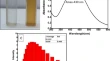
<p>Figure <figr fid="F2">2</figr> shows the optical transmittance of the Al-ZnO hierarchical nanostructures on the quartz substrate with ZnO film. The transmittance is above 60% in the visible region. After depositing on the CdSe and Cu<sub>2</sub>O layer, the transmittance was decreased to 19%. Energy gaps (<it>E</it><sub>g</sub>) close to 3.372 eV for the Al-ZnO hierarchical nanostructures and 1.67 eV for CdSe have been estimated from these spectra using the relation for direct transition <abbrgrp><abbr bid="B15">15</abbr></abbrgrp>. The optical bandgap of the Cu<sub>2</sub>O layer in the cell could not have been measured because it was deposited on the CdSe layer, but it has a bandgap of 2.1 eV <abbrgrp><abbr bid="B16">16</abbr></abbrgrp>, which is larger than that of the CdSe.</p>
<fig id="F2"><title><p>Figure 2</p></title><caption><p>The optical transmittance spectra</p></caption><text>
   <p><b>The optical transmittance spectra</b>. (<b>a</b>) Quartz/Al-ZnO film/Al-ZnO nanostructures, (<b>b</b>) quartz/Al-ZnO film/Al-ZnO nanostructures/CdSe, and (<b>c</b>) quartz/Al-ZnO film/Al-ZnO nanostructures/CdSe/Cu<sub>2</sub>O.</p>
</text><graphic file="1556-276X-6-614-2"/></fig>
<p>The photovoltaic properties of the quartz/Al-ZnO film/nanostructured Al-ZnO/CdSe/Cu<sub>2</sub>O solar cell were measured under illumination with a 100-mW/cm<sup>2 </sup>power at 1.5 AM from the contact with area of 0.369 cm<sup>2</sup>. Figure <figr fid="F3">3</figr> shows the current density-voltage [<it>J</it>-<it>V</it>] measurements for the solar cell. Prior to the measurement for the photovoltaic properties, the <it>J</it>-<it>V </it>curve measured between the front contact of the evaporated indium on the Al-ZnO film and the back contact of the evaporated gold/nickel on Cu<sub>2</sub>O was rectifying. The junctions (ZnO/CdSe, ZnO/Cu<sub>2</sub>O, CdSe/Cu<sub>2</sub>O) were also rectifying. The short-circuit photocurrent density [<it>J</it><sub>SC</sub>], open circuit voltage [<it>V</it><sub>OC</sub>], fill factor [FF], and conversion efficiency of the fabricated solar cell were 11.09 mA cm<sup>-2</sup>, 0.67 V, 0.45, and 3.16%, respectively. These values of <it>J</it><sub>SC</sub>, <it>V</it><sub>OC</sub>, FF, and efficiency are the highest to be reported for the oxide used as p- and n-type window layers simultaneously in ETA solar cells. The relative band location diagram of the nanostructured Al-ZnO/CdSe/Cu<sub>2</sub>O heterostructure is shown in the inset of Figure <figr fid="F3">3</figr>, using the reported values for band structure relationship between ZnO, CdSe, <abbrgrp><abbr bid="B7">7</abbr></abbrgrp> and Cu<sub>2</sub>O <abbrgrp><abbr bid="B6">6</abbr></abbrgrp>. According to the band location diagram, it was found that the valence band offsets at the interfaces of ZnO/CdSe(<inline-formula>
<m:math xmlns:m="http://www.w3.org/1998/Math/MathML" name="1556-276X-6-614-i1"><m:mrow>
   <m:msubsup>
      <m:mrow>
         <m:mo class="MathClass-op">&#916;</m:mo>
         <m:mi>E</m:mi>
      </m:mrow>
      <m:mrow>
         <m:mi>V</m:mi>
      </m:mrow>
      <m:mrow>
         <m:mstyle class="text">
            <m:mtext class="textsf" mathvariant="sans-serif">ZnO/CdSe</m:mtext>
         </m:mstyle>
      </m:mrow>
   </m:msubsup>
</m:mrow>
</m:math>
</inline-formula>), CdSe/Cu<sub>2</sub>O(<inline-formula>
<m:math xmlns:m="http://www.w3.org/1998/Math/MathML" name="1556-276X-6-614-i2"><m:mrow>
   <m:msubsup>
      <m:mrow>
         <m:mo class="MathClass-op">&#916;</m:mo>
         <m:mi>E</m:mi>
      </m:mrow>
      <m:mrow>
         <m:mi>V</m:mi>
      </m:mrow>
      <m:mrow>
         <m:mstyle class="text">
            <m:mtext class="textsf" mathvariant="sans-serif">CdSe/C</m:mtext>
         </m:mstyle>
         <m:msub>
            <m:mrow>
               <m:mstyle class="text">
                  <m:mtext class="textsf" mathvariant="sans-serif">u</m:mtext>
               </m:mstyle>
            </m:mrow>
            <m:mrow>
               <m:mstyle class="text">
                  <m:mtext class="textsf" mathvariant="sans-serif">2</m:mtext>
               </m:mstyle>
            </m:mrow>
         </m:msub>
         <m:mstyle class="text">
            <m:mtext class="textsf" mathvariant="sans-serif">O</m:mtext>
         </m:mstyle>
      </m:mrow>
   </m:msubsup>
</m:mrow>
</m:math>
</inline-formula>), and ZnO/Cu<sub>2</sub>O(<inline-formula>
<m:math xmlns:m="http://www.w3.org/1998/Math/MathML" name="1556-276X-6-614-i3"><m:mrow>
   <m:msubsup>
      <m:mrow>
         <m:mo class="MathClass-op">&#916;</m:mo>
         <m:mi>E</m:mi>
      </m:mrow>
      <m:mrow>
         <m:mi>V</m:mi>
      </m:mrow>
      <m:mrow>
         <m:mstyle class="text">
            <m:mtext class="textsf" mathvariant="sans-serif">ZnO/C</m:mtext>
         </m:mstyle>
         <m:msub>
            <m:mrow>
               <m:mstyle class="text">
                  <m:mtext class="textsf" mathvariant="sans-serif">u</m:mtext>
               </m:mstyle>
            </m:mrow>
            <m:mrow>
               <m:mstyle class="text">
                  <m:mtext class="textsf" mathvariant="sans-serif">2</m:mtext>
               </m:mstyle>
            </m:mrow>
         </m:msub>
         <m:mstyle class="text">
            <m:mtext class="textsf" mathvariant="sans-serif">O</m:mtext>
         </m:mstyle>
      </m:mrow>
   </m:msubsup>
</m:mrow>
</m:math>
</inline-formula>) heterostructures were around 1.7, 0.57, and 2.27 eV; the conduction band offsets at the interfaces of ZnO/CdSe(<inline-formula>
<m:math xmlns:m="http://www.w3.org/1998/Math/MathML" name="1556-276X-6-614-i4"><m:mrow>
   <m:msubsup>
      <m:mrow>
         <m:mo class="MathClass-op">&#916;</m:mo>
         <m:mi>E</m:mi>
      </m:mrow>
      <m:mrow>
         <m:mi>C</m:mi>
      </m:mrow>
      <m:mrow>
         <m:mstyle class="text">
            <m:mtext class="textsf" mathvariant="sans-serif">ZnO/CdSe</m:mtext>
         </m:mstyle>
      </m:mrow>
   </m:msubsup>
</m:mrow>
</m:math>
</inline-formula>), CdSe/Cu<sub>2</sub>O(<inline-formula>
<m:math xmlns:m="http://www.w3.org/1998/Math/MathML" name="1556-276X-6-614-i5"><m:mrow>
   <m:msubsup>
      <m:mrow>
         <m:mo class="MathClass-op">&#916;</m:mo>
         <m:mi>E</m:mi>
      </m:mrow>
      <m:mrow>
         <m:mi>C</m:mi>
      </m:mrow>
      <m:mrow>
         <m:mstyle class="text">
            <m:mtext class="textsf" mathvariant="sans-serif">CdSe/C</m:mtext>
         </m:mstyle>
         <m:msub>
            <m:mrow>
               <m:mstyle class="text">
                  <m:mtext class="textsf" mathvariant="sans-serif">u</m:mtext>
               </m:mstyle>
            </m:mrow>
            <m:mrow>
               <m:mstyle class="text">
                  <m:mtext class="textsf" mathvariant="sans-serif">2</m:mtext>
               </m:mstyle>
            </m:mrow>
         </m:msub>
         <m:mstyle class="text">
            <m:mtext class="textsf" mathvariant="sans-serif">O</m:mtext>
         </m:mstyle>
      </m:mrow>
   </m:msubsup>
</m:mrow>
</m:math>
</inline-formula>), and ZnO/Cu<sub>2</sub>O(<inline-formula>
<m:math xmlns:m="http://www.w3.org/1998/Math/MathML" name="1556-276X-6-614-i6"><m:mrow>
   <m:msubsup>
      <m:mrow>
         <m:mo class="MathClass-op">&#916;</m:mo>
         <m:mi>E</m:mi>
      </m:mrow>
      <m:mrow>
         <m:mi>C</m:mi>
      </m:mrow>
      <m:mrow>
         <m:mstyle class="text">
            <m:mtext class="textsf" mathvariant="sans-serif">ZnO/C</m:mtext>
         </m:mstyle>
         <m:msub>
            <m:mrow>
               <m:mstyle class="text">
                  <m:mtext class="textsf" mathvariant="sans-serif">u</m:mtext>
               </m:mstyle>
            </m:mrow>
            <m:mrow>
               <m:mstyle class="text">
                  <m:mtext class="textsf" mathvariant="sans-serif">2</m:mtext>
               </m:mstyle>
            </m:mrow>
         </m:msub>
         <m:mstyle class="text">
            <m:mtext class="textsf" mathvariant="sans-serif">O</m:mtext>
         </m:mstyle>
      </m:mrow>
   </m:msubsup>
</m:mrow>
</m:math>
</inline-formula>) heterostructures were around 0, 1, and 1 eV, respectively. Due to the short diffusion length of the p-type Cu<sub>2</sub>O and n-type ZnO semiconductors employed in the p-i-n structure, a CdSe absorption layer is introduced between the p- and n-type layers, inducing an internal electric field across the absorption layer, which promotes electron transfer from the CdSe absorber to the ZnO and hole transfer to Cu<sub>2</sub>O.</p>
<fig id="F3"><title><p>Figure 3</p></title><caption><p><it>J-V </it>curves</p></caption><text>
   <p><b><it>J-V </it>curves</b>. The Al-ZnO nanostructures/CdSe/Cu<sub>2</sub>O solar cell <it>J</it>-<it>V </it>curves under illumination with a 100-mW/cm<sup>2 </sup>power at 1.5 AM. Inset is the relative band location diagram of nanostructure Al-ZnO/CdSe/Cu<sub>2</sub>O heterostructure. <it>E<sub>C </sub></it>and <it>E<sub>V </sub></it>are the conduction and valence bands, respectively.</p>
</text><graphic file="1556-276X-6-614-3"/></fig>
<p>Figure <figr fid="F4">4</figr> shows the spectral response of the solar cell. The quantum efficiency was measured in the wavelength range from 382 to 730 nm. The wavelength range where the cells show the quantum efficiency is higher than the energy gap of the CdSe, indicating that the photons are mainly absorbed in the CdSe layer. The largest value of quantum efficiency is close to 49% at wavelengths of about 400 nm. At the wavelength of 590 nm, the value obviously decreases to 38%. Above 730 nm, the quantum efficiency of the cell is very low. It will be presumed that beside the most part of photons absorbed in the layer of CdSe, in the region with high quantum efficiency (between 400 nm and 590 nm), a part of the photons are also absorbed in the depletion layer region of the heterojunction between the nanostructured Al-ZnO/CdSe where the high electric field causes a high collection probability. In the region between 590 nm and 730 nm, a part of the photons are also absorbed in the depletion layer region of the heterojunction between CdSe/Cu<sub>2</sub>O.</p>
<fig id="F4"><title><p>Figure 4</p></title><caption><p>The spectral response of the solar cell</p></caption><text>
   <p><b>The spectral response of the solar cell</b>.</p>
</text><graphic file="1556-276X-6-614-4"/></fig>
</sec>
<sec><st><p>Conclusions</p></st>
<p>To summarize, the quartz/Al-ZnO film/nanostructured Al-ZnO/CdSe/Cu<sub>2</sub>O solar cell was fabricated. The oxide semiconducting materials of the ZnO nanostructure and Cu<sub>2</sub>O were simultaneously used as n- and p-type window layers; CdSe was used as absorber layer. Although the transmittance of the Al-ZnO nanostructure is only about 60% in the visible region, the solar cell shows a high energy conversion efficiency of 3.16%, indicating that these three materials of ZnO, CdSe, and Cu<sub>2</sub>O are suitable for application in ETA solar cells. We believe that conversion efficiencies above 5% can be reached by depositing antireflection coating layers onto the back of the glass substrate and reduce the length of the ZnO nanostructures by shortening the growth time, so this kind of ETA solar cell provides a new cheaper alternative to the existing solar cells.</p>
</sec>
<sec><st><p>Competing interests</p></st>
<p>The authors declare that they have no competing interests.</p>
</sec>
<sec><st><p>Authors' contributions</p></st>
<p>XHW carried out the experiments and measurements and drafted the manuscript. RBL and DHF participated in the discussion. All authors read and approved the final manuscript.</p>
</sec>
</bdy>
<bm>
<ack>
<sec><st><p>Acknowledgements</p></st>
<p>This work was supported by the National Natural Science Foundation of China (contract nos.: 10804071 and 51072113), Shanghai Rising-Star Program (contract no.: 11QA1402700), the Innovation Program of Shanghai Municipal Education Commission (contract no.: 11YZ266), the Natural Science Foundation of Shanghai (contract no.: 09ZR1420500), the Leading Academic Discipline Project of Shanghai Municipal Education Commission (contract no.: J51902), and the Shanghai Municipal Education Commission Project (contract no.: sdj08013).</p>
</sec>
</ack>
<refgrp><bibl id="B1"><title><p>ZnO quantum particle thin films fabricated by electrophoretic deposition</p></title><aug><au><snm>Wong</snm><fnm>EM</fnm></au><au><snm>Searson</snm><fnm>PC</fnm></au></aug><source>Appl Phys Lett</source><pubdate>1999</pubdate><volume>74</volume><fpage>2939</fpage><lpage>2941</lpage><xrefbib><pubid idtype="doi">10.1063/1.123972</pubid></xrefbib></bibl><bibl id="B2"><title><p>CdSe-sensitized p-CuSCN/nanowire n-ZnO heterojunctions</p></title><aug><au><snm>Claude</snm><fnm>LC</fnm></au><au><snm>Ramon</snm><fnm>TZ</fnm></au><au><snm>Margaret</snm><fnm>AR</fnm></au><au><snm>Abou</snm><fnm>K</fnm></au><au><snm>Gary</snm><fnm>H</fnm></au></aug><source>Adv Mater</source><pubdate>2005</pubdate><volume>17</volume><fpage>1512</fpage><lpage>1515</lpage><xrefbib><pubid idtype="doi">10.1002/adma.200401848</pubid></xrefbib></bibl><bibl id="B3"><title><p>Effect of internal surface area on the performance of ZnO/In<sub>2</sub>S<sub>3</sub>/CuSCN solar cells with extremely thin absorber</p></title><aug><au><snm>Kievan</snm><fnm>D</fnm></au><au><snm>Dittrich</snm><fnm>T</fnm></au><au><snm>Belaidi</snm><fnm>A</fnm></au><au><snm>Tornow</snm><fnm>J</fnm></au><au><snm>Schwarzburg</snm><fnm>K</fnm></au><au><snm>Allsop</snm><fnm>N</fnm></au><au><snm>Lux-Steiner</snm><fnm>M</fnm></au></aug><source>Appl Phys Lett</source><pubdate>2008</pubdate><volume>92</volume><fpage>153107</fpage><lpage>153109</lpage><xrefbib><pubid idtype="doi">10.1063/1.2909576</pubid></xrefbib></bibl><bibl id="B4"><title><p>Influence of the local absorber layer thickness on the performance of ZnO nanorod solar cells</p></title><aug><au><snm>Belaidi</snm><fnm>A</fnm></au><au><snm>Dittrich</snm><fnm>T</fnm></au><au><snm>Kieven</snm><fnm>D</fnm></au><au><snm>Tornow</snm><fnm>J</fnm></au><au><snm>Schwarzburg</snm><fnm>K</fnm></au><au><snm>Lux-Steiner</snm><fnm>M</fnm></au></aug><source>Phys Status Solidi--Rapid Reseach Letters</source><pubdate>2008</pubdate><volume>2</volume><fpage>172</fpage><lpage>174</lpage><xrefbib><pubid idtype="doi">10.1002/pssr.200802092</pubid></xrefbib></bibl><bibl id="B5"><title><p>A 5% efficient photoelectrochemical solar cell based on nanostructured ZnO electrodes</p></title><aug><au><snm>Keis</snm><fnm>K</fnm></au><au><snm>Magnusson</snm><fnm>E</fnm></au><au><snm>Lindstr&#246;m</snm><fnm>H</fnm></au><au><snm>Lindquist</snm><fnm>SE</fnm></au><au><snm>Hagfeldt</snm><fnm>A</fnm></au></aug><source>Sol Energ Mat Sol C</source><pubdate>2002</pubdate><volume>73</volume><fpage>51</fpage><lpage>58</lpage><xrefbib><pubid idtype="doi">10.1016/S0927-0248(01)00110-6</pubid></xrefbib></bibl><bibl id="B6"><title><p>Cu2O/n-ZnO nanowire solar cells on ZnO:Ga/glass templates</p></title><aug><au><snm>Hsueh</snm><fnm>TJ</fnm></au><au><snm>Hsu</snm><fnm>CL</fnm></au><au><snm>Chang</snm><fnm>SJ</fnm></au><au><snm>Guo</snm><fnm>PW</fnm></au><au><snm>Hsieh</snm><fnm>JH</fnm></au><au><snm>Chen</snm><fnm>IC</fnm></au></aug><source>Scripta Mater</source><pubdate>2007</pubdate><volume>57</volume><fpage>53</fpage><lpage>56</lpage><xrefbib><pubid idtype="doi">10.1016/j.scriptamat.2007.03.012</pubid></xrefbib></bibl><bibl id="B7"><title><p>Fabrication and characterization of ZnO nanowires/CdSe/CuSCN eta-solar cell</p></title><aug><au><snm>Ramon</snm><fnm>TZ</fnm></au><au><snm>Margaret</snm><fnm>AR</fnm></au><au><snm>Abou</snm><fnm>K</fnm></au><au><snm>Gary</snm><fnm>H</fnm></au><au><snm>St&#233;phane</snm><fnm>B</fnm></au><au><snm>Claude</snm><fnm>LC</fnm></au></aug><source>C R Chimie</source><pubdate>2006</pubdate><volume>9</volume><fpage>717</fpage><lpage>729</lpage><xrefbib><pubid idtype="doi">10.1016/j.crci.2005.03.034</pubid></xrefbib></bibl><bibl id="B8"><title><p>ZnO nanorods for solar cells: hydrothermal growth versus vapor deposition</p></title><aug><au><snm>Hsu</snm><fnm>YF</fnm></au><au><snm>Xi</snm><fnm>YY</fnm></au><au><snm>Djuri&#353;i&#263;</snm><fnm>AB</fnm></au><au><snm>Chan</snm><fnm>WK</fnm></au></aug><source>Appl Phys Lett</source><pubdate>2008</pubdate><volume>92</volume><fpage>133507</fpage><lpage>133509</lpage><xrefbib><pubid idtype="doi">10.1063/1.2906370</pubid></xrefbib></bibl><bibl id="B9"><title><p>Control growth of catalyst-free high-quality ZnO nanowire arrays on transparent quartz glass substrate by chemical vapor deposition</p></title><aug><au><snm>Wang</snm><fnm>XH</fnm></au><au><snm>Li</snm><fnm>RB</fnm></au><au><snm>Fan</snm><fnm>DH</fnm></au></aug><source>Appl Surf Sci</source><pubdate>2011</pubdate><volume>257</volume><fpage>2960</fpage><lpage>2964</lpage><xrefbib><pubid idtype="doi">10.1016/j.apsusc.2010.10.100</pubid></xrefbib></bibl><bibl id="B10"><title><p>Effect of AZO film deposition conditions on the photovoltaic properties of AZO-Cu<sub>2</sub>O heterojunctions</p></title><aug><au><snm>Tanaka</snm><fnm>H</fnm></au><au><snm>Shimakawa</snm><fnm>T</fnm></au><au><snm>Miyata</snm><fnm>T</fnm></au><au><snm>Sato</snm><fnm>H</fnm></au><au><snm>Minami</snm><fnm>T</fnm></au></aug><source>Appl Surf Sci</source><pubdate>2005</pubdate><volume>244</volume><fpage>568</fpage><lpage>572</lpage><xrefbib><pubid idtype="doi">10.1016/j.apsusc.2004.10.121</pubid></xrefbib></bibl><bibl id="B11"><title><p>Electrodeposited ZnO/Cu<sub>2</sub>O heterojunction solar cells</p></title><aug><au><snm>Jeong</snm><fnm>SS</fnm></au><au><snm>Mittiga</snm><fnm>A</fnm></au><au><snm>Salza</snm><fnm>E</fnm></au><au><snm>Masci</snm><fnm>A</fnm></au><au><snm>Passerini</snm><fnm>S</fnm></au></aug><source>Electrochim Acta</source><pubdate>2008</pubdate><volume>53</volume><fpage>2226</fpage><lpage>2231</lpage><xrefbib><pubid idtype="doi">10.1016/j.electacta.2007.09.030</pubid></xrefbib></bibl><bibl id="B12"><title><p>Nanowire-based all-oxide solar cells</p></title><aug><au><snm>Benjamin</snm><fnm/></au><au><snm>Yuhas</snm><fnm>D</fnm></au><au><snm>Yang</snm><fnm>P</fnm></au></aug><source>J Am Chem Soc</source><pubdate>2009</pubdate><volume>131</volume><fpage>3756</fpage><lpage>3761</lpage><xrefbib><pubidlist><pubid idtype="doi">10.1021/ja8095575</pubid><pubid idtype="pmpid" link="fulltext">19275263</pubid></pubidlist></xrefbib></bibl><bibl id="B13"><title><p>p-Cu2O/n-ZnO nanowires on ITO glass for solar cells</p></title><aug><au><snm>Zhang</snm><fnm>J</fnm></au><au><snm>Que</snm><fnm>W</fnm></au><au><snm>Zhong</snm><fnm>P</fnm></au><au><snm>Zhu</snm><fnm>G</fnm></au></aug><source>J Nanosci Nanotechnol</source><pubdate>2010</pubdate><volume>10</volume><fpage>7473</fpage><lpage>7476</lpage><xrefbib><pubidlist><pubid idtype="doi">10.1166/jnn.2010.2875</pubid><pubid idtype="pmpid">21137962</pubid></pubidlist></xrefbib></bibl><bibl id="B14"><title><p>Study on synthesis and optical properties of Al-doped ZnO hierarchical nanostructures</p></title><aug><au><snm>Wang</snm><fnm>XH</fnm></au><au><snm>Li</snm><fnm>RB</fnm></au><au><snm>Fan</snm><fnm>DH</fnm></au></aug><source>AIP Advances</source><pubdate>2011</pubdate><volume>1</volume><fpage>012107</fpage><lpage>012112</lpage><xrefbib><pubid idtype="doi">10.1063/1.3559506</pubid></xrefbib></bibl><bibl id="B15"><aug><au><snm>Klingshrin</snm><fnm>CF</fnm></au></aug><source>Semiconductor Optics</source><publisher>Berlin: Springer</publisher><pubdate>1997</pubdate></bibl><bibl id="B16"><title><p>Electron spectroscopic studies of CH<sub>3</sub>OH chemisorption on Cu<sub>2</sub>O and ZnO single-crystal surfaces: methoxide bonding and reactivity related to methanol synthesis</p></title><aug><au><snm>Jones</snm><fnm>PM</fnm></au><au><snm>May</snm><fnm>JA</fnm></au><au><snm>Reitz</snm><fnm>JB</fnm></au><au><snm>Solomon</snm><fnm>EI</fnm></au></aug><source>J Am Chem Soc</source><pubdate>1998</pubdate><volume>120</volume><fpage>1506</fpage><lpage>1516</lpage><xrefbib><pubid idtype="doi">10.1021/ja963990q</pubid></xrefbib></bibl></refgrp>
</bm>
</art>