<?xml version='1.0'?>
<!DOCTYPE art SYSTEM 'http://www.biomedcentral.com/xml/article.dtd'>
<art><ui>1556-276X-6-581</ui><ji>1556-276X</ji><fm>
<dochead>Nano Express</dochead>
<bibl>
<title>
<p>Field modulation in Na-incorporated Cu(In,Ga)Se<sub>2 </sub>(CIGS) polycrystalline films influenced by alloy-hardening and pair-annihilation probabilities</p>
</title>
<aug>
<au id="A1" ce="yes"><snm>Jeong</snm><fnm>Yonkil</fnm><insr iid="I1"/><email>yjeong@gist.ac.kr</email></au>
<au id="A2" ce="yes"><snm>Kim</snm><fnm>Chae-Woong</fnm><insr iid="I2"/><email>cwk@kitech.re.kr</email></au>
<au id="A3"><snm>Park</snm><fnm>Dong-Won</fnm><insr iid="I1"/><email>widipark@gist.ac.kr</email></au>
<au id="A4"><snm>Jung</snm><fnm>Seung Chul</fnm><insr iid="I2"/><email>scjung@kitech.re.kr</email></au>
<au id="A5"><snm>Lee</snm><fnm>Jongjin</fnm><insr iid="I1"/><email>bandy1@gist.ac.kr</email></au>
<au ca="yes" id="A6"><snm>Shim</snm><fnm>Hee-Sang</fnm><insr iid="I1"/><email>thanks21@gist.ac.kr</email></au>
</aug>
<insg>
<ins id="I1"><p>Research Institute for Solar and Sustainable Energies (RISE), Gwangju Institute of Science and Technology (GIST), 261 Cheomdan-gwagiro, Buk-gu, Gwangju 500-712, South Korea</p></ins>
<ins id="I2"><p>Korea Institute of Industrial Technology, 1110-9 Oryong-dong, Buk-gu, Gwangju 500-757, South Korea</p></ins>
</insg>
<source>Nanoscale Research Letters</source>
<issn>1556-276X</issn>
<pubdate>2011</pubdate>
<volume>6</volume>
<issue>1</issue>
<fpage>581</fpage>
<url>http://www.nanoscalereslett.com/content/6/1/581</url>
<xrefbib><pubidlist><pubid idtype="pmpid">22060119</pubid><pubid idtype="doi">10.1186/1556-276X-6-581</pubid></pubidlist></xrefbib>
</bibl>
<history><rec><date><day>12</day><month>8</month><year>2011</year></date></rec><acc><date><day>7</day><month>11</month><year>2011</year></date></acc><pub><date><day>7</day><month>11</month><year>2011</year></date></pub></history>
<cpyrt><year>2011</year><collab>Jeong et al; licensee Springer.</collab><note>This is an Open Access article distributed under the terms of the Creative Commons Attribution License (<url>http://creativecommons.org/licenses/by/2.0</url>), which permits unrestricted use, distribution, and reproduction in any medium, provided the original work is properly cited.</note></cpyrt>
<kwdg>
<kwd>Cu(In,Ga)Se<sub>2</sub>
</kwd>
<kwd>solar cells</kwd>
<kwd>grain growth model</kwd>
<kwd>alloy hardening</kwd>
<kwd>pair-annihilation</kwd>
</kwdg>
<abs>
<sec>
<st>
<p>Abstract</p>
</st>
<p>The influence of Na on Cu(In,Ga)Se<sub>2 </sub>(CIGS) solar cells was investigated. A gradient profile of the Na in the CIGS absorber layer can induce an electric field modulation and significantly strengthen the back surface field effect. This field modulation originates from a grain growth model introduced by a combination of alloy-hardening and pair-annihilation probabilities, wherein the Cu supply and Na diffusion together screen the driving force of the grain boundary motion (GBM) by alloy hardening, which indicates a specific GBM pinning by Cu and Na. The pair annihilation between the ubiquitously evolving GBMs has a coincident probability with the alloy-hardening event.</p>
<p>
<b>PACS: </b>88. 40. H-, 81. 10. Aj, 81. 40. Cd,</p>
</sec>
</abs>
</fm><bdy>
<sec>
<st>
<p>Introduction</p>
</st>
<p>Thin film solar cells are promising candidates for power generation and other integrated photovoltaic applications, as part of an effort to develop new renewable energy technologies <abbrgrp>
<abbr bid="B1">1</abbr>
<abbr bid="B2">2</abbr>
</abbrgrp>. Specifically, chalcopyrite semiconductor systems, such as Cu(In,Ga)Se<sub>2 </sub>(CIGS), have attracted a great deal of interest as potential absorber materials for thin film solar cells. In recent years, the CIGS solar cells have demonstrated efficiencies of greater than 20% using three-stage co-evaporation methods <abbrgrp>
<abbr bid="B3">3</abbr>
</abbrgrp>. One of the common methods for improving the performance of CIGS solar cells uses soda-lime glass (SLG) substrates, in which the amount of Na incorporated into the CIGS absorber layer is on the order of 0.1 at.% <abbrgrp>
<abbr bid="B4">4</abbr>
<abbr bid="B5">5</abbr>
</abbrgrp>. Several models have been proposed that explain the effect of Na on device performance. Wang et al. reported that the carrier concentration in the CIGS absorber layer increases due to a reduction in the amount of compensating (In,Ga)<sub>Cu </sub>defects due to the substitution with Na<sub>Cu </sub>
<abbrgrp>
<abbr bid="B6">6</abbr>
<abbr bid="B7">7</abbr>
<abbr bid="B8">8</abbr>
</abbrgrp>. In contrast, Herberholz et al. suggest that the existence range of &#945;-CuInSe<sub>2 </sub>widens due to the incorporation of 0.1 at.% of Na, which suppresses the formation of the &#946;-phase <abbrgrp>
<abbr bid="B9">9</abbr>
</abbrgrp>. Rockett suggests that Na incorporation leads to an increase in the grain size and the lowest energy surfaces, such as Se-terminated (112) surfaces, due to an increase in the atomic mobility during CIGS growth and at grain boundaries <abbrgrp>
<abbr bid="B10">10</abbr>
<abbr bid="B11">11</abbr>
</abbrgrp>. Based on <it>ab initio </it>calculations, Persson and Zunger demonstrate that Na<sub>Cu </sub>defects or NaInSe<sub>2 </sub>phases at grain boundaries decrease the valence-band (VB) maximum due to a lack of Na d-electron states, which is similar to the case of (2<it>V</it>
<sub>Cu </sub>+ In<sub>Cu</sub>) neutral defect complexes at grain boundaries <abbrgrp>
<abbr bid="B12">12</abbr>
<abbr bid="B13">13</abbr>
</abbrgrp>. However, the dominant phenomenon is an increase in the output voltage from the perspective of CIGS device physics, and an increase in the grain size from a crystallographic perspective. These increases are being recognized as far more acceptable explanations for the improvement in performance.</p>
<p>In this paper, we discuss how an increase in the fill factor is caused by the back surface field (BSF) effect from the perspective of CIGS device physics, and a structural change in the grain size from a crystallographic approach using a combination of alloy-hardening and pair-annihilation events.</p>
</sec>
<sec>
<st>
<p>Experimental</p>
</st>
<sec>
<st>
<p>Fabrication of CIGS absorber film and device</p>
</st>
<p>CIGS solar cells were fabricated on Corning glass (CG) and SLG substrates. The basic properties, including the coefficient of thermal expansion (CTE), are summarized in Table <tblr tid="T1">1</tblr> for the SLG and the CG <abbrgrp>
<abbr bid="B14">14</abbr>
</abbrgrp> (<url>http://www.abrisatechnologies.com</url>). The polycrystalline CIGS films were deposited on Mo-coated SLG and CG using a typical three-stage co-evaporation process, as described in other studies <abbrgrp>
<abbr bid="B15">15</abbr>
<abbr bid="B16">16</abbr>
</abbrgrp>. In the first stage, indium (In), gallium (Ga), and selenium (Se) sources were evaporated at a growth temperature of 350&#176;C to form a (In,Ga)<sub>2</sub>Se<sub>3 </sub>layer with a thickness of 1 &#956;m. In the second stage, copper (Cu) and Se were evaporated and reacted with the (In,Ga)<sub>2</sub>Se<sub>3 </sub>layer at a temperature of 550&#176;C to form the Cu-rich phase. In the third stage, In, Ga, and Se were evaporated to form the Cu-poor phase, while maintaining the substrate temperature. Then, CdS buffer and i-ZnO/Al:ZnO window layers were sequentially deposited. The cell area was defined as 0.49 cm<sup>2 </sup>using a simple mechanical scribing tool.</p>
<tbl id="T1"><title><p>Table 1</p></title><caption><p>CTE and chemical composition of soda-lime glass and Corning glass substrates</p></caption><tblbdy cols="5">
      <r>
         <c ca="left">
            <p>
               <b>Type</b>
            </p>
         </c>
         <c ca="left">
            <p>
               <b>CTE (&#215;10</b>
               <sup>
                  <b>-6</b>
               </sup>
               <b>/&#176;C)</b>
            </p>
         </c>
         <c ca="center" cspan="3">
            <p>
               <b>Chemical contents (%)</b>
            </p>
         </c>
      </r>
      <r>
         <c>
            <p/>
         </c>
         <c>
            <p/>
         </c>
         <c ca="center">
            <p>
               <b>SiO</b>
               <sub>
                  <b>2</b>
               </sub>
            </p>
         </c>
         <c ca="center">
            <p>
               <b>Na</b>
               <sub>
                  <b>2</b>
               </sub>
               <b>O</b>
            </p>
         </c>
         <c ca="center">
            <p>
               <b>Others</b>
            </p>
         </c>
      </r>
      <r>
         <c cspan="5">
            <hr/>
         </c>
      </r>
      <r>
         <c ca="left">
            <p>Soda-lime glass</p>
         </c>
         <c ca="left">
            <p>8.4 (in the range of 25&#176;C to approximately 513&#176;C)</p>
         </c>
         <c ca="center">
            <p>72.6</p>
         </c>
         <c ca="center">
            <p>13.9</p>
         </c>
         <c ca="center">
            <p>13.5</p>
         </c>
      </r>
      <r>
         <c ca="left">
            <p>Corning glass</p>
         </c>
         <c ca="left">
            <p>4.2 (in the range of 25&#176;C to approximately 671&#176;C)</p>
         </c>
         <c ca="center">
            <p>69.0</p>
         </c>
         <c ca="center">
            <p>1.0</p>
         </c>
         <c ca="center">
            <p>30.0</p>
         </c>
      </r>
   </tblbdy></tbl>
</sec>
<sec>
<st>
<p>Characterization</p>
</st>
<p>The microstructure of the CIGS absorber layers was investigated using transmission electron microscopy (TEM, JEOL, Tokyo, Japan) operated at an acceleration voltage of 200 keV. The samples were prepared using a dual focused ion beam (FIB) system. Depth profiling of the chemical composition in both device structures was performed with a secondary ion mass spectrometer (SIMS, in a <it>Cameca IMS </it>4f system, CAMECA SAS, Gennevilliers Cedex, France) using an impact energy of 7.5 keV and a 200 nA O<sub>2</sub>
<sup>+ </sup>beam and detecting MCs + complexes (<it>M </it>= <sup>63</sup>Cu, <sup>115</sup>In, <sup>69 </sup>Ga, <sup>80</sup>Se, <sup>23</sup>Na, and<sup>98</sup>Mo). The solar cell efficiencies were measured and recorded using a Keithley 4300 source meter under 100-mW/cm<sup>2 </sup>irradiation (Oriel<sup>&#174; </sup>Sol3A&#8482;, 450-W solar simulator equipped with an AM 1.5-G filter; Oriel Instruments, Irvine, CA, USA) and an incident-photon-to-electron conversion efficiency measurement system for the wavelength range of 300 to 1,200 nm (QEX7, PV Measurements Inc., Boulder, Colorado, USA).</p>
</sec>
</sec>
<sec>
<st>
<p>Results and discussion</p>
</st>
<sec>
<st>
<p>Microstructure and photovoltaic performances</p>
</st>
<p>Figure <figr fid="F1">1</figr> shows the cross-sectional TEM (XTEM) images of the interfaces in the CIGS solar cells on the CG (Figure <figr fid="F1">1a,c</figr>) and SLG substrates (Figure <figr fid="F1">1b,d</figr>). The solar cells fabricated on the CG and the SLG substrates will be referred to as Na-restricted and Na-incorporated devices, respectively. The interfaces in Figure <figr fid="F1">1c,d</figr> have a quasi-ohmic MoSe<sub>2 </sub>layer formed by the inter-diffusion of Se and Mo atoms <abbrgrp>
<abbr bid="B17">17</abbr>
<abbr bid="B18">18</abbr>
</abbrgrp>. In Figure <figr fid="F1">1a,b</figr>, the grain configurations, such as the size and crystallographic orientation, seem to be similar to one another, while the bottom regions of the CIGS absorber layers in Figure <figr fid="F1">1c,d</figr> clearly show different features. The interface configuration in Figure <figr fid="F1">1c</figr> might be that of the elongated grain boundary motion (GBM) between the CIGS polycrystalline grain blocks, moving toward the Mo surface.</p>
<fig id="F1"><title><p>Figure 1</p></title><caption><p>XTEM images of each interface</p></caption><text>
   <p><b>XTEM images of each interface</b>. <b>(a) </b>the interface between the CdS buffer; <b>(b) </b>the CIGS absorber layers for the Na-restricted device and the Na-incorporated device; the interface between the CIGS absorber layers and the Mo back contact layers for <b>(c) </b>the Na-restricted device; <b>(d) </b>the Na-incorporated device.</p>
</text><graphic file="1556-276X-6-581-1"/></fig>
<p>Figure <figr fid="F2">2</figr> shows the illuminated J-V and external quantum efficiency (EQE) curves of the Na-restricted and Na-incorporated devices. The open-circuit voltage (<it>V</it>
<sub>oc</sub>), short-circuit current density (<it>J</it>
<sub>sc</sub>), fill factor (FF), and photo-conversion efficiency (Eff) are summarized in Table <tblr tid="T2">2</tblr>. The EQE curves exhibit similar absorption band-edges, which represent a very small difference in the output voltage, as shown in Figure <figr fid="F2">2b</figr>. From the EQE in the wavelength range of 400 nm to approximately 550 nm and 600 nm to approximately 850 nm in Figure <figr fid="F2">2b</figr>, the slightly higher quantum efficiency of the Na-incorporated device leads an improvement in the <it>J</it>
<sub>sc</sub>. However, the main source of efficiency improvement, which increases significantly from 10.9% to 14.6%, is caused by the enhancement in the FF of greater than 10%. This result could be attributed to the BSF induced at the bottom region of the CIGS absorber layer. The BSF effect might not be from the energy band-gap tuning by the In and Ga profile modulation but instead from the energy-level pinning caused by a structural change in the Na-incorporated CIGS absorber layer.</p>
<fig id="F2"><title><p>Figure 2</p></title><caption><p>J-V and EQE curves</p></caption><text>
   <p><b>J-V and EQE curves</b>. <b>(a) </b>Illuminated J-V and <b>(b) </b>EQE curves of Na-restricted and Na-incorporated devices.</p>
</text><graphic file="1556-276X-6-581-2"/></fig>
<tbl id="T2"><title><p>Table 2</p></title><caption><p>Parameters obtained from illuminated J-V curves.</p></caption><tblbdy cols="5">
      <r>
         <c ca="left">
            <p>
               <b>Device</b>
            </p>
         </c>
         <c ca="center">
            <p>
               <b>
                  <it>V</it>
               </b>
               <sub>
                  <b>oc </b>
               </sub>
               <b>(V)</b>
            </p>
         </c>
         <c ca="center">
            <p>
               <b>
                  <it>J</it>
               </b>
               <sub>
                  <b>sc </b>
               </sub>
               <b>(mA cm</b>
               <sup>
                  <b>-2</b>
               </sup>
               <b>)</b>
            </p>
         </c>
         <c ca="center">
            <p>
               <b>FF (%)</b>
            </p>
         </c>
         <c ca="center">
            <p>
               <b>Eff (%)</b>
            </p>
         </c>
      </r>
      <r>
         <c cspan="5">
            <hr/>
         </c>
      </r>
      <r>
         <c ca="left">
            <p>Na restricted</p>
         </c>
         <c ca="center">
            <p>0.626</p>
         </c>
         <c ca="center">
            <p>30.4</p>
         </c>
         <c ca="center">
            <p>57.1</p>
         </c>
         <c ca="center">
            <p>10.9</p>
         </c>
      </r>
      <r>
         <c ca="left">
            <p>Na incorporated</p>
         </c>
         <c ca="center">
            <p>0.641</p>
         </c>
         <c ca="center">
            <p>32.0</p>
         </c>
         <c ca="center">
            <p>71.1</p>
         </c>
         <c ca="center">
            <p>14.6</p>
         </c>
      </r>
   </tblbdy></tbl>
</sec>
<sec>
<st>
<p>Compositional profile</p>
</st>
<p>Figure <figr fid="F3">3</figr> shows the SIMS profile plotted on a logarithm and linear scale for the Na-incorporated device as a function of the sputter-etch time (the SIMS profile of the Na-restricted device is not shown in here). The Na is distributed from the substrate to the surface: the Na intensity is higher than that of Cu and Se in the CIGS absorber layer, whereas it is lower than that of In and Ga (Figure <figr fid="F3">3a</figr>). In particular, the gradient of the Na profile changes abruptly at the interface between CIGS and Mo. This finding implies two possible diffusion mechanisms of elemental Na. First, the Na continuously diffuses through the Mo from the SLG during the CIGS grain growth, in which Na diffusion is gradually restricted by the compact CIGS grain blocks, and consequently, Na accumulation is more prominent in the bottom region of the CIGS absorber layer. Second, the Na diffusion should already be in progress during the deposition of the (In,Ga)<sub>2</sub>Se<sub>3 </sub>precursor film, and in the beginning of the CIGS grain growth, Na should begin to spread out upward and downward, as shown in Figure <figr fid="F3">3b</figr>. At the same time, the continuous Na diffusion from the substrate results in a prominent Na profile in the bottom region. In practice, such a Na profile could improve the device performance, as reported in the literature <abbrgrp>
<abbr bid="B19">19</abbr>
</abbrgrp>. As far as the Na diffusion mechanism is concerned, the second mechanism seems to be a far more acceptable explanation. Herein, we suggest a model describing a structural change in the CIGS polycrystalline film.</p>
<fig id="F3"><title><p>Figure 3</p></title><caption><p>SIMS depth profile</p></caption><text>
   <p><b>SIMS depth profile</b>. Plotted on (a) a logarithm scale and <b>(b) </b>a linear scale for the Na-incorporated devices.</p>
</text><graphic file="1556-276X-6-581-3"/></fig>
</sec>
<sec>
<st>
<p>Grain growth model</p>
</st>
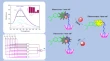
<p>Figure <figr fid="F4">4</figr> provides a detailed schematic of the structural change that occurs during the growth process of the CIGS film for the Na-restricted device (Figure a,b,c) and the Na-incorporated device (Figure d,e,f). The (In<it>
<sub>x</sub>
</it>Ga<sub>1-<it>x</it>
</sub>)<sub>2</sub>Se<sub>3 </sub>precursor film is formed in the first deposition stage of the CIGS film. For the second stage in which Cu and Se are introduced, the grain growth of the CIGS starts from the surface of the (In<sub>x</sub>Ga<sub>1-x</sub>)<sub>2</sub>Se<sub>3 </sub>film (Figure <figr fid="F4">4a,d</figr>). The grain growth and volume expansion of the CIGS crystal would progress simultaneously upward and downward, leading the GBM. The upward grain growth from the initially formed surface grain results from alloy-hardening and pair-annihilation events in both devices <abbrgrp>
<abbr bid="B20">20</abbr>
<abbr bid="B21">21</abbr>
<abbr bid="B22">22</abbr>
</abbrgrp>. The constant Cu supply to the surface leads to a lower activation energy for the GBM <abbrgrp>
<abbr bid="B23">23</abbr>
<abbr bid="B24">24</abbr>
</abbrgrp> because the supplied Cu atoms induce an alloy hardening in the CIGS film and make the upward propagation of the grain boundary more energetically unfavorable. In addition, Cu could act as a driving force screen for the GBM, which indicates that the GBM is partially pinned by the Cu supply. Subsequently, the grain boundaries come together in the same growth direction and are eventually pair-annihilated. The grain size at the top region of the CIGS films, as shown in Figure <figr fid="F1">1a,b</figr>, can be explained by the upward structural evolution. However, the downward structural evolution occurs in a different manner in the Na-restricted and the Na-incorporated devices. In the case of the Na-restricted film, the downward grain growth is accompanied by a volume expansion that weakens the grain size effect because the Cu diffusion is gradually restricted due to the compactly preformed CIGS crystal grains. Finally, the polycrystalline CIGS film is formed as shown in Figure <figr fid="F4">4c</figr>, which is attributed to the structural configuration of the bottom region in Figure <figr fid="F1">1c</figr>. In the Na-incorporated film, the downward grain growth should be the same as that of the Na-restricted device. However, there is sufficient Na diffusion from the SLG such that the Cu vacancies are compensated due to the limited diffusion rate of Cu and it maintains grain growth by alloy hardening. Such a structural feature of the bottom region (Figure <figr fid="F4">4f</figr>) is in good agreement with the TEM image, as shown in Figure <figr fid="F1">1d</figr>. It should be noted that the Na diffusion from the SLG occurs during the second stage due to a higher CTE of the SLG substrate, while the Corning glass substrate restricts the Na diffusion due to its lower CTE and lower Na content. From the SIMS profile, we observe that the Na is prominently located at the interface between the CIGS absorber and the Mo back contact, in which the Na might occupy the Cu vacancies or replace the Cu atoms and form Na(In,Ga)Se<sub>2 </sub>phases, which produces a decrease in the valence-band maximum at the grain boundaries <abbrgrp>
<abbr bid="B12">12</abbr>
<abbr bid="B13">13</abbr>
</abbrgrp>. In other words, the electric field is modulated because the valence-band maximum approaches the Fermi-energy level. Specifically, the prominent Na profile in the bottom region of the CIGS absorber layer is likely to cause energy-level pinning, which could strengthen the BSF.</p>
<fig id="F4"><title><p>Figure 4</p></title><caption><p>The mechanism of the crystal growth model for CIGS films</p></caption><text>
   <p><b>The mechanism of the crystal growth model for CIGS films</b>. In <b>(a,b,c) </b>Na-restricted and <b>(d,e,f) </b>Na-incorporated devices.</p>
</text><graphic file="1556-276X-6-581-4"/></fig>
</sec>
</sec>
<sec>
<st>
<p>Conclusions</p>
</st>
<p>We fabricated Na-restricted and Na-incorporated CIGS solar cells to investigate the influence of Na on the device performances. The enhancement in the output voltage and photocurrent density for the Na-incorporated device was negligible, while the FF revealed a remarkable increase. This finding could be attributed to the strengthening of the BSF by the energy-level pinning in the bottom region of the CIGS absorber layer. The energy-level pinning originates from the proposed grain growth model wherein the Cu supply and the Na diffusion both contribute to the grain growth by a combination of alloy-hardening and pair-annihilation events that occur between grain boundaries.</p>
</sec>
<sec>
<st>
<p>Abbreviations</p>
</st>
<p>CIGS: Cu(In,Ga)Se<sub>2</sub>; GBM: grain boundary motion; SLG: soda-lime glass; CG: Corning glass; VB: valence band; BSF: back surface field; CTE: coefficient of thermal expansion; TEM: transmission electron microscopy; FIB: focused ion beam; SIMS: secondary ion mass spectrometer; XTEM: cross-sectional TEM; EQE: external quantum efficiency; <it>V</it>
<sub>oc</sub>: open-circuit voltage; <it>J</it>
<sub>sc</sub>: short-circuit current; FF: fill factor; Eff: photo-conversion efficiency.</p>
</sec>
<sec>
<st>
<p>Competing interests</p>
</st>
<p>The authors declare that they have no competing interests.</p>
</sec>
<sec>
<st>
<p>Authors' contributions</p>
</st>
<p>YKJ, CWK and HSS designed and drafted the study. CWK fabricated the CIGS absorber films and devices using three-stage co-evaporation technique. YKJ and HSS carried out the characterization of the CIGS devices. DWP and JJL participated in the establishment of the grain growth mechanism for CIGS absorber film during the three-stage evaporation. All authors read and approved the final manuscript.</p>
</sec>
</bdy><bm>
<ack>
<sec>
<st>
<p>Acknowledgements</p>
</st>
<p>This work was supported by the Core Technology Development Program for the Next-generation Solar Cells of Research Institute for Solar and Sustainable Energies (RISE), GIST.</p>
</sec>
</ack>
<refgrp><bibl id="B1"><title><p>CIGS absorbers and processes</p></title><aug><au><snm>Niki</snm><fnm>S</fnm></au><au><snm>Contreras</snm><fnm>M</fnm></au><au><snm>Repins</snm><fnm>I</fnm></au><au><snm>Kushiya</snm><fnm>K</fnm></au><au><snm>Ishizuka</snm><fnm>S</fnm></au><au><snm>Matsubara</snm><fnm>K</fnm></au></aug><source>Prog Photovolt:Res Appl</source><pubdate>2010</pubdate><volume>18</volume><fpage>453</fpage><xrefbib><pubid idtype="doi">10.1002/pip.969</pubid></xrefbib></bibl><bibl id="B2"><title><p>Optimization of CIGS-based PV device through antimony doping</p></title><aug><au><snm>Yuan</snm><fnm>M</fnm></au><au><snm>Mitzi</snm><fnm>DB</fnm></au><au><snm>Liu</snm><fnm>W</fnm></au><au><snm>Kellock</snm><fnm>AJ</fnm></au><au><snm>Chey</snm><fnm>SJ</fnm></au><au><snm>Deline</snm><fnm>VR</fnm></au></aug><source>Chem Mater</source><pubdate>2010</pubdate><volume>22</volume><fpage>285</fpage><xrefbib><pubid idtype="doi">10.1021/cm903428f</pubid></xrefbib></bibl><bibl id="B3"><title><p>Solar cell efficiency tables (version 37)</p></title><aug><au><snm>Green</snm><fnm>MA</fnm></au><au><snm>Emery</snm><fnm>K</fnm></au><au><snm>Hishikawa</snm><fnm>Y</fnm></au><au><snm>Warta</snm><fnm>W</fnm></au></aug><source>Prog Photovolt:Res Appl</source><pubdate>2011</pubdate><volume>19</volume><fpage>84</fpage><xrefbib><pubid idtype="doi">10.1002/pip.1088</pubid></xrefbib></bibl><bibl id="B4"><title><p>Influence of sodium on the growth of polycrystalline Cu(In, Ga)Se2 thin films</p></title><aug><au><snm>Braunger</snm><fnm>D</fnm></au><au><snm>Hariskos</snm><fnm>D</fnm></au><au><snm>Bilger</snm><fnm>G</fnm></au><au><snm>Rau</snm><fnm>U</fnm></au><au><snm>Schock</snm><fnm>HW</fnm></au></aug><source>Thin Solid Films</source><pubdate>2000</pubdate><volume>361-362</volume><fpage>161</fpage><xrefbib><pubid idtype="doi">10.1016/S0040-6090(99)00777-4</pubid></xrefbib></bibl><bibl id="B5"><title><p>Effects of sodium on growth and properties of Cu(In,Ga)Se<sub>2 </sub>thin films and solar cells</p></title><aug><au><snm>Rudmann</snm><fnm>D</fnm></au></aug><source>Doctoral Thesis</source><publisher>Swiss Federal Institute of Technology</publisher><pubdate>2004</pubdate></bibl><bibl id="B6"><title><p>Na impurity chemistry in photovoltaic CIGS thin films: investigation with x-ray photoelectron spectroscopy</p></title><aug><au><snm>Niles</snm><fnm>DW</fnm></au><au><snm>Ramanathan</snm><fnm>K</fnm></au><au><snm>Hasson</snm><fnm>F</fnm></au><au><snm>Noufi</snm><fnm>R</fnm></au><au><snm>Tielsch</snm><fnm>BJ</fnm></au><au><snm>Fulghum</snm><fnm>JE</fnm></au></aug><source>J Vac Sci Technol A</source><pubdate>1997</pubdate><volume>15</volume><fpage>3044</fpage><xrefbib><pubid idtype="doi">10.1116/1.580902</pubid></xrefbib></bibl><bibl id="B7"><title><p>On the role of Na and modifications to Cu(In, Ga)Se<sub>2 </sub>absoorber materials using thin MF (<it>M </it>= Na, K, Cs) precursor layers [solar cells]</p></title><aug><au><snm>Contreras</snm><fnm>MA</fnm></au><au><snm>Egaas</snm><fnm>B</fnm></au><au><snm>Dippo</snm><fnm>P</fnm></au><au><snm>Webb</snm><fnm>J</fnm></au><au><snm>Granata</snm><fnm>J</fnm></au><au><snm>Ramanathan</snm><fnm>K</fnm></au><au><snm>Asher</snm><fnm>S</fnm></au><au><snm>Swartzlander</snm><fnm>A</fnm></au><au><snm>Noufi</snm><fnm>R</fnm></au></aug><source>IEEE Photovoltaic Specialists Conference</source><pubdate>1997</pubdate><fpage>359</fpage></bibl><bibl id="B8"><title><p>Engineered phase inhomogeneity for CIS device optimization</p></title><aug><au><snm>Stanbery</snm><fnm>BJ</fnm></au><au><snm>Chang</snm><fnm>CH</fnm></au><au><snm>Anderson</snm><fnm>TJ</fnm></au></aug><source>Proc 11th Int Conf on Ternary and Multinary Compounds</source><publisher>Salford</publisher><pubdate>1997</pubdate><fpage>915</fpage><lpage>922</lpage></bibl><bibl id="B9"><title><p>Phase segregation, Cu migration and junction formation in Cu(In, Ga)Se<sub>2</sub></p></title><aug><au><snm>Herberholz</snm><fnm>R</fnm></au><au><snm>Rau</snm><fnm>U</fnm></au><au><snm>Schock</snm><fnm>HW</fnm></au><au><snm>Haalboom</snm><fnm>T</fnm></au><au><snm>Godecke</snm><fnm>T</fnm></au><au><snm>Ernst</snm><fnm>F</fnm></au><au><snm>Beilharz</snm><fnm>C</fnm></au><au><snm>Benz</snm><fnm>KW</fnm></au><au><snm>Cahen</snm><fnm>D</fnm></au></aug><source>Eur Phys J Appl Phys</source><pubdate>1999</pubdate><volume>6</volume><fpage>131</fpage><xrefbib><pubid idtype="doi">10.1051/epjap:1999162</pubid></xrefbib></bibl><bibl id="B10"><title><p>The electronic effects of point defects in Cu(In<it><sub>x</sub></it>Ga<sub>1 - <it>x</it></sub>)Se<sub>2</sub></p></title><aug><au><snm>Rockett</snm><fnm>A</fnm></au></aug><source>Thin Solid Films</source><pubdate>2000</pubdate><volume>361-362</volume><fpage>330</fpage><xrefbib><pubid idtype="doi">10.1016/S0040-6090(99)00766-X</pubid></xrefbib></bibl><bibl id="B11"><title><p>Sodium co-evaporation for low temperature Cu(In, Ga)Se<sub>2 </sub>deposition</p></title><aug><au><snm>Lammer</snm><fnm>M</fnm></au><au><snm>Klemm</snm><fnm>U</fnm></au><au><snm>Powalla</snm><fnm>M</fnm></au></aug><source>Thin Solid Films</source><pubdate>2001</pubdate><volume>387</volume><fpage>33</fpage><xrefbib><pubid idtype="doi">10.1016/S0040-6090(00)01712-0</pubid></xrefbib></bibl><bibl id="B12"><title><p><it>Ab initio </it>calculation of intrinsic point defects in CuInSe<sub>2</sub></p></title><aug><au><snm>Domain</snm><fnm>C</fnm></au><au><snm>Laribi</snm><fnm>S</fnm></au><au><snm>Taunier</snm><fnm>S</fnm></au><au><snm>Guillemoles</snm><fnm>JF</fnm></au></aug><source>J Phys Chem Solids</source><pubdate>2003</pubdate><volume>64</volume><fpage>1657</fpage><xrefbib><pubid idtype="doi">10.1016/S0022-3697(03)00208-7</pubid></xrefbib></bibl><bibl id="B13"><title><p>Defect physics of the CuInSe2 chalcopyrite semiconductor</p></title><aug><au><snm>Zhang</snm><fnm>SB</fnm></au><au><snm>Wei</snm><fnm>S-H</fnm></au><au><snm>Zunger</snm><fnm>A</fnm></au><au><snm>Katayama-Yoshida</snm><fnm>H</fnm></au></aug><source>Phys Rev B</source><pubdate>1998</pubdate><volume>57</volume><fpage>9642</fpage><xrefbib><pubid idtype="doi">10.1103/PhysRevB.57.9642</pubid></xrefbib></bibl><bibl id="B14"><title><p>Sodium tracer diffusion in an alkaline-earth boroaluminosilicate glass</p></title><aug><au><snm>Tian</snm><fnm>L</fnm></au><au><snm>Dieckmann</snm><fnm>R</fnm></au></aug><source>Journal of Non-Crystalline Solids</source><pubdate>2000</pubdate><volume>265</volume><fpage>36</fpage><xrefbib><pubid idtype="doi">10.1016/S0022-3093(99)00703-6</pubid></xrefbib></bibl><bibl id="B15"><title><p>Effect of gallium grading in Cu(In, Ga)Se<sub>2 </sub>solar-cell absorbers produced by multi-stage coevaporation</p></title><aug><au><snm>Schleussner</snm><fnm>S</fnm></au><au><snm>Zimmermann</snm><fnm>U</fnm></au><au><snm>W&#228;tjen</snm><fnm>R</fnm></au><au><snm>Leifer</snm><fnm>K</fnm></au><au><snm>Edoff</snm><fnm>M</fnm></au></aug><source>Sol Energy Mater Sol Cells</source><pubdate>2011</pubdate><volume>95</volume><fpage>721</fpage><xrefbib><pubid idtype="doi">10.1016/j.solmat.2010.10.011</pubid></xrefbib></bibl><bibl id="B16"><title><p>Handbook of Photovoltaic Science and Engineering</p></title><aug><au><snm>Luque</snm><fnm>A</fnm></au><au><snm>Hegedus</snm><fnm>A</fnm></au></aug><publisher>London, John Wiely &amp; Sons Ltd</publisher><pubdate>2002</pubdate><fpage>567</fpage><lpage>611</lpage></bibl><bibl id="B17"><title><p>Formation and characterization of MoSe<sub>2 </sub>for Cu(In,Ga)Se<sub>2 </sub>based solar cells</p></title><aug><au><snm>Abou-Ras</snm><fnm>D</fnm></au><au><snm>Kostorz</snm><fnm>G</fnm></au><au><snm>Bremaud</snm><fnm>D</fnm></au><au><snm>Kalin</snm><fnm>M</fnm></au><au><snm>Kurdesau</snm><fnm>FV</fnm></au><au><snm>Tiwari</snm><fnm>AN</fnm></au><au><snm>Dobeli</snm><fnm>M</fnm></au></aug><source>Thin Solid Films</source><pubdate>2005</pubdate><volume>480-481</volume><fpage>433</fpage></bibl><bibl id="B18"><title><p>Electrical properties of the Cu(In,Ga)Se<sub>2</sub>/MoSe<sub>2</sub>/Mo structure</p></title><aug><au><snm>Kohara</snm><fnm>N</fnm></au><au><snm>Nishiwaki</snm><fnm>S</fnm></au><au><snm>Hashimoto</snm><fnm>Y</fnm></au><au><snm>Negami</snm><fnm>T</fnm></au><au><snm>Wada</snm><fnm>T</fnm></au></aug><source>Sol Energy Mater Sol Cells</source><pubdate>2001</pubdate><volume>67</volume><fpage>209</fpage><xrefbib><pubid idtype="doi">10.1016/S0927-0248(00)00283-X</pubid></xrefbib></bibl><bibl id="B19"><title><p>Effect of Na doping using Na2<sub>S </sub>on the structure and photovoltaic properties of CIGS solar cells</p></title><aug><au><snm>Shin</snm><fnm>YM</fnm></au><au><snm>Shin</snm><fnm>DH</fnm></au><au><snm>Kim</snm><fnm>JH</fnm></au><au><snm>Ahn</snm><fnm>BT</fnm></au></aug><source>Curr Appl Phys</source><pubdate>2011</pubdate><volume>11</volume><fpage>S59</fpage><xrefbib><pubid idtype="doi">10.1016/j.cap.2010.11.019</pubid></xrefbib></bibl><bibl id="B20"><title><p>Invalidity of graded buffers for InAs grown on GaAs(001)-A comparison between direct and graded-buffer growth</p></title><aug><au><snm>Jeong</snm><fnm>Y</fnm></au><au><snm>Choi</snm><fnm>H</fnm></au><au><snm>Suzuki</snm><fnm>T</fnm></au></aug><source>J Cryst Growth</source><pubdate>2007</pubdate><volume>301-302</volume><fpage>235</fpage></bibl><bibl id="B21"><title><p>Film thickness dependence of dislocation density reduction in GaAs-on-Si substrates</p></title><aug><au><snm>Tachikawa</snm><fnm>M</fnm></au><au><snm>Yamaguchi</snm><fnm>M</fnm></au></aug><source>Appl Phys Lett</source><pubdate>1990</pubdate><volume>56</volume><fpage>484</fpage><xrefbib><pubid idtype="doi">10.1063/1.102773</pubid></xrefbib></bibl><bibl id="B22"><title><p>Dislocation-limited electron transport in InSb grown on GaAs(001)</p></title><aug><au><snm>Sato</snm><fnm>T</fnm></au><au><snm>Suzuki</snm><fnm>T</fnm></au><au><snm>Tomiya</snm><fnm>S</fnm></au><au><snm>Yamada</snm><fnm>S</fnm></au></aug><source>Physica B: Cond Matter</source><pubdate>2006</pubdate><volume>376-377</volume><fpage>579</fpage></bibl><bibl id="B23"><title><p>Grain growth studies of thin Cu(In, Ga)Se<sub>2 </sub>films</p></title><aug><au><snm>Schlenker</snm><fnm>T</fnm></au><au><snm>Luis Valero</snm><fnm>M</fnm></au><au><snm>Schock</snm><fnm>HW</fnm></au><au><snm>Werner</snm><fnm>JH</fnm></au></aug><source>J Cryst Growth</source><pubdate>2004</pubdate><volume>264</volume><fpage>178</fpage><xrefbib><pubid idtype="doi">10.1016/j.jcrysgro.2004.01.020</pubid></xrefbib></bibl><bibl id="B24"><title><p>Na incorporation into Cu(In, Ga)Se<sub>2 </sub>for high-efficiency flexible solar cells on polymer foils</p></title><aug><au><snm>Rudmann</snm><fnm>D</fnm></au><au><snm>Bremaud</snm><fnm>D</fnm></au><au><snm>Zogg</snm><fnm>H</fnm></au><au><snm>Tiwari</snm><fnm>AN</fnm></au></aug><source>J Appl Phys</source><pubdate>2005</pubdate><volume>97</volume><fpage>084903</fpage><xrefbib><pubid idtype="doi">10.1063/1.1857059</pubid></xrefbib></bibl></refgrp>
</bm></art>