<?xml version='1.0'?>
<!DOCTYPE art SYSTEM 'http://www.biomedcentral.com/xml/article.dtd'>
<art><ui>1556-276X-6-575</ui><ji>1556-276X</ji><fm>
<dochead>Nano Express</dochead>
<bibl>
<title>
<p>p-Cu<sub>2</sub>O-shell/n-TiO<sub>2</sub>-nanowire-core heterostucture photodiodes</p>
</title>
<aug>
<au id="A1" ce="yes"><snm>Tsai</snm><fnm>Tsung-Ying</fnm><insr iid="I1"/><email>ty.tsai84@gmail.com</email></au>
<au id="A2" ce="yes"><snm>Chang</snm><fnm>Shoou-Jinn</fnm><insr iid="I1"/><email>changsj@mail.ncku.edu.tw</email></au>
<au ca="yes" id="A3" ce="yes"><snm>Hsueh</snm><fnm>Ting-Jen</fnm><insr iid="I2"/><email>tj.hsueh@gmail.com</email></au>
<au id="A4" ce="yes"><snm>Hsueh</snm><fnm>Han-Ting</fnm><insr iid="I2"/><email>handing@ndl.org.tw</email></au>
<au id="A5" ce="yes"><snm>Weng</snm><fnm>Wen-Yin</fnm><insr iid="I1"/><email>weng.wenyin@gmail.com</email></au>
<au id="A6" ce="yes"><snm>Hsu</snm><fnm>Cheng-Liang</fnm><insr iid="I3"/><email>clhsu@mail.nutn.edu.tw</email></au>
<au id="A7" ce="yes"><snm>Dai</snm><fnm>Bau-Tong</fnm><insr iid="I2"/><email>bt.d@gmail.com</email></au>
</aug>
<insg>
<ins id="I1"><p>Institute of Microelectronics and Department of Electrical Engineering, Center for Micro/Nano Science and Technology, Advanced Optoelectronic Technology Center, National Cheng Kung University, Tainan, 701, Taiwan</p></ins>
<ins id="I2"><p>National Nano Device Laboratories, Tainan, 741, Taiwan</p></ins>
<ins id="I3"><p>Department of Electronic Engineering, National University of Tainan, Tainan, 700, Taiwan</p></ins>
</insg>
<source>Nanoscale Research Letters</source>
<issn>1556-276X</issn>
<pubdate>2011</pubdate>
<volume>6</volume>
<issue>1</issue>
<fpage>575</fpage>
<url>http://www.nanoscalereslett.com/content/6/1/575</url>
<xrefbib><pubidlist><pubid idtype="doi">10.1186/1556-276X-6-575</pubid><pubid idtype="pmpid">22040099</pubid></pubidlist></xrefbib>
</bibl>
<history><rec><date><day>8</day><month>9</month><year>2011</year></date></rec><acc><date><day>31</day><month>10</month><year>2011</year></date></acc><pub><date><day>31</day><month>10</month><year>2011</year></date></pub></history>
<cpyrt><year>2011</year><collab>Tsai et al; licensee Springer.</collab><note>This is an Open Access article distributed under the terms of the Creative Commons Attribution License (<url>http://creativecommons.org/licenses/by/2.0</url>), which permits unrestricted use, distribution, and reproduction in any medium, provided the original work is properly cited.</note></cpyrt>
<abs>
<sec>
<st>
<p>Abstract</p>
</st>
<p>This study reports the deposition of cuprous oxide [Cu<sub>2</sub>O] onto titanium dioxide [TiO<sub>2</sub>] nanowires [NWs] prepared on TiO<sub>2</sub>/glass templates. The average length and average diameter of these thermally oxidized and evaporated TiO<sub>2 </sub>NWs are 0.1 to 0.4 &#956;m and 30 to 100 nm, respectively. The deposited Cu<sub>2</sub>O fills gaps between the TiO<sub>2 </sub>NWs with good step coverage to form nanoshells surrounding the TiO<sub>2 </sub>cores. The p-Cu<sub>2</sub>O/n-TiO<sub>2 </sub>NW heterostructure exhibits a rectifying behavior with a sharp turn-on at approximately 0.9 V. Furthermore, the fabricated p-Cu<sub>2</sub>O-shell/n-TiO<sub>2</sub>-nanowire-core photodiodes exhibit reasonably large photocurrent-to-dark-current contrast ratios and fast responses.</p>
</sec>
</abs>
</fm><bdy>
<sec>
<st>
<p>Introduction</p>
</st>
<p>UV photodetectors are important devices that have a range of commercial, research, and military applications. They can be used for space communication, ozone layer monitoring, and flame detection <abbrgrp>
<abbr bid="B1">1</abbr>
</abbrgrp>. In recent years, high-performance GaN-based (including AlGaN and AlInN) <abbrgrp>
<abbr bid="B2">2</abbr>
<abbr bid="B3">3</abbr>
<abbr bid="B4">4</abbr>
<abbr bid="B5">5</abbr>
</abbrgrp>, ZnO-based <abbrgrp>
<abbr bid="B6">6</abbr>
</abbrgrp>, and ZnSe-based <abbrgrp>
<abbr bid="B7">7</abbr>
</abbrgrp> photodetectors have all been demonstrated. However, high-quality GaN-based UV photodetectors could only be prepared on a sapphire substrate, which is much more expensive as compared with a glass substrate. On the other hand, the photocurrent-to-dark-current contrast ratio of ZnO-based UV photodetectors is still low. Titanium dioxide [TiO<sub>2</sub>] is a potentially useful wide direct-bandgap material (3.2 eV for anatase and 3.0 eV for rutile) for UV photodetectors, solar cells, and gas sensors due to its outstanding physical, chemical, and optical properties <abbrgrp>
<abbr bid="B8">8</abbr>
<abbr bid="B9">9</abbr>
<abbr bid="B10">10</abbr>
</abbrgrp>. TiO<sub>2 </sub>is a nontoxic naturally n-type semiconductor material which has a high-temperature stability and low-production costs.</p>
<p>For two-dimensional [2D] films, TiO<sub>2 </sub>UV photodetectors such as metal-semiconductor-metal detectors and Schottky barrier diodes have been demonstrated <abbrgrp>
<abbr bid="B11">11</abbr>
<abbr bid="B12">12</abbr>
</abbrgrp>. It is difficult to produce p- and n-type materials simultaneously, which is necessary for certain device applications. Zhang et al. reported the formation of a 2D TiO<sub>2</sub>/Cu<sub>2</sub>O composite film for a photocatalyst application using the metal ion-implantation method <abbrgrp>
<abbr bid="B13">13</abbr>
<abbr bid="B14">14</abbr>
<abbr bid="B15">15</abbr>
</abbrgrp>. Cuprous oxide [Cu<sub>2</sub>O] is naturally a p-type direct-bandgap semiconductor with a cubic crystal structure and a room-temperature bandgap energy of 2.17 eV <abbrgrp>
<abbr bid="B16">16</abbr>
</abbrgrp>, which makes it ideal for TiO<sub>2</sub>-based p-n heterojunctions. Cu<sub>2</sub>O can be deposited using methods such as thermal oxidation, anodic oxidation, sputtering, solution growth, sol-gel, and electro-deposition <abbrgrp>
<abbr bid="B17">17</abbr>
<abbr bid="B18">18</abbr>
<abbr bid="B19">19</abbr>
<abbr bid="B20">20</abbr>
<abbr bid="B21">21</abbr>
<abbr bid="B22">22</abbr>
<abbr bid="B23">23</abbr>
<abbr bid="B24">24</abbr>
</abbrgrp>. Among these methods, sputtering is commonly used in the semiconductor industry. By carefully controlling the growth parameters, high-quality 2D Cu<sub>2</sub>O films can be produced by direct-current [DC] sputtering <abbrgrp>
<abbr bid="B18">18</abbr>
</abbrgrp>.</p>
<p>Recently, one-dimensional oxide semiconducting materials have attracted a lot of attention for potential application in optoelectronic devices due to their large surface-area-to-volume ratio <abbrgrp>
<abbr bid="B25">25</abbr>
</abbrgrp>. Wu et al. reported the growth of TiO<sub>2 </sub>nanowires [NWs] on glass substrates by the thermal oxidation-evaporation method <abbrgrp>
<abbr bid="B26">26</abbr>
<abbr bid="B27">27</abbr>
</abbrgrp>. They produced single-crystalline TiO<sub>2 </sub>NWs, whose size and density were controlled by adjusting the growth parameters. However, no report on the fabrication of p-Cu<sub>2</sub>O-shell/n-TiO<sub>2</sub>-nanowire-core heterojunction UV photodetectors could be found in the literature, to our knowledge. The present study reports the deposition of p-Cu<sub>2</sub>O film onto n-TiO<sub>2 </sub>NWs by DC sputtering and the fabrication of radial p-Cu<sub>2</sub>O-shell/n-TiO<sub>2</sub>-nanowire-core photodiodes. The physical, electrical, and optical properties of the fabricated radial p-Cu<sub>2</sub>O-shell/n-TiO<sub>2</sub>-nanowire-core photodiodes are discussed.</p>
</sec>
<sec>
<st>
<p>Experimental section</p>
</st>
<p>Before the growth of TiO<sub>2 </sub>NWs, a Corning 1737 glass substrate (Corning Display Technologies Taiwan Co., Ltd., Taipei City, Taiwan) was wet-cleaned with acetone and deionized water. The glass substrate was subsequently baked at 100&#176;C for 10 min to evacuate moisture. A 400-nm-thick titanium [Ti] film layer was then deposited onto the glass substrate by electron-beam evaporation. Finally, the samples were annealed in a furnace at 700&#176;C for 3 h to synthesize TiO<sub>2 </sub>NWs in argon [Ar] ambiance. The crystal quality of the as-grown NWs was then characterized by an X-ray diffractometer [XRD] (MXP 18, MAC Science Co., Tokyo, Japan). The surface morphology of the samples and the size distribution of the NWs were characterized by a field-emission scanning electron microscope [FE-SEM] (JEOL JSM-7000F, JEOL Ltd., Tokyo, Japan).</p>
<p>To investigate the deposition of Cu<sub>2</sub>O, glass was used as the substrate. The target used to deposit Cu<sub>2</sub>O was a 4-N pure copper block mounted on the cathode. The distance between the target and the sample was fixed at 60 mm. A rotating magnet fixed on the backside of the cathode was used to enhance the plasma bombardment effect. During sputtering, the Ar flow rate, deposition time, base pressure, and chamber pressure were kept at 15 sccm, 10 min, 2 &#215; 10<sup>-6 </sup>Torr, and 6 mTorr, respectively, and the DC power, O<sub>2 </sub>flow rate, and substrate temperature were 200 W, 4 sccm, and 25&#176;C, respectively. The crystallography and structure of the deposited Cu<sub>2</sub>O and the Cu<sub>2</sub>O/TiO<sub>2 </sub>NWs were evaluated by XRD and FE-SEM.</p>
<p>Prior to the fabrication of p-Cu<sub>2</sub>O-shell/n-TiO<sub>2</sub>-nanowire-core photodiodes, a small piece of glass was used to cover the TiO<sub>2 </sub>NWs to prevent the deposition of Cu<sub>2</sub>O in these regions. A 200-nm-thick Cu<sub>2</sub>O layer was subsequently deposited onto the TiO<sub>2 </sub>NWs. A 500-nm-thick silver layer was then sputtered onto the Cu<sub>2</sub>O layer and TiO<sub>2 </sub>NWs to serve as the p-electrode and n-electrode with a shadow mask. Figure <figr fid="F1">1</figr> schematically shows the structure of the fabricated p-Cu<sub>2</sub>O-shell/n-TiO<sub>2</sub>-nanowire-core photodiodes. A picoammeter (HP-4145B semiconductor parameter analyzer, Agilent Technologies, Sta. Clara, CA, USA), connected via a GPIB controller to a computer, was then used to measure the current-voltage [I-V] characteristics of the fabricated diodes under darkness. The photo responses of the devices were also measured. During photo-response measurements, a 4-W mercury vapor lamp emitting at 365 nm was used as the excitation source.</p>
<fig id="F1"><title><p>Figure 1</p></title><caption><p>Schematic diagram of fabricated p-Cu<sub>2</sub>O-shell/n-TiO<sub>2</sub>-nanowire-core for photodiode measurements</p></caption><text>
   <p><b>Schematic diagram of fabricated p-Cu<sub>2</sub>O-shell/n-TiO<sub>2</sub>-nanowire-core for photodiode measurements</b>.</p>
</text><graphic file="1556-276X-6-575-1"/></fig>
</sec>
<sec>
<st>
<p>Results and discussion</p>
</st>
<p>Figure <figr fid="F2">2a</figr> shows a cross-sectional FE-SEM image of the TiO<sub>2 </sub>NWs prepared on a Ti/glass template. It can be clearly seen that high-density TiO<sub>2 </sub>NWs of various lengths were grown on the Ti/glass template. As shown in Figure <figr fid="F2">2a</figr>, it can be seen that the average length, diameter, and density of these TiO<sub>2 </sub>NWs were 0.3 &#956;m, 50 nm, and 60 wires/&#956;m<sup>2</sup>, respectively. Figure <figr fid="F2">2b</figr> shows a cross-sectional FE-SEM image of the sample with Cu<sub>2</sub>O deposited on TiO<sub>2 </sub>NWs. As shown, the deposited Cu<sub>2</sub>O filled the gaps between the TiO<sub>2 </sub>NWs with good step coverage to form radial Cu<sub>2</sub>O/TiO<sub>2 </sub>NWs. It was also found that the deposited Cu<sub>2</sub>O formed at the sample surface after filling the gaps. In order to investigate the coating performance of Cu<sub>2</sub>O, the deposited sample was scraped with tweezers into an alcohol solution, which was then ultrasonically treated for 20 min to disperse the NWs. The solution was dropped on carbon tape which was then placed on a hot plate to evacuate the alcohol. Figure <figr fid="F3">3a</figr> shows a SEM image of a single NW. Figures <figr fid="F3">3b</figr> and <figr fid="F3">3c</figr> show energy-dispersive X-ray [EDX] spectroscopic mapping images of Cu and Ti, respectively. These figures correspond to the SEM image shown in Figure <figr fid="F3">3a</figr>. After the deposition of Cu<sub>2</sub>O, Cu and Ti atoms were distributed over the entire NW. These results suggest that the sputtered Cu<sub>2</sub>O not only forms the head portion of the nanoclubs, but also forms nanoshells surrounding the TiO<sub>2 </sub>cores in the nanowire portion of the nanoclubs. The formation of such p-Cu<sub>2</sub>O-shell/n-TiO<sub>2</sub>-nanowire-core heterostructure should be able to provide us with a large junction area, which is important for the application of photodetectors.</p>
<fig id="F2"><title><p>Figure 2</p></title><caption><p>Cross-sectional FE-SEM images</p></caption><text>
   <p><b>Cross-sectional FE-SEM images</b>. (<b>a</b>) Pure TiO<sub>2 </sub>nanowires and (<b>b</b>) the sample with Cu<sub>2</sub>O deposited on TiO<sub>2 </sub>nanowires at 300&#176;C with 200 W DC power, 6 mTorr chamber pressure, and 3 sccm O<sub>2 </sub>flow rate.</p>
</text><graphic file="1556-276X-6-575-2"/></fig>
<fig id="F3"><title><p>Figure 3</p></title><caption><p>FE-SEM and EDX images</p></caption><text>
   <p><b>FE-SEM and EDX images</b>. (<b>a</b>) An FE-SEM image of a single radial nanowire. EDX spectroscopic mapping images of (<b>b</b>) Cu and (<b>c</b>) Ti which were corresponded to (a).</p>
</text><graphic file="1556-276X-6-575-3"/></fig>
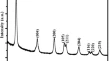
<p>Figure <figr fid="F4">4</figr> shows the crystallographic characteristics obtained from XRD measurements. For the pure TiO<sub>2 </sub>NWs used for adhesion, the peaks were attributed to the rutile-TiO2 (110) phase (JCPDS Card No. 88-1175). For the p-Cu<sub>2</sub>O/n-TiO<sub>2 </sub>NWs, the peaks were attributed to the (110) and (111) phases of the Cu<sub>2</sub>O phase (JCPDS Card No. 78-2076). No Ti-related signal was found, indicating that the Ti film changed into a TiO<sub>2 </sub>film after the annealing process.</p>
<fig id="F4"><title><p>Figure 4</p></title><caption><p>XRD measurements of pure TiO<sub>2 </sub>nanowires and p-Cu<sub>2</sub>O/n-TiO<sub>2 </sub>nanowires obtained by DC sputtering</p></caption><text>
   <p><b>XRD measurements of pure TiO<sub>2 </sub>nanowires and p-Cu<sub>2</sub>O/n-TiO<sub>2 </sub>nanowires obtained by DC sputtering</b>.</p>
</text><graphic file="1556-276X-6-575-4"/></fig>
<p>Figure <figr fid="F5">5</figr> shows the dark I-V characteristics measured from the fabricated radial Cu<sub>2</sub>O/TiO<sub>2 </sub>NWs. The rectifying behavior indicates that a p-n junction formed in the Cu<sub>2</sub>O/TiO<sub>2 </sub>NWs. The operation of the photodiode detector involves three steps (1) the generation of electron-hole [<it>e-h</it>] pairs by the absorption of incident light, whose photon energy exceeds the bandgap of the materials in the device; (2) the separation and transport of the <it>e-h </it>pairs by the internal electric field; and (3) the interaction of current with the external circuit to generate an output signal. Hence, the I-V characteristics of a photodiode in a dark environment are similar to those of a normal rectifying diode. If the p-n junction does not form, the generated <it>e-h </it>pairs will exhibit an ohmic character in the I-V curve and change the resistance. When a photodiode with a p-n junction is illuminated with optical radiation, the I-V characteristics shift according to the photocurrent and reverse current. The measured current in the photodiode, <it>I</it>
<sub>m</sub>, is:</p>
<fig id="F5"><title><p>Figure 5</p></title><caption><p>Dark I-V characteristic measured from the fabricated radial p-Cu<sub>2</sub>O/n-TiO<sub>2 </sub>nanowires</p></caption><text>
   <p><b>Dark I-V characteristic measured from the fabricated radial p-Cu<sub>2</sub>O/n-TiO<sub>2 </sub>nanowires</b>.</p>
</text><graphic file="1556-276X-6-575-5"/></fig>
<p>
<display-formula>
<m:math name="1556-276X-6-575-i1" xmlns:m="http://www.w3.org/1998/Math/MathML"><m:mrow>
   <m:msub>
      <m:mrow>
         <m:mi>I</m:mi>
      </m:mrow>
      <m:mrow>
         <m:mstyle class="text">
            <m:mtext class="textsf" mathvariant="sans-serif">m</m:mtext>
         </m:mstyle>
      </m:mrow>
   </m:msub>
   <m:mo class="MathClass-rel">=</m:mo>
   <m:msub>
      <m:mrow>
         <m:mi>I</m:mi>
      </m:mrow>
      <m:mrow>
         <m:mstyle class="text">
            <m:mtext class="textsf" mathvariant="sans-serif">d</m:mtext>
         </m:mstyle>
      </m:mrow>
   </m:msub>
   <m:mo class="MathClass-bin">-</m:mo>
   <m:msub>
      <m:mrow>
         <m:mi>I</m:mi>
      </m:mrow>
      <m:mrow>
         <m:mstyle class="text">
            <m:mtext class="textsf" mathvariant="sans-serif">ph</m:mtext>
         </m:mstyle>
      </m:mrow>
   </m:msub>
</m:mrow>
</m:math>
</display-formula>
</p>
<p>where <it>I</it>
<sub>d </sub>is the dark current and <it>I</it>
<sub>ph </sub>is the photocurrent. The presence of a reverse current indicates that the photo response is due to the p-n junction, not the TiO<sub>2 </sub>NWs or the Cu<sub>2</sub>O. In the process of measurement under illumination, UV light passes through the TiO<sub>2 </sub>and illuminates the array of the radial p-Cu<sub>2</sub>O/n-TiO<sub>2 </sub>NWs; <it>e-h </it>pairs are produced in the radial NWs when the energy of the UV light is absorbed. The <it>e-h </it>pairs are separated by the internal electric field, and a photocurrent is simultaneously generated. Under forward bias, the turn-on occurred at approximately 0.9 V. With a +5-V applied bias, the forward current of the device was 1.53 &#215; 10<sup>-7 </sup>A, and with a -5-V applied bias, the reverse leakage current was 7.74 &#215; 10<sup>-9 </sup>A.</p>
<p>Figure <figr fid="F6">6</figr> shows the dynamic photo response measured from the fabricated p-Cu<sub>2</sub>O-shell/n-TiO<sub>2</sub>-nanowire-core photodiode. With a +10-V applied bias, the dark reverse leakage current of the diode was only around 3.37 &#215; 10<sup>-8 </sup>A. However, the reverse leakage current increased rapidly to 1.15 &#215; 10<sup>-6 </sup>A upon UV illumination. When the UV lamp was turned off, the reverse leakage current rapidly decreased to its original value. The reasonably large photocurrent-to-dark-current contrast ratio and the fast responses suggest that the radial p-Cu<sub>2</sub>O-shell/n-TiO<sub>2</sub>-nanowire-core photodiodes proposed in this study are potentially useful for UV detector applications.</p>
<fig id="F6"><title><p>Figure 6</p></title><caption><p>Dynamic photo response measured from the fabricated p-Cu<sub>2</sub>O-shell/n-TiO<sub>2</sub>-nanowire-core photodiode</p></caption><text>
   <p><b>Dynamic photo response measured from the fabricated p-Cu<sub>2</sub>O-shell/n-TiO<sub>2</sub>-nanowire-core photodiode</b>.</p>
</text><graphic file="1556-276X-6-575-6"/></fig>
</sec>
<sec>
<st>
<p>Conclusions</p>
</st>
<p>The deposition of Cu<sub>2</sub>O onto well-aligned TiO<sub>2 </sub>NWs by DC sputtering was reported. With the proper sputtering parameters, the deposited Cu<sub>2</sub>O filled the gaps between the TiO<sub>2 </sub>NWs with good step coverage to form radial p-Cu<sub>2</sub>O/n-TiO<sub>2 </sub>NWs that exhibited rectifying I-V characteristics. The fabricated radial p-Cu<sub>2</sub>O-shell/n-TiO<sub>2</sub>-nanowire-core photodiodes had a reasonably large photocurrent-to-dark-current contrast ratio and fast responses.</p>
</sec>
<sec>
<st>
<p>Competing interests</p>
</st>
<p>The authors declare that they have no competing interests.</p>
</sec>
<sec>
<st>
<p>Authors' contributions</p>
</st>
<p>TYT carried out the nanowire experiments and data analysis and wrote the manuscript. SJC and TJH participated in data analysis and revised and finalized the manuscript. HTH designed the thin film and other experiments and data analysis. WYW participated in the revision of the manuscript. CLH provided the concept of the growth process of the nanowire. All the authors contributed to the preparation and revision of the manuscript and approved its final version.</p>
</sec>
</bdy><bm>
<ack>
<sec>
<st>
<p>Acknowledgements</p>
</st>
<p>The authors would like to thank the National Science Council and Bureau of Energy, Ministry of Economic Affairs of Taiwan, Republic of China for the financial support under contract nos. 100-2221-E-006-040-MY2 and 100-D0204-6 and the LED Lighting Research Center of NCKU for the assistance on device characterization.</p>
</sec>
</ack>
<refgrp><bibl id="B1"><title><p>Visible-blindness in photoconductive and photovoltaic algan ultraviolet detectors</p></title><aug><au><snm>Monroy</snm><fnm>E</fnm></au><au><snm>Calle</snm><fnm>F</fnm></au><au><snm>Munoz</snm><fnm>E</fnm></au><au><snm>Omnes</snm><fnm>F</fnm></au><au><snm>Beaumont</snm><fnm>B</fnm></au><au><snm>Gibart</snm><fnm>P</fnm></au></aug><source>J Electron Mater</source><pubdate>1999</pubdate><volume>28</volume><fpage>240</fpage><lpage>245</lpage><xrefbib><pubid idtype="doi">10.1007/s11664-999-0021-2</pubid></xrefbib></bibl><bibl id="B2"><title><p>GaN-based p-i-n sensors with ITO contacts</p></title><aug><au><snm>Chang</snm><fnm>SJ</fnm></au><au><snm>Ko</snm><fnm>TK</fnm></au><au><snm>Su</snm><fnm>YK</fnm></au><au><snm>Chiou</snm><fnm>YZ</fnm></au><au><snm>Chang</snm><fnm>CS</fnm></au><au><snm>Shei</snm><fnm>SC</fnm></au><au><snm>Sheu</snm><fnm>JK</fnm></au><au><snm>Lai</snm><fnm>WC</fnm></au><au><snm>Lin</snm><fnm>YC</fnm></au><au><snm>Chen</snm><fnm>WS</fnm></au><au><snm>Shen</snm><fnm>CF</fnm></au></aug><source>IEEE Sens J</source><pubdate>2006</pubdate><volume>6</volume><fpage>406</fpage><lpage>411</lpage></bibl><bibl id="B3"><title><p>Large optical gain AlGaN-delta-GaN quantum wells laser active regions in mid- and deep-ultraviolet spectral regimes</p></title><aug><au><snm>Zhang</snm><fnm>J</fnm></au><au><snm>Zhao</snm><fnm>H</fnm></au><au><snm>Tansu</snm><fnm>N</fnm></au></aug><source>Appl Phys Lett</source><pubdate>2011</pubdate><volume>98</volume><fpage>171111</fpage><xrefbib><pubid idtype="doi">10.1063/1.3583442</pubid></xrefbib></bibl><bibl id="B4"><title><p>Characterizations of Seebeck coefficients and thermoelectric figures of merit for AlInN alloys with various In-contents</p></title><aug><au><snm>Zhang</snm><fnm>J</fnm></au><au><snm>Tong</snm><fnm>H</fnm></au><au><snm>Liu</snm><fnm>G</fnm></au><au><snm>Herbsommer</snm><fnm>JA</fnm></au><au><snm>Huang</snm><fnm>G</fnm></au><au><snm>Tansu</snm><fnm>N</fnm></au></aug><source>J Appl Phys</source><pubdate>2011</pubdate><volume>109</volume><fpage>053706</fpage><xrefbib><pubid idtype="doi">10.1063/1.3553880</pubid></xrefbib></bibl><bibl id="B5"><title><p>High-temperature characteristics of Seebeck coefficients for AlInN alloys grown by metalorganic vapor phase epitaxy</p></title><aug><au><snm>Zhang</snm><fnm>J</fnm></au><au><snm>Kutlu</snm><fnm>S</fnm></au><au><snm>Liu</snm><fnm>G</fnm></au><au><snm>Tansu</snm><fnm>N</fnm></au></aug><source>J Appl Phys</source><pubdate>2011</pubdate><volume>110</volume><fpage>043710</fpage><xrefbib><pubid idtype="doi">10.1063/1.3624761</pubid></xrefbib></bibl><bibl id="B6"><title><p>A ZnO nanowire phototransistor prepared on glass substrates</p></title><aug><au><snm>Weng</snm><fnm>WY</fnm></au><au><snm>Chang</snm><fnm>SJ</fnm></au><au><snm>Hsu</snm><fnm>CL</fnm></au><au><snm>Hsueh</snm><fnm>TJ</fnm></au></aug><source>ACS Appl Mat Interfaces</source><pubdate>2011</pubdate><volume>3</volume><fpage>162</fpage><lpage>166</lpage><xrefbib><pubid idtype="doi">10.1021/am100746c</pubid></xrefbib></bibl><bibl id="B7"><title><p>ZnSe homoepitaxial MSM photodetectors with transparent ITO contact electrodes</p></title><aug><au><snm>Lin</snm><fnm>TK</fnm></au><au><snm>Chang</snm><fnm>SJ</fnm></au><au><snm>Su</snm><fnm>YK</fnm></au><au><snm>Chiou</snm><fnm>YZ</fnm></au><au><snm>Wang</snm><fnm>CK</fnm></au><au><snm>Chang</snm><fnm>CM</fnm></au><au><snm>Huang</snm><fnm>BR</fnm></au></aug><source>IEEE Trans Electron Devices</source><pubdate>2005</pubdate><volume>52</volume><fpage>121</fpage><lpage>123</lpage><xrefbib><pubid idtype="doi">10.1109/TED.2004.841288</pubid></xrefbib></bibl><bibl id="B8"><title><p>Conversion efficiency of 10.8% by a dye-sensitized solar cell using a TiO<sub>2 </sub>electrode with high haze</p></title><aug><au><snm>Chiba</snm><fnm>Y</fnm></au><au><snm>Islam</snm><fnm>A</fnm></au><au><snm>Komiya</snm><fnm>R</fnm></au><au><snm>Koide</snm><fnm>N</fnm></au><au><snm>Han</snm><fnm>L</fnm></au></aug><source>Appl Phys Lett</source><pubdate>2006</pubdate><volume>88</volume><fpage>223505</fpage><lpage>223507</lpage><xrefbib><pubid idtype="doi">10.1063/1.2208920</pubid></xrefbib></bibl><bibl id="B9"><title><p>Spatial location of transport-limiting traps in TiO<sub>2 </sub>nanoparticle films in dye-sensitized solar cells</p></title><aug><au><snm>Kopidakis</snm><fnm>N</fnm></au><au><snm>Neale</snm><fnm>NR</fnm></au><au><snm>Zhu</snm><fnm>K</fnm></au><au><snm>Lagemaat</snm><fnm>JVD</fnm></au><au><snm>Frank</snm><fnm>AJ</fnm></au></aug><source>Appl Phys Lett</source><pubdate>2005</pubdate><volume>87</volume><fpage>202106</fpage><lpage>202108</lpage><xrefbib><pubid idtype="doi">10.1063/1.2130723</pubid></xrefbib></bibl><bibl id="B10"><title><p>Performance improvement of TiO<sub>2</sub>/P3HT solar cells using CuPc as a sensitizer</p></title><aug><au><snm>Shen</snm><fnm>L</fnm></au><au><snm>Zhu</snm><fnm>G</fnm></au><au><snm>Guo</snm><fnm>W</fnm></au><au><snm>Tao</snm><fnm>C</fnm></au><au><snm>Zhang</snm><fnm>X</fnm></au><au><snm>Liu</snm><fnm>C</fnm></au><au><snm>Chen</snm><fnm>W</fnm></au><au><snm>Ruan</snm><fnm>S</fnm></au><au><snm>Zhong</snm><fnm>Z</fnm></au></aug><source>Appl Phys Lett</source><pubdate>2008</pubdate><volume>92</volume><fpage>073307</fpage><lpage>073309</lpage><xrefbib><pubid idtype="doi">10.1063/1.2884270</pubid></xrefbib></bibl><bibl id="B11"><title><p>TiO<sub>2 </sub>based metal-semiconductor-metal ultraviolet photodetectors</p></title><aug><au><snm>Xue</snm><fnm>H</fnm></au><au><snm>Kong</snm><fnm>X</fnm></au><au><snm>Liu</snm><fnm>Z</fnm></au><au><snm>Liu</snm><fnm>C</fnm></au><au><snm>Zhou</snm><fnm>J</fnm></au><au><snm>Chen</snm><fnm>W</fnm></au><au><snm>Ruan</snm><fnm>S</fnm></au><au><snm>Xu</snm><fnm>Q</fnm></au></aug><source>Appl Phys Lett</source><pubdate>2007</pubdate><volume>90</volume><fpage>201118</fpage><lpage>201120</lpage><xrefbib><pubid idtype="doi">10.1063/1.2741128</pubid></xrefbib></bibl><bibl id="B12"><title><p>Metal-semiconductor-metal TiO<sub>2 </sub>ultraviolet detectors with Ni electrodes</p></title><aug><au><snm>Kong</snm><fnm>X</fnm></au><au><snm>Liu</snm><fnm>C</fnm></au><au><snm>Dong</snm><fnm>W</fnm></au><au><snm>Zhang</snm><fnm>X</fnm></au><au><snm>Tao</snm><fnm>C</fnm></au><au><snm>Shen</snm><fnm>L</fnm></au><au><snm>Zhou</snm><fnm>J</fnm></au><au><snm>Fei</snm><fnm>Y</fnm></au><au><snm>Ruan</snm><fnm>S</fnm></au></aug><source>Appl Phys Lett</source><pubdate>2009</pubdate><volume>94</volume><fpage>123502</fpage><lpage>123504</lpage><xrefbib><pubid idtype="doi">10.1063/1.3103288</pubid></xrefbib></bibl><bibl id="B13"><title><p>Photocatalytic oxidation activity of titanium dioxide film enhanced by Mn non-uniform doping</p></title><aug><au><snm>Zhang</snm><fnm>KJ</fnm></au><au><snm>Xu</snm><fnm>W</fnm></au><au><snm>Li</snm><fnm>XJ</fnm></au><au><snm>Zheng</snm><fnm>SJ</fnm></au><au><snm>Xu</snm><fnm>G</fnm></au><au><snm>Wang</snm><fnm>JH</fnm></au></aug><source>Trans Nonferrous Met SOC China</source><pubdate>2006</pubdate><volume>16</volume><fpage>1069</fpage><lpage>1075</lpage><xrefbib><pubid idtype="doi">10.1016/S1003-6326(06)60379-8</pubid></xrefbib></bibl><bibl id="B14"><title><p>Multi-electron storage of photoenergy using Cu<sub>2</sub>O-TiO<sub>2 </sub>thin film photocatalyst</p></title><aug><au><snm>Yasomanee</snm><fnm>JP</fnm></au><au><snm>Bandara</snm><fnm>J</fnm></au></aug><source>Sol Energy Mat Sol Cells</source><pubdate>2008</pubdate><volume>92</volume><fpage>348</fpage><lpage>352</lpage><xrefbib><pubid idtype="doi">10.1016/j.solmat.2007.09.016</pubid></xrefbib></bibl><bibl id="B15"><title><p>In situ Fenton reagent generated from TiO<sub>2</sub>/Cu<sub>2</sub>O composite film: a new way to utilize TiO<sub>2 </sub>under visible light irradiation</p></title><aug><au><snm>Zhang</snm><fnm>YG</fnm></au><au><snm>Ma</snm><fnm>LL</fnm></au><au><snm>Li</snm><fnm>JL</fnm></au><au><snm>Yu</snm><fnm>Y</fnm></au></aug><source>Environ Sci Technol</source><pubdate>2007</pubdate><volume>41</volume><fpage>6264</fpage><lpage>6269</lpage><xrefbib><pubidlist><pubid idtype="doi">10.1021/es070345i</pubid><pubid idtype="pmpid">17937313</pubid></pubidlist></xrefbib></bibl><bibl id="B16"><title><p>A Cu<sub>2</sub>O/TiO<sub>2 </sub>heterojunction thin film cathode for photoelectrocatalysis</p></title><aug><au><snm>Siripala</snm><fnm>W</fnm></au><au><snm>Ivanovskaya</snm><fnm>A</fnm></au><au><snm>Jaramillo</snm><fnm>TF</fnm></au><au><snm>Baeck</snm><fnm>SH</fnm></au><au><snm>McFarland</snm><fnm>EW</fnm></au></aug><source>Sol Energy Mat Sol Cells</source><pubdate>2003</pubdate><volume>77</volume><fpage>229</fpage><lpage>237</lpage><xrefbib><pubid idtype="doi">10.1016/S0927-0248(02)00343-4</pubid></xrefbib></bibl><bibl id="B17"><title><p>Electronic structure of Cu<sub>2</sub>O and CuO</p></title><aug><au><snm>Ghijsen</snm><fnm>J</fnm></au><au><snm>Tjeng</snm><fnm>LH</fnm></au><au><snm>Elp</snm><fnm>JV</fnm></au><au><snm>Eskes</snm><fnm>H</fnm></au><au><snm>Westerink</snm><fnm>J</fnm></au><au><snm>Sawatzky</snm><fnm>GA</fnm></au><au><snm>Czyzyk</snm><fnm>MT</fnm></au></aug><source>Phys Rev B</source><pubdate>1988</pubdate><volume>38</volume><fpage>11322</fpage><lpage>11330</lpage><xrefbib><pubid idtype="doi">10.1103/PhysRevB.38.11322</pubid></xrefbib></bibl><bibl id="B18"><title><p>Passivation of defects in polycrystalline Cu<sub>2</sub>O thin films by hydrogen or cyanide treatment</p></title><aug><au><snm>Ishizuka</snm><fnm>S</fnm></au><au><snm>Kato</snm><fnm>S</fnm></au><au><snm>Okamoto</snm><fnm>Y</fnm></au><au><snm>Sakurai</snm><fnm>T</fnm></au><au><snm>Akimoto</snm><fnm>K</fnm></au><au><snm>Fujiwara</snm><fnm>N</fnm></au><au><snm>Kobayashi</snm><fnm>H</fnm></au></aug><source>Appl Surf Sci</source><pubdate>2003</pubdate><volume>216</volume><fpage>94</fpage><lpage>97</lpage><xrefbib><pubid idtype="doi">10.1016/S0169-4332(03)00485-9</pubid></xrefbib></bibl><bibl id="B19"><title><p>Investigation of metal oxide/cuprous oxide heterojunction solar cells</p></title><aug><au><snm>Herion</snm><fnm>J</fnm></au><au><snm>Niekisch</snm><fnm>EA</fnm></au><au><snm>Scharl</snm><fnm>G</fnm></au></aug><source>Sol Energy Mater</source><pubdate>1980</pubdate><volume>4</volume><fpage>101</fpage><lpage>112</lpage><xrefbib><pubid idtype="doi">10.1016/0165-1633(80)90022-2</pubid></xrefbib></bibl><bibl id="B20"><title><p>Photovoltaic effects in Cu<sub>2</sub>O-Cu solar cells grown by anodic oxidation</p></title><aug><au><snm>Fortin</snm><fnm>E</fnm></au><au><snm>Masson</snm><fnm>D</fnm></au></aug><source>Solid State Electron</source><pubdate>1982</pubdate><volume>25</volume><fpage>281</fpage><lpage>283</lpage><xrefbib><pubid idtype="doi">10.1016/0038-1101(82)90136-8</pubid></xrefbib></bibl><bibl id="B21"><title><p>Investigation of photoelectrochemical characteristics of n-type Cu<sub>2</sub>O films</p></title><aug><au><snm>Fernando</snm><fnm>CAN</fnm></au><au><snm>Wetthasinghe</snm><fnm>SK</fnm></au></aug><source>Sol Energy Mater Sol Cells</source><pubdate>2000</pubdate><volume>63</volume><fpage>299</fpage><lpage>308</lpage><xrefbib><pubid idtype="doi">10.1016/S0927-0248(00)00036-2</pubid></xrefbib></bibl><bibl id="B22"><title><p>A sol-gel approach to nanophasic copper oxide thin films</p></title><aug><au><snm>Armelao</snm><fnm>L</fnm></au><au><snm>Barreca</snm><fnm>D</fnm></au><au><snm>Bertapelle</snm><fnm>M</fnm></au><au><snm>Bottaro</snm><fnm>Y</fnm></au><au><snm>Sada</snm><fnm>C</fnm></au><au><snm>Tondello</snm><fnm>E</fnm></au></aug><source>Thin Solid Films</source><pubdate>2003</pubdate><volume>442</volume><fpage>48</fpage><lpage>52</lpage><xrefbib><pubid idtype="doi">10.1016/S0040-6090(03)00940-4</pubid></xrefbib></bibl><bibl id="B23"><title><p>Electrochemical deposition of copper (I) oxide films</p></title><aug><au><snm>Golden</snm><fnm>TD</fnm></au><au><snm>Shumsky</snm><fnm>MG</fnm></au><au><snm>Zhou</snm><fnm>Y</fnm></au><au><snm>VanderWerf</snm><fnm>RA</fnm></au><au><snm>Leeuwen</snm><fnm>RAV</fnm></au><au><snm>Switzer</snm><fnm>JA</fnm></au></aug><source>Chem Mater</source><pubdate>1996</pubdate><volume>8</volume><fpage>2499</fpage><lpage>2504</lpage><xrefbib><pubid idtype="doi">10.1021/cm9602095</pubid></xrefbib></bibl><bibl id="B24"><title><p>Preparation and microstructural studies of electrodeposited Cu<sub>2</sub>O thin films</p></title><aug><au><snm>Mahalingam</snm><fnm>T</fnm></au><au><snm>Chitra</snm><fnm>JSP</fnm></au><au><snm>Chu</snm><fnm>JP</fnm></au><au><snm>Sebastian</snm><fnm>PJ</fnm></au></aug><source>Mater Lett</source><pubdate>2004</pubdate><volume>58</volume><fpage>1802</fpage><lpage>1807</lpage><xrefbib><pubid idtype="doi">10.1016/j.matlet.2003.10.055</pubid></xrefbib></bibl><bibl id="B25"><title><p>Si nanowire-based photovoltaic devices prepared at various temperatures</p></title><aug><au><snm>Hsueh</snm><fnm>TJ</fnm></au><au><snm>Chen</snm><fnm>HY</fnm></au><au><snm>Tsai</snm><fnm>TY</fnm></au><au><snm>Weng</snm><fnm>WY</fnm></au><au><snm>Yeh</snm><fnm>YM</fnm></au><au><snm>Dai</snm><fnm>BT</fnm></au><au><snm>Shieh</snm><fnm>JM</fnm></au></aug><source>IEEE Electron Dev Lett</source><pubdate>2010</pubdate><volume>31</volume><fpage>1275</fpage><lpage>1277</lpage></bibl><bibl id="B26"><title><p>Electron field emission from single crystalline TiO<sub>2 </sub>nanowires prepared by thermal evaporation</p></title><aug><au><snm>Wu</snm><fnm>JM</fnm></au><au><snm>Shih</snm><fnm>HC</fnm></au><au><snm>Wu</snm><fnm>WT</fnm></au></aug><source>Chen Phys Lett</source><pubdate>2005</pubdate><volume>413</volume><fpage>490</fpage><lpage>494</lpage><xrefbib><pubid idtype="doi">10.1016/j.cplett.2005.07.113</pubid></xrefbib></bibl><bibl id="B27"><title><p>Formation and photoluminescence of single-crystalline rutile TiO<sub>2 </sub>nanowires synthesized by thermal evaporation</p></title><aug><au><snm>Wu</snm><fnm>JM</fnm></au><au><snm>Shih</snm><fnm>HC</fnm></au><au><snm>Wu</snm><fnm>WT</fnm></au></aug><source>Nanotechnology</source><pubdate>2006</pubdate><volume>17</volume><fpage>105</fpage><lpage>109</lpage><xrefbib><pubid idtype="doi">10.1088/0957-4484/17/1/017</pubid></xrefbib></bibl></refgrp>
</bm></art>