<?xml version='1.0'?>
<!DOCTYPE art SYSTEM 'http://www.biomedcentral.com/xml/article.dtd'>
<art>
<ui>1556-276X-6-539</ui>
<ji>1556-276X</ji>
<fm>
<dochead>Nano Express</dochead>
<bibl>
<title><p>Synthesis of NaYF<sub>4</sub>:Yb<sup>3+</sup>, Er<sup>3+ </sup>upconversion nanoparticles in normal microemulsions</p></title>
<aug>
<au id="A1"><snm>Shan</snm><fnm>Shu-Nan</fnm><insr iid="I1"/><email>shanshunan@shnu.edu.cn</email></au>
<au id="A2"><snm>Wang</snm><fnm>Xiu-Ying</fnm><insr iid="I1"/><email>ssdxywang@shnu.edu.cn</email></au>
<au ca="yes" id="A3"><snm>Jia</snm><fnm>Neng-Qin</fnm><insr iid="I1"/><email>nqjia@shnu.edu.cn</email></au>
</aug>
<insg>
<ins id="I1"><p>Department of Chemistry, Shanghai Normal University, Shanghai 200234, P.R. China</p></ins>
</insg>
<source>Nanoscale Research Letters</source>
<issn>1556-276X</issn>
<pubdate>2011</pubdate>
<volume>6</volume>
<issue>1</issue>
<fpage>539</fpage>
<url>http://www.nanoscalereslett.com/content/6/1/539</url>
<xrefbib><pubidlist><pubid idtype="doi">10.1186/1556-276X-6-539</pubid><pubid idtype="pmpid">21968102</pubid></pubidlist></xrefbib></bibl>
<history><rec><date><day>9</day><month>4</month><year>2011</year></date></rec><acc><date><day>3</day><month>10</month><year>2011</year></date></acc><pub><date><day>3</day><month>10</month><year>2011</year></date></pub></history><cpyrt><year>2011</year><collab>Shan et al; licensee Springer.</collab><note>This is an Open Access article distributed under the terms of the Creative Commons Attribution License (<url>http://creativecommons.org/licenses/by/2.0</url>), which permits unrestricted use, distribution, and reproduction in any medium, provided the original work is properly cited.</note></cpyrt>
<abs>
<sec><st><p>Abstract</p></st>
<p>An interface-controlled reaction in normal microemulsions (water/ethanol/sodium oleate/oleic acid/<it>n</it>-hexane) was designed to prepare NaYF<sub>4</sub>:Yb<sup>3+</sup>, Er<sup>3+ </sup>upconversion nanoparticles. The phase diagram of the system was first studied to obtain the appropriate oil-in-water microemulsions. Transmission electron microscopy and X-ray powder diffractometer measurements revealed that the as-prepared nanoparticles were spherical, monodisperse with a uniform size of 20 nm, and of cubic phase with good crystallinity. Furthermore, these nanoparticles have good dispersibility in nonpolar organic solvents and exhibit visible upconversion luminescence of orange color under continuous excitation at 980 nm. Then, a thermal treatment for the products was found to enhance the luminescence intensity. In addition, because of its inherent merit in high yielding and being economical, this synthetic method could be utilized for preparation of the UCNPs on a large scale.</p>
</sec>
</abs>
</fm>
<bdy>
<sec><st><p>Introduction</p></st>
<p>The synthesis and spectroscopy of NaYF<sub>4</sub>:Yb<sup>3+</sup>, Er<sup>3+ </sup>upconversion nanoparticles (UCNPs) have attracted a tremendous amount of attention because of their potential use in bioanalysis and medical imaging recently <abbrgrp><abbr bid="B1">1</abbr><abbr bid="B2">2</abbr><abbr bid="B3">3</abbr><abbr bid="B4">4</abbr><abbr bid="B5">5</abbr></abbrgrp>. Upconversion was first recognized and formulated by Auzel in the mid-1960s <abbrgrp><abbr bid="B6">6</abbr></abbrgrp>, which is a process where low energy light, usually near-infrared (NIR) or infrared (IR), is converted to higher energies, ultraviolet (UV) or visible, via multiple absorptions or energy transfers. Up to now, several synthetic paths have been reported to obtain UCNPs, such as co-precipitation <abbrgrp><abbr bid="B2">2</abbr></abbrgrp>, hydrothermal, or solvothermal processing <abbrgrp><abbr bid="B7">7</abbr><abbr bid="B8">8</abbr><abbr bid="B9">9</abbr><abbr bid="B10">10</abbr><abbr bid="B11">11</abbr></abbrgrp>, liquid-solid two-phase approach <abbrgrp><abbr bid="B12">12</abbr></abbrgrp>, co-thermolysis of trifluoroacetate <abbrgrp><abbr bid="B13">13</abbr><abbr bid="B14">14</abbr><abbr bid="B15">15</abbr><abbr bid="B16">16</abbr><abbr bid="B17">17</abbr></abbrgrp>, decomposition of carbonate <abbrgrp><abbr bid="B18">18</abbr></abbrgrp>, diffusion-limited growth <abbrgrp><abbr bid="B19">19</abbr></abbrgrp>, and ionic liquid-assisted technique <abbrgrp><abbr bid="B20">20</abbr></abbrgrp>.</p>
<p>It is known that an important prerequisite for the applications of UCNPs is the availability of small and monodisperse nanoparticles <abbrgrp><abbr bid="B1">1</abbr></abbrgrp>. Recently, the synthesis of various inorganic nanoparticles in normal microemulsions attracts our attention <abbrgrp><abbr bid="B21">21</abbr></abbrgrp>. In the normal microemulsions, reactions are taking place at the interface of the normal micelles. Owing to the polarity inverse caused by the neutralization, the particles can be transferred from water phase to the oil phase. However, to the best of our knowledge, there is no study about the synthesis of NaYF<sub>4</sub>:Yb<sup>3+</sup>, Er<sup>3+ </sup>UCNPs by this method. Therefore, we designed an oil/water interface-controlled reaction in normal microemulsions (water/surfactant/<it>n</it>-hexane) to produce NaYF<sub>4</sub>:Yb<sup>3+</sup>, Er<sup>3+ </sup>UCNPs. The products are small, monodisperse, and high-yielding. They show good dispersibility in nonpolar organic solvents and emit visible upconversion luminescence under 980 nm excitation. Moreover, this synthetic strategy is very facile and less costly, which could be applied to mass-production.</p>
</sec>
<sec><st><p>Results and discussion</p></st>
<p>First, the phase behavior of the system was studied to obtain the appropriate microemulsions. Figure <figr fid="F1">1</figr> shows the empirical phase diagram of the water/ethanol/sodium oleate (NaOA)/oleic acid (OA)/<it>n</it>-hexane mixtures at 298 K. Because of the complexity of the five-component system, the phase diagram was simplified to a ternary phase diagram, which is composed of total OA (including the part to generate NaOA with sodium hydroxide), water plus ethanol, and <it>n</it>-hexane. The composition is described using volume fractions. The water/ethanol ratio is always 1:1. The NaOA/OA molar ratio is always 2:3, and the total volume of OA is considered as the surfactant volume. The phase diagram is determined by gradual addition of <it>n</it>-hexane to a one-phase water/ethanol/NaOA/OA mixture with a constant volume fraction. For example, we begin from point A, and reach a critical point C where the solution starts showing a two-phase character.</p>
<fig id="F1"><title><p>Figure 1</p></title><caption><p>Empirical phase diagram of the water/ethanol/NaOA/OA/<it>n</it>-hexane microemulsions</p></caption><text>
   <p><b>Empirical phase diagram of the water/ethanol/NaOA/OA/<it>n</it>-hexane microemulsions</b>.</p>
</text><graphic file="1556-276X-6-539-1"/></fig>
<p>The result shows that the one-phase/two-phase envelope extends from the point at 100% water plus ethanol to the point at 26.23% water plus ethanol, 20.45% OA, and 53.32% <it>n</it>-hexane, and the two-phase part is located in the lower OA region. Obviously, with an increase of the ratio of OA/(water plus ethanol), more <it>n</it>-hexane can be dissolved into their mixtures to form a stable system. The actual point (point B) we used is located in the right-bottom region, where the oil-in-water microemulsions are formed.</p>
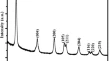
<p>Figure <figr fid="F2">2</figr> shows the characterization data for the NaYF<sub>4</sub>:20% Yb<sup>3+</sup>, 2% Er<sup>3+ </sup>sample. The TEM image (Figure <figr fid="F2">2A</figr>) demonstrates that the synthesized particles are roughly spherical, monodisperse with the size uniformity of about 20 nm in diameter. The X-ray powder diffractometer (XRD) pattern (Figure <figr fid="F2">2B</figr>) shows well-defined peaks, indicating the high crystallinity of the synthesized material, and the peak positions and intensities from the experimental XRD pattern match closely with the calculated pattern for cubic phase of NaYF<sub>4 </sub>(JCPDS card, No. 77-2042). From the line broadening of the diffraction peaks, the crystallite size of the sample was determined to be approximately 18 nm using the Debye-Scherrer formula, which corresponds to the particle size determined from the TEM result.</p>
<fig id="F2"><title><p>Figure 2</p></title><caption><p>Characterization data for NaYF<sub>4</sub>: 20% Yb<sup>3+</sup>, 2% Er<sup>3+ </sup>UCNPs</p></caption><text>
   <p><b>Characterization data for NaYF<sub>4</sub>: 20% Yb<sup>3+</sup>, 2% Er<sup>3+ </sup>UCNPs</b>. <b>(A) </b>TEM image (Inlet: HRTEM image of a single nanocrystal). <b>(B) </b>XRD pattern of the sample and the calculated line pattern for cubic phase of NaYF<sub>4 </sub>(JCPDS card, No. 77-2042).</p>
</text><graphic file="1556-276X-6-539-2"/></fig>
<p>The NaYF<sub>4</sub>:Yb<sup>3+</sup>, Er<sup>3+ </sup>UCNPs can easily be dispersed in nonpolar solvents (such as <it>n</it>-hexane, cyclohexane) to form homogenous colloidal solutions. Figure <figr fid="F3">3A</figr> shows images of a 1 wt.% solution of NaYF<sub>4</sub>:20% Yb<sup>3+</sup>, 2% Er<sup>3+ </sup>UCNPs in <it>n</it>-hexane, demonstrating its transparency. The visible upconversion luminescence can be observed when the solution is excited at 980 nm with a power density of 1.2 kW/cm<sup>2 </sup>(Figure <figr fid="F3">3B</figr>). The corresponding upconversion luminescence spectrum is also shown in Figure <figr fid="F3">3C</figr>. There are three major emission bands at 520-530 nm (green light), 540-550 nm (green light), and 650-670 nm (red light), which are assigned to the <sup>2</sup>H<sub>11/2 </sub>to <sup>4</sup>I<sub>15/2</sub>, <sup>4</sup>S<sub>3/2 </sub>to <sup>4</sup>I<sub>15/2</sub>, and <sup>4</sup>F<sub>9/2 </sub>to <sup>4</sup>I<sub>15/2 </sub>transitions of Er<sup>3+ </sup>ion, respectively. Under 980 nm excitation, the absorption of the first photon can elevate Yb<sup>3+ </sup>ion to the <sup>2</sup>F<sub>5/2 </sub>level from ground state, and then it can transfer the energy to the Er<sup>3+ </sup>ion. This energy transfer can promote Er<sup>3+ </sup>ion from <sup>4</sup>I<sub>15/2 </sub>level to the <sup>4</sup>I<sub>11/2 </sub>level and from the <sup>4</sup>I<sub>11/2 </sub>level to the <sup>4</sup>F<sub>7/2 </sub>by another energy transfer upconversion process (or a second 980 nm photon) if the <sup>4</sup>I<sub>11/2 </sub>level is already populated. Then, the Er<sup>3+ </sup>ion can relax nonradiatively to the <sup>2</sup>H<sub>11/2 </sub>and <sup>4</sup>S<sub>3/2 </sub>levels, and the green emissions occur (<sup>2</sup>H<sub>11/2 </sub>&#8594; <sup>4</sup>I<sub>15/2 </sub>and <sup>4</sup>S<sub>3/2 </sub>&#8594; <sup>4</sup>I<sub>15/2</sub>). Alternatively, the ion can further relax and populate the <sup>4</sup>F<sub>9/2 </sub>level leading to the red emission (<sup>4</sup>F<sub>9/2 </sub>&#8594; <sup>4</sup>I<sub>15/2</sub>) <abbrgrp><abbr bid="B8">8</abbr><abbr bid="B22">22</abbr></abbrgrp>. The curve also shows that red emissions are much stronger than green emissions, so the products present light of orange color on the whole (Figure <figr fid="F3">3B</figr>).</p>
<fig id="F3"><title><p>Figure 3</p></title><caption><p>Colloidal solutions of NaYF<sub>4</sub>:20% Yb<sup>3+</sup>, 2% Er<sup>3+ </sup>sample in <it>n</it>-hexane</p></caption><text>
   <p><b>Colloidal solutions of NaYF<sub>4</sub>:20% Yb<sup>3+</sup>, 2% Er<sup>3+ </sup>sample in <it>n</it>-hexane</b>. <b>(A) </b>The solution showing its transparency. <b>(B) </b>Visible upconversion luminescence excited by 980 nm laser oxide. <b>(C) </b>Upconversion luminescence emission spectrum.</p>
</text><graphic file="1556-276X-6-539-3"/></fig>
<p>It is noted that the as-prepared nanoparticles are cubic phase, whose fluorescence efficiency is at least one-order of magnitude less than that of the hexagonal phase <abbrgrp><abbr bid="B8">8</abbr></abbrgrp>. A thermal treatment at ca. 400-600&#176;C was reported to transform the cubic phase to the hexagonal phase, but which led to undesirable particle growth and agglomeration <abbrgrp><abbr bid="B2">2</abbr></abbrgrp>. We carried out the annealing of the as-prepared nanoparticles under N<sub>2 </sub>atmosphere by heating them to 600&#176;C, and maintaining this temperature for 5 h. After annealing, the particles aggregated into larger clusters (Figure <figr fid="F4">4A</figr>), and the XRD pattern (Figure <figr fid="F4">4B</figr>) shows that hexagonal NaYF<sub>4</sub>:Yb<sup>3+</sup>, Er<sup>3+ </sup>phase emerged in addition to the already existing cubic pattern (marked with asterisks), which implies that the particles transformed partially from cubic phase to hexagonal phase by annealing. In addition, upconversion luminescence emission spectrum (Figure <figr fid="F5">5</figr>) was obtained after ultrasonic dispersion of a 1 wt.% solution of the products in <it>n</it>-hexane, compared with the spectrum of nanoparticles before annealing, its green emission plays a dominant role, and the overall emissions are much stronger than those for cubic phase products.</p>
<fig id="F4"><title><p>Figure 4</p></title><caption><p>Characterization data for NaYF<sub>4</sub>: 20% Yb<sup>3+</sup>, 2% Er<sup>3+ </sup>UCNPs after annealing</p></caption><text>
   <p><b>Characterization data for NaYF<sub>4</sub>: 20% Yb<sup>3+</sup>, 2% Er<sup>3+ </sup>UCNPs after annealing</b>. <b>(A) </b>TEM image. <b>(B) </b>XRD pattern (cubic phase is marked with asterisks) and the calculated line pattern for hexagonal phase of NaYF<sub>4 </sub>(JCPDS card, No. 28-1192).</p>
</text><graphic file="1556-276X-6-539-4"/></fig>
<fig id="F5"><title><p>Figure 5</p></title><caption><p>Upconversion luminescence emission spectra of the nanoparticles before (dash line) and after (solid line) annealing</p></caption><text>
   <p><b>Upconversion luminescence emission spectra of the nanoparticles before (dash line) and after (solid line) annealing</b>.</p>
</text><graphic file="1556-276X-6-539-5"/></fig>
</sec>
<sec><st><p>Conclusions</p></st>
<p>In summary, we designed a method of normal microemulsions to prepare NaYF<sub>4</sub>:Yb<sup>3+</sup>, Er<sup>3+ </sup>UCNPs, which are small, monodisperse, and have good dispersibility in nonpolar organic solvents. Besides, the products exhibited visible upconversion luminescence under 980 nm excitation and a thermal treatment was proved to be able to strengthen the luminescence intensity. This method has its inherent merit in high yielding and being economical. Further study is currently underway to functionalize these synthesized UCNPs for their applications in biolabel and medical imaging.</p>
</sec>
<sec><st><p>Materials and methods</p></st>
<p>All reagents used in this study, including sodium hydroxide, oleic acid, ethanol, <it>n</it>-hexane, sodium fluoride, and Ln(NO<sub>3</sub>)<sub>3 </sub>&#183; 6H<sub>2</sub>O (Ln = Y, Yb, and Er, 99.99%) salt, were of analytical grade from Sinopharm Chemical Reagent Co., Ltd. (Shanghai, China). These chemicals were used without further purification. Water used in the experiment was double distilled.</p>
<p>In a typical synthetic route, sodium hydroxide (400 mg) was dissolved in a mixture of water (20 mL) and ethanol (30 mL), followed by the addition of oleic acid (7.4 mL) and <it>n</it>-hexane (4 mL); this formed a bright yellow transparent solution. Then, two separate aqueous solutions (5 mL) of Ln(NO<sub>3</sub>)<sub>3 </sub>(0.8 mmol, Y:Yb:Er = 78:20:2) and sodium fluoride (3.2 mmol) were added to the above microemulsions one after the other with vigorous stirring. Then, the solution was transferred to a Teflon-lined stainless steel autoclave and heated at 180&#176;C for 6 h. When the autoclave was cooled down to room temperature, the products were found deposited at the bottom. Then, <it>n</it>-hexane (30 mL) was added to destroy the one-phase solution and form a two-phase mixture, so the hydrophobic colloidal NaYF<sub>4</sub>:20% Yb<sup>3+</sup>, 2% Er<sup>3+ </sup>UCNPs were extracted into the upper layer (<it>n</it>-hexane region). With precipitation by additional ethanol, and highspeed centrifugation, the white products (yield: 85%) were re-dispersed in <it>n</it>-hexane to bring out a transparent colloidal solution.</p>
<p>The structure and morphology of NaYF<sub>4</sub>:20% Yb<sup>3+</sup>, 2% Er<sup>3+ </sup>UCNPs were characterized by XRD and TEM. The obtained samples were characterized by XRD using a Brucker D8-advance X-ray diffractometer with Cu<sub>Ka </sub>radiation (&#955; = 1.5418 &#197;). The low- and high-resolution transmission electron microscopy (HRTEM) was performed on a JEOL JEM-3010 electron microscope operated at 300 kV. The upconversion emission spectra of NaYF<sub>4</sub>:20% Yb<sup>3+</sup>, 2% Er<sup>3+ </sup>UCNPs were acquired using a Jobin-Yvon Fluorolog-3 fluorescence spectrometer system equipped with an external 0-1300 mW adjustable laser (980 nm, Beijing Hi-Tech Optoelectronic Co., China) as the excitation source, instead of the Xenon source in the spectrophotometer, and with an optic fiber accessory.</p>
</sec>
<sec><st><p>Competing interests</p></st>
<p>The authors declare that they have no competing interests.</p>
</sec>
<sec><st><p>Authors' contributions</p></st>
<p>SNS and XYW carried out the phase diagram studies. SNS participate in the sequence studies and drafted the manuscript. NQJ conceived of the study, and participated in its design and coordination and helped to draft and revise the manuscript.</p>
</sec>
</bdy>
<bm>
<ack>
<sec><st><p>Acknowledgements</p></st>
<p>This study was supported by the Program for New Century Excellent Talents in University (NCET-08-0897), the National 973 Project (No.2010CB933901), the Shanghai Education Committee (09SG43,09zz137, S30406), and the SHNU (SK201101, DZL806).</p>
</sec>
</ack>
<refgrp><bibl id="B1"><title><p>Up-converting phosphor reporters for nucleic acid microarrays</p></title><aug><au><snm>Van de Rijke</snm><fnm>F</fnm></au><au><snm>Zijlmans</snm><fnm>H</fnm></au><au><snm>Li</snm><fnm>S</fnm></au><au><snm>Vail</snm><fnm>T</fnm></au><au><snm>Rapp</snm><fnm>AK</fnm></au><au><snm>Niedbala</snm><fnm>RS</fnm></au><au><snm>Tanke</snm><fnm>HJ</fnm></au></aug><source>Nat Biotechnol</source><pubdate>2001</pubdate><volume>19</volume><fpage>273</fpage><lpage>276</lpage><xrefbib><pubidlist><pubid idtype="doi">10.1038/85734</pubid><pubid idtype="pmpid" link="fulltext">11231563</pubid></pubidlist></xrefbib></bibl><bibl id="B2"><title><p>Synthesis, characterization, and biological application of size-controlled nanocrystalline NaYF<sub>4</sub>:Yb, Er infrared-to-visible up-conversion phosphors</p></title><aug><au><snm>Yi</snm><fnm>GS</fnm></au><au><snm>Lu</snm><fnm>HC</fnm></au><au><snm>Zhao</snm><fnm>SY</fnm></au><au><snm>Ge</snm><fnm>Y</fnm></au><au><snm>Yang</snm><fnm>WJ</fnm></au><au><snm>Chen</snm><fnm>DP</fnm></au><au><snm>Guo</snm><fnm>LH</fnm></au></aug><source>Nano Lett</source><pubdate>2004</pubdate><volume>4</volume><fpage>2191</fpage><lpage>2196</lpage><xrefbib><pubid idtype="doi">10.1021/nl048680h</pubid></xrefbib></bibl><bibl id="B3"><title><p>Homogeneous assay technology based on upconverting phosphors</p></title><aug><au><snm>Kuningas</snm><fnm>K</fnm></au><au><snm>Rantanen</snm><fnm>T</fnm></au><au><snm>Ukonaho</snm><fnm>T</fnm></au><au><snm>L&#246;vgren</snm><fnm>T</fnm></au><au><snm>Soukka</snm><fnm>T</fnm></au></aug><source>Anal Chem</source><pubdate>2005</pubdate><volume>77</volume><fpage>7348</fpage><lpage>7355</lpage><xrefbib><pubidlist><pubid idtype="doi">10.1021/ac0510944</pubid><pubid idtype="pmpid" link="fulltext">16285685</pubid></pubidlist></xrefbib></bibl><bibl id="B4"><title><p>High contrast in vitro and in vivo photoluminescence bioimaging using near infrared to near infrared up-conversion in Tm<sup>3+ </sup>and Yb<sup>3+ </sup>doped fluoride nanophosphors</p></title><aug><au><snm>Nyk</snm><fnm>M</fnm></au><au><snm>Kumar</snm><fnm>R</fnm></au><au><snm>Ohulchanskyy</snm><fnm>TY</fnm></au><au><snm>Bergey</snm><fnm>EJ</fnm></au><au><snm>Prasad</snm><fnm>P</fnm></au></aug><source>Nano Lett</source><pubdate>2008</pubdate><volume>8</volume><fpage>3834</fpage><lpage>3838</lpage><xrefbib><pubidlist><pubid idtype="doi">10.1021/nl802223f</pubid><pubid idtype="pmpid" link="fulltext">18928324</pubid></pubidlist></xrefbib></bibl><bibl id="B5"><title><p>Recent advances in the chemistry of lanthanide-doped upconversion nanocrystals</p></title><aug><au><snm>Wang</snm><fnm>F</fnm></au><au><snm>Liu</snm><fnm>XG</fnm></au></aug><source>Chem Soc Rev</source><pubdate>2009</pubdate><volume>38</volume><fpage>976</fpage><lpage>989</lpage><xrefbib><pubidlist><pubid idtype="doi">10.1039/b809132n</pubid><pubid idtype="pmpid" link="fulltext">19421576</pubid></pubidlist></xrefbib></bibl><bibl id="B6"><title><p>Upconversion and anti-stokes processes with f and d ions in solids</p></title><aug><au><snm>Auzel</snm><fnm>F</fnm></au></aug><source>Chem Rev</source><pubdate>2004</pubdate><volume>104</volume><fpage>139</fpage><lpage>173</lpage><xrefbib><pubidlist><pubid idtype="doi">10.1021/cr020357g</pubid><pubid idtype="pmpid" link="fulltext">14719973</pubid></pubidlist></xrefbib></bibl><bibl id="B7"><title><p>Fluorescence resonant energy transfer biosensor based on upconversion-luminescent nanoparticles</p></title><aug><au><snm>Wang</snm><fnm>LY</fnm></au><au><snm>Yan</snm><fnm>RX</fnm></au><au><snm>Huo</snm><fnm>ZY</fnm></au><au><snm>Wang</snm><fnm>L</fnm></au><au><snm>Zeng</snm><fnm>JH</fnm></au><au><snm>Bao</snm><fnm>J</fnm></au><au><snm>Wang</snm><fnm>X</fnm></au><au><snm>Peng</snm><fnm>Q</fnm></au><au><snm>Li</snm><fnm>YD</fnm></au></aug><source>Angew Chem Int Ed</source><pubdate>2005</pubdate><volume>44</volume><fpage>6054</fpage><lpage>6057</lpage><xrefbib><pubid idtype="doi">10.1002/anie.200501907</pubid></xrefbib></bibl><bibl id="B8"><title><p>Synthesis and upconversion luminescence of hexagonal-phase NaYF<sub>4</sub>:Yb, Er<sup>3+ </sup>phosphors of controlled size and morphology</p></title><aug><au><snm>Zeng</snm><fnm>JH</fnm></au><au><snm>Su</snm><fnm>J</fnm></au><au><snm>Li</snm><fnm>ZH</fnm></au><au><snm>Yan</snm><fnm>RX</fnm></au><au><snm>Li</snm><fnm>YD</fnm></au></aug><source>Adv Mater</source><pubdate>2005</pubdate><volume>17</volume><fpage>2119</fpage><lpage>2123</lpage><xrefbib><pubid idtype="doi">10.1002/adma.200402046</pubid></xrefbib></bibl><bibl id="B9"><title><p>Uniform nanostructured arrays of sodium rare-earth fluorides for highly efficient multicolor upconversion luminescence</p></title><aug><au><snm>Zhang</snm><fnm>F</fnm></au><au><snm>Wan</snm><fnm>Y</fnm></au><au><snm>Yu</snm><fnm>T</fnm></au><au><snm>Zhang</snm><fnm>FQ</fnm></au><au><snm>Shi</snm><fnm>YF</fnm></au><au><snm>Xie</snm><fnm>SH</fnm></au><au><snm>Li</snm><fnm>YG</fnm></au><au><snm>Xu</snm><fnm>L</fnm></au><au><snm>Tu</snm><fnm>B</fnm></au><au><snm>Zhao</snm><fnm>DY</fnm></au></aug><source>Angew Chem Int Ed</source><pubdate>2007</pubdate><volume>46</volume><fpage>7976</fpage><lpage>7979</lpage><xrefbib><pubid idtype="doi">10.1002/anie.200702519</pubid></xrefbib></bibl><bibl id="B10"><title><p>Shape, size, and phase-controlled rare-earth fluoride nanocrystals with optical up-conversion properties</p></title><aug><au><snm>Zhang</snm><fnm>F</fnm></au><au><snm>Li</snm><fnm>J</fnm></au><au><snm>Shan</snm><fnm>J</fnm></au><au><snm>Xu</snm><fnm>L</fnm></au><au><snm>Zhao</snm><fnm>DY</fnm></au></aug><source>Chem Eur J</source><pubdate>2009</pubdate><volume>15</volume><fpage>11010</fpage><lpage>11019</lpage><xrefbib><pubid idtype="doi">10.1002/chem.200900861</pubid></xrefbib></bibl><bibl id="B11"><title><p>A general strategy for nanocrystal synthesis</p></title><aug><au><snm>Wang</snm><fnm>X</fnm></au><au><snm>Zhuang</snm><fnm>J</fnm></au><au><snm>Peng</snm><fnm>Q</fnm></au><au><snm>Li</snm><fnm>YD</fnm></au></aug><source>Nature</source><pubdate>2005</pubdate><volume>437</volume><fpage>121</fpage><lpage>124</lpage><xrefbib><pubidlist><pubid idtype="doi">10.1038/nature03968</pubid><pubid idtype="pmpid" link="fulltext">16136139</pubid></pubidlist></xrefbib></bibl><bibl id="B12"><title><p>Synthesis of oil-dispersible hexagonal-phase and hexagonal-shaped NaYF<sub>4</sub>:Yb, Er nanoplates</p></title><aug><au><snm>Wei</snm><fnm>Y</fnm></au><au><snm>Lu</snm><fnm>FQ</fnm></au><au><snm>Zhang</snm><fnm>XR</fnm></au><au><snm>Chen</snm><fnm>DP</fnm></au></aug><source>Chem Mater</source><pubdate>2006</pubdate><volume>18</volume><fpage>5733</fpage><lpage>5737</lpage><xrefbib><pubid idtype="doi">10.1021/cm0606171</pubid></xrefbib></bibl><bibl id="B13"><title><p>High-quality sodium rare-earth fluoride nanocrystals: controlled synthesis and optical properties</p></title><aug><au><snm>Mai</snm><fnm>HX</fnm></au><au><snm>Zhang</snm><fnm>YW</fnm></au><au><snm>Si</snm><fnm>R</fnm></au><au><snm>Yan</snm><fnm>ZG</fnm></au><au><snm>Sun</snm><fnm>LD</fnm></au><au><snm>You</snm><fnm>LP</fnm></au><au><snm>Chun</snm><fnm>CH</fnm></au></aug><source>J Am Chem Soc</source><pubdate>2006</pubdate><volume>128</volume><fpage>6426</fpage><lpage>6436</lpage><xrefbib><pubidlist><pubid idtype="doi">10.1021/ja060212h</pubid><pubid idtype="pmpid" link="fulltext">16683808</pubid></pubidlist></xrefbib></bibl><bibl id="B14"><title><p>Synthesis of colloidal upconverting NaYF<sub>4 </sub>nanocrystals doped with Er<sup>3+</sup>, Yb<sup>3+ </sup>and Tm<sup>3+</sup>, Yb<sup>3+ </sup>via thermal decomposition of lanthanide trifluoroacetate precursors</p></title><aug><au><snm>Boyer</snm><fnm>JC</fnm></au><au><snm>Vetrone</snm><fnm>F</fnm></au><au><snm>Cuccia</snm><fnm>LA</fnm></au><au><snm>Capobianco</snm><fnm>JA</fnm></au></aug><source>J Am Chem Soc</source><pubdate>2006</pubdate><volume>128</volume><fpage>7444</fpage><lpage>7445</lpage><xrefbib><pubidlist><pubid idtype="doi">10.1021/ja061848b</pubid><pubid idtype="pmpid" link="fulltext">16756290</pubid></pubidlist></xrefbib></bibl><bibl id="B15"><title><p>Synthesis of hexagonal-phase NaYF<sub>4</sub>:Yb, Er and NaYF<sub>4</sub>:Yb, Tm nanocrystals with efficient up-conversion fluorescence</p></title><aug><au><snm>Yi</snm><fnm>GS</fnm></au><au><snm>Chow</snm><fnm>GM</fnm></au></aug><source>Adv Funct Mater</source><pubdate>2006</pubdate><volume>16</volume><fpage>2324</fpage><lpage>2329</lpage><xrefbib><pubid idtype="doi">10.1002/adfm.200600053</pubid></xrefbib></bibl><bibl id="B16"><title><p>Heterometallic Na-Y(Ln) trifluoroacetate diglyme complexes as novel single-source precursors for upconverting NaYF<sub>4 </sub>nanocrystals co-doped with Yb and Er/Tm ions</p></title><aug><au><snm>Mishra</snm><fnm>S</fnm></au><au><snm>Daniele</snm><fnm>S</fnm></au><au><snm>Ledoux</snm><fnm>G</fnm></au><au><snm>Jeanneauc</snm><fnm>E</fnm></au><au><snm>Joubert</snm><fnm>MF</fnm></au></aug><source>Chem Commun</source><pubdate>2010</pubdate><volume>46</volume><fpage>3756</fpage><lpage>3758</lpage><xrefbib><pubid idtype="doi">10.1039/b921474g</pubid></xrefbib></bibl><bibl id="B17"><title><p>Synthesis of colour tunable lanthanide-ion doped NaYF<sub>4 </sub>upconversion nanoparticles by controlling temperature</p></title><aug><au><snm>Niu</snm><fnm>WB</fnm></au><au><snm>Wu</snm><fnm>SL</fnm></au><au><snm>Zhang</snm><fnm>SF</fnm></au><au><snm>Li</snm><fnm>L</fnm></au></aug><source>Chem Commun</source><pubdate>2010</pubdate><volume>46</volume><fpage>3908</fpage><lpage>3910</lpage><xrefbib><pubid idtype="doi">10.1039/c002615h</pubid></xrefbib></bibl><bibl id="B18"><title><p>Synthesis of hexagonal Yb<sup>3+</sup>, Er<sup>3+</sup>-doped NaYF<sub>4 </sub>nanocrystals at low temperature</p></title><aug><au><snm>Sch&#228;fer</snm><fnm>H</fnm></au><au><snm>Ptacek</snm><fnm>P</fnm></au><au><snm>Eickmeier</snm><fnm>H</fnm></au><au><snm>Haase</snm><fnm>M</fnm></au></aug><source>Adv Funct Mater</source><pubdate>2009</pubdate><volume>19</volume><fpage>3091</fpage><lpage>3097</lpage><xrefbib><pubid idtype="doi">10.1002/adfm.200900642</pubid></xrefbib></bibl><bibl id="B19"><title><p>An efficient and user-friendly method for the synthesis of hexagonal-phase NaYF<sub>4</sub>:Yb, Er/Tm nanocrystals with controllable shape and upconversion fluorescence</p></title><aug><au><snm>Li</snm><fnm>ZQ</fnm></au><au><snm>Zhang</snm><fnm>Y</fnm></au></aug><source>Nanotechnology</source><pubdate>2008</pubdate><volume>19</volume><fpage>345606/1</fpage><lpage>345606/16</lpage></bibl><bibl id="B20"><title><p>Ionothermal synthesis of hexagonal-phase NaYF<sub>4</sub>:Yb<sup>3+</sup>, Er<sup>3+</sup>/Tm<sup>3+ </sup>upconversion nanophosphors</p></title><aug><au><snm>Liu</snm><fnm>XM</fnm></au><au><snm>Zhao</snm><fnm>JW</fnm></au><au><snm>Sun</snm><fnm>YJ</fnm></au><au><snm>Song</snm><fnm>K</fnm></au><au><snm>Yu</snm><fnm>Y</fnm></au><au><snm>Du</snm><fnm>C</fnm></au><au><snm>Kong</snm><fnm>XG</fnm></au><au><snm>Zhang</snm><fnm>H</fnm></au></aug><source>Chem Commun</source><pubdate>2009</pubdate><volume>43</volume><fpage>6628</fpage><lpage>6630</lpage></bibl><bibl id="B21"><title><p>Formation of disperse nanoparticles at the oil/water interface in normal microemulsions</p></title><aug><au><snm>Ge</snm><fnm>JP</fnm></au><au><snm>Chen</snm><fnm>W</fnm></au><au><snm>Liu</snm><fnm>LP</fnm></au><au><snm>Li</snm><fnm>YD</fnm></au></aug><source>Chem Eur J</source><pubdate>2006</pubdate><volume>12</volume><fpage>6552</fpage><lpage>6558</lpage><xrefbib><pubid idtype="doi">10.1002/chem.200600454</pubid></xrefbib></bibl><bibl id="B22"><title><p>Synthesis of colloidal upconverting NaYF<sub>4</sub>:Er<sup>3+</sup>/Yb<sup>3+ </sup>and Tm<sup>3+</sup>/Yb<sup>3+ </sup>monodisperse nanocrystals</p></title><aug><au><snm>Boyer</snm><fnm>JC</fnm></au><au><snm>Cuccia</snm><fnm>LA</fnm></au><au><snm>Capobianco</snm><fnm>JA</fnm></au></aug><source>Nano Lett</source><pubdate>2007</pubdate><volume>7</volume><fpage>847</fpage><lpage>852</lpage><xrefbib><pubidlist><pubid idtype="doi">10.1021/nl070235+</pubid><pubid idtype="pmpid" link="fulltext">17302461</pubid></pubidlist></xrefbib></bibl></refgrp>
</bm>
</art>