<?xml version='1.0'?>
<!DOCTYPE art SYSTEM 'http://www.biomedcentral.com/xml/article.dtd'>
<art><ui>1556-276X-6-533</ui><ji>1556-276X</ji><fm>
<dochead>Nano Express</dochead>
<bibl>
<title>
<p>Facile method to synthesize magnetic iron oxides/TiO<sub>2 </sub>hybrid nanoparticles and their photodegradation application of methylene blue</p>
</title>
<aug>
<au id="A1"><snm>Wu</snm><fnm>Wei</fnm><insr iid="I1"/><insr iid="I2"/><insr iid="I3"/><email>weiwu@whu.edu.cn</email></au>
<au id="A2"><snm>Xiao</snm><fnm>Xiangheng</fnm><insr iid="I1"/><insr iid="I2"/><email>xxh@whu.edu.cn</email></au>
<au id="A3"><snm>Zhang</snm><fnm>Shaofeng</fnm><insr iid="I1"/><insr iid="I2"/><email>sf_zhang2010@163.com</email></au>
<au id="A4"><snm>Ren</snm><fnm>Feng</fnm><insr iid="I1"/><insr iid="I2"/><email>fren@whu.edu.cn</email></au>
<au ca="yes" id="A5"><snm>Jiang</snm><fnm>Changzhong</fnm><insr iid="I1"/><insr iid="I2"/><email>czjiang@whu.edu.cn</email></au>
</aug>
<insg>
<ins id="I1"><p>Key Laboratory of Artificial Micro- and Nano-structures of Ministry of Education, Wuhan University, Wuhan 430072, People's Republic of China</p></ins>
<ins id="I2"><p>Center for Electron Microscopy and School of Physics and Technology, Wuhan University, Wuhan 430072, People's Republic of China</p></ins>
<ins id="I3"><p>School of Printing and Packaging, Wuhan University, Wuhan 430079, People's Republic of China China</p></ins>
</insg>
<source>Nanoscale Research Letters</source>
<issn>1556-276X</issn>
<pubdate>2011</pubdate>
<volume>6</volume>
<issue>1</issue>
<fpage>533</fpage>
<url>http://www.nanoscalereslett.com/content/6/1/533</url>
<xrefbib><pubidlist><pubid idtype="pmpid">21961891</pubid><pubid idtype="doi">10.1186/1556-276X-6-533</pubid></pubidlist></xrefbib>
</bibl>
<history><rec><date><day>18</day><month>5</month><year>2011</year></date></rec><acc><date><day>30</day><month>9</month><year>2011</year></date></acc><pub><date><day>30</day><month>9</month><year>2011</year></date></pub></history>
<cpyrt><year>2011</year><collab>Wu et al; licensee Springer.</collab><note>This is an Open Access article distributed under the terms of the Creative Commons Attribution License (<url>http://creativecommons.org/licenses/by/2.0</url>), which permits unrestricted use, distribution, and reproduction in any medium, provided the original work is properly cited.</note></cpyrt>
<kwdg>
<kwd>magnetic iron oxide nanoparticles</kwd>
<kwd>TiO<sub>2</sub>
</kwd>
<kwd>hybrid structure</kwd>
<kwd>photocatalyst</kwd>
<kwd>methylene blue</kwd>
</kwdg>
<abs>
<sec>
<st>
<p>Abstract</p>
</st>
<p>Many methods have been reported to improving the photocatalytic efficiency of organic pollutant and their reliable applications. In this work, we propose a facile pathway to prepare three different types of magnetic iron oxides/TiO<sub>2 </sub>hybrid nanoparticles (NPs) by seed-mediated method. The hybrid NPs are composed of spindle, hollow, and ultrafine iron oxide NPs as seeds and 3-aminopropyltriethyloxysilane as linker between the magnetic cores and TiO<sub>2 </sub>layers, respectively. The composite structure and the presence of the iron oxide and titania phase have been confirmed by transmission electron microscopy, X-ray diffraction, and X-ray photoelectron spectra. The hybrid NPs show good magnetic response, which can get together under an external applied magnetic field and hence they should become promising magnetic recovery catalysts (MRCs). Photocatalytic ability examination of the magnetic hybrid NPs was carried out in methylene blue (MB) solutions illuminated under Hg light in a photochemical reactor. About 50% to 60% of MB was decomposed in 90 min in the presence of magnetic hybrid NPs. The synthesized magnetic hybrid NPs display high photocatalytic efficiency and will find recoverable potential applications in cleaning polluted water with the help of magnetic separation.</p>
</sec>
</abs>
</fm><bdy>
<sec>
<st>
<p>Introduction</p>
</st>
<p>Extended and oriented nanostructures are desirable for many applications, but facile fabrication of complex nanostructures with controlled crystalline morphology, orientation, and surface architectures remains a significant challenge <abbrgrp>
<abbr bid="B1">1</abbr>
</abbrgrp>. Among their various nanostructured materials, magnetic NPs-based hybrid nanomaterials have attracted growing interests due to their unique magnetic properties. These functional composite NPs have been widely used in various fields, such as magnetic fluids, data storage, catalysis, target drug delivery, magnetic resonance imaging contrast agents, hyperthermia, magnetic separation of biomolecules, biosensor, and especially the isolation and recycling of expensive catalysts <abbrgrp>
<abbr bid="B2">2</abbr>
<abbr bid="B3">3</abbr>
<abbr bid="B4">4</abbr>
<abbr bid="B5">5</abbr>
<abbr bid="B6">6</abbr>
<abbr bid="B7">7</abbr>
<abbr bid="B8">8</abbr>
<abbr bid="B9">9</abbr>
<abbr bid="B10">10</abbr>
<abbr bid="B11">11</abbr>
<abbr bid="B12">12</abbr>
</abbrgrp>. To this end, magnetic iron oxide NPs became the strong candidates, and the application of small iron oxide NPs has been practiced for nearly semicentury owing to its simple preparation methods and low cost approaches <abbrgrp>
<abbr bid="B13">13</abbr>
</abbrgrp>.</p>
<p>Currently, semiconductor NPs have been extensively used as photocatalyst. TiO<sub>2 </sub>NPs have been used as aphotocatalytic purification of polluted air or wastewater, will become a promising environmental remediation technology because of their high surface area, low cost, nontoxicity, high chemical stability, and excellent degradation for organic pollutants <abbrgrp>
<abbr bid="B14">14</abbr>
<abbr bid="B15">15</abbr>
<abbr bid="B16">16</abbr>
<abbr bid="B17">17</abbr>
</abbrgrp>. Moreover, TiO<sub>2 </sub>also bears tremendous hope in helping to ease the energy crisis through effective utilization of solar energy based on photovoltaic and water-splitting devices <abbrgrp>
<abbr bid="B18">18</abbr>
<abbr bid="B19">19</abbr>
<abbr bid="B20">20</abbr>
<abbr bid="B21">21</abbr>
</abbrgrp>. As comparing with heterogeneous catalysts, many homogenerous catalytic systems have not been commericalized because of one major disadvantage: the difficulty of separation the reaction product from the catalyst and from any reaction solvent for a long and sustained environment protection <abbrgrp>
<abbr bid="B22">22</abbr>
</abbrgrp>. In addition, there are two bottleneck drawbacks associated with TiO<sub>2 </sub>photocatalysis currently, namely, high charge recombination rate inherently and low efficiency for utilizing solar light, which would greatly hinder the commercialization of this technology <abbrgrp>
<abbr bid="B23">23</abbr>
</abbrgrp>. Currently, the common methods are metals/non-metals-doping or its oxides-doping to increasing the utilization of visible light and enhancing the separation situation of charge carriers <abbrgrp>
<abbr bid="B24">24</abbr>
<abbr bid="B25">25</abbr>
<abbr bid="B26">26</abbr>
<abbr bid="B27">27</abbr>
</abbrgrp>. More importantly, the abuse and overuse of photocatalyst will also pollute the enviroment.</p>
<p>In this point, magnetic separation provides a convenient method to removing pollutants and recycling magnetized species by applying an appropriate external magnetic field. Therefore, immobilization of TiO<sub>2 </sub>on magnetic iron oxide NPs has been investigated intensely due to its magnetic separation properties <abbrgrp>
<abbr bid="B28">28</abbr>
<abbr bid="B29">29</abbr>
<abbr bid="B30">30</abbr>
<abbr bid="B31">31</abbr>
<abbr bid="B32">32</abbr>
</abbrgrp>. Indeed, the study of core-shell magnetic NPs has a wide range of applications because of the unique combination of the nanoscale magnetic iron oxide core and the functional titania shell. Although some publications reported the synthesis of iron oxide-TiO<sub>2 </sub>core-shell nanostructure, these reported synthesis generally employed solid thick SiO<sub>2 </sub>interlayer. For instance, Chen et al. reported using TiO<sub>2</sub>-coated Fe<sub>3</sub>O<sub>4 </sub>(with a silica layer) core-shell structure NPs as affinity probes for the analysis of phosphopeptides and as a photokilling agent for pathogenic bacteria <abbrgrp>
<abbr bid="B33">33</abbr>
<abbr bid="B34">34</abbr>
</abbrgrp>. Recently, Wang et al. reported the synthesis of (&#947;-Fe<sub>2</sub>O<sub>3</sub>@SiO<sub>2</sub>)<sub>
<it>n</it>
</sub>@TiO<sub>2 </sub>functional hybrid NPs with high photocatalytic efficiency <abbrgrp>
<abbr bid="B35">35</abbr>
</abbrgrp>. Generally, immobilization of homogeneous catalysts usually decreases the catalytic activity due to the problem of diffusion of reactants to the surface-anchored catalysts <abbrgrp>
<abbr bid="B36">36</abbr>
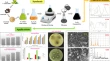
</abbrgrp>. In order to increase the active surface area, hollow and ultrafine iron oxide NPs are employed in this paper. Moreover, we proposed a new utilization of magnetic NPs as a catalyst support by modifying the surface on three different-shaped amino-functionalized iron oxide NPs with an active TiO<sub>2 </sub>photocatalytic layer via a seed-mediate method, as shown in Figure <figr fid="F1">1</figr>. The surface amines on the magnetic iron oxide NPs can serve as functional groups for further modification of titania. We discuss the formation mechanism of iron oxide/TiO<sub>2 </sub>hybrid NPs. The results maybe provide some new insights into the growth mechanism of iron oxide-TiO<sub>2 </sub>composite NPs. It is shown that the as-synthesized iron oxide/TiO<sub>2 </sub>hybrid NPs display good magnetic response and photocatalytic activity. The magnetic NPs can be used as a MRCs vehicle for simply and easily recycled separation by external magnetic field application.</p>
<fig id="F1"><title><p>Figure 1</p></title><caption><p>Illustration of the synthetic chemistry and process of magnetic iron oxide/TiO<sub>2 </sub>hybrid NPs preparation</p></caption><text>
   <p><b>Illustration of the synthetic chemistry and process of magnetic iron oxide/TiO<sub>2 </sub>hybrid NPs preparation</b>.</p>
</text><graphic file="1556-276X-6-533-1"/></fig>
</sec>
<sec>
<st>
<p>Experiment</p>
</st>
<sec>
<st>
<p>Reagents and materials</p>
</st>
<p>FeCl<sub>3</sub>&#183;6H<sub>2</sub>O, FeCl<sub>2</sub>&#183;4H<sub>2</sub>O, FeSO<sub>4</sub>&#183;7H<sub>2</sub>O, and KOH were purchased from Tianjin Kermel Chemical Reagent Co., Ltd. (Tianjin, China); KNO<sub>3</sub>, L(+)-glutamic acid (Gla, C<sub>5</sub>H<sub>9</sub>NO<sub>4</sub>), tetrabutyl titanate (Ti(Bu)<sub>4</sub>, Bu = OC<sub>4</sub>H<sub>9</sub>, CP) and methylene blue were purchased from Sinopharm Chemical Reagent CO., Ltd. (Shanghai, China); cetyltrimethylammmonium bromide (CTAB, C<sub>19</sub>H<sub>42</sub>BrN, ultrapure), MB and hexamethylenetetramine (C<sub>6</sub>H<sub>12</sub>N<sub>4</sub>) were purchased from Aladdin Chemical Reagent CO., Ltd. (Shanghai, China); 3-aminopropyltriethyloxysilane (APTES) were purchased from Sigma (St. Louis, MO, USA), and all the reagents are analytical pure and used as received.</p>
</sec>
<sec>
<st>
<p>Preparation of iron oxide seeds</p>
</st>
<sec>
<st>
<p>A. Spindle hematite NPs</p>
</st>
<p>According to Ishikava's report <abbrgrp>
<abbr bid="B37">37</abbr>
</abbrgrp>, we take a modified method to prepare the monodisperse spindle hematite NPs, in a typical synthesis, 1.8 ml of a 3.7 M FeCl<sub>3</sub>&#183;6H<sub>2</sub>O solution was added dropwise into 4.5 &#215; 10<sup>-4 </sup>M NaH<sub>2</sub>PO<sub>4 </sub>solution at 95&#176;C and the mixture was aged at 100&#176;C for 12 h. The resulting precipitates were washed with a 1 M ammonia solution and doubly distilled water and finally dried under vacuum.</p>
</sec>
<sec>
<st>
<p>B. Hollow magnetite NPs</p>
</st>
<p>According to our previous report <abbrgrp>
<abbr bid="B38">38</abbr>
</abbrgrp>, in a typical synthesis, solution A was prepared by dissolving 2.02 g KNO<sub>3 </sub>and 0.28 g KOH in 50 mL double distilled water, solution B was prepared by dissolving 0.070 g FeSO<sub>4</sub>&#183;7H<sub>2</sub>O in 50 mL double distilled water. Then the two solution were mixed together under magnetic stirring at a rate of ca. 400 rpm. Two minutes later, solution C (0.18 g Gla in 25 mL double distilled water) was added dropwise into the mixed solution. The reaction temperature was raised increasingly to 90&#176;C and kept 3 h under argon (Ar) atmosphere. Meanwhile, the brown solution was observed to change black. After the mixture was cooled to room temperature, the precipitate products were magnetically separated by MSS, washed with ethanol and water two times, respectively, and then redispersed in ethanol.</p>
</sec>
<sec>
<st>
<p>C. Ultrafine magnetite NPs</p>
</st>
<p>The ultrafine magnetite NPs were prepared through the chemical co-precipitation of Fe(II) and Fe(III) chlorides (Fe<sup>II</sup>/Fe<sup>III </sup>ratio = 0.5) with 0.5 M NaOH <abbrgrp>
<abbr bid="B39">39</abbr>
</abbrgrp>. The black precipitate was collected on a magnet, followed by rinsing with water several times until the pH reached 6 to 7.</p>
</sec>
</sec>
<sec>
<st>
<p>Preparation of amino-functionalized iron oxide NPs</p>
</st>
<p>A solution of APTES was added into the above seed suspensions, stirred under Ar atmosphere at 25&#176;C for 4 h. The prepared APTES-modified seeds were collected with a magnet, and washed with 50 mL of ethanol, followed by double distilled water for three times <abbrgrp>
<abbr bid="B40">40</abbr>
</abbrgrp>.</p>
</sec>
<sec>
<st>
<p>Preparation of iron oxides/TiO<sub>2 </sub>hybrid NPs</p>
</st>
<p>In a typical synthesis, 0.2 g amino-functionalized seeds, 0.2 g CTAB, and 0.056 g HMTA were dissolved in 25 ml ethanol solution under ultrasonic condition at room temperature. The mixture solution was then transferred into a Teflon-lined tube reactor. Then, 1 ml Ti(Bu)<sub>4 </sub>dropwise added in the tube, and was kept at 150&#176;C for 8 h.</p>
</sec>
<sec>
<st>
<p>Photodegradation of MB</p>
</st>
<p>The prepared samples were weighed and added into 80 mL of methylene blue solutions (12 mg/L). The mixed solutions were illuminated under mercury lamp (OSRAM, 250 W with characteristic wavelength at 365 nm), and the MB solutions were illuminated under UV light in the photochemical reactor. The solutions were fetched at 10-min intervals by pipette for each solution and centrifuged. Then, the time-dependent absorbance changes of the transparent solution after centrifugation were measured at the wavelength between 500 and 750 nm.</p>
</sec>
<sec>
<st>
<p>Characterization</p>
</st>
<p>TEM images were performed with a JEOL JEM-2010 (HT) (JEOL, Tokyo, Japan) transmission electron microscope operating at 200 kV, and the samples were dissolved in ethanol and dropped on super-thin cabon coated copper grids. SEM studies were carried out using a FEI Sirion FEG operating at 25 keV, samples were sprinkled onto the conductive substrate, respectively. Powder X-ray diffraction (XRD) patterns of the samples were recorded on a D8 Advance X-ray diffractometer (Germany) using Cu K&#945; radiation (<it>&#955; </it>= 0.1542 nm) operating at 40 kV and 40 mA and with a scan rate of 0.05&#176; 2<it>&#952; </it>s<sup>-1</sup>. X-ray photoelectron spectroscopy (XPS) measurements were made using a VG Multilab2000X. This system uses a focused Al exciting source for excitation and a spherical section analyzer. The percentages of individual elements detection were determined from the relative composition analysis of the peak areas of the bands. Magnetic measurements were performed using a Quantum Design MPMS XL-7 SQUID magnetometer. The powder sample was filled in a diamagnetic plastic capsule, and then the packed sample was put in a diamagnetic plastic straw and impacted into a minimal volume for magnetic measurements. Background magnetic measurements were checked for the packing material. The diffuse reflectance, absorbance and transmittance spectra, and photodegradation examination of the microspheres was carried out in a PGeneral TU-1901 spectrophotometer.</p>
</sec>
</sec>
<sec>
<st>
<p>Results and discussion</p>
</st>
<sec>
<st>
<p>Formation mechanism and morphology</p>
</st>
<p>For the synthesis of the functional hybrid nanomaterials, we synthesized the colloidal solutions of iron oxides NPs with different shapes in ethanol at the first. These iron oxide NPs exhibit long sedimentation time, and are stable against agglomeration for several days. Then, iron oxides NPs were modified with amino group by APTES because silane can render highly stability and water-dispersibility, and it also forms a protective layer against mild acid and alkaline environment. As shown in Figure <figr fid="F2">2</figr>, hydroxyl groups (-OH) on the magnetite surface reacted with the -OH of the APTES molecules leading to the formation of Si-O bonds and leaving the terminal -NH<sub>2 </sub>groups available for immobilization of TiO<sub>2 </sub>
<abbrgrp>
<abbr bid="B41">41</abbr>
</abbrgrp>. The immobilization of TiO<sub>2 </sub>can be explained by HSAB (hard and soft acids and bases) formula <abbrgrp>
<abbr bid="B42">42</abbr>
</abbrgrp>. As a typical hard acid, Ti ions can be combined to the terminal -NH<sub>2 </sub>groups (hard bases) easily, owing to there is small amount water in ethanol (95%), and then TiO<sub>2 </sub>will be coated on the surface of amino-functionalized iron oxide NPs by hydrolysis and poly-condensation as follows:</p>
<fig id="F2"><title><p>Figure 2</p></title><caption><p>Illustration of the functionalization process of iron oxides NPs with amino group by APTES</p></caption><text>
   <p><b>Illustration of the functionalization process of iron oxides NPs with amino group by APTES</b>.</p>
</text><graphic file="1556-276X-6-533-2"/></fig>
<p>
<display-formula id="M1">
<graphic file="1556-276X-6-533-i1.gif"/>
</display-formula>
</p>
<p>
<display-formula id="M2">
<graphic file="1556-276X-6-533-i2.gif"/>
</display-formula>
</p>
<p>We prepared the monodisperse spindle-like iron oxide NPs by ferric hydroxide precipitate method for evaluating and verifying our experimental mechanism and functional strategies. The electron micrograph of the starting weak-magnetic spindle-like hematite NPs are shown in Figure <figr fid="F3">3a</figr>, which have longitudinal diameter in the range from 120 to 150 nm and transverse diameter (short axis) around 40 nm. After TiO<sub>2 </sub>coating (FT-1), the transverse diameter increased to around 50 nm, and the representative image is shown in Figure <figr fid="F3">3b</figr>. Moreover, the obvious contrast differences between the pale edges and dark centers further clearly confirms the composite structure. Therefore, the results reveal that this functional strategy for fabricating the TiO<sub>2</sub>-functionalized iron oxide NPs is a feasible approach. Then, two strong magnetic iron oxide NPs with different shape and diameter as seeds were employed to fabricate the magnetic TiO<sub>2 </sub>hybrid materials. As shown in Figure <figr fid="F3">3c</figr>, Fe<sub>3</sub>O<sub>4 </sub>NPs with an obviously hollow structure have diameters around 100 nm, and the insert field-emission SEM image illustrates the hollow NPs present sphere-like shape. In our previous report, we have confirmed that the hollow Fe<sub>3</sub>O<sub>4 </sub>NPs were formed by oriented aggregation of small Fe<sub>3</sub>O<sub>4 </sub>NPs <abbrgrp>
<abbr bid="B38">38</abbr>
</abbrgrp>. Figure <figr fid="F3">3d</figr> shows bright field TEM image of the corresponding iron oxide NPs after the same TiO<sub>2 </sub>coating process (FT-2). However, the hybrid NPs present a shagginess sphere-like shape and cannot observe the hollow structure. Additionally, the diameters of hybrid NPs increased about 5 to 10 nm. The results reveal that the hollow Fe<sub>3</sub>O<sub>4 </sub>NPs have been covered by TiO<sub>2</sub>. Owing to the loose struture of Fe<sub>3</sub>O<sub>4 </sub>seeds, TiO<sub>2 </sub>will fill to its internal and surface, and finally cause the hybrid products present a solid nature. The diameter of above two different iron oxide NPs including spindle-like and hollow is relatively large, subsequently, we employ the ultrafine Fe<sub>3</sub>O<sub>4 </sub>NPs as seeds to fabricate the hybrid NPs. Figure <figr fid="F3">3e</figr> presents the TEM images of ultrafine Fe<sub>3</sub>O<sub>4 </sub>NPs without any size selection, the size is about 5 to 8 nm. By introduce the TiO<sub>2</sub>, the as-obtained products (FT-3) exhibit an aggregated nature and the ultrafine Fe<sub>3</sub>O<sub>4 </sub>NPs dispersing in the TiO<sub>2 </sub>matrix, as shown in Figure <figr fid="F3">3f</figr>.</p>
<fig id="F3"><title><p>Figure 3</p></title><caption><p>Representative TEM images of naked iron oxides and iron oxides/TiO<sub>2 </sub>hybrid NPs</p></caption><text>
   <p><b>Representative TEM images of naked iron oxides and iron oxides/TiO<sub>2 </sub>hybrid NPs</b>. The insert in <b>(c) </b>is the corresponding SEM image.</p>
</text><graphic file="1556-276X-6-533-3"/></fig>
</sec>
<sec>
<st>
<p>Structure and composition</p>
</st>
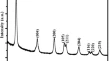
<p>XRD and XPS surface analysis was used to further confirm the structure and composition of iron oxides/TiO<sub>2 </sub>hybrid NPs. Figure <figr fid="F4">4a</figr> shows the XRD patterns of the as-synthesized &#945;-Fe<sub>2</sub>O<sub>3 </sub>seeds and &#945;-Fe<sub>2</sub>O<sub>3</sub>/TiO<sub>2 </sub>(FT-1). From the XRD patterns of &#945;-Fe<sub>2</sub>O<sub>3 </sub>seeds, it can be seen that the diffraction peaks conformity with that of rhombohedral &#945;-Fe<sub>2</sub>O<sub>3 </sub>(JCPDS no. 33-0664, show in the bottom). After coating, compared with that data of JCPDS no. 33-0664 and JCPDS no. 21-1272 (pure anatase TiO<sub>2 </sub>phase), the (101) and (200) peaks of anatase TiO<sub>2 </sub>can be found in FT-1, suggesting that &#945;-Fe<sub>2</sub>O<sub>3</sub>/TiO<sub>2 </sub>composite NPs are successfully fabricated by this method. Figure <figr fid="F4">4b</figr> shows the XRD patterns of the as-synthesized Fe<sub>3</sub>O<sub>4 </sub>seeds and Fe<sub>3</sub>O<sub>4</sub>/TiO<sub>2 </sub>(FT-2 and FT-3). All peaks in the XRD patterns of both seeds can be perfectly indexed to the cubic Fe<sub>3</sub>O<sub>4 </sub>structure (JCPDS no. 19-0629, show in the bottom). After coating, the (101) peak of anatase TiO<sub>2 </sub>can be clearly found in FT-2 and FT-3, suggesting that Fe<sub>3</sub>O<sub>4</sub>/TiO<sub>2 </sub>hybrid NPs are successfully synthesized.</p>
<fig id="F4"><title><p>Figure 4</p></title><caption><p>XRD patterns</p></caption><text>
   <p><b>XRD patterns</b>. Patterns of the as-prepared spindle-like &#945;-Fe<sub>2</sub>O<sub>3 </sub>NPs and FT-1 <b>(a)</b>, as-prepared hollow and ultrafine Fe<sub>3</sub>O<sub>4 </sub>NPs, FT-2 and FT-3 <b>(b)</b>.</p>
</text><graphic file="1556-276X-6-533-4"/></fig>
<p>Figure <figr fid="F5">5</figr> is the typical XPS spectra of the naked, amino-functionalized, and titania coating ultrafine Fe<sub>3</sub>O<sub>4 </sub>NPs, where part (a) is the survey spectrum and parts (b) to (d) are the high-resolution binding energy spectrum for Fe, Si, O, and Ti species, respectively. According to the survey spectrum, the elements of Fe, O, and C are found in the naked ultrafine Fe<sub>3</sub>O<sub>4 </sub>NPs, of which the element of C is found on the surface as the internal reference, and the elements of Fe and O arise from the components of Fe<sub>3</sub>O<sub>4</sub>. The new signals of N 1<it>s</it>, Si 2<it>s</it>, and Si 2<it>p </it>are observed in APTES-coated Fe<sub>3</sub>O<sub>4 </sub>NPs, and the new signal of Ti 2<it>p </it>signals is observed in FT-3 hybrid NPs. These results indicate that the FT-3 are composed of two components, silane functionalized Fe<sub>3</sub>O<sub>4 </sub>and TiO<sub>2</sub>. It is noteworthy that many studies demonstrated that if particles possessed a real core and shell structure, the core would be screened by the shell and the compositions in the shell layer became gradually more dominant, the intensity ratio of the shell/core spectra would gradually increase <abbrgrp>
<abbr bid="B43">43</abbr>
<abbr bid="B44">44</abbr>
<abbr bid="B45">45</abbr>
<abbr bid="B46">46</abbr>
<abbr bid="B47">47</abbr>
</abbrgrp>. The gradually subdued XPS signals of Fe after TiO<sub>2 </sub>coating are discerned in Figure <figr fid="F5">5b</figr>. APTES coating increases the intensity of carbon and oxygen, and decreases the concentration of Fe; further TiO<sub>2 </sub>coating decreases the intensity of silicon and Fe (as shown in Figure <figr fid="F5">5b, c</figr>). Therefore, after TiO<sub>2 </sub>coating, corresponding XPS signals of Fe, and Si rule also are decreased, C and O do not match with this rule due to the formation of TiO<sub>2 </sub>and surfactant impurities (as shown in Figure <figr fid="F5">5d, e</figr>). Additionally, interactions should exist among APTES-coated Fe<sub>3</sub>O<sub>4 </sub>NPs and titania which cause the shift of binding energy of Fe. Usually, XPS measures the elemental composition of the substance surface up to 1 to 10 nm depth. Therefore, XPS could be regarded as a bulk technique due to the ultrafine particles size of the FT-3 (less than 10 nm). The XPS result indicates that the amino-functionalized Fe<sub>3</sub>O<sub>4 </sub>seeds have been coated by a TiO<sub>2 </sub>layer, thus greatly reducing the intensity signals of the element inside. Table <tblr tid="T1">1</tblr> lists the binding energy values of Fe, Si, O, N, and Ti resolved from XPS spectra of the above three different NPs. In three cases, the value of binding energy of Fe 2<it>p </it>and other elements are very close to the standard binding energy values. Relative to the standard values <abbrgrp>
<abbr bid="B48">48</abbr>
</abbrgrp>, the binding energy values in FT-3 have decreased and this result is in agreement with the previous discussions.</p>
<fig id="F5"><title><p>Figure 5</p></title><caption><p>XPS spectra of the naked, amino-functionalized, and titania coating ultrafine Fe<sub>3</sub>O<sub>4 </sub>NPs</p></caption><text>
   <p><b>XPS spectra of the naked, amino-functionalized, and titania coating ultrafine Fe<sub>3</sub>O<sub>4 </sub>NPs</b>. XPS spectra for ultrafine Fe<sub>3</sub>O<sub>4 </sub>NPs (curve a), APTES-coated ultrafine Fe<sub>3</sub>O<sub>4 </sub>NPs (curve b) and ultrafine Fe<sub>3</sub>O<sub>4</sub>/TiO<sub>2 </sub>hybrid NPs (curve c) comparison <b>(a)</b>, the regions for Fe 2<it>p </it><b>(b)</b>, Si 2<it>p </it><b>(c)</b>, O 1<it>s </it><b>(d)</b>, and C 1<it>s </it><b>(e)</b>, comparison respectively.</p>
</text><graphic file="1556-276X-6-533-5"/></fig>
<tbl id="T1"><title><p>Table 1</p></title><caption><p>Standard binding energy values</p></caption><tblbdy cols="6">
      <r>
         <c ca="left">
            <p>
               <b>Samples</b>
               <sup>
                  <b>a</b>
               </sup>
            </p>
         </c>
         <c ca="center">
            <p>
               <b>Fe 2p</b>
               <sub>
                  <b>3/2</b>
               </sub>
            </p>
         </c>
         <c ca="center">
            <p>
               <b>O 1<it>s</it></b>
            </p>
         </c>
         <c ca="center">
            <p>
               <b>Si 2<it>p</it></b>
            </p>
         </c>
         <c ca="center">
            <p>
               <b>N 1<it>s</it></b>
            </p>
         </c>
         <c ca="center">
            <p>
               <b>Ti 2<it>p</it></b>
               <sub>
                  <b>3/2</b>
               </sub>
            </p>
         </c>
      </r>
      <r>
         <c cspan="6">
            <hr/>
         </c>
      </r>
      <r>
         <c ca="left">
            <p>Naked Fe<sub>3</sub>O<sub>4 </sub>nanoparticles</p>
         </c>
         <c ca="center">
            <p>710.9</p>
         </c>
         <c ca="center">
            <p>531.5</p>
         </c>
         <c>
            <p/>
         </c>
         <c>
            <p/>
         </c>
         <c>
            <p/>
         </c>
      </r>
      <r>
         <c ca="left">
            <p>APTES-coated Fe<sub>3</sub>O<sub>4 </sub>nanoparticles</p>
         </c>
         <c ca="center">
            <p>710.5</p>
         </c>
         <c ca="center">
            <p>531.5</p>
         </c>
         <c ca="center">
            <p>102.5</p>
         </c>
         <c ca="center">
            <p>399.5</p>
         </c>
         <c>
            <p/>
         </c>
      </r>
      <r>
         <c ca="left">
            <p>Hybrid nanoparticles (FT-3)</p>
         </c>
         <c ca="center">
            <p>710.0</p>
         </c>
         <c ca="center">
            <p>530.0</p>
         </c>
         <c ca="center">
            <p>101.4</p>
         </c>
         <c ca="center">
            <p>400.7</p>
         </c>
         <c ca="center">
            <p>458.3</p>
         </c>
      </r>
      <r>
         <c ca="left">
            <p>Standard value</p>
         </c>
         <c ca="center">
            <p>710.5<sup>b</sup></p>
         </c>
         <c ca="center">
            <p>531.4<sup>c</sup>, 529.9<sup>d</sup></p>
         </c>
         <c ca="center">
            <p>103.3<sup>e</sup></p>
         </c>
         <c ca="center">
            <p>399.8<sup>f</sup></p>
         </c>
         <c ca="center">
            <p>458.8<sup>g</sup></p>
         </c>
      </r>
   </tblbdy><tblfn>
      <p>Standard binding energy values for Fe 2<it>p</it>, Si 2<it>p</it>, N 1<it>s</it>, O 1<it>s</it>, and Ti 2<it><ul>p </ul></it>and those resolved in the naked, amino-functionalized, and titania coating ultrafine Fe<sub>3</sub>O<sub>4 </sub>nanoparticles. <sup>a</sup>Unit for binding energy: eV; <sup>b</sup>Fe in Fe<sub>3</sub>O<sub>4</sub>; <sup>c</sup>O in Fe<sub>3</sub>O<sub>4</sub>; <sup>d</sup>O in TiO<sub>2</sub>; <sup>e</sup>Si in SiO<sub>2</sub>; <sup>f</sup>N in N-C group; <sup>g </sup>Ti in TiO<sub>2</sub>, <it>&#916; </it>= 5.54 eV</p>
   </tblfn></tbl>
<p>Furthermore, XPS surface analysis is also used to quantify the amount of titanium and iron present in the near surface region of the three different hybrid NPs. Figure <figr fid="F6">6</figr> is the typical XPS spectra of the FT-1, FT-2, and FT-3, where part (a) is the survey spectrum and parts (b)-(d) are the high-resolution binding energy spectrum for Fe, Si, O, C, N, and Ti species, respectively. According to the survey spectrum, all hybrid NPs exhibited typical binding energies at the characteristic peaks of Ti 2<it>p</it>, Fe 2<it>p</it>, Si 2<it>p</it>, N 1<it>s </it>and O1<it>s </it>in the region of 458, 710, 103, 400, and 530 eV, respectively. Details of the XPS surface elemental composition results of as-obtained products are shown in Table <tblr tid="T2">2</tblr>. The XPS data of the titanium-to-iron ratio of hybrid NPs is calculated in which the elemental composition ratio of FT-1, FT-2, and FT-3 (titanium/iron) are about 2:1, 3.5:1, and 5.5:1. The results reveal that the quantity of Ti element is higher than that of Fe element on the surface of samples. That is, it may deduce that iron oxide NPs have been coated by TiO<sub>2</sub>. In all hybrid NPs, the amount of oxygen to titanium or iron calculated from XPS data is about 5:1, this results is in agreement with the other reports <abbrgrp>
<abbr bid="B49">49</abbr>
</abbrgrp>. Nevertheless, the combined results from TEM and XPS suggest that the synthesized hybrid NPs are composed of amino-functionalized iron oxide NPs and TiO<sub>2</sub>.</p>
<fig id="F6"><title><p>Figure 6</p></title><caption><p>XPS spectra of the FT-1, FT-2, and FT-3</p></caption><text>
   <p><b>XPS spectra of the FT-1, FT-2, and FT-3</b>. XPS spectra for FT-1 (curve a), FT-2 (curve b), and FT-3 (curve c) comparison <b>(a)</b>, the regions for C 1<it>s </it><b>(b)</b>, O 1<it>s </it><b>(c)</b>, N 1<it>s </it><b>(d)</b>, Si 2<it>p </it><b>(e)</b>, Fe 2<it>p </it><b>(f)</b>, and Ti 2<it>p </it><b>(g)</b>, comparison respectively.</p>
</text><graphic file="1556-276X-6-533-6"/></fig>
<tbl id="T2"><title><p>Table 2</p></title><caption><p>Surface elemental composition and XPS binding energies of FT-1, FT-2, and FT-3</p></caption><tblbdy cols="8">
      <r>
         <c>
            <p/>
         </c>
         <c ca="left" cspan="5">
            <p>
               <b>Chemical composition (%); in parentheses, binding energy (eV)</b>
            </p>
         </c>
         <c ca="center" cspan="2">
            <p>
               <b>Atomic ratio</b>
            </p>
         </c>
      </r>
      <r>
         <c ca="left">
            <p>
               <b>Samples</b>
            </p>
         </c>
         <c ca="center">
            <p>
               <b>Ti 2<it>p</it></b>
            </p>
         </c>
         <c ca="center">
            <p>
               <b>Fe 2<it>p</it></b>
            </p>
         </c>
         <c ca="center">
            <p>
               <b>O 1<it>s</it></b>
            </p>
         </c>
         <c ca="center">
            <p>
               <b>N 1<it>s</it></b>
            </p>
         </c>
         <c ca="center">
            <p>
               <b>Si 2<it>p</it></b>
            </p>
         </c>
         <c ca="center">
            <p>
               <b>Ti/Fe</b>
            </p>
         </c>
         <c ca="center">
            <p>
               <b>O/FeTi</b>
            </p>
         </c>
      </r>
      <r>
         <c cspan="8">
            <hr/>
         </c>
      </r>
      <r>
         <c ca="left">
            <p>FT-1</p>
         </c>
         <c ca="center">
            <p>2.87</p>
            <p>(457.7)</p>
         </c>
         <c ca="center">
            <p>1.38</p>
            <p>(709.2)</p>
         </c>
         <c ca="center">
            <p>29.08</p>
            <p>(529.4)</p>
         </c>
         <c ca="center">
            <p>3.96</p>
            <p>(400.3)</p>
         </c>
         <c ca="center">
            <p>3.80</p>
            <p>(101.5)</p>
         </c>
         <c ca="center">
            <p>2.08</p>
         </c>
         <c ca="center">
            <p>6.84</p>
         </c>
      </r>
      <r>
         <c ca="left">
            <p>FT-2</p>
         </c>
         <c ca="center">
            <p>4.72</p>
            <p>(457.8)</p>
         </c>
         <c ca="center">
            <p>1.25</p>
            <p>(709.3)</p>
         </c>
         <c ca="center">
            <p>27.13</p>
            <p>(529.5)</p>
         </c>
         <c ca="center">
            <p>4.10</p>
            <p>(401.2)</p>
         </c>
         <c ca="center">
            <p>2.60</p>
            <p>(101.0)</p>
         </c>
         <c ca="center">
            <p>3.78</p>
         </c>
         <c ca="center">
            <p>4.54</p>
         </c>
      </r>
      <r>
         <c ca="left">
            <p>FT-3</p>
         </c>
         <c ca="center">
            <p>5.75</p>
            <p>(458.3)</p>
         </c>
         <c ca="center">
            <p>1.02</p>
            <p>(710.0)</p>
         </c>
         <c ca="center">
            <p>33.53</p>
            <p>(530.0)</p>
         </c>
         <c ca="center">
            <p>4.38</p>
            <p>(400.7)</p>
         </c>
         <c ca="center">
            <p>5.48</p>
            <p>(101.4)</p>
         </c>
         <c ca="center">
            <p>5.63</p>
         </c>
         <c ca="center">
            <p>4.95</p>
         </c>
      </r>
   </tblbdy></tbl>
</sec>
<sec>
<st>
<p>Magnetic and magnetic response properties</p>
</st>
<p>Magnetic measurements of the hybrid NPs were performed on a SQUID magnetometer. As shown in Figure <figr fid="F7">7</figr>, hysteresis loops demonstrate that FT-2 and FT-3 have no hysteresis, the forward and backward magnetization curves overlap completely and are almost negligible. Moreover, the NPs have zero magnetization at zero applied field, indicating that they are superparamagnetic at room temperature, no remnant magnetism was observed when the magnetic field was removed <abbrgrp>
<abbr bid="B50">50</abbr>
</abbrgrp>. Superparamagnetism occurs when the size of the crystals is smaller than the ferromagnetic domain (the size of iron oxide NPs should less than 30 nm), the size of the ultrafine Fe<sub>3</sub>O<sub>4 </sub>component in our product is less than 10 nm, and the hollow Fe<sub>3</sub>O<sub>4 </sub>is consist of small magnetite NPs, there are reasonable to suppose that the hybrid NPs showed superparamagnetic behavior. The results reveal that the products have been inherit the superparamagnetic property from the Fe<sub>3</sub>O<sub>4 </sub>NPs, and the saturation magnetization value (<it>M</it>
<sub>s</sub>) of naked hollow Fe<sub>3</sub>O<sub>4 </sub>and ultrafine Fe<sub>3</sub>O<sub>4 </sub>is 89.2 and 72.1 emu/g, respectively. After TiO<sub>2 </sub>coating, the corresponding value of <it>M</it>
<sub>s </sub>decreases to 16.2 and 5.0 emu/g, respectively. The <it>M</it>
<sub>s </sub>decreased significantly after coating with TiO<sub>2 </sub>due to the surface effect arising from the non-collinearity of magnetic moments, which may be due to the coated TiO<sub>2 </sub>is impregnated at the interface of iron oxide matrix and pinning of the surface spins <abbrgrp>
<abbr bid="B51">51</abbr>
</abbrgrp>. Moreover, this decrease in magnetic behavior is very close to other reports <abbrgrp>
<abbr bid="B52">52</abbr>
<abbr bid="B53">53</abbr>
</abbrgrp>. As the most stable iron oxide NPs in the ambient conditions, the magnetic properties of hematite are not well understood <abbrgrp>
<abbr bid="B54">54</abbr>
<abbr bid="B55">55</abbr>
<abbr bid="B56">56</abbr>
</abbrgrp>. We checked the magnetic properties of FT-1 hybrid NPs, the <it>M</it>
<sub>s </sub>is about 2 &#215; 10<sup>-4 </sup>emu/g, and the composite NPs exhibit a typical ferromagnetism. Thereby, as a weak magnetic hybrid NPs, FT-1 cannot be separate by common magnet.</p>
<fig id="F7"><title><p>Figure 7</p></title><caption><p>Magnetization vs. filed dependence curves of iron oxides and hybrid NPs</p></caption><text>
   <p><b>Magnetization vs. filed dependence curves of iron oxides and hybrid NPs</b>. Recorded at T = 300 K. Insert shows the M-H curve of FT-1 samples.</p>
</text><graphic file="1556-276X-6-533-7"/></fig>
<p>We checked the magnetic responsibility of FT-2 and FT-3 hybrid NPs under the external applied magnetic field by a common magnet. As shown in Figure <figr fid="F8">8</figr>, both hybrid NPs gather quickly without residues left in the solid and solution state when the magnet presence. The gathered hybrid NPs can be redispersed in the solution easily by a slight shake. The results illustrate that the hybrid NPs display a good magnetic response, and this is also important for the industrial application in water cleaning as MRCs for preventing loss of materials and save cost.</p>
<fig id="F8"><title><p>Figure 8</p></title><caption><p>Photographs showing the magnetic separation of the FT-2 and FT-3 in solid and solution state</p></caption><text>
   <p><b>Photographs showing the magnetic separation of the FT-2 and FT-3 in solid and solution state</b>. At the presence of magnet (take from the MSS).</p>
</text><graphic file="1556-276X-6-533-8"/></fig>
</sec>
<sec>
<st>
<p>Optical adsorption and photocatalytic properties</p>
</st>
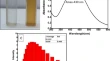
<p>The three different hybrid NPs were further characterized by UV-vis absorption spectra to compare their optical adsorption properties and the results are shown in Figure <figr fid="F9">9a</figr>. The spectra highlight a strong adsorption in the UV region, the results are in agreement with the other reports <abbrgrp>
<abbr bid="B57">57</abbr>
<abbr bid="B58">58</abbr>
</abbrgrp>. It is noteworthy that the hybrid NPs with different morphology (at same concentration) will cause the difference of adsorption intensity and peak location. Due to the small dimensions of semiconductor NPs, a discretization of the bandgap occurs with decreasing particle size, leading to smaller excitation frequencies. A blue shift of FT-3 is observed in the extinction behavior, and the absorption edge is positioned at smaller wavelengths <abbrgrp>
<abbr bid="B59">59</abbr>
</abbrgrp>. The result confirms that the diameter of FT-1 hybrid NPs is large than the other two different types hybrid NPs. Additionally, a concomitant tail can be clearly observed in the visible region of the absorption curve owing to scattering losses induced by the large number of inorganic NPs in the composite nanostructure <abbrgrp>
<abbr bid="B60">60</abbr>
</abbrgrp>.</p>
<fig id="F9"><title><p>Figure 9</p></title><caption><p>UV-vis absorbance spectrum and bandgap energy</p></caption><text>
   <p><b>UV-vis absorbance spectrum and bandgap energy</b>. UV-vis absorbance spectrum <b>(a) </b>and bandgap energy <b>(b) </b>of FT-1 (curve a), FT-2 (curve b) and FT-3 (curve c) hybrid NPs.</p>
</text><graphic file="1556-276X-6-533-9"/></fig>
<p>In order to calculate the bandgap of hybrid NPs, the relationship between the absorption coefficient (<it>&#945;</it>) and the photon energy (h&#957;) have been given by equation as follows: <it>&#945;</it>hv = <it>A</it>(hv-<it>E</it>
<sub>
<it>E</it>
</sub>)<sup>
<it>m</it>
</sup>, where <it>A </it>is a constant, <it>E</it>
<sub>g </sub>is the bandgap energy, h&#957; is the incident photon energy and the exponent m depends on the nature of optical transition. The value of <it>m </it>is 1/2 for direct allowed, 2 for indirect allowed, 3/2 for direct forbidden, and 3 for indirect forbidden transitions <abbrgrp>
<abbr bid="B61">61</abbr>
</abbrgrp>. The main mechanism of light absorption in pure semiconductors is direct interband electron transitions. The absorption coefficient &#945; has been calculated from the Lamberts formula <abbrgrp>
<abbr bid="B62">62</abbr>
</abbrgrp>, <inline-formula>
<m:math name="1556-276X-6-533-i3" xmlns:m="http://www.w3.org/1998/Math/MathML"><m:mi>&#945;</m:mi>
<m:mo class="MathClass-rel">=</m:mo>
<m:mfrac>
   <m:mrow>
      <m:mn>1</m:mn>
   </m:mrow>
   <m:mrow>
      <m:mi>t</m:mi>
   </m:mrow>
</m:mfrac>
<m:mo class="qopname">ln</m:mo>
<m:mfenced close=")" open="(" separators="">
   <m:mrow>
      <m:mfrac>
         <m:mrow>
            <m:mn>1</m:mn>
         </m:mrow>
         <m:mrow>
            <m:mi>T</m:mi>
         </m:mrow>
      </m:mfrac>
   </m:mrow>
</m:mfenced>
</m:math>
</inline-formula>, where <it>T </it>and <it>t </it>are the transmittance (can be directly measured by UV-vis spectra) and path length of the colloids solution (same concentration), respectively. A typical plot of (<it>&#945;</it>h&#957;)<sup>2 </sup>versus photon energy (h&#957;) for the samples are shown in Figure <figr fid="F9">9b</figr>. The value of FT-1, FT-2, and FT-3 is 2.85, 2.89, and 2.73 eV, respectively.TiO<sub>2 </sub>is important for its application in energy transport, storage, and for the environmental cleanup due to its well known photocatalytic effect with a bandgap of 3.2 eV <abbrgrp>
<abbr bid="B63">63</abbr>
</abbrgrp>. Comparing with the pure TiO<sub>2 </sub>NPs, the bandgap of hybrid NPs is obviously decreased, and the absorption edge generates obvious red shift. This red shift is attributed to the charge-transfer transition between the electrons of the iron oxide NPs and the conduction band (or valence band) of TiO<sub>2 </sub>
<abbrgrp>
<abbr bid="B64">64</abbr>
</abbrgrp>. Iron oxide NPs can increase energy spacing of the conduction band in TiO<sub>2 </sub>and finally lead to the quantization of energy levels and causes the absorption in the visible region. The other is that amino groups can act as a substitutional dopant for the place of titanium and change metal coordination of TiO<sub>2 </sub>and the electronic environment around them <abbrgrp>
<abbr bid="B65">65</abbr>
</abbrgrp>. Similar phenomenon of red shift in the bandgap for iron oxide/TiO<sub>2 </sub>hybrid NPs were also found by other reports <abbrgrp>
<abbr bid="B53">53</abbr>
<abbr bid="B65">65</abbr>
<abbr bid="B66">66</abbr>
<abbr bid="B67">67</abbr>
</abbrgrp>.</p>
<p>The photocatalytic activity was examined by a colorant decomposition test using MB, which is very stable chemical dye under normal conditions. In general, absorption spectra can be used to measure the concentration changes of MB in extremely dilute aqueous solution. The MB displays an absorption peak at the wavelength of about 664 nm. Time-dependent photodegradation of MB is shown in Figure <figr fid="F10">10</figr>. It is illustrated that MB decomposes in the presence of magnetic TiO<sub>2 </sub>hybrid materials. Generally, the pure TiO<sub>2 </sub>NPs can decompose 40% MB in 90 min <abbrgrp>
<abbr bid="B68">68</abbr>
<abbr bid="B69">69</abbr>
<abbr bid="B70">70</abbr>
</abbrgrp>. In our previous report, the pure TiO<sub>2 </sub>NPs with a average diameter of 5 nm can be decomposed 53% MB in 90 min <abbrgrp>
<abbr bid="B71">71</abbr>
</abbrgrp>. However, in our system, 49.0%, 56.5%, and 49.6% MB decomposed by FT-1, FT-2, and FT-3 in 90 min, respectively. The result reveals that the introduction of iron oxide NPs not only improve the photocatalytic activity but also employ the corresponding magnetic properties from itself. Thus, the as-synthesized magnetic hybrid NPs with high photocatalytic efficiency are very potentially useful for cleaning polluted water with the help of magnetic separation. The photocatalytic degradation generally follows a Langmuir-Hinshelwood mechanism, which could be simplified as a pseudo-first order reaction as follows <abbrgrp>
<abbr bid="B72">72</abbr>
<abbr bid="B73">73</abbr>
</abbrgrp>: <inline-formula>
<m:math name="1556-276X-6-533-i4" xmlns:m="http://www.w3.org/1998/Math/MathML"><m:mi>r</m:mi>
<m:mo class="MathClass-rel">=</m:mo>
<m:mo class="MathClass-bin">-</m:mo>
<m:mfrac>
   <m:mrow>
      <m:mi>d</m:mi>
      <m:msub>
         <m:mrow>
            <m:mi>C</m:mi>
         </m:mrow>
         <m:mrow>
            <m:mi>t</m:mi>
         </m:mrow>
      </m:msub>
   </m:mrow>
   <m:mrow>
      <m:mi>d</m:mi>
      <m:mi>t</m:mi>
   </m:mrow>
</m:mfrac>
<m:mo class="MathClass-rel">=</m:mo>
<m:mi>k</m:mi>
<m:mi>C</m:mi>
<m:mi>t</m:mi>
</m:math>
</inline-formula>, where <it>r </it>is the degradation rate of reactant, <it>C </it>is the concentration of reactant, <it>k </it>is the apparent reaction rate constant. The <it>k </it>for FT-1, FT-2, and FT-3 was 1.066% min<sup>-1</sup>, 1.331% min<sup>-1</sup>, 1.054% min<sup>-1</sup>, respectively. It was surprising that the FT-2 exhibited such higher activity. This may be explained by light absorption capability of the FT-2 due to their rough shell contributes to the good photocatalytic activity. Compared to smooth surface, the rough surface layers can absorb more light because the UV-vis light can have multiple-reflections among the shagginess surface structure <abbrgrp>
<abbr bid="B74">74</abbr>
</abbrgrp>.</p>
<fig id="F10"><title><p>Figure 10</p></title><caption><p>Changes of MB concentration photocatalytic degradation in the presence of samples</p></caption><text>
   <p><b>Changes of MB concentration photocatalytic degradation in the presence of samples</b>. <b>(a) </b>Without samples, <b>(b) </b>pure TiO<sub>2 </sub>(5 nm), <b>(c) </b>FT-1, <b>(d) </b>FT-2, and <b>(e) </b>FT-3, and the insert is the correspondingly logarithmic coordinate versus time and liner fitting results.</p>
</text><graphic file="1556-276X-6-533-10"/></fig>
</sec>
</sec>
<sec>
<st>
<p>Conclusions</p>
</st>
<p>In summary, MRCs have been fabricated via a facile seed-mediate technology. These iron oxide/TiO<sub>2 </sub>hybrid NPs were synthesized in a stepwise process. First, three different shapes of naked iron oxide NPs were prepared. Next, amino groups encapsulated iron oxide NPs are synthesized by APTES modification. Finally, the iron oxide/TiO<sub>2 </sub>hybrid NPs can be obtained after the TiO<sub>2 </sub>coating. The FT-2 and FT-3 hybrid NPs show superparamagnetic and both display good photocatalytic properties. This MRCs combination of the photocatalysis properties of TiO<sub>2 </sub>and the superparamagnetic property of Fe<sub>3</sub>O<sub>4 </sub>NPs endows this material with a bright perspective in purification of polluted wastewater. Additionally, this work also discusses the formation mechanism and potentially provided a general method for synthesizing nanocomposites of magnetic iron oxide NPs and other functional NPs, which may find wider applications besides in photocatalysis.</p>
</sec>
<sec>
<st>
<p>Competing interests</p>
</st>
<p>The authors declare that they have no competing interests.</p>
</sec>
<sec>
<st>
<p>Authors' contributions</p>
</st>
<p>WW participated in the materials preparation, data analysis and drafted the manuscript. SZ, XX and RF participated in the sample characterization. CZ participated in its design and coordination. All authors read and approved the final manuscript.</p>
</sec>
</bdy><bm>
<ack>
<sec>
<st>
<p>Acknowledgements</p>
</st>
<p>The authors thank the National Basic Research Program of China (973 Program, no. 2009CB939704), the National Nature Science Foundation of China (nos. 91026014, 10905043, 11005082), the Fundamental Research Funds for the Central Universities and the PhD candidates self-research (including 1 + 4) program of Wuhan University in 2008 (no. 20082020201000008) for financial support. W. Wu thanks L. Lin, L. Zeng, Z. H. Wu, and Prof. Q. G. He of HUT for assistance with the photodegradation measurements.</p>
</sec>
</ack>
<refgrp><bibl id="B1"><title><p>Complex and oriented ZnO nanostructures</p></title><aug><au><snm>Tian</snm><fnm>ZRR</fnm></au><au><snm>Voigt</snm><fnm>JA</fnm></au><au><snm>Liu</snm><fnm>J</fnm></au><au><snm>McKenzie</snm><fnm>B</fnm></au><au><snm>McDermott</snm><fnm>MJ</fnm></au><au><snm>Rodriguez</snm><fnm>MA</fnm></au><au><snm>Konishi</snm><fnm>H</fnm></au><au><snm>Xu</snm><fnm>HF</fnm></au></aug><source>Nat Mater</source><pubdate>2003</pubdate><volume>2</volume><fpage>821</fpage><lpage>826</lpage><xrefbib><pubidlist><pubid idtype="doi">10.1038/nmat1014</pubid><pubid idtype="pmpid" link="fulltext">14634640</pubid></pubidlist></xrefbib></bibl><bibl id="B2"><title><p>Magnetic nanoparticles for drug delivery</p></title><aug><au><snm>Dobson</snm><fnm>J</fnm></au></aug><source>Drug Dev Res</source><pubdate>2006</pubdate><volume>67</volume><fpage>55</fpage><lpage>60</lpage><xrefbib><pubid idtype="doi">10.1002/ddr.20067</pubid></xrefbib></bibl><bibl id="B3"><title><p>Magnetic iron oxide nanoparticles: synthesis and surface functionalization strategies</p></title><aug><au><snm>Wu</snm><fnm>W</fnm></au><au><snm>He</snm><fnm>QG</fnm></au><au><snm>Jiang</snm><fnm>CZ</fnm></au></aug><source>Nanoscale Res Lett</source><pubdate>2008</pubdate><volume>3</volume><fpage>397</fpage><lpage>415</lpage><xrefbib><pubidlist><pubid idtype="doi">10.1007/s11671-008-9174-9</pubid><pubid idtype="pmpid" link="fulltext">21749733</pubid></pubidlist></xrefbib></bibl><bibl id="B4"><title><p>A magnetically recyclable nanocomposite catalyst for olefin epoxidation</p></title><aug><au><snm>Shokouhimehr</snm><fnm>M</fnm></au><au><snm>Piao</snm><fnm>YZ</fnm></au><au><snm>Kim</snm><fnm>J</fnm></au><au><snm>Jang</snm><fnm>YJ</fnm></au><au><snm>Hyeon</snm><fnm>T</fnm></au></aug><source>Angew Chem Int Ed</source><pubdate>2007</pubdate><volume>46</volume><fpage>7039</fpage><lpage>7043</lpage><xrefbib><pubid idtype="doi">10.1002/anie.200702386</pubid></xrefbib></bibl><bibl id="B5"><title><p>Synthesis of iron oxide nanoparticles used as MRI contrast agents: a parametric study</p></title><aug><au><snm>Babes</snm><fnm>L</fnm></au><au><snm>Denizot</snm><fnm>B</fnm></au><au><snm>Tanguy</snm><fnm>G</fnm></au><au><snm>Le Jeune</snm><fnm>JJ</fnm></au><au><snm>Jallet</snm><fnm>P</fnm></au></aug><source>J Colloid Interface Sci</source><pubdate>1999</pubdate><volume>212</volume><fpage>474</fpage><lpage>482</lpage><xrefbib><pubidlist><pubid idtype="doi">10.1006/jcis.1998.6053</pubid><pubid idtype="pmpid" link="fulltext">10092379</pubid></pubidlist></xrefbib></bibl><bibl id="B6"><title><p>Multimodality based diagnosis and treatment of breast cancer cells by magnetic nanoparticles coated by a gold shell with hyperthermia and radiation therapy</p></title><aug><au><snm>Yao</snm><fnm>Y</fnm></au><au><snm>Huang</snm><fnm>J</fnm></au><au><snm>Yang</snm><fnm>J</fnm></au><au><snm>McIntyre</snm><fnm>T</fnm></au><au><snm>Chen</snm><fnm>J</fnm></au></aug><source>Radiother Oncol</source><pubdate>2007</pubdate><volume>84</volume><fpage>S78</fpage><lpage>S78</lpage></bibl><bibl id="B7"><title><p>Preparation of magnetic microspheres based on Poly(epsilon-caprolactone)-Poly(ethylene glycol)-Poly(epsilon-caprolactone) copolymers by modified solvent diffusion method</p></title><aug><au><snm>Qian</snm><fnm>ZY</fnm></au><au><snm>Men</snm><fnm>K</fnm></au><au><snm>Zeng</snm><fnm>S</fnm></au><au><snm>Gou</snm><fnm>ML</fnm></au><au><snm>Guo</snm><fnm>G</fnm></au><au><snm>Gu</snm><fnm>YC</fnm></au><au><snm>Luo</snm><fnm>F</fnm></au><au><snm>Zhao</snm><fnm>X</fnm></au><au><snm>Wei</snm><fnm>YQ</fnm></au></aug><source>J Biomed Nanotechnol</source><pubdate>2010</pubdate><volume>6</volume><fpage>287</fpage><lpage>292</lpage><xrefbib><pubidlist><pubid idtype="doi">10.1166/jbn.2010.1125</pubid><pubid idtype="pmpid">21179946</pubid></pubidlist></xrefbib></bibl><bibl id="B8"><title><p>Capture of enveloped viruses using polymer tentacles containing magnetic latex particles</p></title><aug><au><snm>Arkhis</snm><fnm>A</fnm></au><au><snm>Elaissari</snm><fnm>A</fnm></au><au><snm>Delair</snm><fnm>T</fnm></au><au><snm>Verrier</snm><fnm>B</fnm></au><au><snm>Mandrand</snm><fnm>B</fnm></au></aug><source>J Biomed Nanotechnol</source><pubdate>2010</pubdate><volume>6</volume><fpage>28</fpage><lpage>36</lpage><xrefbib><pubidlist><pubid idtype="doi">10.1166/jbn.2010.1093</pubid><pubid idtype="pmpid">20499829</pubid></pubidlist></xrefbib></bibl><bibl id="B9"><title><p>A novel single nucleotide polymorphisms detection sensors based on magnetic nanoparticles array and dual-color single base extension</p></title><aug><au><snm>He</snm><fnm>NY</fnm></au><au><snm>Liu</snm><fnm>HN</fnm></au><au><snm>Li</snm><fnm>S</fnm></au><au><snm>Tian</snm><fnm>L</fnm></au><au><snm>Liu</snm><fnm>LS</fnm></au></aug><source>J Nanosci Nanotechnol</source><pubdate>2010</pubdate><volume>10</volume><fpage>5311</fpage><lpage>5315</lpage><xrefbib><pubidlist><pubid idtype="doi">10.1166/jnn.2010.2386</pubid><pubid idtype="pmpid">21125888</pubid></pubidlist></xrefbib></bibl><bibl id="B10"><title><p>An applied approach in detecting <it>E. coli </it>O157:H7 using immunological method based on chemiluminescence and magnetic nanoparticles</p></title><aug><au><snm>Li</snm><fnm>ZY</fnm></au><au><snm>He</snm><fnm>L</fnm></au><au><snm>He</snm><fnm>NY</fnm></au><au><snm>Shi</snm><fnm>ZY</fnm></au><au><snm>Wang</snm><fnm>H</fnm></au><au><snm>Li</snm><fnm>S</fnm></au><au><snm>Liu</snm><fnm>HN</fnm></au><au><snm>Dai</snm><fnm>YB</fnm></au></aug><source>Acta Chim Sinica</source><pubdate>2010</pubdate><volume>68</volume><fpage>251</fpage><lpage>256</lpage></bibl><bibl id="B11"><title><p>Preparation of SiO<sub>2</sub>/polymethyl methacrylate/Fe<sub>3</sub>O<sub>4 </sub>nanoparticles and its application in detecting <it>E. coli </it>O157:H7 using chemiluminescent immunological method</p></title><aug><au><snm>He</snm><fnm>NY</fnm></au><au><snm>Li</snm><fnm>ZY</fnm></au><au><snm>He</snm><fnm>L</fnm></au><au><snm>Shi</snm><fnm>ZY</fnm></au><au><snm>Wang</snm><fnm>H</fnm></au><au><snm>Li</snm><fnm>S</fnm></au><au><snm>Liu</snm><fnm>HN</fnm></au><au><snm>Wang</snm><fnm>ZF</fnm></au></aug><source>J Biomed Nanotechnol</source><pubdate>2009</pubdate><volume>5</volume><fpage>505</fpage><lpage>510</lpage><xrefbib><pubidlist><pubid idtype="doi">10.1166/jbn.2009.1070</pubid><pubid idtype="pmpid">20201424</pubid></pubidlist></xrefbib></bibl><bibl id="B12"><title><p>An automated MagStation for high-throughput single nucleotide polymorphism genotyping and the dual-color hybridization</p></title><aug><au><snm>He</snm><fnm>NY</fnm></au><au><snm>Tian</snm><fnm>L</fnm></au><au><snm>Li</snm><fnm>S</fnm></au><au><snm>Liu</snm><fnm>HN</fnm></au><au><snm>Wang</snm><fnm>ZF</fnm></au></aug><source>J Biomed Nanotechnol</source><pubdate>2009</pubdate><volume>5</volume><fpage>511</fpage><lpage>515</lpage><xrefbib><pubidlist><pubid idtype="doi">10.1166/jbn.2009.1066</pubid><pubid idtype="pmpid">20201425</pubid></pubidlist></xrefbib></bibl><bibl id="B13"><title><p>Synthesis and surface engineering of iron oxide nanoparticles for biomedical applications</p></title><aug><au><snm>Gupta</snm><fnm>AK</fnm></au><au><snm>Gupta</snm><fnm>M</fnm></au></aug><source>Biomaterials</source><pubdate>2005</pubdate><volume>26</volume><fpage>3995</fpage><lpage>4021</lpage><xrefbib><pubidlist><pubid idtype="doi">10.1016/j.biomaterials.2004.10.012</pubid><pubid idtype="pmpid" link="fulltext">15626447</pubid></pubidlist></xrefbib></bibl><bibl id="B14"><title><p>TiO<sub>2 </sub>nanoparticles with high photocatalytic activity under visible light</p></title><aug><au><snm>Janus</snm><fnm>M</fnm></au><au><snm>Tryba</snm><fnm>B</fnm></au><au><snm>Kusiak</snm><fnm>E</fnm></au><au><snm>Tsumura</snm><fnm>T</fnm></au><au><snm>Toyoda</snm><fnm>M</fnm></au><au><snm>Inagaki</snm><fnm>M</fnm></au><au><snm>Morawski</snm><fnm>A</fnm></au></aug><source>Catal Lett</source><pubdate>2009</pubdate><volume>128</volume><fpage>36</fpage><lpage>39</lpage><xrefbib><pubid idtype="doi">10.1007/s10562-008-9721-0</pubid></xrefbib></bibl><bibl id="B15"><title><p>N-doped SiO<sub>2</sub>/TiO<sub>2 </sub>mesoporous nanoparticles with enhanced photocatalytic activity under visible-light irradiation</p></title><aug><au><snm>Hou</snm><fnm>YD</fnm></au><au><snm>Wang</snm><fnm>XC</fnm></au><au><snm>Wu</snm><fnm>L</fnm></au><au><snm>Chen</snm><fnm>XF</fnm></au><au><snm>Ding</snm><fnm>ZX</fnm></au><au><snm>Wang</snm><fnm>XX</fnm></au><au><snm>Fu</snm><fnm>XZ</fnm></au></aug><source>Chemosphere</source><pubdate>2008</pubdate><volume>72</volume><fpage>414</fpage><lpage>421</lpage><xrefbib><pubidlist><pubid idtype="doi">10.1016/j.chemosphere.2008.02.035</pubid><pubid idtype="pmpid" link="fulltext">18423518</pubid></pubidlist></xrefbib></bibl><bibl id="B16"><title><p>Photocatalytic oxidation of gaseous benzene over nanosized TiO<sub>2 </sub>prepared by solvothermal method</p></title><aug><au><snm>Wu</snm><fnm>ZB</fnm></au><au><snm>Gu</snm><fnm>ZL</fnm></au><au><snm>Zhao</snm><fnm>WR</fnm></au><au><snm>Wang</snm><fnm>HQ</fnm></au></aug><source>Chin Sci Bull</source><pubdate>2007</pubdate><volume>52</volume><fpage>3061</fpage><lpage>3067</lpage><xrefbib><pubid idtype="doi">10.1007/s11434-007-0456-x</pubid></xrefbib></bibl><bibl id="B17"><title><p>Preparation and photocatalytic properties of Fe<sup>3+</sup>-doped Ag@TiO<sub>2 </sub>core-shell nanoparticles</p></title><aug><au><snm>Wang</snm><fnm>WJ</fnm></au><au><snm>Zhang</snm><fnm>JL</fnm></au><au><snm>Chen</snm><fnm>F</fnm></au><au><snm>He</snm><fnm>DN</fnm></au><au><snm>Anpo</snm><fnm>M</fnm></au></aug><source>J Colloid Interface Sci</source><pubdate>2008</pubdate><volume>323</volume><fpage>182</fpage><lpage>186</lpage><xrefbib><pubidlist><pubid idtype="doi">10.1016/j.jcis.2008.03.043</pubid><pubid idtype="pmpid" link="fulltext">18448112</pubid></pubidlist></xrefbib></bibl><bibl id="B18"><title><p>Compact inverse-opal electrode using non-aggregated TiO<sub>2 </sub>nanoparticles for dye-sensitized solar cells</p></title><aug><au><snm>Kwak</snm><fnm>ES</fnm></au><au><snm>Lee</snm><fnm>W</fnm></au><au><snm>Park</snm><fnm>NG</fnm></au><au><snm>Kim</snm><fnm>J</fnm></au><au><snm>Lee</snm><fnm>H</fnm></au></aug><source>Adv Funct Mater</source><pubdate>2009</pubdate><volume>19</volume><fpage>1093</fpage><lpage>1099</lpage><xrefbib><pubid idtype="doi">10.1002/adfm.200801540</pubid></xrefbib></bibl><bibl id="B19"><title><p>Growth of oriented single-crystalline rutile TiO<sub>2 </sub>nanorods on transparent conducting substrates for dye-sensitized solar sells</p></title><aug><au><snm>Liu</snm><fnm>B</fnm></au><au><snm>Aydil</snm><fnm>ES</fnm></au></aug><source>J Am Chem Soc</source><pubdate>2009</pubdate><volume>131</volume><fpage>3985</fpage><lpage>3990</lpage><xrefbib><pubidlist><pubid idtype="doi">10.1021/ja8078972</pubid><pubid idtype="pmpid" link="fulltext">19245201</pubid></pubidlist></xrefbib></bibl><bibl id="B20"><title><p>Effect of annealing temperature on the photoelectrochemical properties of dye-sensitized solar cells made with mesoporous TiO<sub>2 </sub>nanoparticles</p></title><aug><au><snm>Zhao</snm><fnm>D</fnm></au><au><snm>Peng</snm><fnm>TY</fnm></au><au><snm>Lu</snm><fnm>LL</fnm></au><au><snm>Cai</snm><fnm>P</fnm></au><au><snm>Jiang</snm><fnm>P</fnm></au><au><snm>Bian</snm><fnm>ZQ</fnm></au></aug><source>J Phys Chem C</source><pubdate>2008</pubdate><volume>112</volume><fpage>8486</fpage><lpage>8494</lpage><xrefbib><pubid idtype="doi">10.1021/jp800127x</pubid></xrefbib></bibl><bibl id="B21"><title><p>Facile preparation of large aspect ratio ellipsoidal anatase TiO<sub>2 </sub>nanoparticles and their application to dye-sensitized solar cell</p></title><aug><au><snm>Baek</snm><fnm>IC</fnm></au><au><snm>Vithal</snm><fnm>M</fnm></au><au><snm>Chang</snm><fnm>JA</fnm></au><au><snm>Yum</snm><fnm>JH</fnm></au><au><snm>Nazeeruddin</snm><fnm>MK</fnm></au><au><snm>Gratzel</snm><fnm>M</fnm></au><au><snm>Chung</snm><fnm>YC</fnm></au><au><snm>Seok</snm><fnm>SI</fnm></au></aug><source>Electrochem Commun</source><pubdate>2009</pubdate><volume>11</volume><fpage>909</fpage><lpage>912</lpage><xrefbib><pubid idtype="doi">10.1016/j.elecom.2009.02.026</pubid></xrefbib></bibl><bibl id="B22"><title><p>Homogeneous catalysis-new approaches to catalyst separation, recovery, and recycling</p></title><aug><au><snm>Cole-Hamilton</snm><fnm>DJ</fnm></au></aug><source>Science</source><pubdate>2003</pubdate><volume>299</volume><fpage>1702</fpage><lpage>1706</lpage><xrefbib><pubidlist><pubid idtype="doi">10.1126/science.1081881</pubid><pubid idtype="pmpid" link="fulltext">12637737</pubid></pubidlist></xrefbib></bibl><bibl id="B23"><title><p>Enhanced activity of bismuth-compounded TiO<sub>2 </sub>nanoparticles for photocatalytically degrading rhodamine B solution</p></title><aug><au><snm>Wang</snm><fnm>J</fnm></au><au><snm>Jing</snm><fnm>LQ</fnm></au><au><snm>Xue</snm><fnm>LP</fnm></au><au><snm>Qu</snm><fnm>YC</fnm></au><au><snm>Fu</snm><fnm>HG</fnm></au></aug><source>J Hazard Mater</source><pubdate>2008</pubdate><volume>160</volume><fpage>208</fpage><lpage>212</lpage><xrefbib><pubidlist><pubid idtype="doi">10.1016/j.jhazmat.2008.02.103</pubid><pubid idtype="pmpid" link="fulltext">18400384</pubid></pubidlist></xrefbib></bibl><bibl id="B24"><title><p>Pt/TiO<sub>2 </sub>brain biocompatible nanoparticles: GBM treatment using the C6 model in Wistar rats</p></title><aug><au><snm>Lopez</snm><fnm>T</fnm></au><au><snm>Recillas</snm><fnm>S</fnm></au><au><snm>Guevara</snm><fnm>P</fnm></au><au><snm>Sotelo</snm><fnm>J</fnm></au><au><snm>Alvarez</snm><fnm>M</fnm></au><au><snm>Odriozola</snm><fnm>JA</fnm></au></aug><source>Acta Biomater</source><pubdate>2008</pubdate><volume>4</volume><fpage>2037</fpage><lpage>2044</lpage><xrefbib><pubidlist><pubid idtype="doi">10.1016/j.actbio.2008.05.027</pubid><pubid idtype="pmpid" link="fulltext">18640082</pubid></pubidlist></xrefbib></bibl><bibl id="B25"><title><p>(Bi, C and N) codoped TiO<sub>2 </sub>nanoparticles</p></title><aug><au><snm>Lv</snm><fnm>KL</fnm></au><au><snm>Zuo</snm><fnm>HS</fnm></au><au><snm>Sun</snm><fnm>J</fnm></au><au><snm>Deng</snm><fnm>KJ</fnm></au><au><snm>Liu</snm><fnm>SC</fnm></au><au><snm>Li</snm><fnm>XF</fnm></au><au><snm>Wang</snm><fnm>DY</fnm></au></aug><source>J Hazard Mater</source><pubdate>2009</pubdate><volume>161</volume><fpage>396</fpage><lpage>401</lpage><xrefbib><pubidlist><pubid idtype="doi">10.1016/j.jhazmat.2008.03.111</pubid><pubid idtype="pmpid" link="fulltext">18457917</pubid></pubidlist></xrefbib></bibl><bibl id="B26"><title><p>Synthesis of Gd-doped TiO<sub>2 </sub>nanoparticles under mild condition and their photocatalytic activity</p></title><aug><au><snm>Xu</snm><fnm>JJ</fnm></au><au><snm>Ao</snm><fnm>YH</fnm></au><au><snm>Fu</snm><fnm>D</fnm></au><au><snm>Yuan</snm><fnm>CW</fnm></au></aug><source>Colloid Surf A</source><pubdate>2009</pubdate><volume>334</volume><fpage>107</fpage><lpage>111</lpage><xrefbib><pubid idtype="doi">10.1016/j.colsurfa.2008.10.017</pubid></xrefbib></bibl><bibl id="B27"><title><p>Preparation of highly dispersed CeO<sub>2</sub>/TiO<sub>2 </sub>core-shell nanoparticles</p></title><aug><au><snm>Yue</snm><fnm>L</fnm></au><au><snm>Zhang</snm><fnm>XM</fnm></au></aug><source>Mater Lett</source><pubdate>2008</pubdate><volume>62</volume><fpage>3764</fpage><lpage>3766</lpage><xrefbib><pubid idtype="doi">10.1016/j.matlet.2008.04.059</pubid></xrefbib></bibl><bibl id="B28"><title><p>Novel approach for the synthesis of Fe<sub>3</sub>O<sub>4</sub>@TiO<sub>2 </sub>core-shell microspheres and their application to the highly specific capture of phosphopeptides for MALDI-TOF MS analysis</p></title><aug><au><snm>Li</snm><fnm>Y</fnm></au><au><snm>Wu</snm><fnm>JS</fnm></au><au><snm>Qi</snm><fnm>DW</fnm></au><au><snm>Xu</snm><fnm>XQ</fnm></au><au><snm>Deng</snm><fnm>CH</fnm></au><au><snm>Yang</snm><fnm>PY</fnm></au><au><snm>Zhang</snm><fnm>XM</fnm></au></aug><source>Chem Commun</source><pubdate>2008</pubdate><issue>5</issue><fpage>564</fpage><lpage>566</lpage></bibl><bibl id="B29"><title><p>Solvent-mediated synthesis of magnetic Fe<sub>2</sub>O<sub>3 </sub>chestnut-like amorphous-core/&#947;-phase-shell hierarchical nanostructures with strong As(v) removal capability</p></title><aug><au><snm>Mou</snm><fnm>F</fnm></au><au><snm>Guan</snm><fnm>J</fnm></au><au><snm>Xiao</snm><fnm>Z</fnm></au><au><snm>Sun</snm><fnm>Z</fnm></au><au><snm>Shi</snm><fnm>W</fnm></au><au><snm>Fan</snm><fnm>XA</fnm></au></aug><source>J Mater Chem</source><pubdate>2011</pubdate><volume>21</volume><fpage>5414</fpage><lpage>5421</lpage><xrefbib><pubid idtype="doi">10.1039/c0jm03726e</pubid></xrefbib></bibl><bibl id="B30"><title><p>Preparation of hollow spheres with controllable interior structures by heterogeneous contraction</p></title><aug><au><snm>Guan</snm><fnm>JG</fnm></au><au><snm>Mou</snm><fnm>FZ</fnm></au><au><snm>Sun</snm><fnm>ZG</fnm></au><au><snm>Shi</snm><fnm>WD</fnm></au></aug><source>Chem Commun</source><pubdate>2010</pubdate><volume>46</volume><fpage>6605</fpage><lpage>6607</lpage><xrefbib><pubid idtype="doi">10.1039/c0cc01044h</pubid></xrefbib></bibl><bibl id="B31"><title><p><it>In situ </it>generated gas bubble-assisted modulation of the morphologies, photocatalytic, and magnetic properties of ferric oxide nanostructures synthesized by thermal decomposition of iron nitrate</p></title><aug><au><snm>Guan</snm><fnm>JG</fnm></au><au><snm>Tong</snm><fnm>GX</fnm></au><au><snm>Xiao</snm><fnm>ZD</fnm></au><au><snm>Huang</snm><fnm>X</fnm></au><au><snm>Guan</snm><fnm>Y</fnm></au></aug><source>J Nanopart Res</source><pubdate>2010</pubdate><volume>12</volume><fpage>3025</fpage><lpage>3037</lpage><xrefbib><pubid idtype="doi">10.1007/s11051-010-9897-2</pubid></xrefbib></bibl><bibl id="B32"><title><p>Goethite hierarchical nanostructures: Glucose-assisted synthesis, chemical conversion into hematite with excellent photocatalytic properties</p></title><aug><au><snm>Tong</snm><fnm>G</fnm></au><au><snm>Guan</snm><fnm>J</fnm></au><au><snm>Zhang</snm><fnm>Q</fnm></au></aug><source>Mater Chem Phys</source><pubdate>2011</pubdate><volume>127</volume><fpage>371</fpage><lpage>378</lpage><xrefbib><pubid idtype="doi">10.1016/j.matchemphys.2011.02.021</pubid></xrefbib></bibl><bibl id="B33"><title><p>Fe<sub>3</sub>O<sub>4</sub>/TiO<sub>2 </sub>core/shell nanoparticles as affinity probes for the analysis of phosphopeptides using TiO<sub>2 </sub>surface-assisted laser desorption/ionization mass spectrometry</p></title><aug><au><snm>Chen</snm><fnm>CT</fnm></au><au><snm>Chen</snm><fnm>YC</fnm></au></aug><source>Anal Chem</source><pubdate>2005</pubdate><volume>77</volume><fpage>5912</fpage><lpage>5919</lpage><xrefbib><pubidlist><pubid idtype="doi">10.1021/ac050831t</pubid><pubid idtype="pmpid" link="fulltext">16159121</pubid></pubidlist></xrefbib></bibl><bibl id="B34"><title><p>Functional Fe<sub>3</sub>O<sub>4</sub>/TiO<sub>2 </sub>core/shell magnetic nanoparticles as photokilling agents for pathogenic bacteria</p></title><aug><au><snm>Chen</snm><fnm>WJ</fnm></au><au><snm>Tsai</snm><fnm>PJ</fnm></au><au><snm>Chen</snm><fnm>YC</fnm></au></aug><source>Small</source><pubdate>2008</pubdate><volume>4</volume><fpage>485</fpage><lpage>491</lpage><xrefbib><pubidlist><pubid idtype="doi">10.1002/smll.200701164</pubid><pubid idtype="pmpid" link="fulltext">18348230</pubid></pubidlist></xrefbib></bibl><bibl id="B35"><title><p>Magnetic (&#947;-Fe<sub>2</sub>O<sub>3</sub>@SiO<sub>2</sub>)<sub>n</sub>@TiO<sub>2 </sub>functional hybrid nanoparticles with actived photocatalytic ability</p></title><aug><au><snm>Wang</snm><fnm>CX</fnm></au><au><snm>Yin</snm><fnm>LW</fnm></au><au><snm>Zhang</snm><fnm>LY</fnm></au><au><snm>Kang</snm><fnm>L</fnm></au><au><snm>Wang</snm><fnm>XF</fnm></au><au><snm>Gao</snm><fnm>R</fnm></au></aug><source>J Phys Chem C</source><pubdate>2009</pubdate><volume>113</volume><fpage>4008</fpage><lpage>4011</lpage><xrefbib><pubid idtype="doi">10.1021/jp809835a</pubid></xrefbib></bibl><bibl id="B36"><title><p>Magnetic nanoparticles as a catalyst vehicle for simple and easy recycling</p></title><aug><au><snm>Yoon</snm><fnm>TJ</fnm></au><au><snm>Lee</snm><fnm>W</fnm></au><au><snm>Oh</snm><fnm>YS</fnm></au><au><snm>Lee</snm><fnm>JK</fnm></au></aug><source>New J Chem</source><pubdate>2003</pubdate><volume>27</volume><fpage>227</fpage><lpage>229</lpage><xrefbib><pubid idtype="doi">10.1039/b209391j</pubid></xrefbib></bibl><bibl id="B37"><title><p>Formation of monodispersed pure and coated spindle-type iron particles</p></title><aug><au><snm>Ishikawa</snm><fnm>T</fnm></au><au><snm>Matijevic</snm><fnm>E</fnm></au></aug><source>Langmuir</source><pubdate>1988</pubdate><volume>4</volume><fpage>26</fpage><lpage>31</lpage><xrefbib><pubid idtype="doi">10.1021/la00079a004</pubid></xrefbib></bibl><bibl id="B38"><title><p>One-pot reaction and subsequent annealing to synthesis hollow spherical magnetite and maghemite nanocages</p></title><aug><au><snm>Wu</snm><fnm>W</fnm></au><au><snm>Xiao</snm><fnm>XH</fnm></au><au><snm>Zhang</snm><fnm>SF</fnm></au><au><snm>Li</snm><fnm>H</fnm></au><au><snm>Zhou</snm><fnm>XD</fnm></au><au><snm>Jiang</snm><fnm>CZ</fnm></au></aug><source>Nanoscale Res Lett</source><pubdate>2009</pubdate><volume>4</volume><fpage>926</fpage><lpage>931</lpage><xrefbib><pubidlist><pubid idtype="doi">10.1007/s11671-009-9342-6</pubid><pubid idtype="pmcid">2894336</pubid><pubid idtype="pmpid" link="fulltext">20596278</pubid></pubidlist></xrefbib></bibl><bibl id="B39"><title><p>Preparation of aqueous magnetic liquids in alkaline and acidic media</p></title><aug><au><snm>Massart</snm><fnm>R</fnm></au></aug><source>IEEE Trans Magn</source><pubdate>1981</pubdate><volume>17</volume><fpage>1247</fpage><lpage>1248</lpage><xrefbib><pubid idtype="doi">10.1109/TMAG.1981.1061188</pubid></xrefbib></bibl><bibl id="B40"><title><p>Silane bridged surface tailoring on magnetite nanoparticles</p></title><aug><au><snm>Wu</snm><fnm>W</fnm></au><au><snm>He</snm><fnm>Q</fnm></au><au><snm>Chen</snm><fnm>H</fnm></au></aug><source>Bioinformatics and Biomedical Engineering</source><pubdate>2007</pubdate></bibl><bibl id="B41"><title><p>Sonochemical synthesis, structure and magnetic properties of air-stable Fe<sub>3</sub>O<sub>4</sub>/Au nanoparticles</p></title><aug><au><snm>Wu</snm><fnm>W</fnm></au><au><snm>He</snm><fnm>QG</fnm></au><au><snm>Chen</snm><fnm>H</fnm></au><au><snm>Tang</snm><fnm>JX</fnm></au><au><snm>Nie</snm><fnm>LB</fnm></au></aug><source>Nanotechnology</source><pubdate>2007</pubdate><volume>18</volume><fpage>145609</fpage><xrefbib><pubid idtype="doi">10.1088/0957-4484/18/14/145609</pubid></xrefbib></bibl><bibl id="B42"><title><p>Hard and soft acids and bases</p></title><aug><au><snm>Pearson</snm><fnm>RG</fnm></au></aug><source>J Am Chem Soc</source><pubdate>1963</pubdate><volume>85</volume><fpage>3533</fpage><lpage>3539</lpage><xrefbib><pubid idtype="doi">10.1021/ja00905a001</pubid></xrefbib></bibl><bibl id="B43"><title><p>General equation for size nanocharacterization of the core-shell nanoparticles by X-ray photoelectron spectroscopy</p></title><aug><au><snm>Gillet</snm><fnm>JN</fnm></au><au><snm>Meunier</snm><fnm>M</fnm></au></aug><source>J Phys Chem B</source><pubdate>2005</pubdate><volume>109</volume><fpage>8733</fpage><lpage>8737</lpage><xrefbib><pubidlist><pubid idtype="doi">10.1021/jp044322r</pubid><pubid idtype="pmpid" link="fulltext">16852034</pubid></pubidlist></xrefbib></bibl><bibl id="B44"><title><p>Direct verification of the core-shell structure of shell cross-linked micelles in the solid state using X-ray photoelectron spectroscopy</p></title><aug><au><snm>Liu</snm><fnm>SY</fnm></au><au><snm>Ma</snm><fnm>YH</fnm></au><au><snm>Armes</snm><fnm>SP</fnm></au></aug><source>Langmuir</source><pubdate>2002</pubdate><volume>18</volume><fpage>7780</fpage><lpage>7784</lpage><xrefbib><pubid idtype="doi">10.1021/la020517j</pubid></xrefbib></bibl><bibl id="B45"><title><p>Fabrication of core-shell Au-Pt nanoparticle film and its potential application as catalysis and SERS substrate</p></title><aug><au><snm>Lu</snm><fnm>LH</fnm></au><au><snm>Sun</snm><fnm>GY</fnm></au><au><snm>Zhang</snm><fnm>HJ</fnm></au><au><snm>Wang</snm><fnm>HS</fnm></au><au><snm>Xi</snm><fnm>SQ</fnm></au><au><snm>Hu</snm><fnm>JQ</fnm></au><au><snm>Tian</snm><fnm>ZQ</fnm></au><au><snm>Chen</snm><fnm>R</fnm></au></aug><source>J Mater Chem</source><pubdate>2004</pubdate><volume>14</volume><fpage>1005</fpage><lpage>1009</lpage><xrefbib><pubid idtype="doi">10.1039/b314868h</pubid></xrefbib></bibl><bibl id="B46"><title><p>Dose rate effect on bimetallic gold-palladium cluster structure</p></title><aug><au><snm>Remita</snm><fnm>H</fnm></au><au><snm>Etcheberry</snm><fnm>A</fnm></au><au><snm>Belloni</snm><fnm>J</fnm></au></aug><source>J Phys Chem B</source><pubdate>2003</pubdate><volume>107</volume><fpage>31</fpage><lpage>36</lpage><xrefbib><pubid idtype="doi">10.1021/jp021277j</pubid></xrefbib></bibl><bibl id="B47"><title><p>Polymer-protected palladium-platinum bimetallic clusters: preparation, catalytic properties and structural considerations</p></title><aug><au><snm>Toshima</snm><fnm>N</fnm></au><au><snm>Yonezawa</snm><fnm>T</fnm></au><au><snm>Kushihashi</snm><fnm>K</fnm></au></aug><source>J Chem Soc, Faraday Trans</source><pubdate>1993</pubdate><volume>89</volume><fpage>2537</fpage><lpage>2543</lpage><xrefbib><pubid idtype="doi">10.1039/ft9938902537</pubid></xrefbib></bibl><bibl id="B48"><aug><au><snm>Wagner</snm><fnm>CD</fnm></au><au><snm>Riggs</snm><fnm>WW</fnm></au><au><snm>Davis</snm><fnm>LE</fnm></au><au><snm>Moulder</snm><fnm>JF</fnm></au><au><snm>Muilenberg</snm><fnm>GE</fnm></au></aug><source>Handbook of X-ray Photoelectron Spectroscopy</source><publisher>Eden Prairie: Perkin-Elmer Corporation, Physical Electronics Division</publisher><pubdate>1979</pubdate></bibl><bibl id="B49"><title><p>New approach toward nanosized ferrous ferric oxide and Fe<sub>3</sub>O<sub>4</sub>-doped titanium dioxide photocatalysts</p></title><aug><au><snm>Tung</snm><fnm>WS</fnm></au><au><snm>Daoud</snm><fnm>WA</fnm></au></aug><source>ACS Appl Mater Interfaces</source><pubdate>2009</pubdate><volume>1</volume><fpage>2453</fpage><lpage>2461</lpage><xrefbib><pubidlist><pubid idtype="doi">10.1021/am900418q</pubid><pubid idtype="pmpid" link="fulltext">20356114</pubid></pubidlist></xrefbib></bibl><bibl id="B50"><title><p>Rigid, superparamagnetic chains of permanently linked beads coated with magnetic nanoparticles. Synthesis and rotational dynamics under applied magnetic fields</p></title><aug><au><snm>Singh</snm><fnm>H</fnm></au><au><snm>Laibinis</snm><fnm>PE</fnm></au><au><snm>Hatton</snm><fnm>TA</fnm></au></aug><source>Langmuir</source><pubdate>2005</pubdate><volume>21</volume><fpage>11500</fpage><lpage>11509</lpage><xrefbib><pubidlist><pubid idtype="doi">10.1021/la0517843</pubid><pubid idtype="pmpid" link="fulltext">16285833</pubid></pubidlist></xrefbib></bibl><bibl id="B51"><title><p>Effect of SnO<sub>2 </sub>coating on the magnetic properties of nanocrystalline CuFe<sub>2</sub>O<sub>4</sub></p></title><aug><au><snm>Selvan</snm><fnm>RK</fnm></au><au><snm>Augustin</snm><fnm>CO</fnm></au><au><snm>Sanjeeviraja</snm><fnm>C</fnm></au><au><snm>Prabhakaran</snm><fnm>D</fnm></au></aug><source>Solid State Commun</source><pubdate>2006</pubdate><volume>137</volume><fpage>512</fpage><lpage>516</lpage><xrefbib><pubid idtype="doi">10.1016/j.ssc.2005.12.018</pubid></xrefbib></bibl><bibl id="B52"><title><p>Magnetically separable Fe<sub>3</sub>O<sub>4</sub>/TiO<sub>2 </sub>hollow spheres: Fabrication and photocatalytic activity</p></title><aug><au><snm>Xuan</snm><fnm>SH</fnm></au><au><snm>Jiang</snm><fnm>WQ</fnm></au><au><snm>Gong</snm><fnm>XL</fnm></au><au><snm>Hu</snm><fnm>Y</fnm></au><au><snm>Chen</snm><fnm>ZY</fnm></au></aug><source>J Phys Chem C</source><pubdate>2009</pubdate><volume>113</volume><fpage>553</fpage><lpage>558</lpage><xrefbib><pubid idtype="doi">10.1021/jp8073859</pubid></xrefbib></bibl><bibl id="B53"><title><p>A novel biomaterial - Fe<sub>3</sub>O<sub>4</sub>:TiO<sub>2 </sub>core-shell nanoparticle with magnetic performance and high visible-light photocatalytic activity</p></title><aug><au><snm>He</snm><fnm>QH</fnm></au><au><snm>Zhang</snm><fnm>ZX</fnm></au><au><snm>Xiong</snm><fnm>JW</fnm></au><au><snm>Xiong</snm><fnm>YY</fnm></au><au><snm>Xiao</snm><fnm>H</fnm></au></aug><source>Opt Mater</source><pubdate>2008</pubdate><volume>31</volume><fpage>380</fpage><lpage>384</lpage><xrefbib><pubid idtype="doi">10.1016/j.optmat.2008.05.011</pubid></xrefbib></bibl><bibl id="B54"><title><p>Magnetic properties of hematite nanoparticles</p></title><aug><au><snm>Bodker</snm><fnm>F</fnm></au><au><snm>Hansen</snm><fnm>MF</fnm></au><au><snm>Koch</snm><fnm>CB</fnm></au><au><snm>Lefmann</snm><fnm>K</fnm></au><au><snm>Morup</snm><fnm>S</fnm></au></aug><source>Phys Rev B</source><pubdate>2000</pubdate><volume>61</volume><fpage>6826</fpage><lpage>6838</lpage><xrefbib><pubid idtype="doi">10.1103/PhysRevB.61.6826</pubid></xrefbib></bibl><bibl id="B55"><title><p>Annealing effects on magnetic properties of acicular hematite nanoparticles</p></title><aug><au><snm>Mansilla</snm><fnm>MV</fnm></au><au><snm>Zysler</snm><fnm>R</fnm></au><au><snm>Fiorani</snm><fnm>D</fnm></au><au><snm>Suber</snm><fnm>L</fnm></au></aug><source>Physica B-Condensed Matter</source><pubdate>2002</pubdate><volume>320</volume><fpage>206</fpage><lpage>209</lpage><xrefbib><pubid idtype="doi">10.1016/S0921-4526(02)00683-X</pubid></xrefbib></bibl><bibl id="B56"><title><p>High concentration of hematite nanoparticles in a silica matrix: structural and magnetic properties</p></title><aug><au><snm>Tadic</snm><fnm>M</fnm></au><au><snm>Kusigerski</snm><fnm>V</fnm></au><au><snm>Markovic</snm><fnm>D</fnm></au><au><snm>Milosevic</snm><fnm>I</fnm></au><au><snm>Spasojevic</snm><fnm>V</fnm></au></aug><source>J Magn Magn Mater</source><pubdate>2009</pubdate><volume>321</volume><fpage>12</fpage><lpage>16</lpage><xrefbib><pubid idtype="doi">10.1016/j.jmmm.2008.07.006</pubid></xrefbib></bibl><bibl id="B57"><title><p>Growth of TiO<sub>2 </sub>nanorods by chemical bath deposition method</p></title><aug><au><snm>More</snm><fnm>AM</fnm></au><au><snm>Gujar</snm><fnm>TP</fnm></au><au><snm>Gunjakar</snm><fnm>JL</fnm></au><au><snm>Lokhande</snm><fnm>CD</fnm></au><au><snm>Joo</snm><fnm>OS</fnm></au></aug><source>Appl Surf Sci</source><pubdate>2008</pubdate><volume>255</volume><fpage>2682</fpage><lpage>2687</lpage><xrefbib><pubid idtype="doi">10.1016/j.apsusc.2008.08.003</pubid></xrefbib></bibl><bibl id="B58"><title><p>Surface-initiated atom transfer radical polymerization from TiO<sub>2 </sub>nanoparticles</p></title><aug><au><snm>Park</snm><fnm>JT</fnm></au><au><snm>Koh</snm><fnm>JH</fnm></au><au><snm>Koh</snm><fnm>JK</fnm></au><au><snm>Kim</snm><fnm>JH</fnm></au></aug><source>Appl Surf Sci</source><pubdate>2009</pubdate><volume>255</volume><fpage>3739</fpage><lpage>3744</lpage><xrefbib><pubid idtype="doi">10.1016/j.apsusc.2008.10.027</pubid></xrefbib></bibl><bibl id="B59"><title><p>Analysis of optical absorbance spectra for the determination of ZnO nanoparticle size distribution, solubility, and surface energy</p></title><aug><au><snm>Segets</snm><fnm>D</fnm></au><au><snm>Gradl</snm><fnm>J</fnm></au><au><snm>Taylor</snm><fnm>RK</fnm></au><au><snm>Vassilev</snm><fnm>V</fnm></au><au><snm>Peukert</snm><fnm>W</fnm></au></aug><source>Acs Nano</source><pubdate>2009</pubdate><volume>3</volume><fpage>1703</fpage><lpage>1710</lpage><xrefbib><pubidlist><pubid idtype="doi">10.1021/nn900223b</pubid><pubid idtype="pmpid" link="fulltext">19507865</pubid></pubidlist></xrefbib></bibl><bibl id="B60"><title><p>TiO<sub>2 </sub>nanorods/PMMA copolymer-based nanocomposites: highly homogeneous linear and nonlinear optical material</p></title><aug><au><snm>Sciancalepore</snm><fnm>C</fnm></au><au><snm>Cassano</snm><fnm>T</fnm></au><au><snm>Curri</snm><fnm>ML</fnm></au><au><snm>Mecerreyes</snm><fnm>D</fnm></au><au><snm>Valentini</snm><fnm>A</fnm></au><au><snm>Agostiano</snm><fnm>A</fnm></au><au><snm>Tommasi</snm><fnm>R</fnm></au><au><snm>Striccoli</snm><fnm>M</fnm></au></aug><source>Nanotechnology</source><pubdate>2008</pubdate><volume>19</volume><fpage>205705</fpage><xrefbib><pubidlist><pubid idtype="doi">10.1088/0957-4484/19/20/205705</pubid><pubid idtype="pmpid" link="fulltext">21825748</pubid></pubidlist></xrefbib></bibl><bibl id="B61"><aug><au><snm>Pankove</snm><fnm>JI</fnm></au></aug><source>Optical Processes in Semiconductors</source><publisher>Mineola, New York: Courier Dover Publications</publisher><pubdate>1975</pubdate></bibl><bibl id="B62"><title><p>Controllable Ssynthesis and optical properties of connected zinc oxide nanoparticles</p></title><aug><au><snm>Wu</snm><fnm>W</fnm></au><au><snm>Xiao</snm><fnm>XH</fnm></au><au><snm>Peng</snm><fnm>TC</fnm></au><au><snm>Jiang</snm><fnm>CZ</fnm></au></aug><source>Chem-Asian J</source><pubdate>2010</pubdate><volume>5</volume><fpage>315</fpage><lpage>321</lpage><xrefbib><pubidlist><pubid idtype="doi">10.1002/asia.200900378</pubid><pubid idtype="pmpid" link="fulltext">20029892</pubid></pubidlist></xrefbib></bibl><bibl id="B63"><title><p>Electrochemical photolysis of water at a semiconductor electrode</p></title><aug><au><snm>Fujishima</snm><fnm>A</fnm></au><au><snm>Honda</snm><fnm>K</fnm></au></aug><source>Nature</source><pubdate>1972</pubdate><volume>238</volume><fpage>37</fpage><lpage>38</lpage><xrefbib><pubidlist><pubid idtype="doi">10.1038/238037a0</pubid><pubid idtype="pmpid">12635268</pubid></pubidlist></xrefbib></bibl><bibl id="B64"><title><p>Titanium dioxide nanomaterials: Synthesis, properties, modifications, and applications</p></title><aug><au><snm>Chen</snm><fnm>X</fnm></au><au><snm>Mao</snm><fnm>SS</fnm></au></aug><source>Chem Rev</source><pubdate>2007</pubdate><volume>107</volume><fpage>2891</fpage><lpage>2959</lpage><xrefbib><pubidlist><pubid idtype="doi">10.1021/cr0500535</pubid><pubid idtype="pmpid" link="fulltext">17590053</pubid></pubidlist></xrefbib></bibl><bibl id="B65"><title><p>Hybrid photoreactive magnet obtained from Fe<sub>3</sub>O<sub>4</sub>/TiO<sub>2 </sub>composite nanoparticles</p></title><aug><au><snm>Song</snm><fnm>HM</fnm></au><au><snm>Ko</snm><fnm>JM</fnm></au><au><snm>Park</snm><fnm>JH</fnm></au></aug><source>Chem Lett</source><pubdate>2009</pubdate><volume>38</volume><fpage>612</fpage><lpage>613</lpage><xrefbib><pubid idtype="doi">10.1246/cl.2009.612</pubid></xrefbib></bibl><bibl id="B66"><title><p>Intercalation of iron oxide in layered H<sub>2</sub>Ti<sub>4</sub>O<sub>9 </sub>and H<sub>4</sub>Nb<sub>6</sub>O<sub>17</sub>: visible-light induced photocatalytic properties</p></title><aug><au><snm>Sato</snm><fnm>T</fnm></au><au><snm>Yamamoto</snm><fnm>Y</fnm></au><au><snm>Fujishiro</snm><fnm>Y</fnm></au><au><snm>Uchida</snm><fnm>S</fnm></au></aug><source>J Chem Soc, Faraday Trans</source><pubdate>1996</pubdate><volume>92</volume><fpage>5089</fpage><lpage>5092</lpage><xrefbib><pubid idtype="doi">10.1039/ft9969205089</pubid></xrefbib></bibl><bibl id="B67"><title><p>Photocatalytic performance of nanometer-sized Fe<sub>x</sub>O<sub>y</sub>/TiO<sub>2 </sub>particle synthesized by hydrothermal method</p></title><aug><au><snm>Kang</snm><fnm>M</fnm></au><au><snm>Choung</snm><fnm>SJ</fnm></au><au><snm>Park</snm><fnm>JY</fnm></au></aug><source>Catal Today</source><pubdate>2003</pubdate><volume>87</volume><fpage>87</fpage><lpage>97</lpage><xrefbib><pubid idtype="doi">10.1016/j.cattod.2003.09.011</pubid></xrefbib></bibl><bibl id="B68"><title><p>Photocatalytic property of colloidal TiO<sub>2 </sub>nanoparticles prepared by sparking process</p></title><aug><au><snm>Thongsuwan</snm><fnm>W</fnm></au><au><snm>Kumpika</snm><fnm>T</fnm></au><au><snm>Singjai</snm><fnm>P</fnm></au></aug><source>Curr Appl Phys</source><pubdate>2008</pubdate><volume>8</volume><fpage>563</fpage><lpage>568</lpage><xrefbib><pubid idtype="doi">10.1016/j.cap.2007.10.004</pubid></xrefbib></bibl><bibl id="B69"><title><p>Structural characterization and photocatalytic activity of hollow binary ZrO<sub>2</sub>/TiO<sub>2 </sub>oxide fibers</p></title><aug><au><snm>Wu</snm><fnm>BC</fnm></au><au><snm>Yuan</snm><fnm>RS</fnm></au><au><snm>Fu</snm><fnm>XZ</fnm></au></aug><source>J Solid State Chem</source><pubdate>2009</pubdate><volume>182</volume><fpage>560</fpage><lpage>565</lpage><xrefbib><pubid idtype="doi">10.1016/j.jssc.2008.11.030</pubid></xrefbib></bibl><bibl id="B70"><title><p>Effects of samarium dopant on photocatalytic activity of TiO<sub>2 </sub>nanocrystallite for methylene blue degradation</p></title><aug><au><snm>Xiao</snm><fnm>Q</fnm></au><au><snm>Si</snm><fnm>Z</fnm></au><au><snm>Zhang</snm><fnm>J</fnm></au><au><snm>Xiao</snm><fnm>C</fnm></au><au><snm>Zhiming</snm><fnm>Y</fnm></au><au><snm>Qiu</snm><fnm>G</fnm></au></aug><source>J Mater Sci</source><pubdate>2007</pubdate><volume>42</volume><fpage>9194</fpage><lpage>9199</lpage><xrefbib><pubid idtype="doi">10.1007/s10853-007-1919-9</pubid></xrefbib></bibl><bibl id="B71"><title><p>Controllable synthesis of TiO<sub>2 </sub>submicrospheres with smooth or rough surface</p></title><aug><au><snm>Wu</snm><fnm>W</fnm></au><au><snm>Xiao</snm><fnm>X</fnm></au><au><snm>Zhang</snm><fnm>S</fnm></au><au><snm>Zhou</snm><fnm>J</fnm></au><au><snm>Ren</snm><fnm>F</fnm></au><au><snm>Jiang</snm><fnm>C</fnm></au></aug><source>Chem Lett</source><pubdate>2010</pubdate><volume>39</volume><fpage>684</fpage><lpage>685</lpage><xrefbib><pubid idtype="doi">10.1246/cl.2010.684</pubid></xrefbib></bibl><bibl id="B72"><title><p>Environmental applications of semiconductor photocatalysis</p></title><aug><au><snm>Hoffmann</snm><fnm>MR</fnm></au><au><snm>Martin</snm><fnm>ST</fnm></au><au><snm>Choi</snm><fnm>W</fnm></au><au><snm>Bahnemann</snm><fnm>DW</fnm></au></aug><source>Chem Rev</source><pubdate>1995</pubdate><volume>95</volume><fpage>69</fpage><lpage>96</lpage><xrefbib><pubid idtype="doi">10.1021/cr00033a004</pubid></xrefbib></bibl><bibl id="B73"><title><p>TiO<sub>2 </sub>nanowire membrane for concurrent filtration and photocatalytic oxidation of humic acid in water</p></title><aug><au><snm>Zhang</snm><fnm>XW</fnm></au><au><snm>Du</snm><fnm>AJ</fnm></au><au><snm>Lee</snm><fnm>PF</fnm></au><au><snm>Sun</snm><fnm>DD</fnm></au><au><snm>Leckie</snm><fnm>JO</fnm></au></aug><source>J Membr Sci</source><pubdate>2008</pubdate><volume>313</volume><fpage>44</fpage><lpage>51</lpage><xrefbib><pubid idtype="doi">10.1016/j.memsci.2007.12.045</pubid></xrefbib></bibl><bibl id="B74"><title><p>Room-temperature fabrication of anatase TiO<sub>2 </sub>submicrospheres with nanothornlike shell for photocatalytic degradation of methylene blue</p></title><aug><au><snm>Zhang</snm><fnm>XW</fnm></au><au><snm>Pan</snm><fnm>JH</fnm></au><au><snm>Du</snm><fnm>AJ</fnm></au><au><snm>Xu</snm><fnm>SP</fnm></au><au><snm>Sun</snm><fnm>DD</fnm></au></aug><source>J Photochem Photobio A</source><pubdate>2009</pubdate><volume>204</volume><fpage>154</fpage><lpage>160</lpage><xrefbib><pubid idtype="doi">10.1016/j.jphotochem.2009.03.011</pubid></xrefbib></bibl></refgrp>
</bm></art>