<?xml version='1.0'?>
<!DOCTYPE art SYSTEM 'http://www.biomedcentral.com/xml/article.dtd'>
<art><ui>1556-276X-6-530</ui><ji>1556-276X</ji><fm>
<dochead>Nano Express</dochead>
<bibl>
<title>
<p>Nanoscale potassium niobate crystal structure and phase transition</p>
</title>
<aug>
<au ca="yes" id="A1"><snm>Chen</snm><fnm>Haiyan</fnm><insr iid="I1"/><email>hychen@shmtu.edu.cn</email></au>
<au id="A2"><snm>Zhang</snm><fnm>Yixuan</fnm><insr iid="I2"/><email>eshiuan@sjtu.edu.cn</email></au>
<au id="A3"><snm>Lu</snm><fnm>Yanling</fnm><insr iid="I3"/><email>luyanling@sinap.ac.cn</email></au>
</aug>
<insg>
<ins id="I1"><p>Institute of Marine Materials Science and Engineering, Shanghai Maritime University, 1550 Harbor Avenue, Lingang New City, Shanghai 201306, China</p></ins>
<ins id="I2"><p>State Key Laboratory of Metal Matrix Composites, Shanghai Jiaotong University, 800 Dongchuan Road, Shanghai 200240, China</p></ins>
<ins id="I3"><p>Shanghai Institute of Applied Physics, Chinese Academy of Sciences, 239 Zhangheng Road, Shanghai 201204, China</p></ins>
</insg>
<source>Nanoscale Research Letters</source>
<issn>1556-276X</issn>
<pubdate>2011</pubdate>
<volume>6</volume>
<issue>1</issue>
<fpage>530</fpage>
<url>http://www.nanoscalereslett.com/content/6/1/530</url>
<xrefbib><pubidlist><pubid idtype="pmpid">21943345</pubid><pubid idtype="doi">10.1186/1556-276X-6-530</pubid></pubidlist></xrefbib>
</bibl>
<history><rec><date><day>1</day><month>6</month><year>2011</year></date></rec><acc><date><day>23</day><month>9</month><year>2011</year></date></acc><pub><date><day>23</day><month>9</month><year>2011</year></date></pub></history>
<cpyrt><year>2011</year><collab>Chen et al; licensee Springer.</collab><note>This is an Open Access article distributed under the terms of the Creative Commons Attribution License (<url>http://creativecommons.org/licenses/by/2.0</url>), which permits unrestricted use, distribution, and reproduction in any medium, provided the original work is properly cited.</note></cpyrt>
<kwdg>
<kwd>potassium niobate</kwd>
<kwd>crystal structure</kwd>
<kwd>phase transition</kwd>
<kwd>nanoscale powder.</kwd>
</kwdg>
<abs>
<sec>
<st>
<p>Abstract</p>
</st>
<p>Nanoscale potassium niobate (KNbO<sub>3</sub>) powders of orthorhombic structure were synthesized using the sol-gel method. The heat-treatment temperature of the gels had a pronounced effect on KNbO<sub>3 </sub>particle size and morphology. Field emission scanning electron microscopy and transmission electron microscopy were used to determine particle size and morphology. The average KNbO<sub>3 </sub>grain size was estimated to be less than 100 nm, and transmission electron microscopy images indicated that KNbO<sub>3 </sub>particles had a brick-like morphology. Synchrotron X-ray diffraction was used to identify the room-temperature structures using Rietveld refinement. The ferroelectric orthorhombic phase was retained even for particles smaller than 50 nm. The orthorhombic to tetragonal and tetragonal to cubic phase transitions of nanocrystalline KNbO<sub>3 </sub>were investigated using temperature-dependent powder X-ray diffraction. Differential scanning calorimetry was used to examine the temperature dependence of KNbO<sub>3 </sub>phase transition. The Curie temperature and phase transition were independent of particle size, and Rietveld analyses showed increasing distortions with decreasing particle size.</p>
</sec>
</abs>
</fm><meta>
<classifications>
<classification id="NC2011" subtype="theme_series_title" type="BMC">Nano Component 2011</classification>
<classification id="NC2011" subtype="theme_series_editor" type="BMC"/>
</classifications>
</meta><bdy>
<sec>
<st>
<p>Background</p>
</st>
<p>Lead oxide-based perovskites are a commonly used piezoelectric material and are now widely used in transducers and other electromechanical devices <abbrgrp>
<abbr bid="B1">1</abbr>
<abbr bid="B2">2</abbr>
<abbr bid="B3">3</abbr>
<abbr bid="B4">4</abbr>
</abbrgrp>. However, the high toxicity and high processing vapor pressure of lead oxide cause serious environmental problems. A promising way to address this issue is to develop lead-free piezoelectric ceramics to minimize lead pollution. Recently, as demand has increased, many studies have focused on the development of high-quality lead-free piezoelectric materials <abbrgrp>
<abbr bid="B5">5</abbr>
<abbr bid="B6">6</abbr>
<abbr bid="B7">7</abbr>
</abbrgrp>.</p>
<p>Potassium niobate (KNbO<sub>3</sub>) is a ferroelectric compound with a perovskite-type structure and is a promising piezoelectric material owing to superior coupling in its single crystal form <abbrgrp>
<abbr bid="B8">8</abbr>
<abbr bid="B9">9</abbr>
</abbrgrp>. KNbO<sub>3 </sub>materials have attracted considerable attention for applications in lead-free piezoelectric materials. KNbO<sub>3 </sub>has an orthorhombic structure and is a well-known ferroelectric material with extensive applications in electromechanical, nonlinear optical, and other technological fields <abbrgrp>
<abbr bid="B10">10</abbr>
<abbr bid="B11">11</abbr>
<abbr bid="B12">12</abbr>
<abbr bid="B13">13</abbr>
</abbrgrp>.</p>
<p>KNbO<sub>3 </sub>phase transition temperatures have already been determined. KNbO<sub>3 </sub>can exist in orthorhombic, tetragonal, and cubic phases above room temperature, and at ambient pressure, it exhibits two structural transitions with decreasing temperature: cubic to tetragonal at 691 K and tetragonal to orthorhombic at 498 K <abbrgrp>
<abbr bid="B14">14</abbr>
</abbrgrp>. The cubic phase is paraelectric while the remaining two are ferroelectric; however, phase transitions of nanoscale KNbO<sub>3 </sub>have not yet been reported in detail.</p>
<p>The phase transition temperatures of ferroelectric ceramics are size dependent, with the ferroelectric phase becoming unstable at room temperature when the particle diameter decreases below a critical size <abbrgrp>
<abbr bid="B15">15</abbr>
<abbr bid="B16">16</abbr>
<abbr bid="B17">17</abbr>
</abbrgrp>. However, this critical size usually encompasses a broad size range. Experimental discrepancies may arise because of intrinsic differences between ferroelectric samples, and several theoretical models based on Landau theory overestimate the critical sizes <abbrgrp>
<abbr bid="B18">18</abbr>
</abbrgrp>. Therefore, the phase structure of nanoscale KNbO<sub>3 </sub>at room temperature requires further investigations.</p>
<p>The current work is a systematic study of the crystal structure and phase transitions of nanoscale KNbO<sub>3</sub>, synthesized using the sol-gel method. The aim was to investigate the size dependence of the ferroelectric phase and the phase transition temperatures of nanoscale KNbO<sub>3 </sub>powders.</p>
</sec>
<sec>
<st>
<p>Results and discussion</p>
</st>
<p>Typical field emission scanning electron microscopy (FESEM) and transmission electron microscopy (TEM) images of KNbO<sub>3 </sub>powders obtained from heat-treating gels at 600&#176;C, 700&#176;C, and 800&#176;C are shown in Figure <figr fid="F1">1</figr>. Particle sizes were found to be much smaller than those produced by conventional mixed-oxide processing. The 600&#176;C sample in Figure <figr fid="F1">1a</figr> showed that most primary particles were &lt; 50 nm in size, but many of these had clustered into agglomerates. Raising the temperature to 700&#176;C resulted in particle sizes increasing to approximately 70 nm, as shown in Figure <figr fid="F1">1b</figr>. Particles of up to approximately 80 nm in size were present in the 800&#176;C sample shown in Figure <figr fid="F1">1c</figr>. Figure <figr fid="F1">1d, e, f</figr> shows TEM images of nanoscale KNbO<sub>3 </sub>particles in a brick-like morphology. Increasing heat-treatment temperature led to an increase in particle size, which was accompanied by an incremental increase in the brick-like morphology. The average grain size of aggregated KNbO<sub>3 </sub>powders was estimated to be &lt; 100 nm. Table <tblr tid="T1">1</tblr> shows average particle sizes obtained at different temperatures estimated from FESEM and TEM images, and the given error was &#177; 1 standard deviation.</p>
<fig id="F1"><title><p>Figure 1</p></title><caption><p>FESEM images of nanoscale KNO<sub>3 </sub>powders obtained by heat-treating gels</p></caption><text>
   <p><b>FESEM images of nanoscale KNO<sub>3 </sub>powders obtained by heat-treating gels</b>. At (<b>a</b>) 600&#176;C, (<b>b</b>) 700&#176;C, and (<b>c</b>) 800&#176;C. (d, e, f) TEM images of a nanocrystallite from (a), (b), and (c), respectively.</p>
</text><graphic file="1556-276X-6-530-1"/></fig>
<tbl id="T1"><title><p>Table 1</p></title><caption><p>Particle size dependence on gel heat-treatment temperature</p></caption><tblbdy cols="4">
      <r>
         <c ca="left">
            <p>
               <b>Heat-treatment temperature (&#176;C)</b>
            </p>
         </c>
         <c ca="center">
            <p>
               <b>600</b>
            </p>
         </c>
         <c ca="center">
            <p>
               <b>700</b>
            </p>
         </c>
         <c ca="center">
            <p>
               <b>800</b>
            </p>
         </c>
      </r>
      <r>
         <c cspan="4">
            <hr/>
         </c>
      </r>
      <r>
         <c ca="left">
            <p>Particle size (nm)</p>
         </c>
         <c ca="center">
            <p>40 &#177; 10</p>
         </c>
         <c ca="center">
            <p>70 &#177; 15</p>
         </c>
         <c ca="center">
            <p>80 &#177; 15</p>
         </c>
      </r>
   </tblbdy></tbl>
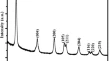
<p>Rietveld refinement results of synchrotron X-ray diffraction (XRD) data for KNO<sub>3 </sub>powders obtained by heat-treating gels at 600&#176;C, 700&#176;C, and 800&#176;C are given in Table <tblr tid="T2">2</tblr>, and the corresponding XRD patterns are shown in Figure <figr fid="F2">2</figr>. Each powder crystallized in a perovskite phase with an orthorhombic structure (space group Amm2) at room temperature. Orthorhombic KNbO<sub>3 </sub>is thermodynamically stable at room temperature, and orthorhombic KNbO<sub>3 </sub>crystals have potential in applications as ferroelectric and nonlinear optical materials. The ferroelectric orthorhombic phase was retained even for particles smaller than 50 nm.</p>
<tbl id="T2"><title><p>Table 2</p></title><caption><p>Rietveld refinement results of synchrotron XRD data collected at <it>&#955; </it>= 1.2348 &#197;</p></caption><tblbdy cols="4">
      <r>
         <c ca="center">
            <p>
               <b>Heat-treatment temperature (&#176;C)</b>
            </p>
         </c>
         <c ca="left">
            <p>
               <b>600</b>
            </p>
         </c>
         <c ca="left">
            <p>
               <b>700</b>
            </p>
         </c>
         <c ca="left">
            <p>
               <b>800</b>
            </p>
         </c>
      </r>
      <r>
         <c cspan="4">
            <hr/>
         </c>
      </r>
      <r>
         <c ca="left">
            <p>Crystal structure</p>
         </c>
         <c ca="left">
            <p>Orthorhombic</p>
         </c>
         <c ca="left">
            <p>Orthorhombic</p>
         </c>
         <c ca="left">
            <p>Orthorhombic</p>
         </c>
      </r>
      <r>
         <c ca="left">
            <p>Space group</p>
         </c>
         <c ca="left">
            <p>Amm2</p>
         </c>
         <c ca="left">
            <p>Amm2</p>
         </c>
         <c ca="left">
            <p>Amm2</p>
         </c>
      </r>
      <r>
         <c ca="left">
            <p>Unit cell dimensions</p>
         </c>
         <c>
            <p/>
         </c>
         <c>
            <p/>
         </c>
         <c>
            <p/>
         </c>
      </r>
      <r>
         <c ca="left">
            <p>a (&#197;)</p>
         </c>
         <c ca="left">
            <p>4.004135</p>
         </c>
         <c ca="left">
            <p>4.006313</p>
         </c>
         <c ca="left">
            <p>4.007833</p>
         </c>
      </r>
      <r>
         <c ca="left">
            <p>b (&#197;)</p>
         </c>
         <c ca="left">
            <p>5.737700</p>
         </c>
         <c ca="left">
            <p>5.726862</p>
         </c>
         <c ca="left">
            <p>5.724034</p>
         </c>
      </r>
      <r>
         <c ca="left">
            <p>c (&#197;)</p>
         </c>
         <c ca="left">
            <p>5.742700</p>
         </c>
         <c ca="left">
            <p>5.736795</p>
         </c>
         <c ca="left">
            <p>5.734393</p>
         </c>
      </r>
      <r>
         <c ca="left">
            <p>Atomic coordinates</p>
         </c>
         <c ca="left">
            <p>
               <it>X</it>
            </p>
         </c>
         <c ca="left">
            <p>
               <it>Y</it>
            </p>
         </c>
         <c ca="left">
            <p>
               <it>Z</it>
            </p>
         </c>
      </r>
      <r>
         <c ca="left">
            <p>O1(4d)</p>
         </c>
         <c ca="left">
            <p>0</p>
         </c>
         <c ca="left">
            <p>0.254</p>
         </c>
         <c ca="left">
            <p>0.285</p>
         </c>
      </r>
      <r>
         <c ca="left">
            <p>O2(2b)</p>
         </c>
         <c ca="left">
            <p>0.500</p>
         </c>
         <c ca="left">
            <p>0</p>
         </c>
         <c ca="left">
            <p>0.021</p>
         </c>
      </r>
      <r>
         <c ca="left">
            <p>K (2b)</p>
         </c>
         <c ca="left">
            <p>0.500</p>
         </c>
         <c ca="left">
            <p>0</p>
         </c>
         <c ca="left">
            <p>0.517</p>
         </c>
      </r>
      <r>
         <c ca="left">
            <p>Nb (2a)</p>
         </c>
         <c ca="left">
            <p>0</p>
         </c>
         <c ca="left">
            <p>0</p>
         </c>
         <c ca="left">
            <p>0</p>
         </c>
      </r>
   </tblbdy><tblfn>
      <p><it>R</it><sub>wp </sub>of all samples was &lt; 10%.</p>
   </tblfn></tbl>
<fig id="F2"><title><p>Figure 2</p></title><caption><p>Synchrotron XRD patterns of nanoscale KNO<sub>3 </sub>powders obtained by heat-treating gels at the stated temperature</p></caption><text>
   <p><b>Synchrotron XRD patterns of nanoscale KNO<sub>3 </sub>powders obtained by heat-treating gels at the stated temperature</b>. <it>&#955; </it>= 1.2348 &#197;.</p>
</text><graphic file="1556-276X-6-530-2"/></fig>
<p>A cell volume plot is shown in Figure <figr fid="F3">3</figr>, and cell volume increased with decreasing particle size. An increase in unit cell volume has been reported for many metal oxides and ferroelectric materials <abbrgrp>
<abbr bid="B19">19</abbr>
<abbr bid="B20">20</abbr>
<abbr bid="B21">21</abbr>
<abbr bid="B22">22</abbr>
</abbrgrp>. The most consistent explanation for this in small oxide particles is the effect of the truncated attractive Madelung potential that holds the oxide lattice together <abbrgrp>
<abbr bid="B23">23</abbr>
</abbrgrp>. The Rietveld analysis showed increasing distortions with decreasing particle size.</p>
<fig id="F3"><title><p>Figure 3</p></title><caption><p>Rietveld refinement of synchrotron data</p></caption><text>
   <p><b>Rietveld refinement of synchrotron data</b>. For nanoscale KNO<sub>3 </sub>powders showing cell (<b>a</b>) parameters and (<b>b</b>) volume.</p>
</text><graphic file="1556-276X-6-530-3"/></fig>
<p>Figure <figr fid="F4">4</figr> shows temperature-dependent XRD patterns of nanoscale KNO<sub>3 </sub>powders obtained by heat-treating gels at different temperatures. Three structural types were distinguished by the diffraction at 44&#176; to 46&#176; 2 <it>&#952;</it>. The clearly split peaks were indexed to the 022 and 200 planes for the orthorhombic phase. Broad diffractions of reversed intensity to those of orthorhombic diffractions were considered to correspond to 002 and 020 tetragonal diffractions, since a reversed intensity was observed for the corresponding peaks of the high-temperature tetragonal phase above approximately 220&#176;C. The single peak of the 200 plane was identified as that of the cubic phase above approximately 430&#176;C.</p>
<fig id="F4"><title><p>Figure 4</p></title><caption><p>XRD patterns showing phase transition of nanoscale KNO<sub>3 </sub>powders</p></caption><text>
   <p><b>XRD patterns showing phase transition of nanoscale KNO<sub>3 </sub>powders</b>. Obtained upon heat-treating gels at different temperatures: (<b>a</b>) orthorhombic to tetragonal (600&#176;C), (<b>b</b>) tetragonal to cubic (600&#176;C), (<b>c</b>) orthorhombic to tetragonal (700&#176;C), (<b>d</b>) tetragonal to cubic (700&#176;C), (<b>e</b>) orthorhombic to tetragonal (800&#176;C), and (<b>f</b>) tetragonal to cubic (800&#176;C).</p>
</text><graphic file="1556-276X-6-530-4"/></fig>
<p>Figure <figr fid="F4">4</figr> shows that there was no obvious difference in transition temperature between the three samples. Temperature-dependent XRD showed that the actual transition temperature was nearly unchanged, and that the Curie temperature (<it>T</it>
<sub>C</sub>) and phase transition were independent of particle size.</p>
<p>To further investigate the phase transition of nanoscale KNbO<sub>3</sub>, the differential scanning calorimetry (DSC) analyses were undertaken and the results are shown in Figure <figr fid="F5">5</figr>. Table <tblr tid="T3">3</tblr> shows transition temperatures observed from DSC, for the three nanoscale KNbO<sub>3 </sub>samples of different particle sizes. The lower temperature corresponded to the phase change from orthorhombic to tetragonal, and the higher temperature was that from tetragonal to cubic. DSC results showed that phase transition was independent of particle size.</p>
<fig id="F5"><title><p>Figure 5</p></title><caption><p>DSC plots of nanoscale KNO<sub>3 </sub>powders obtained by heat-treating gels</p></caption><text>
   <p><b>DSC plots of nanoscale KNO<sub>3 </sub>powders obtained by heat-treating gels</b>. At (<b>a</b>) 600&#176;C, (<b>b</b>) 700&#176;C, and (<b>c</b>) 800&#176;C.</p>
</text><graphic file="1556-276X-6-530-5"/></fig>
<tbl id="T3"><title><p>Table 3</p></title><caption><p>Transition temperature observed from DSC</p></caption><tblbdy cols="4">
      <r>
         <c ca="left">
            <p>
               <b>Heat-treatment temperature (&#176;C)</b>
            </p>
         </c>
         <c ca="center">
            <p>
               <b>600</b>
            </p>
         </c>
         <c ca="center">
            <p>
               <b>700</b>
            </p>
         </c>
         <c ca="center">
            <p>
               <b>800</b>
            </p>
         </c>
      </r>
      <r>
         <c cspan="4">
            <hr/>
         </c>
      </r>
      <r>
         <c ca="left">
            <p>Transition temperature (&#176;C)</p>
         </c>
         <c ca="center">
            <p>213.2, 414.5</p>
         </c>
         <c ca="center">
            <p>215.5, 415.7</p>
         </c>
         <c ca="center">
            <p>211.2, 412.5</p>
         </c>
      </r>
   </tblbdy></tbl>
</sec>
<sec>
<st>
<p>Conclusions</p>
</st>
<p>Nanoscale KNbO<sub>3 </sub>powders were synthesized using the sol-gel method. The average KNbO<sub>3 </sub>grain size was estimated to be within 100 nm from FESEM and TEM images, and TEM images showed that nanoscale KNbO<sub>3 </sub>particles had a brick-like morphology.</p>
<p>Synchrotron XRD and Rietveld refinement showed that the ferroelectric orthorhombic phase was retained at room temperature, even for particles smaller than 50 nm. Temperature-dependent XRD confirmed that the actual transition temperature was nearly unchanged and that the <it>T</it>
<sub>C </sub>and phase transition were independent of particle size. Rietveld analysis showed increasing distortions with decreasing particle size.</p>
</sec>
<sec>
<st>
<p>Methods</p>
</st>
<p>Precursor solutions were prepared using the sol-gel method reported in the literature <abbrgrp>
<abbr bid="B24">24</abbr>
</abbrgrp>. K-ethoxide, Nb-pentaethoxide, 2-methoxyethanol, K-ethoxide, and Nb-pentaethoxide were dissolved in 2-methoxyethanol and refluxed at 120&#176;C for 90 min in dry N<sub>2</sub>. The concentrations of all precursor solutions were 0.32 mol/L. Weighed gel samples in Pt cells were calcined at 600&#176;C to 800&#176;C for 3 min in air to obtain crystalline powders, with a heating rate of 10&#176;C/min.</p>
<p>Powder sizes and morphologies were examined using FESEM (JEOL JSM-7500F; JEOL Ltd., Tokyo, Japan) and TEM (JEOL JEM-2010; JEOL Ltd.). Crystal structures were determined using high-resolution synchrotron radiation diffractometry at the BL14B1 beam line of Shanghai Synchrotron Radiation Facility, using 1.2398 &#197; X-rays with a Huber 5021 6-axes diffractometer (energy = 3.5 GeV). Structural refinements were performed using the Rietveld analysis program X'Pert Highscore Plus (PANalytical X-ray Company, Almelo, The Netherlands). Phase transitions were investigated using non-ambient XRD (PANalytical X'pert Pro, Cu K&#945;, 40 kV, 40 mA) with a Pt strip stage from ambient temperature to 600&#176;C. The differential scanning calorimetry (NETZSCH STA 449F3, Selb, Germany) was used to follow the phase transitions. Nitrogen was used in the DSC measurement at a flow rate of 50 ml/min with a heating rate of 5&#176;C/min. The measurement was carried out in the temperature range of 50&#176;C to 500&#176;C.</p>
</sec>
<sec>
<st>
<p>Abbreviations</p>
</st>
<p>DSC: differential scanning calorimetry; FESEM: field emission scanning electron microscopy; KNbO<sub>3</sub>: potassium niobate; TEM: transmission electron microscopy; XRD: X-ray diffraction.</p>
</sec>
<sec>
<st>
<p>Competing interests</p>
</st>
<p>The authors declare that they have no competing interests.</p>
</sec>
<sec>
<st>
<p>Authors' contributions</p>
</st>
<p>HC performed the sample preparation, analyzed the materials, and interpreted the results. YZ participated in the XRD, FESEM, TEM, and DSC measurements. YL participated in the synchrotron XRD measurements. All authors read and approved the final manuscript.</p>
</sec>
</bdy><bm>
<ack>
<sec>
<st>
<p>Acknowledgements</p>
</st>
<p>This work was supported by the Innovation Program of the Shanghai Municipal Education Commission in China (grant no. 11YZ128).</p>
</sec>
</ack>
<refgrp><bibl id="B1"><aug><au><snm>Jaffe</snm><fnm>B</fnm></au><au><snm>Cook</snm><fnm>WR</fnm></au><au><snm>Jaffe</snm><fnm>H</fnm></au></aug><source>Piezoelectric Ceramics</source><publisher>New York: Academic Press</publisher><pubdate>1971</pubdate></bibl><bibl id="B2"><title><p>Piezoelectric actuators 2008: Key factors for commercialization</p></title><aug><au><snm>Uchino</snm><fnm>K</fnm></au></aug><source>Adv Mater Res</source><pubdate>2008</pubdate><volume>55-57</volume><fpage>1</fpage><lpage>9</lpage></bibl><bibl id="B3"><title><p>The microscopic origin of residual stress for flat self-actuating piezoelectric cantilevers</p></title><aug><au><snm>Lee</snm><fnm>JH</fnm></au><au><snm>Hwang</snm><fnm>KS</fnm></au><au><snm>Kim</snm><fnm>TS</fnm></au></aug><source>Nanoscale Res Lett</source><pubdate>2011</pubdate><volume>6</volume><fpage>55</fpage><lpage>60</lpage></bibl><bibl id="B4"><title><p>Nanoscale investigations of switching properties and piezoelectric activity in ferroelectric thin films using piezoresponse force microscopy</p></title><aug><au><snm>Desfeux</snm><fnm>R</fnm></au><au><snm>Ferri</snm><fnm>A</fnm></au><au><snm>Legrand</snm><fnm>C</fnm></au><au><snm>Ma&#235;s</snm><fnm>L</fnm></au><au><snm>Da Costa</snm><fnm>A</fnm></au><au><snm>Poullain</snm><fnm>G</fnm></au><au><snm>Bouregba</snm><fnm>R</fnm></au><au><snm>Soyer</snm><fnm>C</fnm></au><au><snm>R&#232;miens</snm><fnm>D</fnm></au></aug><source>Int J Nanotechnol</source><pubdate>2008</pubdate><volume>5</volume><fpage>827</fpage><lpage>837</lpage><xrefbib><pubid idtype="doi">10.1504/IJNT.2008.018701</pubid></xrefbib></bibl><bibl id="B5"><title><p>Lead-free piezoceramics</p></title><aug><au><snm>Saito</snm><fnm>Y</fnm></au><au><snm>Takao</snm><fnm>H</fnm></au><au><snm>Tani</snm><fnm>T</fnm></au><au><snm>Nonoyama</snm><fnm>T</fnm></au><au><snm>Takatori</snm><fnm>K</fnm></au><au><snm>Homma</snm><fnm>T</fnm></au><au><snm>Nagaya</snm><fnm>T</fnm></au><au><snm>Nakamura</snm><fnm>M</fnm></au></aug><source>Nature</source><pubdate>2004</pubdate><volume>432</volume><fpage>84</fpage><lpage>86</lpage><xrefbib><pubidlist><pubid idtype="doi">10.1038/nature03028</pubid><pubid idtype="pmpid" link="fulltext">15516921</pubid></pubidlist></xrefbib></bibl><bibl id="B6"><title><p>Synthesis and Characterization of Bowl-Like Single-Crystalline BaTiO<sub>3 </sub>Nanoparticles</p></title><aug><au><snm>Deng</snm><fnm>Z</fnm></au><au><snm>Dai</snm><fnm>Y</fnm></au><au><snm>Chen</snm><fnm>W</fnm></au><au><snm>Pei</snm><fnm>XM</fnm></au><au><snm>Liao</snm><fnm>JH</fnm></au></aug><source>Nanoscale Res Lett</source><pubdate>2010</pubdate><volume>5</volume><fpage>1217</fpage><lpage>1221</lpage><xrefbib><pubidlist><pubid idtype="doi">10.1007/s11671-010-9629-7</pubid><pubid idtype="pmcid">2894195</pubid><pubid idtype="pmpid" link="fulltext">20596350</pubid></pubidlist></xrefbib></bibl><bibl id="B7"><title><p>Towards ferroelectric and multiferroic nanostructures and their characterisation</p></title><aug><au><snm>Harnagea</snm><fnm>C</fnm></au><au><snm>Cojocaru</snm><fnm>CV</fnm></au><au><snm>Nechache</snm><fnm>R</fnm></au><au><snm>Gautreau</snm><fnm>O</fnm></au><au><snm>Rosei</snm><fnm>F</fnm></au><au><snm>Pignolet</snm><fnm>A</fnm></au></aug><source>Int J Nanotechnol</source><pubdate>2008</pubdate><volume>5</volume><fpage>930</fpage><lpage>962</lpage><xrefbib><pubid idtype="doi">10.1504/IJNT.2008.019827</pubid></xrefbib></bibl><bibl id="B8"><title><p>Poling treatment and piezoelectric properties of potassium niobate ferroelectric single crystals</p></title><aug><au><snm>Wada</snm><fnm>S</fnm></au><au><snm>Seike</snm><fnm>A</fnm></au><au><snm>Tsurumi</snm><fnm>T</fnm></au></aug><source>Jpn J Appl Phys</source><pubdate>2001</pubdate><volume>40</volume><fpage>5690</fpage><lpage>5697</lpage><xrefbib><pubid idtype="doi">10.1143/JJAP.40.5690</pubid></xrefbib></bibl><bibl id="B9"><title><p>Domain structures in KNbO<sub>3 </sub>crystals and their piezoelectric properties</p></title><aug><au><snm>Nakamura</snm><fnm>K</fnm></au><au><snm>Tokiwa</snm><fnm>T</fnm></au><au><snm>Kawamura</snm><fnm>Y</fnm></au></aug><source>J Appl Phys</source><pubdate>2002</pubdate><volume>91</volume><fpage>9272</fpage><lpage>9276</lpage><xrefbib><pubid idtype="doi">10.1063/1.1476078</pubid></xrefbib></bibl><bibl id="B10"><title><p>Photorefractive properties of KNbO<sub>3</sub></p></title><aug><au><snm>Reeves</snm><fnm>RJ</fnm></au><au><snm>Jani</snm><fnm>MG</fnm></au><au><snm>Jassemnejad</snm><fnm>B</fnm></au><au><snm>Powell</snm><fnm>RC</fnm></au><au><snm>Mizell</snm><fnm>GJ</fnm></au><au><snm>Fay</snm><fnm>W</fnm></au></aug><source>Phys Rev B</source><pubdate>1991</pubdate><volume>43</volume><fpage>71</fpage><lpage>82</lpage><xrefbib><pubid idtype="doi">10.1103/PhysRevB.43.71</pubid></xrefbib></bibl><bibl id="B11"><title><p>Materials constants of KNbO<sub>3 </sub>relevant for electrooptics and acoustooptics</p></title><aug><au><snm>Zgonik</snm><fnm>M</fnm></au><au><snm>Schlesser</snm><fnm>R</fnm></au><au><snm>Biaggio</snm><fnm>I</fnm></au><au><snm>Voit</snm><fnm>E</fnm></au><au><snm>Tscherry</snm><fnm>J</fnm></au><au><snm>G&#252;nter</snm><fnm>P</fnm></au></aug><source>J Appl Phys</source><pubdate>1993</pubdate><volume>74</volume><fpage>1287</fpage><lpage>1297</lpage><xrefbib><pubid idtype="doi">10.1063/1.354934</pubid></xrefbib></bibl><bibl id="B12"><title><p>KNbO<sub>3 </sub>electro-optic induced optical wave-guide cutoffs modulator</p></title><aug><au><snm>Baumert</snm><fnm>JC</fnm></au><au><snm>Walther</snm><fnm>C</fnm></au><au><snm>Buchmann</snm><fnm>P</fnm></au><au><snm>Kaufmann</snm><fnm>H</fnm></au><au><snm>Melchior</snm><fnm>H</fnm></au><au><snm>Gunter</snm><fnm>P</fnm></au></aug><source>Appl Phys Lett</source><pubdate>1985</pubdate><volume>46</volume><fpage>1018</fpage><lpage>1020</lpage><xrefbib><pubid idtype="doi">10.1063/1.95796</pubid></xrefbib></bibl><bibl id="B13"><title><p>Absolute scale of second-order nonlinear-optical coefficients</p></title><aug><au><snm>Shoji</snm><fnm>I</fnm></au><au><snm>Kondo</snm><fnm>T</fnm></au><au><snm>Kitamoto</snm><fnm>A</fnm></au><au><snm>Shirane</snm><fnm>M</fnm></au><au><snm>Ito</snm><fnm>R</fnm></au></aug><source>J Opt Soc Am Opt Phys</source><pubdate>1997</pubdate><volume>14B</volume><fpage>2268</fpage><lpage>2294</lpage></bibl><bibl id="B14"><title><p>Phase Transitions in Ferroelectric KNbO<sub>3</sub></p></title><aug><au><snm>Shirane</snm><fnm>G</fnm></au><au><snm>Danner</snm><fnm>H</fnm></au><au><snm>Pavlovic</snm><fnm>A</fnm></au><au><snm>Pepinsky</snm><fnm>R</fnm></au></aug><source>Phys Rev</source><pubdate>1954</pubdate><volume>93</volume><fpage>672</fpage><lpage>673</lpage><xrefbib><pubid idtype="doi">10.1103/PhysRev.93.672</pubid></xrefbib></bibl><bibl id="B15"><title><p>Thermodynamic theory of intrinsic finite size effects in PbTiO<sub>3 </sub>nanocrystals. II. Dielectric and piezoelectric properties</p></title><aug><au><snm>Akdogan</snm><fnm>EK</fnm></au><au><snm>Safari</snm><fnm>A</fnm></au></aug><source>J Appl Phys</source><pubdate>2007</pubdate><volume>101</volume><fpage>064115</fpage><xrefbib><pubid idtype="doi">10.1063/1.2713348</pubid></xrefbib></bibl><bibl id="B16"><title><p>Ferroelectric phase transition in individual single-crystalline BaTiO<sub>3 </sub>nanowire</p></title><aug><au><snm>Spanier</snm><fnm>JE</fnm></au><au><snm>Kolpak</snm><fnm>AM</fnm></au><au><snm>Urban</snm><fnm>JJ</fnm></au><au><snm>Grinberg</snm><fnm>I</fnm></au><au><snm>Ouyang</snm><fnm>L</fnm></au><au><snm>Yun</snm><fnm>WS</fnm></au><au><snm>Rappe</snm><fnm>AM</fnm></au><au><snm>Park</snm><fnm>H</fnm></au></aug><source>Nano Lett</source><pubdate>2006</pubdate><volume>6</volume><fpage>735</fpage><lpage>739</lpage><xrefbib><pubidlist><pubid idtype="doi">10.1021/nl052538e</pubid><pubid idtype="pmpid" link="fulltext">16608274</pubid></pubidlist></xrefbib></bibl><bibl id="B17"><title><p>Ferroelectricity in ultrathin perovskite films</p></title><aug><au><snm>Fong</snm><fnm>DD</fnm></au><au><snm>Stephenson</snm><fnm>GB</fnm></au><au><snm>Streiffer</snm><fnm>SK</fnm></au><au><snm>Eastman</snm><fnm>JA</fnm></au><au><snm>Auciello</snm><fnm>O</fnm></au><au><snm>Fuoss</snm><fnm>PH</fnm></au><au><snm>Thompson</snm><fnm>C</fnm></au></aug><source>Science</source><pubdate>2004</pubdate><volume>304</volume><fpage>1650</fpage><lpage>1653</lpage><xrefbib><pubidlist><pubid idtype="doi">10.1126/science.1098252</pubid><pubid idtype="pmpid" link="fulltext">15192223</pubid></pubidlist></xrefbib></bibl><bibl id="B18"><title><p>Landau theory of asymmetric behaviour in ferroelectric thin films</p></title><aug><au><snm>Wang</snm><fnm>CL</fnm></au><au><snm>Smith</snm><fnm>SRP</fnm></au></aug><source>Solid State Commun</source><pubdate>1996</pubdate><volume>99</volume><fpage>559</fpage><lpage>562</lpage><xrefbib><pubid idtype="doi">10.1016/0038-1098(96)00267-0</pubid></xrefbib></bibl><bibl id="B19"><title><p>Effect of crystal size reduction on lattice symmetry and cooperative properties</p></title><aug><au><snm>Ayyub</snm><fnm>P</fnm></au><au><snm>Palkar</snm><fnm>VR</fnm></au><au><snm>Chattopadhyay</snm><fnm>S</fnm></au><au><snm>Multani</snm><fnm>MS</fnm></au></aug><source>Phys Rev B</source><pubdate>1995</pubdate><volume>51</volume><fpage>6135</fpage><lpage>6138</lpage><xrefbib><pubid idtype="doi">10.1103/PhysRevB.51.6135</pubid></xrefbib></bibl><bibl id="B20"><title><p>Properties of magnetite nanoparticles synthesized through a novel chemical route</p></title><aug><au><snm>Thapa</snm><fnm>D</fnm></au><au><snm>Palkar</snm><fnm>VR</fnm></au><au><snm>Kurup</snm><fnm>MB</fnm></au><au><snm>Malik</snm><fnm>SK</fnm></au></aug><source>Mater Lett</source><pubdate>2004</pubdate><volume>58</volume><fpage>2692</fpage><lpage>2694</lpage><xrefbib><pubid idtype="doi">10.1016/j.matlet.2004.03.045</pubid></xrefbib></bibl><bibl id="B21"><title><p>Evidence of linear lattice expansion and covalency enhancement in rutile TiO<sub>2 </sub>nanocrystals</p></title><aug><au><snm>Li</snm><fnm>G</fnm></au><au><snm>Boerio-Goates</snm><fnm>J</fnm></au><au><snm>Woodfield</snm><fnm>BF</fnm></au><au><snm>Li</snm><fnm>L</fnm></au></aug><source>Appl Phys Lett</source><pubdate>2004</pubdate><volume>85</volume><fpage>2059</fpage><lpage>2061</lpage><xrefbib><pubid idtype="doi">10.1063/1.1790596</pubid></xrefbib></bibl><bibl id="B22"><title><p>Surface relaxation in ferroelectric perovskites</p></title><aug><au><snm>Ishikawa</snm><fnm>K</fnm></au><au><snm>Uemori</snm><fnm>T</fnm></au></aug><source>Phys Rev B</source><pubdate>1999</pubdate><volume>60</volume><fpage>11841</fpage><lpage>11845</lpage><xrefbib><pubid idtype="doi">10.1103/PhysRevB.60.11841</pubid></xrefbib></bibl><bibl id="B23"><title><p>Crystal structure and the paraelectric-to-ferroelectric phase transition of nanoscale BaTiO<sub>3</sub></p></title><aug><au><snm>Smith</snm><fnm>MB</fnm></au><au><snm>Page</snm><fnm>K</fnm></au><au><snm>Siegrist</snm><fnm>T</fnm></au><au><snm>Redmond</snm><fnm>PL</fnm></au><au><snm>Walter</snm><fnm>EC</fnm></au><au><snm>Seshadri</snm><fnm>R</fnm></au><au><snm>Brus</snm><fnm>LE</fnm></au><au><snm>Steigerwald</snm><fnm>ML</fnm></au></aug><source>J Am Chem Soc</source><pubdate>2008</pubdate><volume>130</volume><fpage>6955</fpage><lpage>6963</lpage><xrefbib><pubidlist><pubid idtype="doi">10.1021/ja0758436</pubid><pubid idtype="pmpid" link="fulltext">18461943</pubid></pubidlist></xrefbib></bibl><bibl id="B24"><title><p>Morphology and crystallinity of KNbO<sub>3</sub>-based nano powder fabricated by sol-gel process</p></title><aug><au><snm>Tanaka</snm><fnm>K</fnm></au><au><snm>Kakimoto</snm><fnm>KI</fnm></au><au><snm>Ohsato</snm><fnm>H</fnm></au></aug><source>J Eur Ceram Soc</source><pubdate>2007</pubdate><volume>27</volume><fpage>3591</fpage><lpage>3595</lpage><xrefbib><pubid idtype="doi">10.1016/j.jeurceramsoc.2007.02.070</pubid></xrefbib></bibl></refgrp>
</bm></art>