<?xml version='1.0'?>
<!DOCTYPE art SYSTEM 'http://www.biomedcentral.com/xml/article.dtd'>
<art><ui>1556-276X-6-526</ui><ji>1556-276X</ji><fm>
<dochead>Nano Express</dochead>
<bibl>
<title>
<p>Tuning the electronic transport properties of graphene through functionalisation with fluorine</p>
</title>
<aug>
<au id="A1"><snm>Withers</snm><fnm>Freddie</fnm><insr iid="I1"/><email>fw212@exeter.ac.uk</email></au>
<au id="A2"><snm>Russo</snm><fnm>Saverio</fnm><insr iid="I1"/><email>S.Russo@exeter.ac.uk</email></au>
<au id="A3"><snm>Dubois</snm><fnm>Marc</fnm><insr iid="I2"/><email>marc.dubois@univ-bpclermont.fr</email></au>
<au ca="yes" id="A4"><snm>Craciun</snm><mi>F</mi><fnm>Monica</fnm><insr iid="I3"/><email>m.f.craciun@exeter.ac.uk</email></au>
</aug>
<insg>
<ins id="I1"><p>Centre for Graphene Science, College of Engineering, Mathematics and Physical Sciences, University of Exeter, Physics building, Exeter EX4 4QF, UK</p></ins>
<ins id="I2"><p>Clermont Universit&#233;, UBP, Laboratoire des Mat&#233;riaux Inorganiques, CNRS-UMR 6002, 63177 Aubi&#232;re, France</p></ins>
<ins id="I3"><p>Centre for Graphene Science, College of Engineering, Mathematics and Physical Sciences, University of Exeter, Harrison building, Exeter EX4 4QL, UK</p></ins>
</insg>
<source>Nanoscale Research Letters</source>
<issn>1556-276X</issn>
<pubdate>2011</pubdate>
<volume>6</volume>
<issue>1</issue>
<fpage>526</fpage>
<url>http://www.nanoscalereslett.com/content/6/1/526</url>
<xrefbib><pubidlist><pubid idtype="doi">10.1186/1556-276X-6-526</pubid><pubid idtype="pmpid">21910905</pubid></pubidlist></xrefbib>
</bibl>
<history><rec><date><day>18</day><month>5</month><year>2011</year></date></rec><acc><date><day>12</day><month>9</month><year>2011</year></date></acc><pub><date><day>12</day><month>9</month><year>2011</year></date></pub></history>
<cpyrt><year>2011</year><collab>Withers et al; licensee Springer.</collab><note>This is an Open Access article distributed under the terms of the Creative Commons Attribution License (<url>http://creativecommons.org/licenses/by/2.0</url>), which permits unrestricted use, distribution, and reproduction in any medium, provided the original work is properly cited.</note></cpyrt>
<abs>
<sec>
<st>
<p>Abstract</p>
</st>
<p>We demonstrate the possibility to tune the electronic transport properties of graphene mono-layers and multi-layers by functionalisation with fluorine. For mono-layer samples, with increasing the fluorine content, we observe a transition from electronic transport through Mott variable range hopping (VRH) in two dimensions to Efros-Shklovskii VRH. Multi-layer fluorinated graphene with high concentration of fluorine show two-dimensional Mott VRH transport, whereas CF<sub>0.28 </sub>multi-layer flakes exhibit thermally activated transport through near neighbour hopping. Our experimental findings demonstrate that the ability to control the degree of functionalisation of graphene is instrumental to engineer different electronic properties in graphene materials.</p>
</sec>
</abs>
</fm><meta>
<classifications>
<classification id="NC2011" subtype="theme_series_title" type="BMC">Nano Component 2011</classification>
<classification id="NC2011" subtype="theme_series_editor" type="BMC"/>
</classifications>
</meta><bdy>
<sec>
<st>
<p>1 Introduction</p>
</st>
<p>Graphene, a mono-layer of <it>sp</it>2 bonded carbon atoms arranged in a honeycomb pattern (Figure <figr fid="F1">1a</figr>), is a two-dimensional semi-metal where the valence and conduction bands touch in two independent points at the border of the Brillouin zone, named K and K' valleys <abbrgrp>
<abbr bid="B1">1</abbr>
<abbr bid="B2">2</abbr>
<abbr bid="B3">3</abbr>
<abbr bid="B4">4</abbr>
<abbr bid="B5">5</abbr>
</abbrgrp>. This material has remarkable electronic, optical and mechanical properties which can be used in a new generation of devices <abbrgrp>
<abbr bid="B6">6</abbr>
<abbr bid="B7">7</abbr>
</abbrgrp>. For instance, the high mobility of charge carriers is attracting considerable interest in the realm of high-speed electronics <abbrgrp>
<abbr bid="B8">8</abbr>
</abbrgrp>. Furthermore, thanks to the unique combination of high electrical conductivity <abbrgrp>
<abbr bid="B4">4</abbr>
<abbr bid="B5">5</abbr>
</abbrgrp> and optical transparency <abbrgrp>
<abbr bid="B9">9</abbr>
</abbrgrp>, graphene is a promising material for optoelectronic applications such as displays, photovoltaic cells and light-emitting diodes. Few-layer graphene are yet unique materials <abbrgrp>
<abbr bid="B10">10</abbr>
</abbrgrp> with unprecedented physical properties: bilayers are semiconductors with a gate-tuneable band gap <abbrgrp>
<abbr bid="B11">11</abbr>
<abbr bid="B12">12</abbr>
<abbr bid="B13">13</abbr>
<abbr bid="B14">14</abbr>
<abbr bid="B15">15</abbr>
<abbr bid="B16">16</abbr>
<abbr bid="B17">17</abbr>
<abbr bid="B18">18</abbr>
<abbr bid="B19">19</abbr>
<abbr bid="B20">20</abbr>
<abbr bid="B21">21</abbr>
</abbrgrp>, whereas trilayers are semi-metals with a gate-tuneable overlap between the conduction and valence bands <abbrgrp>
<abbr bid="B22">22</abbr>
<abbr bid="B23">23</abbr>
</abbrgrp>. However, the use of graphene for applications in daily-life electronics suffers from a major drawback, i.e. the current in graphene cannot be simply pinched off by means of a gate voltage. A valuable solution to this problem is to engineer a band gap in the energy spectrum of graphene for example confining the physical dimensions of graphene into nanoribbons <abbrgrp>
<abbr bid="B24">24</abbr>
<abbr bid="B25">25</abbr>
<abbr bid="B26">26</abbr>
<abbr bid="B27">27</abbr>
<abbr bid="B28">28</abbr>
</abbrgrp> or by chemical functionalisation <abbrgrp>
<abbr bid="B29">29</abbr>
<abbr bid="B30">30</abbr>
<abbr bid="B31">31</abbr>
<abbr bid="B32">32</abbr>
<abbr bid="B33">33</abbr>
<abbr bid="B34">34</abbr>
<abbr bid="B35">35</abbr>
<abbr bid="B36">36</abbr>
<abbr bid="B37">37</abbr>
<abbr bid="B38">38</abbr>
<abbr bid="B39">39</abbr>
<abbr bid="B40">40</abbr>
<abbr bid="B41">41</abbr>
<abbr bid="B42">42</abbr>
<abbr bid="B43">43</abbr>
<abbr bid="B44">44</abbr>
<abbr bid="B45">45</abbr>
<abbr bid="B46">46</abbr>
</abbrgrp>.</p>
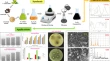
<fig id="F1"><title><p>Figure 1</p></title><caption><p>Fabrication of fluorinated graphene layers and transistor devices</p></caption><text>
   <p><b>Fabrication of fluorinated graphene layers and transistor devices</b>. Crystal structure of pristine graphene <b>(a) </b>and fluorinated graphene <b>(b)</b>. The grey balls in <b>(b) </b>represent the carbon atoms, whereas the green balls are the fluorine atoms. Optical image of pristine graphene <b>(c) </b>and of fluorinated graphene <b>(d)</b>. <b>(e) </b>False colour SEM image of a fluorinated graphene device. <b>(f) </b>Schematic view of the transistor structure fabricated on fluorinated graphene.</p>
</text><graphic file="1556-276X-6-526-1"/></fig>
<p>When chemical elements, e.g. oxygen, hydrogen or fluorine, are adsorbed on the surface of graphene, they form covalent bonds with the carbon atoms. As a result, the planar crystal structure of graphene characterised by <it>sp</it>2 bonds between the carbon atoms is transformed into a three-dimensional structure with <it>sp</it>3 bonds (see Figure <figr fid="F1">1b</figr>). The adsorbed elements can attach to graphene in a random way, as it is the case in graphene oxide <abbrgrp>
<abbr bid="B44">44</abbr>
<abbr bid="B45">45</abbr>
<abbr bid="B46">46</abbr>
</abbrgrp>, or they can form ordered patterns as it has been found for hydrogen <abbrgrp>
<abbr bid="B33">33</abbr>
<abbr bid="B34">34</abbr>
<abbr bid="B35">35</abbr>
</abbrgrp> and fluorine <abbrgrp>
<abbr bid="B36">36</abbr>
<abbr bid="B37">37</abbr>
<abbr bid="B38">38</abbr>
<abbr bid="B39">39</abbr>
<abbr bid="B40">40</abbr>
<abbr bid="B41">41</abbr>
<abbr bid="B42">42</abbr>
<abbr bid="B43">43</abbr>
</abbrgrp> adsorbates. <it>Ab initio </it>calculations performed within the density functional theory formalism predict that functionalisation with hydrogen and fluorine should lead, respectively, to a band gap of 3.8 and 4.2 eV for full functionalisation <abbrgrp>
<abbr bid="B29">29</abbr>
<abbr bid="B30">30</abbr>
<abbr bid="B31">31</abbr>
<abbr bid="B32">32</abbr>
</abbrgrp>.</p>
<p>Successful hydrogenation and fluorination of graphene have been recently achieved by several groups <abbrgrp>
<abbr bid="B33">33</abbr>
<abbr bid="B34">34</abbr>
<abbr bid="B35">35</abbr>
<abbr bid="B36">36</abbr>
<abbr bid="B37">37</abbr>
<abbr bid="B38">38</abbr>
<abbr bid="B39">39</abbr>
<abbr bid="B40">40</abbr>
<abbr bid="B41">41</abbr>
<abbr bid="B42">42</abbr>
<abbr bid="B43">43</abbr>
</abbrgrp>. Hydrogenation is usually carried out in a remote plasma of H<sub>2 </sub>
<abbrgrp>
<abbr bid="B33">33</abbr>
<abbr bid="B34">34</abbr>
<abbr bid="B35">35</abbr>
</abbrgrp> which makes it difficult to control the degree of induced atomic defects as well as the stoichiometry of the functionalisation. Furthermore, hydrogenated graphene can loose H at moderate temperatures <abbrgrp>
<abbr bid="B33">33</abbr>
</abbrgrp>, which limits the use of this material in applications where high-temperature stability is required. On the other hand, fluorine has higher binding energy to carbon and higher desorption energy than hydrogen <abbrgrp>
<abbr bid="B29">29</abbr>
<abbr bid="B30">30</abbr>
<abbr bid="B31">31</abbr>
<abbr bid="B32">32</abbr>
</abbrgrp>. Opposed to hydrogenation, the process of fluorination is easy to control, e.g. <it>via </it>temperature and reactant gases, leading to reproducibly precise C/F stoichiometries.</p>
<p>Here, we explore the electronic transport properties of functionalised graphene with a fluorine content ranging from 7% (i.e. CF<sub>0.07 </sub>or F/C atomic ratio of 0.07) to 100% (CF<sub>1</sub>). We have fabricated transistor structures with fluorinated graphene mono-layers and multi-layers and studied their electrical transport properties in the temperature range from 4.2 to 300 K. We show that the electronic transport properties of fluorinated graphene can be tuned by adjusting the fluorine content, so that different transport regimes can be accessed, like Mott variable range hopping (VRH) in two dimensions <abbrgrp>
<abbr bid="B47">47</abbr>
<abbr bid="B48">48</abbr>
</abbrgrp>, Efros-Shklovskii VRH <abbrgrp>
<abbr bid="B49">49</abbr>
</abbrgrp> and nearest neighbour hopping (NNH) transport.</p>
</sec>
<sec>
<st>
<p>2 Experimental details</p>
</st>
<p>Fluorinated graphene mono-layers and multi-layers were mechanically exfoliated from fluorinated graphite and deposited onto conventional Si/SiO<sub>2 </sub>(275 nm) substrates. The fluorinated graphite was synthesised via two routes: graphite fluorides (using F<sub>2 </sub>gas) and fluorine graphite intercalation compounds (FGIC) (using XeF<sub>2 </sub>as fluorinating agent), see Section 6. The samples produced using F<sub>2 </sub>gas that we investigate here are multi-layers and have the concentration of fluorine of 28 and 100%, whereas the samples synthesised using XeF<sub>2 </sub>gas are all mono-layers and have the fluorine content of 7, 24 and 28%.</p>
<p>Flakes of fluorinated graphene are located using an optical microscope (see Figure <figr fid="F1">1d</figr>) and subsequently characterised by Raman spectroscopy. Mono-layer graphene flakes were identified by fitting the 2D peak of the Raman spectra by a single Lorentzian function (see Figure <figr fid="F2">2b</figr>), with a full width at half maximum (FWHM) of 30-45 cm<sup>-1 </sup>which is typical for pristine mono-layer graphene <abbrgrp>
<abbr bid="B50">50</abbr>
</abbrgrp>. The height of the studied multi-layer flakes is determined by Atomic Force Microscopy: 10-nm height for flakes exfoliated from the CF and 0.86-6.1 nm for flakes obtained from CF<sub>0.28</sub>. In total, four mono-layer, five CF and five CF<sub>0:28 </sub>multi-layer flakes were processed into four-terminal transistor devices, where the electrical contacts were defined by e-beam lithography, deposition of Cr/Au (5/50 nm) and lift-off procedure, see Figure <figr fid="F1">1e,f</figr>.</p>
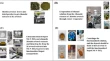
<fig id="F2"><title><p>Figure 2</p></title><caption><p>Raman spectroscopy in fluorinated and pristine graphene</p></caption><text>
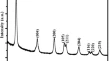
   <p><b>Raman spectroscopy in fluorinated and pristine graphene</b>. <b>(a) </b>Raman spectra of mono-layer fluorinated graphene with different fluorine content and pristine mono-layer graphene. <b>(b) </b>Fitting of the 2D peak with a single Lorentzian function for pristine and fluorinated mono-layer graphene. <b>(c, d) </b>Raman spectra of fluorinated multi-layer graphene.</p>
</text><graphic file="1556-276X-6-526-2"/></fig>
<p>The typical optical contrast of fluorinated graphene is ~2-6%, which is systematically lower than what we observe on pristine graphene (~9%), see Figure <figr fid="F1">1c,d</figr>. The reduced contrast in fluorinated graphene has to be expected, since the opening of a large energygap in the energy dispersion of fluorinated graphene lowers the optical absorption transitions between conduction and valence bands.</p>
</sec>
<sec>
<st>
<p>3 Raman spectroscopy</p>
</st>
<p>Figure <figr fid="F2">2</figr> shows the Raman spectra of a mechanically exfoliated pristine graphene flake, with the G and 2D (also known as G') bands at 1580 and 2700 cm<sup>-1</sup>. The G band is associated with the double degenerate E2g phonon mode at the Brillouin zone center, while the 2D mode originates from a second-order process, involving two intervalley phonons near the K point, without the presence of any kind of disorder or defect <abbrgrp>
<abbr bid="B50">50</abbr>
</abbrgrp>. In the fluorinated graphene, additional peaks are activated in the Raman spectra (see Figure <figr fid="F2">2</figr>), the D and D' peaks that appear at 1350 and 1620 cm<sup>-1</sup>. These Raman peaks originate from double-resonance processes at the K point in the presence of defects, involving, respectively, intervalley (D) and intravalley (D') phonons <abbrgrp>
<abbr bid="B51">51</abbr>
<abbr bid="B52">52</abbr>
<abbr bid="B53">53</abbr>
<abbr bid="B54">54</abbr>
</abbrgrp>.</p>
<p>In exfoliated pristine graphene, the D peak can only be observed at the edges of the flakes where there is a large concentration of structural defects and its intensity is typically much lower than the intensity of the G peak <abbrgrp>
<abbr bid="B55">55</abbr>
<abbr bid="B56">56</abbr>
</abbrgrp>. In our studies performed on pristine graphene flakes with similar size as the fluorinated graphene flakes, the intensity of the D peak is typically well below the sensitivity of our Raman setup, i.e. we are usually not able to detect any D peak because of the edges of the flakes. Therefore, the observed D peak in our fluorinated graphene samples must originate from other defects than simply the edges of the samples. As all our samples contain networks of <it>sp</it>2 bonded carbon atom rings, we believe that the D peak is mainly activated by the F atoms which act as vacancies in these <it>sp</it>2 rings.</p>
<p>A better understanding of the level of disorder in our samples is reached when analysing the intensity ratio I<sub>D</sub>/I<sub>G </sub>for the D and G bands. It has recently been shown that in graphene I<sub>D</sub>/I<sub>G </sub>has a non-monotonic dependence on the average distance between defects L<sub>D</sub>, increasing with increasing L<sub>D </sub>up to L<sub>D </sub>~ 4 nm and decreasing for L<sub>D </sub>&gt; 4 nm <abbrgrp>
<abbr bid="B53">53</abbr>
<abbr bid="B54">54</abbr>
<abbr bid="B57">57</abbr>
</abbrgrp>. Such behavior has been explained by the existence of two disorder-induced regions contributing to the D peak: a structurally disordered region of a radius ~1 nm around the defect and a larger defect-activated region which extends to ~3 nm around the defect. In the defect-activated region, the lattice structure is preserved, but the proximity to a defect causes a mixing of Bloch states near the K and K' valleys. Consequently, the breaking of the selection rules leads to an enhancement of the D peak. Furthermore, it was shown that in the structurally disordered region, the G and D' peaks overlap.</p>
<p>The Raman spectra of fluorinated mono-layer samples produced from graphite with fluorine content of 7 and 28% (see Figure <figr fid="F2">2a</figr>) systematically show that the G and D' peaks have a significant overlap. On the other hand, the samples exfoliated from CF<sub>0.24 </sub>exhibit very distinct G and D' peaks. Based on the aforementioned phenomenological model <abbrgrp>
<abbr bid="B53">53</abbr>
<abbr bid="B54">54</abbr>
<abbr bid="B57">57</abbr>
</abbrgrp>, we can state that the CF<sub>0.07 </sub>and CF<sub>0.28 </sub>samples are in the regime where the intensity ratio I<sub>D</sub>/I<sub>G </sub>increases with increasing L<sub>D </sub>(i.e. decreasing the concentration of F) whereas the CF<sub>0.24 </sub>samples are in the opposite regime. This scenario is confirmed when comparing the intensity ratio I<sub>D</sub>/I<sub>G </sub>for fluorinated mono-layers extracted from graphite with different fluorine content: I<sub>D</sub>/I<sub>G </sub>= 1.74 for CF<sub>0:28 </sub>and I<sub>D</sub>/I<sub>G </sub>= 2.16 for CF<sub>0.07</sub>. From the L<sub>D </sub>dependence on I<sub>D</sub>/I<sub>G </sub>we estimate L<sub>D </sub>~ 1.5 nm for CF<sub>0.28 </sub>and L<sub>D </sub>~2 nm for CF<sub>0.07 </sub>
<abbrgrp>
<abbr bid="B53">53</abbr>
<abbr bid="B54">54</abbr>
<abbr bid="B57">57</abbr>
</abbrgrp>. For the CF<sub>0.24 </sub>samples, we estimate L<sub>D </sub>~ 5.3 nm for device 1 and L<sub>D </sub>~ 6.1 nm for device 2. These values of L<sub>D </sub>are in agreement with the observed frequencies of the D, G, D' and 2D peaks as well as with the FWHM values of the 2D peaks <abbrgrp>
<abbr bid="B53">53</abbr>
</abbrgrp>.</p>
<p>In the case of the fluorinated multi-layer flakes, see Figure <figr fid="F2">2c,d</figr>, it is difficult to perform a similar analysis, as the intensity of the G band depends on the number of graphene layers present in the sample <abbrgrp>
<abbr bid="B50">50</abbr>
</abbrgrp>. For samples thicker than three to four layers, the structure of the 2D peak does not provide an accurate estimation for the number of layers because of the large number of fitting parameters.</p>
</sec>
<sec>
<st>
<p>4 Electrical transport measurements</p>
</st>
<p>Having characterised the level of disorder from Raman spectroscopy, we now proceed to address the role of disorder on the electrical transport properties of fluorinated graphene materials. Figure <figr fid="F3">3</figr> shows the resistivity (<it>&#961;</it>) as a function of gate voltage (<it>V</it>
<sub>g</sub>) for the fluorinated mono-layer samples for different temperatures. The resistivity exhibits a non-monotonous dependence on <it>V</it>
<sub>g </sub>with a maximum at <it>V</it>
<sub>g </sub>= +10 V, stemming for a doping level of <it>n </it>= 0.74 10<sup>12 </sup>cm<sup>-2 </sup>commonly seen also in pristine graphene devices and attributed to doping by atmospheric water. In all cases, the resistivity of fluorinated graphene shows a pronounced temperature dependence. Indeed, the maximum of resistivity changes over two orders of magnitude as <it>T </it>decreases from 300 to 4.2 K. Away from the maximum of resistivity region, the temperature dependence remains weak, with the mobility of carriers of 150 cm<sup>2</sup>/Vs. Furthermore, at low temperature the resistance shows strong mesoscopic fluctuations, as expected for samples of small size <abbrgrp>
<abbr bid="B58">58</abbr>
</abbrgrp>. In the analysis of the maximum of resistivity, we smooth the <it>&#961;</it>(<it>V</it>
<sub>g</sub>) curves using a moving average filter.</p>
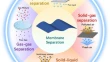
<fig id="F3"><title><p>Figure 3</p></title><caption><p>Electronic transport in fluorinated mono-layer graphene</p></caption><text>
   <p><b>Electronic transport in fluorinated mono-layer graphene</b>. Resitivity of four fluorinated mono-layer graphene samples as a function of gate voltage at different temperatures. The different panels correspond to different concentration of fluorine in the starting fluorinated graphite material, as indicated in each panel.</p>
</text><graphic file="1556-276X-6-526-3"/></fig>
<p>To examine the presence of the energy gap, we analyse the temperature dependence of the maximum of resistivity by an exponential law describing thermal activation of carriers across an energy gap <it>&#916;&#949;</it>: <it>&#961;</it>(<it>T</it>) = <it>&#961;</it>
<sub>0</sub>
<it>exp</it>(<it>&#916;&#949;/</it>2<it>k</it>
<sub>B</sub>T), see Figure <figr fid="F4">4a</figr>. This analysis clearly shows that our data are not described by the thermal activation law over the whole temperature range. We note that the slope of <it>ln&#961; </it>(1/<it>T</it>) versus 1/<it>T </it>decreases with decreasing <it>T</it>, which is a signature of hopping conduction via localised states <abbrgrp>
<abbr bid="B48">48</abbr>
</abbrgrp>. The fact that in the whole range of studied temperatures electron transport is not due to thermal activation across the gap but due to hopping becomes clear when re-analysing the temperature dependence in terms of the 2D Mott VRH (2D-VRH) <abbrgrp>
<abbr bid="B47">47</abbr>
<abbr bid="B48">48</abbr>
</abbrgrp>. In this model, the functional dependence of <it>&#961; </it>on temperature is <it>&#961;</it>(<it>T</it>) = <it>&#961;</it>
<sub>0</sub>
<it>exp</it>(<it>T</it>
<sub>0</sub>/<it>T</it>)<sup>1/3</sup>, where <it>k</it>
<sub>B</sub>
<it>T</it>
<sub>0 </sub>= 13.6/<it>a</it>
<sup>2</sup>
<it>g</it>(<it>&#949;<sub>F</sub>
</it>), <it>g </it>is the density of localised states at the Fermi level <it>&#949;<sub>F </sub>
</it>and <it>a </it>is the localisation length <abbrgrp>
<abbr bid="B47">47</abbr>
<abbr bid="B48">48</abbr>
</abbrgrp>. Experimentally we find that the measured <it>&#961;</it>(<it>T</it>) for the samples produced from CF<sub>0.07 </sub>and CF<sub>0.24 </sub>graphite (see Figure <figr fid="F3">3b</figr> for CF<sub>0.24</sub>) is described well by the 2D-VRH model.</p>
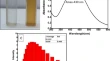
<fig id="F4"><title><p>Figure 4</p></title><caption><p>VRH transport in fluorinated mono-layer graphene</p></caption><text>
   <p><b>VRH transport in fluorinated mono-layer graphene</b>. Resistivity of fluorinated mono-layer graphene in the charge neutrality region plotted as a function of <it>T</it><sup>-1 </sup><b>(a) </b>and T<sup>-1/3 </sup><b>(b)</b>. <b>(c) </b>The values of the hopping parameter <it>T</it><sub>0 </sub>as a function of carrier density for the samples where transport occurs by two-dimensional Mott VRH. <b>(d) </b>Schematic diagrams of the energy dispersion of fluorinated mono-layer graphene (left panel) and of the energy dependence of the density of electron states, with the Fermi level at zero energy (right panel). The localised states are shown by the shaded area. <b>(e) </b>Resistivity of fluorinated mono-layer graphene (exfoliated from CF<sub>0.28 </sub>graphite) in the charge neutrality region plotted as a function of T<sup>-<it>x</it></sup>. The solid lines represent fits to the experimental data where <it>x </it>= 1 for thermally activated transport, <it>x </it>= 1/2 for Efros-Shklovskii VRH and <it>x </it>= 1/3 for 2D Mott VRH. The best t is obtained for <it>x </it>= 1/2.</p>
</text><graphic file="1556-276X-6-526-4"/></fig>
<p>Figure <figr fid="F4">4c</figr> shows the hopping parameter <it>T</it>
<sub>0 </sub>as a function of carrier concentration for these three samples. The value of <it>T</it>
<sub>0 </sub>approaches zero at a carrier concentration of &#177;1.2 10<sup>12 </sup>cm<sup>-2</sup>. This value gives the concentration of the localised electron states in the energy range from <it>&#949; </it>= 0 to the mobility edge, see Figure <figr fid="F4">4d</figr>. The mobility edge occurs at <it>V</it>
<sub>g </sub>&#177; 20<it>V </it>and indicates the transition from hopping to metallic conduction.</p>
<p>In order to relate the obtained concentration of the localised states to the energy gap <it>&#916;&#949;</it>, one needs to know the exact energy dependence of the density of states in the gap. For estimations, we will use the linear relation for the density of extended states above the mobility edge <it>g</it>(<it>&#949;</it>) = 2<it>&#949;</it>/<it>&#960;&#295;</it>
<sup>2</sup>
<it>v</it>
<sup>2 </sup>(<it>v </it>= 10<sup>6 </sup>m/s is the Fermi velocity), and a constant value for the density of localised states below the mobility edge, Figure <figr fid="F4">4d</figr>. This gives <it>&#916;&#949; </it>= 60 meV and twice this value for the full mobility gap. In this approximation, the density of the localised states in the gap is ~10<sup>36 </sup>J/m<sup>2</sup>. Using the obtained value of the hopping parameter at the maximum of resistivity, we can then estimate the localisation length at <it>&#949; </it>= 0 as <it>a </it>= 40 nm for CF<sub>0.24 </sub>(device 1), <it>a </it>= 81 nm for CF<sub>0.24 </sub>(device 2) and <it>a </it>= 265 nm for CF<sub>0.07</sub>.</p>
<p>Figure <figr fid="F4">4e</figr> shows the analysis of the temperature dependence of the resistivity for fluorinated mono-layer graphene exfoliated from CF<sub>0.28 </sub>graphite. For this sample, characterised by the largest disorder L<sub>D </sub>~1.5 nm, the experimental data cannot be described by thermally activated law nor Mott VRH. In this case, the <it>ln</it>(<it>&#961;</it>) follows a <it>T</it>
<sup>-1/2 </sup>dependence characteristic of the Efros-Shklovskii VRH in the presence of Coulomb interaction between the localised states (<it>&#961;</it>(<it>T</it>) = <it>&#961;</it>
<sub>0</sub>
<it>exp</it>(<it>T</it>
<sub>0</sub>/<it>T</it>)<sup>1/2</sup>) <abbrgrp>
<abbr bid="B49">49</abbr>
</abbrgrp>. <it>T</it>
<sub>0 </sub>is related to the localisation lengths through <it>T</it>
<sub>0 </sub>= 2.8e<sup>2</sup> / 4 <it>&#960;&#949;<sub>r</sub>&#949;</it>
<sub>0</sub>
<it>k</it>
<sub>B</sub>
<it>a </it>and for our sample we estimate <it>T</it>
<sub>0 </sub>= 52 K. Assuming that <it>&#949;<sub>r </sub>
</it>is the dielectric constant of SiO<sub>2 </sub>we obtain the localisation length <it>a </it>= 282 nm.</p>
<p>We turn now our discussion to multi-layer fluorinated graphene exfoliated from fully fluorinated graphite and from CF<sub>0.28 </sub>prepared by exposure to fluorine gas. The fully fluorinated multi-layer show systematically a very large resistance (more than 100 G&#937;) independently of the specific thickness and no gate-voltage control of the resistivity. To achieve gate modulation in these samples, we reduced the fluorine content by annealing the samples at 300&#176;C, in a 10 % atmosphere of H<sub>2</sub>/Ar for 2 h. This annealing process restores a partial gate-voltage control of the resistance (Figure <figr fid="F5">5a</figr>) while leaving unchanged the Raman spectrum in Figure <figr fid="F2">2d</figr>.</p>
<fig id="F5"><title><p>Figure 5</p></title><caption><p>Electronic transport in fluorinated multi-layer graphene</p></caption><text>
   <p><b>Electronic transport in fluorinated multi-layer graphene</b>. <b>(a) </b>Resistivity as a function of gate voltage for an annealed fully fluorinated device. <b>(a) </b>Resistivity for the fully fluorinated device plotted against <it>T</it><sup>-1 </sup>and <it>T</it><sup>-1/3 </sup>at <it>V</it><sub>g </sub>= +50 V. <b>(c) </b><it>I</it>-<it>V </it>characteristics for multi-layer fluorinated graphene exfoliated from CF<sub>0.28 </sub>graphite. <b>(d) </b>Resistivity of fluorinated multi-layer graphene (exfoliated from CF<sub>0.28</sub>) plotted as a function of <it>T</it><sup>-<it>x</it></sup>, where <it>x </it>= 1 for thermally activated transport, <it>x </it>= 1/2 for Efros-Shklovskii VRH and <it>x </it>= 1/3 for 2D Mott VRH.</p>
</text><graphic file="1556-276X-6-526-5"/></fig>
<p>Resistance measurements of CF<it>
<sub>n </sub>
</it>flakes after annealing show a strong temperature dependence, Figure <figr fid="F5">5a</figr>. Analysis of the temperature dependence of the resistance in terms of the activation law at the highest gate voltage <it>V</it>
<sub>g </sub>= 50 V (which is still far from the Dirac point) gives a gap of only 25 meV, which is significantly smaller than the expected energy gap for fully fluorinated graphene. Similarly to the fluorinated mono-layer graphene, the resistivity dependence on temperature is fitted well by VRH with the value of <it>T</it>
<sub>0 </sub>= 20000 K. This confirms that the previously found activation energy of 25 meV is not the activation energy <it>&#916;&#949; </it>that separates the localised states from extended states at the mobility edge, but is an activation energy &#948;<it>&#949; </it>of hopping between localised states within the mobility gap, see Figure <figr fid="F4">4d</figr>.</p>
<p>Figure <figr fid="F5">5c,d</figr> shows the transport data for the multi-layer fluorinated graphene CF<sub>0.28 </sub>prepared by exposure to fluorine gas. The <it>I</it>-<it>V </it>characteristics of these samples are strongly non-linear (see Figure <figr fid="F5">5c</figr>) with resistances of more than 1 G&#937;. In this case, the dependence of the resistivity on temperature cannot be described neither by 2D-VRH nor by Efros-Shklovskii VRH (see Figure <figr fid="F5">5d</figr>). The ln(<it>&#961;</it>)(<it>T</it>) dependence is rather well described by a thermally activated law at elevated temperatures (regime A), with a <it>&#916;&#949; </it>= 0.25 eV, followed by a temperature regime where the resistivity decreases with lowering the temperature (regime B). A 1/<it>T </it>dependence of ln(<it>&#961;</it>) could be the consequence of either intrinsic transport through thermally excited carriers above the bandgap or conduction through NNH via localised states within the gap. Since the <it>I</it>-<it>V </it>characteristics of our devices show a non-linearity on a <it>V</it>
<sub>sd </sub>range much larger than the estimated <it>&#916;&#949; </it>= 0.25 eV (see Figure <figr fid="F5">5c</figr>), we conclude that transport occurs via NNH.</p>
<p>Finally, for the same degree of fluorination (i.e. CF<sub>0.28</sub>) the graphene multi-layers exhibit a stronger temperature dependence and a larger transport gap than what is observed in mono-layers. This difference could originate from the different fluorination processes used for the multi-layers (direct fluorination with F<sub>2 </sub>gas at high temperature to produce graphite fluorides) and for the monolayers (FGIC synthesised at lower temperatures), see Section 6. Indeed, different fluorination processes may lead to different concentrations of localised states. Even though in both materials, F-GIC and graphite fluorides, the nature of the bonding between fluorine and carbon atoms is covalent, the C-F bond order is slightly lower in F-GIC <abbrgrp>
<abbr bid="B59">59</abbr>
</abbrgrp>. The lower C-F bond order in F-GIC is due to the hyper-conjugation which occurs between the C-F and the C-C single bonds around the C-F bonds. In particular, the C-F and C-C single bond lengths are, respectively, longer and shorter in F-GIC than those in graphite fluorides. As a result, the electrons involved in the covalent C-F bonds in F-GIC are slightly delocalised by this hyperconjugation, which may result in a smaller transport gap.</p>
</sec>
<sec>
<st>
<p>5 Conclusions</p>
</st>
<p>In conclusion, we have demonstrated the possibility to tune the band structure and therefore the electronic transport properties of graphene through functionalisation with fluorine. In particular, depending on the fluorine concentration different transport regimes can be accessed. For mono-layer samples, we observe a transition from 2D Mott VRH to Efros-Shklovskii VRH with increasing the fluorine content. Multi-layer fluorinated graphene with high concentration of fluorine shows 2D Mott VRH, whereas CF<sub>0:28 </sub>multi-layer flakes exhibit NNH transport. Our experimental findings demonstrate that the ability to control the degree of functionalisation of graphene is instrumental to engineer different electronic properties in graphene materials. In all cases, fluorinated graphene transistors exhibit a large on/off ratio of the current, making this material of interest for future applications in transparent and bendable electronics.</p>
</sec>
<sec>
<st>
<p>6 Methods</p>
</st>
<sec>
<st>
<p>6.1 Fluorination of graphite</p>
</st>
<p>To produce fluorinated graphite, we have used two distinct methods <abbrgrp>
<abbr bid="B59">59</abbr>
<abbr bid="B60">60</abbr>
<abbr bid="B61">61</abbr>
<abbr bid="B62">62</abbr>
</abbrgrp>. In the first method, graphite is heated in the presence of F<sub>2 </sub>to temperatures in excess of 300&#176;C, so that covalent C-F bonds are formed and modify the carbon hybridisation <abbrgrp>
<abbr bid="B60">60</abbr>
</abbrgrp>. The layered structure of graphite is then transformed into a 3D arrangement of carbon atoms (Figure <figr fid="F1">1a,b</figr>). In this article, we present the studies on graphene exfoliated from fully fluorinated HOPG graphite CF<it>
<sub>n </sub>
</it>(obtained at 600&#176;C) and CF<sub>0.28 </sub>synthesised with this method at 530&#176;C. However, due to the harsh fluorination conditions, many structural defects are formed, which makes it very difficult to exfoliate large enough mono-layer flakes that can be identified by optical microscopy and easily processed into devices. To prepare larger fluorinated graphene samples, we have used a second fluorination method where graphite is exposed to a fluorinating agent, i.e. XeF<sub>2</sub>. In this case, the functionalisation process is carried out at <it>T </it>&#8804; 120&#176;C, as XeF<sub>2 </sub>easily decomposes on the graphite surface into atomic fluorine <abbrgrp>
<abbr bid="B59">59</abbr>
</abbrgrp>. The mixture of natural graphite and XeF<sub>2 </sub>was prepared in a glove box in an Ar atmosphere. Owing to its reactivity and diffusion, the fluorination results in a homogenous dispersion of fluorine atoms that become covalently bonded to carbon atoms <abbrgrp>
<abbr bid="B59">59</abbr>
<abbr bid="B62">62</abbr>
<abbr bid="B63">63</abbr>
</abbrgrp>. At low fluorine content, the F/C atomic ratio is &#8804; 0.4. In this case, the conjugated C-C double bonds in the non-fluorinated parts and covalent C-F bonds in corrugated fluorocarbon regions coexist <abbrgrp>
<abbr bid="B62">62</abbr>
<abbr bid="B64">64</abbr>
</abbrgrp>. The concentration of the covalent bonds increases with increasing the concentration of fluorine. The samples produced using the XeF<sub>2 </sub>gas that we investigate here have the concentration of fluorine of 7, 24 and 28%.</p>
</sec>
<sec>
<st>
<p>6.2 Determination of fluorine concentration</p>
</st>
<p>The fluorine concentration (i.e. F:C molar ratio) of fluorinated graphite was determined by gravimetry (weight uptake). The concentration obtained by weight uptake was confirmed by solid-state NMR measurements on samples fabricated under identical conditions and the accuracy of gravimetry was estimated to be 0.02 <abbrgrp>
<abbr bid="B65">65</abbr>
<abbr bid="B66">66</abbr>
<abbr bid="B67">67</abbr>
</abbrgrp>. The fluorine concentration measured by gravimetry can be under-estimated due to the decomposition of graphite under fluorine gas at high temperature, which results in the formation of carbene (CF<sub>2</sub>) and C<sub>2</sub>F<sub>4</sub>. However, the decomposition of graphite was found to start as a secondary reaction close to 600&#176;C, with fluorination being the main reaction. Since the reactions with F<sub>2 </sub>and XeF<sub>2 </sub>have been carried at lower temperatures than the graphite decomposition temperature, the underestimation of F:C ratio in our fluorinated graphite samples is likely to be less than 0.02.</p>
</sec>
<sec>
<st>
<p>6.3 Raman spectroscopy characterisation</p>
</st>
<p>We have characterised all the exfoliated flakes by Raman spectroscopy using an excitation light with a wavelength of 532 nm and a spot size of 1.5 <it>&#956;</it>m in diameter. An incident power of 5 mW was used. We ensured that this power does not damage the graphene by performing Raman measurements on a similarly sized pristine graphene flake which shows the common spectra of mechanically exfoliated graphene: the G band and 2D band (also known as G') at 1580 and 2700 cm<sup>-1</sup>, see Figure <figr fid="F2">2</figr>.</p>
</sec>
<sec>
<st>
<p>6.4 Electrical characterisation</p>
</st>
<p>The resistance of the transistor devices was measured both in dc, by means of Keithley 2400 Source-meter, and in ac at low frequency (34 Hz) with a lock-in amplifier in a voltage-biased configuration. For the ac-measurements, the excitation current was varied to ensure that the resulting voltage was smaller than the temperature to prevent heating of the electrons and the occurrence of nonequilibrium effects. The comparison of 2- and 4-probe measurements shows that the contact resistance in our devices is negligible as compared to the sample resistance. This experimental finding insures that even 2-probe transport measurements are probing the electrical properties of the bulk fluorinated graphene rather then simply the Cr/graphene interface.</p>
</sec>
</sec>
<sec>
<st>
<p>Abbreviations</p>
</st>
<p>2D-VRH: two-dimensional Mott variable range hopping; AFM: atomic force microscopy; F-GIC: fluorine graphite intercalation compounds; FWHM: full width at half maximum; NMR: nuclear magnetic resonance; NNH: nearest neighbour hopping; VRH: variable range hopping.</p>
</sec>
<sec>
<st>
<p>Competing interests</p>
</st>
<p>The authors declare that they have no competing interests.</p>
</sec>
<sec>
<st>
<p>Authors' contributions</p>
</st>
<p>FW fabricated the fluorinated graphene devices and carried out the measurements. MD synthesised the fluorinated graphite. FW and MFC performed the data analysis. FW, SR and MFC wrote the manuscript. All authors discussed the results, read and approved the final manuscript.</p>
</sec>
</bdy><bm>
<ack>
<sec>
<st>
<p>Acknowledgements</p>
</st>
<p>We acknowledge T.H. Bointon for performing the AFM measurements on the multi-layer graphene. SR and MFC acknowledge the financial support from the EPSRC (Grant nos. EP/G036101/1 and EP/J000396/1). SR acknowledges the financial support from the Royal Society Research Grant 2010/R2 (Grant no. SH-05052).</p>
</sec>
</ack>
<refgrp><bibl id="B1"><title><p>The band theory of graphite</p></title><aug><au><snm>Wallace</snm><fnm>PR</fnm></au></aug><source>Phys Rev</source><pubdate>1947</pubdate><volume>71</volume><fpage>622</fpage><lpage>634</lpage><xrefbib><pubid idtype="doi">10.1103/PhysRev.71.622</pubid></xrefbib></bibl><bibl id="B2"><title><p>The electronic properties of graphene</p></title><aug><au><snm>Castro Neto</snm><fnm>AH</fnm></au><au><snm>Guinea</snm><fnm>F</fnm></au><au><snm>Peres</snm><fnm>NMR</fnm></au><au><snm>Novoselov</snm><fnm>KS</fnm></au><au><snm>Geim</snm><fnm>AK</fnm></au></aug><source>Rev Mod Phys</source><pubdate>2009</pubdate><volume>81</volume><fpage>109</fpage><lpage>162</lpage><xrefbib><pubid idtype="doi">10.1103/RevModPhys.81.109</pubid></xrefbib></bibl><bibl id="B3"><title><p>Electric field effect in atomically thin carbon films</p></title><aug><au><snm>Novoselov</snm><fnm>KS</fnm></au><au><snm>Geim</snm><fnm>AK</fnm></au><au><snm>Morozov</snm><fnm>SV</fnm></au><au><snm>Jiang</snm><fnm>D</fnm></au><au><snm>Zhang</snm><fnm>Y</fnm></au><au><snm>Dubonos</snm><fnm>SV</fnm></au><au><snm>Grigorieva</snm><fnm>IV</fnm></au><au><snm>Firsov</snm><fnm>AA</fnm></au></aug><source>Science</source><pubdate>2004</pubdate><volume>306</volume><fpage>666</fpage><lpage>669</lpage><xrefbib><pubidlist><pubid idtype="doi">10.1126/science.1102896</pubid><pubid idtype="pmpid" link="fulltext">15499015</pubid></pubidlist></xrefbib></bibl><bibl id="B4"><title><p>Two-dimensional gas of massless Dirac fermions in graphene</p></title><aug><au><snm>Novoselov</snm><fnm>KS</fnm></au><au><snm>Geim</snm><fnm>AK</fnm></au><au><snm>Morozov</snm><fnm>SV</fnm></au><au><snm>Jiang</snm><fnm>D</fnm></au><au><snm>Katsnelson</snm><fnm>MI</fnm></au><au><snm>Grigorieva</snm><fnm>IV</fnm></au><au><snm>Dubonos</snm><fnm>SV</fnm></au><au><snm>Firsov</snm><fnm>AA</fnm></au></aug><source>Nature</source><pubdate>2005</pubdate><volume>438</volume><fpage>197</fpage><lpage>200</lpage><xrefbib><pubidlist><pubid idtype="doi">10.1038/nature04233</pubid><pubid idtype="pmpid" link="fulltext">16281030</pubid></pubidlist></xrefbib></bibl><bibl id="B5"><title><p>Experimental observation of the quantum Hall effect and Berry's phase in graphene</p></title><aug><au><snm>Zhang</snm><fnm>YB</fnm></au><au><snm>Tan</snm><fnm>YW</fnm></au><au><snm>Stormer</snm><fnm>HL</fnm></au><au><snm>Kim</snm><fnm>P</fnm></au></aug><source>Nature</source><pubdate>2005</pubdate><volume>438</volume><fpage>201</fpage><lpage>204</lpage><xrefbib><pubidlist><pubid idtype="doi">10.1038/nature04235</pubid><pubid idtype="pmpid" link="fulltext">16281031</pubid></pubidlist></xrefbib></bibl><bibl id="B6"><title><p>The rise of graphene</p></title><aug><au><snm>Geim</snm><fnm>AK</fnm></au><au><snm>Novoselov</snm><fnm>KS</fnm></au></aug><source>Nat Mater</source><pubdate>2007</pubdate><volume>6</volume><fpage>183</fpage><lpage>191</lpage><xrefbib><pubidlist><pubid idtype="doi">10.1038/nmat1849</pubid><pubid idtype="pmpid" link="fulltext">17330084</pubid></pubidlist></xrefbib></bibl><bibl id="B7"><title><p>Graphene: status and prospects</p></title><aug><au><snm>Geim</snm><fnm>AK</fnm></au></aug><source>Science</source><pubdate>2009</pubdate><volume>324</volume><fpage>1530</fpage><lpage>1534</lpage><xrefbib><pubidlist><pubid idtype="doi">10.1126/science.1158877</pubid><pubid idtype="pmpid" link="fulltext">19541989</pubid></pubidlist></xrefbib></bibl><bibl id="B8"><title><p>Giant intrinsic carrier mobilities in graphene and its bilayer</p></title><aug><au><snm>Morozov</snm><fnm>SV</fnm></au><au><snm>Novoselov</snm><fnm>KS</fnm></au><au><snm>Katsnelson</snm><fnm>MI</fnm></au><au><snm>Schedin</snm><fnm>F</fnm></au><au><snm>Elias</snm><fnm>DC</fnm></au><au><snm>Jaszczak</snm><fnm>JA</fnm></au><au><snm>Geim</snm><fnm>AK</fnm></au></aug><source>Phys Rev Lett</source><pubdate>2008</pubdate><volume>100</volume><fpage>016602</fpage><lpage>016606</lpage><xrefbib><pubid idtype="pmpid" link="fulltext">18232798</pubid></xrefbib></bibl><bibl id="B9"><title><p>Fine structure constant defines visual transparency of graphene</p></title><aug><au><snm>Nair</snm><fnm>RR</fnm></au><au><snm>Blake</snm><fnm>P</fnm></au><au><snm>Grigorenko</snm><fnm>AN</fnm></au><au><snm>Novoselov</snm><fnm>KS</fnm></au><au><snm>Booth</snm><fnm>TJ</fnm></au><au><snm>Stauber</snm><fnm>T</fnm></au><au><snm>Peres</snm><fnm>NMR</fnm></au><au><snm>Geim</snm><fnm>AK</fnm></au></aug><source>Science</source><pubdate>2008</pubdate><volume>320</volume><fpage>1308</fpage><xrefbib><pubidlist><pubid idtype="doi">10.1126/science.1156965</pubid><pubid idtype="pmpid" link="fulltext">18388259</pubid></pubidlist></xrefbib></bibl><bibl id="B10"><title><p>Tuneable electronic properties in graphene</p></title><aug><au><snm>Craciun</snm><fnm>MF</fnm></au><au><snm>Russo</snm><fnm>S</fnm></au><au><snm>Yamamoto</snm><fnm>M</fnm></au><au><snm>Tarucha</snm><fnm>S</fnm></au></aug><source>Nano Today</source><pubdate>2011</pubdate><volume>6</volume><fpage>42</fpage><lpage>60</lpage><xrefbib><pubid idtype="doi">10.1016/j.nantod.2010.12.001</pubid></xrefbib></bibl><bibl id="B11"><title><p>Controlling the electronic structure of bilayer graphene</p></title><aug><au><snm>Ohta</snm><fnm>T</fnm></au><au><snm>Bostowick</snm><fnm>A</fnm></au><au><snm>Seyller</snm><fnm>T</fnm></au><au><snm>Horn</snm><fnm>K</fnm></au><au><snm>Rotenberg</snm><fnm>E</fnm></au></aug><source>Science</source><pubdate>2006</pubdate><volume>313</volume><fpage>951</fpage><lpage>954</lpage><xrefbib><pubidlist><pubid idtype="doi">10.1126/science.1130681</pubid><pubid idtype="pmpid" link="fulltext">16917057</pubid></pubidlist></xrefbib></bibl><bibl id="B12"><title><p>Biased bilayer graphene: semiconductor with a gap tunable by the electric field effect</p></title><aug><au><snm>Castro</snm><fnm>EV</fnm></au><au><snm>Novoselov</snm><fnm>KS</fnm></au><au><snm>Morozov</snm><fnm>SV</fnm></au><au><snm>Peres</snm><fnm>NMR</fnm></au><au><snm>Lopes dos Santos</snm><fnm>JMB</fnm></au><au><snm>Nilsson</snm><fnm>J</fnm></au><au><snm>Guinea</snm><fnm>F</fnm></au><au><snm>Geim</snm><fnm>AK</fnm></au><au><snm>Castro Neto</snm><fnm>AH</fnm></au></aug><source>Phys Rev Lett</source><pubdate>2007</pubdate><volume>99</volume><fpage>216802</fpage><lpage>216806</lpage><xrefbib><pubid idtype="pmpid" link="fulltext">18233240</pubid></xrefbib></bibl><bibl id="B13"><title><p>Gate-induced insulating state in bilayer graphene devices</p></title><aug><au><snm>Oostinga</snm><fnm>JB</fnm></au><au><snm>Heersche</snm><fnm>HB</fnm></au><au><snm>Liu</snm><fnm>X</fnm></au><au><snm>Morpurgo</snm><fnm>AF</fnm></au><au><snm>Vandersypen</snm><fnm>LMK</fnm></au></aug><source>Nat Mater</source><pubdate>2008</pubdate><volume>7</volume><fpage>151</fpage><lpage>157</lpage><xrefbib><pubidlist><pubid idtype="doi">10.1038/nmat2082</pubid><pubid idtype="pmpid" link="fulltext">18059274</pubid></pubidlist></xrefbib></bibl><bibl id="B14"><title><p>Determination of the electronic structure of bilayer graphene from infrared spectroscopy</p></title><aug><au><snm>Zhang</snm><fnm>LM</fnm></au><au><snm>Li</snm><fnm>ZQ</fnm></au><au><snm>Basov</snm><fnm>DN</fnm></au><au><snm>Fogler</snm><fnm>MM</fnm></au><au><snm>Hao</snm><fnm>Z</fnm></au><au><snm>Martin</snm><fnm>MC</fnm></au></aug><source>Phys Rev B</source><pubdate>2008</pubdate><volume>78</volume><fpage>235408</fpage><lpage>235419</lpage></bibl><bibl id="B15"><title><p>Metal to insulator transition in epitaxial graphene induced by molecular doping</p></title><aug><au><snm>Zhou</snm><fnm>SY</fnm></au><au><snm>Siegel</snm><fnm>DA</fnm></au><au><snm>Fedorov</snm><fnm>AV</fnm></au><au><snm>Lanzara</snm><fnm>A</fnm></au></aug><source>Phys Rev Lett</source><pubdate>2008</pubdate><volume>101</volume><fpage>086402</fpage><lpage>086406</lpage><xrefbib><pubid idtype="pmpid" link="fulltext">18764644</pubid></xrefbib></bibl><bibl id="B16"><title><p>Direct observation of a widely tunable bandgap in bilayer graphene</p></title><aug><au><snm>Zhang</snm><fnm>YB</fnm></au><au><snm>Tang</snm><fnm>TT</fnm></au><au><snm>Girit</snm><fnm>C</fnm></au><au><snm>Hao</snm><fnm>Z</fnm></au><au><snm>Martin</snm><fnm>MC</fnm></au><au><snm>Zettl</snm><fnm>A</fnm></au><au><snm>Crommie</snm><fnm>MF</fnm></au><au><snm>Shen</snm><fnm>YR</fnm></au><au><snm>Wang</snm><fnm>F</fnm></au></aug><source>Nature</source><pubdate>2009</pubdate><volume>459</volume><fpage>820</fpage><lpage>823</lpage><xrefbib><pubidlist><pubid idtype="doi">10.1038/nature08105</pubid><pubid idtype="pmpid" link="fulltext">19516337</pubid></pubidlist></xrefbib></bibl><bibl id="B17"><title><p>Observation of an electric-field-induced band gap in bilayer graphene by infrared spectroscopy</p></title><aug><au><snm>Mak</snm><fnm>KF</fnm></au><au><snm>Lui</snm><fnm>CH</fnm></au><au><snm>Shan</snm><fnm>J</fnm></au><au><snm>Heinz</snm><fnm>TF</fnm></au></aug><source>Phys Rev Lett</source><pubdate>2009</pubdate><volume>102</volume><fpage>256405</fpage><lpage>256409</lpage><xrefbib><pubid idtype="pmpid" link="fulltext">19659105</pubid></xrefbib></bibl><bibl id="B18"><title><p>Determination of the gate-tunable band gap and tight-binding parameters in bilayer graphene using infrared spectroscopy</p></title><aug><au><snm>Kuzmenko</snm><fnm>AB</fnm></au><au><snm>Crassee</snm><fnm>I</fnm></au><au><snm>van der Marel</snm><fnm>D</fnm></au><au><snm>Blake</snm><fnm>P</fnm></au><au><snm>Novoselov</snm><fnm>KS</fnm></au></aug><source>Phys Rev B</source><pubdate>2009</pubdate><volume>80</volume><fpage>165406</fpage><lpage>165418</lpage></bibl><bibl id="B19"><title><p>Double-gated graphene-based devices</p></title><aug><au><snm>Russo</snm><fnm>S</fnm></au><au><snm>Craciun</snm><fnm>MF</fnm></au><au><snm>Yamamoto</snm><fnm>M</fnm></au><au><snm>Tarucha</snm><fnm>S</fnm></au><au><snm>Morpurgo</snm><fnm>AF</fnm></au></aug><source>New J Phys</source><pubdate>2009</pubdate><volume>11</volume><fpage>095018</fpage><lpage>095029</lpage><xrefbib><pubid idtype="doi">10.1088/1367-2630/11/9/095018</pubid></xrefbib></bibl><bibl id="B20"><title><p>Graphene field-effect transistors with high on/off current ratio and large transport band gap at room temperature</p></title><aug><au><snm>Xia</snm><fnm>F</fnm></au><au><snm>Farmer</snm><fnm>DB</fnm></au><au><snm>Lin</snm><fnm>Y</fnm></au><au><snm>Avouris</snm><fnm>P</fnm></au></aug><source>Nano Lett</source><pubdate>2010</pubdate><volume>10</volume><fpage>715</fpage><lpage>718</lpage><xrefbib><pubidlist><pubid idtype="doi">10.1021/nl9039636</pubid><pubid idtype="pmpid" link="fulltext">20092332</pubid></pubidlist></xrefbib></bibl><bibl id="B21"><title><p>Transport in gapped bilayer graphene: the role of potential fluctuations</p></title><aug><au><snm>Zou</snm><fnm>K</fnm></au><au><snm>Zhu</snm><fnm>J</fnm></au></aug><source>Phys Rev B</source><pubdate>2010</pubdate><volume>82</volume><fpage>081407</fpage><lpage>081411</lpage></bibl><bibl id="B22"><title><p>Trilayer graphene is a semimetal with a gate-tunable band overlap</p></title><aug><au><snm>Craciun</snm><fnm>MF</fnm></au><au><snm>Russo</snm><fnm>S</fnm></au><au><snm>Yamamoto</snm><fnm>M</fnm></au><au><snm>Oostinga</snm><fnm>JB</fnm></au><au><snm>Morpurgo</snm><fnm>AF</fnm></au><au><snm>Tarucha</snm><fnm>S</fnm></au></aug><source>Nat Nanotechnol</source><pubdate>2009</pubdate><volume>4</volume><fpage>383</fpage><lpage>388</lpage><xrefbib><pubidlist><pubid idtype="doi">10.1038/nnano.2009.89</pubid><pubid idtype="pmpid">19498401</pubid></pubidlist></xrefbib></bibl><bibl id="B23"><title><p>Gate-induced interlayer asymmetry in ABA-stacked trilayer graphene</p></title><aug><au><snm>Koshino</snm><fnm>M</fnm></au><au><snm>McCann</snm><fnm>E</fnm></au></aug><source>Phys Rev B</source><pubdate>2009</pubdate><volume>79</volume><fpage>125443</fpage><lpage>125448</lpage></bibl><bibl id="B24"><title><p>Energy gaps in graphene nanoribbons</p></title><aug><au><snm>Son</snm><fnm>YW</fnm></au><au><snm>Cohen</snm><fnm>ML</fnm></au><au><snm>Louie</snm><fnm>SG</fnm></au></aug><source>Phys Rev Lett</source><pubdate>2006</pubdate><volume>97</volume><fpage>216803</fpage><lpage>216807</lpage><xrefbib><pubid idtype="pmpid" link="fulltext">17155765</pubid></xrefbib></bibl><bibl id="B25"><title><p>Energy band-gap engineering of graphene nanoribbons</p></title><aug><au><snm>Han</snm><fnm>MY</fnm></au><au><snm>Ozyilmaz</snm><fnm>B</fnm></au><au><snm>Zhang</snm><fnm>YB</fnm></au><au><snm>Kim</snm><fnm>P</fnm></au></aug><source>Phys Rev Lett</source><pubdate>2007</pubdate><volume>98</volume><fpage>206805</fpage><lpage>206809</lpage><xrefbib><pubid idtype="pmpid" link="fulltext">17677729</pubid></xrefbib></bibl><bibl id="B26"><title><p>Chemically derived, ultrasmooth graphene nanoribbon semiconductors</p></title><aug><au><snm>Li</snm><fnm>XL</fnm></au><au><snm>Wang</snm><fnm>XR</fnm></au><au><snm>Zhang</snm><fnm>L</fnm></au><au><snm>Lee</snm><fnm>SW</fnm></au><au><snm>Dai</snm><fnm>HJ</fnm></au></aug><source>Science</source><pubdate>2008</pubdate><volume>319</volume><fpage>1229</fpage><lpage>1232</lpage><xrefbib><pubidlist><pubid idtype="doi">10.1126/science.1150878</pubid><pubid idtype="pmpid" link="fulltext">18218865</pubid></pubidlist></xrefbib></bibl><bibl id="B27"><title><p>Narrow graphene nanoribbons from carbon nanotubes</p></title><aug><au><snm>Jiao</snm><fnm>LY</fnm></au><au><snm>Zhang</snm><fnm>L</fnm></au><au><snm>Wang</snm><fnm>XR</fnm></au><au><snm>Diankov</snm><fnm>G</fnm></au><au><snm>Dai</snm><fnm>H</fnm></au></aug><source>Nature</source><pubdate>2009</pubdate><volume>458</volume><fpage>877</fpage><lpage>880</lpage><xrefbib><pubidlist><pubid idtype="doi">10.1038/nature07919</pubid><pubid idtype="pmpid" link="fulltext">19370031</pubid></pubidlist></xrefbib></bibl><bibl id="B28"><title><p>Magnetotransport through graphene nanoribbons</p></title><aug><au><snm>Oostinga</snm><fnm>JB</fnm></au><au><snm>Sacepe</snm><fnm>B</fnm></au><au><snm>Craciun</snm><fnm>MF</fnm></au><au><snm>Morpurgo</snm><fnm>AF</fnm></au></aug><source>Phys Rev B</source><pubdate>2010</pubdate><volume>81</volume><fpage>193408</fpage><lpage>193412</lpage></bibl><bibl id="B29"><title><p>Graphane: A two-dimensional hydrocarbon</p></title><aug><au><snm>Sofo</snm><fnm>OJ</fnm></au><au><snm>Chaudhari</snm><fnm>AS</fnm></au><au><snm>Barber</snm><fnm>GD</fnm></au></aug><source>Phys Rev B</source><pubdate>2007</pubdate><volume>75</volume><fpage>153401</fpage><lpage>153405</lpage></bibl><bibl id="B30"><title><p>Chemical functionalization of graphene</p></title><aug><au><snm>Boukhvalov</snm><fnm>DW</fnm></au><au><snm>Katsnelson</snm><fnm>MI</fnm></au></aug><source>J Phys Condens Matter</source><pubdate>2009</pubdate><volume>21</volume><fpage>344205</fpage><lpage>344217</lpage><xrefbib><pubidlist><pubid idtype="doi">10.1088/0953-8984/21/34/344205</pubid><pubid idtype="pmpid" link="fulltext">21715780</pubid></pubidlist></xrefbib></bibl><bibl id="B31"><title><p>First-principles investigation of graphene fluoride and graphane</p></title><aug><au><snm>Leenaerts</snm><fnm>O</fnm></au><au><snm>Peelaers</snm><fnm>H</fnm></au><au><snm>Hernandez-Nieves</snm><fnm>AD</fnm></au><au><snm>Partoens</snm><fnm>B</fnm></au><au><snm>Peeters</snm><fnm>FM</fnm></au></aug><source>Phys Rev B</source><pubdate>2010</pubdate><volume>82</volume><fpage>195436</fpage><lpage>195442</lpage></bibl><bibl id="B32"><title><p>Structures of fluorinated graphene and their signatures</p></title><aug><au><snm>Sahin</snm><fnm>H</fnm></au><au><snm>Topsakal</snm><fnm>M</fnm></au><au><snm>Ciraci</snm><fnm>S</fnm></au></aug><source>Phys Rev B</source><pubdate>2011</pubdate><volume>83</volume><fpage>115432</fpage><lpage>115438</lpage></bibl><bibl id="B33"><title><p>Control of graphene's properties by reversible hydrogenation: evidence for graphane</p></title><aug><au><snm>Elias</snm><fnm>DC</fnm></au><au><snm>Nair</snm><fnm>RR</fnm></au><au><snm>Mohiuddin</snm><fnm>TMG</fnm></au><au><snm>Morozov</snm><fnm>SV</fnm></au><au><snm>Blake</snm><fnm>P</fnm></au><au><snm>Halsall</snm><fnm>MP</fnm></au><au><snm>Ferrari</snm><fnm>AC</fnm></au><au><snm>Boukhvalov</snm><fnm>DW</fnm></au><au><snm>Katsnelson</snm><fnm>MI</fnm></au><au><snm>Geim</snm><fnm>AK</fnm></au><au><snm>Novoselov</snm><fnm>KS</fnm></au></aug><source>Science</source><pubdate>2009</pubdate><volume>323</volume><fpage>610</fpage><lpage>613</lpage><xrefbib><pubidlist><pubid idtype="doi">10.1126/science.1167130</pubid><pubid idtype="pmpid" link="fulltext">19179524</pubid></pubidlist></xrefbib></bibl><bibl id="B34"><title><p>Reversible basal plane hydrogenation of graphene</p></title><aug><au><snm>Han</snm><fnm>Y</fnm></au><au><snm>Maultzsch</snm><fnm>J</fnm></au><au><snm>Heinz</snm><fnm>TF</fnm></au><au><snm>Kim</snm><fnm>P</fnm></au><au><snm>Steigerwald</snm><fnm>ML</fnm></au><au><snm>Brus</snm><fnm>LE</fnm></au></aug><source>Nano Lett</source><pubdate>2008</pubdate><volume>8</volume><fpage>4597</fpage><lpage>4602</lpage><xrefbib><pubidlist><pubid idtype="doi">10.1021/nl802940s</pubid><pubid idtype="pmpid" link="fulltext">19053793</pubid></pubidlist></xrefbib></bibl><bibl id="B35"><title><p>Bandgap opening in graphene induced by patterned hydrogen adsorption</p></title><aug><au><snm>Balog</snm><fnm>R</fnm></au><au><snm>Jorgensen</snm><fnm>B</fnm></au><au><snm>Nilsson</snm><fnm>L</fnm></au><au><snm>Andersen</snm><fnm>M</fnm></au><au><snm>Rienks</snm><fnm>E</fnm></au><au><snm>Bianchi</snm><fnm>M</fnm></au><au><snm>Fanetti</snm><fnm>M</fnm></au><au><snm>Lagsgaard</snm><fnm>E</fnm></au><au><snm>Baraldi</snm><fnm>A</fnm></au><au><snm>Lizzit</snm><fnm>S</fnm></au><au><snm>Sljivancanin</snm><fnm>Z</fnm></au><au><snm>Besenbacher</snm><fnm>F</fnm></au><au><snm>Hammer</snm><fnm>B</fnm></au><au><snm>Pedersen</snm><fnm>TG</fnm></au><au><snm>Hofmann</snm><fnm>P</fnm></au><au><snm>Hornekar</snm><fnm>L</fnm></au></aug><source>Nat Mater</source><pubdate>2010</pubdate><volume>9</volume><fpage>315</fpage><lpage>319</lpage><xrefbib><pubidlist><pubid idtype="doi">10.1038/nmat2710</pubid><pubid idtype="pmpid" link="fulltext">20228819</pubid></pubidlist></xrefbib></bibl><bibl id="B36"><title><p>Soluble graphene derived from graphite fluoride</p></title><aug><au><snm>Worsley</snm><fnm>KA</fnm></au><au><snm>Ramesh</snm><fnm>P</fnm></au><au><snm>Mandal</snm><fnm>SK</fnm></au><au><snm>Niyogi</snm><fnm>S</fnm></au><au><snm>Itkis</snm><fnm>ME</fnm></au><au><snm>Haddon</snm><fnm>RC</fnm></au></aug><source>Chem Phys Lett</source><pubdate>2007</pubdate><volume>445</volume><fpage>51</fpage><lpage>56</lpage><xrefbib><pubid idtype="doi">10.1016/j.cplett.2007.07.059</pubid></xrefbib></bibl><bibl id="B37"><title><p>Plasma fluorination of chemically derived graphene sheets and subsequent modification with butylamine</p></title><aug><au><snm>Bon</snm><fnm>SB</fnm></au><au><snm>Valentini</snm><fnm>L</fnm></au><au><snm>Verdejo</snm><fnm>R</fnm></au><au><snm>Garcia Fierro</snm><fnm>JL</fnm></au><au><snm>Peponi</snm><fnm>L</fnm></au><au><snm>Lopez-Manchado</snm><fnm>MA</fnm></au><au><snm>Kenny</snm><fnm>JM</fnm></au></aug><source>Chem Mater</source><pubdate>2009</pubdate><volume>21</volume><fpage>3433</fpage><lpage>3438</lpage><xrefbib><pubid idtype="doi">10.1021/cm901039j</pubid></xrefbib></bibl><bibl id="B38"><title><p>Electron properties of fluorinated single-layer graphene transistors</p></title><aug><au><snm>Withers</snm><fnm>F</fnm></au><au><snm>Dubois</snm><fnm>M</fnm></au><au><snm>Savchenko</snm><fnm>AK</fnm></au></aug><source>Phys Rev B</source><pubdate>2010</pubdate><volume>82</volume><fpage>073403</fpage><lpage>073407</lpage></bibl><bibl id="B39"><title><p>Fluorographene: a two-dimensional counterpart of teflon</p></title><aug><au><snm>Nair</snm><fnm>RR</fnm></au><au><snm>Ren</snm><fnm>W</fnm></au><au><snm>Jalil</snm><fnm>R</fnm></au><au><snm>Riaz</snm><fnm>I</fnm></au><au><snm>Kravets</snm><fnm>VG</fnm></au><au><snm>Britnell</snm><fnm>L</fnm></au><au><snm>Blake</snm><fnm>P</fnm></au><au><snm>Schedin</snm><fnm>F</fnm></au><au><snm>Mayorov</snm><fnm>AS</fnm></au><au><snm>Yuan</snm><fnm>S</fnm></au><au><snm>Katsnelson</snm><fnm>MI</fnm></au><au><snm>Cheng</snm><fnm>HM</fnm></au><au><snm>Strupinski</snm><fnm>W</fnm></au><au><snm>Bulusheva</snm><fnm>LG</fnm></au><au><snm>Okotrub</snm><fnm>AV</fnm></au><au><snm>Grigorieva</snm><fnm>IV</fnm></au><au><snm>Grigorenko</snm><fnm>AN</fnm></au><au><snm>Novoselov</snm><fnm>KS</fnm></au><au><snm>Geim</snm><fnm>AK</fnm></au></aug><source>Small</source><pubdate>2010</pubdate><volume>6</volume><fpage>2877</fpage><lpage>2884</lpage><xrefbib><pubidlist><pubid idtype="doi">10.1002/smll.201001555</pubid><pubid idtype="pmpid" link="fulltext">21053339</pubid></pubidlist></xrefbib></bibl><bibl id="B40"><title><p>Properties of fluorinated graphene films</p></title><aug><au><snm>Robinson</snm><fnm>JT</fnm></au><au><snm>Burgess</snm><fnm>JS</fnm></au><au><snm>Junkermeier</snm><fnm>CE</fnm></au><au><snm>Badescu</snm><fnm>SC</fnm></au><au><snm>Reinecke</snm><fnm>TL</fnm></au><au><snm>Perkins</snm><fnm>FK</fnm></au><au><snm>Zalalutdniov</snm><fnm>MK</fnm></au><au><snm>Baldwin</snm><fnm>JW</fnm></au><au><snm>Culbertson</snm><fnm>JC</fnm></au><au><snm>Sheehan</snm><fnm>PE</fnm></au><au><snm>Snow</snm><fnm>ES</fnm></au></aug><source>Nano Lett</source><pubdate>2010</pubdate><volume>10</volume><fpage>3001</fpage><lpage>3005</lpage><xrefbib><pubidlist><pubid idtype="doi">10.1021/nl101437p</pubid><pubid idtype="pmpid" link="fulltext">20698613</pubid></pubidlist></xrefbib></bibl><bibl id="B41"><title><p>Reversible fluorination of graphene: evidence of a two-dimensional wide bandgap semiconductor</p></title><aug><au><snm>Cheng</snm><fnm>SH</fnm></au><au><snm>Zou</snm><fnm>K</fnm></au><au><snm>Okino</snm><fnm>F</fnm></au><au><snm>Gutierrez</snm><fnm>HR</fnm></au><au><snm>Gupta</snm><fnm>A</fnm></au><au><snm>Shen</snm><fnm>N</fnm></au><au><snm>Eklund</snm><fnm>PC</fnm></au><au><snm>Sofo</snm><fnm>JO</fnm></au><au><snm>Zhu</snm><fnm>J</fnm></au></aug><source>Phys Rev B</source><pubdate>2010</pubdate><volume>81</volume><fpage>205435</fpage><lpage>205440</lpage></bibl><bibl id="B42"><title><p>Fluorographene: a wide bandgap semiconductor with ultraviolet luminescence</p></title><aug><au><snm>Jeon</snm><fnm>KJ</fnm></au><au><snm>Lee</snm><fnm>Z</fnm></au><au><snm>Pollak</snm><fnm>E</fnm></au><au><snm>Moreschini</snm><fnm>L</fnm></au><au><snm>Bostwick</snm><fnm>A</fnm></au><au><snm>Park</snm><fnm>CM</fnm></au><au><snm>Mendelsberg</snm><fnm>R</fnm></au><au><snm>Radmilovic</snm><fnm>V</fnm></au><au><snm>Kostecki</snm><fnm>R</fnm></au><au><snm>Richardson</snm><fnm>TJ</fnm></au><au><snm>Rotenberg</snm><fnm>E</fnm></au></aug><source>ACS Nano</source><pubdate>2011</pubdate><volume>5</volume><fpage>1042</fpage><lpage>1046</lpage><xrefbib><pubidlist><pubid idtype="doi">10.1021/nn1025274</pubid><pubid idtype="pmpid" link="fulltext">21204572</pubid></pubidlist></xrefbib></bibl><bibl id="B43"><title><p>Colossal negative magnetoresistance in dilute fluorinated graphene</p></title><aug><au><snm>Hong</snm><fnm>X</fnm></au><au><snm>Cheng</snm><fnm>SH</fnm></au><au><snm>Herding</snm><fnm>C</fnm></au><au><snm>Zhu</snm><fnm>J</fnm></au></aug><source>Phys Rev B</source><pubdate>2011</pubdate><volume>83</volume><fpage>085410</fpage><lpage>085415</lpage></bibl><bibl id="B44"><title><p>Preparation and characterization of graphene oxide paper</p></title><aug><au><snm>Dikin</snm><fnm>DA</fnm></au><au><snm>Stankovich</snm><fnm>S</fnm></au><au><snm>Zimney</snm><fnm>EJ</fnm></au><au><snm>Piner</snm><fnm>RD</fnm></au><au><snm>Dommett</snm><fnm>GHB</fnm></au><au><snm>Evmenenko</snm><fnm>G</fnm></au><au><snm>Nguyen</snm><fnm>ST</fnm></au><au><snm>Ruoff</snm><fnm>RS</fnm></au></aug><source>Nature</source><pubdate>2007</pubdate><volume>448</volume><fpage>457</fpage><lpage>460</lpage><xrefbib><pubidlist><pubid idtype="doi">10.1038/nature06016</pubid><pubid idtype="pmpid" link="fulltext">17653188</pubid></pubidlist></xrefbib></bibl><bibl id="B45"><title><p>Chemical methods for the production of graphenes</p></title><aug><au><snm>Park</snm><fnm>S</fnm></au><au><snm>Ruoff</snm><fnm>RS</fnm></au></aug><source>Nat Nanotechnol</source><pubdate>2009</pubdate><volume>4</volume><fpage>217</fpage><lpage>224</lpage><xrefbib><pubidlist><pubid idtype="doi">10.1038/nnano.2009.58</pubid><pubid idtype="pmpid">19350030</pubid></pubidlist></xrefbib></bibl><bibl id="B46"><title><p>Chemically derived graphene oxide: towards large-area thin-film electronics and optoelectronics</p></title><aug><au><snm>Eda</snm><fnm>G</fnm></au><au><snm>Chhowalla</snm><fnm>M</fnm></au></aug><source>Adv Mater</source><pubdate>2010</pubdate><volume>22</volume><fpage>2392</fpage><lpage>2415</lpage><xrefbib><pubidlist><pubid idtype="doi">10.1002/adma.200903689</pubid><pubid idtype="pmpid" link="fulltext">20432408</pubid></pubidlist></xrefbib></bibl><bibl id="B47"><title><p>Conduction in non-crystalline materials III. Localized states in a pseudogap and near extremities of conduction and valence bands</p></title><aug><au><snm>Mott</snm><fnm>NF</fnm></au></aug><source>Philos Mag</source><pubdate>1969</pubdate><volume>19</volume><fpage>835</fpage><lpage>852</lpage><xrefbib><pubid idtype="doi">10.1080/14786436908216338</pubid></xrefbib></bibl><bibl id="B48"><aug><au><snm>Shklovskii</snm><fnm>BI</fnm></au><au><snm>Efros</snm><fnm>AL</fnm></au></aug><source>Electronic Properties of Doped Semiconductors</source><publisher>Springer Series in Solid State Sciences, vol 45. Berlin: Springer</publisher><pubdate>1984</pubdate></bibl><bibl id="B49"><aug><au><snm>Efros</snm><fnm>AL</fnm></au><au><snm>Shklovskii</snm><fnm>BI</fnm></au></aug><source>Electron-Electron Interactions in Disordered Systems</source><publisher>Amsterdam: North-Holland</publisher><pubdate>1985</pubdate><volume>409</volume></bibl><bibl id="B50"><title><p>Raman spectrum of graphene and graphene layers</p></title><aug><au><snm>Ferrari</snm><fnm>AC</fnm></au><au><snm>Meyer</snm><fnm>JC</fnm></au><au><snm>Scardaci</snm><fnm>V</fnm></au><au><snm>Casiraghi</snm><fnm>C</fnm></au><au><snm>Lazzeri</snm><fnm>M</fnm></au><au><snm>Mauri</snm><fnm>F</fnm></au><au><snm>Piscanec</snm><fnm>S</fnm></au><au><snm>Jiang</snm><fnm>D</fnm></au><au><snm>Novoselov</snm><fnm>KS</fnm></au><au><snm>Roth</snm><fnm>S</fnm></au><au><snm>Geim</snm><fnm>AK</fnm></au></aug><source>Phys Rev Lett</source><pubdate>2006</pubdate><volume>97</volume><fpage>187401</fpage><lpage>187405</lpage><xrefbib><pubid idtype="pmpid" link="fulltext">17155573</pubid></xrefbib></bibl><bibl id="B51"><title><p>Perspectives on carbon nanotubes and graphene raman spectroscopy</p></title><aug><au><snm>Dresselhaus</snm><fnm>MS</fnm></au><au><snm>Jorio</snm><fnm>A</fnm></au><au><snm>Hofmann</snm><fnm>M</fnm></au><au><snm>Dresselhaus</snm><fnm>G</fnm></au><au><snm>Saito</snm><fnm>R</fnm></au></aug><source>Nano Lett</source><pubdate>2010</pubdate><volume>10</volume><fpage>751</fpage><lpage>758</lpage><xrefbib><pubidlist><pubid idtype="doi">10.1021/nl904286r</pubid><pubid idtype="pmpid" link="fulltext">20085345</pubid></pubidlist></xrefbib></bibl><bibl id="B52"><title><p>Studying disorder in graphite-based systems by Raman spectroscopy</p></title><aug><au><snm>Pimenta</snm><fnm>MA</fnm></au><au><snm>Dresselhaus</snm><fnm>G</fnm></au><au><snm>Dresselhaus</snm><fnm>MS</fnm></au><au><snm>Cancado</snm><fnm>LG</fnm></au><au><snm>Jorio</snm><fnm>A</fnm></au><au><snm>Saito</snm><fnm>R</fnm></au></aug><source>Phys Chem Chem Phys</source><pubdate>2007</pubdate><volume>9</volume><fpage>1276</fpage><lpage>1291</lpage><xrefbib><pubid idtype="pmpid" link="fulltext">17347700</pubid></xrefbib></bibl><bibl id="B53"><title><p>Evolution of the Raman spectra from single-, few-, and many-layer graphene with increasing disorder</p></title><aug><au><snm>Martins Ferreira</snm><fnm>EH</fnm></au><au><snm>Moutinho</snm><fnm>MVO</fnm></au><au><snm>Stavale</snm><fnm>F</fnm></au><au><snm>Lucchese</snm><fnm>MM</fnm></au><au><snm>Capaz</snm><fnm>RB</fnm></au><au><snm>Achete</snm><fnm>CA</fnm></au><au><snm>Jorio</snm><fnm>A</fnm></au></aug><source>Phys Rev B</source><pubdate>2010</pubdate><volume>82</volume><fpage>125429</fpage><lpage>125438</lpage></bibl><bibl id="B54"><title><p>Quantifying ion-induced defects and Raman relaxation length in graphene</p></title><aug><au><snm>Lucchese</snm><fnm>MM</fnm></au><au><snm>Stavale</snm><fnm>F</fnm></au><au><snm>Martins Ferreira</snm><fnm>EH</fnm></au><au><snm>Vilania</snm><fnm>C</fnm></au><au><snm>Moutinho</snm><fnm>MVO</fnm></au><au><snm>Capaz</snm><fnm>RB</fnm></au><au><snm>Achete</snm><fnm>CA</fnm></au><au><snm>Jorio</snm><fnm>A</fnm></au></aug><source>Carbon</source><pubdate>2010</pubdate><volume>48</volume><fpage>1592</fpage><lpage>1597</lpage><xrefbib><pubid idtype="doi">10.1016/j.carbon.2009.12.057</pubid></xrefbib></bibl><bibl id="B55"><title><p>Raman spectroscopy of graphene edges</p></title><aug><au><snm>Casiraghi</snm><fnm>C</fnm></au><au><snm>Hartschuh</snm><fnm>A</fnm></au><au><snm>Qian</snm><fnm>H</fnm></au><au><snm>Piscane</snm><fnm>S</fnm></au><au><snm>Georgi</snm><fnm>C</fnm></au><au><snm>Fasoli</snm><fnm>A</fnm></au><au><snm>Novoselov</snm><fnm>KS</fnm></au><au><snm>Basko</snm><fnm>DM</fnm></au><au><snm>Ferrari</snm><fnm>AC</fnm></au></aug><source>Nano Lett</source><pubdate>2009</pubdate><volume>9</volume><fpage>1433</fpage><lpage>1441</lpage><xrefbib><pubidlist><pubid idtype="doi">10.1021/nl8032697</pubid><pubid idtype="pmpid" link="fulltext">19290608</pubid></pubidlist></xrefbib></bibl><bibl id="B56"><title><p>Raman spectroscopy in graphene</p></title><aug><au><snm>Malard</snm><fnm>LM</fnm></au><au><snm>Pimenta</snm><fnm>MA</fnm></au><au><snm>Dresselhaus</snm><fnm>G</fnm></au><au><snm>Dresselhaus</snm><fnm>MS</fnm></au></aug><source>Phys Rep</source><pubdate>2009</pubdate><volume>473</volume><fpage>51</fpage><lpage>87</lpage><xrefbib><pubid idtype="doi">10.1016/j.physrep.2009.02.003</pubid></xrefbib></bibl><bibl id="B57"><title><p>Quantifying defects in graphene via Raman spectroscopy at different excitation energies</p></title><aug><au><snm>Cancado</snm><fnm>LG</fnm></au><au><snm>Jorio</snm><fnm>A</fnm></au><au><snm>Martins Ferreira</snm><fnm>EH</fnm></au><au><snm>Stavale</snm><fnm>F</fnm></au><au><snm>Achete</snm><fnm>CA</fnm></au><au><snm>Capaz</snm><fnm>RB</fnm></au><au><snm>Moutinho</snm><fnm>MVO</fnm></au><au><snm>Lombardo</snm><fnm>A</fnm></au><au><snm>Kulmala</snm><fnm>T</fnm></au><au><snm>Ferrari</snm><fnm>AC</fnm></au></aug><note>arXiv:1105.0175</note></bibl><bibl id="B58"><title><p>Quantum transport thermometry for electrons in graphene</p></title><aug><au><snm>Kechedzhi</snm><fnm>K</fnm></au><au><snm>Horsell</snm><fnm>DW</fnm></au><au><snm>Tikhonenko</snm><fnm>FV</fnm></au><au><snm>Savchenko</snm><fnm>AK</fnm></au><au><snm>Gorbachev</snm><fnm>RV</fnm></au><au><snm>Lerner</snm><fnm>IV</fnm></au><au><snm>Falko</snm><fnm>VI</fnm></au></aug><source>Phys Rev Lett</source><pubdate>2009</pubdate><volume>102</volume><fpage>066801</fpage><lpage>066805</lpage><xrefbib><pubid idtype="pmpid" link="fulltext">19257617</pubid></xrefbib></bibl><bibl id="B59"><title><p>On the so-called "semi-ionic" C-F bond character in fluorine-GIC</p></title><aug><au><snm>Sato</snm><fnm>Y</fnm></au><au><snm>Itoh</snm><fnm>K</fnm></au><au><snm>Hagiwara</snm><fnm>R</fnm></au><au><snm>Fukunaga</snm><fnm>T</fnm></au><au><snm>Ito</snm><fnm>Y</fnm></au></aug><source>Carbon</source><pubdate>2004</pubdate><volume>42</volume><fpage>3243</fpage><lpage>3249</lpage><xrefbib><pubid idtype="doi">10.1016/j.carbon.2004.08.012</pubid></xrefbib></bibl><bibl id="B60"><title><p>Synthesis, structure and physicochemical properties of fluorine-graphite intercalation compounds</p></title><aug><au><snm>Nakajima</snm><fnm>T</fnm></au></aug><source>Fluorine-Carbon and Fluoride-Carbon Materials</source><publisher>New York: Marcel Dekker Inc</publisher><pubdate>1995</pubdate><fpage>1</fpage><lpage>33</lpage></bibl><bibl id="B61"><title><p>Property control of carbon materials by fluorination</p></title><aug><au><snm>Touhara</snm><fnm>K</fnm></au><au><snm>Okino</snm><fnm>K</fnm></au></aug><source>Carbon</source><pubdate>2000</pubdate><volume>38</volume><fpage>241</fpage><lpage>267</lpage><xrefbib><pubid idtype="doi">10.1016/S0008-6223(99)00140-2</pubid></xrefbib></bibl><bibl id="B62"><title><p>New synthesis methods for fluorinated carbon nanofibres and applications</p></title><aug><au><snm>Zhang</snm><fnm>W</fnm></au><au><snm>Spinelle</snm><fnm>L</fnm></au><au><snm>Dubois</snm><fnm>M</fnm></au><au><snm>Guerin</snm><fnm>K</fnm></au><au><snm>Kharbache</snm><fnm>H</fnm></au><au><snm>Masin</snm><fnm>F</fnm></au><au><snm>Kharitonov</snm><fnm>AP</fnm></au><au><snm>Hamwi</snm><fnm>A</fnm></au><au><snm>Brunet</snm><fnm>J</fnm></au><au><snm>Varenne</snm><fnm>C</fnm></au><au><snm>Pauly</snm><fnm>A</fnm></au><au><snm>Thomas</snm><fnm>P</fnm></au><au><snm>Himmel</snm><fnm>D</fnm></au><au><snm>Mansot</snm><fnm>JL</fnm></au></aug><source>J Fluorine Chem</source><pubdate>2010</pubdate><volume>131</volume><fpage>676</fpage><lpage>683</lpage><xrefbib><pubid idtype="doi">10.1016/j.jfluchem.2010.02.007</pubid></xrefbib></bibl><bibl id="B63"><title><p>Carbon nanofibres fluorinated using TbF4 as fluorinating agent. Part I: structural properties</p></title><aug><au><snm>Zhanga</snm><fnm>W</fnm></au><au><snm>Guerina</snm><fnm>K</fnm></au><au><snm>Dubois</snm><fnm>M</fnm></au><au><snm>Fawalb</snm><fnm>ZE</fnm></au><au><snm>Ivanovc</snm><fnm>DA</fnm></au><au><snm>Vidalc</snm><fnm>L</fnm></au><au><snm>Hamwia</snm><fnm>A</fnm></au></aug><source>Carbon</source><pubdate>2008</pubdate><volume>46</volume><fpage>1010</fpage><lpage>1016</lpage><xrefbib><pubid idtype="doi">10.1016/j.carbon.2008.02.029</pubid></xrefbib></bibl><bibl id="B64"><title><p>Solid-state NMR study of the post-fluorination of (C2.5F)n fluorine-GIC</p></title><aug><au><snm>Giraudet</snm><fnm>J</fnm></au><au><snm>Dubois</snm><fnm>M</fnm></au><au><snm>Guerin</snm><fnm>K</fnm></au><au><snm>Delabarre</snm><fnm>C</fnm></au><au><snm>Hamwi</snm><fnm>A</fnm></au><au><snm>Masin</snm><fnm>F</fnm></au></aug><source>J Phys Chem B</source><pubdate>2007</pubdate><volume>111</volume><fpage>14143</fpage><lpage>14151</lpage><xrefbib><pubidlist><pubid idtype="doi">10.1021/jp076170g</pubid><pubid idtype="pmpid" link="fulltext">18052273</pubid></pubidlist></xrefbib></bibl><bibl id="B65"><title><p>Reactivity of carbon nanofibers with fluorine gas</p></title><aug><au><snm>Chamssedine</snm><fnm>F</fnm></au><au><snm>Dubois</snm><fnm>M</fnm></au><au><snm>Guerin</snm><fnm>K</fnm></au><au><snm>Giraudet</snm><fnm>J</fnm></au><au><snm>Masin</snm><fnm>F</fnm></au><au><snm>Ivanov</snm><fnm>DA</fnm></au><au><snm>Vidal</snm><fnm>L</fnm></au><au><snm>Yazami</snm><fnm>R</fnm></au><au><snm>Hamwi</snm><fnm>A</fnm></au></aug><source>Chem Mater</source><pubdate>2007</pubdate><volume>19</volume><fpage>161</fpage><lpage>172</lpage><xrefbib><pubid idtype="doi">10.1021/cm061731m</pubid></xrefbib></bibl><bibl id="B66"><title><p>EPR and solid-state NMR studies of poly(dicarbon monofluoride) (C2F)n</p></title><aug><au><snm>Dubois</snm><fnm>M</fnm></au><au><snm>Giraudet</snm><fnm>J</fnm></au><au><snm>Guerin</snm><fnm>K</fnm></au><au><snm>Hamwi</snm><fnm>A</fnm></au><au><snm>Fawal</snm><fnm>Z</fnm></au><au><snm>Pirotte</snm><fnm>P</fnm></au><au><snm>Masin</snm><fnm>F</fnm></au></aug><source>J Phys Chem B</source><pubdate>2006</pubdate><volume>110</volume><fpage>11800</fpage><lpage>11808</lpage><xrefbib><pubidlist><pubid idtype="doi">10.1021/jp061291m</pubid><pubid idtype="pmpid" link="fulltext">16800480</pubid></pubidlist></xrefbib></bibl><bibl id="B67"><title><p>Effect of curvature on C-F bonding in fluorinated carbons: from fullerene and derivatives to graphite</p></title><aug><au><snm>Zhang</snm><fnm>W</fnm></au><au><snm>Dubois</snm><fnm>M</fnm></au><au><snm>Guerin</snm><fnm>K</fnm></au><au><snm>Bonnet</snm><fnm>P</fnm></au><au><snm>Kharbache</snm><fnm>H</fnm></au><au><snm>Masin</snm><fnm>F</fnm></au><au><snm>Kharitonovd</snm><fnm>AP</fnm></au><au><snm>Hamwi</snm><fnm>A</fnm></au></aug><source>Phys Chem Chem Phys</source><pubdate>2010</pubdate><volume>12</volume><fpage>1388</fpage><lpage>1398</lpage><xrefbib><pubid idtype="pmpid" link="fulltext">20119617</pubid></xrefbib></bibl></refgrp>
</bm></art>