<?xml version='1.0'?>
<!DOCTYPE art SYSTEM 'http://www.biomedcentral.com/xml/article.dtd'>
<art>
<ui>1556-276X-6-5</ui>
<ji>1556-276X</ji>
<fm>
<dochead>Nano Express</dochead>
<bibl>
<title><p>Persistent deNO<it>x</it> Ability of CaAl<sub>2</sub>O<sub>4</sub>:(Eu, Nd)/TiO<sub>2-<it>x</it></sub>N<sub><it>y</it></sub> Luminescent Photocatalyst</p></title>
<aug>
<au id="A1"><snm>Li</snm><fnm>Huihui</fnm><insr iid="I1"/></au>
<au ca="yes" id="A2"><snm>Yin</snm><fnm>Shu</fnm><insr iid="I1"/><email>shuyin@tagen.tohoku.ac.jp</email></au>
<au id="A3"><snm>Sato</snm><fnm>Tsugio</fnm><insr iid="I1"/></au>
</aug>
<insg>
<ins id="I1"><p>Institute of Multidisciplinary Research for Advanced Materials, Tohuko University, 2-1-1 Katahira, Sendai, Aoba-ku Japan</p></ins>
</insg>
<source>Nanoscale Res Lett</source>
<issn>1556-276X</issn>
<pubdate>2011</pubdate>
<volume>6</volume>
<issue>1</issue>
<fpage>5</fpage>
<url>http://www.nanoscalereslett.com/content/6/1/5</url>
<xrefbib><pubid idtype="doi">10.1007/s11671-010-9750-7</pubid></xrefbib>
</bibl>
<history><rec><date><day>3</day><month>7</month><year>2010</year></date></rec><acc><date><day>6</day><month>8</month><year>2010</year></date></acc><pub><date><day>20</day><month>8</month><year>2010</year></date></pub></history>
<cpyrt><year>2010</year><collab>Li et al.</collab><note>This is an Open Access article distributed under the terms of the Creative Commons Attribution License (<url>http://creativecommons.org/licenses/by/2.0</url>), which permits unrestricted use, distribution, and reproduction in any medium, provided the original work is properly cited.</note></cpyrt>
<kwdg>
<kwd>Luminescent photocatalyst</kwd>
<kwd>deNO<it>x</it></kwd>
<kwd>Composite</kwd>
</kwdg>
<abs>
<sec><st><p>Abstract</p></st>
<p>CaAl<sub>2</sub>O<sub>4</sub>:(Eu, Nd)/TiO<sub>2-<it>x</it></sub>N<sub><it>y</it></sub> composite luminescent photocatalyst was successfully synthesized by a simple planetary ball milling process. Improvement of photocatalytic deNO<it>x</it> ability of TiO<sub>2-<it>x</it></sub>N<sub><it>y</it></sub>, together with the persistent photocatalytic activity for the decomposition of NO after turning off the light were realized, by coupling TiO<sub>2-<it>x</it></sub>N<sub><it>y</it></sub> with long afterglow phosphor, CaAl<sub>2</sub>O<sub>4</sub>:(Eu, Nd). The novel persistent photocatalytic behavior was related to the overlap between the absorption wavelength of TiO<sub>2-<it>x</it></sub>N<sub><it>y</it></sub> and the emission wavelength of the CaAl<sub>2</sub>O<sub>4</sub>:(Eu, Nd). It was found that CaAl<sub>2</sub>O<sub>4</sub>:(Eu, Nd)/TiO<sub>2-<it>x</it></sub>N<sub><it>y</it></sub> composites provided the luminescence to persist photocatalytic reaction for more than 3 h after turning off the light.</p>
</sec>
<sec><st><p>Graphical Abstract</p></st>
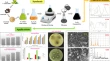
<p>CaAl<sub>2</sub>O<sub>4</sub>:(Eu, Nd)/TiO<sub>2-<it>x</it></sub>N<sub><it>y</it></sub>
 composite luminescent photocatalyst with persistent deNO<it>x</it> activity after turning
 off the light was successfully synthesized by a simple planetary ball milling process. The
 novel persistent photocatalytic behavior was related to the overlap between the absorption
 wavelength of TiO<sub>2-<it>x</it></sub>N<sub><it>y</it></sub> and the emission wavelength
 of the CaAl<sub>2</sub>O<sub>4</sub>:(Eu, Nd).</p>
<graphic file="1556-276X-6-5-i1.gif"/>
<suppl id="S1">
<title><p>Additional file 1</p></title>
<file name="1556-276X-6-5-S1.doc">
   <p>Click here for file</p>
</file>
</suppl>
</sec>
</abs>
</fm>
<bdy>
<sec><st><p>Introduction</p></st>
<p>Hot photocatalytic research attention has been focused on titania (TiO<sub>2</sub>), because of its chemical stability <abbrgrp><abbr bid="B1">1</abbr></abbrgrp>, excellent photocatalytic activity <abbrgrp><abbr bid="B2">2</abbr></abbrgrp> and low cost. However, since titania has large band gap energy of about 3.2 eV corresponding to the wavelength of 387.5 nm, it is active under irradiation of only UV light less than 400 nm of wavelength. Since the content of UV light in sun light is less than 5% <abbrgrp><abbr bid="B3">3</abbr></abbrgrp>, the development of high performance visible light responsive photocatalyst which can use main part of sunlight or indoor light is highly desired <abbrgrp><abbr bid="B4">4</abbr><abbr bid="B5">5</abbr><abbr bid="B6">6</abbr><abbr bid="B7">7</abbr></abbrgrp>. Various modifications have been devoted to TiO<sub>2</sub> in extending the absorption edge into visible light and enhancing the photocatalytic activity <abbrgrp><abbr bid="B8">8</abbr><abbr bid="B9">9</abbr><abbr bid="B10">10</abbr><abbr bid="B11">11</abbr><abbr bid="B12">12</abbr><abbr bid="B13">13</abbr></abbrgrp>, and one of them is doping TiO<sub>2</sub> with nitrogen because the band gap of titania could be narrowed by doping with nitrogen ion since the valence band of N2p band locates above O2p band <abbrgrp><abbr bid="B14">14</abbr></abbrgrp>.</p>
<p>The aluminate long afterglow phosphor (CaAl<sub>2</sub>O<sub>4</sub>:(Eu, Nd)) has characteristics of high luminescent brightness around 440 nm of wavelength, long afterglow time, good chemical stability and low toxicity <abbrgrp><abbr bid="B15">15</abbr><abbr bid="B16">16</abbr></abbrgrp>. Therefore, the coupling of TiO<sub>2</sub> with CaAl<sub>2</sub>O<sub>4</sub>:(Eu, Nd) was expected to prolong the photocatalytic activity even after turning off the light by using the persistent emitting luminescence of the long afterglow phosphor as a light source of TiO<sub>2</sub> photocatalyst. However, TiO<sub>2</sub> possessing a large bandgap energy ca. 3.2 eV can not be effectively excited by the visible light luminescence of 440 nm from CaAl<sub>2</sub>O<sub>4</sub>:(Eu, Nd). Recently, the combinations of TiO<sub>2</sub> photocatalyst with other long afterglow materials such as BaAl<sub>2</sub>O<sub>4</sub>:(Eu, Dy) <abbrgrp><abbr bid="B17">17</abbr></abbrgrp> and Sr<sub>4</sub>Al<sub>14</sub>O<sub>25</sub>:(Nd, Eu) <abbrgrp><abbr bid="B18">18</abbr></abbrgrp> were also reported. However, the emission wavelengths of these phosphors around 495 nm <abbrgrp><abbr bid="B19">19</abbr></abbrgrp> and 488 nm, respectively, are also too long to excite TiO<sub>2</sub> photocatalyst. Actually, it was reported that BaAl<sub>2</sub>O<sub>4</sub>:(Eu, Dy)/TiO<sub>2</sub> and Sr<sub>4</sub>Al<sub>14</sub>O<sub>25</sub>:(Nd, Eu)/TiO<sub>2</sub> coupled compounds showed photocatalytic performance for the oxidation of gaseous benzene and RhB solution, respectively, under UV light irradiation, but no noticeable degradation was observed after turning off the light <abbrgrp><abbr bid="B17">17</abbr></abbrgrp>.</p>
<p>In the present research, we firstly provided a direct evidence for such persistent photocatalytic deNO<it>x</it> system, by the coupling of long afterglow phosphor CaAl<sub>2</sub>O<sub>4</sub>:(Eu, Nd) with brookite type nitrogen-doped titania (TiO<sub>2-<it>x</it></sub>N<sub><it>y</it></sub>), which was produced by a hydrothermal reaction <abbrgrp><abbr bid="B20">20</abbr><abbr bid="B21">21</abbr></abbrgrp>. Brookite phase nitrogen-doped titania possessed band gap of ca. 2.34 eV and showed excellent photocatalytic deNO<it>x</it> ability even under visible light irradiation of wavelength &gt;510 nm <abbrgrp><abbr bid="B20">20</abbr></abbrgrp>. In comparison with anatase and rutile phase nitrogen-doped titania, brookite phase nitrogen-doped titania photocatalyst has seldom been reported, however, it is expected to be a potential novel photocatalyst.</p>
</sec>
<sec><st><p>Experimental Section</p></st>
<p>CaAl<sub>2</sub>O<sub>4</sub>:(Eu, Nd) powders with the particle size of 13.9 &#956;m (D<sub>50</sub>) were purchased from Nemoto Co. Ltd. Other chemicals were purchased from Kanto Chem. Co. Inc. Japan and were used as received without further purification. TiO<sub>2-<it>x</it></sub>N<sub><it>y</it></sub> nanoparticles with brookite phase were synthesized by hydrothermal reaction using TiCl<sub>3</sub> as titanium source and HMT (hexamethylenetetramine) as nitrogen source at pH 7 and 190&#176;C for 2 h <abbrgrp><abbr bid="B20">20</abbr></abbrgrp>. Brookite phase TiO<sub>2-<it>x</it></sub>N<sub><it>y</it></sub> nanoparticles were mixed with desired amounts of CaAl<sub>2</sub>O<sub>4</sub>:(Eu, Nd) powders followed by planetary ball milling at 200 rpm for 20 min. The mass ratio of CaAl<sub>2</sub>O<sub>4</sub>:(Eu, Nd):TiO<sub>2-<it>x</it></sub>N<sub><it>y</it></sub> or P25 TiO<sub>2</sub> was kept at 3/2. For comparison, undoped titania (Degussa P25) was also coupled with CaAl<sub>2</sub>O<sub>4</sub>:(Eu, Nd) by the completely same manner. The UV&#8211;vis diffuse reflectance spectra were obtained using a UV&#8211;vis spectrophotometer (Shimadazu, UV-2450). The time dependence of photoluminescence spectra and intensity were measured by a spectrofluorophotometer (Shimadzu RF-5300P).</p>
<p>The photocatalytic activity for nitrogen monoxide destruction was determined by measuring the concentration of NO gas at the outlet of the reactor (373 cm<sup>3</sup> of internal volume) during the photo-irradiation of a constantly flowing 1 ppm NO/50 vol% air mixed (balance N<sub>2</sub>) gas (200 cm<sup>3</sup>min<sup>-1</sup>). 0.16 g of CaAl<sub>2</sub>O<sub>4</sub>:(Eu, Nd)/TiO<sub>2-<it>x</it></sub>N<sub><it>y</it></sub>, TiO<sub>2-<it>x</it></sub>N<sub><it>y</it></sub> or CaAl<sub>2</sub>O<sub>4</sub>:(Eu, Nd)/P25 photocatalyst material was placed in the same area of a hollow of 40 &#215; 30 &#215; 0.5 mm on a glass holder plate and set in the bottom center of the reactor. A 450 W high-pressure mercury lamp was used as the light source, where the inner cell had water flowing through a Pyrex jacket between the mercury lamp and the reactor. The light of &#955; &lt; 290 nm wavelength was cut off by Pyrex glass <abbrgrp><abbr bid="B20">20</abbr><abbr bid="B21">21</abbr><abbr bid="B22">22</abbr></abbrgrp>. Before light irradiation, the NO gas was continuously flowed through the reactor for 10 min to achieve adsorption balance. Then, the light was irradiated for 30 min to realize the steady status of the photocatalytic NO degradation and let long afterglow phosphor CaAl<sub>2</sub>O<sub>4</sub>:(Eu, Nd) absorb enough exciting energy. After that, the light was switched off, while the NO gas was flowed further for 3 h.</p>
</sec>
<sec><st><p>Results and Discussion</p></st>
<p>Figure <figr fid="F1">1</figr> shows the diffuse reflectance spectra of undoped and nitrogen-doped titania and the emission spectrum of CaAl<sub>2</sub>O<sub>4</sub>:(Eu, Nd). CaAl<sub>2</sub>O<sub>4</sub>:(Eu, Nd) emitted blue luminescent light with a peak of 440 nm in wavelength by UV light irradiation (325 nm). Although undoped titania absorbed only UV light of the wavelength less than 400 nm, nitrogen&#8211;doped titania showed absorption of visible light up to 700 nm showing a nice overlap between the diffuse reflectance spectrum of TiO<sub>2-<it>x</it></sub>N<sub><it>y</it></sub> and the emission spectrum of CaAl<sub>2</sub>O<sub>4</sub>:(Eu, Nd). Therefore, it implied the potential possibility of CaAl<sub>2</sub>O<sub>4</sub>:(Eu, Nd)/TiO<sub>2-<it>x</it></sub>N<sub><it>y</it></sub> composite as the luminescent assisted photocatalyst which use the long after glow from the phosphor as the light source of the photocatalyst. Our previous research proved that nitrogen doped titania could be induced the photocatalytic activity by such weak LED light as 2.0 mW/cm<sup>2</sup> with long wavelength of 627 nm <abbrgrp><abbr bid="B23">23</abbr><abbr bid="B24">24</abbr></abbrgrp>. This result also strongly implied the potential application of the composite as luminescent assisted photocatalyst material.</p>
<fig id="F1"><title><p>Figure 1</p></title><caption><p>Overlap of diffuse reflectance spectra of a undoped TiO<sub>2</sub>(P25) and b TiO<sub>2-<it>x</it></sub>N<sub><it>y</it></sub> and c emission spectrum of CaAl<sub>2</sub>O<sub>4</sub>:(Eu, Nd)</p></caption><text>
   <p><b>Overlap of diffuse reflectance spectra of a undoped TiO<sub>2</sub>(P25) and b TiO<sub>2-<it>x</it></sub>N<sub><it>y</it></sub> and c emission spectrum of CaAl<sub>2</sub>O<sub>4</sub>:(Eu, Nd)</b>.</p>
</text><graphic file="1556-276X-6-5-1" hint_layout="single"/></fig>
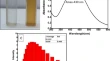
<p>Figure <figr fid="F2">2</figr> shows the emission decay profile of CaAl<sub>2</sub>O<sub>4</sub>:(Eu, Nd)/TiO<sub>2-<it>x</it></sub>N<sub><it>y</it></sub> composite. The composite showed an emission spectrum peaked at 440 nm, which was almost identical to that of CaAl<sub>2</sub>O<sub>4</sub>:(Eu, Nd), attributed to the typical 4f<sup>6</sup>5d<sup>1</sup>-4f<sup>7</sup> transition of Eu<sup>2+ </sup><abbrgrp><abbr bid="B16">16</abbr></abbrgrp>. This indicated that the even if 40% brookite TiO<sub>2-<it>x</it></sub>N<sub><it>y</it></sub> was coated on the surface of CaAl<sub>2</sub>O<sub>4</sub>:(Eu, Nd) particles, comparatively strong luminescence property of the composite was kept. Although the emission intensity decayed with time, the emission intensity about 23 mcd/mm<sup>2</sup> was retained even after 2 h.</p>
<fig id="F2"><title><p>Figure 2</p></title><caption><p>The emission decay profile of CaAl<sub>2</sub>O<sub>4</sub>:(Eu, Nd)/TiO<sub>2-<it>x</it></sub>N<sub><it>y</it></sub> composite after irradiation by the mercury lamp used for photocatalytic reactions</p></caption><text>
   <p><b>The emission decay profile of CaAl<sub>2</sub>O<sub>4</sub>:(Eu, Nd)/TiO<sub>2-<it>x</it></sub>N<sub><it>y</it></sub> composite after irradiation by the mercury lamp used for photocatalytic reactions</b>. The inset shows the decline of the intensity of the emission.</p>
</text><graphic file="1556-276X-6-5-2" hint_layout="single"/></fig>
<p>Figure <figr fid="F3">3</figr> shows the photocatalytic NO destruction behaviors of CaAl<sub>2</sub>O<sub>4</sub>:(Eu, Nd)/TiO<sub>2-<it>x</it></sub>N<sub><it>y</it></sub>, TiO<sub>2-<it>x</it></sub>N<sub><it>y</it></sub> and CaAl<sub>2</sub>O<sub>4</sub>:(Eu, Nd)/undoped TiO<sub>2</sub> (P25) under UV light irradiation and after turning off the light. It was obvious that all the samples possessed excellent photocatalytic deNO<it>x</it> activity under UV light irradiation. Although the effect was very limited, it could be actually confirmed from the data of Figure <figr fid="F3">3a, b</figr> that under irradiation of high pressure mercury lamp (The data between <it>light on</it> and <it>light off</it>), CaAl<sub>2</sub>O<sub>4</sub>:(Eu, Nd)/TiO<sub>2-<it>x</it></sub>N<sub><it>y</it></sub> luminescent photocatalyst exhibit better photocatalytic activity than that of TiO<sub>2-<it>x</it></sub>N<sub><it>y</it>.</sub>
</p>
<fig id="F3"><title><p>Figure 3</p></title><caption><p>The photocatalytic deNO<it>x</it> activity of the prepared samples during UV light irradiation for 30 min followed by turning off light, while NO gas was continuously flowed in the dark for 3 h</p></caption><text>
   <p><b>The photocatalytic deNO<it>x</it> activity of the prepared samples during UV light irradiation for 30 min followed by turning off light, while NO gas was continuously flowed in the dark for 3 h</b>. <b>a</b> CaAl<sub>2</sub>O<sub>4</sub>:(Eu, Nd)/TiO<sub>2-<it>x</it></sub>N<sub><it>y</it></sub> composite; <b>b</b> brookite phase TiO<sub>2-<it>x</it></sub>N<sub><it>y</it></sub>; <b>c</b> CaAl<sub>2</sub>O<sub>4</sub>:(Eu, Nd)/undoped TiO<sub>2</sub> (P25) composite.</p>
</text><graphic file="1556-276X-6-5-3" hint_layout="double"/></fig>
<p>The characterization system used in the present research was similar to that of the Japanese Industrial Standard which was established at the beginning of 2004 <abbrgrp><abbr bid="B25">25</abbr></abbrgrp>. In this JIS standard, it is recommended that the photocatalytic activity of photocatalyst should be characterized by measuring the decrease in the concentration of NO at the outlet of a continuous reactor. One ppm of NO gas with a flow rate of 3.0 dm<sup>3</sup>/min is introduced to a reactor then irradiated by a lamp with light wavelength of 300&#8211;400 nm. The mechanism of photocatalytic deNO<it>x</it> had been researched carefully by M.Anpo <abbrgrp><abbr bid="B26">26</abbr></abbrgrp>. During the deNO<it>x</it> photocatalytic reaction, the nitrogen monoxide reacts with these reactive oxygen radicals, molecular oxygen, and very small amount of water in air to produce HNO<sub>2</sub> or HNO<sub>3</sub>. It was confirmed that about 20% of nitrogen monoxide was decomposed to nitrogen and oxygen directly <abbrgrp><abbr bid="B26">26</abbr></abbrgrp> Because a continuous reaction system was utilized in the deNO<it>x</it> characterization <abbrgrp><abbr bid="B20">20</abbr><abbr bid="B21">21</abbr></abbrgrp>, after turning off the light, it took about 10 min (total 50 min from the start of the characterization) to achieve diffusion balance and return to the initial NO concentration.</p>
<p>The degree of NO destruction by TiO<sub>2-<it>x</it></sub>N<sub><it>y</it></sub> and CaAl<sub>2</sub>O<sub>4</sub>:(Eu, Nd)/undoped TiO<sub>2</sub> (P25) immediately decreased after turning off the light, however, as-expected, CaAl<sub>2</sub>O<sub>4</sub>:(Eu, Nd)/TiO<sub>2-<it>x</it></sub>N<sub><it>y</it></sub> retained the NO destruction ability for about 3 h. Since the decay profile of the NO destruction degree of CaAl<sub>2</sub>O<sub>4</sub>:(Eu, Nd)/TiO<sub>2-<it>x</it></sub>N<sub><it>y</it></sub> was similar to the emission decay profile shown in Figure <figr fid="F2">2</figr>, it might be concluded that the emission by CaAl<sub>2</sub>O<sub>4</sub>:(Eu, Nd) was used as a light source to excite TiO<sub>2-<it>x</it></sub>N<sub><it>y</it></sub> photocatalyst. It was also confirmed that CaAl<sub>2</sub>O<sub>4</sub>:(Eu, Nd)/TiO<sub>2-<it>x</it></sub>N<sub><it>y</it></sub> composite consisted of 40% brookite TiO<sub>2-<it>x</it></sub>N<sub><it>y</it></sub> (mass ratio of CaAl<sub>2</sub>O<sub>4</sub>:(Eu, Nd)/TiO<sub>2-<it>x</it></sub>N<sub><it>y</it></sub> = 3/2) possessed the best performance after turning off the light.</p>
<p>Present results indicate that the combination of CaAl<sub>2</sub>O<sub>4</sub>:(Eu, Nd) and TiO<sub>2-<it>x</it></sub>N<sub><it>y</it></sub> is a key point to realize the persistent catalytic activity even after turning off the light. In addition, it is well known that the combination of the two different band structure compounds may cause the charge transfer on the photocatalyst surface to depress the recombination of photo-induced electrons and holes, which is helpful for the improvement of photocatalytic activity <abbrgrp><abbr bid="B27">27</abbr><abbr bid="B28">28</abbr></abbrgrp>. This novel system provides a possibility of atmosphere purification not only in day time, but also in night time. A promising strategy involves coupling of visible light induced photocatalyst with long afterglow phosphor might be established. It is a new concept for the photocatalyst synthesis and applications.</p>
</sec>
<sec><st><p>Conclusion</p></st>
<p>A novel CaAl<sub>2</sub>O<sub>4</sub>:(Eu, Nd)/TiO<sub>2-<it>x</it></sub>N<sub><it>y</it></sub> composite luminescent photocatalyst was successfully synthesized. Not only the UV-light induced photocatalytic activity, but also the persistent catalytic ability after turning off the light was realized successfully. The CaAl<sub>2</sub>O<sub>4</sub>:(Eu, Nd)/TiO<sub>2-<it>x</it></sub>N<sub><it>y</it></sub> composite photocatalyst provided enough luminescence intensity for the photocatalytic reaction for more than 3 h after turning off the light source.</p>
</sec>
</bdy>
<bm>
<ack>
<sec><st><p>Acknowledgements</p></st>
<p>This research was carried out as one of the projects under the Special Education and Research Expenses on "Post-Silicon Materials and Devices Research Alliance", supported by Grant-in-Aid for Science Research (No. 20360293 &amp; No. 22651022).</p>
</sec>
</ack>
<refgrp><bibl id="B1"><aug><au><snm>Li</snm><fnm>Y</fnm></au><au><snm>Sun</snm><fnm>X</fnm></au><au><snm>Li</snm><fnm>H</fnm></au><au><snm>Wang</snm><fnm>S</fnm></au><au><snm>Wei</snm><fnm>Y</fnm></au></aug><source>Powder Technol</source><pubdate>2009</pubdate><volume>194</volume><fpage>149</fpage><lpage>152</lpage><xrefbib><pubid idtype="doi">10.1016/j.powtec.2009.03.041</pubid></xrefbib></bibl><bibl id="B2"><aug><au><snm>Kim</snm><fnm>D</fnm></au><au><snm>Kwak</snm><fnm>S</fnm></au></aug><source>Appl Catal A-Gen</source><pubdate>2007</pubdate><volume>323</volume><fpage>110</fpage><lpage>118</lpage><xrefbib><pubid idtype="doi">10.1016/j.apcata.2007.02.010</pubid></xrefbib></bibl><bibl id="B3"><aug><au><snm>Tafen</snm><fnm>D</fnm></au><au><snm>Wang</snm><fnm>J</fnm></au><au><snm>Wu</snm><fnm>N</fnm></au><au><snm>Lewis</snm><fnm>J</fnm></au></aug><source>Appl Phys Lett</source><pubdate>2009</pubdate><volume>94</volume><fpage>093101</fpage><xrefbib><pubid idtype="doi">10.1063/1.3093820</pubid></xrefbib></bibl><bibl id="B4"><aug><au><snm>Yin</snm><fnm>S</fnm></au><au><snm>Zhang</snm><fnm>Q</fnm></au><au><snm>Saito</snm><fnm>F</fnm></au><au><snm>Sato</snm><fnm>T</fnm></au></aug><source>Chem Lett</source><pubdate>2003</pubdate><volume>32</volume><fpage>358</fpage><lpage>359</lpage><xrefbib><pubid idtype="doi">10.1246/cl.2003.358</pubid></xrefbib></bibl><bibl id="B5"><aug><au><snm>Yin</snm><fnm>S</fnm></au><au><snm>Yamaki</snm><fnm>H</fnm></au><au><snm>Komatsu</snm><fnm>M</fnm></au><au><snm>Zhang</snm><fnm>Q</fnm></au><au><snm>Wang</snm><fnm>J</fnm></au><au><snm>Tang</snm><fnm>Q</fnm></au><au><snm>Saito</snm><fnm>F</fnm></au><au><snm>Sato</snm><fnm>T</fnm></au></aug><source>J Mater Chem</source><pubdate>2003</pubdate><volume>13</volume><fpage>2996</fpage><lpage>3001</lpage><xrefbib><pubid idtype="doi">10.1039/b309217h</pubid></xrefbib></bibl><bibl id="B6"><aug><au><snm>Wang</snm><fnm>J</fnm></au><au><snm>Yin</snm><fnm>S</fnm></au><au><snm>Zhang</snm><fnm>Q</fnm></au><au><snm>Saito</snm><fnm>F</fnm></au><au><snm>Sato</snm><fnm>T</fnm></au></aug><source>J Mater Chem</source><pubdate>2003</pubdate><volume>13</volume><fpage>2348</fpage><lpage>2352</lpage><xrefbib><pubid idtype="doi">10.1039/b303420h</pubid></xrefbib></bibl><bibl id="B7"><aug><au><snm>Aita</snm><fnm>Y</fnm></au><au><snm>Komatsu</snm><fnm>M</fnm></au><au><snm>Yin</snm><fnm>S</fnm></au><au><snm>Sato</snm><fnm>T</fnm></au></aug><source>J Solid State Chem</source><pubdate>2004</pubdate><volume>177</volume><fpage>3235</fpage><lpage>3238</lpage><xrefbib><pubid idtype="doi">10.1016/j.jssc.2004.04.048</pubid></xrefbib></bibl><bibl id="B8"><aug><au><snm>Moon</snm><fnm>J</fnm></au><au><snm>Yun</snm><fnm>C</fnm></au><au><snm>Chung</snm><fnm>K</fnm></au><au><snm>Kang</snm><fnm>M</fnm></au><au><snm>Yi</snm><fnm>J</fnm></au></aug><source>Catal Today</source><pubdate>2003</pubdate><volume>87</volume><fpage>77</fpage><lpage>86</lpage><xrefbib><pubid idtype="doi">10.1016/j.cattod.2003.10.009</pubid></xrefbib></bibl><bibl id="B9"><aug><au><snm>Cho</snm><fnm>Y</fnm></au><au><snm>Kyung</snm><fnm>H</fnm></au><au><snm>Choi</snm><fnm>W</fnm></au></aug><source>Appl Catal B:Environ</source><pubdate>2004</pubdate><volume>52</volume><fpage>23</fpage><lpage>32</lpage><xrefbib><pubid idtype="doi">10.1016/j.apcatb.2004.03.013</pubid></xrefbib></bibl><bibl id="B10"><aug><au><snm>Kaur</snm><fnm>S</fnm></au><au><snm>Singh</snm><fnm>V</fnm></au></aug><source>Ultrason Sonochem</source><pubdate>2007</pubdate><volume>14</volume><fpage>531</fpage><lpage>537</lpage><xrefbib><pubidlist><pubid idtype="doi">10.1016/j.ultsonch.2006.09.015</pubid><pubid idtype="pmpid" link="fulltext">17289421</pubid><pubid idtype="pubmed">17289421</pubid></pubidlist></xrefbib></bibl><bibl id="B11"><aug><au><snm>Liu</snm><fnm>S</fnm></au><au><snm>Chen</snm><fnm>X</fnm></au></aug><source>J Hazard Mater</source><pubdate>2008</pubdate><volume>152</volume><fpage>48</fpage><lpage>55</lpage><xrefbib><pubidlist><pubid idtype="doi">10.1016/j.jhazmat.2007.06.062</pubid><pubid idtype="pmpid" link="fulltext">17673365</pubid><pubid idtype="pubmed">17673365</pubid></pubidlist></xrefbib></bibl><bibl id="B12"><aug><au><snm>Chen</snm><fnm>F</fnm></au><au><snm>Zou</snm><fnm>W</fnm></au><au><snm>Qu</snm><fnm>W</fnm></au><au><snm>Zhang</snm><fnm>J</fnm></au></aug><source>Catal Commun</source><pubdate>2009</pubdate><volume>10</volume><fpage>1510</fpage><lpage>1513</lpage><xrefbib><pubid idtype="doi">10.1016/j.catcom.2009.04.005</pubid></xrefbib></bibl><bibl id="B13"><aug><au><snm>Jirapat</snm><fnm>A</fnm></au><au><snm>Puangrat</snm><fnm>K</fnm></au><au><snm>Supapan</snm><fnm>S</fnm></au></aug><source>J Hazard Mater</source><pubdate>2009</pubdate><volume>168</volume><fpage>253</fpage><lpage>261</lpage><xrefbib><pubidlist><pubid idtype="doi">10.1016/j.jhazmat.2009.02.036</pubid><pubid idtype="pmpid" link="fulltext">19282105</pubid></pubidlist></xrefbib></bibl><bibl id="B14"><aug><au><snm>Asahi</snm><fnm>R</fnm></au><au><snm>Morikawa</snm><fnm>T</fnm></au><au><snm>Ohwaki</snm><fnm>T</fnm></au><au><snm>Aoki</snm><fnm>K</fnm></au><au><snm>Tage</snm><fnm>Y</fnm></au></aug><source>Science</source><pubdate>2001</pubdate><volume>293</volume><fpage>269</fpage><lpage>271</lpage><xrefbib><pubidlist><pubid idtype="doi">10.1126/science.1061051</pubid><pubid idtype="pmpid" link="fulltext">11452117</pubid><pubid idtype="pubmed">11452117</pubid></pubidlist></xrefbib></bibl><bibl id="B15"><aug><au><snm>Chang</snm><fnm>C</fnm></au><au><snm>Xu</snm><fnm>J</fnm></au><au><snm>Jiang</snm><fnm>L</fnm></au><au><snm>Mao</snm><fnm>D</fnm></au><au><snm>Ying</snm><fnm>W</fnm></au></aug><source>Mater Chem Phys</source><pubdate>2006</pubdate><volume>98</volume><fpage>509</fpage><lpage>513</lpage><xrefbib><pubid idtype="doi">10.1016/j.matchemphys.2005.09.069</pubid></xrefbib></bibl><bibl id="B16"><aug><au><snm>Zhao</snm><fnm>C</fnm></au><au><snm>Chen</snm><fnm>D</fnm></au></aug><source>Mater Lett</source><pubdate>2007</pubdate><volume>61</volume><fpage>3673</fpage><lpage>3675</lpage><xrefbib><pubid idtype="doi">10.1016/j.matlet.2006.12.015</pubid></xrefbib></bibl><bibl id="B17"><aug><au><snm>Li</snm><fnm>S</fnm></au><au><snm>Wang</snm><fnm>W</fnm></au><au><snm>Chen</snm><fnm>Y</fnm></au><au><snm>Zhang</snm><fnm>L</fnm></au><au><snm>Guo</snm><fnm>J</fnm></au><au><snm>Gong</snm><fnm>M</fnm></au></aug><source>Catal Commun</source><pubdate>2009</pubdate><volume>10</volume><fpage>1048</fpage><lpage>1051</lpage><xrefbib><pubid idtype="doi">10.1016/j.catcom.2008.12.064</pubid></xrefbib></bibl><bibl id="B18"><aug><au><snm>Zhang</snm><fnm>J</fnm></au><au><snm>Pan</snm><fnm>F</fnm></au><au><snm>Hao</snm><fnm>W</fnm></au><au><snm>Ge</snm><fnm>Q</fnm></au><au><snm>Wang</snm><fnm>T</fnm></au></aug><source>Appl Phys Lett</source><pubdate>2004</pubdate><volume>85</volume><fpage>5778</fpage><lpage>5780</lpage><xrefbib><pubid idtype="doi">10.1063/1.1833554</pubid></xrefbib></bibl><bibl id="B19"><aug><au><snm>Chen</snm><fnm>X</fnm></au><au><snm>Ma</snm><fnm>C</fnm></au><au><snm>Li</snm><fnm>X</fnm></au><au><snm>Shi</snm><fnm>C</fnm></au><au><snm>Li</snm><fnm>X</fnm></au><au><snm>Lu</snm><fnm>D</fnm></au></aug><source>J Phys Chem C</source><pubdate>2009</pubdate><volume>113</volume><fpage>2685</fpage><lpage>2689</lpage><xrefbib><pubid idtype="doi">10.1021/jp806375p</pubid></xrefbib></bibl><bibl id="B20"><aug><au><snm>Yin</snm><fnm>S</fnm></au><au><snm>Aita</snm><fnm>Y</fnm></au><au><snm>Komatsu</snm><fnm>M</fnm></au><au><snm>Wang</snm><fnm>J</fnm></au><au><snm>Tang</snm><fnm>Q</fnm></au><au><snm>Sato</snm><fnm>T</fnm></au></aug><source>J Mater Chem</source><pubdate>2005</pubdate><volume>15</volume><fpage>674</fpage><lpage>682</lpage><xrefbib><pubid idtype="doi">10.1039/b413377c</pubid></xrefbib></bibl><bibl id="B21"><aug><au><snm>Yin</snm><fnm>S</fnm></au><au><snm>Hasegawa</snm><fnm>H</fnm></au><au><snm>Maeda</snm><fnm>D</fnm></au><au><snm>Ishitsuka</snm><fnm>M</fnm></au><au><snm>Sato</snm><fnm>T</fnm></au></aug><source>J Photoch Photobio A: Chem</source><pubdate>2004</pubdate><volume>163</volume><fpage>1</fpage><lpage>8</lpage><xrefbib><pubid idtype="doi">10.1016/S1010-6030(03)00289-2</pubid></xrefbib></bibl><bibl id="B22"><aug><au><snm>Gateshki</snm><fnm>M</fnm></au><au><snm>Yin</snm><fnm>S</fnm></au><au><snm>Ren</snm><fnm>Y</fnm></au><au><snm>Petkov</snm><fnm>V</fnm></au></aug><source>Chem Mater</source><pubdate>2007</pubdate><volume>19</volume><fpage>2512</fpage><lpage>2518</lpage><xrefbib><pubid idtype="doi">10.1021/cm0630587</pubid></xrefbib></bibl><bibl id="B23"><aug><au><snm>Yin</snm><fnm>S</fnm></au><au><snm>Zhang</snm><fnm>P</fnm></au><au><snm>Liu</snm><fnm>B</fnm></au><au><snm>Liu</snm><fnm>X</fnm></au><au><snm>Sato</snm><fnm>T</fnm></au><au><snm>Xue</snm><fnm>D</fnm></au><au><snm>Lee</snm><fnm>S</fnm></au></aug><source>Res Chem Intermed</source><pubdate>2010</pubdate><volume>36</volume><fpage>69</fpage><lpage>75</lpage><xrefbib><pubid idtype="doi">10.1007/s11164-010-0115-8</pubid></xrefbib></bibl><bibl id="B24"><aug><au><snm>Yin</snm><fnm>S</fnm></au><au><snm>Liu</snm><fnm>B</fnm></au><au><snm>Zhang</snm><fnm>P</fnm></au><au><snm>Morikawa</snm><fnm>T</fnm></au><au><snm>Yamanaka</snm><fnm>K</fnm></au><au><snm>Sato</snm><fnm>T</fnm></au></aug><source>J Phys Chem C</source><pubdate>2008</pubdate><volume>112</volume><fpage>12425</fpage><lpage>12431</lpage><xrefbib><pubid idtype="doi">10.1021/jp803371s</pubid></xrefbib></bibl><bibl id="B25"><title><p>Japanese Industrial Standard (JIS R 1701-1:2004(J)), Test method for air purification performance of photocatalytic materials&#8212;part 1: removal of nitric oxide, Japanese Standards Association, Established on 20-Jan-2004</p></title></bibl><bibl id="B26"><title><p>"Recent Development on Visible Light Response Type Photocatalyst"</p></title><aug><au><snm>Anpo</snm><fnm>M</fnm></au></aug><publisher>NTS, Tokyo</publisher><pubdate>2002</pubdate><fpage>9</fpage><note>(ISBN4-86043-009-03)</note></bibl><bibl id="B27"><aug><au><snm>Wang</snm><fnm>J</fnm></au><au><snm>Xie</snm><fnm>Y</fnm></au><au><snm>Zhang</snm><fnm>Z</fnm></au><au><snm>Li</snm><fnm>J</fnm></au><au><snm>Chen</snm><fnm>X</fnm></au><au><snm>Zhang</snm><fnm>L</fnm></au><au><snm>Xu</snm><fnm>R</fnm></au><au><snm>Zhang</snm><fnm>X</fnm></au></aug><source>Sol Energ Mat Sol C</source><pubdate>2009</pubdate><volume>93</volume><fpage>355</fpage><lpage>361</lpage><xrefbib><pubid idtype="doi">10.1016/j.solmat.2008.11.017</pubid></xrefbib></bibl><bibl id="B28"><aug><au><snm>Kamei</snm><fnm>M</fnm></au><au><snm>Miyagi</snm><fnm>T</fnm></au><au><snm>Ishigaki</snm><fnm>T</fnm></au></aug><source>Chem Phys Lett</source><pubdate>2005</pubdate><volume>407</volume><fpage>209</fpage><lpage>212</lpage><xrefbib><pubid idtype="doi">10.1016/j.cplett.2005.03.075</pubid></xrefbib></bibl></refgrp>
</bm>
</art>