<?xml version='1.0'?>
<!DOCTYPE art SYSTEM 'http://www.biomedcentral.com/xml/article.dtd'>
<art>
<ui>1556-276X-6-45</ui>
<ji>1556-276X</ji>
<fm>
<dochead>Nano Express</dochead>
<bibl>
<title><p>A Novel Way for Synthesizing Phosphorus-Doped Zno Nanowires</p></title>
<aug>
<au id="A1"><snm>Gao</snm><fnm>Jingyun</fnm><insr iid="I1"/></au>
<au ca="yes" id="A2"><snm>Zhao</snm><fnm>Qing</fnm><insr iid="I1"/><email>zhaoqing@pku.edu.cn</email></au>
<au id="A3"><snm>Sun</snm><fnm>Yanghui</fnm><insr iid="I1"/></au>
<au id="A4"><snm>Li</snm><fnm>Guo</fnm><insr iid="I1"/></au>
<au id="A5"><snm>Zhang</snm><fnm>Jingmin</fnm><insr iid="I1"/></au>
<au ca="yes" id="A6"><snm>Yu</snm><fnm>Dapeng</fnm><insr iid="I1"/><email>yudp@pku.edu.cn</email></au>
</aug>
<insg>
<ins id="I1"><p>State Key Laboratory for Mesoscopic Physics, and Electron Microscopy Laboratory, School of Physics, Peking University, 100871, Beijing, Peoples's Republic of China</p></ins>
</insg>
<source>Nanoscale Res Lett</source>
<issn>1556-276X</issn>
<pubdate>2011</pubdate>
<volume>6</volume>
<issue>1</issue>
<fpage>45</fpage>
<url>http://www.nanoscalereslett.com/content/6/1/45</url>
<xrefbib><pubid idtype="doi">10.1007/s11671-010-9805-9</pubid></xrefbib>
</bibl>
<history><rec><date><day>22</day><month>7</month><year>2010</year></date></rec><acc><date><day>14</day><month>9</month><year>2010</year></date></acc><pub><date><day>28</day><month>9</month><year>2010</year></date></pub></history>
<cpyrt><year>2010</year><collab>Gao et al.</collab><note>This is an Open Access article distributed under the terms of the Creative Commons Attribution License (<url>http://creativecommons.org/licenses/by/2.0</url>), which permits unrestricted use, distribution, and reproduction in any medium, provided the original work is properly cited.</note></cpyrt>
<kwdg>
<kwd>ZnO</kwd>
<kwd>Nanowires</kwd>
<kwd>P-doped</kwd>
<kwd>Zinc phosphate</kwd>
</kwdg>
<abs>
<sec><st><p>Abstract</p></st>
<p>We developed a novel approach to synthesize phosphorus (P)-doped ZnO nanowires by directly decomposing zinc phosphate powder. The samples were demonstrated to be P-doped ZnO nanowires by using scanning electron microscopy, high-resolution transmission electron microscopy, X-ray diffraction spectra, X-ray photoelectron spectroscopy, energy dispersive spectrum, Raman spectra and photoluminescence measurements. The chemical state of P was investigated by electron energy loss spectroscopy (EELS) analyses in individual ZnO nanowires. P was found to substitute at oxygen sites (P<sub>O</sub>), with the presence of anti-site P on Zn sites (P<sub>Zn</sub>). P-doped ZnO nanowires were high resistance and the related P-doping mechanism was discussed by combining EELS results with electrical measurements, structure characterization and photoluminescence measurements. Our method provides an efficient way of synthesizing P-doped ZnO nanowires and the results help to understand the P-doping mechanism.</p>
</sec>
</abs>
</fm>
<bdy>
<sec><st><p>Introduction</p></st>
<p>As a kind of very potential candidate material for future short-wavelength optoelectronic devices, zinc oxide (ZnO) has stimulated intensive research interest in the past decades <abbrgrp><abbr bid="B1">1</abbr></abbrgrp>. However, commercialization of ZnO remains in doubt due to great difficulties in achieving stable p-type-doped ZnO because of low doping efficiency <abbrgrp><abbr bid="B2">2</abbr></abbrgrp> and instability of dopant in ZnO <abbrgrp><abbr bid="B3">3</abbr></abbrgrp>. Phosphorus (P) has been proved to be one of the best dopant for p-type doping in ZnO; however, the doping mechanism remains controversial <abbrgrp><abbr bid="B4">4</abbr></abbrgrp>. P has at least two stable configurations: complex (P<sub>Zn</sub> + 2V<sub>Zn</sub>) formed by combination between antisite substitutional P (P<sub>Zn</sub>) and two zinc vacancies (V<sub>Zn</sub>); substitutional P at oxygen sites (P<sub>O</sub>) <abbrgrp><abbr bid="B4">4</abbr></abbrgrp>. P<sub>Zn</sub> + 2V<sub>Zn</sub> were believed to be the effective configuration for p-type doping, which induces a shallow acceptor level in the band gap, while P<sub>O</sub> was suggested to induce relatively deep acceptor level, not resulting in sufficient hole concentration in ZnO. Most of the p-type conductivity observed in P-doped ZnO is attributed to P<sub>Zn</sub> + 2V<sub>Zn</sub> until now <abbrgrp><abbr bid="B5">5</abbr><abbr bid="B6">6</abbr></abbrgrp> and high resistance of P-doped ZnO is always believed to be induced by P<sub>O </sub><abbrgrp><abbr bid="B7">7</abbr></abbrgrp>. However, experimental evidence for such assignment is rarely reported.</p>
<p>As building blocks for next generation nano-optoelectronic devices, p-type ZnO nanowires have attracted considerable attention recently <abbrgrp><abbr bid="B8">8</abbr><abbr bid="B9">9</abbr></abbrgrp>. P-doped p-type ZnO nanowires have been obtained by simple chemical vapor deposition method <abbrgrp><abbr bid="B10">10</abbr></abbrgrp>, direct carbothermal method <abbrgrp><abbr bid="B11">11</abbr></abbrgrp>, pulsed-laser deposition (PLD) <abbrgrp><abbr bid="B12">12</abbr></abbrgrp>, thermal evaporation <abbrgrp><abbr bid="B13">13</abbr></abbrgrp>, diffusion method <abbrgrp><abbr bid="B14">14</abbr></abbrgrp> and hydrothermal method <abbrgrp><abbr bid="B15">15</abbr></abbrgrp>. However, in all above reports, the configuration of incorporated P was not determined, leaving the doping mechanism unclear. Meanwhile, carbon (C), which was introduced more or less in most of the methods reported above, was demonstrated to be a big obstacle to realize p-type ZnO by forming n-type domains such as graphite clusters along the grain boundaries <abbrgrp><abbr bid="B16">16</abbr></abbrgrp>. Thus, a kind of C-free method is highly needed to be more effective in p-type doping of ZnO.</p>
<p>In this work, a novel C-free approach was developed to synthesize P-doped ZnO nanowires. The configuration of incorporated P in ZnO was achieved from individual ZnO nanowires by electron energy loss spectroscopy (EELS) analyses. Possible P-doping mechanism was investigated by combining EELS results with electrical measurements.</p>
</sec>
<sec><st><p>Experimental Section</p></st>
<p>ZnO nanowires were synthesized by directly decomposing zinc phosphate powder. Pure zinc phosphate powder (99%) was loaded in an alumina boat. The purity of zinc phosphate is rather low; however, as pointed out by the manufacturer, the main impurities in zinc phosphate are other compounds composed of phosphorus and zinc such as zinc pyrophosphate, as well as some lead, iron and other heavy metals. In addition, we checked the purity of zinc phosphate by EDS measurements, and no other elements can be detected except oxygen, zinc and phosphorus. We also checked the purity of the nanowires after growth by XPS, EDS and EELS measurements and we did not find other elements. As a result, we think that the impurity in the source does not affect the properties of nanowires severely. A piece of (001) sapphire slice was placed above the zinc phosphate powder as the collecting substrate. Then, the boat was placed at the center of a quartz tube and inserted into a rapid heating furnace. Argon was used to clean the furnace for 10 min and then set to 200 sccm as carrier gas during growth. The furnace was heated up to 1,050&#176;C in 20 min and held for 1 min and then cooled down to room temperature naturally. Oxygen (2.6 sccm) was added as the reactive gas when the furnace temperature reached 1,050&#176;C. After growth, the substrate was covered by a layer of wax-like product.</p>
<p>The samples were characterized by using scanning electron microscopy (SEM) (Quanta 200FEG), high-resolution transmission electron microscopy (HRTEM) (Tecnai F30) and energy dispersive spectrum (EDS). Raman spectra excited by a 514 nm laser (Renishaw inVia Raman Microscope Raman system) and photoluminescence (PL) using a He&#8211;Cd laser with a wavelength of 325 nm were measured. X-ray photoelectron spectroscopy (XPS) (AXIS-Ultra instrument, Kratos Analytical) analysis was carried out to investigate the chemical states of phosphorus in ZnO. EELS analyses were performed to determine the configuration of incorporated P in ZnO lattice.</p>
</sec>
<sec><st><p>Results and Discussion</p></st>
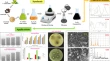
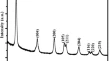
<p>Figure <figr fid="F1">1a</figr> shows a typical SEM image of the as-grown P-doped ZnO nanowires. The substrate is covered with nanowires with length up to several tens of micrometers and diameter in a range from tens to hundreds nanometers. All peaks in the X-ray diffraction (XRD) spectrum of the as-grown samples (Figure <figr fid="F1">1b</figr>) correspond to ZnO lattice, and no additional peak related to secondary phase appears, indicating purity of our sample. XPS results (Figure <figr fid="F1">1c</figr>) show P peak at 133.56 eV, proving preliminarily the incorporation of P into the as-grown nanowires.</p>
<fig id="F1"><title><p>Figure 1</p></title><caption><p>a SEM image, b XRD spectrum and c XPS spectrum of P-doped ZnO nanowires</p></caption><text>
   <p><b>a SEM image, b XRD spectrum and c XPS spectrum of P-doped ZnO nanowires</b>. The inset of <b>b</b> shows the detail of the peaks suppressed by (002) peak <b>d</b> Low-magnification TEM image and <b>e</b> HRTEM image of a typical P-doped ZnO nanowire. Inset of <b>e</b>: electron diffraction pattern of the nanowire <b>f</b> EDS spectrum of an individual P-doped ZnO nanowire.</p>
</text><graphic file="1556-276X-6-45-1" hint_layout="double"/></fig>
<p>Low-magnification TEM image of a typical P-doped nanowire is shown in Figure <figr fid="F1">1d</figr>. The P-doped nanowires have a uniform diameter about 100 nm from bottom to top and a smooth surface with no cluster attached on it. High-resolution TEM image (Figure <figr fid="F1">1e</figr>) shows that the as-grown P-doped ZnO nanowires are single crystal without amorphous layer on the surface. The lattice spacing along the growth direction is 0.52 nm, corresponding to the planar spacing between two (001) planes of ZnO, which indicates that the as-grown samples are ZnO nanowires rather than Zn<sub>3</sub>P<sub>2</sub> or other phases. As shown in the electron diffraction pattern in the inset of Figure <figr fid="F1">1e</figr>, the P-doped ZnO nanowires grow along [001] axis. No second phase or cluster could be detected in the electron diffraction pattern. Zn and O peaks dominate the EDS spectrum from a single P-doped ZnO nanowire (Figure <figr fid="F1">1f</figr>) with P signal, indicating the existence of P in individual nanowires. The peak of C and Cu comes from copper grid and Fe and Co and Ni are from Tecnai F30. By analyzing the EDS spectrum, the content of phosphorus in the nanowire was quantified as P: Zn = 1.4% (Atomic Ratio), corresponding to the P concentration of ~10<sup>20</sup> cm<sup>-3</sup>.</p>
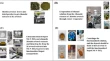
<p>Raman and PL measurements were carried out to characterize the quality of the as-grown P-doped ZnO nanowires. There are two common peaks in ZnO Raman spectra: one at 437 cm<sup>-1</sup> corresponding to E<sub>2H</sub> mode and one broad peak at 580 cm<sup>-1</sup>, which is a combination of E<sub>1LO</sub> and A<sub>1LO</sub> modes and usually been found to be enhanced by disorder <abbrgrp><abbr bid="B17">17</abbr></abbrgrp>. As shown in Figure <figr fid="F2">2a</figr>, only the peak at 437 cm<sup>-1</sup> appears in the Raman spectra of P-doped ZnO nanowires. The absence of 580 cm<sup>-1</sup> peak is a signal of good ZnO lattice quality grown by this method.</p>
<fig id="F2"><title><p>Figure 2</p></title><caption><p>a Raman spectra of P-doped ZnO nanowires b PL spectra of P-doped ZnO nanowires at room temperature</p></caption><text>
   <p><b>a Raman spectra of P-doped ZnO nanowires b PL spectra of P-doped ZnO nanowires at room temperature</b>. Inset: detail of the defect-related emission part in PL <b>c</b> Atomic configurations of P<sub>O</sub> and P<sub>Zn</sub> + 2V<sub>Zn</sub> in ZnO, respectively. <it>Big red balls</it> represent oxygen atoms and <it>small gray balls</it> represent zinc atoms. Phosphorus atoms and Zinc vacancy are marked by P and V<sub>Zn</sub>, respectively <b>d</b> EELS spectra obtained at the P L<sub>23</sub> peak in P-doped ZnO nanowires with the referenced P L<sub>23</sub> peaks in Zn<sub>3</sub>(PO<sub>4</sub>)<sub>2</sub>, P<sub>2</sub>O<sub>5</sub> and Zn<sub>3</sub>P<sub>2</sub>, respectively.</p>
</text><graphic file="1556-276X-6-45-2" hint_layout="double"/></fig>
<p>In Figure <figr fid="F2">2b</figr>, the PL spectrum of P-doped ZnO nanowires at room temperature has only one peak centered at 380 nm, which is the near band edge (NBE) emission due to recombination of free excitons (FX). No defect-related emission is observed, especially the commonly observed peak at 520 nm caused by oxygen vacancy and the peak around 480 nm caused by zinc vacancy <abbrgrp><abbr bid="B18">18</abbr></abbrgrp>. Magnified spectrum from 475~625 nm part (inset of Figure <figr fid="F2">2b</figr>) demonstrates that the defect-related emission disappears. The absence of such defect-related emission suggests the good quality of the as-synthesized P-doped ZnO nanowires.</p>
<p>Hereto, successful synthesis of P-doped ZnO nanowires by decomposing zinc phosphate powder was demonstrated. Next, we investigated the configuration and chemical state of incorporated P in the as-grown P-doped ZnO nanowires by EELS analyses, which can give information of chemical valence and neighboring environment. Atomic configurations of P<sub>O</sub> and P<sub>Zn</sub> + 2V<sub>Zn</sub> in ZnO are shown in Figure <figr fid="F2">2c</figr>. P L<sub>23</sub> peak appears in the EELS spectra (Tecnai F30 together with a Gatan imaging filter) of P-doped ZnO nanowires (Figure <figr fid="F2">2d</figr>), which is a evidence for the incorporation of P in ZnO nanowires. P L<sub>23</sub> peak in Zn<sub>3</sub>P<sub>2</sub>, P<sub>2</sub>O<sub>5</sub> and Zn<sub>3</sub>(PO<sub>4</sub>)<sub>2</sub> was also measured for comparison and shown in Figure <figr fid="F2">2d</figr> as well, where P adopts chemical valence -3, +5 and +5, respectively. For reference samples, Zn<sub>3</sub>P<sub>2</sub> nanowires, P<sub>2</sub>O<sub>5</sub> powder and Zn<sub>3</sub> (PO<sub>4</sub>)<sub>2</sub> powder were used, respectively. From Figure <figr fid="F2">2d</figr>, it can be seen that the P L<sub>23</sub> peak from P<sub>2</sub>O<sub>5</sub> is almost the same as those from Zn<sub>3</sub>(PO<sub>4</sub>)<sub>2</sub>, because of the same chemical valence of P. The peak around 136 eV is demonstrated to be associated with +5 state of P <abbrgrp><abbr bid="B19">19</abbr></abbrgrp>. In Figure <figr fid="F2">2d</figr>, the one mostly similar to the P L<sub>23</sub> peak in P-doped ZnO nanowires is those from Zn<sub>3</sub>P<sub>2</sub>, with a little difference on the intensity of the peak around 129 eV. The peak at 129 eV is attributable to the -3 state of P <abbrgrp><abbr bid="B19">19</abbr></abbrgrp>. The appearance of the peak at 129 eV and the agreement between the P L<sub>23</sub> peak from P-doped ZnO nanowires and Zn<sub>3</sub>P<sub>2</sub> demonstrate that a part of P in P-doped ZnO nanowires adopts chemical valences of -3 as in Zn<sub>3</sub>P<sub>2 </sub><abbrgrp><abbr bid="B19">19</abbr></abbrgrp>, corresponding to substitutional P at an O site, forming Zn&#8211;P bonds with surrounding Zn atoms. The intensity difference between P L<sub>23</sub> peaks from P-doped ZnO nanowires and Zn<sub>3</sub>P<sub>2</sub> results from the difference between the fine configurations of P in these two cases. In addition, the peak at 136 eV related to +5 state of P also appeared in EELS spectrum of P L<sub>23</sub> peak from P-doped ZnO nanowires, indicating the presence of antisite P with chemical valence of +5. The role of PO and P<sub>Zn</sub> will be discussed after the electrical measurements section.</p>
<p>EELS has been wildly used to investigate the chemical environment of magnetic dopant in ZnO <abbrgrp><abbr bid="B20">20</abbr><abbr bid="B21">21</abbr></abbrgrp>, while there is no report of EELS analyses on p-type dopant mainly due to low doping concentration. As an alternative, X-ray photoelectron spectroscopy (XPS) was always used to characterize the chemical state of dopant. However, as we know, XPS reflects the mixed information from the entire substrate, which cannot be corresponded to state of dopant in individual nanowire. Compared to XPS, EELS analyses on individual nanowire provide unambiguous information about the chemical state of dopant in single nanowire and are effective to understand the doping mechanism related to such state.</p>
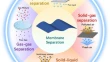
<p>To investigate the doping mechanism of P incorporated into the P-doped ZnO nanowires, back-gate field-effect transistors (FETs) measurements were conducted (inset of Figure <figr fid="F3">3a</figr>). Silicon (n&#177;Si) substrates covered by a 300 nm SiO<sub>2</sub> layer served as the back-gate and dielectric gate oxide, respectively. Single P-doped ZnO nanowire was dispersed on the substrates. A layer of 20 nm Ni and 80 nm Au was deposited on the two ends of the nanowire as the contact by e-beam lithography and sputtering. The upper left inset of Figure <figr fid="F3">3b</figr> shows a typical image of a single P-doped ZnO nanowire FET. We fabricated twenty FETs in all and found that the as-grown P-doped ZnO nanowires are high resistance. The resistance was so large that the current between drain and source (I<sub>DS</sub>) could not be modulated by gate voltage (V<sub>G</sub>), and we could not make sure whether the high resistance came from the nanowire itself. To rule out the other factors that may contribute to the high resistance observed in the P-doped nanowires, we measured the device under UV illumination. I<sub>DS</sub> as a function of voltage between drain and source (V<sub>DS</sub>) under different gate voltages (V<sub>G</sub>) was plotted in Figure <figr fid="F3">3a</figr>, where the gate voltages modulated the current through the nanowire obviously. Thus, we made sure that there was no problem with our measurement process. The presence of the intersection between I<sub>DS</sub> at V<sub>G</sub> = 0 V and V<sub>G</sub> = 20 V is due to the weak modulation of small V<sub>G</sub> on weak I<sub>DS</sub>. To further rule out the effect of contact resistance on the measurements, we fabricated platinum electrode at two ends of ZnO nanowire by focused ion beam (FIB)-induced deposition technique, which have previously been proven to be ohmic contact with ZnO <abbrgrp><abbr bid="B22">22</abbr></abbrgrp>. Then, we measured the device in dark and under UV illumination (see Figure <figr fid="F3">3b</figr>), respectively. We can see that the I<sub>DS</sub> is really weak in dark and the resistance is estimated to be ~10<sup>4</sup> &#937;cm. However, the nanowire forms ohmic contact with the platinum electrode and the contact resistance is not the cause of the high resistance observed above. The I<sub>DS</sub> is not perfect linear due to low carrier concentration of as-grown nanowire in dark. As concluded from the above discussions, we believe that the nanowires are high resistive. However, we cannot determine the conductive type of our P-doped ZnO nanowires in dark according to the measurements under UV illumination due to the effect of photo-generated carriers <abbrgrp><abbr bid="B23">23</abbr></abbrgrp>.</p>
<fig id="F3"><title><p>Figure 3</p></title><caption><p>a I<sub>DS</sub>&#8211;V<sub>DS</sub> plots of P-doped ZnO nanowire FETs measured under UV illumination</p></caption><text>
   <p><b>a I<sub>DS</sub>&#8211;V<sub>DS</sub> plots of P-doped ZnO nanowire FETs measured under UV illumination</b>. Inset: The schematic illustration of the measured device <b>b</b> I<sub>DS</sub>&#8211;V<sub>DS</sub> plot of the P-doped ZnO nanowire FETs transistor with platinum electrodes. <it>Lower right</it> inset: Enlarged I<sub>DS</sub>&#8211;V<sub>DS</sub><it>curve in dark</it>. <it>Upper left</it> inset: SEM image of a typical device <b>c</b> NBE of pure and P-doped ZnO nanowires at 10 K. Inset: enlarged part of the peaks around 3.31 eV for P-doped ZnO nanowires <b>d</b> Temperature-dependent PL spectra of P-doped ZnO nanowires with the evolution of two separate peaks around 3.31 eV.</p>
</text><graphic file="1556-276X-6-45-3" hint_layout="double"/></fig>
<p>Combining electrical measurements with EELS results and structure characterization, the doping mechanism of P is discussed as follows. From Raman and PL characterization, P-doped ZnO nanowires are of high quality. The possibility of imperfect lattice inducing high resistance of P-doped ZnO nanowires can be excluded. The native defects in P-doped ZnO nanowires are limited, thus the compensation effects from native defects are suppressed. Thus, P did not generated sufficient hole in as-grown P-doped ZnO nanowires though it mainly substitutes at oxygen sites from EELS analyses, which mostly because it induces a deep acceptor level in the ZnO band and may not provide effective conductive hole to contribute to p-type doping. In addition, due to the lack of zinc vacancy, the P<sub>Zn</sub> cannot form effective P-doping configuration of P<sub>Zn</sub> + 2V<sub>Zn</sub> and does also not generate sufficient hole.</p>
<p>To confirm the effects of P-doping on electronic structure of ZnO, the PL measurements at 10 K were performed. The PL spectrum of P-doped ZnO nanowires at 10 K is shown in Figure <figr fid="F3">3c</figr> with the enlarged detail for the peaks around 3.310 eV shown in inset. The PL spectrum of pure ZnO nanowires at 10 K is also shown for reference. The free-exciton (FX) peak locates at 3.377 eV with its first longitudinal-optical (LO) phonon replicas at 3.310 eV, consistent with other reports <abbrgrp><abbr bid="B24">24</abbr></abbrgrp>. The difference between FX and FX-1LO is only 67 meV, smaller than the LO-phonon energy of ZnO, due to energy softening of 1LO-phonon <abbrgrp><abbr bid="B25">25</abbr></abbrgrp>. The neutral&#8211;donor-bound exciton (D<sub>0</sub>X) centered at 3.361 eV dominates the near band edge emission (NBE) of P-doped ZnO nanowires with D<sub>0</sub>X-1LO at 3.290 eV. Neutral-acceptor-bound peaks around 3.35 eV, which were always found in P-doped ZnO <abbrgrp><abbr bid="B26">26</abbr><abbr bid="B27">27</abbr></abbrgrp>, were not observed here. The peak at 3.321 eV is always observed in P-doped ZnO films and attributed to free electron to acceptor (FA) transitions <abbrgrp><abbr bid="B26">26</abbr><abbr bid="B27">27</abbr></abbrgrp>. To investigate the origin of 3.321 eV peak, the temperature-dependent PL measurements were performed. In Figure <figr fid="F3">3d</figr>, as the temperature rising from 10 to 50 K, the peak at 3.321 eV decreased rapidly and disappeared at 40 K with only FX-1LO peak left. It was reported that FA emission is often accompanied with DAP (donor&#8211;acceptor pair) emission in ZnO at low temperature <abbrgrp><abbr bid="B24">24</abbr></abbrgrp>. The DAP emission can transform into FA with increasing temperature due to the smaller donor binding energy than acceptor energy. Thus, FA intensity was relatively enhanced compared to D<sub>0</sub>X and TES as increasing temperature, though the absolute intensity of whole spectrum decreased. The FA peak will remain in PL spectrum until the acceptors are thermally ionized at temperatures above 200 K. Here, the peak at 3.321 eV decreased rapidly as the increasing temperature and disappeared at 40 K, which was not the characteristic of FA. As a result, the peak at 3.321 eV could not be assigned to FA. In addition, the peak at 3.321 eV also appeared in PL of pure ZnO nanowires as shown in Figure <figr fid="F3">3c</figr>, which could be assigned to two-electron satellite (TES) emission, which often appeared in low-temperature PL of ZnO and disappeared at the temperature around 50 K <abbrgrp><abbr bid="B28">28</abbr></abbrgrp>. The absence of P-related peak in PL of P-doped ZnO nanowires may confirm our discussion about P-doping mechanism in above section: P<sub>O</sub> induces a deep acceptor level in the ZnO band and may not provide effective conductive hole to contribute to p-type doping. P<sub>Zn</sub> cannot form effective P-doping configuration of P<sub>Zn</sub> + 2V<sub>Zn</sub> due to the lack of zinc vacancy. To realize p-type doping in P-doped ZnO, appropriate growth conditions must be adopted to form P<sub>Zn</sub> + 2V<sub>Zn</sub>, which is the effective configuration of P for the p-type doping. Our results confirm the theoretical results related to P-doping mechanism in ZnO <abbrgrp><abbr bid="B4">4</abbr></abbrgrp>.</p>
<p>As we introduced, we developed a kind of C-free method to synthesize P-doped ZnO nanowires. The detailed characterization on the effect of C was not performed because C presented in most of characterization method. C is usually used as the standard reference in XPS measurement and a thin C layer covers on the copper grid used in EELS analyses performed in TEM. However, we believe that the absence of C in the growth process would be very effective to avoid the possible effect induced by C <abbrgrp><abbr bid="B16">16</abbr></abbrgrp>. Such kind of C-free method can be applied to synthesize other materials nanowires by decomposing-related compound.</p>
</sec>
<sec><st><p>Conclusions</p></st>
<p>In summary, P-doped ZnO nanowires were successfully synthesized by a C-free method via directly decomposing zinc phosphate powder. As-grown samples were single-crystalline ZnO nanowires grown along [001] direction. Phosphorus incorporated into individual ZnO nanowires, which were directly confirmed by EELS analyses. EELS analyses demonstrated that P incorporated substitutionally at O sites in the as-grown P-doped ZnO nanowires with the presence of P<sub>Zn</sub>. As-grown P-doped ZnO nanowires showed high resistance, which because that P<sub>O</sub> induced a deep acceptor level in the band gap and P<sub>Zn</sub> cannot form effective P-doping configuration of P<sub>Zn</sub> + 2V<sub>Zn</sub> due to the lack of zinc vacancy. Our method provides a novel approach to synthesize P-doped nanowires, and the investigation results help to understand the p-type-doping mechanism of ZnO nanowires.</p>
</sec>
</bdy>
<bm>
<ack>
<sec><st><p>Acknowledgements</p></st>
<p>This project is financially supported by the National Natural Science Foundation of China (Project No. 50902004, 90606023, 10974003), National 973 projects (No. 2007CB936202, 2009CB623703, MOST) from China's Ministry of Science and Technology and the Research Fund for the Doctoral Program of Higher Education.</p>
</sec>
</ack>
<refgrp><bibl id="B1"><aug><au><snm>Tang</snm><fnm>ZK</fnm></au><au><snm>Wong</snm><fnm>GKL</fnm></au><au><snm>Yu</snm><fnm>P</fnm></au><au><snm>Kawasaki</snm><fnm>M</fnm></au><au><snm>Ohtomo</snm><fnm>A</fnm></au><au><snm>Koinuma</snm><fnm>H</fnm></au><au><snm>Segawa</snm><fnm>Y</fnm></au></aug><source>Appl Phys Lett</source><pubdate>1998</pubdate><volume>72</volume><fpage>3270</fpage><xrefbib><pubid idtype="doi">10.1063/1.121620</pubid></xrefbib></bibl><bibl id="B2"><aug><au><snm>Park</snm><fnm>CH</fnm></au><au><snm>Zhang</snm><fnm>SB</fnm></au><au><snm>Wei</snm><fnm>SH</fnm></au></aug><source>Phys Rev B</source><pubdate>2002</pubdate><volume>66</volume><fpage>073202</fpage><xrefbib><pubid idtype="doi">10.1103/PhysRevB.66.073202</pubid></xrefbib></bibl><bibl id="B3"><aug><au><snm>Xiang</snm><fnm>B</fnm></au><au><snm>Wang</snm><fnm>PW</fnm></au><au><snm>Zhang</snm><fnm>XZ</fnm></au><au><snm>Dayeh</snm><fnm>SA</fnm></au><au><snm>Aplin</snm><fnm>DPR</fnm></au><au><snm>Soci</snm><fnm>C</fnm></au><au><snm>Yu</snm><fnm>DP</fnm></au><au><snm>Wang</snm><fnm>DL</fnm></au></aug><source>Nano Lett</source><pubdate>2007</pubdate><volume>7</volume><fpage>323</fpage><xrefbib><pubidlist><pubid idtype="doi">10.1021/nl062410c</pubid><pubid idtype="pmpid" link="fulltext">17297995</pubid><pubid idtype="pubmed">17297995</pubid></pubidlist></xrefbib></bibl><bibl id="B4"><aug><au><snm>Lee</snm><fnm>WJ</fnm></au><au><snm>Kang</snm><fnm>J</fnm></au><au><snm>Chang</snm><fnm>KJ</fnm></au></aug><source>Phys Rev B</source><pubdate>2006</pubdate><volume>73</volume><fpage>024117</fpage><xrefbib><pubid idtype="doi">10.1103/PhysRevB.73.024117</pubid></xrefbib></bibl><bibl id="B5"><aug><au><snm>Kim</snm><fnm>HS</fnm></au><au><snm>Pearton</snm><fnm>SJ</fnm></au><au><snm>Nortona</snm><fnm>DP</fnm></au></aug><source>J Appl Phys</source><pubdate>2007</pubdate><volume>102</volume><fpage>104904</fpage><xrefbib><pubid idtype="doi">10.1063/1.2815676</pubid></xrefbib></bibl><bibl id="B6"><aug><au><snm>Lu</snm><fnm>MP</fnm></au><au><snm>Song</snm><fnm>JH</fnm></au><au><snm>Lu</snm><fnm>MY</fnm></au><au><snm>Chen</snm><fnm>MT</fnm></au><au><snm>Gao</snm><fnm>YF</fnm></au><au><snm>Chen</snm><fnm>LJ</fnm></au><au><snm>Wang</snm><fnm>ZL</fnm></au></aug><source>Nano Lett</source><pubdate>2009</pubdate><volume>9</volume><fpage>1223</fpage><xrefbib><pubidlist><pubid idtype="doi">10.1021/nl900115y</pubid><pubid idtype="pmpid" link="fulltext">19209870</pubid><pubid idtype="pubmed">19209870</pubid></pubidlist></xrefbib></bibl><bibl id="B7"><aug><au><snm>Heo</snm><fnm>YW</fnm></au><au><snm>Park</snm><fnm>SJ</fnm></au><au><snm>Ip</snm><fnm>K</fnm></au><au><snm>Pearton</snm><fnm>SJ</fnm></au><au><snm>Norton</snm><fnm>DP</fnm></au></aug><source>Appl Phys Lett</source><pubdate>2003</pubdate><volume>83</volume><fpage>1128</fpage><xrefbib><pubid idtype="doi">10.1063/1.1594835</pubid></xrefbib></bibl><bibl id="B8"><aug><au><snm>Liu</snm><fnm>W</fnm></au><au><snm>Xiu</snm><fnm>FX</fnm></au><au><snm>Sun</snm><fnm>K</fnm></au><au><snm>Xie</snm><fnm>YH</fnm></au><au><snm>Wang</snm><fnm>KL</fnm></au><au><snm>Wang</snm><fnm>Y</fnm></au><au><snm>Zou</snm><fnm>J</fnm></au><au><snm>Yang</snm><fnm>Z</fnm></au><au><snm>Liu</snm><fnm>JL</fnm></au></aug><source>J Am Chem Soc</source><pubdate>2010</pubdate><volume>132</volume><fpage>2498</fpage><xrefbib><pubidlist><pubid idtype="doi">10.1021/ja908521s</pubid><pubid idtype="pmpid">20141133</pubid><pubid idtype="pubmed">20141133</pubid></pubidlist></xrefbib></bibl><bibl id="B9"><aug><au><snm>Yuan</snm><fnm>GD</fnm></au><au><snm>Zhang</snm><fnm>WJ</fnm></au><au><snm>Jie</snm><fnm>JS</fnm></au><au><snm>Fan</snm><fnm>X</fnm></au><au><snm>Zapien</snm><fnm>JA</fnm></au><au><snm>Leung</snm><fnm>YH</fnm></au><au><snm>Luo</snm><fnm>LB</fnm></au><au><snm>Wang</snm><fnm>PF</fnm></au><au><snm>Lee</snm><fnm>CS</fnm></au><au><snm>Lee</snm><fnm>ST</fnm></au></aug><source>Nano Lett</source><pubdate>2008</pubdate><volume>8</volume><fpage>2591</fpage><xrefbib><pubidlist><pubid idtype="doi">10.1021/nl073022t</pubid><pubid idtype="pmpid" link="fulltext">18624388</pubid><pubid idtype="pubmed">18624388</pubid></pubidlist></xrefbib></bibl><bibl id="B10"><aug><au><snm>Li</snm><fnm>PJ</fnm></au><au><snm>Liao</snm><fnm>ZM</fnm></au><au><snm>Zhang</snm><fnm>XZ</fnm></au><au><snm>Zhang</snm><fnm>XJ</fnm></au><au><snm>Zhu</snm><fnm>HC</fnm></au><au><snm>Gao</snm><fnm>JY</fnm></au><au><snm>Laurent</snm><fnm>K</fnm></au><au><snm>Wang</snm><fnm>YL</fnm></au><au><snm>Wang</snm><fnm>N</fnm></au><au><snm>Yu</snm><fnm>DP</fnm></au></aug><source>Nano Lett</source><pubdate>2009</pubdate><volume>9</volume><fpage>2513</fpage><xrefbib><pubidlist><pubid idtype="doi">10.1021/nl803443x</pubid><pubid idtype="pmpid" link="fulltext">19583279</pubid><pubid idtype="pubmed">19583279</pubid></pubidlist></xrefbib></bibl><bibl id="B11"><aug><au><snm>Cao</snm><fnm>BQ</fnm></au><au><snm>Lorenz</snm><fnm>M</fnm></au><au><snm>Brandt</snm><fnm>M</fnm></au><au><snm>Wenckstern</snm><fnm>HV</fnm></au><au><snm>Lenzner</snm><fnm>J</fnm></au><au><snm>Biehne</snm><fnm>G</fnm></au><au><snm>Grundmann</snm><fnm>M</fnm></au></aug><source>Phys Status Solidi RRL</source><pubdate>2008</pubdate><volume>2</volume><fpage>37</fpage><xrefbib><pubid idtype="doi">10.1002/pssr.200701268</pubid></xrefbib></bibl><bibl id="B12"><aug><au><snm>Lin</snm><fnm>SS</fnm></au><au><snm>Hong</snm><fnm>JI</fnm></au><au><snm>Song</snm><fnm>JH</fnm></au><au><snm>Zhu</snm><fnm>Y</fnm></au><au><snm>He</snm><fnm>HP</fnm></au><au><snm>Xu</snm><fnm>Z</fnm></au><au><snm>Wei</snm><fnm>YG</fnm></au><au><snm>Ding</snm><fnm>Y</fnm></au><au><snm>Snyder</snm><fnm>RL</fnm></au><au><snm>Wang</snm><fnm>ZL</fnm></au></aug><source>Nano Lett</source><pubdate>2009</pubdate><volume>9</volume><fpage>3877</fpage><xrefbib><pubidlist><pubid idtype="doi">10.1021/nl902067a</pubid><pubid idtype="pmpid" link="fulltext">19757858</pubid><pubid idtype="pubmed">19757858</pubid></pubidlist></xrefbib></bibl><bibl id="B13"><aug><au><snm>Shan</snm><fnm>CX</fnm></au><au><snm>Liu</snm><fnm>Z</fnm></au><au><snm>Hark</snm><fnm>SK</fnm></au></aug><source>Appl Phys Lett</source><pubdate>2008</pubdate><volume>92</volume><fpage>073103</fpage><xrefbib><pubid idtype="doi">10.1063/1.2884312</pubid></xrefbib></bibl><bibl id="B14"><aug><au><snm>Zhang</snm><fnm>JY</fnm></au><au><snm>Li</snm><fnm>PJ</fnm></au><au><snm>Sun</snm><fnm>H</fnm></au><au><snm>Shen</snm><fnm>X</fnm></au><au><snm>Deng</snm><fnm>TS</fnm></au><au><snm>Zhu</snm><fnm>KT</fnm></au><au><snm>Zhang</snm><fnm>QF</fnm></au><au><snm>Wu</snm><fnm>JL</fnm></au></aug><source>Appl Phys Lett</source><pubdate>2008</pubdate><volume>93</volume><fpage>021116</fpage><xrefbib><pubid idtype="doi">10.1063/1.2958230</pubid></xrefbib></bibl><bibl id="B15"><aug><au><snm>Fang</snm><fnm>X</fnm></au><au><snm>Li</snm><fnm>JH</fnm></au><au><snm>Zhao</snm><fnm>DX</fnm></au><au><snm>Shen</snm><fnm>DZ</fnm></au><au><snm>Li</snm><fnm>BH</fnm></au><au><snm>Wang</snm><fnm>XH</fnm></au></aug><source>J Phys Chem C</source><pubdate>2009</pubdate><volume>113</volume><fpage>21208</fpage><xrefbib><pubid idtype="doi">10.1021/jp906175x</pubid></xrefbib></bibl><bibl id="B16"><aug><au><snm>Tang</snm><fnm>K</fnm></au><au><snm>Gu</snm><fnm>SL</fnm></au><au><snm>Zhu</snm><fnm>SM</fnm></au><au><snm>Liu</snm><fnm>W</fnm></au><au><snm>Ye</snm><fnm>JD</fnm></au><au><snm>Zhu</snm><fnm>JM</fnm></au><au><snm>Zhang</snm><fnm>R</fnm></au><au><snm>Zheng</snm><fnm>YD</fnm></au><au><snm>Sun</snm><fnm>XW</fnm></au></aug><source>Appl Phys Lett</source><pubdate>2008</pubdate><volume>93</volume><fpage>132107</fpage><xrefbib><pubid idtype="doi">10.1063/1.2992197</pubid></xrefbib></bibl><bibl id="B17"><aug><au><snm>Sieber</snm><fnm>B</fnm></au><au><snm>Liu</snm><fnm>H</fnm></au><au><snm>Piret</snm><fnm>G</fnm></au><au><snm>Laureyns</snm><fnm>J</fnm></au><au><snm>Roussel</snm><fnm>P</fnm></au><au><snm>Gelloz</snm><fnm>B</fnm></au><au><snm>Szunerits</snm><fnm>S</fnm></au><au><snm>Boukherroub</snm><fnm>R</fnm></au></aug><source>J Phys Chem C</source><pubdate>2009</pubdate><volume>113</volume><fpage>13643</fpage><xrefbib><pubid idtype="doi">10.1021/jp903504w</pubid></xrefbib></bibl><bibl id="B18"><aug><au><snm>Djurisic</snm><fnm>AB</fnm></au><au><snm>Leung</snm><fnm>YH</fnm></au><au><snm>Tam</snm><fnm>KH</fnm></au><au><snm>Hsu</snm><fnm>YF</fnm></au><au><snm>Ding</snm><fnm>L</fnm></au><au><snm>Ge</snm><fnm>WK</fnm></au><au><snm>Zhong</snm><fnm>YC</fnm></au><au><snm>Wong</snm><fnm>KS</fnm></au><au><snm>Chan</snm><fnm>WK</fnm></au><au><snm>Tam</snm><fnm>HL</fnm></au><au><snm>Cheah</snm><fnm>KW</fnm></au><au><snm>Kwok</snm><fnm>WM</fnm></au><au><snm>Phillips</snm><fnm>DL</fnm></au></aug><source>Nanotechnology</source><pubdate>2007</pubdate><volume>18</volume><fpage>095702</fpage><xrefbib><pubid idtype="doi">10.1088/0957-4484/18/9/095702</pubid></xrefbib></bibl><bibl id="B19"><aug><au><snm>Vaithianathan</snm><fnm>V</fnm></au><au><snm>Asokan</snm><fnm>K</fnm></au><au><snm>Park</snm><fnm>JY</fnm></au><au><snm>Kim</snm><fnm>SS</fnm></au></aug><source>Appl Phys A</source><pubdate>2009</pubdate><volume>94</volume><fpage>995</fpage><xrefbib><pubid idtype="doi">10.1007/s00339-008-4883-6</pubid></xrefbib></bibl><bibl id="B20"><aug><au><snm>Chen</snm><fnm>JJ</fnm></au><au><snm>Yu</snm><fnm>MH</fnm></au><au><snm>Zhou</snm><fnm>WL</fnm></au><au><snm>Sun</snm><fnm>K</fnm></au><au><snm>Wang</snm><fnm>LM</fnm></au></aug><source>Appl Phys Lett</source><pubdate>2005</pubdate><volume>87</volume><fpage>173119</fpage><xrefbib><pubid idtype="doi">10.1063/1.2119415</pubid></xrefbib></bibl><bibl id="B21"><aug><au><snm>Zhang</snm><fnm>JM</fnm></au><au><snm>Yu</snm><fnm>C</fnm></au><au><snm>Liao</snm><fnm>ZM</fnm></au><au><snm>Zhang</snm><fnm>XZ</fnm></au><au><snm>You</snm><fnm>LP</fnm></au><au><snm>Yu</snm><fnm>DP</fnm></au></aug><source>J Electron Microsc</source><pubdate>2009</pubdate><volume>58</volume><fpage>295</fpage><xrefbib><pubid idtype="doi">10.1093/jmicro/dfp026</pubid></xrefbib></bibl><bibl id="B22"><aug><au><snm>Lao</snm><fnm>CS</fnm></au><au><snm>Liu</snm><fnm>J</fnm></au><au><snm>Gao</snm><fnm>PX</fnm></au><au><snm>Zhang</snm><fnm>LY</fnm></au><au><snm>Davidovic</snm><fnm>D</fnm></au><au><snm>Tummala</snm><fnm>R</fnm></au><au><snm>Wang</snm><fnm>ZL</fnm></au></aug><source>Nano Lett</source><pubdate>2006</pubdate><volume>6</volume><fpage>263</fpage><xrefbib><pubidlist><pubid idtype="doi">10.1021/nl052239p</pubid><pubid idtype="pmpid" link="fulltext">16464047</pubid><pubid idtype="pubmed">16464047</pubid></pubidlist></xrefbib></bibl><bibl id="B23"><aug><au><snm>Jie</snm><fnm>JS</fnm></au><au><snm>Zhang</snm><fnm>WJ</fnm></au><au><snm>Peng</snm><fnm>KQ</fnm></au><au><snm>Yuan</snm><fnm>GD</fnm></au><au><snm>Lee</snm><fnm>CS</fnm></au><au><snm>Lee</snm><fnm>ST</fnm></au></aug><source>Adv Funct Mater</source><pubdate>2008</pubdate><volume>18</volume><fpage>3251</fpage><xrefbib><pubid idtype="doi">10.1002/adfm.200800399</pubid></xrefbib></bibl><bibl id="B24"><aug><au><snm>Sun</snm><fnm>JW</fnm></au><au><snm>Lu</snm><fnm>YM</fnm></au><au><snm>Liu</snm><fnm>YC</fnm></au><au><snm>Shen</snm><fnm>DZ</fnm></au><au><snm>Zhang</snm><fnm>ZZ</fnm></au><au><snm>Yao</snm><fnm>B</fnm></au><au><snm>Li</snm><fnm>BH</fnm></au><au><snm>Zhang</snm><fnm>JY</fnm></au><au><snm>Zhao</snm><fnm>DX</fnm></au><au><snm>Fan</snm><fnm>XW</fnm></au></aug><source>J Appl Phys</source><pubdate>2007</pubdate><volume>102</volume><fpage>043522</fpage><xrefbib><pubid idtype="doi">10.1063/1.2772581</pubid></xrefbib></bibl><bibl id="B25"><aug><au><snm>Hsu</snm><fnm>HC</fnm></au><au><snm>Hsieh</snm><fnm>WF</fnm></au></aug><source>Solid State Commun</source><pubdate>2004</pubdate><volume>131</volume><fpage>371</fpage><xrefbib><pubid idtype="doi">10.1016/j.ssc.2004.05.043</pubid></xrefbib></bibl><bibl id="B26"><aug><au><snm>Hwang</snm><fnm>DK</fnm></au><au><snm>Oh</snm><fnm>MS</fnm></au><au><snm>Lim</snm><fnm>JH</fnm></au><au><snm>Kang</snm><fnm>CG</fnm></au><au><snm>Park</snm><fnm>SJ</fnm></au></aug><source>Appl Phys Lett</source><pubdate>2007</pubdate><volume>90</volume><fpage>021106</fpage><xrefbib><pubid idtype="doi">10.1063/1.2430937</pubid></xrefbib></bibl><bibl id="B27"><aug><au><snm>Hwang</snm><fnm>DK</fnm></au><au><snm>Kim</snm><fnm>HS</fnm></au><au><snm>Lim</snm><fnm>JH</fnm></au><au><snm>Oh</snm><fnm>JY</fnm></au><au><snm>Yang</snm><fnm>JH</fnm></au><au><snm>Park</snm><fnm>SJ</fnm></au></aug><source>Appl Phys Lett</source><pubdate>2005</pubdate><volume>86</volume><fpage>151917</fpage><xrefbib><pubid idtype="doi">10.1063/1.1895480</pubid></xrefbib></bibl><bibl id="B28"><aug><au><snm>Cao</snm><fnm>BQ</fnm></au><au><snm>Lorenz</snm><fnm>M</fnm></au><au><snm>Rahm</snm><fnm>A</fnm></au><au><snm>Wenckstern</snm><fnm>HV</fnm></au><au><snm>Zekalla</snm><fnm>CC</fnm></au><au><snm>Lenzner</snm><fnm>J</fnm></au><au><snm>Benndorf</snm><fnm>G</fnm></au><au><snm>Grundmann</snm><fnm>M</fnm></au></aug><source>Nanotechnology</source><pubdate>2007</pubdate><volume>18</volume><fpage>455707</fpage><xrefbib><pubid idtype="doi">10.1088/0957-4484/18/45/455707</pubid></xrefbib></bibl></refgrp>
</bm>
</art>