<?xml version='1.0'?>
<!DOCTYPE art SYSTEM 'http://www.biomedcentral.com/xml/article.dtd'>
<art><ui>1556-276X-6-440</ui><ji>1556-276X</ji><fm>
<dochead>Nano Express</dochead>
<bibl>
<title>
<p>Facile synthesis of concentrated gold nanoparticles with low size-distribution in water: temperature and pH controls</p>
</title>
<aug>
<au id="A1"><snm>Li</snm><fnm>Chunfang</fnm><insr iid="I1"/><email>lichunfang@qust.edu.cn</email></au>
<au ca="yes" id="A2"><snm>Li</snm><fnm>Dongxiang</fnm><insr iid="I1"/><email>lidx@iccas.ac.cn</email></au>
<au id="A3"><snm>Wan</snm><fnm>Gangqiang</fnm><insr iid="I1"/><email>wgq0601@126.com</email></au>
<au id="A4"><snm>Xu</snm><fnm>Jie</fnm><insr iid="I1"/><email>xujie@qust.edu.cn</email></au>
<au ca="yes" id="A5"><snm>Hou</snm><fnm>Wanguo</fnm><insr iid="I1"/><email>wghou@sdu.edu.cn</email></au>
</aug>
<insg>
<ins id="I1"><p>State Key Laboratory Base of Eco-Chemical Engineering, Lab of Colloids and Interfaces, College of Chemistry and Molecular Engineering, Qingdao University of Science and Technology, Qingdao 266042, China</p></ins>
</insg>
<source>Nanoscale Research Letters</source>
<issn>1556-276X</issn>
<pubdate>2011</pubdate>
<volume>6</volume>
<issue>1</issue>
<fpage>440</fpage>
<url>http://www.nanoscalereslett.com/content/6/1/440</url>
<xrefbib><pubidlist><pubid idtype="doi">10.1186/1556-276X-6-440</pubid><pubid idtype="pmpid">21733153</pubid></pubidlist></xrefbib>
</bibl>
<history><rec><date><day>14</day><month>4</month><year>2011</year></date></rec><acc><date><day>6</day><month>7</month><year>2011</year></date></acc><pub><date><day>6</day><month>7</month><year>2011</year></date></pub></history>
<cpyrt><year>2011</year><collab>Li et al; licensee Springer.</collab><note>This is an Open Access article distributed under the terms of the Creative Commons Attribution License (<url>http://creativecommons.org/licenses/by/2.0</url>), which permits unrestricted use, distribution, and reproduction in any medium, provided the original work is properly cited.</note></cpyrt>
<kwdg>
<kwd>gold nanoparticles</kwd>
<kwd>concentrated</kwd>
<kwd>sodium citrate</kwd>
</kwdg>
<abs>
<sec>
<st>
<p>Abstract</p>
</st>
<p>The citrate reduction method for the synthesis of gold nanoparticles (GNPs) has known advantages but usually provides the products with low nanoparticle concentration and limits its application. Herein, we report a facile method to synthesize GNPs from concentrated chloroauric acid (2.5 mM) via adding sodium hydroxide and controlling the temperature. It was found that adding a proper amount of sodium hydroxide can produce uniform concentrated GNPs with low size distribution; otherwise, the largely distributed nanoparticles or instable colloids were obtained. The low reaction temperature is helpful to control the nanoparticle formation rate, and uniform GNPs can be obtained in presence of optimized NaOH concentrations. The pH values of the obtained uniform GNPs were found to be very near to neutral, and the pH influence on the particle size distribution may reveal the different formation mechanism of GNPs at high or low pH condition. Moreover, this modified synthesis method can save more than 90% energy in the heating step. Such environmental-friendly synthesis method for gold nanoparticles may have a great potential in large-scale manufacturing for commercial and industrial demand.</p>
</sec>
</abs>
</fm><bdy>
<sec>
<st>
<p>Introduction</p>
</st>
<p>Gold nanoparticles (GNPs), also named as gold colloids, have attracted increasing attention due to their unique properties in multidisciplinary research fields <abbrgrp>
<abbr bid="B1">1</abbr>
<abbr bid="B2">2</abbr>
</abbrgrp>. Although GNPs are defined by tiny size, significant quantities of GNPs are likely required in many commercial and industrial applications. Remarkably, novel emerging applications bring a huge growth of the global demand of GNPs. For instance, (1) biomolecule- and/or biopolymer-conjugated GNPs are largely used as biomarkers and biodelivery vehicles in the medicine/pharmacy, and in cosmetic products, GNPs are employed as anti-aging components for skin protection <abbrgrp>
<abbr bid="B3">3</abbr>
<abbr bid="B4">4</abbr>
<abbr bid="B5">5</abbr>
</abbrgrp>; (2) GNPs are used to treat wool or cotton fibers for a permanent coloration <abbrgrp>
<abbr bid="B6">6</abbr>
</abbrgrp> of value textiles; (3) various polymer/gold nanocomposites display a high potential for novel coatings and paintings <abbrgrp>
<abbr bid="B7">7</abbr>
<abbr bid="B8">8</abbr>
<abbr bid="B9">9</abbr>
<abbr bid="B10">10</abbr>
<abbr bid="B11">11</abbr>
</abbrgrp>; (4) GNPs are used to enhance the performance of non-volatile memory devices <abbrgrp>
<abbr bid="B12">12</abbr>
</abbrgrp> and low temperature printing metal inks in electronics <abbrgrp>
<abbr bid="B13">13</abbr>
</abbrgrp>; and (5) GNPs as catalysts are developed in novel usages <abbrgrp>
<abbr bid="B14">14</abbr>
<abbr bid="B15">15</abbr>
<abbr bid="B16">16</abbr>
<abbr bid="B17">17</abbr>
<abbr bid="B18">18</abbr>
</abbrgrp>. Therefore, more attention should be paid on effective synthesis methods to match the enlarging demand of GNPs.</p>
<p>In the past decades, though many synthetic strategies have been developed to prepare GNPs in organic or aqueous solvents <abbrgrp>
<abbr bid="B19">19</abbr>
<abbr bid="B20">20</abbr>
<abbr bid="B21">21</abbr>
<abbr bid="B22">22</abbr>
<abbr bid="B23">23</abbr>
<abbr bid="B24">24</abbr>
</abbrgrp>, the citrate reduction method has remained the best candidate to fit the enlarging demand of GNPs due to its advantages such as inexpensive reductant, non-toxic water solvent, and low pollution in the reaction <abbrgrp>
<abbr bid="B25">25</abbr>
<abbr bid="B26">26</abbr>
<abbr bid="B27">27</abbr>
<abbr bid="B28">28</abbr>
</abbrgrp>. The simple operation of pouring rapidly a certain amount of sodium citrate solution into a boiling solution of 0.25 mM chloroauric acid produces narrowly distributed GNPs which are biocompatible and easily handled in applications <abbrgrp>
<abbr bid="B29">29</abbr>
<abbr bid="B30">30</abbr>
<abbr bid="B31">31</abbr>
</abbrgrp>. So, this method is extensively used in GNP-based bioassays and biomedicine systems <abbrgrp>
<abbr bid="B5">5</abbr>
<abbr bid="B32">32</abbr>
<abbr bid="B33">33</abbr>
<abbr bid="B34">34</abbr>
</abbrgrp> and even in structured/assembled nanomaterials <abbrgrp>
<abbr bid="B35">35</abbr>
<abbr bid="B36">36</abbr>
<abbr bid="B37">37</abbr>
<abbr bid="B38">38</abbr>
<abbr bid="B39">39</abbr>
<abbr bid="B40">40</abbr>
<abbr bid="B41">41</abbr>
</abbrgrp>. In the pioneering work on the citrate reduction method, Turkevich in 1951 reported the basic experimental approach and the effect of temperature and reagent concentration upon the nanoparticle size and size distribution <abbrgrp>
<abbr bid="B25">25</abbr>
</abbrgrp>, and in 1973, Frens published the control of size variation of GNPs by changing the concentration of sodium citrate <abbrgrp>
<abbr bid="B26">26</abbr>
</abbrgrp>. Then, in 1994, Zukoski published a sol formation mechanism and a particle growth model <abbrgrp>
<abbr bid="B42">42</abbr>
</abbrgrp>. Recently, the decisive role of sodium citrate on the pH value of the reaction mixture and the nanoparticle size was demonstrated based on experimental and theoretical modeling results <abbrgrp>
<abbr bid="B27">27</abbr>
<abbr bid="B43">43</abbr>
<abbr bid="B44">44</abbr>
</abbrgrp>. On the other hand, in the majority of the published citrate reduction works, GNPs were synthesized from a dilute solution of 0.25 mM chloroauric acid, such a concentration yields aqueous GNPs with low weight content (0.005%) as a disadvantage. The low nanoparticle content asks for abundant water to be used in the preparation and consumes a lot of energy in the heating step. Sometimes, such dilute gold colloids cannot fulfill the requirement of high concentration. Thus, the classical citrate method will be limited in large-scale manufacturing. Considering the abovementioned advantages and disadvantages, we expected that the citrate reduction method should have been developed to produce concentrated aqueous GNPs already from several years ago. However, simply increasing the reactant concentration will change the systemic pH and salt concentration with drastic influence on the nanoparticle size polydispersity and the colloidal stability.</p>
<p>Herein, to meet the need of high concentrations, we modified the classical citrate reduction method and synthesized uniform GNPs from tenfold concentrated precursor (2.5 mM HAuCl<sub>4</sub>) via adding sodium hydroxide and controlling the temperature. We demonstrated that adding a proper amount of sodium hydroxide to the reaction mixture could produce uniform GNPs with a narrow size distribution after the reduction by sodium citrate at boiling sate. The low reaction temperature was helpful to control the nanoparticle formation rate, and uniform GNPs could be obtained at different temperature by adding a proper amount of alkali. The pH change resulting from the addition of alkali showed a critical role in the influence on the particle size distribution, which might be related to the different formation mechanism of GNPs under different pH conditions.</p>
</sec>
<sec>
<st>
<p>Experimental methods</p>
</st>
<sec>
<st>
<p>Materials</p>
</st>
<p>Hydrochloroauric acid trihydrate (HAuCl<sub>4 </sub>3H<sub>2</sub>O, 99.9%) was purchased from Sigma-Aldrich Shanghai Trading Co Ltd, Shanghai, China, while sodium citrate (Na<sub>3</sub>C<sub>6</sub>H<sub>5</sub>O<sub>7 </sub>2H<sub>2</sub>O, &gt; 99%) and sodium hydroxide (NaOH, &gt; 98%) were obtained from Shanghai Chemical Co., Shanghai, China. Deionized water (resistance &gt; 18.2 M&#937;) was prepared by an ultrapure water system in our laboratory. All chemicals were used as received without any purification.</p>
</sec>
<sec>
<st>
<p>Synthesis of concentrated nanoparticle dispersions via simply increasing reactant concentration</p>
</st>
<p>GNPs were first synthesized from HAuCl<sub>4 </sub>solution with gradually increased concentration of the reactant. In detail, 50 ml deionized water in a round-bottom flask was added to 5, 10, 20, 30, 40, and 50 mg chloroauric acid, respectively. After heating to boiling state, 0.3, 0.6, 1.2, 1.8, 2.4, and 3.0 ml sodium citrate solution (50 mg/ml) were rapidly introduced into the flask with drastic stirring, respectively. The mixtures were continuously heated for a certain period till a ruby-red color appeared.</p>
</sec>
<sec>
<st>
<p>Synthesis of concentrated GNPs under alkali control and different temperature</p>
</st>
<p>The concentrations of chloroauric acid and sodium citrate in the final mixture were respectively fixed to 2.5 and 5.0 mM, while that of NaOH was changed. The reaction temperature was selected to be boiling state, 85&#176;C and 70&#176;C. For example, 2.0 mL chloroauric acid (25 mM) was mixed with 5.3 to 10.2 mL of 20 mM NaOH solution, followed by adding the calculated volume of water to a total volume of 20 mL. The flask was put into an oil bath at 110&#176;C for 30 min to balance the reaction mixture to 85&#176;C. Then, 0.6 mL sodium citrate solution (50 mg/ml) was rapidly introduced into the flask under vigorous stirring. After different reaction time, samples were taken out for characterization. The reaction at the boiling state and 70&#176;C was similarly performed, respectively.</p>
</sec>
<sec>
<st>
<p>Detecting the nanoparticle formation process</p>
</st>
<p>In the synthesis process of GNPs, a portion of the reaction mixture (0.5 to 1 mL) was taken out from the flask at different reaction time and immediately poured into 9 mL ice-cooled water at 0&#176;C. Such an operation can basically cease the formation process of GNPs due to the low temperature surrounding and the dilution effect, so it was called here as a "sample-frozen" operation. Then, the transmission electron microscopy (TEM) samples were prepared at the earliest time and the ultraviolet-visible (UV-vis) spectra were recorded.</p>
</sec>
<sec>
<st>
<p>Characterization and instrumentation</p>
</st>
<p>UV-vis spectra were recorded on a U-3010 UV-visible spectrophotometer (Hitachi High-Technologies Co., Tokyo, Japan) to collect the surface plasmon resonance (SPR) information of GNPs, in which the highly concentrated samples were diluted pro rata by deionized water to adapt the measurement limitation. TEM samples were prepared by dropping the diluted gold colloids on carbon-coated copper grids, followed by natural drying; then, the samples were observed on a JEM-2010 microscope (JOEL Ltd, Tokyo, Japan).</p>
</sec>
</sec>
<sec>
<st>
<p>Results and discussion</p>
</st>
<sec>
<st>
<p>Size distribution enlarging of GNPs at high reactant concentration</p>
</st>
<p>In Turkevich's work, the influence of reactant concentration of HAuCl<sub>4 </sub>from 0.25 mM to decreased values was studied <abbrgrp>
<abbr bid="B25">25</abbr>
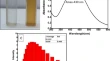
</abbrgrp>. Herein, our first effort was taken to prepare GNPs through gradual increase of reactant concentration by the classical citrate method. Aqueous chloroauric acid solution from 0.25 to 2.5 mM was heated to boiling and the four times molar amount of sodium citrate was added, followed by continuously heating for a certain period to get the ruby-red colloids. It was found that the reaction rate was greatly enhanced at high reactant concentration. The optical photos of the obtained samples and diluted samples, as well as the corresponding UV-vis spectra, are shown in Figure <figr fid="F1">1</figr>. The color and the surface plasmon resonance (SPR) peaks of these colloids do not show obvious differences, and no obvious difference is found in the full width at half maximum of these peak profiles. However, TEM images of these GNPs (Figure <figr fid="F2">2</figr>) show that the size polydispersity remarkably varies with the reactant concentration increase although the particle average sizes are all located in a range of 10 to 20 nm. The large size distribution of GNPs at high reactant concentration will limit further applications such as size-related bioassays and well-defined nanoassembly. Moreover, the as-obtained gold colloids from 2.5 mM HAuCl<sub>4 </sub>are not stable and become black precipitates after hours; this is partially ascribed to the colloidal instability at high ionic strength.</p>
<fig id="F1"><title><p>Figure 1</p></title><caption><p>Optical photos of the obtained gold colloids the diluted samples and their corresponding UV-vis spectra</p></caption><text>
   <p><b>Optical photos of the obtained gold colloids, the diluted samples and their corresponding UV-vis spectra</b>. (<b>A</b>) Photos of gold colloids prepared from a solution of 0.25 mM to 2.0 mM HAuCl<sub>4 </sub>3H<sub>2</sub>O (corresponding to 0.1 mg/ml to 0.8 mg/ml, respectively) and their diluted samples at a content of 0.25 mM Au. (<b>B</b>) The corresponding UV-vis spectra of the diluted samples. (Baseline was adjusted artificially).</p>
</text><graphic file="1556-276X-6-440-1"/></fig>
<fig id="F2"><title><p>Figure 2</p></title><caption><p>TEM images of GNPs with indicated size and polydispersity</p></caption><text>
   <p><b>TEM images of GNPs with indicated size and polydispersity</b>. They are prepared by conventional citrate method from 0.25 mM (<b>A</b>), 0.50 mM (<b>B</b>), 1.0 mM (<b>C</b>), 1.5 mM (<b>D</b>), 2.0 mM (<b>E</b>), and 2.5 mM (<b>F</b>) chloroauric acid, respectively. Scale bar: 20 nm.</p>
</text><graphic file="1556-276X-6-440-2"/></fig>
</sec>
<sec>
<st>
<p>Controlling the size distribution by adding sodium hydroxide</p>
</st>
<p>In recent published work, pH control was reported to produce monodisperse GNPs with low polydispersity <abbrgrp>
<abbr bid="B27">27</abbr>
<abbr bid="B43">43</abbr>
<abbr bid="B44">44</abbr>
</abbrgrp>. In our experiments, we found that the increase of the reactant concentration slightly decreased the pH of the final mixture. Thus, we were inspired to add sodium hydroxide (NaOH) into the reaction mixture as a trial to lower particle polydispersity. Then, GNPs were prepared at boiling state with fixed 2.5 mM chloroauric acid and 5 mM sodium citrate (calculated based on the volume of the final mixture). This reduction of the molar ratio of citrate to chloroaurate was applied to decrease the ionic strength in the final colloids. It was found that the reaction rate was reduced as the alkali was added into the reaction system, but precipitates appeared under a high NaOH concentration of 7.8 mM. The color of the obtained colloids was not obviously different from each other (Figure S1 in Additional file <supplr sid="S1">1</supplr>). Figure <figr fid="F3">3</figr> shows the TEM images of GNPs synthesized under different NaOH amount from 3.1 to 6.6 mM, and their size distribution was measured from more TEM images as shown below each image. Obviously, the particle size polydispersity was largely decreased with the increase of added NaOH amount. We find that the obtained particles at 5.3 and 6.6 mM NaOH have a narrow size distribution, and the best alkali dosage is 6.6 mM. However, the reaction rate was still found to be too fast to be controlled well, although the alkali's addition could lower it in a certain extent. The time that the color changed to red after adding sodium citrate was still only 1 min in presence of 6.6 mM NaOH, and the reaction flask had to be removed from the oil bath at once, otherwise aggregated particles were obtained (Figure S1 in Additional file <supplr sid="S1">1</supplr>) possibly due to the kinetic instability <abbrgrp>
<abbr bid="B45">45</abbr>
</abbrgrp>. Moreover, at different reaction time, portions of the reaction mixture were taken out and were recorded by UV-vis spectrophotometer. The SPR peaks of these samples (Figure S2 in Additional file <supplr sid="S1">1</supplr>) show that under the presence of 5.3 and 6.6 mM NaOH, the gold colloids after 1- to 2-min reaction have an SPR peak around 518 nm which corresponds to the uniform colloids. However, at longer reaction time, the SPR peaks are strongly red shifted, indicating an aggregation process in accordance with the TEM results. Therefore, the synthesis time under the boiling state should be no longer than 2 min.</p>
<suppl id="S1">
<title>
<p>Additional file 1</p>
</title>
<text>
<p>
<b>Sample photos, supplementary TEM images, SPR peak changes and UV-vis spectra</b>. Sample photos of concentrated GNPs prepared at different conditions, supplementary TEM images of a selected sample of aggregated Au colloids, SPR peak changes of gold colloids prepared after different reaction time, and the temporal changes of UV-vis spectra and photos in the formation process of GNPs.</p>
</text>
<file name="1556-276X-6-440-S1.DOC">
   <p>Click here for file</p>
</file>
</suppl>
<fig id="F3"><title><p>Figure 3</p></title><caption><p>TEM images and size distribution diagrams of GNPs</p></caption><text>
   <p><b>TEM images and size distribution diagrams of GNPs</b>. They were synthesized at boiling state under addition of different NaOH content of (A1) 3.1 mM, (A2) 4.4 mM, (A3) 5.3 mM, and (A4) 6.6 mM, respectively. Scale bar: 50 nm.</p>
</text><graphic file="1556-276X-6-440-3"/></fig>
</sec>
<sec>
<st>
<p>Decreasing reaction rate by lowering temperature</p>
</st>
<p>Basically, the chemical reaction rate drastically depends on temperature, so the high rate of nanoparticle formation can be decreased at a low temperature. In this work, the nanoparticle synthesis was therefore performed at 85&#176;C and 70&#176;C with a defined range of NaOH amount. It was found that the formation rate of GNPs slowed as expected at lower temperatures. The color of the colloids obtained at 85&#176;C (Figure S1 in Additional file <supplr sid="S1">1</supplr>) did not differ from that of those produced under boiling state. TEM images of the synthesized GNPs at 85&#176;C in the presence of different alkali amount were shown in Figure <figr fid="F4">4</figr> (B1 to B4), including the particle size polydispersity. We could find that GNPs synthesized in presence of 5.5 mM NaOH have an average size of 15 nm with large size distribution, while at a high NaOH concentration, from 6.6 to 8.8 mM, the particle size was slightly decreased to 12 to 13 nm with a narrow distribution. The best GNPs were produced in presence of 7.7 mM NaOH. The higher NaOH dosage of 9.9 mM could only produce purple-color colloid which was not stable and precipitated after hours. The SPR peaks of the gold colloids taken-out from the reaction mixture at different time were also studied by UV-vis spectroscopy (Figure S2 in Additional file <supplr sid="S1">1</supplr>). We found that the colloidal samples prepared at 6.6 to 8.8 mM NaOH show SPR peaks around 519 nm, and the reaction time should be controlled at 10 to 15 min, although longer reaction time did not cause aggregation.</p>
<fig id="F4"><title><p>Figure 4</p></title><caption><p>TEM images and size distribution diagrams of GNPs</p></caption><text>
   <p><b>TEM images and size distribution diagrams of GNPs</b>. They were synthesized under labeled NaOH concentration (millimolars) at 85&#176;C (B1-B4) and 70&#176;C (C1-C4), respectively. Scale bar: 100 nm.</p>
</text><graphic file="1556-276X-6-440-4"/></fig>
<p>Similarly, as shown in Figure <figr fid="F4">4</figr> (C1 to C4), the TEM results of GNPs synthesized at 70&#176;C show the same tendency in particle size and size distribution in presence of different NaOH amount. The dosage of NaOH influences the particle size distribution, and the optimal alkali concentration should be 8.8 mM for the most uniform nanoparticles. The reaction under 9.9 mM NaOH needs a long time heating after citrate addition and produces broadly size distributed GNPs (Figure <figr fid="F4">4</figr> C4). Optical photos of these gold colloids are shown in the inset of Figure <figr fid="F5">5</figr>. The color of samples prepared under 7.7 and 8.8 mM NaOH is similar, which is slightly different from that of samples prepared at 6.6 and 9.9 mM NaOH. The sample prepared at 5.5 mM NaOH was dark red while that prepared under 11 mM NaOH was cyan due to the aggregation and precipitation of nanoparticles. The SPR peaks (Figure S2 in Additional file <supplr sid="S1">1</supplr>) of the gold colloids obtained after different reaction times showed that the gold colloids synthesized at optimal conditions (NaOH 7.7 to 8.8 mM) had SPR peaks around 520 nm and the reaction time should be 20 to 25 min.</p>
<fig id="F5"><title><p>Figure 5</p></title><caption><p>pH values of Au colloid dispersions obtained at different temperature versus NaOH concentration</p></caption><text>
   <p><b>pH values of Au colloid dispersions obtained at different temperature versus NaOH concentration</b>. The pH values before reaction were also involved and the inset photo shows Au colloids prepared at 70&#176;C under the labeled alkaline concentration (millimolars).</p>
</text><graphic file="1556-276X-6-440-5"/></fig>
<p>It can be concluded that uniform GNPs can be synthesized from concentrated gold precursor solution of 2.5 mM based on the citrate reduction by pH and temperature control. The recommended experimental parameters are listed in Table <tblr tid="T1">1</tblr>. This modified citrate method will largely save energy in the heating stage because of two main reasons. The first is, because the concentration of gold precursor is tenfold compared to the majority of common uses, the usage of only 10% water solvent will save 90% heating energy. Secondly, if the reaction is performed at 70&#176;C or 85&#176;C and room temperature is 25&#176;C, the low temperature reaction will further save 40% or 20% energy, and totally save 94% or 92% heating energy, compared with the dilute concentration and boiling state reaction. Furthermore, it should be noted that the obtained concentrated gold colloids had a good stability, no change was found in the colloid color and the UV-vis absorbance after more than 1-year storage at the room temperature.</p>
<tbl id="T1"><title><p>Table 1</p></title><caption><p>Optimal experimental parameters for GNP synthesis at different temperature</p></caption><tblbdy cols="4">
      <r>
         <c ca="left">
            <p>
               <b>Reaction temperature</b>
            </p>
         </c>
         <c ca="center">
            <p>
               <b>NaOH (mM)</b>
            </p>
         </c>
         <c ca="center">
            <p>
               <b>Reaction time (min)</b>
            </p>
         </c>
         <c ca="center">
            <p>
               <b>Final pH</b>
            </p>
         </c>
      </r>
      <r>
         <c cspan="4">
            <hr/>
         </c>
      </r>
      <r>
         <c ca="left">
            <p>Boiling state</p>
         </c>
         <c ca="center">
            <p>5.3-6.6</p>
         </c>
         <c ca="center">
            <p>1-2</p>
         </c>
         <c ca="center">
            <p>6.3-6.7</p>
         </c>
      </r>
      <r>
         <c ca="left">
            <p>85&#176;C</p>
         </c>
         <c ca="center">
            <p>6.6-8.8</p>
         </c>
         <c ca="center">
            <p>10-15</p>
         </c>
         <c ca="center">
            <p>6.4-7.4</p>
         </c>
      </r>
      <r>
         <c ca="left">
            <p>70&#176;C</p>
         </c>
         <c ca="center">
            <p>7.7-8.8</p>
         </c>
         <c ca="center">
            <p>20-25</p>
         </c>
         <c ca="center">
            <p>7.1-7.5</p>
         </c>
      </r>
   </tblbdy></tbl>
</sec>
<sec>
<st>
<p>pH analysis of the reaction mixture at different conditions</p>
</st>
<p>Figure <figr fid="F5">5</figr> displays the pH values of the reaction mixture mixed at room temperature and those as-obtained gold colloids prepared at various conditions. The pH value shows a linear change with respect to the addition of NaOH both before and after the reaction, which is due to the buffer behavior of the sodium citrate and the low alkali dosage. When the reaction was performed at boiling state, the optimal NaOH dosage (6.6 mM) corresponds to pH 6.7. At 85&#176;C, the pH of the best colloids prepared in presence of 7.7 mM NaOH is 6.8, while at 70&#176;C the final pH for the best colloids is 7.5. The pH values of the acceptable GNPs with a narrow size distribution are listed in Table <tblr tid="T1">1</tblr>. It is found that the pH values for uniform gold colloids are slightly different at different reaction temperatures and a higher pH value is indicated at lower temperature. These pH values are very close to the neutral condition (between 6.5 and 7.5), which is in accordance with the literature <abbrgrp>
<abbr bid="B27">27</abbr>
</abbrgrp>.</p>
</sec>
<sec>
<st>
<p>Analysis of the pH influence on the nanoparticle size distribution</p>
</st>
<p>From the above results, the alkali concentration and the pH value should play a critical role in controlling the size distribution of finally synthesized GNPs. To discover the pH effect on nanoparticle formation, we use a so-called frozen method to cease the nanoparticle growth at different reaction time at 85&#176;C as described in the experimental section and investigate the TEM morphology changes and UV-vis spectra. Three NaOH dosages of 6.0 mM (corresponding to a low pH), 7.8 mM (a medium pH, near the optimal condition), and 9.0 mM (a high pH) were used to prepare reaction-time-dependent samples under different pH conditions. UV-vis spectra and photos (Figure S3 in Additional file <supplr sid="S1">1</supplr>) of the time-dependent samples can only show the macroscopic changes with time, from which only the difference of the reaction rate can be shown under different pH conditions. The microscopic changes in the process of nanoparticle formation are shown by the TEM images in Figure <figr fid="F6">6</figr>. With the addition of 6.0 mM NaOH, many small particles with about 2 nm in diameter were found after 10-s reaction, and then, the particles grew to 4-nm size at 30 s and about 8-nm particles appeared at 90 s. After 180 s, the formed GNPs did not obviously change their shapes (Figure <figr fid="F6">6A</figr>). In case of 7.8 mM NaOH, similarly, many 3-nm small nanoparticles were found after 30 s (Figure <figr fid="F6">6B</figr>). Then, these small particles grew into large ones of about 10 nm at 210 s, and the final particle size was about 14 nm after 10-min reaction. It should be noticed that these 3-nm small particles continuously exist in the whole particle formation process and even in the final samples (arrow marked). This phenomenon was not found in the low pH case, and it is indicated that the nanoparticle growth step is different at low and medium pH. Thus, the difference in the nanoparticle growth step at low and medium pH might result in the difference of the size polydispersity of the final GNPs. Differently, at high pH (9.5 mM NaOH), both the small particles of about 2 nm and the large particles of about 8 nm (arrow marked) were found after only 30-s reaction (Figure <figr fid="F6">6C</figr>). This is obviously different from the low pH conditions (6.0 and 7.8 mM NaOH) and might imply a different nucleation or coagulation step in the nanoparticle formation at high pH which causes the enlargement of the size distribution. Anyway, the nanoparticle formation process at low or high pH is different from that at mediate pH either in the final nanoparticle growth step or in the beginning nucleation/coagulation step. Therefore, the pH influence on the size distribution of GNPs factually reveals the different formation mechanism of GNPs at different pH conditions as mentioned in the literatures <abbrgrp>
<abbr bid="B44">44</abbr>
<abbr bid="B46">46</abbr>
<abbr bid="B47">47</abbr>
<abbr bid="B48">48</abbr>
<abbr bid="B49">49</abbr>
</abbrgrp>.</p>
<fig id="F6"><title><p>Figure 6</p></title><caption><p>TEM images of temporal evolution of GNPs after the labeled reaction time</p></caption><text>
   <p><b>TEM images of temporal evolution of GNPs after the labeled reaction time</b>. These samples were obtained from the reaction process at 85&#176;C in the presence NaOH with a concentration of (<b>A</b>) 6.0 mM, (<b>B</b>) 7.7 mM, and (<b>C</b>) 9.5 mM, respectively. Scale bar: 50 nm in (A) and 20 nm in (B, C).</p>
</text><graphic file="1556-276X-6-440-6"/></fig>
</sec>
</sec>
<sec>
<st>
<p>Conclusions</p>
</st>
<p>In this work, uniform GNPs with low size polydispersity can be synthesized from the chloroauric acid precursor at high concentration (2.5 mM) by the citrate reduction method via combined temperature and pH controls. The addition of a proper amount of sodium hydroxide can produce uniform GNPs with a narrow size distribution. The low reaction temperature is helpful to control the nanoparticle formation rate, and uniform GNPs can be obtained at different temperatures in presence of an optimized NaOH dosage. The pH analysis demonstrates that uniform GNPs can be obtained at around neutral conditions. The modified citrate reduction method can produce concentrated gold colloid dispersions and save more than 90% energy in the heating step. Such environmental-friendly synthesis method for gold nanoparticles may have a great potential in large-scale manufacturing to match the increasing commercial and industrial demands.</p>
</sec>
<sec>
<st>
<p>Competing interests</p>
</st>
<p>The authors declare that they have no competing interests.</p>
</sec>
<sec>
<st>
<p>Authors' contributions</p>
</st>
<p>CL and GW took the tasks of experimental, basic data collection, and the draft writing; DL gave his contributions on the experimental guidance and TEM observation, as well as the main paper organization; JX took some spectrometric works; and WH took the contributions on the research guidance, discussion, and paper modification.</p>
</sec>
<sec>
<st>
<p>Authors' information</p>
</st>
<p>DL is a Ph.D. major in Physical Chemistry, Shandong University, China. He has focused his research interest on the gold nanomaterials especially on the polymer modified gold nanoparticles for more than 6 years from his postdoc careers in Institute of Chemistry, Chinese Academy of Sciences, China and in the Max-Planck Institute of Colloids and Interfaces, Germany. His published papers involved the core/shell nanostructures of the thermosensitive/pH-responsive polymer and amphiphilic polymer grafted gold nanoparticles toward multifunctional nanocarriers and nanosupports.</p>
</sec>
</bdy><bm>
<ack>
<sec>
<st>
<p>Acknowledgements</p>
</st>
<p>We thank Prof. Dr. Helmuth M&#246;hwald (Max-Planck Institute of Colloids and Interfaces, Germany) for suggestions and editing of the English of this paper. This work has been supported by the National Natural Science Foundation of China (No. 21073102), as well as the Taishan Scholar Foundation (ts20070713) of Shandong Province, China.</p>
</sec>
</ack>
<refgrp><bibl id="B1"><title><p>Gold nanoparticles: Assembly, supramolecular chemistry, quantum-size-related properties, and applications toward biology, catalysis, and nanotechnology</p></title><aug><au><snm>Daniel</snm><fnm>MC</fnm></au><au><snm>Astruc</snm><fnm>D</fnm></au></aug><source>Chem Rev</source><pubdate>2004</pubdate><volume>104</volume><fpage>293</fpage><xrefbib><pubidlist><pubid idtype="doi">10.1021/cr030698+</pubid><pubid idtype="pmpid" link="fulltext">14719978</pubid></pubidlist></xrefbib></bibl><bibl id="B2"><title><p>Gold Nanoparticles: Past, Present, and Future</p></title><aug><au><snm>Sardar</snm><fnm>R</fnm></au><au><snm>Funston</snm><fnm>AM</fnm></au><au><snm>Mulvaney</snm><fnm>P</fnm></au><au><snm>Murray</snm><fnm>RW</fnm></au></aug><source>Langmuir</source><pubdate>2009</pubdate><volume>25</volume><fpage>13840</fpage><xrefbib><pubidlist><pubid idtype="doi">10.1021/la9019475</pubid><pubid idtype="pmpid" link="fulltext">19572538</pubid></pubidlist></xrefbib></bibl><bibl id="B3"><title><p>Gold nanoparticles in nanomedicine: preparations, imaging, diagnostics, therapies and toxicity</p></title><aug><au><snm>Boisselier</snm><fnm>E</fnm></au><au><snm>Astruc</snm><fnm>D</fnm></au></aug><source>Chem Soc Rev</source><pubdate>2009</pubdate><volume>38</volume><fpage>1759</fpage><xrefbib><pubidlist><pubid idtype="doi">10.1039/b806051g</pubid><pubid idtype="pmpid" link="fulltext">19587967</pubid></pubidlist></xrefbib></bibl><bibl id="B4"><title><p>Biological applications of gold nanoparticles</p></title><aug><au><snm>Sperling</snm><fnm>RA</fnm></au><au><snm>Rivera Gil</snm><fnm>P</fnm></au><au><snm>Zhang</snm><fnm>F</fnm></au><au><snm>Zanella</snm><fnm>M</fnm></au><au><snm>Parak</snm><fnm>WJ</fnm></au></aug><source>Chem Soc Rev</source><pubdate>2008</pubdate><volume>37</volume><fpage>1896</fpage><xrefbib><pubidlist><pubid idtype="doi">10.1039/b712170a</pubid><pubid idtype="pmpid" link="fulltext">18762838</pubid></pubidlist></xrefbib></bibl><bibl id="B5"><title><p>DNA polymerization on gold nanoparticles through rolling circle amplification: Towards novel scaffolds for three-dimensional periodic nanoassemblies</p></title><aug><au><snm>Zhao</snm><fnm>WA</fnm></au><au><snm>Gao</snm><fnm>Y</fnm></au><au><snm>Kandadai</snm><fnm>SA</fnm></au><au><snm>Brook</snm><fnm>MA</fnm></au><au><snm>Li</snm><fnm>YF</fnm></au></aug><source>Angew Chem-Int Ed</source><pubdate>2006</pubdate><volume>45</volume><fpage>2409</fpage><xrefbib><pubid idtype="doi">10.1002/anie.200600061</pubid></xrefbib></bibl><bibl id="B6"><title><p>Sorption and binding of nanocrystalline gold by Merino wool fibres-An XPS study</p></title><aug><au><snm>Richardson</snm><fnm>MJ</fnm></au><au><snm>Johnston</snm><fnm>JH</fnm></au></aug><source>J Colloid Interface Sci</source><pubdate>2007</pubdate><volume>310</volume><fpage>425</fpage><xrefbib><pubidlist><pubid idtype="doi">10.1016/j.jcis.2007.01.075</pubid><pubid idtype="pmpid" link="fulltext">17328905</pubid></pubidlist></xrefbib></bibl><bibl id="B7"><title><p>Coating materials containing gold nanoparticles</p></title><aug><au><snm>Iwakoshi</snm><fnm>A</fnm></au><au><snm>Nanke</snm><fnm>T</fnm></au><au><snm>Kobayashi</snm><fnm>T</fnm></au></aug><source>Gold Bull</source><pubdate>2005</pubdate><volume>38</volume><fpage>107</fpage><xrefbib><pubid idtype="doi">10.1007/BF03215244</pubid></xrefbib></bibl><bibl id="B8"><title><p>Poly(acrylic acid)-stabilized colloidal gold nanoparticles: synthesis and properties</p></title><aug><au><snm>Jans</snm><fnm>H</fnm></au><au><snm>Jans</snm><fnm>K</fnm></au><au><snm>Lagae</snm><fnm>L</fnm></au><au><snm>Borghs</snm><fnm>G</fnm></au><au><snm>Maes</snm><fnm>G</fnm></au><au><snm>Huo</snm><fnm>Q</fnm></au></aug><source>Nanotechnology</source><pubdate>2010</pubdate><volume>21</volume><fpage>455702</fpage><xrefbib><pubidlist><pubid idtype="doi">10.1088/0957-4484/21/45/455702</pubid><pubid idtype="pmpid" link="fulltext">20947937</pubid></pubidlist></xrefbib></bibl><bibl id="B9"><title><p>Synthesis of gold nanoparticles coated with well-defined, high-density polymer brushes by surface-initiated living radical polymerization</p></title><aug><au><snm>Ohno</snm><fnm>K</fnm></au><au><snm>Koh</snm><fnm>K</fnm></au><au><snm>Tsujii</snm><fnm>Y</fnm></au><au><snm>Fukuda</snm><fnm>T</fnm></au></aug><source>Macromolecules</source><pubdate>2002</pubdate><volume>35</volume><fpage>8989</fpage><xrefbib><pubid idtype="doi">10.1021/ma0209491</pubid></xrefbib></bibl><bibl id="B10"><title><p>Fabrication of ordered arrays of gold nanoparticles coated with high-density polymer brushes</p></title><aug><au><snm>Ohno</snm><fnm>K</fnm></au><au><snm>Koh</snm><fnm>K</fnm></au><au><snm>Tsujii</snm><fnm>Y</fnm></au><au><snm>Fukuda</snm><fnm>T</fnm></au></aug><source>Angew Chem-Int Ed</source><pubdate>2003</pubdate><volume>42</volume><fpage>2751</fpage><xrefbib><pubid idtype="doi">10.1002/anie.200250850</pubid></xrefbib></bibl><bibl id="B11"><title><p>Recent developments in the preparation of nano-gold composite coatings</p></title><aug><au><snm>Freudenberger</snm><fnm>R</fnm></au><au><snm>Zielonka</snm><fnm>A</fnm></au><au><snm>Funk</snm><fnm>M</fnm></au><au><snm>Servin</snm><fnm>P</fnm></au><au><snm>Haag</snm><fnm>R</fnm></au><au><snm>Valkova</snm><fnm>T</fnm></au><au><snm>Landau</snm><fnm>U</fnm></au></aug><source>Gold Bull</source><pubdate>2010</pubdate><volume>43</volume><fpage>169</fpage><xrefbib><pubid idtype="doi">10.1007/BF03214984</pubid></xrefbib></bibl><bibl id="B12"><title><p>Recent progress in gold nanoparticle-based non-volatile memory devices</p></title><aug><au><snm>Lee</snm><fnm>JS</fnm></au></aug><source>Gold Bull</source><pubdate>2010</pubdate><volume>43</volume><fpage>189</fpage><xrefbib><pubid idtype="doi">10.1007/BF03214986</pubid></xrefbib></bibl><bibl id="B13"><title><p>Printed gold for electronic applications</p></title><aug><au><snm>Bishop</snm><fnm>PT</fnm></au><au><snm>Ashfield</snm><fnm>LJ</fnm></au><au><snm>Berzins</snm><fnm>A</fnm></au><au><snm>Boardman</snm><fnm>A</fnm></au><au><snm>Buche</snm><fnm>V</fnm></au><au><snm>Cookson</snm><fnm>J</fnm></au><au><snm>Gordon</snm><fnm>RJ</fnm></au><au><snm>Salcianu</snm><fnm>C</fnm></au><au><snm>Sutton</snm><fnm>PA</fnm></au></aug><source>Gold Bull</source><pubdate>2010</pubdate><volume>43</volume><fpage>181</fpage><xrefbib><pubid idtype="doi">10.1007/BF03214985</pubid></xrefbib></bibl><bibl id="B14"><title><p>Tunable gold catalysts for selective hydrocarbon oxidation under mild conditions</p></title><aug><au><snm>Hughes</snm><fnm>MD</fnm></au><au><snm>Xu</snm><fnm>YJ</fnm></au><au><snm>Jenkins</snm><fnm>P</fnm></au><au><snm>McMorn</snm><fnm>P</fnm></au><au><snm>Landon</snm><fnm>P</fnm></au><au><snm>Enache</snm><fnm>DI</fnm></au><au><snm>Carley</snm><fnm>AF</fnm></au><au><snm>Attard</snm><fnm>GA</fnm></au><au><snm>Hutchings</snm><fnm>GJ</fnm></au><au><snm>King</snm><fnm>F</fnm></au><au><snm>Stitt</snm><fnm>EH</fnm></au><au><snm>Johnston</snm><fnm>P</fnm></au><au><snm>Griffin</snm><fnm>K</fnm></au><au><snm>Kiely</snm><fnm>CJ</fnm></au></aug><source>Nature</source><pubdate>2005</pubdate><volume>437</volume><fpage>1132</fpage><xrefbib><pubidlist><pubid idtype="doi">10.1038/nature04190</pubid><pubid idtype="pmpid" link="fulltext">16237439</pubid></pubidlist></xrefbib></bibl><bibl id="B15"><title><p>Catalytic activity of Au nanoparticles</p></title><aug><au><snm>Hvolbaek</snm><fnm>B</fnm></au><au><snm>Janssens</snm><fnm>TVW</fnm></au><au><snm>Clausen</snm><fnm>BS</fnm></au><au><snm>Falsig</snm><fnm>H</fnm></au><au><snm>Christensen</snm><fnm>CH</fnm></au><au><snm>Norskov</snm><fnm>JK</fnm></au></aug><source>Nano Today</source><pubdate>2007</pubdate><volume>2</volume><fpage>14</fpage></bibl><bibl id="B16"><title><p>Promotional effect of H<sub>2</sub> on CO oxidation over Au/TiO<sub>2</sub> studied by operando infrared spectroscopy</p></title><aug><au><snm>Piccolo</snm><fnm>L</fnm></au><au><snm>Daly</snm><fnm>H</fnm></au><au><snm>Valcarcel</snm><fnm>A</fnm></au><au><snm>Meunier</snm><fnm>FC</fnm></au></aug><source>Appl Catal B-Environ</source><pubdate>2009</pubdate><volume>86</volume><fpage>190</fpage><xrefbib><pubid idtype="doi">10.1016/j.apcatb.2008.08.011</pubid></xrefbib></bibl><bibl id="B17"><title><p>Size-Dependent Catalytic Activity and Dynamics of Gold Nanoparticles at the Single-Molecule Level</p></title><aug><au><snm>Zhou</snm><fnm>XC</fnm></au><au><snm>Xu</snm><fnm>WL</fnm></au><au><snm>Liu</snm><fnm>GK</fnm></au><au><snm>Panda</snm><fnm>D</fnm></au><au><snm>Chen</snm><fnm>P</fnm></au></aug><source>J Am Chem Soc</source><pubdate>2010</pubdate><volume>132</volume><fpage>138</fpage><xrefbib><pubidlist><pubid idtype="doi">10.1021/ja904307n</pubid><pubid idtype="pmpid" link="fulltext">19968305</pubid></pubidlist></xrefbib></bibl><bibl id="B18"><title><p>Coadsorption of CO and O<sub>2</sub> on selected gold clusters: Evidence for efficient room-temperature CO<sub>2</sub> generation</p></title><aug><au><snm>Wallace</snm><fnm>WT</fnm></au><au><snm>Whetten</snm><fnm>RL</fnm></au></aug><source>J Am Chem Soc</source><pubdate>2002</pubdate><volume>124</volume><fpage>7499</fpage><xrefbib><pubidlist><pubid idtype="doi">10.1021/ja0175439</pubid><pubid idtype="pmpid" link="fulltext">12071759</pubid></pubidlist></xrefbib></bibl><bibl id="B19"><title><p>Implications of citrate concentration during the seeded growth synthesis of gold nanoparticles</p></title><aug><au><snm>Volkert</snm><fnm>AA</fnm></au><au><snm>Subramaniam</snm><fnm>V</fnm></au><au><snm>Haes</snm><fnm>AJ</fnm></au></aug><source>Chem Commun</source><pubdate>2011</pubdate><volume>47</volume><fpage>478</fpage><xrefbib><pubid idtype="doi">10.1039/c0cc02075c</pubid></xrefbib></bibl><bibl id="B20"><title><p>One-Phase Synthesis of Water-Soluble Gold Nanoparticles with Control over Size and Surface Functionalities</p></title><aug><au><snm>Oh</snm><fnm>E</fnm></au><au><snm>Susumu</snm><fnm>K</fnm></au><au><snm>Goswami</snm><fnm>R</fnm></au><au><snm>Mattoussi</snm><fnm>H</fnm></au></aug><source>Langmuir</source><pubdate>2010</pubdate><volume>26</volume><fpage>7604</fpage><xrefbib><pubidlist><pubid idtype="doi">10.1021/la904438s</pubid><pubid idtype="pmpid" link="fulltext">20121172</pubid></pubidlist></xrefbib></bibl><bibl id="B21"><title><p>Charged Gold Nanoparticles in Non-Polar Solvents: 10-min Synthesis and 2D Self-Assembly</p></title><aug><au><snm>Martin</snm><fnm>MN</fnm></au><au><snm>Basham</snm><fnm>JI</fnm></au><au><snm>Chando</snm><fnm>P</fnm></au><au><snm>Eah</snm><fnm>SK</fnm></au></aug><source>Langmuir</source><pubdate>2010</pubdate><volume>26</volume><fpage>7410</fpage><xrefbib><pubidlist><pubid idtype="doi">10.1021/la100591h</pubid><pubid idtype="pmpid" link="fulltext">20392108</pubid></pubidlist></xrefbib></bibl><bibl id="B22"><title><p>Synthesis of Thiol-derivatised Gold Nanoparticles in a Two-phase Liquid-Liquid System</p></title><aug><au><snm>Brust</snm><fnm>M</fnm></au><au><snm>Walker</snm><fnm>M</fnm></au><au><snm>Bethell</snm><fnm>D</fnm></au><au><snm>Schiffrin</snm><fnm>DJ</fnm></au><au><snm>Whyman</snm><fnm>R</fnm></au></aug><source>J Chem Soc, Chem Commun</source><pubdate>1994</pubdate><fpage>801</fpage></bibl><bibl id="B23"><title><p>Reactivity of monolayer-protected gold cluster molecules: Steric effects</p></title><aug><au><snm>Templeton</snm><fnm>AC</fnm></au><au><snm>Hostetler</snm><fnm>MJ</fnm></au><au><snm>Kraft</snm><fnm>CT</fnm></au><au><snm>Murray</snm><fnm>RW</fnm></au></aug><source>J Am Chem Soc</source><pubdate>1998</pubdate><volume>120</volume><fpage>1906</fpage><xrefbib><pubid idtype="doi">10.1021/ja973863+</pubid></xrefbib></bibl><bibl id="B24"><title><p>Purification of dodecanethiol derivatised gold nanoparticles</p></title><aug><au><snm>Waters</snm><fnm>CA</fnm></au><au><snm>Mills</snm><fnm>AJ</fnm></au><au><snm>Johnson</snm><fnm>KA</fnm></au><au><snm>Schiffrin</snm><fnm>DJ</fnm></au></aug><source>Chem Commun</source><pubdate>2003</pubdate><fpage>540</fpage></bibl><bibl id="B25"><title><p>A Study of the Nucleation and Growth Processes in the Synthesis of Colloidal Gold</p></title><aug><au><snm>Turkevich</snm><fnm>J</fnm></au><au><snm>Stevenson</snm><fnm>PC</fnm></au><au><snm>Hillier</snm><fnm>J</fnm></au></aug><source>Discuss Faraday Soc</source><pubdate>1951</pubdate><fpage>55</fpage></bibl><bibl id="B26"><title><p>Controlled Nucleation for Regulation of Particle-Size in Monodisperse Gold Suspensions</p></title><aug><au><snm>Frens</snm><fnm>G</fnm></au></aug><source>Nature-Physical Science</source><pubdate>1973</pubdate><volume>241</volume><fpage>20</fpage></bibl><bibl id="B27"><title><p>Size control of gold nanocrystals in citrate reduction: The third role of citrate</p></title><aug><au><snm>Ji</snm><fnm>XH</fnm></au><au><snm>Song</snm><fnm>XN</fnm></au><au><snm>Li</snm><fnm>J</fnm></au><au><snm>Bai</snm><fnm>YB</fnm></au><au><snm>Yang</snm><fnm>WS</fnm></au><au><snm>Peng</snm><fnm>XG</fnm></au></aug><source>J Am Chem Soc</source><pubdate>2007</pubdate><volume>129</volume><fpage>13939</fpage><xrefbib><pubidlist><pubid idtype="doi">10.1021/ja074447k</pubid><pubid idtype="pmpid" link="fulltext">17948996</pubid></pubidlist></xrefbib></bibl><bibl id="B28"><title><p>The Role of Colloidal Stability in the Formation of Gold Sols</p></title><aug><au><snm>Biggs</snm><fnm>S</fnm></au><au><snm>Chow</snm><fnm>MK</fnm></au><au><snm>Zukoski</snm><fnm>CF</fnm></au><au><snm>Grieser</snm><fnm>F</fnm></au></aug><source>J Colloid Interface Sci</source><pubdate>1993</pubdate><volume>160</volume><fpage>511</fpage><xrefbib><pubid idtype="doi">10.1006/jcis.1993.1430</pubid></xrefbib></bibl><bibl id="B29"><title><p>Experimental measurements of gold nanoparticle nucleation and growth by citrate reduction of HAuCl<sub>4</sub></p></title><aug><au><snm>Nguyen</snm><fnm>DT</fnm></au><au><snm>Kim</snm><fnm>DJ</fnm></au><au><snm>So</snm><fnm>MG</fnm></au><au><snm>Kim</snm><fnm>KS</fnm></au></aug><source>Adv Powder Technol</source><pubdate>2010</pubdate><volume>21</volume><fpage>111</fpage><xrefbib><pubid idtype="doi">10.1016/j.apt.2009.11.005</pubid></xrefbib></bibl><bibl id="B30"><title><p>The effect of initiation method on the size, monodispersity and shape of gold nanoparticles formed by the Turkevich method</p></title><aug><au><snm>Uppal</snm><fnm>MA</fnm></au><au><snm>Kafizas</snm><fnm>A</fnm></au><au><snm>Ewing</snm><fnm>MB</fnm></au><au><snm>Parkin</snm><fnm>IP</fnm></au></aug><source>New J Chem</source><pubdate>2010</pubdate><volume>34</volume><fpage>2906</fpage><xrefbib><pubid idtype="doi">10.1039/c0nj00505c</pubid></xrefbib></bibl><bibl id="B31"><title><p>The extended time evolution size decrease of gold nanoparticles formed by the Turkevich method</p></title><aug><au><snm>Uppal</snm><fnm>MA</fnm></au><au><snm>Kafizas</snm><fnm>A</fnm></au><au><snm>Lim</snm><fnm>TH</fnm></au><au><snm>Parkin</snm><fnm>IP</fnm></au></aug><source>New J Chem</source><pubdate>2010</pubdate><volume>34</volume><fpage>1401</fpage><xrefbib><pubid idtype="doi">10.1039/b9nj00745h</pubid></xrefbib></bibl><bibl id="B32"><title><p>Hierarchical gold/copolymer nanostructures as hydrophobic nanotanks for drug encapsulation</p></title><aug><au><snm>Li</snm><fnm>DX</fnm></au><au><snm>Li</snm><fnm>CF</fnm></au><au><snm>Wang</snm><fnm>AH</fnm></au><au><snm>He</snm><fnm>Q</fnm></au><au><snm>Li</snm><fnm>JB</fnm></au></aug><source>J Mater Chem</source><pubdate>2010</pubdate><volume>20</volume><fpage>7782</fpage><xrefbib><pubid idtype="doi">10.1039/c0jm01059f</pubid></xrefbib></bibl><bibl id="B33"><title><p>Protein kinase assay on peptide-conjugated gold nanoparticles</p></title><aug><au><snm>Kim</snm><fnm>YP</fnm></au><au><snm>Oh</snm><fnm>YH</fnm></au><au><snm>Kim</snm><fnm>HS</fnm></au></aug><source>Biosens Bioelectron</source><pubdate>2008</pubdate><volume>23</volume><fpage>980</fpage><xrefbib><pubidlist><pubid idtype="doi">10.1016/j.bios.2007.10.001</pubid><pubid idtype="pmpid" link="fulltext">18024102</pubid></pubidlist></xrefbib></bibl><bibl id="B34"><title><p>Nanometer-sized gold-loaded gelatin/silica nanocapsules</p></title><aug><au><snm>Liu</snm><fnm>SH</fnm></au><au><snm>Zhang</snm><fnm>ZH</fnm></au><au><snm>Han</snm><fnm>MY</fnm></au></aug><source>Adv Mater</source><pubdate>2005</pubdate><volume>17</volume><fpage>1862</fpage><xrefbib><pubid idtype="doi">10.1002/adma.200500124</pubid></xrefbib></bibl><bibl id="B35"><title><p>Fabrication of Macroscopic Freestanding Films of Metallic Nanoparticle Monolayers by Interfacial Self-Assembly</p></title><aug><au><snm>Xia</snm><fnm>H</fnm></au><au><snm>Wang</snm><fnm>D</fnm></au></aug><source>Adv Mater</source><pubdate>2008</pubdate><volume>20</volume><fpage>4253</fpage><xrefbib><pubid idtype="doi">10.1002/adma.200702978</pubid></xrefbib></bibl><bibl id="B36"><title><p>Selective colorimetric detection of polynucleotides based on the distance-dependent optical properties of gold nanoparticles</p></title><aug><au><snm>Elghanian</snm><fnm>R</fnm></au><au><snm>Storhoff</snm><fnm>JJ</fnm></au><au><snm>Mucic</snm><fnm>RC</fnm></au><au><snm>Letsinger</snm><fnm>RL</fnm></au><au><snm>Mirkin</snm><fnm>CA</fnm></au></aug><source>Science</source><pubdate>1997</pubdate><volume>277</volume><fpage>1078</fpage><xrefbib><pubidlist><pubid idtype="doi">10.1126/science.277.5329.1078</pubid><pubid idtype="pmpid" link="fulltext">9262471</pubid></pubidlist></xrefbib></bibl><bibl id="B37"><title><p>One-pot colorimetric differentiation of polynucleotides with single base imperfections using gold nanoparticle probes</p></title><aug><au><snm>Storhoff</snm><fnm>JJ</fnm></au><au><snm>Elghanian</snm><fnm>R</fnm></au><au><snm>Mucic</snm><fnm>RC</fnm></au><au><snm>Mirkin</snm><fnm>CA</fnm></au><au><snm>Letsinger</snm><fnm>RL</fnm></au></aug><source>J Am Chem Soc</source><pubdate>1998</pubdate><volume>120</volume><fpage>1959</fpage><xrefbib><pubid idtype="doi">10.1021/ja972332i</pubid></xrefbib></bibl><bibl id="B38"><title><p>Application of the biological conjugate between antibody and colloid Au nanoparticles as analyte to inductively coupled plasma mass spectrometry</p></title><aug><au><snm>Zhang</snm><fnm>C</fnm></au><au><snm>Zhang</snm><fnm>ZY</fnm></au><au><snm>Yu</snm><fnm>BB</fnm></au><au><snm>Shi</snm><fnm>JJ</fnm></au><au><snm>Zhang</snm><fnm>XR</fnm></au></aug><source>Anal Chem</source><pubdate>2002</pubdate><volume>74</volume><fpage>96</fpage><xrefbib><pubidlist><pubid idtype="doi">10.1021/ac0103468</pubid><pubid idtype="pmpid">11795824</pubid></pubidlist></xrefbib></bibl><bibl id="B39"><title><p>Two-stage pH response of poly(4-vinylpyridine) grafted gold nanoparticles</p></title><aug><au><snm>Li</snm><fnm>DX</fnm></au><au><snm>He</snm><fnm>Q</fnm></au><au><snm>Yang</snm><fnm>Y</fnm></au><au><snm>M&#246;hwald</snm><fnm>H</fnm></au><au><snm>Li</snm><fnm>JB</fnm></au></aug><source>Macromolecules</source><pubdate>2008</pubdate><volume>41</volume><fpage>7254</fpage><xrefbib><pubid idtype="doi">10.1021/ma800894c</pubid></xrefbib></bibl><bibl id="B40"><title><p>Haptenylated mercaptodextran-coated gold nanoparticles for biomolecular assays</p></title><aug><au><snm>Wilson</snm><fnm>R</fnm></au></aug><source>Chem Commun</source><pubdate>2003</pubdate><fpage>108</fpage></bibl><bibl id="B41"><title><p>Thermosensitive nanostructures comprising gold nanoparticles grafted with block copolymers</p></title><aug><au><snm>Li</snm><fnm>DX</fnm></au><au><snm>Cui</snm><fnm>Y</fnm></au><au><snm>Wang</snm><fnm>KW</fnm></au><au><snm>He</snm><fnm>Q</fnm></au><au><snm>Yan</snm><fnm>XH</fnm></au><au><snm>Li</snm><fnm>JB</fnm></au></aug><source>Adv Funct Mater</source><pubdate>2007</pubdate><volume>17</volume><fpage>3134</fpage><xrefbib><pubid idtype="doi">10.1002/adfm.200700427</pubid></xrefbib></bibl><bibl id="B42"><title><p>Gold Sol Formation Mechanisms-Role of Colloidal Stability</p></title><aug><au><snm>Chow</snm><fnm>MK</fnm></au><au><snm>Zukoski</snm><fnm>CF</fnm></au></aug><source>J Colloid Interface Sci</source><pubdate>1994</pubdate><volume>165</volume><fpage>97</fpage><xrefbib><pubid idtype="doi">10.1006/jcis.1994.1210</pubid></xrefbib></bibl><bibl id="B43"><title><p>UV irradiation induced formation of Au nanoparticles at room temperature: The case of pH values</p></title><aug><au><snm>Yang</snm><fnm>SC</fnm></au><au><snm>Wang</snm><fnm>YP</fnm></au><au><snm>Wang</snm><fnm>QF</fnm></au><au><snm>Zhang</snm><fnm>RL</fnm></au><au><snm>Ding</snm><fnm>BJ</fnm></au></aug><source>Colloid Surf A-Physicochem Eng Asp</source><pubdate>2007</pubdate><volume>301</volume><fpage>174</fpage><xrefbib><pubid idtype="doi">10.1016/j.colsurfa.2006.12.051</pubid></xrefbib></bibl><bibl id="B44"><title><p>Modeling of formation of gold nanoparticles by citrate method</p></title><aug><au><snm>Kumar</snm><fnm>S</fnm></au><au><snm>Gandhi</snm><fnm>KS</fnm></au><au><snm>Kumar</snm><fnm>R</fnm></au></aug><source>Ind Eng Chem Res</source><pubdate>2007</pubdate><volume>46</volume><fpage>3128</fpage><xrefbib><pubid idtype="doi">10.1021/ie060672j</pubid></xrefbib></bibl><bibl id="B45"><title><p>Coagulation of Colloidal Gold</p></title><aug><au><snm>Enustun</snm><fnm>BV</fnm></au><au><snm>Turkevich</snm><fnm>J</fnm></au></aug><source>J Am Chem Soc</source><pubdate>1963</pubdate><volume>85</volume><fpage>3317</fpage><xrefbib><pubid idtype="doi">10.1021/ja00904a001</pubid></xrefbib></bibl><bibl id="B46"><title><p>Turkevich method for gold nanoparticle synthesis revisited</p></title><aug><au><snm>Kimling</snm><fnm>J</fnm></au><au><snm>Maier</snm><fnm>M</fnm></au><au><snm>Okenve</snm><fnm>B</fnm></au><au><snm>Kotaidis</snm><fnm>V</fnm></au><au><snm>Ballot</snm><fnm>H</fnm></au><au><snm>Plech</snm><fnm>A</fnm></au></aug><source>J Phys Chem B</source><pubdate>2006</pubdate><volume>110</volume><fpage>15700</fpage><xrefbib><pubidlist><pubid idtype="doi">10.1021/jp061667w</pubid><pubid idtype="pmpid" link="fulltext">16898714</pubid></pubidlist></xrefbib></bibl><bibl id="B47"><title><p>New insights on the nanoparticle growth mechanism in the citrate reduction of Gold(III) salt: Formation of the au nanowire intermediate and its nonlinear optical properties</p></title><aug><au><snm>Pong</snm><fnm>BK</fnm></au><au><snm>Elim</snm><fnm>HI</fnm></au><au><snm>Chong</snm><fnm>JX</fnm></au><au><snm>Ji</snm><fnm>W</fnm></au><au><snm>Trout</snm><fnm>BL</fnm></au><au><snm>Lee</snm><fnm>JY</fnm></au></aug><source>J Phys Chem C</source><pubdate>2007</pubdate><volume>111</volume><fpage>6281</fpage><xrefbib><pubid idtype="doi">10.1021/jp068666o</pubid></xrefbib></bibl><bibl id="B48"><title><p>Mechanism of Gold Nanoparticle Formation in the Classical Citrate Synthesis Method Derived from Coupled In Situ XANES and SAXS Evaluation</p></title><aug><au><snm>Polte</snm><fnm>J</fnm></au><au><snm>Ahner</snm><fnm>TT</fnm></au><au><snm>Delissen</snm><fnm>F</fnm></au><au><snm>Sokolov</snm><fnm>S</fnm></au><au><snm>Emmerling</snm><fnm>F</fnm></au><au><snm>Thunemann</snm><fnm>AF</fnm></au><au><snm>Kraehnert</snm><fnm>R</fnm></au></aug><source>J Am Chem Soc</source><pubdate>2010</pubdate><volume>132</volume><fpage>1296</fpage><xrefbib><pubidlist><pubid idtype="doi">10.1021/ja906506j</pubid><pubid idtype="pmpid" link="fulltext">20102229</pubid></pubidlist></xrefbib></bibl><bibl id="B49"><title><p>Small Gold Nanoparticles Synthesized with Sodium Citrate and Heavy Water: Insights into the Reaction Mechanism</p></title><aug><au><snm>Ojea-Jimenez</snm><fnm>I</fnm></au><au><snm>Romero</snm><fnm>FM</fnm></au><au><snm>Bastus</snm><fnm>NG</fnm></au><au><snm>Puntes</snm><fnm>V</fnm></au></aug><source>J Phys Chem C</source><pubdate>2010</pubdate><volume>114</volume><fpage>1800</fpage><xrefbib><pubid idtype="doi">10.1021/jp9091305</pubid></xrefbib></bibl></refgrp>
</bm></art>