<?xml version='1.0'?>
<!DOCTYPE art SYSTEM 'http://www.biomedcentral.com/xml/article.dtd'>
<art><ui>1556-276X-6-311</ui><ji>1556-276X</ji><fm>
<dochead>Nano Express</dochead>
<bibl>
<title>
<p>An investigation into the conversion of In<sub>2</sub>O<sub>3 </sub>into InN nanowires</p>
</title>
<aug>
<au id="A1"><snm>Papageorgiou</snm><fnm>Polina</fnm><insr iid="I1"/><email>polina_thes@hotmail.com</email></au>
<au ca="yes" id="A2"><snm>Zervos</snm><fnm>Matthew</fnm><insr iid="I2"/><email>zervos@ucy.ac.cy</email></au>
<au id="A3"><snm>Othonos</snm><fnm>Andreas</fnm><insr iid="I1"/><email>othonos@ucy.ac.cy</email></au>
</aug>
<insg>
<ins id="I1"><p>Department of Physics, Research Centre of Ultrafast Science, University of Cyprus, P.O. Box 20537, Nicosia, 1678, Cyprus</p></ins>
<ins id="I2"><p>Nanostructured Materials and Devices Laboratory, Department of Mechanical Engineering, Materials Science Group, School of Engineering, University of Cyprus, P.O. Box 20537, Nicosia, 1678, Cyprus</p></ins>
</insg>
<source>Nanoscale Research Letters</source>
<issn>1556-276X</issn>
<pubdate>2011</pubdate>
<volume>6</volume>
<issue>1</issue>
<fpage>311</fpage>
<url>http://www.nanoscalereslett.com/content/6/1/311</url>
<xrefbib><pubidlist><pubid idtype="pmpid">21711836</pubid><pubid idtype="doi">10.1186/1556-276X-6-311</pubid></pubidlist></xrefbib>
</bibl>
<history><rec><date><day>9</day><month>12</month><year>2010</year></date></rec><acc><date><day>7</day><month>4</month><year>2011</year></date></acc><pub><date><day>7</day><month>4</month><year>2011</year></date></pub></history>
<cpyrt><year>2011</year><collab>Papageorgiou et al; licensee Springer.</collab><note>This is an Open Access article distributed under the terms of the Creative Commons Attribution License (<url>http://creativecommons.org/licenses/by/2.0</url>), which permits unrestricted use, distribution, and reproduction in any medium, provided the original work is properly cited.</note></cpyrt>
<abs>
<sec>
<st>
<p>Abstract</p>
</st>
<p>Straight In<sub>2</sub>O<sub>3 </sub>nanowires (NWs) with diameters of 50 nm and lengths &#8805;2 &#956;m have been grown on Si(001) via the wet oxidation of In at 850&#176;C using Au as a catalyst. These exhibited clear peaks in the X-ray diffraction corresponding to the body centred cubic crystal structure of In<sub>2</sub>O<sub>3 </sub>while the photoluminescence (PL) spectrum at 300 K consisted of two broad peaks, centred around 400 and 550 nm. The post-growth nitridation of In<sub>2</sub>O<sub>3 </sub>NWs was systematically investigated by varying the nitridation temperature between 500 and 900&#176;C, flow of NH<sub>3 </sub>and nitridation times between 1 and 6 h. The NWs are eliminated above 600&#176;C while long nitridation times at 500 and 600&#176;C did not result into the efficient conversion of In<sub>2</sub>O<sub>3 </sub>to InN. We find that the nitridation of In<sub>2</sub>O<sub>3 </sub>is effective by using NH<sub>3 </sub>and H<sub>2 </sub>or a two-step temperature nitridation process using just NH<sub>3 </sub>and slower ramp rates. We discuss the nitridation mechanism and its effect on the PL.</p>
</sec>
</abs>
</fm><meta>
<classifications>
<classification id="MicroandNano2010" subtype="theme_series_title" type="BMC">Micro&amp;Nano2010: Special Symposium on Nanomaterials for sensing and energy harvesting devices</classification>
<classification id="MicroandNano2010" subtype="theme_series_editor" type="BMC">Androula Nassiopoulou</classification>
</classifications>
</meta><bdy>
<sec>
<st>
<p>Introduction</p>
</st>
<p>Group III-Nitride (III-N) semiconductors have been investigated extensively over the past decades due to their applications as electronic and optoelectronic devices. In addition, they are promising for the realization of high efficiency, multi-junction solar cells since their band-gaps vary from 0.7 eV in InN through to 3.4 eV in GaN up to 6.2 eV in AlN; thereby, allowing the band gaps of the ternaries In<it>
<sub>x</sub>
</it>Ga<sub>1-<it>x</it>
</sub>N and Al<it>
<sub>x</sub>
</it>Ga<sub>1-<it>x</it>
</sub>N to be tailored in between by varying <it>x</it>. Nanowires solar cells (NWSCs) are also receiving increasing attention but so far they have been fabricated from Si and metal-oxide (MO) NWs. Nitride NWs such as InN <abbrgrp>
<abbr bid="B1">1</abbr>
</abbrgrp>, GaN <abbrgrp>
<abbr bid="B2">2</abbr>
</abbrgrp> and AlN <abbrgrp>
<abbr bid="B3">3</abbr>
</abbrgrp> are, therefore, promising for the realization of full-spectrum third generation NWSCs. However, their growth and properties must be understood beforehand in order to make nanoscale devices. So far we have grown InN <abbrgrp>
<abbr bid="B1">1</abbr>
</abbrgrp> and GaN NWs <abbrgrp>
<abbr bid="B2">2</abbr>
</abbrgrp> using the direct reaction of In or Ga with NH<sub>3</sub>, while more recently we showed that Ga<sub>2</sub>O<sub>3 </sub>NWs may be converted to GaN by post-growth nitridation using NH<sub>3 </sub>and H<sub>2 </sub>
<abbrgrp>
<abbr bid="B4">4</abbr>
</abbrgrp>. Here, we have undertaken a systematic investigation into the conversion of In<sub>2</sub>O<sub>3 </sub>to InN NWs, which has not been carried out previously by others, thereby complementing our earlier work on the conversion of Ga<sub>2</sub>O<sub>3 </sub>to GaN NWs.</p>
<p>Therefore, we have grown straight In<sub>2</sub>O<sub>3 </sub>NWs with diameters of 50 nm and a high yield and uniformity. We find that the post-growth nitridation of In<sub>2</sub>O<sub>3 </sub>NWs using NH<sub>3 </sub>leads to the elimination of the NWs above 600&#176;C. The In<sub>2</sub>O<sub>3 </sub>NWs are preserved for temperatures less than 700&#176;C but are not converted into InN even after long nitridation times of 6 h. However, the nitridation process was enhanced significantly via the use of H<sub>2 </sub>or by employing a two-step temperature nitridation process, which also lead to a suppression of the photoluminescence (PL) peak at 550 nm similar to the nitridation of Ga<sub>2</sub>O<sub>3 </sub>NWs <abbrgrp>
<abbr bid="B4">4</abbr>
</abbrgrp>.</p>
</sec>
<sec>
<st>
<p>Experimental method</p>
</st>
<p>Initially In<sub>2</sub>O<sub>3 </sub>NWs were grown using an atmospheric pressure chemical vapour deposition (APCVD) reactor described elsewhere <abbrgrp>
<abbr bid="B5">5</abbr>
</abbrgrp>. For the growth of In<sub>2</sub>O<sub>3 </sub>NWs, 0.2 g of fine In powder (Aldrich, Cyprus, Mesh 100, 99.99%) was weighed and loaded in a quartz boat, while square pieces of <it>n</it>
<sup>+ </sup>Si(001) &#8776; 7 mm &#215; 7 mm, coated with &#8776;1.0 nm of Au, were loaded at various distances from the In. The Au layer was deposited via sputtering using Ar under a pressure of &#8776;10<sup>-2 </sup>mBar. The boat was positioned directly above the thermocouple used to measure the heater temperature at the centre of the 1" quartz tube (QT). Another quartz boat with &#8776;5 ml of de-ionised (DI) H<sub>2</sub>O was positioned at the inlet of the tube. After loading the boats at room temperature (RT), Ar (99.999%) was introduced at a flow rate of 500 standard cubic centimetres per minute (sccm) for 10 min. Following this, the temperature was ramped to 850&#176;C under a flow of 50 sccm Ar using a ramp rate of 30&#176;C/min. Upon reaching the growth temperature (<it>T</it>
<sub>G</sub>), the flow of Ar was maintained at 50 sccm for 30 min in order to grow the In<sub>2</sub>O<sub>3 </sub>NWs after which the reactor was allowed to cool down in a flow of 50 sccm of Ar for at least 30 min. The sample was always removed only when the temperature was lower than 100&#176;C.</p>
<p>The nitridation of the In<sub>2</sub>O<sub>3 </sub>NWs was carried out in a new 1" QT without any solid precursors. After loading each sample with In<sub>2</sub>O<sub>3 </sub>NWs from the downstream side, a flow of 500 sccm Ar was introduced for 10 min after which the temperature was ramped to the nitridation temperature (<it>T</it>
<sub>N</sub>) under a flow of NH<sub>3 </sub>that varied between 125 and 250 sccm using a ramp rate of 30&#176;C/min. Upon reaching <it>T</it>
<sub>N</sub>, the same flow of NH<sub>3 </sub>was maintained for various times between 1 and 6 h after which the reactor was allowed to cool down to RT under the same flow of NH<sub>3</sub>. A list of the different temperatures, nitridation times and NH<sub>3 </sub>gas flows used for the nitridation of the In<sub>2</sub>O<sub>3 </sub>NWs are shown in Table <tblr tid="T1">1</tblr>. Similarly nitridation was carried out using NH<sub>3 </sub>and H<sub>2</sub>. In this case, the temperature was ramped to 500&#176;C under a flow of NH<sub>3 </sub>and H<sub>2 </sub>whose relative flows varied using a ramp rate of 30&#176;C/min. Upon reaching <it>T</it>
<sub>N</sub>, the same flow of NH<sub>3 </sub>and H<sub>2 </sub>was maintained for 1 h. The total flow of NH<sub>3 </sub>and H<sub>2 </sub>was kept constant at 200 sccm and a list of the different flows of H<sub>2 </sub>is listed in Table <tblr tid="T1">1</tblr>. Finally, we carried out a two-step temperature process. In this case, the temperature was ramped to 500&#176;C under 125 sccm of NH<sub>3 </sub>using a ramp rate of 10&#176;C/min. Upon reaching <it>T</it>
<sub>N</sub>, the same flow of NH<sub>3 </sub>was maintained for 1 h. Then, the temperature was ramped to 700&#176;C and the same flow of NH<sub>3 </sub>was maintained for 30 min after which the reactor was allowed to cool down to RT.</p>
<tbl id="T1"><title><p>Table 1</p></title><caption><p>Summary of post-growth nitridation conditions for the conversion of In<sub>2</sub>O<sub>3 </sub>NWs to InN.</p></caption><tblbdy cols="6">
      <r>
         <c ca="left" cspan="2">
            <p>
               <b>(I) <it>T</it><sub>N </sub>(&#176;C)</b>
            </p>
         </c>
         <c ca="left" cspan="2">
            <p>
               <b>(II) <it>t </it>(h)</b>
            </p>
         </c>
         <c ca="left" cspan="2">
            <p>
               <b>(III) %H<sub>2</sub></b>
            </p>
         </c>
      </r>
      <r>
         <c cspan="6">
            <hr/>
         </c>
      </r>
      <r>
         <c ca="left">
            <p>CVD797</p>
         </c>
         <c ca="left">
            <p>500&#176;C</p>
         </c>
         <c ca="left">
            <p>CVD850</p>
         </c>
         <c ca="left">
            <p>500&#176;C, 3 h</p>
         </c>
         <c ca="left">
            <p>CVD855</p>
         </c>
         <c ca="left">
            <p>10</p>
         </c>
      </r>
      <r>
         <c ca="left">
            <p>CVD788</p>
         </c>
         <c ca="left">
            <p>600&#176;C</p>
         </c>
         <c ca="left">
            <p>CVD853</p>
         </c>
         <c ca="left">
            <p>500&#176;C, 6 h</p>
         </c>
         <c ca="left">
            <p>CVD856</p>
         </c>
         <c ca="left">
            <p>20</p>
         </c>
      </r>
      <r>
         <c ca="left">
            <p>CVD790</p>
         </c>
         <c ca="left">
            <p>800&#176;C</p>
         </c>
         <c ca="left">
            <p>CVD795</p>
         </c>
         <c ca="left">
            <p>600&#176;C, 1 h</p>
         </c>
         <c ca="left">
            <p>CVD857</p>
         </c>
         <c ca="left">
            <p>40</p>
         </c>
      </r>
      <r>
         <c ca="left">
            <p>CVD791</p>
         </c>
         <c ca="left">
            <p>900&#176;C</p>
         </c>
         <c ca="left">
            <p>CVD849</p>
         </c>
         <c ca="left">
            <p>600&#176;C, 2 h</p>
         </c>
         <c ca="left">
            <p>CVD859</p>
         </c>
         <c ca="left">
            <p>80</p>
         </c>
      </r>
      <r>
         <c>
            <p/>
         </c>
         <c>
            <p/>
         </c>
         <c ca="left">
            <p>CVD848</p>
         </c>
         <c ca="left">
            <p>600&#176;C, 3 h</p>
         </c>
         <c>
            <p/>
         </c>
         <c>
            <p/>
         </c>
      </r>
   </tblbdy><tblfn>
      <p>Initially a flow of 500 sccm of Ar was introduced into the reactor after which the temperature was ramped to <it>T</it><sub>N </sub>at 30&#176;C/min under a flow of (I) 250 sccm of NH<sub>3</sub>, (II) 125 scmms of NH<sub>3 </sub>and (III) under different flows of NH<sub>3 </sub>and H<sub>2</sub>, but keeping the total flow constant at 200 sccm. Upon reaching <it>T</it><sub>N</sub>, the same flows were maintained for 1 h at various temperatures (I), different nitridation times at 500 and 600&#176;C (II) and for 1 h at 500&#176;C (III).</p>
   </tblfn></tbl>
<p>The morphology of the as grown In<sub>2</sub>O<sub>3 </sub>NWs and those treated with NH<sub>3 </sub>were examined with a TESCAN scanning electron microscope (SEM), while their crystal structure and phase purity were investigated using a SHIMADZU, X-ray diffraction (XRD-6000), with Cu-Ka source, by performing a scan of &#952; - 2&#952; in the range between 10&#176; and 80&#176;. Finally, PL measurements were carried using above bandgap (approx. 3.75 eV <abbrgrp>
<abbr bid="B6">6</abbr>
</abbrgrp>) excitation at 267 nm. The pulse excitation was the second harmonic of a beam from an <it>optical parametric amplifier </it>pumped with a mode-locked TiSapphire laser. The pulses were 100 fs FWHM at a repetition rate of 250 kHz. The energy per pulse incident on the samples was 40 pJ over a spot of 2 mm in diameter.</p>
</sec>
<sec>
<st>
<p>Results and discussion</p>
</st>
<p>Previously, we obtained In<sub>2</sub>O<sub>3 </sub>NWs by dry oxidation at 700&#176;C <abbrgrp>
<abbr bid="B7">7</abbr>
</abbrgrp>. A high yield of In<sub>2</sub>O<sub>3 </sub>NWs with an average diameter of &#8776;100 nm and lengths of &#8776;1 &#956;m was obtained on Si(111) and quartz. However, these In<sub>2</sub>O<sub>3 </sub>NWs were slightly tapered; their diameters were larger and lengths were shorter compared to the In<sub>2</sub>O<sub>3 </sub>NWs obtained here by wet oxidation. Moreover, the distribution of the In<sub>2</sub>O<sub>3 </sub>NWs obtained by wet oxidation was far superior and much more uniform compared to those obtained by dry oxidation. A typical image of In<sub>2</sub>O<sub>3 </sub>NWs that were obtained at <it>T</it>
<sub>G </sub>= 850&#176;C by wet oxidation is shown in Figure <figr fid="F1">1</figr>. It should be pointed out that a high yield and uniform distribution of In<sub>2</sub>O<sub>3 </sub>NWs extending over 1 cm<sup>2 </sup>was obtained when the distance between the In and the Au/n<sup>+</sup>Si (001) was &#8805;15 mm, which led to a light blue-like deposit. The In<sub>2</sub>O<sub>3 </sub>NWs have diameters of &#8776;50 nm, lengths &#8805;2 &#956;m and exhibited clear peaks in the XRD as shown in Figure <figr fid="F2">2</figr> by the top curve, corresponding to the body centred cubic (bcc) crystal structure of In<sub>2</sub>O<sub>3 </sub>with <it>a </it>= 10.12 &#197;, in agreement with Dai et al. who obtained twisted In<sub>2</sub>O<sub>3 </sub>NWs by wet oxidation <abbrgrp>
<abbr bid="B8">8</abbr>
</abbrgrp>. The In<sub>2</sub>O<sub>3 </sub>NWs shown in Figure <figr fid="F1">1</figr> are straight <abbrgrp>
<abbr bid="B9">9</abbr>
<abbr bid="B10">10</abbr>
</abbrgrp> and in our case In<sub>2</sub>O<sub>3 </sub>NWs grow by a simple chemical route involving the following reaction: 2In + 3H<sub>2</sub>O &#8594; In<sub>2</sub>O<sub>3 </sub>+ 3H<sub>2 </sub>
<abbrgrp>
<abbr bid="B8">8</abbr>
</abbrgrp>. Wet oxidation is a facile method and generally occurs faster than dry oxidation. No NWs were obtained on plain Si(001), suggesting the growth of In<sub>2</sub>O<sub>3 </sub>NWs occurs via the vapour-liquid-solid (VLS) mechanism with Au acting as the catalyst. In this case, Au NPs absorb In until they become supersaturated after which In<sub>2</sub>O<sub>3 </sub>NW growth commences via the reaction of In with H<sub>2</sub>O as outlined above.</p>
<fig id="F1"><title><p>Figure 1</p></title><caption><p>Typical SEM image of In<sub>2</sub>O<sub>3 </sub>NWs obtained on 1.1 nm Au/Si(001)</p></caption><text>
   <p><b>Typical SEM image of In<sub>2</sub>O<sub>3 </sub>NWs obtained on 1.1 nm Au/Si(001)</b>.</p>
</text><graphic file="1556-276X-6-311-1"/></fig>
<fig id="F2"><title><p>Figure 2</p></title><caption><p>XRD of In<sub>2</sub>O<sub>3 </sub>NWs obtained after nitridation at different temperature as listed in Table 1</p></caption><text>
   <p><b>XRD of In<sub>2</sub>O<sub>3 </sub>NWs obtained after nitridation at different temperature as listed in Table 1</b>. Note that CVD841 shown at the top corresponds to the as grown In<sub>2</sub>O<sub>3 </sub>NWs. The InN related peaks are shown in bold, while the Al peaks belong to the holder and have also been identified.</p>
</text><graphic file="1556-276X-6-311-2"/></fig>
<p>The PL spectrum following excitation at 267 nm at 300 K consisted of two broad peaks, centred at 400 and 550 nm as shown in Figure <figr fid="F3">3</figr> Similar peaks in the PL have been observed by Yan et al. <abbrgrp>
<abbr bid="B11">11</abbr>
</abbrgrp> who obtained a broad luminescence band centred at 395 nm from In<sub>2</sub>O<sub>3 </sub>nanorods, Liang et al. <abbrgrp>
<abbr bid="B12">12</abbr>
</abbrgrp> who found a peak at 470 nm from In<sub>2</sub>O<sub>3 </sub>nanofibres and Wu et al. <abbrgrp>
<abbr bid="B13">13</abbr>
</abbrgrp> who observed two distinct peaks at 416 and 435 nm from In<sub>2</sub>O<sub>3 </sub>nanowires. It is important to point out that these peaks are commonly attributed to the presence of oxygen vacancies.</p>
<fig id="F3"><title><p>Figure 3</p></title><caption><p>PL spectrum of In<sub>2</sub>O<sub>3 </sub>NWs as grown and after nitridation using NH<sub>3 </sub>only or NH<sub>3 </sub>and H<sub>2</sub></p></caption><text>
   <p><b>PL spectrum of In<sub>2</sub>O<sub>3 </sub>NWs as grown and after nitridation using NH<sub>3 </sub>only or NH<sub>3 </sub>and H<sub>2</sub></b>.</p>
</text><graphic file="1556-276X-6-311-3"/></fig>
<p>Next, we will describe the conversion of In<sub>2</sub>O<sub>3 </sub>NWs into InN and in particular consider the nitridation of In<sub>2</sub>O<sub>3 </sub>NWs at different temperatures. To begin with In<sub>2</sub>O<sub>3 </sub>NWs were subjected to 250 sccm of NH<sub>3 </sub>for 1 h at various temperatures between 500 and 900&#176;C as listed in Table <tblr tid="T1">1</tblr>.</p>
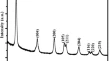
<p>The XRD spectra of the In<sub>2</sub>O<sub>3 </sub>NWs treated at different temperatures is shown in Figure <figr fid="F2">2</figr>. As can be seen most of the oxide peaks disappear at temperatures &gt;600&#176;C. However, a new peak appears, which corresponds to the (101) crystallographic direction of InN <abbrgrp>
<abbr bid="B1">1</abbr>
</abbrgrp>. Furthermore, SEM images reveal that the In<sub>2</sub>O<sub>3 </sub>NWs have been eliminated above 600&#176;C, but a thin layer of InN remains on the Si(001). Evidently, the nitridation of the In<sub>2</sub>O<sub>3 </sub>NWs is destructive above 600&#176;C due to the fast decomposition of In<sub>2</sub>O<sub>3 </sub>to In<sub>2</sub>O, which is a gas. We should also point out that in addition to the temperature we also varied the nitridation time. In particular, we carried out nitridations of In<sub>2</sub>O<sub>3 </sub>NWs at 500 and 600&#176;C under a flow of 125 sccm NH<sub>3 </sub>for different times as described in Table <tblr tid="T1">1</tblr>.</p>
<p>Again the conversion of In<sub>2</sub>O<sub>3 </sub>NWs to InN appears to be incomplete as can be clearly seen from the XRD spectra in Figure <figr fid="F4">4</figr> where one can observe the presence of In<sub>2</sub>O<sub>3 </sub>peaks and just one peak at (101) corresponding to InN. In order to achieve the efficient conversion of In<sub>2</sub>O<sub>3 </sub>NWs to InN without eliminating them, we used two different approaches. In the first one, we have carried out post-growth nitridation, which included H<sub>2 </sub>as shown in Table <tblr tid="T1">1</tblr> and in the second approach, we have utilised a two-step temperature nitridation process. The corresponding XRD spectra are shown in Figure <figr fid="F5">5</figr>. As can be seen from the XRD spectra, H<sub>2 </sub>plays a significant role in the removal of the oxygen and thus all major oxide peaks are eliminated and the conversion to InN is achieved with 40% H<sub>2</sub>. As already described above, NH<sub>3 </sub>alone does not promote the efficient conversion of In<sub>2</sub>O<sub>3 </sub>NWs into InN at temperatures between 500 and 600&#176;C. This is likely due to the formation of an InN shell around the In<sub>2</sub>O<sub>3</sub>, which prevents the diffusion of N into the In<sub>2</sub>O<sub>3 </sub>core. However, H<sub>2 </sub>appears to promote the conversion of In<sub>2</sub>O<sub>3</sub>into InN <abbrgrp>
<abbr bid="B14">14</abbr>
</abbrgrp>.</p>
<fig id="F4"><title><p>Figure 4</p></title><caption><p>XRD of In<sub>2</sub>O<sub>3 </sub>NWs obtained after nitridation at 500 and 600&#176;C for different times as described in Table 1</p></caption><text>
   <p><b>XRD of In<sub>2</sub>O<sub>3 </sub>NWs obtained after nitridation at 500 and 600&#176;C for different times as described in Table 1</b>.</p>
</text><graphic file="1556-276X-6-311-4"/></fig>
<fig id="F5"><title><p>Figure 5</p></title><caption><p>XRD of In<sub>2</sub>O<sub>3 </sub>NWs obtained after nitridation at 500&#176;C under various flows of NH<sub>3 </sub>and H<sub>2 </sub>as described in Table 1</p></caption><text>
   <p><b>XRD of In<sub>2</sub>O<sub>3 </sub>NWs obtained after nitridation at 500&#176;C under various flows of NH<sub>3 </sub>and H<sub>2 </sub>as described in Table 1</b>. The curve at the bottom corresponds to the two-step temperature nitridation process.</p>
</text><graphic file="1556-276X-6-311-5"/></fig>
<p>In addition, the two-step process lead to the effective conversion of In<sub>2</sub>O<sub>3 </sub>NWs to InN using just NH<sub>3</sub>. In this case, the temperature was ramped at 10&#176;C/min up to 500&#176;C and held constant over a period of 1 h, after which the temperature was ramped again slowly to 700&#176;C in order to promote the nitridation. Recall that the In<sub>2</sub>O<sub>3 </sub>NWs were eliminated during a single-step nitridation process at 700&#176;C using a fast ramp rate of 30&#176;C/min. However, it should be noted that the NWs treated by this two-step temperature nitridation process were bent probably due to the fact that the crystal structure changes from bcc to the hexagonal wurtzite structure, and there is a non-uniform strain distribution between the core and shell. The effect of the post-growth nitridations on the PL of the In<sub>2</sub>O<sub>3 </sub>NWs is shown in Figure <figr fid="F3">3</figr>.</p>
<p>In the case of the nitridation using just NH<sub>3 </sub>for 3 h at 500&#176;C, one may observe that there is no substantial change in the shape of the PL of the In<sub>2</sub>O<sub>3 </sub>NWs except from the fact that the PL intensity has been reduced. However, the nitridation of the In<sub>2</sub>O<sub>3 </sub>NWs using NH<sub>3 </sub>and H<sub>2 </sub>leads to a clear suppression of the peak at 550 nm, which is attributed to oxygen consistent with previous investigations on Ga<sub>2</sub>O<sub>3 </sub>
<abbrgrp>
<abbr bid="B4">4</abbr>
</abbrgrp>. The peak around 400 nm maybe attributed to In vacancies <abbrgrp>
<abbr bid="B15">15</abbr>
</abbrgrp>, but not O<sub>2 </sub>as commonly suggested <abbrgrp>
<abbr bid="B11">11</abbr>
<abbr bid="B12">12</abbr>
<abbr bid="B13">13</abbr>
</abbrgrp>. However, further work is required to clarify the origin of the PL peak around 400 nm.</p>
</sec>
<sec>
<st>
<p>Conclusions</p>
</st>
<p>Straight In<sub>2</sub>O<sub>3 </sub>NWs with diameters of 50 nm, lengths &#8805;2 &#956;m and a bcc crystal structure have been grown on Au/Si(001) via the wet oxidation of In at 850&#176;C. These exhibited two broad peaks in the PL, centred around 400 and 550 nm. The post-growth nitridation of In<sub>2</sub>O<sub>3 </sub>NWs was found to be effective by using NH<sub>3 </sub>and H<sub>2 </sub>at 500 and 600&#176;C or a two-step temperature, nitridation process at 500 and 700&#176;C. This lead to a suppression of the PL peak around 550 nm related to O<sub>2 </sub>consistent with previous investigations on Ga<sub>2</sub>O<sub>3</sub>. In contrast, single-step temperature, nitridations using just NH<sub>3</sub>, carried out with fast ramp rates above 600&#176;C lead to the complete elimination of the In<sub>2</sub>O<sub>3 </sub>NWs, while they were not effective at 500 and 600&#176;C.</p>
</sec>
<sec>
<st>
<p>Abbreviations</p>
</st>
<p>APCVD: atmospheric pressure chemical vapour deposition; bcc: body centred cubic; DI: de-ionised; MO: metal-oxide; NWs: nanowires; NWSCs: nanowires solar cells; PL: photoluminescence; QT: quartz tube; RT: room temperature; SEM: scanning electron microscope; VLS: vapour-liquid-solid; XRD: X-ray diffraction.</p>
</sec>
<sec>
<st>
<p>Competing interests</p>
</st>
<p>The authors declare that they have no competing interests.</p>
</sec>
<sec>
<st>
<p>Authors' contributions section</p>
</st>
<p>MZ and PP carried out the growth, scanning electron microscopy and x-ray diffraction measurements. AO carried optical characterization. All authors read and approved the final manuscript.</p>
</sec>
</bdy><bm>
<ack>
<sec>
<st>
<p>Acknowledgements</p>
</st>
<p>This work was supported by the Research Promotion Foundation of Cyprus under grant BE0308/03.</p>
</sec>
</ack>
<refgrp><bibl id="B1"><title><p>Ultrafast Carrier Relaxation in InN Nanowires Grown by Reactive Vapor Transport</p></title><aug><au><snm>Othonos</snm><fnm>A</fnm></au><au><snm>Zervos</snm><fnm>M</fnm></au><au><snm>Pervolaraki</snm><fnm>M</fnm></au></aug><source>Nanoscale Res Lett</source><pubdate>2009</pubdate><volume>4</volume><fpage>122</fpage><xrefbib><pubid idtype="doi">10.1007/s11671-008-9211-8</pubid></xrefbib></bibl><bibl id="B2"><title><p>Defect states of chemical vapor deposition grown GaN nanowires: Effects and mechanisms in the relaxation of carriers</p></title><aug><au><snm>Tsokkou</snm><fnm>D</fnm></au><au><snm>Othonos</snm><fnm>A</fnm></au><au><snm>Zervos</snm><fnm>M</fnm></au></aug><source>J Appl Phys</source><pubdate>2009</pubdate><volume>106</volume><fpage>05431</fpage></bibl><bibl id="B3"><title><p>Band structure and fundamental optical transitions in wurtzite AlN</p></title><aug><au><snm>Li</snm><fnm>J</fnm></au><au><snm>Nam</snm><fnm>KB</fnm></au><au><snm>Nakarmi</snm><fnm>ML</fnm></au><au><snm>Lin</snm><fnm>JY</fnm></au><au><snm>Jiang</snm><fnm>HX</fnm></au><au><snm>Pierre</snm><fnm>Carrier</fnm></au><au><snm>Su-Huai</snm><fnm>Wei</fnm></au></aug><source>Appl Phys Lett</source><pubdate>2003</pubdate><volume>83</volume><fpage>5163</fpage><xrefbib><pubid idtype="doi">10.1063/1.1633965</pubid></xrefbib></bibl><bibl id="B4"><title><p>A systematic investigation into the conversion of &#946;-Ga<sub>2</sub>O<sub>3 </sub>to GaN nanowires using NH<sub>3 </sub>and H<sub>2</sub>: Effects on the photoluminescence properties</p></title><aug><au><snm>Othonos</snm><fnm>&#913;</fnm></au><au><snm>Zervos</snm><fnm>&#924;</fnm></au><au><snm>Christofides</snm><fnm>C</fnm></au></aug><source>J Appl Phys</source><pubdate>2010</pubdate><volume>108</volume><fpage>124319</fpage><xrefbib><pubid idtype="doi">10.1063/1.3525562</pubid></xrefbib></bibl><bibl id="B5"><title><p>Synthesis of Tin Nitride SnxNy Nanowires by Chemical Vapour Deposition</p></title><aug><au><snm>Zervos</snm><fnm>M</fnm></au><au><snm>Othonos</snm><fnm>A</fnm></au></aug><source>Nanoscale Res Lett</source><pubdate>2009</pubdate><volume>4</volume><fpage>1103</fpage><xrefbib><pubidlist><pubid idtype="doi">10.1007/s11671-009-9364-0</pubid><pubid idtype="pmcid">2894173</pubid><pubid idtype="pmpid">20596341</pubid></pubidlist></xrefbib></bibl><bibl id="B6"><title><p>Nature of the Band Gap of In2O3 Revealed by First-Principles Calculations and X-Ray Spectroscopy</p></title><aug><au><snm>Aron</snm><fnm>Walsh</fnm></au><au><snm>Da Silva Juarez</snm><fnm>LF</fnm></au><au><snm>Su-Huai</snm><fnm>Wei</fnm></au><au><snm>K&#246;rber</snm><fnm>C</fnm></au><au><snm>Klein</snm><fnm>A</fnm></au><au><snm>Piper</snm><fnm>LFJ</fnm></au><au><snm>Alex</snm><fnm>DeMasi</fnm></au><au><snm>Smith Kevin</snm><fnm>E</fnm></au><au><snm>Panaccione</snm><fnm>G</fnm></au><au><snm>Torelli</snm><fnm>P</fnm></au><au><snm>Payne</snm><fnm>DJ</fnm></au><au><snm>Bourlange</snm><fnm>A</fnm></au><au><snm>Egdell</snm><fnm>RG</fnm></au></aug><source>Phys Rev Lett</source><pubdate>2008</pubdate><volume>100</volume><fpage>167402</fpage><xrefbib><pubidlist><pubid idtype="doi">10.1103/PhysRevLett.100.167402</pubid><pubid idtype="pmpid" link="fulltext">18518246</pubid></pubidlist></xrefbib></bibl><bibl id="B7"><title><p>Ultrafast time-resolved spectroscopy of In<sub>2</sub>O<sub>3 </sub>nanowires</p></title><aug><au><snm>Tsokkou</snm><fnm>D</fnm></au><au><snm>Othonos</snm><fnm>A</fnm></au><au><snm>Zervos</snm><fnm>M</fnm></au></aug><source>J Appl Phys</source><pubdate>2009</pubdate><volume>106</volume><fpage>084307</fpage><xrefbib><pubid idtype="doi">10.1063/1.3245339</pubid></xrefbib></bibl><bibl id="B8"><title><p>Fabrication and characterization of In2O3 Nanowires</p></title><aug><au><snm>Dai</snm><fnm>L</fnm></au><au><snm>Chen</snm><fnm>XL</fnm></au><au><snm>Jian</snm><fnm>JK</fnm></au><au><snm>He</snm><fnm>M</fnm></au><au><snm>Zhou</snm><fnm>T</fnm></au><au><snm>Hu</snm><fnm>BQ</fnm></au></aug><source>Appl Phys A</source><pubdate>2002</pubdate><volume>75</volume><fpage>687</fpage><xrefbib><pubid idtype="doi">10.1007/s00339-002-1475-8</pubid></xrefbib></bibl><bibl id="B9"><title><p>Catalyst supported growth of In<sub>2</sub>O<sub>3 </sub>nanostructures and their hydrogen gas sensing properties</p></title><aug><au><snm>Qurashi</snm><fnm>A</fnm></au><au><snm>El-Maghraby</snm><fnm>EM</fnm></au><au><snm>Yamazaki</snm><fnm>T</fnm></au><au><snm>Kikuta</snm><fnm>T</fnm></au></aug><source>Sensors and Actuators B</source><pubdate>2010</pubdate><volume>147</volume><fpage>48</fpage><xrefbib><pubid idtype="doi">10.1016/j.snb.2010.03.024</pubid></xrefbib></bibl><bibl id="B10"><title><p>In-catalyzed growth of high-purity indium oxide nanowires</p></title><aug><au><snm>Calestani</snm><fnm>D</fnm></au><au><snm>Zha</snm><fnm>M</fnm></au><au><snm>Zappettini</snm><fnm>A</fnm></au><au><snm>Lazzarini</snm><fnm>L</fnm></au><au><snm>Zanotti</snm><fnm>L</fnm></au></aug><source>Chem Phys Lett</source><pubdate>2007</pubdate><volume>445</volume><fpage>251</fpage><xrefbib><pubid idtype="doi">10.1016/j.cplett.2007.07.089</pubid></xrefbib></bibl><bibl id="B11"><title><p>Competitive growth of In<sub>2</sub>O<sub>3 </sub>nanorods with rectangular cross sections</p></title><aug><au><snm>Yan</snm><fnm>Y</fnm></au><au><snm>Zhou</snm><fnm>L</fnm></au></aug><source>Appl Phys A</source><pubdate>2008</pubdate><volume>92</volume><fpage>401</fpage><xrefbib><pubid idtype="doi">10.1007/s00339-008-4538-7</pubid></xrefbib></bibl><bibl id="B12"><title><p>Catalytic Growth of Semiconducting In<sub>2</sub>O<sub>3 </sub>Nanofibers</p></title><aug><au><snm>Liang</snm><fnm>C</fnm></au><au><snm>Meng</snm><fnm>G</fnm></au><au><snm>Lei</snm><fnm>Y</fnm></au><au><snm>Phillipp</snm><fnm>F</fnm></au><au><snm>Zhang</snm><fnm>L</fnm></au></aug><source>Adv Mater</source><pubdate>2001</pubdate><volume>13</volume><fpage>1330</fpage><xrefbib><pubid idtype="doi">10.1002/1521-4095(200109)13:17&lt;1330::AID-ADMA1330&gt;3.0.CO;2-6</pubid></xrefbib></bibl><bibl id="B13"><title><p>Fabrication and photoluminescence characteristics of single crystalline In2O3 nanowires</p></title><aug><au><snm>Wu</snm><fnm>XC</fnm></au><au><snm>Hong</snm><fnm>JM</fnm></au><au><snm>Han</snm><fnm>ZJ</fnm></au><au><snm>Tao</snm><fnm>YR</fnm></au></aug><source>Chem Phys Lett</source><pubdate>2003</pubdate><volume>373</volume><fpage>28</fpage><xrefbib><pubid idtype="doi">10.1016/S0009-2614(03)00582-7</pubid></xrefbib></bibl><bibl id="B14"><title><p>Preparation of ultrafine InN powder by the nitridation of In2O3 or In(OH)<sub>3 </sub>and its thermal stability</p></title><aug><au><snm>Gao</snm><fnm>L</fnm></au><au><snm>Zhang</snm><fnm>Q</fnm></au><au><snm>Li</snm><fnm>J</fnm></au></aug><source>J Mater Chem</source><pubdate>2003</pubdate><volume>13</volume><fpage>154</fpage><xrefbib><pubid idtype="doi">10.1039/b208105a</pubid></xrefbib></bibl><bibl id="B15"><title><p>Fabrication of ordered InN nanowire arrays and their photoluminescence properties</p></title><aug><au><snm>Zhang</snm><fnm>J</fnm></au><au><snm>Xu</snm><fnm>B</fnm></au><au><snm>Jiang</snm><fnm>F</fnm></au><au><snm>Yang</snm><fnm>Y</fnm></au><au><snm>Li</snm><fnm>J</fnm></au></aug><source>Phys Lett A</source><pubdate>2005</pubdate><volume>337</volume><fpage>121</fpage><xrefbib><pubid idtype="doi">10.1016/j.physleta.2005.01.048</pubid></xrefbib></bibl></refgrp>
</bm></art>