<?xml version='1.0'?>
<!DOCTYPE art SYSTEM 'http://www.biomedcentral.com/xml/article.dtd'>
<art>
<ui>1556-276X-6-290</ui>
<ji>1556-276X</ji>
<fm>
<dochead>Nano Express</dochead>
<bibl>
<title><p>Solar light-driven photocatalytic hydrogen evolution over ZnIn<sub>2</sub>S<sub>4</sub> loaded with transition-metal sulfides</p></title>
<aug><au id="A1"><snm>Shen</snm><fnm>Shaohua</fnm><insr iid="I1"/><insr iid="I2"/><email>shshen_xjtu@mail.xjtu.edu.cn</email></au>
<au id="A2"><snm>Chen</snm><fnm>Xiaobo</fnm><insr iid="I2"/><email>chenxiaobolbl@gmail.com</email></au>
<au id="A3"><snm>Ren</snm><fnm>Feng</fnm><insr iid="I2"/><email>FRen@lbl.gov</email></au>
<au id="A4"><snm>Kronawitter</snm><mi>X</mi><fnm>Coleman</fnm><insr iid="I2"/><email>colemank@newton.berkeley.edu</email></au>
<au ca="yes" id="A5"><snm>Mao</snm><mi>S</mi><fnm>Samuel</fnm><insr iid="I2"/><email>ssmao@lbl.gov</email></au>
<au ca="yes" id="A6"><snm>Guo</snm><fnm>Liejin</fnm><insr iid="I1"/><email>lj-guo@mail.xjtu.edu.cn</email></au>
</aug>
<insg>
<ins id="I1"><p>State Key Laboratory of Multiphase Flow in Power Engineering, Xi'an Jiaotong University, Xi'an, Shaanxi 710049, China</p></ins>
<ins id="I2"><p>Lawrence Berkeley National Laboratory, Berkeley, CA 94720, USA</p></ins>
</insg>
<source>Nanoscale Research Letters</source>
<issn>1556-276X</issn>
<pubdate>2011</pubdate>
<volume>6</volume>
<issue>1</issue>
<fpage>290</fpage>
<url>http://www.nanoscalereslett.com/content/6/1/290</url>
<xrefbib><pubidlist><pubid idtype="pmpid">21711804</pubid><pubid idtype="doi">10.1186/1556-276X-6-290</pubid></pubidlist></xrefbib></bibl>
<history><rec><date><day>6</day><month>10</month><year>2010</year></date></rec><acc><date><day>5</day><month>4</month><year>2011</year></date></acc><pub><date><day>5</day><month>4</month><year>2011</year></date></pub></history><cpyrt><year>2011</year><collab>Shen et al; licensee Springer.</collab><note>This is an Open Access article distributed under the terms of the Creative Commons Attribution License (<url>http://creativecommons.org/licenses/by/2.0</url>), which permits unrestricted use, distribution, and reproduction in any medium, provided the original work is properly cited.</note></cpyrt>
<abs>
<sec><st><p>Abstract</p></st>
<p>A series of Pt-loaded MS/ZnIn<sub>2</sub>S<sub>4</sub> (MS = transition-metal sulfide: Ag<sub>2</sub>S, SnS, CoS, CuS, NiS, and MnS) photocatalysts was investigated to show various photocatalytic activities depending on different transition-metal sulfides. Thereinto, CoS, NiS, or MnS-loading lowered down the photocatalytic activity of ZnIn<sub>2</sub>S<sub>4</sub>, while Ag<sub>2</sub>S, SnS, or CuS loading enhanced the photocatalytic activity. After loading 1.0 wt.% CuS together with 1.0 wt.% Pt on ZnIn<sub>2</sub>S<sub>4</sub>, the activity for H<sub>2</sub> evolution was increased by up to 1.6 times, compared to the ZnIn<sub>2</sub>S<sub>4</sub> only loaded with 1.0 wt.% Pt. Here, transition-metal sulfides such as CuS, together with Pt, acted as the dual co-catalysts for the improved photocatalytic performance. This study indicated that the application of transition-metal sulfides as effective co-catalysts opened up a new way to design and prepare high-efficiency and low-cost photocatalysts for solar-hydrogen conversion.</p>
</sec>
</abs>
</fm>
<bdy>
<sec><st><p>Introduction</p></st>
<p>Since the discovery of photo-induced water splitting on TiO<sub>2</sub> electrodes <abbrgrp><abbr bid="B1">1</abbr></abbrgrp>, solar-driven photocatalytic hydrogen production from water using a semiconductor catalyst has attracted a tremendous amount of interest <abbrgrp><abbr bid="B2">2</abbr><abbr bid="B3">3</abbr></abbrgrp>. To efficiently utilize solar energy, numerous attempts have been made in recent years to realize different visible light-active photocatalysts <abbrgrp><abbr bid="B4">4</abbr><abbr bid="B5">5</abbr><abbr bid="B6">6</abbr><abbr bid="B7">7</abbr><abbr bid="B8">8</abbr></abbrgrp>. Among them, sulfides, especially CdS-based photocatalysts with narrow band gaps, proved to be good candidates for photocatalytic hydrogen evolution from water under visible light irradiation <abbrgrp><abbr bid="B9">9</abbr><abbr bid="B10">10</abbr><abbr bid="B11">11</abbr><abbr bid="B12">12</abbr></abbrgrp>. However, CdS itself is not stable for water splitting, and Cd<sup>2+</sup> is hazardous to environment and human health. A number of nontoxic multicomponent sulfides without Cd<sup>2+</sup> ions have been developed to show comparable photocatalytic efficiency for hydrogen evolution <abbrgrp><abbr bid="B13">13</abbr><abbr bid="B14">14</abbr><abbr bid="B15">15</abbr><abbr bid="B16">16</abbr><abbr bid="B17">17</abbr></abbrgrp>. In our previous work <abbrgrp><abbr bid="B18">18</abbr><abbr bid="B19">19</abbr><abbr bid="B20">20</abbr><abbr bid="B21">21</abbr><abbr bid="B22">22</abbr></abbrgrp>, hydrothermally synthesized ZnIn<sub>2</sub>S<sub>4</sub> was found to have photocatalytic and photoelectrochemical properties that made it a good candidate for hydrogen production from water under visible light irradiation. On the other hand, a solid co-catalyst, typically noble metal (e.g., Pt, Ru, Rh) <abbrgrp><abbr bid="B23">23</abbr></abbrgrp> or transition-metal oxide (e.g., NiO <abbrgrp><abbr bid="B24">24</abbr></abbrgrp>, Rh<sub>2-y</sub>Cr<sub>y</sub>O<sub>3 </sub><abbrgrp><abbr bid="B25">25</abbr></abbrgrp>, RuO<sub>2 </sub><abbrgrp><abbr bid="B26">26</abbr></abbrgrp>, IrO<sub>2</sub><abbrgrp><abbr bid="B27">27</abbr></abbrgrp>), loaded on the surface of the base photocatalyst can be beneficial to photocatalytic H<sub>2</sub> and/or O<sub>2</sub> evolution for water splitting <abbrgrp><abbr bid="B25">25</abbr></abbrgrp>. Nevertheless, there have been only a limited number of studies in which metal sulfides acted as co-catalysts to enhance the activity of a semiconducting photocatalyst <abbrgrp><abbr bid="B28">28</abbr><abbr bid="B29">29</abbr><abbr bid="B30">30</abbr></abbrgrp>. For instance, Li and co-workers observed that dual co-catalysts consisting of noble metals (Pt, Pd) and noble-metal sulfides (PdS, Ru<sub>2</sub>S<sub>3</sub>, Rh<sub>2</sub>S<sub>3</sub>) played a crucial role in achieving very high efficiency for hydrogen evolution over CdS photocatalyst <abbrgrp><abbr bid="B29">29</abbr><abbr bid="B30">30</abbr></abbrgrp>. In this study, a series of transition-metal sulfides (MS: Ag<sub>2</sub>S, SnS, CoS, CuS, NiS, and MnS) were deposited on hydrothermally synthesized ZnIn<sub>2</sub>S<sub>4</sub> by a simple precipitation process. The photocatalytic activities for hydrogen evolution over these MS/ZnIn<sub>2</sub>S<sub>4</sub> products were investigated. We demonstrated that transition-metal sulfides, such as CuS, combined with Pt could act as dual co-catalysts for improving photocatalytic activity for hydrogen evolution from a Na<sub>2</sub>SO<sub>3</sub>/Na<sub>2</sub>S aqueous solution under simulated sunlight.</p>
<sec><st><p>Experimental section</p></st>
<p>All chemicals are of analytical grade and used as received without further purification. ZnIn<sub>2</sub>S<sub>4</sub> products were prepared by a cetyltrimethylammoniumbromide (CTAB)-assisted hydrothermal synthetic method as described in our previous studies <abbrgrp><abbr bid="B18">18</abbr><abbr bid="B19">19</abbr></abbrgrp>. For the synthesis of MS/ZnIn<sub>2</sub>S<sub>4 </sub>(MS = Ag<sub>2</sub>S, SnS, CoS, CuS, NiS, and MnS), 0.1 g of prepared ZnIn<sub>2</sub>S<sub>4 </sub>was dispersed in 20 mL of distilled water and ultrasonicated for 20 min. Under stirring, a desired amount of 0.1 M AgNO<sub>3 </sub>(J.T.Baker Chemical Co., Phillipsburg, NJ, USA), SnCl<sub>2 </sub>(Sigma-Aldrich, Milwaukee, WI, USA), Co(NO<sub>3</sub>)<sub>2</sub> (Aldrich), Cu(NO<sub>3</sub>)<sub>2 </sub>(Fluka Chemical Company, Buchs, Switzerland), Ni(NO<sub>3</sub>)<sub>2 </sub>(Fluka), or Mn(CH<sub>3</sub>COO)<sub>2 </sub>(Alfa-Aesar, Ward Hill, MA, USA) aqueous solution was dropped into the above suspension, followed by a drop-wise addition of 0.1 M Na<sub>2</sub>S&#183;9H<sub>2</sub>O (Sigma-Aldrich) aqueous solution, containing double excess of S<sup>2- </sup>relative to the amount of metal ions. The resulting suspension was stirred for another 20 min, then the MS/ZnIn<sub>2</sub>S<sub>4 </sub>precipitate was collected by centrifugation and washed with distilled water for several times, and dried overnight at 65&#176;C. The weight contents of transition-metal sulfides (MS) in these MS/ZnIn<sub>2</sub>S<sub>4</sub> products were controlled at 0.5% to approximately 2.0%.</p>
<p>X-ray diffraction patterns were obtained from a PANalytical X'pert diffractometer (PANalytical, Almelo, The Netherlands) using Ni-filtered Cu K&#945; irradiation (wavelength 1.5406 &#197;). UV-visible absorption spectra were determined with a Varian Cary 50 UV spectrophotometer (Varian Inc, Cary, NC, USA) with MgO as reference. Morphology inspection was performed with a high-resolution scanning electron microscope (SEM, Hitachi S-4300, Tokyo, Japan). Transmission electron microscopy (TEM) study was carried out on a JEOL JEM 2010 instrument (JEOL Ltd., Tokyo, Japan). The X-ray photoelectron spectroscopy (XPS) measurements were conducted on a Kratos spectrometer (AXIS Ultra DLD, Shimadzu/Kratos Analytical, Hadano, Kanagawa, Japan) with monochromatic Al K<sub>&#945;</sub> radiation (h&#957; = 1,486.69 eV) and with a concentric hemispherical analyzer. Elemental Analysis was conducted on the Bruker S4 PIONEER X-ray fluorescence spectrum (XRF, Bruker AXS GmbH, Karlsruhe, Germany) using Rh target and 4-kW-maximum power.</p>
<p>Photocatalytic hydrogen evolution was performed in a side-window reaction cell. A 300-W solar simulator (AM 1.5; Newport Corporation, Irvine, CA, USA) was used as the light source. The amount of hydrogen evolved was determined using a gas chromatograph (CP-4900 Micro-GC, thermal conductivity detector, Ar carrier; Varian Inc., Palo Alto, CA, USA). In all experiments, 100 mL of deionized water containing 0.05 g of catalyst and 0.25 M Na<sub>2</sub>SO<sub>3</sub>/0.35 M Na<sub>2</sub>S mixed sacrificial agent was added into the reaction cell. Here, sacrificial agent was used to scavenge photo-generated holes. Argon gas was purged through the reaction cell for 30 min before reaction to remove air. Pt (1.0 wt.%) as a co-catalyst for the promotion of hydrogen evolution was deposited in situ on the photocatalyst from the precursor of H<sub>2</sub>PtCl<sub>6</sub>&#183;xH<sub>2</sub>O (Aldrich; 99.9%). In all cases, the reproducibility of the measurements was within &#177; 10%. Control experiments showed no appreciable H<sub>2</sub> evolution without solar light irradiation or photocatalyst.</p>
</sec>
</sec>
<sec><st><p>Results and discussion</p></st>
<p>The ZnIn<sub>2</sub>S<sub>4</sub> products prepared by the CTAB-assisted hydrothermal method possessed a hexagonal structure and morphology of microspheres comprising of numerous petals, and showed an absorption edge at about 510 nm (Additional file <supplr sid="S1">1</supplr>, Figure S1-3). Compared to pure ZnIn<sub>2</sub>S<sub>4</sub>, the obtained MS/ZnIn<sub>2</sub>S<sub>4</sub> (MS = metal sulfide: Ag<sub>2</sub>S, SnS, CoS, CuS, NiS, and MnS) displayed different absorption profiles (Additional file <supplr sid="S1">1</supplr>, Figure S4), with enhanced absorption in the visible light region from 550 to 800 nm. Such additional broad band (&#955; &gt; 550 nm) can be assigned to the absorption of transition-metal sulfides.</p>
<suppl id="S1">
<title><p>Additional file 1</p></title>
<text><p><b>Figures S1, S2, S3, S4 and S5</b>.</p></text>
<file name="1556-276X-6-290-S1.DOC">
   <p>Click here for file</p>
</file>
</suppl>
<p>We investigated the photocatalytic activity for hydrogen evolution over MS/ZnIn<sub>2</sub>S<sub>4</sub> (MS = metal sulfide: Ag<sub>2</sub>S, SnS, CoS, CuS, NiS, and MnS). Photocatalytic activities for hydrogen evolution over MS/ZnIn<sub>2</sub>S<sub>4</sub> were evaluated by loading 1 wt.% Pt as co-catalyst. Figure <figr fid="F1">1</figr> shows the average rates of H<sub>2</sub> evolution over Pt-loaded MS/ZnIn<sub>2</sub>S<sub>4</sub> photocatalysts under simulated solar irradiation in the initial 20-h period. The Pt-ZnIn<sub>2</sub>S<sub>4</sub> showed a photocatalytic activity for H<sub>2</sub> production at the rate of 126.7 &#956;mol&#183;h<sup>-1</sup>, which is comparable to reported values in previous literatures <abbrgrp><abbr bid="B18">18</abbr><abbr bid="B19">19</abbr><abbr bid="B20">20</abbr></abbrgrp>. The hydrogen production rates of Pt-MS/ZnIn<sub>2</sub>S<sub>4</sub> photocatalysts varied with different kinds of loaded transition-metal sulfides. The Pt-MS/ZnIn<sub>2</sub>S<sub>4</sub> (MS = Ag<sub>2</sub>S, SnS, and CuS) photocatalysts displayed enhanced activities for hydrogen evolution under solar irradiation. In particular, the H<sub>2</sub> evolution rate greatly increased to 200 &#956;mol&#183;h<sup>-1</sup> after loading 1.0 wt.% of CuS on ZnIn<sub>2</sub>S<sub>4</sub>. In this CuS/ZnIn<sub>2</sub>S<sub>4</sub> sample, the formation of CuS (copper monosulfide) could be evidenced by XPS analysis results shown in Figure S5 (Additional file <supplr sid="S1">1</supplr>). The survey scan spectrum (Figure S5A of Additional file <supplr sid="S1">1</supplr>) indicated the presence of Cu, Zn, In, and S in the sample <abbrgrp><abbr bid="B21">21</abbr><abbr bid="B31">31</abbr></abbrgrp>. The binding energies shown in Figure S5E (Additional file <supplr sid="S1">1</supplr>) for Cu 2p<sub>3/2</sub> and Cu 2p<sub>1/2</sub> were 952.5 and 932.5 eV, respectively, which are close to the reported value of Cu<sup>2+</sup><abbrgrp><abbr bid="B31">31</abbr></abbrgrp>. The actual molar ratio of Cu:Zn:In:S was 0.011:0.2:0.39:1.01 as confirmed by XRF analysis result, with weight content of CuS calculated to be 1.15 wt.%, which is quite close to the proposed stoichiometric ratio. The photocatalytic activities for hydrogen evolution over Pt-MS/ZnIn<sub>2</sub>S<sub>4</sub> (MS = Ag<sub>2</sub>S, SnS, and CuS) in the initial 20-h period were measured to increase in the order of SnS &lt;Ag<sub>2</sub>S &lt;CuS. Generally, these transition-metal sulfides (SnS, Ag<sub>2</sub>S, and CuS) alone are not photocatalytically active for H<sub>2</sub> evolution, as no H<sub>2</sub> was detected when they were used as the catalysts. Thus, the improvement of photocatalytic performances of Pt-MS/ZnIn<sub>2</sub>S<sub>4</sub> (MS = Ag<sub>2</sub>S, SnS, and CuS) can be related to the enhanced separation of photo-generated electrons and holes induced by the hybridization of MS with ZnIn<sub>2</sub>S<sub>4</sub>. In this photocatalysis system, transition-metal sulfides (MS = Ag<sub>2</sub>S, SnS, and CuS) combined with noble-metal Pt acted as dual co-catalysts for photocatalytic hydrogen evolution. However, when transition-metal sulfides (MS = CoS, NiS, and MnS) were loaded on ZnIn<sub>2</sub>S<sub>4</sub>, the rates of H<sub>2</sub> evolution over Pt-MS/ZnIn<sub>2</sub>S<sub>4</sub> (MS = CoS, NiS, and MnS) were sharply decreased. Instead of the role as effective co-catalysts, these transition-metal sulfides (i.e., CoS, NiS, and MnS) may work as the recombination center of photo-generated electron-hole pairs, which lowered the photocatalytic activity for hydrogen evolution over Pt-MS/ZnIn<sub>2</sub>S<sub>4</sub> (MS = CoS, NiS, and MnS). Further investigation is needed and also under way to provide enough supporting information to evidence the negative effects of CoS, NiS, and MnS, although main attention has focused on the more effective co-catalysts such as Ag<sub>2</sub>S, SnS, and CuS in the following discussion.</p>
<fig id="F1"><title><p>Figure 1</p></title><caption><p>Average rates of H<sub>2</sub> evolution</p></caption><text>
   <p><b>Average rates of H<sub>2</sub> evolution</b>. The average rates of H<sub>2</sub> evolution over Pt-loaded MS/ZnIn<sub>2</sub>S<sub>4</sub> (MS = metal sulfide: Ag<sub>2</sub>S, SnS, CoS, CuS, NiS, and MnS) under solar light irradiation in the initial 20-h period.</p>
</text><graphic file="1556-276X-6-290-1"/></fig>
<p>Figure <figr fid="F2">2</figr> shows the reaction time depended H<sub>2</sub> evolution over Pt-loaded MS/ZnIn<sub>2</sub>S<sub>4</sub> (MS = Ag<sub>2</sub>S, SnS, and CuS) under solar irradiation. Pt-SnS/ZnIn<sub>2</sub>S<sub>4</sub> and Pt-CuS/ZnIn<sub>2</sub>S<sub>4</sub> exhibited stable activity in the period of 34-h experiment. However, the rate of H<sub>2</sub> production over Pt-Ag<sub>2</sub>S/ZnIn<sub>2</sub>S<sub>4</sub> had a significant drop after irradiation for approximately 20 h. This deactivation may result from gradual reduction of Ag<sub>2</sub>S particles loaded on the surface of ZnIn<sub>2</sub>S<sub>4</sub> to metallic Ag by photo-generated electrons during the reaction. Similar deactivation of photocatalyst was previously observed for CdS modified with Ag<sub>2</sub>S <abbrgrp><abbr bid="B32">32</abbr></abbrgrp>. However, this result is quite different from our previous report on Pt-Ag<sub>2</sub>S/CdS, in which the high dispersion of Ag<sub>2</sub>S in the nanostructure of CdS contributed to stable photocatalytic activity for hydrogen evolution <abbrgrp><abbr bid="B33">33</abbr></abbrgrp>. Taking into account the reduction potential (<it>vs</it>. normal hydrogen electrode (NHE)) of Ag<sup>+</sup>/Ag (0.80 V), Cu<sup>2+</sup>/Cu (0.34 V), and Sn<sup>2+</sup>/Sn (-0.14 V), reduction of Ag<sub>2</sub>S by photo-generated electrons is easier than photoreduction of CuS and SnS. Therefore, Pt-MS/ZnIn<sub>2</sub>S<sub>4</sub> (MS = SnS and CuS) turned to be more stable than Pt-Ag<sub>2</sub>S/ZnIn<sub>2</sub>S<sub>4</sub> during the photocatalytic reaction for hydrogen evolution.</p>
<fig id="F2"><title><p>Figure 2</p></title><caption><p>Time courses of H<sub>2</sub> evolution</p></caption><text>
   <p><b>Time courses of H<sub>2</sub> evolution</b>. The time courses of H<sub>2</sub> evolution over Pt-loaded MS/ZnIn<sub>2</sub>S<sub>4</sub> (MS = Ag<sub>2</sub>S, SnS, and CuS) under solar light irradiation.</p>
</text><graphic file="1556-276X-6-290-2"/></fig>
<p>Table <tblr tid="T1">1</tblr> shows the dependence of photocatalytic activity for H<sub>2</sub> evolution over Pt-loaded MS/ZnIn<sub>2</sub>S<sub>4</sub> (MS = SnS and CuS) on the loading amount of transition-metal sulfides. With the increase of SnS-loading from 0 to 2.0 wt.%, the rate of H<sub>2</sub> evolution over Pt-SnS/ZnIn<sub>2</sub>S<sub>4</sub> does not show significant changes. In contrast, the photocatalytic performance of Pt-CuS/ZnIn<sub>2</sub>S<sub>4</sub> depends strongly on the amount of CuS-loading, and the optimum loading amount of CuS is approximately1.0 wt.%. The progressive regression of photocatalytic activity observed with the amount of CuS increasing from 1.0 to 2.0 wt.% may be due to the fact that excess CuS particles loaded on the surface of ZnIn<sub>2</sub>S<sub>4</sub> could act as the optical filter or charge recombination center instead of co-catalyst for charge separation <abbrgrp><abbr bid="B19">19</abbr><abbr bid="B32">32</abbr></abbrgrp>.</p>
<tbl id="T1"><title><p>Table 1</p></title><caption><p>Average rates of H<sub>2</sub> evolution over Pt-loaded MS/ZnIn<sub>2</sub>S<sub>4</sub>.</p></caption><tblbdy cols="3">
      <r>
         <c ca="center">
            <p>
               <b>Photocatalyst</b>
            </p>
            <p>
               <b>MS/ZnIn<sub>2</sub>S<sub>4</sub></b>
            </p>
         </c>
         <c ca="center">
            <p>
               <b>Content of MS</b>
            </p>
         </c>
         <c ca="center">
            <p>
               <b>Rate of hydrogen evolution</b>
            </p>
            <p>
               <b>&#956;mol/h</b>
            </p>
         </c>
      </r>
      <r>
         <c cspan="3">
            <hr/>
         </c>
      </r>
      <r>
         <c ca="center">
            <p>ZnIn<sub>2</sub>S<sub>4</sub></p>
         </c>
         <c ca="center">
            <p>0</p>
         </c>
         <c ca="center">
            <p>126.7</p>
         </c>
      </r>
      <r>
         <c ca="center">
            <p>SnS/ZnIn<sub>2</sub>S<sub>4</sub></p>
         </c>
         <c ca="center">
            <p>0.5%</p>
         </c>
         <c ca="center">
            <p>115.4</p>
         </c>
      </r>
      <r>
         <c ca="center">
            <p>SnS/ZnIn<sub>2</sub>S<sub>4</sub></p>
         </c>
         <c ca="center">
            <p>1.0%</p>
         </c>
         <c ca="center">
            <p>129.7</p>
         </c>
      </r>
      <r>
         <c ca="center">
            <p>SnS/ZnIn<sub>2</sub>S<sub>4</sub></p>
         </c>
         <c ca="center">
            <p>2.0%</p>
         </c>
         <c ca="center">
            <p>127.1</p>
         </c>
      </r>
      <r>
         <c ca="center">
            <p>CuS/ZnIn<sub>2</sub>S<sub>4</sub></p>
         </c>
         <c ca="center">
            <p>0.5%</p>
         </c>
         <c ca="center">
            <p>181.4</p>
         </c>
      </r>
      <r>
         <c ca="center">
            <p>CuS/ZnIn<sub>2</sub>S<sub>4</sub></p>
         </c>
         <c ca="center">
            <p>1.0%</p>
         </c>
         <c ca="center">
            <p>201.7</p>
         </c>
      </r>
      <r>
         <c ca="center">
            <p>CuS/ZnIn<sub>2</sub>S<sub>4</sub></p>
         </c>
         <c ca="center">
            <p>2.0%</p>
         </c>
         <c ca="center">
            <p>139.4</p>
         </c>
      </r>
   </tblbdy><tblfn>
      <p>The average rates of H<sub>2</sub> evolution over Pt-loaded MS/ZnIn<sub>2</sub>S<sub>4</sub> (MS = metal sulfide: SnS and CuS) under solar light irradiation in the initial 20-h period</p>
   </tblfn></tbl>
<p>To visualize hybridization of CuS with ZnIn<sub>2</sub>S<sub>4</sub>, ZnIn<sub>2</sub>S<sub>4</sub>, and CuS/ZnIn<sub>2</sub>S<sub>4 </sub>photocatalysts were investigated by TEM. A representative TEM image of ZnIn<sub>2</sub>S<sub>4</sub> is shown in Figure <figr fid="F3">3A</figr>, which shows the formation of microspheres, 1-2 &#956;m in diameter and comprised of a circle of micro-petals. The ED pattern (inset of Figure <figr fid="F3">3A</figr>) substantiates that the ZnIn<sub>2</sub>S<sub>4</sub> microsphere is of a hexagonal phase. The TEM image in Figure <figr fid="F3">3B</figr> shows that some nanoparticles are loaded on the surface of ZnIn<sub>2</sub>S<sub>4</sub> microspheres. Such nanoparticles were confirmed by the ED pattern (inset in Figure <figr fid="F3">3B</figr>) to be CuS with typical orthorhombic structure. Thus, nanosized CuS particles dispersed on the ZnIn<sub>2</sub>S<sub>4</sub> surface would act as the charge-transfer co-catalyst, together with photodeposited Pt particles. The Pt-CuS dual co-catalysts improved the charge separation and therefore increased the photocatalytic activity.</p>
<fig id="F3"><title><p>Figure 3</p></title><caption><p>TEM images (A) ZnIn<sub>2</sub>S<sub>4</sub> and (B) CuS/ZnIn<sub>2</sub>S<sub>4</sub></p></caption><text>
   <p><b>TEM images (A) ZnIn<sub>2</sub>S<sub>4</sub> and (B) CuS/ZnIn<sub>2</sub>S<sub>4</sub></b>.</p>
</text><graphic file="1556-276X-6-290-3"/></fig>
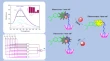
<p>Figure <figr fid="F4">4</figr> illustrates the process of photo-generated charge transfer for photocatalytic hydrogen evolution over Pt-CuS/ZnIn<sub>2</sub>S<sub>4</sub> in an aqueous solution containing Na<sub>2</sub>SO<sub>3</sub>/Na<sub>2</sub>S under simulated sunlight. Band gap excitation produces electron-hole pairs in ZnIn<sub>2</sub>S<sub>4</sub> particles. The excited electrons are subsequently channeled to Pt sites, which reduce protons to generate hydrogen. On the other hand, the valence band potential of ZnIn<sub>2</sub>S<sub>4</sub>, deduced from the conduction band potential (0.29 V <it>vs</it>. NHE) <abbrgrp><abbr bid="B22">22</abbr></abbrgrp> and the band gap energy (2.43 eV), is about 2.72 V <it>vs</it>. NHE, which is more positive than the OH<sup>-</sup>/O<sub>2</sub> redox potential <abbrgrp><abbr bid="B4">4</abbr></abbrgrp>. The valence band potential of CuS is less positive than the OH<sup>-</sup>/O<sub>2</sub> redox potential <abbrgrp><abbr bid="B34">34</abbr></abbrgrp>. Such a difference of valence band potentials makes it possible for the excited holes to transfer from ZnIn<sub>2</sub>S<sub>4</sub> to CuS to react with Na<sub>2</sub>S/Na<sub>2</sub>SO<sub>3</sub> electron donor in the solution. Therefore, Pt and CuS are supposed to act as the reduction and oxidation co-catalyst, respectively, which leads to more efficient charge separation, thus improves photocatalytic activity of Pt-CuS/ZnIn<sub>2</sub>S<sub>4</sub>. Similar benefits of dual co-catalysts on photocatalytic activity have been observed for CdS loaded with noble metals as reduction catalysts and noble-metal sulfides as oxidation catalysts <abbrgrp><abbr bid="B29">29</abbr><abbr bid="B30">30</abbr></abbrgrp>. It is noteworthy that replacing noble-metal sulfides (such as PdS) by transition-metal sulfides (such as CuS) as the co-catalysts would help lower the cost of photocatalysts for solar-hydrogen production. Moreover, seeking effective co-catalyst candidates could be expanded to other transition-metal sulfides such as FeS and SnS<sub>2</sub>, etc. Detailed research on this subject is still an ongoing progress in our group.</p>
<fig id="F4"><title><p>Figure 4</p></title><caption><p>Schematic illustration of photo-generated charge-transfer process for photocatalytic hydrogen evolution over Pt-CuS/ZnIn<sub>2</sub>S<sub>4</sub></p></caption><text>
   <p><b>Schematic illustration of photo-generated charge-transfer process for photocatalytic hydrogen evolution over Pt-CuS/ZnIn<sub>2</sub>S<sub>4</sub></b>. From an aqueous solution containing Na<sub>2</sub>SO<sub>3</sub>/Na<sub>2</sub>S under simulated solar light.</p>
</text><graphic file="1556-276X-6-290-4"/></fig>
</sec>
<sec><st><p>Conclusions</p></st>
<p>In summary, a series of Pt-loaded MS/ZnIn<sub>2</sub>S<sub>4</sub> (MS = transition-metal sulfides: Ag<sub>2</sub>S, SnS, CoS, CuS, NiS, and MnS) photocatalysts were developed. It is found that Ag<sub>2</sub>S, SnS, and CuS could enhance the photocatalytic activity of hydrogen evolution over ZnIn<sub>2</sub>S<sub>4</sub> to varying degrees, while SnS, CoS, and NiS would reduce the activity. Among them, the Pt-CuS/ZnIn<sub>2</sub>S<sub>4</sub> photocatalyst exhibited the most efficient and stable activity for hydrogen evolution. This can be attributed to the fact that the dual co-catalysts of Pt and CuS entrapped photo-induced electrons and holes for reduction and oxidation reaction, respectively, improving charge separation and hence the photocatalytic activity. Application of transition-metal sulfides as co-catalysts opens up an opportunity toward realizing high-efficiency, low-cost photocatalysts for solar-hydrogen conversion.</p>
</sec>
<sec><st><p>Competing interests</p></st>
<p>The authors declare that they have no competing interests.</p>
</sec>
<sec><st><p>Authors' contributions</p></st>
<p>SS carried out experiments except SEM and TEM characterization, and drafted the manuscript. XC participated in the design of the study. FR performed the TEM characterization. CXK performed the SEM characterization and improved English writing. SSM provide financial support and participated in the design and coordination of this study. LG conceived of the study, and participated in its design and coordination. All authors read and approved the final manuscript.</p>
</sec>
</bdy>
<bm>
<ack><sec><st><p>Acknowledgements</p></st>
<p>The authors acknowledge the support by the National Basic Research Program of China (No. 2009CB220000), Natural Science Foundation of China (No. 50821064 and No. 90610022), and the U.S. Department of Energy. One of the authors (SS) was also supported by China Scholarship Council and the Fundamental Research Funds for the Central Universities (No. 08142004 and No. 08143019).</p>
</sec>
</ack>
<refgrp><bibl id="B1"><title><p>Electrochemical photolysis of water at a semiconductor electrode</p></title><aug><au><snm>Fujishima</snm><fnm>A</fnm></au><au><snm>Honda</snm><fnm>K</fnm></au></aug><source>Nature (London)</source><pubdate>1972</pubdate><volume>238</volume><fpage>37</fpage><xrefbib><pubid idtype="doi">10.1038/238037a0</pubid></xrefbib></bibl><bibl id="B2"><title><p>Selected nanotechnologies for renewable energy applications</p></title><aug><au><snm>Mao</snm><fnm>SS</fnm></au><au><snm>Chen</snm><fnm>X</fnm></au></aug><source>Int J Energy Res</source><pubdate>2007</pubdate><volume>31</volume><fpage>619</fpage><xrefbib><pubid idtype="doi">10.1002/er.1283</pubid></xrefbib></bibl><bibl id="B3"><title><p>Titanium dioxide nanomaterials: synthesis, properties, modifications, and applications</p></title><aug><au><snm>Chen</snm><fnm>X</fnm></au><au><snm>Mao</snm><fnm>SS</fnm></au></aug><source>Chem Rev</source><publisher>Washington, D.C.</publisher><pubdate>2007</pubdate><volume>107</volume><fpage>2891</fpage><xrefbib><pubidlist><pubid idtype="doi">10.1021/cr0500535</pubid><pubid idtype="pmpid" link="fulltext">17590053</pubid></pubidlist></xrefbib></bibl><bibl id="B4"><title><p>Heterogeneous photocatalyst materials for water splitting</p></title><aug><au><snm>Kudo</snm><fnm>A</fnm></au><au><snm>Miseki</snm><fnm>Y</fnm></au></aug><source>Chem Soc Rev</source><pubdate>2009</pubdate><volume>38</volume><fpage>253</fpage><xrefbib><pubidlist><pubid idtype="doi">10.1039/b800489g</pubid><pubid idtype="pmpid" link="fulltext">19088977</pubid></pubidlist></xrefbib></bibl><bibl id="B5"><title><p>Semiconductor-based photocatalytic hydrogen generation</p></title><aug><au><snm>Chen</snm><fnm>X</fnm></au><au><snm>Shen</snm><fnm>S</fnm></au><au><snm>Guo</snm><fnm>L</fnm></au><au><snm>Mao</snm><fnm>SS</fnm></au></aug><source>Chem Rev</source><publisher>Washington, D.C.</publisher><pubdate>2010</pubdate><volume>110</volume><fpage>6503</fpage><xrefbib><pubidlist><pubid idtype="doi">10.1021/cr1001645</pubid><pubid idtype="pmpid" link="fulltext">21062099</pubid></pubidlist></xrefbib></bibl><bibl id="B6"><title><p>Direct splitting of water under visible light irradiation with an oxide semiconductor photocatalyst</p></title><aug><au><snm>Zou</snm><fnm>ZG</fnm></au><au><snm>Ye</snm><fnm>JH</fnm></au><au><snm>Sayama</snm><fnm>K</fnm></au><au><snm>Arakawa</snm><fnm>H</fnm></au></aug><source>Nature (London)</source><pubdate>2001</pubdate><volume>414</volume><fpage>625</fpage><xrefbib><pubid idtype="doi">10.1038/414625a</pubid></xrefbib></bibl><bibl id="B7"><title><p>Photocatalyst releasing hydrogen from water</p></title><aug><au><snm>Maeda</snm><fnm>K</fnm></au><au><snm>Teramura</snm><fnm>K</fnm></au><au><snm>Lu</snm><fnm>D</fnm></au><au><snm>Takata</snm><fnm>T</fnm></au><au><snm>Saito</snm><fnm>N</fnm></au><au><snm>Inoue</snm><fnm>Y</fnm></au><au><snm>Domen</snm><fnm>K</fnm></au></aug><source>Nature (London)</source><pubdate>2006</pubdate><volume>440</volume><fpage>295</fpage><xrefbib><pubid idtype="doi">10.1038/440295a</pubid></xrefbib></bibl><bibl id="B8"><title><p>New non-oxide photocatalysts designed for overall water splitting under visible light</p></title><aug><au><snm>Maeda</snm><fnm>K</fnm></au><au><snm>Domen</snm><fnm>K</fnm></au></aug><source>J Phys Chem C</source><pubdate>2007</pubdate><volume>111</volume><fpage>7851</fpage><xrefbib><pubid idtype="doi">10.1021/jp070911w</pubid></xrefbib></bibl><bibl id="B9"><title><p>Band structure-controlled solid solution of Cd<sub>1-x</sub>Zn<sub>x</sub>S photocatalyst for hydrogen production by water splitting</p></title><aug><au><snm>Xing</snm><fnm>C</fnm></au><au><snm>Zhang</snm><fnm>Y</fnm></au><au><snm>Yan</snm><fnm>W</fnm></au><au><snm>Guo</snm><fnm>L</fnm></au></aug><source>Int J Hydrogen Energy</source><pubdate>2006</pubdate><volume>31</volume><fpage>2018</fpage><xrefbib><pubid idtype="doi">10.1016/j.ijhydene.2006.02.003</pubid></xrefbib></bibl><bibl id="B10"><title><p>A novel method for the preparation of a highly stable and active CdS photocatalyst with a special surface nanostructure</p></title><aug><au><snm>Jing</snm><fnm>D</fnm></au><au><snm>Guo</snm><fnm>L</fnm></au></aug><source>J Phys Chem B</source><pubdate>2006</pubdate><volume>110</volume><fpage>11139</fpage><xrefbib><pubidlist><pubid idtype="doi">10.1021/jp060905k</pubid><pubid idtype="pmpid">16771376</pubid></pubidlist></xrefbib></bibl><bibl id="B11"><title><p>Growth of quantum-confined CdS nanoparticles inside Ti-MCM-41 as a visible light photocatalyst</p></title><aug><au><snm>Shen</snm><fnm>S</fnm></au><au><snm>Guo</snm><fnm>L</fnm></au></aug><source>Mater Res Bull</source><pubdate>2008</pubdate><volume>43</volume><fpage>437</fpage><xrefbib><pubid idtype="doi">10.1016/j.materresbull.2007.02.034</pubid></xrefbib></bibl><bibl id="B12"><title><p>Self-templated synthesis of nanoporous CdS nanostructures for highly efficient photocatalytic hydrogen production under visible light</p></title><aug><au><snm>Bao</snm><fnm>N</fnm></au><au><snm>Shen</snm><fnm>L</fnm></au><au><snm>Takata</snm><fnm>T</fnm></au><au><snm>Domen</snm><fnm>K</fnm></au></aug><source>Chem Mater</source><pubdate>2008</pubdate><volume>20</volume><fpage>110</fpage><xrefbib><pubid idtype="doi">10.1021/cm7029344</pubid></xrefbib></bibl><bibl id="B13"><title><p>Solar hydrogen production over novel metal sulfide photocatalysts of AGa<sub>2</sub>In<sub>3</sub>S<sub>8</sub> (A = Cu or Ag) with layered structures</p></title><aug><au><snm>Kaga</snm><fnm>H</fnm></au><au><snm>Saito</snm><fnm>K</fnm></au><au><snm>Kudo</snm><fnm>A</fnm></au></aug><source>Chem Commun</source><pubdate>2010</pubdate><volume>46</volume><fpage>3779</fpage><xrefbib><pubid idtype="doi">10.1039/b927362j</pubid></xrefbib></bibl><bibl id="B14"><title><p>AgGaS<sub>2</sub>-type photocatalysts for hydrogen production under visible light: Effects of post-synthetic H<sub>2</sub>S treatment</p></title><aug><au><snm>Jang</snm><fnm>JS</fnm></au><au><snm>Choi</snm><fnm>SH</fnm></au><au><snm>Shin</snm><fnm>N</fnm></au><au><snm>Yu</snm><fnm>C</fnm></au><au><snm>Lee</snm><fnm>JS</fnm></au></aug><source>J Solid State Chem</source><pubdate>2007</pubdate><volume>180</volume><fpage>1110</fpage><xrefbib><pubid idtype="doi">10.1016/j.jssc.2007.01.008</pubid></xrefbib></bibl><bibl id="B15"><title><p>Novel stannite-type complex sulfide photocatalysts A<sup>I</sup><sub>2</sub>-Zn-A<sup>IV</sup>-S<sub>4</sub> (A<sup>I</sup> = Cu and Ag; A<sup>IV</sup> = Sn and Ge) for hydrogen evolution under visible-light irradiation</p></title><aug><au><snm>Tsuji</snm><fnm>I</fnm></au><au><snm>Shimodaira</snm><fnm>Y</fnm></au><au><snm>Kato</snm><fnm>H</fnm></au><au><snm>Kobayashi</snm><fnm>H</fnm></au><au><snm>Kudo</snm><fnm>A</fnm></au></aug><source>Chem Mater</source><pubdate>2010</pubdate><volume>22</volume><fpage>1402</fpage><xrefbib><pubid idtype="doi">10.1021/cm9022024</pubid></xrefbib></bibl><bibl id="B16"><title><p>Photocatalytic H<sub>2</sub> evolution reaction from aqueous solutions over band structure-controlled (AgIn)<sub>x</sub>Zn<sub>2(1-x)</sub>S<sub>2</sub> solid solution photocatalysts with visible-light response and their surface nanostructures</p></title><aug><au><snm>Tsuji</snm><fnm>I</fnm></au><au><snm>Kato</snm><fnm>H</fnm></au><au><snm>Kobayashi</snm><fnm>H</fnm></au><au><snm>Kudo</snm><fnm>A</fnm></au></aug><source>J Am Chem Soc</source><pubdate>2004</pubdate><volume>126</volume><fpage>13406</fpage><xrefbib><pubidlist><pubid idtype="doi">10.1021/ja048296m</pubid><pubid idtype="pmpid">15479097</pubid></pubidlist></xrefbib></bibl><bibl id="B17"><title><p>Photocatalytic hydrogen evolution on ZnS-CuInS<sub>2</sub>-AgInS<sub>2</sub> solid solution photocatalysts with wide visible light absorption bands</p></title><aug><au><snm>Tsuji</snm><fnm>I</fnm></au><au><snm>Kato</snm><fnm>H</fnm></au><au><snm>Kudo</snm><fnm>A</fnm></au></aug><source>Chem Mater</source><pubdate>2006</pubdate><volume>18</volume><fpage>1969</fpage><xrefbib><pubid idtype="doi">10.1021/cm0527017</pubid></xrefbib></bibl><bibl id="B18"><title><p>Cetyltrimethylammoniumbromide (CTAB)-assisted hydrothermal synthesis of ZnIn<sub>2</sub>S<sub>4</sub> as an efficient visible-light-driven photocatalyst for hydrogen production</p></title><aug><au><snm>Shen</snm><fnm>S</fnm></au><au><snm>Zhao</snm><fnm>L</fnm></au><au><snm>Guo</snm><fnm>L</fnm></au></aug><source>Int J Hydrogen Energy</source><pubdate>2008</pubdate><volume>33</volume><fpage>4501</fpage><xrefbib><pubid idtype="doi">10.1016/j.ijhydene.2008.05.043</pubid></xrefbib></bibl><bibl id="B19"><title><p>Enhanced photocatalytic hydrogen evolution over Cu-doped ZnIn<sub>2</sub>S<sub>4</sub> under visible light irradiation</p></title><aug><au><snm>Shen</snm><fnm>S</fnm></au><au><snm>Zhao</snm><fnm>L</fnm></au><au><snm>Zhou</snm><fnm>Z</fnm></au><au><snm>Guo</snm><fnm>L</fnm></au></aug><source>J Phys Chem C</source><pubdate>2008</pubdate><volume>112</volume><fpage>16148</fpage><xrefbib><pubid idtype="doi">10.1021/jp804525q</pubid></xrefbib></bibl><bibl id="B20"><title><p>Crystallite, optical and photocatalytic properties of visible-light-driven ZnIn<sub>2</sub>S<sub>4</sub> photocatalysts synthesized via a surfactant-assisted hydrothermal method</p></title><aug><au><snm>Shen</snm><fnm>S</fnm></au><au><snm>Zhao</snm><fnm>L</fnm></au><au><snm>Guo</snm><fnm>L</fnm></au></aug><source>Mater Res Bull</source><pubdate>2009</pubdate><volume>44</volume><fpage>100</fpage><xrefbib><pubid idtype="doi">10.1016/j.materresbull.2008.03.027</pubid></xrefbib></bibl><bibl id="B21"><title><p>Morphology, structure and photocatalytic performance of ZnIn<sub>2</sub>S<sub>4</sub> synthesized via a solvothermal/hydrothermal route in different solvents</p></title><aug><au><snm>Shen</snm><fnm>S</fnm></au><au><snm>Zhao</snm><fnm>L</fnm></au><au><snm>Guo</snm><fnm>L</fnm></au></aug><source>J Phys Chem Solids</source><volume>69</volume><fpage>2426</fpage><xrefbib><pubid idtype="doi">10.1016/j.jpcs.2008.04.035</pubid></xrefbib></bibl><bibl id="B22"><title><p>Preparation and characterization of ZnIn<sub>2</sub>S<sub>4</sub> thin films deposited by spray pyrolysis for hydrogen production</p></title><aug><au><snm>Li</snm><fnm>M</fnm></au><au><snm>Su</snm><fnm>J</fnm></au><au><snm>Guo</snm><fnm>L</fnm></au></aug><source>Int J Hydrogen Energy</source><pubdate>2008</pubdate><volume>33</volume><fpage>2891</fpage><xrefbib><pubid idtype="doi">10.1016/j.ijhydene.2008.04.008</pubid></xrefbib></bibl><bibl id="B23"><title><p>The effect of co-catalyst for Z-scheme photocatalysis systems with an Fe<sup>3+</sup>/Fe<sup>2+</sup> electron mediator on overall water splitting under visible light irradiation</p></title><aug><au><snm>Sasaki</snm><fnm>Y</fnm></au><au><snm>Iwase</snm><fnm>A</fnm></au><au><snm>Kato</snm><fnm>H</fnm></au><au><snm>Kudo</snm><fnm>A</fnm></au></aug><source>J Catal</source><pubdate>2008</pubdate><volume>259</volume><fpage>133</fpage><xrefbib><pubid idtype="doi">10.1016/j.jcat.2008.07.017</pubid></xrefbib></bibl><bibl id="B24"><title><p>K<sub>4</sub>Ce<sub>2</sub>M<sub>10</sub>O<sub>30</sub> (M = Ta, Nb) as visible light-driven photocatalysts for hydrogen evolution from water decomposition</p></title><aug><au><snm>Tian</snm><fnm>M</fnm></au><au><snm>Shangguan</snm><fnm>W</fnm></au><au><snm>Yuan</snm><fnm>J</fnm></au><au><snm>Jiang</snm><fnm>L</fnm></au><au><snm>Chen</snm><fnm>M</fnm></au><au><snm>Shi</snm><fnm>J</fnm></au><au><snm>Ouyang</snm><fnm>Z</fnm></au><au><snm>Wang</snm><fnm>S</fnm></au></aug><source>Appl Catal A: Gen</source><pubdate>2006</pubdate><volume>309</volume><fpage>76</fpage><xrefbib><pubid idtype="doi">10.1016/j.apcata.2006.04.035</pubid></xrefbib></bibl><bibl id="B25"><title><p>Development of cocatalysts for photocatalytic overall water splitting on (Ga<sub>1-x</sub>Zn<sub>x</sub>)(N<sub>1-x</sub>O<sub>x</sub>) solid solution</p></title><aug><au><snm>Maeda</snm><fnm>K</fnm></au><au><snm>Teramura</snm><fnm>K</fnm></au><au><snm>Domen</snm><fnm>K</fnm></au></aug><source>Catal Surv Asia</source><pubdate>2007</pubdate><volume>11</volume><fpage>145</fpage><xrefbib><pubid idtype="doi">10.1007/s10563-007-9032-2</pubid></xrefbib></bibl><bibl id="B26"><title><p>Large impact of strontium substitution on photocatalytic water splitting activity of BaSnO<sub>3</sub></p></title><aug><au><snm>Yuan</snm><fnm>Y</fnm></au><au><snm>Lv</snm><fnm>J</fnm></au><au><snm>Jiang</snm><fnm>X</fnm></au><au><snm>Li</snm><fnm>Z</fnm></au><au><snm>Yu</snm><fnm>T</fnm></au><au><snm>Zou</snm><fnm>Z</fnm></au><au><snm>Ye</snm><fnm>J</fnm></au></aug><source>Appl Phys Lett</source><pubdate>2007</pubdate><volume>91</volume><fpage>094107</fpage><xrefbib><pubid idtype="doi">10.1063/1.2778631</pubid></xrefbib></bibl><bibl id="B27"><title><p>photocatalytic water oxidation in a buffered Tris(2,2'-bipyridyl)ruthenium complex-colloidal IrO<sub>2</sub> system</p></title><aug><au><snm>Hara</snm><fnm>M</fnm></au><au><snm>Waraksa</snm><fnm>CC</fnm></au><au><snm>Lean</snm><fnm>JT</fnm></au><au><snm>Lewis</snm><fnm>BA</fnm></au><au><snm>Mallouk</snm><fnm>TE</fnm></au></aug><source>J Phys Chem A</source><pubdate>2000</pubdate><volume>104</volume><fpage>5275</fpage><xrefbib><pubid idtype="doi">10.1021/jp000321x</pubid></xrefbib></bibl><bibl id="B28"><title><p>Enhancement of photocatalytic H<sub>2</sub> evolution on CdS by loading MoS<sub>2</sub> as cocatalyst under visible light irradiation</p></title><aug><au><snm>Zong</snm><fnm>X</fnm></au><au><snm>Yan</snm><fnm>H</fnm></au><au><snm>Wu</snm><fnm>G</fnm></au><au><snm>Ma</snm><fnm>G</fnm></au><au><snm>Wen</snm><fnm>F</fnm></au><au><snm>Wang</snm><fnm>L</fnm></au><au><snm>Li</snm><fnm>C</fnm></au></aug><source>J Am Chem Soc</source><pubdate>2008</pubdate><volume>130</volume><fpage>7176</fpage><xrefbib><pubidlist><pubid idtype="doi">10.1021/ja8007825</pubid><pubid idtype="pmpid">18473462</pubid></pubidlist></xrefbib></bibl><bibl id="B29"><title><p>Direct splitting of H<sub>2</sub>S into H<sub>2</sub> and S on CdS-based photocatalyst under visible light irradiation</p></title><aug><au><snm>Ma</snm><fnm>G</fnm></au><au><snm>Yan</snm><fnm>H</fnm></au><au><snm>Shi</snm><fnm>J</fnm></au><au><snm>Zong</snm><fnm>X</fnm></au><au><snm>Lei</snm><fnm>Z</fnm></au><au><snm>Li</snm><fnm>C</fnm></au></aug><source>J Catal</source><pubdate>2008</pubdate><volume>260</volume><fpage>134</fpage><xrefbib><pubid idtype="doi">10.1016/j.jcat.2008.09.017</pubid></xrefbib></bibl><bibl id="B30"><title><p>Visible-light-driven hydrogen production with extremely high quantum efficiency on Pt-PdS/CdS photocatalyst</p></title><aug><au><snm>Yan</snm><fnm>H</fnm></au><au><snm>Yang</snm><fnm>J</fnm></au><au><snm>Ma</snm><fnm>G</fnm></au><au><snm>Wu</snm><fnm>G</fnm></au><au><snm>Zong</snm><fnm>X</fnm></au><au><snm>Lei</snm><fnm>Z</fnm></au><au><snm>Shi</snm><fnm>J</fnm></au><au><snm>Li</snm><fnm>C</fnm></au></aug><source>J Catal</source><pubdate>2009</pubdate><volume>266</volume><fpage>165</fpage><xrefbib><pubid idtype="doi">10.1016/j.jcat.2009.06.024</pubid></xrefbib></bibl><bibl id="B31"><title><p>Hierarchical ZnS-In<sub>2</sub>S<sub>3</sub>-CuS nanospheres with nanoporous structure: facile synthesis, growth mechanism, and excellent photocatalytic activity</p></title><aug><au><snm>Li</snm><fnm>Y</fnm></au><au><snm>Chen</snm><fnm>G</fnm></au><au><snm>Wang</snm><fnm>Q</fnm></au><au><snm>Wang</snm><fnm>X</fnm></au><au><snm>Zhou</snm><fnm>A</fnm></au><au><snm>Shen</snm><fnm>Z</fnm></au></aug><source>Adv Funct Mater</source><pubdate>2010</pubdate><volume>20</volume><fpage>3390</fpage><xrefbib><pubid idtype="doi">10.1002/adfm.201000604</pubid></xrefbib></bibl><bibl id="B32"><title><p>Photochemical hydrogen production with platinized suspensions of cadmium sulfide and cadmium zinc sulfide modified by silver sulfide</p></title><aug><au><snm>Reber</snm><fnm>JF</fnm></au><au><snm>Rusek</snm><fnm>M</fnm></au></aug><source>J Phys Chem</source><pubdate>1986</pubdate><volume>90</volume><fpage>824</fpage><xrefbib><pubid idtype="doi">10.1021/j100277a024</pubid></xrefbib></bibl><bibl id="B33"><title><p>Effect of Ag<sub>2</sub>S on solar-driven photocatalytic hydrogen evolution of nanostructured CdS</p></title><aug><au><snm>Shen</snm><fnm>S</fnm></au><au><snm>Guo</snm><fnm>L</fnm></au><au><snm>Chen</snm><fnm>X</fnm></au><au><snm>Ren</snm><fnm>F</fnm></au><au><snm>Mao</snm><fnm>SS</fnm></au></aug><source>Int J Hydrogen Energy</source><pubdate>2010</pubdate><volume>35</volume><fpage>7110</fpage><xrefbib><pubid idtype="doi">10.1016/j.ijhydene.2010.02.013</pubid></xrefbib></bibl><bibl id="B34"><title><p>The absolute energy positions of conduc-tion and valence bands of selected semiconducting minerals</p></title><aug><au><snm>Xu</snm><fnm>Y</fnm></au><au><snm>Schoonen</snm><fnm>MAA</fnm></au></aug><source>Am Mineral</source><pubdate>2000</pubdate><volume>85</volume><fpage>543</fpage></bibl></refgrp>
</bm>
</art>