<?xml version='1.0'?>
<!DOCTYPE art SYSTEM 'http://www.biomedcentral.com/xml/article.dtd'>
<art>
<ui>1556-276X-6-289</ui>
<ji>1556-276X</ji>
<fm>
<dochead>Nano Express</dochead>
<bibl>
<title><p>Enhanced convective heat transfer using graphene dispersed nanofluids</p></title>
<aug><au id="A1"><snm>Baby</snm><mnm>Theres</mnm><fnm>Tessy</fnm><insr iid="I1"/><email>tessytheres@physics.iitm.ac.in</email></au>
<au ca="yes" id="A2"><snm>Ramaprabhu</snm><fnm>Sundara</fnm><insr iid="I1"/><email>ramp@iitm.ac.in</email></au></aug>
<insg>
<ins id="I1"><p>Alternative Energy and Nanotechnology Laboratory (AENL), Nano Functional Materials Technology Centre (NFMTC), Department of Physics, Indian Institute of Technology Madras, Chennai 600036, India</p></ins>
</insg>
<source>Nanoscale Research Letters</source>
<issn>1556-276X</issn>
<pubdate>2011</pubdate>
<volume>6</volume>
<issue>1</issue>
<fpage>289</fpage>
<url>http://www.nanoscalereslett.com/content/6/1/289</url>
<xrefbib><pubidlist><pubid idtype="pmpid">21711824</pubid><pubid idtype="doi">10.1186/1556-276X-6-289</pubid></pubidlist></xrefbib></bibl>
<history><rec><date><day>2</day><month>10</month><year>2010</year></date></rec><acc><date><day>4</day><month>4</month><year>2011</year></date></acc><pub><date><day>4</day><month>4</month><year>2011</year></date></pub></history><cpyrt><year>2011</year><collab>Baby and Ramaprabhu; licensee Springer.</collab><note>This is an Open Access article distributed under the terms of the Creative Commons Attribution License (<url>http://creativecommons.org/licenses/by/2.0</url>), which permits unrestricted use, distribution, and reproduction in any medium, provided the original work is properly cited.</note></cpyrt>
<abs>
<sec><st><p>Abstract</p></st>
<p>Nanofluids are having wide area of application in electronic and cooling industry. In the present work, hydrogen exfoliated graphene (HEG) dispersed deionized (DI) water, and ethylene glycol (EG) based nanofluids were developed. Further, thermal conductivity and heat transfer properties of these nanofluids were systematically investigated. HEG was synthesized by exfoliating graphite oxide in H<sub>2 </sub>atmosphere at 200&#176;C. The nanofluids were prepared by dispersing functionalized HEG (f-HEG) in DI water and EG without the use of any surfactant. HEG and f-HEG were characterized by powder X-ray diffractometry, electron microscopy, Raman and FTIR spectroscopy. Thermal and electrical conductivities of f-HEG dispersed DI water and EG based nanofluids were measured for different volume fractions and at different temperatures. A 0.05% volume fraction of f-HEG dispersed DI water based nanofluid shows an enhancement in thermal conductivity of about 16% at 25&#176;C and 75% at 50&#176;C. The enhancement in Nusselts number for these nanofluids is more than that of thermal conductivity.</p>
</sec>
</abs>
</fm>
<meta><classifications><classification id="Nanofluids" subtype="theme_series_title" type="BMC">Nanofluids</classification><classification id="Nanofluids" subtype="theme_series_editor" type="BMC">Stephen Choi, Liqiu Wang, Yogesh Jaluria and Oronzio Manca</classification></classifications></meta><bdy>
<sec><st><p>Introduction</p></st>
<p>Most industries use conventional fluids like deionized (DI) water, ethylene glycol (EG), transformer oil, etc., as heat transfer fluids. The efficiency of the heat transfer fluid determines the productivity and lifetime of the equipments, electronic circuits, machines, etc. The efficiency of the heat transfer fluids can be increased by enhancing the thermal conductivity and heat transfer properties. Conventional fluids have low thermal conductivity compared to solid counter parts. Therefore, solid particles with high thermal conductivity are generally added to these fluids to enhance their thermal conductivity. However, the addition of macro- and micro-sized particles can create problems like agglomeration and sedimentation. To avoid these problems Choi, Eastman, and co-workers <abbrgrp><abbr bid="B1">1</abbr><abbr bid="B2">2</abbr></abbrgrp> introduced a new type of fluid called nanofluid wherein nanomaterials are dispersed in base fluids like water or EG. Subsequently many research groups have worked on the thermal conductivity and heat transfer mechanism of different nanomaterials dispersed nanofluids. Several groups have shown enhancement in thermal conductivity with Al<sub>2</sub>O<sub>3 </sub>and CuO nanoparticles dispersed water and EG based nanofluids <abbrgrp><abbr bid="B3">3</abbr><abbr bid="B4">4</abbr><abbr bid="B5">5</abbr></abbrgrp>. The enhancement in thermal conductivity depends on several parameters like, size and shape of the nanomaterials, pH of the base fluid, temperature of the fluid, presence of additives, volume fraction of the nanomaterials, etc.</p>
<p>Similar to thermal conductivity, heat transfer mechanism also plays a crucial role in nanofluids. The use of nanofluids having good heat transfer properties reduces the size of the entire unit thereby increases the efficiency of the unit. Hence, it is necessary to determine the heat transfer performance of various nanofluids under dynamic flow conditions apart from steady state thermal conductivity measurements. The heat transfer measurements have been carried out for different flow conditions, laminar flow, and turbulent flow by several groups. Yang et al. <abbrgrp><abbr bid="B6">6</abbr></abbrgrp> studied the heat transfer performance of several nanofluids under laminar conditions in a horizontal tube heat exchanger. Heris et al. <abbrgrp><abbr bid="B7">7</abbr></abbrgrp> found heat transfer enhancement as high as 40% with Al<sub>2</sub>O<sub>3 </sub>particles. However, there is not much work on the heat transfer mechanism of carbon based nanofluids except a few on carbon nanotubes (CNTs) <abbrgrp><abbr bid="B8">8</abbr></abbrgrp>.</p>
<p>Recently, the two-dimensional one carbon atom thick graphene was found to exhibit high crystal quality and ballistic electron transport at room temperature. Theoretical study of thermal conductivity on graphene suggests that it is having unusual thermal conductivity <abbrgrp><abbr bid="B9">9</abbr><abbr bid="B10">10</abbr></abbrgrp>. Following this, Balandin et al. <abbrgrp><abbr bid="B11">11</abbr></abbrgrp> measured experimentally the thermal conductivity of about 5300 W/mK for a single layer graphene from the dependence of the Raman G peak frequency on the excitation laser power. The thermal conductivity of single layer graphene is higher than that of CNTs.</p>
<p>To our knowledge, there is no work on the heat transfer properties of graphene based nanofluids. In the present work, we have synthesized graphene dispersed nanofluids and studied its thermal conductivity and heat transfer properties. The nanofluids were prepared by taking DI water and EG as base fluids.</p>
</sec>
<sec><st><p>Experimental methods</p></st>
<sec><st><p>Materials</p></st>
<p>Graphite (99.99%, 45 &#956;m) was purchased from Bay Carbon, Inc, USA. All other reagents like sulfuric acid, nitric acid, sodium nitrate, potassium permanganate, hydrogen peroxide, and ethylene glycol were analytical grade. DI water was used throughout the experiment. Graphite oxide (GO) was prepared from graphite using Hummers method <abbrgrp><abbr bid="B12">12</abbr></abbrgrp>. Briefly, 2 g of graphite was treated with 46 ml of sulphuric acid in an ice bath. One gram of sodium nitrate was added to the above solution slowly, followed by the addition of 6 g of potassium permanganate. At room temperature, specific quantity of water was added to the above mixture. After 15 min the suspension was further treated with hydrogen peroxide and was filtered. Finally the filter cake was washed with copious quantity of DI water. At last, the suspension was filtered and dried in vacuum oven at 40&#176;C for 8 h. The dried GO was used for synthesizing hydrogen exfoliated graphene (HEG). Exfoliation of GO was done in hydrogen atmosphere at 200&#176;C as reported previously <abbrgrp><abbr bid="B13">13</abbr></abbrgrp>. Functionalization of HEG was done by treating as synthesized HEG with conc. H<sub>2</sub>SO<sub>4</sub>:HNO<sub>3 </sub>in the ratio 3:1. The acid-HEG mixture was ultrasonicated for about 3 h at room temperature. After 3 h the sample was washed several times with DI water, filtered and dried in vacuum.</p>
</sec>
<sec><st><p>Characterization techniques</p></st>
<p>The samples were characterized with different characterization techniques. Powder X-ray diffraction (XRD) studies were carried out using a PANalytical X'PERT Pro X-ray diffractometer with Nickel-filtered Cu K<sub>&#945; </sub>radiation as the X-ray source. The pattern was recorded in the 2&#952; range of 5&#176; to 90&#176; with a step size of 0.016&#176;. The Raman spectra were obtained with a WITEC alpha 300 Confocal Raman spectrometer equipped with Nd:YAG laser (532 nm) as the excitation source. Identification and characterization of functional groups were carried out using PerkinElmer FT-IR spectrometer in the range 500-4000 cm<sup>-</sup><sup>1</sup>. Digital photograph has been taken with a Canon Power Shot A590 IS 8 Megapixel camera with 4 &#215; optical zooming. Field emission scanning electron microscopy (FESEM) and transmission electron microscopy (TEM) images were obtained using, FEI QUANTA and JEOL TEM-2010F instruments, respectively. Nanofluid was prepared by dispersing a known amount of f-HEG in the base fluid by ultrasonication (30-45 min). Thermal conductivity of the suspension was measured using KD2 pro thermal property analyzer (Decagon, Canada). The probe sensor used for these measurements were of 6 cm in length and 1.3 mm in diameter. In order to study the temperature effect on thermal conductivity of nanofluid a thermostat was used. Electrical conductivity of the nanofluid was measured using ELICO Ltd CM 183, EC-TDS meter.</p>
<p>The convective heat transfer mechanism was studied using an indigenously fabricated setup. The schematic of the setup is shown in Figure <figr fid="F1">1</figr>. It consists of a flow loop, a heat unit, a cooling part, and a measuring and control unit. The flow loop included a pump with flow controlling valve system, a reservoir and a test section. A straight stainless steel tube with 108 cm length and 23 mm inner diameter was used as the test section. The whole test section was heated by a copper coil linked to an adjustable DC power supply. There was a thick thermal isolating layer surrounding the heater to obtain a constant heat flux condition along the test section. Four T-type thermocouples were mounted on the test section at axial positions in mm of 298 (T1), 521 (T2), 748 (T3), and 858 (T4) from the inlet of the test section to measure the wall temperature distribution, and two further T-type thermocouples were inserted into the flow at the inlet and exit of the test section to measure the bulk temperatures of nanofluids. Cooling part is to cool down the nanofluid coming out from the outlet of test section.</p>
<fig id="F1"><title><p>Figure 1</p></title><caption><p>Schematic of the heat transfer set up</p></caption><text>
   <p><b>Schematic of the heat transfer set up</b>.</p>
</text><graphic file="1556-276X-6-289-1"/></fig>
</sec>
</sec>
<sec><st><p>Results and discussion</p></st>
<sec><st><p>XRD and Raman analysis</p></st>
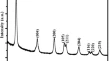
<p>The crystallinity of the samples was studied using XRD. Figure <figr fid="F2">2a</figr> shows the X-ray diffractogram of HEG and f-HEG. The characteristic (002) plane in graphite at approximately 26&#176; is shifted to approximately 24&#176; in HEG. This is same in all graphene prepared by different exfoliation techniques <abbrgrp><abbr bid="B14">14</abbr><abbr bid="B15">15</abbr></abbrgrp>. There is not much difference in XRD of f-HEG and HEG except the broadening of the (002) peak. After vigorous acid treatment, the layers might have separated further and that may be the reason for this broadening <abbrgrp><abbr bid="B16">16</abbr></abbrgrp>. The functionalization and defects on the carbon based materials can be sought out by Raman spectroscopy <abbrgrp><abbr bid="B17">17</abbr></abbrgrp>. Figure <figr fid="F2">2b</figr> shows the Raman spectrum of HEG and f-HEG. In HEG, the peak around 1588 cm<sup>-1 </sup>corresponds to the G-band and the peak around 1356 cm<sup>-1 </sup>corresponds to D-band. The D- and G-band represent the sp<sup>3 </sup>and sp<sup>2 </sup>hybridization of carbon atoms present in the sample, respectively. In the case of f-HEG, G-band as well as D-band shifted to higher wave number side and also broadened with respect to HEG peak positions. G-band has a broad peak centered around 1591 cm<sup>-1 </sup>and D-band has a peak centered around 1371 cm<sup>-1</sup>. The ratio of the D-band intensity to G-band intensity in f-HEG is higher than that of HEG. The increase in the relative intensity of the disordered mode can be attributed to the increased number of structural defects and to the sp<sup>3 </sup>hybridization of carbon for chemically induced disruption of the hexagonal carbon order after acid treatment. Acid treatment created some functional groups at the edges of the graphene sheets which helped for the proper dispersion of f-HEG on water and EG. The presence of functional groups may be the reason for broadening of the D-band peak.</p>
<fig id="F2"><title><p>Figure 2</p></title><caption><p>Crystallographic study (a) X-ray diffractogram and (b) Raman spectra of HEG and f-HEG</p></caption><text>
   <p><b>Crystallographic study (a) X-ray diffractogram and (b) Raman spectra of HEG and f-HEG</b>.</p>
</text><graphic file="1556-276X-6-289-2"/></fig>
</sec>
<sec><st><p>FTIR study and digital photograph</p></st>
<p>The effect of acid treatment and attachment of functional groups were further confirmed with FTIR. Figure <figr fid="F3">3a</figr> shows the FTIR spectra of HEG and f-HEG. During the heat treatment in H<sub>2 </sub>atmosphere, most of the oxygen containing functional groups has been removed from HEG. So the functional groups are not dominant in FTIR of HEG. After acid treatment, functional groups are formed at the plane and edges of the sheets. The peaks at around 3442 and 1625 cm<sup>-</sup><sup>1 </sup>are due to OH functional groups. A small doublet peak of CH<sub>2 </sub>(2922 and 2860 cm<sup>-</sup><sup>1</sup>) and CH at 1365 cm<sup>-</sup><sup>1 </sup>are present both in HEG and f-HEG. The peaks at 1720 and 1380 cm<sup>-</sup><sup>1</sup>can be assigned to the C = O and C-O stretching vibrations of COOH. These functional groups help graphene sheets to interact with water molecules and disperse properly. Figure <figr fid="F3">3b</figr> shows the digital photograph of f-HEG dispersed DI water and EG based nanofluid after 2 months of the nanofluid preparation. Even after 2 months of preparation no sedimentation was observed.</p>
<fig id="F3"><title><p>Figure 3</p></title><caption><p>Spectral analysis (a) FTIR spectrum of HEG and f-HEG; (b) Digital photograph nanofluid made up of f-HEG in DI water and EG</p></caption><text>
   <p><b>Spectral analysis (a) FTIR spectrum of HEG and f-HEG; (b) Digital photograph nanofluid made up of f-HEG in DI water and EG</b>.</p>
</text><graphic file="1556-276X-6-289-3"/></fig>
</sec>
<sec><st><p>Morphology of graphene sheet</p></st>
<p>Figure <figr fid="F4">4a</figr> shows the FESEM image of as-synthesized HEG taken by putting a small amount of powder sample on carbon tape. The image shows a large area of transparent graphene sheet with rough and soft wrinkled surface morphology. Transmission electron microscopy is also a powerful technique used extensively to provide definitive identification of graphene materials. The sample preparation was done by depositing a drop of ethanol dissolved HEG on Cu grid. Figure <figr fid="F4">4b</figr> clearly shows the wrinkles on the surface and folding at the edges of HEG sheets.</p>
<fig id="F4"><title><p>Figure 4</p></title><caption><p>Microscopy study (a) Field emission scanning electron microscopy and (b) transmission electron microscopy images of HEG</p></caption><text>
   <p><b>Microscopy study (a) Field emission scanning electron microscopy and (b) transmission electron microscopy images of HEG</b>.</p>
</text><graphic file="1556-276X-6-289-4"/></fig>
</sec>
<sec><st><p>Thermal conductivity study of graphene nanofluid</p></st>
<p>The proper functionalization helped to make well-dispersed HEG nanofluid. Figure <figr fid="F5">5a</figr> shows the normalized thermal conductivity (<it>K</it><sub>n</sub>/<it>K</it><sub>f</sub>) of f-HEG dispersed DI water based nanofluid as a function of temperature for different f-HEG volume fractions. All the measurements were carried out for low volume fractions so as to keep the viscosity of the fluid at a minimum level. For DI water based f-HEG nanofluids, the range of volume fractions used was from 0.005 to 0.05%. The percentage enhancement in thermal conductivity was calculated using the relation ((<it>K</it><sub>n </sub>- <it>K</it><sub>f</sub>) &#215; 100)/<it>K</it><sub>f</sub>, where '<it>K</it><sub>f</sub>' was the thermal conductivity of base fluid and '<it>K</it><sub>n</sub>' was that of nanofluid. For 0.05% volume fraction, the enhancement in thermal conductivity is about 16% at 25&#176;C and about 75% at 50&#176;C. The enhancement is less than 10% for 0.005% volume fraction. It is clear from the graph that the thermal conductivity increases with increasing temperature and volume fractions. According to Das et al. <abbrgrp><abbr bid="B4">4</abbr></abbrgrp>, in nanofluid the main mechanism of thermal conductivity enhancement can be thought as the stochastic motion of the nanoparticles. This Brownian-like motion will be dependent on fluid temperature and so the huge enhancement in thermal conductivity with temperature is quite explicable. At low temperature this motion was less significant giving the characteristics of normal slurries which rapidly changed at elevated temperature bringing more nanoeffect in the conducting behavior of the fluid. The error bar is shown only for low and high volume fractions.</p>
<fig id="F5"><title><p>Figure 5</p></title><caption><p>Normalized thermal conductivity of f-HEG dispersed</p></caption><text>
   <p><b>Normalized thermal conductivity of f-HEG dispersed</b>. <b>(a) </b>DI water and <b>(b) </b>EG based nanofluids for different volume fractions and at varying temperatures.</p>
</text><graphic file="1556-276X-6-289-5"/></fig>
<p>Figure <figr fid="F5">5b</figr> shows the normalized thermal conductivity of f-HEG dispersed EG based nanofluids with varying temperatures and volume fractions. The thermal conductivity of EG based nanofluids did not show much enhancement for low volume fractions. Till around 0.05% volume fraction there was no enhancement in thermal conductivity. Thermal conductivity started increasing from 0.05% volume fraction onwards. For 0.08% the enhancement was about 1% at 25&#176;C and about 5% at 50&#176;C. This low enhancement in thermal conductivity may be due to the high viscosity of EG. Even though the enhancement in thermal conductivity of EG based nanofluids with f-HEG is low, it is slightly higher than that of CNT dispersed EG <abbrgrp><abbr bid="B18">18</abbr></abbrgrp>.</p>
<p>The conventional theoretical models on thermal conductivity of nanoparticles suspended fluids does not consider particle size, shape, the distribution, and the motion of dispersed particles, while only thermal conductivities of base fluid and particles, and volume fraction of article. Maxwell was the man who first investigated the thermal conductivity of liquid suspensions analytically <abbrgrp><abbr bid="B19">19</abbr></abbrgrp>. Later, Hamilton and Crossser modified Maxwell's model by taking in to consideration of geometry of particles <abbrgrp><abbr bid="B20">20</abbr></abbrgrp>. In 1987 Hasselman and Johnson <abbrgrp><abbr bid="B21">21</abbr></abbrgrp> modified Maxwell's model by including the interfacial thermal resistance (Kapitza resistance, <it>R</it><sub>bd</sub>). The resulting theoretical prediction for the effective thermal conductivity (<it>K</it>) enhancement of the particle-in-liquid colloidal suspensions is given by,</p>
<p><display-formula id="M1"><graphic file="1556-276X-6-289-i1.gif"/></display-formula></p>
<p>where &#945; = 2 <it>R</it><sub>bd</sub><it>K</it><sub>f </sub><it>/d</it>, <it>d </it>is the average particle diameter, <it>R</it><sub>bd </sub>is the interfacial thermal resistance, <it>K</it><sub>f </sub>and <it>K</it><sub>p </sub>are the thermal conductivity of base fluid and particles, respectively. This is also called Maxwell-Garnett type effective medium approximation (MG-EMA). In the absence of thermal boundary resistance (<it>R</it><sub>bd </sub>= 0), the above equation reduces to Maxwell's model. The results are shown in Figure <figr fid="F6">6a,b</figr> for DI water and EG, respectively. The thermal conductivity is correlated with lower and upper bounds of <it>R</it><sub>bd</sub>. The lower and upper bound MG-EMA correlation is almost matching for the DI water based nanofluid at 25&#176;C. When the temperature increases the thermal conductivity is going away from the correlated values. But in the case of EG based nanofluids the calculated value is very much less than the correlated value. This suggests that there are other mechanisms contribute to the thermal conductivity of EG based f-HEG dispersed nanofluids.</p>
<fig id="F6"><title><p>Figure 6</p></title><caption><p>Correlation of experiment with theory</p></caption><text>
   <p><b>Correlation of experiment with theory</b>. The enhancement of effective thermal conductivity of <it>K</it><sub>n</sub>/<it>K</it><sub>f </sub>as a function of volume fraction correlated for Maxwell-Garnet effective medium approximation (MG-EMA) for <b>(a) </b>DI water and <b>(b) </b>EG based f-HEG dispersed nanofluids.</p>
</text><graphic file="1556-276X-6-289-6"/></fig>
</sec>
<sec><st><p>Electrical conductivity of f-HEG dispersed nanofluids</p></st>
<p>Finally electrical conductivity was also measured for some volume fractions of f-HEG dispersed nanofluid. Figure <figr fid="F7">7a</figr> shows the normalized electrical conductivity (&#963;<sub>n</sub>/&#963;<sub>f</sub>) for three different volume fractions at varying temperature in DI water based nanofluid. '&#963;<sub>n</sub>' represents the electrical conductivity of nanofluid and '&#963;<sub>f</sub>' that of base fluid. The graph suggests that like thermal conductivity, electrical conductivity also increased with increase in volume fraction and increase in temperature. Similar trend was observed for f-HEG dispersed EG nanofluids also. Figure <figr fid="F7">7b</figr> shows the normalized electrical conductivity of f-HEG dispersed EG based nanofluid for three different volume fractions at varying temperature. The experiments were repeated several times and the error in measurements was less than 4%.</p>
<fig id="F7"><title><p>Figure 7</p></title><caption><p>Normalized electrical conductivity of f-HEG dispersed (a) DI water and (b) EG based nanofluids for different volume fractions and varying temperatures</p></caption><text>
   <p><b>Normalized electrical conductivity of f-HEG dispersed (a) DI water and (b) EG based nanofluids for different volume fractions and varying temperatures</b>.</p>
</text><graphic file="1556-276X-6-289-7"/></fig>
</sec>
<sec><st><p>Convective heat transfer</p></st>
<p>The heat transfer coefficient, (<it>h</it>) is a macroscopic parameter describing heat transfer when a fluid is flowing across a solid surface of different temperature. It is not a material property. The convective heat transfer coefficient is defined as</p>
<p><display-formula id="M2"><graphic file="1556-276X-6-289-i2.gif"/></display-formula></p>
<p>where <it>x </it>represents axial distance from the entrance of the test section, <it>q </it>is the heat flux, <it>T</it><sub>s </sub>is the measured wall temperature, and <it>T</it><sub>f </sub>is the fluid temperature decided by the following energy balance:</p>
<p><display-formula id="M3"><graphic file="1556-276X-6-289-i3.gif"/></display-formula></p>
<p>where <it>c</it><sub><it>p </it></sub>is the heat capacity, <it>M </it>is the mass flow rate, and <it>E</it>(<it>x</it>) is the energy at position <it>x</it>. Equation 3 is based on an assumption of zero heat loss through the insulation layer.</p>
<p><display-formula id="M4"><graphic file="1556-276X-6-289-i4.gif"/></display-formula></p>
<p>And mass flow rate can be calculated using the relation,</p>
<p><display-formula id="M5"><graphic file="1556-276X-6-289-i5.gif"/></display-formula></p>
<p>where <it>u </it>is the velocity of flow, <it>A </it>is the area of cross-section, and &#961; is the density of fluid. Reynolds number is defined as <it>Re </it>= &#961;uD/&#956; and the Prandtl number is defined as <it>Pr </it>= &#957;/&#945;, where &#956; is the fluid dynamic viscosity, &#957; is the fluid kinematic viscosity, and &#945; is the fluid thermal diffusivity.</p>
<sec><st><p>Validity of the experimental setup with DI water</p></st>
<p>To check the reliability and accuracy of fabricated experimental setup, systematic measurements were carried out using DI water as the working fluid for different flow rates. The experimental results obtained for different flow rates were correlated with well-known Shah correlation <abbrgrp><abbr bid="B22">22</abbr></abbrgrp> and Dittus-Boelter <abbrgrp><abbr bid="B23">23</abbr></abbrgrp> equation under the constant heat flux boundary condition. The famous Shah correlation is</p>
<p><display-formula id="M6"><graphic file="1556-276X-6-289-i6.gif"/></display-formula></p>
<p>where <it>Nu </it>is the Nusselts number. The experimental values were reasonably in good agreement with the Shah equation as shown in Figure <figr fid="F8">8a</figr>. The same was observed for other laminar flow rates also. Reynolds number greater than 10,000 has been correlated with Dittus-Boelter equation given below:</p>
<fig id="F8"><title><p>Figure 8</p></title><caption><p>Validity of the experimental heat transfer setup for (a) low (Shah correlation) and (b) high (Dittus-Boelter correlation) flow rates using water</p></caption><text>
   <p><b>Validity of the experimental heat transfer setup for (a) low (Shah correlation) and (b) high (Dittus-Boelter correlation) flow rates using water</b>.</p>
</text><graphic file="1556-276X-6-289-8"/></fig>
<p><display-formula id="M7"><graphic file="1556-276X-6-289-i7.gif"/></display-formula></p>
<p>As shown in Figure <figr fid="F8">8b</figr>, the good coincidence between the experimental results and the calculated values for water reveals that the precision of the experimental system is considerably good. The uncertainty of the experimental system is less than 8%.</p>
</sec>
<sec><st><p>Convective heat transfer of graphene nanofluids</p></st>
<p>Having established confidence in the experimental system, systematic experiments were performed at different flow conditions (Reynolds numbers) for different f-HEG volume fractions under a constant heat flow. From the experiment heat transfer coefficient was calculated and then converts it into corresponding Nusselts number. The Reynolds number is calculated based on the viscosity of the host liquid. Since the calculated Reynolds numbers were greater than 4000, for DI water based nanofluids, the flow was considered to be turbulent. Figure <figr fid="F9">9a</figr> shows the heat transfer measurement of DI water, 0.005 and 0.01% volume fractions f-HEG dispersed DI water for different Reynolds numbers. <it>X</it>-axis shows the ratio of axial distance to diameter of the tube (<it>x</it>/<it>D</it>) and <it>Y</it>-axis the corresponding Nusselts number. Black dotted lines, blue solid lines, and red dashed lines are for DI water alone, 0.005% of f-HEG and 0.01% of f-HEG, respectively. Symbols represents <it>Re </it>= 4500 (&#9632;),<it>Re </it>= 8700 (&#9679;), and <it>Re </it>= 15500 (&#9650;). For better understanding the change in Nusselts number for different Reynolds number is shown in Figure <figr fid="F9">9b</figr>. Similar measurements on EG based nanofluid for different volume fractions and varying Reynolds number are shown in Figure <figr fid="F10">10</figr>. Black dotted lines, blue solid lines, and red dashed lines are for EG alone, 0.005% of f-HEG and 0.01% of f-HEG, respectively. Symbols represents <it>Re </it>= 250 (&#9632;),<it>Re </it>= 550 (&#9679;), and <it>Re </it>= 1000 (&#9650;). Since the calculated Reynolds numbers were less than 2800, for EG based nanofluids, the flow rates used were laminar.</p>
<fig id="F9"><title><p>Figure 9</p></title><caption><p>Convective heat transfer study</p></caption><text>
   <p><b>Convective heat transfer study</b>. <b>(a) </b>Heat transfer measurement of f-HEG dispersed DI water based nanofluids. Black dotted lines, blue solid lines, and red dashed lines are for DI water alone, 0.005% of f-HEG and 0.01% of f-HEG, respectively. Symbols represents <it>Re </it>= 4500 (<it>square</it>), <it>Re </it>= 8700 (<it>circle</it>), and <it>Re </it>= 15,500 (<it>triangle</it>). <b>(b) </b>Measurement of Nusselts number with respect to different Reynolds numbers for DI water based nanofluids, containing 0.01% volume fraction of f-HEG.</p>
</text><graphic file="1556-276X-6-289-9"/></fig>
<fig id="F10"><title><p>Figure 10</p></title><caption><p>Heat transfer measurement of f-HEG dispersed EG based nanofluids</p></caption><text>
   <p><b>Heat transfer measurement of f-HEG dispersed EG based nanofluids</b>. Black dotted lines, blue solid lines, and red dashed lines are for EG alone, 0.005% of f-HEG and 0.01% of f-HEG, respectively. Symbols represents <it>Re </it>= 250 (<it>square</it>), <it>Re </it>= 550 (<it>circle</it>), and <it>Re </it>= 1000 (<it>triangle</it>).</p>
</text><graphic file="1556-276X-6-289-10"/></fig>
<p>Both the DI water and EG based nanofluids results suggests that the presence of nanomaterials dispersed nanofluids increases the Nusselts number significantly, and the increase is considerably more at high volume fractions and high Reynolds numbers. From Figure <figr fid="F9">9</figr> it is clear that for a given f-HEG volume fraction, the Nusselts number decreases with axial distance. This is as expected for heat transfer in the entrance region. The percentage enhancement in heat transfer is calculated using the relation [<it>h</it><sub>n</sub>(<it>x</it>) - <it>h</it><sub>f</sub>(<it>x</it>)] &#215; 100/<it>h</it><sub>f</sub>(<it>x</it>), where <it>h</it><sub>f</sub>(<it>x</it>) and <it>h</it><sub>n</sub>(<it>x</it>) are the heat transfer coefficient for the base fluid and nanofluid at distance <it>x</it>, respectively. The enhancement in heat transfer for <it>Re </it>= 4500 at the tube entrance is about 64 and 76% for 0.005 and 0.01% volume fractions, respectively. At the outlet, the value decreases to about 21 and 57%, respectively, for 0.005 and 0.01%. When the Reynolds number increases (<it>Re </it>= 15,500) the enhancement also increases and it is about 108 for 0.005% and 171 for 0.01% at the entrance. At the end, the values change to about 92 for 0.005% and 141 for 0.01%, respectively.</p>
<p>Similar trend is observed in the case of EG based nanofluid also. Figure <figr fid="F10">10</figr> shows the variation of Nusselts number for 0.005 and 0.01% f-HEG dispersed EG based nanofluids. From graph it is clear that heat transfer increases with volume fraction. The enhancement in heat transfer for <it>Re </it>= 250 at the tube entrance is about 100 and 172% for 0.005 and 0.01%, respectively. At the exit, the value decreases to about 59 and 140%, respectively, for 0.005 and 0.01%. Like water based nanofluids, here also the Nusselts number increases with increase in Reynolds number and it is around 130 and 219% for 0.005 and 0.01% volume fractions, respectively, at the entrance for <it>Re </it>= 1000. At the tube exit, the values change to about 69% for 0.005% and 183% for 0.01%. The enhancement in Nusselts number for EG based nanofluids are higher than that of DI water based nanofluids.</p>
<p>Figure <figr fid="F9">9b</figr> shows the effect of the Reynolds number on heat transfer. Figure clearly shows that the Nusselts number increases with increasing Reynolds number. There is a large difference in the Nusselts number at <it>Re </it>= 4500 and that at <it>Re </it>= 15,500 for DI water based nanofluids. Similar will be the case for EG based nanofluids also (figure not given). This suggests that Reynolds number has a significant effect on the heat transfer mechanism. The enhancement in heat transfer is very drastic compared to the enhancement in thermal conductivity. Another important observation is that even though enhancement in thermal conductivity is very low, enhancement in heat transfer is high for EG based nanofluid.</p>
<p>The reason for decrease in heat transfer from entrance to exit of the tube is due to the variation of thermal boundary layer. In a simple way heat transfer can be written as <it>k</it>/&#948; with &#948; the thickness of thermal boundary layer. At the entrance (<it>x </it>= 0), the theoretical boundary layer thickness is zero, hence the heat transfer coefficient approaches infinity. The boundary layer increases with axial distance until fully developed after which the boundary layer thickness and hence the convective heat transfer coefficient is constant <abbrgrp><abbr bid="B8">8</abbr></abbrgrp>. Since there is not much enhancement in thermal conductivity, the effect of thickness of thermal boundary may be the reason for this huge enhancement in heat transfer.</p>
<p>Ding et al. <abbrgrp><abbr bid="B8">8</abbr></abbrgrp> also showed that for nanofluids containing 0.5 wt% CNT, the maximum enhancement reaches over 350% at <it>Re </it>= 800 and showed that enhancement is a function of the axial distance from the inlet of the test section. Similar observations but with less significant enhancement was observed by Xuan and Li <abbrgrp><abbr bid="B24">24</abbr></abbrgrp> in the turbulent flow regime. Wen and Ding <abbrgrp><abbr bid="B25">25</abbr></abbrgrp> also showed similar features at the entrance region in the laminar flow regime when they investigated heat transfer of aqueous c-alumina nanofluids. They have observed around 47% increase in the convective heat transfer coefficient for 1.6 vol.% nanoparticles loading and <it>Re </it>= 1600, which is much greater than that due to the enhancement of thermal conduction (&lt;~10%).</p>
<p>According to the Brownian theory <abbrgrp><abbr bid="B26">26</abbr></abbrgrp>, the smaller the sizes of the colloid particles, the faster the particles move, so that energy transport inside the liquid becomes stronger. The clustering or restacking of graphene is very less in solution. Each sheet will be separated out during ultrasonication and was well dispersed which helps for fast heat transfer. Another factor which helps in the enhancement of thermal conductivity as well as heat transfer is surface area of the material. The surface area of hydrogen exfoliated graphene is approximately 450 m<sup>2</sup>/g <abbrgrp><abbr bid="B13">13</abbr></abbrgrp>. Other factors which affect the thermal conductivity and heat transfer of nanofluids are size and shape of the nanomaterials, the material (test section) in which nanofluid is flowing, temperature of the test section as well as the surrounding, viscosity of the fluid, etc. Further studies are being carried out for deeper understanding of the mechanism.</p>
</sec>
</sec>
</sec>
<sec><st><p>Conclusion</p></st>
<p>Graphene was synthesized by hydrogen induced exfoliation of graphite oxide. Further we effectively dispersed f-HEG in the base fluids without any surfactant or additives by using ultrasonication. Systematic characterization and experiments were carried out for the sample preparation as well as the thermal conductivity and heat transfer measurements. The results suggest that there was considerable enhancement in thermal conductivity and heat transfer for f-HEG dispersed fluid compared to its base fluid. The Nusselts number increases with increase in volume fraction and Reynolds number of f-HEG. Similarly, the thermal conductivity of f-HEG increases due to the increase in volume fraction and temperature. Electrical conductivity of f-HEG dispersed base fluids was also showing enhancement compared to the base fluid.</p>
</sec>
<sec><st><p>Abbreviations</p></st>
<p>DI: deionized; EG: ethylene glycol; FESEM: field emission scanning electron microscopy; GO: graphite oxide; HEG: hydrogen exfoliated grapheme; TEM: transmission electron microscopy; XRD: X-ray diffraction.</p>
</sec>
<sec><st><p>Competing interests</p></st>
<p>The authors declare that they have no competing interests.</p>
</sec>
<sec><st><p>Authors' contributions</p></st>
<p>TTB has carried out the experimental part, set up the experimental setup, analysis of the data and manuscript preparation. SR has participated in the design of the experimental setup,, analysis of the data and drafted the manuscript.</p>
</sec>
</bdy>
<bm>
<ack>
<sec><st><p>Acknowledgements</p></st>
<p>The authors like to thank Indian Institute of Technology Madras, India for giving the financial support for the present work.</p>
</sec>
</ack>
<refgrp><bibl id="B1"><title><p>Anomalous thermal conductivity enhancement in nanotube suspensions</p></title><aug><au><snm>Choi</snm><fnm>SUS</fnm></au><au><snm>Zhang</snm><fnm>ZG</fnm></au><au><snm>Yu</snm><fnm>W</fnm></au><au><snm>Lockwood</snm><fnm>F</fnm></au><au><snm>Grulke</snm><fnm>EA</fnm></au></aug><source>Appl Phys Lett</source><pubdate>2001</pubdate><volume>79</volume><fpage>2252</fpage><xrefbib><pubid idtype="doi">10.1063/1.1408272</pubid></xrefbib></bibl><bibl id="B2"><title><p>Anomalously increased effective thermal conductivities of ethylene glycol-based nanofluids containing copper nanoparticles</p></title><aug><au><snm>Eastman</snm><fnm>JA</fnm></au><au><snm>Choi</snm><fnm>SUS</fnm></au><au><snm>Li</snm><fnm>S</fnm></au><au><snm>Yu</snm><fnm>W</fnm></au><au><snm>Thompson</snm><fnm>LJ</fnm></au></aug><source>Appl Phys Lett</source><pubdate>2001</pubdate><volume>78</volume><fpage>718</fpage><xrefbib><pubid idtype="doi">10.1063/1.1341218</pubid></xrefbib></bibl><bibl id="B3"><title><p>Measuring thermal conductivity of fluids containing oxide nanoparticles</p></title><aug><au><snm>Lee</snm><fnm>S</fnm></au><au><snm>Choi</snm><fnm>SUS</fnm></au><au><snm>Li</snm><fnm>S</fnm></au><au><snm>Eastman</snm><fnm>JA</fnm></au></aug><source>J Heat Transfer</source><pubdate>1999</pubdate><volume>121</volume><fpage>280</fpage><xrefbib><pubid idtype="doi">10.1115/1.2825978</pubid></xrefbib></bibl><bibl id="B4"><title><p>Temperature dependence of thermal conductivity enhancement for nanofluids</p></title><aug><au><snm>Das</snm><fnm>SK</fnm></au><au><snm>Putra</snm><fnm>N</fnm></au><au><snm>Thiesen</snm><fnm>P</fnm></au><au><snm>Roetzel</snm><fnm>W</fnm></au></aug><source>J Heat transfer</source><pubdate>2003</pubdate><volume>125</volume><fpage>567</fpage><xrefbib><pubid idtype="doi">10.1115/1.1571080</pubid></xrefbib></bibl><bibl id="B5"><title><p>Thermal conductivity of nanoparticle fluid mixture</p></title><aug><au><snm>Wang</snm><fnm>X</fnm></au><au><snm>Xu</snm><fnm>X</fnm></au><au><snm>Choi</snm><fnm>SUS</fnm></au></aug><source>J Thermophys Heat Transfer</source><pubdate>1999</pubdate><volume>13</volume><fpage>474</fpage><xrefbib><pubid idtype="doi">10.2514/2.6486</pubid></xrefbib></bibl><bibl id="B6"><title><p>Heat transfer properties of nanoparticle-in-fluid dispersions (nanofluids) in larninar flow</p></title><aug><au><snm>Yang</snm><fnm>Y</fnm></au><au><snm>Zhang</snm><fnm>ZG</fnm></au><au><snm>Grulke</snm><fnm>EA</fnm></au><au><snm>Anderson</snm><fnm>WB</fnm></au><au><snm>Wu</snm><fnm>G</fnm></au></aug><source>Int J Heat Mass Transfer</source><pubdate>2005</pubdate><volume>48</volume><fpage>1107</fpage><xrefbib><pubid idtype="doi">10.1016/j.ijheatmasstransfer.2004.09.038</pubid></xrefbib></bibl><bibl id="B7"><title><p>Experimental investigation of oxide nanofluids laminar flow convective heat transfer</p></title><aug><au><snm>Heris</snm><fnm>SZ</fnm></au><au><snm>Etemad</snm><fnm>G</fnm></au><au><snm>Esfahany</snm><fnm>MN</fnm></au></aug><source>Int Commun Heat Mass Transfer</source><pubdate>2006</pubdate><volume>33</volume><fpage>529</fpage><xrefbib><pubid idtype="doi">10.1016/j.icheatmasstransfer.2006.01.005</pubid></xrefbib></bibl><bibl id="B8"><title><p>Heat transfer of aqueous suspensions of carbon nanotubes (CNT nanofluids)</p></title><aug><au><snm>Ding</snm><fnm>Y</fnm></au><au><snm>Alias</snm><fnm>H</fnm></au><au><snm>Wen</snm><fnm>D</fnm></au><au><snm>Williams</snm><fnm>RA</fnm></au></aug><source>Int J Heat Mass Transfer</source><pubdate>2006</pubdate><volume>49</volume><fpage>240</fpage><xrefbib><pubid idtype="doi">10.1016/j.ijheatmasstransfer.2005.07.009</pubid></xrefbib></bibl><bibl id="B9"><title><p>Carbon Nanotube Ballistic Thermal Conductance and Its Limits</p></title><aug><au><snm>Mingo</snm><fnm>N</fnm></au><au><snm>Broido</snm><fnm>DA</fnm></au></aug><source>Phys Rev Lett</source><pubdate>2005</pubdate><volume>95</volume><fpage>096105</fpage><xrefbib><pubidlist><pubid idtype="doi">10.1103/PhysRevLett.95.096105</pubid><pubid idtype="pmpid" link="fulltext">16197233</pubid></pubidlist></xrefbib></bibl><bibl id="B10"><title><p>Ballistic thermal conductance of a graphene sheet</p></title><aug><au><snm>Saito</snm><fnm>K</fnm></au><au><snm>Nakamura</snm><fnm>J</fnm></au><au><snm>Natori</snm><fnm>A</fnm></au></aug><source>Phys Rev B: Condens Matter</source><pubdate>2007</pubdate><volume>76</volume><fpage>115409</fpage><xrefbib><pubid idtype="doi">10.1103/PhysRevB.76.115409</pubid></xrefbib></bibl><bibl id="B11"><title><p>Superior Thermal Conductivity of Single-Layer Graphene</p></title><aug><au><snm>Balandin</snm><fnm>AA</fnm></au><au><snm>Ghosh</snm><fnm>S</fnm></au><au><snm>Bao</snm><fnm>W</fnm></au><au><snm>Calizo</snm><fnm>I</fnm></au><au><snm>Teweldebrhan</snm><fnm>D</fnm></au><au><snm>Miao</snm><fnm>F</fnm></au><au><snm>Lau</snm><fnm>CN</fnm></au></aug><source>Nano Lett</source><pubdate>2008</pubdate><volume>8</volume><fpage>902</fpage><xrefbib><pubidlist><pubid idtype="doi">10.1021/nl0731872</pubid><pubid idtype="pmpid" link="fulltext">18284217</pubid></pubidlist></xrefbib></bibl><bibl id="B12"><title><p>Preparation of Graphitic Oxide</p></title><aug><au><snm>Hummers</snm><fnm>WS</fnm></au><au><snm>Offeman</snm><fnm>RE</fnm></au></aug><source>J Am Chem Soc</source><pubdate>1958</pubdate><volume>80</volume><fpage>1339</fpage><xrefbib><pubid idtype="doi">10.1021/ja01539a017</pubid></xrefbib></bibl><bibl id="B13"><title><p>Graphene synthesis via hydrogen induced low temperature exfoliation of graphite oxide</p></title><aug><au><snm>Kaniyoor</snm><fnm>A</fnm></au><au><snm>Baby</snm><fnm>TT</fnm></au><au><snm>Ramaprabhu</snm><fnm>S</fnm></au></aug><source>J Mater Chem</source><pubdate>2010</pubdate><volume>20</volume><fpage>8467</fpage><xrefbib><pubid idtype="doi">10.1039/c0jm01876g</pubid></xrefbib></bibl><bibl id="B14"><title><p>Exfoliated Graphene Separated by Platinum Nanoparticles</p></title><aug><au><snm>Si</snm><fnm>Y</fnm></au><au><snm>Samulski</snm><fnm>ET</fnm></au></aug><source>Chem Mater</source><pubdate>2008</pubdate><volume>20</volume><fpage>6792</fpage><xrefbib><pubid idtype="doi">10.1021/cm801356a</pubid></xrefbib></bibl><bibl id="B15"><title><p>Low-Temperature Exfoliated Graphenes: Vacuum-Promoted Exfoliation and Electrochemical Energy Storage</p></title><aug><au><snm>Wei</snm><fnm>L</fnm></au><au><snm>Ming</snm><fnm>TD</fnm></au><au><snm>Bing</snm><fnm>HY</fnm></au><au><snm>Hui</snm><fnm>YC</fnm></au><au><snm>Qiang</snm><fnm>SZ</fnm></au><au><snm>Cheng</snm><fnm>CX</fnm></au><au><snm>Meng</snm><fnm>CC</fnm></au><au><snm>Xiang</snm><fnm>HP</fnm></au><au><snm>Chang</snm><fnm>L</fnm></au><au><snm>Hong</snm><fnm>YQ</fnm></au></aug><source>ACS Nano</source><pubdate>2009</pubdate><volume>3</volume><fpage>3730</fpage><xrefbib><pubidlist><pubid idtype="doi">10.1021/nn900933u</pubid><pubid idtype="pmpid" link="fulltext">19824654</pubid></pubidlist></xrefbib></bibl><bibl id="B16"><title><p>X-ray diffraction patterns of graphite and turbostratic carbon</p></title><aug><au><snm>Li</snm><fnm>ZQ</fnm></au><au><snm>Lu</snm><fnm>CJ</fnm></au><au><snm>Xia</snm><fnm>ZP</fnm></au><au><snm>Zhou</snm><fnm>Y</fnm></au><au><snm>Luo</snm><fnm>Z</fnm></au></aug><source>Carbon</source><pubdate>2007</pubdate><volume>45</volume><fpage>1686</fpage><xrefbib><pubid idtype="doi">10.1016/j.carbon.2007.03.038</pubid></xrefbib></bibl><bibl id="B17"><title><p>Molecular Mobility of Free-Radical-Functionalized Carbon-Nanotube/Siloxane/Poly(urea urethane) Nanocomposites</p></title><aug><au><snm>Wu</snm><fnm>H-L</fnm></au><au><snm>Yang</snm><fnm>Y-T</fnm></au><au><snm>Ma</snm><fnm>C-CM</fnm></au><au><snm>Kuan</snm><fnm>H-C</fnm></au></aug><source>J Polym Sci A: Polym Chem</source><pubdate>2005</pubdate><volume>43</volume><fpage>6084</fpage><xrefbib><pubid idtype="doi">10.1002/pola.21121</pubid></xrefbib></bibl><bibl id="B18"><title><p>Enhancement of thermal conductivity with carbon nanotubes for nanofluids</p></title><aug><au><snm>Liu</snm><fnm>M-S</fnm></au><au><snm>Lin</snm><fnm>MC-C</fnm></au><au><snm>Huang</snm><fnm>I-T</fnm></au><au><snm>Wang</snm><fnm>C-C</fnm></au></aug><source>Int Commun Heat Mass Transfer</source><pubdate>2005</pubdate><volume>32</volume><fpage>1202</fpage><xrefbib><pubid idtype="doi">10.1016/j.icheatmasstransfer.2005.05.005</pubid></xrefbib></bibl><bibl id="B19"><title><p>A Treatise on Electricity and Magnetism</p></title><aug><au><snm>Maxwell</snm><fnm>JC</fnm></au></aug><publisher>Oxford: Pergamon</publisher><pubdate>1904</pubdate><volume>1</volume></bibl><bibl id="B20"><title><p>Thermal conductivity of heterogeneous two-component systems</p></title><aug><au><snm>Hamilton</snm><fnm>RL</fnm></au><au><snm>Crosser</snm><fnm>OK</fnm></au></aug><source>Ind Eng Chem Fundam</source><pubdate>1962</pubdate><volume>1</volume><fpage>187</fpage><xrefbib><pubid idtype="doi">10.1021/i160003a005</pubid></xrefbib></bibl><bibl id="B21"><title><p>Effective thermal conductivity of composites with interfacial thermal barrier resistance</p></title><aug><au><snm>Hasselman</snm><fnm>DPH</fnm></au><au><snm>Johnson</snm><fnm>LF</fnm></au></aug><source>J Compos Mater</source><pubdate>1987</pubdate><volume>21</volume><fpage>508</fpage><xrefbib><pubid idtype="doi">10.1177/002199838702100602</pubid></xrefbib></bibl><bibl id="B22"><title><p>Thermal Entry Length Solutions for the Circular Tube and Parallel Plates</p></title><aug><au><snm>Shah</snm><fnm>RK</fnm></au></aug><source>Proceedings of the 3rd National Heat Mass Transfer Conference</source><publisher>Indian Institute of Technology, Bombay</publisher><pubdate>1975</pubdate><volume>1</volume><note>Paper no. HMT-11-75</note></bibl><bibl id="B23"><title><p>Heat Transfer in Automobile Radiators of the Tubular Type</p></title><aug><au><snm>Dittus</snm><fnm>FW</fnm></au><au><snm>Boelter</snm><fnm>LMK</fnm></au></aug><source>University of California Publications in English</source><pubdate>1930</pubdate><volume>2</volume><fpage>443</fpage><lpage>461</lpage></bibl><bibl id="B24"><title><p>Investigation on convective heat transfer and flow features of nanofluids</p></title><aug><au><snm>Xuan</snm><fnm>YM</fnm></au><au><snm>Li</snm><fnm>Q</fnm></au></aug><source>J Heat Transfer</source><pubdate>2003</pubdate><volume>125</volume><fpage>151</fpage><xrefbib><pubid idtype="doi">10.1115/1.1532008</pubid></xrefbib></bibl><bibl id="B25"><title><p>Convective heat transfer of nanofluids at the entrance region under laminar flow conditions</p></title><aug><au><snm>Wen</snm><fnm>DS</fnm></au><au><snm>Ding</snm><fnm>YL</fnm></au></aug><source>Int J Heat Mass Transfer</source><pubdate>2004</pubdate><volume>47</volume><fpage>5181</fpage><xrefbib><pubid idtype="doi">10.1016/j.ijheatmasstransfer.2004.07.012</pubid></xrefbib></bibl><bibl id="B26"><title><p>Aggregation structure and thermal conductivity of nanofluids</p></title><aug><au><snm>Xuan</snm><fnm>Y</fnm></au><au><snm>Li</snm><fnm>Q</fnm></au><au><snm>Hu</snm><fnm>W</fnm></au></aug><source>AIChE J</source><pubdate>2003</pubdate><volume>49</volume><fpage>1038</fpage><xrefbib><pubid idtype="doi">10.1002/aic.690490420</pubid></xrefbib></bibl></refgrp>
</bm>
</art>