<?xml version='1.0'?>
<!DOCTYPE art SYSTEM 'http://www.biomedcentral.com/xml/article.dtd'>
<art>
<ui>1556-276X-6-267</ui>
<ji>1556-276X</ji>
<fm>
<dochead>Nano Express</dochead>
<bibl>
<title><p>Monodisperse upconversion GdF<sub>3</sub>:Yb, Er rhombi by microwave-assisted synthesis</p></title>
<aug><au ca="yes" id="A1"><snm>Wang</snm><fnm>Haiqiao</fnm><insr iid="I1"/><email>wang.hai-qiao@ww.uni-erlangen.de</email></au>
<au id="A2"><snm>Nann</snm><fnm>Thomas</fnm><insr iid="I2"/><email>thomas.nann@unisa.edu.au</email></au>
</aug>
<insg>
<ins id="I1"><p>Institute Materials for Electronics and Energy Technology (I-MEET), Friedrich Alexander Universit&#228;t Erlangen-N&#252;rnberg, Marternsstra&#223;e 7, 91058, Erlangen, Germany</p></ins>
<ins id="I2"><p>Ian Wark Research Institute, University of South Australia, Mawson Lakes, South Australia 5095, Australia</p></ins>
</insg>
<source>Nanoscale Research Letters</source>
<issn>1556-276X</issn>
<pubdate>2011</pubdate>
<volume>6</volume>
<issue>1</issue>
<fpage>267</fpage>
<url>http://www.nanoscalereslett.com/content/6/1/267</url>
<xrefbib><pubidlist><pubid idtype="pmpid">21711769</pubid><pubid idtype="doi">10.1186/1556-276X-6-267</pubid></pubidlist></xrefbib></bibl>
<history><rec><date><day>3</day><month>11</month><year>2010</year></date></rec><acc><date><day>29</day><month>3</month><year>2011</year></date></acc><pub><date><day>29</day><month>3</month><year>2011</year></date></pub></history><cpyrt><year>2011</year><collab>Wang and Nann; licensee Springer.</collab><note>This is an Open Access article distributed under the terms of the Creative Commons Attribution License (<url>http://creativecommons.org/licenses/by/2.0</url>), which permits unrestricted use, distribution, and reproduction in any medium, provided the original work is properly cited.</note></cpyrt>
<abs>
<sec><st><p>Abstract</p></st>
<p>We have synthesized a variety of monodisperse colloidal GdF<sub>3</sub>:Yb, Er upconversion nanocrystals with different shape, size, and dopants by microwave-assisted synthesis. Typical upconversion emission from Er<sup>3+ </sup>was observed. In addition to highly monodisperse spherical particles, we were able to prepare monodispersed rhombic-shaped slices that showed a tendency for self-assembly into stacks.</p>
</sec>
</abs>
</fm>
<bdy>
<sec><st><p>Introduction</p></st>
<p>In recent publications we have shown that microwave-assisted synthesis allows for the preparation of highly monodisperse, spherical upconversion nanocrystals <abbrgrp><abbr bid="B1">1</abbr></abbrgrp>, as well as nanocrystals with unusual morphologies <abbrgrp><abbr bid="B2">2</abbr></abbrgrp>. In this research letter, we report on the microwave-assisted synthesis of monodispersed spherical and rhombic GdF<sub>3</sub>-based nanoparticles, which show a high tendency for self-assembly in one- and two-dimensional superstructures.</p>
<p>Research on upconversion nanocrystals increased exponentially over the past several years (e.g., in 2000, one article on upconversion nanomaterials was published, in 2009, it have been 57) as the extremely attractive prospects for applications of these materials in bioanalytics <abbrgrp><abbr bid="B3">3</abbr></abbrgrp>, (cancer) therapy <abbrgrp><abbr bid="B4">4</abbr></abbrgrp>, and electro-optics <abbrgrp><abbr bid="B5">5</abbr></abbrgrp>. And subsequently, it is concluded that the most efficient infrared-to-visible upconversion phosphors are Yb/Er or Yb/Tm co-doped fluorides, such as hexagonal phase NaYF<sub>4 </sub><abbrgrp><abbr bid="B6">6</abbr><abbr bid="B7">7</abbr></abbrgrp>, LaF<sub>3 </sub><abbrgrp><abbr bid="B8">8</abbr><abbr bid="B9">9</abbr></abbrgrp>, and orthorhombic phase YF<sub>3 </sub><abbrgrp><abbr bid="B10">10</abbr></abbrgrp>, GdF<sub>3 </sub><abbrgrp><abbr bid="B11">11</abbr></abbrgrp>. Especially in the past few years, the NaYF<sub>4</sub>-based phosphors, as the highest efficient upconversion phosphors, with different morphologies and different dopants have been widely investigated, based on various synthesis procedures. However, GdF<sub>3 </sub>as one of the efficient upconversion phosphor host <abbrgrp><abbr bid="B8">8</abbr></abbrgrp>, not too much work has been reported focusing on Yb/Er codoped fluorecence upconversion. Although Tm, Dy, Ho, and Yb/Tm doped GdF<sub>3 </sub>has been reported <abbrgrp><abbr bid="B11">11</abbr><abbr bid="B12">12</abbr><abbr bid="B13">13</abbr><abbr bid="B14">14</abbr></abbrgrp>. As far as we know, in 1971, the preparation of GdF<sub>3</sub>:Yb, Er phosphor was reported firstly by Major et al. In their procedure, the oxide precursors were dissolved in high purity nitric acid and precipitated with excess hydrofluoric acid, and finally experienced calcination. They found that the color of the anti-Stokes luminescence of the Yb/Er doped GdF<sub>3 </sub>phosphors was controllable by preparation processes, and was associated with the crystal structure of the host lattices. And they gave a dominant green emission when excited by 940 nm infrared light <abbrgrp><abbr bid="B10">10</abbr></abbrgrp>. In 2006, Fan et al. employed a hydrothermal synthesis procedure to produced Yb/Er codoped GdF<sub>3 </sub>nanoparticles. For their prepared sample, typical upconversion emission was observed but with much weaker intensity than that of bulk crystal <abbrgrp><abbr bid="B15">15</abbr></abbrgrp>.</p>
<p>Microwave-assisted synthesis of nanomaterials offers several interesting synthetic opportunities which are based on the specific microwave effects: (i) microwave irradiation is absorbed by polar and ionic substances only (dielectric heating); (ii) enhanced reaction rates can be observed; (iii) heterogeneous heating (viz. "hot spots") and wall effects can be suppressed <abbrgrp><abbr bid="B16">16</abbr></abbrgrp>. Details on the microwave-assisted synthesis of AYF<sub>4 </sub>(A = Na, Li) nanocrystals can be found elsewhere <abbrgrp><abbr bid="B1">1</abbr></abbrgrp>. This research letter is concerned with the effects of microwave irradiation on the shape evolution of GdF<sub>3 </sub>nanocrystals.</p>
<p>In this paper, we firstly presented the preparation of colloidal upconversion GdF<sub>3</sub>:Yb, Er nanocrystals, based on a new microwave-assisted synthesis method. We have synthesized a variety of GdF<sub>3</sub>-based upconversion nanocrystals with different shape, size, and dopants by microwave-assisted synthesis. In addition to highly monodisperse spherical particles, we were able to prepare monodisperse rhombic-shaped slices that showed a tendency for self-assembly into stacks.</p>
</sec>
<sec><st><p>Experimental</p></st>
<p>According to our previous work <abbrgrp><abbr bid="B1">1</abbr></abbrgrp>, introduction of Li<sup>+ </sup>can help to enhance the upconversion efficiency. So here in the procedure, Li<sup>+ </sup>was used as well. In a typical synthesis (standard conditions), 0.115 mmol (13.8 mg) lithium trifluoroacetate (TFA), 0.083 mmol (41.2 mg) gadolinium TFA, 17 &#956;mol (8.5 mg) ytterbium TFA, and 1.7 &#956;mol (0.86 mg) erbium TFA were dissolved in 6 ml of a 1:1 (v:v) mixture of oleic acid and octadecene in a nitrogen atmosphere. The solution was thoroughly degassed at 120&#176;C and transferred into a microwave reaction vessel. Then, the mixture was heated for 10 min at 290&#176;C by microwave irradiation. The resulting nanocrystals were precipitated by addition of 3 ml of ethanol to the cold reaction solution and subsequent centrifugation. The supernatant was discarded and the nanocrystals were repeatedly washed with ethanol. Eventually, the particles were re-dissolved in chloroform or toluene for further studies.</p>
<p>Transmission electron micrographs (TEMs) were recorded on a JEOL 2000EX and a JEOL 2010 microscope at 200 kV. Selected area electron diffraction (SAED) patterns were measured on the same instrument. The X-ray diffraction (XRD) patterns were measured with a thermo ARL XTRA equipped with a Cu X-ray tube (&#955; = 1.5418 &#197;). Upconversion spectra were recorded on an Oceanoptics USB spectrometer and a home-made cuvette holder and excitation source (980 nm, 100 mW laser diode).</p>
</sec>
<sec><st><p>Results and discussion</p></st>
<p>Figure <figr fid="F1">1</figr> shows TEMs of the resulting nanocrystals. It was observed that the particles were regularly shaped rhombic plates with approximately 3.2 nm thickness, approximately 45 nm in length and with a roughly calculated aspect ratio of 1:3. Both micrographs show clearly that the nanoplates have a strong tendency to form two-dimensional aggregates. This effect can be attributed to the minimization in energy, which is achieved by hydrophobic interaction of the surface ligands of the nanoparticles at their largest faces.</p>
<fig id="F1"><title><p>Figure 1</p></title><caption><p>TEMs of GdF<sub>3 </sub>nanocrystals</p></caption><text>
   <p><b>TEMs of GdF<sub>3 </sub>nanocrystals</b>. <b>(A) </b>Overview graph of single nanocrystals and "stacks". <b>(B) </b>Blow-up of self-assembled nanocrystals.</p>
</text><graphic file="1556-276X-6-267-1"/></fig>
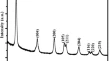
<p>The XRD pattern of these particles (Figure <figr fid="F2">2</figr>) which shows orthorhombic phase GdF<sub>3 </sub>was obtained. Almost all the diffraction peaks of the XRD pattern can be assigned, respectively, to the planes of orthorhombic GdF<sub>3 </sub>crystalline (JCPDS-file 012-0788), as indicated (101), (020), (111), (210), (002), (221), (112), (301), (230), (212) in Figure <figr fid="F2">2</figr> (red, round dot). However, two more weak diffraction peaks can also be observed at 2&#952; = 38.7&#176; and 45&#176;, which cannot be assigned to GdF<sub>3</sub>. We considered that these two weak peaks arose from the diffraction of LiF (JCPDS-file 045-1460) <abbrgrp><abbr bid="B17">17</abbr></abbrgrp>. And it suggests that the Li<sup>+ </sup>was not only introduced into the expected phosphor GdF<sub>3 </sub>crystal to replace some Gd<sup>3+ </sup>sites as impurity but also a few LiF was formed. A further confirmation of a predominant GdF<sub>3 </sub>lattice can be found by measuring distances of the lattice fringes in the high resolution transmission electron microscopy (HRTEM). Lattice fringes were found with distances of 3.29 and 2.94 &#197; (cf. Figure <figr fid="F3">3B</figr>), corresponding well to the theoretically calculated distance of the {111} and {210} planes of the orthorhombic-YF<sub>3 </sub>space group GdF<sub>3 </sub>(orthorhombic phase JCPDS-file 012-0788), respectively. It is noteworthy that the same XRD patterns were observed for decreased and increased reactant concentrations.</p>
<fig id="F2"><title><p>Figure 2</p></title><caption><p>XRD pattern of GdF3 nanocrystals as depicted in Figure 1</p></caption><text>
   <p><b>XRD pattern of GdF3 nanocrystals as depicted in Figure 1</b>. Full circle (red): diffraction pattern according to JCPDS-file 012-0788; full square (green): diffraction pattern according to JCPDS-file 045-1460.</p>
</text><graphic file="1556-276X-6-267-2"/></fig>
<fig id="F3"><title><p>Figure 3</p></title><caption><p>TEMs of GdF3 nanocrystals prepared with 25% of the original concentration of reactants</p></caption><text>
   <p><b>TEMs of GdF3 nanocrystals prepared with 25% of the original concentration of reactants</b>. <b>(A) </b>Overview picture. <b>(B) </b>High-resolution TEM of single nanocrystals.</p>
</text><graphic file="1556-276X-6-267-3"/></fig>
<p>In our previous work, we found that changing the reaction parameters (especially the concentration of reactants) in the synthesis of NaYF<sub>4</sub>-based upconversion nanocrystals, has crucial influence on the morphology of the resulting particles <abbrgrp><abbr bid="B2">2</abbr></abbrgrp>. In this work, we observed that, based on our precursors, GdF<sub>3 </sub>nanocrystals were obtained and always adopt a rhombic shape under microwave irradiation, even when other synthesis parameters were changed.</p>
<p>Figure <figr fid="F3">3</figr> shows TEMs of GdF<sub>3 </sub>nanocrystals that were synthesized under the above conditions, but with 25% of the original concentration of reactants. The particles are smaller than the ones displayed in Figure <figr fid="F1">1</figr> (approximately 15-18 nm in length), but have roughly the same thickness and aspect ratio. Therefore, the rate of growth along the "edges" of the particles has to be much faster as compared to the primary faces ({111} and {210}). Figure <figr fid="F3">3B</figr> shows a HRTEM of the same particles. It can be observed that the lattice fringes are always aligned with one edge of the rhombi. This observation and the overall shape of the nanocrystals are in agreement with the anticipated orthorhombic-YF<sub>3 </sub>space group <abbrgrp><abbr bid="B18">18</abbr></abbrgrp>.</p>
<p>When the concentration of reactants was increased by a factor of five, compared with the standard conditions, the nanocrystals were still predominantly rhombic in shape (in addition, some spherical particles were observed), but approximately 150 nm in length and 5 nm in thickness (cf. Figure <figr fid="F4">4A</figr>). This finding confirms further that the nanocrystals grow preferentially in two dimensions. Again, the XRD pattern is associated well with the orthorhombic phase GdF<sub>3</sub>, and without diffraction peaks of LiF any more (Figure <figr fid="F4">4C</figr>). Figure <figr fid="F4">4C</figr> inset shows the SAED pattern of this prepared sample. Figure <figr fid="F4">4B</figr> shows the TEM of the obtained nanocrystals that were prepared under identical conditions as the ones in Figure <figr fid="F4">4A</figr>, but using traditional conductive heating. Shape and size of these particles are roughly in the order of magnitude of the standard conditions described above. However, the XRD pattern (inset Figure <figr fid="F4">4B</figr>) of these nanocrystals shows that mainly cubic LiF nanocrystals have been synthesized.</p>
<fig id="F4"><title><p>Figure 4</p></title><caption><p>TEM, XRD and SAED characterization of obtained samples</p></caption><text>
   <p><b>TEM, XRD and SAED characterization of obtained samples</b>. <b>(A) </b>TEM micrograph of GdF<sub>3 </sub>nanocrystals synthesized at five times the standard concentration. <b>(B) </b>LiF nanocrystals synthesized by traditional conductive heating at the same conditions like A. Inset: XRD pattern of the obtained nanocrystals. <b>(C) </b>XRD pattern of GdF<sub>3 </sub>nanocrystals synthesized at five times the standard concentration. Inset: SAED pattern of the prepared sample.</p>
</text><graphic file="1556-276X-6-267-4"/></fig>
<p>Figure <figr fid="F5">5</figr> shows the upconversion emission spectrum of the nanocrystals from Figure <figr fid="F4">4A</figr>, under 980 nm near infra-red (NIR) excitation. Mainly two emission bands were observed, with emission peaks at 521, 545, and 660 nm. These emission peaks can be attributed to the 4f-4f transitions of the Er<sup>3+ </sup>ions. The green emission accounts for the <sup>2</sup>H<sub>(11/2)</sub>, <sup>4</sup>S<sub>(3/2) </sub>&#8594; <sup>4</sup>I<sub>(15/2) </sub>transition, the red emission is caused by the <sup>4</sup>F<sub>(9/2) </sub>&#8594; <sup>4</sup>I<sub>(15/2) </sub>transition. The difference compared with typical reported Yb/Er emission spectrum is that a weak red emission at approximately 628 nm was observed, which could be attributed to the transition <sup>4</sup>I<sub>(9/2) </sub>&#8594; <sup>4</sup>I<sub>(15/2)</sub>. Based on Yb/Er codopants, the observed upconversion efficiency of the GdF<sub>3</sub>-based nanocrystals is relatively lower than that of the NaYF<sub>4</sub>-based nanocrystals in our lab <abbrgrp><abbr bid="B1">1</abbr></abbrgrp>. Comparing these values with data from the literature shows that the microwave-assisted synthesis does not influence the optical properties of the nanocrystals <it>per se</it>.</p>
<fig id="F5"><title><p>Figure 5</p></title><caption><p>Upconversion spectrum of GdF<sub>3</sub>:Yb, Er nanocrystals under excitation of 980 nm</p></caption><text>
   <p><b>Upconversion spectrum of GdF<sub>3</sub>:Yb, Er nanocrystals under excitation of 980 nm</b>.</p>
</text><graphic file="1556-276X-6-267-5"/></fig>
<p>In order to establish the reason for the strict rhombic shape of the nanocrystals, we replaced lithium with sodium in the above synthesis method. Yb/Ho codoped NaGdF<sub>4 </sub>nanocrystals were synthesized under the same conditions as above. Figure <figr fid="F6">6A</figr> shows the TEMs of the resulting particles with high and low reactant concentration, respectively. It can be seen that monodisperse, spherical particles were synthesized at low reactant concentration, and a bimodal distribution of monodisperse, spherical, and irregular larger nanocrystals at higher concentrations. Hence, these particles adopted a completely different morphology compared with GdF<sub>3</sub>. Figure <figr fid="F6">6C</figr> shows a XRD pattern of these particles, which confirms that the nanocrystals have crystallized in the cubic &#945;-NaGdF<sub>4 </sub>phase (JCPDS 27-697). Therefore, we can conclude that the rhombic morphology of the GdF<sub>3 </sub>nanocrystals was primarily driven by the crystal lattice. Under the 980 nm excitation, mainly three emission bands were observed (Figure <figr fid="F6">6D</figr>). Predominantly green upconversion luminescence was observed at 542 nm, corresponding to the transition from the <sup>5</sup>F<sub>4 </sub>and <sup>5</sup>S<sub>2 </sub>to the <sup>5</sup>I<sub>8 </sub>ground state. A weaker red and NIR upconversion luminescence was observed at 650 and 751 nm, which could be attributed to the transition from the <sup>5</sup>F<sub>5 </sub>&#8594; <sup>5</sup>I<sub>8 </sub>and <sup>5</sup>F<sub>4</sub>, <sup>5</sup>S<sub>2 </sub>&#8594; <sup>5</sup>I<sub>7 </sub>states, respectively, which is in agreement with data from the literature.</p>
<fig id="F6"><title><p>Figure 6</p></title><caption><p>TEMs of NaGdF4:Yb, Ho nanocrystals</p></caption><text>
   <p><b>TEMs of NaGdF4:Yb, Ho nanocrystals</b>. <b>(A) </b>Five times standard concentration; <b>(B) </b>25% standard concentration; <b>(C) </b>XRD pattern of NaGdF<sub>4</sub>:Yb, Ho nanocrystals; <b>(D) </b>Upconversion spectrum of NaGdF<sub>4</sub>:Yb, Ho nanocrystals under excitation of 980 nm.</p>
</text><graphic file="1556-276X-6-267-6"/></fig>
</sec>
<sec><st><p>Conclusions</p></st>
<p>Our experimental results allow for three major conclusions:</p>
<p indent="1">1. The presence of lithium does not impair the predominant orthorhombic-YF<sub>3 </sub>space group of GdF<sub>3 </sub>at all concentrations tested.</p>
<p indent="1">2. The crystallization in the orthorhombic-YF<sub>3 </sub>space group and the rhombic shape of the nanoparticles are specific microwave effects. Conductive heating leads to completely different nanocrystals, although rhombic in shape.</p>
<p indent="1">3. The optical properties (viz. upconversion) of the nanocrystals seem to be unaffected by the microwave-assisted synthesis method.</p>
<p>Thus, beyond being rapid and easy to use, microwave-assisted synthesis of upconversion nanocrystals allows for the crystallization of new nanocrystals and morphologies. Rhombic plates, like the ones synthesized in our study, might be key to self-assembly or supramolecular strategies towards an improvement of the upconversion quantum yield.</p>
</sec>
<sec><st><p>Abbreviations</p></st>
<p>SAED: selected area electron diffraction; TFA: trifluoroacetate; TEM: transmission electron microscopy; XRD: X-ray diffraction; HRTEM: high resolution transmission electron microscopy; NIR: near infra-red.</p>
</sec>
<sec><st><p>Competing interests</p></st>
<p>The authors declare that they have no competing interests.</p>
</sec>
<sec><st><p>Authors' contributions</p></st>
<p>WH participated in the design of the study, carried out the synthesis, analyzed the data, and drafted the manuscript. NT participated in the design of the study and helped to draft the manuscript All authors read and approved the final manuscript.</p>
</sec>
</bdy>
<bm>
<ack><sec><st><p>Acknowledgements</p></st>
<p>We acknowledge gratefully the financial support of the Deutsche Forschungsgemeinschaft (DFG project NA 373/7-1) for this work. Furthermore, we would like to thank Dr Richard D Tilley of the Victoria University of Wellington, NZ, for the HRTEM measurements. And we also thank Dr Miroslaw Batentschuk of the University Erlangen for proof reading of the manuscript.</p>
</sec>
</ack>
<refgrp><bibl id="B1"><title><p>Monodisperse Upconverting Nanocrystals by Microwave-Assisted Synthesis</p></title><aug><au><snm>Wang</snm><fnm>H</fnm></au><au><snm>Nann</snm><fnm>T</fnm></au></aug><source>ACS Nano</source><pubdate>2009</pubdate><volume>3</volume><fpage>3804</fpage><xrefbib><pubidlist><pubid idtype="doi">10.1021/nn9012093</pubid><pubid idtype="pmpid" link="fulltext">19873986</pubid></pubidlist></xrefbib></bibl><bibl id="B2"><title><p>Size and shape evolution of upconverting nanoparticles using microwave assisted synthesis</p></title><aug><au><snm>Wang</snm><fnm>H</fnm></au><au><snm>Tilley</snm><fnm>RD</fnm></au><au><snm>Nann</snm><fnm>T</fnm></au></aug><source>CrystEngComm</source><pubdate>2010</pubdate><volume>12</volume><fpage>1993</fpage><xrefbib><pubid idtype="doi">10.1039/b927225a</pubid></xrefbib></bibl><bibl id="B3"><title><p>Immunolabeling and NIR-Excited Fluorescent Imaging of HeLa Cells by Using NaYF4:Yb,Er Upconversion Nanoparticles</p></title><aug><au><snm>Wang</snm><fnm>M</fnm></au><au><snm>Mi</snm><fnm>C</fnm></au><au><snm>Wang</snm><fnm>W</fnm></au><au><snm>Liu</snm><fnm>C</fnm></au><au><snm>Wu</snm><fnm>Y</fnm></au><au><snm>Xu</snm><fnm>Z</fnm></au><au><snm>Mao</snm><fnm>C</fnm></au><au><snm>Xu</snm><fnm>S</fnm></au></aug><source>ACS Nano</source><pubdate>2009</pubdate><volume>3</volume><fpage>1580</fpage><xrefbib><pubidlist><pubid idtype="doi">10.1021/nn900491j</pubid><pubid idtype="pmpid" link="fulltext">19476317</pubid></pubidlist></xrefbib></bibl><bibl id="B4"><title><p>Upconverting nanoparticles as nanotransducers for photodynamic therapy in cancer cells</p></title><aug><au><snm>Chatterjee</snm><fnm>DK</fnm></au><au><snm>Yong</snm><fnm>Z</fnm></au></aug><source>Nanomedicine</source><pubdate>2008</pubdate><volume>3</volume><fpage>73</fpage><xrefbib><pubidlist><pubid idtype="doi">10.2217/17435889.3.1.73</pubid><pubid idtype="pmpid" link="fulltext">18393642</pubid></pubidlist></xrefbib></bibl><bibl id="B5"><title><p>A Three-Color, Solid-State, Three-Dimensional Display</p></title><aug><au><snm>Downing</snm><fnm>E</fnm></au><au><snm>Hesselink</snm><fnm>L</fnm></au><au><snm>Ralston</snm><fnm>J</fnm></au><au><snm>Macfarlane</snm><fnm>R</fnm></au></aug><source>Science</source><pubdate>1996</pubdate><volume>273</volume><fpage>1185</fpage><xrefbib><pubid idtype="doi">10.1126/science.273.5279.1185</pubid></xrefbib></bibl><bibl id="B6"><title><p>Upconversion and Anti-Stokes Processes with f and d Ions in Solids</p></title><aug><au><snm>Auzel</snm><fnm>F</fnm></au></aug><source>Chem Rev</source><pubdate>2004</pubdate><volume>104</volume><fpage>139</fpage><xrefbib><pubidlist><pubid idtype="doi">10.1021/cr020357g</pubid><pubid idtype="pmpid" link="fulltext">14719973</pubid></pubidlist></xrefbib></bibl><bibl id="B7"><title><p>Recent advances in the chemistry of lanthanide-doped upconversion nanocrystals</p></title><aug><au><snm>Wang</snm><fnm>F</fnm></au><au><snm>Liu</snm><fnm>XG</fnm></au></aug><source>Chem Soc Rev</source><pubdate>2009</pubdate><volume>38</volume><fpage>976</fpage><xrefbib><pubidlist><pubid idtype="doi">10.1039/b809132n</pubid><pubid idtype="pmpid" link="fulltext">19421576</pubid></pubidlist></xrefbib></bibl><bibl id="B8"><title><p>Colloidal LaF3:Yb,Er, LaF3:Yb,Ho and LaF3:Yb,Tm nanocrystals with multicolor upconversion fluorescence</p></title><aug><au><snm>Yi</snm><fnm>GS</fnm></au><au><snm>Chow</snm><fnm>GM</fnm></au></aug><source>J Mater Chem</source><pubdate>2005</pubdate><volume>15</volume><fpage>4460</fpage><xrefbib><pubid idtype="doi">10.1039/b508240d</pubid></xrefbib></bibl><bibl id="B9"><title><p>Synthesis of LaF3: Yb3+,Ln3+ nanoparticles with improved upconversion luminescence</p></title><aug><au><snm>Shen</snm><fnm>HX</fnm></au><au><snm>Wang</snm><fnm>F</fnm></au><au><snm>Fan</snm><fnm>XP</fnm></au><au><snm>Wang</snm><fnm>MQ</fnm></au></aug><source>J Exp Nanosci</source><pubdate>2007</pubdate><volume>2</volume><fpage>303</fpage><xrefbib><pubid idtype="doi">10.1080/17458080701724943</pubid></xrefbib></bibl><bibl id="B10"><title><p>Effects of preparation on the anti-stokes luminescence of Er-activated rare-earth phosphors</p></title><aug><au><snm>Low</snm><fnm>NMP</fnm></au><au><snm>Major</snm><fnm>AL</fnm></au></aug><source>J Lumin</source><pubdate>1971</pubdate><volume>4</volume><fpage>357</fpage><xrefbib><pubid idtype="doi">10.1016/0022-2313(71)90038-X</pubid></xrefbib></bibl><bibl id="B11"><title><p>Study on Upconversion Luminescence and Luminescent Dynamics of 20%Yb3+, 0.5%Tm3+ Co-Doped YF3 and GdF3 Nanocrystals</p></title><aug><au><snm>Cao</snm><fnm>CY</fnm></au><au><snm>Qin</snm><fnm>WP</fnm></au><au><snm>Zhang</snm><fnm>JS</fnm></au></aug><source>J Nanosci Nanotechnol</source><pubdate>2010</pubdate><volume>10</volume><fpage>1900</fpage><xrefbib><pubidlist><pubid idtype="doi">10.1166/jnn.2010.2054</pubid><pubid idtype="pmpid">20355596</pubid></pubidlist></xrefbib></bibl><bibl id="B12"><title><p>Structure and Optical Spectroscopy of Eu-Doped Glass Ceramics Containing GdF3 Nanocrystals</p></title><aug><au><snm>Chen</snm><fnm>DQ</fnm></au><au><snm>Wang</snm><fnm>YS</fnm></au><au><snm>Yu</snm><fnm>YL</fnm></au><au><snm>Huang</snm><fnm>P</fnm></au></aug><source>J Phys Chem C</source><pubdate>2008</pubdate><volume>112</volume><fpage>18943</fpage></bibl><bibl id="B13"><title><p>Luminescence in rare earth-doped transparent glass ceramics containing GdF3 nanocrystals for lighting applications</p></title><aug><au><snm>Shan</snm><fnm>ZF</fnm></au><au><snm>Chen</snm><fnm>DQ</fnm></au><au><snm>Yu</snm><fnm>YL</fnm></au><au><snm>Huang</snm><fnm>P</fnm></au><au><snm>Lin</snm><fnm>H</fnm></au><au><snm>Wan</snm><fnm>YS</fnm></au></aug><source>J Mater Sci</source><pubdate>2010</pubdate><volume>45</volume><fpage>2775</fpage><xrefbib><pubid idtype="doi">10.1007/s10853-010-4266-1</pubid></xrefbib></bibl><bibl id="B14"><title><p>Towards pure near-infrared to near-infrared upconversion of multifunctional GdF3:Yb3+,Tm3+ nanoparticles</p></title><aug><au><snm>Wong</snm><fnm>HT</fnm></au><au><snm>Chan</snm><fnm>HLW</fnm></au><au><snm>Hao</snm><fnm>JH</fnm></au></aug><source>Opt Exp</source><pubdate>2010</pubdate><volume>18</volume><fpage>6123</fpage><xrefbib><pubid idtype="doi">10.1364/OE.18.006123</pubid></xrefbib></bibl><bibl id="B15"><title><p>Hydrothermal synthesis and luminescence behavior of lanthanide-doped GdF3 nanoparticles</p></title><aug><au><snm>Fan</snm><fnm>XP</fnm></au><au><snm>Pi</snm><fnm>DB</fnm></au><au><snm>Wang</snm><fnm>F</fnm></au><au><snm>Qiu</snm><fnm>JR</fnm></au><au><snm>Wang</snm><fnm>MQ</fnm></au></aug><source>IEEE Trans Nanotechnol</source><pubdate>2006</pubdate><volume>5</volume><fpage>123</fpage><xrefbib><pubid idtype="doi">10.1109/TNANO.2006.869670</pubid></xrefbib></bibl><bibl id="B16"><title><p>Controlled Microwave Heating in Modern Organic Synthesis</p></title><aug><au><snm>Kappe</snm><fnm>CO</fnm></au></aug><source>Angew Chem Int Ed</source><pubdate>2004</pubdate><volume>43</volume><fpage>6250</fpage><xrefbib><pubid idtype="doi">10.1002/anie.200400655</pubid></xrefbib></bibl><bibl id="B17"><title><p>The phase diagram of the system LiF-GdF3</p></title><aug><au><snm>Ranieri</snm><fnm>IM</fnm></au><au><snm>Bressiani</snm><fnm>AHA</fnm></au><au><snm>Morato</snm><fnm>SP</fnm></au><au><snm>Baldochi</snm><fnm>SL</fnm></au></aug><source>J Alloys Compd</source><pubdate>2004</pubdate><volume>379</volume><fpage>95</fpage><xrefbib><pubid idtype="doi">10.1016/j.jallcom.2004.02.010</pubid></xrefbib></bibl><bibl id="B18"><title><p>The Crystal Structures of YF3 and Related Compounds</p></title><aug><au><snm>Zalkin</snm><fnm>A</fnm></au><au><snm>Templeton</snm><fnm>DH</fnm></au></aug><source>J Am Chem Soc</source><pubdate>1953</pubdate><volume>75</volume><fpage>2453</fpage><xrefbib><pubid idtype="doi">10.1021/ja01106a052</pubid></xrefbib></bibl></refgrp>
</bm>
</art>