<?xml version='1.0'?>
<!DOCTYPE art SYSTEM 'http://www.biomedcentral.com/xml/article.dtd'>
<art><ui>1556-276X-6-223</ui><ji>1556-276X</ji><fm>
<dochead>Nano Express</dochead>
<bibl>
<title>
<p>Optimal synthesis and characterization of Ag nanofluids by electrical explosion of wires in liquids</p>
</title>
<aug>
<au id="A1"><snm>Ju Park</snm><fnm>Eun</fnm><insr iid="I1"/><email>stari12@unist.ac.kr</email></au>
<au id="A2"><snm>Won Lee</snm><fnm>Seung</fnm><insr iid="I2"/><email>swlee@unist.ac.kr</email></au>
<au id="A3"><snm>Bang</snm><fnm>In Cheol</fnm><insr iid="I2"/><email>icbang@unist.ac.kr</email></au>
<au ca="yes" id="A4"><snm>Park</snm><fnm>Hyung Wook</fnm><insr iid="I1"/><email>hwpark@unist.ac.kr</email></au>
</aug>
<insg>
<ins id="I1"><p>School of Mechanical and Advanced Materials Engineering, UNIST 100 Banyeon-ri, Eonyang-eup, Ulju-gun, Ulsan Metropolitan City 689-798, Republic of Korea</p></ins>
<ins id="I2"><p>Interdisciplinary School of Green Energy, UNIST, 100 Banyeon-ri, Eonyang-eup, Ulju-gun, Ulsan Metropolitan City 689-798, Republic of Korea</p></ins>
</insg>
<source>Nanoscale Research Letters</source>
<issn>1556-276X</issn>
<pubdate>2011</pubdate>
<volume>6</volume>
<issue>1</issue>
<fpage>223</fpage>
<url>http://www.nanoscalereslett.com/content/6/1/223</url>
<xrefbib><pubidlist><pubid idtype="pmpid">21711757</pubid><pubid idtype="doi">10.1186/1556-276X-6-223</pubid></pubidlist></xrefbib>
</bibl>
<history><rec><date><day>30</day><month>10</month><year>2010</year></date></rec><acc><date><day>15</day><month>3</month><year>2011</year></date></acc><pub><date><day>15</day><month>3</month><year>2011</year></date></pub></history>
<cpyrt><year>2011</year><collab>Ju Park et al; licensee Springer.</collab><note>This is an Open Access article distributed under the terms of the Creative Commons Attribution License (<url>http://creativecommons.org/licenses/by/2.0</url>), which permits unrestricted use, distribution, and reproduction in any medium, provided the original work is properly cited.</note></cpyrt>
<abs>
<sec>
<st>
<p>Abstract</p>
</st>
<p>Silver nanoparticles were produced by electrical explosion of wires in liquids with no additive. In this study, we optimized the fabrication method and examined the effects of manufacturing process parameters. Morphology and size of the Ag nanoparticles were determined using transmission electron microscopy and field-emission scanning electron microscopy. Size and zeta potential were analyzed using dynamic light scattering. A response optimization technique showed that optimal conditions were achieved when capacitance was 30 &#956;F, wire length was 38 mm, liquid volume was 500 mL, and the liquid type was deionized water. The average Ag nanoparticle size in water was 118.9 nm and the zeta potential was -42.5 mV. The critical heat flux of the 0.001-vol.% Ag nanofluid was higher than pure water.</p>
</sec>
</abs>
</fm><meta>
<classifications>
<classification id="Nanofluids" subtype="theme_series_title" type="BMC">Nanofluids</classification>
<classification id="Nanofluids" subtype="theme_series_editor" type="BMC">Yogesh Jaluria, Liqiu Wang, Stephen Choi and Oronzio Manca</classification>
</classifications>
</meta><bdy>
<sec>
<st>
<p>Introduction</p>
</st>
<p>As noble metal materials, silver nanoparticles exhibit significantly distinct physical, chemical, and biological properties. Silver nanoparticles have attracted attention in a wide range of application fields <abbrgrp>
<abbr bid="B1">1</abbr>
<abbr bid="B2">2</abbr>
<abbr bid="B3">3</abbr>
<abbr bid="B4">4</abbr>
</abbrgrp>. Their unique properties result from particles on the nanoscale that are monodispersed and unagglomerated.</p>
<p>Nanofluids, dispersed nanoscale particles suspended in a base fluid <abbrgrp>
<abbr bid="B5">5</abbr>
</abbrgrp>, have drawn tremendous interest from scientific and industrial communities because of their unique properties. They have been used in many industrial applications such as heat transfer, automotive, electronic, biomedical device manufacturing, and others <abbrgrp>
<abbr bid="B6">6</abbr>
<abbr bid="B7">7</abbr>
<abbr bid="B8">8</abbr>
<abbr bid="B9">9</abbr>
<abbr bid="B10">10</abbr>
</abbrgrp>. In particular, nanofluids have gained interest as heat transfer fluids. Due to the high thermal conductivity of nanoscale metal particles, metal-nanofluids may significantly enhance thermal transport capabilities. Nanofluids have shown the most promise as coolants because they enhance critical heat flux [CHF] <abbrgrp>
<abbr bid="B11">11</abbr>
<abbr bid="B12">12</abbr>
<abbr bid="B13">13</abbr>
</abbrgrp>.</p>
<p>Nanofluids are produced by two methods: a one-step method and a two-step method. The two-step method forms nanoparticles using physical or chemical synthesis techniques and disperses them in basic fluids. The one-step method forms nanoparticles directly in basic fluids <abbrgrp>
<abbr bid="B14">14</abbr>
<abbr bid="B15">15</abbr>
<abbr bid="B16">16</abbr>
</abbrgrp>. A promising one-step method, a physical synthesis technique, is the electrical explosion of wires in liquids [EEWL]. EEWL has advantages, such as high-purity nanoparticle production without surfactants (non-toxic), in contrast to chemical techniques, oxidation prevention using dense media, and spherical nanoparticle production. The greatest advantages are simple evaporation and condensation, short production times, and possibility of mass production. The EEWL method has been studied by many researchers. Most previous studies were conducted with various materials under gaseous conditions. Table <tblr tid="T1">1</tblr> summarizes previous studies on the EEWL method.</p>
<tbl id="T1"><title><p>Table 1</p></title><caption><p>Previous works on electrical explosion of wires</p></caption><tblbdy cols="5">
      <r>
         <c ca="center">
            <p>
               <b>Reference</b>
            </p>
         </c>
         <c ca="center">
            <p>
               <b>Material</b>
            </p>
         </c>
         <c ca="center">
            <p>
               <b>Condition</b>
            </p>
         </c>
         <c ca="center">
            <p>
               <b>Control parameter</b>
            </p>
         </c>
         <c ca="center">
            <p>
               <b>Average size</b>
            </p>
         </c>
      </r>
      <r>
         <c cspan="5">
            <hr/>
         </c>
      </r>
      <r>
         <c ca="center">
            <p>Karioris and Fish <abbrgrp><abbr bid="B20">20</abbr></abbrgrp></p>
         </c>
         <c ca="center">
            <p>Au, Ag, Al, Cu, Fe, W, Mo, Ni, Th, U, Pt, Mg, Pb, Sn, Ta</p>
         </c>
         <c ca="center">
            <p>Air</p>
         </c>
         <c ca="center">
            <p>Capacitance</p>
         </c>
         <c ca="center">
            <p>30-50 nm</p>
         </c>
      </r>
      <r>
         <c>
            <p/>
         </c>
         <c>
            <p/>
         </c>
         <c>
            <p/>
         </c>
         <c ca="center">
            <p>Applied voltage</p>
         </c>
         <c>
            <p/>
         </c>
      </r>
      <r>
         <c>
            <p/>
         </c>
         <c>
            <p/>
         </c>
         <c>
            <p/>
         </c>
         <c ca="center">
            <p>Wire mass</p>
         </c>
         <c>
            <p/>
         </c>
      </r>
      <r>
         <c>
            <p/>
         </c>
         <c>
            <p/>
         </c>
         <c>
            <p/>
         </c>
         <c ca="center">
            <p>Ambient gas</p>
         </c>
         <c>
            <p/>
         </c>
      </r>
      <r>
         <c ca="center">
            <p>Couchman<abbrgrp><abbr bid="B21">21</abbr></abbrgrp></p>
         </c>
         <c ca="center">
            <p>Al, Ni, Au, Pt</p>
         </c>
         <c ca="center">
            <p>Air</p>
         </c>
         <c>
            <p/>
         </c>
         <c ca="center">
            <p>10 nm</p>
         </c>
      </r>
      <r>
         <c ca="center">
            <p>Phalen <abbrgrp><abbr bid="B22">22</abbr></abbrgrp></p>
         </c>
         <c ca="center">
            <p>Ag</p>
         </c>
         <c ca="center">
            <p>Air</p>
         </c>
         <c ca="center">
            <p>Voltage: 0-30 kV</p>
         </c>
         <c ca="center">
            <p>0.3 &#956;m</p>
         </c>
      </r>
      <r>
         <c ca="center">
            <p>Cho <abbrgrp><abbr bid="B23">23</abbr></abbrgrp></p>
         </c>
         <c ca="center">
            <p>Ag</p>
         </c>
         <c ca="center">
            <p>Water</p>
         </c>
         <c>
            <p/>
         </c>
         <c ca="center">
            <p>&lt;100 nm</p>
         </c>
      </r>
      <r>
         <c ca="center">
            <p>Park <abbrgrp><abbr bid="B24">24</abbr></abbrgrp></p>
         </c>
         <c ca="center">
            <p>Ag</p>
         </c>
         <c ca="center">
            <p>Water</p>
         </c>
         <c ca="center">
            <p>One-step</p>
         </c>
         <c ca="center">
            <p>88.8 nm</p>
         </c>
      </r>
      <r>
         <c>
            <p/>
         </c>
         <c>
            <p/>
         </c>
         <c>
            <p/>
         </c>
         <c ca="center">
            <p>Two-step</p>
         </c>
         <c>
            <p/>
         </c>
      </r>
   </tblbdy></tbl>
<p>A schematic illustration of the experimental system is shown in Figure <figr fid="F1">1</figr>. The system consists of a container for liquid media for the explosion process and a simple discharge circuit, which includes a high-voltage power supply, a capacitor, and a spark-gap switch. A metal wire (conductor) was placed in the container filled with the liquids. The capacitor was charged using an applied voltage. The amount of stored energy in the capacitor was <it>W </it>= 0.5<it>CV</it>
<sup>2</sup>, where <it>C </it>is the capacitance and <it>V </it>is the charged voltage. By closing the switch, the current was allowed to flow through the wire. The current deposited the electrical energy in the wire due to its finite resistance. Thus, the wire located between the two electrodes melted, vaporized, and turned into plasma. Finally, nanoparticles were formed by interaction with the liquid. The vaporized particles were condensed more efficiently in the liquid than in ambient air. The basic principle of the method is illustrated in Figure <figr fid="F2">2</figr>.</p>
<fig id="F1"><title><p>Figure 1</p></title><caption><p>Schematic diagram of the experimental system for the EEWL process</p></caption><text>
   <p><b>Schematic diagram of the experimental system for the EEWL process</b>.</p>
</text><graphic file="1556-276X-6-223-1"/></fig>
<fig id="F2"><title><p>Figure 2</p></title><caption><p>Production principles for nanoparticles produced by EEWL</p></caption><text>
   <p><b>Production principles for nanoparticles produced by EEWL</b>.</p>
</text><graphic file="1556-276X-6-223-2"/></fig>
<p>Although the formation of nanoparticles by EEWL is complex, including melting, vaporization, and condensation, it can be explained based on the energy deposited in the wire. In the EEWL process, the energy deposited in the wire can be calculated by time integration using the measured voltage and current waveform of the power dissipated in the wire according to the following equation:</p>
<p>
<display-formula>
<graphic file="1556-276X-6-223-i1.gif"/>
</display-formula>
</p>
<p>where <it>W </it>is the energy deposited in the wire, <it>v </it>is the voltage, and <it>i</it>(<it>&#964;</it>) is the time integration.</p>
<p>Parameters that can influence the properties of particles synthesized by EEWL include electrical circuit parameters (voltage, capacitance, inductance); the amount of energy deposited in the wire; the properties of the exploding wire (diameter, length, defects); sublimation of the metal; and properties of the liquid (viscosity, thermal conductivity, breakdown strength).</p>
<p>In this study, we produced and characterized pure Ag nanofluids by EEWL. We examined the energy deposition in the wire under various conditions and focused on controlled particle size and stability. To identify the effects of key parameters in EEWL, we designed the experiments using Minitab and observed the Ag particle size, morphology, and dispersibility in nanofluids. For applications such as cooling system for electronics and nuclear reactors, it is important to increase the CHF. Thus, to determine potential for increased CHF, we used the pool boiling test of the Ag nanofluids. Finally, to decrease the particle size and improve the dispersibility of Ag nanofluids, we optimized the processing parameters for EEWL using a response optimization technique [ROT].</p>
</sec>
<sec>
<st>
<p>Experimental setup</p>
</st>
<p>The Ag wire (0.1 mm in diameter) was installed in the cylinder filled with the liquids. The capacitor was charged to 3 kV and the current flowed through the wire when the spark-gap switch was closed. High-temperature plasma was generated by the electrical energy deposited in the wire and was condensed by the basic fluids. A self-integrated Rogowsky coil and a high-voltage probe were used to measure the current and voltage waveforms, respectively.</p>
<p>Many parameters can influence the particles produced by EEWL. In this work, we examined the effects of capacitance, wire length, and liquid type and volume. The experimental parameters are summarized in Table <tblr tid="T2">2</tblr>.</p>
<tbl id="T2"><title><p>Table 2</p></title><caption><p>Summary of experimental parameters</p></caption><tblbdy cols="2">
      <r>
         <c ca="center">
            <p>Capacitance</p>
         </c>
         <c ca="center">
            <p>7.5 &#956;F, 30 &#956;F</p>
         </c>
      </r>
      <r>
         <c ca="center">
            <p>Charging voltage</p>
         </c>
         <c ca="center">
            <p>3 kV</p>
         </c>
      </r>
      <r>
         <c ca="center">
            <p>Material</p>
         </c>
         <c ca="center">
            <p>Silver</p>
         </c>
      </r>
      <r>
         <c ca="center">
            <p>Wire diameter</p>
         </c>
         <c ca="center">
            <p>0.1 mm</p>
         </c>
      </r>
      <r>
         <c ca="center">
            <p>Wire length</p>
         </c>
         <c ca="center">
            <p>2.8 mm, 3.8 mm</p>
         </c>
      </r>
      <r>
         <c ca="center">
            <p>Liquid</p>
         </c>
         <c ca="center">
            <p>Deionized water, Ethanol</p>
         </c>
      </r>
      <r>
         <c ca="center">
            <p>Liquid volume</p>
         </c>
         <c ca="center">
            <p>500 mL, 1,000 mL</p>
         </c>
      </r>
      <r>
         <c ca="center">
            <p>Ag concentration</p>
         </c>
         <c ca="center">
            <p>0.001 vol.%</p>
         </c>
      </r>
   </tblbdy></tbl>
<p>We analyzed the effects of the energy deposited in the exploding wire on the size and shape of the Ag nanoparticles. The morphology was observed by high-resolution transmission electron microscopy [TEM]. The size and zeta potential of the nanoparticles were measured using a submicron size and zeta potential measuring system (Nano ZS, Malvern, Worcestershire WR14 1XZUK, UK). Adsorption spectra were analyzed using UV/Vis spectroscopy. Design of experiments [DOE] was performed to optimize the control factors for EEWL.</p>
</sec>
<sec>
<st>
<p>Results</p>
</st>
<sec>
<st>
<p>Manufacturing of Ag nanofluids</p>
</st>
<p>Figure <figr fid="F3">3</figr> shows the current and voltage waveform measurements. When the capacitor was discharged, the current decreased, and after a certain time, a sudden current drop and sharp rise in voltage occurred. The current drop and voltage rise resulted from an increase in the resistivity of the wire due to vaporization. The resistance increased several orders of magnitude, and the current in the circuit was interrupted. The inductive energy stored in the stray inductance of the circuit generated a high voltage, which was higher than the initial voltage of the capacitor. Once vaporization occurred, an arc discharge formed between the electrodes, and the current flowed through the low-resistance arc plasma. Thus, the wire was heated and vaporized by the energy deposited in the wire until the arc discharged.</p>
<fig id="F3"><title><p>Figure 3</p></title><caption><p>Voltage, current, and energy deposited in the wire during the explosion process</p></caption><text>
   <p><b>Voltage, current, and energy deposited in the wire during the explosion process</b>.</p>
</text><graphic file="1556-276X-6-223-3"/></fig>
<p>Figure <figr fid="F4">4</figr> shows the voltage and current waveforms under various capacitances. Under the same discharge voltage, the pulsed voltage was faster and higher with 30 &#956;F than with 7.5 &#956;F. The increase in capacitance resulted in a slight increase in current and energy deposition.</p>
<fig id="F4"><title><p>Figure 4</p></title><caption><p>Voltage and current waveforms under various capacitances</p></caption><text>
   <p><b>Voltage and current waveforms under various capacitances</b>: Voltage (<b>a</b>), current (<b>b</b>), and deposited energy (<b>c</b>) as a function of time (<it>black line</it>, 30 &#956;F; <it>red line</it>, 7.5 &#956;F).</p>
</text><graphic file="1556-276X-6-223-4"/></fig>
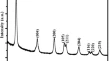
<p>The energy deposited in the wire affected the size and shape of the particles (Table <tblr tid="T3">3</tblr>). As the energy deposited in the wire increased, the particle size decreased. Figure <figr fid="F5">5</figr> shows the X-ray diffraction [XRD] patterns of silver nanoparticles generated through the EEWL. Only a silver peak was observed. The average size of the synthesized Ag nanoparticles calculated from the XRD patterns by Scherrer's equation is around 23.9 nm. Figure <figr fid="F6">6</figr> shows the size distribution from TEM images and the morphology of the Ag nanoparticles at different capacitances. The charging time and duration of plasma can influence the formation of particles. The Ag particles were spherical in shape and the particle distribution approached a bimodal distribution, which may have resulted from liquid droplet formation-induced aggregation of particles <abbrgrp>
<abbr bid="B17">17</abbr>
</abbrgrp>.</p>
<tbl id="T3"><title><p>Table 3</p></title><caption><p>Average particle size and zeta potential of Ag nanofluids produced by EEWL in deionized water</p></caption><tblbdy cols="3">
      <r>
         <c ca="center">
            <p>Capacitance (&#956;F)</p>
         </c>
         <c ca="center">
            <p>30</p>
         </c>
         <c ca="center">
            <p>7.5</p>
         </c>
      </r>
      <r>
         <c ca="center">
            <p>Average particle size (nm)</p>
         </c>
         <c ca="center">
            <p>123.5</p>
         </c>
         <c ca="center">
            <p>1,283</p>
         </c>
      </r>
      <r>
         <c ca="center">
            <p>Zeta potential (mV)</p>
         </c>
         <c ca="center">
            <p>-37</p>
         </c>
         <c ca="center">
            <p>-11.80</p>
         </c>
      </r>
   </tblbdy></tbl>
<fig id="F5"><title><p>Figure 5</p></title><caption><p>XRD pattern of Ag nanoparticles produced by EEWL</p></caption><text>
   <p><b>XRD pattern of Ag nanoparticles produced by EEWL</b>.</p>
</text><graphic file="1556-276X-6-223-5"/></fig>
<fig id="F6"><title><p>Figure 6</p></title><caption><p>Size distribution and morphology of Ag nanoparticles under different capacitances</p></caption><text>
   <p><b>Size distribution and morphology of Ag nanoparticles under different capacitances</b>: 7.5 &#956;F (<b>a</b>, <b>c</b>), 30 &#956;F (<b>b</b>, <b>d</b>).</p>
</text><graphic file="1556-276X-6-223-6"/></fig>
<p>Figure <figr fid="F6">6b</figr> shows the coagulation of Ag nanoparticles, which was likely a result of three potential processes. First, agglomeration may have occurred during handling or processing due to the high specific surface area of the nanoparticles. Second, it may have occurred during the drying process of sample preparation. Finally, it may have occurred during condensation.</p>
<p>Figure <figr fid="F7">7</figr> shows the effect of liquid type on the current and energy. Deionized water resulted in smaller particle sizes and good stability (Table <tblr tid="T4">4</tblr>). The plasma expanded in the medium due to the temperature difference between the plasma and the medium. A low viscosity led to a larger expansion in the plasma volume; thus, the particle size was smaller.</p>
<fig id="F7"><title><p>Figure 7</p></title><caption><p>Effect of liquid type on current and deposited energy in the wire</p></caption><text>
   <p><b>Effect of liquid type on current and deposited energy in the wire</b>. Ethanol (<it>black line</it>), water (<it>red line</it>)</p>
</text><graphic file="1556-276X-6-223-7"/></fig>
<tbl id="T4"><title><p>Table 4</p></title><caption><p>Average particle size and zeta potential of Ag nanofluids</p></caption><tblbdy cols="3">
      <r>
         <c>
            <p/>
         </c>
         <c ca="center">
            <p>
               <b>Deionized water</b>
            </p>
         </c>
         <c ca="center">
            <p>
               <b>Ethanol</b>
            </p>
         </c>
      </r>
      <r>
         <c cspan="3">
            <hr/>
         </c>
      </r>
      <r>
         <c ca="center">
            <p>Average particle size (nm)</p>
         </c>
         <c ca="center">
            <p>123.5</p>
         </c>
         <c ca="center">
            <p>1,873</p>
         </c>
      </r>
      <r>
         <c ca="center">
            <p>Zeta potential (mV)</p>
         </c>
         <c ca="center">
            <p>-37</p>
         </c>
         <c ca="center">
            <p>1.43</p>
         </c>
      </r>
   </tblbdy></tbl>
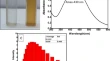
<p>Defects were observed in the particle structure. Under non-equilibrium process conditions, the synthesized particles were imperfect and had defects, such as twins and dislocations. The UV/Vis absorption spectra of Ag nanofluids are shown in Figure <figr fid="F8">8</figr>. Maximum absorbance occurred at ~398 nm, similar to previous reports <abbrgrp>
<abbr bid="B18">18</abbr>
</abbrgrp>.</p>
<fig id="F8"><title><p>Figure 8</p></title><caption><p>UV/Vis absorption spectra of Ag nanofluids</p></caption><text>
   <p><b>UV/Vis absorption spectra of Ag nanofluids</b>.</p>
</text><graphic file="1556-276X-6-223-8"/></fig>
<p>Typical boiling curves for pure water and Ag nanofluids are shown in Figure <figr fid="F9">9</figr>. The boiling curves of Ag nanofluids showed no significant change due to the very low concentration. The increase in the CHF can be explained by the changes in surface properties <abbrgrp>
<abbr bid="B19">19</abbr>
</abbrgrp>. Analysis of the wire surface showed that a silver layer built up during nanofluids boiling, as shown in Figure <figr fid="F10">10</figr>.</p>
<fig id="F9"><title><p>Figure 9</p></title><caption><p>Boiling curves for pure water and 0.001 vol.% Ag nanofluids</p></caption><text>
   <p><b>Boiling curves for pure water and 0.001 vol.% Ag nanofluids</b>.</p>
</text><graphic file="1556-276X-6-223-9"/></fig>
<fig id="F10"><title><p>Figure 10</p></title><caption><p>Ag particles coating the surface of the wire after boiling</p></caption><text>
   <p><b>Ag particles coating the surface of the wire after boiling</b>. Magnification: &#215;400 (<b>a</b>), &#215;4,998 (<b>b</b>).</p>
</text><graphic file="1556-276X-6-223-10"/></fig>
</sec>
<sec>
<st>
<p>Process optimization</p>
</st>
<p>DOE was used to compare the discharge features and to optimize process parameters. EEWL is a function of many parameters, including wire diameter, length and material, electrical circuit properties, and ambient conditions. In this experiment, there were four parameters of interest that affected the size and dispersibility of particles: capacitance, wire length, liquid volume, and liquid type. Each parameter had two levels or values. The experimental parameters are summarized in Table <tblr tid="T5">5</tblr>. The experiments were set up using Minitab. The DOE used a 1/4 fractional factorial design of the full factorial design with two repetitions. This resulted in eight total experiments, which was less than the full factorial design of 16, as shown in Table <tblr tid="T5">5</tblr>. Designs with factors that are usually set at two levels assume that the effects of the factors are linear. Generally, a factor is only evaluated at the low and high points. Ideally, there should be one or more center points to improve the reliability. Further analysis can compare the measurements of the dependent variable at the center point with the average values of the design.</p>
<tbl id="T5"><title><p>Table 5</p></title><caption><p>Experimental conditions</p></caption><tblbdy cols="5">
      <r>
         <c>
            <p/>
         </c>
         <c ca="center">
            <p>
               <b>Capacitance (&#956;F)</b>
            </p>
         </c>
         <c ca="center">
            <p>
               <b>Length (mm)</b>
            </p>
         </c>
         <c ca="center">
            <p>
               <b>Liquid volume (mL)</b>
            </p>
         </c>
         <c ca="center">
            <p>
               <b>Liquid</b>
            </p>
         </c>
      </r>
      <r>
         <c cspan="5">
            <hr/>
         </c>
      </r>
      <r>
         <c ca="center">
            <p>Run 1</p>
         </c>
         <c ca="center">
            <p>30</p>
         </c>
         <c ca="center">
            <p>38</p>
         </c>
         <c ca="center">
            <p>1,000</p>
         </c>
         <c ca="center">
            <p>Ethanol</p>
         </c>
      </r>
      <r>
         <c ca="center">
            <p>Run 2</p>
         </c>
         <c ca="center">
            <p>7.5</p>
         </c>
         <c ca="center">
            <p>38</p>
         </c>
         <c ca="center">
            <p>1,000</p>
         </c>
         <c ca="center">
            <p>Deionized water</p>
         </c>
      </r>
      <r>
         <c ca="center">
            <p>Run 3</p>
         </c>
         <c ca="center">
            <p>7.5</p>
         </c>
         <c ca="center">
            <p>38</p>
         </c>
         <c ca="center">
            <p>500</p>
         </c>
         <c ca="center">
            <p>Ethanol</p>
         </c>
      </r>
      <r>
         <c ca="center">
            <p>Run 4</p>
         </c>
         <c ca="center">
            <p>30</p>
         </c>
         <c ca="center">
            <p>28</p>
         </c>
         <c ca="center">
            <p>500</p>
         </c>
         <c ca="center">
            <p>Ethanol</p>
         </c>
      </r>
      <r>
         <c ca="center">
            <p>Run 5</p>
         </c>
         <c ca="center">
            <p>7.5</p>
         </c>
         <c ca="center">
            <p>28</p>
         </c>
         <c ca="center">
            <p>500</p>
         </c>
         <c ca="center">
            <p>Deionized water</p>
         </c>
      </r>
      <r>
         <c ca="center">
            <p>Run 6</p>
         </c>
         <c ca="center">
            <p>30</p>
         </c>
         <c ca="center">
            <p>28</p>
         </c>
         <c ca="center">
            <p>1,000</p>
         </c>
         <c ca="center">
            <p>Deionized water</p>
         </c>
      </r>
      <r>
         <c ca="center">
            <p>Run 7</p>
         </c>
         <c ca="center">
            <p>7.5</p>
         </c>
         <c ca="center">
            <p>28</p>
         </c>
         <c ca="center">
            <p>1,000</p>
         </c>
         <c ca="center">
            <p>Ethanol</p>
         </c>
      </r>
      <r>
         <c ca="center">
            <p>Run 8</p>
         </c>
         <c ca="center">
            <p>30</p>
         </c>
         <c ca="center">
            <p>38</p>
         </c>
         <c ca="center">
            <p>500</p>
         </c>
         <c ca="center">
            <p>Deionized water</p>
         </c>
      </r>
      <r>
         <c ca="center">
            <p>Run 9</p>
         </c>
         <c ca="center">
            <p>15</p>
         </c>
         <c ca="center">
            <p>33</p>
         </c>
         <c ca="center">
            <p>500</p>
         </c>
         <c ca="center">
            <p>Deionized water</p>
         </c>
      </r>
      <r>
         <c ca="center">
            <p>Run 10</p>
         </c>
         <c ca="center">
            <p>15</p>
         </c>
         <c ca="center">
            <p>33</p>
         </c>
         <c ca="center">
            <p>1,000</p>
         </c>
         <c ca="center">
            <p>Deionized water</p>
         </c>
      </r>
      <r>
         <c ca="center">
            <p>Run 11</p>
         </c>
         <c ca="center">
            <p>15</p>
         </c>
         <c ca="center">
            <p>33</p>
         </c>
         <c ca="center">
            <p>500</p>
         </c>
         <c ca="center">
            <p>Ethanol</p>
         </c>
      </r>
      <r>
         <c ca="center">
            <p>Run 12</p>
         </c>
         <c ca="center">
            <p>15</p>
         </c>
         <c ca="center">
            <p>33</p>
         </c>
         <c ca="center">
            <p>1,000</p>
         </c>
         <c ca="center">
            <p>Ethanol</p>
         </c>
      </r>
   </tblbdy></tbl>
<p>Figures <figr fid="F11">11</figr> and <figr fid="F12">12</figr> show the main effects plot, interaction plot, and cube plot for size and zeta potential to quantitatively assess the effects of the parameters of EEWL. In the cube plot, the mean responses of the factors are displayed on the corners of the cube. Low levels of the factors are to the left, front, or bottom and high levels to the right, back, or front of the cube. Figure <figr fid="F13">13</figr> represents the residual plot for size and zeta potential. The normal probability plot did not show any unusual features.</p>
<fig id="F11"><title><p>Figure 11</p></title><caption><p>Quantitative assessment of the effects of the parameters of EEWL for particle size</p></caption><text>
   <p><b>Quantitative assessment of the effects of the parameters of EEWL for particle size</b>. Main effects (<b>a</b>) and interaction plots (<b>b</b>).</p>
</text><graphic file="1556-276X-6-223-11"/></fig>
<fig id="F12"><title><p>Figure 12</p></title><caption><p>Quantitative assessment of the effects of the parameters of EEWL for particle zeta potential</p></caption><text>
   <p><b>Quantitative assessment of the effects of the parameters of EEWL for particle zeta potential</b>. Main effects (<b>a</b>) and Interaction plots (<b>b</b>)</p>
</text><graphic file="1556-276X-6-223-12"/></fig>
<fig id="F13"><title><p>Figure 13</p></title><caption><p>Residual plots for Ag nanofluids</p></caption><text>
   <p><b>Residual plots for Ag nanofluids</b>. Particle size (<b>a</b>) and zeta potential (<b>b</b>).</p>
</text><graphic file="1556-276X-6-223-13"/></fig>
<p>The process was optimized when capacitance was 30 &#956;F, wire length was 38 mm, liquid volume was 500 mL, and liquid type was deionized water. These conditions corresponded to a particle size of 49 nm and zeta potential of -39.15 mV, as shown in Figure <figr fid="F14">14</figr>. These predicted optimized parameters were confirmed by repeating the experiment, and the results for particle size and zeta potential were 118.9 nm and -42.5 mV, respectively. There were differences between the prediction and the experimental results. However, the experimental results showed the smallest and most stable Ag nanoparticles.</p>
<fig id="F14"><title><p>Figure 14</p></title><caption><p>Response optimization conditions</p></caption><text>
   <p><b>Response optimization conditions</b>.</p>
</text><graphic file="1556-276X-6-223-14"/></fig>
</sec>
</sec>
<sec>
<st>
<p>Conclusions</p>
</st>
<p>In this study, we produced Ag nanofluids by electrical explosion of wires in liquids. By optimizing control parameters, we decreased the particle size under fast explosion conditions and long plasma duration with low-viscosity media. Low viscosity decreased the particle size and dispersion stability due to greater expansion in the plasma volume. The process was optimized by ROT when capacitance was 30 &#956;F, wire length was 38 mm, liquid volume was 500 mL, and the liquid type was deionized water. For the repeated experiment, the average particle size of the Ag nanoparticles in water was 118.9 nm and the zeta potential was -42.5 mV. The CHF of the 0.001-vol.% Ag nanofluid was higher than that of pure water.</p>
</sec>
<sec>
<st>
<p>Competing interests</p>
</st>
<p>The authors declare that they have no competing interests.</p>
</sec>
<sec>
<st>
<p>Authors' contributions</p>
</st>
<p>EJP and HWP designed and guided all aspects of this work. SWL participated in the experiments. ICB participated in the design of the experiments.</p>
</sec>
</bdy><bm>
<ack>
<sec>
<st>
<p>Acknowledgements</p>
</st>
<p>This research was partly supported by Basic Science Research Program through the National Research Foundation of Korea (NRF) funded by the Ministry of Education, Science and Technology (2010-0023511) and the Fostering of Regional Strategic Industry Program though the Ministry of Knowledge Economy (70007094).</p>
</sec>
</ack>
<refgrp><bibl id="B1"><title><p>Silver based batteries for high power applications</p></title><aug><au><snm>Karpinski</snm><fnm>AP</fnm></au><au><snm>Russell</snm><fnm>SJ</fnm></au><au><snm>Serenyi</snm><fnm>JR</fnm></au><au><snm>Murphy</snm><fnm>JP</fnm></au></aug><source>Journal of Power Sources</source><pubdate>2000</pubdate><volume>91</volume><fpage>77</fpage><lpage>82</lpage><xrefbib><pubid idtype="doi">10.1016/S0378-7753(00)00489-4</pubid></xrefbib></bibl><bibl id="B2"><title><p>Preparation of Silver Nanoparticle and Its Application to the Determination of ct-DNA</p></title><aug><au><snm>Liu</snm><fnm>C</fnm></au><au><snm>Yang</snm><fnm>X</fnm></au><au><snm>Yuan</snm><fnm>H</fnm></au><au><snm>Zhou</snm><fnm>Z</fnm></au><au><snm>Xiao</snm><fnm>D</fnm></au></aug><source>Sensors</source><pubdate>2007</pubdate><volume>7</volume><fpage>708</fpage><lpage>718</lpage><xrefbib><pubid idtype="doi">10.3390/s7050708</pubid></xrefbib></bibl><bibl id="B3"><title><p>An evidence-based environmental perspective of manufactured silver nanoparticle in syntheses and applications: A systematic review and critical appraisal of peer-reviewed scientific papers</p></title><aug><au><snm>Tolaymat</snm><fnm>TM</fnm></au><au><snm>El Badawy</snm><fnm>AM</fnm></au><au><snm>Genaidy</snm><fnm>A</fnm></au><au><snm>Scheckel</snm><fnm>KG</fnm></au><au><snm>Luxton</snm><fnm>TP</fnm></au><au><snm>Suidan</snm><fnm>M</fnm></au></aug><source>Science of The Total Environment</source><pubdate>2010</pubdate><volume>408</volume><fpage>999</fpage><lpage>1006</lpage><xrefbib><pubidlist><pubid idtype="doi">10.1016/j.scitotenv.2009.11.003</pubid><pubid idtype="pmpid" link="fulltext">19945151</pubid></pubidlist></xrefbib></bibl><bibl id="B4"><title><p>Chemistry, Electrochemistry, and Electrochemical Applications | Silver</p></title><aug><au><snm>Cameron</snm><fnm>DS</fnm></au></aug><source>Encyclopedia of Electrochemical Power Sources</source><publisher>Amsterdam: Elsevier</publisher><editor>&#252;rgen G</editor><pubdate>2009</pubdate><fpage>876</fpage><lpage>882</lpage><xrefbib><pubid idtype="doi">full_text</pubid></xrefbib></bibl><bibl id="B5"><title><p>Special Issue on Micro/Nanoscale Heat Transfer---Part I</p></title><aug><au><snm>Cheng</snm><fnm>P</fnm></au><au><snm>Choi</snm><fnm>S</fnm></au><au><snm>Jaluria</snm><fnm>Y</fnm></au><au><snm>Li</snm><fnm>D</fnm></au><au><snm>Norris</snm><fnm>P</fnm></au><au><snm>Tzou</snm><fnm>RDY</fnm></au></aug><source>Journal of Heat Transfer</source><pubdate>2009</pubdate><volume>131</volume><fpage>030301</fpage><xrefbib><pubid idtype="doi">10.1115/1.3056579</pubid></xrefbib></bibl><bibl id="B6"><title><p>Fluorescence properties of Fe nanoparticles prepared by electro-explosion of wires</p></title><aug><au><snm>Siwach</snm><fnm>OP</fnm></au><au><snm>Sen</snm><fnm>P</fnm></au></aug><source>Materials Science and Engineering: B</source><pubdate>2008</pubdate><volume>149</volume><fpage>99</fpage><lpage>104</lpage><xrefbib><pubid idtype="doi">10.1016/j.mseb.2007.12.007</pubid></xrefbib></bibl><bibl id="B7"><title><p>Investigation on Convective Heat Transfer and Flow Features of Nanofluids</p></title><aug><au><snm>Xuan</snm><fnm>Y</fnm></au><au><snm>Li</snm><fnm>Q</fnm></au></aug><source>Journal of Heat Transfer</source><pubdate>2003</pubdate><volume>125</volume><fpage>151</fpage><lpage>155</lpage><xrefbib><pubid idtype="doi">10.1115/1.1532008</pubid></xrefbib></bibl><bibl id="B8"><title><p>Thermal conductivities of naked and monolayer protected metal nanoparticle based nanofluids: Manifestation of anomalous enhancement and chemical effects</p></title><aug><au><snm>Patel</snm><fnm>HE</fnm></au><au><snm>Das</snm><fnm>SK</fnm></au><au><snm>Sundararajan</snm><fnm>T</fnm></au><au><snm>Nair</snm><fnm>AS</fnm></au><au><snm>George</snm><fnm>B</fnm></au><au><snm>Pradeep</snm><fnm>T</fnm></au></aug><source>Applied Physics Letters</source><pubdate>2003</pubdate><volume>83</volume><fpage>2931</fpage><lpage>2933</lpage><xrefbib><pubid idtype="doi">10.1063/1.1602578</pubid></xrefbib></bibl><bibl id="B9"><title><p>Applications of Nanofluids: Current and Future</p></title><aug><au><snm>Wong</snm><fnm>KV</fnm></au><au><snm>De Leon</snm><fnm>O</fnm></au></aug><source>Advances in Mechanical Engineering</source><pubdate>2010</pubdate><volume>2010</volume><fpage>1</fpage><lpage>12</lpage></bibl><bibl id="B10"><title><p>Force modeling of microscale grinding process incorporating thermal effects</p></title><aug><au><snm>Park</snm><fnm>H</fnm></au><au><snm>Liang</snm><fnm>S</fnm></au></aug><source>The International Journal of Advanced Manufacturing Technology</source><pubdate>2009</pubdate><volume>44</volume><fpage>476</fpage><lpage>486</lpage><xrefbib><pubid idtype="doi">10.1007/s00170-008-1852-3</pubid></xrefbib></bibl><bibl id="B11"><title><p>Heat transfer characteristics of nanofluids: a review</p></title><aug><au><snm>Wang</snm><fnm>XQ</fnm></au><au><snm>Mujumdar</snm><fnm>AS</fnm></au></aug><source>International Journal of Thermal Sciences</source><pubdate>2007</pubdate><volume>46</volume><fpage>1</fpage><lpage>19</lpage><xrefbib><pubid idtype="doi">10.1016/j.ijthermalsci.2006.06.010</pubid></xrefbib></bibl><bibl id="B12"><title><p>Boiling phenomena with surfactants and polymeric additives: A state-of-the-art review</p></title><aug><au><snm>Cheng</snm><fnm>L</fnm></au><au><snm>Mewes</snm><fnm>D</fnm></au><au><snm>Luke</snm><fnm>A</fnm></au></aug><source>International Journal of Heat and Mass Transfer</source><pubdate>2007</pubdate><volume>50</volume><fpage>2744</fpage><lpage>2771</lpage><xrefbib><pubid idtype="doi">10.1016/j.ijheatmasstransfer.2006.11.016</pubid></xrefbib></bibl><bibl id="B13"><title><p>Study of thermal conductivity of nanofluids for the application of heat transfer fluids</p></title><aug><au><snm>Yoo</snm><fnm>DH</fnm></au><au><snm>Hong</snm><fnm>KS</fnm></au><au><snm>Yang</snm><fnm>HS</fnm></au></aug><source>Thermochimica Acta</source><pubdate>2007</pubdate><volume>455</volume><fpage>66</fpage><lpage>69</lpage><xrefbib><pubid idtype="doi">10.1016/j.tca.2006.12.006</pubid></xrefbib></bibl><bibl id="B14"><title><p>Heat transfer enhancement of copper nanofluid with acoustic cavitation</p></title><aug><au><snm>Zhou</snm><fnm>DW</fnm></au></aug><source>International Journal of Heat and Mass Transfer</source><pubdate>2004</pubdate><volume>47</volume><fpage>3109</fpage><lpage>3117</lpage><xrefbib><pubid idtype="doi">10.1016/j.ijheatmasstransfer.2004.02.018</pubid></xrefbib></bibl><bibl id="B15"><title><p>Study of heat transfer augmentation in a differentially heated square cavity using copper-water nanofluid</p></title><aug><au><snm>Santra</snm><fnm>AK</fnm></au><au><snm>Sen</snm><fnm>S</fnm></au><au><snm>Chakraborty</snm><fnm>N</fnm></au></aug><source>International Journal of Thermal Sciences</source><pubdate>2008</pubdate><volume>47</volume><fpage>1113</fpage><lpage>1122</lpage><xrefbib><pubid idtype="doi">10.1016/j.ijthermalsci.2007.10.005</pubid></xrefbib></bibl><bibl id="B16"><title><p>Anomalously increased effective thermal conductivities of ethylene glycol-based nanofluids containing copper nanoparticles</p></title><aug><au><snm>Eastman</snm><fnm>JA</fnm></au><au><snm>Choi</snm><fnm>SUS</fnm></au><au><snm>Li</snm><fnm>S</fnm></au><au><snm>Yu</snm><fnm>W</fnm></au><au><snm>Thompson</snm><fnm>LJ</fnm></au></aug><source>Applied Physics Letters</source><pubdate>2001</pubdate><volume>78</volume><fpage>718</fpage><lpage>720</lpage><xrefbib><pubid idtype="doi">10.1063/1.1341218</pubid></xrefbib></bibl><bibl id="B17"><title><p>Properties of powders produced by electrical explosions of copper-nickel alloy wires</p></title><aug><au><snm>Kwon</snm><fnm>YS</fnm></au><au><snm>An</snm><fnm>VV</fnm></au><au><snm>Ilyin</snm><fnm>AP</fnm></au><au><snm>Tikhonov</snm><fnm>DV</fnm></au></aug><source>Materials Letters</source><pubdate>2007</pubdate><volume>61</volume><fpage>3247</fpage><lpage>3250</lpage><xrefbib><pubid idtype="doi">10.1016/j.matlet.2006.11.047</pubid></xrefbib></bibl><bibl id="B18"><title><p>Physicochemical properties of small metal particles in solution: "microelectrode" reactions, chemisorption, composite metal particles, and the atom-to-metal transition</p></title><aug><au><snm>Henglein</snm><fnm>A</fnm></au></aug><source>The Journal of Physical Chemistry</source><pubdate>1993</pubdate><volume>97</volume><fpage>5457</fpage><lpage>5471</lpage><xrefbib><pubid idtype="doi">10.1021/j100123a004</pubid></xrefbib></bibl><bibl id="B19"><title><p>Characteristic stability of bare Au-water nanofluids fabricated by pulsed laser ablation in liquids</p></title><aug><au><snm>Kim</snm><fnm>HJ</fnm></au><au><snm>Bang</snm><fnm>IC</fnm></au><au><snm>Onoe</snm><fnm>J</fnm></au></aug><source>Optics and Lasers in Engineering</source><pubdate>2009</pubdate><volume>47</volume><fpage>532</fpage><lpage>538</lpage><xrefbib><pubid idtype="doi">10.1016/j.optlaseng.2008.10.011</pubid></xrefbib></bibl><bibl id="B20"><title><p>An exploding wire aerosol generator</p></title><aug><au><snm>Karioris</snm><fnm>FG</fnm></au><au><snm>Fish</snm><fnm>BR</fnm></au></aug><source>Journal of Colloid Science</source><pubdate>1962</pubdate><volume>17</volume><fpage>155</fpage><lpage>161</lpage><xrefbib><pubid idtype="doi">10.1016/0095-8522(62)90006-5</pubid></xrefbib></bibl><bibl id="B21"><title><p>Study of the use of cascade impactors for analyzing airborne particles of high specific gravity</p></title><aug><au><snm>Couchman</snm><fnm>JC</fnm></au></aug><source>Ph.D thesis</source><publisher>Texas Christian University</publisher><pubdate>1965</pubdate></bibl><bibl id="B22"><title><p>Evaluation of an exploded-wire aerosol generator for use in inhalation studies</p></title><aug><au><snm>Phalen</snm><fnm>RF</fnm></au></aug><source>Journal of Aerosol Science</source><pubdate>1972</pubdate><volume>3</volume><fpage>395</fpage><lpage>400</lpage><note>IN395-IN396, 401-406</note><xrefbib><pubid idtype="doi">10.1016/0021-8502(72)90094-8</pubid></xrefbib></bibl><bibl id="B23"><title><p>Production of nanopowders by wire explosion in liquid media</p></title><aug><au><snm>Cho</snm><fnm>CH</fnm></au><au><snm>Park</snm><fnm>SH</fnm></au><au><snm>Choi</snm><fnm>YW</fnm></au><au><snm>Kim</snm><fnm>BG</fnm></au></aug><source>Surface and Coatings Technology</source><pubdate>2007</pubdate><volume>201</volume><fpage>4847</fpage><lpage>4849</lpage><xrefbib><pubid idtype="doi">10.1016/j.surfcoat.2006.07.032</pubid></xrefbib></bibl><bibl id="B24"><title><p>Production and Properties of Ag Metallic Nanoparticle Fluid by Electrical Explosion of Wire in Liquid</p></title><aug><au><snm>Park</snm><fnm>EJ</fnm></au><au><snm>Bac</snm><fnm>LH</fnm></au><au><snm>Kim</snm><fnm>JS</fnm></au><au><snm>Kwon</snm><fnm>YS</fnm></au><au><snm>Kim</snm><fnm>JC</fnm></au><au><snm>Choi</snm><fnm>HS</fnm></au><au><snm>Chung</snm><fnm>YH</fnm></au></aug><source>Journal of Korean Powder Metallurgy Institute</source><pubdate>2009</pubdate><volume>16</volume><fpage>217</fpage><lpage>222</lpage><xrefbib><pubid idtype="doi">10.4150/KPMI.2009.16.3.217</pubid></xrefbib></bibl></refgrp>
</bm></art>