<?xml version='1.0'?>
<!DOCTYPE art SYSTEM 'http://www.biomedcentral.com/xml/article.dtd'>
<art><ui>1556-276X-6-174</ui><ji>1556-276X</ji><fm>
<dochead>Nano Express</dochead>
<bibl>
<title>
<p>Studying the local character of Raman features of single-walled carbon nanotubes along a bundle using TERS</p>
</title>
<aug>
<au ca="yes" id="A1"><snm>Peica</snm><fnm>Niculina</fnm><insr iid="I1"/><email>peica@physik.tu-berlin.de</email></au>
<au id="A2"><snm>Thomsen</snm><fnm>Christian</fnm><insr iid="I1"/><email>thomsen@physik.tu-berlin.de</email></au>
<au id="A3"><snm>Maultzsch</snm><fnm>Janina</fnm><insr iid="I1"/><email>janina@physik.tu-berlin.de</email></au>
</aug>
<insg>
<ins id="I1"><p>Institut f&#252;r Festk&#246;rperphysik, Technische Universit&#228;t Berlin, Hardenbergstr. 36, 10623 Berlin, Germany</p></ins>
</insg>
<source>Nanoscale Research Letters</source>
<issn>1556-276X</issn>
<pubdate>2011</pubdate>
<volume>6</volume>
<issue>1</issue>
<fpage>174</fpage>
<url>http://www.nanoscalereslett.com/content/6/1/174</url>
<xrefbib><pubidlist><pubid idtype="pmpid">21711681</pubid><pubid idtype="doi">10.1186/1556-276X-6-174</pubid></pubidlist></xrefbib>
</bibl>
<history><rec><date><day>6</day><month>9</month><year>2010</year></date></rec><acc><date><day>25</day><month>2</month><year>2011</year></date></acc><pub><date><day>25</day><month>2</month><year>2011</year></date></pub></history>
<cpyrt><year>2011</year><collab>Peica et al; licensee Springer.</collab><note>This is an Open Access article distributed under the terms of the Creative Commons Attribution License (<url>http://creativecommons.org/licenses/by/2.0</url>), which permits unrestricted use, distribution, and reproduction in any medium, provided the original work is properly cited.</note></cpyrt>
<abs>
<sec>
<st>
<p>Abstract</p>
</st>
<p>Here, we show that the Raman intensity of the G-mode in tip-enhanced Raman spectroscopy (TERS) is strongly dependent on the height of the bundle. Moreover, using TERS we are able to position different single-walled carbon nanotubes along a bundle, by correlating the observed radial breathing mode (RBM) with the AFM topography at the measuring point. The frequency of the G<sup>- </sup>mode behaves differently in TERS as compared to far-field Raman. Using the RBM frequency, the diameters of the tubes were calculated and a very good agreement with the G<sup>-</sup>-mode frequency was observed.</p>
</sec>
</abs>
</fm><meta>
<classifications>
<classification id="advanced_materials_nanocharacterization" subtype="theme_series_title" type="BMC">Advanced Materials Nanocharacterization</classification>
<classification id="advanced_materials_nanocharacterization" subtype="theme_series_editor" type="BMC"/>
</classifications>
</meta><bdy>
<sec>
<st>
<p>Introduction</p>
</st>
<p>Tip-enhanced Raman spectroscopy (TERS) became a very useful technique in studying the optical properties of carbon nanotubes <abbrgrp>
<abbr bid="B1">1</abbr>
<abbr bid="B2">2</abbr>
<abbr bid="B3">3</abbr>
<abbr bid="B4">4</abbr>
<abbr bid="B5">5</abbr>
<abbr bid="B6">6</abbr>
</abbrgrp>. A previous study <abbrgrp>
<abbr bid="B7">7</abbr>
</abbrgrp> on the detection of single-walled carbon nanotubes (SWCNT) by using TERS concentrated on showing the G-mode and the radial breathing mode (RBM) from a nanometer-sized region that could not be visible in the micro-Raman measurements. Another report <abbrgrp>
<abbr bid="B8">8</abbr>
</abbrgrp> has focused on studying the variations in the Raman spectra of the G-mode and RBM by changing the polarization conditions and has shown different behaviors for the two distinct modes. Identification of the chiral indices of SWCNT through the observed radial breathing mode (RBM) in near-field Raman and photoluminescence (PL) of the nanotubes was reported as well <abbrgrp>
<abbr bid="B9">9</abbr>
</abbrgrp>. Combining near-field PL and near-field Raman imaging, Hartschuh et al. <abbrgrp>
<abbr bid="B10">10</abbr>
</abbrgrp> observed higher near-field enhancements using PL and suggested that using these two techniques for the study of individual SWCNTs it should be possible to correlate the structural defects with the emission properties of the nanotubes. Recently, Roy and Williams <abbrgrp>
<abbr bid="B11">11</abbr>
</abbrgrp> developed a new spectrometer for high resolution Raman imaging of SWCNTs and showed TERS images of SWCNTs using radially polarized circular and annular beams, respectively. In order to extract structural information from SWCNTs in bundles we combine the AFM topography with the TERS and confocal Raman measurements along an SWCNTs bundle. The purpose of our study is to analyze the vibrational properties of SWCNTs along a bundle using TERS. From the observed RBMs in the TERS spectra and the extracted information from the AFM topography we attribute each RBM to a nanostructure from the measured bundle. Moreover a correlation of the diameter-dependent G<sup>- </sup>peaks to the assigned RBMs is discussed.</p>
<sec>
<st>
<p>Experimental</p>
</st>
<p>The TERS measurements were performed using a commercially available combination of an AFM/STM XE-100 from Park Systems and a LabRam HR-800 spectrometer from Horiba Jobin Yvon. For excitation, the 532.2 nm line from a doubled-frequency Nd:YAG laser was used. The spectra were collected in backscattering geometry with a resolution of 2 cm<sup>-1 </sup>and recorded with a Peltier-cooled CCD camera. The laser power on the sample used in our measurements was 0.1 mW. The TERS experiments were done in contact-mode AFM with an Au-coated tip. The silicon nitride AFM tips with a reflective Au-coating of 60 nm were purchased from Veeco and were coated with an extra 20 nm Au by thermal evaporation in a vacuum chamber kept at a pressure of 10<sup>-5 </sup>mbar. SWCNTs were produced by high-pressure gas-phase decomposition of CO (HipCO), deposited on a Si/SiO<sub>2 </sub>substrate.</p>
</sec>
</sec>
<sec>
<st>
<p>Results and discussion</p>
</st>
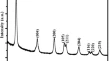
<p>We performed TERS and confocal Raman measurements at seven different positions along a small SWCNTs bundle in order to study the local character of different Raman features of SWCNTs. The seven positions along the SWCNTs bundle are depicted in Figure <figr fid="F1">1</figr> together with their corresponding AFM height profiles. Figure <figr fid="F1">1</figr> shows the optically excited areas in the far-field (green ellipse) as well as in the near-field (blue circle). The tip-induced enhancement is coming from the small excited area in the near-field (Figure <figr fid="F1">1</figr>, blue circle) whereas the total signal in TERS always includes the confocal Raman signal, coming from the same area as in the far-field (Figure <figr fid="F1">1</figr>, green ellipse) and thus including more carbon nanostructures than the near-field area. The incident laser is coming under an angle of 60&#176; with respect to the surface normal and its polarization direction is depicted in Figure <figr fid="F1">1</figr> by the <it>y</it>-axis of the green ellipse.</p>
<fig id="F1"><title><p>Figure 1</p></title><caption><p>Left-hand side: Height profiles of the seven measured positions along an SWCNTs bundle</p></caption><text>
   <p><b>Left-hand side: Height profiles of the seven measured positions along an SWCNTs bundle</b>. Right-hand side: AFM topography together with an approximation of the far-field spot area (green ellipse), diffraction-limited area (green circle), the near-field area (small blue circle), and the <it>y</it>-polarization direction of the incident laser. <b>(<it>A</it>)</b>, <b>(<it>B</it>)</b>, and <b>(<it>C</it>) </b>denote the three different bundles observed in the AFM topography. This notation is used in the RBM discussion part.</p>
</text><graphic file="1556-276X-6-174-1"/></fig>
<p>The heights and the full widths at half maxima (FWHM) of the peaks after a Lorentzian fit of the height profiles are summarized in Table <tblr tid="T1">1</tblr>. The determined FWHMs are between 21 and 94 nm and the heights range from 2 to 9 nm. The height profiles indicate the presence of an SWCNT bundle.</p>
<tbl id="T1"><title><p>Table 1</p></title><caption><p>Heights and FWHM after a Lorentzian fit of the profiles at each measured position</p></caption><tblbdy cols="6">
      <r>
         <c ca="left">
            <p>
               <b>Position</b>
            </p>
         </c>
         <c ca="left">
            <p>
               <b>Height 1 (nm)</b>
            </p>
         </c>
         <c ca="left">
            <p>
               <b>Height 2 (nm)</b>
            </p>
         </c>
         <c ca="left">
            <p>
               <b>FWHM 1 (nm)</b>
            </p>
         </c>
         <c ca="left">
            <p>
               <b>FWHM 2 (nm)</b>
            </p>
         </c>
         <c ca="left">
            <p>
               <b>Cumulated FWHM (nm)</b>
            </p>
         </c>
      </r>
      <r>
         <c cspan="6">
            <hr/>
         </c>
      </r>
      <r>
         <c ca="left">
            <p><b>1</b>.</p>
         </c>
         <c ca="center">
            <p>6.80*</p>
         </c>
         <c>
            <p/>
         </c>
         <c ca="center">
            <p>61.37</p>
         </c>
         <c>
            <p/>
         </c>
         <c ca="center">
            <p>61.37</p>
         </c>
      </r>
      <r>
         <c ca="left">
            <p><b>2</b>.</p>
         </c>
         <c ca="center">
            <p>3.40*</p>
         </c>
         <c>
            <p/>
         </c>
         <c ca="center">
            <p>49.28</p>
         </c>
         <c>
            <p/>
         </c>
         <c ca="center">
            <p>49.28</p>
         </c>
      </r>
      <r>
         <c ca="left">
            <p><b>3</b>.</p>
         </c>
         <c ca="center">
            <p>2.70</p>
         </c>
         <c ca="center">
            <p>8.30*</p>
         </c>
         <c ca="center">
            <p>34.58</p>
         </c>
         <c ca="center">
            <p>76.56</p>
         </c>
         <c ca="center">
            <p>111.14</p>
         </c>
      </r>
      <r>
         <c ca="left">
            <p><b>4</b>.</p>
         </c>
         <c ca="center">
            <p>9.00*</p>
         </c>
         <c>
            <p/>
         </c>
         <c ca="center">
            <p>55.61</p>
         </c>
         <c>
            <p/>
         </c>
         <c ca="center">
            <p>55.61</p>
         </c>
      </r>
      <r>
         <c ca="left">
            <p><b>5</b>.</p>
         </c>
         <c ca="center">
            <p>1.80</p>
         </c>
         <c ca="center">
            <p>6.40*</p>
         </c>
         <c ca="center">
            <p>21.71</p>
         </c>
         <c ca="center">
            <p>84.82</p>
         </c>
         <c ca="center">
            <p>106.53</p>
         </c>
      </r>
      <r>
         <c ca="left">
            <p><b>6</b>.</p>
         </c>
         <c ca="center">
            <p>4.40*</p>
         </c>
         <c ca="center">
            <p>10.00</p>
         </c>
         <c ca="center">
            <p>47.43</p>
         </c>
         <c ca="center">
            <p>93.98</p>
         </c>
         <c ca="center">
            <p>141.41</p>
         </c>
      </r>
      <r>
         <c ca="left">
            <p><b>7</b>.</p>
         </c>
         <c ca="center">
            <p>2.22*</p>
         </c>
         <c>
            <p/>
         </c>
         <c ca="center">
            <p>53.69</p>
         </c>
         <c>
            <p/>
         </c>
         <c ca="center">
            <p>53.69</p>
         </c>
      </r>
   </tblbdy><tblfn>
      <p>The star-marked height profiles correspond to the tip position, and were used for plotting the Raman signal dependence as a function of the height.</p>
   </tblfn></tbl>
<sec>
<st>
<p>Radial breathing modes</p>
</st>
<p>In the RBM region of the TERS spectra three or four different RBMs are observed at each of the marked positions (Figure <figr fid="F1">1</figr>). In total seven different RBMs are observed confirming the presence of an SWCNT bundle. In Table <tblr tid="T2">2</tblr> we summarize all observed RBMs together with a tentative chiral-index assignment. Taking into account the observed RBM frequencies and the presence of bundled SWCNTs, the tubes' diameters were calculated <abbrgrp>
<abbr bid="B12">12</abbr>
</abbrgrp> and based on previous theoretical studies <abbrgrp>
<abbr bid="B13">13</abbr>
</abbrgrp> a tentative assignment of the chiral indices is also given (Table <tblr tid="T2">2</tblr>).</p>
<tbl id="T2"><title><p>Table 2</p></title><caption><p>Summary of the RBM frequencies in the TERS spectra along the measured bundle together with their calculated diameter and tentative chiral indices assignment</p></caption><tblbdy cols="8">
      <r>
         <c ca="center">
            <p>
               <b>Position</b>
            </p>
         </c>
         <c ca="center">
            <p>
               <b>&#969;</b>
               <sub>
                  <b>RBM_1 </b>
               </sub>
            </p>
            <p>
               <b>(cm</b>
               <sup>
                  <b>-1</b>
               </sup>
               <b>)</b>
            </p>
            <p>
               <b>d</b>
               <sub>
                  <b>t</b>
               </sub>
               <b>_</b>
               <sub>
                  <b>1</b>
               </sub>
               <b>(nm)</b>
            </p>
         </c>
         <c ca="center">
            <p>
               <b>&#969;</b>
               <sub>
                  <b>RBM_2 </b>
               </sub>
            </p>
            <p>
               <b>(cm</b>
               <sup>
                  <b>-1</b>
               </sup>
               <b>)</b>
            </p>
            <p>
               <b>d</b>
               <sub>
                  <b>t</b>
               </sub>
               <b>_</b>
               <sub>
                  <b>2</b>
               </sub>
               <b>(nm)</b>
            </p>
         </c>
         <c ca="center">
            <p>
               <b>&#969;RBM_3</b>
            </p>
            <p>
               <b>(cm)</b>
               <sup>
                  <b>-1</b>
               </sup>
            </p>
            <p>
               <b>d</b>
               <sub>
                  <b>t</b>
               </sub>
               <b>_</b>
               <sub>
                  <b>3</b>
               </sub>
               <b>(nm)</b>
            </p>
         </c>
         <c ca="center">
            <p>
               <b>&#969;</b>
               <sub>
                  <b>RBM_4</b>
               </sub>
            </p>
            <p>
               <b>(cm)</b>
               <sup>
                  <b>-1</b>
               </sup>
            </p>
            <p>
               <b>d</b>
               <sub>
                  <b>t</b>
               </sub>
               <b>_</b>
               <sub>
                  <b>4</b>
               </sub>
               <b>(nm)</b>
            </p>
         </c>
         <c ca="center">
            <p>
               <b>&#969;</b>
               <sub>
                  <b>RBM_5</b>
               </sub>
            </p>
            <p>
               <b>(cm)</b>
               <sup>
                  <b>-1</b>
               </sup>
            </p>
            <p>
               <b>d</b>
               <sub>
                  <b>t</b>
               </sub>
               <b>_</b>
               <sub>
                  <b>5</b>
               </sub>
               <b>(nm)</b>
            </p>
         </c>
         <c ca="center">
            <p>
               <b>&#969;</b>
               <sub>
                  <b>RBM_6 </b>
               </sub>
            </p>
            <p>
               <b>(cm)</b>
               <sup>
                  <b>-1</b>
               </sup>
            </p>
            <p>
               <b>d</b>
               <sub>
                  <b>t</b>
               </sub>
               <b>_</b>
               <sub>
                  <b>6</b>
               </sub>
               <b>(nm)</b>
            </p>
         </c>
         <c ca="center">
            <p>
               <b>&#969;</b>
               <sub>
                  <b>RBM_7 </b>
               </sub>
            </p>
            <p>
               <b>(cm)</b>
               <sup>
                  <b>-1</b>
               </sup>
            </p>
            <p><b>d</b><sub><b>t</b></sub>_<sub><b>7</b></sub><b>(nm)</b></p>
         </c>
      </r>
      <r>
         <c cspan="8">
            <hr/>
         </c>
      </r>
      <r>
         <c ca="center">
            <p><b>1</b>.</p>
         </c>
         <c ca="center">
            <p>150.1 wm</p>
            <p>(1.63)</p>
         </c>
         <c ca="center">
            <p>-</p>
         </c>
         <c ca="center">
            <p>177.4 m</p>
            <p>(1.35)</p>
         </c>
         <c ca="center">
            <p>-</p>
         </c>
         <c ca="center">
            <p>-</p>
         </c>
         <c ca="center">
            <p>-</p>
         </c>
         <c ca="center">
            <p>277.9 m</p>
            <p> (0.83)</p>
         </c>
      </r>
      <r>
         <c ca="center">
            <p><b>2</b>.</p>
         </c>
         <c ca="center">
            <p>150.1 wm</p>
            <p>(1.63)</p>
         </c>
         <c ca="center">
            <p>-</p>
         </c>
         <c ca="center">
            <p>178.1 wm</p>
            <p>(1.35)</p>
         </c>
         <c ca="center">
            <p>-</p>
         </c>
         <c ca="center">
            <p>-</p>
         </c>
         <c ca="center">
            <p>-</p>
         </c>
         <c ca="center">
            <p>277.1 ms</p>
            <p>(0.83)</p>
         </c>
      </r>
      <r>
         <c ca="center">
            <p><b>3</b>.</p>
         </c>
         <c ca="center">
            <p>-</p>
         </c>
         <c ca="center">
            <p>155.7 wm</p>
            <p>(1.56)</p>
         </c>
         <c ca="center">
            <p>-</p>
         </c>
         <c ca="center">
            <p>181.5 wm</p>
            <p>(1.32)</p>
         </c>
         <c ca="center">
            <p>204.9 vw</p>
            <p>(1.15)</p>
         </c>
         <c ca="center">
            <p>-</p>
         </c>
         <c ca="center">
            <p>277.5 vs</p>
            <p>(0.83)</p>
         </c>
      </r>
      <r>
         <c ca="center">
            <p><b>4</b>.</p>
         </c>
         <c ca="center">
            <p>-</p>
         </c>
         <c ca="center">
            <p>-</p>
         </c>
         <c ca="center">
            <p>-</p>
         </c>
         <c ca="center">
            <p>182.7 m</p>
            <p>(1.31)</p>
         </c>
         <c ca="center">
            <p>205.3 w</p>
            <p>(1.15)</p>
         </c>
         <c ca="center">
            <p>-</p>
         </c>
         <c ca="center">
            <p>276.9 s</p>
            <p>(0.83)</p>
         </c>
      </r>
      <r>
         <c ca="center">
            <p><b>5</b>.</p>
         </c>
         <c ca="center">
            <p>-</p>
         </c>
         <c ca="center">
            <p>-</p>
         </c>
         <c ca="center">
            <p>-</p>
         </c>
         <c ca="center">
            <p>183.3 ms</p>
            <p>(1.30)</p>
         </c>
         <c ca="center">
            <p>205.7 w</p>
            <p>(1.15)</p>
         </c>
         <c ca="center">
            <p>-</p>
         </c>
         <c ca="center">
            <p>277.2 m</p>
            <p>(0.83)</p>
         </c>
      </r>
      <r>
         <c ca="center">
            <p><b>6</b>.</p>
         </c>
         <c ca="center">
            <p>-</p>
         </c>
         <c ca="center">
            <p>-</p>
         </c>
         <c ca="center">
            <p>-</p>
         </c>
         <c ca="center">
            <p>182.8 m</p>
            <p>(1.31)</p>
         </c>
         <c ca="center">
            <p>-</p>
         </c>
         <c ca="center">
            <p>244.2 wm</p>
            <p>(0.95)</p>
         </c>
         <c ca="center">
            <p>276.9 wm</p>
            <p>(0.83)</p>
         </c>
      </r>
      <r>
         <c ca="center">
            <p><b>7</b>.</p>
         </c>
         <c ca="center">
            <p>-</p>
         </c>
         <c ca="center">
            <p>-</p>
         </c>
         <c ca="center">
            <p>-</p>
         </c>
         <c ca="center">
            <p>181.8 w</p>
            <p>(1.32)</p>
         </c>
         <c ca="center">
            <p>-</p>
         </c>
         <c ca="center">
            <p>244.1 w</p>
            <p>(0.95)</p>
         </c>
         <c ca="center">
            <p>279.7 w</p>
            <p>(0.82)</p>
         </c>
      </r>
      <r>
         <c cspan="8">
            <hr/>
         </c>
      </r>
      <r>
         <c ca="center">
            <p>
               <b>(n,m)</b>
            </p>
            <p>
               <b>E</b>
               <sub>
                  <b>ii</b>
               </sub>
               <b>(eV)</b>
            </p>
         </c>
         <c ca="center">
            <p>(17,6)<sup>S</sup></p>
            <p>2.030</p>
         </c>
         <c ca="center">
            <p>(20,0)<sup>S</sup></p>
            <p>2.035</p>
         </c>
         <c ca="center">
            <p>(13,6)<sup>S</sup></p>
            <p>2.014</p>
         </c>
         <c ca="center">
            <p>(15,3)<sup>M</sup></p>
            <p>2.764</p>
         </c>
         <c ca="center">
            <p>(11,5)<sup>M</sup></p>
            <p>2.003</p>
         </c>
         <c ca="center">
            <p>(10,3)<sup>S</sup></p>
            <p>2.581</p>
         </c>
         <c ca="center">
            <p>(8,4)<sup>S</sup></p>
            <p>2.880</p>
         </c>
      </r>
      <r>
         <c>
            <p/>
         </c>
         <c ca="center">
            <p>
               <it>(12,12)</it>
               <sup>
                  <it>M</it>
               </sup>
            </p>
            <p>
               <it>2.539</it>
            </p>
         </c>
         <c ca="center">
            <p>
               <it>(17,5)</it>
               <sup>
                  <it>M</it>
               </sup>
            </p>
            <p>
               <it>2.436</it>
            </p>
         </c>
         <c ca="center">
            <p>
               <it>(14,5)</it>
               <sup>
                  <it>M</it>
               </sup>
            </p>
            <p>
               <it>2.763</it>
            </p>
         </c>
         <c ca="center">
            <p>(12,7)<sup>S</sup></p>
            <p>2.251</p>
         </c>
         <c ca="center">
            <p>
               <it>(14,1)</it>
               <sup>
                  <it>S </it>
               </sup>
            </p>
            <p>
               <it>2.178</it>
            </p>
         </c>
         <c ca="center">
            <p>
               <it>(12,0)</it>
               <sup>
                  <it>M</it>
               </sup>
            </p>
            <p>
               <it>1.934</it>
            </p>
         </c>
         <c ca="center">
            <p>
               <it>(10,1)</it>
               <sup>
                  <it>M</it>
               </sup>
            </p>
            <p>
               <it>2.100</it>
            </p>
         </c>
      </r>
   </tblbdy><tblfn>
      <p>w, weak; m, medium; s, strong; S, semiconducting; M, metallic.</p>
   </tblfn></tbl>
<p>In order to explain the appearance of different RBMs for each measured region, we will attempt to correlate each RBM with the corresponding AFM topography. In Figure <figr fid="F2">2</figr>, we see that <b>
<it>RBM_7 </it>
</b>is observed in the TERS spectra at each of the considered sites. This enables us to attribute its corresponding SWCNT to bundle <b>(<it>A</it>) </b>(Figure <figr fid="F1">1</figr>). Its intensity varies longwise the measured positions, becoming stronger at positions <b>(3) </b>and <b>(4)</b>, in accordance with the corresponding height profiles (Table <tblr tid="T1">1</tblr>) of the nanostructure <b>(<it>A</it>) </b>(Figure <figr fid="F1">1</figr>).</p>
<fig id="F2"><title><p>Figure 2</p></title><caption><p>TERS intensity as a function of the position along the SWCNT bundle and bundle height, exemplified on <b><it>RBM_7</it></b></p></caption><text>
   <p><b>TERS intensity as a function of the position along the SWCNT bundle and bundle height, exemplified on <b><it>RBM_7</it>. </b>(a)</b> TERS spectra in the RBM region at different positions, from (1) to (7) along the SWCNT bundle. The peaks marked with stars belong to the silicon substrate. The colored numbers correspond to the RBM numbering given in Table 2. <b>(b) <it>RBM_7 </it></b>TERS intensity as a function of the height of the bundle at the seven measurements sites.</p>
</text><graphic file="1556-276X-6-174-2"/></fig>
<p>At positions <b>(1)</b>, <b>(5)</b>, <b>(2)</b>, and <b>(6) </b>the heights of the nanostructure are lower than at position <b>(4) </b>(Table <tblr tid="T1">1</tblr>, Figure <figr fid="F2">2b</figr>). Assuming a resulting increased distance between tip and nanotube, weaker intensities of <b>
<it>RBM_7 </it>
</b>in the TERS spectra are expected (Figure <figr fid="F2">2</figr>). The smallest intensity of <b>
<it>RBM_7 </it>
</b>is observed at position <b>(7)</b>, but it is still clearly visible probably because its corresponding SWCNT is oriented almost parallel to the direction of the laser polarization. Figure <figr fid="F2">2b</figr> shows the variation of the <b>
<it>RBM_7 </it>
</b>intensity with the nanostructure height, which can be reasonably fitted by a linear function (dashed line).</p>
<p>Taking into account the size of the far-field spot, we conclude that bundle <b>(<it>B</it>) </b>contributes with its far-field signal at each measured point from <b>(1) </b>to <b>(3)</b>. This nanostructure ends probably before position <b>(3) </b>or between positions <b>(3) </b>and <b>(4)</b>. The responsible RBM for this nanostructure should be <b>
<it>RBM_1</it>
</b>, as it is present only at positions <b>(1) </b>and <b>(2) </b>(see Table <tblr tid="T2">2</tblr>). Furthermore we observe an RBM at 152 cm<sup>-1 </sup>being very weak and broad in the far-field Raman spectra taken at positions <b>(1) </b>and <b>(2)</b>. This confirms the contribution of the confocal Raman signal to the TERS signal. The absence of <b>
<it>RBM_1 </it>
</b>in the TERS spectrum at position <b>(3) </b>and the appearance of <b>
<it>RBM_2 </it>
</b>can be explained by another, shorter tube lying on top of the tube corresponding to <b>
<it>RBM_1</it>
</b>. This is in accordance with the AFM topography of bundle <b>(<it>B</it>)</b>. Furthermore, at positions <b>(1) </b>and <b>(2) </b>another RBM could be observed, <b>
<it>RBM_3</it>
</b>, which is assigned to an SWCNT belonging to nanostructure <b>(<it>A</it>) </b>because it is not visible in the far-field.</p>
<p>Beginning with position <b>(3)</b>, a new RBM, denoted <b>
<it>RBM_4</it>
</b>, emerges in the TERS spectra. This <b>
<it>RBM_4 </it>
</b>with high intensity from position <b>(3) </b>to <b>(6) </b>can be attributed to the main nanostructure <b>
<it>(A) </it>
</b>of the AFM topography, which has a considerable height (Figure <figr fid="F1">1</figr>, Table <tblr tid="T2">2</tblr>). As <b>
<it>RBM_7 </it>
</b>at positions <b>(3) </b>and <b>(4) </b>has considerable larger intensity than <b>
<it>RBM_4</it>
</b>, the corresponding tube might be closer to the tip as compared to the SWCNT observed through <b>
<it>RBM_4</it>
</b>. At positions <b>(5) </b>and <b>(6)</b>, <b>
<it>RBM_4 </it>
</b>has slightly larger intensity than <b>
<it>RBM_7</it>
</b>, which indicates that the corresponding tube might be closer to the tip as compared to the SWCNT observed through <b>
<it>RBM_7</it>
</b>. At the last position, according to the smaller height profile, the Raman intensity of <b>
<it>RBM_4 </it>
</b>is weak.</p>
<p>Moving on to <b>
<it>RBM_5</it>
</b>, which has a weaker intensity (Figure <figr fid="F2">2</figr>, Table <tblr tid="T2">2</tblr>) and is observed in the TERS spectra only at positions <b>(3) </b>to <b>(5)</b>, we might attribute it to a new tube that belongs to nanostructure <b>(<it>B</it>) </b>(Figure <figr fid="F1">1</figr>) and is situated further away from the tip position. Its weak intensity cannot be associated with the nanostructure heights at the three observed positions. Moreover in the confocal Raman spectra a very weak and broad feature at ~195 cm<sup>-1 </sup>was observed. Thus, <b>
<it>RBM_5 </it>
</b>seems to be a contribution from the far-field to the TERS spectra. At positions <b>(6) </b>and <b>(7)</b>, <b>
<it>RBM_6 </it>
</b>appears in the TERS measurements. The presence of this RBM can evidently be assigned to the new nanostructure <b>(<it>C</it>) </b>that emerges beginning with position <b>(5)</b>. Its higher intensity at position <b>(6) </b>is associated with its parallel orientation to the direction of the laser polarization. This SWCNT seems to be deeper situated, and by that, its intensity does not exceed the highest intensity of other observed RBMs. The weaker intensity of <b>
<it>RBM_6 </it>
</b>at position <b>(7) </b>appears to be due to the smallest height (Figure <figr fid="F1">1</figr>, Table <tblr tid="T1">1</tblr>) of the nanostructure <b>(<it>C</it>) </b>at this position.</p>
<p>In the confocal Raman spectra, as already mentioned, very weak and broad or no RBM at all could be observed. This might indicate that, on using the 2.33 eV excitation line, we are slightly off-resonance with the optical transitions of these carbon nanostructures.</p>
<p>The different RBMs observed in the TERS spectra at the seven measured positions confirm the possibility to locally characterize and to differentiate between individual SWCNTs in a bundle. Therefore, due to its lateral resolution, TERS may be successfully used in biology and medicine making possible the characterization not only at single cell level, but also at cell component level. Moreover, the enhancement through the plasmon resonances might open up new perspectives in the investigations of semiconducting materials (e.g., SiGe nanowires) and functionalized graphene.</p>
</sec>
<sec>
<st>
<p>G-mode</p>
</st>
<p>In Figure <figr fid="F3">3</figr> we show the TERS and confocal Raman spectra of the G-mode at the seven chosen positions. Based on the assignment made for the RBM in the previous section, we will now discuss the dependence of the G-mode on bundle height and nanotube chiral index.</p>
<fig id="F3"><title><p>Figure 3</p></title><caption><p>TERS (red) and confocal Raman (blue) spectra of the G-mode at seven positions along an SWCNT bundle</p></caption><text>
   <p><b>TERS (red) and confocal Raman (blue) spectra of the G-mode at seven positions along an SWCNT bundle</b>. The gray and light gray peaks represent the Lorentzian fits for the TERS and confocal Raman spectra, respectively.</p>
</text><graphic file="1556-276X-6-174-3"/></fig>
<p>On enlarging the bundle size (i.e., higher features in the AFM topography), an increase of the G-mode intensity is to be expected. This can be partly due to the presumably smaller distance between the tip and the nanotubes, for larger bundles. Undoubtedly, however, in a larger bundle there are more carbon nanotubes contributing to the recorded Raman signal. In contrast to the RBM, the G<sup>+ </sup>mode is only very slightly diameter-dependent, and the resonance window is much wider. Indeed, when plotting the G<sup>+ </sup>and G<sup>- </sup>intensities as a function of the bundle height, we observe an increased intensity with increasing height (see Figure <figr fid="F4">4</figr>).</p>
<fig id="F4"><title><p>Figure 4</p></title><caption><p>TERS and confocal Raman intensities of the G<sup>+</sup>-mode (squares) and G<sup>-</sup>-mode (stars) as a function of the height of the bundle at the seven measurement sites</p></caption><text>
   <p><b>TERS and confocal Raman intensities of the G</b><sup><b>+</b></sup><b>-mode (squares) and G</b><sup>-</sup><b>-mode (stars) as a function of the height of the bundle at the seven measurement sites</b>.</p>
</text><graphic file="1556-276X-6-174-4"/></fig>
<p>Moreover, correlating the FWHM (Table <tblr tid="T1">1</tblr>) of the nanostructures at the measured positions, one can observe that in a larger bundle more nanotubes contribute to the TERS signal. For example, at positions <b>(1) </b>and <b>(5)</b>, where similar height profiles of bundles are observed (Figure <figr fid="F1">1</figr>, Table <tblr tid="T1">1</tblr>), the TERS intensities of the G<sup>+ </sup>and G<sup>- </sup>modes are considerably higher for the smaller bundle height [position <b>(5)</b>, Figure <figr fid="F4">4</figr>]. Owing to an FWHM of 84.82 nm at position <b>(5)</b>, in comparison to an FWHM of 61.37 nm at position <b>(1)</b>, one can argue that at position <b>(5) </b>the nanostructure is broader than at position <b>(1)</b>, and therefore, more nanotubes participate to the TERS signal. These observations emphasize the potential of the TERS technique to distinguish local vibrational properties of nanometer-sized regions.</p>
<p>Further on we intend to correlate the observed G<sup>- </sup>peaks with the assigned RBMs. The G<sup>+ </sup>and G<sup>- </sup>peaks in semiconducting tubes correspond to the longitudinal (axial) and transverse (circumferential) optical vibrations, respectively, and vice versa in metallic nanotubes <abbrgrp>
<abbr bid="B14">14</abbr>
<abbr bid="B15">15</abbr>
<abbr bid="B16">16</abbr>
</abbrgrp>. The G<sup>- </sup>peak in both metallic and semiconducting nanotubes is strongly diameter-dependent. Using the assignment of RBMs to the measured positions <b>(1) </b>to <b>(7)</b>, we plot the observed G<sup>- </sup>frequencies as a function of tube diameters in Figure <figr fid="F5">5</figr>.</p>
<fig id="F5"><title><p>Figure 5</p></title><caption><p>Calculated (from ref. <abbrgrp><abbr bid="B16">16</abbr></abbrgrp>) and experimental TERS and confocal Raman G<sup>-</sup>-mode frequencies as a function of the calculated tube diameter</p></caption><text>
   <p><b>Calculated (from ref. </b><abbrgrp><abbr bid="B16">16</abbr></abbrgrp><b>) and experimental TERS and confocal Raman G<sup>-</sup>-mode frequencies as a function of the calculated tube diameter</b>. The dashed lines are drawn to guide the eye and refer to the theoretical data. SEM, semiconducting; MET, metallic.</p>
</text><graphic file="1556-276X-6-174-5"/></fig>
<p>In the TERS and confocal Raman spectra, the position of the G<sup>+</sup>-mode is preserved, at 1595 cm<sup>-1</sup>, whereas different G<sup>-</sup>-modes have been observed in TERS as compared to the far-field spectra. Moreover, different G<sup>-</sup>-modes are observed along the measured SWCNTs bundle, two for the first four positions <b>(1)</b>-<b>(4) </b>and three for positions <b>(5)</b>-<b>(7)</b>. For positions <b>(1) </b>to <b>(4)</b>, the first G<sup>-</sup>-peak is present at 1572 cm<sup>-1 </sup>in both TERS and confocal Raman measurements, whereas the second G<sup>-</sup>-mode exhibits different positions (Table <tblr tid="T3">3</tblr>).</p>
<tbl id="T3"><title><p>Table 3</p></title><caption><p>Summary of the G- frequencies in the TERS and confocal Raman spectra along the measured bundle.</p></caption><tblbdy cols="7">
      <r>
         <c ca="left">
            <p>
               <b>Position</b>
            </p>
         </c>
         <c ca="center" cspan="3">
            <p>
               <b>Frequency (cm<sup>-1</sup>) in TERS</b>
            </p>
         </c>
         <c ca="center" cspan="3">
            <p>
               <b>Frequency (cm<sup>-1</sup>) in confocal</b>
            </p>
         </c>
      </r>
      <r>
         <c>
            <p/>
         </c>
         <c ca="center">
            <p>
               <b>G</b>
               <sup>-</sup>
               <sub>
                  <b>1</b>
               </sub>
            </p>
         </c>
         <c ca="center">
            <p>
               <b>G</b>
               <sup>-</sup>
               <sub>
                  <b>2</b>
               </sub>
            </p>
         </c>
         <c ca="center">
            <p>
               <b>G</b>
               <sup>-</sup>
               <sub>
                  <b>3</b>
               </sub>
            </p>
         </c>
         <c ca="center">
            <p>
               <b>G</b>
               <sup>-</sup>
               <sub>
                  <b>1</b>
               </sub>
            </p>
         </c>
         <c ca="center">
            <p>
               <b>G</b>
               <sup>-</sup>
               <sub>
                  <b>2</b>
               </sub>
            </p>
         </c>
         <c ca="center">
            <p>
               <b>G</b>
               <sup>-</sup>
               <sub>
                  <b>3</b>
               </sub>
            </p>
         </c>
      </r>
      <r>
         <c cspan="7">
            <hr/>
         </c>
      </r>
      <r>
         <c ca="left">
            <p><b>1</b>.</p>
         </c>
         <c ca="right">
            <p>1556</p>
         </c>
         <c ca="right">
            <p>1572</p>
         </c>
         <c ca="right">
            <p>-</p>
         </c>
         <c ca="right">
            <p>1554</p>
         </c>
         <c ca="right">
            <p>1572</p>
         </c>
         <c ca="right">
            <p>-</p>
         </c>
      </r>
      <r>
         <c ca="left">
            <p><b>2</b>.</p>
         </c>
         <c ca="right">
            <p>1558</p>
         </c>
         <c ca="right">
            <p>1572</p>
         </c>
         <c ca="right">
            <p>-</p>
         </c>
         <c ca="right">
            <p>1544</p>
         </c>
         <c ca="right">
            <p>1572</p>
         </c>
         <c ca="right">
            <p>-</p>
         </c>
      </r>
      <r>
         <c ca="left">
            <p><b>3</b>.</p>
         </c>
         <c ca="right">
            <p>1543</p>
         </c>
         <c ca="right">
            <p>1572</p>
         </c>
         <c ca="right">
            <p>-</p>
         </c>
         <c ca="right">
            <p>1557</p>
         </c>
         <c ca="right">
            <p>1572</p>
         </c>
         <c ca="right">
            <p>-</p>
         </c>
      </r>
      <r>
         <c ca="left">
            <p><b>4</b>.</p>
         </c>
         <c ca="right">
            <p>1534</p>
         </c>
         <c ca="right">
            <p>1572</p>
         </c>
         <c ca="right">
            <p>-</p>
         </c>
         <c ca="right">
            <p>1557</p>
         </c>
         <c ca="right">
            <p>1572</p>
         </c>
         <c ca="right">
            <p>-</p>
         </c>
      </r>
      <r>
         <c ca="left">
            <p><b>5</b>.</p>
         </c>
         <c ca="right">
            <p>1539</p>
         </c>
         <c ca="right">
            <p>1569</p>
         </c>
         <c ca="right">
            <p>1581</p>
         </c>
         <c ca="right">
            <p>1544</p>
         </c>
         <c ca="right">
            <p>1569</p>
         </c>
         <c ca="right">
            <p>1575</p>
         </c>
      </r>
      <r>
         <c ca="left">
            <p><b>6</b>.</p>
         </c>
         <c ca="right">
            <p>1547</p>
         </c>
         <c ca="right">
            <p>1569</p>
         </c>
         <c ca="right">
            <p>1581</p>
         </c>
         <c ca="right">
            <p>1541</p>
         </c>
         <c ca="right">
            <p>1569</p>
         </c>
         <c ca="right">
            <p>1575</p>
         </c>
      </r>
      <r>
         <c ca="left">
            <p><b>7</b>.</p>
         </c>
         <c ca="right">
            <p>1547</p>
         </c>
         <c ca="right">
            <p>1569</p>
         </c>
         <c ca="right">
            <p>1581</p>
         </c>
         <c ca="right">
            <p>1548</p>
         </c>
         <c ca="right">
            <p>1569</p>
         </c>
         <c ca="right">
            <p>1575</p>
         </c>
      </r>
   </tblbdy></tbl>
<p>For positions <b>(5) </b>to <b>(7)</b>, a new G<sup>- </sup>peak with a constant frequency of 1581 cm<sup>-1 </sup>in TERS and of 1575 cm<sup>-1 </sup>in confocal Raman was observed. The G<sup>-</sup>-mode observed previously at 1572 cm<sup>-1 </sup>is now present at 1569 cm<sup>-1</sup>, and the third G<sup>-</sup>-peak has different frequencies for each position in TERS and confocal Raman, respectively (see Table <tblr tid="T3">3</tblr>). The appearance of various G<sup>- </sup>modes at different positions along the measured bundle, and in TERS in comparison to the confocal Raman measurements, prove the effectiveness to identify the local character of this Raman feature with a spatial resolution of 100 nm by using TERS. This spatial resolution is based on the 30 nm radius of the Au-coated tip we have used and on the distances between the measured positions along an SWCNTs bundle. Thus, TERS enables the local detection and identification of optical properties of the measured SWCNTs bundle. Moreover, the detection of the different G<sup>-</sup>-mode in TERS can be associated with the local detection of different SWCNTs in a bundle. In this sense, based on the calculated tube diameters (Table <tblr tid="T2">2</tblr>) by using the observed RBM frequencies, we have correlated the observed G<sup>-</sup>-modes along the measured bundles with previous calculations <abbrgrp>
<abbr bid="B16">16</abbr>
</abbrgrp>. Taking into account the calculated diameter of the tube we found good agreement with the theoretically predicted values <abbrgrp>
<abbr bid="B16">16</abbr>
</abbrgrp> of the corresponding G<sup>-</sup>-modes. These were correlated with the G<sup>-</sup>-frequencies from our TERS and confocal Raman measurements (Figure <figr fid="F5">5</figr>).</p>
<p>Considering the increasing of the frequency with the increase in the diameter, one can assume that the G<sup>-</sup>-frequency for tube 1 (<it>d</it>
<sub>t_1 </sub>= 1.63 nm, Table <tblr tid="T2">2</tblr>) is very close to the G<sup>+</sup>-mode frequency, and for this reason is not observed as a separate peak in the Raman spectra. However, the first G<sup>-</sup>-peak appears to be broader in the TERS spectra at positions <b>(1) </b>to <b>(3)</b>. Therefore, it is possible that due to this broad G<sup>-</sup>-mode we do not resolve the G<sup>-</sup>-mode corresponding to the tube 1. As for the second proposed chiral-index assignment, no experimental G<sup>-</sup>-frequency fits to the calculated value. As the theoretical energy <it>E</it>
<sub>ii </sub>(Table <tblr tid="T2">2</tblr>) is much higher than that of the excitation energy we have used, the assignment to a metallic tube is not supported.</p>
<p>For tube 2 (<it>d</it>
<sub>t_2 </sub>= 1.56 nm), taking into account the observed RBM, two different chiral indices could be considered for the assignment. However, considering the observed G<sup>-</sup>-frequency for both TERS and confocal Raman measurements (Figure <figr fid="F5">5</figr>) and that the observed RBM in the TERS spectra appears as a contribution from the confocal Raman signal, one can exclude the attribution to a metallic tube. Therefore the attribution to (20,0) chiral-index tube (Table <tblr tid="T2">2</tblr>, Figure <figr fid="F5">5</figr>) is in good agreement with both RBM and G<sup>-</sup>-mode frequencies assignment.</p>
<p>In the case of tube 3 (<it>d</it>
<sub>t_3 </sub>= 1.35 nm), whose RBM was observed only in the TERS spectra, two chiral indices were proposed. However, one of them corresponds to a higher energy shift in comparison to the used excitation energy (Table <tblr tid="T2">2</tblr>). Considering the observed G<sup>-</sup>-frequency (Figure <figr fid="F5">5</figr>), the assignment to a semiconducting nanotube (13,6) is very likely.</p>
<p>The fourth observed RBM in the TERS spectra at positions <b>(3) </b>to <b>(7) </b>corresponds to tube 4 and its diameter, <it>d</it>
<sub>t_4</sub>, varies between 1.30 and 1.32 nm. Furtheron, accounting for the observed G<sup>-</sup>-frequencies in the TERS and confocal Raman spectra, we can prove that two different tubes coexist in bundle <b>(<it>A</it>)</b>. Due to the excitation energy of the incoming laser at the tip apex, localized surface plasmons are excited in the apex or in the gap between the tip and the sample and therefore small shifts of the plasmon resonance can occur. These induce small shifts in the RBM frequencies and therefore tubes with slightly different diameters are observed.</p>
<p>For tube 5 (<it>d</it>
<sub>t_5 </sub>= 1.15 nm), whose RBM was observed in TERS as a contribution from the far-field, also two different chiral-indices assignment were proposed. Accounting for the observed G<sup>-</sup>-frequencies, one can conclude that the likely assignment is to a metallic tube (11,5) (Table <tblr tid="T2">2</tblr>, Figure <figr fid="F5">5</figr>).</p>
<p>Based on the good agreement with the experimental G<sup>-</sup>-frequencies in the TERS and confocal Raman measurements, we have assigned tubes 6 (<it>d</it>
<sub>t_6 </sub>= 0.95 nm) and 7 (<it>d</it>
<sub>t_7 </sub>= 0.83 nm) to semiconducting tubes (Table <tblr tid="T2">2</tblr>).</p>
<p>Our experimental work using TERS enabled us to observe more G<sup>-</sup>-frequency modes than would have been possible by using conventional Raman spectroscopy. This allows us to precisely correlate the observed frequencies to the tubes' diameter, providing a more accurate assignment of the vibrational modes. This underlines once more the potential and the perspectives opened up by using the TERS technique in spectroscopically investigating nanoscaled materials.</p>
</sec>
</sec>
<sec>
<st>
<p>Conclusions</p>
</st>
<p>Using TERS we have probed the variation of the Raman signal of SWCNTs at seven different positions along a bundle. The TERS intensity of G-mode in carbon nanotubes is strongly dependent on the height of the bundle. Moreover, the frequency of the G<sup>-</sup>-mode changes from one position to the other in TERS demonstrating the strong dependence of the Raman signal on the local position along the bundle. Correlating the observed RBMs with the AFM topography we were able to identify several tubes within the observed bundles. Using TERS it is possible to differentiate between SWCNTs in bundles by using the observed RBMs. Furthermore, recording confocal Raman and TERS measurements at seven positions along a bundle we could give an accurate chiral-indices assignment, considering both, RBM and G<sup>-</sup>-mode frequencies.</p>
</sec>
<sec>
<st>
<p>Abbreviations</p>
</st>
<p>FWHM: full widths at half maxima; HipCO: high-pressure gas-phase decomposition of CO; PL: photoluminescence; RBM: radial breathing mode; SWCNT: single-walled carbon nanotubes; TERS: tip-enhanced Raman spectroscopy.</p>
</sec>
<sec>
<st>
<p>Competing interests</p>
</st>
<p>The authors declare that they have no competing interests.</p>
</sec>
<sec>
<st>
<p>Authors' contributions</p>
</st>
<p>NP carried out the experiment and analyzed the data; NP and JM conceived the experiment; NP, JM, and CT discussed the results and contributed to writing the manuscript.</p>
</sec>
</bdy><bm>
<ack>
<sec>
<st>
<p>Acknowledgements</p>
</st>
<p>We gratefully acknowledge financial support from the DFG Cluster of Excellence "Unifying Concepts in Catalysis."</p>
</sec>
</ack>
<refgrp><bibl id="B1"><title><p>Nanoscale Uniaxial Pressure Effect of a Carbon Nanotube Bundle on Tip-Enhanced Near-Field Raman Spectra</p></title><aug><au><snm>Yano</snm><fnm>T</fnm></au><au><snm>Inouye</snm><fnm>Y</fnm></au><au><snm>Kawata</snm><fnm>S</fnm></au></aug><source>Nano Lett</source><pubdate>2006</pubdate><volume>6</volume><fpage>1269</fpage><xrefbib><pubidlist><pubid idtype="doi">10.1021/nl060108y</pubid><pubid idtype="pmpid" link="fulltext">16771592</pubid></pubidlist></xrefbib></bibl><bibl id="B2"><title><p>Chirality Changes in Carbon Nanotubes Studied with Near-Field Raman Spectroscopy</p></title><aug><au><snm>Anderson</snm><fnm>N</fnm></au><au><snm>Hartschuh</snm><fnm>A</fnm></au><au><snm>Novotny</snm><fnm>L</fnm></au></aug><source>Nano Lett</source><pubdate>2007</pubdate><volume>7</volume><fpage>577</fpage><xrefbib><pubidlist><pubid idtype="doi">10.1021/nl0622496</pubid><pubid idtype="pmpid" link="fulltext">17324000</pubid></pubidlist></xrefbib></bibl><bibl id="B3"><title><p>Tip-enhanced near-field optical microscopy of carbon nanotubes</p></title><aug><au><snm>Hartschuh</snm><fnm>A</fnm></au><au><snm>Qian</snm><fnm>H</fnm></au><au><snm>Georgi</snm><fnm>C</fnm></au><au><snm>B&#246;hmler</snm><fnm>M</fnm></au><au><snm>Novotny</snm><fnm>L</fnm></au></aug><source>Anal Bioanal Chem</source><pubdate>2009</pubdate><volume>394</volume><fpage>1787</fpage><xrefbib><pubidlist><pubid idtype="doi">10.1007/s00216-009-2827-4</pubid><pubid idtype="pmpid" link="fulltext">19455312</pubid></pubidlist></xrefbib></bibl><bibl id="B4"><title><p>Pressure-assisted tip-enhanced Raman imaging at a resolution of a few nanometers</p></title><aug><au><snm>Yano</snm><fnm>T</fnm></au><au><snm>Verma</snm><fnm>P</fnm></au><au><snm>Saito</snm><fnm>Y</fnm></au><au><snm>Ichimura</snm><fnm>T</fnm></au><au><snm>Kawata</snm><fnm>S</fnm></au></aug><source>Nat Photon</source><pubdate>2009</pubdate><volume>3</volume><fpage>473</fpage><xrefbib><pubid idtype="doi">10.1038/nphoton.2009.74</pubid></xrefbib></bibl><bibl id="B5"><title><p>Mechanism of Near-Field Raman Enhancement in One-Dimensional Systems</p></title><aug><au><snm>Can&#231;ado</snm><fnm>LG</fnm></au><au><snm>Jorio</snm><fnm>A</fnm></au><au><snm>Ismach</snm><fnm>A</fnm></au><au><snm>Joselevich</snm><fnm>E</fnm></au><au><snm>Hartschuh</snm><fnm>A</fnm></au><au><snm>Novotny</snm><fnm>L</fnm></au></aug><source>Phys Rev Lett</source><pubdate>2009</pubdate><volume>103</volume><fpage>186101</fpage><xrefbib><pubid idtype="pmpid" link="fulltext">19905816</pubid></xrefbib></bibl><bibl id="B6"><title><p>Tip-enhanced Raman scattering along a single wall carbon nanotubes bundle</p></title><aug><au><snm>Peica</snm><fnm>N</fnm></au><au><snm>Thomsen</snm><fnm>C</fnm></au><au><snm>Maultzsch</snm><fnm>J</fnm></au></aug><source>Phys Status Solidi B</source><pubdate>2010</pubdate><volume>247</volume><fpage>2818</fpage><xrefbib><pubid idtype="doi">10.1002/pssb.201000208</pubid></xrefbib></bibl><bibl id="B7"><title><p>Detection of an individual single-wall carbon nanotube by tip-enhanced near-field Raman spectroscopy</p></title><aug><au><snm>Hayazawa</snm><fnm>N</fnm></au><au><snm>Yano</snm><fnm>T</fnm></au><au><snm>Watanabe</snm><fnm>H</fnm></au><au><snm>Inouye</snm><fnm>Y</fnm></au><au><snm>Kawata</snm><fnm>S</fnm></au></aug><source>Chem Phys Lett</source><pubdate>2003</pubdate><volume>376</volume><fpage>174</fpage><xrefbib><pubid idtype="doi">10.1016/S0009-2614(03)00883-2</pubid></xrefbib></bibl><bibl id="B8"><title><p>Polarization measurements in tip-enhanced Raman spectroscopy applied to single-walled carbon nanotubes</p></title><aug><au><snm>Saito</snm><fnm>Y</fnm></au><au><snm>Hayazawa</snm><fnm>N</fnm></au><au><snm>Kataura</snm><fnm>H</fnm></au><au><snm>Murakami</snm><fnm>T</fnm></au><au><snm>Tsukagoshi</snm><fnm>K</fnm></au><au><snm>Inouye</snm><fnm>Y</fnm></au><au><snm>Kawata</snm><fnm>S</fnm></au></aug><source>Chem Phys Lett</source><pubdate>2005</pubdate><volume>410</volume><fpage>136</fpage><xrefbib><pubid idtype="doi">10.1016/j.cplett.2005.05.003</pubid></xrefbib></bibl><bibl id="B9"><title><p>Nanoscale optical imaging of single-walled carbon nanotubes</p></title><aug><au><snm>Hartschuh</snm><fnm>A</fnm></au><au><snm>Qian</snm><fnm>H</fnm></au><au><snm>Meixner</snm><fnm>AJ</fnm></au><au><snm>Anderson</snm><fnm>AJ</fnm></au><au><snm>Novotny</snm><fnm>L</fnm></au></aug><source>J Luminesc</source><pubdate>2006</pubdate><volume>119-120</volume><fpage>204</fpage><xrefbib><pubid idtype="doi">10.1016/j.jlumin.2005.12.031</pubid></xrefbib></bibl><bibl id="B10"><title><p>Nanoscale Optical Imaging of Excitons in Single-Walled Carbon Nanotubes</p></title><aug><au><snm>Hartschuh</snm><fnm>A</fnm></au><au><snm>Qian</snm><fnm>H</fnm></au><au><snm>Meixner</snm><fnm>AJ</fnm></au><au><snm>Anderson</snm><fnm>N</fnm></au><au><snm>Novotny</snm><fnm>L</fnm></au></aug><source>Nano Lett</source><pubdate>2005</pubdate><volume>5</volume><fpage>2310</fpage><xrefbib><pubidlist><pubid idtype="doi">10.1021/nl051775e</pubid><pubid idtype="pmpid" link="fulltext">16277474</pubid></pubidlist></xrefbib></bibl><bibl id="B11"><title><p>High resolution Raman imaging of single wall carbon nanotubes using electrochemically etched gold tips and a radially polarized annular beam</p></title><aug><au><snm>Roy</snm><fnm>D</fnm></au><au><snm>Williams</snm><fnm>C</fnm></au></aug><source>J Vac Sci Technol A</source><pubdate>2010</pubdate><volume>28</volume><fpage>472</fpage><xrefbib><pubid idtype="doi">10.1116/1.3368499</pubid></xrefbib></bibl><bibl id="B12"><title><p>Chirality assignments in carbon nanotubes based on resonant Raman scattering</p></title><aug><au><snm>Thomsen</snm><fnm>C</fnm></au><au><snm>Telg</snm><fnm>H</fnm></au><au><snm>Maultzsch</snm><fnm>J</fnm></au><au><snm>Reich</snm><fnm>S</fnm></au></aug><source>Phys Status Solidi B</source><pubdate>2005</pubdate><volume>242</volume><fpage>1802</fpage><xrefbib><pubid idtype="doi">10.1002/pssb.200461715</pubid></xrefbib></bibl><bibl id="B13"><title><p>Electron-phonon and electron-photon interactions and resonant Raman scattering from the radial-breathing mode of single-walled carbon naotubes</p></title><aug><au><snm>Popov</snm><fnm>VN</fnm></au><au><snm>Henrard</snm><fnm>L</fnm></au><au><snm>Lambin</snm><fnm>P</fnm></au></aug><source>Phys Rev B</source><pubdate>2005</pubdate><volume>72</volume><fpage>035436</fpage><xrefbib><pubid idtype="doi">10.1103/PhysRevB.72.035436</pubid></xrefbib></bibl><bibl id="B14"><title><p>High-Energy Phonon Branches of an Individual Metallic Carbon Nanotube</p></title><aug><au><snm>Maultzsch</snm><fnm>J</fnm></au><au><snm>Reich</snm><fnm>S</fnm></au><au><snm>Schlecht</snm><fnm>U</fnm></au><au><snm>Thomsen</snm><fnm>C</fnm></au></aug><source>Phys Rev Lett</source><pubdate>2003</pubdate><volume>91</volume><fpage>087402</fpage><xrefbib><pubidlist><pubid idtype="doi">10.1103/PhysRevLett.91.087402</pubid><pubid idtype="pmpid" link="fulltext">14525277</pubid></pubidlist></xrefbib></bibl><bibl id="B15"><title><p>Phonon linewidths and electron-phonon coupling in graphite and nanotubes</p></title><aug><au><snm>Lazzeri</snm><fnm>M</fnm></au><au><snm>Piscanec</snm><fnm>S</fnm></au><au><snm>Mauri</snm><fnm>F</fnm></au><au><snm>Ferrari</snm><fnm>AC</fnm></au><au><snm>Robertson</snm><fnm>J</fnm></au></aug><source>Phys Rev B</source><pubdate>2006</pubdate><volume>73</volume><fpage>155426</fpage><xrefbib><pubid idtype="doi">10.1103/PhysRevB.73.155426</pubid></xrefbib></bibl><bibl id="B16"><title><p>Phonon Softening in Metallic Nanotubes by a Peierls-like Mechanism</p></title><aug><au><snm>Dubay</snm><fnm>O</fnm></au><au><snm>Kresse</snm><fnm>G</fnm></au><au><snm>Kuzmany</snm><fnm>H</fnm></au></aug><source>Phys Rev Lett</source><pubdate>2002</pubdate><volume>88</volume><fpage>235506</fpage><xrefbib><pubidlist><pubid idtype="doi">10.1103/PhysRevLett.88.235506</pubid><pubid idtype="pmpid" link="fulltext">12059378</pubid></pubidlist></xrefbib></bibl></refgrp>
</bm></art>