<?xml version='1.0'?>
<!DOCTYPE art SYSTEM 'http://www.biomedcentral.com/xml/article.dtd'>
<art>
   <ui>1556-276X-5-559</ui>
   <ji>1556-276X</ji>
   <fm>
      <dochead>Special Issue Article</dochead>
      <bibl>
         <title>
            <p>Synthesis of <it>p</it><b>-</b> and <it>n</it>-type Gels Doped with Ionic Charge Carriers</p>
         </title>
         <aug>
            <au ca="yes" id="A1"><snm>Alveroglu</snm><fnm>E</fnm><insr iid="I1"/><email>alveroglu@itu.edu.tr</email></au>
            <au id="A2"><snm>Yilmaz</snm><fnm>Y</fnm><insr iid="I1"/><email>yyilmaz@itu.edu.tr</email></au>
         </aug>
         <insg>
            <ins id="I1"><p>Faculty of Science and Letters, Department of Physics, Istanbul Technical University, Maslak, 34469, Istanbul, Turkey</p></ins>
         </insg>
         <source>Nanoscale Research Letters</source>
         <publisher>Springer-Verlag, New York</publisher>
         <conference>
            <title>
               <p>Special Section (pp. 453-565): Nanoscale science and technology for electronics, photonics and renewable energy applications: Selected papers from NGC2009 &amp; CSTC2009 conference. Guest Editors: Anatoli Korkin, Predrag Krstic, Zoran Miskovic, Hongbin Yu and Igor Zhitomirsky.</p>
            </title>
         </conference>
         <issn>1556-276X</issn>
         <pubdate>2010</pubdate>
         <volume>5</volume>
         <issue>3</issue>
         <fpage>559</fpage>
         <lpage>565</lpage>
         <xrefbib><pubidlist><pubid idtype="pmpid">20672071</pubid><pubid idtype="doi">10.1007/s11671-010-9550-0</pubid></pubidlist></xrefbib>
      </bibl>
      <history><rec><date><day>30</day><month>9</month><year>2009</year></date></rec><acc><date><day>21</day><month>1</month><year>2010</year></date></acc><pub><date><day>5</day><month>2</month><year>2010</year></date></pub></history>
      <cpyrt><year>2010</year><collab>The Author(s)</collab></cpyrt>
      <kwdg>
         <kwd>Semiconducting gel</kwd>
         <kwd>Ionic conductivity</kwd>
         <kwd><it>pn</it> Junction</kwd>
         <kwd>Gel synthesis</kwd>
      </kwdg>
      <abs>
         <sec>
            <st>
               <p>Abstract</p>
            </st>
            <p>In this study, we synthesized the new kinds of semiconducting polymeric gels having negative (<it>n</it>-type) and positive (<it>p</it>-type) counter ions as charge carriers. The polyacrylamide gel was doped with pyranine (8-hydroxypyrene-1,3,6-trisulfonic acid, trisodium salt), having<inline-formula><graphic file="1556-276X-5-559-i1.gif"/></inline-formula>ions as side groups and Na<sup>+</sup> as counter ions, so-called <it>p</it>-type semiconducting gel. The doping process was performed during the polymerization where the pyranine binds to the polymer strands over OH group chemically via radical addition. In a similar way, N-isopropylacrylamide (NIPA) gel was doped with methacrylamidopropyltrimethyl ammonium chloride (MAPTAC), having Cl<sup>&#8722;</sup> as counter ions, so-called <it>n</it>-type semiconducting gel. Here MAPTAC was embedded by copolymerization within the polymer network (NIPA). These semiconducting gels can show different electrical properties by changing the concentration of the doping agents, swelling ratio etc. We have shown that the <it>pn</it> junction, formed by combining <it>p</it>-type and <it>n</it>-type gels together in close contact, rectifies the current similar to the conventional Si and Ge diodes.</p>
         </sec>
      </abs>
   </fm>
   <meta>
      <classifications>
         <classification id="springerjournalsubject" type="Primary">Material Science</classification>
         <classification id="springerjournalsubject" type="Secondary">Molecular Medicine</classification>
         <classification id="springerjournalsubject" type="Secondary">Engineering, general</classification>
         <classification id="springerjournalsubject" type="Secondary">Chemistry/Food Science, general</classification>
         <classification id="springerjournalsubject" type="Secondary">Physics, general</classification>
         <classification id="springerjournalsubject" type="Secondary">Materials Science, general</classification>
         <classification id="springerjournalsubject" type="Secondary">Nanotechnology</classification>
      <classification id="NSTEPREA" subtype="theme_series_title" type="BMC">Nanoscale science and technology for electronics, photonics and renewable energy applications: Selected papers from NGC2009 &amp; CSTC2009 conference</classification><classification id="NSTEPREA" subtype="theme_series_editor" type="BMC"/></classifications>
   </meta>
   <bdy>
      <sec>
         <st>
            <p>Introduction</p>
         </st>
         <p>The discovery of the silicon <it>pn</it> junction is a landmark in the development of modern microelectronics. Silicon and other inorganic semiconductors are the predominant materials in electronic manufacturing today; however, the development of organic-based electronic components has been a focus of intensive research and development. Organic electronics have become an active research area in recent years because they are an alternative to the traditional semiconductor technology and challenges in design on a smaller scale from microscale to nanoscale. Moreover, organic materials have vast potential for integration in low-cost microelectronic devices. Organic-based semiconductors, for example polymeric gels, may have superior properties due to their flexibility against to regulate some physical properties of the materials even after the production, e.g., by changing the volume of the gel. Circuits and displays based on organic electronics may also be flexible, low-weight, and environment friendly. Due to great diversity and functionality of the polymers, they may also be produced for specific requirements, like biocompatible semiconductors. Last, some water-tolerant organic devices may be biocompatible, that is, they may be used in circuits that directly reside on or are implanted inside animal and human tissue and could perform various sensing, interfacing, and controlling functions for drug delivery, prosthetics, and neural-electronic integration.</p>
         <p>Insulating polymers have been made conductive so far by using various methods such as ion implantation <abbrgrp><abbr bid="B1">1</abbr><abbr bid="B2">2</abbr><abbr bid="B3">3</abbr><abbr bid="B4">4</abbr></abbrgrp>, press contacting <abbrgrp><abbr bid="B5">5</abbr><abbr bid="B6">6</abbr></abbrgrp>, and photochemical doping <abbrgrp><abbr bid="B7">7</abbr></abbrgrp>. The impressive properties of these materials that have been taken advantage are the ability to manipulate electronic properties by changing their molecular structure <abbrgrp><abbr bid="B8">8</abbr></abbrgrp>. Differently current rectifying in semiconductor diodes via diffusion of ionic charges across a <it>pn</it> junction sets up a built in potential; there is unidirectional current is observed across a membrane where a built in potential arises from diffusion of anions and cations in organic junctions <abbrgrp><abbr bid="B9">9</abbr></abbrgrp>.</p>
         <p>We considered that the principle of the electrical conductivity in polymeric gels can be changed by doping static (inactive) ions having counter ions as charge carriers and these gels can be used to form <it>pn</it> junctions that work similar to inorganic semiconductors. These semiconductor polymeric gels can be doped with both negative (<it>n</it>-type) and positive (<it>p</it>-type) counter ions as charge carriers. We have shown that the <it>pn</it> junction formed by combining <it>p</it>-type and <it>n</it>-type gels together in much closer contact rectifies the current.</p>
      </sec>
      <sec>
         <st>
            <p>Experiment</p>
         </st>
         <sec>
            <st>
               <p>Preparation of <it>p</it>-Type Gel</p>
            </st>
            <p><it>p</it>-type hydrogels were synthesized via free radical cross-linking co-polymerization of acrylamide (AAm) and N,N&#8242;-methylene bisacrylamide (BIS) as crosslink agent in the presence of pyranine (8-hydroxypyrene-1,3,6-trisulfonic acid, trisodium salt) in varying amount, 10<sup>&#8722;6</sup>, 10<sup>&#8722;4</sup>, 10<sup>&#8722;2</sup> mol/l <abbrgrp><abbr bid="B10">10</abbr><abbr bid="B11">11</abbr><abbr bid="B12">12</abbr></abbrgrp>. Ammonium persulfate (APS) was used as the initiator. The ratios of AAm to BIS and AAm to APS were kept fixed for all samples; AAm/BIS = 31 and AAm/APS = 43 in bidistilled water. The samples were deoxygenated by bubbling nitrogen during 10 min, and the gelation was performed in the 1 &#215; 1 cm<sup>2</sup> square-shaped holders (4 cm<sup>3</sup> of volume) at 60&#176;C in a heat bath.</p>
            <p>After gelation processes were completed, gels were washed with pure water during 15 days with changing their water every day. Thus, pollutions and unreacted chemicals washed out from the gel, and only pyranines, which were bound to the polymer strands chemically <abbrgrp><abbr bid="B10">10</abbr><abbr bid="B11">11</abbr><abbr bid="B12">12</abbr></abbrgrp>, were stayed in the gel. After the gels dried at 40&#176;C furnace, they were cut into thin slices with ~1 mm thickness for electrical measurements.</p>
         </sec>
         <sec>
            <st>
               <p>Preparation of <it>n</it>-Type Gel</p>
            </st>
            <p><it>n</it>-type gels were synthesized, similar to <it>p</it>-type, as free radical cross-linking co-polymerization of N-isopropylacrylamide (NIPA) and N,N&#8242;-methylene bisacrylamide (BIS) as crosslink agent in the presence of methacrylamidopropyltrimethylammonium chloride (MAPTAC) in varying amount, 3 &#215; 10<sup>&#8722;6</sup>, 3 &#215; 10<sup>&#8722;4</sup>, 3 &#215; 10<sup>&#8722;2</sup> mol/l <abbrgrp><abbr bid="B13">13</abbr><abbr bid="B14">14</abbr><abbr bid="B15">15</abbr></abbrgrp>. 2,2- Azobisizob&#252;tilonitril (AIBN) was used as an initiator. The ratios of NIPA to BIS and NIPA to AIBN were kept fixed for all samples; NIPA/BIS = 50 and NIPA/AIBN = 71 in Dimethylsulphoxide (DMSO). These gels were prepared for electrical measurements in similar way with <it>p</it>-type gels.</p>
            <p>AAm, NIPA, and doping concentrations of the samples were summarized in Table <tblr tid="T1">1</tblr>.</p>
            <table id="T1">
               <title>
                  <p>Table 1</p>
               </title>
               <caption>
                  <p>Properties and codes of synthesizing semiconducting gels</p>
               </caption>
               <tgroup cols="6">
                  <colspec align="left" colname="c1" colnum="1"/>
                  <colspec align="char" char="." colname="c2" colnum="2"/>
                  <colspec align="char" char="." colname="c3" colnum="3"/>
                  <colspec align="left" colname="c4" colnum="4"/>
                  <colspec align="char" char="." colname="c5" colnum="5"/>
                  <colspec align="char" char="&#215;" colname="c6" colnum="6"/>
                  <thead>
                     <row>
                        <entry align="left" nameend="c3" namest="c1">
                           <p><it>p</it>-type</p>
                        </entry>
                        <entry align="left" nameend="c6" namest="c4">
                           <p><it>n</it>-type</p>
                        </entry>
                     </row>
                     <row>
                        <entry align="left" colname="c1">
                           <p>Sample code</p>
                        </entry>
                        <entry align="left" colname="c2">
                           <p>AAm concentration (mol/l)</p>
                        </entry>
                        <entry align="left" colname="c3">
                           <p>Doping (pyranine) concentration (mol/l)</p>
                        </entry>
                        <entry align="left" colname="c4">
                           <p>Sample code</p>
                        </entry>
                        <entry align="left" colname="c5">
                           <p>NIPA concentration (mol/l)</p>
                        </entry>
                        <entry align="left" colname="c6">
                           <p>Doping (MAPTAC) concentration (mol/l)</p>
                        </entry>
                     </row>
                  </thead>
                  <tbody>
                     <row>
                        <entry align="left" colname="c1">
                           <p>p1</p>
                        </entry>
                        <entry align="char" char="." colname="c2">
                           <p>4</p>
                        </entry>
                        <entry align="char" char="." colname="c3">
                           <p>&#8211;</p>
                        </entry>
                        <entry align="left" colname="c4">
                           <p>n1</p>
                        </entry>
                        <entry align="char" char="." colname="c5">
                           <p>4</p>
                        </entry>
                        <entry align="char" char="&#215;" colname="c6">
                           <p>&#8211;</p>
                        </entry>
                     </row>
                     <row>
                        <entry align="left" colname="c1">
                           <p>p2</p>
                        </entry>
                        <entry align="char" char="." colname="c2">
                           <p>4</p>
                        </entry>
                        <entry align="char" char="." colname="c3">
                           <p>10<sup>&#8722;6</sup></p>
                        </entry>
                        <entry align="left" colname="c4">
                           <p>n2</p>
                        </entry>
                        <entry align="char" char="." colname="c5">
                           <p>4</p>
                        </entry>
                        <entry align="char" char="&#215;" colname="c6">
                           <p>3 &#215; 10<sup>&#8722;6</sup></p>
                        </entry>
                     </row>
                     <row>
                        <entry align="left" colname="c1">
                           <p>p3</p>
                        </entry>
                        <entry align="char" char="." colname="c2">
                           <p>4</p>
                        </entry>
                        <entry align="char" char="." colname="c3">
                           <p>10<sup>&#8722;4</sup></p>
                        </entry>
                        <entry align="left" colname="c4">
                           <p>n3</p>
                        </entry>
                        <entry align="char" char="." colname="c5">
                           <p>4</p>
                        </entry>
                        <entry align="char" char="&#215;" colname="c6">
                           <p>3 &#215; 10<sup>&#8722;4</sup></p>
                        </entry>
                     </row>
                     <row>
                        <entry align="left" colname="c1">
                           <p>p4</p>
                        </entry>
                        <entry align="char" char="." colname="c2">
                           <p>4</p>
                        </entry>
                        <entry align="char" char="." colname="c3">
                           <p>10<sup>&#8722;2</sup></p>
                        </entry>
                        <entry align="left" colname="c4">
                           <p>n4</p>
                        </entry>
                        <entry align="char" char="." colname="c5">
                           <p>4</p>
                        </entry>
                        <entry align="char" char="&#215;" colname="c6">
                           <p>3 &#215; 10<sup>&#8722;2</sup></p>
                        </entry>
                     </row>
                     <row>
                        <entry align="left" colname="c1">
                           <p>p5</p>
                        </entry>
                        <entry align="char" char="." colname="c2">
                           <p>2</p>
                        </entry>
                        <entry align="char" char="." colname="c3">
                           <p>&#8211;</p>
                        </entry>
                        <entry align="left" colname="c4">
                           <p>n5</p>
                        </entry>
                        <entry align="char" char="." colname="c5">
                           <p>2</p>
                        </entry>
                        <entry align="char" char="&#215;" colname="c6">
                           <p>&#8211;</p>
                        </entry>
                     </row>
                     <row>
                        <entry align="left" colname="c1">
                           <p>p6</p>
                        </entry>
                        <entry align="char" char="." colname="c2">
                           <p>2</p>
                        </entry>
                        <entry align="char" char="." colname="c3">
                           <p>10<sup>&#8722;6</sup></p>
                        </entry>
                        <entry align="left" colname="c4">
                           <p>n6</p>
                        </entry>
                        <entry align="char" char="." colname="c5">
                           <p>2</p>
                        </entry>
                        <entry align="char" char="&#215;" colname="c6">
                           <p>3 &#215; 10<sup>&#8722;6</sup></p>
                        </entry>
                     </row>
                     <row>
                        <entry align="left" colname="c1">
                           <p>p7</p>
                        </entry>
                        <entry align="char" char="." colname="c2">
                           <p>2</p>
                        </entry>
                        <entry align="char" char="." colname="c3">
                           <p>10<sup>&#8722;4</sup></p>
                        </entry>
                        <entry align="left" colname="c4">
                           <p>n7</p>
                        </entry>
                        <entry align="char" char="." colname="c5">
                           <p>2</p>
                        </entry>
                        <entry align="char" char="&#215;" colname="c6">
                           <p>3 &#215; 10<sup>&#8722;4</sup></p>
                        </entry>
                     </row>
                     <row>
                        <entry align="left" colname="c1">
                           <p>p8</p>
                        </entry>
                        <entry align="char" char="." colname="c2">
                           <p>2</p>
                        </entry>
                        <entry align="char" char="." colname="c3">
                           <p>10<sup>&#8722;2</sup></p>
                        </entry>
                        <entry align="left" colname="c4">
                           <p>n8</p>
                        </entry>
                        <entry align="char" char="." colname="c5">
                           <p>2</p>
                        </entry>
                        <entry align="char" char="&#215;" colname="c6">
                           <p>3 &#215; 10<sup>&#8722;2</sup></p>
                        </entry>
                     </row>
                  </tbody>
               </tgroup>
            </table>
            <p>To be able to evaluate the net effect of the doping on the electrical properties, samples p1, p5, n1, and n5 were synthesized without doping agents for comparison with the other samples.</p>
         </sec>
         <sec>
            <st>
               <p>Electrical Measurements</p>
            </st>
            <p>Electrical measurements were taken on Keithley, Model 6487 Picoammeter/Voltage Source. The gels, prepared in the slice shapes of area A and thickness D, were swollen to a certain swelling ratio, and then placed between platinum electrodes, and sealed from the air against drying. The current densities per unit mass, <it>J</it><b>/</b><it>m</it>, of the gel were measured against the time, the applied voltage and the swelling ratio of the gels. The detailed discussions about these measurements are given in results and discussion part.</p>
         </sec>
      </sec>
      <sec>
         <st>
            <p>Results and Discussion</p>
         </st>
         <p>The pyranine binds to the polymer chains, over its OH group, chemically during the polymerization as it is discussed in detail in references <abbrgrp><abbr bid="B10">10</abbr><abbr bid="B11">11</abbr><abbr bid="B12">12</abbr></abbrgrp>, and they form stable charged sites doped with positive counter ions. Thus, the polyacrylamide gel is doped with pyranine having <inline-formula><graphic file="1556-276X-5-559-i2.gif"/></inline-formula> ions as side groups and Na<sup>+</sup> as counter ions, so-called <it>p</it>-type semiconducting gel <abbrgrp><abbr bid="B12">12</abbr></abbrgrp>.</p>
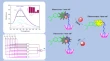
         <p>Similarly, NIPA gel was doped with MAPTAC, having Cl<sup>&#8722;</sup> as counter ions, so-called <it>n</it>-type semiconducting gel. The MAPTAC binds to the polymer chains chemically during the polymerization, thus they form stable charged sites doped with negative counter ions as represented in Scheme <schemer cid="C1">1</schemer>together with the <it>p</it>-type gel. This doping process was also discussed in detail in references, <abbrgrp><abbr bid="B10">10</abbr><abbr bid="B14">14</abbr><abbr bid="B15">15</abbr></abbrgrp>. When these gels are in the collapsed state, no current is observed. When the gels start to swell, the current starts to flow through the gels.</p>
         <scheme id="C1">
            <title>
               <p>Scheme 1</p>
            </title>
            <text>
               <p>Schematic representation of the <it>p</it>-type (<b>a</b>) and <it>n</it>-type (<b>b</b>) gels doped with pyranine and MAPTAC</p>
            </text>
            <graphic file="1556-276X-5-559-i3.gif"/>
         </scheme>
         <p>The currents decrease with time for a constant applied voltage as shown in Fig. <figr fid="F1">1a</figr> for p1, p2, p3, and p4 samples. This decrease in the currents is a direct indication of the ionic conductivity. As the charge carriers (the ions in water phase of the gel) were gathered on the electrodes, the density of the charge carriers decrease in time, and thus the current. As seen, the initial values of the currents measured for the doped gels are considerably bigger than that of the &#8220;neat&#8221; gel (the gel that was not doped with ions) at a certain swelling ratio, <it>V</it>/<it>V</it><sub><it>0</it></sub> = 1.28 and under constant applied voltage, U = 5 V. Furthermore, the initial amplitude of the currents increases with increasing doping concentration. This clearly shows that the net charge in the gel increases with increasing doping concentration.</p>
         <fig id="F1"><title><p>Figure 1</p></title><caption><p>aJ/mgel vs time plots for the doped (p2, p3, p4) and neat (p1) gels under constant applied voltage, 5 V, and swelling ratio, V/V0 ~ 1,28</p></caption><text>
   <p><b>a</b><it>J</it>/<it>m</it><sub><it>gel</it></sub> vs time plots for the doped (p2, p3, p4) and neat (p1) gels under constant applied voltage, 5 V, and swelling ratio, <it>V</it>/<it>V</it><sub><it>0</it></sub> ~ 1,28. <b>b</b><it>J</it>/<it>m</it><sub><it>gel</it></sub> versus time plots upon short-cut of the circuit for samples p4, p3, p2, p1. The <it>vertical bar</it> represents the standard error for each plot</p>
</text><graphic file="1556-276X-5-559-1"/></fig>
         <p>Examples for the short-cut experiments -the source of the voltage was removed and the current was measured by means of an ammeter without changing its polarity- were also indicated in (Fig. <figr fid="F1">1b</figr>) where all the current takes first a negative value, as it is expected, and then goes to zero with time.</p>
         <p>Figure <figr fid="F1">1</figr> clearly indicates that the free charges leading the current are accumulated on the surfaces of the gel on which the voltage is applied (similar to charging a parallel plate capacitor) and the gels have ionic charge carriers.</p>
         <p>Figure <figr fid="F2">2a</figr> shows typical current-time plots of the slab gels for increasing pyranine content. The gels were swollen in pure water up to certain swelling degree (<it>V</it>/<it>V</it><sub>0</sub> = 1,3), under a fixed applied voltage, 1 V. As seen, the currents for all samples decrease with time; however, the initial values of them increase with increasing doping agent (pyranine content).</p>
         <fig id="F2"><title><p>Figure 2</p></title><caption><p><b>a</b><it>J</it>/<it>m</it><sub><it>gel</it></sub> versus time plots of the samples p6, p7, and p8, <b>b</b> the ratios of <it>J</it>/<it>m</it><sub><it>gel</it></sub> for the doped and neat gels (p8/p5) as function of the applied voltage for varying swelling ratio, <it>V</it>/<it>V</it><sub><it>0</it></sub></p></caption><text>
   <p><b>a</b><it>J</it>/<it>m</it><sub><it>gel</it></sub> versus time plots of the samples p6, p7, and p8, <b>b</b> the ratios of <it>J</it>/<it>m</it><sub><it>gel</it></sub> for the doped and neat gels (p8/p5) as function of the applied voltage for varying swelling ratio, <it>V</it>/<it>V</it><sub><it>0</it></sub></p>
</text><graphic file="1556-276X-5-559-2"/></fig>
         <p>Figure <figr fid="F2">2b</figr> shows the ratio of the normalized current densities (<it>J</it>/<it>m</it><sub><it>gel</it></sub>) for doped (p8) to neat (p5) gels as function of the applied voltage for varying swelling ratio. The currents were measured 5 s later just after applying voltage. As seen, the doping effect on the current decreases when the swelling ratio is increased. This may be due to the vast increase in the free ions coming from the water which causes screening. This picture may indicate that doping effect (<it>p</it>-type behavior) can be fulfilled up to a certain swelling degree of the above-mentioned gel which semiconducting behavior will be lost.</p>
         <p>The instantaneous currents&#8212;the currents that were measured 5 s later just after changing the voltage- as function of the volume of the gels for varying voltages were also measured, and the results were indicated in Fig. <figr fid="F3">3</figr>. As seen from this figure, distinct peaks appear as the solvent uptake, <it>V</it>/<it>V</it><sub>0</sub>, increases. The peaks almost disappear for the gels doped with pyranine due to increasing homogeneity of the gels in the presence of the ions <abbrgrp><abbr bid="B16">16</abbr></abbrgrp>. The results coincide with the recent literature where three dominant peaks, each corresponding to a different swelling stage in the conductivity, were observed <abbrgrp><abbr bid="B17">17</abbr></abbrgrp>. Figure <figr fid="F3">3</figr> indicates that the volume of the gel is one of the main parameters determining the current.</p>
         <fig id="F3"><title><p>Figure 3</p></title><caption><p>Variation in <it>J</it>/<it>m</it><sub><it>gel</it></sub> against <it>V</it>/<it>V</it><sub><it>0</it></sub> for (<b>a)</b> the neat gel, p1, and for (<b>b</b>) the doped gel, p2</p></caption><text>
   <p>Variation in <it>J</it>/<it>m</it><sub><it>gel</it></sub> against <it>V</it>/<it>V</it><sub><it>0</it></sub> for (<b>a)</b> the neat gel, p1, and for (<b>b</b>) the doped gel, p2</p>
</text><graphic file="1556-276X-5-559-3"/></fig>
         <p>These peaks were related to the distribution of dense polymer regions; they are defined as the &#8220;blobs&#8221; appearing in a microstructure of the given PAAm gel having at least some average sizes. This special behavior in these gels may result specific features related to the electrical features. The heterogeneity of the gel may decrease essentially in case when it is prepared with the charged groups. The internal electric field due to the charged sites could disturb the tendency between the polymer units (affinity of the AAm momoners to the cross-linker molecules) because the charge excess has a tendency to form denser polymer regions especially in mesoscale regions. The formation of the rigid network in the charged gel makes it more homogenous in comparison with the neutral gel. This could cause the decreasing amplitude of the peaks, and overall decrease in the conductivity as it is confirmed by Fig. <figr fid="F3">3</figr> (see also Fig. <figr fid="F2">2</figr> of reference <abbrgrp><abbr bid="B17">17</abbr></abbrgrp>). Therefore, in the charged gel, the penetration of neutral water molecules through the system of large channels located in the vicinity of small blobs is facilitated. Because of this fact the total value of the dc conductivity is decreased.</p>
         <p>Figure <figr fid="F4">4</figr> represents the normalized current density per unit mass as function of the voltage for the gels (sample p3) swollen with water (Fig. <figr fid="F4">4a</figr>) and DMSO (Fig. <figr fid="F4">4b</figr>). DMSO is not a polar molecule; therefore, the ions like H or OH are absent in it. As seen from this figure, the current density decreases fairly for the gels swollen with DMSO since no contribution to the current occurs via H and OH ions. The current occurs mainly due to doped ions (the counter ions of the doping agent). This observation clearly indicates that the possible negative effects of the water upon the <it>pn</it>junctions that may be formed by means of our gels can be eliminated.</p>
         <fig id="F4"><title><p>Figure 4</p></title><caption><p><it>J</it>/<it>m</it><sub><it>gel</it></sub> versus applied voltage, <it>U</it>, for the doped gel (p3) swollen in (<b>a</b>) pure water, <b>b</b> and in DMSO</p></caption><text>
   <p><it>J</it>/<it>m</it><sub><it>gel</it></sub> versus applied voltage, <it>U</it>, for the doped gel (p3) swollen in (<b>a</b>) pure water, <b>b</b> and in DMSO</p>
</text><graphic file="1556-276X-5-559-4"/></fig>
         <p>All the above-mentioned measurements were repeated for <it>n</it>-type gels, and the similar results were reproduced. Here the results are not given to avoid the repetition.</p>
         <p>In Fig. <figr fid="F5">5</figr>, representative examples of <it>I</it>-<it>U</it>(current&#8211;voltage) character of polymeric diode are given for the neat and the doped gels. Figure <figr fid="F5">5a</figr> shows the current&#8211;voltage character that was made by means of close connection of <it>p</it>-(sample p4) and <it>n</it>-type (sample n4) slab gels- putting one of the gel on the top of the other for each gel. The swelling ratio of each gel was kept the same, <it>V</it>/<it>V</it><sub><it>0</it></sub> = 1,2. When the neat gels are used for both the <it>p</it>-and <it>n</it>-type sides, no rectification is observed as can be seen from Fig. <figr fid="F5">5b</figr>. Figure <figr fid="F5">5a</figr> clearly shows that the current of the interface between the cationic and anionic gels, which is passing through only one direction, originates directly from the doping effect of the gels.</p>
         <fig id="F5"><title><p>Figure 5</p></title><caption><p><b>a</b> I versus U plot for pn junction formed with <it>p</it>-and <it>n</it>-type gels (p4-n4), <b>b</b> I versus U plot for the junction formed with neat gels (p1-n1)</p></caption><text>
   <p><b>a</b> I versus U plot for pn junction formed with <it>p</it>-and <it>n</it>-type gels (p4-n4), <b>b</b> I versus U plot for the junction formed with neat gels (p1-n1)</p>
</text><graphic file="1556-276X-5-559-5"/></fig>
      </sec>
      <sec>
         <st>
            <p>Conclusion</p>
         </st>
         <p>In this study, we have shown that p- and n-type doped hydrogels can be synthesized and be used to built <it>pn</it> junction. The synthesis of these gels and making junctions are more simple, inexpensive, and scalable than traditional <it>pn</it> junctions. Moreover, they could be used in flexible and biocompatible electronic circuits. The current&#8211;voltage characteristic of the polymeric <it>pn</it> junction can be changed by changing doping concentration, swelling ratio etc that will be discussed in our feature works.</p>
         <p>The percentage of the standard deviations changes around 20% as can be seen from Fig. <figr fid="F1">1a</figr>. The reasons for this high standard deviations can be explained by the following arguments: (1) The electrical futures of these gels depend strictly on the swelling ratio of the gels as can be seen from Fig. <figr fid="F3">3</figr> and from the detailed discussion given in a recent work <abbrgrp><abbr bid="B17">17</abbr></abbrgrp> and (2) on the internal morphology (nonergodicity or random distribution of the heterogeneous regions in the gels). This strict volume dependence and the randomness of the internal distributions of the heterogeneous regions <abbrgrp><abbr bid="B18">18</abbr><abbr bid="B19">19</abbr></abbrgrp> set a barrier for comparison of the samples from the point of the current amplitudes due to the difficulties to bring the gels to exactly the same swelling ratios and to repeat the synthesis with exactly the same internal morphology. Therefore, the stability and reversibility problems need detailed experiments and probably more controllable polymer synthesis.</p>
      </sec>
   </bdy>
   <bm>
      <ack>
         <sec>
            <st>
               <p>Open Access</p>
            </st>
            <p>This article is distributed under the terms of the Creative Commons Attribution Noncommercial License which permits any noncommercial use, distribution, and reproduction in any medium, provided the original author(s) and source are credited.</p>
         </sec>
      </ack>
      <refgrp><bibl id="B1"><title><p>Fabrication of a stable p-n-junction in a polyacetylene film by ion-implantation</p></title><aug><au><snm>Wada</snm><fnm>T</fnm></au><etal/></aug><source>J. Chem. Soc.Chem. Commun.</source><pubdate>1985</pubdate><volume>17</volume><fpage>1194</fpage><lpage>1195</lpage><xrefbib><pubid idtype="doi">10.1039/c39850001194</pubid></xrefbib></bibl><bibl id="B2"><title><p>Application of ion-implantation for doping of polyacetylene films</p></title><aug><au><snm>Koshida</snm><fnm>N</fnm></au><au><snm>Wachi</snm><fnm>Y</fnm></au></aug><source>Appl. Phys. Lett.</source><pubdate>1984</pubdate><volume>45</volume><fpage>436</fpage><lpage>437</lpage><note>COI number [1:CAS:528:DyaL2cXlsVWktb8%3D]; Bibcode number [1984ApPhL..45..436K]</note><xrefbib><pubid idtype="doi">10.1063/1.95249</pubid></xrefbib></bibl><bibl id="B3"><title><p>Ion-beam modification of polyacetylene films</p></title><aug><au><snm>Lin</snm><fnm>SH</fnm></au><etal/></aug><source>Nuclear Inst. Methods Phys. Res. Sect. B Beam Interac. Mater. Atoms</source><pubdate>1989</pubdate><volume>39</volume><fpage>778</fpage><lpage>782</lpage><note>Bibcode number [1989NIMPB..39..778L]</note><xrefbib><pubid idtype="doi">10.1016/0168-583X(89)90895-1</pubid></xrefbib></bibl><bibl id="B4"><title><p>Diode characteristics and degradation mechanism of ion-implanted polyacetylene films</p></title><aug><au><snm>Wang</snm><fnm>WM</fnm></au><etal/></aug><source>Nuclear Inst. Methods Phys. Res. Sect. B Beam Interac. Mater. Atoms</source><pubdate>1991</pubdate><volume>61</volume><fpage>466</fpage><lpage>471</lpage><note>Bibcode number [1991NIMPB..61..466W]</note><xrefbib><pubid idtype="doi">10.1016/0168-583X(91)95324-7</pubid></xrefbib></bibl><bibl id="B5"><title><p>Polyacetylene, (CH)X&#8211;n-type and p-type doping and compensation</p></title><aug><au><snm>Chiang</snm><fnm>CK</fnm></au><etal/></aug><source>Appl. Phys. Lett.</source><pubdate>1978</pubdate><volume>33</volume><fpage>18</fpage><lpage>20</lpage><note>COI number [1:CAS:528:DyaE1cXkvFylsb8%3D]; Bibcode number [1978ApPhL..33...18C]</note><xrefbib><pubid idtype="doi">10.1063/1.90166</pubid></xrefbib></bibl><bibl id="B6"><title><p>Photovoltaic effect of normal-type polyacetylene junctions</p></title><aug><au><snm>Usuki</snm><fnm>A</fnm></au><au><snm>Murase</snm><fnm>M</fnm></au><au><snm>Kurauchi</snm><fnm>T</fnm></au></aug><source>Synth. Metals</source><pubdate>1987</pubdate><volume>18</volume><fpage>705</fpage><lpage>710</lpage><note>COI number [1:CAS:528:DyaL2sXhs1Oitr4%3D]</note><xrefbib><pubid idtype="doi">10.1016/0379-6779(87)90965-9</pubid></xrefbib></bibl><bibl id="B7"><title><p>Fabrication of an organic p-n homojunction diode using electrochemically cation-doped and photochemically anion-doped polymer</p></title><aug><au><snm>Yamashita</snm><fnm>K</fnm></au><etal/></aug><source>Jpn. J. Appl. Phys. Part 1</source><pubdate>1995</pubdate><volume>34</volume><fpage>3794</fpage><lpage>3797</lpage><note>COI number [1:CAS:528:DyaK2MXnsFagtbs%3D]</note><xrefbib><pubid idtype="doi">10.1143/JJAP.34.3794</pubid></xrefbib></bibl><bibl id="B8"><title><p>The electronic and electrochemical properties of poly(phenylene vinylenes) and poly(thienylene vinylenes)&#8211;an experimental and theoretical-study</p></title><aug><au><snm>Eckhardt</snm><fnm>H</fnm></au><etal/></aug><source>J. Chem. Phys.</source><pubdate>1989</pubdate><volume>91</volume><fpage>1303</fpage><lpage>1315</lpage><note>COI number [1:CAS:528:DyaL1MXlsFCksL4%3D]; Bibcode number [1989JChPh..91.1303E]</note><xrefbib><pubid idtype="doi">10.1063/1.457153</pubid></xrefbib></bibl><bibl id="B9"><title><p>A conjugated polymer pn junction</p></title><aug><au><snm>Cheng</snm><fnm>CHW</fnm></au><au><snm>Lonergan</snm><fnm>MC</fnm></au></aug><source>J. Am. Chem. Soc.</source><pubdate>2004</pubdate><volume>126</volume><fpage>10536</fpage><lpage>10537</lpage><note>COI number [1:CAS:528:DC%2BD2cXmt12ktL8%3D]</note><xrefbib><pubidlist><pubid idtype="doi">10.1021/ja046880p</pubid><pubid idtype="pmpid" link="fulltext">15327300</pubid></pubidlist></xrefbib></bibl><bibl id="B10"><title><p>Fluorescence study on the phase transition of hydrogen-bonding gels</p></title><aug><au><snm>Yilmaz</snm><fnm>Y</fnm></au></aug><source>Phys. Rev. E</source><pubdate>2002</pubdate><volume>66</volume><fpage>052801</fpage><note>Bibcode number [2002PhRvE..66e2801Y]</note><xrefbib><pubid idtype="doi">10.1103/PhysRevE.66.052801</pubid></xrefbib></bibl><bibl id="B11"><title><p>Testing percolation theory in the laboratory: Measuring the critical exponents and fractal dimension during gelation</p></title><aug><au><snm>Yilmaz</snm><fnm>Y</fnm></au><etal/></aug><source>Physical Review E</source><pubdate>2008</pubdate><volume>77</volume><fpage>051121</fpage><note>Bibcode number [2008PhRvE..77e1121Y]</note><xrefbib><pubid idtype="doi">10.1103/PhysRevE.77.051121</pubid></xrefbib></bibl><bibl id="B12"><title><p>Elucidation of multiple-point interactions of pyranine fluoroprobe during the gelation</p></title><aug><au><snm>Yilmaz</snm><fnm>Y</fnm></au><etal/></aug><source>Spectroch. Acta Part a-Mol. Biomol. Spect.</source><pubdate>2009</pubdate><volume>72</volume><fpage>332</fpage><lpage>338</lpage><xrefbib><pubid idtype="doi">10.1016/j.saa.2008.09.012</pubid></xrefbib></bibl><bibl id="B13"><title><p>Transition between collapsed state phases and the critical swelling of a hydrogen bonding gel: Poly(methacrylic acid-co-dimethyl acrylamide)</p></title><aug><au><snm>Yilmaz</snm><fnm>Y</fnm></au></aug><source>J. Chem. Phys.</source><pubdate>2007</pubdate><volume>126</volume><fpage>224501</fpage><note>Bibcode number [2007JChPh.126v4501Y]</note><xrefbib><pubidlist><pubid idtype="doi">10.1063/1.2743960</pubid><pubid idtype="pmpid" link="fulltext">17581057</pubid></pubidlist></xrefbib></bibl><bibl id="B14"><title><p>Reversible molecular adsorption based on multiple-point interaction by shrinkable gels</p></title><aug><au><snm>Oya</snm><fnm>T</fnm></au></aug><source>Science</source><pubdate>1999</pubdate><volume>286</volume><fpage>1543</fpage><lpage>1545</lpage><note>COI number [1:CAS:528:DyaK1MXns1ajt7w%3D]</note><xrefbib><pubidlist><pubid idtype="doi">10.1126/science.286.5444.1543</pubid><pubid idtype="pmpid" link="fulltext">10567256</pubid></pubidlist></xrefbib></bibl><bibl id="B15"><aug><au><snm>Gelir</snm><fnm>A</fnm></au></aug><source>Synthes&#305;s of &#305;mpr&#305;nted gels wh&#305;ch sens&#305;t&#305;ve to spec&#305;f&#305;c target molecules and the effect of the phys&#305;cal parameters on the sens&#305;t&#305;v&#305;ty</source><publisher>Istanbul Technical University: Istanbul</publisher><pubdate>2009</pubdate><note>Ph D Thesis</note><xrefbib><pubid idtype="pmpid">21604419</pubid></xrefbib></bibl><bibl id="B16"><title><p>Swelling behavior of chemically ion-doped hydrogels</p></title><aug><au><snm>Alveroglu</snm><fnm>E</fnm></au><au><snm>Gelir</snm><fnm>A</fnm></au><au><snm>Yilmaz</snm><fnm>Y</fnm></au></aug><source>Macromol. Symp.</source><pubdate>2008</pubdate><volume>281</volume><fpage>174</fpage><lpage>180</lpage><xrefbib><pubid idtype="doi">10.1002/masy.200950723</pubid></xrefbib></bibl><bibl id="B17"><title><p>Dielectric study of neutral and charged hydrogels during the swelling process</p></title><aug><au><snm>Yilmaz</snm><fnm>Y</fnm></au><etal/></aug><source>J. Chem. Phys.</source><pubdate>2006</pubdate><volume>125</volume><fpage>234705</fpage><note>COI number [1:STN:280:DC%2BD2s%2Fks1ersw%3D%3D]; Bibcode number [2006JChPh.125w4705Y]</note><xrefbib><pubidlist><pubid idtype="doi">10.1063/1.2349480</pubid><pubid idtype="pmpid" link="fulltext">17190568</pubid></pubidlist></xrefbib></bibl><bibl id="B18"><aug><au><snm>Geissler</snm><fnm>E</fnm></au><etal/></aug><source>In Dynamic Light Scattering</source><publisher>Oxford U.K, Oxford University Press</publisher><pubdate>1993</pubdate></bibl><bibl id="B19"><aug><au><snm>Dusek</snm><fnm>K</fnm></au><etal/></aug><source>In Polymer Networks</source><publisher>Plennum, New York</publisher><pubdate>1971</pubdate></bibl></refgrp>
   </bm>
</art>