<?xml version='1.0'?>
<!DOCTYPE art SYSTEM 'http://www.biomedcentral.com/xml/article.dtd'>
<art>
   <ui>1556-276X-5-550</ui>
   <ji>1556-276X</ji>
   <fm>
      <dochead>Special Issue Article</dochead>
      <bibl>
         <title>
            <p>Nano-regime Length Scales Extracted from the First Sharp Diffraction Peak in Non-crystalline SiO<sub>2</sub> and Related Materials: Device Applications</p>
         </title>
         <aug>
            <au ca="yes" id="A1"><snm>Lucovsky</snm><fnm>Gerald</fnm><insr iid="I1"/><email>lucovsky@ncsu.edu</email></au>
            <au id="A2"><snm>Phillips</snm><mi>C</mi><fnm>James</fnm><insr iid="I2"/></au>
         </aug>
         <insg>
            <ins id="I1"><p>Department of Physics, North Carolina State University, Raleigh, NC, 27695-8202, USA</p></ins>
            <ins id="I2"><p>Department of Physics and Astronomy, Rutgers University, Piscataway, NJ, 08854, USA</p></ins>
         </insg>
         <source>Nanoscale Research Letters</source>
         <publisher>Springer-Verlag, New York</publisher>
         <conference>
            <title>
               <p>Special Section (pp. 453-565): Nanoscale science and technology for electronics, photonics and renewable energy applications: Selected papers from NGC2009 &amp; CSTC2009 conference. Guest Editors: Anatoli Korkin, Predrag Krstic, Zoran Miskovic, Hongbin Yu and Igor Zhitomirsky.</p>
            </title>
         </conference>
         <issn>1556-276X</issn>
         <pubdate>2010</pubdate>
         <volume>5</volume>
         <issue>3</issue>
         <fpage>550</fpage>
         <lpage>558</lpage>
         <xrefbib><pubidlist><pubid idtype="pmpid">20672114</pubid><pubid idtype="doi">10.1007/s11671-009-9520-6</pubid></pubidlist></xrefbib>
      </bibl>
      <history><rec><date><day>11</day><month>9</month><year>2009</year></date></rec><acc><date><day>17</day><month>12</month><year>2009</year></date></acc><pub><date><day>6</day><month>1</month><year>2010</year></date></pub></history>
      <cpyrt><year>2010</year><collab>The Author(s)</collab></cpyrt>
      <kwdg>
         <kwd>Non-crystalline materials</kwd>
         <kwd>Nano-crystalline thin films</kwd>
         <kwd>Nano-crystalline/non-crystalline composites</kwd>
         <kwd>Chemical bonding self-organizations</kwd>
         <kwd>Percolation theory</kwd>
      </kwdg>
      <abs>
         <sec>
            <st>
               <p>Abstract</p>
            </st>
            <p>This paper distinguishes between two different scales of medium range order, MRO, in non-crystalline SiO<sub>2</sub>: (1) the first is ~0.4 to 0.5 nm and is obtained from the position of the first sharp diffraction peak, FSDP, in the X-ray diffraction structure factor, S(<it>Q</it>), and (2) the second is ~1 nm and is calculated from the FSDP full-width-at-half-maximum FWHM. Many-electron calculations yield Si&#8211;O third- and O&#8211;O fourth-nearest-neighbor bonding distances in the same 0.4&#8211;0.5 nm MRO regime. These derive from the availability of empty Si d&#960; orbitals for back-donation from occupied O p&#960; orbitals yielding narrow symmetry determined distributions of third neighbor Si&#8211;O, and fourth neighbor O&#8211;O distances. These are segments of six member rings contributing to connected six-member rings with ~1 nm length scale within the MRO regime. The unique properties of non-crystalline SiO<sub>2</sub> are explained by the encapsulation of six-member ring clusters by five- and seven-member rings on average in a compliant hard-soft nano-scaled inhomogeneous network. This network structure minimizes macroscopic strain, reducing intrinsic bonding defects as well as defect precursors. This inhomogeneous CRN is enabling for applications including thermally grown ~1.5 nm SiO<sub>2</sub> layers for Si field effect transistor devices to optical components with centimeter dimensions. There are qualitatively similar length scales in nano-crystalline HfO<sub>2</sub> and phase separated Hf silicates based on the primitive unit cell, rather than a ring structure. Hf oxide dielectrics have recently been used as replacement dielectrics for a new generation of Si and Si/Ge devices heralding a transition into nano-scale circuits and systems on a Si chip.</p>
         </sec>
      </abs>
   </fm>
   <meta>
      <classifications>
         <classification id="springerjournalsubject" type="Primary">Material Science</classification>
         <classification id="springerjournalsubject" type="Secondary">Molecular Medicine</classification>
         <classification id="springerjournalsubject" type="Secondary">Engineering, general</classification>
         <classification id="springerjournalsubject" type="Secondary">Chemistry/Food Science, general</classification>
         <classification id="springerjournalsubject" type="Secondary">Physics, general</classification>
         <classification id="springerjournalsubject" type="Secondary">Materials Science, general</classification>
         <classification id="springerjournalsubject" type="Secondary">Nanotechnology</classification>
      <classification id="NSTEPREA" subtype="theme_series_title" type="BMC">Nanoscale science and technology for electronics, photonics and renewable energy applications: Selected papers from NGC2009 &amp; CSTC2009 conference</classification><classification id="NSTEPREA" subtype="theme_series_editor" type="BMC"/></classifications>
   </meta>
   <bdy>
      <sec>
         <st>
            <p>Introduction</p>
         </st>
         <p>There have been many models proposed for the unique properties of non-crystalline SiO<sub>2</sub>. These are based on the concept of the continuous random network, CRN, structure as first proposed by Zachariasen <abbrgrp><abbr bid="B1">1</abbr><abbr bid="B2">2</abbr></abbrgrp>. CRN models assume the short range order, SRO, of SiO<sub>2</sub> is comprised of fourfold coordinated Si in tetrahedral environments through corner-connected twofold coordinated O bridging two Si atoms in a bent geometry. The random character of the network has generally been attributed to a wide distribution of Si&#8211;O&#8211;Si bond angles, 150 &#177; 30&#176; as determined by X-ray diffraction <abbrgrp><abbr bid="B3">3</abbr></abbrgrp>, as well as a random distribution of dihedral angles. These combine to give a distribution of ring geometries that defines a compliant and strain free CRN structure <abbrgrp><abbr bid="B2">2</abbr></abbrgrp>.</p>
         <p>More recently, a semi-empirical bond constraint theory (SE-BCT) was proposed by one of the authors (JCP) to correlate the ease of glass formation in SiO<sub>2</sub> and chalcogenide glass with local bonding constraints associated with two-body bond-stretching and three-body bond-bending forces <abbrgrp><abbr bid="B4">4</abbr><abbr bid="B5">5</abbr></abbrgrp>. The criterion for ease of glass formation was a mean-field relation equating the average number of stretching and bending constraints/atom with the network dimensionality of three. When applied to SiO<sub>2</sub>, satisfaction of this criterion was met by assuming a broken bond bending constraint for the bridging O-atoms. This was inferred from the large bond angle distribution of the Si&#8211;O&#8211;Si bonding group, and the weak bonding force constant. The same local mean-field approach for the ease of glass formation has been applied with good success to other non-crystalline network glasses in the Ge&#8211;Se and As&#8211;Se alloy systems.</p>
         <p>SE-BCT makes no connection with medium MRO that is a priori deemed to be important with other properties. As such, SE-BCT cannot identify MRO bonding that has been associated with the FSDP <abbrgrp><abbr bid="B6">6</abbr><abbr bid="B7">7</abbr></abbrgrp>. Based on these references, the position and width of the FSDP identify two different MRO length scales. It will be demonstrated in this paper that these length scales provide a basis for explaining some of the unique nano-scale related properties of non-crystalline SiO<sub>2</sub> that are enabling for device applications.</p>
         <p>The FSDP in the structure factor, S(<it>Q</it>), has been determined from X-ray and neutron diffraction studies of oxide, silicate, germanate, borate and chalcogenide glasses <abbrgrp><abbr bid="B7">7</abbr></abbrgrp>. There is a consensus that the position and width of this feature derive from MRO <abbrgrp><abbr bid="B6">6</abbr><abbr bid="B7">7</abbr><abbr bid="B8">8</abbr></abbrgrp>. This is defined as order extending beyond the nearest- and next-nearest neighbor distances extracted from diffraction studies, and displayed in radial distribution function plots <abbrgrp><abbr bid="B2">2</abbr></abbrgrp>. There has been much speculation and empirical modeling addressing the microscopic nature of bonding arrangements in the MRO regime including rings of bonded atoms <abbrgrp><abbr bid="B9">9</abbr></abbrgrp>, distances between layer-like ordering <abbrgrp><abbr bid="B10">10</abbr></abbrgrp>, and/or void clustering that are responsible for the FSDP <abbrgrp><abbr bid="B11">11</abbr></abbrgrp>. First-principle molecular dynamics calculations have been applied to the FSDP <abbrgrp><abbr bid="B7">7</abbr><abbr bid="B12">12</abbr></abbrgrp>. One of these papers ruled out models based on layer-like nano-structures, and nano-scale voids as the MRO responsible for the FSDP <abbrgrp><abbr bid="B12">12</abbr></abbrgrp>. References <abbrgrp><abbr bid="B7">7</abbr></abbrgrp> and <abbrgrp><abbr bid="B12">12</abbr></abbrgrp> did not offered alternative explanations for the FSDP based a microscopic understanding of the relationship between atomic pair correlations in the MRO regime and constraints imposed by fundamental electronic structure at the atomic and molecular levels.</p>
         <p>Moss and Price in <abbrgrp><abbr bid="B7">7</abbr></abbrgrp>, building on the 1974 deNeufville et al. <abbrgrp><abbr bid="B6">6</abbr></abbrgrp> observation and interpretation of the FSDP proposed that the position this feature, <it>Q</it><sub>1</sub>(&#197;<sup>&#8722;1</sup>), &#8220;can be related, via an approximate reciprocal relation, to a distance <it>R</it> in real space by the expression <it>R</it> = 2&#960;/<it>Q</it>&#8221;. It is important to note the MRO-scale bonding structures previously proposed in <abbrgrp><abbr bid="B9">9</abbr></abbrgrp> and <abbrgrp><abbr bid="B10">10</abbr></abbrgrp>, and ruled out in <abbrgrp><abbr bid="B12">12</abbr></abbrgrp>, could not explain why a large number of oxide and chalcogenide glasses exhibit FSDP&#8217;s in a relative narrow regime of <it>Q</it>-values, ~1 to 1.6 &#197;<sup>&#8722;1</sup>. Nor could they account for the systematic differences among these <it>Q</it>-values, ~1.5 for oxides, and 1.0&#8211;1.25 for chalcogenides. It has been shown in <abbrgrp><abbr bid="B13">13</abbr></abbrgrp> that this is a result of an scaling relationship between the position of the FSDP in <it>Q</it>-space and the nearest neighbor bond length.</p>
         <p>Based on <abbrgrp><abbr bid="B7">7</abbr><abbr bid="B8">8</abbr><abbr bid="B13">13</abbr><abbr bid="B14">14</abbr></abbrgrp>, the position, <it>Q</it><sub>1</sub>(&#197;<sup>&#8722;1</sup>), and full-width at half-maximum, FWHM, &#916;<it>Q</it><sub>1</sub>(&#197;<sup>&#8722;1</sup>) of the FSDP have been used to identify a second length scale within the MRO regime for a representative set of oxide and chalcogenide glasses <abbrgrp><abbr bid="B7">7</abbr><abbr bid="B11">11</abbr></abbrgrp>. The first length scale has been designated as a correlation length, <it>R</it> = 2&#960;/<it>Q</it><sub>1</sub>(&#197;<sup>&#8722;1</sup>), and is determined from the <it>Q</it>-space position of the spectral peak as suggested in <abbrgrp><abbr bid="B1">1</abbr></abbrgrp>, and the second has been designated as a coherence length, <it>L</it> = 2&#960;/&#916;<it>Q</it><sub>1</sub>(&#197;<sup>&#8722;1</sup>), and is determined from the FWHM <abbrgrp><abbr bid="B7">7</abbr></abbrgrp>. This interpretation of the FSDP position and line-shape is consistent with the interpretation of diffraction peaks or local maxima in S(<it>Q</it>) for non-crystalline and crystalline solids <abbrgrp><abbr bid="B2">2</abbr></abbrgrp>. These are interpreted as inter-atomic distances or equivalently atomic pair correlations that are repeated throughout a significant volume of the sample within the X-ray beam, but not in a periodic manner characteristic of long range crystalline order. Like other diffraction features, e.g., the width of the Si&#8211;Si pair correlation length in SiO<sub>2</sub> as determined in <abbrgrp><abbr bid="B3">3</abbr></abbrgrp>, is also associated with a characteristic real space distance, e.g., of a MRO-scale cluster of atoms.</p>
         <p>In referring to the FSDP, Moss and Prince in <abbrgrp><abbr bid="B7">7</abbr></abbrgrp> noted that &#8220;such a diffraction feature thus represents the build up of correlation whose basic period is well beyond the first few neighbor distances&#8221;; this basic period is within the MRO domain. It was also pointed out by them that &#8220;In fact, the width of this feature can be used to estimate a correlation range over which the period in question survives&#8221;, or persists.</p>
         <p>Returning to paper published in 1974 by deNeufville, Moss and Ovshinsky; this article addressed photo-darkening in As<sub>2</sub>(S, Se)<sub>3</sub> in a way that anticipated the quantitative definitions for <it>R</it> and <it>L</it> in subsequent publications <abbrgrp><abbr bid="B7">7</abbr></abbrgrp>. This is of historical interest since FSDPs were observed for the first time in each compound and/or alloy studied, and these were associated with a real space distance of ~5.5 A in the MRO regime. It was also noted that the width of this feature in reciprocal (<it>Q</it>) space identified a larger scale of order over which these MRO-regime correlations persisted; this has subsequently been defined as the coherence length, <it>L</it>.</p>
      </sec>
      <sec>
         <st>
            <p>Experimental Results for SiO<sub>2</sub></p>
         </st>
         <p>The position and width of the FSDP in glassy SiO<sub>2</sub> have received considerable attention, and are well-characterized <abbrgrp><abbr bid="B7">7</abbr><abbr bid="B8">8</abbr><abbr bid="B14">14</abbr></abbrgrp>. Based on these references and others as well, <it>Q</it><sub>1</sub>(&#197;<sup>&#8722;1</sup>) is equal to 1.52 &#177; 0.03 &#197;<sup>&#8722;1</sup>, and &#916;<it>Q</it><sub>1</sub>(&#197;<sup>&#8722;1</sup>) to 0.66 &#177; 0.03 &#197;<sup>&#8722;1</sup>. The calculated values of the correlation length, <it>R</it> = 2&#960;/<it>Q</it><sub>1</sub>(&#197;<sup>&#8722;1</sup>), and the coherence length, <it>L</it> = 2&#960;/&#916;<it>Q</it><sub>1</sub>(&#197;<sup>&#8722;1</sup>), are, respectively, <it>R</it> = 4.13 &#177; 0.08 &#197;, and <it>L</it> = 9.95 &#177; 0.05 &#197;. <it>R</it> gives rise to features in the RDF in a regime associated with rings of bonded atoms; these are a universal aspect of the CRN description of non-crystalline oxides and chalcogenides which include twofold coordinate atoms <abbrgrp><abbr bid="B2">2</abbr></abbrgrp>.</p>
         <p>In a continuous random network, CRN, such as SiO<sub>2</sub>, the primitive ring size is defined by the number of Si atoms connected through bridging O atoms to form the smallest high symmetry ring structure. This primitive ring is the non-crystalline analog of the primitive unit cell (PUC) in crystalline solids and this provides an important connection between the properties of non-crystalline and nano-crystalline thin films.</p>
         <p>It has been first demonstrated in the Bell and Dean model <abbrgrp><abbr bid="B15">15</abbr><abbr bid="B16">16</abbr></abbrgrp>, and later by computer generated modeling <abbrgrp><abbr bid="B17">17</abbr><abbr bid="B18">18</abbr><abbr bid="B19">19</abbr></abbrgrp>, and molecular dynamic simulations as well <abbrgrp><abbr bid="B8">8</abbr></abbrgrp>, that the ring size distribution for SiO<sub>2</sub> is dominated by six-member rings with six silicon and six oxygen atoms.</p>
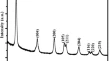
         <p>The contributions to the partial structure factor, S<sub><it>ij</it></sub><sup><it>N</it></sup> (<it>Q</it>) associated with Si&#8211;O, O&#8211;O and Si&#8211;Si pair correlation distances have been determined using classical molecular dynamics simulations as addressed in <abbrgrp><abbr bid="B8">8</abbr></abbrgrp>. Combined with RDFs from the Bell and Dean model <abbrgrp><abbr bid="B16">16</abbr></abbrgrp>, and computer modeling <abbrgrp><abbr bid="B17">17</abbr><abbr bid="B18">18</abbr><abbr bid="B20">20</abbr></abbrgrp>, these studies identify inter-atomic pair correlations in the regime of 4&#8211;5 &#197; that contribute to the position of FSDP. Figure 3 of <abbrgrp><abbr bid="B16">16</abbr></abbrgrp>, is a pair distribution histogram that indicates a (1) a Si&#8211;O pair correlation, or third nearest neighbor distance of 4.1 &#177; 0.5 &#197;, and (2) an O&#8211;O pair correlation, or fourth nearest neighbor distance of 4.5 &#177; 0.3 &#197;. These features are evident in the computed and experimental radial distribution function plots for X-ray diffraction in Fig. 4, and neutron diffraction in Fig. 5, also of <abbrgrp><abbr bid="B16">16</abbr></abbrgrp>. As indicated in Fig. <figr fid="F1">1</figr> of this paper, the 4.1 &#197; feature is assigned with Si&#8211;O third nearest-neighbor distances, and the 4.5 &#197; feature is assigned to fourth nearest-neighbor O&#8211;O distances. Figure <figr fid="F1">1</figr> is a schematic representation of local cluster that has been used to determine the Si&#8211;O&#8211;Si bond angle using many-electron ab initio quantum chemistry calculations in <abbrgrp><abbr bid="B18">18</abbr></abbrgrp>.</p>
         <fig id="F1"><title><p>Figure 1</p></title><caption><p>Two-dimensional top view of the local bonding arrangements in a portion of the primitive high-symmetry six-member ring structure for non-crystalline SiO2</p></caption><text>
   <p>Two-dimensional top view of the local bonding arrangements in a portion of the primitive high-symmetry six-member ring structure for non-crystalline SiO<sub>2</sub>. Selected MRO distances are indicated</p>
</text><graphic file="1556-276X-5-550-1"/></fig>
         <p>The importance of Si atom d-state symmetries in calculations of the electronic structure of non-crystalline SiO<sub>2</sub> was recognized in <abbrgrp><abbr bid="B18">18</abbr></abbrgrp>, published in 2002. These symmetries, coupled with the O 2p&#960; states play a significant role in narrowing the two pair distribution distances identified above. The cluster displayed in Fig. <figr fid="F1">1</figr> is large enough to include the correlation length, <it>R</it> in the MRO regime. The calculations of <abbrgrp><abbr bid="B18">18</abbr></abbrgrp> demonstrated that Si d-state basis Gaussian functions when included into a many-electron, ab initio calculation play a determinant role in generating a stable minimum for a Si&#8211;O&#8211;Si bond angle, &#920;, that is smaller than the ionic bonding value 180&#176;. In addition these values of &#920;, and the bond angle distribution, &#916;&#920; (1) were different from what had been determined by the X-ray diffraction studies of Mozzi and Warren in <abbrgrp><abbr bid="B3">3</abbr></abbrgrp>, but (2) were in excellent agreement with more recent studies that employed a larger range of <it>k</it> or <it>Q</it><abbrgrp><abbr bid="B19">19</abbr></abbrgrp>. The values obtained by Mozzi and Warren <abbrgrp><abbr bid="B3">3</abbr></abbrgrp> are &#920; ~ 144&#176;, and &#916;&#920;]FWHM ~ 30&#176;, whereas the studies in <abbrgrp><abbr bid="B19">19</abbr></abbrgrp> obtained values of <it>Q</it> ~ 148&#176; and &#916;&#920;]FWHM ~ 13&#8211;15&#176; that were essentially the same as those calculated in <abbrgrp><abbr bid="B16">16</abbr></abbrgrp>. The Bell and Dean model of <abbrgrp><abbr bid="B15">15</abbr></abbrgrp> in Fig. 2 gave a Si&#8211;O&#8211;Si bond angle of 152&#176;, and also wide bond angle distribution with a FWHM ~ 15&#176;. Of particular significance is the significantly narrower Si&#8211;O&#8211;Si bond angle distribution of the calculations in <abbrgrp><abbr bid="B18">18</abbr></abbrgrp>, and the X-ray diffraction studies of <abbrgrp><abbr bid="B19">19</abbr></abbrgrp>. The bond angles and bond distributions of <abbrgrp><abbr bid="B16">16</abbr><abbr bid="B18">18</abbr><abbr bid="B19">19</abbr></abbrgrp> have important implications for the existence of high symmetry six member Si&#8211;O rings their importance as the primitive ring structure in both &#945;-quartz and &#946;-quartz, as well as non-crystalline SiO<sub>2</sub>.</p>
         <p>The identification of the specific MRO regime features obtained from S(<it>Q</it>) rely heavily on the pair correlation functions derived from the Bell and Dean model <abbrgrp><abbr bid="B16">16</abbr></abbrgrp>, as well as from computer modeling of the Gaskell group <abbrgrp><abbr bid="B21">21</abbr></abbrgrp> and Tadros et al. <abbrgrp><abbr bid="B17">17</abbr><abbr bid="B20">20</abbr></abbrgrp>. Combined with <abbrgrp><abbr bid="B16">16</abbr></abbrgrp>, The Si d&#960;-O 2p&#960;-Si d&#960; symmetry determined overlap and charge transfer from occupied O &#960;-states into otherwise empty Si d&#960; states, plays the determinant role in forcing the narrowness of this MRO length scale feature. Stated differently, pairs of Si atoms connected through an intervening O atom as in Fig. <figr fid="F1">1</figr>, are strongly correlated by the local symmetries forced on these Si d&#960;-states. This correlation reflects the even symmetry of the respective Si d-states, and the odd symmetry of the O p-states. In contrast, the coherence length, <it>L</it>, as determined from the FWHM of the FSDP cannot be assigned to a specific inter-atomic repeat distance identified in any of the models addressed above, but instead is an average cluster dimension, in the spirit of the definitions in <abbrgrp><abbr bid="B6">6</abbr></abbrgrp> and <abbrgrp><abbr bid="B7">7</abbr></abbrgrp>.</p>
         <p>The coherence length, <it>L</it> in SiO<sub>2</sub>, as computed from the FWHM of the FSDP, is 9.5 &#177; 0.5 &#197;, and this identifies the cluster associated with this length scale. Based on a simple extension of the schematic diagram in Fig. <figr fid="F1">1</figr>, this cluster includes a coupling of at least two, and no more than three symmetric six-member primitive rings. If this cluster is extended well beyond two to three rings in all directions, it would eventually generate the crystal structure of &#945;-quartz. This helical aspect of this structure gives rise to a right- or left-handed optical rotary property of &#945;-quartz <abbrgrp><abbr bid="B22">22</abbr></abbrgrp>. The helical structure of &#945;-quartz has its parentage in trigonal Se, which is comprised of right or left-handed helical chains with three Se atoms per turn of the helix. The two-atom helix analog is the cinnabar phase of HgS with six atoms/turn, three Hg and three S. &#945;-quartz is the three-atom analog with nine atoms/turn, three Si and six O <abbrgrp><abbr bid="B22">22</abbr></abbrgrp>. Returning to non-crystalline SiO<sub>2</sub>, the coupling of two to three-six-member rings is consist with the relative fraction of six member rings, ~50% in the Bell and Dean <abbrgrp><abbr bid="B16">16</abbr></abbrgrp> construction as well as other estimates of the ring fraction.</p>
         <p>Moreover, this two to three ring clustered structure is an example of the MRO structures addressed in <abbrgrp><abbr bid="B7">7</abbr></abbrgrp>. With respect the FSDP, Moss and Price noted that &#8220;such a diffraction feature thus represents the build up of correlation whose basic period is well beyond the first few neighbor distances&#8221;; it therefore in the MRO regime. They also pointed out that: &#8220;In fact, the width of this feature (the, FSDP) can be used to estimate a correlation range over which the period in question survives&#8221;. This incoherent coupling associated with less symmetric five- and seven-member rings than determines the correlation, or coherence range over which this period survives.</p>
      </sec>
      <sec>
         <st>
            <p>Revisiting the CRN in Context of Correlation and Coherence Length Determinations</p>
         </st>
         <p>The pair correlation assignments made for <it>R</it> and <it>L</it> are consistent with the global concept of a CRN, but the length scales for correlation, <it>R</it>, and coherence. <it>L</it>, are quantitatively different that what was proposed originally in <abbrgrp><abbr bid="B1">1</abbr></abbrgrp>, and discussed at length <abbrgrp><abbr bid="B3">3</abbr></abbrgrp>. Each of these envisioned the CRN randomness to be associated with the relative widths of bond lengths and bond angles, as in Fig. 2 in the Bell and Dean <abbrgrp><abbr bid="B16">16</abbr></abbrgrp>. Based on this model the Si&#8211;O pair correlation has a width &lt;0.05 &#197;, and the Si&#8211;O&#8211;Si bond angle displays a 30&#176; width, corresponding to a Si&#8211;Si pair correlation width at least two-to-three larger. In these conventional descriptions of the CRN, any dihedral angle correlations, or four-atom correlations, are removed by bond-angle widths.</p>
         <p>The identification of the MRO length scales, <it>R</it> and <it>L</it>, also has important implications for the use of semi-empirical bond constraint theory (SE-BCT) for identifying and/or describing ideal glass formers. This theory is a mean-field theory based on average properties that are determined by constraints restricted to SRO bonding arrangements <abbrgrp><abbr bid="B4">4</abbr><abbr bid="B5">5</abbr><abbr bid="B23">23</abbr></abbrgrp>. The identification and interpretation of the two MRO length scales discussed above indicates that this emphasis on SRO is not sufficient for identifying the important nano-scale properties of SiO<sub>2</sub>. Indeed MRO is deemed crucial for establishing the unique and technologically important character of non-crystalline SiO<sub>2</sub> over a dimensional scale from 1 to 2 nm thick gate dielectrics to centimeter dimensions for high-quality optically homogeneous components, e.g., lenses.</p>
         <p>The FSDP has been observed, and studied in other non-crystalline oxide glasses, e.g., B<sub>2</sub>O<sub>3</sub>, GeO<sub>2</sub>, as well chalcogenide glasses including sulfides, GeS<sub>2</sub> and As<sub>2</sub>S<sub>3</sub>, and selenides, GeSe<sub>2</sub>, As<sub>2</sub>Se<sub>3</sub> and SiSe<sub>2</sub><abbrgrp><abbr bid="B6">6</abbr><abbr bid="B7">7</abbr></abbrgrp>. The values of <it>R</it> and <it>L</it> have been calculated, and display anion, O, S and Se and cation coordination specific behaviors. For example, the values of the correlation length <it>R</it>, and the coherence length <it>L</it>, have been obtained from the position, and FWHM of the S(<it>Q</it>) FSDP peak for (a) SiO<sub>2</sub>: <it>R</it> = 4.1 &#177; 0.2 &#197;, and <it>L</it> = 9.5 &#177; 0.5 &#197;; (b) B<sub>2</sub>O<sub>3</sub>: <it>R</it> = 4.0 &#177; 0.2 &#197;, and <it>L</it> = 11 &#177; 1 &#197;; and (c) GeSe<sub>2</sub>: <it>R</it> = 6.3 &#177; 0.3 &#197;, and <it>L</it> = 24 &#177; 4 &#197;.</p>
         <p>It has been noted previously elsewhere <abbrgrp><abbr bid="B7">7</abbr><abbr bid="B13">13</abbr></abbrgrp>, that quantitative differences between the position of the FSDPs in SiO<sub>2</sub> and GeSe<sub>2</sub> can be correlated directly with differences between the respective (1) Si&#8211;O and Ge&#8211;Se bond-lengths, 1.65 and 2.39 &#197;, and (2) Si&#8211;Si and Ge&#8211;Ge next neighbor features as determined by the respective Si&#8211;O&#8211;Si and Ge&#8211;Se&#8211;Ge bond angles, ~148&#176; and ~105&#176;. This was addressed in <abbrgrp><abbr bid="B1">1</abbr></abbrgrp> and <abbrgrp><abbr bid="B24">24</abbr></abbrgrp>, where it was shown that the products of nearest neighbor bond length (in &#197;) and positions of the FSDP (<it>Q</it>(&#197;<sup>&#8722;1</sup>) are approximately the same, ~2.5 &#177; 0.4 for the oxide and chalcogenide glasses <abbrgrp><abbr bid="B1">1</abbr><abbr bid="B24">24</abbr></abbrgrp>. Based on this scaling, the value <it>R</it> for GeSe<sub>2</sub> (<it>x</it> = 0.33), is estimated to be 6.2 &#177; 0.2 &#197;, compared with the averaged experimental value of <it>R</it> = 6.30 &#177; 0.07 &#197;.</p>
         <p>This values of <it>Q</it><sub>1</sub>(&#197;<sup>&#8722;1</sup>) show interesting correlations with the nature of the CRNs. For the three oxide glasses in Table <tblr tid="T1">1</tblr><it>Q</it><sub>1</sub>(&#197;<sup>&#8722;1</sup>) ~ 1.55 &#177; 0.03, and is independent of the network coordination, i.e., 3&#8211;2 for B<sub>2</sub>O<sub>3</sub> and 4&#8211;2 SiO<sub>2</sub> and GeO<sub>2</sub>. In contrast, the value of <it>Q</it><sub>1</sub>(&#197;<sup>&#8722;1</sup>) decreases to ~1.05 for 4&#8211;2 selenides, and then increases to ~1.25 for the 3&#8211;2 chalcogenides. This indicates a longer correlation length in the 3&#8211;2 alloys that is presumed to be associated with repulsions between lone pairs on As, and either the Se or S atoms of the particular alloy for the 3&#8211;2 chalcogenides.</p>
         <table id="T1">
            <title>
               <p>Table 1</p>
            </title>
            <caption>
               <p>Comparisons and scaling for R <abbrgrp><abbr bid="B1">1</abbr></abbrgrp></p>
            </caption>
            <tgroup cols="5">
               <colspec align="left" colname="c1" colnum="1"/>
               <colspec align="char" char="." colname="c2" colnum="2"/>
               <colspec align="char" char="." colname="c3" colnum="3"/>
               <colspec align="char" char="." colname="c4" colnum="4"/>
               <colspec align="char" char="." colname="c5" colnum="5"/>
               <thead>
                  <row>
                     <entry align="left" colname="c1">
                        <p>Glass</p>
                     </entry>
                     <entry align="left" colname="c2">
                        <p><it>Q</it><sub>1</sub>(&#197;<sup>&#8722;1</sup>)</p>
                     </entry>
                     <entry align="left" colname="c3">
                        <p><it>R</it>(&#197;)</p>
                     </entry>
                     <entry align="left" colname="c4">
                        <p><it>r</it><sub>1</sub>(&#197;)</p>
                     </entry>
                     <entry align="left" colname="c5">
                        <p>
                           <it>r</it>
                           <sub>1</sub>
                           <it>Q</it>
                           <sub>1</sub>
                        </p>
                     </entry>
                  </row>
               </thead>
               <tfoot>
                  <p><it>r</it><sub>1</sub> = bond length</p>
               </tfoot>
               <tbody>
                  <row>
                     <entry align="left" colname="c1">
                        <p>SiO<sub>2</sub></p>
                     </entry>
                     <entry align="char" char="." colname="c2">
                        <p>1.55</p>
                     </entry>
                     <entry align="char" char="." colname="c3">
                        <p>4.1</p>
                     </entry>
                     <entry align="char" char="." colname="c4">
                        <p>1.61</p>
                     </entry>
                     <entry align="char" char="." colname="c5">
                        <p>2.48</p>
                     </entry>
                  </row>
                  <row>
                     <entry align="left" colname="c1">
                        <p>GeO<sub>2</sub></p>
                     </entry>
                     <entry align="char" char="." colname="c2">
                        <p>1.55</p>
                     </entry>
                     <entry align="char" char="." colname="c3">
                        <p>4.1</p>
                     </entry>
                     <entry align="char" char="." colname="c4">
                        <p>1.74</p>
                     </entry>
                     <entry align="char" char="." colname="c5">
                        <p>2.70</p>
                     </entry>
                  </row>
                  <row>
                     <entry align="left" colname="c1">
                        <p>B<sub>2</sub>O<sub>3</sub></p>
                     </entry>
                     <entry align="char" char="." colname="c2">
                        <p>1.57</p>
                     </entry>
                     <entry align="char" char="." colname="c3">
                        <p>4.0</p>
                     </entry>
                     <entry align="char" char="." colname="c4">
                        <p>1.36</p>
                     </entry>
                     <entry align="char" char="." colname="c5">
                        <p>2.14</p>
                     </entry>
                  </row>
                  <row>
                     <entry align="left" colname="c1">
                        <p>SiSe<sub>2</sub></p>
                     </entry>
                     <entry align="char" char="." colname="c2">
                        <p>1.02</p>
                     </entry>
                     <entry align="char" char="." colname="c3">
                        <p>6.2</p>
                     </entry>
                     <entry align="char" char="." colname="c4">
                        <p>2.30</p>
                     </entry>
                     <entry align="char" char="." colname="c5">
                        <p>2.35</p>
                     </entry>
                  </row>
                  <row>
                     <entry align="left" colname="c1">
                        <p>GeS<sub>2</sub></p>
                     </entry>
                     <entry align="char" char="." colname="c2">
                        <p>1.00</p>
                     </entry>
                     <entry align="char" char="." colname="c3">
                        <p>6.3</p>
                     </entry>
                     <entry align="char" char="." colname="c4">
                        <p>2.37</p>
                     </entry>
                     <entry align="char" char="." colname="c5">
                        <p>2.37</p>
                     </entry>
                  </row>
                  <row>
                     <entry align="left" colname="c1">
                        <p>GeS<sub>2</sub></p>
                     </entry>
                     <entry align="char" char="." colname="c2">
                        <p>1.04</p>
                     </entry>
                     <entry align="char" char="." colname="c3">
                        <p>6.0</p>
                     </entry>
                     <entry align="char" char="." colname="c4">
                        <p>2.22</p>
                     </entry>
                     <entry align="char" char="." colname="c5">
                        <p>2.30</p>
                     </entry>
                  </row>
                  <row>
                     <entry align="left" colname="c1">
                        <p>As<sub>2</sub>S<sub>2</sub></p>
                     </entry>
                     <entry align="char" char="." colname="c2">
                        <p>1.27</p>
                     </entry>
                     <entry align="char" char="." colname="c3">
                        <p>4.9</p>
                     </entry>
                     <entry align="char" char="." colname="c4">
                        <p>2.28</p>
                     </entry>
                     <entry align="char" char="." colname="c5">
                        <p>3.10</p>
                     </entry>
                  </row>
                  <row>
                     <entry align="left" colname="c1">
                        <p>As<sub>2</sub>S<sub>2</sub></p>
                     </entry>
                     <entry align="char" char="." colname="c2">
                        <p>1.26</p>
                     </entry>
                     <entry align="char" char="." colname="c3">
                        <p>5.0</p>
                     </entry>
                     <entry align="char" char="." colname="c4">
                        <p>2.44</p>
                     </entry>
                     <entry align="char" char="." colname="c5">
                        <p>2.87</p>
                     </entry>
                  </row>
               </tbody>
            </tgroup>
         </table>
         <p>It is significant to note that the scaling relationship based on SRO, breaks down for the coherence length <it>L</it> for GeSe<sub>2</sub>. The scaled ratio for <it>L</it> is estimated to be 15 &#197; compared with the higher average experimental value of <it>L</it> = 24 &#177; 4 &#197; <abbrgrp><abbr bid="B11">11</abbr><abbr bid="B25">25</abbr></abbrgrp>. The comparisons based on scaling are consistent with <it>R</it> being determined by the extension of a local pair correlation determined by the ring structures in the SiO<sub>2</sub> and GeSe<sub>2</sub> CRNs. The microscopic basis for <it>L</it> in SiO<sub>2</sub>, and B<sub>2</sub>O<sub>3</sub> as well, is determined by characteristic inter-ring bonding arrangements with a cluster size that related to coupling of two, two or three rings, respectively. These determine the period of the cluster repetition, and the encapsulation of these more symmetric rings by less symmetric rings of bonded atoms; i.e., five- and seven-member rings in SiO<sub>2</sub>. The inter-ring coupling in SiO<sub>2</sub> is direct result of the softness of the Si&#8211;O&#8211;Si bonding force constant in SiO<sub>2</sub><abbrgrp><abbr bid="B4">4</abbr><abbr bid="B5">5</abbr></abbrgrp>. For the case of the GeSe<sub>2</sub> CRN because of the smaller Ge&#8211;Se&#8211;Ge bond angle and repulsive effects between the Se lone pair electrons and the bonding electrons localized in the more covalent Ge&#8211;Se bonds, the coherence length is not attributed to rings of bonded atoms, but rather to a hard soft cluster mixture. The hard soft structure in GeSe alloys is determined by compositionally dependent constraints imposed by local bonding, e.g., locally rigid groups with Ge atoms separated by one bridging Se atom, Ge&#8211;Se&#8211;Se, and locally compliant groups associated with two bridging Se atoms, Ge&#8211;Se&#8211;Se&#8211;Ge <abbrgrp><abbr bid="B23">23</abbr></abbrgrp>. Similar considerations apply to the period of the hard-component of a hard-soft structure that have been proposed as the driving force for glass formation, and the associated low densities of defect and defect precursors which are associated with either broken and strained-bonds, respectively. The criterion is SiO<sub>2</sub> and B<sub>2</sub>O<sub>3</sub> is determined by a nano-structures that includes a multiplicity of different ring sizes, whereas the criterion is a volume percolation threshold that applies in chalcogenides glasses, and is consistent with locally rigid, and locally compliant groups been phase-separated into hard-soft mixtures <abbrgrp><abbr bid="B26">26</abbr></abbrgrp>. The same considerations apply in As-chalcogenides, and for the compound As<sub>2</sub>Se<sub>3</sub> and GeSe<sub>2</sub> compositions that include local small discrete molecules that add compliance to the otherwise locally rigid CNRs that includes As&#8211;Se&#8211;As and Ge&#8211;Se&#8211;Ge bonding, respectively <abbrgrp><abbr bid="B23">23</abbr></abbrgrp>.</p>
         <p>The conclusion is that SE-BCT, even with local modifications for symmetry-associated broken bending constraints, and additional constraints due to lone pair and terminal atom repulsions <abbrgrp><abbr bid="B23">23</abbr></abbrgrp>, has limited value in accounting the elimination of macroscopic strain reduction for technology applications. This property depends on MRO, as embodied in hard-soft mixtures, and/or percolation of short-range order ground that exceeds a volume percolation threshold <abbrgrp><abbr bid="B23">23</abbr><abbr bid="B27">27</abbr></abbrgrp>.</p>
      </sec>
      <sec>
         <st>
            <p>Nano-crystalline and Nano-crystalline/Non-crystalline Alloys</p>
         </st>
         <p>Extension of the MRO concepts of the previous sections from CRNS to nano-crystalline and nano-crystalline/non-crystalline composites of technological importance is addressed in this section. One way to formulate this issue is to determine conditions that promote hard-soft mixtures in materials that are (1) chemically homogeneous, but inhomogeneous on a nano-meter length scale, or (2) both chemically inhomogeneous and phase-separated. The first of these is addressed in homogeneous HfO<sub>2</sub> thin films, and the second for phase separated Hf silicates, as well as other phase separated materials in which SiO<sub>2</sub> in a chemical constituent <abbrgrp><abbr bid="B28">28</abbr></abbrgrp>.</p>
         <sec>
            <st>
               <p>Nano-grain HfO<sub>2</sub> Films</p>
            </st>
            <p>The nano-grain morphology of deposited and subsequently high temperature, &gt;700&#176;C, annealed HfO<sub>2</sub> thin films is typically a mixture of monoclinic (m-) and tetragonal (t-) grains differentiated by Hf 5d features in combination with O 2p &#960; states that comprise local symmetry adapted linear combinations (SALCs) of atomic states into molecular orbitals (MO) <abbrgrp><abbr bid="B28">28</abbr><abbr bid="B29">29</abbr></abbrgrp>. These MOs are essentially one-electron states, in contrast to occupied Hf states that must by treated in a many-electron theory <abbrgrp><abbr bid="B30">30</abbr></abbrgrp>. Of particular importance are the &#960;-bonded MOs that contribute to the lowest conduction band features in O K edge XAS spectra <abbrgrp><abbr bid="B28">28</abbr><abbr bid="B29">29</abbr></abbrgrp>. Figure <figr fid="F2">2</figr> indicates differences in these band edge features for nano-grain t-HfO<sub>2</sub> and m-HfO<sub>2</sub> thin films in which the grain-morphology has been controlled by interfacial bonding. The t-HfO<sub>2</sub> films display a single asymmetric band edge feature, whereas m-HfO<sub>2</sub> films display two band edge features. Figure <figr fid="F3">3</figr> is for films that have with a mixed t-/m- nano-grain morphology, and a thickness that is increased from 2 to 3 nm, and then to 4 nm. Based of features in these spectra, and 2nd derivative spectra as well, the 2 nm film displays neither a t-, nor a m-nano-grain morphology, while the thicker films display a doublet structure indicative of a mixed nano-grain morphology.</p>
            <fig id="F2"><title><p>Figure 2</p></title><caption><p/></caption><text>
   <p>O K edge for t-HfO<sub>2</sub> and m-HfO<sub>2</sub> indicating differences in these band edge features</p>
</text><graphic file="1556-276X-5-550-2"/></fig>
            <fig id="F3"><title><p>Figure 3</p></title><caption><p/></caption><text>
   <p>O K edge for mixed phase 900&#176;C annealed t-/m-HfO<sub>2</sub> films as a function of film thickness</p>
</text><graphic file="1556-276X-5-550-3"/></fig>
            <p>The band edge 5d E<sub>g</sub> splittings in Figs. <figr fid="F2">2</figr> and <figr fid="F3">3</figr> indicate a cooperative Jahn&#8211;Teller (J&#8211;T) distortion <abbrgrp><abbr bid="B28">28</abbr></abbrgrp>. The theoretical model in <abbrgrp><abbr bid="B31">31</abbr></abbrgrp> indicates that an electronic unit cell comprised of seven PUCs, each ~0.5 to 0.55 nm is necessary for a cooperative J&#8211;T effect, and this requires a nano-grain dimensions of ~3 to 3.5 nm. This indicates a dimensional constraint in the 2 nm thick film. This film is simply too thin to support a high concentration of randomly oriented nano-grains with an electronic unit cell large enough to support a J&#8211;T distortion. These 2 nm films are generally characterized as X-ray amorphous. As-deposited 3 and 4 nm thick films also display no J&#8211;T, but when subjected to the same 900&#176;C anneal as the 2 nm thick film, the dimensional constraint is relaxed and J&#8211;T distortions are stabilized and are observed in O K edge XAS.</p>
            <p>These differences in nano-scale morphology identify several scales of MRO for HfO<sub>2</sub>, as well as other TM d<sup>0</sup> oxides, TiO<sub>2</sub> and ZrO<sub>2</sub>. The first is the PUC ~ 0.5 to 0.55 nm, and the second and third are for coupling of unit cells. The first coupling is manifest in 1.5&#8211;2.0 nm grains that are analogues of the SiO<sub>2</sub> clusters comprised of 2&#8211;3 symmetric six-member rings. The second length scale is 3&#8211;3.5 nm and is sufficient to promote J&#8211;T distortion which persist in thicker annealed film and bulk crystals as well. The PUC of HfO<sub>2</sub> then plays the same role as the symmetric or regular six-member ring of non-crystalline SiO<sub>2</sub> and in crystalline a-quartz.</p>
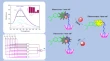
            <p>Differences in nano-grain order have a profound effect on intrinsic bonding defects in HfO<sub>2</sub>. In films thicker than 3 nm they contribute to high densities of vacancy defects (~10<sup>12</sup> cm<sup>&#8722;2</sup>, or equivalently 10<sup>18</sup> cm<sup>&#8722;3</sup>), clustered on internal grain boundaries of nano-grains large enough to display J&#8211;T term splittings <abbrgrp><abbr bid="B28">28</abbr></abbrgrp>. These are indicated in Fig. <figr fid="F4">4</figr>.</p>
            <fig id="F4"><title><p>Figure 4</p></title><caption><p>Second derivative O K pre-edge for t-HfO2 and m-HfO2</p></caption><text>
   <p>Second derivative O K pre-edge for t-HfO<sub>2</sub> and m-HfO<sub>2</sub>. The features in these films are associated with band edge vacancy defects</p>
</text><graphic file="1556-276X-5-550-4"/></fig>
            <p>Nano-grain HfO<sub>2</sub> in the MRO size regime of 1.5&#8211;2 nm can also formed in phase-separated Hf silicates (HfO<sub>2</sub>)<sub><it>x</it></sub>(SiO<sub>2</sub>)<sub>1&#8722;<it>x</it></sub>, alloys in two narrow compositional regimes: 0.15 &lt;<it>x</it> &lt; 0.3, and 0.75 &lt;<it>x</it> &lt; 0.85. For the lower <it>x</it>-regime, the phase separation of an as-deposited homogeneous silicate yields a compliant hard-soft structure. This is comprised of X-ray amorphous nano-grains with &lt;3 nm dimensions that are encapsulated by non-crystalline SiO<sub>2</sub>. For the higher <it>x</it>-regime. The phase separated silicates include X-ray amorphous nano-grains &lt;3 nm in size, whose growth is frustrated by a random incorporation of 2 nm clusters of compliant non-crystalline SiO<sub>2</sub>. The concentration of these 2 nm clusters exceeds a volume percolation threshold accounting for the frustration of larger nano-grain growth <abbrgrp><abbr bid="B27">27</abbr></abbrgrp>.</p>
            <p>Each of these phase-separated silicate regimes exhibits low densities of defects and defect precursors. However, these diphasic silicates have not studied with respect to radiation stressing, so it would be ill-advised and inappropriate to call then SiO<sub>2</sub>-look-alikes, a label that has been attached to the homogeneous Hf Si oxynitride alloys in the next sub-section based on radiation stressing <abbrgrp><abbr bid="B32">32</abbr></abbrgrp>.</p>
         </sec>
         <sec>
            <st>
               <p>Homogeneous Hf Si Oxynitride Alloys</p>
            </st>
            <p>There is a unique composition (HfO<sub>2</sub>)<sub>0.3</sub>(SiO<sub>2</sub>)<sub>0.3</sub>(Si<sub>3</sub>N<sub>4</sub>)<sub>0.4</sub>(concentrations &#177; 0.025) hereafter HfSiON<sub>334</sub>, which is stable to annealing temperatures &gt;1,000&#176;C, and whose electrical response after X-ray and &#947;-ray stressing is essentially the same as SiO<sub>2</sub><abbrgrp><abbr bid="B32">32</abbr></abbrgrp>.This similarity is with respect to (1) the linear dependence on dosing, (2) the sign of the fixed charge, always positive, and (3) the magnitude of the defect generation. The unique properties are attributed to a fourfold coordinated Hf substitute onto 16.7% of the possible fourfold coordinated Si bonding sites. This concentration is at the percolation threshold for connectivity of compliant local bonding arrangements <abbrgrp><abbr bid="B27">27</abbr></abbrgrp>. Larger concentrations of (Si<sub>3</sub>N<sub>4</sub>) for the same or different combinations of HfO<sub>2</sub> and SiO<sub>2</sub> bonding leads to chemical phase separation with loss of bonded N, and therefore qualitatively different thin films.</p>
         </sec>
         <sec>
            <st>
               <p>Other Diphasic Materials with 20% SiO<sub>2</sub></p>
            </st>
            <p>There are at least two other diphasic materials with a dimensionally stabilized symmetric nano-crystalline phase, and a 20% compliant non-crystalline phase, 2 nm clusters of SiO<sub>2</sub>. This includes a 20% mixture of non-crystalline SiO<sub>2</sub> with (1) nano-crystalline zincblende-structured ZnS grains, or (2) a fine nano-grain ceramic as in Corning cookware <abbrgrp><abbr bid="B33">33</abbr></abbrgrp>. In each of these thin materials, TEM imaging indicates that the 20% SiO<sub>2</sub> is distributed uniformly in compliant clusters with an average size of ~2&#8211;3 nm. These encapsulated nano-clusters reduce macroscopic strain, but equally important suppress the formation of more asymmetric crystal structures, e.g., wurtzite ZnS, which would lead to anisotropic optical properties, and make these films in unusable for use as protective layers in optical memory stacks for digital video disks (DVD) for information storage and retrieval. In the second application, the SiO<sub>2</sub> makes these ceramics macroscopically strain free, and capable on being moved from the &#8220;oven to the refrigerator&#8221; without cracking <abbrgrp><abbr bid="B33">33</abbr></abbrgrp>.</p>
         </sec>
         <sec>
            <st>
               <p>(Si<sub>3</sub>N<sub>4</sub>)<sub><it>x</it></sub>(SiO<sub>2</sub>)<sub>1&#8722;<it>x</it></sub> Gate Dielectrics</p>
            </st>
            <p>Si oxynitride pseudo-binary alloys (Si<sub>3</sub>N<sub>4</sub>)<sub><it>x</it></sub>(SiO<sub>2</sub>)<sub>1&#8722;<it>x</it></sub>, have emerged in the late 1990s as replacement dielectrics <abbrgrp><abbr bid="B34">34</abbr></abbrgrp>. These alloys have been used with small and high concentrations of Si<sub>3</sub>N<sub>4</sub> with different objectives. At low concentration levels &lt;5% Si<sub>3</sub>N<sub>4</sub>, for blocking Boron transported from B-doped poly-Si gate dielectrics <abbrgrp><abbr bid="B24">24</abbr></abbrgrp>, and at significantly higher concentrations, ~50 to 60% Si<sub>3</sub>N<sub>4</sub>, as required for a significant increase in the dielectric constant from ~3.9 to ~5.4 to 5.8 <abbrgrp><abbr bid="B35">35</abbr></abbrgrp>.</p>
            <p>The mid-gap interface state density, <it>D</it><sub>it</sub>, and the flat-band voltage <it>V</it><sub>fb</sub> were obtained from a conventional C&#8211;V analysis of metal&#8211;oxide&#8211;semiconductor capacitors on p-type Si substrates with ~10<sup>17</sup> cm<sup>&#8722;3</sup> doping, <it>p</it>-MOSCAPs, with Al gate metal layers deposited after a post metal anneal in forming gas. Both <it>D</it><sub>it</sub> and and <it>V</it><sub>fb</sub> display qualitatively similar behavior as function of <it>x</it> for both as-deposited and Si-dielectric layers annealed at 900&#176;C in Ar for 1 min <abbrgrp><abbr bid="B34">34</abbr></abbrgrp>. The annealed dielectrics are processed at temperatures that validate comparisons with <it>p</it>-MOSCAPs with thermally grown SiO<sub>2</sub> and similarly processed Al gates. <it>D</it><sub>it</sub> decreases from ~10<sup>11</sup> cm<sup>&#8722;2</sup> eV<sup>&#8722;1</sup> for Si<sub>3</sub>N<sub>4</sub> (<it>x</it> = 1), to ~10<sup>10</sup> cm<sup>&#8722;2</sup> eV<sup>&#8722;1</sup> for <it>x</it> ~ 0.7 to a value comparable to state of the art SiO<sub>2</sub> MOSCAPs. The value of <it>D</it><sub>it</sub> is relatively constant, 1.1 &#177; 0.2 &#215; 10<sup>&#8722;10</sup> cm<sup>&#8722;2</sup> eV<sup>&#8722;1</sup>, for values of <it>x</it> from 0.65 to 0.0 (SiO<sub>2</sub>). In a complementary manner, <it>V</it><sub>fb</sub> increases from &#8722;1.3 eV for Si<sub>3</sub>N<sub>4</sub> (<it>x</it> = 1), to &#8722;0.9 eV at <it>x</it> ~ 0.7, and then remains relatively constant, &#8722;0.8 &#177; 0.1 eV for values of <it>x</it> from 0.65 to 0.0 (SiO<sub>2</sub>). The values of <it>D</it><sub>it</sub> and <it>V</it><sub>fb</sub> are comparable to those for thermally grown SiO<sub>2</sub>, and therefore have been the basis for use of these Si oxynitrides in commercial devices <abbrgrp><abbr bid="B34">34</abbr></abbrgrp>.</p>
            <p>The electrical measurements are consistent with significant decreases in macroscopic strain for Si oxnitride alloys with SiO<sub>2</sub> concentrations exceeding about 35% or <it>x</it> = 0.65. This suggests a hard-soft mechanism in this regime similar to that in Hf silicates. At concentrations &lt;0.35, i.e., SiO<sub>2</sub> = 65%, the roles of the hard and soft components are assumed to be reversed. However, strain reduction over such an extensive composition regime suggests a more complicated nano-scale structure that has a mixed hard-soft character over a significant composition region, The proposed mixed phase is comprised of equal concentrations of Si<sub>3</sub>N<sub>4</sub> encapsulating SiO<sub>2</sub> at high Si<sub>3</sub>N<sub>4</sub> concentrations, and an inverted hard-soft character with SiO<sub>2</sub> encapsulating Si<sub>3</sub>N<sub>4</sub> at lower Si<sub>3</sub>N<sub>4</sub> concentrations. If this is indeed the case, it represents a rather interesting example of a double percolation process <abbrgrp><abbr bid="B26">26</abbr><abbr bid="B36">36</abbr></abbrgrp>.</p>
         </sec>
      </sec>
      <sec>
         <st>
            <p>Summary and Conclusions</p>
         </st>
         <p>This will be displayed in a bulleted format.</p>
         <p indent="1">1. The spectral position of the FSDP for glasses, and its FWHM are associated with real space distances as obtained from the structure factor S(<it>Q</it>) derived from X-ray or neutron diffraction\are in the MRO regime. The first length scale has been designated as a correlation length, <it>R</it> = 2&#960;/<it>Q</it><sub>1</sub>(&#197;<sup>&#8722;1</sup>), and the second length scale has been designated as a coherence length, <it>L</it> = 2&#960;/&#916;<it>Q</it><sub>1</sub>(&#197;<sup>&#8722;1</sup>) where <it>Q</it><sub>1</sub>(&#197;<sup>&#8722;1</sup>) and &#916;<it>Q</it><sub>1</sub>(&#197;<sup>&#8722;1</sup>) are, respectively, the position and FWHM of S(<it>Q</it>).</p>
         <p indent="1">2. The values of the correlation length <it>R</it>, and the coherence length <it>L</it>, obtained in this way are for: (a) SiO<sub>2</sub>:<it>R</it> = 4.1 &#177; 0.2 &#197;, and <it>L</it> = 9.5 &#177; 0.5 &#197;; (b) B<sub>2</sub>O<sub>3</sub>:<it>R</it> = 4.0 &#177; 0.2 &#197;, and <it>L</it> = 11 &#177; 1 &#197;; and (c) GeSe<sub>2</sub>: <it>R</it> = 6.3 &#177; 0.3 &#197;, and <it>L</it> = 24 &#177; 4 &#197;.</p>
         <p indent="1">3. Based on molecular dynamics calculations and modeling, the values of <it>R</it> correspond to third neighbor Si&#8211;O, and associated with segments of six-member rings in SiO<sub>2</sub>. The larger value of <it>R</it> in GeSe<sub>2</sub> is consistent with scaling based on Ge&#8211;Se bond lengths and therefore has a similar origin.</p>
         <p indent="1">4. Based on molecular dynamics calculations and modeling, the coherence length features are not a direct result of inter-atomic pair correlations. This is supported by the analysis of X-ray diffraction data as well, where the coherence length is determined by the width of the FSDP rather than by an additional peak in S(<it>Q</it>).</p>
         <p indent="1">5. The ring clusters contributing to the coherence lengths for SiO<sub>2</sub> are comprised of two, or at most three symmetric six-member rings, that are stabilized by back donation of electrons from occupied 2p &#960; states on O atoms to empty &#960; orbitals on the Si atoms. These rings are encapsulated by more compliant structures with lower symmetry irregular five- and seven-member rings to form a compliant hard-soft system.</p>
         <p indent="1">6. The coherence length in Ge<sub><it>x</it></sub>Se<sub>1&#8722;<it>x</it></sub> alloys is different in Se-rich and Ge-rich composition regimes, and is significantly larger in each of these regimes than at the compound composition, GeSe<sub>2</sub> which they bracket. It is determined in each alloy regime, and at the compound composition by minimization of macroscopic strain by a chemical bonding self-organization as in which site percolation dominates. There is a compliant alloy regime which extends from <it>x</it> = 0.2 to 0.26 in which locally compliant bonding arrangements, Ge&#8211;Se&#8211;Se&#8211;Ge, completely encapsulate a more rigid cluster comprised of locally rigid Ge&#8211;Se&#8211;Ge bonding. For compositions greater than <it>x</it> = 0.26 and extending to <it>x</it> = 0.4, macroscopic compliance results form a diphasic mixture which includes small molecules with Ge&#8211;Se, and Ge&#8211;Ge bonding.</p>
         <p indent="1">7. The hard-soft mix in non-crystalline SiO<sub>2</sub> with a length scale of at most 1 nm establishes the unique properties of gate dielectrics &gt;1&#8211;1.5 nm thick, and for cm glasses with cm-dimensions as well.</p>
         <p indent="1">8. There is an analog between the properties of nano-crystalline HfO<sub>2</sub>, and phase separated HfO<sub>2</sub>-SiO<sub>2</sub> silicate alloys, ZnS-SiO<sub>2</sub> alloys and ceramic-SiO<sub>2</sub> alloys that establishes their unique properties in device applications as diverse as gate dielectrics for aggressively scaled dielectrics, protective layers for stacks in with rewritable optical information storage, and for temperature compliance in ceramic cookware.</p>
         <p indent="1">9. <it>p</it>-MOSCAPs with Si oxynitride pseudo-binary alloys (Si<sub>3</sub>N<sub>4</sub>)<sub><it>x</it></sub>(SiO<sub>2</sub>)<sub>1&#8722;<it>x</it></sub>, gate dielectrics display an defect densities for interface trapping, <it>D</it><sub>it</sub>, and fixed positive charge that determines the flat-band voltage, <it>V</it><sub>fb</sub>, comparable to those of thermally grown SiO<sub>2</sub> dielectrics for a range of concentrations extending for ~70%, <it>x</it> = 0.7, Si<sub>3</sub>N<sub>4</sub> to SiO<sub>2</sub>. The electrical measurements are consistent with significant decreases in macroscopic strain, suggesting a hard-soft mechanism in this regime similar to that in Hf silicates. However, strain reduction over such an extensive composition regime suggests a more complicated nano-scale structure that has a mixed hard-soft character over a significant composition region, The proposed mixed phase is comprised of equal concentrations of Si<sub>3</sub>N<sub>4</sub> encapsulating SiO<sub>2</sub> at high Si<sub>3</sub>N<sub>4</sub> concentrations, and an inverted hard-soft character with SiO<sub>2</sub> encapsulating Si<sub>3</sub>N<sub>4</sub> at lower Si<sub>3</sub>N<sub>4</sub> concentrations. If this is indeed the case, it represents a rather interesting example of a double percolation process.</p>
         <p indent="1">10. The properties of the films and bulk materials identified above are underpinned by the real-space correlation and coherence lengths, <it>R</it> and <it>L</it>, obtained from analysis of the SiO<sub>2</sub> structure factor derived from X-ray or neutron diffraction. The real space interpretation relies of the application of many-electron theory to the structural, optical and defect properties on non-crystalline SiO<sub>2</sub>.</p>
      </sec>
   </bdy>
   <bm>
      <ack>
         <sec>
            <st>
               <p>Acknowledgments</p>
            </st>
            <p>One of the authors (G. L.) acknowledges support from the AFOSR, SRC, DTRA and NSF.</p>
            <sec>
               <st>
                  <p>Open Access</p>
               </st>
               <p>This article is distributed under the terms of the Creative Commons Attribution Noncommercial License which permits any noncommercial use, distribution, and reproduction in any medium, provided the original author(s) and source are credited.</p>
            </sec>
         </sec>
      </ack>
      <refgrp><bibl id="B1"><aug><au><snm>Zachariasen</snm><fnm>WH</fnm></au></aug><source>J. Am. Chem. Soc.</source><pubdate>1932</pubdate><volume>54</volume><fpage>3841</fpage><note>COI number [1:CAS:528:DyaA38Xls1OnsQ%3D%3D]</note><xrefbib><pubid idtype="doi">10.1021/ja01349a006</pubid></xrefbib></bibl><bibl id="B2"><aug><au><snm>Zallen</snm><fnm>R</fnm></au></aug><source>The physics of amorphous solids</source><publisher>Wiley-Interscience, New York</publisher><pubdate>1983</pubdate><xrefbib><pubid idtype="doi">10.1002/3527602798</pubid></xrefbib></bibl><bibl id="B3"><aug><au><snm>Mozzi</snm><fnm>L</fnm></au><au><snm>Warren</snm><fnm>BE</fnm></au></aug><source>J. Appl. Crystallogr.</source><pubdate>1969</pubdate><volume>2</volume><fpage>164</fpage><note>COI number [1:CAS:528:DyaE3cXmvFar]</note><xrefbib><pubid idtype="doi">10.1107/S0021889869006868</pubid></xrefbib></bibl><bibl id="B4"><aug><au><snm>Phillips</snm><fnm>JC</fnm></au></aug><source>J. Non-Cryst. Solids</source><pubdate>1979</pubdate><volume>34</volume><fpage>153</fpage><note>COI number [1:CAS:528:DyaL3cXotVKgug%3D%3D]; Bibcode number [1979JNCS...34..153P]</note><xrefbib><pubid idtype="doi">10.1016/0022-3093(79)90033-4</pubid></xrefbib></bibl><bibl id="B5"><aug><au><snm>Phillips</snm><fnm>JC</fnm></au></aug><source>J. Non-Cryst. Solids</source><pubdate>1981</pubdate><volume>43</volume><fpage>37</fpage><note>COI number [1:CAS:528:DyaL3MXhs1Gkt7Y%3D]; Bibcode number [1981JNCS...43...37P]</note><xrefbib><pubid idtype="doi">10.1016/0022-3093(81)90172-1</pubid></xrefbib></bibl><bibl id="B6"><aug><au><snm>DeNeufville</snm><fnm>J</fnm></au><etal/></aug><source>J. Non-Cryst. Solids</source><pubdate>1974</pubdate><volume>13</volume><fpage>191</fpage><note>COI number [1:CAS:528:DyaE2cXlt12isbs%3D]; Bibcode number [1974JNCS...13..191D]</note><xrefbib><pubid idtype="doi">10.1016/0022-3093(74)90091-X</pubid></xrefbib></bibl><bibl id="B7"><aug><au><snm>Moss</snm><fnm>SC</fnm></au><au><snm>Price</snm><fnm>DL</fnm></au></aug><source>Physics of disordered materials</source><publisher>Plenum, New York</publisher><editor>Adler D, Fritzsche H, Ovshinsky SR</editor><pubdate>1985</pubdate><fpage>77</fpage></bibl><bibl id="B8"><aug><au><snm>Du</snm><fnm>J</fnm></au><au><snm>Corrales</snm><fnm>LR</fnm></au></aug><source>Phys. Rev. B</source><pubdate>2005</pubdate><volume>72</volume><fpage>092201</fpage><note>and references therein</note></bibl><bibl id="B9"><aug><au><snm>Uchino</snm><fnm>T</fnm></au><etal/></aug><source>Phys. Rev. B</source><pubdate>2005</pubdate><volume>71</volume><fpage>014202</fpage><note>Bibcode number [2005PhRvB..71a4202U]</note><xrefbib><pubid idtype="doi">10.1103/PhysRevB.71.014202</pubid></xrefbib></bibl><bibl id="B10"><aug><au><snm>Elliott</snm><fnm>SR</fnm></au></aug><source>Phys. Rev. Lett.</source><pubdate>1991</pubdate><volume>67</volume><fpage>711</fpage><note>COI number [1:CAS:528:DyaK3MXlsVaqtrk%3D]; Bibcode number [1991PhRvL..67..711E]</note><xrefbib><pubidlist><pubid idtype="doi">10.1103/PhysRevLett.67.711</pubid><pubid idtype="pmpid" link="fulltext">10044969</pubid></pubidlist></xrefbib></bibl><bibl id="B11"><aug><au><snm>Rao</snm><fnm>NR</fnm></au><etal/></aug><source>J. Non-Cryst. Solids</source><pubdate>1998</pubdate><volume>240</volume><fpage>221</fpage><note>Bibcode number [1998JNCS..240..221R]</note><xrefbib><pubid idtype="doi">10.1016/S0022-3093(98)00705-4</pubid></xrefbib></bibl><bibl id="B12"><aug><au><snm>Massobrio</snm><fnm>C</fnm></au><au><snm>Pasquarello</snm><fnm>A</fnm></au></aug><source>J. Chem. Phys.</source><pubdate>2001</pubdate><volume>114</volume><fpage>7976</fpage><note>COI number [1:CAS:528:DC%2BD3MXjtVGgt74%3D]; Bibcode number [2001JChPh.114.7976M]</note><xrefbib><pubid idtype="doi">10.1063/1.1365108</pubid></xrefbib></bibl><bibl id="B13"><aug><au><snm>Price</snm><fnm>DL</fnm></au><etal/></aug><source>J. Phys. Condens. Matter</source><pubdate>1989</pubdate><volume>1</volume><fpage>1005</fpage><note>COI number [1:CAS:528:DyaL1MXitlOnsL8%3D]; Bibcode number [1989JPCM....1.1005P]</note><xrefbib><pubid idtype="doi">10.1088/0953-8984/1/5/017</pubid></xrefbib></bibl><bibl id="B14"><aug><au><snm>Sussman</snm><fnm>S</fnm></au><etal/></aug><source>Phys. Rev. B</source><pubdate>1991</pubdate><volume>43</volume><fpage>1194</fpage><note>Bibcode number [1991PhRvB..43.1194S]</note><xrefbib><pubid idtype="doi">10.1103/PhysRevB.43.1194</pubid></xrefbib></bibl><bibl id="B15"><aug><au><snm>Bell</snm><fnm>RJ</fnm></au><au><snm>Dean</snm><fnm>P</fnm></au></aug><source>Nature</source><pubdate>1966</pubdate><volume>212</volume><fpage>1354</fpage><note>COI number [1:CAS:528:DyaF2sXlvVGgtA%3D%3D]; Bibcode number [1966Natur.212.1354B]</note><xrefbib><pubid idtype="doi">10.1038/2121354a0</pubid></xrefbib></bibl><bibl id="B16"><aug><au><snm>Bell</snm><fnm>RJ</fnm></au><au><snm>Dean</snm><fnm>P</fnm></au></aug><source>Philos. Mag.</source><pubdate>1972</pubdate><volume>15</volume><fpage>1381</fpage><note>Bibcode number [1972PMag...25.1381B]</note><xrefbib><pubid idtype="doi">10.1080/14786437208223861</pubid></xrefbib></bibl><bibl id="B17"><aug><au><snm>Tadros</snm><fnm>A</fnm></au><au><snm>Klenin</snm><fnm>MA</fnm></au><au><snm>Lucovsky</snm><fnm>G</fnm></au></aug><source>J. Non-Cryst. Solids</source><pubdate>1985</pubdate><volume>75</volume><fpage>407</fpage><note>COI number [1:CAS:528:DyaL28XisVGmsQ%3D%3D]; Bibcode number [1985JNCS...75..407T]</note><xrefbib><pubid idtype="doi">10.1016/0022-3093(85)90249-2</pubid></xrefbib></bibl><bibl id="B18"><aug><au><snm>Whitten</snm><fnm>JL</fnm></au><etal/></aug><source>J. Vac. Sci. Technol. B</source><pubdate>2002</pubdate><volume>20</volume><fpage>1710</fpage><note>COI number [1:CAS:528:DC%2BD38XmtVClu7c%3D]</note><xrefbib><pubid idtype="doi">10.1116/1.1490382</pubid></xrefbib></bibl><bibl id="B19"><aug><au><snm>Neufeind</snm><fnm>J</fnm></au><au><snm>Liss</snm><fnm>K-D</fnm></au></aug><source>Bur. Bunsen. Phys. Chem.</source><pubdate>1996</pubdate><volume>100</volume><fpage>1341</fpage></bibl><bibl id="B20"><aug><au><snm>Tadros</snm><fnm>A</fnm></au><au><snm>Klenin</snm><fnm>MA</fnm></au><au><snm>Lucovsky</snm><fnm>G</fnm></au></aug><source>J. Non-Cryst. Solids</source><pubdate>1984</pubdate><volume>64</volume><fpage>215</fpage><note>COI number [1:CAS:528:DyaL2cXktFamsLw%3D]; Bibcode number [1984JNCS...64..215T]</note><xrefbib><pubid idtype="doi">10.1016/0022-3093(84)90218-7</pubid></xrefbib></bibl><bibl id="B21"><aug><au><snm>Evans</snm><fnm>KM</fnm></au><au><snm>Gaskell</snm><fnm>PH</fnm></au><au><snm>Nex</snm><fnm>CMM</fnm></au></aug><source>The structure of non-crystalline materials 1982</source><publisher>Talyor and Francis, London</publisher><editor>Gaskell PH, Parker JM, Davis EA</editor><pubdate>1983</pubdate><fpage>426</fpage></bibl><bibl id="B22"><aug><au><snm>Zallen</snm><fnm>R</fnm></au><etal/></aug><source>Phys. Rev. B</source><pubdate>1970</pubdate><volume>1</volume><fpage>4058</fpage><note>Bibcode number [1970PhRvB...1.4058Z]</note><xrefbib><pubid idtype="doi">10.1103/PhysRevB.1.4058</pubid></xrefbib></bibl><bibl id="B23"><aug><au><snm>Lucovsky</snm><fnm>G</fnm></au><au><snm>Phillips</snm><fnm>JC</fnm></au></aug><source>J. Phys. Condens. Mater.</source><pubdate>2007</pubdate><volume>19</volume><fpage>455218</fpage><note>Bibcode number [2007JPCM...19S5218L]</note><xrefbib><pubid idtype="doi">10.1088/0953-8984/19/45/455218</pubid></xrefbib></bibl><bibl id="B24"><aug><au><snm>Wu</snm><fnm>Y</fnm></au><etal/></aug><source>J. Vac. Technol. B</source><pubdate>1999</pubdate><volume>17</volume><fpage>3017</fpage></bibl><bibl id="B25"><aug><au><snm>Shatnawi</snm><fnm>MTM</fnm></au><etal/></aug><source>Phys. Rev. B</source><pubdate>2008</pubdate><volume>77</volume><fpage>094134</fpage><note>Bibcode number [2008PhRvB..77i4134S]</note><xrefbib><pubid idtype="doi">10.1103/PhysRevB.77.094134</pubid></xrefbib></bibl><bibl id="B26"><aug><au><snm>Phillips</snm><fnm>JC</fnm></au></aug><source>J. Phys. Condens. Mater.</source><pubdate>2007</pubdate><volume>19</volume><fpage>455213</fpage><note>Bibcode number [2007JPCM...19S5213P]</note><xrefbib><pubid idtype="doi">10.1088/0953-8984/19/45/455213</pubid></xrefbib></bibl><bibl id="B27"><aug><au><snm>Scher</snm><fnm>H</fnm></au><au><snm>Zallen</snm><fnm>R</fnm></au></aug><source>J. Chem. Phys.</source><pubdate>1970</pubdate><volume>53</volume><fpage>3759</fpage><note>COI number [1:CAS:528:DyaE3cXlt1Cnt7o%3D]; Bibcode number [1970JChPh..53.3759S]</note><xrefbib><pubid idtype="doi">10.1063/1.1674565</pubid></xrefbib></bibl><bibl id="B28"><aug><au><snm>Lucovsky</snm><fnm>G</fnm></au><au><snm>Jpn</snm><fnm>J</fnm></au><etal/></aug><source>Appl. Phys. 46</source><pubdate>2007</pubdate><fpage>1899</fpage><note>and references therein</note></bibl><bibl id="B29"><aug><au><snm>Cotton</snm><fnm>FA</fnm></au></aug><source>Chemical applications of group theory</source><publisher>Wiley-Interscience, New York</publisher><pubdate>1953</pubdate></bibl><bibl id="B30"><aug><au><snm>de Grott</snm><fnm>F</fnm></au><au><snm>Kotani</snm><fnm>A</fnm></au></aug><source>Core level spectroscopy of solids</source><publisher>CRC, Boca Ratan</publisher><pubdate>2008</pubdate><note>Chapters 2, 3 and 4</note></bibl><bibl id="B31"><aug><au><snm>Bersuker</snm><fnm>IB</fnm></au></aug><source>J. Comput. Chem.</source><pubdate>1997</pubdate><volume>18</volume><fpage>260</fpage><note>COI number [1:CAS:528:DyaK2sXisl2lsQ%3D%3D]</note><xrefbib><pubid idtype="doi">10.1002/(SICI)1096-987X(19970130)18:2&lt;260::AID-JCC10&gt;3.0.CO;2-M</pubid></xrefbib></bibl><bibl id="B32"><title><p>IEEE Trans.</p></title><aug><au><snm>Chen</snm><fnm>DK</fnm></au><etal/></aug><source>Nucl. Sci.</source><pubdate>2007</pubdate><volume>54</volume><fpage>1931</fpage><note>and references therein</note></bibl><bibl id="B33"><aug><au><snm>Lucovsky</snm><fnm>G</fnm></au></aug><source>Phys. Status Solid A</source><pubdate>2009</pubdate><volume>206</volume><fpage>915</fpage><note>COI number [1:CAS:528:DC%2BD1MXntVSntr8%3D]; Bibcode number [2009PSSAR.206..915L]</note><xrefbib><pubid idtype="doi">10.1002/pssa.200881312</pubid></xrefbib></bibl><bibl id="B34"><aug><au><snm>Hattangady</snm><fnm>SV</fnm></au><etal/></aug><source>J. Vac. Technol. A</source><pubdate>1996</pubdate><volume>14</volume><fpage>3017</fpage><note>COI number [1:CAS:528:DyaK28Xntlalt7c%3D]; Bibcode number [1996JVST...14.3017H]</note><xrefbib><pubid idtype="doi">10.1116/1.580165</pubid></xrefbib></bibl><bibl id="B35"><aug><au><snm>Wu</snm><fnm>Y</fnm></au><etal/></aug><source>IEEE Trans. Electron. Devices</source><pubdate>2000</pubdate><volume>47</volume><fpage>1361</fpage><note>COI number [1:CAS:528:DC%2BD3cXltl2ls78%3D]; Bibcode number [2000ITED...47.1361W]</note><xrefbib><pubid idtype="doi">10.1109/16.848278</pubid></xrefbib></bibl><bibl id="B36"><aug><au><snm>Lucovsky</snm><fnm>G</fnm></au><au><snm>Phillips</snm><fnm>JC</fnm></au></aug><source>J. Phys. Condens. Mater.</source><pubdate>2007</pubdate><volume>19</volume><fpage>455218</fpage><note>Bibcode number [2007JPCM...19S5218L]</note><xrefbib><pubid idtype="doi">10.1088/0953-8984/19/45/455218</pubid></xrefbib></bibl></refgrp>
   </bm>
</art>