<?xml version='1.0'?>
<!DOCTYPE art SYSTEM 'http://www.biomedcentral.com/xml/article.dtd'>
<art>
   <ui>1556-276X-5-1868</ui>
   <ji>1556-276X</ji>
   <fm>
      <dochead>SPECIAL ISSUE ARTICLE</dochead>
      <bibl>
         <title>
            <p>Excitation Intensity Driven PL Shifts of SiGe Islands on Patterned and Planar Si(001) Substrates: Evidence for Ge-rich Dots in Islands</p>
         </title>
         <aug>
            <au ca="yes" id="A1"><snm>Brehm</snm><fnm>M</fnm><insr iid="I1"/><email>moritz.brehm@jku.at</email></au>
            <au id="A2"><snm>Grydlik</snm><fnm>M</fnm><insr iid="I1"/></au>
            <au id="A3"><snm>Hackl</snm><fnm>F</fnm><insr iid="I1"/></au>
            <au id="A4"><snm>Lausecker</snm><fnm>E</fnm><insr iid="I1"/></au>
            <au id="A5"><snm>Fromherz</snm><fnm>T</fnm><insr iid="I1"/></au>
            <au id="A6"><snm>Bauer</snm><fnm>G</fnm><insr iid="I1"/></au>
         </aug>
         <insg>
            <ins id="I1"><p>Institute of Semiconductor and Solid State Physics, University of Linz, Altenbergerstrasse 69, 4040, Linz, Austria</p></ins>
         </insg>
         <source>Nanoscale Research Letters</source>
         <publisher>Springer-Verlag, New York</publisher>
         <conference>
            <title>
               <p>Special Section(pp.1863-1951): 8th International Workshop on Epitaxial Semiconductors on Patterned Substrates and Novel Index Surfaces;Guest Editor: Stefano Sanguinetti</p>
            </title>
         </conference>
         <issn>1556-276X</issn>
         <pubdate>2010</pubdate>
         <volume>5</volume>
         <issue>12</issue>
         <fpage>1868</fpage>
         <lpage>1872</lpage>
         <xrefbib><pubidlist><pubid idtype="pmpid">21170407</pubid><pubid idtype="doi">10.1007/s11671-010-9713-z</pubid></pubidlist></xrefbib>
      </bibl>
      <history><rec><date><day>28</day><month>6</month><year>2010</year></date></rec><acc><date><day>19</day><month>7</month><year>2010</year></date></acc><pub><date><day>5</day><month>8</month><year>2010</year></date></pub></history>
      <cpyrt><year>2010</year><collab>The Author(s)</collab></cpyrt>
      <kwdg>
         <kwd>SiGe</kwd>
         <kwd>Island</kwd>
         <kwd>Photoluminescence</kwd>
         <kwd>AFM</kwd>
         <kwd>Lateral ordering</kwd>
         <kwd>Intermixing</kwd>
      </kwdg>
      <abs>
         <sec>
            <st>
               <p>Abstract</p>
            </st>
            <p>For randomly nucleated SiGe/Si(001) islands, a significantly stronger blue-shift of the PL spectra as a function of the excitation intensity is observed when compared to islands grown on patterned substrates side by side within the same run in a solid source molecular beam epitaxy chamber. We ascribe this different PL behavior to the much larger inhomogeneity of the Ge distribution in islands on planar substrates when compared to islands grown on pit-patterned ones, as observed previously. 3D band-structure calculations show that Ge-rich inclusions of approximately 5 nm diameter at the apex of the islands can account for the observed differences in the PL spectra. The existence of such inclusions can be regarded as a quantum dot in an island and is in agreement with recent nano-tomography experiments.</p>
         </sec>
      </abs>
   </fm>
   <meta>
      <classifications>
         <classification id="springerjournalsubject" type="Primary">Material Science</classification>
         <classification id="springerjournalsubject" type="Secondary">Molecular Medicine </classification>
         <classification id="springerjournalsubject" type="Secondary">Engineering, general</classification>
         <classification id="springerjournalsubject" type="Secondary">Chemistry/Food Science, general </classification>
         <classification id="springerjournalsubject" type="Secondary">Physics, general</classification>
         <classification id="springerjournalsubject" type="Secondary">Materials Science, general</classification>
         <classification id="springerjournalsubject" type="Secondary">Nanotechnology</classification>
      <classification id="ESPSNIS" subtype="theme_series_title" type="BMC">8th International Workshop on Epitaxial Semiconductors on Patterned Substrates and Novel Index Surfaces</classification><classification id="ESPSNIS" subtype="theme_series_editor" type="BMC"/></classifications>
   </meta>
   <bdy>
      <sec>
         <st>
            <p>Introduction</p>
         </st>
         <p>Since their discovery in the early nineties <abbrgrp><abbr bid="B1">1</abbr><abbr bid="B2">2</abbr></abbrgrp>, SiGe islands are regarded as promising building blocks on the road toward SiGe integrated optoelectronics <abbrgrp><abbr bid="B3">3</abbr></abbrgrp>. In the course of understanding basic formation principles like SiGe intermixing and the influence of kinetic and thermodynamic effects during nano-structure growth, the SiGe system together with the InAs on GaAs(001) system established themselves as a model system of Stranski&#8211;Krastanow heteroepitaxial island growth. It has been shown that SiGe islands can be positioned very precisely in regular pit arrays <abbrgrp><abbr bid="B4">4</abbr><abbr bid="B5">5</abbr></abbrgrp>, providing a dot addressability that is a prerequisite for future applications of single SiGe islands. However, in the SiGe system, facets with low surface energies ({105},{113} facets) include only small angles with the (001) Si substrate surface (11.3&#176; 25.2&#176;, respectively), resulting in SiGe islands with a small aspect ratio (AR) defined as fraction between island height and square root of base area. In addition, effective SiGe intermixing via surface segregation during island formation at typical growth temperatures of <it>T</it><sub>Ge</sub> &gt; 600&#176;C results in rather large islands with base diameters (heights) around 100 (20) nm. For electrons or holes bound to such large islands, the effect of lateral and also vertical carrier confinement on their eigen-energy spectrum is small, resulting in a number of eigen-states per energy interval (density of states) more similar to a rather broad quantum well than to a quantum dot <abbrgrp><abbr bid="B6">6</abbr></abbrgrp>. As a consequence, the ground state energy in these type of islands is mainly determined by the Ge concentration, while confinement energies due to size quantization are almost negligible.</p>
         <p>Nevertheless, a detailed understanding of intermixing processes that occur during island growth is needed in order to precisely design and control the optical properties of the islands. Lateral and vertical composition gradients of islands in pits and on planar substrates were already investigated by anomalous X-ray diffraction <abbrgrp><abbr bid="B7">7</abbr></abbrgrp> and by nano-tomography, a method based on wet chemical etching and subsequent AFM analysis <abbrgrp><abbr bid="B8">8</abbr></abbrgrp>. Both methods reveal that islands grown on pit-patterned substrates have more homogeneous composition profiles compared to the islands that nucleate randomly on flat substrates <abbrgrp><abbr bid="B9">9</abbr></abbrgrp>. The latter ones show a high Ge composition gradient from the bottom to the Ge-rich apex of the island, where the strain can be relieved most efficiently. Both, the favorable homogeneity and larger intermixing of the islands on patterned substrates were explained by the fact that Si is more easily accessible in the pits when compared to the flat where trenches reaching through the wetting layer into the Si substrate form around islands via that Si can be incorporated into the Ge islands. Additionally, the lateral Ge capture areas out of which the Ge atoms diffuse into the growing islands are by far less homogeneous when islands are grown on flat substrates when compared to pit-patterned ones. This inhomogeneity leads to slightly different intermixing for each island on a flat substrate.</p>
         <p>In this work, we give evidence that the aforementioned Ge-rich apex of the island grown on flat substrates might actually act as quantum dot within the island. Our conclusions are based on photoluminescence spectroscopy experiments (PL) with varying excitation intensity and 3D band-structure calculations using the nextnano<sup>3</sup> simulation package <abbrgrp><abbr bid="B10">10</abbr></abbrgrp>.</p>
      </sec>
      <sec>
         <st>
            <p>Experimental Procedure</p>
         </st>
         <p>Holographic lithography and electron beam lithography were used to define a quadratic hole pattern into a photoresist which was subsequently transferred into high resistivity Si(001) substrates by reactive ion etching. The pit spacing was chosen to be 400 nm, the diameter and the depth of the pits before growth were about 250 and 40 nm, respectively. After a standard cleaning process of the sample surface including RCA cleaning and a subsequent HF-dip, a 40 min desorption step at 700&#176;C was performed in the molecular beam epitaxy (MBE) chamber. Hereafter, a 45 nm thick Si buffer layer was deposited at a growth temperature ramped up from 450 to 550&#176;C and at a growth rate of 0.6 &#197;/s. For the growth of the island layer, 6 monolayer (ML) of Ge were deposited at a Ge growth temperature (<it>T</it><sub>Ge</sub>) of 700&#176;C. For the PL studies, the samples were capped by a 50 nm thick Si layer grown at a moderate capping layer growth temperature (<it>T</it><sub>cap</sub>) of 500&#176;C. It was shown that at this <it>T</it><sub>cap</sub>, the Ge concentration profile of the large islands (height &#8764;25 nm) remains almost unaffected <abbrgrp><abbr bid="B11">11</abbr><abbr bid="B12">12</abbr><abbr bid="B13">13</abbr></abbrgrp>. PL experiments were conducted at 4.2 K under illumination with an argon ion laser with emission wavelength of 514.5 nm. For the experiments, the excitation power density (<it>P</it><sub>exc</sub>) was varied from 16 mW/cm<sup>2</sup> to 244.3 W/cm<sup>2</sup>. The PL spectra were recorded with an InGaAs line detector with a cut-off energy of 0.77 eV. Atomic force microscopy (AFM) measurements were performed on uncapped reference samples that were grown at a 10&#176;C lower growth temperature (<it>T</it><sub>Ge</sub> = 690&#176;C), but under otherwise identical conditions. The influence of the slightly smaller growth temperature on the island morphology is negligible according to our experience.</p>
      </sec>
      <sec>
         <st>
            <p>Results and Discussion</p>
         </st>
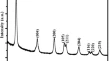
         <p>Figures <figr fid="F1">1a</figr>, <figr fid="F1">1b</figr> show 3 &#215; 3 &#956;m<sup>2</sup> AFM micrographs measured on uncapped islands, where 6 ML of Ge were deposited at <it>T</it><sub>Ge</sub> = 690&#176;C on an e-beam pit-patterned Si(001) substrate with pit-period of 400 nm (Fig. <figr fid="F1">1a</figr>) and on a planar Si(001) substrate (Fig. <figr fid="F1">1b</figr>). The gray scale depicts the local surface slope with respect to the (001) surface. Darker color indicates steeper island facets. The islands in the pits are all multi-faceted domes <abbrgrp><abbr bid="B14">14</abbr></abbrgrp> with dimensions of about 142 nm in base diameter and 24.5 nm in height. The islands grown on planar Si(001) substrates show the very well-known bimodal island distribution of pyramids and domes <abbrgrp><abbr bid="B2">2</abbr><abbr bid="B5">5</abbr><abbr bid="B15">15</abbr></abbrgrp>, where the domes have dimensions of about 117 nm in diameter and 20.1 nm in height. It is worth to mention that for the growth conditions used in this work, 94% of the islands grown on the planar substrate are dome shaped; therefore, it can be expected that these islands are contributing most to the island PL spectra discussed in the following. Figure <figr fid="F1">1c</figr> shows PL spectra (<it>P</it><sub>exc</sub> = 2.6 W/cm<sup>2</sup>) of islands (6 ML of Ge at <it>T</it><sub>Ge</sub> = 700&#176;C) grown on a holographically patterned (red spectrum) and a planar Si(001) substrate (black spectrum). The PL spectrum measured on the planar Si(001) sample exhibits the well-known peaks stemming from the WL (the no-phonon transition (NP), transversal acoustical phonon-assisted transition and the transversal optical Si&#8211;Si phonon-assisted transition (TO) can be identified at 1.03, 1.013 and 0.975 eV, respectively) as well as the Si bulk phonon replica in the energy range from 1.025 to 1.15 eV. The PL signal originating from the islands at about 0.825 eV is relatively broad when compared to the island signal originating from the islands grown on the patterned substrate. Here, a clear splitting of the NP peak at 0.887 eV and the TO-phonon peak at 0.831 eV can be observed. As size quantization in these large islands is negligible, the narrowing of the emission lines can be attributed only to enhanced chemical uniformity of the islands grown on pit-patterned Si <abbrgrp><abbr bid="B7">7</abbr><abbr bid="B9">9</abbr></abbrgrp>.</p>
         <fig id="F1"><title><p>Figure 1</p></title><caption><p>a and b 3 &#215; 3 &#956;m AFM micrographs measured on uncapped samples (6 ML at TGe = 690&#176;C) grown on a e-beam patterned Si(001) (pit-period = 400 nm) and b on planar Si(001)</p></caption><text>
   <p><b>a</b> and <b>b</b> 3 &#215; 3 &#956;m AFM micrographs measured on uncapped samples (6 ML at <it>T</it><sub>Ge</sub> = 690&#176;C) grown on <b>a</b> e-beam patterned Si(001) (pit-period = 400 nm) and <b>b</b> on planar Si(001). The color scale depicts the local surface slope with respect to (001). <b>c</b> PL spectra (<it>P</it><sub>exc</sub> = 2.6 W/cm<sup>2</sup>) of capped islands (6 ML at <it>T</it><sub>Ge</sub> = 700&#176;C) grown on holographically patterned Si(001) (<it>red</it>) and planar Si(001) (<it>black</it>) substrates. A clear splitting of the NP peak and the TO replica is observed in the PL of ordered islands</p>
</text><graphic file="1556-276X-5-1868-1"/></fig>
         <p>In Fig. <figr fid="F2">2</figr>, the PL spectra of the Ge WL and islands grown on the pit-patterned Si substrate were measured as a function of <it>P</it><sub>exc</sub> that was varied between 16 mW/cm<sup>2</sup> and 244.3 W/cm<sup>2</sup>. For <it>P</it><sub>exc</sub> = 16 mW/cm<sup>2</sup> (blue spectrum, bottom), the island NP peak at 0.882 eV and the island TO-phonon peak at 0.825 eV can be clearly observed. For <it>P</it><sub>exc</sub> &gt; 91 mW/cm<sup>2</sup>, peaks corresponding to the Si bulk phonon replica arise. Additionally, a weak signal between 0.99 and 1.075 eV is attributed to the Ge WL between the islands. For <it>P</it><sub>exc</sub> &gt; 18.21 mW/cm<sup>2</sup>, we observe the formation of so-called electron-hole droplets correlated to the Si bulk phonon replica <abbrgrp><abbr bid="B16">16</abbr></abbrgrp>. Only a small blue-shift of the island NP-PL from 0.882 to 0.9 eV is observed by increasing <it>P</it><sub>exc</sub> from 16 mW/cm<sup>2</sup> to 244 W/cm<sup>2</sup>. The peak at 0.898 eV that appears for <it>P</it><sub>exc</sub> &gt; 3.3 W/cm<sup>2</sup> is of unknown origin.</p>
         <fig id="F2"><title><p>Figure 2</p></title><caption><p>PL spectra for 16 mW/cm2 &lt; Pexc &lt; 244</p></caption><text>
   <p>PL spectra for 16 mW/cm<sup>2</sup> &lt;<it>P</it><sub>exc</sub> &lt; 244.3 W/cm<sup>2</sup> measured for islands on a pit-patterned substrate. Only a minor shift of the island PL with increasing <it>P</it><sub>exc</sub> is observed. A new peak of unknown origin appears for <it>P</it><sub>exc</sub> &#8805; 18 W/cm<sup>2</sup> at 898 meV. The detector cut-off at 0.77 eV is indicated by the <it>dashed line</it>. The spectra are shifted vertically for clarity</p>
</text><graphic file="1556-276X-5-1868-2"/></fig>
         <p>Figure <figr fid="F3">3</figr> shows PL spectra measured on the islands grown on planar Si(001) as a function of <it>P</it><sub>exc</sub>. The same behavior as described for the ordered islands shown in Fig. <figr fid="F2">2</figr> is observed for the Si bulk phonon replica. The WL signal is stronger in intensity when compared to the one measured for islands grown on the pit-patterned substrate, which can be explained by the higher area of uniform WL thickness on planar Si(001). The WL peak positions of the NP transition and the TO-phonon transition are observed at 1.03 and 0.973 eV, respectively, for <it>P</it><sub>exc</sub> = 16 mW/cm<sup>2</sup> and exhibit only a minor blue-shift (to 0.979 and 1.035 eV) by increasing <it>P</it><sub>exc</sub> to 244 W/cm<sup>2</sup>. By comparing Figs. <figr fid="F2">2</figr> and <figr fid="F3">3</figr>, it is obvious that there exists a dramatic difference between the <it>P</it><sub>exc</sub> dependencies of the PL emission of the islands grown on pit-patterned substrate (Fig. <figr fid="F2">2</figr>) and the one of islands grown on planar Si (Fig. <figr fid="F3">3</figr>). While for the ordered islands, the PL emission does not shift significantly with <it>P</it><sub>exc</sub>, it does shift by more than 90 meV when increasing <it>P</it><sub>exc</sub> from 33 mW/cm<sup>2</sup> to 244.3 W/cm<sup>2</sup> in the case of the islands on the planar substrate. Due to the cut-off energy of the InGaAs detector, the energetic position of the PL peak emission for <it>P</it><sub>exc</sub> &lt; 33 mW/cm<sup>2</sup> cannot be determined exactly. Similar findings have been reported for smaller pit periods and lower growth temperatures in <abbrgrp><abbr bid="B17">17</abbr></abbrgrp> and were ascribed to the large size inhomogeneity and a concomitant inter-dot Ge concentration inhomogeneity. However, in our samples, we observe within the domes on the planar sample (94% of all islands, height: 20.1 &#177; 0.1 nm) a similar size distribution as for the domes on the patterned samples. Thus, this model cannot be applied to the islands in our experiments.</p>
         <fig id="F3"><title><p>Figure 3</p></title><caption><p>PL spectra obtained at different Pexc for islands on a planar Si(001) substrate</p></caption><text>
   <p>PL spectra obtained at different <it>P</it><sub>exc</sub> for islands on a planar Si(001) substrate. The island PL shifts strongly with increasing excitation power from 0.77 eV at <it>P</it><sub>exc</sub> = 16 mW/cm<sup>2</sup> to 0.86 eV at <it>P</it><sub>exc</sub> = 244.3 W/cm<sup>2</sup>. The detector cut-off at 0.77 eV is indicated by the <it>dashed line</it>. The spectra are shifted vertically for clarity</p>
</text><graphic file="1556-276X-5-1868-3"/></fig>
         <p>We suggest instead that the intra-dot Ge concentration inhomogeneity as reported in <abbrgrp><abbr bid="B7">7</abbr><abbr bid="B8">8</abbr><abbr bid="B9">9</abbr></abbrgrp> is responsible for the observed large blue-shift with <it>P</it><sub>exc</sub> in the randomly nucleated islands. Ross et al. and Montalenti et al. have shown that domes evolve from pyramids by exploiting a complex shape transformation <abbrgrp><abbr bid="B18">18</abbr><abbr bid="B19">19</abbr></abbrgrp> via asymmetric Ge accumulation at the islands apex, finally, resulting in the formation of the steeper {113} and {15 3 23} facets characteristic for domes. This evolution can be clearly seen in the AFM micrographs given in Fig. <figr fid="F4">4a</figr>, <figr fid="F4">4b</figr> for which the scan size is 500 &#215; 500 nm<sup>2</sup> and 2 &#215; 2 &#956;m<sup>2</sup>, respectively. The scans were taken on a sample where 5.5 ML of Ge were deposited at 700&#176;C. At this coverage, the shape transition from pyramids to domes can be best observed <abbrgrp><abbr bid="B15">15</abbr></abbrgrp>. The color coding represents the local surface slope with respect to the (001) surface. In order to highlight the shape transition, we have chosen the color scale in such a way that every of the four different facets of a dome-shaped island corresponds to a different color. The high index facet {15 3 23} that has an inclination with respect to (001) of 33.6&#176; is red, while the {113}-facets (25.2&#176;) are yellow, the 11.3&#176; {105}-facets blue and the (001) surface white. The asymmetric growth of the steeper facets can be directly correlated with Ge enrichment on one side of the island as described in Ref. <abbrgrp><abbr bid="B8">8</abbr></abbrgrp>. We want to point out that such strong enrichment effects are not observed for islands on pit-patterned substrates.</p>
         <fig id="F4"><title><p>Figure 4</p></title><caption><p>a and b AFM micrographs of islands grown on planar Si(001) (5</p></caption><text>
   <p><b>a</b> and <b>b</b> AFM micrographs of islands grown on planar Si(001) (5.5 ML at T<sub>Ge</sub> = 700&#176;C). The <it>color scale</it> represents the local surface slope with respect to (001). Every color corresponds to a certain facet of the SiGe domes (<it>blue</it>: {105}, <it>yellow</it>: {113}, <it>red</it>: {15 3 23}). <b>c</b>&#8211;<b>f</b>: Calculated energy level scheme for islands grown on pit-patterned Si(001) substrates without regions of Ge enrichment (<b>d</b>, <b>f</b>) and islands grown on planar Si(001) substrates containing Ge-rich regions (<b>c</b>, <b>e</b>) as described in the text. The stronger Ge composition gradient of the islands grown on planar substrates compared to the ones grown on pit-patterned substrates <abbrgrp><abbr bid="B7">7</abbr><abbr bid="B8">8</abbr><abbr bid="B9">9</abbr></abbrgrp> leads to a confining potential at the top of the island. The strong shift of the island signal on planar substrates at moderate <it>P</it><sub>exc</sub> as observed in Figs. <figr fid="F1">1c</figr>, <figr fid="F2">2</figr> and <figr fid="F3">3</figr> is explained by the decreased density of states (indicated by the <it>horizontal lines</it>) in this confining potential</p>
</text><graphic file="1556-276X-5-1868-4"/></fig>
         <p>The Ge enrichment discussed in the previous paragraph significantly modifies the energy spectrum of the island. To model this influence, we compare in Fig. <figr fid="F4">4c</figr>&#8211;<figr fid="F4">4f</figr> the eigen-energies (indicated by horizontal lines) and the band edge profiles along the symmetry axis parallel to the [001] growth direction of a of dome-shaped island with (Fig. <figr fid="F4">4c</figr>, <figr fid="F4">4e</figr>) and without (Fig. <figr fid="F4">4d</figr>, <figr fid="F4">4f</figr>) a Ge enrichment region. For the model dome that can be identified with the island on the patterned substrate (Fig. <figr fid="F4">4d</figr>, <figr fid="F4">4f</figr>), we assume that the Ge gradient varies linear from base (110 nm diameter) to apex (18 nm above the base) between 30 and 47%. A full 3D simulation of the energy levels and the band edge profiles was performed using the nextnano<sup>3</sup> code, <abbrgrp><abbr bid="B10">10</abbr></abbrgrp> taking into account the strain tensor field around and in an island and the multi-valley nature of the conduction bands. The hole bands were included uncoupled using spherically averaged effective masses that are given together with other relevant material parameters in Refs. <abbrgrp><abbr bid="B6">6</abbr><abbr bid="B20">20</abbr></abbrgrp>. In Fig. <figr fid="F4">4d</figr>, <figr fid="F4">4f</figr>, the first 10 eigen-energies in the heavy hole (HH) as well as in the &#916; conduction band along the growth direction (&#916;<sub><it>z</it></sub>) are shown. It is evident that in such large islands, the eigen-energies form a quasi-continuum with interlevel energy spacings comparable to the line width used in Fig. <figr fid="F4">4d</figr>, f so that the 10 levels appear as a bold line in this plot. The calculated energy difference between the lowest &#916;<sub><it>z</it></sub> and the highest HH is 0.83 eV, in reasonable agreement with the measured island NP emission observed at 0.89 eV.</p>
         <p>The situation becomes completely different, if we assume a region of Ge enrichment in an island with otherwise unchanged structural parameters. For simplicity, we have assumed that the enrichment region has a spherical surface with a diameter of 8 nm. The Ge content within this region was assumed to increase linearly in the lower hemisphere from 40 to 70% and stays constant at 70% in the upper hemisphere. The corresponding energy level diagram for the first ten &#916;<sub><it>z</it></sub> and HH states are depicted in Fig. <figr fid="F4">4c</figr>, <figr fid="F4">4e</figr>. Especially in the valence band, a discrete level spectrum characteristic for a quantum dot is calculated. As a consequence of the higher Ge content, the calculated PL onset is shifted as low as &#8764;0.7 eV, similar to what is observed for low <it>P</it><sub>exc</sub>. Due to the discrete nature of the energy spectrum, at increasing <it>P</it><sub>exc</sub> the few HH states above the onset of the quasi-continuum of the states localized mainly outside the enrichment region can be easily occupied with holes. It is well known that such filling effects result in a blue-shift of the PL emission spectrum of quantum dots <abbrgrp><abbr bid="B21">21</abbr></abbrgrp> similar to what is observed in our experiments. In the calculations, we show that dot in island potential leads to a decreased density of states for holes in the islands and, thus, to shift of the island PL emission even at moderate <it>P</it><sub>exc</sub> as observed in Fig. <figr fid="F3">3</figr>. In other words, the Ge enriched top of the island creates a confining potential within the potential formed by the island. In this former potential, the density of states is smaller than for the islands grown on pit-patterned substrates in which the Ge is more homogeneously distributed and thus the confinement in the broader potential is smaller.</p>
         <p>Therefore, for islands grown on a planar substrate, at low <it>P</it><sub>exc</sub> the PL shifts strongly, while it does not in the case of islands grown on pit-patterned substrates. When the hole states at the top of the island grown on a planar substrate are filled, we observe a broad PL peak and for even higher <it>P</it><sub>exc</sub> the PL is shifted less to higher energies because of the increased number of states, that is similar to the one for the islands grown on the pit-patterned substrates.</p>
      </sec>
      <sec>
         <st>
            <p>Conclusions</p>
         </st>
         <p>Based on the well-documented tendency of SiGe islands growing on planar substrates to accumulate Ge at the apex, we give strong evidence that the observed blue-shift of the PL emission spectrum of these islands with increasing excitation intensity <it>P</it><sub>exc</sub> is caused by the discrete, dot-like HH energy level spectrum in these narrow regions of high Ge content. Such regions are absent in islands growing on pit-patterned substrates, explaining the observed different dependence of their PL spectra on <it>P</it><sub>exc</sub>. Our arguing is supported by model calculations based on the nextnano<sup>3</sup> code that allow to estimate the dimensions and the Ge content (&#8764;70%) of such inclusions.</p>
      </sec>
      <sec>
         <st>
            <p>Note Added in Proof</p>
         </st>
         <p>In a recent work, Hossain et al. <abbrgrp><abbr bid="B22">22</abbr></abbrgrp> showed, based on finite element method simulation in combination with density functional theory calculation that non-uniform alloying in SiGe islands can lead to enhanced hole confinement, confirming the interpretation of the results presented in this work.</p>
      </sec>
   </bdy>
   <bm>
      <ack>
         <sec>
            <st>
               <p>Acknowledgments</p>
            </st>
            <p>The authors like to thank T. Schwarzl, H. Lichtenberger and F. Sch&#228;ffler for fruitful discussions. The work was supported by the FWF (Contracts No. SFB025&#8211;02 and No. SFB025&#8211;12), by GMe, Austria and by the Austrian Nanoinitiative (Proj. Nos. 815802, 815803).</p>
            <sec>
               <st>
                  <p>Open Access</p>
               </st>
               <p>This article is distributed under the terms of the Creative Commons Attribution Noncommercial License which permits any noncommercial use, distribution, and reproduction in any medium, provided the original author(s) and source are credited.</p>
            </sec>
         </sec>
      </ack>
      <refgrp><bibl id="B1"><aug><au><snm>Eaglesham</snm><fnm>DJ</fnm></au><au><snm>Cerullo</snm><fnm>M</fnm></au></aug><source>Phys. Rev. Lett.</source><pubdate>1990</pubdate><volume>64</volume><fpage>1943</fpage><note>COI number [1:CAS:528:DyaK3cXktFCqtLc%3D]; Bibcode number [1990PhRvL..64.1943E]</note><xrefbib><pubidlist><pubid idtype="doi">10.1103/PhysRevLett.64.1943</pubid><pubid idtype="pmpid" link="fulltext">10041534</pubid></pubidlist></xrefbib></bibl><bibl id="B2"><aug><au><snm>Mo</snm><fnm>YW</fnm></au><au><snm>Savage</snm><fnm>DE</fnm></au><au><snm>Swartzentruber</snm><fnm>BS</fnm></au><au><snm>Lagally</snm><fnm>MG</fnm></au></aug><source>Phys. Rev. Lett.</source><pubdate>1990</pubdate><volume>65</volume><fpage>1020</fpage><note>COI number [1:CAS:528:DyaK3cXlvVWksbs%3D]; Bibcode number [1990PhRvL..65.1020M]</note><xrefbib><pubidlist><pubid idtype="doi">10.1103/PhysRevLett.65.1020</pubid><pubid idtype="pmpid" link="fulltext">10043085</pubid></pubidlist></xrefbib></bibl><bibl id="B3"><aug><au><snm>Tsybeskov</snm><fnm>L</fnm></au><au><snm>Lockwood</snm><fnm>DJ</fnm></au></aug><source>Proc. IEEE</source><pubdate>2009</pubdate><volume>79</volume><fpage>1284</fpage></bibl><bibl id="B4"><source>Lateral alignment of epitaxial quantum dots</source><publisher>Springer, Berlin</publisher><editor>Schmidt O.G.</editor><pubdate>2007</pubdate></bibl><bibl id="B5"><aug><au><snm>Zhong</snm><fnm>Z</fnm></au><au><snm>Bauer</snm><fnm>G</fnm></au></aug><source>Appl. Phys. Lett.</source><pubdate>2009</pubdate><volume>84</volume><fpage>1922</fpage><note>Bibcode number [2004ApPhL..84.1922Z]</note><xrefbib><pubid idtype="doi">10.1063/1.1664014</pubid></xrefbib></bibl><bibl id="B6"><aug><au><snm>Brehm</snm><fnm>M</fnm></au><au><snm>Suzuki</snm><fnm>T</fnm></au><au><snm>Fromherz</snm><fnm>T</fnm></au><au><snm>Zhong</snm><fnm>Z</fnm></au><au><snm>Hrauda</snm><fnm>N</fnm></au><au><snm>Hackl</snm><fnm>F</fnm></au><au><snm>Stangl</snm><fnm>J</fnm></au><au><snm>Sch&#228;ffler</snm><fnm>F</fnm></au><au><snm>Bauer</snm><fnm>G</fnm></au></aug><source>New J. Phys.</source><pubdate>2009</pubdate><volume>11</volume><fpage>063021</fpage><note>Bibcode number [2009NJPh...11f3021B]</note><xrefbib><pubid idtype="doi">10.1088/1367-2630/11/6/063021</pubid></xrefbib></bibl><bibl id="B7"><aug><au><snm>Sch&#252;lli</snm><fnm>TU</fnm></au><au><snm>Vastola</snm><fnm>G</fnm></au><au><snm>Richard</snm><fnm>M-I</fnm></au><au><snm>Malachias</snm><fnm>A</fnm></au><au><snm>Renaud</snm><fnm>G</fnm></au><au><snm>Uhl&#237;k</snm><fnm>F</fnm></au><au><snm>Montalenti</snm><fnm>F</fnm></au><au><snm>Chen</snm><fnm>G</fnm></au><au><snm>Miglio</snm><fnm>L</fnm></au><au><snm>Sch&#228;ffler</snm><fnm>F</fnm></au><au><snm>Bauer</snm><fnm>G</fnm></au></aug><source>Phys. Rev. Lett.</source><pubdate>2009</pubdate><volume>102</volume><fpage>025502</fpage><note>Bibcode number [2009PhRvL.102b5502S]</note><xrefbib><pubidlist><pubid idtype="doi">10.1103/PhysRevLett.102.025502</pubid><pubid idtype="pmpid" link="fulltext">19257289</pubid></pubidlist></xrefbib></bibl><bibl id="B8"><aug><au><snm>Rastelli</snm><fnm>A</fnm></au><au><snm>Stoffel</snm><fnm>M</fnm></au><au><snm>Malachias</snm><fnm>A</fnm></au><au><snm>Merdzhanova</snm><fnm>T</fnm></au><au><snm>Katsaros</snm><fnm>G</fnm></au><au><snm>Kern</snm><fnm>K</fnm></au><au><snm>Metzger</snm><fnm>TH</fnm></au><au><snm>Schmidt</snm><fnm>OG</fnm></au></aug><source>Nano Lett.</source><pubdate>2008</pubdate><volume>8</volume><fpage>1404</fpage><note>COI number [1:CAS:528:DC%2BD1cXktVGitLc%3D]; Bibcode number [2008NanoL...8.1404R]</note><xrefbib><pubidlist><pubid idtype="doi">10.1021/nl080290y</pubid><pubid idtype="pmpid" link="fulltext">18376870</pubid></pubidlist></xrefbib></bibl><bibl id="B9"><aug><au><snm>Pezzoli</snm><fnm>F</fnm></au><au><snm>Stoffel</snm><fnm>M</fnm></au><au><snm>Merdzhanova</snm><fnm>T</fnm></au><au><snm>Rastelli</snm><fnm>A</fnm></au><au><snm>Schmidt</snm><fnm>OG</fnm></au></aug><source>Nanoscale Res. Lett.</source><pubdate>2009</pubdate><volume>4</volume><fpage>1073</fpage><note>COI number [1:CAS:528:DC%2BD1MXhtVCmtb7E]; Bibcode number [2009NRL.....4.1073P]</note><xrefbib><pubidlist><pubid idtype="doi">10.1007/s11671-009-9360-4</pubid><pubid idtype="pmcid">2894314</pubid><pubid idtype="pmpid">20596332</pubid></pubidlist></xrefbib></bibl><bibl id="B10"><aug><au><snm>Majewski</snm><fnm>JA</fnm></au><au><snm>Birner</snm><fnm>S</fnm></au><au><snm>Trellakis</snm><fnm>A</fnm></au><au><snm>Sabathil</snm><fnm>M</fnm></au><au><snm>Vogl</snm><fnm>P</fnm></au></aug><source>Phys. Status Solidi C</source><pubdate>2004</pubdate><volume>1</volume><fpage>2003</fpage><note>COI number [1:CAS:528:DC%2BD2cXlslemuro%3D]; Bibcode number [2004PSSCR...1.2003M]</note><xrefbib><pubid idtype="doi">10.1002/pssc.200404761</pubid></xrefbib></bibl><bibl id="B11"><aug><au><snm>Brehm</snm><fnm>M</fnm></au><au><snm>Grydlik</snm><fnm>M</fnm></au><au><snm>Lichtenberger</snm><fnm>H</fnm></au><au><snm>Fromherz</snm><fnm>T</fnm></au><au><snm>Hrauda</snm><fnm>N</fnm></au><au><snm>Jantsch</snm><fnm>W</fnm></au><au><snm>Sch&#228;ffler</snm><fnm>F</fnm></au><au><snm>Bauer</snm><fnm>G</fnm></au></aug><source>Appl. Phys. Lett.</source><pubdate>2008</pubdate><volume>93</volume><fpage>121901</fpage><note>Bibcode number [2008ApPhL..93l1901B]</note><xrefbib><pubid idtype="doi">10.1063/1.2988261</pubid></xrefbib></bibl><bibl id="B12"><aug><au><snm>Zhang</snm><fnm>JJ</fnm></au><au><snm>Rastelli</snm><fnm>A</fnm></au><au><snm>Schmidt</snm><fnm>OG</fnm></au><au><snm>Bauer</snm><fnm>G</fnm></au></aug><source>Semic. Sci. Techn.</source><note>submitted</note></bibl><bibl id="B13"><aug><au><snm>Brehm</snm><fnm>M</fnm></au><au><snm>Grydlik</snm><fnm>M</fnm></au><au><snm>Hackl</snm><fnm>F</fnm></au><au><snm>Groiss</snm><fnm>H</fnm></au><au><snm>Schffler, T. Fromherz, G. Bauer</snm><fnm>F</fnm></au><au><snm>Fromherz</snm><fnm>T</fnm></au><au><snm>Bauer</snm><fnm>G</fnm></au></aug><source/><note>to be published</note></bibl><bibl id="B14"><aug><au><snm>Medeiros-Ribeiro</snm><fnm>G</fnm></au><au><snm>Bratkovski</snm><fnm>AM</fnm></au><au><snm>Kamins</snm><fnm>TI</fnm></au><au><snm>Ohlberg</snm><fnm>DAA</fnm></au><au><snm>Williams</snm><fnm>RS</fnm></au></aug><source>Science</source><pubdate>1998</pubdate><volume>279</volume><fpage>353</fpage><note>COI number [1:CAS:528:DyaK1cXmtlOiuw%3D%3D]; Bibcode number [1998Sci...279..353M]</note><xrefbib><pubidlist><pubid idtype="doi">10.1126/science.279.5349.353</pubid><pubid idtype="pmpid" link="fulltext">9430580</pubid></pubidlist></xrefbib></bibl><bibl id="B15"><aug><au><snm>Brehm</snm><fnm>M</fnm></au><au><snm>Montalenti</snm><fnm>F</fnm></au><au><snm>Grydlik</snm><fnm>M</fnm></au><au><snm>Vastola</snm><fnm>G</fnm></au><au><snm>Lichtenberger</snm><fnm>H</fnm></au><au><snm>Hrauda</snm><fnm>N</fnm></au><au><snm>Beck</snm><fnm>MJ</fnm></au><au><snm>Fromherz</snm><fnm>T</fnm></au><au><snm>Sch&#228;ffler</snm><fnm>F</fnm></au><au><snm>Miglio</snm><fnm>L</fnm></au><au><snm>Bauer</snm><fnm>G</fnm></au></aug><source>Phys. Rev. B</source><pubdate>2009</pubdate><volume>80</volume><fpage>205321</fpage><note>Bibcode number [2009PhRvB..80t5321B]</note><xrefbib><pubid idtype="doi">10.1103/PhysRevB.80.205321</pubid></xrefbib></bibl><bibl id="B16"><aug><au><snm>Thomas</snm><fnm>TA</fnm></au><au><snm>Rice</snm><fnm>TM</fnm></au><au><snm>Hensel</snm><fnm>JC</fnm></au></aug><source>Phys. Rev. Lett.</source><pubdate>1974</pubdate><volume>33</volume><fpage>219</fpage><note>COI number [1:CAS:528:DyaE2cXlsVejtbw%3D]; Bibcode number [1974PhRvL..33..219T]</note><xrefbib><pubid idtype="doi">10.1103/PhysRevLett.33.219</pubid></xrefbib></bibl><bibl id="B17"><aug><au><snm>Dais</snm><fnm>C</fnm></au><au><snm>Mussler</snm><fnm>G</fnm></au><au><snm>Sigg</snm><fnm>H</fnm></au><au><snm>Fromherz</snm><fnm>T</fnm></au><au><snm>Auzelyte</snm><fnm>V</fnm></au><au><snm>Solak</snm><fnm>HH</fnm></au><au><snm>Gr&#252;tzmacher</snm><fnm>D</fnm></au></aug><source>Europhys. Lett.</source><pubdate>2008</pubdate><volume>84</volume><fpage>67017</fpage><note>Bibcode number [2008EL.....8467017D]</note><xrefbib><pubid idtype="doi">10.1209/0295-5075/84/67017</pubid></xrefbib></bibl><bibl id="B18"><aug><au><snm>Ross</snm><fnm>FM</fnm></au><au><snm>Tromp</snm><fnm>RM</fnm></au><au><snm>Reuter</snm><fnm>MC</fnm></au></aug><source>Science</source><pubdate>1999</pubdate><volume>286</volume><fpage>1931</fpage><note>COI number [1:CAS:528:DyaK1MXnvFSitLs%3D]</note><xrefbib><pubidlist><pubid idtype="doi">10.1126/science.286.5446.1931</pubid><pubid idtype="pmpid" link="fulltext">10583951</pubid></pubidlist></xrefbib></bibl><bibl id="B19"><aug><au><snm>Montalenti</snm><fnm>F</fnm></au><au><snm>Raiteri</snm><fnm>P</fnm></au><au><snm>Migas</snm><fnm>DB</fnm></au><au><snm>von K&#228;nel</snm><fnm>H</fnm></au><au><snm>Rastelli</snm><fnm>A</fnm></au><au><snm>Manzano</snm><fnm>C</fnm></au><au><snm>Costantini</snm><fnm>G</fnm></au><au><snm>Denker</snm><fnm>U</fnm></au><au><snm>Schmidt</snm><fnm>OG</fnm></au><au><snm>Kern</snm><fnm>K</fnm></au><au><snm>Miglio</snm><fnm>L</fnm></au></aug><source>Phys. Rev. Lett.</source><pubdate>2004</pubdate><volume>93</volume><fpage>216102</fpage><note>COI number [1:STN:280:DC%2BD2cnjtVSnsw%3D%3D]; Bibcode number [2004PhRvL..93u6102M]</note><xrefbib><pubidlist><pubid idtype="doi">10.1103/PhysRevLett.93.216102</pubid><pubid idtype="pmpid" link="fulltext">15601034</pubid></pubidlist></xrefbib></bibl><bibl id="B20"><aug><au><snm>Grydlik</snm><fnm>M</fnm></au><au><snm>Brehm</snm><fnm>M</fnm></au><au><snm>Hackl</snm><fnm>F</fnm></au><au><snm>Groiss</snm><fnm>H</fnm></au><au><snm>Fromherz</snm><fnm>T</fnm></au><au><snm>Sch&#228;ffler</snm><fnm>F</fnm></au><au><snm>Bauer</snm><fnm>G</fnm></au></aug><source>New J. Phys.</source><pubdate>2010</pubdate><volume>12</volume><fpage>063002</fpage><note>Bibcode number [2010NJPh...12f3002G]</note><xrefbib><pubid idtype="doi">10.1088/1367-2630/12/6/063002</pubid></xrefbib></bibl><bibl id="B21"><aug><au><snm>Kiravittaya</snm><fnm>S</fnm></au><au><snm>Rastelli</snm><fnm>A</fnm></au><au><snm>Schmidt</snm><fnm>OG</fnm></au></aug><source>Appl. Phys. Lett.</source><pubdate>2006</pubdate><volume>88</volume><fpage>043112</fpage><note>Bibcode number [2006ApPhL..88d3112K]</note><xrefbib><pubid idtype="doi">10.1063/1.2168494</pubid></xrefbib></bibl><bibl id="B22"><aug><au><snm>Hossain</snm><fnm>MZ</fnm></au><au><snm>Medhekar</snm><fnm>NV</fnm></au><au><snm>Shenoy</snm><fnm>VB</fnm></au><au><snm>Johnson</snm><fnm>HT</fnm></au></aug><source>Nanotech.</source><pubdate>2010</pubdate><volume>12</volume><fpage>095401</fpage><note>Bibcode number [2010Nanot..21i5401H]</note><xrefbib><pubid idtype="doi">10.1088/0957-4484/21/9/095401</pubid></xrefbib></bibl></refgrp>
   </bm>
</art>