<?xml version='1.0'?>
<!DOCTYPE art SYSTEM 'http://www.biomedcentral.com/xml/article.dtd'>
<art>
   <ui>1556-276X-4-84</ui>
   <ji>1556-276X</ji>
   <fm>
      <dochead>Nano Express</dochead>
      <bibl>
         <title>
            <p>Thermosensitive Nanocables Prepared by Surface-Initiated Atom Transfer Radical Polymerization</p>
         </title>
         <aug>
            <au id="A1"><snm>Wei</snm><fnm>Qingshan</fnm><insr iid="I1"/></au>
            <au id="A2"><snm>Zhou</snm><fnm>Wenbo</fnm><insr iid="I1"/></au>
            <au ca="yes" id="A3"><snm>Ji</snm><fnm>Jian</fnm><insr iid="I1"/><email>jijian@zju.edu.cn</email></au>
            <au id="A4"><snm>Shen</snm><fnm>Jiacong</fnm><insr iid="I1"/></au>
         </aug>
         <insg>
            <ins id="I1"><p>Department of Polymer Science and Engineering, Key Laboratory of Macromolecule Synthesis and Functionalization, Ministry of Education, Zhejiang University, Hangzhou, 310027, People&#8217;s Republic of China</p></ins>
         </insg>
         <source>Nanoscale Research Letters</source>
         <publisher>Springer-Verlag, New York</publisher>
         <issn>1556-276X</issn>
         <pubdate>2008</pubdate>
         <volume>4</volume>
         <issue>1</issue>
         <fpage>84</fpage>
         <lpage>89</lpage>
         <xrefbib><pubidlist><pubid idtype="pmpid">20592960</pubid><pubid idtype="doi">10.1007/s11671-008-9206-5</pubid></pubidlist></xrefbib>
      </bibl>
      <history><rec><date><day>6</day><month>10</month><year>2008</year></date></rec><acc><date><day>30</day><month>10</month><year>2008</year></date></acc><pub><date><day>19</day><month>11</month><year>2008</year></date></pub></history>
      <cpyrt><year>2008</year><collab>to the authors</collab></cpyrt>
      <kwdg>
         <kwd>Nanocables</kwd>
         <kwd>Gold nanowires</kwd>
         <kwd>Poly(<it>N</it>-isopropylacrylamide)</kwd>
         <kwd>Surface-initiated atom transfer radical polymerization</kwd>
         <kwd>Thermoresponsive</kwd>
      </kwdg>
      <abs>
         <sec>
            <st>
               <p>Abstract</p>
            </st>
            <p>Thermosensitive nanocables consisting of Au nanowire cores and poly(<it>N</it>-isopropylacrylamide) sheaths (denoted as Au/PNIPAAm) were synthesized by surface-initiated atom transfer radical polymerization (SI-ATRP). The formation of PNIPAAm sheath was verified by Fourier transform infrared (FTIR) and hydrogen nuclear magnetic resonance (<sup>1</sup>H NMR) spectroscopy. Transmission electron microscope (TEM) results confirmed the core/shell structure of nanohybrids. The thickness and density of PNIPAAm sheaths can be adjusted by controlling the amount of cross-linker during the polymerization. Signature temperature response was observed from Au/cross-linked-PNIPAAm nanocables. Such smart nanocables show immense potentials as building blocks for novel thermosensitive nanodevices in future.</p>
         </sec>
      </abs>
   </fm>
   <meta>
      <classifications>
         <classification subtype="Primary" type="springerjournalsubject">Material Science</classification>
         <classification subtype="Secondary" type="springerjournalsubject">Molecular Medicine</classification>
         <classification subtype="Secondary" type="springerjournalsubject">Engineering, general</classification>
         <classification subtype="Secondary" type="springerjournalsubject">Chemistry/Food Science, general</classification>
         <classification subtype="Secondary" type="springerjournalsubject">Physics, general</classification>
         <classification subtype="Secondary" type="springerjournalsubject">Materials Science, general</classification>
         <classification subtype="Secondary" type="springerjournalsubject">Nanotechnology</classification>
      </classifications>
   </meta>
   <bdy>
      <sec>
         <st>
            <p>Introduction</p>
         </st>
         <p>Coaxial nanocables have received extensive attentions since they were first prepared in 1997 <abbrgrp>
               <abbr bid="B1">1</abbr>
            </abbrgrp>. In general, they comprise a nanowire core and a protective shell. Based on the nature of sheath materials, different synthetic routes are developed to prepare diverse core/shell nanocables. Roughly speaking, sheath materials can be divided into two groups: hard sheaths (e.g. C <abbrgrp>
               <abbr bid="B2">2</abbr>
            </abbrgrp>, SiO<sub>2</sub> 
            <abbrgrp>
               <abbr bid="B3">3</abbr>
            </abbrgrp>, BN <abbrgrp>
               <abbr bid="B4">4</abbr>
            </abbrgrp>, CdSe <abbrgrp>
               <abbr bid="B5">5</abbr>
            </abbrgrp>, Au <abbrgrp>
               <abbr bid="B6">6</abbr>
            </abbrgrp>) and soft sheaths (mainly polymers <abbrgrp>
               <abbr bid="B7">7</abbr>
            </abbrgrp>). The main methods to form a hard or inorganic sheath are vapor transfer-based <abbrgrp><abbr bid="B8">8</abbr>
            <abbr bid="B9">9</abbr></abbrgrp> or electrochemical deposition <abbrgrp>
               <abbr bid="B10">10</abbr>
            </abbrgrp>, but the coating of nanowires with soft or organic sheaths, especially polymeric shells, needs much milder solution-based reactions. Polymeric sheaths are advantageous over inorganic sheaths in making insulated nanocables, which is essential in optoelectronic nanodevices fabrication and high-density microcircuit industry in order to separate different signal circuit. Moreover, the polymeric coatings would add multiple functions to nanocables, for example, the pH-, temperature- and ion strength-responsive properties, allowing the potential applications in smart nanomachines. Furthermore, polymeric sheaths facilitate a wide range of surface functionalization possibilities, such as biomolecule immobilization. Finally, many polymeric coatings are biocompatible, which promotes the introduction of the one-dimensional (1D) inorganic nanostructures into the biological systems.</p>
         <p>The surface functionalization of nanowires with polymeric sheaths can be achieved via several routes: (1) &#8220;grafting&#8221; method. The as-prepared nanowires are used as templates to graft a polymeric coating. For example, Au/polystyrene (PS) cable-like structures were obtained via emulsion polymerization on as-prepared Au nanorods <abbrgrp>
               <abbr bid="B11">11</abbr>
            </abbrgrp>; Ag nanofibers/PS nanocomposites were prepared by using the reverse micelle-gas antisolvent-ultrasound method <abbrgrp>
               <abbr bid="B12">12</abbr>
            </abbrgrp>. (2) &#8220;filling&#8221; method. Nanocables can be synthesized by filling core materials into existing polymeric or self-assembled peptide nanotubes <abbrgrp>
               <abbr bid="B13">13</abbr>
            </abbrgrp>. However, the fabrication of a polymeric nanotube template with desired diameter and length is quite challenging. (3) in situ formation. In this protocol, the nanowire cores and outlayers are formed simultaneously through a one-pot solution reaction. For instance, CdSe/poly(vinyl acetate) (PVAc) nanocables were synthesized from a heterogeneous system of vinyl acetate (VAc) monomer and precursor under &#947;-irradiation at room temperature <abbrgrp>
               <abbr bid="B14">14</abbr>
            </abbrgrp>; Ag/poly(vinyl alcohol) (PVA) <abbrgrp>
               <abbr bid="B15">15</abbr>
            </abbrgrp>, Te/PVA <abbrgrp>
               <abbr bid="B16">16</abbr>
            </abbrgrp> and Pd/PVA <abbrgrp>
               <abbr bid="B17">17</abbr>
            </abbrgrp> nanocables were prepared via one-step hydrothermal process. Besides, novel approaches including electrospinning <abbrgrp>
               <abbr bid="B18">18</abbr>
            </abbrgrp>, self-assembly of nanoparticles <abbrgrp>
               <abbr bid="B19">19</abbr>
            </abbrgrp>, and interfacial reaction <abbrgrp>
               <abbr bid="B20">20</abbr>
            </abbrgrp> are also developed to prepare various nanocable structures.</p>
         <p>Recently, surface-initiated atom transfer radical polymerization (SI-ATRP) has been demonstrated as a useful tool for coating different substrates with polymeric outlayers <abbrgrp>
               <abbr bid="B21">21</abbr>
            </abbrgrp>. However, there have been very few reports on the preparation of metal/polymer nanocables via SI-ATRP. John Arnold and Peidong Yang and et al. reported the synthesis of Si/SiO<sub>2</sub>/poly(methyl methacrylate) (PMMA) nanocables via SI-ATRP <abbrgrp>
               <abbr bid="B22">22</abbr>
            </abbrgrp>. John Arnold and co-workers further applied this method to fabricate ZnO/PMMA and ZnO/PS nanocables <abbrgrp>
               <abbr bid="B23">23</abbr>
            </abbrgrp>. Moreover, except conducting polymers <abbrgrp>
               <abbr bid="B24">24</abbr>
            </abbrgrp>, few other types of functional polymeric sheaths have been integrated onto nanowire cores.</p>
         <p>Poly(<it>N</it>-isopropylacrylamide) (PNIPAAm) is a widely used thermosensitive polymer which undergoes a coil-globule transition at the lower critical solution temperature (LCST) around 32 &#176;C <abbrgrp>
               <abbr bid="B25">25</abbr>
            </abbrgrp>. PNIPAAm coatings have been successfully grafted via SI-ATRP on gold nanoparticles <abbrgrp><abbr bid="B26">26</abbr>
            <abbr bid="B27">27</abbr>
            <abbr bid="B28">28</abbr></abbrgrp>, gold nanorods <abbrgrp>
               <abbr bid="B29">29</abbr>
            </abbrgrp>, silica beads <abbrgrp>
               <abbr bid="B30">30</abbr>
            </abbrgrp>, dextran particles <abbrgrp>
               <abbr bid="B31">31</abbr>
            </abbrgrp>, carbon nanotubes <abbrgrp>
               <abbr bid="B32">32</abbr>
            </abbrgrp> and self-assembled peptide nanotubes <abbrgrp>
               <abbr bid="B33">33</abbr>
            </abbrgrp>. The coating of high aspect ratio 1D nanowires with PNIPAAm sheaths, however, has not been demonstrated and could be a novel kind of stimulation responsive materials.</p>
         <p>Here, we report the synthesis of thermosensitive nanocables by the SI-ATRP method. Gold nanowires (Au NWs) of 1.5&#8211;1.8 &#956;m in length were prepared as the templates via a modified seeding growth method developed by our team. Two different sorts of PNIPAAm sheaths (noncross-linked and cross-linked) were directly grafted from the Au NW surface through the surface-initiated polymerization. The smart thermosensitive nanocables would become the fundamental materials for fabricating resistance sensitive/thermo sensitive nanodevices in future.</p>
      </sec>
      <sec>
         <st>
            <p>Experimental</p>
         </st>
         <sec>
            <st>
               <p>Materials</p>
            </st>
            <p>Chloroauric acid (HAuCl<sub>4</sub> &#183; 3H<sub>2</sub>O), cetyltrimethylammonium bromide (CTAB), sodium borohydride (NaBH<sub>4</sub>), <it>N,N,N&#8242;,N&#8242;,N&#8242;&#8242;</it>-pentamethyldiethylenetriamine (PMDETA) and <smcaps>l</smcaps>-ascorbic acid (AA) were used as received. NIPAAm monomer was purchased from Aldrich and purified by recrystallization with hexane. Cu<sup>I</sup>Br was purified by dissolution in HBr and recrystallization done with water/ethanol. Deionized water was distilled twice again before use. All the glasswares were washed by aqua regia and repeatedly purified thrice by distilled water. The disulfide initiator [BrC(CH<sub>3</sub>)<sub>2</sub>COO(CH)<sub>11</sub>S]<sub>2</sub> was prepared according to the literature <abbrgrp>
                  <abbr bid="B34">34</abbr>
               </abbrgrp>.</p>
         </sec>
         <sec>
            <st>
               <p>Synthesis of Au NWs</p>
            </st>
            <p>Au NWs of 1.5&#8211;1.8 &#956;m in length were synthesized by a pH-controlled growth method which has been developed by our team recently <abbrgrp>
                  <abbr bid="B35">35</abbr>
               </abbrgrp>. In brief, the Au seed solution was prepared by mixing 5.0 mL 0.20 M CTAB with 5.0 mL of 0.50 mM HAuCl<sub>4</sub>. A quantity of 0.60 mL freshly prepared ice-cold NaBH<sub>4</sub>(0.010 M) was added all at once under vigourous stirring. The stirring was continued for 2 min and the seed solutions were used within 2&#8211;4 h after their preparation.</p>
            <p>The growth solution was prepared by adding 10 mL 0.30 M CTAB to the same volume of 1.0 mM HAuCl<sub>4</sub>and 140 &#956;L 0.10 M AA. After that, 0.30 mmol HCl was injected into the growth solution to lower the solution pH value to around 2.5. Finally, 24 &#956;L seed solution were added rapidly, followed by gently mixing for about 1 min. The solution was then kept in 25 &#176;C water bath overnight.</p>
         </sec>
         <sec>
            <st>
               <p>Preparation of Thermosensitive Nanocables</p>
            </st>
            <p>The first step of preparing PNIPAAm capped nanocables is to immobilize the disulfide-terminated initiator onto the surface of Au NWs. Excess surfactant in nanowire solution was removed by slow centrifugation (1,500 rpm, 15 min) After purification, 1.135 mL initiator/THF solution (0.02 mmol) was added dropwise to Au NWs. The site exchange reaction was left to proceed overnight before centrifugation. The precipitate was collected and washed by H<sub>2</sub>O/DMF (v: v = 1:1) and THF, respectively. Finally, the initiator-capped Au NWs were redispersed in 8 mL H<sub>2</sub>O/DMF (v: v = 1:1) solution.</p>
            <p>For the formation of noncross-linked and cross-linked PNIPAAm shells on Au NWs, the above Au NWs at initiator solution (8 mL) was equally divided into two separate round-bottomed flasks (labelled with I and II). Then, 0.4526 g NIPAAm (4 mmol) and 10.0 &#956;L PMDETA (0.04 mmol) were added to each flask. In flask II, 62 &#956;L ethylene diacrylate (10 mol% with respect to NIPAAm) was added as the cross-linker. The mixture was degassed by three freeze-pump-thaw cycles with N<sub>2</sub>. Degassed Cu<sup>I</sup>Br (5.7 mg, 0.04 mmol) was finally added to both systems to initiate the polymerization. The reaction was performed for 48 h and was terminated by opening the system to air. The nanocables were separated from the reaction solution by centrifugation. After repeating wash, centrifugation and redispersion, the samples were dispersed in water finally.</p>
         </sec>
         <sec>
            <st>
               <p>Characterizations</p>
            </st>
            <p>FTIR spectra were recorded by using a Bruker Vectro 22 instrument.<sup>1</sup>H NMR measurements were carried out on a DMX500 spectrometer (Bruker). TEM images of Au NWs and nanocables were obtained by using a JEM-1200EX transmission electron microscope. The nanocables were stained for TEM observation on copper grids by using 1.5% phosphotungstic acid. The transmittance of nanocables solution was measured on a Shimadzu UV-2550 spectrometer. A water bath was used to control the temperature of nanocable solutions.</p>
         </sec>
      </sec>
      <sec>
         <st>
            <p>Results and Discussions</p>
         </st>
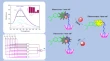
         <p>The process of preparing Au/PNIPAAm nanocables is illustrated in Scheme <schemer cid="C1">1</schemer>. Two steps including the immobilization of disulfide initiator and surface polymerization are involved. The incorporation of initiator and PNIPAAm sheath was verified by FTIR spectra (Fig. <figr fid="F1">1</figr>). As-synthesized Au NWs have a characteristic absorbance at 1,481 cm<sup>&#8722;1</sup>, corresponding to the C&#8211;H antisymmetric methylene scissoring mode of CH<sub>3</sub>&#8211;N<sup>+</sup> moiety in CTAB capping molecules <abbrgrp>
               <abbr bid="B36">36</abbr>
            </abbrgrp>. After ligand exchange with disulfide initiator, a new characteristic absorbance at 1,735 cm<sup>&#8722;1</sup> appears. This peak can be attributed to the C=O stretching from the bromoester moiety of the polymerization initiator <abbrgrp><abbr bid="B26">26</abbr>
            <abbr bid="B27">27</abbr></abbrgrp>, indicating the successful immobilization of initiator molecules on Au NWs. The FTIR spectra also show the characteristic peaks of Au/PNIPAAm nanocables at 1,645 cm<sup>&#8722;1</sup> (C=O stretching, amide I), and 1,552 cm<sup>&#8722;1</sup> (N&#8211;H bending, amide II) which proves the formation of PNIPAAm sheaths <abbrgrp><abbr bid="B26">26</abbr>
            <abbr bid="B27">27</abbr></abbrgrp>.</p>

<scheme id="C1">

<title>
<p>Scheme 1</p></title>

<text>
<p>Two-step synthesis of Au/PNIPAAm nanocables. The red: Au NWs; the light yellow coating: initiator layer; the dark green coating: PNIPAAm sheath</p>
</text>

<graphic file="1556-276X-4-84-i1.gif"/>

</scheme>
<fig id="F1"><title><p>Figure 1</p></title><text>
   <p>FTIR spectra of as-prepared Au NWs, initiator-capped Au NWs and Au/PNIPAAm nanocables</p>
</text><graphic file="1556-276X-4-84-1"/></fig>
         <p>The generation of PNIPAAm sheath can be further determined by <sup>1</sup>H NMR spectra (Fig. <figr fid="F2">2</figr>). Au NWs and Au/PNIPAAm nanocables were separated from H<sub>2</sub>O by centrifugation at 1,500 rpm for 15 min and redispersed in D<sub>2</sub>O. Initiator modified Au NWs were redispersed in CDCl<sub>3</sub> instead. The as-prepared Au NWs showed alkane signal of CTAB at 3.37 (2H, &#945;-CH<sub>2</sub>), 1.72 (2H, &#946;-CH<sub>2</sub>), 1.32 (6H, &#947;-CH<sub>2</sub> of (CH<sub>2</sub>)<sub>3</sub>), 1.24 (20H, (CH<sub>2</sub>)<sub>10</sub>, main chain peak) and 0.82 (3H, &#969;-CH<sub>3</sub>) ppm <abbrgrp>
               <abbr bid="B37">37</abbr>
            </abbrgrp>. And the large narrow <it>N</it>-methyl (headgroup, 9H) singlet appeared at 3.12 ppm <abbrgrp>
               <abbr bid="B37">37</abbr>
            </abbrgrp>. After capping with disulfide initiator, new peaks at 4.17 (t, 2H, OCOCH<sub>2</sub>), 2.69 (q, 2H, SCH<sub>2</sub>) and 1.94 (s, 6H, CH<sub>3</sub>) ppm which belong to the disulfide initiator <abbrgrp><abbr bid="B34">34</abbr>
            <abbr bid="B38">38</abbr></abbrgrp> appeared while the characteristic peak of CTAB at 3.12 ppm was hard to be detected. The change in <sup>1</sup>H NMR spectra indicates the replacement of CTAB-capping molecules with disulfide initiator after site exchange reaction. Au/PNIPAAm nanocables displayed characteristic PNIPAAm signals at 3.84 (CH, side chain), 1.96 (CH, main chain), 1.53 (CH<sub>2</sub>, main chain) and 1.09 (CH<sub>3</sub>, side chain) ppm, thus verifying the successful coating of PNIPAAm sheath <abbrgrp>
               <abbr bid="B32">32</abbr>
            </abbrgrp>. The <sup>1</sup>H NMR spectra are in good agreement with FTIR results, both indicating the attachment of PNIPAAm chains onto the surface of Au NWs.</p>
         <fig id="F2"><title><p>Figure 2</p></title><text>
   <p><sup>1</sup>H NMR spectra of as-prepared Au NWs, initiator-capped Au NWs and Au/PNIPAAm nanocables</p>
</text><graphic file="1556-276X-4-84-2"/></fig>
         <p>The core/shell coaxial structure was directly observed by TEM (Fig. <figr fid="F3">3</figr>). The first row in Fig. <figr fid="F3">3</figr> (Fig. <figr fid="F3">3</figr>a, b) shows the TEM images of as-prepared Au NWs, 1.5&#8211;1.8-&#956;m long and 40-nm wide. The second row (Fig. <figr fid="F3">3</figr>c, d) and third row (Fig. <figr fid="F3">3</figr>e, f) are typical TEM images of Au/noncross-linked PNIPAAm and Au/cross-linked PNIPAAm nanocables, respectively. The dark Au NWs were found to be localized at the centre of a gray PNIPAAm halo. The polymeric sheaths were quite uniform judged by the TEM images and the thickness was estimated to be about 50 nm when no cross-linker was used (Fig. <figr fid="F3">3</figr>c, d). In contrast, appropriate amount of cross-linker would slightly increase the thickness of PNIPAAm coating to about 55 nm. The cross-linked sheaths also appeared much darker in TEM images (Fig. <figr fid="F3">3</figr>e, f), which could be due to the higher density of polymer chains than the noncross-linked ones. Such core/shell structure is identical to the previous reports of Si/SiO<sub>2</sub>/PMMA <abbrgrp>
               <abbr bid="B22">22</abbr>
            </abbrgrp>, ZnO/PMMA and ZnO/PS <abbrgrp>
               <abbr bid="B23">23</abbr>
            </abbrgrp>.</p>
         <fig id="F3"><title><p>Figure 3</p></title><text>
   <p>TEM images of (<b>a</b>,<b>b</b>) as-prepared Au NWs, (<b>c</b>,<b>d</b>) Au/noncross-linked PNIPAAm nanocables and (<b>e</b>,<b>f</b>) Au/cross-linked PNIPAAm nanocables. The nanocable samples were stained by phosphotungstic acid before TEM observation. All scale bars are 0.2 &#956;m</p>
</text><graphic file="1556-276X-4-84-3"/></fig>
         <p>The thermosensitive properties of Au/PNIPAAm nanocables were characterized by UV spectrometer. Figure <figr fid="F4">4</figr>a shows the variations of the transmittance of nanocable solution when exposed to different temperatures. Interestingly, the Au/noncross-linked nanocables and Au/cross-linked nanocables exhibited completely different temperature-sensitive properties. The transmittance of Au/noncross-linked nanocables decreases with the increase of temperature (Fig. <figr fid="F4">4</figr>a). At the range of 32&#8211;34 &#176;C, a sharp transition occurred due to the inherent hydrophilic-to-hydrophobic transition of PNIPAAm <abbrgrp>
               <abbr bid="B25">25</abbr>
            </abbrgrp>. The decrease in transmittance in high-temperature range may be attributed to the formation of large nanocable aggregates, which significantly enhanced the scattering intensity of the solution. Our observation is also in good agreement with the former reports of PNIPAAm-capped gold nanoparticles <abbrgrp>
               <abbr bid="B39">39</abbr>
            </abbrgrp>. However, the transmittance of Au/cross-linked PNIPAAm nanocables gradually increased when the temperature was higher than 36 &#176;C and was nearly 50 times higher than the noncross-linked ones at 45 &#176;C (Fig. <figr fid="F4">4</figr>a). Digital photos also showed the difference of thermoresponsive properties of Au/noncross-linked (I in Fig. <figr fid="F4">4</figr>b, c) and Au/cross-linked PNIPAAm nanocables (II in Fig. <figr fid="F4">4</figr>b, c). At room temperature (25 &#176;C), the two kinds of PNIPAAm-coated nanocables did not show significant difference (Fig. <figr fid="F4">4</figr>b). When the temperature increased to 45 &#176;C, noncross-linked nanocables did not change much (Fig. <figr fid="F4">4</figr>c, I) although the UV-vis spectra showed us the happening of a possible aggregation. On the contrary, the cross-linked nanocables experienced a significant precipitation through the temperature increasing cycle (Fig. <figr fid="F4">4</figr>c, II). The aqueous media thus was much more transparent, which results in an atypical transmittance increase with an increase in temperature. We hypothesized that the cross-linked PNIPAAm sheaths with higher density would become more hydrophobic so that more serious aggregation occurred. It hence provides a method to effectively tune the thermoreponsive properties of Au/PNIPAAm nanocables solely by adjusting the amount of cross-linker used.</p>
         <fig id="F4"><title><p>Figure 4</p></title><text>
   <p><b>a</b>Thermoresponsive changes in transmittance of Au/noncross-linked PNIPAAm (circles) and Au/cross-linked PNIPAAm (squares) nanocables; Digital photos of Au/noncross-linked PNIPAAm (number I) and Au/cross-linked PNIPAAm (number II) nanocables at<b>b</b>25 &#176;C and<b>c</b>45 &#176;C, respectively</p>
</text><graphic file="1556-276X-4-84-4"/></fig>
      </sec>
      <sec>
         <st>
            <p>Conclusions</p>
         </st>
         <p>In summary, two types of thermosensitive Au/PNIPAAm nanocables were successfully prepared via SI-ATRP method. FTIR,<sup>1</sup>H NMR and TEM results clearly demonstrate the formation of PNIPAAm sheath. The use of cross-linker in the polymerization process improved the density and thickness of the polymeric shell as estimated from the TEM images. The different thermoresponsive properties of Au/noncross-linked PNIPAAm and Au/cross-linked PNIPAAm nanocables were determined by transmittance measurement. These kinds of thermosensitive nanocables provide potential applications in resistance sensitive/thermosensitive nanodevices, smart drug delivery and other stimuli-responsive devices.</p>
      </sec>
   </bdy>
   <bm>
      <ack>
         <sec>
            <st>
               <p>Acknowledgements</p>
            </st>
            <p>This research was financially supported by Program for New Century Excellent Talents in University (NCET-05-0527), Natural Science Foundation of China (NSFC-20774082,50830106) and National High Technology Research and Development Program of China (2006AA03Z329).</p>
         </sec>
      </ack>
      <refgrp><bibl id="B1"><aug><au><snm>Suenaga</snm><fnm>K</fnm></au><au><snm>Colliex</snm><fnm>C</fnm></au><au><snm>Demoncy</snm><fnm>N</fnm></au><au><snm>Loiseau</snm><fnm>A</fnm></au><au><snm>Pascard</snm><fnm>H</fnm></au><au><snm>Willaime</snm><fnm>F</fnm></au></aug><source>Science</source><pubdate>1997</pubdate><volume>278</volume><fpage>653</fpage><note>COI number [1:CAS:528:DyaK2sXmvVOrsLg%3D]; Bibcode number [1997Sci...278..653S]</note><xrefbib><pubid idtype="doi">10.1126/science.278.5338.653</pubid></xrefbib></bibl><bibl id="B2"><aug><au><snm>Ma</snm><fnm>D</fnm></au><au><snm>Zhang</snm><fnm>M</fnm></au><au><snm>Xi</snm><fnm>G</fnm></au><au><snm>Zhang</snm><fnm>J</fnm></au><au><snm>Qian</snm><fnm>Y</fnm></au></aug><source>Inorg. Chem.</source><pubdate>2006</pubdate><volume>45</volume><fpage>4845</fpage><note>COI number [1:CAS:528:DC%2BD28XksFegtLg%3D]</note><xrefbib><pubid idtype="doi">10.1021/ic060126i</pubid></xrefbib></bibl><bibl id="B3"><aug><au><snm>Yin</snm><fnm>Y</fnm></au><au><snm>Lu</snm><fnm>Y</fnm></au><au><snm>Sun</snm><fnm>Y</fnm></au><au><snm>Xia</snm><fnm>Y</fnm></au></aug><source>Nano Lett.</source><pubdate>2002</pubdate><volume>2</volume><fpage>427</fpage><note>COI number [1:CAS:528:DC%2BD38Xps1Wkuw%3D%3D]</note><xrefbib><pubid idtype="doi">10.1021/nl025508+</pubid></xrefbib></bibl><bibl id="B4"><aug><au><snm>Zhu</snm><fnm>YC</fnm></au><au><snm>Bando</snm><fnm>Y</fnm></au><au><snm>Xue</snm><fnm>DF</fnm></au><au><snm>Golberg</snm><fnm>D</fnm></au></aug><source>J. Am. Chem. Soc.</source><pubdate>2003</pubdate><volume>125</volume><fpage>16196</fpage><note>COI number [1:CAS:528:DC%2BD3sXps1Sms74%3D]</note><xrefbib><pubid idtype="doi">10.1021/ja037965d</pubid></xrefbib></bibl><bibl id="B5"><aug><au><snm>Li</snm><fnm>Q</fnm></au><au><snm>Wang</snm><fnm>C</fnm></au></aug><source>J. Am. Chem. Soc.</source><pubdate>2003</pubdate><volume>125</volume><fpage>9892</fpage><note>COI number [1:CAS:528:DC%2BD3sXls1ehu7o%3D]</note><xrefbib><pubid idtype="doi">10.1021/ja035787i</pubid></xrefbib></bibl><bibl id="B6"><aug><au><snm>Wen</snm><fnm>X</fnm></au><au><snm>Yang</snm><fnm>S</fnm></au></aug><source>Nano Lett.</source><pubdate>2002</pubdate><volume>2</volume><fpage>451</fpage><note>COI number [1:CAS:528:DC%2BD38XisVeis7c%3D]</note><xrefbib><pubid idtype="doi">10.1021/nl0202915</pubid></xrefbib></bibl><bibl id="B7"><aug><au><snm>Lu</snm><fnm>X</fnm></au><au><snm>Zhao</snm><fnm>Q</fnm></au><au><snm>Liu</snm><fnm>X</fnm></au><au><snm>Wang</snm><fnm>D</fnm></au><au><snm>Zhang</snm><fnm>W</fnm></au><au><snm>Wang</snm><fnm>C</fnm></au><au><snm>Wei</snm><fnm>Y</fnm></au></aug><source>Macromol. Rapid Commun.</source><pubdate>2006</pubdate><volume>27</volume><fpage>430</fpage><note>COI number [1:CAS:528:DC%2BD28XjsVCnsL4%3D]</note><xrefbib><pubid idtype="doi">10.1002/marc.200500810</pubid></xrefbib></bibl><bibl id="B8"/><bibl id="B9"><aug><au><snm>Li</snm><fnm>Y</fnm></au><au><snm>Bando</snm><fnm>Y</fnm></au><au><snm>Golberg</snm><fnm>D</fnm></au></aug><source>Adv. Mater.</source><pubdate>2004</pubdate><volume>16</volume><fpage>93</fpage><xrefbib><pubid idtype="doi">10.1002/adma.200306117</pubid></xrefbib></bibl><bibl id="B10"><aug><au><snm>Ku</snm><fnm>JR</fnm></au><au><snm>Vidu</snm><fnm>R</fnm></au><au><snm>Talroze</snm><fnm>R</fnm></au><au><snm>Stroeve</snm><fnm>P</fnm></au></aug><source>J. Am. Chem. Soc.</source><pubdate>2004</pubdate><volume>126</volume><fpage>15022</fpage><note>COI number [1:CAS:528:DC%2BD2cXptVyru7w%3D]</note><xrefbib><pubid idtype="doi">10.1021/ja0450657</pubid></xrefbib></bibl><bibl id="B11"><aug><au><snm>Obare</snm><fnm>SO</fnm></au><au><snm>Jana</snm><fnm>NR</fnm></au><au><snm>Murphy</snm><fnm>CJ</fnm></au></aug><source>Nano Lett.</source><pubdate>2001</pubdate><volume>1</volume><fpage>601</fpage><note>COI number [1:CAS:528:DC%2BD3MXmvFGksbw%3D]</note><xrefbib><pubid idtype="doi">10.1021/nl0156134</pubid></xrefbib></bibl><bibl id="B12"><aug><au><snm>Zhang</snm><fnm>J</fnm></au><au><snm>Liu</snm><fnm>Z</fnm></au><au><snm>Han</snm><fnm>B</fnm></au><au><snm>Jiang</snm><fnm>T</fnm></au><au><snm>Wu</snm><fnm>W</fnm></au><au><snm>Chen</snm><fnm>J</fnm></au><au><snm>Li</snm><fnm>Z</fnm></au><au><snm>Liu</snm><fnm>D</fnm></au></aug><source>J. Phys. Chem. B</source><pubdate>2004</pubdate><volume>108</volume><fpage>2200</fpage><note>COI number [1:CAS:528:DC%2BD2cXksFOnug%3D%3D]</note><xrefbib><pubid idtype="doi">10.1021/jp036408a</pubid></xrefbib></bibl><bibl id="B13"><aug><au><snm>Carny</snm><fnm>O</fnm></au><au><snm>Shalev</snm><fnm>DE</fnm></au><au><snm>Gazit</snm><fnm>E</fnm></au></aug><source>Nano Lett.</source><pubdate>2006</pubdate><volume>6</volume><fpage>1594</fpage><note>COI number [1:CAS:528:DC%2BD28Xms1eqt7w%3D]</note><xrefbib><pubid idtype="doi">10.1021/nl060468l</pubid></xrefbib></bibl><bibl id="B14"/><bibl id="B15"><aug><au><snm>Luo</snm><fnm>LB</fnm></au><au><snm>Yu</snm><fnm>SH</fnm></au><au><snm>Qian</snm><fnm>HS</fnm></au><au><snm>Zhou</snm><fnm>T</fnm></au></aug><source>J. Am. Chem. Soc.</source><pubdate>2005</pubdate><volume>127</volume><fpage>2822</fpage><note>COI number [1:CAS:528:DC%2BD2MXht1yjsbo%3D]</note><xrefbib><pubid idtype="doi">10.1021/ja0428154</pubid></xrefbib></bibl><bibl id="B16"><aug><au><snm>Xiong</snm><fnm>S</fnm></au><au><snm>Fei</snm><fnm>L</fnm></au><au><snm>Wang</snm><fnm>Z</fnm></au><au><snm>Zhou</snm><fnm>HY</fnm></au><au><snm>Wang</snm><fnm>W</fnm></au><au><snm>Qian</snm><fnm>Y</fnm></au></aug><source>Eur. J. Inorg. Chem.</source><pubdate>2006</pubdate><volume>2006</volume><fpage>207</fpage><xrefbib><pubid idtype="doi">10.1002/ejic.200500654</pubid></xrefbib></bibl><bibl id="B17"><aug><au><snm>Lu</snm><fnm>X</fnm></au><au><snm>Zhang</snm><fnm>G</fnm></au><au><snm>Wang</snm><fnm>W</fnm></au><au><snm>Li</snm><fnm>X</fnm></au></aug><source>Angew. Chem. Int. Ed.</source><pubdate>2007</pubdate><volume>46</volume><fpage>5772</fpage><note>COI number [1:CAS:528:DC%2BD2sXosFGmsL4%3D]</note><xrefbib><pubid idtype="doi">10.1002/anie.200701591</pubid></xrefbib></bibl><bibl id="B18"><aug><au><snm>Li</snm><fnm>Z</fnm></au><au><snm>Huang</snm><fnm>H</fnm></au><au><snm>Wang</snm><fnm>C</fnm></au></aug><source>Macromol. Rapid Commun.</source><pubdate>2006</pubdate><volume>27</volume><fpage>152</fpage><xrefbib><pubid idtype="doi">10.1002/marc.200500627</pubid></xrefbib></bibl><bibl id="B19"><aug><au><snm>Qi</snm><fnm>Y</fnm></au><au><snm>Chen</snm><fnm>P</fnm></au><au><snm>Wang</snm><fnm>T</fnm></au><au><snm>Hu</snm><fnm>X</fnm></au><au><snm>Zhou</snm><fnm>S</fnm></au></aug><source>Macromol. Rapid Commun.</source><pubdate>2006</pubdate><volume>27</volume><fpage>356</fpage><note>COI number [1:CAS:528:DC%2BD28XjtVans7k%3D]</note><xrefbib><pubid idtype="doi">10.1002/marc.200500758</pubid></xrefbib></bibl><bibl id="B20"><aug><au><snm>Lu</snm><fnm>G</fnm></au><au><snm>Li</snm><fnm>C</fnm></au><au><snm>Shen</snm><fnm>J</fnm></au><au><snm>Chen</snm><fnm>Z</fnm></au><au><snm>Shi</snm><fnm>G</fnm></au></aug><source>J. Phys. Chem. C</source><pubdate>2007</pubdate><volume>111</volume><fpage>5926</fpage><note>COI number [1:CAS:528:DC%2BD2sXjslWgt7k%3D]</note><xrefbib><pubid idtype="doi">10.1021/jp070387t</pubid></xrefbib></bibl><bibl id="B21"><aug><au><snm>Pyun</snm><fnm>J</fnm></au><au><snm>Kowalewski</snm><fnm>T</fnm></au><au><snm>Matyjaszewski</snm><fnm>K</fnm></au></aug><source>Macromol. Rapid Commun.</source><pubdate>2003</pubdate><volume>24</volume><fpage>1043</fpage><note>COI number [1:CAS:528:DC%2BD2cXhsVOkuw%3D%3D]</note><xrefbib><pubid idtype="doi">10.1002/marc.200300078</pubid></xrefbib></bibl><bibl id="B22"><aug><au><snm>Mulvihill</snm><fnm>MJ</fnm></au><au><snm>Rupert</snm><fnm>BL</fnm></au><au><snm>He</snm><fnm>R</fnm></au><au><snm>Hochbaum</snm><fnm>A</fnm></au><au><snm>Arnold</snm><fnm>J</fnm></au><au><snm>Yang</snm><fnm>P</fnm></au></aug><source>J. Am. Chem. Soc.</source><pubdate>2005</pubdate><volume>127</volume><fpage>16040</fpage><note>COI number [1:CAS:528:DC%2BD2MXhtFKgsL%2FO]</note><xrefbib><pubid idtype="doi">10.1021/ja056242m</pubid></xrefbib></bibl><bibl id="B23"><aug><au><snm>Rupert</snm><fnm>BL</fnm></au><au><snm>Mulvihill</snm><fnm>MJ</fnm></au><au><snm>Arnold</snm><fnm>J</fnm></au></aug><source>Chem. Mater.</source><pubdate>2006</pubdate><volume>18</volume><fpage>5045</fpage><note>COI number [1:CAS:528:DC%2BD28XpvFSmurs%3D]</note><xrefbib><pubid idtype="doi">10.1021/cm061387t</pubid></xrefbib></bibl><bibl id="B24"><aug><au><snm>Huang</snm><fnm>K</fnm></au><au><snm>Zhang</snm><fnm>Y</fnm></au><au><snm>Long</snm><fnm>Y</fnm></au><au><snm>Yuan</snm><fnm>J</fnm></au><au><snm>Han</snm><fnm>D</fnm></au><au><snm>Wang</snm><fnm>Z</fnm></au><au><snm>Niu</snm><fnm>L</fnm></au><au><snm>Chen</snm><fnm>Z</fnm></au></aug><source>Chem. Eur. J.</source><pubdate>2006</pubdate><volume>12</volume><fpage>5314</fpage><note>COI number [1:CAS:528:DC%2BD28XntFGntLk%3D]</note><xrefbib><pubid idtype="doi">10.1002/chem.200501527</pubid></xrefbib></bibl><bibl id="B25"><aug><au><snm>Wu</snm><fnm>C</fnm></au><au><snm>Wang</snm><fnm>X</fnm></au></aug><source>Phys. Rev. Lett.</source><pubdate>1998</pubdate><volume>80</volume><fpage>4092</fpage><note>COI number [1:CAS:528:DyaK1cXislOjtLo%3D]</note><xrefbib><pubid idtype="doi">10.1103/PhysRevLett.80.4092</pubid></xrefbib></bibl><bibl id="B26"><aug><au><snm>Kim</snm><fnm>DJ</fnm></au><au><snm>Kang</snm><fnm>SM</fnm></au><au><snm>Kong</snm><fnm>B</fnm></au><au><snm>Kim</snm><fnm>W-J</fnm></au><au><snm>H-j</snm><fnm>Paik</fnm></au><au><snm>Choi</snm><fnm>H</fnm></au><au><snm>Choi</snm><fnm>IS</fnm></au></aug><source>Macromol. Chem. Phys.</source><pubdate>2005</pubdate><volume>206</volume><fpage>1941</fpage><note>COI number [1:CAS:528:DC%2BD2MXhtFOns7zO]</note><xrefbib><pubid idtype="doi">10.1002/macp.200500268</pubid></xrefbib></bibl><bibl id="B27"><aug><au><snm>Li</snm><fnm>D</fnm></au><au><snm>He</snm><fnm>Q</fnm></au><au><snm>Cui</snm><fnm>Y</fnm></au><au><snm>Wang</snm><fnm>K</fnm></au><au><snm>Zhang</snm><fnm>X</fnm></au><au><snm>Li</snm><fnm>J</fnm></au></aug><source>Chem. Eur. J.</source><pubdate>2007</pubdate><volume>13</volume><fpage>2224</fpage><note>COI number [1:CAS:528:DC%2BD2sXjsVagtLk%3D]</note><xrefbib><pubid idtype="doi">10.1002/chem.200600839</pubid></xrefbib></bibl><bibl id="B28"><aug><au><snm>Li</snm><fnm>D</fnm></au><au><snm>Cui</snm><fnm>Y</fnm></au><au><snm>Wang</snm><fnm>K</fnm></au><au><snm>He</snm><fnm>Q</fnm></au><au><snm>Yan</snm><fnm>X</fnm></au><au><snm>Li</snm><fnm>J</fnm></au></aug><source>Adv. Funct. Mater.</source><pubdate>2007</pubdate><volume>17</volume><fpage>3134</fpage><note>COI number [1:CAS:528:DC%2BD2sXhtlKktLzJ]</note><xrefbib><pubid idtype="doi">10.1002/adfm.200700427</pubid></xrefbib></bibl><bibl id="B29"><aug><au><snm>Wei</snm><fnm>Q</fnm></au><au><snm>Ji</snm><fnm>J</fnm></au><au><snm>Shen</snm><fnm>J</fnm></au></aug><source>Macromol. Rapid Commun.</source><pubdate>2008</pubdate><volume>29</volume><fpage>645</fpage><note>COI number [1:CAS:528:DC%2BD1cXlsl2gsL8%3D]</note><xrefbib><pubid idtype="doi">10.1002/marc.200800009</pubid></xrefbib></bibl><bibl id="B30"><aug><au><snm>Seino</snm><fnm>M</fnm></au><au><snm>Yokomachi</snm><fnm>K</fnm></au><au><snm>Hayakawa</snm><fnm>T</fnm></au><au><snm>Kikuchi</snm><fnm>R</fnm></au><au><snm>Kakimoto</snm><fnm>M-a</fnm></au><au><snm>Horiuchi</snm><fnm>S</fnm></au></aug><source>Polymer (Guildf)</source><pubdate>2006</pubdate><volume>47</volume><fpage>1946</fpage><note>COI number [1:CAS:528:DC%2BD28Xitlejtrk%3D]</note><xrefbib><pubid idtype="doi">10.1016/j.polymer.2006.01.027</pubid></xrefbib></bibl><bibl id="B31"><aug><au><snm>Kim</snm><fnm>DJ</fnm></au><au><snm>Heo</snm><fnm>J-y</fnm></au><au><snm>Kim</snm><fnm>KS</fnm></au><au><snm>Choi</snm><fnm>IS</fnm></au></aug><source>Macromol. Rapid Commun.</source><pubdate>2003</pubdate><volume>24</volume><fpage>517</fpage><xrefbib><pubid idtype="doi">10.1002/marc.200390076</pubid></xrefbib></bibl><bibl id="B32"><aug><au><snm>Kong</snm><fnm>H</fnm></au><au><snm>Li</snm><fnm>W</fnm></au><au><snm>Gao</snm><fnm>C</fnm></au><au><snm>Yan</snm><fnm>D</fnm></au><au><snm>Jin</snm><fnm>Y</fnm></au><au><snm>Walton</snm><fnm>DRM</fnm></au><au><snm>Kroto</snm><fnm>HW</fnm></au></aug><source>Macromolecules</source><pubdate>2004</pubdate><volume>37</volume><fpage>6683</fpage><note>COI number [1:CAS:528:DC%2BD2cXmt1Sntrg%3D]</note><xrefbib><pubid idtype="doi">10.1021/ma048682o</pubid></xrefbib></bibl><bibl id="B33"><aug><au><snm>Couet</snm><fnm>J</fnm></au><au><snm>Biesalski</snm><fnm>M</fnm></au></aug><source>Macromolecules</source><pubdate>2006</pubdate><volume>39</volume><fpage>7258</fpage><note>COI number [1:CAS:528:DC%2BD28Xps1aktrw%3D]</note><xrefbib><pubid idtype="doi">10.1021/ma061200j</pubid></xrefbib></bibl><bibl id="B34"><aug><au><snm>Shah</snm><fnm>RR</fnm></au><au><snm>Merreceyes</snm><fnm>D</fnm></au><au><snm>Husemann</snm><fnm>M</fnm></au><au><snm>Rees</snm><fnm>I</fnm></au><au><snm>Abbott</snm><fnm>NL</fnm></au><au><snm>Hawker</snm><fnm>CJ</fnm></au><au><snm>Hedrick</snm><fnm>JL</fnm></au></aug><source>Macromolecules</source><pubdate>2000</pubdate><volume>33</volume><fpage>597</fpage><note>COI number [1:CAS:528:DC%2BD3cXhs1GhsA%3D%3D]</note><xrefbib><pubid idtype="doi">10.1021/ma991264c</pubid></xrefbib></bibl><bibl id="B35"><aug><au><snm>Wei</snm><fnm>Q</fnm></au><au><snm>Ji</snm><fnm>J</fnm></au><au><snm>Shen</snm><fnm>J</fnm></au></aug><source>J. Nanosci. Nanotechnol.</source><pubdate>2008</pubdate><volume>8</volume><fpage>5708</fpage><xrefbib><pubid idtype="doi">10.1166/jnn.2008.302</pubid></xrefbib></bibl><bibl id="B36"><aug><au><snm>Nikoobakht</snm><fnm>B</fnm></au><au><snm>El-Sayed</snm><fnm>MA</fnm></au></aug><source>Langmuir</source><pubdate>2001</pubdate><volume>17</volume><fpage>6368</fpage><note>COI number [1:CAS:528:DC%2BD3MXmsF2ltr8%3D]</note><xrefbib><pubid idtype="doi">10.1021/la010530o</pubid></xrefbib></bibl><bibl id="B37"><aug><au><snm>Kreke</snm><fnm>PJ</fnm></au><au><snm>Magid</snm><fnm>LJ</fnm></au><au><snm>Gee</snm><fnm>JC</fnm></au></aug><source>Langmuir</source><pubdate>1996</pubdate><volume>12</volume><fpage>699</fpage><note>COI number [1:CAS:528:DyaK28Xmt1GqtQ%3D%3D]</note><xrefbib><pubid idtype="doi">10.1021/la9509662</pubid></xrefbib></bibl><bibl id="B38"/><bibl id="B39"><aug><au><snm>Zhu</snm><fnm>MQ</fnm></au><au><snm>Wang</snm><fnm>LQ</fnm></au><au><snm>Exarhos</snm><fnm>GJ</fnm></au><au><snm>Li</snm><fnm>ADQ</fnm></au></aug><source>J. Am. Chem. Soc.</source><pubdate>2004</pubdate><volume>126</volume><fpage>2656</fpage><note>COI number [1:CAS:528:DC%2BD2cXhtVyqtbk%3D]</note><xrefbib><pubid idtype="doi">10.1021/ja038544z</pubid></xrefbib></bibl></refgrp>
   </bm>
</art>