<?xml version='1.0'?>
<!DOCTYPE art SYSTEM 'http://www.biomedcentral.com/xml/article.dtd'>
<art>
   <ui>1556-276X-4-47</ui>
   <ji>1556-276X</ji>
   <fm>
      <dochead>Nano Express</dochead>
      <bibl>
         <title>
            <p>Synthesis of Indium Nanowires by Galvanic Displacement and Their Optical Properties</p>
         </title>
         <aug>
            <au id="A1"><snm>Li</snm><fnm>Haohua</fnm><insr iid="I1"/><insr iid="I2"/></au>
            <au id="A2"><snm>Liang</snm><fnm>Chaolun</fnm><insr iid="I3"/></au>
            <au id="A3"><snm>Liu</snm><fnm>Meng</fnm><insr iid="I1"/><insr iid="I2"/></au>
            <au id="A4"><snm>Zhong</snm><fnm>Kuan</fnm><insr iid="I1"/><insr iid="I2"/></au>
            <au ca="yes" id="A5"><snm>Tong</snm><fnm>Yexiang</fnm><insr iid="I1"/><insr iid="I2"/><email>cesdhx@mail.sysu.edu.cn</email></au>
            <au ca="yes" id="A6"><snm>Liu</snm><fnm>Peng</fnm><insr iid="I1"/><insr iid="I2"/><email>pengliupd@hotmail.com</email></au>
            <au id="A7"><snm>Hope</snm><mi>A</mi><fnm>Greg</fnm><insr iid="I4"/></au>
         </aug>
         <insg>
            <ins id="I1"><p>School of Chemistry and Chemical Engineering / MOE of Key Laboratory of Bioinorganic and Synthetic Chemistry, Sun Yat-Sen University, Guangzhou, 510275, China</p></ins>
            <ins id="I2"><p>Institute of Optoelectronic and Functional Composite Material, Sun Yat-Sen University, Guangzhou, 510275, China</p></ins>
            <ins id="I3"><p>Instrumental Analysis &amp; Research Center, Sun Yat-Sen University, Guangzhou, 510275, China</p></ins>
            <ins id="I4"><p>School of Science, Griffith University, Nathan, Qld 4111, Australia</p></ins>
         </insg>
         <source>Nanoscale Research Letters</source>
         <publisher>Springer-Verlag, New York</publisher>
         <issn>1556-276X</issn>
         <pubdate>2008</pubdate>
         <volume>4</volume>
         <issue>1</issue>
         <fpage>47</fpage>
         <lpage>53</lpage>
         <xrefbib><pubidlist><pubid idtype="pmpid">20592961</pubid><pubid idtype="doi">10.1007/s11671-008-9201-x</pubid></pubidlist></xrefbib>
      </bibl>
      <history><rec><date><day>10</day><month>8</month><year>2008</year></date></rec><acc><date><day>22</day><month>10</month><year>2008</year></date></acc><pub><date><day>18</day><month>11</month><year>2008</year></date></pub></history>
      <cpyrt><year>2008</year><collab>to the authors</collab></cpyrt>
      <kwdg>
         <kwd>Indium</kwd>
         <kwd>Nanowire</kwd>
         <kwd>Galvanic displacement</kwd>
         <kwd>Surface plasmon resonance</kwd>
         <kwd>Soft template</kwd>
      </kwdg>

<abs>

<sec>
<st><p>Abstract</p>
</st>
<p>Single crystalline indium nanowires were prepared on Zn substrate which had been treated in concentrated sulphuric acid by galvanic displacement in the 0.002 mol L<sup>&#8722;1</sup>In<sub>2</sub>(SO<sub>4</sub>)<sub>3</sub>-0.002 mol L<sup>&#8722;1</sup>SeO<sub>2</sub>-0.02 mol L<sup>&#8722;1</sup>SDS-0.01 mol L<sup>&#8722;1</sup>citric acid aqueous solution. The typical diameter of indium nanowires is 30 nm and most of the nanowires are over 30 &#956;m in length. XRD, HRTEM, SAED and structural simulation clearly demonstrate that indium nanowires are single-crystalline with the tetragonal structure, the growth direction of the nanowires is along [100] facet. The UV-Vis absorption spectra showed that indium nanowires display typical transverse resonance of SPR properties. The surfactant (SDS) and the pretreatment of Zn substrate play an important role in the growth process. The mechanism of indium nanowires growth is the synergic effect of treated Zn substrate (hard template) and SDS (soft template).</p>
</sec>

</abs>
</fm>
<meta>
      <classifications>
         <classification subtype="Primary" type="springerjournalsubject">Material Science</classification>
         <classification subtype="Secondary" type="springerjournalsubject">Molecular Medicine</classification>
         <classification subtype="Secondary" type="springerjournalsubject">Engineering, general</classification>
         <classification subtype="Secondary" type="springerjournalsubject">Chemistry/Food Science, general</classification>
         <classification subtype="Secondary" type="springerjournalsubject">Physics, general</classification>
         <classification subtype="Secondary" type="springerjournalsubject">Materials Science, general</classification>
         <classification subtype="Secondary" type="springerjournalsubject">Nanotechnology</classification>
      </classifications>
   </meta>
<bdy>

<sec>
<st>
<p>Introduction</p>
</st>
<p>The interaction of light with metal nanoparticles and nanowires as opposed to their bulk counterparts are subject to intense research for their application in plasmonics including chemical sensors and optical filters <abbrgrp>
<abbr bid="B1">1</abbr>
</abbrgrp>. Some metal nanoparticles, such as gold and silver, have exhibited a strong absorption peak in the visible range of the spectrum, due to the excitation of a collective oscillation of electrons which is described as the surface plasmon resonance (SPR) <abbrgrp><abbr bid="B2">2</abbr><abbr bid="B3">3</abbr>
<abbr bid="B4">4</abbr>
<abbr bid="B5">5</abbr>
<abbr bid="B6">6</abbr></abbrgrp>. However, nanorods and nanowires are the most prominent examples of nanoscale entities with SPR ranging from the visible to the near-infrared because the variation of the parameters such as shape and geometry enables tuning of the optical resonances <abbrgrp><abbr bid="B6">6</abbr>
<abbr bid="B7">7</abbr>
<abbr bid="B8">8</abbr></abbrgrp>. Therefore, metal nanowires have received immense research intention in recent years owing to their tunable optical and electronic properties and potential applications in nanoelectronic, probes, biological sensors, storage media and sensing devices <abbrgrp>
<abbr bid="B9">9</abbr></abbrgrp>. Gold and silver are among the most useful metals of the nanowires prepared for the purpose of optical resonances research <abbrgrp><abbr bid="B8">8</abbr><abbr bid="B10">10</abbr></abbrgrp>. The nanowires based on the other metals Cu, Ni, Co have also been studied and they have also exhibited good SPR properties <abbrgrp><abbr bid="B7">7</abbr><abbr bid="B9">9</abbr>
<abbr bid="B11">11</abbr></abbrgrp>. Further researches on the fabrication and their application of these prospective metal nanowires are of considerable importance nowadays. For example, indium nanowires exhibit excellent temperature-dependent electrical properties <abbrgrp>
<abbr bid="B12">12</abbr>
</abbrgrp>. In particular, under the superconducting temperature, the electrical resistance of indium nanowires rapidly decreased, which are expected to play a part in making magnetic field generators or superconducting quantum-interference devices <abbrgrp>
<abbr bid="B13">13</abbr></abbrgrp>. Indium nanowire arrays on Silicon surface have been synthesized <abbrgrp><abbr bid="B14">14</abbr><abbr bid="B15">15</abbr>
<abbr bid="B16">16</abbr>
<abbr bid="B17">17</abbr>
<abbr bid="B18">18</abbr></abbrgrp>, the properties used as the temperature-induced metal-insulator transitions were studied. In addition, indium nanoparticles have also attracted particular interest because they can be used as lubricants, single electron transistors and tags for the detection of DNA hybridization <abbrgrp><abbr bid="B19">19</abbr><abbr bid="B20">20</abbr>
<abbr bid="B21">21</abbr><abbr bid="B22">22</abbr></abbrgrp>.</p>
<p>The past studies on the preparation of indium nanowires using thermal evaporation have revealed the interesting structural and electrical and optical properties of these samples <abbrgrp><abbr bid="B15">15</abbr>
<abbr bid="B18">18</abbr>
<abbr bid="B23">23</abbr></abbrgrp>. Galvanic displacement or the so-called immersion plating is another way to synthesize nanoscale materials in recent years <abbrgrp><abbr bid="B24">24</abbr>
</abbrgrp>. It is a spontaneous electrochemical reaction induced by the difference in redox potentials between the substances of the solid substrates and the ions of the source materials. Obviously, it is different from electrodeposition and chemical bath deposition <abbrgrp><abbr bid="B25">25</abbr>
</abbrgrp>; the substrates act as the reducing agents instead of the electric power or other reductant. Therefore, it yields the product with a high purity. On the other hand, it needs no apparatus as compared with the standard evaporation techniques <abbrgrp><abbr bid="B26">26</abbr></abbrgrp>. Previous works on the synthesis of nanostructured materials via galvanic displacement have mainly focused on the metals including Au, Pd, Pt, Ag, Cu, Ni and Pb <abbrgrp><abbr bid="B24">24</abbr><abbr bid="B26">26</abbr>
<abbr bid="B27">27</abbr>
<abbr bid="B28">28</abbr>
<abbr bid="B29">29</abbr>
<abbr bid="B30">30</abbr></abbrgrp>, the binary intermetallic compounds such as Bi-Te <abbrgrp>
<abbr bid="B31">31</abbr>
</abbrgrp>, Pd-Ag and Pt-Ag <abbrgrp>
<abbr bid="B32">32</abbr></abbrgrp>.</p>
<p>In this paper, we report the synthesis of indium nanowires by galvanic displacement on a zinc sheet after being treated in concentrated sulphuric acid. The galvanic displacement is usually performed on a plain substrate, in this letter, we found that only nanoparticles grew on the untreated zinc sheets. However, indium nanowires can grow on the zinc sheet after being oxidized in concentrated sulphuric acid. The small holes in the porous ZnO oxide film formed on a treated zinc sheet play a confinement effect or act as a &#8220;template&#8221; in indium nanowires growth. This illustrates a simple way for the large-scale fabrication of indium nanowires with high purity at a mild condition. Furthermore, the structural characterization and UV properties of the as-prepared indium nanowires are also studied.</p>
</sec>
<sec>
<st>
<p>Experimental</p></st>

<sec>

<st><p>Material</p>
</st>
<p>Zinc sheet (99.99%) was used as the substrate. The selenium dioxide, indium sulphate concentrated sulphuric acid (98%), citric acid, sodium dodecyl sulphonate (SDS), octyl hydride were analytical reagents. Trioctyl phosphine oxide (TOPO) was purchased from Alfa Aesar.</p>
</sec>

<sec>
<st><p>Synthesis of Indium Nanowires</p></st>

<p>The Zn sheet was polished and rinsed with acetone, and then it was put into the concentrated sulphuric acid and passivated for 6 h to form a porous oxide film. The passivated Zn sheet was immersed in the aqueous solution containing 0.002 mol L<sup>&#8722;1</sup>In<sub>2</sub>(SO<sub>4</sub>)<sub>3</sub>-0.002 mol L<sup>&#8722;1</sup>SeO<sub>2</sub>-0.02 mol L<sup>&#8722;1</sup>SDS-0.01 mol L<sup>&#8722;1</sup>citric acid aqueous solution without any disturbance for 40 min, SeO<sub>2</sub>was used as the supporting electrolyte in acid medium. The pH value of the solution was adjusted to be 1.4 by using 1 mol L<sup>&#8722;1</sup>H<sub>2</sub>SO<sub>4</sub>. The deposits on the Zn sheet were analysed.</p>
</sec>
<sec>

<st>
<p>Characterization</p></st>

<p>The morphology of the as-prepared samples was observed by a field emission scanning electron microscope (FE-SEM, JSM 6330F, JEOL) and its structure was determined by a transmission electron microscope (TEM) and a high resolution-transmission electron microscope (HRTEM) (JEM 2010HR, JEOL) with an Oxford EDS spectrometer and an X-ray diffractometer (XRD, PW 1830, Philips).</p>
</sec>

<sec>
<st>
<p>The UV-vis Absorption Spectroscopy Measurement</p>
</st>
<p>The deposits were scraped down and dispersed in methanol and then sonicated for 1 h. The diameter of the nanowires suspended at the top of the solution is small and the diameter of the nanowires sinked at the bottom of the solution is large. So three different levels from top to bottom of the dispersion were collected. Each part of the dispersion was centrifugated for 20 min. The precipitations were redispersed in octane-TOPO solution and sonicated for 10 min, respectively, as illustrated by the literature <abbrgrp><abbr bid="B30">30</abbr></abbrgrp>. The UV-vis absorption spectroscopy of these nanowires with different diameters was measured by a UV-visible Spectrophotometer (UV-vis UV-2501PC, Shimadzu). The average diameter and aspect ratio of the nanowires dispersed in different levels were calculated by SEM images.</p>
</sec>

</sec>

<sec>
<st>
<p>Results and Discussion</p>
</st>

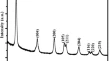
<p>Figure <figr fid="F1">1</figr> presents the XRD pattern of the as-deposited sample. The diffraction peaks (2<it>&#952;</it> = 36.5, 39.2 and 43.4) belong to the zinc substrate. While the diffraction peaks (2<it>&#952;</it> = 33.1 and 54.6) belong to the (101) and (112) facets of indium with tetragonal structure (JCPDS Card 05-0642). The XRD results indicate that the as-deposited sample is tetragonal phase indium.</p>
<fig id="F1"><title><p>Figure 1</p></title><text>
   <p>X-ray diffraction patterns of the as-deposited sample</p>
</text><graphic file="1556-276X-4-47-1"/></fig>

<p>Figure <figr fid="F2">2</figr> is the typical SEM images of the as-prepared samples. The SEM image at a low magnification (as shown in Fig. <figr fid="F2">2a</figr>) clearly reveals the film consists of a high yield of nanowires. Most of the nanowires are over 30 &#956;m in length. Figure <figr fid="F2">2b</figr> depicts the detail morphology of the nanowires. The average diameter of indium naowires is about 30 nm and the diameter ranges from 20 nm to 60 nm.</p>
<fig id="F2"><title><p>Figure 2</p></title><text>
   <p>The typical SEM images of the as-prepared nanowires.<b>a</b>, at a low magnification. <b>b</b> at a high magnification</p>
</text><graphic file="1556-276X-4-47-2"/></fig>
<p>The microstructure of individual nanowire was further investigated by TEM and HRTEM. Figure <figr fid="F3">3</figr> shows a typical TEM image of the sample after ultrasonic treatment, a fragment of indium nanowires was captured. The diameter of the nanowire is about 25 nm. The inset in Fig. <figr fid="F3">3</figr> shows the selected area electron diffraction (SAED) pattern of the circled area in Fig. <figr fid="F3">3</figr> taken along [001] zone axis. In the SEAD pattern, sharp and clear diffraction spots were observed, proving that the nanowire is single crystalline. The reflections correspond to (110), (<inline-formula>
<graphic file="1556-276X-4-47-i1.gif"/>
</inline-formula>) and (200) lattice planes of In with tetragonal structure. Therefore, the In nanowire adopt a single crystalline structure with tetragonal phase. From the SAED, it can also be found that the growth direction of this nanowire is along [100] direction.</p>

<fig id="F3"><title><p>Figure 3</p></title><text>
   <p>TEM image of In nanowire and the SEAD pattern of the circled area in TEM image.The HRTEM image of the nanowire is shown in Fig. <figr fid="F4">4</figr>, the lattice fringe image can be observed, this reveals the orientation, size and grain boundary of the nanowire</p>
</text><graphic file="1556-276X-4-47-3"/></fig>
<p>The corresponding high resolution transmission electron microscopy is shown in Fig. <figr fid="F4">4</figr>, the area in which lattice fringe image appeared reveals the orientation, size and grain boundary of the nanowires. In order to investigate the details of the crystal structure, Fouier filtered reconstructed image is shown in Fig. <figr fid="F5">5</figr>. From the image, two-dimensional lattice fringes were observed in the individual indium nanowire. The marked d spacing of 0.25 nm meeting at an angle of 90<sup>0</sup>corresponds to the interplanar distance of (110). In addition, the planes with an interplanar distance of 0.16 nm can be indexed as (200). In other words, the indium nanowire was formed by the stacking of (100) planes, which indicates that the indium nanowire grew along a-axis of the tetragonal lattice.</p>
<fig id="F4"><title><p>Figure 4</p></title><text>
   <p>HRTEM image of the In nanowire</p>
</text><graphic file="1556-276X-4-47-4"/></fig>
<fig id="F5"><title><p>Figure 5</p></title><text>
   <p>The diffractogram of Fig. 4 (inset) and its Fouier filtered reconstructed image</p>
</text><graphic file="1556-276X-4-47-5"/></fig>
<p>To further demonstrate the structure and growth direction of In nanowire, simulation of the perfect tetragonal In crystal with electron beam along [001] direction was carried out by Jems program. As is shown in Fig. <figr fid="F6">6b</figr>, periodicity and contrast of the simulation image (the inset) were in good agreement with that of the experimental image. A structural model of body-centred tetragonal indium unit cell along [001] is depicted in Fig. <figr fid="F6">6</figr>a. Based on this structure, simulation image indicates that around the Scherzer defocus, the location of indium columns is represented by the dark contrast, while the bright dots represent the vacancy among the atomic columns. The dark spheres show the stacking sequence of (100) planes of indium. The HRTEM images and simulation results reveal that the dark contrast areas correspond to atomic columns and the In nanowire consisted of the stacking of (100) planes.</p>

<fig id="F6"><title><p>Figure 6</p></title><text>
   <p><b>a</b> A structure model of body-centred tetragonal indium along [001] zone axis. <b>b</b> Enlarged IFFT image. Image simulation (the inset) is compared with the experimental image. Multislice method was performed for the calculation. The dark spheres of inset image show the stacking model of indium atomic columns</p>
</text><graphic file="1556-276X-4-47-6"/></fig>
<p>The size-dependent optical properties were investigated. The as-prepared samples were dispersed in methanol. Generally, the size of the nanowires dispersed in methanol solution increases from top to bottom. The nanowires in different levels of the methanol dispersion solution were extracted. Fig. <figr fid="F7">7</figr> presents the absorption spectra of indium nanowires with different diameters in octane-TOPO solution, the average diameter and aspect ratio of the nanowires were 40 nm and 10:1 (top); 105 nm and 7:1 (middle) and 300 nm and 5:1 (bottom), respectively. It can be seen that the absorption peak of nanowires with small diameter appeared at 525 nm, the peak of the nanowires with middle diameter appeared at 551 nm and the peak of nanowires with large diameter appeared at 559 nm. Therefore, a red shift of the maximum absorption wavelength can be observed with the decrease of the aspect ratio. The light absorption is due to collective resonant absorption of free electrons at the surface of particles. Thus, the overall UV-vis absorbance of the one-dimensional (1-D) nano-structures, such as nanowires, nanorods and even the elongated ellipsoids, is the summation over the three dimensions in which plasmon oscillation is not prohibited. According to Gans theory <abbrgrp>
<abbr bid="B6">6</abbr>
</abbrgrp>, for 1-D nano-structures, the direction of the plasmon oscillation depends on the orientation of nanowires with respect to the wavevector of incident light, which can lead to two absorbance peaks including transverse resonance (shorter wavelength) and longitudinal resonance (longer wavelength). Furthermore, Gans theoretically deduced the equation between the extinction coefficient <it>&#947;</it> and the wavelength <it>&#955;</it> by using dipole approximation. The relation between <it>&#947;</it> and <it>&#955;</it> is significantly affected by the aspect ratio. A term geometrical factor <it>P</it>
<sub>j</sub> which corresponds to three dimensional axes A, B and C was introduced to calculate the absorbance of light in Gans equation. For 1-D nano-structures, the B and C axes (transverse direction) are equal and correspond to the diameter and  the A-axis (longitudinal direction) represents the length. The screening parameter <it>R</it><sub>j</sub> is defined as (1-<it>P</it>
<sub>j</sub>)/<it>P</it>
<sub>j</sub><it>R</it><sub>j</sub> strongly depends on the anisotropy of the samples. With increasing aspect ratio, the screening parameter <it>R</it><sub>A</sub> (the longitudinal oscillation) shifts towards infinity, while <it>R</it><sub>B</sub> and <it>R</it><sub>C</sub> (transverse plasmon oscillation) reaches 1. The calculation shows that the maximum of the longitudinal absorbance band shifts to longer wavelengths and the transverse resonance maximum slightly shifts to shorter wavelengths with increasing aspect ratio. Both shifts can be attributed to the change in the screening parameter <abbrgrp>
<abbr bid="B6">6</abbr></abbrgrp>.</p>
<fig id="F7"><title><p>Figure 7</p></title><text>
   <p>UV-vis absorption spectrum of In nanowires with different diameters in octane-TOPO solution.<b>a</b> The nanowires extracted from the top level of methanol dispersion solution.<b>b</b>, The nanowires extracted from the middle level of methanol dispersion solution.<b>c</b> The nanowires extracted from the bottom level of methanol dispersion solution</p>
</text><graphic file="1556-276X-4-47-7"/></fig>

<p>In Fig. <figr fid="F7">7</figr>, it can also be found that only one absorption peak near 525 to 559 nm was observed and the peaks shifted to longer wavelength with the decrease of the aspect ratio; therefore, these peaks should be caused by the transverse resonance of the nanowires. However, the absorption band caused by longitudinal resonance is absent in Fig. <figr fid="F7">7</figr>. This may be  due to the low dielectric constant of octane (2.1&#8211;2.3, 20&#176;C). Because of the lower dielectric constant, the screening of electrical dipole decreases and the longitudinal resonance peak disappears <abbrgrp>
<abbr bid="B9">9</abbr></abbrgrp>. On the other hand, in the past years many studies focused on the SPR of indium nanoparticles, the peak wavelength existed in the range from 240 nm to 400 nm <abbrgrp><abbr bid="B21">21</abbr>
<abbr bid="B22">22</abbr>
<abbr bid="B23">23</abbr>
<abbr bid="B24">24</abbr><abbr bid="B33">33</abbr></abbrgrp>, this is different from the SPR of In nanowires mentioned above. In this work, the wavelength shifted to longer wavelength because indium nanowires other than indium nanoparticles are dispersed in octane/TOPO solution. However, it is difficult to compare these data because the SPR is solvent and  morphology dependent <abbrgrp>
<abbr bid="B34">34</abbr>
</abbrgrp>.</p>
<p>In our experiments, we found that the surfactant (SDS) played an important role in the indium nanowires growth. Some large particles instead of nanowires were formed on the treated Zn substrate if SDS was not added into the solution. In nanowires can grow on the substrate only when SDS was added. At the beginning of the reaction, the In<sup>3+</sup>ions attacked Zn atoms and were reduced to be In atoms. The small In crystalline seeds formed on the surface of Zn substrate. The surfactant, SDS, was adsorbed around the In crystalline seeds, while SDS is a anionic surfactant and In<sup>3+</sup>ions were apt to be attracted. According to the HRTEM image and SAED experiments, the growth direction of In nanowires is along (100) facets; therefore, it can be deduced that a preferential adsorption of SDS on the (100) facets of In seeds occurred. In<sup>3+</sup>ions obtained electrons which was transferred by In atoms from Zn substrate and piled alone (100) facets. In this case, SDS acted as a soft template for the growth of In nanowires.</p>
         <p>On the other hand, we also found that In nanowires could not grow on the Zn substrate which was not treated in concentrated sulphuric acid even if there was SDS in the solution.</p>
         <p>Figure <figr fid="F8">8</figr>is the SEM image of the Zn substrate after treated in concentrated sulphuric acid. The substrate was eroded by concentrated sulphuric acid and the oxide film formed. It can be seen that the oxide film distributed many small holes with the diameter ranged from 200 to 1000 nm in Fig. <figr fid="F8">8</figr>. These holes acted as a &#8220;hard template&#8221; for the growth of In nanowires. On the surface of the untreated plane Zn substrate, the replacement reaction can take place anywhere on the substrate and In atoms deposited and spreaded out along two-dimensional space on the whole surface. In fact, large particles of In deposit can be observed on the untreated Zn substrate in our experiment. After treatment with concentrated sulphuric acid, there are many holes formed on the surface of Zn substrate, the surfactant SDS was absorbed on the inner surface of the small holes and the anionic surfactant SDS could further attract In<sup>3+</sup>ions, In<sup>3+</sup>ions contacted Zn atoms at the bottom of the hole (Zn Substrate) and were reduced to In atoms. The size of the crystalline seeds was confined by the &#8220;hard template&#8221;. Then SDS were preferentially adsorbed on the (100) facets. Hence, the growth of In nanowires was the synergic effect of treated Zn substrate and SDS.</p>
         <fig id="F8"><title><p>Figure 8</p></title><text>
   <p>The SEM image of Zn substrate after treated in concentrated sulphuric acid for 6.5 h</p>
</text><graphic file="1556-276X-4-47-8"/></fig>
      </sec>
      <sec>
         <st>
            <p>Conclusion</p>
         </st>
         <p>In summary, high purity single crystalline indium nanowires can be prepared on Zn substrate via galvanic displacement at room temperature. These indium nanowires exhibit the expected SPR properties. The mechanism of the growth of indium nanowires is the synergic effect of treated Zn substrate (hard template) and SDS (soft template).</p>
      </sec>
   </bdy>
   <bm>
      <ack>
         <sec>
            <st>
               <p>Acknowledgments</p>
            </st>
            <p>This work was supported by the National Foundations of China-Australia Special Fund for Scientific and Technological Cooperation (grant No. 20711120186), the Natural Science Foundations of China (grant No. 20573136), the Natural Science Foundations of Guangdong Province (grant No. 8151027501000095).</p>
         </sec>
      </ack>
      <refgrp><bibl id="B1"><aug><au><snm>Bouhelier</snm><fnm>A</fnm></au><au><snm>Bacgelot</snm><fnm>R</fnm></au><au><snm>Im</snm><fnm>JS</fnm></au><au><snm>Wiederrecht</snm><fnm>GP</fnm></au><au><snm>Lerondel</snm><fnm>G</fnm></au><au><snm>Kostcheev</snm><fnm>S</fnm></au><au><snm>Royer</snm><fnm>P</fnm></au><au><snm>Phy</snm><fnm>J</fnm></au></aug><source>Chem Br</source><pubdate>2005</pubdate><volume>109</volume><fpage>3195</fpage><note>COI number [1:CAS:528:DC%2BD2MXntFCqsA%3D%3D]</note><xrefbib><pubid idtype="doi">10.1021/jp046224b</pubid></xrefbib></bibl><bibl id="B2"><aug><au><snm>Dong</snm><fnm>SA</fnm></au><au><snm>Zhou</snm><fnm>SP</fnm></au></aug><source>Mater Sci Eng B</source><pubdate>2007</pubdate><volume>140</volume><fpage>153</fpage><note>COI number [1:CAS:528:DC%2BD2sXmvV2gt7s%3D]</note><xrefbib><pubid idtype="doi">10.1016/j.mseb.2007.03.020</pubid></xrefbib></bibl><bibl id="B3"><aug><au><snm>Zhang</snm><fnm>AP</fnm></au><au><snm>Fang</snm><fnm>Y</fnm></au></aug><source>Chem. Phys.</source><pubdate>2007</pubdate><volume>332</volume><fpage>284</fpage><note>COI number [1:CAS:528:DC%2BD2sXhsFOisbg%3D]</note><xrefbib><pubid idtype="doi">10.1016/j.chemphys.2006.12.013</pubid></xrefbib></bibl><bibl id="B4"><aug><au><snm>Bi</snm><fnm>YP</fnm></au><au><snm>Lu</snm><fnm>GX</fnm></au></aug><source>Chem Mater</source><pubdate>2008</pubdate><volume>20</volume><fpage>1224</fpage><note>COI number [1:CAS:528:DC%2BD1cXmtleksA%3D%3D]</note><xrefbib><pubid idtype="doi">10.1021/cm703093m</pubid></xrefbib></bibl><bibl id="B5"/><bibl id="B6"><aug><au><snm>Van der Zande</snm><fnm>BM</fnm></au><au><snm>Bohmer</snm><fnm>MR</fnm></au><au><snm>Fokkink</snm><fnm>LG</fnm></au><au><snm>Schoenenberger</snm><fnm>C</fnm></au></aug><source>Langmuir</source><pubdate>2000</pubdate><volume>16</volume><fpage>451</fpage><xrefbib><pubid idtype="doi">10.1021/la9900425</pubid></xrefbib></bibl><bibl id="B7"/><bibl id="B8"><aug><au><snm>Navaladian</snm><fnm>S</fnm></au><au><snm>Janet</snm><fnm>CM</fnm></au><au><snm>Viswanathan</snm><fnm>B</fnm></au><au><snm>Varadarajan</snm><fnm>TK</fnm></au><au><snm>Viswanath</snm><fnm>RP</fnm></au></aug><source>J Phys Chem C</source><pubdate>2007</pubdate><volume>111</volume><fpage>14150</fpage><note>COI number [1:CAS:528:DC%2BD2sXpslShsLY%3D]</note><xrefbib><pubid idtype="doi">10.1021/jp0744782</pubid></xrefbib></bibl><bibl id="B9"><aug><au><snm>Azarian</snm><fnm>A</fnm></au><au><snm>Iraji</snm><fnm>ZA</fnm></au><au><snm>Dolati</snm><fnm>A</fnm></au></aug><source>Opt. Commun.</source><pubdate>2007</pubdate><volume>274</volume><fpage>471</fpage><note>COI number [1:CAS:528:DC%2BD2sXkslagtbk%3D]; Bibcode number [2007OptCo.274..471A]</note><xrefbib><pubid idtype="doi">10.1016/j.optcom.2007.02.031</pubid></xrefbib></bibl><bibl id="B10"><aug><au><snm>Wang</snm><fnm>QQ</fnm></au><au><snm>Han</snm><fnm>JB</fnm></au><au><snm>Gong</snm><fnm>HM</fnm></au><au><snm>Chen</snm><fnm>DJ</fnm></au><au><snm>Zhao</snm><fnm>XJ</fnm></au><au><snm>Feng</snm><fnm>JY</fnm></au><au><snm>Ren</snm><fnm>JJ</fnm></au></aug><source>Adv Funct Mater</source><pubdate>2006</pubdate><volume>16</volume><fpage>2405</fpage><note>COI number [1:CAS:528:DC%2BD2sXivFaqsg%3D%3D]</note><xrefbib><pubid idtype="doi">10.1002/adfm.200600096</pubid></xrefbib></bibl><bibl id="B11"/><bibl id="B12"><aug><au><snm>Oh</snm><fnm>SS</fnm></au><au><snm>Kim</snm><fnm>DH</fnm></au><au><snm>Moon</snm><fnm>MW</fnm></au><au><snm>Vaziri</snm><fnm>A</fnm></au><au><snm>Kim</snm><fnm>M</fnm></au><au><snm>Yoon</snm><fnm>E</fnm></au><au><snm>Oh</snm><fnm>KH</fnm></au><au><snm>Hutchinson</snm><fnm>JW</fnm></au></aug><source>Adv Mater</source><pubdate>2008</pubdate><volume>20</volume><fpage>1093</fpage><note>COI number [1:CAS:528:DC%2BD1cXlt1Wmtb4%3D]</note><xrefbib><pubid idtype="doi">10.1002/adma.200702134</pubid></xrefbib></bibl><bibl id="B13"><aug><au><snm>Giordano</snm><fnm>N</fnm></au></aug><source>Phys. Rev. Lett.</source><pubdate>1988</pubdate><volume>61</volume><fpage>2137</fpage><note>COI number [1:CAS:528:DyaL1MXjt1artg%3D%3D]; Bibcode number [1988PhRvL..61.2137G]</note><xrefbib><pubidlist><pubid idtype="doi">10.1103/PhysRevLett.61.2137</pubid><pubid idtype="pmpid" link="fulltext">10038993</pubid></pubidlist></xrefbib></bibl><bibl id="B14"/><bibl id="B15"><aug><au><snm>Fleischer</snm><fnm>K</fnm></au><au><snm>Chandola</snm><fnm>S</fnm></au><au><snm>Esser</snm><fnm>N</fnm></au><au><snm>Richter</snm><fnm>W</fnm></au><au><snm>Mcgilp</snm><fnm>JF</fnm></au><au><snm>Schmidt</snm><fnm>WG</fnm></au><au><snm>Wang</snm><fnm>S</fnm></au><au><snm>Lu</snm><fnm>W</fnm></au><au><snm>Bernholc</snm><fnm>J</fnm></au></aug><source>Appl Surf Sci</source><pubdate>2004</pubdate><volume>234</volume><fpage>302</fpage><note>COI number [1:CAS:528:DC%2BD2cXmtF2gu7Y%3D]; Bibcode number [2004ApSS..234..302F]</note><xrefbib><pubid idtype="doi">10.1016/j.apsusc.2004.05.114</pubid></xrefbib></bibl><bibl id="B16"><aug><au><snm>Wippermann</snm><fnm>S</fnm></au><au><snm>Schmidt</snm><fnm>WG</fnm></au><au><snm>Calzolari</snm><fnm>A</fnm></au><au><snm>Nardelli</snm><fnm>MB</fnm></au><au><snm>Stekolnikov</snm><fnm>AA</fnm></au><au><snm>Seino</snm><fnm>K</fnm></au><au><snm>Bechstedt</snm><fnm>F</fnm></au></aug><source>Surf. Sci.</source><pubdate>2007</pubdate><volume>601</volume><fpage>4045</fpage><note>COI number [1:CAS:528:DC%2BD2sXhtVOrtrjP]; Bibcode number [2007SurSc.601.4045W]</note><xrefbib><pubid idtype="doi">10.1016/j.susc.2007.04.053</pubid></xrefbib></bibl><bibl id="B17"/><bibl id="B18"><aug><au><snm>Li</snm><fnm>JL</fnm></au><au><snm>Liang</snm><fnm>XJ</fnm></au><au><snm>Jia</snm><fnm>JF</fnm></au><au><snm>Liu</snm><fnm>X</fnm></au><au><snm>Wang</snm><fnm>JZ</fnm></au><au><snm>Wang</snm><fnm>EG</fnm></au><au><snm>Xue</snm><fnm>QK</fnm></au></aug><source>Appl Phys Lett</source><pubdate>2001</pubdate><volume>79</volume><fpage>2826</fpage><note>COI number [1:CAS:528:DC%2BD3MXns1Khu7s%3D]; Bibcode number [2001ApPhL..79.2826L]</note><xrefbib><pubid idtype="doi">10.1063/1.1413722</pubid></xrefbib></bibl><bibl id="B19"><aug><au><snm>Zhao</snm><fnm>YB</fnm></au><au><snm>Zhang</snm><fnm>ZJ</fnm></au><au><snm>Dang</snm><fnm>HX</fnm></au></aug><source>J Phys Chem B</source><pubdate>2003</pubdate><volume>107</volume><fpage>7574</fpage><note>COI number [1:CAS:528:DC%2BD3sXlt1Sisbc%3D]</note><xrefbib><pubid idtype="doi">10.1021/jp027768l</pubid></xrefbib></bibl><bibl id="B20"/><bibl id="B21"><aug><au><snm>Yu</snm><fnm>H</fnm></au><au><snm>Gibbons</snm><fnm>PC</fnm></au><au><snm>Kelton</snm><fnm>KF</fnm></au><au><snm>Buhro</snm><fnm>WE</fnm></au></aug><source>J. Am. Chem. Soc.</source><pubdate>2001</pubdate><volume>123</volume><fpage>9198</fpage><note>COI number [1:CAS:528:DC%2BD3MXmtVCiu7Y%3D]</note><xrefbib><pubidlist><pubid idtype="doi">10.1021/ja016529t</pubid><pubid idtype="pmpid">11552843</pubid></pubidlist></xrefbib></bibl><bibl id="B22"/><bibl id="B23"><aug><au><snm>Hwang</snm><fnm>CG</fnm></au><au><snm>Kim</snm><fnm>ND</fnm></au><au><snm>Shin</snm><fnm>SY</fnm></au><au><snm>Chung</snm><fnm>JW</fnm></au></aug><source>N J Phys</source><pubdate>2007</pubdate><volume>9</volume><fpage>1367</fpage><xrefbib><pubid idtype="doi">10.1088/1367-2630/9/8/249</pubid></xrefbib></bibl><bibl id="B24"><aug><au><snm>Carraro</snm><fnm>C</fnm></au><au><snm>Maboundian</snm><fnm>R</fnm></au><au><snm>Magagin</snm><fnm>L</fnm></au></aug><source>Surf Sci Rep</source><pubdate>2007</pubdate><volume>62</volume><fpage>499</fpage><note>COI number [1:CAS:528:DC%2BD2sXht1yntL3O]; Bibcode number [2007SurSR..62..499C]</note><xrefbib><pubid idtype="doi">10.1016/j.surfrep.2007.08.002</pubid></xrefbib></bibl><bibl id="B25"><aug><au><snm>Hodes</snm><fnm>G</fnm></au></aug><source>Phys Chem Chem Phys</source><pubdate>2007</pubdate><volume>9</volume><fpage>2181</fpage><note>COI number [1:CAS:528:DC%2BD2sXltVWlsLg%3D]</note><xrefbib><pubidlist><pubid idtype="doi">10.1039/b616684a</pubid><pubid idtype="pmpid" link="fulltext">17487315</pubid></pubidlist></xrefbib></bibl><bibl id="B26"><aug><au><snm>Aizawa</snm><fnm>M</fnm></au><au><snm>Cooper</snm><fnm>AM</fnm></au><au><snm>Malac</snm><fnm>M</fnm></au><au><snm>Buriak</snm><fnm>JM</fnm></au></aug><source>Nano Lett</source><pubdate>2005</pubdate><volume>5</volume><fpage>815</fpage><note>COI number [1:CAS:528:DC%2BD2MXnvVemsA%3D%3D]</note><xrefbib><pubidlist><pubid idtype="doi">10.1021/nl048008k</pubid><pubid idtype="pmpid" link="fulltext">15884877</pubid></pubidlist></xrefbib></bibl><bibl id="B27"><aug><au><snm>Nezhad</snm><fnm>MH</fnm></au><au><snm>Aizawa</snm><fnm>M</fnm></au><au><snm>Porter</snm><fnm>LJ</fnm></au><au><snm>Ribbe</snm><fnm>A</fnm></au><au><snm>Buriak</snm><fnm>J</fnm></au></aug><source>Small</source><pubdate>2005</pubdate><volume>1</volume><fpage>1076</fpage><note>COI number [1:CAS:528:DC%2BD2MXhtFGit7vL]</note><xrefbib><pubidlist><pubid idtype="doi">10.1002/smll.200500121</pubid><pubid idtype="pmpid" link="fulltext">17193399</pubid></pubidlist></xrefbib></bibl><bibl id="B28"><aug><au><snm>Sun</snm><fnm>YG</fnm></au><au><snm>Mayer</snm><fnm>B</fnm></au><au><snm>Xia</snm><fnm>YN</fnm></au></aug><source>Adv Mater</source><pubdate>2003</pubdate><volume>15</volume><fpage>641</fpage><note>COI number [1:CAS:528:DC%2BD3sXjtlyqu7g%3D]</note><xrefbib><pubid idtype="doi">10.1002/adma.200301639</pubid></xrefbib></bibl><bibl id="B29"><aug><au><snm>Sun</snm><fnm>YG</fnm></au><au><snm>Mayer</snm><fnm>B</fnm></au><au><snm>Xia</snm><fnm>YN</fnm></au></aug><source>Nano Lett</source><pubdate>2003</pubdate><volume>2</volume><fpage>481</fpage><xrefbib><pubid idtype="doi">10.1021/nl025531v</pubid></xrefbib></bibl><bibl id="B30"><aug><au><snm>Wang</snm><fnm>CY</fnm></au><au><snm>Lu</snm><fnm>MY</fnm></au><au><snm>Chen</snm><fnm>HC</fnm></au><au><snm>Chen</snm><fnm>LJ</fnm></au></aug><source>J Phys Chem C</source><pubdate>2007</pubdate><volume>111</volume><fpage>6215</fpage><note>COI number [1:CAS:528:DC%2BD2sXktVWnu70%3D]</note><xrefbib><pubid idtype="doi">10.1021/jp068662j</pubid></xrefbib></bibl><bibl id="B31"><aug><au><snm>Xiao</snm><fnm>F</fnm></au><au><snm>Yoo</snm><fnm>B</fnm></au><au><snm>Lee</snm><fnm>KH</fnm></au><au><snm>Myung</snm><fnm>NV</fnm></au></aug><source>J. Am. Chem. Soc.</source><pubdate>2007</pubdate><volume>129</volume><fpage>10068</fpage><note>COI number [1:CAS:528:DC%2BD2sXotFGnurg%3D]</note><xrefbib><pubidlist><pubid idtype="doi">10.1021/ja073032w</pubid><pubid idtype="pmpid" link="fulltext">17655307</pubid></pubidlist></xrefbib></bibl><bibl id="B32"><aug><au><snm>Chen</snm><fnm>JY</fnm></au><au><snm>Wiley</snm><fnm>B</fnm></au><au><snm>Mclellan</snm><fnm>J</fnm></au><au><snm>Xiong</snm><fnm>YJ</fnm></au><au><snm>Li</snm><fnm>ZY</fnm></au><au><snm>Xia</snm><fnm>YN</fnm></au></aug><source>Nano Lett</source><pubdate>2005</pubdate><volume>5</volume><fpage>2058</fpage><note>COI number [1:CAS:528:DC%2BD2MXpvFCmsLk%3D]</note><xrefbib><pubidlist><pubid idtype="doi">10.1021/nl051652u</pubid><pubid idtype="pmpid" link="fulltext">16218737</pubid></pubidlist></xrefbib></bibl><bibl id="B33"><aug><au><snm>Chou</snm><fnm>NH</fnm></au><au><snm>Ke</snm><fnm>XL</fnm></au><au><snm>Schiffer</snm><fnm>P</fnm></au><au><snm>Schaak</snm><fnm>R</fnm></au></aug><source>J. Am. Chem. Soc.</source><pubdate>2008</pubdate><volume>130</volume><fpage>8140</fpage><note>COI number [1:CAS:528:DC%2BD1cXmvFKmtbk%3D]</note><xrefbib><pubidlist><pubid idtype="doi">10.1021/ja801949c</pubid><pubid idtype="pmpid" link="fulltext">18540599</pubid></pubidlist></xrefbib></bibl><bibl id="B34"><aug><au><snm>Raneev</snm><fnm>RA</fnm></au><au><snm>Ryasnyanskiy</snm><fnm>AI</fnm></au><au><snm>Chakravarty</snm><fnm>U</fnm></au><au><snm>Naik</snm><fnm>PA</fnm></au><au><snm>Srivastava</snm><fnm>H</fnm></au><au><snm>Tiwari</snm><fnm>MK</fnm></au><au><snm>Gupta</snm><fnm>PD</fnm></au></aug><source>Appl Phys B</source><pubdate>2007</pubdate><volume>86</volume><fpage>337</fpage><note>Bibcode number [2007ApPhB..86..337G]</note><xrefbib><pubid idtype="doi">10.1007/s00340-006-2526-1</pubid></xrefbib></bibl></refgrp>
   </bm>
</art>