<?xml version='1.0'?>
<!DOCTYPE art SYSTEM 'http://www.biomedcentral.com/xml/article.dtd'>
<art>
   <ui>1556-276X-4-431</ui>
   <ji>1556-276X</ji>
   <fm>
      <dochead>Nano Express</dochead>
      <bibl>
         <title>
            <p>Field Emission and Radial Distribution Function Studies of Fractal-like Amorphous Carbon Nanotips</p>
         </title>
         <aug>
            <au id="A1"><snm>Sol&#225;</snm><fnm>F</fnm><insr iid="I1"/></au>
            <au id="A2"><snm>Biaggi-Labiosa</snm><fnm>A</fnm><insr iid="I1"/></au>
            <au ca="yes" id="A3"><snm>Fonseca</snm><fnm>LF</fnm><insr iid="I1"/><email>luis.upr@gmail.com</email></au>
            <au id="A4"><snm>Resto</snm><fnm>O</fnm><insr iid="I1"/></au>
            <au id="A5"><snm>Lebr&#243;n-Col&#243;n</snm><fnm>M</fnm><insr iid="I2"/></au>
            <au id="A6"><snm>Meador</snm><fnm>MA</fnm><insr iid="I2"/></au>
         </aug>
         <insg>
            <ins id="I1"><p>Department of Physics, Institute for Functional Nanomaterials, University of Puerto Rico, Rio Piedras, P.O. Box 23343, San Juan, PR, 00931, USA</p></ins>
            <ins id="I2"><p>Polymeric Materials Branch, Materials and Structures Division, National Aeronautics and Space Administration Glenn Research Center, 21000 Brookpark Road, Cleveland, OH, 44135, USA</p></ins>
         </insg>
         <source>Nanoscale Research Letters</source>
         <publisher>Springer-Verlag, New York</publisher>
         <issn>1556-276X</issn>
         <pubdate>2009</pubdate>
         <volume>4</volume>
         <issue>5</issue>
         <fpage>431</fpage>
         <lpage>436</lpage>
         <xrefbib><pubid idtype="doi">10.1007/s11671-009-9270-5</pubid></xrefbib>
      </bibl>
      <history><rec><date><day>30</day><month>9</month><year>2008</year></date></rec><acc><date><day>28</day><month>1</month><year>2009</year></date></acc><pub><date><day>13</day><month>2</month><year>2009</year></date></pub></history>
      <cpyrt><year>2009</year><collab>to the authors</collab></cpyrt>
      <kwdg>
         <kwd>Carbon nanotips</kwd>
         <kwd>Graphite-like a-C</kwd>
         <kwd>EELS</kwd>
         <kwd>EFED</kwd>
         <kwd>Field emission</kwd>
      </kwdg>
      <abs>
         <sec>
            <st>
               <p>Abstract</p>
            </st>
            <p>The short-range order of individual fractal-like amorphous carbon nanotips was investigated by means of energy-filtered electron diffraction in a transmission electron microscope (TEM). The nanostructures were grown in porous silicon substrates in situ within the TEM by the electron beam-induced deposition method. The structure factor<it>S</it>(<it>k</it>) and the reduced radial distribution function<it>G</it>(<it>r</it>) were calculated. From these calculations a bond angle of 124&#176; was obtained which suggests a distorted graphitic structure. Field emission was obtained from individual nanostructures using two micromanipulators with sub-nanometer positioning resolution. A theoretical three-stage model that accounts for the geometry of the nanostructures provides a value for the field enhancement factor close to the one obtained experimentally from the Fowler-Nordheim law.</p>
         </sec>
      </abs>
   </fm>
   <meta>
      <classifications>
         <classification subtype="Primary" type="springerjournalsubject">Material Science</classification>
         <classification subtype="Secondary" type="springerjournalsubject">Molecular Medicine</classification>
         <classification subtype="Secondary" type="springerjournalsubject">Engineering, general</classification>
         <classification subtype="Secondary" type="springerjournalsubject">Chemistry/Food Science, general</classification>
         <classification subtype="Secondary" type="springerjournalsubject">Physics, general</classification>
         <classification subtype="Secondary" type="springerjournalsubject">Materials Science, general</classification>
         <classification subtype="Secondary" type="springerjournalsubject">Nanotechnology</classification>
      </classifications>
   </meta>
   <bdy>
      <sec>
         <st>
            <p>Introduction</p>
         </st>
         <p>Nanotips made of carbon can have many different applications such as scanning microscope probes <abbrgrp>
               <abbr bid="B1">1</abbr>
            </abbrgrp> and field emission (FE) sources <abbrgrp>
               <abbr bid="B2">2</abbr>
            </abbrgrp>. For instance, recently carbon nanofibers were used as the electron source in order to test and build an FE display device prototype where a new nanocrystalline silicon&#8212;polymer film&#8212;was used as the phosphor material <abbrgrp>
               <abbr bid="B3">3</abbr>
            </abbrgrp>. Carbon nanotubes, from single to film dispersed cases, have been extensively studied due to their tensile strength, electrical properties, chemical inertness, and high aspect ratio <abbrgrp><abbr bid="B4">4</abbr>
            <abbr bid="B5">5</abbr>
            <abbr bid="B6">6</abbr>
            <abbr bid="B7">7</abbr>
            <abbr bid="B8">8</abbr>
            <abbr bid="B9">9</abbr>
            <abbr bid="B10">10</abbr></abbrgrp>. However, an advantage that amorphous carbon (a-C) nanotips have over carbon nanotubes is that when a-C nanotips are synthesized using the electron beam-induced deposition method with a transmission electron microscope (TEM-EBID) their growth process can be followed in real-time and the nanostructures can be grown at preferred positions by controlling the electron beam <abbrgrp>
               <abbr bid="B11">11</abbr>
            </abbrgrp>. Recently, FE studies were done on an individual one-dimensional a-C nanotip grown by the TEM-EBID method, where a field enhancement factor of the order of 10 was found <abbrgrp>
               <abbr bid="B12">12</abbr>
            </abbrgrp>. In this study, a field enhancement factor of the order of 10<sup>3</sup> was obtained for fractal-like a-C nanotips consisting of several branches, each branch similar in shape to the previously mentioned one-dimensional nanotips. A theoretical three-stage model that accounts for those findings is presented and discussed. Multistage models have been used for other types of nanostructures such as carbon nanotubes and tungsten oxide nanowires <abbrgrp><abbr bid="B7">7</abbr><abbr bid="B13">13</abbr><abbr bid="B14">14</abbr>
<abbr bid="B15">15</abbr></abbrgrp>. In addition, we also present information of the short-range order of our nanostructures, using the radial distribution function (RDF) obtained by electron diffraction patterns. With this information average nearest-neighbor distances and their bond angle were obtained. The results are consistent with distorted graphitic-like structure that can account for the moderate conductivity of the tips observed in the FE results.</p>
      </sec>
      <sec>
         <st>
            <p>Experimental</p>
         </st>
         <p>The nanostructures were grown in situ in a TEM by the TEM-EBID method <abbrgrp>
               <abbr bid="B11">11</abbr>
            </abbrgrp> using porous silicon (PSi) substrates. Full details about the PSi preparation procedure can be found elsewhere <abbrgrp>
               <abbr bid="B16">16</abbr>
            </abbrgrp>. Pieces of the PSi films of the order of 2 mm<sup>2</sup> were attached to copper TEM grids. TEM-EBID experiments were made in a JEOL JEM-100S TEM at 100 kV. Electron energy loss spectroscopy (EELS) measurements were made in a Carl Zeiss LEO-922 TEM equipped with an Omega filter. Energy-filtered electron diffraction studies were done in a Phillips CM-200 TEM at 200 kV using a Gatan imaging filter. The energy selecting window used to filter the electron diffraction pattern was 10 eV and was centered at the zero loss peak of the electron energy loss spectrum. The inverse space was calibrated using a polycrystalline aluminum standard sample.</p>
         <p>FE studies were done in an FEI Strata 235 Dual Beam FIB (DB-FIB) with a vacuum better than 10<sup>&#8722;5</sup> Torr. Two electrochemically etched tungsten tips were connected to two Kleindiek micromanipulators, each having a positioning resolution of 0.25 nm. One of the tungsten tips is landed on a platinum contact which ends at the base of the nanostructure and the other is positioned close to the outer branches of the nanostructure to collect the FE current. The platinum contact was carefully deposited by SEM-EBID method using only the electron source of the DB-FIB. FE experiments were controlled with a LabView program and the beam was blanked before collecting the FE currents. Inspection of the samples after the FE measurements did not show additional growth of nanotrees.</p>
      </sec>
      <sec>
         <st>
            <p>Results and Discussion</p>
         </st>
         <p>A TEM image of fractal-like a-C nanotips is shown in Fig. <figr fid="F1">1</figr>. A qualitative growth mechanism for this type of nanostructure has been reported previously <abbrgrp>
               <abbr bid="B17">17</abbr>
            </abbrgrp>. In a few words, the poor vacuum conditions in the JEOL JEM-100S TEM working without the liquid nitrogen trap brings hydrocarbon contamination inside the chamber which generally comes from the diffusion pump. Due to the incident electron beam, the hydrocarbon molecules are ionized. The high resistivity of the PSi samples allows the charging of the irradiated area, which becomes positively charged as secondary electrons leave the sample into the vacuum. Since there is no charge outside the sample, the Laplace equation is fulfilled. With these conditions, the hydrocarbons are attracted to the surface of the sample and preferentially deposited on hot spots with the highest local electric fields. Branching takes place during growth due to the preferential deposition near the tip regions. Finally, the deposited hydrocarbons are then transformed into a-C due to the continuous electron irradiation. With this technique, we recently developed methods to synthesize nanopalm-like silica/carbon heterostructures <abbrgrp>
               <abbr bid="B16">16</abbr>
            </abbrgrp> and arrays of fractal-like a-C nanotips <abbrgrp>
               <abbr bid="B11">11</abbr>
            </abbrgrp>.</p>
         <fig id="F1"><title><p>Figure 1</p></title><text>
   <p>TEM image of a fractal-like a-C nanotips obtained by TEM-EBID method</p>
</text><graphic file="1556-276X-4-431-1"/></fig>
         <sec>
            <st>
               <p>RDF Studies</p>
            </st>
            <p>Previous to the FE experiments we made energy-filtered convergent-beam electron diffraction (EFCBED) studies on the nanostructures to clarify the bonding and atomic order properties of the tips on which the FE properties will depend. Figure <figr fid="F2">2a</figr> is a low loss electron energy loss spectrum of fractal-like a-C nanotips. The first peak at 0 eV is the zero loss peak associated to the elastically scattered electrons. The second peak is located at 21.4 eV and it is related to the Plasmon energy (<it>E</it>
               <sub>p</sub>) associated to the collective resonant oscillations of the valence electrons <abbrgrp>
                  <abbr bid="B18">18</abbr>
               </abbrgrp>. The Plasmon energy can be used to estimate the density of the nanostructures according to Eq. 1</p>
<p><display-formula id="M1"><graphic file="1556-276X-4-431-i1.gif"/>
</display-formula></p>
<p>where <it>m</it>* = 0.87<it>m</it>
               <it>m</it> is the electron rest mass and the other factors have their usual meaning <abbrgrp>
                  <abbr bid="B19">19</abbr>
               </abbrgrp>. Taking the molar mass of carbon (<it>M</it>
               <sub>C</sub>) as 12 g/mol, the density is found to be 1.44 g/cm<sup>3</sup>, which is consistent with the density of graphite-like a-C <abbrgrp>
                  <abbr bid="B20">20</abbr>
               </abbrgrp>. The C&#8211;K energy-loss near-edge structure (ELNES) spectrum of the nanotips (Fig. <figr fid="F2">2b</figr>) exhibits two peaks. The first peak corresponds to a 1<it>s</it> &#8594; &#960;* transition and the second peak to a 1<it>s</it> &#8594; &#963;* transition. These two transitions are consistent with the ELNES spectrum of a-C <abbrgrp>
                  <abbr bid="B21">21</abbr>
               </abbrgrp>. Based on this type of spectrum we previously found a <it>sp</it>
               <sup>2</sup> bonding percentage around 80% for our nanostructures and when these results were compared with visible Raman studies, they were classified as graphite-like a-C with low hydrogen content <abbrgrp>
                  <abbr bid="B11">11</abbr>
               </abbrgrp>.</p>
            <fig id="F2"><title><p>Figure 2</p></title><text>
   <p><b>a</b>Low loss EELS showing the Plasmon energy at 21.4 eV.<b>b</b>C&#8211;K ELNES of a nanostructure typical of highly<it>sp</it><sup>2</sup>amorphous carbon</p>
</text><graphic file="1556-276X-4-431-2"/></fig>
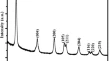
            <p>Figure <figr fid="F3">3a</figr> shows the EFCBED pattern of fractal-like a-C nanotips. In order to avoid any damage to the CCD camera, the central spot of the EFCBED was positioned on the right corner. Cockayne and McKenzie <abbrgrp>
                  <abbr bid="B22">22</abbr>
               </abbrgrp> presented a pioneering study on calculating nearest-neighbor distances using EFED patterns. However, several improvements have been made to this study <abbrgrp><abbr bid="B23">23</abbr>
               <abbr bid="B24">24</abbr></abbrgrp>. Here we use the procedure presented in ref. <abbrgrp>
                  <abbr bid="B24">24</abbr>
               </abbrgrp> by splicing together two electron diffraction patterns with &#967;<sup>2</sup> = 0.0038. First, the static structure factor was calculated. In Fig. <figr fid="F3">3b</figr>, we present the static structure factor <it>S</it>(<it>k</it>) plot obtained using Eq. 2</p>
<p><display-formula id="M2">
<graphic file="1556-276X-4-431-i2.gif"/>
</display-formula></p>
<p>where <it>I</it>(<it>k</it>) is the azimuthally average intensity, <it>f</it>(<it>k</it>) is the atomic scattering factor, <it>N</it> a fitting parameter, and <it>k</it> = 2 sin <it>&#952;</it>/&#955; is the magnitude of the scattering vector. Secondly, the short-range order of individual fractal-like a-C nanotips can be investigated using the RDF defined as the probability to find an atom at a given distance from a particular atom. RDF is characterized by peaks from each shell of neighbors. The reduced RDF <it>G</it>(<it>r</it>) is calculated by applying an inverse Fourier sine transformation to Eq. 3,</p>
<p><display-formula id="M3">
<graphic file="1556-276X-4-431-i3.gif"/>
</display-formula></p>
<p>where &#934;(<it>k</it>) is the reduced intensity function, <it>G</it>(<it>r</it>) = 4&#960;r<it>p</it>(<it>r</it>) &#8722; <it>p</it>
               <sub>0</sub> and <it>p</it>(<it>r</it>) is the average density of neighbors a distance <it>r</it> from a particular atom. Figure <figr fid="F3">3c</figr> shows the reduced RDF <it>G</it>(<it>r</it>) plot. At this point it is worth mentioning that the hydrogen contribution is excluded in <it>p</it>
               <sub>0</sub> because hydrogen is a weak scatterer and, hence, its contribution to the scattering intensity can be assumed to be negligible <abbrgrp>
                  <abbr bid="B25">25</abbr>
               </abbrgrp>. Taking first and second nearest-neighbor distances as the peak maxima of peaks 1 and 2 in the <it>G</it>(<it>r</it>) plot, respectively, the values for <it>r</it>
               <sub>1</sub> and <it>r</it>
               <sub>2</sub> are: <it>r</it>
               <sub>1</sub> = 1.49 &#197; and <it>r</it>
               <sub>2</sub> = 2.65 &#197;. Furthermore, the average bond angle can be acquired using Eq. 4 <abbrgrp>
                  <abbr bid="B25">25</abbr>
               </abbrgrp></p>
<p><display-formula id="M4">
<graphic file="1556-276X-4-431-i4.gif"/>
</display-formula></p>
<fig id="F3"><title><p>Figure 3</p></title><text>
   <p><b>a</b>EFCBED pattern showing diffuse rings typical of an amorphous structure. The central spot is at the right corner.<b>b</b>Plot of the structure factor<it>S</it>(<it>k</it>) with<it>k</it><sub>max</sub> = 6 &#197;<sup>&#8722;1</sup>.<b>c</b>Corresponding reduced RDF plot of (<b>b</b>), where first and second nearest-neighbors distance peaks are marked 1 and 2, respectively</p>
</text><graphic file="1556-276X-4-431-3"/></fig>
            <p>From this expression, a bond angle of 124&#176; was obtained. This bond angle differs from a <it>sp</it>
               <sup>2</sup> trigonally bonded carbon, which has a bond angle of 120&#176;. This difference suggests that our nanostructures have a distorted graphitic structure which is consistent with our previous Raman and EELS results. From these findings it is expected that the a-C fractal nanotips will present good FE properties <abbrgrp>
                  <abbr bid="B26">26</abbr>
               </abbrgrp>.</p>
         </sec>
         <sec>
            <st>
               <p>FE Studies</p>
            </st>
            <p>A SEM image of our FE set-up is shown in Fig. <figr fid="F4">4a</figr>, and the inset is the TEM image representative of the type of fractal nanotips tested. A typical FE current (<it>I</it>) curve is presented in Fig. <figr fid="F4">4b</figr>. For these measurements the distance (<it>d</it>) between the collection tip and the outer tips of the nanostructure was 252 nm. The turn on field was around 24 V/&#956;m and is defined here as the field required for extracting a current of 10 nA, which is much lower than the 88 V/&#956;m turn on field found in ref. <abbrgrp>
                  <abbr bid="B12">12</abbr>
               </abbrgrp> for a single nanotip. The fact that several branches are contributing to the total current can justify this difference. The inset of Fig. <figr fid="F4">4b</figr> is the corresponding Fowler-Nordheim (FN) plot (Ln(<it>I</it>/<it>V</it>
               <sup>2</sup>) versus 1/V) which shows a fairly linear relation at low electric field intensities. At high electric fields the slope increases, which can be an indication of heating <abbrgrp>
                  <abbr bid="B2">2</abbr>
               </abbrgrp>. At the intermediate values of the electric field, the curve slightly deviates from the straight line. This deviation has been observed previously and explained in terms of the presence of adsorbates that enhances the tunneling probability <abbrgrp>
                  <abbr bid="B27">27</abbr>
               </abbrgrp>. In general, the curve suggests that the FE from the nanostructures follows the FN law expressed as</p>
<p><display-formula id="M5">
<graphic file="1556-276X-4-431-i5.gif"/>
</display-formula></p>
<p>where <it>A</it> is the emitting area (&#960;<it>r</it>
               <sup>2</sup>), <it>E</it> is the applied field, <it>&#981;</it> the work function of the material, and <it>a</it> and <it>b</it> are constants equal to 1.54  &#215; 10<sup>&#8722;6</sup> A eV V<sup>&#8722;2</sup> and 6.83 &#215; 10<sup>3</sup> eV<sup>&#8722;3/2</sup> V &#956;m<sup>&#8722;1</sup>, respectively <abbrgrp>
                  <abbr bid="B4">4</abbr>
               </abbrgrp>. Due to the tip-like geometry of our field emitters one can approximate <it>E</it> to <it>&#946;V</it>/<it>d</it>, where <it>&#946;</it> is the field enhancement factor that accounts for the geometry of the emitter. With this definition and rearranging Eq. 5, we can estimate <it>&#946;</it> from the slope of the following relation</p>
<p><display-formula id="M6"><graphic file="1556-276X-4-431-i6.gif"/>
</display-formula></p>
<fig id="F4"><title><p>Figure 4</p></title><text>
   <p><b>a</b>SEM image of our FE set-up. The inset is the TEM image representative of the type of fractal nanorods tested; the scale bar is 200 nm.<b>b</b>FE current curve obtained at a distance of 252 nm and the inset is the linear FN plot.<b>c</b>Schematic representation of the three-stage model. The<it>solid line</it>corresponds to the first stage and so on</p>
</text><graphic file="1556-276X-4-431-4"/></fig>
            <p>Taking a work function of a graphitic structure of 5 eV <abbrgrp>
                  <abbr bid="B26">26</abbr>
               </abbrgrp>, and the radius of the emitting area as <it>r</it> ~ 0.5 &#956;m, the slope of Eq. 6 gives a <it>&#946;</it> equal to 889. In trying to find a possible explanation of the previous enhancement factor, the multistage model <abbrgrp>
                  <abbr bid="B14">14</abbr>
               </abbrgrp> is used. We interpret the previous result of the field enhancement as a product of three stages. The schematic representation of our three-stage model is presented in Fig. <figr fid="F4">4c</figr> in which each stage represents an effective branch of the fractal-like a-C nanostructure. Each stage is defined with a particular length (<it>l</it>
               <sub>
                  <it>i</it>
               </sub>) and radius (<it>r</it>
               <sub>
                  <it>i</it>
               </sub>), where stage 1 has the biggest length and radius. In a multistage model the total enhancement factor can be written as a product of individual stages <abbrgrp><abbr bid="B7">7</abbr><abbr bid="B13">13</abbr>
<abbr bid="B14">14</abbr>
<abbr bid="B15">15</abbr></abbrgrp>. With that interpretation <it>&#946;</it> is written as</p>
<p><display-formula id="M7">
<graphic file="1556-276X-4-431-i7.gif"/>
</display-formula></p>
<p>where</p>
<p><display-formula id="M8">
<graphic file="1556-276X-4-431-i8.gif"/>
</display-formula></p>
<p>The expression for <it>&#946;</it>
               <sub>
                  <it>i</it>
               </sub> was derived by Huang et al. <abbrgrp>
                  <abbr bid="B14">14</abbr>
               </abbrgrp>. The factor <it>&#946;</it>
               <sub>s</sub> is a factor that accounts for the screening effect of adjacent tips <abbrgrp><abbr bid="B28">28</abbr>
               <abbr bid="B29">29</abbr>
               <abbr bid="B30">30</abbr></abbrgrp>, where <it>s</it> is interpreted here as the average distance between adjacent tips, <it>L</it> is the sum of the lengths of three stages, and <it>a</it> is a fitting parameter <abbrgrp>
                  <abbr bid="B30">30</abbr>
               </abbrgrp>. Taking the common fitting parameter <it>a</it> equal to 2.3172 <abbrgrp><abbr bid="B28">28</abbr>
               <abbr bid="B29">29</abbr></abbrgrp>, and measuring average values for <it>l</it>
               <sub>
                  <it>i</it>
               </sub> as 491 nm (<it>i</it> = 1), 146 nm (<it>i</it> = 2) and 74 nm (<it>i</it> = 3), average values of <it>r</it>
               <sub>
                  <it>i</it>
               </sub> as 13.4, 5.6, and 2.1 nm and with <it>s</it> equal to 54.7 nm, we obtain (from Eqs. 7 and 8) a field enhancement factor, <it>&#946;</it>, equal to 981. This result agrees well with the value found experimentally of 889.</p>
         </sec>
      </sec>
      <sec>
         <st>
            <p>Conclusions</p>
         </st>
         <p>In summary, the reduced RDF analysis on the fractal-like a-C nanotips grown by the TEM-EBID method shows first and second bond lengths at 1.49 and 2.65 &#197;. Those nearest-neighbors distances defined an average bond angle of 124&#176; which deviates from a trigonally<it>sp</it>
            <sup>2</sup>bonded carbon (120&#176;) indicating a distorted graphite-like structure, which explains the moderate conductivity of the tips observed in the FE results. The electron FE measurements of the individual fractal-like a-C nanorods showed a turn on field of 24 V/&#956;m. A three-stage model that accounts for the geometry of the nanostructures described well the value of the enhancement factor obtained experimentally from the FN law, and hence suggests a possible explanation of our observations. Hence, our observations show that these nanostructures are promising to be used in FE applications. In particular, the growth mechanism of the nanotrees&#8217; tips follows the path of maximum local field at the tips thus forming a nanostructure where the relationship between the density of tips and the local electric field intensity at the tips is optimized. It is worth to mention that for our calculations of the emission current densities we have used as the active emitting area the cross section of the total nanotree such that the values for the current density per branch&#8217;s tip are lowest bound values.</p>
      </sec>
   </bdy>
   <bm>
      <ack>
         <sec>
            <st>
               <p>Acknowledgments</p>
            </st>
            <p>This study was supported by the following grants numbers and projects: NASA NNX08BA48A, NASA Space Grant NNG05GG78H, NSF 0701525, Fundamental Aeronautics Program and Subsonic Fixed Wing Project. The authors acknowledge the National Center for Electron Microscopy, Lawrence Berkeley Lab, which is supported by the U.S. Department of Energy under Contract #DE-AC02-05CH11231, and in particular to Dr. A. Minor for helping us with the FE experimental setup. F&#183;S. kindly acknowledges Dr. D. J. H. Cockayne from Oxford University and D. Hull from NASA GRC for providing helpful information related to the electron diffraction analysis.</p>
         </sec>
      </ack>
      <refgrp><bibl id="B1"><aug><au><snm>Chen</snm><fnm>IC</fnm></au><au><snm>Chen</snm><fnm>LH</fnm></au><au><snm>Christine</snm><fnm>O</fnm></au><au><snm>Quist</snm><fnm>A</fnm></au><au><snm>Lal</snm><fnm>R</fnm></au><au><snm>Jin</snm><fnm>S</fnm></au></aug><source>Nanotechnology</source><pubdate>2006</pubdate><volume>17</volume><fpage>4322</fpage><note>COI number [1:CAS:528:DC%2BD28XhtFWks7rL]; Bibcode number [2006Nanot..17.4322C]</note><xrefbib><pubid idtype="doi">10.1088/0957-4484/17/17/007</pubid></xrefbib></bibl><bibl id="B2"><aug><au><snm>Yeong</snm><fnm>KS</fnm></au><au><snm>Boothroyd</snm><fnm>BC</fnm></au><au><snm>Thong</snm><fnm>JTL</fnm></au></aug><source>Nanotechnology</source><pubdate>2006</pubdate><volume>17</volume><fpage>3655</fpage><note>COI number [1:CAS:528:DC%2BD28XhtVSrsb7F]; Bibcode number [2006Nanot..17.3655Y]</note><xrefbib><pubid idtype="doi">10.1088/0957-4484/17/15/006</pubid></xrefbib></bibl><bibl id="B3"><aug><au><snm>Biaggi-Labiosa</snm><fnm>A</fnm></au><au><snm>Sol&#225;</snm><fnm>F</fnm></au><au><snm>Resto</snm><fnm>O</fnm></au><au><snm>Fonseca</snm><fnm>LF</fnm></au><au><snm>Gonz&#225;lez-Berr&#237;os</snm><fnm>A</fnm></au><au><snm>De Jes&#250;s</snm><fnm>J</fnm></au><au><snm>Morell</snm><fnm>G</fnm></au></aug><source>Nanotechnology</source><pubdate>2008</pubdate><volume>19</volume><fpage>225202</fpage><note>Bibcode number [2008Nanot..19v5202B]</note><xrefbib><pubid idtype="doi">10.1088/0957-4484/19/22/225202</pubid></xrefbib></bibl><bibl id="B4"><aug><au><snm>Passacantando</snm><fnm>M</fnm></au><au><snm>Bussolotti</snm><fnm>F</fnm></au><au><snm>Santucci</snm><fnm>S</fnm></au><au><snm>Di Bartolomeo</snm><fnm>A</fnm></au><au><snm>Giubileo</snm><fnm>F</fnm></au><au><snm>Iemmo</snm><fnm>L</fnm></au><au><snm>Cucolo</snm><fnm>AM</fnm></au></aug><source>Nanotechnology</source><pubdate>2008</pubdate><volume>19</volume><fpage>395701</fpage><xrefbib><pubid idtype="doi">10.1088/0957-4484/19/39/395701</pubid></xrefbib></bibl><bibl id="B5"><aug><au><snm>Li</snm><fnm>XJ</fnm></au><au><snm>Jiang</snm><fnm>WF</fnm></au></aug><source>Nanotechnology</source><pubdate>2007</pubdate><volume>18</volume><fpage>065203</fpage><note>Bibcode number [2007Nanot..18f5203L]</note><xrefbib><pubid idtype="doi">10.1088/0957-4484/18/6/065203</pubid></xrefbib></bibl><bibl id="B6"><aug><au><snm>Xu</snm><fnm>Z</fnm></au><au><snm>Bai</snm><fnm>XD</fnm></au><au><snm>Wang</snm><fnm>EG</fnm></au><au><snm>Wang</snm><fnm>ZL</fnm></au></aug><source>Appl. Phys. Lett.</source><pubdate>2005</pubdate><volume>87</volume><fpage>163106</fpage><note>Bibcode number [2005ApPhL..87p3106X]</note><xrefbib><pubid idtype="doi">10.1063/1.2103420</pubid></xrefbib></bibl><bibl id="B7"><aug><au><snm>Niemann</snm><fnm>DL</fnm></au><au><snm>Ribaya</snm><fnm>BP</fnm></au><au><snm>Gunther</snm><fnm>N</fnm></au><au><snm>Rahman</snm><fnm>M</fnm></au><au><snm>Leung</snm><fnm>J</fnm></au><au><snm>Nguyen</snm><fnm>V</fnm></au></aug><source>Nanotechnology</source><pubdate>2007</pubdate><volume>18</volume><fpage>485702</fpage><xrefbib><pubid idtype="doi">10.1088/0957-4484/18/48/485702</pubid></xrefbib></bibl><bibl id="B8"><aug><au><snm>Smith</snm><fnm>RC</fnm></au><au><snm>Cox</snm><fnm>DC</fnm></au><au><snm>Silva</snm><fnm>SRP</fnm></au></aug><source>Appl. Phys. Lett.</source><pubdate>2005</pubdate><volume>87</volume><fpage>103112</fpage><note>Bibcode number [2005ApPhL..87j3112S]</note><xrefbib><pubid idtype="doi">10.1063/1.2041824</pubid></xrefbib></bibl><bibl id="B9"><aug><au><snm>Jo</snm><fnm>SH</fnm></au><au><snm>Tu</snm><fnm>Y</fnm></au><au><snm>Huang</snm><fnm>ZP</fnm></au><au><snm>Carnahan</snm><fnm>DL</fnm></au><au><snm>Wang</snm><fnm>DZ</fnm></au><au><snm>Reng</snm><fnm>ZF</fnm></au></aug><source>Appl. Phys. Lett.</source><pubdate>2003</pubdate><volume>82</volume><fpage>3520</fpage><note>COI number [1:CAS:528:DC%2BD3sXjvVSls7c%3D]; Bibcode number [2003ApPhL..82.3520J]</note><xrefbib><pubid idtype="doi">10.1063/1.1576310</pubid></xrefbib></bibl><bibl id="B10"><aug><au><snm>Bonard</snm><fnm>JM</fnm></au><au><snm>Dean</snm><fnm>KA</fnm></au><au><snm>Coll</snm><fnm>BF</fnm></au><au><snm>Klinke</snm><fnm>C</fnm></au></aug><source>Phys. Rev. Lett.</source><pubdate>2002</pubdate><volume>89</volume><fpage>1976021</fpage><xrefbib><pubid idtype="doi">10.1103/PhysRevLett.89.197602</pubid></xrefbib></bibl><bibl id="B11"><aug><au><snm>Sol&#225;</snm><fnm>F</fnm></au><au><snm>Resto</snm><fnm>O</fnm></au><au><snm>Biaggi-Labiosa</snm><fnm>A</fnm></au><au><snm>Fonseca</snm><fnm>LF</fnm></au></aug><source>Micron</source><pubdate>2009</pubdate><volume>40</volume><fpage>80</fpage><xrefbib><pubidlist><pubid idtype="doi">10.1016/j.micron.2008.01.005</pubid><pubid idtype="pmpid" link="fulltext">18296056</pubid></pubidlist></xrefbib></bibl><bibl id="B12"><aug><au><snm>Jin</snm><fnm>CH</fnm></au><au><snm>Wang</snm><fnm>JY</fnm></au><au><snm>Chen</snm><fnm>Q</fnm></au><au><snm>Peng</snm><fnm>LM</fnm></au></aug><source>J. Phys. Chem. B</source><pubdate>2006</pubdate><volume>110</volume><fpage>5423</fpage><note>COI number [1:CAS:528:DC%2BD28Xhsl2mtrc%3D]</note><xrefbib><pubidlist><pubid idtype="doi">10.1021/jp057240r</pubid><pubid idtype="pmpid" link="fulltext">16539478</pubid></pubidlist></xrefbib></bibl><bibl id="B13"><aug><au><snm>Seelaboyina</snm><fnm>R</fnm></au><au><snm>Boddepalli</snm><fnm>S</fnm></au><au><snm>Noh</snm><fnm>K</fnm></au><au><snm>Jeon</snm><fnm>M</fnm></au><au><snm>Choi</snm><fnm>W</fnm></au></aug><source>Nanotechnology</source><pubdate>2008</pubdate><volume>19</volume><fpage>065605</fpage><note>Bibcode number [2008Nanot..19f5605S]</note><xrefbib><pubid idtype="doi">10.1088/0957-4484/19/6/065605</pubid></xrefbib></bibl><bibl id="B14"><aug><au><snm>Huang</snm><fnm>JY</fnm></au><au><snm>Kempa</snm><fnm>K</fnm></au><au><snm>Jo</snm><fnm>SH</fnm></au><au><snm>Chen</snm><fnm>S</fnm></au><au><snm>Ren</snm><fnm>ZF</fnm></au></aug><source>Appl. Phys. Lett.</source><pubdate>2005</pubdate><volume>87</volume><fpage>053110</fpage><note>Bibcode number [2005ApPhL..87e3110H]</note><xrefbib><pubid idtype="doi">10.1063/1.2008363</pubid></xrefbib></bibl><bibl id="B15"><aug><au><snm>Seelaboyina</snm><fnm>R</fnm></au><au><snm>Huang</snm><fnm>J</fnm></au><au><snm>Park</snm><fnm>J</fnm></au><au><snm>Kang</snm><fnm>DH</fnm></au><au><snm>Choi</snm><fnm>WB</fnm></au></aug><source>Nanotechnology</source><pubdate>2006</pubdate><volume>17</volume><fpage>4840</fpage><note>COI number [1:CAS:528:DC%2BD28Xht1Klt7jN]; Bibcode number [2006Nanot..17.4840S]</note><xrefbib><pubid idtype="doi">10.1088/0957-4484/17/19/010</pubid></xrefbib></bibl><bibl id="B16"><aug><au><snm>Sol&#225;</snm><fnm>F</fnm></au><au><snm>Resto</snm><fnm>O</fnm></au><au><snm>Biaggi-Labiosa</snm><fnm>A</fnm></au><au><snm>Fonseca</snm><fnm>LF</fnm></au></aug><source>Nanotechnology</source><pubdate>2007</pubdate><volume>18</volume><fpage>405308</fpage><xrefbib><pubid idtype="doi">10.1088/0957-4484/18/40/405308</pubid></xrefbib></bibl><bibl id="B17"><aug><au><snm>Banhart</snm><fnm>F</fnm></au></aug><source>Phys. Rev. E</source><pubdate>1995</pubdate><volume>52</volume><fpage>5156</fpage><note>COI number [1:CAS:528:DyaK2MXpsVKitro%3D]; Bibcode number [1995PhRvE..52.5156B]</note><xrefbib><pubid idtype="doi">10.1103/PhysRevE.52.5156</pubid></xrefbib></bibl><bibl id="B18"></bibl><bibl id="B19"><aug><au><snm>Ferrari</snm><fnm>AC</fnm></au><au><snm>Libassi</snm><fnm>A</fnm></au><au><snm>Tanner</snm><fnm>BK</fnm></au><au><snm>Stolojan</snm><fnm>V</fnm></au><au><snm>Yuan</snm><fnm>J</fnm></au><au><snm>Brown</snm><fnm>LM</fnm></au><au><snm>Rodil</snm><fnm>SE</fnm></au><au><snm>Kleinsorge</snm><fnm>B</fnm></au><au><snm>Robertson</snm><fnm>J</fnm></au></aug><source>Phys. Rev. B</source><pubdate>2000</pubdate><volume>62</volume><fpage>11089</fpage><note>COI number [1:CAS:528:DC%2BD3cXnsFWju70%3D]; Bibcode number [2000PhRvB..6211089F]</note><xrefbib><pubid idtype="doi">10.1103/PhysRevB.62.11089</pubid></xrefbib></bibl><bibl id="B20"></bibl><bibl id="B21"><aug><au><snm>Uppireddi</snm><fnm>K</fnm></au><au><snm>Resto</snm><fnm>O</fnm></au><au><snm>Weiner</snm><fnm>BR</fnm></au><au><snm>Morell</snm><fnm>G</fnm></au></aug><source>Nanoscale Res. Lett.</source><pubdate>2008</pubdate><volume>3</volume><fpage>65</fpage><note>COI number [1:CAS:528:DC%2BD1cXlslejtr0%3D]; Bibcode number [2008NRL.....3...65U]</note><xrefbib><pubid idtype="doi">10.1007/s11671-008-9117-5</pubid></xrefbib></bibl><bibl id="B22"><aug><au><snm>Cockayne</snm><fnm>DJH</fnm></au><au><snm>McKenzie</snm><fnm>DR</fnm></au></aug><source>Acta Crystallogr. A</source><pubdate>1988</pubdate><volume>44</volume><fpage>870</fpage><xrefbib><pubid idtype="doi">10.1107/S0108767388004957</pubid></xrefbib></bibl><bibl id="B23"><aug><au><snm>McBride</snm><fnm>W</fnm></au><au><snm>Cockayne</snm><fnm>DJH</fnm></au></aug><source>J. Non-Cryst. Solids</source><pubdate>2003</pubdate><volume>318</volume><fpage>233</fpage><note>COI number [1:CAS:528:DC%2BD3sXhsVagtbo%3D]; Bibcode number [2003JNCS..318..233M]</note><xrefbib><pubid idtype="doi">10.1016/S0022-3093(02)01908-7</pubid></xrefbib></bibl><bibl id="B24"><aug><au><snm>Petersen</snm><fnm>TC</fnm></au><au><snm>McBride</snm><fnm>W</fnm></au><au><snm>McCulloch</snm><fnm>DG</fnm></au><au><snm>Snook</snm><fnm>IK</fnm></au><au><snm>Yarovsky</snm><fnm>I</fnm></au></aug><source>Ultramicroscopy</source><pubdate>2005</pubdate><volume>103</volume><fpage>275</fpage><note>COI number [1:CAS:528:DC%2BD2MXktFWmsL0%3D]</note><xrefbib><pubidlist><pubid idtype="doi">10.1016/j.ultramic.2005.01.002</pubid><pubid idtype="pmpid" link="fulltext">15885432</pubid></pubidlist></xrefbib></bibl><bibl id="B25"><aug><au><snm>Evans</snm><fnm>RD</fnm></au><au><snm>Bentley</snm><fnm>J</fnm></au><au><snm>More</snm><fnm>KL</fnm></au><au><snm>Doll</snm><fnm>GL</fnm></au><au><snm>Glass</snm><fnm>JT</fnm></au></aug><source>J. Appl. Phys.</source><pubdate>2004</pubdate><volume>96</volume><fpage>273</fpage><note>COI number [1:CAS:528:DC%2BD2cXltVensb4%3D]; Bibcode number [2004JAP....96..273E]</note><xrefbib><pubid idtype="doi">10.1063/1.1760232</pubid></xrefbib></bibl><bibl id="B26"><aug><au><snm>Ferrari</snm><fnm>AC</fnm></au><au><snm>Satyanarayana</snm><fnm>BS</fnm></au><au><snm>Robertson</snm><fnm>J</fnm></au><au><snm>Milne</snm><fnm>WI</fnm></au><au><snm>Barborini</snm><fnm>E</fnm></au><au><snm>Piseri</snm><fnm>P</fnm></au><au><snm>Milani</snm><fnm>P</fnm></au></aug><source>Europhys. Lett.</source><pubdate>1999</pubdate><volume>46</volume><fpage>245</fpage><note>COI number [1:CAS:528:DyaK1MXis12huro%3D]</note><xrefbib><pubid idtype="doi">10.1209/epl/i1999-00251-7</pubid></xrefbib></bibl><bibl id="B27"><aug><au><snm>Yeong</snm><fnm>KS</fnm></au><au><snm>Thong</snm><fnm>JTL</fnm></au></aug><source>Appl. Surf. Sci.</source><pubdate>2004</pubdate><volume>233</volume><fpage>20</fpage><note>COI number [1:CAS:528:DC%2BD2cXkvVeks7w%3D]; Bibcode number [2004ApSS..233...20Y]</note><xrefbib><pubid idtype="doi">10.1016/j.apsusc.2004.03.222</pubid></xrefbib></bibl><bibl id="B28"><aug><au><snm>Xiao</snm><fnm>J</fnm></au><au><snm>Zhang</snm><fnm>X</fnm></au><au><snm>Zhang</snm><fnm>G</fnm></au></aug><source>Nanotechnology</source><pubdate>2008</pubdate><volume>19</volume><fpage>295706</fpage><note>Bibcode number [2008Nanot..19A5706X]</note><xrefbib><pubid idtype="doi">10.1088/0957-4484/19/29/295706</pubid></xrefbib></bibl><bibl id="B29"><aug><au><snm>Zhu</snm><fnm>YW</fnm></au><au><snm>Yu</snm><fnm>T</fnm></au><au><snm>Cheong</snm><fnm>FC</fnm></au><au><snm>Xu</snm><fnm>XJ</fnm></au><au><snm>Lim</snm><fnm>CT</fnm></au><au><snm>Tan</snm><fnm>VBC</fnm></au><au><snm>Thong</snm><fnm>JTL</fnm></au><au><snm>Sow</snm><fnm>CH</fnm></au></aug><source>Nanotechnology</source><pubdate>2005</pubdate><volume>16</volume><fpage>88</fpage><note>COI number [1:CAS:528:DC%2BD2MXitVaksLk%3D]; Bibcode number [2005Nanot..16...88Z]</note><xrefbib><pubid idtype="doi">10.1088/0957-4484/16/1/018</pubid></xrefbib></bibl><bibl id="B30"><aug><au><snm>Qian</snm><fnm>X</fnm></au><au><snm>Liu</snm><fnm>H</fnm></au><au><snm>Guo</snm><fnm>Y</fnm></au><au><snm>Song</snm><fnm>Y</fnm></au><au><snm>Li</snm><fnm>Y</fnm></au></aug><source>Nanoscale Res. Lett.</source><pubdate>2008</pubdate><volume>3</volume><fpage>303</fpage><note>COI number [1:CAS:528:DC%2BD1cXhsVyhtr3K]; Bibcode number [2008NRL.....3..303Q]</note><xrefbib><pubid idtype="doi">10.1007/s11671-008-9154-0</pubid></xrefbib></bibl></refgrp>
   </bm>
</art>